About this topic
Half off. Fifty percent off. One-half of the price. Same sticker, three labels. The store could print any of them and your wallet would not know the difference — because a fraction, a decimal, and a percent are three names for one number, a piece of a whole.
Watch one number wear all three costumes:
1/2 = 0.5 = 50%3/4 = 0.75 = 75%1/5 = 0.2 = 20%1/8 = 0.125 = 12.5%
A kid who thinks in only one costume is always translating mid-problem. A kid who knows all three picks the easiest one for the question in front of them — and the easy half of every contest rewards exactly that. Know these few conversions cold and a lot of ‘hard’ problems turn into one line.
Nine moves ahead: (1) jump between the three forms fast, (2) read every percent as a multiplier, (3) see why stacked percents multiply instead of add, (4) rank fractions without dividing, (5) collapse a fraction-inside-a-fraction, (6) watch a long product or sum telescope, (7) chase a fraction-of-a-fraction story to the start, (8) average groups of different sizes, (9) tell ‘percent OF’ apart from ‘percent MORE THAN.’
Three forms, one number
A fraction like 3/5 means “3 out of 5 equal parts.” A decimal like 0.6 means “6 tenths.” A percent like 60% means “60 per hundred.”
They’re all the same number — three costumes for one value, and the kid who thinks in all three picks the easiest costume for each problem. Before any rules, look at the pictures: every rule below is a thing you can already SEE.
See it first: a fraction is a shaded part of a bar
Take a chocolate bar. Snap it into equal pieces. A fraction is “how many pieces you shade” over “how many equal pieces there are.” The bottom number tells you how many cuts; the top tells you how many you grabbed.
See it: equivalent fractions are the SAME shaded length
Here is the idea that unlocks everything else. Take the bar shaded to one-half. Now draw extra cut lines through it — you didn’t move any chocolate, you only chopped it finer. The shaded part is exactly as long as before, but now you can call it 2/4, or 3/6, or 50/100. Same length, more names.
That picture is the rule everyone memorizes: multiply top and bottom by the same number and the fraction does not change. Multiplying by the same number means cutting every piece into the same number of smaller pieces — nothing was added or removed. Running it backward (dividing top and bottom by a shared factor) is gluing pieces back together: that is “simplifying.”
2 × 3 = 6 shaded pieces out of 3 × 3 = 9. So 2/3 = 6/9 — same shaded length, finer cuts. 6 pieces are shaded.See it: a decimal is a 10×10 grid
Take a square and cut it into a 10×10 grid — 100 little cells, the whole square is “1.” Now each column is one tenth (0.1) and each tiny cell is one hundredth (0.01). A decimal is how many cells you shade.
Place value falls right out of the grid. The first decimal spot counts columns (tenths); the second counts single cells (hundredths). So 0.3 is three whole columns — 30 cells — which is why 0.3 = 0.30 = 30/100. Adding a zero on the end shades the same area, only counted in smaller cells.
7 × 10 = 70 cells. That is 70/100 = 0.70 = 0.7 — 7 tenths and 70 hundredths are the same shaded area. 70 cells.See it: a percent is the SAME grid — one bar, three labels
Here is the punchline of the whole chapter. The 10×10 grid has exactly 100 cells. So “percent” — which means per hundred — is exactly how many of those 100 cells are shaded. The decimal grid and the percent grid are the same drawing. That is why one shaded bar can wear all three labels at once.
To turn any fraction into a percent, cut the bar into 100 pieces and count the shaded ones — that is exactly “scale the bottom to 100,” which you’ll use constantly below.
3 × 25 = 75 cells out of 100. So 3/4 = 75/100 = 0.75 = 75% — one bar, three labels.Go deeper: compare two fractions just by lining the bars up
See it: compare fractions by lining the bars up
Which is bigger, 2/3 or 3/5? Stack two equal-length bars, shade each, and look at which shaded edge sticks out farther. No arithmetic — your eyes do it.
The bars make the “common denominator” trick feel obvious. To compare with numbers, give both bars the same number of pieces (a common bottom): 2/3 = 10/15 and 3/5 = 9/15. Now it’s 10 pieces vs 9 pieces — 2/3 wins, exactly as the picture showed.
Go deeper: “of” means multiply — fraction × fraction is an overlap
See it: fraction × fraction is the OVERLAP in a unit square
“Of” means multiply — but why does 1/2 × 1/3 come out so small, only 1/6? Watch it in a square that stands for one whole.
First take 1/3 of the square: shade a vertical strip one-third wide. Now take 1/2 of that strip: cut it in half the other way and shade the lower half. The piece you shaded twice — the overlap — is the answer. Count the little boxes: the square split into 2 rows and 3 columns has 6 equal boxes, and the overlap is exactly 1 of them.
The picture spells out the rule. The square is split into 2 × 3 = 6 equal boxes (rows times columns), and the overlap is only 1 box. That is exactly multiply the tops, multiply the bottoms: (1×1)/(2×3) = 1/6. Multiplying two fractions under 1 makes a smaller piece because you are taking a part of a part.
2 × 3 = 6 boxes out of 3 × 4 = 12. So 2/3 × 3/4 = 6/12 = 1/2. The overlap is 6 boxes.Pictured-intuition adapted from Competition Math for Middle School (AoPS).
Go deeper: converting between the three forms (the six conversions, the table to know cold, the eighths ladder)
A worked example with the bar picture
Peter’s family orders a 12-slice pizza. Peter eats one slice, and splits a second slice equally with his brother. What fraction of the pizza did Peter eat?
Draw the pizza as a bar of 12 equal slices. Peter’s full slice is 1 slice. The shared slice splits in two, so Peter gets half a slice more. Peter’s total shaded length is 1 + ½ = 1½ slices out of 12.
That is 1.5/12. Double top and bottom to clear the half: 3/24 = 1/8 (answer C). The bar kept the “out of 12” honest — no guessing.
The six conversions, spelled out
| Direction | Rule | Worked example |
|---|---|---|
| Fraction → Decimal | Divide top by bottom | 3 ÷ 5 = 0.6 |
| Decimal → Fraction | Read place value, simplify | 0.6 = 6/10 = 3/5 |
| Decimal → Percent | Multiply by 100 (move dot 2 right) | 0.6 → 60% |
| Percent → Decimal | Divide by 100 (move dot 2 left) | 60% → 0.60 |
| Fraction → Percent | Scale denom to 100, OR divide × 100 | 3/5 = 60/100 = 60% |
| Percent → Fraction | Put over 100 then simplify | 60% = 60/100 = 3/5 |
THE MOVE — SCALE TO 100
When the bottom of a fraction divides 100 cleanly (2, 4, 5, 10, 20, 25, 50), don’t long-divide. Multiply top and bottom until the bottom is 100 — now the top is the percent and the decimal reads off for free. 2/25 → ×4 → 8/100 = 8% = 0.08.
7/20 = 35/100. That bottom-of-100 means the top is the percent: 35% (and the decimal is 0.35). No division.Conversions to KNOW COLD
| Fraction | Decimal | Percent |
|---|---|---|
| 1/2 | 0.5 | 50% |
| 1/3 | 0.3 (0.333…) | 33⅓% |
| 2/3 | 0.6 (0.666…) | 66⅔% |
| 1/4 | 0.25 | 25% |
| 3/4 | 0.75 | 75% |
| 1/5 | 0.2 | 20% |
| 2/5 | 0.4 | 40% |
| 3/5 | 0.6 | 60% |
| 4/5 | 0.8 | 80% |
| 1/8 | 0.125 | 12.5% |
| 3/8 | 0.375 | 37.5% |
| 5/8 | 0.625 | 62.5% |
| 7/8 | 0.875 | 87.5% |
| 1/6 | 0.16 | 16⅔% |
| 1/9 | 0.1 | 11⅑% |
| 1/99 | 0.01 | ≈ 1.01% |
Named trick: build percents from the eighths ladder
You almost never need long division if you can climb a short ladder. Quarters and eighths are the rungs that show up most:
- Halves and quarters:
1/2 = 50%, and a quarter is half of that:1/4 = 25%,3/4 = 75%. - Eighths are half-of-a-quarter, so each step is
12.5%:1/8 = 12.5%,3/8 = 37.5%,5/8 = 62.5%,7/8 = 87.5%.
So 5/8 is just ‘a half plus an eighth’ = 50% + 12.5% = 62.5% — no division at all. Anchoring an unfamiliar fraction to the nearest rung is the fastest mental conversion there is.
Go deeper: repeating decimals — the bar notation and the shift-subtract trick
Repeating decimals — use the bar
Some fractions never stop when you divide them out (1/3, 1/6, 1/9, 1/99 above). Instead of rounding to “0.333” or “0.667,” write a bar over the block that repeats forever: 1/3 = 0.3, 2/3 = 0.6, 1/6 = 0.16, 1/99 = 0.01.
The pattern. One repeating digit over 9 is that digit as a ninth: 0.1 = 1/9, 0.4 = 4/9. Two repeating digits go over 99: 0.27 = 27/99 — which is why 1/99 = 0.01.
The trick: turn a repeating decimal into a fraction
Name the decimal, multiply by 10 (or 100…) to slide it one whole period, then subtract so the repeating tail cancels.
Then 10x = 9.9 (that is 9.999…).
Subtract: 10x − x = 9.999… − 0.999… = 9, so 9x = 9 and x = 1.
So 0.999… is exactly 1 — not “almost.”
Same move for any repeater. x = 0.3 → 10x = 3.3 → 9x = 3 → x = 3/9 = 1/3. For a two-digit period, multiply by 100: x = 0.01 → 100x = 1.01 → 99x = 1 → x = 1/99.
When only PART of the decimal repeats
Trickier cousins like 0.28 (that is 0.2888…) have a non-repeating digit out front and only the 8 looping. The shift trick still works — you only have to line up the tails so they truly match before subtracting.
Multiply by 10 to slide one whole period: 10x = 2.8 (= 2.888…).
Subtract: 10x − x = 2.888… − 0.2888… = 2.6, so 9x = 2.6 and x = 2.6/9 = 26/90 = 13/45.
The watch-out. Do NOT write 10x − x = 0.8. The repeating 8-tails only cancel if the two numbers line up digit-for-digit past the decimal — 2.88 minus 0.28 leaves a clean 2.6, tails gone. Pick the power of 10 that lands the repeating block in the same spot in both numbers, then subtract.
10x − x = 1.666… − 0.1666… = 1.5. So 9x = 1.5 and x = 1.5/9 = 15/90 = 1/6. Numerator + denominator = 1 + 6 = 7. (And indeed 1/6 = 0.1666… ✓)Go deeper: why some fractions stop and others repeat forever
See it: WHY some fractions stop and some repeat forever
1/4 stops dead at 0.25. 1/3 goes 0.3333… forever. What decides it? Not the size of the fraction — it’s the prime factors hiding in the bottom. Here is the whole secret in one idea.
A decimal that stops is really a fraction over 10, or 100, or 1000 — 0.25 = 25/100. And every power of ten is built from only two primes: 2 and 5 (10 = 2·5, 100 = 2·2·5·5). So a fraction can be rewritten over a power of ten exactly when its bottom is built from only 2s and 5s. If any other prime (3, 7, 11…) is stuck in the bottom, no power of ten will ever fit, and the long division never closes — it repeats.
THE TEST — SIMPLIFY, THEN CHECK THE BOTTOM
Put the fraction in lowest terms. If the bottom’s only prime factors are 2 and 5, the decimal terminates. If any other prime survives, it repeats.
Watch out: simplify first. 3/6 looks like it has a 3 in the bottom, but it’s really 1/2 — it stops.
The long-division loop for a repeater
Why does 1/7 repeat with a block exactly 6 long? Do the long division and watch the remainders. Dividing by 7, every remainder is one of 1, 2, 3, 4, 5, 6 (a remainder of 0 would mean it stopped). There are only 6 of those. So within 6 steps a remainder must repeat — and the instant a remainder comes back, the whole string of digits after it comes back too. The decimal is trapped in a loop.
That is the contest payoff: 1/7 = 0.142857, and the six sevenths are all the same six digits, only started at a different spot. The repeating block can never be longer than “denominator minus 1.”
Pictured-intuition adapted from Competition Math for Middle School (AoPS).
7/56 = 1/8. And 8 = 2·2·2 — only 2s. So it terminates: 1/8 = 0.125. Answer: 1. (Don’t be fooled by the 7 and 56 — after simplifying, the bottom is pure 2s.)Go deeper: reading a shaded figure as a fraction or percent
Reading a shaded figure as a fraction
Contests love to draw a shape, shade part of it, and ask “what fraction is shaded?” (or “what percent?”). Your instinct is to measure areas with a ruler. Resist it. A fraction is parts out of equal parts — so the whole job is: cut the figure into pieces that are all the same size, then count.
THE MOVE
- Slice the whole figure into equal pieces (use the lines already drawn, or extend them).
- Count the shaded pieces — that’s the top.
- Count all the pieces — that’s the bottom.
- Shaded fraction = shaded ÷ total. Then convert to a percent if asked.
The trick is choosing equal pieces. A grid hands them to you. Lines through a circle’s center make equal pie slices. A square cut into a clean number of smaller squares gives you a counting unit.
Worked example. Three circles share a center, and four straight lines run through that center; every other wedge is shaded. What percent of the figure is shaded?
Don’t fight the three rings. The four lines through the center cut the whole picture into 8 equal pie slices. The shading alternates — one slice on, the next off, all the way around — so exactly 4 of the 8 slices are shaded.
That holds in every ring at once, so the fraction is the same for the whole figure: 4/8 = 1/2 = 50% (answer E). No areas, no ruler — count equal slices.
Go deeper: fast tricks for repeaters: the 9s engine and the k-th digit
The 9s engine: read the repeating block straight off
The shift-subtract trick always works, but for the common cases there is something even faster. Remember the pattern: one repeating digit sits over 9, two over 99, three over 999. Run it backward — if you can get a fraction’s bottom to be a string of 9s, the top is the repeating block.
THE MOVE — SCALE THE BOTTOM TO 9, 99, OR 999
Force the denominator into 9, 99, 999… by scaling. Then the numerator, padded to that many digits, is the block that repeats.
7/11: scale the bottom to 99 (11 × 9 = 99), so7/11 = 63/99 = 0.63.2/37: scale to 999 (37 × 27 = 999), so2/37 = 54/999 = 0.054(pad to three digits).5/9 = 0.5,24/99 = 0.24— read straight off, no division.
It only works when the bottom divides a string of 9s (no factor of 2 or 5 left after simplifying) — exactly the fractions that repeat from the very first digit.
Engine adapted from Competition Math for Middle School (AoPS).
11 × 9 = 99, so multiply top and bottom by 9: 2/11 = 18/99 = 0.18. The block is “18”, and 1 + 8 = 9. (Check: 18/99 = 2/11 ✓.)Finding the k-th digit of a repeater
Once you know the repeating block, you can name any digit far out in the decimal without writing them all. The digits just cycle through the block forever, so the only question is where in the block does position k land? That is a remainder (clock) question: divide k by the block length and read the leftover.
Worked example. What is the 59th digit after the decimal point of 5/33? First the decimal: 33 × 3 = 99, so 5/33 = 15/99 = 0.15 — the block is “15”, length 2. Now place position 59 on a 2-clock: 59 = 2 × 29 + 1, remainder 1. A remainder of 1 means the 1st digit of the block, which is 1. (A remainder of 0 would mean the last digit of the block.)
k-th-digit method adapted from Competition Math for Middle School (AoPS).
2/27 = 0.074 (block “074”, length 3), what is the 41st digit after the decimal point? Type the digit.41 = 3 × 13 + 2, remainder 2. So it is the 2nd digit of “074”, which is 7. (The digits go 0,7,4,0,7,4… — the 41st is a 7.)Go deeper: the sevenths shortcut — one block, six rotations (142857)
The contest payoff: every seventh is the SAME six digits
You already saw why 1/7 repeats with a six-long block: dividing by 7 leaves only the remainders 1,2,3,4,5,6, and they cycle 1→3→2→6→4→5→1. Here is the prize that cycle hands you. Because the remainders for 2/7, 3/7, …, 6/7 are just that same loop started at a different spot, all six sevenths read off the same six digits — 1·4·2·8·5·7 — only beginning in a different place. The number 142857 is called a cyclic number.
| Fraction | Decimal | Block starts at |
|---|---|---|
| 1/7 | 0.142857 | 1 |
| 2/7 | 0.285714 | 2 |
| 3/7 | 0.428571 | 4 |
| 4/7 | 0.571428 | 5 |
| 5/7 | 0.714285 | 7 |
| 6/7 | 0.857142 | 8 |
Notice the right-hand column: the six leading digits are 1, 2, 4, 5, 7, 8 — in increasing order, exactly matching 1/7 < 2/7 < … < 6/7. So to write any seventh, you don’t divide: start the loop 142857 at whatever digit ranks the fraction (the bigger the seventh, the later in the loop it begins) and wrap around.
Cyclic-number table adapted from Competition Math for Middle School (AoPS).
3/7 starts the loop at 4: 3/7 = 0.428571. The first digit is 4. (Check: 3 ÷ 7 = 0.4285… ✓.)When the denominator divides 100 cleanly (4, 5, 10, 20, 25, 50, 100), scale to 100 instead of long-dividing.
Example. Convert 2/25 to a percent. Multiply top and bottom by 4: 2/25 = 8/100 = 0.08 = 8%. Done in 2 seconds. The slow way (long division: 2 ÷ 25) takes 30 seconds.
When the denominator is 2 or 10, you can read the decimal directly. When it's 8 or 16, scale to 1000.
2 ⁄ 25 =
Convert 2/25 to a decimal.
Step 1 — aim for a bottom of 100. 25 already divides 100: 25 × 4 = 100.
Step 2 — scale top and bottom by the same 4. 2/25 = (2×4)/(25×4) = 8/100.
Step 3 — read it off. A bottom of 100 means the top is the percent and the decimal is automatic: 8/100 = 0.08 = 8%. No long division.
The slow approach is to do 2 ÷ 25 by long division. The fast approach: recognize that 25 × 4 = 100, and multiply both top and bottom by 4. Now the decimal is automatic.
Memorize the common conversions. When dividing by 4, 5, 20, 25, 50, scale the denominator to 100. When dividing by 2 or 10, read directly. Long division is the last resort.
1989 · #2 210 + 4100 + 61000 =
210 + 4100 + 61000 =
Show answer
Show hints
Still stuck? Show hint 2 →
Still stuck? Show hint 3 →
Show solution
- The denominator names the column: /10 is the tenths place, /100 the hundredths, /1000 the thousandths. So 2/10 puts a 2 in the tenths column, 4/100 a 4 in the hundredths, 6/1000 a 6 in the thousandths.
- Because each digit sits in a separate column, you just write them in order: .246 — no carrying, no lining up.
- Trap to avoid: the off-answer .0246 comes from shoving all three digits one column too far right. Anchor on 2/10 = 0.2 (a 2 right after the point) and the rest follows.
2017 · #4 Which statement is correct?
Which statement is correct?
Show answer
Show hints
Still stuck? Show hint 2 →
Show solution
- Test each: 4/1 = 4 (not 1.4), 5/2 = 2.5 (correct), 6/3 = 2 (not 3.6), 7/4 = 1.75, 8/5 = 1.6.
- Only 5/2 = 2.5 is right.
1997 · #3 Which of the following numbers is the largest?
Which of the following numbers is the largest?
Show answer
Show hints
Still stuck? Show hint 2 →
Show solution
- Tenths first: all five start 0.9…, a tie. Move right.
- Hundredths: 0.97, 0.979, 0.9709 all have a 7, but 0.907 has 0 and 0.9089 has 0 — those two are knocked out, even though 0.9089 has lots of digits.
- Thousandths decides the survivors: 0.979 has a 9 while 0.97 and 0.9709 have 0, so 0.979 wins.
- Why this transfers: extra trailing digits never make a decimal bigger — only an earlier place can. 0.97 = 0.9700, which already beats 0.9709? No: 0.9700 vs 0.9709 ties through hundredths, then 0 vs 0 in thousandths, then 0 vs 9 — so 0.9709 > 0.97. The first difference rules.
2024 · #2 What is the value of this expression in decimal form?4411 + 11044 + 441100
What is the value of this expression in decimal form?
Show answer
Show hints
Still stuck? Show hint 2 →
Show solution
- Don't reach for a common denominator — each fraction simplifies to a clean decimal on its own, so just turn them one at a time. 4411 = 4.
- 11044 = 52 = 2.5 (cancel 22).
- 441100 = 4100 = 0.04 (cancel 11).
- Add: 4 + 2.5 + 0.04 = 6.54. Sanity check: answers near 6.5 should sit just above 6.5 once the tiny 0.04 is added — rules out 6.4 and 6.9.
- Every numerator and denominator carries a factor of 11. Spotting that turns 44, 110, 1100 into 4×11, 10×11, 100×11 — the 11's cancel before you divide.
- You're left with 41 + 104 + 4100 = 4 + 2.5 + 0.04 = 6.54.
1998 · #5 Which of the following numbers is largest?
Which of the following numbers is largest?
Show answer
Show hints
Still stuck? Show hint 2 →
Show solution
- Write the bars out a few places: A 9.12344, B 9.12344̄ = 9.123444…, C 9.1234343…, D 9.1234234…, E 9.1234123…. All share 9.1234, so look at the 5th decimal place: it's 4 for A and B, but only 3, 2, 1 for C, D, E. The winner is A or B.
- A and B agree through 9.12344. At the next place A has nothing (it stopped) — that's a 0 — while B keeps going with another 4. So B pulls ahead: B is largest.
- Trap to remember: more digits does NOT mean bigger. A short number can beat a long one (0.9 > 0.12345). Compare position by position, left to right, and the first place that differs decides it.
2021 · #2 The figure shows three concentric circles with four lines passing through their common centre. What percentage of the figure is shaded?
The figure shows three concentric circles with four lines passing through their common centre. What percentage of the figure is shaded?

Show answer
Show hints
Still stuck? Show hint 2 →
Show solution
- The four lines through the common centre split the figure into 8 equal sectors.
- Going around, the sectors alternate shaded / unshaded, so exactly half of every ring is shaded.
- Half of the whole figure is shaded, which is 50%.
- So the answer is E.
Mixed numbers — improper fractions in disguise
Nobody at a bake sale asks for “seven-fourths of a pie.” They ask for “one and three-quarter pies.” Same amount, friendlier name. 7/4 is an improper fraction (top bigger than bottom); 1¾ is a mixed number — a whole number sitting next to a leftover fraction. They are two costumes for one value, and a contest will hand you whichever is more annoying.
Improper → mixed: it is just division with a leftover
To rename 23/5, ask the plain division question: how many whole 5s fit in 23, and what is left over? 23 ÷ 5 = 4 remainder 3. The quotient 4 is the whole part; the leftover 3 stays on top over the same bottom 5. So 23/5 = 4⅗. The remainder can never reach the bottom number — if it did, that would be one more whole.
Mixed → improper: glue the whole back on
Going back, 4⅗ means 4 + ⅗. Write the 4 as fifths too: 4 = 20/5, so 4⅗ = 20/5 + 3/5 = 23/5. The shortcut everyone memorizes — (whole × bottom + top) over the bottom — is exactly that: (4×5 + 3)/5 = 23/5.
THE TWO MOVES
- Improper → mixed: divide top by bottom. Quotient = whole part; remainder = new top (same bottom).
- Mixed → improper: (whole × bottom + top) all over the bottom.
5 × 4 = 20, then 20 + 3 = 23. So 5¾ = 23/4, and the numerator is 23. Check by dividing back: 23 ÷ 4 = 5 remainder 3 = 5¾ ✓.Go deeper: adding and subtracting mixed numbers (carrying and borrowing)
Adding mixed numbers — watch the fraction part overflow
Add wholes to wholes and fractions to fractions, keeping the two stacks separate. The only twist: the fraction stack can pile up past 1, and then you regroup — trade the extra whole over to the whole stack.
Take 2⅔ + 1¾. Wholes: 2 + 1 = 3. Fractions: ⅔ + ¾ = 8/12 + 9/12 = 17/12 — that is more than a whole. Rename it: 17/12 = 1 and 5/12. Now carry that 1 over: 3 + 1 and 5/12 = 4 and 5/12.
Subtracting mixed numbers — borrowing a whole
Subtraction has the mirror twist. In 5¼ − 2¾ you cannot take ¾ from ¼ — the top fraction is too small. So borrow one whole and turn it into fourths, exactly like borrowing a ten in plain subtraction:
So 5¼ − 2¾ = 2½. (If borrowing feels slippery, the safe fallback is to flip BOTH numbers to improper fractions first: 21/4 − 11/4 = 10/4 = 2½ — same answer, no borrowing.)
One more, with a carry
Compute 3¼ + 2⅚. Wholes: 3 + 2 = 5. Fractions over 12: ¼ + ⅚ = 3/12 + 10/12 = 13/12 = 1 and 1/12 — past one whole, so carry. Total: 5 + 1 and 1/12 = 6 and 1/12. (Improper check: 13/4 + 17/6 = 39/12 + 34/12 = 73/12 = 6 and 1/12 ✓.)
Framing inspired by AoPS Prealgebra.
a and b/5 — type the WHOLE part a. (You will need to borrow.)⅕ − ⅗, so borrow: 6⅕ = 5 and 6/5. Then (5 and 6/5) − 3⅗ = (5 − 3) + (6/5 − 3/5) = 2 + 3/5 = 2⅗. The whole part is 2. (Improper check: 31/5 − 18/5 = 13/5 = 2⅗ ✓.)When mixed numbers fight you, flip them to improper fractions, do the arithmetic over a common bottom, then flip the answer back. No borrowing, no carrying — one clean lane.
And to estimate a pile of mixed numbers fast: each one is “a whole part plus a bit under 1,” so the sum is a little above the sum of the whole parts.
Find the smallest whole number that is larger than the sum 212 + 313 + 414 + 515.
Find the smallest whole number larger than 2½ + 3⅓ + 4¼ + 5⅕.
Step 1 — split into two stacks. Wholes: 2 + 3 + 4 + 5 = 14.
Step 2 — add the fraction stack. Over a common bottom of 60: ½ + ⅓ + ¼ + ⅕ = 30/60 + 20/60 + 15/60 + 12/60 = 77/60 = 1 and 17/60.
Step 3 — recombine. 14 + 1 and 17/60 = 15 and 17/60 — past 15 but nowhere near 16.
Step 4 — answer the question asked. The smallest whole number larger than 15 and 17/60 is 16 (answer C).
You never need the exact 17/60. The four fractions are each under 1, and four of them add to a touch over 1 — so the whole parts (14) plus “a little more than 1” lands between 15 and 16. The smallest whole number above that is 16. Estimating the fraction stack beats grinding the common denominator.
Add wholes to wholes, fractions to fractions. If the fraction stack tops 1, carry a whole over (addition) or borrow a whole down (subtraction). When in doubt, convert to improper fractions and the carrying/borrowing disappears.
1992 · #2 Which of the following is not equal to 54?
Which of the following is not equal to 54?
Show answer
Show hints
Still stuck? Show hint 2 →
Still stuck? Show hint 3 →
Show solution
- 5/4 = 1 + 1/4 = 1.25. Now test each: 10/8 = 1.25 (just doubled top and bottom); 1 1/4 = 1.25; 1 3/12 = 1 + 1/4 = 1.25 (3/12 reduces to 1/4); 1 10/40 = 1 + 1/4 = 1.25 (10/40 reduces to 1/4).
- That leaves 1 1/5. Since 1/5 = 0.2, this is 1.2, NOT 1.25 — so 1 1/5 is the one not equal.
- Trap to remember: a fifth feels "close" to a quarter, but cutting something into 5 pieces gives smaller pieces than cutting into 4. The trickster choice swaps the denominator from 4 to 5 hoping you won't notice the slice shrank.
1998 · #3 38 + 7845=
Show answer
Show hints
Still stuck? Show hint 2 →
Show solution
- The top adds easily because the bottoms match: 3/8 + 7/8 = 10/8 = 5/4.
- The big bar means divide by 4/5, and dividing by a fraction means flip-and-multiply: (5/4) ÷ (4/5) = (5/4) × (5/4).
- That's the same fraction times itself: (5/4)² = 25/16.
- Why this transfers: a fraction stacked over a fraction is always a division in disguise — rewrite it as ÷, then flip the bottom. And a sanity check: 5/4 is a bit over 1, so its square should be a bit over 1; 25/16 ≈ 1.56 fits.
1995 · #3 Which of the following operations has the same effect on a number as multiplying by 34 and then dividing by 35?
Which of the following operations has the same effect on a number as multiplying by 34 and then dividing by 35?
Show answer
Show hints
Still stuck? Show hint 2 →
Show solution
- The insight: 'divide by 3/5' is the same as 'multiply by 5/3' (flip the divisor). Now both steps are multiplications, which combine cleanly.
- So the effect is × 34 × 53. The 3's cancel, leaving × 54 — i.e. multiplying by 5/4.
- Why this transfers: any string of ×'s and ÷'s by fractions collapses to one fraction — flip every divisor, then multiply across and cancel.
- Pick 12 (divisible by 4 and 3). Multiply by 3/4: 12 → 9. Divide by 3/5: 9 ÷ 3/5 = 9 × 5/3 = 15.
- So 12 became 15 — that's × 5/4 (since 12 × 5/4 = 15). Matches multiplying by 5/4.
Percent is a multiplier
A $40 lunch, 8% tax. Most kids do two steps: find 8% of 40 (that’s $3.20), then add it on ($43.20). Watch a faster kid do it in one: $40 × 1.08 = $43.20. Done. No side calculation, no adding.
The difference is one habit. Stop reading a percent as a thing you find and add. Read it as a number you multiply by.
Build the multiplier straight from the words:
THE MOVE — PERCENT IS A MULTIPLIER
- p% OF B is
(p/100) × B. - Up by p% is
(1 + p/100) × B. +10% → ×1.10. - Down by p% is
(1 − p/100) × B. −25% → ×0.75.
Once every percent is a multiplier, percent ‘arithmetic’ turns into plain multiplication. A $180 coat at 50% off is $180 × 0.5 = $90 — no ‘find half, then subtract’ two-step.
Named trick: the 10% anchor for mental tax and tips
Ten percent is the easiest percent in the world — just slide the decimal point one place left. Build every other ‘nice’ percent from it:
- 10% of $60 → move the dot:
$6. - 5% is half of 10%:
$3. 20% is double:$12. - 15% (a classic tip) is 10% + 5%:
$6 + $3 = $9.
So a $60 meal with a 15% tip is $60 + $9 = $69 — or in one multiplier, $60 × 1.15 = $69. Same answer; pick whichever is faster in your head.
× 1.20. So $70 × 1.20 = $84. (The slow way: 20% of 70 is $14, then $70 + $14 = $84. Same answer, two steps instead of one.)‘Save’ means the savings, not the new price — and the discount lands on the whole purchase, so multiply once at the end.
20% off a $12.50 order: the amount saved is $12.50 × 0.20 = $2.50. You don’t need the sale price at all when the question only asks how much you saved.
Karl bought five folders from Pay-A-Lot at a cost of $2.50 each. Pay-A-Lot had a 20%-off sale the following day. How much could Karl have saved on the purchase by waiting a day?
Karl buys five folders at $2.50 each. A day later it’s 20% off. How much could he have saved?
Step 1 — find the order total. 5 × $2.50 = $12.50.
Step 2 — read ‘saved’ as the discount itself. 20% off is the multiplier × 0.20 on the total — no need for the sale price.
Step 3 — multiply once. $12.50 × 0.20 = $2.50 (answer C).
The instinct is to find the sale price first ($12.50 × 0.8 = $10) and then subtract ($12.50 − $10 = $2.50). That works, but it’s the long road. The question asks for the savings, and the savings is the percent-off times the total — one multiplication, no subtraction.
Every percent change is a multiplier. Build it straight from the words: up → 1+, down → 1−, ‘of’ → the bare fraction. Then multiply once.
2003 · #5 If 20% of a number is 12, what is 30% of the same number?
If 20% of a number is 12, what is 30% of the same number?
Show answer
Show hints
Still stuck? Show hint 2 →
Show solution
- Both percentages sit on the same number, so 30% relates to 20% the same way 30 relates to 20: it's 1.5 times as big.
- Whatever 20% is worth (12), 30% is 1.5 of that: 1.5 × 12 = 18.
- Why this is faster: a handier unit here is 10%, which is 12 ÷ 2 = 6. Then 30% = three of those tens = 6 × 3 = 18. Working in 10%-chunks skips finding the whole number entirely.
- 20% of the number is 12, so the number is 12 ÷ 0.2 = 60.
- 30% of 60 = 0.3 × 60 = 18.
1992 · #4 During the softball season, Judy had 35 hits. Among her hits were 1 home run, 1 triple, and 5 doubles. The rest of her hits were...
During the softball season, Judy had 35 hits. Among her hits were 1 home run, 1 triple, and 5 doubles. The rest of her hits were singles. What percent of her hits were singles?
Show answer
Show hints
Still stuck? Show hint 2 →
Still stuck? Show hint 3 →
Show solution
- Only a few hits are named, so count those: 1 home run + 1 triple + 5 doubles = 7 non-singles. Everything else is a single: 35 − 7 = 28 singles.
- Percent of singles = 28 ÷ 35. Since 28/35 = 4/5, that's 80%.
- Why this transfers: when one category dominates, it's faster to count its complement (the leftovers) and subtract than to tally the big group directly — the same move shows up in probability ("at least one" problems) all the time.
- Sanity check: 7 non-singles is one-fifth of 35, so singles must be the other four-fifths — 80% — matching our answer.
2003 · #3 A burger at Ricky C's weighs 120 grams, of which 30 grams are filler. What percent of the burger is not filler?
A burger at Ricky C's weighs 120 grams, of which 30 grams are filler. What percent of the burger is not filler?
Show answer
Show hints
Still stuck? Show hint 2 →
Show solution
- The question asks for the non-filler part, so peel it off first: 120 − 30 = 90 grams are not filler.
- Now compare that part to the whole burger: 90/120. This simplifies to 3/4 = 75%.
- Shortcut check: the filler is 30/120 = 1/4 = 25%, and the rest must make 100%, so 100% − 25% = 75% — same answer, faster. Finding one part and subtracting from 100% often beats computing the other part directly.
- Filler is 30 of 120 grams = 30/120 = 1/4 = 25%.
- Everything else is 100% − 25% = 75%.
2013 · #2 A sign at the fish market says, "50% off, today only: half-pound packages for just $3 per package." What is the regular price for a full...
A sign at the fish market says, "50% off, today only: half-pound packages for just $3 per package." What is the regular price for a full pound of fish, in dollars? (Assume that there are no deals for bulk.)
Show answer
Show hints
Still stuck? Show hint 2 →
Show solution
- $3 buys half a pound, so a full pound at the sale price is 2 × $3 = $6.
- "50% off" means $6 is only half of the regular price, so regular = 2 × $6 = $12.
- Watch the trap: the two halvings (half-pound and half-price) tempt you to answer $6. Doubling twice — ×4 from the $3 — lands you at $12.
2005 · #11 The sales tax rate in Bergville is 6%. During a sale at the Bergville Coat Closet, the price of a coat is discounted 20% from its $90.00...
The sales tax rate in Bergville is 6%. During a sale at the Bergville Coat Closet, the price of a coat is discounted 20% from its $90.00 price. Two clerks, Jack and Jill, calculate the bill independently. Jack rings up $90.00 and adds 6% sales tax, then subtracts 20% from this total. Jill rings up $90.00, subtracts 20% of the price, then adds 6% of the discounted price for sales tax. What is Jack's total minus Jill's total?
Show answer
Show hints
Still stuck? Show hint 2 →
Show solution
- Translate each step into a multiplier: 'add 6% tax' is ×1.06, 'discount 20%' is ×0.80.
- Jack does 90 · 1.06 · 0.80; Jill does 90 · 0.80 · 1.06. Same three factors, swapped order.
- Multiplication doesn't care about order, so the totals are identical — the difference is $0.
- Why this transfers: stacked percentage changes are just multipliers, and multipliers commute. 'Discount then tax' always equals 'tax then discount' — recognizing this saves you from grinding out two dollar amounts (and from the ±$1.06 traps).
2016 · #6 At Anna’s school 45 teachers come to school by bike, and that is 60% of all the teachers. Only 12% of the teachers come to school by...
At Anna’s school 45 teachers come to school by bike, and that is 60% of all the teachers. Only 12% of the teachers come to school by car. How many teachers come to school by car?
Show answer
Show hints
Still stuck? Show hint 2 →
Show solution
- 45 teachers are 60% of all teachers, so the total is 45 ÷ 0.60 = 75 teachers.
- 12% of 75 is 0.12 × 75 = 9 teachers come by car.
Compound percent — when +25% and −20% return to start
A stock goes up 25% on Monday and down 25% on Tuesday. Back to even, right? Wrong — and that gap is the most famous percent trap in contest math.
Start with $100. Up 25% → $125. Now drop that by 25%: $125 × 0.75 = $93.75. You ended below where you started, down $6.25.
Here’s why your gut was wrong: the 25% down is taken off the bigger number ($125), so it’s worth more dollars than the 25% up was. Same percent, different base.
The fix is to multiply the multipliers: 1.25 × 0.75 = 0.9375. The chain never adds.
COMPOUND PERCENT
+p% then +q% is ×(1+p/100)(1+q/100). Multiply the multipliers.
The result is never +(p+q)%, except when p=0 or q=0.
Two important special cases:
- +25%, then −20%:
×1.25 × ×0.8 = ×1.00. Returns to start. Because 0.8 = 1/1.25. - +10% four times:
×(1.1)⁴ = ×1.4641— about 46.4%, NOT 40%.
Named trick: up p%, then down p% always loses
Raise by p% then cut by the same p% and you never return to the start — you land a little low, every time. The reason is the difference-of-squares pattern:
(1 + p/100)(1 − p/100) = 1 − (p/100)².
So the loss is exactly (p/100)² of the original, no matter the order. Up/down 10% leaves 1 − 0.01 = 0.99 (lose 1%). Up/down 30% leaves 1 − 0.09 = 0.91 (lose 9%). The bigger the swing, the bigger the bite — and it grows like the square of the percent.
THE MOVE — STACK BY MULTIPLYING
String the percent changes into one multiplier and multiply them all at once. +25%, then −20% → 1.25 × 0.80 = 1.00. Whatever the chain, the answer is the product — never the sum.
1.10 × 0.90 = 0.99 = 99%. Not 100% — the down-step hit the bigger number, so you end a hair low. (Try the same with 50% up/down: 1.5 × 0.5 = 0.75, only 75% left.)Climb higher: back-solve when the same percent repeats many times
Stacking the same change n times is just one multiplier raised to a power: n drops of p% is ×(1 − p/100)n. Contests love to run this backward — give you the ending value and the rate, and ask for the start.
Worked example. A runner’s record falls 2% each year for 6 straight years, landing at 66 seconds. What was the original time?
Six drops of 2% multiply the start by 0.986. So start × 0.986 = 66, which means start = 66 ÷ 0.986. Since 0.986 ≈ 0.8858, the original time is 66 ÷ 0.8858 ≈ 74.5 seconds.
Repeated-power back-solve adapted from Competition Math for Middle School (AoPS).
The instant you see two percent changes stacked, reach for one multiplier — never a sum. Up by p then down by q is (1 + p/100)(1 − q/100), one multiplication and done.
Quick reflex: +50% then −50% feels like a wash, but 1.5 × 0.5 = 0.75 — you keep only three-quarters. The bigger the swings, the more the ‘add them up’ guess overshoots.
A $600 laptop is 20% off, and you also have a coupon for 30% off. So the price drops by 20% + 30% = 50%. Half of $600 is $300 — you pay $300.
Why it breaks: The two discounts hit different prices. The 20% comes off $600, but the 30% comes off the already-reduced price, not the original — so the percents don’t add.
The fix: Multiply the multipliers. 20% off is ×0.80; 30% off is ×0.70. Together 0.80 × 0.70 = 0.56, so you pay $600 × 0.56 = $336 — a 44% discount, not 50%. Step by step: $600 → $480 → $336.
Trap framing inspired by AoPS Prealgebra.
Tom's Hat Shoppe increased all original prices by 25%. Now the shoppe is having a sale where all prices are 20% off these increased prices. Which statement best describes the sale price of an item?
Tom’s Hat Shoppe raises prices 25%, then sells everything at 20% off. How does the final price compare to the original?
Step 1 — turn each change into a multiplier. +25% is ×1.25; 20% off is ×0.80.
Step 2 — multiply the multipliers (never add). 1.25 × 0.80 = 1.00.
Step 3 — read the result. A net multiplier of 1.00 means the sale price equals the original — the up and down exactly cancel because 0.80 = 1/1.25.
The pair (+25%, −20%) is one of the contest's favorite traps because the numbers look different (one is bigger). Once you see ×1.25 and ×0.8 as reciprocals, the answer is instant.
+1/n turns into a ×(1 + 1/n). Its undo is ÷(1 + 1/n), which equals ×(1 − 1/(n+1)). So +1/n undoes with −1/(n+1). +25%=+1/4 undoes with −1/5 = −20%. Memorize this pattern.
2009 · #8 The length of a rectangle is increased by 10% and the width is decreased by 10%. What percent of the old area is the new area?
The length of a rectangle is increased by 10% and the width is decreased by 10%. What percent of the old area is the new area?
Show answer
Show hints
Still stuck? Show hint 2 →
Show solution
- New area ÷ old area = 1.1 × 0.9 = 0.99 = 99%.
- Intuition for the 1% loss: 1.1 × 0.9 = (1 + 0.1)(1 − 0.1) = 1 − 0.1² = 1 − 0.01. The leftover is the square of the percent — tiny, and always a LOSS.
- You'll see it again: stacked percent changes always multiply, never add. "Raise then drop by the same %" always ends below where you started, by exactly (that %)².
2008 · #9 In 2005 Tycoon Tammy invested 100 dollars for two years. During the first year her investment suffered a 15% loss, but during the second...
In 2005 Tycoon Tammy invested 100 dollars for two years. During the first year her investment suffered a 15% loss, but during the second year the remaining investment showed a 20% gain. Over the two-year period, what was the change in Tammy's investment?
Show answer
Show hints
Still stuck? Show hint 2 →
Show solution
- Each year scales the money: a 15% loss is ×0.85, a 20% gain is ×1.20. Doing them in sequence means multiplying: 0.85 × 1.20 = 1.02.
- 1.02 means the money ended at 102% of the start — a 2% gain. The starting $100 never even matters.
- Why this transfers: percent changes compound (multiply), they never add — that's why the +20% can't undo the −15% to give +5%.
- After year 1: 100 − 15% = $85. After year 2: 85 + 20% of 85 = 85 + 17 = $102.
- From $100 to $102 is a 2% gain.
1985 · #21 Mr. Green receives a 10% raise every year. His salary after four such raises has gone up by what percent?
Mr. Green receives a 10% raise every year. His salary after four such raises has gone up by what percent?
Show answer
Show hints
Still stuck? Show hint 2 →
Show solution
- Start at 1.00 and multiply by 1.10 each year: after year 1, 1.10; year 2, 1.21; year 3, 1.331; year 4, ≈ 1.4641.
- That's about a 46% increase — more than 45%, so the answer is more than 45%.
- Why it beats 40%: simply adding 10% four times ignores that later raises act on an already-bigger salary. After two years alone you're at 1.21 (a 21% gain, not 20%) — that extra 1% snowballs, landing you past 45% by year four. This 'interest on interest' is the heart of compounding.
- Two 10% raises multiply to 1.10 × 1.10 = 1.21. Four raises = (1.21)² = 1.21 × 1.21.
- 1.21 × 1.21 is clearly above 1.21 × 1.20 = 1.452, so the gain exceeds 45% — answer is more than 45% without ever finishing the multiplication.
2019 · #22 A store increased the original price of a shirt by a certain percent and then decreased the new price by the same amount. Given that the...
A store increased the original price of a shirt by a certain percent and then decreased the new price by the same amount. Given that the resulting price was 84% of the original price, by what percent was the price increased and decreased?
Show answer
Show hints
Still stuck? Show hint 2 →
Show solution
- Raising by p then lowering by p multiplies the price by (1 + p)(1 − p) = 1 − p2 — a difference of squares, neatly collapsing the two steps into one.
- Set 1 − p2 = 0.84, so p2 = 0.16 and p = 0.4 = 40%.
- Why this transfers: a percent up and the same percent down always leaves 1 − p2 — strictly less than the original, since the drop applies to a larger amount. Recognizing (1+p)(1−p) as a difference of squares is the shortcut.
2012 · #8 A shop advertises everything is "half price in today's sale." In addition, a coupon gives a 20% discount on sale prices. Using the...
A shop advertises everything is "half price in today's sale." In addition, a coupon gives a 20% discount on sale prices. Using the coupon, the price today represents what percentage off the original price?
Show answer
Show hints
Still stuck? Show hint 2 →
Show solution
- Half price means you still pay 1/2 of the original. The 20%-off coupon then leaves 80% = 0.8 of that, so discounts chain by multiplying.
- What you actually pay: 0.5 × 0.8 = 0.4 of the original price.
- So the total discount is 1 − 0.4 = 60% — not the 70% you'd get by wrongly adding 50 + 20.
- Why multiply, not add: each percent acts on the price left after the previous one. Multiplying the "keep" fractions is the safe path for any stacked discount or tax.
2013 · #12 At the 2013 Winnebago County Fair a vendor is offering a "fair special" on sandals. If you buy one pair of sandals at the regular price...
At the 2013 Winnebago County Fair a vendor is offering a "fair special" on sandals. If you buy one pair of sandals at the regular price of $50, you get a second pair at a 40% discount, and a third pair at half the regular price. Javier took advantage of the "fair special" to buy three pairs of sandals. What percentage of the $150 regular price did he save?
Show answer
Show hints
Still stuck? Show hint 2 →
Show solution
- Only the 2nd and 3rd pairs are discounted (the 1st is full price). Convert each discount to dollars: 40% of $50 = $20 saved, and half of $50 = $25 saved.
- Total saved = $20 + $25 = $45, against the regular three-pair price of $150.
- Percent saved = 45 ÷ 150 = 30%.
- Watch the trap: the discounts 40% and 50% average to 45%, but each applies to only one of three pairs — spreading the savings over the full $150 is what drops the answer to 30%.
2024 · #23 Fresh mushrooms consist of 80% water. In dried mushrooms, however, the water is only 20% of the mass. By what percentage does the mass...
Fresh mushrooms consist of 80% water. In dried mushrooms, however, the water is only 20% of the mass. By what percentage does the mass of a mushroom decrease during drying?
Show answer
Show hints
Still stuck? Show hint 2 →
Show solution
- Take 100 g fresh: 80% water means 20 g of solid.
- Dried, water is 20% so solid is 80% of the new mass: 20 = 0.8 × new, giving new = 25 g.
- Mass drops from 100 g to 25 g, a decrease of 75%.
Percent basics — multipliers and compounds
Three problems on +p% = ×(1+p/100) and stacking percent changes.
2020 · #5 Three fourths of a pitcher is filled with pineapple juice. The pitcher is emptied by pouring an equal amount of juice into each of 5...
Three fourths of a pitcher is filled with pineapple juice. The pitcher is emptied by pouring an equal amount of juice into each of 5 cups. What percent of the total capacity of the pitcher did each cup receive?
Show answer
Show hints
Still stuck? Show hint 2 →
Show solution
- Each cup gets 34 ÷ 5 = 320 of the whole pitcher (the “of the pitcher” never goes away).
- Percent means “out of 100,” so scale the denominator to 100: 320 = 15100 = 15%.
- Sanity check: 5 cups × 15% = 75%, exactly the 34 we poured. The shares add back to the whole.
- 34 of the pitcher is 75%.
- Five equal cups means each gets 75% ÷ 5 = 15%.
2016 · #6 At Anna’s school 45 teachers come to school by bike, and that is 60% of all the teachers. Only 12% of the teachers come to school by...
At Anna’s school 45 teachers come to school by bike, and that is 60% of all the teachers. Only 12% of the teachers come to school by car. How many teachers come to school by car?
Show answer
Show hints
Still stuck? Show hint 2 →
Show solution
- 45 teachers are 60% of all teachers, so the total is 45 ÷ 0.60 = 75 teachers.
- 12% of 75 is 0.12 × 75 = 9 teachers come by car.
2026 · #4 Brynn's savings decreased by 20% in July, then increased by 50% of the new amount in August. Brynn's savings are now what percent of the...
Brynn's savings decreased by 20% in July, then increased by 50% of the new amount in August. Brynn's savings are now what percent of the original amount?
Show answer
Show hints
Still stuck? Show hint 2 →
Show solution
- A percent change is really a multiplier: down 20% leaves 80%, so × 0.8; up 50% means × 1.5. And changes chain by multiplying, so you never need a starting amount.
- 0.8 × 1.5 = 1.2, which is 120% of the original.
- Watch the trap: the answer is not −20% + 50% = +30%. Percents stack by multiplying, not adding, because the +50% applies to the shrunken amount, not the original.
- Pretend Brynn started with $100. July: down 20% leaves $80. August: up 50% of $80 adds $40, giving $120.
- $120 out of the original $100 is 120%. Picking 100 makes the percent fall right out.
Comparing fractions without computing them
Which is bigger, 4/9 or 17/35? Reach for a calculator and you’ve already lost the race. Both are a whisker under one-half — and a contest writes them that way on purpose, daring you to divide. You don’t have to. Three habits let you rank fractions by looking.
FRACTION-COMPARISON TRICKS
- Compare to ½. A fraction
a/bis bigger than ½ exactly when2a > b. Test mentally. - Compare two fractions by cross-multiplying.
a/b > c/dexactly whenad > bc(assuming b, d positive). No common denominator needed. - Compare to 1. Top bigger than bottom → fraction > 1; top smaller → < 1.
The number-line picture. Imagine a number line from 0 to 1, with ½ marked in the middle. Every fraction lives somewhere on this line. Comparing to ½ tells you which half it's in.
Four of these five fractions sit just below ½. Only 151/301 crosses over.
How to compare to ½ in your head. Double the top; if it's bigger than the bottom, the fraction beats ½.
- Is
151/301bigger than ½? Double 151 = 302. Compare to 301: 302 > 301, so YES,151/301 > ½. - Is
100/201bigger than ½? Double 100 = 200. Compare to 201: 200 < 201, so100/201 < ½.
For five-way comparisons, use the landmark idea: compare each candidate to ½ first. Any below ½ is eliminated immediately if a candidate above ½ exists.
Quick cross-multiply: 7/12 vs 8/13
Both are a hair under ⅔, so a landmark won’t separate them — cross-multiply. 7/12 gets 7×13 = 91; 8/13 gets 8×12 = 96. Keep each product on its own side: 96 > 91, so 8/13 > 7/12. (Common-bottom check over 156: that’s 96/156 vs 91/156 — same verdict, no big division.)
Framing inspired by AoPS Prealgebra.
5/8 the larger? Type 1 for yes, 0 for no.5/8 gets 5×5 = 25; 3/5 gets 3×8 = 24. Since 25 > 24, 5/8 > 3/5. (Common-denominator check: over 40, that is 25/40 vs 24/40.) Answer: 1.5/9 > ½. Answer: 1. (One doubling, one comparison — no division.)Go deeper: why cross-multiplying works (it is a hidden common denominator)
WHY cross-multiplying works (it is just a hidden common denominator)
The rule says a/b > c/d exactly when ad > bc. That can feel like a spell. It isn’t — it is the common-denominator method with the writing hidden.
To compare 3/5 and 4/7 the honest way, give both the same bottom, 5 × 7 = 35:
3/5 = (3×7)/35 = 21/35 and 4/7 = (4×5)/35 = 20/35.
Now both bottoms are 35, so the bigger fraction is just the bigger top: 21 vs 20. But look at where those tops came from — 3×7 and 4×5. Those are exactly the two cross-products! Cross-multiplying compares the numerators you would get over the common denominator bd — without writing the 35. Since 21 > 20, 3/5 > 4/7.
THE MOVE — CROSS, KEEPING SIDES STRAIGHT
Multiply each top by the OTHER fraction’s bottom, and keep each product on its own fraction’s side: a/b gets a×d, c/d gets c×b. Bigger product wins. (Works only when both bottoms are positive — a negative bottom flips the inequality.)
Go deeper: compare the leftover, not the fraction — plus a worked example
A handy trick: compare the leftover, not the fraction
When two fractions each sit just under 1, don’t compare them directly — compare what is missing from 1. The fraction with the smaller gap is the bigger fraction. Take 7/8 and 9/10: the gaps are 1 − 7/8 = 1/8 and 1 − 9/10 = 1/10. Since 1/10 < 1/8, 9/10 is missing less, so 9/10 > 7/8. (Cross-check: 7×10 = 70 vs 9×8 = 72, and 72 > 70 — same verdict.)
Another worked example
Which is larger, 11/12 or 23/24? Both sit just below 1, so weigh the leftovers. 1 − 11/12 = 1/12 and 1 − 23/24 = 1/24. Write the first gap over 24 to match: 1/12 = 2/24. Now 2/24 > 1/24, so 11/12 has the bigger hole — it is the smaller fraction. Therefore 23/24 > 11/12. (Cross-product check: 11×24 = 264 vs 23×12 = 276; 276 > 264. ✓) One subtraction beats a common denominator of 24.
For a fraction a/b close to ½, look at 2a − b: positive means > ½, negative means < ½. Quick mental check.
Which is bigger, 2/5 or 2/7? They have the same top, 2. The bottom of 2/7 is bigger, and bigger numbers win — so 2/7 is the larger fraction.
Why it breaks: A bigger bottom means you cut the whole into more pieces, so each piece is smaller. Sevenths are tinier than fifths, so two of them is less, not more.
The fix: With the same top, the fraction with the smaller bottom is bigger: 2/5 > 2/7. Picture two equal bars — cut one into 5, the other into 7, shade 2 of each: the fifths-bar sticks out farther.
Trap framing inspired by AoPS Prealgebra.
Which of the following is the correct order of the fractions 1511, 1915, and 1713, from least to greatest?
Order 15/11, 19/15, 17/13 from least to greatest.
Step 1 — peel off the whole. Each top beats its bottom by exactly 4: 15/11 = 1 + 4/11, 19/15 = 1 + 4/15, 17/13 = 1 + 4/13.
Step 2 — rank the leftovers. Same top (4), so the biggest bottom is the smallest piece: 4/15 < 4/13 < 4/11.
Step 3 — translate back. So 19/15 < 17/13 < 15/11 (answer E). No division, no common denominator.
The instinct is to slam all three onto a common denominator (11 × 13 × 15 — ugh). Resist it. When every fraction is ‘1 plus the same numerator over different bottoms,’ you only compare the bottoms: bigger bottom, smaller piece. The whole problem collapses to ordering 11, 13, 15.
Compare to a landmark first (½ or 1) to sieve. For fractions just over 1 with a shared numerator, rank the leftover above 1: bigger bottom means smaller fraction. Cross-multiply only the close calls; decimals last.
1994 · #1 Which of the following is the largest?
Which of the following is the largest?
Show answer
Show hints
Still stuck? Show hint 2 →
Show solution
- All five bottoms (3, 4, 8, 12, 24) divide 24, so 24 is the natural common yardstick. Rewrite each: 1/3 = 8/24, 1/4 = 6/24, 3/8 = 9/24, 5/12 = 10/24, 7/24 = 7/24.
- Now the bottoms all match, so just read off the biggest top: 10 wins, so 5/12 is largest.
- Why this works: a fraction's size is 'how many pieces' (top) of 'a fixed piece-size' (bottom). Only when the piece-size is the same can you compare by counting pieces. You'll reuse this every time you add, subtract, or order fractions.
- Notice 1/3, 1/4, 7/24 are all below 1/3 ≈ 0.33, while 3/8 = 0.375 and 5/12 ≈ 0.417 are bigger.
- Between the two big ones, 5/12 > 3/8 (10/24 vs 9/24), so 5/12 is largest — no full common denominator needed if you only care about the top contenders.
1992 · #2 Which of the following is not equal to 54?
Which of the following is not equal to 54?
Show answer
Show hints
Still stuck? Show hint 2 →
Still stuck? Show hint 3 →
Show solution
- 5/4 = 1 + 1/4 = 1.25. Now test each: 10/8 = 1.25 (just doubled top and bottom); 1 1/4 = 1.25; 1 3/12 = 1 + 1/4 = 1.25 (3/12 reduces to 1/4); 1 10/40 = 1 + 1/4 = 1.25 (10/40 reduces to 1/4).
- That leaves 1 1/5. Since 1/5 = 0.2, this is 1.2, NOT 1.25 — so 1 1/5 is the one not equal.
- Trap to remember: a fifth feels "close" to a quarter, but cutting something into 5 pieces gives smaller pieces than cutting into 4. The trickster choice swaps the denominator from 4 to 5 hoping you won't notice the slice shrank.
1986 · #2 Which of the following numbers has the largest reciprocal?
Which of the following numbers has the largest reciprocal?
Show answer
Show hints
Still stuck? Show hint 2 →
Show solution
- The reciprocal of a positive number is 1 over it. Taking 1-over reverses the size order — the *smallest* number turns into the *largest* reciprocal. So you never have to compute a single reciprocal; just find the smallest number.
- The smallest of the choices is 1⁄3; its reciprocal is 3, larger than the reciprocals of 1, 5, and 1986 (which are all 1 or less).
- Why this transfers: whenever you flip a list of positive numbers, biggest and smallest swap places — handy for spotting the answer without arithmetic.
Complex fractions — top first, bottom next, divide last
Some problems look like a fraction that fell into a blender:
(1 − 1/3) ÷ (1 − 1/2)
That’s a complex fraction — fractions stacked inside fractions. Your eye wants to smash all four pieces under one giant common denominator at once. That’s where kids drop a sign or a factor. Don’t. Break it into THREE small, safe steps:
THE RECIPE
- Simplify the TOP to one fraction.
- Simplify the BOTTOM to one fraction.
- Divide: Keep the first, Change ÷ to ×, Flip the second. (“KCF.”)
Go deeper: what dividing by a fraction really asks (“how many fit?”)
What division even MEANS: “how many fit?”
Before the flip rule, ask what dividing by a fraction is really asking. 6 ÷ 2 asks “how many 2s fit in 6?” (three). In the same way, 6 ÷ ¾ asks “how many ¾-cups fit in 6 cups?” The pieces are small, so a lot of them fit — that is why the answer comes out bigger than 6.
Counting confirms it: eight ¾-cups is 8 × ¾ = 6 cups exactly. And the flip rule gives the same thing in one line: 6 ÷ ¾ = 6 × 4/3 = 24/3 = 8. The reciprocal isn’t a magic trick — it is literally counting how many pieces fit.
Framing inspired by AoPS Prealgebra.
5 ÷ ⅓ = 5 × 3 = 15. Check: 15 scoops of ⅓ cup is 15 × ⅓ = 5 cups. 15 scoops.One with fractions on both floors
Simplify (2/3 + 1/6) ÷ (1 − 1/4). Top first: 2/3 + 1/6 = 4/6 + 1/6 = 5/6. Bottom: 1 − 1/4 = 3/4. Now KCF: (5/6) ÷ (3/4) = (5/6) × (4/3) = 20/18 = 10/9 = 1⅑. Three small, safe steps — never one giant common denominator across all four pieces.
1 − 1/2 = 1/2. Bottom is already 1/16. Keep-Change-Flip: (1/2) × (16/1) = 16/2 = 8. Dividing by 1/16 multiplied it 16-fold — the answer grew, as it should.Go deeper: why “flip the second” works (and the bigger-not-smaller trap)
Why “flip the second” works
Dividing by 1/2 is the SAME as multiplying by 2. Because asking “how many halves fit?” doubles whatever you started with.
| Division | = Multiplication by flipped second | Answer |
|---|---|---|
| 5 ÷ 1/3 | 5 × 3 | 15 |
| 6 ÷ 2/3 | 6 × 3/2 | 9 |
| (3/4) ÷ (2/5) | (3/4) × (5/2) | 15/8 |
| 10 ÷ 1/4 | 10 × 4 | 40 |
Go deeper: continued fractions — unwind from the bottom up
A handy trick: continued fractions unwind from the bottom up
A ‘stacked’ fraction such as 1 + 1/(2 + 1/(3 + 1/4)) looks scary, but it only needs one rule applied bottom-up: simplify the deepest floor first, flip it, add, and climb. Never try to clear all the floors at once — start in the basement. Each step is a single ‘add, then flip’ (Keep-Change-Flip), repeated until you reach the top.
Another worked example
Evaluate 1 + 1/(2 + 1/(3 + 1/4)). Start at the bottom floor: 3 + 1/4 = 13/4. Flip it: 1 ÷ (13/4) = 4/13. Climb one floor: 2 + 4/13 = 30/13. Flip again: 1 ÷ (30/13) = 13/30. Top floor: 1 + 13/30 = 43/30, i.e. 1 and 13/30. Four tiny steps, each a single add-and-flip — and the denominators never grow past two digits.
Climb higher: a continued fraction that never ends
Some continued fractions go on forever. You cannot start at the bottom — there is no bottom. Instead, give the whole thing a name and notice it contains a copy of itself. Take x = 1 + 1/(1 + 1/(1 + 1/(1 + …))). Everything under the first bar is the very same endless fraction, so the part under the bar is just x again:
x = 1 + 1/x.
Multiply through by x: x² = x + 1, i.e. x² − x − 1 = 0. The positive solution is x = (1 + √5)/2 ≈ 1.618 — the golden ratio. (Sanity check: 1 + 1/1.618 ≈ 1.618 ✓.) The trick for an infinite continued fraction is always the same: spot the self-copy, set x = (one layer) + 1/x, and solve the little equation.
Infinite continued-fraction climb adapted from Terry Chew, Complex Fractions II.
Dividing by a fraction is multiplying by its flip (reciprocal). ÷ (1/n) = × n. So 5 ÷ (1/3) = 15, not 5/3.
Memorize the rule: Keep, Change, Flip (KCF). Keep the first fraction, change ÷ to ×, flip the second fraction. (3/4) ÷ (2/5) = (3/4) × (5/2) = 15/8.
2 ⁄ (1 − 2⁄3) =
Simplify 2 ÷ (1 − 2/3).
Step 1 — simplify the top. It’s already a single number: 2.
Step 2 — simplify the bottom. 1 − 2/3 = 1/3 (the trap: it’s 1/3, not 2/3).
Step 3 — divide with Keep-Change-Flip. 2 ÷ (1/3) = 2 × (3/1) = 6 (answer E). Dividing by a number under 1 grows it.
The big trap is the bottom: 1 − 2/3 is 1/3, not 2/3 or 1/2. Once the bottom is a single fraction, dividing by 1/3 triples the top — so the answer (6) is bigger than the 2 you started with. Dividing by a number under 1 grows it.
Simplify top and bottom separately. Then KCF (Keep-Change-Flip) the bottom. Dividing by a number under 1 makes the result bigger — that’s the sanity check.
1998 · #3 38 + 7845=
Show answer
Show hints
Still stuck? Show hint 2 →
Show solution
- The top adds easily because the bottoms match: 3/8 + 7/8 = 10/8 = 5/4.
- The big bar means divide by 4/5, and dividing by a fraction means flip-and-multiply: (5/4) ÷ (4/5) = (5/4) × (5/4).
- That's the same fraction times itself: (5/4)² = 25/16.
- Why this transfers: a fraction stacked over a fraction is always a division in disguise — rewrite it as ÷, then flip the bottom. And a sanity check: 5/4 is a bit over 1, so its square should be a bit over 1; 25/16 ≈ 1.56 fits.
1995 · #3 Which of the following operations has the same effect on a number as multiplying by 34 and then dividing by 35?
Which of the following operations has the same effect on a number as multiplying by 34 and then dividing by 35?
Show answer
Show hints
Still stuck? Show hint 2 →
Show solution
- The insight: 'divide by 3/5' is the same as 'multiply by 5/3' (flip the divisor). Now both steps are multiplications, which combine cleanly.
- So the effect is × 34 × 53. The 3's cancel, leaving × 54 — i.e. multiplying by 5/4.
- Why this transfers: any string of ×'s and ÷'s by fractions collapses to one fraction — flip every divisor, then multiply across and cancel.
- Pick 12 (divisible by 4 and 3). Multiply by 3/4: 12 → 9. Divide by 3/5: 9 ÷ 3/5 = 9 × 5/3 = 15.
- So 12 became 15 — that's × 5/4 (since 12 × 5/4 = 15). Matches multiplying by 5/4.
1996 · #4 What is the value of 2 + 4 + 6 + … + 343 + 6 + 9 + … + 51 ?
What is the value of 2 + 4 + 6 + … + 343 + 6 + 9 + … + 51 ?
Show answer
Show hints
Still stuck? Show hint 2 →
Show solution
- Each top term is 2 × something and each bottom term is 3 × something, with the same 'somethings' (1 through 17). So top = 2(1 + 2 + … + 17) and bottom = 3(1 + 2 + … + 17).
- The big bracket appears in both, so it cancels — leaving just 2/3. The actual value of 1 + … + 17 never mattered.
- Why this transfers: before grinding out a sum or product in a fraction, hunt for a common factor on top and bottom. Cancelling first turns scary arithmetic into a one-line answer.
Multiplying fractions — telescoping products
Picture a problem that asks you to multiply a hundred fractions in a row. Looks like a death march. It isn’t — if the fractions are built right, almost every number erases its neighbor and the whole line collapses to one tiny answer.
Start small. (2/3) × (3/4) × (4/5). The 3 on top of the second cancels the 3 on the bottom of the first; the 4 on top of the third cancels the 4 on the bottom of the second. All that survives is the very first top and the very last bottom: 2/5. Two cancellations, zero real multiplying. That domino effect is called telescoping.
TELESCOPING
When a chain of fractions has each numerator matching the previous denominator, all the middle terms cancel and you're left with first-top divided by last-bottom.
Classic case: the product (1 − 1/n) from n = 2 to N.
(1 − 1/2)(1 − 1/3)(1 − 1/4) ⋯ (1 − 1/N) = (1/2)(2/3)(3/4) ⋯ ((N−1)/N) = 1/N
Why? Look at consecutive factors: the 2 on top of 2/3 cancels the 2 on the bottom of 1/2. The 3 on top of 3/4 cancels the 3 on the bottom of 2/3. The 4 on top of 4/5 cancels the 4 on the bottom of 3/4. Each numerator (except the first) kills the denominator on its left, so everything in the middle cancels — leaving the very first numerator (1) over the very last denominator (N).
So a product of 1000 fractions of this kind collapses to a single fraction in one move.
Sums can telescope too
The same cancellation idea works when you’re adding fractions, not only multiplying them — you rewrite each fraction as a difference of two pieces first. Here’s the most useful identity:
SPLIT IDENTITY (the partial-fraction crack)
1 / (n · (n+1)) = 1/n − 1/(n+1)
Each fraction of the form “one over consecutive product” splits into a difference of two unit fractions.
Don’t take it on faith — compute a few:
1/(1·2) = 1/2 — and 1/1 − 1/2 = 1/2 ✓1/(2·3) = 1/6 — and 1/2 − 1/3 = 1/6 ✓1/(3·4) = 1/12 — and 1/3 − 1/4 = 1/12 ✓
So a sum like 1/(1·2) + 1/(2·3) + 1/(3·4) + … + 1/(99·100) rewrites as:
(1/1 − 1/2) + (1/2 − 1/3) + (1/3 − 1/4) + … + (1/99 − 1/100).
Now look closely: every term in the middle cancels. The +1/2 cancels the −1/2, the +1/3 cancels the −1/3, and so on, all the way down. The only survivors are the very first piece (1/1 = 1) and the very last piece (−1/100).
Adding 99 fractions becomes a single subtraction. Whenever you see a sum that looks like “one over (consecutive product),” split each piece and let the cancellation do the work.
Go deeper: more telescoping: an extra sum, and the gap version when factors skip
One more telescoping sum
Add 1/(2·3) + 1/(3·4) + 1/(4·5) + … + 1/(9·10). Split each piece with the identity 1/(n(n+1)) = 1/n − 1/(n+1): the sum becomes (1/2 − 1/3) + (1/3 − 1/4) + … + (1/9 − 1/10). Every inside term cancels, leaving only the first and last: 1/2 − 1/10 = 5/10 − 1/10 = 4/10 = 2/5. Eight fractions, one subtraction.
THE MOVE — LET IT TELESCOPE
Rewrite every factor (or term) so each piece matches its neighbor, then cancel down the line. In a product, only first-top over last-bottom survives. In a sum of split pieces, only the first and last survive.
1 + 1/k = (k+1)/k, so it’s (2/1)(3/2)(4/3). The 2 cancels the 2, the 3 cancels the 3 — leaving first-bottom 1 under last-top 4: 4/1 = 4.A handy trick: telescoping when the factors skip (the gap version)
The plain split 1/(n(n+1)) = 1/n − 1/(n+1) has a big brother for when the two factors are k apart: 1/(n(n+k)) = (1/k)·(1/n − 1/(n+k)). The 1/k out front is the fee for the wider gap; inside, the pieces still telescope. Pull the 1/k outside the whole sum, cancel the middle, and only the first and last terms survive.
Another worked example
Add 1/(2·5) + 1/(5·8) + 1/(8·11). Here the factors jump by k = 3, so each piece is (1/3)(1/n − 1/(n+3)). Factor out the 1/3: the sum is (1/3)[(1/2 − 1/5) + (1/5 − 1/8) + (1/8 − 1/11)]. The 1/5 and 1/8 cancel in pairs, leaving (1/3)(1/2 − 1/11) = (1/3)(11/22 − 2/22) = (1/3)(9/22) = 9/66 = 3/22. (Decimal check: 1/10 + 1/40 + 1/88 ≈ 0.1364, and 3/22 ≈ 0.1364. ✓) Three fractions collapse to one subtraction.
Before multiplying any chain of fractions, write each as something/something and look for matches across. If the chain has structure like (k)/(k+1), it telescopes — only the very first top and very last bottom survive.
What is 1/2 + 1/2? Add the tops, add the bottoms: (1+1)/(2+2) = 2/4 = 1/2. So two halves make a half.
Why it breaks: Two halves of a pizza is a whole pizza, not half — the answer must be 1. Adding bottoms changes the size of the pieces mid-problem, which you’re not allowed to do when adding.
The fix: To add, the bottoms must already match; then add only the tops: 1/2 + 1/2 = (1+1)/2 = 2/2 = 1. (You add tops-and-bottoms when you multiply — never when you add.)
Trap framing inspired by AoPS Prealgebra.
What is the value of the product
Find (1 + 1/1)(1 + 1/2)(1 + 1/3)(1 + 1/4)(1 + 1/5)(1 + 1/6).
Step 1 — turn each factor into one fraction. 1 + 1/k = (k+1)/k, so the product is (2/1)(3/2)(4/3)(5/4)(6/5)(7/6).
Step 2 — let the dominoes fall. Each top cancels the next bottom: 2 kills 2, 3 kills 3, all the way up.
Step 3 — collect the survivors. Only the first bottom (1) and last top (7) remain: 7/1 = 7 (answer D). 6 factors or 600, the move is the same.
The temptation is to multiply six fractions step by step and pray you don’t slip. Resist it. Rewrite each 1 + 1/k as (k+1)/k and the staircase cancels itself — the answer is last-top over first-bottom. Whether it’s 6 factors or 600, the move is identical.
In a product of fractions, cancel across before you multiply. If the chain has the (k)/(k+1) shape, only first-top and last-bottom remain.
1992 · #25 One half of the water is poured out of a full container. Then one third of the remainder is poured out. Continue the process: one fourth...
One half of the water is poured out of a full container. Then one third of the remainder is poured out. Continue the process: one fourth of the remainder for the third pouring, one fifth of the remainder for the fourth pouring, and so on. After how many pourings does exactly one tenth of the original water remain?
Show answer
Show hints
Still stuck? Show hint 2 →
Still stuck? Show hint 3 →
Show solution
- Each pouring removes a slice and leaves the rest: keep 1/2, then 2/3 of that, then 3/4, then 4/5, and so on. After k pourings the fraction left is 1/2 × 2/3 × 3/4 × … × k/(k+1).
- Watch the cancellation: the 2 on top of 2/3 cancels the 2 on the bottom of 1/2, the 3 on top of 3/4 cancels the 3 below it, and so on down the chain. Everything cancels except the very first top (1) and the very last bottom (k+1), leaving 1/(k+1).
- We want exactly 1/10 left, so 1/(k+1) = 1/10 means k+1 = 10, giving k = 9 pourings.
- Why this transfers: when a product's numerators reuse the previous denominators, it ‘telescopes’ — the middle all cancels and only the outermost top and bottom remain. Spotting this saves you from multiplying nine fractions by hand.
- Sanity check: after 1 pouring you have 1/2; the formula gives 1/(1+1) = 1/2. Good — and 1/10 is reached when the denominator hits 10, i.e. the 9th pouring.
2019 · #25 Elisabeth has 60 pralines. On Monday she eats 110 of them. Of the ones left she eats 19 on Tuesday, then on Wednesday 18 of those left...
Elisabeth has 60 pralines. On Monday she eats 110 of them. Of the ones left she eats 19 on Tuesday, then on Wednesday 18 of those left from the day before, on Thursday 17 of those left, and so on, until she eats one half of the pralines left over from the day before. How many pralines has she still got afterwards?
Show answer
Show hints
Still stuck? Show hint 2 →
Show solution
- Start 60. Monday eat 1/10 → 54 left; Tuesday 1/9 → 48; Wednesday 1/8 → 42; Thursday 1/7 → 36.
- Continuing 1/6, 1/5, 1/4, 1/3, then 1/2 of what remains, the count drops to 30, 24, 18, 12, then 6.
- She has 6 pralines left.
Fraction arithmetic
Three fraction problems: a comparison, a fraction-operation, and a telescoping product. Resist long-multiplying.
1992 · #2 Which of the following is not equal to 54?
Which of the following is not equal to 54?
Show answer
Show hints
Still stuck? Show hint 2 →
Still stuck? Show hint 3 →
Show solution
- 5/4 = 1 + 1/4 = 1.25. Now test each: 10/8 = 1.25 (just doubled top and bottom); 1 1/4 = 1.25; 1 3/12 = 1 + 1/4 = 1.25 (3/12 reduces to 1/4); 1 10/40 = 1 + 1/4 = 1.25 (10/40 reduces to 1/4).
- That leaves 1 1/5. Since 1/5 = 0.2, this is 1.2, NOT 1.25 — so 1 1/5 is the one not equal.
- Trap to remember: a fifth feels "close" to a quarter, but cutting something into 5 pieces gives smaller pieces than cutting into 4. The trickster choice swaps the denominator from 4 to 5 hoping you won't notice the slice shrank.
1995 · #3 Which of the following operations has the same effect on a number as multiplying by 34 and then dividing by 35?
Which of the following operations has the same effect on a number as multiplying by 34 and then dividing by 35?
Show answer
Show hints
Still stuck? Show hint 2 →
Show solution
- The insight: 'divide by 3/5' is the same as 'multiply by 5/3' (flip the divisor). Now both steps are multiplications, which combine cleanly.
- So the effect is × 34 × 53. The 3's cancel, leaving × 54 — i.e. multiplying by 5/4.
- Why this transfers: any string of ×'s and ÷'s by fractions collapses to one fraction — flip every divisor, then multiply across and cancel.
- Pick 12 (divisible by 4 and 3). Multiply by 3/4: 12 → 9. Divide by 3/5: 9 ÷ 3/5 = 9 × 5/3 = 15.
- So 12 became 15 — that's × 5/4 (since 12 × 5/4 = 15). Matches multiplying by 5/4.
1992 · #25 One half of the water is poured out of a full container. Then one third of the remainder is poured out. Continue the process: one fourth...
One half of the water is poured out of a full container. Then one third of the remainder is poured out. Continue the process: one fourth of the remainder for the third pouring, one fifth of the remainder for the fourth pouring, and so on. After how many pourings does exactly one tenth of the original water remain?
Show answer
Show hints
Still stuck? Show hint 2 →
Still stuck? Show hint 3 →
Show solution
- Each pouring removes a slice and leaves the rest: keep 1/2, then 2/3 of that, then 3/4, then 4/5, and so on. After k pourings the fraction left is 1/2 × 2/3 × 3/4 × … × k/(k+1).
- Watch the cancellation: the 2 on top of 2/3 cancels the 2 on the bottom of 1/2, the 3 on top of 3/4 cancels the 3 below it, and so on down the chain. Everything cancels except the very first top (1) and the very last bottom (k+1), leaving 1/(k+1).
- We want exactly 1/10 left, so 1/(k+1) = 1/10 means k+1 = 10, giving k = 9 pourings.
- Why this transfers: when a product's numerators reuse the previous denominators, it ‘telescopes’ — the middle all cancels and only the outermost top and bottom remain. Spotting this saves you from multiplying nine fractions by hand.
- Sanity check: after 1 pouring you have 1/2; the formula gives 1/(1+1) = 1/2. Good — and 1/10 is reached when the denominator hits 10, i.e. the 9th pouring.
Fraction of an unknown — keep-fractions
Half the people in a room left. One third of those still there got up to dance. Twelve weren’t dancing. How many were in the room to start?
The number you want is hiding behind a chain of fractions-of-fractions. The slow road is to guess a starting number and grind forward. The fast road: notice you never need the in-between counts at all — you can multiply the fractions straight through.
The shaded strip is the not-dancers: ½ of the room, then ⅔ of that. Multiply the two keep-fractions and you have them as one slice of the whole: (½)(⅔) = ⅓ of N. Set that equal to 12 and N pops out: (⅓)N = 12 → N = 36.
Two clean routes, same answer:
- Forward (keep-fractions): at each step keep the fraction of the subgroup you care about, multiply them, then divide the final count by that product.
- Backward: start from 12 and undo each step. Not-dancers are ⅔ of the stayers, so stayers =
12 ÷ ⅔ = 18. Stayers are half the room, so room =18 × 2 = 36.
Pick whichever has fewer steps for the numbers in front of you.
THE MOVE — KEEP, DON’T DROP
For a ‘fraction of a fraction of…’ story, track the part you keep at each stage and multiply those fractions. You never need the in-between counts — the chain collapses to one multiplication.
(½)(⅔) = ⅓ of the start remains. So (⅓)N = 10 → N = 30. (Check forward: 30 → give ½ leaves 15 → give ⅓ of 15 = 5 leaves 10. ✓)‘Sells 25%’ means he keeps 75%. Track the keep-fraction, not the sell-fraction, and the stages chain by multiplying: × 3/4 each time.
Jack had a bag of 128 apples. He sold 25% of them to Jill. Next he sold 25% of those remaining to June. Of those apples still in his bag, he gave the shiniest one to his teacher. How many apples did Jack have then?
Jack starts with 128 apples. He sells 25% to Jill, then 25% of what’s left to June, then gives away 1.
Step 1 — track what he keeps. Each ‘sell 25%’ means keep 75%, so multiply by 3/4 each time.
Step 2 — apply it twice. 128 × 3/4 = 96, then 96 × 3/4 = 72 (128 is friendly to quarters, so every step is whole).
Step 3 — finish the story. He gives one away: 72 − 1 = 71 (answer D).
The trap is computing how many he sold (32, then 24…) and subtracting twice — more steps, more slips. Track what survives instead. Keeping 75% twice is × 3/4 × 3/4, and because 128 is a power-of-two multiple of 4, every step lands on a whole number.
Multiply keep-fractions to track a subgroup through several stages, then use the final count to solve for the start. Track what survives, not what leaves.
2012 · #4 Peter's family ordered a 12-slice pizza for dinner. Peter ate one slice and shared another slice equally with his brother Paul. What...
Peter's family ordered a 12-slice pizza for dinner. Peter ate one slice and shared another slice equally with his brother Paul. What fraction of the pizza did Peter eat?
Show answer
Show hints
Still stuck? Show hint 2 →
Show solution
- Peter ate 1 whole slice plus half of another — that's 1½ slices out of the 12.
- A clean way to avoid the ½: count in half-slices. Peter ate 3 half-slices, and the pizza holds 24 half-slices, so his share is 3/24 = 1/8.
- Sanity check: one slice alone is 1/12, and he ate a bit more than one slice, so the answer should be a little bigger than 1/12 — 1/8 is.
2004 · #16 Two 600 mL pitchers contain orange juice. One pitcher is 1/3 full and the other pitcher is 2/5 full. Water is added to fill each pitcher...
Two 600 mL pitchers contain orange juice. One pitcher is 1/3 full and the other pitcher is 2/5 full. Water is added to fill each pitcher completely, then both pitchers are poured into one large container. What fraction of the mixture in the large container is orange juice?
Show answer
Show hints
Still stuck? Show hint 2 →
Show solution
- Juice in: pitcher 1 has 600 × 1/3 = 200 mL, pitcher 2 has 600 × 2/5 = 240 mL. Total juice = 440 mL.
- Total liquid: both pitchers are filled, so 600 + 600 = 1200 mL.
- Fraction juice = 440 / 1200 = 11/30.
- Quick check: the two juice fractions 1/3 (≈ 0.33) and 2/5 (= 0.40) should blend to something between them, and 11/30 ≈ 0.367 sits right in the middle — here a plain average works only because the pitchers are equal-sized.
- Because both pitchers hold the same 600 mL, the mixture's juice fraction is the plain average of the two: (1/3 + 2/5) / 2.
- 1/3 + 2/5 = 5/15 + 6/15 = 11/15; halve it: 11/30.
- Caution: this shortcut only works when the containers are equal in size — otherwise you must weight by volume.
2019 · #25 Elisabeth has 60 pralines. On Monday she eats 110 of them. Of the ones left she eats 19 on Tuesday, then on Wednesday 18 of those left...
Elisabeth has 60 pralines. On Monday she eats 110 of them. Of the ones left she eats 19 on Tuesday, then on Wednesday 18 of those left from the day before, on Thursday 17 of those left, and so on, until she eats one half of the pralines left over from the day before. How many pralines has she still got afterwards?
Show answer
Show hints
Still stuck? Show hint 2 →
Show solution
- Start 60. Monday eat 1/10 → 54 left; Tuesday 1/9 → 48; Wednesday 1/8 → 42; Thursday 1/7 → 36.
- Continuing 1/6, 1/5, 1/4, 1/3, then 1/2 of what remains, the count drops to 30, 24, 18, 12, then 6.
- She has 6 pralines left.
2020 · #26 Lady Josephine bought a pack of beans. The beans come mixed with impurities such as pebbles and sand, and the label says these...
Lady Josephine bought a pack of beans. The beans come mixed with impurities such as pebbles and sand, and the label says these impurities make up 8% of the contents of the package. Lady Josephine removes part of these impurities, reducing them to 4% of the contents of the package. What fraction of the total amount of impurities was removed from the package?
Show answer
Show hints
Still stuck? Show hint 2 →
Show solution
- Take a 100 g pack: 8 g impurities and 92 g good beans. Removing x g of impurity leaves a pack of (100 − x) g.
- Now (8 − x) is 4% of (100 − x): 8 − x = 0.04(100 − x), giving 4 = 0.96x, so x = 25/6 g.
- The fraction of the original impurities removed is (25/6) ÷ 8 = 25/48.
- The answer is 25/48, choice B.
Weighted averages — when group sizes differ
Class A (20 kids) averages 80. Class B (30 kids) averages 70. Put them together — what’s the average now? Almost everyone says 75, splitting the difference. Wrong. The classes aren’t the same size, so they don’t pull equally.
Think of a see-saw with 80 on one end and 70 on the other. The balance point sits over the middle only if both sides have equal weight. Class B has more kids, so it’s the heavier end — the average slides toward 70.
Forget the see-saw arithmetic for a second — the real rule is simpler than any formula:
WEIGHTED AVERAGE
Combined average = (total of everything) ÷ (total count). For two groups: (nₐ·avgₐ + nₛ·avgₛ) / (nₐ + nₛ).
Here: (20·80 + 30·70) / (20+30) = (1600 + 2100)/50 = 3700/50 = 74. As predicted — below 75, leaning toward the bigger class’s 70.
The combined average always lands between the two group averages, nearer the larger group. Sanity checks: it can’t be under 70 or over 80, and it should sit closer to whichever group is bigger.
THE MOVE — TOTAL OVER COUNT
Never average the averages. Add up every value (group size × group average), divide by the total count. The result leans toward the bigger group — use that to sanity-check your answer.
Go deeper: one more weighted-average example
Try the move once more
A class has 12 boys averaging 84 and 18 girls averaging 92 on a test. What is the class average? Not (84+92)/2 = 88 — the groups differ. Total points: 12×84 + 18×92 = 1008 + 1656 = 2664, over 12 + 18 = 30 students: 2664/30 = 88.8. It lands between 84 and 92, leaning toward 92 because the girls are the bigger group — exactly the sanity check.
10×90 + 40×75 = 900 + 3000 = 3900. Over 50 questions: 3900/50 = 78. It sits near 75, because the 40-question quiz is the heavier group — not the halfway 82.5.The headline trap: average SPEED
The most common place this bites on a contest is speed. “You drive somewhere at 30 mph and back at 60 mph — what was your average speed?” Almost everyone says 45. It is the same mistake as averaging the averages: the two legs are not equal in time, so they do not pull equally.
Average speed obeys the very same rule as a weighted average — total over count — only now it is total distance ÷ total time:
AVERAGE SPEED
average speed = (total distance) ÷ (total time) — never the average of the two speeds.
Worked example. A cyclist rides 30 mph one way and 60 mph back over the same road. Average speed?
Pick a convenient distance — say 60 miles each way (any number works; the answer will not depend on it). Out at 30 mph takes 60 ÷ 30 = 2 hours; back at 60 mph takes 60 ÷ 60 = 1 hour. Total distance = 120 miles in total time = 3 hours, so average speed = 120 ÷ 3 = 40 mph — not 45. It leans toward the slower leg because you spend more time going slow.
Average-speed framing inspired by Terry Chew, Maths Olympiad — Averages.
120 ÷ 60 = 2 h; back: 120 ÷ 40 = 3 h. Total 240 miles in 5 hours: 240 ÷ 5 = 48 mph. It sits below 50, leaning toward the slower 40 because that leg took longer. 48 mph.Don’t average the percents — rebuild the totals. Turn each percent into a raw count (score = percent × how many), add up all the points, divide by all the problems.
Ryan got 80% of the problems correct on a 25-problem test, 90% on a 40-problem test, and 70% on a 10-problem test. What percent of all the problems did Ryan answer correctly?
Ryan scores 80% on 25 problems, 90% on 40, and 70% on 10. What is his overall percent?
Step 1 — don’t average the percents. The tests are different sizes, so go back to raw points.
Step 2 — count actual correct answers. 80% of 25 = 20, 90% of 40 = 36, 70% of 10 = 7.
Step 3 — total over total. (20 + 36 + 7)/(25 + 40 + 10) = 63/75 = 84% (answer D) — pulled above the plain average of 80 because his best score sits on the biggest test.
The trap is the plain average of 80, 90, 70 = 80. But the 40-problem test carries the most weight, and Ryan’s best score (90%) is on it — so the true number is pulled up above 80, to 84%. Counting actual points instead of averaging percents is what keeps the weights honest.
Combined average = combined total ÷ combined count. The answer always lands between the two group averages, pulled toward the bigger group.
2006 · #12 Antonette gets 70% on a 10-problem test, 80% on a 20-problem test and 90% on a 30-problem test. If the three tests are combined into one...
Antonette gets 70% on a 10-problem test, 80% on a 20-problem test and 90% on a 30-problem test. If the three tests are combined into one 60-problem test, which percent is closest to her overall score?
Show answer
Show hints
Still stuck? Show hint 2 →
Show solution
- Convert each percent to a count: 70% of 10 = 7, 80% of 20 = 16, 90% of 30 = 27.
- Pool them: 7 + 16 + 27 = 50 correct out of 60 total.
- 50 ÷ 60 ≈ 0.833 ⇒ closest to 83%.
- Why not 80%? The naive average of 70, 80, 90 is 80 — that's answer choice C, the trap. It would only be right if the tests were the same size. Because the 90% test is the biggest (30 problems), it pulls the real score above 80. Always weight by size.
2022 · #21 Steph scored 15 baskets out of 20 attempts in the first half of a game, and 10 baskets out of 10 attempts in the second half. Candace...
Steph scored 15 baskets out of 20 attempts in the first half of a game, and 10 baskets out of 10 attempts in the second half. Candace took 12 attempts in the first half and 18 attempts in the second. In each half, Steph scored a higher percentage of baskets than Candace. Surprisingly they ended with the same overall percentage of baskets scored. How many more baskets did Candace score in the second half than in the first?
Show answer
Show hints
Still stuck? Show hint 2 →
Show solution
- Insight: turn the “surprising” tie into arithmetic. Both shot 30 total (Steph 20+10, Candace 12+18). Equal attempts and equal overall percentage means equal makes — Steph made 15 + 10 = 25, so Candace made 25 too.
- Let Candace's makes be f (of 12) and s (of 18), with f + s = 25. Beating-by-Steph in each half caps her: f/12 < 15/20 = ¾ forces f ≤ 8, and s/18 < 1 forces s ≤ 17.
- Those caps add to exactly 8 + 17 = 25, so the only split is f = 8, s = 17 — any less in one half can't be made up in the other.
- s − f = 17 − 8 = 9.
- Why the caps pin it down: when two upper bounds sum to exactly the required total, each variable is pinned to its max — no slack to trade. (This is also the resolution of the classic “Simpson's paradox” setup: losing both halves yet tying overall.)
2013 · #8 Marie works out the average number of children per family in her village. Five families live in the village. Which of these values could...
Marie works out the average number of children per family in her village. Five families live in the village. Which of these values could she not get?
Show answer
Show hints
Still stuck? Show hint 2 →
Show solution
- With 5 families, the average equals (total children) ÷ 5.
- The total is a whole number, so the average must be a multiple of 0.2.
- 1.0, 1.2, 1.4, 2.0 are multiples of 0.2, but 1.3 is not.
- So she could not get 1.3.
Percent OF vs percent INCREASE
One of the most consistent mid-contest traps is mixing up “A is what percent OF B” with “A is what percent MORE THAN B.” Two different sentences, two different formulas, two different answers.
Pictures kill the confusion. Take A = 50 and B = 40 (so A is bigger):
Phrase ↔ formula cheat-sheet
| Phrase | Formula | With A=50, B=40 |
|---|---|---|
| A is x% OF B | A = (x/100) · B | 125% of 40 = 50 ✓ |
| A is x% MORE than B | A = (1 + x/100) · B | 25% more than 40 = 50 ✓ |
| A is x% LESS than B | A = (1 − x/100) · B | (if A<B; e.g. 20% less than 50 = 40) |
| What percent IS A of B? | = A/B × 100 | 50/40 = 125% |
| What percent GREATER is A than B? | = (A−B)/B × 100 | 10/40 = 25% |
OF vs MORE THAN, same two numbers
$60 compared to $48. ‘What percent OF $48 is $60?’ uses the full ratio: 60/48 = 5/4 = 125%. ‘What percent MORE THAN $48 is $60?’ uses only the extra: (60 − 48)/48 = 12/48 = 1/4 = 25%. Two correct answers to two different questions — name the phrasing before you divide so you pick the right base.
(50 − 40)/40 = 10/40 = 25%. (Watch the trap: $50 is 125% OF $40, but only 25% MORE than it. Same two prices, two different questions.)Go deeper: ratios that change: anchor on the part that stays put
A handy trick: in a changing ratio, the unchanged amount is your anchor
When two quantities are in a ratio and only one of them changes, lock onto the part that stays put — it is the same real number before and after. Write both quantities as multiples of one unknown k taken from the first ratio (so the anchor really is identical in both snapshots), then set the second ratio equal. One clean equation in k drops out.
Another worked example
A drink is mixed syrup : water = 2 : 5. You pour in 12 more cups of water (the syrup is untouched) and now it is syrup : water = 1 : 4. How many cups of syrup are there? The syrup never changes — that is the anchor. From the first ratio write syrup = 2k and water = 5k. After the pour, syrup is still 2k and water is 5k + 12, with ratio 1 : 4, so 4×(2k) = 1×(5k + 12), i.e. 8k = 5k + 12 → 3k = 12 → k = 4. Syrup = 2k = 8 cups. (Check: start 8 : 20 = 2 : 5 ✓; after 8 : 32 = 1 : 4 ✓.) Naming the anchor turned a wordy mixing story into one line of algebra.
Go deeper: a faster route to a percent decrease — find what you still pay
Percent decrease, the back-door way
The standard route for a price drop is (drop)÷(old) × 100. There is a second route that is often quicker in your head: work out what percent of the old price you STILL pay, then subtract from 100%. The two always agree, because the part you pay plus the part you save make the whole 100%.
THE MOVE — STILL-PAY, THEN SUBTRACT
percent decrease = 100% − (new ÷ old) × 100%. Divide new by old to get the slice you keep paying, then take it from 100%.
Worked example. A calculator is marked down from $28.90 to $20.23. Percent decrease? The still-pay slice is 20.23 ÷ 28.90 = 0.70 = 70% — a clean number. So you save the other 100% − 70% = 30%. (The standard route agrees: drop = 28.90 − 20.23 = 8.67, and 8.67 ÷ 28.90 = 0.30 = 30%.) When the new-over-old ratio lands on something friendly, the back door is faster.
It cuts both ways for the 41¢→7¢ call from the worked example below: 7 ÷ 41 ≈ 0.17 = 17% still paid, so the decrease is 100% − 17% = 83% — the same ‘about 80%’ answer, reached without ever subtracting first.
Still-pay alternate method adapted from Competition Math for Middle School (AoPS).
48 ÷ 80 = 0.60 = 60%. So the decrease is 100% − 60% = 40%. (Standard check: drop = 80 − 48 = 32, and 32 ÷ 80 = 0.40 = 40% ✓.)‘A is what percent of B?’ is A/B × 100. ‘A is what percent more than B?’ is (A − B)/B × 100. And ‘percent decrease’ compares the drop to the original, not the new number: (old − new)/old × 100. Always name which phrasing before you compute.
A class has 30 girls and 20 boys. What percent of the class is girls? There are more girls than boys, so compare them: 30/20 = 150%. So 150% of the class is girls.
Why it breaks: A percent of the class can never top 100% — you can’t have more girls than there are people. The 150% answer divided by the wrong base (boys), not by the whole.
The fix: ‘Percent OF the class’ means out of everyone: the class is 30 + 20 = 50. So girls are 30/50 = 60%. The base after ‘of’ is the total, not the other group.
Trap framing inspired by AoPS Prealgebra.
The average cost of a long-distance call in the USA in 1985 was 41 cents per minute, and the average cost of a long-distance call in the USA in 2005 was 7 cents per minute. Find the approximate percent decrease in the cost per minute of a long-distance call.
A call cost 41 cents/min in 1985 and 7 cents/min in 2005. Find the approximate percent decrease.
Step 1 — pick the right base. ‘Percent decrease’ measures the drop against where you started (41), never the ending price.
Step 2 — find the drop. 41 − 7 = 34 cents.
Step 3 — divide by the original. 34/41 ≈ 0.83 = about 83%, closest to 80% (answer E). (Dividing by 7 would give a wild 486% — a red flag you used the wrong base.)
The trap is dividing by the wrong number. ‘Percent decrease’ always measures the change against where you started (41), never against where you ended (7). Dividing 34 by 7 would give a wild 486% — a red flag that you used the wrong base.
‘of’ = direct ratio A/B. ‘more/less than’ = the difference over the original. Two phrasings, two formulas, two answers.
2003 · #3 A burger at Ricky C's weighs 120 grams, of which 30 grams are filler. What percent of the burger is not filler?
A burger at Ricky C's weighs 120 grams, of which 30 grams are filler. What percent of the burger is not filler?
Show answer
Show hints
Still stuck? Show hint 2 →
Show solution
- The question asks for the non-filler part, so peel it off first: 120 − 30 = 90 grams are not filler.
- Now compare that part to the whole burger: 90/120. This simplifies to 3/4 = 75%.
- Shortcut check: the filler is 30/120 = 1/4 = 25%, and the rest must make 100%, so 100% − 25% = 75% — same answer, faster. Finding one part and subtracting from 100% often beats computing the other part directly.
- Filler is 30 of 120 grams = 30/120 = 1/4 = 25%.
- Everything else is 100% − 25% = 75%.
2010 · #3 The graph shows the price of five gallons of gasoline during the first ten months of the year. By what percent is the highest price more...
The graph shows the price of five gallons of gasoline during the first ten months of the year. By what percent is the highest price more than the lowest price?
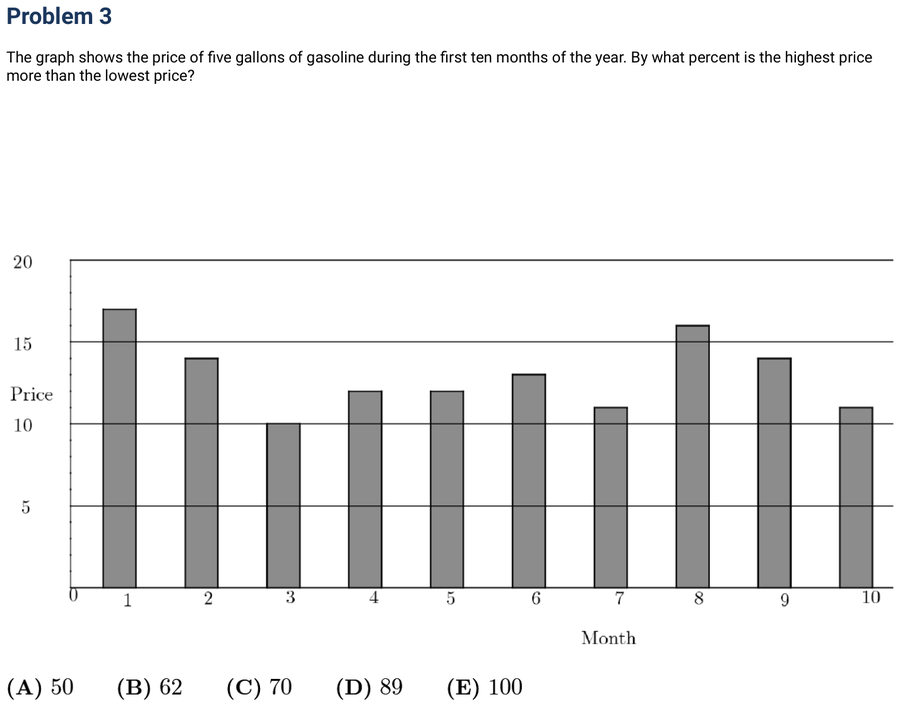
Show answer
Show hints
Still stuck? Show hint 2 →
Show solution
- Read the tallest and shortest bars: highest = 17, lowest = 10. The gap is 17 − 10 = 7.
- ‘How much more than the low’ means measure that gap against the low: 7 / 10 = 0.7 = 70%.
- Watch out: a common trap is dividing by 17 (the high). Dividing by the wrong number is exactly why the wrong answers are on the list — always anchor to the amount named after ‘than.’
2026 · #4 Brynn's savings decreased by 20% in July, then increased by 50% of the new amount in August. Brynn's savings are now what percent of the...
Brynn's savings decreased by 20% in July, then increased by 50% of the new amount in August. Brynn's savings are now what percent of the original amount?
Show answer
Show hints
Still stuck? Show hint 2 →
Show solution
- A percent change is really a multiplier: down 20% leaves 80%, so × 0.8; up 50% means × 1.5. And changes chain by multiplying, so you never need a starting amount.
- 0.8 × 1.5 = 1.2, which is 120% of the original.
- Watch the trap: the answer is not −20% + 50% = +30%. Percents stack by multiplying, not adding, because the +50% applies to the shrunken amount, not the original.
- Pretend Brynn started with $100. July: down 20% leaves $80. August: up 50% of $80 adds $40, giving $120.
- $120 out of the original $100 is 120%. Picking 100 makes the percent fall right out.
2024 · #23 Fresh mushrooms consist of 80% water. In dried mushrooms, however, the water is only 20% of the mass. By what percentage does the mass...
Fresh mushrooms consist of 80% water. In dried mushrooms, however, the water is only 20% of the mass. By what percentage does the mass of a mushroom decrease during drying?
Show answer
Show hints
Still stuck? Show hint 2 →
Show solution
- Take 100 g fresh: 80% water means 20 g of solid.
- Dried, water is 20% so solid is 80% of the new mass: 20 = 0.8 × new, giving new = 25 g.
- Mass drops from 100 g to 25 g, a decrease of 75%.
Ratios and proportions
“Three girls for every two boys.” That is a ratio — written 3 : 2. It does not say how many people are in the room; it says how the room is split. A ratio is the same family as fractions and percents: just another way to describe a part of a whole.
Part-to-part vs part-to-whole
This is where most ratio mistakes are born. 3 : 2 compares one part to the other part. But “what fraction are girls?” compares one part to the whole — and the whole is 3 + 2 = 5. So 3 of every 5 are girls: that is 3/5 = 60%. The trick is always the same: add the parts to get the whole.
THE MOVE — ADD THE PARTS
Ratio a : b means a whole of a + b equal shares. Part A is a/(a+b) of the whole; part B is b/(a+b). Part-to-part is a : b; part-to-whole is a/(a+b).
Sharing in a ratio: find the value of one share
Split $96 between two kids in the ratio 3 : 5. Add the parts: 3 + 5 = 8 equal shares. One share is $96 ÷ 8 = $12. So the kids get 3 × $12 = $36 and 5 × $12 = $60. (Check: $36 + $60 = $96 ✓, and 36 : 60 = 3 : 5 ✓.) Find one share, then scale.
3 + 5 = 8 shares, so one share is 96 ÷ 8 = 12 pages. Read is 3 shares: 3 × 12 = 36 pages. (Unread is 5 × 12 = 60; 36 + 60 = 96 ✓.)Three-term ratios a : b : c
Ratios can chain three (or more) quantities. Red : white : blue marbles = 2 : 3 : 4 means every group of 2 + 3 + 4 = 9 marbles has 2 red, 3 white, 4 blue. With 108 marbles, that is 108 ÷ 9 = 12 groups, so blue = 12 × 4 = 48. Or in one line: four of every nine are blue, so (4/9) × 108 = 48.
a : b : c, the whole is a + b + c shares. Everything else is “value of one share, then scale” — same move as a two-term ratio.Marble and three-term examples adapted from Competition Math for Middle School (AoPS).
Proportions: when two ratios are equal
A proportion says two ratios match: 3/5 = x/20. Solve it the way you already compared fractions — cross-multiply: 3 × 20 = 5 × x, so 60 = 5x and x = 12. It is the same cross-product machinery from the comparison chapter, now set equal instead of compared.
Scale factor: maps, models, and recipes
Maps and models are pure proportions. If a model uses 1/4 inch = 1 foot, then 1 inch = 4 feet, so a 14-inch model boat is 14 × 4 = 56 feet long. As a proportion: (1/4)/1 = 14/x gives x = 56.
Recipes too: if 5 cups of flour need 3 cups of milk, then for 4 cups of flour you need m where 5/3 = 4/m, so 5m = 12 and m = 2ⅎ cups. Set up the proportion, cross-multiply, done.
Scale-factor and recipe examples adapted from Competition Math for Middle School (AoPS).
3 × 25 = 5 × x, so 75 = 5x and x = 15. (Check: 15/25 = 3/5 ✓.)The instant a problem gives a ratio, add the parts to get the whole — that turns part-to-part into part-to-whole, which is a fraction and a percent you can use. For sharing problems: find the value of one share (total ÷ sum of parts), then scale each part.
Ratio a : b : c → whole is a + b + c shares; one share is total ÷ that sum. Part-to-whole is each part over the sum. Solve a proportion by cross-multiplying. The base after ‘of the whole’ is always the sum of all parts — never one of the other parts.
Mixtures: track the part that doesn't change
Here is a problem that looks like it needs algebra and doesn’t: A plum is 92% water. Dry it into a prune that is only 20% water. Starting from 100 lb of plums, how much prune do you get?
The instinct is to chase the water as it evaporates. Don’t. Chase the part that never moves.
The anchor: the non-water pulp is constant
Only water leaves during drying, so the actual pulp (everything that isn’t water) is the same weight before and after. In 100 lb of plums, water is 92%, so pulp is 100 − 92 = 8% — that is 8 lb of pulp. That 8 lb is your anchor; it is still 8 lb in the finished prune.
Now read the dried fruit: it is 20% water, so pulp is the other 80%. The same 8 lb of pulp is now 80% of the total weight, so:
8 = 0.80 × total → total = 8 ÷ 0.80 = 10 lb of prune.The fruit lost 90% of its weight as water — from 100 lb down to 10 lb — even though it only dropped from 92% to 20% water. That surprising swing is exactly why this is a contest favorite.
THE MOVE — FIND WHAT STAYS, MAKE IT THE BASE
- Spot the quantity that does not change (the pulp, the syrup, the solute).
- Compute its actual amount from the “before” picture.
- In the “after” picture, that amount is some percent of the new total — divide to get the new total.
Prune problem adapted from Competition Math for Middle School (AoPS); “track the constant part” mixtures also in Terry Chew, Ratio & Percentage.
Same move, a salt-water mix
You have 40 lb of brine that is 5% salt. How much water must boil off to make it 8% salt? The salt never leaves — that is the anchor. Salt = 5% of 40 = 2 lb. After boiling, that same 2 lb is 8% of the new total: 2 = 0.08 × total, so total = 2 ÷ 0.08 = 25 lb. Water boiled off = 40 − 25 = 15 lb. Again: name the constant, make it the base.
100 − 99 = 1% of 100 lb = 1 lb, and it never leaves. After drying it is 98% water, so it is 100 − 98 = 2% non-water. That 1 lb is now 2% of the total: 1 = 0.02 × total, so total = 1 ÷ 0.02 = 50 lb. Dropping from 99% to 98% water halves the weight — the famous surprise. 50 lb.In any ‘dry it / boil it / dilute it’ problem, one ingredient is untouched. Find that constant amount from the before-state, then in the after-state it equals (100 − new%) of the new total — divide to finish. Never track the part that is leaving.
Mixtures: the changing liquid is a distraction. Lock onto the constant part (pulp, salt, syrup), get its real amount, then set it equal to its new percent of the unknown total and divide. One division, no algebra.
Stretch test
Five harder FDP problems combining percent reasoning and fraction manipulation.
2019 · #22 A store increased the original price of a shirt by a certain percent and then decreased the new price by the same amount. Given that the...
A store increased the original price of a shirt by a certain percent and then decreased the new price by the same amount. Given that the resulting price was 84% of the original price, by what percent was the price increased and decreased?
Show answer
Show hints
Still stuck? Show hint 2 →
Show solution
- Raising by p then lowering by p multiplies the price by (1 + p)(1 − p) = 1 − p2 — a difference of squares, neatly collapsing the two steps into one.
- Set 1 − p2 = 0.84, so p2 = 0.16 and p = 0.4 = 40%.
- Why this transfers: a percent up and the same percent down always leaves 1 − p2 — strictly less than the original, since the drop applies to a larger amount. Recognizing (1+p)(1−p) as a difference of squares is the shortcut.
2024 · #23 Fresh mushrooms consist of 80% water. In dried mushrooms, however, the water is only 20% of the mass. By what percentage does the mass...
Fresh mushrooms consist of 80% water. In dried mushrooms, however, the water is only 20% of the mass. By what percentage does the mass of a mushroom decrease during drying?
Show answer
Show hints
Still stuck? Show hint 2 →
Show solution
- Take 100 g fresh: 80% water means 20 g of solid.
- Dried, water is 20% so solid is 80% of the new mass: 20 = 0.8 × new, giving new = 25 g.
- Mass drops from 100 g to 25 g, a decrease of 75%.
2022 · #21 Steph scored 15 baskets out of 20 attempts in the first half of a game, and 10 baskets out of 10 attempts in the second half. Candace...
Steph scored 15 baskets out of 20 attempts in the first half of a game, and 10 baskets out of 10 attempts in the second half. Candace took 12 attempts in the first half and 18 attempts in the second. In each half, Steph scored a higher percentage of baskets than Candace. Surprisingly they ended with the same overall percentage of baskets scored. How many more baskets did Candace score in the second half than in the first?
Show answer
Show hints
Still stuck? Show hint 2 →
Show solution
- Insight: turn the “surprising” tie into arithmetic. Both shot 30 total (Steph 20+10, Candace 12+18). Equal attempts and equal overall percentage means equal makes — Steph made 15 + 10 = 25, so Candace made 25 too.
- Let Candace's makes be f (of 12) and s (of 18), with f + s = 25. Beating-by-Steph in each half caps her: f/12 < 15/20 = ¾ forces f ≤ 8, and s/18 < 1 forces s ≤ 17.
- Those caps add to exactly 8 + 17 = 25, so the only split is f = 8, s = 17 — any less in one half can't be made up in the other.
- s − f = 17 − 8 = 9.
- Why the caps pin it down: when two upper bounds sum to exactly the required total, each variable is pinned to its max — no slack to trade. (This is also the resolution of the classic “Simpson's paradox” setup: losing both halves yet tying overall.)
2020 · #26 Lady Josephine bought a pack of beans. The beans come mixed with impurities such as pebbles and sand, and the label says these...
Lady Josephine bought a pack of beans. The beans come mixed with impurities such as pebbles and sand, and the label says these impurities make up 8% of the contents of the package. Lady Josephine removes part of these impurities, reducing them to 4% of the contents of the package. What fraction of the total amount of impurities was removed from the package?
Show answer
Show hints
Still stuck? Show hint 2 →
Show solution
- Take a 100 g pack: 8 g impurities and 92 g good beans. Removing x g of impurity leaves a pack of (100 − x) g.
- Now (8 − x) is 4% of (100 − x): 8 − x = 0.04(100 − x), giving 4 = 0.96x, so x = 25/6 g.
- The fraction of the original impurities removed is (25/6) ÷ 8 = 25/48.
- The answer is 25/48, choice B.
1994 · #20 Let W, X, Y, and Z be four different digits selected from the set {1, 2, 3, 4, 5, 6, 7, 8, 9}.If the sum WX + YZ is to be as small as...
Let W, X, Y, and Z be four different digits selected from the set {1, 2, 3, 4, 5, 6, 7, 8, 9}.
If the sum WX + YZ is to be as small as possible, then WX + YZ must equal
Show answer
Show hints
Still stuck? Show hint 2 →
Show solution
- Smallest tops, largest bottoms ⇒ numerators 1 and 2, denominators 8 and 9.
- Two ways to pair them, both over a common 72: (a) 1/9 + 2/8 = 8/72 + 18/72 = 26/72; (b) 1/8 + 2/9 = 9/72 + 16/72 = 25/72. Option (b) is smaller.
- So the minimum sum is 25/72.
- Why the better pairing puts the bigger numerator over the bigger denominator: the '2' does the most damage, so park it over the biggest bottom (9) to shrink its effect. Lesson — for these extremes, 'pick the right digits' is only half the job; how you MATCH them up is the tiebreaker, so always check the few pairings.
Stretch practice — beyond AMC 8
5 bonus problems on Fractions, Decimals & Percents. These are typed-answer (no multiple choice) and tilt harder — closer to early AMC 10. Try the ones that look fun.
Stretch · #1 On a real national test, more than half of junior-high students missed this question: What is 75% of 12? That is surprising, because the...
Show answer
Show hints
Still stuck? Show hint 2 →
Still stuck? Show hint 3 →
Show solution
- The trick is to see 75% as the friendly fraction \(\tfrac34\), not to reach for a percent rule.
- Draw 12 squares in a 3-by-4 array and split them into 4 equal columns. Each column has 3 squares, so each column is \(\tfrac14\) of the whole.
- \(\tfrac14\) of 12 = 3 squares (one column), so \(\tfrac34\) of 12 = three columns = 3 + 3 + 3 = 9.
- So 75% of 12 = \(\tfrac34 \times 12 = 9\).
- The unfriendly twin 74% of 13 looks almost the same on paper, but 74% is not a clean fraction and 13 won't split into equal small groups, so there is no neat picture — you would just estimate \(0.74 \times 13 \approx 9.6\). The real lesson: grab the easy picture when the numbers are friendly.
Stretch · #2 Reading a fraction as a COUNT of equal pieces, \(\frac{2}{3}\) means '2 thirds.' Using that idea (the bottom is the unit, the top is how...
Show answer
Show hints
Still stuck? Show hint 2 →
Still stuck? Show hint 3 →
Show solution
- Why you never add the bottoms: the fake rule turns \(\frac{1}{2}+\frac{1}{2}\) into \(\frac{2}{4}=\frac{1}{2}\), but two halves make a whole \(= 1\). So 'add the bottoms' is false.
- Read the bottom as the NAME of the piece (the unit) and the top as HOW MANY. So \(\frac{2}{3}\) is '2 thirds' and \(\frac{5}{3}\) is '5 thirds.'
- With the same unit, adding is like \(2\text{ m} + 5\text{ m} = 7\text{ m}\): \(2\text{ thirds} + 5\text{ thirds} = 7\text{ thirds}\).
- So \(\frac{2}{3}+\frac{5}{3}=\frac{7}{3}\): add the tops, keep the bottom. Adding bottoms would secretly change the slice size mid-count.
Stretch · #7 Compute \(\dfrac{3}{17} + \dfrac{6}{13}\). First warm up with the easier sum \(\dfrac{1}{2} + \dfrac{1}{3}\), thinking of adding...
Show answer
Show hints
Still stuck? Show hint 2 →
Still stuck? Show hint 3 →
Show solution
- Adding fractions just means combining 'so many of one size piece.' Warm-up: for \(\frac{1}{2} + \frac{1}{3}\) use sixths — \(\frac{1}{2} = \frac{3}{6}\) and \(\frac{1}{3} = \frac{2}{6}\), so the sum is \(\frac{5}{6}\).
- Same idea, bigger numbers. A common size for seventeenths and thirteenths is \(17 \times 13 = 221\). Then \(\frac{3}{17} = \frac{39}{221}\) and \(\frac{6}{13} = \frac{102}{221}\).
- Add the tops: \(\frac{39}{221} + \frac{102}{221} = \frac{141}{221}\).
- Since \(221 = 13 \times 17\) and \(141 = 3 \times 47\) share no common factor, \(\frac{141}{221}\) is already in lowest terms.
Stretch · #18 A store takes \(10\%\) off a price, and then takes another \(8\%\) off the new (already reduced) price. What single discount percentage...
Show answer
Show hints
Still stuck? Show hint 2 →
Still stuck? Show hint 3 →
Show solution
- Pick a convenient starting price of \(100\) dollars; the final percent off is the same no matter the price.
- After \(10\%\) off: \(100 - 10 = 90\). After \(8\%\) off the \(90\): \(8\%\) of \(90\) is \(7.20\), so \(90 - 7.20 = 82.80\).
- The price dropped from \(100\) to \(82.80\), a drop of \(17.20\) out of \(100\), which is \(17.2\%\).
- Note the two discounts of \(10\%\) and \(8\%\) do NOT add to \(18\%\): they give \(17.2\%\), because the second discount comes off a smaller amount.
Stretch · #23 The 'mediant' of two fractions adds the tops and adds the bottoms: \(\frac{a}{b} \oplus \frac{c}{d} = \frac{a+c}{b+d}\). (This is NOT...
Show answer
Show hints
Still stuck? Show hint 2 →
Still stuck? Show hint 3 →
Show solution
- Add tops and bottoms: \(\frac{1 + 1}{3 + 2} = \frac{2}{5}\), already in lowest terms.
- Check the order as decimals: \(\frac{1}{3} \approx 0.333\), \(\frac{2}{5} = 0.4\), \(\frac{1}{2} = 0.5\). The mediant sits right between them.
- Why it always works: if \(\frac{a}{b} < \frac{c}{d}\) then \(ad < bc\). Comparing \(\frac{a}{b}\) with \(\frac{a+c}{b+d}\) by cross-multiplying gives \(a(b+d) < b(a+c)\), i.e. \(ab + ad < ab + bc\), i.e. \(ad < bc\) — exactly what we know.
- The same check shows the mediant is below \(\frac{c}{d}\), so the mediant of \(\frac{1}{3}\) and \(\frac{1}{2}\) is \(\frac{2}{5}\) and always lands strictly between.
FDP quick-reference
CONVERSIONS TO MEMORIZE
- 1/2 = 0.5 = 50%; 1/3 ≈ 0.333 = 33⅓%; 2/3 ≈ 0.667 = 66⅔%
- 1/4 = 0.25 = 25%; 3/4 = 0.75 = 75%
- 1/5 = 0.2 = 20%; 2/5 = 0.4 = 40%; 3/5 = 0.6 = 60%; 4/5 = 0.8 = 80%
- 1/6 ≈ 0.167; 5/6 ≈ 0.833
- 1/8 = 0.125 = 12.5%; 3/8 = 0.375; 5/8 = 0.625; 7/8 = 0.875
- 1/9 ≈ 0.111; 1/11 ≈ 0.0909; 1/12 ≈ 0.0833
- Scale to 100: if the bottom divides 100 (2,4,5,10,20,25,50), multiply top and bottom up to /100 — the top is then the percent (2/25 = 8/100 = 8% = 0.08). No long division.
FRACTION SKILLS
- Mixed ↔ improper: improper → mixed = divide top by bottom (quotient = whole, remainder = new top, same bottom): 23/5 = 4⅗. Mixed → improper = (whole × bottom + top) over the bottom: 4⅗ = (4×5+3)/5 = 23/5.
- Add/subtract mixed numbers: wholes with wholes, fractions with fractions; carry a whole when the fraction part tops 1, borrow a whole when it is too small. (Or flip both to improper and skip carrying.)
- KCF for division: Keep, Change, Flip — keep the first, change ÷ to ×, flip the second. ÷(1/n) = ×n, so dividing by a number under 1 makes the result BIGGER.
- Compare fractions: a/b vs c/d → cross-multiply, a×d vs c×b, bigger product wins (both bottoms positive). Compare to ½ by checking whether 2a > b.
- Terminating vs repeating: simplify first; the decimal terminates exactly when the bottom's only primes are 2 and 5, else it repeats. A one-digit repeating block over 9, two digits over 99: 0.3̄ = 1/3, 0.2̄7̄ = 27/99.
TELESCOPING & PERCENT
- Telescoping product: (1−1/2)(1−1/3)…(1−1/N) = 1/N.
- Telescoping sum: 1/(n(n+1)) = 1/n − 1/(n+1).
- Percent is a multiplier: up p% → ×(1+p/100); down p% → ×(1−p/100); p% OF → ×(p/100).
- +25% then −20% returns to start (because 1.25 × 0.8 = 1).
- +1/n undoes with −1/(n+1). +25% (=+1/4) undoes with −20% (=−1/5).
- Adding percents from successive applications. 50% off then 20% off ≠ 70% off (it's 60% off). Multiply the multipliers.
- +25% then −25% returns to less than the start. +25% then −20% returns exactly (because ×1.25 × ×0.8 = 1).
- Averaging two averages without weighting. Use total ÷ count, not (a+b)/2 when groups differ.
- Confusing 'A is x% of B' with 'A is x% more than B'. The first is A = x%·B; the second is A = (1+x%)·B. 'Percent OF the whole' can never exceed 100% — divide by the total, not the other group.
- Forgetting to KCF when dividing fractions. Dividing by a fraction is multiplying by the flipped fraction; the answer grows when you divide by something under 1.
- Bigger bottom = bigger fraction. No — with the same top, more pieces means each is smaller: 2/7 < 2/5.
- Subtracting mixed numbers without borrowing. 5¼ − 2¾ is not 3 (½). Borrow a whole (5¼ = 4 and 5/4) or flip both to improper first.
- Mis-aligning a partly-repeating decimal. For 0.2̄8̄ = 0.2888…, line the repeating tails up before subtracting (10x − x), or the 8s won't cancel.
- Adding tops and bottoms. 1/2 + 1/2 ≠ 2/4. Match bottoms first, add only the tops (that across-rule is for multiplying).
- Averaging two speeds. 30 mph there and 60 mph back is NOT 45 mph — the slow leg takes more time. Use total distance ÷ total time (here 40 mph).
- Chasing the water in a mixture. When a fruit dries or brine boils, track the part that stays (pulp, salt); it equals (100 − new%) of the new total.
- Part-to-part vs part-to-whole. Ratio 3:2 means 3/5 of the whole is the first part — add the parts to get the base.
Drill these:
- What is 20% of 75? (15)
- What is the result of $200 raised by 30%? ($260)
- Price drops from $50 to $40, percent decrease? (20%)
- Price rises from $40 to $50, percent increase? (25%)
- Two consecutive 10% raises: net multiplier? (1.21, so 21% raise)
- (1/2) ÷ (3/4) using KCF: (1/2)(4/3) = 4/6 = 2/3.
Want to climb higher? — telescoping, repeaters, and mixed-number speed
- Two-apart split:
1 / (n · (n+2)) = ½[1/n − 1/(n+2)]. So 1/(1·3) + 1/(3·5) + 1/(5·7) + … telescopes too, now with a 1/2 out front. - Triangular-number denominators. The k-th triangular number is
1 + 2 + … + k = k(k+1)/2, so its reciprocal is1/(1+2+…+k) = 2/(k(k+1)) = 2[1/k − 1/(k+1)]— the partial-fraction split with a 2 out front. So1/1 + 1/3 + 1/6 + 1/10 + 1/15 = 2[(1/1 − 1/2) + … + (1/5 − 1/6)] = 2(1 − 1/6) = 5/3, and in general the sum of the first n equals2n/(n+1)— another telescoping collapse. - Product telescoping with (1 + 1/k):
(1 + 1/1)(1 + 1/2)(1 + 1/3) … (1 + 1/n) = (2/1)(3/2)(4/3) … ((n+1)/n) = n + 1. Each numerator kills the next denominator. The whole product collapses to n + 1. - The harmonic series. 1 + 1/2 + 1/3 + … does NOT telescope — it grows without bound (slowly). Don’t try.
- Any repeating decimal → fraction. Let x equal the decimal, multiply by a power of 10 to slide one whole period, subtract: 0.3 → 10x−x = 3 → x = 1/3. For a partly-repeating decimal, slide so the loops line up before subtracting: 0.28 → 10x−x = 2.6 → x = 26/90 = 13/45.
- Repeat-block length. For 1/d (in lowest terms, no factor of 2 or 5 in d), the repeating block has length at most d−1 — the remainders cycle: 1/7 = 0.142857, a block of 6.
- Mixed-number arithmetic fast. For a single hard subtraction, flip both to improper over a common bottom (no borrowing). For a long sum, estimate: each mixed number is its whole part plus a bit under 1, so the total is a little above the sum of the whole parts — often enough to pick the smallest whole number above it.