Using the numbers 1, 2, 3 and 4, we can write several fractions whose value is less than 1, for example, 13. How many different values, beyond the example, can be obtained?
Show answer
Answer: B — 4
Show hints
Hint 1 of 2
List every fraction (one number over another) you can build that is below 1, then drop repeats.
Still stuck? Show hint 2 →
Hint 2 of 2
Two different fractions can have the same value, like 2/4 and 1/2 — count values, not fractions.
Show solution
Approach: list the proper fractions and remove equal values
Using two of 1,2,3,4 with value < 1 gives 1/2, 1/3, 1/4, 2/3, 3/4 and 2/4.
But 2/4 equals 1/2, so the distinct values are 1/2, 1/3, 1/4, 2/3, 3/4 — five in all.
The example 1/3 is one of them, so beyond it there are 5 − 1 = 4 other values.
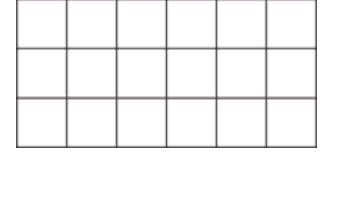
Max colours the squares of the grid so that one third of all the squares are blue and one half are yellow. He colours the rest red. How many squares does he colour red?
Show answer
Answer: C — 3
Show hints
Hint 1 of 2
First count the squares in the grid, then find a third of them and a half of them.
Still stuck? Show hint 2 →
Hint 2 of 2
Red = total minus the blue third minus the yellow half.
Show solution
Approach: take fractions of the total square count
The grid is 3 by 6, so there are 18 squares.
One third are blue: 18÷3 = 6 squares; one half are yellow: 18÷2 = 9 squares.
Anna has shared her apples fairly between herself and her five girlfriends. Each girl has received half an apple. How many apples did Anna have to start with?
Show answer
Answer: B — 3
Show hints
Hint 1 of 2
Count how many people get apples, remembering Anna shares with herself too.
Still stuck? Show hint 2 →
Hint 2 of 2
Six people each get half an apple, so add up six halves.
Show solution
Approach: count the equal half-apple shares
Anna and her 5 girlfriends make 6 people in all.
Each gets half an apple, so the total is 6 × ½ = 3 apples.
At Anna’s school 45 teachers come to school by bike, and that is 60% of all the teachers. Only 12% of the teachers come to school by car. How many teachers come to school by car?
Show answer
Answer: C — 9
Show hints
Hint 1 of 2
First find the total number of teachers from the 60% fact.
Still stuck? Show hint 2 →
Hint 2 of 2
Then take 12% of that total.
Show solution
Approach: find the whole, then a percent of it
45 teachers are 60% of all teachers, so the total is 45 ÷ 0.60 = 75 teachers.
Lenka paid 1 Euro and 50 Cents for three scoops of ice cream. Miso paid 2 Euros and 40 Cents for two chocolate bars. How much did Igor pay for one scoop of ice cream and one chocolate bar?
Show answer
Answer: A — 1 € 70 c
Show hints
Hint 1 of 2
Find the price of one scoop and the price of one bar separately.
Still stuck? Show hint 2 →
Hint 2 of 2
Three scoops cost 1.50 €; two bars cost 2.40 €.
Show solution
Approach: unit prices, then add
One scoop: 1.50 € ÷ 3 = 0.50 €. One bar: 2.40 € ÷ 2 = 1.20 €.
One scoop + one bar = 0.50 + 1.20 = 1 € 70 c, answer A.
Ivan gains 85% of the points in a test. Tibor gains 90% of the points in the same test, but only one point more than Ivan. What is the maximum number of points that can be gained in this test?
Show answer
Answer: D — 20
Show hints
Hint 1 of 2
The gap between 85% and 90% of the same total equals one point.
Still stuck? Show hint 2 →
Hint 2 of 2
Find what 5% of the total is worth.
Show solution
Approach: percent difference equals one point
Tibor scores 90% and Ivan 85% of the same total, so Tibor has 5% more.
That 5% is exactly 1 point, so 1% is worth 0.2 of a point.
The whole test is 100%, which is 100 times 0.2 = 20 points.
There are 200 fish in an aquarium, of which 1% are blue and the rest are yellow. How many yellow fish have to be removed to make the number of blue fish equal 2% of all the fish?
Show answer
Answer: E — 100
Show hints
Hint 1 of 2
1% of 200 is just 2 blue fish, and that count never changes—only the total does.
Still stuck? Show hint 2 →
Hint 2 of 2
You want 2 fish to be 2% of the new total, so the new total must be 100.
Show solution
Approach: hold the blue count fixed and shrink the total
1% of 200 is 2 blue fish; removing yellow fish does not change that.
For 2 fish to be 2% of the total, the total must be 100.
Manuela takes a total of 17 shots at goal over two soccer training sessions. In the first session she scores with 60% of her shots, and in the second she scores with 75% of her shots. How many goals does she score in the second session?
Show answer
Answer: D — 9
Show hints
Hint 1 of 2
Both hit-counts must be whole numbers: 60% of the first session and 75% of the second.
Still stuck? Show hint 2 →
Hint 2 of 2
Split 17 shots so that 60% of the first part and 75% of the second part are both integers.
Show solution
Approach: force whole-number hits to fix the split
60% needs the first count to be a multiple of 5; 75% needs the second to be a multiple of 4.
With shots adding to 17, the split is 5 and 12 (5 is a multiple of 5, 12 of 4).
Second-session hits = 75% of 12 = 9, which is (D).
Jennifer wants to save water. She reduces the water pressure and thus reduces the water usage by one quarter. Furthermore, she reduces the time she takes a shower by one quarter. By which fraction in total does she reduce the water usage for her shower?
Show answer
Answer: E — by \(\frac{7}{16}\)
Show hints
Hint 1 of 2
Water used = pressure × time; cutting each by a quarter multiplies each factor by 3/4.
Still stuck? Show hint 2 →
Hint 2 of 2
Multiply the two reduction factors and compare with the original.
Show solution
Approach: multiply the two scaling factors
Reducing by a quarter leaves 3/4 of the pressure and 3/4 of the time.
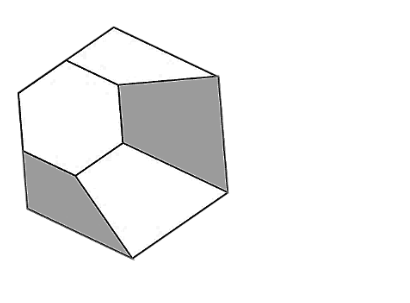
A regular hexagon is split into four quadrilaterals and a smaller regular hexagon. The ratio area of the dark sectionsarea of the small hexagon = 43. How big is the ratio area of the small hexagonarea of the big hexagon?
Show answer
Answer: A — 311
Show hints
Hint 1 of 2
Call the small hexagon's area S; then the dark sections total (4/3)S.
Still stuck? Show hint 2 →
Hint 2 of 2
The big hexagon = small hexagon + four quadrilaterals; express the quadrilaterals using the dark/light split.
Show solution
Approach: write all areas in terms of the small hexagon's area
Let the small hexagon have area S. By symmetry the four quadrilaterals are equal; two of them are dark, two light.
Dark = 2 quadrilaterals = (4/3)S, so one quadrilateral = (2/3)S and all four total (8/3)S.
Big hexagon = small hexagon + four quadrilaterals = S + (8/3)S = (11/3)S.
Tom had ten sparklers of the same size. He lit the first one. When only a tenth of it remained, he lit the second one. When only a tenth of that remained, he lit the third one, and so on. Sparklers burn at the same speed along their entire length, and one sparkler burns in 2 minutes. How long did it take for all 10 sparklers to burn down?
Show answer
Answer: B — 18 min 12 sec
Show hints
Hint 1 of 2
Each sparkler except the last only burns until a tenth is left before the next is lit.
Still stuck? Show hint 2 →
Hint 2 of 2
Add nine 'nine-tenths of 2 minutes' burns plus one full burn.
Show solution
Approach: sum the partial burns plus one full burn
A whole sparkler burns in 2 minutes; burning down to one tenth uses 9/10 of that, i.e. 1.8 minutes.
Sparklers 1 through 9 each contribute 1.8 minutes before the next is lit: 9×1.8 = 16.2 minutes.
The tenth sparkler burns completely: +2 minutes, total 18.2 minutes.
In a particular fraction the numerator and denominator are both positive. The numerator of this fraction is increased by 40%. By what percentage should its denominator be decreased so that the new fraction is double the original fraction?
Show answer
Answer: C — 30%
Show hints
Hint 1 of 2
Increasing the top by 40% multiplies the fraction by 1.4; you want the new fraction to be twice the old.
Still stuck? Show hint 2 →
Hint 2 of 2
Find the multiplier the denominator needs, then convert it to a percent decrease.
Show solution
Approach: balance the multipliers on top and bottom
Multiplying the numerator by 1.4 while dividing the denominator by (1 − p) should double the fraction: 1.4 / (1 − p) = 2.
This school year the number of boys in my class increased by 20% compared with last year, and the number of girls decreased by 20%. There is now one more person in the class than before. Which of the following could be the current number of students in my class?
Show answer
Answer: B — 26
Show hints
Hint 1 of 2
A change of 20% gives a whole number only if the count is a multiple of 5, so last year's boys and girls were each multiples of 5.
Still stuck? Show hint 2 →
Hint 2 of 2
Write boys = 5b and girls = 5g; the net headcount change of +1 pins down b − g.
Show solution
Approach: boys and girls were each multiples of 5 last year
Let last year's boys = 5b and girls = 5g, so the 20% changes give whole numbers.
New count = 6b + 4g, old count = 5b + 5g; the increase is b − g = 1, so b = g + 1.
New total = 6(g+1) + 4g = 10g + 6, which for g = 2 gives 26.
The numbers a, b, c and d are pairwise different integers between 1 and 10 (1 and 10 included). What is the smallest possible value of the expression ab + cd ?
Show answer
Answer: C — 1445
Show hints
Hint 1 of 2
To make a/b + c/d small, use small numerators and large denominators.
Still stuck? Show hint 2 →
Hint 2 of 2
Try numerators 1 and 2 with denominators 9 and 10, paired to minimise the sum.
Show solution
Approach: minimise by smart pairing
Use the small numerators 1, 2 and large denominators 9, 10.
Pairing 1/9 + 2/10 = 1/9 + 1/5 = 14/45.
No other choice of distinct 1–10 values beats it, so the minimum is 14/45.
Jane plays basketball. Of her first 20 throws, 55% are successful. After five more throws her success rate rises to 56%. How many of her last five throws were successful?
Show answer
Answer: C — 3
Show hints
Hint 1 of 2
Turn each percentage into an actual number of successful throws.
Still stuck? Show hint 2 →
Hint 2 of 2
Subtract to find how many of the last five went in.
Show solution
Approach: convert percents to counts and subtract
Of the first 20 throws, 55% = 11 were successful.
After 25 throws the rate is 56%, so 0.56 × 25 = 14 successful in total.
The last five contributed 14 − 11 = 3 successful throws.
A triathlon consists of three disciplines: swimming, running and cycling. The cycle route is three quarters of the entire distance, the running route is one fifth of the entire distance and the swimming route is 2 km long. How long is the whole distance of the triathlon, in km?
Show answer
Answer: D — 40
Show hints
Hint 1 of 2
The swim is the part of the whole left after the cycle and run fractions.
Still stuck? Show hint 2 →
Hint 2 of 2
Find 1 − 3/4 − 1/5 of the distance; that fraction equals 2 km.
Show solution
Approach: the leftover fraction is the swim
Cycle + run = 3/4 + 1/5 = 19/20 of the distance.
So the swim is 1/20 of the distance, and that equals 2 km.
Michaela has 24 animals: dogs, cows, cats and kangaroos. One eighth of the animals are dogs. Three quarters of the animals are not cows, and two thirds are not cats. How many kangaroos does Michaela have?
Show answer
Answer: D — 7
Show hints
Hint 1 of 2
Convert each fraction into an actual number of animals out of 24.
Still stuck? Show hint 2 →
Hint 2 of 2
'Not cows' and 'not cats' tell you the cow and cat counts indirectly.
Show solution
Approach: find each animal count, then subtract
Dogs: 24/8 = 3.
Three quarters are not cows, so cows are one quarter: 24/4 = 6.
Two thirds are not cats, so cats are one third: 24/3 = 8.
A 1-litre bottle of syrup is still half full. The syrup is to be diluted in the ratio 1 : 7 to make juice. Which fraction of the syrup should be used to obtain 2 litres of juice?
Show answer
Answer: B — 12
Show hints
Hint 1 of 2
Syrup : water = 1 : 7 means juice is 1/8 syrup.
Still stuck? Show hint 2 →
Hint 2 of 2
2 litres of juice needs 1/4 litre of syrup — compare to the 1/2 litre you have.
Show solution
Approach: find syrup needed, compare to amount on hand
Juice is 1 part syrup to 7 water, so 1/8 of the juice is syrup.
2 litres of juice need 2 × (1/8) = 1/4 litre of syrup.
You hold 1/2 litre, so you use (1/4)/(1/2) = 1/2 of the syrup.
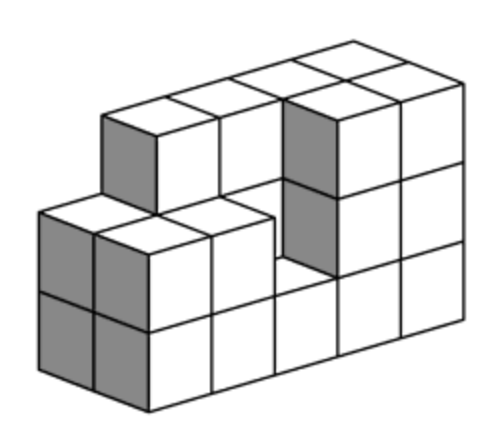
Linus builds a 4 × 4 × 4 cube made up of 32 white and 32 black 1 × 1 × 1 cubes. He arranges the small cubes so that the surface of the big cube shows as much white as possible. Which fraction of the surface is white?
Show answer
Answer: A — 34
Show hints
Hint 1 of 3
First count the whole surface: the big cube has 6 faces, each split into 16 little squares.
Still stuck? Show hint 2 →
Hint 2 of 3
To show the most white, place white cubes where they expose the most faces — corner cubes show 3, edge cubes show 2.
Still stuck? Show hint 3 →
Hint 3 of 3
Count how many white faces those favorable spots give you, then compare with the total.
Show solution
Approach: place white cubes to expose the most faces
The surface has 6 × 16 = 96 unit faces. Corner cubes (8) show 3 faces each, edge cubes (24) show 2 each.
Filling the 8 corners and 24 edges with white uses all 32 white cubes and exposes 8×3 + 24×2 = 72 white faces.
So the white fraction of the surface is 72⁄96 = 3⁄4 (A).
At a humanistic university you can study languages, history or philosophy. Some students study exactly one language (nobody studies several at once). Among those language students, 35% study English. Among all students of the university, 13% study a language other than English. What percentage of all students study a language?
Show answer
Answer: B — 20 %
Show hints
Hint 1 of 2
If 35% of language students study English, then 65% study a non-English language.
Still stuck? Show hint 2 →
Hint 2 of 2
That 65% of the language group equals 13% of all students.
Show solution
Approach: the non-English language students link the two percentages
Among language students, 35% study English, so 65% study another language.
Those non-English language students are 13% of all students, so 65% of the language group = 13% of everyone.
Thus the language group is \(13\% \div 0.65 = \) 20% of all students.
Anna, Bettina and Claudia go shopping. Bettina spends 85% less than Claudia. Anna spends 60% more than Claudia. Together they spend 55 €. How much money does Anna spend?
Show answer
Answer: E — 32 €
Show hints
Hint 1 of 2
Write everyone's spending as a multiple of Claudia's amount.
Still stuck? Show hint 2 →
Hint 2 of 2
Add those multiples, set the total to 55 €, then find Anna's share.
Show solution
Approach: express all spendings via Claudia and total
Bettina spends 0.15 of Claudia's amount and Anna spends 1.6 of it.
At a wedding one eighth of the guests is underage. Three sevenths of the adult guests are men. How big is the fraction of adult women amongst all guests?
Show answer
Answer: A — 12
Show hints
Hint 1 of 2
What fraction of all guests are adults?
Still stuck? Show hint 2 →
Hint 2 of 2
Find the men as a fraction of all guests, then take what is left of the adults.
Show solution
Approach: take fractions of fractions, all relative to the whole party
Underage guests are 1/8 of everyone, so adults are 7/8 of all guests.
Men are 3/7 of the adults: 3/7 × 7/8 = 3/8 of all guests.
Adult women = adults − men = 7/8 − 3/8 = 4/8 = 1/2, choice A.
In the past 20 years the population of Arnberg has increased by 40%. In the same time span the population of Berghausen has increased by 60%. In total the population of the two villages has increased by 54%. What was the ratio of the populations 20 years ago?
Show answer
Answer: C — 3 : 7
Show hints
Hint 1 of 2
The combined 54% growth is a weighted average of 40% and 60%.
Still stuck? Show hint 2 →
Hint 2 of 2
Let the old populations be a and b and set up the weighted-average equation.
Show solution
Approach: weighted average of the two growth rates
With old populations a and b: (1.4a + 1.6b)/(a+b) = 1.54.
So 1.4a + 1.6b = 1.54a + 1.54b, giving 0.06b = 0.14a, i.e. a:b = 6:14 = 3:7.
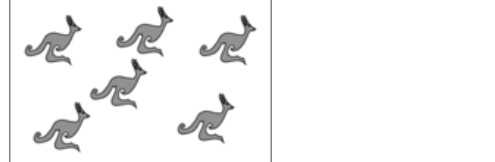
In a group of kangaroos the two lightest ones weigh 25 % of the total weight of the whole group. The three heaviest ones weigh 60 % of the total weight. How many kangaroos are in this group?
Show answer
Answer: A — 6
Show hints
Hint 1 of 2
The 2 lightest take 25% and the 3 heaviest take 60%, so the rest share the remaining percent.
Still stuck? Show hint 2 →
Hint 2 of 2
Find the leftover percentage and how many average-weight kangaroos it represents to total the group.
Show solution
Approach: account for every percent of the weight
The 2 lightest are 25% and the 3 heaviest are 60%, leaving 15% for the kangaroos in between.
A lightest one averages 12.5% and a heaviest one averages 20%, so each middle kangaroo must weigh between 12.5% and 20%.
Only one middle kangaroo fits the leftover 15% (two would average 7.5% each, too light), giving 2 + 1 + 3 = 6 kangaroos.
On the packaging of a soft cheese it says: total amount of fat 24%. On the same packaging it also says: 64% fat in the dry substance. What percentage of water is in the soft cheese?
Show answer
Answer: B — 62.5%
Show hints
Hint 1 of 2
Total fat is 24% of the whole; in the dry part fat is 64%.
Still stuck? Show hint 2 →
Hint 2 of 2
Use those two facts to find how much of the cheese is dry, then the rest is water.
Show solution
Approach: find the dry mass, then water is the remainder
Take 100 g of cheese: it contains 24 g of fat.
Fat is 64% of the dry substance, so dry substance = 24 / 0.64 = 37.5 g.
On an island the frogs are either green or blue. The number of blue frogs increases by 60%, and the number of green frogs decreases by 60%. As a result, the new ratio of blue frogs to green frogs equals the original ratio of green frogs to blue frogs. By what percentage has the total number of frogs changed?
Show answer
Answer: B — 20%
Show hints
Hint 1 of 2
Set up the new blue-to-green ratio equal to the old green-to-blue ratio.
Still stuck? Show hint 2 →
Hint 2 of 2
That equation pins the original green-to-blue ratio; then compare totals.
Show solution
Approach: solve the swapped-ratio equation, then compare totals
With blue B, green G: 1.6B / 0.4G = G / B leads to 4B² = G², so G = 2B.
Old total 3B; new total 1.6B + 0.4(2B) = 2.4B, a drop of 0.6B.
The total changes by 0.6B / 3B = 20% (a decrease).
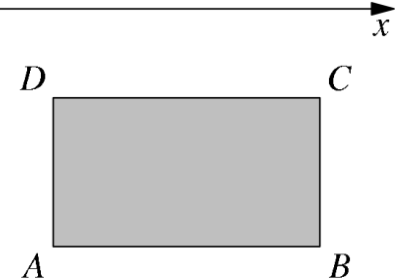
The sides of rectangle ABCD are parallel to the coordinate axes. The rectangle lies below the x-axis and to the right of the y-axis, as shown. The coordinates of A, B, C, D are all whole numbers. For each point we work out (y-coordinate) ÷ (x-coordinate). Which point gives the smallest value?
Show answer
Answer: A — A
Show hints
Hint 1 of 2
All x-coordinates are positive and all y-coordinates are negative, so y/x is always negative.
Still stuck? Show hint 2 →
Hint 2 of 2
To make a negative value smallest, you want the most-negative y over the smallest x.
Show solution
Approach: compare y/x at the four corners
Each point has x > 0 and y < 0, so every y/x is negative.
The smallest (most negative) value comes from the largest |y| with the smallest x.
Corner A is the lowest-left point: smallest x together with the most negative y.
Tango is being danced in pairs, a man with a woman. No more than 50 people attend a dance evening. At a certain moment 34 of the men were dancing with 45 of the women. How many people were dancing at this moment?
Show answer
Answer: B — 24
Show hints
Hint 1 of 2
Dancing men and dancing women are equal in number (they pair up).
Still stuck? Show hint 2 →
Hint 2 of 2
Set (3/4) of the men equal to (4/5) of the women and use the at-most-50 limit.
Show solution
Approach: equal dancing partners
Pairs mean dancing men = dancing women: (3/4)M = (4/5)W, so 15M = 16W, giving M = 16k, W = 15k.
Total people 31k ≤ 50 forces k = 1, so M = 16, W = 15.
Silvia's favourite chocolate bars are sold in packets. There used to be five bars in each packet. Now there are only four in each packet, but the packets still cost the same. By how many percent has each bar become more expensive?
Show answer
Answer: C — by 25%
Show hints
Hint 1 of 2
Find the cost of one bar before and after the change.
Still stuck? Show hint 2 →
Hint 2 of 2
Old price per bar is P/5, new is P/4; compare them as a ratio.
After playing 200 games of chess, Beth’s winning rate is exactly 49 %. What is the minimum number of games she has to still play to increase her winning rate to 50 %?
Show answer
Answer: D — 4
Show hints
Hint 1 of 2
She has 98 wins out of 200; adding x more wins makes it (98+x)/(200+x).
Still stuck? Show hint 2 →
Hint 2 of 2
Set that fraction to at least 1/2 and solve for the smallest whole x.
Show solution
Approach: set up the win-rate inequality
49% of 200 is 98 wins.
Winning the next x games gives rate (98+x)/(200+x).
Require (98+x)/(200+x) ≥ 1/2: 196+2x ≥ 200+x, so x ≥ 4.
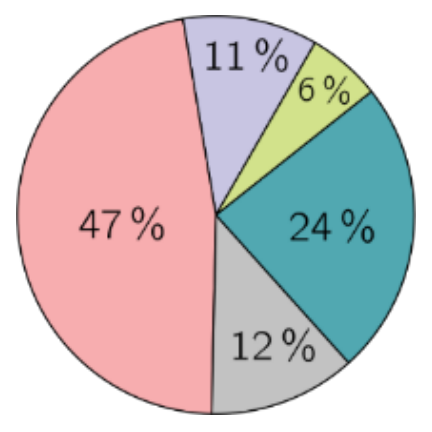
The pie chart shows the number of inhabitants in the five zones of a city. The central zone has the same population as the north, west and east zones combined, and the south zone has half as many inhabitants as the west zone. What is the difference, in percentage points, between the inhabitants of the north and east zones?
Show answer
Answer: D — 13%
Show hints
Hint 1 of 2
The central slice (47%) equals north+west+east together.
Still stuck? Show hint 2 →
Hint 2 of 2
Use 'south is half of west' to pin down which slices are which.
Show solution
Approach: match the percentage slices to the zones using the constraints
The non-central slices are 11, 6, 24, 12 (summing to 53), and central 47 = north+west+east, so south = 53 − 47 = 6.
South is half of west, so west = 12.
North + east = 47 − 12 = 35, which forces the pair to be 11 and 24.
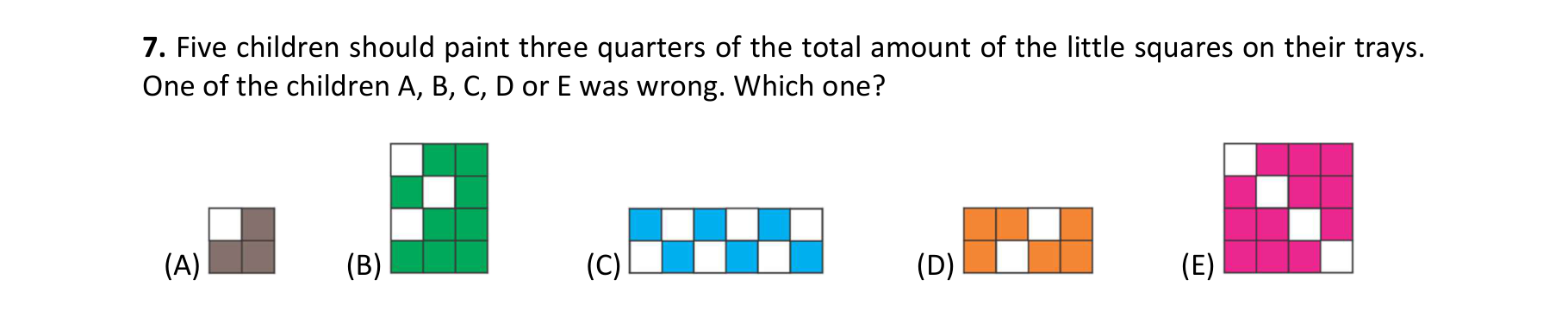
Three quarters painted means exactly 3 out of every 4 little squares are colored.
Still stuck? Show hint 2 →
Hint 2 of 2
Count colored squares versus total squares on each tray — one tray is off.
Show solution
Approach: check the painted fraction on each tray
For each tray, count the coloured squares and the total squares and compare with three quarters.
Trays A, B, D and E each have exactly 3 out of every 4 squares coloured, but tray C has only 5 of its 10 squares coloured (one half), so child C was wrong.
Ana planned to walk an average of 5 km per day in March. In the first 10 days she walked an average of 4.4 km per day, and in the next 6 days she walked an average of 3.5 km per day. What average daily distance must she walk on the remaining days in order to fulfill her plan?
Show answer
Answer: C — 6 km
Show hints
Hint 1 of 2
March has 31 days; turn the planned average into a total distance she must cover.
Still stuck? Show hint 2 →
Hint 2 of 2
Subtract what she has already walked, then divide by the days that remain.
Show solution
Approach: work with totals over the month
A 5 km average over 31 days means a target total of 5 × 31 = 155 km.
First 10 days: 10 × 4.4 = 44 km; next 6 days: 6 × 3.5 = 21 km; so 65 km done in 16 days.
Remaining distance 155 − 65 = 90 km over the last 15 days is 90 ÷ 15 = 6 km/day.
In a class, every student either only swims, or only dances, or does both. Three eighths of the students in the class swim. Exactly five students do both — that is, they swim and dance. At least how many students are in the class?
Show answer
Answer: A — 16
Show hints
Hint 1 of 2
Three eighths of the class swim, so the class size must be a multiple of 8.
Still stuck? Show hint 2 →
Hint 2 of 2
The five who do both must fit inside the swimmers; find the smallest multiple of 8 that allows that.
Show solution
Approach: make the swimmer count work out
Swimmers = 3/8 of the class, so the total must be a multiple of 8.
The 5 students who do both are among the swimmers, so swimmers ≥ 5, meaning 3/8 of the total ≥ 5.
The smallest multiple of 8 giving at least 5 swimmers is 16 (3/8 of 16 = 6 swimmers, which holds the 5).
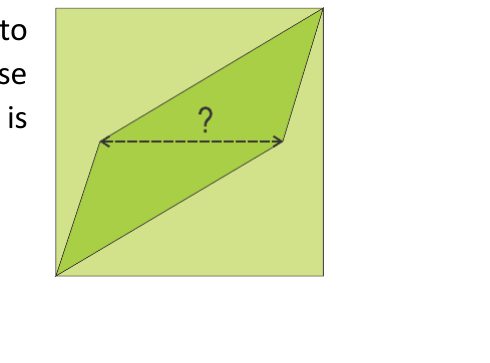
The garden of Sonia's house is shaped like a 12-meter square and is divided into three lawns of equal area. The central lawn is shaped like a parallelogram whose shorter diagonal is parallel to two sides of the square, as shown in the picture. What is the length of this diagonal, in meters?
Show answer
Answer: C — 8.0
Show hints
Hint 1 of 2
The square's area is 12 × 12 = 144, split into three equal lawns of 48 each.
Still stuck? Show hint 2 →
Hint 2 of 2
The central parallelogram has its short diagonal horizontal; its area is half that diagonal times the full height 12.
Show solution
Approach: use the equal-thirds area
Total area 12 × 12 = 144, so each lawn has area 144 ÷ 3 = 48.
The central parallelogram spans the full 12 m height, and its area equals (diagonal × 12) ÷ 2.
A store announced a 30% discount for a sale. However, one day before the promotion the store raised the prices of all its products by 20%. What was the real discount the store gave on the day of the sale?
Show answer
Answer: D — 16%
Show hints
Hint 1 of 2
Start from a price of 100; apply the 20% increase first, then the 30% discount.
Still stuck? Show hint 2 →
Hint 2 of 2
Compare the final price with the original 100 to read off the real discount.
Show solution
Approach: chain the two percentage multipliers
Take the original price as 100. Raising by 20% gives 100 × 1.2 = 120.
Then the 30% sale discount gives 120 × 0.7 = 84.
The customer pays 84 instead of 100, a real discount of 16%.
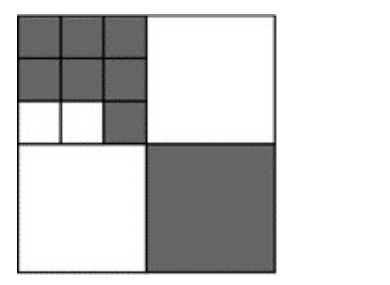
A big square is divided up into smaller squares of different sizes, as shown. Some of the smaller squares are shaded grey. Which fraction of the big square is shaded grey?
Show answer
Answer: D — 49
Show hints
Hint 1 of 2
Pick a unit so the smallest cells are 1 by 1 and the whole square is a whole number of them.
Still stuck? Show hint 2 →
Hint 2 of 2
Count grey units and divide by the total units.
Show solution
Approach: count equal area units
Let the big square be 6×6 = 36 small units.
The fully grey square in the lower-right quarter covers 9 units, and the grey cells in the small 3×3 block cover another 7 units.
Grey total = 9 + 7 = 16 units, so the fraction is 16/36 = 4/9.
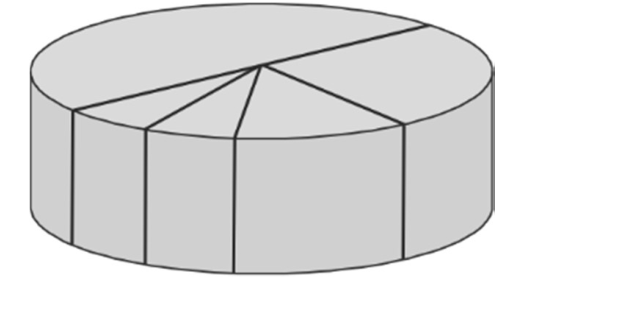
Mother halves the birthday cake. One half she then halves again. Of that she again halves one of the smaller pieces. Of these smaller pieces she once more halves one of them (see diagram). One of the two smallest pieces weighs 100 g. How much does the entire cake weigh?
Show answer
Answer: D — 1600 g
Show hints
Hint 1 of 2
Each halving makes a piece half as big; the smallest piece is a fraction of the whole cake.
Still stuck? Show hint 2 →
Hint 2 of 2
Halving four times gives a sixteenth, so the 100 g piece is 1/16 of the cake.
Show solution
Approach: track the fraction of the whole
Halving the cake repeatedly gives pieces of 1/2, 1/4, 1/8, and finally 1/16.
The smallest piece is 1/16 of the cake and weighs 100 g.
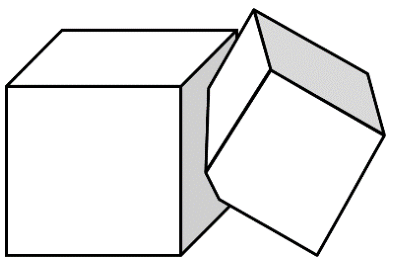
Two cubes with volumes V and W intersect each other as shown. 90% of the volume of the cube with volume V does not belong to both cubes, and 85% of the volume of the cube with volume W does not belong to both cubes. What is the relationship between the volumes of the two cubes?
Show answer
Answer: B — \(V = \tfrac{3}{2}\,W\)
Show hints
Hint 1 of 2
The shared (overlap) part is what each percentage leaves out.
Still stuck? Show hint 2 →
Hint 2 of 2
Set the two expressions for the common volume equal.
Show solution
Approach: equate the two descriptions of the overlap volume
90% of V is outside the overlap, so the overlap is 0.1V.
85% of W is outside the overlap, so the overlap is 0.15W.
Martina plays chess. This season she has already played 15 games, nine of which she has won. She still has to play 5 more games. How high is her win rate at the end of the season if she wins all remaining games?
Show answer
Answer: C — 70 %
Show hints
Hint 1 of 2
First find the final number of wins and the total games played.
Still stuck? Show hint 2 →
Hint 2 of 2
Win rate is wins divided by total games, as a percent.
Show solution
Approach: add the wins and games, then convert to a percent
If she wins all 5 remaining games she has 9 + 5 = 14 wins.
Ant Annie starts at the left end of the stick and crawls 23 of the length of the stick. Ladybird Bob starts at the right end of the stick and crawls 34 of the length of the stick. Which fraction of the length of the stick are they then apart from each other?
Show answer
Answer: D — 512
Show hints
Hint 1 of 2
Put both bugs' positions on the same scale, measured from the left end.
Still stuck? Show hint 2 →
Hint 2 of 2
Subtract the two positions to get the gap.
Show solution
Approach: locate both on [0,1] and subtract
Annie is at 2/3 from the left. Bob, 3/4 from the right, is at 1 − 3/4 = 1/4 from the left.
They have passed each other; the gap is 2/3 − 1/4 = 8/12 − 3/12 = 5/12.
One sixth of all spectators in a children’s theatre are adults, and the rest are children. Two fifths of the children are girls. Which fraction of all spectators are boys?
Show answer
Answer: A — 12
Show hints
Hint 1 of 2
Children are the part that isn't adults; boys are the part of children that aren't girls.
Still stuck? Show hint 2 →
Hint 2 of 2
Multiply the two fractions.
Show solution
Approach: chain the fractions
Children are 5/6 of all spectators.
Boys are 3/5 of the children (since 2/5 are girls).
More than 800 people take part in the kangaroo–run. Among the participants, 35% are female. There are 252 more male than female participants. How many people in total are taking part in the run?
Show answer
Answer: E — 840
Show hints
Hint 1 of 2
The male-minus-female gap is a fixed percent of the total.
Still stuck? Show hint 2 →
Hint 2 of 2
Set that percent equal to 252 and solve for the total.
Show solution
Approach: percent gap equals the headcount difference
Female = 35%, male = 65%, so male − female = 30% of the total.
Which of the following fractions is smaller than 2?
Show answer
Answer: E — \(\frac{23}{12}\)
Show hints
Hint 1 of 3
Notice that a fraction equals exactly 2 when the top is double the bottom.
Still stuck? Show hint 2 →
Hint 2 of 3
So "smaller than 2" just means the top number is less than two times the bottom number.
Still stuck? Show hint 3 →
Hint 3 of 3
Go down the list and compare each top with double its bottom.
Show solution
Approach: compare each numerator to twice its denominator
A fraction is smaller than 2 exactly when its top number is less than double its bottom number (because doubling the bottom is what makes the fraction equal 2).
Compare each one: 19 vs 16, 20 vs 18, 21 vs 20, 22 vs 22, 23 vs 24 — in the first four the top is as big or bigger, so those are 2 or more.
Only \(\frac{23}{12}\) has its top smaller than the doubled bottom (23 < 24), so the answer is E.
A bucket is filled halfway with water. A cleaning liquid adds another 2 litres of liquid to the bucket. Now the bucket is three-quarters full. How many litres in total can the bucket hold?
Show answer
Answer: B — 8 litres
Show hints
Hint 1 of 2
How much of the bucket did the 2 litres fill up?
Still stuck? Show hint 2 →
Hint 2 of 2
Going from half full to three-quarters full is one quarter of the bucket.
Show solution
Approach: match the added amount to the fraction it fills
The level rose from 1/2 to 3/4, an increase of 1/4 of the bucket.
That 1/4 equals 2 litres, so the whole bucket holds 4 × 2 = 8 litres.
A bowl was full of sweets. Raphael took half of them out. Afterwards Emanuel took out half of the remaining sweets. Now there are only 12 sweets left in the bowl. How many sweets were in the bowl to begin with?
Show answer
Answer: E — 48
Show hints
Hint 1 of 3
Start at the end with the 12 sweets that are left and walk backwards.
Still stuck? Show hint 2 →
Hint 2 of 3
Each boy took half, so the 12 left is half of what was there just before him.
Still stuck? Show hint 3 →
Hint 3 of 3
Going back one step means doubling, so double, then double again.
Show solution
Approach: walk backwards, doubling at each step
The 12 left over is half of what was in the bowl before Emanuel reached in, so before Emanuel there were 12 + 12 = 24.
Those 24 are half of what was there before Raphael, so the bowl started with 24 + 24 = 48.
The tail of the biggest crocodile in a zoo is one third of the crocodile’s total length. The head is 93 cm long and makes up one quarter of the length of the crocodile not counting its tail. How long is the crocodile?
Show answer
Answer: A — 558 cm
Show hints
Hint 1 of 2
Tail is 1/3 of the whole, so the rest (head + body) is 2/3 of the whole.
Still stuck? Show hint 2 →
Hint 2 of 2
The head is 1/4 of that 'rest', and the head is 93 cm.
Show solution
Approach: chain the two fractions back to the total
Without the tail the crocodile is 2/3 of the total length.
The head is 1/4 of that part: 93 = (1/4)(2/3 L) = L/6, so L = 558.
The triplets Meike, Monika and Zita each want to buy equally expensive hats. However, Meike’s savings were 13, Monika’s 14, and Zita’s 15 smaller than the price of a hat. After the hats were reduced by €9·40, the triplets put their savings together and each bought a hat, with not a single cent left over. How much had a hat cost originally?
Show answer
Answer: D — €36
Show hints
Hint 1 of 2
Write each girl's savings as a fraction of the original price P.
Still stuck? Show hint 2 →
Hint 2 of 2
Their combined savings exactly buy three reduced hats; solve for P.
Show solution
Approach: sum the three savings and set equal to three reduced prices
Savings: Meike 2P/3, Monika 3P/4, Zita 4P/5. Together they buy 3 hats at (P − 9.40) each.
1000 litres of water is passed through the water system shown, into two identical tanks. At each junction the water separates into two equal amounts. How many litres of water end up in Tank Y?
Show answer
Answer: B — 750
Show hints
Hint 1 of 2
At every junction the water splits into two equal halves.
Still stuck? Show hint 2 →
Hint 2 of 2
Trace what fraction of the original 1000 litres ends up flowing into Tank Y.
Show solution
Approach: track the halving fractions along the paths to Y
The 1000 litres repeatedly splits in half at each junction.
Following the pipes, three quarters of the water is routed toward Tank Y and one quarter toward Tank X.
So Tank Y receives \(\frac{3}{4}\) of 1000 = 750 litres.
John writes a two-digit number on the board. If he erases the ones digit, the value of the number is reduced by p%. Which of the following numbers is closest to the largest possible value of p?
Show answer
Answer: D — 95
Show hints
Hint 1 of 2
Write the number as 10a + b and the erased value as a; the drop is (9a + b)/(10a + b).
Still stuck? Show hint 2 →
Hint 2 of 2
To make the percentage drop largest, make a small and b large—try a = 1, b = 9.
Fresh mushrooms consist of 80% water. In dried mushrooms, however, the water is only 20% of the mass. By what percentage does the mass of a mushroom decrease during drying?
Show answer
Answer: C — 75
Show hints
Hint 1 of 2
The dry solid part of the mushroom never changes when water leaves; only water mass drops.
Still stuck? Show hint 2 →
Hint 2 of 2
Track the solid mass: it is 20% before and 80% after, so set up the new total from the fixed solid.
Show solution
Approach: hold the solid mass fixed and find the new total
Take 100 g fresh: 80% water means 20 g of solid.
Dried, water is 20% so solid is 80% of the new mass: 20 = 0.8 × new, giving new = 25 g.
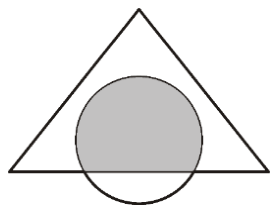
A figure is made of a triangle and a circle that partly overlap. The grey area is 45% of the whole figure, and the white part of the triangle is 40% of the whole figure. What percent of the circle’s area is the white part lying outside the triangle?
Show answer
Answer: B — 25%
Show hints
Hint 1 of 2
Split the shape into three pieces: the white triangle part, the grey overlap, and the white circle part outside.
Still stuck? Show hint 2 →
Hint 2 of 2
The whole shape is 100%; use 45% grey and 40% white-triangle to find the leftover circle piece, then compare it to the whole circle.
Show solution
Approach: track the percent pieces of the figure
The whole figure is 100%: white triangle 40% plus grey 45% leaves 15% for the white circle part outside the triangle.
The grey region is the overlap inside the circle, so the whole circle is grey (45%) plus its outside white part (15%) = 60% of the figure.
The white outside part is 15/60 = 25% of the circle, so the answer is B.
A painter wants to mix 2 litres of blue paint with 3 litres of yellow to make 5 litres of green. By mistake he uses 3 litres of blue and 2 litres of yellow, making the wrong shade. What is the least amount of this green he must throw away so that, by adding only blue or yellow, the rest becomes exactly 5 litres of the correct shade?
Show answer
Answer: A — 5⁄3 litre
Show hints
Hint 1 of 2
The wrong mix is 3 blue : 2 yellow (5 L); correct green is 2 blue : 3 yellow. Compare the blue fractions.
Still stuck? Show hint 2 →
Hint 2 of 2
You may only ADD paint, so you must throw away enough wrong mix that the kept blue and yellow can still reach a 2:3 mix within 5 L.
Show solution
Approach: keep a portion that can be corrected by adding
The wrong 5 L holds 3 L blue and 2 L yellow; correct green needs blue:yellow = 2:3 in 5 L (2 L blue, 3 L yellow).
Keep a fraction k of the wrong mix: kept blue = 3k, yellow = 2k. Since you may only add, need 3k <= 2, so k <= 2/3.
The minimum thrown away is 5(1 - 2/3) = 5/3 litre, so the answer is A.
Lady Josephine bought a pack of beans. The beans come mixed with impurities such as pebbles and sand, and the label says these impurities make up 8% of the contents of the package. Lady Josephine removes part of these impurities, reducing them to 4% of the contents of the package. What fraction of the total amount of impurities was removed from the package?
Show answer
Answer: B — 2548
Show hints
Hint 1 of 2
Start with a 100 g pack: 8 g impurities, 92 g good beans; removing impurities does not change the good beans.
Still stuck? Show hint 2 →
Hint 2 of 2
After removal the impurities are 4% of the new, smaller pack — solve for how much impurity was taken out.
Show solution
Approach: keep the good beans fixed
Take a 100 g pack: 8 g impurities and 92 g good beans. Removing x g of impurity leaves a pack of (100 − x) g.
Now (8 − x) is 4% of (100 − x): 8 − x = 0.04(100 − x), giving 4 = 0.96x, so x = 25/6 g.
The fraction of the original impurities removed is (25/6) ÷ 8 = 25/48.
Elisabeth has 60 pralines. On Monday she eats 110 of them. Of the ones left she eats 19 on Tuesday, then on Wednesday 18 of those left from the day before, on Thursday 17 of those left, and so on, until she eats one half of the pralines left over from the day before. How many pralines has she still got afterwards?
Show answer
Answer: E — 6
Show hints
Hint 1 of 2
Each day she removes a unit fraction of what is currently left.
Still stuck? Show hint 2 →
Hint 2 of 2
Track the running total day by day until the 'eat one half' step.
I have a 6 cm × 6 cm square and a certain triangle. If I lay the square on top of the triangle I can cover up to 60% of the area of the triangle. If I lay the triangle on top of the square I can cover up to 23 of the area of the square. What is the area of the triangle?
Show answer
Answer: D — 40 cm²
Show hints
Hint 1 of 2
The largest possible overlap of square and triangle is one quantity seen two ways.
Still stuck? Show hint 2 →
Hint 2 of 2
Set 60% of the triangle equal to 2/3 of the square and solve.
Show solution
Approach: equate the maximum overlap from both views
The square has area 36, so 2/3 of it is 24 - the most the shapes can share.
From the triangle's side that same maximum is 60% of its area: 0.6 x T = 24, so T = 40.