About this topic
Three friends shake hands once each. Easy — 3 handshakes. Five friends? Still listable. Twenty friends? Now you do not want to draw it. There is a one-line answer, and a kid who knows it beats a kid who draws every line.
That is the whole game. Counting problems look scary because there seem to be hundreds of cases — but almost every one folds down to a small set of moves you can name and reuse:
- List when the answer is small enough to write out.
- Multiply independent choices.
- Count the opposite and subtract.
- Split into cases, count each, add.
And probability is not a separate subject. It is counting, done twice: count the outcomes you want, count all the outcomes, divide. If you can count, you can do probability.
Each chapter hands you one new move. By the end you will reach for the right one on sight — and stop drawing twenty handshakes.
Careful listing — when the answer is small enough to write out
Try this in your head: write down every way to arrange the letters A, B, C in a row. If you scribble them as they pop up — ACB, BAC, ABC, CBA… — you will lose track and either miss one or write one twice. Now do it again, but force yourself to go in alphabetical order:
- ABC, ACB
- BAC, BCA
- CAB, CBA
Six. And you know it is six, because you marched through it: A first (two ways), then B first (two ways), then C first (two ways). The order did the bookkeeping for you.
That is the entire skill. For a small count, the smartest tool is not a formula — it is writing them all out in a fixed order. The list never lies. The danger was never that listing is slow; it is that a random list double-counts and skips. A systematic one cannot.
THE MOVE: PICK AN ORDER, THEN MARCH
Before you write a single case, choose an order — alphabetical, smallest-first, by the value of one key item. Then walk it without jumping around. Every case appears once, in its slot.
(This particular list is also 3! = 3 × 2 × 1 = 6, the factorial you will meet in chapter 8. For small numbers, the list is clearer than any formula — and it is its own proof.)
Counting a plain list — slide it down to start at 1
How many whole numbers are in the list 9, 10, 11, …, 27? The list does not start at 1, so the last number is not the count. But here is a move that makes it start at 1: subtract 8 from every number. The list slides to 1, 2, 3, …, 19 — same length, and now the last number is the count. So there are 19 numbers.
Sliding the list never changes how many entries it has, so this always works. It gives the formula every counter should own:
HOW MANY FROM a TO b
The count of whole numbers from a to b (both ends included) is
b − a + 1
The + 1 is there because you keep both fenceposts. A fence 10 feet long with a post every foot needs 11 posts, not 10.
Now put it beside the bogus “span ÷ step” from the box below. For multiples in a range, slide them onto 1, 2, 3, … the same way. How many multiples of 4 lie between 25 and 101?
- Smallest multiple of 4 that is at least 25: since 24 = 4 × 6 is too small, it is
4 × 7 = 28. - Largest multiple of 4 that is at most 101:
4 × 25 = 100. - So the list is 28, 32, …, 100. Divide every term by 4 to get 7, 8, …, 25 — an ordinary list. Count it:
25 − 7 + 1 = 19multiples.
The recipe: find the first multiple at or above the low end, the last at or below the high end, divide both by the step, then apply b − a + 1. That positive method is what the bogus shortcut below is faking — and unlike the shortcut, it never misses an endpoint.
b − a + 1.)Framing inspired by AoPS Prealgebra.
(Digit-counting / page-numbering idea adapted from Problem Solving via the AMC, Australian Maths Trust.)
Go deeper: counting digits across many numbers (the page-number trick)
Counting digits, not numbers — the page-number trick
A book has pages numbered 1, 2, 3, … up to 150. How many digits get printed in all those page numbers?
Your instinct is to write them all out and count. 150 numbers, each 1 to 3 digits long — that’s a wall of typing. Resist it. The trick: group the pages by how many digits each one uses, and listing collapses into three quick multiplications.
- 1-digit pages (1–9): that’s 9 pages, 1 digit each →
9 × 1 = 9digits. - 2-digit pages (10–99): that’s 90 pages, 2 digits each →
90 × 2 = 180digits. - 3-digit pages (100–150): that’s
150 − 100 + 1 = 51pages, 3 digits each →51 × 3 = 153digits.
Add the groups: 9 + 180 + 153 = 342 digits. No wall of typing.
(Watch the page count in that last group. From 100 to 150 there are 51 pages, not 50 — count both ends. The classic slip is forgetting the + 1.)
DIGIT BLOCKS
1–9: 9 numbers (1 digit). 10–99: 90 numbers (2 digits). 100–999: 900 numbers (3 digits). Count each block, multiply by its digit-length, add.
Running it backwards
The harder version hands you the digit total and asks for the page count. “A book’s page numbers use 270 digits. How many pages?” Peel off the blocks in order:
- Pages 1–9 eat
9digits. Left:270 − 9 = 261. - Pages 10–99 eat
180more. Left:261 − 180 = 81. - The rest are 3-digit pages:
81 ÷ 3 = 27of them (pages 100–126).
So the book has 99 + 27 = 126 pages. Same blocks, subtracting your way down instead of adding up.
To count digits across many numbers, group by digit-length first — never write them all out.
Go deeper: a named move — list by the item that runs out first
A named move: list by the item that runs out first
When you must list combinations of a few sizes, order your list by the largest piece — it caps out fastest, so it gives the fewest rows. That single choice is what kept the $17-bills list to four lines.
Quick example. How many ways to make 30 cents with only dimes and nickels (any number of each, order ignored)? List by the number of dimes, the bigger coin: 3 dimes = 30¢ (0 nickels); 2 dimes = 20¢ + two nickels; 1 dime = 10¢ + four nickels; 0 dimes = six nickels. Four rows, so 4 ways. Leading with dimes (0–3) made the list short; leading with nickels (0–6) would have been longer for the same answer.
When in doubt, list. If you are not sure whether a formula applies, write out the first 4 or 5 cases. Often the pattern jumps out — or the whole list is short enough to finish.
One rule of thumb: if the list is heading past about 25 items, stop and switch to a formula (multiplication, complementary counting). Listing is for small counts; formulas are for big ones.
How many multiples of 10 are there from 11 to 103? The span is 103 − 11 = 92, and the multiples step by 10, so just divide: 92 ÷ 10 = 9.2 → about 9. And for multiples of 10 from 9 to 101, the span is 101 − 9 = 92 too, so that is also 9. Same span, same answer.
Why it breaks: “divide the span by the step” ignores the endpoints — it counts gaps between multiples, not the multiples themselves, and never checks whether each end is actually included. List them and the two cases are different: from 9 to 101 the multiples are 10, 20, …, 100 — that is 10 of them; from 11 to 103 they are 20, 30, …, 100 — only 9, because 10 fell below 11. Same span, different counts.
The fix: shrink to a list you can count. Multiples of 10 up to 100 are 10×1, 10×2, …, 10×10 — divide each by 10 to get 1, 2, …, and count those, both ends included. Beware any quick shortcut you cannot explain — the off-by-one at the ends is where it bites.
Framing inspired by AoPS Prealgebra.
How many different combinations of $5 bills and $2 bills can be used to make a total of $17? Order does not matter.
Problem. How many different combinations of $5 and $2 bills make $17? Order doesn’t matter.
Step 1 — pick an order to list in. List by the number of $5 bills used. That count can only be 0, 1, 2, or 3 — four fives (=$20) would already overshoot $17.
Step 2 — walk the four rows. 3 fives = $15, need $2 more ⇒ one $2 bill. ✓ 2 fives = $10, need $7 from $2s — impossible ($7 is odd). 1 five = $5, need $12 ⇒ six $2 bills. ✓ 0 fives = $0, need $17 from $2s — impossible ($17 is odd).
Step 3 — read off the survivors. Only the rows with an odd number of fives work (since $2 bills add an even amount but $17 is odd). That gives 2 combinations.
Listing by 'number of $5 bills used' hits every case exactly once. The parity observation (the number of $5s must be odd) skips the impossible rows in one step.
Pick a definite ordering before listing. Walk through systematically. Stop when you've covered every case in your ordering.
2004 · #8 Find the number of two-digit positive integers whose digits total 7.
Find the number of two-digit positive integers whose digits total 7.
Show answer
Show hints
Still stuck? Show hint 2 →
Show solution
- Pick the tens digit a; the units digit is then forced to 7 − a. So the count equals the number of valid a.
- a can be 1, 2, 3, 4, 5, 6, or 7 — it can't be 0 (no leading zero) and can't exceed 7 (then the units digit would go negative). That's 7 values: 16, 25, 34, 43, 52, 61, 70.
- You'll reuse this whenever one choice locks in the others — count the driver, not the whole pair.
2011 · #8 Bag A has three chips labeled 1, 3, and 5. Bag B has three chips labeled 2, 4, and 6. If one chip is drawn from each bag, how many...
Bag A has three chips labeled 1, 3, and 5. Bag B has three chips labeled 2, 4, and 6. If one chip is drawn from each bag, how many different values are possible for the sum of the two numbers on the chips?
Show answer
Show hints
Still stuck? Show hint 2 →
Show solution
- Smallest sum: 1 + 2 = 3. Largest: 5 + 6 = 11. Every sum is odd, so the only candidates are 3, 5, 7, 9, 11.
- Each of those is achievable (e.g. 5 = 1+4 or 3+2, 7 = 1+6 = 3+4 = 5+2, etc.), so all 5 occur.
- That's 5 distinct values.
- Worth keeping: spotting that odd + even is always odd cuts the candidate list in half before you compute anything — check the parity of a sum first.
- The nine sums are 3, 5, 7 / 5, 7, 9 / 7, 9, 11.
- Deduping leaves {3, 5, 7, 9, 11} = 5 values.
2017 · #7 The sum of three different positive whole numbers is 7. How big is their product?
The sum of three different positive whole numbers is 7. How big is their product?
Show answer
Show hints
Still stuck? Show hint 2 →
Show solution
- The only three different positive whole numbers adding to 7 are 1, 2 and 4.
- Their product is 1 × 2 × 4 = 8.
2024 · #6 Ria has three cards with the numbers 1, 5 and 11. She wants to place the cards next to each other to form a 4-digit number. How many...
Ria has three cards with the numbers 1, 5 and 11. She wants to place the cards next to each other to form a 4-digit number. How many different 4-digit numbers can she form?
Show answer
Show hints
Still stuck? Show hint 2 →
Show solution
- Placing cards 1, 5, 11 in a row always gives a 4-digit number.
- Writing out the orders gives 1511, 1115, 5111, and 1151 (some orders repeat).
- The distinct numbers are 1511, 1115, 5111, 1151.
- That is 4 different numbers.
2015 · #4 The Centerville Middle School chess team consists of two boys and three girls. A photographer wants to take a picture of the team to...
The Centerville Middle School chess team consists of two boys and three girls. A photographer wants to take a picture of the team to appear in the local newspaper. She decides to have them sit in a row with a boy at each end and the three girls in the middle. How many such arrangements are possible?
Show answer
Show hints
Still stuck? Show hint 2 →
Show solution
- The ends are boys-only and the middle is girls-only, so the two choices never collide — handle them separately.
- Boys in the 2 end seats: 2! = 2 ways. Girls in the 3 middle seats: 3! = 6 ways.
- By the rule of product, total = 2 × 6 = 12.
- Why this transfers: any time a setup divides into independent stages, multiply the counts. The only trap is making sure the stages really don't affect each other — here they can't, since boys and girls occupy disjoint seats.
Multiplication principle — independent choices multiply
If you make a series of choices, and each choice's count is independent of the others, the total number of outcomes is the product of the counts.
MULTIPLICATION PRINCIPLE
If step 1 has m₁ options, step 2 has m₂ options (regardless of step 1's outcome), step 3 has m₃ options, etc., then the total number of ways to make all the choices is:
m₁ × m₂ × m₃ × …
Why does it work? Picture a tree. Each level is one choice. The first choice has m₁ branches; each of those splits into m₂ branches; each of those into m₃; and so on. The total number of leaves at the bottom is the product.
3 shirts × 4 pants — three branches, each splitting into four.
Add 2 hats and each leaf splits again: 3 × 4 × 2 = 24 outfits.
When the count changes after each step. If picking the second item depends on the first — say, you can't pick the same item again — then the count of choices shrinks at each step. For a 3-letter sequence from {A, B, C, D, E} with no letter repeated:
- 1st letter: 5 choices.
- 2nd letter: 4 choices (anything except the first).
- 3rd letter: 3 choices (anything except the first two).
Total: 5 × 4 × 3 = 60.
This shrinking-pool pattern is called a permutation (chapter 8 has more).
Arranging in a circle
Five friends in a row: 5! = 120 orders. Now seat them around a round table. You get fewer — here's why.
A circle has no “first seat.” The order ABCDE is the same as BCDEA, CDEAB, DEABC, EABCD — spin the table and nobody has moved relative to anyone else. Every circular seating got counted 5 times inside that 120.
So divide it out: 5! ÷ 5 = 24 seatings.
CIRCLE RULE
In a row: n!. Around a circle: n! ÷ n = (n − 1)!
If flipping it over counts as the same — a necklace you can turn over — halve it again: (n − 1)! ÷ 2.
THE MOVE: at each step ask “how many options do I have right now?” — then multiply.
(Circular-arrangement idea adapted from Problem Solving via the AMC, Australian Maths Trust.)
A named move: draw the slots, fill each with its count
Before multiplying, draw one empty box per decision and write the number of options inside each. The product of the boxes is the answer — and the boxes stop you forgetting a step or mis-reading a restriction.
Quick example. A locker code is two letters then two digits, where the two letters must be different but the digits may repeat. Four boxes: 26 (1st letter), 25 (2nd letter, different), 10 (1st digit), 10 (2nd digit). Multiply: 26 × 25 × 10 × 10 = 65{,}000 codes. The word “different” turned one box from 26 into 25.
For each step, ask: how many options do I have now? Multiply. The hardest part isn't the multiplication; it's identifying the right number of choices at each step, which depends on whether earlier choices restrict later ones.
A haunted house has six windows. In how many ways can Georgie the Ghost enter the house by one window and leave by a different window?
Georgie enters through one window and leaves through a different window. Two steps:
- Choose an entry window: 6 ways.
- Choose an exit window, different from the entry: 5 ways (anything except the one used).
Total: 6 × 5 = 30 ways.
The “different” constraint shrinks the second count from 6 to 5. Always read the problem for these little restrictions — they change the count.
For independent choices: multiply. For “no repeats”: shrink the count by 1 each step. For “distinct in some way”: adjust the count at each step.
2004 · #4 Ms. Hamilton's eighth-grade class wants to participate in the annual three-person-team basketball tournament. Lance, Sally, Joy, and...
Ms. Hamilton's eighth-grade class wants to participate in the annual three-person-team basketball tournament. Lance, Sally, Joy, and Fred are chosen for the team. In how many ways can the three starters be chosen?
Show answer
Show hints
Still stuck? Show hint 2 →
Show solution
- Each starting trio leaves exactly one person on the bench, so 'how many trios?' = 'how many ways to pick the one who sits?' There are 4 people, so 4 ways.
- Why this transfers: whenever you're choosing almost all of a group, count the tiny excluded part instead — far less work. Choosing 18 of 20, for instance, is just choosing the 2 to drop.
- C(4, 3) = 4!/(3! · 1!) = 4.
- Same 4, the long way.
2014 · #12 A magazine printed photos of three celebrities along with three photos of the celebrities as babies. The baby pictures did not identify...
A magazine printed photos of three celebrities along with three photos of the celebrities as babies. The baby pictures did not identify the celebrities. Readers were asked to match each celebrity with the correct baby pictures. What is the probability that a reader guessing at random will match all three correctly?
Show answer
Show hints
Still stuck? Show hint 2 →
Show solution
- Order the 3 baby photos against the celebrities: 3! = 6 equally likely ways.
- Exactly 1 of those 6 is the all-correct matching, so probability = 1/6 = 1/6.
- Reusable idea: when every arrangement is equally likely and only one wins, P(win) = 1/(total arrangements). The hard part is always the count, never the division.
- First celebrity: 1 of 3 baby photos is right ⇒ chance 1/3.
- Given that, the second celebrity: 1 of the 2 remaining is right ⇒ chance 1/2 (and the third is then forced).
- Multiply: (1/3)(1/2) = 1/6.
2004 · #2 How many different four-digit numbers can be formed by rearranging the four digits in 2004?
How many different four-digit numbers can be formed by rearranging the four digits in 2004?
Show answer
Show hints
Still stuck? Show hint 2 →
Show solution
- The slick view: a valid number is fixed once you decide where the 2 and 4 sit, because the leftover slots must be the two zeros. The thousands place must be 2 or 4 (no leading 0) — 2 choices — and the other non-zero digit then has 3 open slots — 3 choices. That's 2 × 3 = 6.
- Why this beats brute force: you never list anything; the two zeros take care of themselves once the 'real' digits are placed.
- You'll meet this again any time a number has repeated digits and a 'first digit can't be 0' rule — place the restricted/distinct items first, let the duplicates fall into the gaps.
- All arrangements of {2, 0, 0, 4}: 4!/2! = 12 (divide by 2! because the two 0s are identical).
- Bad ones put a 0 in front: the remaining three slots hold {2, 0, 4}, giving 3! = 6 arrangements.
- Valid = 12 − 6 = 6.
- Smallest first: 2004, 2040, 2400, 4002, 4020, 4200.
- That's exactly 6 — a fine check when the count is this small.
2011 · #12 Angie, Bridget, Carlos, and Diego are seated at random around a square table, one person to a side. What is the probability that Angie...
Angie, Bridget, Carlos, and Diego are seated at random around a square table, one person to a side. What is the probability that Angie and Carlos are seated opposite each other?
Show answer
Show hints
Still stuck? Show hint 2 →
Show solution
- Pin Angie in any one seat — this throws away the seating's overall symmetry so we only watch Carlos.
- Carlos is equally likely to take any of the 3 leftover seats, and exactly one of them is directly across from Angie.
- So the probability is 1 out of 3 = 1/3.
- Why this transfers: in seating/circular problems, fixing one object as an anchor turns a messy 4! = 24 count into a simple "where does the one I care about go?"
- Total ways to seat 4 people = 4! = 24.
- Favorable: choose Angie's seat (4 ways), Carlos takes the opposite seat (1 way), the other two fill the rest (2! = 2). That's 4 × 1 × 2 = 8.
- Probability = 8/24 = 1/3.
1997 · #9 Three students, with different names, line up single file. What is the probability that they are in alphabetical order from front to back?
Three students, with different names, line up single file. What is the probability that they are in alphabetical order from front to back?
Show answer
Show hints
Still stuck? Show hint 2 →
Show solution
- Three different people can line up in 3 × 2 × 1 = 6 distinct orders (3 choices for front, 2 for middle, 1 left for back).
- Exactly one of those orders is alphabetical, and all 6 are equally likely, so the probability is 1/6.
- Whatever order they happen to stand in, relabeling can't favor one arrangement over another, so each of the possible orders is equally likely.
- Alphabetical is just one of those orders. With 3 names there are 3! = 6 orders, so its share is 1/6 — no listing required.
Complementary counting — count what you don't want
Count the people in a room who are not wearing a hat. Easy — you glance around and tally the bare heads. Now count the people who are wearing one… the same room, but suddenly you are squinting at every cap and beanie. Same room, two ways to count, and one is far easier. The trick: count the easy side, then subtract from the total.
Contest counting hides this all the time. Whenever the thing you want is messy but its opposite is tidy, count the opposite and subtract.
COMPLEMENTARY COUNTING
|Wanted| = |All| − |Not wanted|
This works because every item is either wanted or not — those two groups together are everything. So if you know how many total there are and how many are NOT wanted, the wanted count is the difference.
The classic signal: phrases like at least one, at least k, contains at least one X, has at least one event A. Trying to count these directly forces you into messy casework (“exactly 1, exactly 2, exactly 3, …”). Instead, count the complement (zero events) and subtract from the total.
Concrete example. How many 4-digit numbers contain at least one digit 2?
- Total 4-digit numbers: 9000 (from 1000 to 9999).
- How many contain no 2? The thousands digit has 8 choices (1, 3, 4, 5, 6, 7, 8, 9 — not 0, not 2). The other three digits each have 9 choices (any digit 0–9 except 2). Total without 2: 8 × 9 × 9 × 9 = 5832.
- So how many contain at least one 2? 9000 − 5832 = 3168.
Counting these directly would require casework on “exactly one 2 / exactly two 2s / exactly three 2s / four 2s” — many cases. Complementary counting collapsed it to one subtraction.
THE MOVE: when you see “at least one,” count the “none” case instead and subtract from the total.
One more: “at least one” in disguise
Quick example. How many three-digit numbers contain at least one digit 7? Direct counting means casework on one 7, two 7s, three 7s — messy. Flip it. Total three-digit numbers: 900 (100–999). Numbers with no 7: hundreds digit has 8 choices (1–9 except 7), tens and units have 9 each (0–9 except 7), giving 8 × 9 × 9 = 648. So at-least-one-7 = 900 − 648 = 252. One subtraction beats four cases.
The signal phrase is “at least one”. When you see it, immediately think: count the “none” case instead, then subtract.
In a town of 351 adults, every adult owns a car, motorcycle, or both. If 331 adults own cars and 45 adults own motorcycles, how many of the car owners do not own a motorcycle?
Problem. 351 adults; every adult owns a car or a motorcycle (or both). 331 own cars; 45 own motorcycles. How many car owners don’t own a motorcycle?
Step 1 — spot the complement. Every adult owns at least one vehicle, so anyone who does not own a motorcycle must own a car. “Car-only” is exactly “not a motorcycle owner.”
Step 2 — subtract. car-only = (total) − (motorcycle owners) = 351 − 45 = 306. You never had to find how many own both.
The 'everyone owns at least one' line is the key. It collapses 'car-only' to 'not-a-motorcycle-owner', and the total minus that subgroup gives the answer in one step.
For “at least one” or “at least k of X”, count the complement (“none” or “fewer than k”) and subtract.
2004 · #21 Spinners A and B are spun. On each spinner, the arrow is equally likely to land on each number. What is the probability that the product...
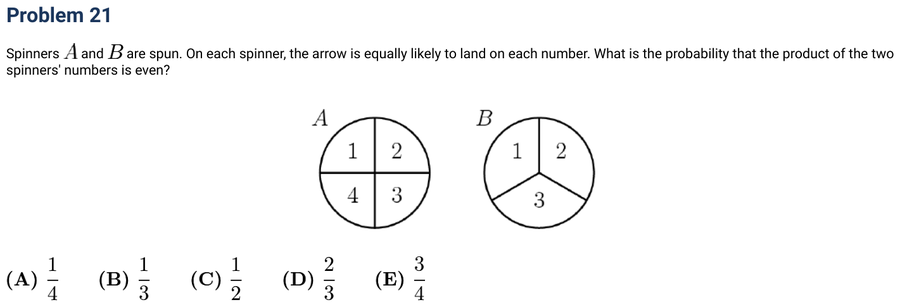
Spinners A and B are spun. On each spinner, the arrow is equally likely to land on each number. What is the probability that the product of the two spinners' numbers is even?
Show answer
Show hints
Still stuck? Show hint 2 →
Show solution
- Spinner A shows 1, 2, 4, 3 — odds are {1, 3}, so P(A odd) = 2/4 = 1/2. Spinner B shows 1, 2, 3 — odds are {1, 3}, so P(B odd) = 2/3.
- Product is odd only if both are odd: P(odd) = (1/2)(2/3) = 1/3.
- Therefore P(even) = 1 − 1/3 = 2/3.
- Why the complement wins: the direct count needs three even-cases, but 'both odd' is a single product — one multiplication instead of several additions. Odd × odd = odd is the only way to dodge an even factor.
- There are 4 × 3 = 12 equally likely (A, B) outcomes.
- Odd products come only from A ∈ {1,3} and B ∈ {1,3}: that's 2 × 2 = 4 odd outcomes, so 12 − 4 = 8 even outcomes.
- P(even) = 8/12 = 2/3.
2015 · #7 Each of two boxes contains three chips numbered 1, 2, 3. A chip is drawn randomly from each box and the numbers on the two chips are...
Each of two boxes contains three chips numbered 1, 2, 3. A chip is drawn randomly from each box and the numbers on the two chips are multiplied. What is the probability that their product is even?
Show answer
Show hints
Still stuck? Show hint 2 →
Show solution
- A product is odd only when both factors are odd, while it's even in many scenarios — so the odd case is the simpler one to count.
- Each box has odds {1, 3} out of {1, 2, 3}, a 2/3 chance, and the draws are independent: P(both odd) = (2/3)(2/3) = 4/9.
- P(even product) = 1 − 4/9 = 5/9.
- Why this transfers: 'at least one __' or 'is even/divisible' events are usually faster through the complement — count the one clean way it fails, then subtract from 1.
- The two draws give 3 × 3 = 9 equally likely pairs.
- List products: row by row they are 1,2,3 / 2,4,6 / 3,6,9. The even ones are 2,2,4,6,6 — that's 5 outcomes.
- Probability = 5/9 = 5/9, matching the complement.
2020 · #10 Zara has a collection of 4 marbles: an Aggie, a Bumblebee, a Steelie, and a Tiger. She wants to display them in a row on a shelf, but...
Zara has a collection of 4 marbles: an Aggie, a Bumblebee, a Steelie, and a Tiger. She wants to display them in a row on a shelf, but does not want to put the Steelie and the Tiger next to one another. In how many ways can she do this?
Show answer
Show hints
Still stuck? Show hint 2 →
Show solution
- All arrangements of 4 distinct marbles: 4! = 24.
- Bad ones (Steelie–Tiger touching): glue them into one block, leaving 3 items → 3! = 6 orders; the block itself is ST or TS → ×2 = 12 bad.
- Good = 24 − 12 = 12.
- You'll see this again as: for a “must be adjacent” condition, glue them into one unit; for “must not be adjacent,” count the total and subtract the glued case. Two tools that pair up on almost every seating problem.
- Place the Aggie and Bumblebee first: 2! = 2 orders. They create 3 gaps: _ A _ B _.
- Drop Steelie and Tiger into two different gaps so they can't touch: choose 2 of the 3 gaps and order them, 3 × 2 = 6 ways.
- 2 × 6 = 12. The gap method builds only the good arrangements directly — no subtracting.
2025 · #7 On the most recent exam in Prof. Xochi's class,5 students earned a score of at least 95%,13 students earned a score of at least 90%,27...
On the most recent exam in Prof. Xochi's class,
- 5 students earned a score of at least 95%,
- 13 students earned a score of at least 90%,
- 27 students earned a score of at least 85%, and
- 50 students earned a score of at least 80%.
How many students earned a score of at least 80% and less than 90%?
Show answer
Show hints
Still stuck? Show hint 2 →
Show solution
- The four counts are nested, not separate: the 13 who scored ≥ 90% sit inside the 50 who scored ≥ 80%. So you subtract, you don't add.
- Students in [80%, 90%) = (those ≥ 80%) − (those ≥ 90%) = 50 − 13 = 37. The 85% and 95% counts are just there to distract.
- Why this transfers: with "at least" cutoffs, the count for a band is the difference of two cumulative counts — spot the nesting and subtract instead of trying to build each band from scratch.
2002 · #21 Harold tosses a nickel four times. The probability that he gets at least as many heads as tails is
Harold tosses a nickel four times. The probability that he gets at least as many heads as tails is
Show answer
Show hints
Still stuck? Show hint 2 →
Show solution
- Heads and tails are interchangeable, so P(heads ≥ tails) = P(tails ≥ heads). Together these events cover all outcomes, overlapping only on the 2–2 tie.
- By inclusion-exclusion, P(H≥T) + P(T≥H) = 1 + P(tie), i.e. 2·P(H≥T) = 1 + P(tie). The tie has C(4,2) = 6 of the 16 equally likely outcomes, so P(tie) = 6/16 = 3/8.
- Then P(heads ≥ tails) = (1 + 3/8) ÷ 2 = 11/16.
- *Why this transfers:* when two symmetric events together fill the whole sample space, you don't count both — you write 2·P = 1 + P(overlap) and only the small overlap needs counting.
- "At least as many heads as tails" over 4 flips means 2, 3, or 4 heads.
- Ways: C(4,2) + C(4,3) + C(4,4) = 6 + 4 + 1 = 11, out of 2⁴ = 16 outcomes.
- Probability = 11/16.
Listing, multiplication, complement
Three problems on the most basic counting moves.
2004 · #8 Find the number of two-digit positive integers whose digits total 7.
Find the number of two-digit positive integers whose digits total 7.
Show answer
Show hints
Still stuck? Show hint 2 →
Show solution
- Pick the tens digit a; the units digit is then forced to 7 − a. So the count equals the number of valid a.
- a can be 1, 2, 3, 4, 5, 6, or 7 — it can't be 0 (no leading zero) and can't exceed 7 (then the units digit would go negative). That's 7 values: 16, 25, 34, 43, 52, 61, 70.
- You'll reuse this whenever one choice locks in the others — count the driver, not the whole pair.
2007 · #4 A haunted house has six windows. In how many ways can Georgie the Ghost enter the house by one window and leave by a different window?
A haunted house has six windows. In how many ways can Georgie the Ghost enter the house by one window and leave by a different window?
Show answer
Show hints
Still stuck? Show hint 2 →
Show solution
- Stage 1 (enter): 6 windows to choose from.
- Stage 2 (leave): must differ from the entrance, so one window is off the table — 5 left.
- Multiply the stages: 6 · 5 = 30.
- You'll reuse this: 'pick an ordered pair of distinct things from n' is always n · (n−1) — first/second place in a race, president/VP, in/out doors.
2011 · #6 In a town of 351 adults, every adult owns a car, motorcycle, or both. If 331 adults own cars and 45 adults own motorcycles, how many of...
In a town of 351 adults, every adult owns a car, motorcycle, or both. If 331 adults own cars and 45 adults own motorcycles, how many of the car owners do not own a motorcycle?
Show answer
Show hints
Still stuck? Show hint 2 →
Show solution
- Every adult owns at least one vehicle, so an adult without a motorcycle owns a car and nothing else — exactly the "car but no motorcycle" group we want.
- Count the non-motorcycle owners: 351 − 45 = 306.
- Why this transfers: when every item is in "A or B or both," the "A only" group is just everyone minus the B group — counting the complement beats wrestling with the overlap.
- Both = cars + motorcycles − total = 331 + 45 − 351 = 25 own both.
- Car owners without a motorcycle = 331 − 25 = 306, matching above.
Casework — split, count, add
When choices split into types and the counts are different in each type, count each type separately and add. This is called casework.
How to set up clean casework:
- Pick the splitting criterion. (Often: “based on what the smallest item is” or “based on which of a few cases applies.”)
- List the cases. They must be mutually exclusive (no overlap) and exhaustive (cover everything).
- Count each case independently.
- Add the counts.
The critical rules:
- If cases overlap, you'll double-count. Bad.
- If cases miss some items, you'll undercount. Also bad.
Concrete example. How many ways can two dice show a sum of 7?
Casework on the first die's value:
- First die = 1: second must be 6. (1 way)
- First die = 2: second must be 5. (1 way)
- First die = 3: second must be 4. (1 way)
- First die = 4: second must be 3. (1 way)
- First die = 5: second must be 2. (1 way)
- First die = 6: second must be 1. (1 way)
Total: 6 ways.
Casework on “first die value” gives mutually exclusive cases (first die can only be one number) and exhaustive (covers all 6 possibilities). Perfect.
Multiply WITHIN a case, add ACROSS cases
This is the line that ties chapters 2 and 4 together. Inside one case you make a chain of choices — that is an AND, so you multiply. Between separate cases you pick exactly one — that is an OR, so you add.
Picture a trip from town A to town D. You may go through B or through C, never both. From A there are 4 roads to B, then 3 roads from B to D; or 2 roads from A to C, then 5 roads from C to D.
Through B: 4 roads AND 3 roads → 4 × 3 = 12 trips. Through C: 2 AND 5 → 2 × 5 = 10 trips. The two routes are exclusive, so add: 12 + 10 = 22 trips. You multiplied inside each route and added across them — that is the whole grammar of counting in one picture.
MULTIPLY WITHIN, ADD ACROSS
Chained choices in one path (AND) → multiply. Separate exclusive cases (OR) → add.
Framing inspired by AoPS Prealgebra.
THE MOVE: split on the variable that gives the fewest cases — then count each and add.
Go deeper: split on even vs. odd — the parity case
Split on even vs. odd — the parity case
Some counting questions look like they need a giant sum-by-sum search. Often the only thing that matters is whether each number is even or odd. Split on that and the search collapses to two cases.
Why does parity do so much work? Because even/odd add in a fixed pattern, no matter the actual numbers:
- even + even = even
- odd + odd = even
- even + odd = odd
The rule for a sum: a sum is even exactly when it contains an even number of odd pieces (zero odds, two odds, four odds…). The evens never change the parity — only the odds flip it.
Concrete example. Pick 2 different numbers from {3, 7, 8, 10, 11}. How many pairs have an even sum? The set has 3 odds (3, 7, 11) and 2 evens (8, 10). A two-number sum is even only when both have the same parity:
- both odd: list the pairs of odds — {3,7}, {3,11}, {7,11} → 3 pairs.
- both even: only {8,10} → 1 pair.
Total 3 + 1 = 4 even-sum pairs — and you never added a single actual sum. You only counted odds and evens. (Counting pairs like this has a one-line formula, C(n, 2), waiting in chapter 8 — here the list is just as fast.)
Go deeper: casework on the biggest coin
One more: casework on the biggest coin
Quick example. How many ways to make 25 cents using nickels, dimes, and quarters (order ignored)? Split on the number of quarters, the coin that caps out fastest: 1 quarter = 25¢ done (1 way). 0 quarters: make 25¢ from dimes and nickels — 0 dimes/5 nickels, 1 dime/3 nickels, 2 dimes/1 nickel (3 ways). Total 1 + 3 = 4 ways. Splitting on the priciest coin keeps the case list shortest.
Pick the casework variable that gives the fewest cases. If splitting on “value of the first card” gives 10 cases but splitting on “parity of the sum” gives 2 cases, prefer parity.
Also: cases don't have to be of equal size. The case “first letter is A” might have 100 sub-counts while “first letter is Z” might have 5 — that's fine. The total is the sum either way.
Zita would like to buy some flowers. She can choose between flowers for 3€, 4€ and 5€. How many different bouquets can she buy for exactly 23€?
Zita buys flowers that cost 3€, 4€, or 5€ each, and wants to spend exactly 23€. How many different bouquets are possible? (A bouquet is only how many of each kind — so “two 4€ flowers” is one bouquet.)
Your instinct is to hunt for combinations at random. You will miss some and repeat others. Instead, pick a splitting variable that pins each case down once. Split on how many 5€ flowers — that number can only be 0, 1, 2, 3, or 4 (five would already cost 25€). For each, see how the remaining euros can be made from 3€ and 4€ flowers:
- 0 fives → make 23€ from 3s and 4s: (5 threes + 2 fours) or (1 three + 5 fours). 2 ways.
- 1 five → make 18€: (6 threes) or (2 threes + 3 fours). 2 ways.
- 2 fives → make 13€: (3 threes + 1 four). 1 way.
- 3 fives → make 8€: (2 fours). 1 way.
- 4 fives → make 3€: (1 three). 1 way.
Add the cases: 2 + 2 + 1 + 1 + 1 = 7 bouquets — choice (D).
Splitting on “number of 5€ flowers” makes the cases mutually exclusive (a bouquet has one fixed count of fives) and exhaustive (0 through 4 covers everything). Inside each case the leftover is small enough to read off by hand. Pick the variable that gives the fewest, smallest cases — here, the priciest flower, since it caps out fastest.
Casework: pick a splitting variable with few options. List, count each case, add. Confirm cases are mutually exclusive and exhaustive.
2011 · #8 Bag A has three chips labeled 1, 3, and 5. Bag B has three chips labeled 2, 4, and 6. If one chip is drawn from each bag, how many...
Bag A has three chips labeled 1, 3, and 5. Bag B has three chips labeled 2, 4, and 6. If one chip is drawn from each bag, how many different values are possible for the sum of the two numbers on the chips?
Show answer
Show hints
Still stuck? Show hint 2 →
Show solution
- Smallest sum: 1 + 2 = 3. Largest: 5 + 6 = 11. Every sum is odd, so the only candidates are 3, 5, 7, 9, 11.
- Each of those is achievable (e.g. 5 = 1+4 or 3+2, 7 = 1+6 = 3+4 = 5+2, etc.), so all 5 occur.
- That's 5 distinct values.
- Worth keeping: spotting that odd + even is always odd cuts the candidate list in half before you compute anything — check the parity of a sum first.
- The nine sums are 3, 5, 7 / 5, 7, 9 / 7, 9, 11.
- Deduping leaves {3, 5, 7, 9, 11} = 5 values.
2024 · #8 On Monday Taye has $2. Every day, he either gains $3 or doubles the amount of money he had on the previous day. How many different...
On Monday Taye has $2. Every day, he either gains $3 or doubles the amount of money he had on the previous day. How many different dollar amounts could Taye have on Thursday, 3 days later?
Show answer
Show hints
Still stuck? Show hint 2 →
Show solution
- The trap is counting 2×2×2 = 8 paths; the question wants distinct amounts, and some paths collide. So carry a SET forward each day instead of a list of paths. Start $2. Tuesday: 2+3 = 5 or 2×2 = 4 → {4, 5}.
- Wednesday, apply both moves to each: 4+3 = 7, 4×2 = 8, 5+3 = 8, 5×2 = 10. The two 8's merge → {7, 8, 10}.
- Thursday from {7, 8, 10}: 7→{10,14}, 8→{11,16}, 10→{13,20}, all distinct → {10, 11, 13, 14, 16, 20}.
- 6 distinct amounts. This transfers: whenever "how many outcomes" can repeat, count states (the set), not branches — the set throws away duplicates for you. It's the seed of breadth-first thinking.
2020 · #6 Bia has the five coins shown. She goes to the grocery store to buy one fruit, paying with exactly three of the coins and receiving no...
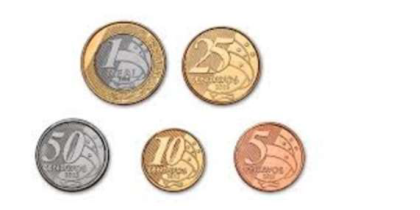
Bia has the five coins shown. She goes to the grocery store to buy one fruit, paying with exactly three of the coins and receiving no change. Among the fruit prices below, which one can she NOT pay for?
Show answer
Show hints
Still stuck? Show hint 2 →
Show solution
- The five coins are R$1.00, 0.50, 0.25, 0.10 and 0.05.
- 1.30 = 1.00+0.25+0.05, 1.35 = 1.00+0.25+0.10, 1.55 = 1.00+0.50+0.05, 1.75 = 1.00+0.50+0.25 - all work.
- For 1.40 no choice of three coins adds up (1.00 leaves 0.40 from two coins, impossible; without the 1.00 two coins fall far short).
- So she cannot buy the fruit costing 1.40.
2023 · #21 Alina writes the numbers 1, 2, …, 9 on separate cards, one number per card. She wishes to divide the cards into 3 groups of 3 cards so...
Alina writes the numbers 1, 2, …, 9 on separate cards, one number per card. She wishes to divide the cards into 3 groups of 3 cards so that the sum of the numbers in each group will be the same. In how many ways can this be done?
Show answer
Show hints
Still stuck? Show hint 2 →
Show solution
- The total 1+2+…+9 = 45 splits into three equal groups, so each must sum to 15. That target instantly pins the big and small cards.
- 7, 8, 9 must each land in a different group (any two of them already total 15 or more, leaving no room for a positive third). By the same squeeze, 1, 2, 3 spread out one per group too.
- So the only real choice is 5's partner-pair, which must sum to 10: {3,5,7}, {2,5,8}, or {1,5,9}. Test each by finishing the other two groups.
- {2,5,8} dies: it would leave 1, 3, 7, 9 to form two groups of 15, but 9 needs a 6 (gone) and 7 needs an 8 (gone) — impossible. The other two succeed: {1,5,9}/{3,4,8}/{2,6,7} and {3,5,7}/{1,6,8}/{2,4,9}.
- So there are 2 ways. This transfers: in equal-sum partition problems, first compute the target, then corner the extreme values — the largest elements have the fewest legal homes, so placing them first kills most of the casework.
1991 · #14 Several students are competing in a series of three races. A student earns 5 points for winning a race, 3 points for finishing second,...
Several students are competing in a series of three races. A student earns 5 points for winning a race, 3 points for finishing second, and 1 point for finishing third. There are no ties. What is the smallest number of points a student must earn in the three races to be guaranteed of earning more points than any other student?
Show answer
Show hints
Still stuck? Show hint 2 →
Still stuck? Show hint 3 →
Show solution
- "Guaranteed to win" means your total must exceed what the strongest possible rival could score, so think worst-case for you. First, a quick filter: 5, 3, 1 are all odd, and odd + odd + odd is always odd — so every three-race total is odd. Only 9, 11, 13, 15 are reachable; check from the bottom.
- Suppose you score 11. One way is 5 + 3 + 3 — but then a rival could take the two 1st places you didn't (5 + 5) plus a 1, reaching 11 and tying you. So 11 can be tied; not safe.
- Now score 13 — say 5 + 5 + 3 (win two races, 2nd in the third). The best any single rival can still collect is 2nd in your two wins and 1st in the remaining race: 3 + 3 + 5 = 11. That's strictly less than 13, every time.
- So the smallest guaranteed-winning total is 13.
- Why this transfers: "guarantee" problems are worst-case problems — you optimize against an adversary playing their best, not against an average. Pair that with a parity filter (totals here must be odd) to skip half the candidates instantly.
Probability — favorable over total
Spin a spinner split into 4 equal wedges, one of them red. What is the chance of red? You did not reach for a formula — you said “1 out of 4” because one wedge out of four is red. That is the whole idea of probability, and you already own it.
Write it down: count the outcomes you want, count all the outcomes, divide. A probability question is really two counting questions wearing a disguise — which means every tool from the last four chapters works here too.
Probability of an event = favorable outcomes / total outcomes, when all outcomes are equally likely.
PROBABILITY FORMULA
P(event) = |favorable| ÷ |total|
So a probability question is really TWO counting questions: how many ways the event happens, and how many total ways anything can happen.
Watch it work — two-dice sum
Roll two dice. What’s the probability the sum is 7? Total outcomes: 6 × 6 = 36 (one for each (A, B) pair). Favorable: count the cells in the grid where the sum is 7.
Six cells light up — one for each pair (1,6), (2,5), (3,4), (4,3), (5,2), (6,1). So P(sum=7) = 6/36 = 1/6.
Go deeper: four probability rules to know cold
Four rules to KNOW COLD
| Rule | When to use | Example |
|---|---|---|
| P(certain) = 1, P(impossible) = 0 | Sanity bounds — all probabilities live in [0, 1]. | P(die ≤ 6) = 1; P(die = 7) = 0 |
| P(NOT A) = 1 − P(A) | If counting “not” is easier than counting “is.” | P(not 6 on a die) = 1 − 1/6 = 5/6 |
| P(A OR B) = P(A) + P(B) (mutually exclusive) | Events can’t both happen at once. | P(die = 1 or die = 2) = 1/6 + 1/6 = 2/6 |
| P(A AND B) = P(A) · P(B) (independent) | Events don’t affect each other. | P(coin heads AND die = 6) = ½ · 1/6 = 1/12 |
Go deeper: symmetry — count one side, the other matches
Symmetry — count one side, the other matches
Two players each roll a die. What’s the probability the first roll is larger than the second? Your instinct is to march through all 36 cells and tally where first > second. Resist it.
Look at the two sides. “First larger” and “second larger” are mirror images — swap the two dice and one turns into the other. Nothing makes the first die special, so those two events must have the exact same probability. Symmetry hands you that for free.
So split the 36 outcomes into three buckets:
- tie (first = second): the 6 cells down the diagonal.
- first larger: some count.
- second larger: the SAME count, by symmetry.
The two “larger” buckets share what’s left after the ties: 36 − 6 = 30 cells, split evenly. So each is 30 ÷ 2 = 15. P(first larger) = 15/36 = 5/12. No cell-by-cell tally.
SYMMETRY SHORTCUT
If two outcomes are mirror images (swap the players, swap heads↔tails), they’re equally likely. Peel off the “tie” (the part that is its own mirror), then split the rest in half.
This is the same idea behind “count it once and multiply”: when a shape has matching halves — the 5 petals of a flower under rotation, the two ends of a necklace — you count one piece and use the symmetry instead of listing every case.
THE MOVE: a probability question is two counts — favorable on top, total on the bottom. Count both, then divide.
Go deeper: probability of “at least one”
One more: probability of “at least one”
Quick example. Roll two dice. P(at least one shows a 6)? Counting the 6-cells directly risks double-counting the (6,6) corner. Use the complement on the grid: cells with no 6 form a 5×5 block = 25 cells, so cells with at least one 6 = 36 − 25 = 11. Thus P = 11/36. (The double-9 trap — adding 6 + 6 = 12 — over-counts (6,6) once; the complement never does.)
The phrase “each outcome is equally likely” is doing the heavy lifting. It means the probability formula works as a count ratio. If outcomes have different likelihoods, you'd need a weighted sum instead — but at this level, problems are almost always equally-likely.
For “or” problems: if events overlap, you need inclusion-exclusion (chapter 7). If they don't overlap, add the probabilities.
Roll two dice. The sum can be any of 2, 3, 4, …, 12 — that is 11 possible sums. A 7 is one of those 11, so P(sum = 7) = 1/11.
Why it breaks: the favorable-over-total rule only works when the outcomes you are counting are equally likely — and those 11 sums are not. A sum of 2 happens only one way (1+1), but a sum of 7 happens six ways (1+6, 2+5, 3+4, 4+3, 5+2, 6+1). Lumping unequal sums into “11 outcomes” treats a rare sum and a common sum as if they were the same size.
The fix: count at the level where every outcome is equally likely — the 36 ordered dice pairs in the grid. Six of them give 7, so P(sum = 7) = 6/36 = 1/6, not 1/11. Before you divide favorable by total, check that every outcome you are counting is equally likely.
Framing inspired by AoPS Prealgebra.
A complete cycle of a traffic light takes 60 seconds. During each cycle the light is green for 25 seconds, yellow for 5 seconds, and red for 30 seconds. At a randomly chosen time, what is the probability that the light will NOT be green?
Problem. A traffic light has a 60-second cycle: 25 s green, 5 s yellow, 30 s red. At a random moment, what is the probability the light is NOT green?
Step 1 — favorable over total, in time. This is geometric probability: P = favorable time ÷ total time. The total is one full cycle, 60 seconds.
Step 2 — add the favorable time. “Not green” is yellow + red = 5 + 30 = 35 seconds.
Step 3 — divide and reduce. P(not green) = 35/60 = 7/12. (Check the complement: P(green) = 25/60 = 5/12, and 5/12 + 7/12 = 1. ✓)
'Not green' bundles two colors. Add their times, divide by the cycle length. No casework, no transitions to worry about.
Probability = favorable / total. Count both. For independent events, multiply. For mutually exclusive events, add. “Not A” has probability 1 − P(A).
2013 · #8 A fair coin is tossed 3 times. What is the probability of at least two consecutive heads?
A fair coin is tossed 3 times. What is the probability of at least two consecutive heads?
Show answer
Show hints
Still stuck? Show hint 2 →
Show solution
- All 8 outcomes: HHH, HHT, HTH, HTT, THH, THT, TTH, TTT. Each is equally likely, so we just count favorables.
- "At least two consecutive heads" needs HH side by side: HHH, HHT, THH — that's 3. (HTH fails: its heads aren't neighbors.)
- Probability = 3 ÷ 8 = 3/8.
- Watch the trap: HTH has two heads but they're not consecutive, so it doesn't count — reading "consecutive" carefully is the whole problem.
- Sometimes it's easier to count the unwanted outcomes. Strings of 3 flips with no two heads adjacent: TTT, TTH, THT, HTT, HTH — 5 of them.
- So favorable = 8 − 5 = 3, giving probability 3/8 = 3/8. (When 'at least' makes direct counting fiddly, count the opposite.)
2004 · #21 Spinners A and B are spun. On each spinner, the arrow is equally likely to land on each number. What is the probability that the product...
Spinners A and B are spun. On each spinner, the arrow is equally likely to land on each number. What is the probability that the product of the two spinners' numbers is even?
Show answer
Show hints
Still stuck? Show hint 2 →
Show solution
- Spinner A shows 1, 2, 4, 3 — odds are {1, 3}, so P(A odd) = 2/4 = 1/2. Spinner B shows 1, 2, 3 — odds are {1, 3}, so P(B odd) = 2/3.
- Product is odd only if both are odd: P(odd) = (1/2)(2/3) = 1/3.
- Therefore P(even) = 1 − 1/3 = 2/3.
- Why the complement wins: the direct count needs three even-cases, but 'both odd' is a single product — one multiplication instead of several additions. Odd × odd = odd is the only way to dodge an even factor.
- There are 4 × 3 = 12 equally likely (A, B) outcomes.
- Odd products come only from A ∈ {1,3} and B ∈ {1,3}: that's 2 × 2 = 4 odd outcomes, so 12 − 4 = 8 even outcomes.
- P(even) = 8/12 = 2/3.
2017 · #10 A box contains five cards, numbered 1, 2, 3, 4, and 5. Three cards are selected randomly without replacement from the box. What is the...
A box contains five cards, numbered 1, 2, 3, 4, and 5. Three cards are selected randomly without replacement from the box. What is the probability that 4 is the largest value selected?
Show answer
Show hints
Still stuck? Show hint 2 →
Show solution
- Decode the condition: for 4 to be the biggest card drawn, you must take the 4 and avoid the 5. So the other two cards are chosen from {1, 2, 3}. That reframing is the insight.
- Favorable draws: choose 2 of {1, 2, 3} = C(3, 2) = 3 ways (namely {1,2,4}, {1,3,4}, {2,3,4}).
- All draws: C(5, 3) = 10. Probability = 3/10 = 3/10.
- Why this transfers: 'the max equals X' problems always split into 'X is in, everything above X is out' — the rest is a small count among the cards below X.
- With only 5 cards, just write the 3-card sets whose max is 4: {1,2,4}, {1,3,4}, {2,3,4} — exactly 3 of them.
- Out of C(5,3) = 10 equally likely draws, that's 3/10.
1992 · #23 If two dice are tossed, the probability that the product of the numbers showing on the tops of the dice is greater than 10 is
If two dice are tossed, the probability that the product of the numbers showing on the tops of the dice is greater than 10 is
Show answer
Show hints
Still stuck? Show hint 2 →
Still stuck? Show hint 3 →
Show solution
- There are 36 equally likely ordered outcomes. Go die-by-die and count partners giving product > 10: first die 1 → none; 2 → only 6 (gives 12), 1 way; 3 → 4, 5, 6, that's 3; 4 → 3, 4, 5, 6, that's 4; 5 → 3, 4, 5, 6, that's 4; 6 → 2, 3, 4, 5, 6, that's 5.
- Total winners: 1 + 3 + 4 + 4 + 5 = 17. So the probability is 17/36.
- Why count this way: sweeping through one die's values in order is a checklist that guarantees no outcome is double-counted or skipped — the safest method for ‘how many of the 36’ dice questions.
- Watch the boundary: ‘greater than 10’ excludes a product of exactly 10 (like 2×5 or 5×2), so those don't count — a classic trap.
2000 · #21 Keiko tosses one penny and Ephraim tosses two pennies. The probability that Ephraim gets the same number of heads that Keiko gets is
Keiko tosses one penny and Ephraim tosses two pennies. The probability that Ephraim gets the same number of heads that Keiko gets is
Show answer
Show hints
Still stuck? Show hint 2 →
Show solution
- Keiko's single coin: 1 head or 0 heads, each probability ½. Ephraim's two coins: 0 heads (TT) with probability ¼, 1 head (HT or TH) with probability ½, 2 heads (HH) with probability ¼. His '2 heads' can never match Keiko, so ignore it.
- Match at 1 head: ½ · ½ = ¼. Match at 0 heads: ½ · ¼ = ⅛.
- These cases are exclusive, so add: ¼ + ⅛ = ⅜.
- The principle: 'same outcome for two players' = sum over each shared value of P(A gets it)·P(B gets it). Limiting to the value the *smaller* experiment can produce keeps the casework tiny.
- Keiko has 2 equally likely results (H, T); Ephraim has 4 (HH, HT, TH, TT). Together that's 2 × 4 = 8 equally likely combined outcomes.
- Matching ones: Keiko H pairs with Ephraim's 1-head results HT, TH (2 ways); Keiko T pairs with Ephraim's TT (1 way). That's 3 favorable out of 8.
- Probability = 3/8 = ⅜.
Independent vs. dependent — with or without replacement
A bag has 5 red and 3 blue marbles. You pull two. After the first marble leaves your hand, here is the only question that matters: did the bag change? If you put the marble back, the bag is good as new and the second pull is a fresh 5-in-8. If you keep it, the bag shrank — now maybe 4 red in 7. That one difference is what makes a probability problem “independent” or “dependent.”
Two events are INDEPENDENT if the outcome of one doesn’t change the probability of the other:
- Flipping a coin twice — the first flip doesn’t affect the second.
- Rolling a die twice.
- Drawing a card and putting it back before drawing again.
Two events are DEPENDENT when one outcome affects the next:
- Drawing two cards WITHOUT replacement — the deck shrinks.
- Picking marbles without putting them back.
See the difference
FORMULAS
| Kind | P(A and B) | Why |
|---|---|---|
| Independent | P(A) × P(B) | B’s probability doesn’t change based on A. |
| Dependent | P(A) × P(B | A) | Compute B’s probability AFTER removing A’s outcome from the pool. |
The trap signal: read the words
| Phrase | Means |
|---|---|
| “with replacement” | Independent — pool unchanged |
| “without replacement” | Dependent — pool shrinks |
| “then draws a second” (no put-back mentioned) | Usually dependent — assume the marble stays out |
| “draws TWO at once” | Same as without replacement (the second can’t be the same marble) |
THE MOVE: after the first pick, ask “did the pool change?” If yes, shrink the counts before the next step.
Go deeper: “exactly 2 heads” — count the patterns
Exactly 2 heads — count the patterns, don’t list them
Flip a fair coin 3 times. What is the probability of exactly 2 heads? You could write out all 8 outcomes and tally. For 3 flips that is fine. For 10 flips it is a nightmare. There is a cleaner move that scales.
Step 1 — nail down ONE pattern. Take the specific sequence H H T. Each flip is independent, so multiply: ½ · ½ · ½ = 1/8. Any single 3-flip sequence has the same 1/8 chance — the coin does not care about order.
Step 2 — count how many patterns fit. “Exactly 2 heads” means choosing which 2 of the 3 flips are heads. Here you can just list them: HHT, HTH, THH — 3 patterns. (Chapter 8 names this “choose 2 of 3” count C(3, 2) and gives a formula for when the list gets long; for 3 flips the list is quickest.)
Step 3 — multiply. Each of the 3 patterns has chance 1/8, and they are mutually exclusive, so add them — which is the same as multiplying: 3 · 1/8 = 3/8.
COUNT-THE-PATTERNS
For “exactly k of n independent tries succeed,” find the chance of one specific success/fail sequence, then multiply by how many sequences have k successes — the “choose k of n” count C(n, k) you will meet in chapter 8.
This is why the casework never explodes: you price one arrangement, then let that “choose k of n” count handle the rest. With a fair coin every sequence is 1/2^n, so it collapses to C(n, k) / 2^n — and chapter 10 will show those counts are exactly Pascal’s triangle.
THE MOVE: price one pattern, then multiply by how many patterns there are.
Framing inspired by Competition Math for Middle School (AoPS) — price one arrangement, then multiply by the number of arrangements.
Go deeper: a named move — walk one branch and multiply
A named move: walk one branch and multiply
For an ordered sequence of draws, write the probability of the wanted outcome at each step — recomputing the pool after every pick — then multiply straight down that one branch. The whole tree never needs drawing.
Quick example. A bag has 4 red and 2 green marbles; draw two without replacement. P(both red)? First red: 4/6. The bag is now 3 red of 5, so second red: 3/5. Multiply along the branch: (4/6)(3/5) = 12/30 = 2/5. With replacement it would stay (4/6)(4/6) = 4/9 — the shrink is the whole difference.
Go deeper: a best-of-three series — win 2 games first
Best-of-three: list how the series can END
Two teams play a best-of-three series — first to 2 wins takes it, and the series stops the instant someone gets there. Each game is independent. The trap is to treat it like 3 flips; it is not, because the series can end early. The fix: list the ways your team can reach 2 wins, and make the last game played a win.
Say your team (A) wins each game with probability p = 2/3 (so the other team, B, wins a game with probability 1/3). A can clinch the series two ways:
- A wins in 2 games (A A):
(2/3)(2/3) = 4/9 = 12/27. - A wins in 3 games — A wins exactly one of the first two, then wins game 3. Two patterns, A B A and B A A, each worth
(2/3)(1/3)(2/3) = 4/27, so together2 × 4/27 = 8/27.
Add the disjoint ways: 12/27 + 8/27 = 20/27. Notice game 3 only happens when the series is tied 1–1 — you never count a “phantom” third game after someone already has 2 wins.
SERIES THAT STOP EARLY
List the win/loss strings that first reach the target; the last letter is always a win. Price each string by multiplying its game chances, then add the strings.
Climb: equal teams — a one-line symmetry shortcut
If the teams are equally good (p = 1/2), you do not even need the list. By symmetry A and B are equally likely to win the whole series, so each wins with probability 1/2. Check it against the formula: A A is 1/4; the two 3-game patterns are each (1/2)^3 = 1/8, totalling 1/4; and 1/4 + 1/4 = 1/2. The list and the symmetry agree.
The general best-of-three answer is p^2(3 − 2p) — plug in p = 2/3 to get (4/9)(5/3) = 20/27, and p = 1/2 to get 1/2.
2/3), what is the probability that B wins the series? Use complementary counting.(Best-of-three framing adapted from Posamentier, The Art of Problem Solving, teacher resource.)
Read the problem carefully: “with replacement” means independent draws (probability stays the same each time). “without replacement” means the pool shrinks for the second draw.
For events that AND together (both happen), multiply probabilities. For events that OR together but can't both happen, add. For events that can both happen, use inclusion-exclusion (chapter 7).
Abe holds 1 green and 1 red jelly bean in his hand. Bob holds 1 green, 1 yellow, and 2 red jelly beans in his hand. Each randomly picks a jelly bean to show the other. What is the probability that the colors match?
Abe holds 1 green and 1 red. Bob holds 1 green, 1 yellow, and 2 red. Both randomly pick one bean from their own hand and show. What's the probability both show the same color?
Abe's beans: 2 total (G, R), so P(Abe G) = 1/2, P(Abe R) = 1/2.
Bob's beans: 4 total (G, Y, R, R), so P(Bob G) = 1/4, P(Bob R) = 2/4 = 1/2, P(Bob Y) = 1/4.
Abe doesn't have yellow, so they can match only on G or R.
P(both G) = P(Abe G) × P(Bob G) = (1/2)(1/4) = 1/8.
P(both R) = P(Abe R) × P(Bob R) = (1/2)(1/2) = 1/4 = 2/8.
P(match) = 1/8 + 2/8 = 3/8.
The two draws are independent (Abe and Bob have their own hands). Multiply within each color, then add across colors (since the colors are mutually exclusive — only one can match at a time).
With replacement: the draws ARE independent — multiply P(A) · P(B) directly. Without replacement: the second draw is conditional on the first — use P(A) · P(B | A), i.e. shrink the pool after removing A's outcome. Use × for AND, + for mutually-exclusive OR.
2017 · #10 A box contains five cards, numbered 1, 2, 3, 4, and 5. Three cards are selected randomly without replacement from the box. What is the...
A box contains five cards, numbered 1, 2, 3, 4, and 5. Three cards are selected randomly without replacement from the box. What is the probability that 4 is the largest value selected?
Show answer
Show hints
Still stuck? Show hint 2 →
Show solution
- Decode the condition: for 4 to be the biggest card drawn, you must take the 4 and avoid the 5. So the other two cards are chosen from {1, 2, 3}. That reframing is the insight.
- Favorable draws: choose 2 of {1, 2, 3} = C(3, 2) = 3 ways (namely {1,2,4}, {1,3,4}, {2,3,4}).
- All draws: C(5, 3) = 10. Probability = 3/10 = 3/10.
- Why this transfers: 'the max equals X' problems always split into 'X is in, everything above X is out' — the rest is a small count among the cards below X.
- With only 5 cards, just write the 3-card sets whose max is 4: {1,2,4}, {1,3,4}, {2,3,4} — exactly 3 of them.
- Out of C(5,3) = 10 equally likely draws, that's 3/10.
2016 · #21 A top hat contains 3 red chips and 2 green chips. Chips are drawn randomly, one at a time without replacement, until all 3 of the reds...
A top hat contains 3 red chips and 2 green chips. Chips are drawn randomly, one at a time without replacement, until all 3 of the reds are drawn or until both green chips are drawn. What is the probability that the 3 reds are drawn?
Show answer
Show hints
Still stuck? Show hint 2 →
Still stuck? Show hint 3 →
Show solution
- Imagine shuffling all 5 chips and revealing them one by one (ignore the early stop — it doesn't change the order). The reds are all out before the greens are all out exactly when the LAST chip revealed is green.
- Why: if the last chip is green, then both greens were NOT out before that point, so the reds must have completed first; if the last chip is red, the greens finished first.
- Every chip is equally likely to occupy the last position, so P(last is green) = 2 greens / 5 chips = 2/5.
- Why this transfers: "which group finishes drawing first" usually hinges only on the single LAST element of a full random order — a powerful shortcut that dodges casework entirely.
- List which chip sits in the final (5th) position of a random arrangement: it's R, R, R, G, or G — 5 equally likely outcomes, 2 of them green.
- The reds-first event is exactly those 2 green-last outcomes, giving 2/5 = 2/5. (You can also enumerate all arrangements and count, landing on the same 2/5.)
2002 · #21 Harold tosses a nickel four times. The probability that he gets at least as many heads as tails is
Harold tosses a nickel four times. The probability that he gets at least as many heads as tails is
Show answer
Show hints
Still stuck? Show hint 2 →
Show solution
- Heads and tails are interchangeable, so P(heads ≥ tails) = P(tails ≥ heads). Together these events cover all outcomes, overlapping only on the 2–2 tie.
- By inclusion-exclusion, P(H≥T) + P(T≥H) = 1 + P(tie), i.e. 2·P(H≥T) = 1 + P(tie). The tie has C(4,2) = 6 of the 16 equally likely outcomes, so P(tie) = 6/16 = 3/8.
- Then P(heads ≥ tails) = (1 + 3/8) ÷ 2 = 11/16.
- *Why this transfers:* when two symmetric events together fill the whole sample space, you don't count both — you write 2·P = 1 + P(overlap) and only the small overlap needs counting.
- "At least as many heads as tails" over 4 flips means 2, 3, or 4 heads.
- Ways: C(4,2) + C(4,3) + C(4,4) = 6 + 4 + 1 = 11, out of 2⁴ = 16 outcomes.
- Probability = 11/16.
2000 · #21 Keiko tosses one penny and Ephraim tosses two pennies. The probability that Ephraim gets the same number of heads that Keiko gets is
Keiko tosses one penny and Ephraim tosses two pennies. The probability that Ephraim gets the same number of heads that Keiko gets is
Show answer
Show hints
Still stuck? Show hint 2 →
Show solution
- Keiko's single coin: 1 head or 0 heads, each probability ½. Ephraim's two coins: 0 heads (TT) with probability ¼, 1 head (HT or TH) with probability ½, 2 heads (HH) with probability ¼. His '2 heads' can never match Keiko, so ignore it.
- Match at 1 head: ½ · ½ = ¼. Match at 0 heads: ½ · ¼ = ⅛.
- These cases are exclusive, so add: ¼ + ⅛ = ⅜.
- The principle: 'same outcome for two players' = sum over each shared value of P(A gets it)·P(B gets it). Limiting to the value the *smaller* experiment can produce keeps the casework tiny.
- Keiko has 2 equally likely results (H, T); Ephraim has 4 (HH, HT, TH, TT). Together that's 2 × 4 = 8 equally likely combined outcomes.
- Matching ones: Keiko H pairs with Ephraim's 1-head results HT, TH (2 ways); Keiko T pairs with Ephraim's TT (1 way). That's 3 favorable out of 8.
- Probability = 3/8 = ⅜.
1986 · #24 The 600 students at King Middle School are divided into three groups of equal size for lunch. Each group has lunch at a different time....
The 600 students at King Middle School are divided into three groups of equal size for lunch. Each group has lunch at a different time. A computer randomly assigns each student to one of three lunch groups. The probability that three friends, Al, Bob, and Carol, will be assigned to the same lunch group is approximately
Show answer
Show hints
Still stuck? Show hint 2 →
Still stuck? Show hint 3 →
Show solution
- Anchor the problem on Al: wherever he lands becomes 'the target group,' which costs no probability — he's somewhere for sure. This sidesteps having to sum over all three groups.
- Now Bob must land in Al's group (chance ≈ 1⁄3, since the three groups are equal size and the 600 students make it essentially even) and Carol must too (another ≈ 1⁄3), independently.
- 'Bob matches AND Carol matches' multiplies: 1⁄3 × 1⁄3 = 1⁄9.
- Why anchoring helps: fixing one object as the reference removes a layer of casework — you no longer care which group, only that the rest agree with it. (The '600 students, equal groups' detail is what makes each chance a clean 1⁄3.)
- List the group each friend gets as a triple; there are 3 × 3 × 3 = 27 equally likely assignments. 'All same' happens in 3 of them (all-group-1, all-group-2, all-group-3), so the probability is 3⁄27 = 1⁄9.
1987 · #25 Ten balls numbered 1 to 10 are in a jar. Jack reaches into the jar and randomly removes one of the balls. Then Jill reaches into the jar...
Ten balls numbered 1 to 10 are in a jar. Jack reaches into the jar and randomly removes one of the balls. Then Jill reaches into the jar and randomly removes a different ball. The probability that the sum of the two numbers on the balls removed is even is
Show answer
Show hints
Still stuck? Show hint 2 →
Show solution
- The sum is even exactly when both balls share parity. Whatever Jack pulls, his ball has 4 same-parity partners left (e.g. if he takes an odd, 4 odds remain) out of the 9 balls Jill can choose from.
- So the probability Jill matches is 4⁄9 — and that's the whole answer: 4⁄9.
- Why this transfers: when only the relationship between two draws matters, fix the first draw as 'done' and ask the chance the second one cooperates. No need to enumerate Jack's case at all.
- P(both odd) = (5⁄10)(4⁄9) = 2⁄9 and P(both even) = (5⁄10)(4⁄9) = 2⁄9.
- Total = 2⁄9 + 2⁄9 = 4⁄9, matching the fixed-draw view.
Casework, probability, independent events
Three problems that combine casework and probability rules.
2020 · #6 Bia has the five coins shown. She goes to the grocery store to buy one fruit, paying with exactly three of the coins and receiving no...
Bia has the five coins shown. She goes to the grocery store to buy one fruit, paying with exactly three of the coins and receiving no change. Among the fruit prices below, which one can she NOT pay for?
Show answer
Show hints
Still stuck? Show hint 2 →
Show solution
- The five coins are R$1.00, 0.50, 0.25, 0.10 and 0.05.
- 1.30 = 1.00+0.25+0.05, 1.35 = 1.00+0.25+0.10, 1.55 = 1.00+0.50+0.05, 1.75 = 1.00+0.50+0.25 - all work.
- For 1.40 no choice of three coins adds up (1.00 leaves 0.40 from two coins, impossible; without the 1.00 two coins fall far short).
- So she cannot buy the fruit costing 1.40.
2013 · #14 Abe holds 1 green and 1 red jelly bean in his hand. Bob holds 1 green, 1 yellow, and 2 red jelly beans in his hand. Each randomly picks...
Abe holds 1 green and 1 red jelly bean in his hand. Bob holds 1 green, 1 yellow, and 2 red jelly beans in his hand. Each randomly picks a jelly bean to show the other. What is the probability that the colors match?
Show answer
Show hints
Still stuck? Show hint 2 →
Show solution
- Only green and red exist in both hands (Bob's yellow can never match), so a match is "both green" OR "both red."
- Both green = P(Abe green) × P(Bob green) = (1/2)(1/4) = 1/8 — multiply because both must happen.
- Both red = P(Abe red) × P(Bob red) = (1/2)(2/4) = 1/4.
- Add the mutually exclusive cases: 1/8 + 1/4 = 1/8 + 2/8 = 3/8.
- Sanity check via counting: 2 × 4 = 8 equally-likely pairs; matches are GG (1 way) and RR (1 × 2 = 2 ways) = 3, so 3/8. Same answer.
2004 · #21 Spinners A and B are spun. On each spinner, the arrow is equally likely to land on each number. What is the probability that the product...
Spinners A and B are spun. On each spinner, the arrow is equally likely to land on each number. What is the probability that the product of the two spinners' numbers is even?
Show answer
Show hints
Still stuck? Show hint 2 →
Show solution
- Spinner A shows 1, 2, 4, 3 — odds are {1, 3}, so P(A odd) = 2/4 = 1/2. Spinner B shows 1, 2, 3 — odds are {1, 3}, so P(B odd) = 2/3.
- Product is odd only if both are odd: P(odd) = (1/2)(2/3) = 1/3.
- Therefore P(even) = 1 − 1/3 = 2/3.
- Why the complement wins: the direct count needs three even-cases, but 'both odd' is a single product — one multiplication instead of several additions. Odd × odd = odd is the only way to dodge an even factor.
- There are 4 × 3 = 12 equally likely (A, B) outcomes.
- Odd products come only from A ∈ {1,3} and B ∈ {1,3}: that's 2 × 2 = 4 odd outcomes, so 12 − 4 = 8 even outcomes.
- P(even) = 8/12 = 2/3.
Inclusion-exclusion — overlap correction
A room of 20 people: 15 drink coffee, 12 drink tea. Add those and you get 27 — more drinkers than there are people. Nobody cloned themselves. The 7 extra are the people who drink both, counted once in the coffee 15 and a second time in the tea 12. Add two overlapping groups and you always count the shared part twice.
So when two events can both happen, |A or B| is not |A| + |B| — that double-counts the overlap. Subtract the overlap once and the count comes back down to earth.
INCLUSION-EXCLUSION (two sets)
|A ∪ B| = |A| + |B| − |A ∩ B|
Picture it as a Venn diagram. Two overlapping circles. When you write |A| (the whole left circle), you've counted the overlap once. When you write |B| (the whole right circle), you've counted the overlap a second time. So |A| + |B| over-counts the overlap. Subtracting |A ∩ B| once fixes it.
Three sets. The pattern continues: add singletons, subtract overlaps, add the triple overlap back.
|A ∪ B ∪ C| = |A| + |B| + |C| − |A∩B| − |A∩C| − |B∩C| + |A∩B∩C|
Where this shows up on contests:
- “X students play soccer, Y play basketball, Z play both — how many play at least one?” → |A| + |B| − |both|.
- “Numbers divisible by 2 or 3 in a range” → |mult of 2| + |mult of 3| − |mult of 6|.
- “Three overlapping shapes — how much total area?” → inclusion-exclusion on the shapes.
Go deeper: when no number fits one region — put a variable in the overlap
When no number fits one region — let the overlap BE the answer
Sometimes none of the given numbers belongs to a single region of the Venn diagram, so you cannot just write them in. The fix is a beautiful one: name the overlap with a letter — usually the very thing the problem asks for — write every region in terms of it, set the regions equal to the grand total, and solve.
Try it with a small zoo. A keeper has 27 animals: 14 are spotted, 11 are babies, and 5 are plain-coloured adults (not spotted, not babies). How many spotted babies are there? Nothing fits a single region yet, so let x = the spotted babies (the overlap, and the answer we want). Then the spotted-but-not-baby region is 14 − x, the baby-but-not-spotted region is 11 − x, and the 5 plain adults sit outside both circles.
Now add every region and set the sum to the total of 27:
(14 − x) + x + (11 − x) + 5 = 27
That collapses to 30 − x = 27, so x = 3. There are 3 spotted babies. (Check: spotted = 11 + 3 = 14 ✓, babies = 3 + 8 = 11 ✓, all four regions 11 + 3 + 8 + 5 = 27 ✓.)
Two habits make this reliable. Start from a region you actually know — often the middle overlap — and only reach for a variable when nothing fits. And if you feel stuck, look for the piece of given information you have not used yet; here it was the grand total of 27 that closed the equation.
VARIABLE-IN-THE-OVERLAP
Let x = the region you want (usually the overlap). Write each region in terms of x. Add all regions = grand total. Solve for x.
A real contest case — ajhsme-1991-23: a band has 100 female and 80 male members; an orchestra has 80 female and 100 male; 60 females are in both; 230 students are in band or orchestra (or both). How many males are in band but not orchestra? First peel the genders apart. Distinct females = 100 + 80 − 60 = 120, so distinct males = 230 − 120 = 110. Now run the overlap-variable on the males: let x = males in both ensembles. Band-only males = 80 − x, orchestra-only males = 100 − x, and these three regions are all 110 males: (80 − x) + x + (100 − x) = 110, so 180 − x = 110 and x = 70. Band males who are not in orchestra = 80 − 70 = 10 — choice (A).
Go deeper: three overlapping sets (with a worked example)
Three sets — a worked example
The same add-then-correct idea handles three overlapping groups; you just bounce in and out one more time. Three circles cut the world into 7 regions: three “only” slivers, three pair-overlaps, and one center where all three meet.
A camp of 40 kids each tried at least one of soccer, tennis, swimming. 20 did soccer, 17 tennis, 18 swimming; 8 did soccer & tennis, 7 soccer & swimming, 6 tennis & swimming. How many did all three?
Plug into the 3-set formula. Everyone did at least one, so the union is 40:
40 = 20 + 17 + 18 − 8 − 7 − 6 + x
Add the singles: 20 + 17 + 18 = 55. Subtract the pairs: 8 + 7 + 6 = 21, so 55 − 21 = 34. Then 40 = 34 + x, giving x = 6 kids did all three.
INCLUSION-EXCLUSION (three sets)
|A∪B∪C| = |A|+|B|+|C| − |A∩B| − |A∩C| − |B∩C| + |A∩B∩C|
Add singles, subtract pairs, add the triple back — alternate the signs.
Climb: the “least who did all of them” twist
A different question asks for the fewest possible in the all-overlap. Suppose in a survey 90% liked apples, 85% bananas, and 80% cherries. What is the least percent who liked all three?
Flip to who is missing each: 10% miss apples, 15% miss bananas, 20% miss cherries. At most 10 + 15 + 20 = 45% of people miss at least one fruit (that is the worst case, when the missers never overlap). So at least 100% − 45% = 55% miss nothing — i.e. like all three. Counting the complement (the missers) makes a min-overlap problem fall out in one line.
THE MOVE: add the groups, then subtract the overlap once — because adding both groups counted it twice.
x be the wooden-and-red overlap, write each region in terms of x, and set the total to 20.)x = wooden-and-red. Wooden-only = 13 − x, red-only = 9 − x, and 2 sit outside both. Add: (13 − x) + x + (9 − x) + 2 = 20, so 24 − x = 20 and x = 4. (Check: wooden 9 + 4 = 13 ✓, red 4 + 5 = 9 ✓, all regions 9 + 4 + 5 + 2 = 20 ✓.)Go deeper: inclusion-exclusion on multiples
One more: inclusion-exclusion on multiples
Quick example. Of the numbers 1 to 30, how many are divisible by 2 or 3? Multiples of 2: 30 ÷ 2 = 15. Multiples of 3: 30 ÷ 3 = 10. Adding gives 25, but every multiple of 6 got counted twice — there are 30 ÷ 6 = 5 of those. So 15 + 10 − 5 = 20. The overlap is the multiples of the two divisors’ product (here 2×3 = 6).
For “A OR B” problems where both can happen: |A ∪ B| = |A| + |B| − |both|. The “both” piece is what you'd otherwise double-count.
Often the problem gives you everything except the overlap, and asks for it. Then rearrange: |both| = |A| + |B| − |A ∪ B|.
In a class of 30, 18 play soccer and 17 play basketball. How many play at least one sport? Add the two groups: 18 + 17 = 35 students.
Why it breaks: 35 is bigger than the whole class of 30 — an instant red flag. Adding both groups counts every student who plays both sports twice, once in each total. You blindly added without asking what you were adding.
The fix: subtract the overlap once. The double-counted amount is exactly 35 − 30 = 5 students who play both, so “at least one” is 18 + 17 − 5 = 30 — the whole class, which checks out. When two groups can overlap, |A or B| = |A| + |B| − |both|; if your total exceeds the whole, you forgot to subtract.
Framing inspired by AoPS Prealgebra.
Each of the 39 students in the eighth grade at Lincoln Middle School has one dog or one cat or both a dog and a cat. Twenty students have a dog and 26 students have a cat. How many students have both a dog and a cat?
Problem. 39 students; every one owns a dog or a cat (or both). 20 own dogs; 26 own cats. How many own both?
Step 1 — name the three numbers. Let A = dog owners, B = cat owners. Then |A ∪ B| = 39 (everyone owns at least one), |A| = 20, |B| = 26.
Step 2 — write inclusion-exclusion. |A ∪ B| = |A| + |B| − |A ∩ B|, so 39 = 20 + 26 − |both|.
Step 3 — solve for the overlap. |both| = 46 − 39 = 7 students own both. (Sanity: 20 + 26 = 46 is 7 more than 39 — that 7 is exactly the double-count.)
This is the classic IE setup. “Every X is in A or B” tells you |A ∪ B|. You're given |A| and |B|. Then |both| falls out of the formula directly.
For overlapping conditions: |A ∪ B| = |A| + |B| − |A ∩ B|. Rearrange to solve for whichever quantity is missing.
1999 · #9 (figure problem)
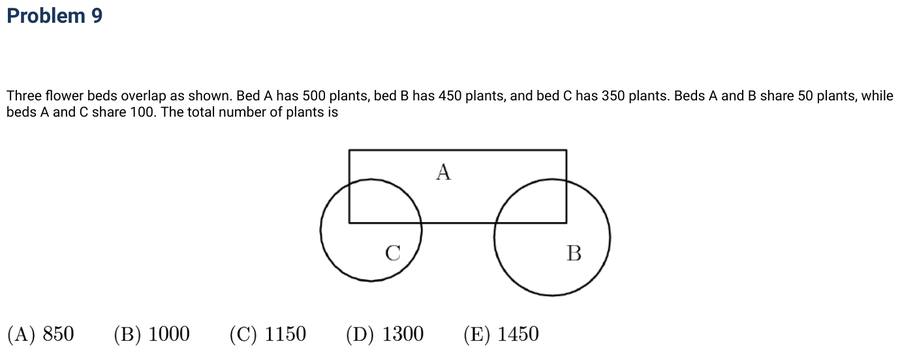
Show answer
Show hints
Still stuck? Show hint 2 →
Show solution
- Add the beds: 500 + 450 + 350 = 1300. But a plant in two beds was tallied in both, so each overlap plant is counted one time too many.
- There are 50 + 100 = 150 such doubly-counted plants (and none in all three). Remove the extra copy: 1300 − 150 = 1150 plants.
- This is inclusion–exclusion, and you'll meet it everywhere: |A ∪ B ∪ C| = (sum of parts) − (pairwise overlaps) + (triple overlap). Here the triple overlap is 0, so you only subtract the pairs.
2011 · #6 In a town of 351 adults, every adult owns a car, motorcycle, or both. If 331 adults own cars and 45 adults own motorcycles, how many of...
In a town of 351 adults, every adult owns a car, motorcycle, or both. If 331 adults own cars and 45 adults own motorcycles, how many of the car owners do not own a motorcycle?
Show answer
Show hints
Still stuck? Show hint 2 →
Show solution
- Every adult owns at least one vehicle, so an adult without a motorcycle owns a car and nothing else — exactly the "car but no motorcycle" group we want.
- Count the non-motorcycle owners: 351 − 45 = 306.
- Why this transfers: when every item is in "A or B or both," the "A only" group is just everyone minus the B group — counting the complement beats wrestling with the overlap.
- Both = cars + motorcycles − total = 331 + 45 − 351 = 25 own both.
- Car owners without a motorcycle = 331 − 25 = 306, matching above.
1991 · #23 The Pythagoras High School band has 100 female and 80 male members. The orchestra has 80 female and 100 male members. There are 60...
The Pythagoras High School band has 100 female and 80 male members. The orchestra has 80 female and 100 male members. There are 60 females who are in both band and orchestra. Altogether there are 230 students who are in either band or orchestra or both. The number of males in the band who are NOT in the orchestra is
Show answer
Show hints
Still stuck? Show hint 2 →
Still stuck? Show hint 3 →
Show solution
- Separate by gender. Distinct females (counting the 60 overlap only once): 100 + 80 − 60 = 120.
- The 230 total is females + males, so distinct males = 230 − 120 = 110.
- Now inclusion-exclusion on the males to find the overlap: (band males) + (orchestra males) − (distinct males) = 80 + 100 − 110 = 70 males are in both.
- Males in band but NOT orchestra = all band males minus those also in orchestra = 80 − 70 = 10.
- Why this transfers: when a population mixes two categories, split it into independent sub-populations you can fully solve, then apply "in A or B = A + B − both" to each. The overlap formula run backwards (solving for "both" from the union) is the key move here.
Permutations and combinations — the two big formulas
Three runners cross the finish line. Now answer two different questions. “In how many orders can they finish?” — gold, silver, bronze all matter, so that is 6. “In how many ways can I pick 2 of them to interview?” — interviewing Ana then Ben is the same pair as Ben then Ana, so order does not matter, and that is only 3. Same three people, two different counts. The entire chapter rests on one question you ask every single time: does order matter?
If order matters, you are arranging — a permutation. If it does not, you are choosing — a combination. Here are the two formulas, but the question above is what tells you which to grab.
Permutations — watch the slots shrink
Ten sprinters race. You want gold, silver, bronze. Draw three empty slots and fill them left to right, asking the same question each time: who is still available?
That is all a permutation is — the multiplication principle with a pool that shrinks by one each step. P(n, k) means “start at n and multiply k shrinking factors”: P(5,3) = 5 · 4 · 3. Filling all the slots is the full factorial: P(5,5) = 5! = 120.
Combinations — the same picks, with order erased
Now interview 3 of 5 runners afterward — here order does not matter. Start from the 60 ordered picks you counted a moment ago, then group together the ones that are secretly the same trio. Take the three runners A, B, C. As an ordered pick they show up 3! = 6 different ways, but they are one and the same group:
Every group of 3 got counted 3! = 6 times in the ordered list. So to count groups, divide the ordered count by that overcount:
C(5, 3) = P(5, 3) ÷ 3! = 60 ÷ 6 = 10
C(n, k) = P(n, k) ÷ k! — count the ordered picks, then squash the k! shuffles of each group into one.Pictured-intuition adapted from Competition Math for Middle School (AoPS).
PERMUTATIONS vs COMBINATIONS
- Permutations (order MATTERS): how many ways to arrange k items chosen from n. Notation: P(n, k) or
nP_k. Formula:n! / (n−k)! = n · (n−1) · … · (n−k+1). - Combinations (order DOESN'T MATTER): how many ways to choose k items from n. Notation: C(n, k) or
nC_kor(n choose k). Formula:n! / (k! · (n−k)!) = P(n, k) / k!.
Factorial. n! (“n factorial”) = n × (n−1) × (n−2) × … × 2 × 1. So 5! = 120, 6! = 720, 7! = 5040. (Also 0! = 1 by convention.)
How to choose between permutations and combinations. Ask: does the order matter?
- “How many ways to seat 5 people in a row of 5 chairs?” Order matters → permutation. Answer: 5! = 120.
- “How many ways to choose 3 of 10 people for a team?” Order doesn't matter (Alice-Bob-Carol is the same team as Bob-Alice-Carol) → combination. Answer: C(10, 3) = 120.
- “How many ways to rank 3 winners (gold, silver, bronze) from 10 contestants?” Order matters (gold is different from silver) → permutation. Answer: P(10, 3) = 10·9·8 = 720.
The most-used combination. C(n, 2) = n(n−1)/2 is the number of pairs you can choose from n items — i.e., the number of handshakes among n people. For 5 people: 5·4/2 = 10 handshakes. For 10 people: 10·9/2 = 45. For 20 people: 20·19/2 = 190.
Go deeper: where the handshake & polygon-diagonal formulas come from
Why handshakes are n(n−1)/2 — see the double-count
Five friends, everyone shakes everyone once. Picture each person and draw a line to each of the others.
Each of the 5 people reaches out to 4 others — that is 5 × 4 = 20 reaches. But a handshake takes two people, and you counted it from both ends. Divide by 2: 20 ÷ 2 = 10. That is exactly C(5, 2) — choosing an unordered pair.
The same count is a stack of dots called a triangular number. The first person shakes 4 hands, the next adds 3 new ones, then 2, then 1: 4 + 3 + 2 + 1 = 10. Stacking those rows makes a triangle, and the count for n people is always 1 + 2 + … + (n−1) = n(n−1)/2. Handshakes, lines between dots, and games in a round-robin are all the same picture.
Pictured-intuition adapted from Competition Math for Middle School (AoPS).
Why 1 + 2 + … + n = n(n+1)/2 — the Gauss fold
The handshake count was 1 + 2 + … + (n−1) — a stack of rows. There is a one-move proof of the sum that a seven-year-old Gauss is said to have found. Write the sum forwards, write it again backwards underneath, and add the two columns:
Every column adds to the same n + 1, and there are n columns, so 2S = n(n+1) and
1 + 2 + … + n = n(n+1)/2.
So 1 + 2 + … + 100 = 100 × 101 / 2 = 5050 — no adding 100 numbers. And this is the twin of the handshake formula: n people make 1 + 2 + … + (n−1) = n(n−1)/2 handshakes (the same fold, one row shorter). Round-robin games, lines between dots, and the triangular numbers are all this one sum.
Same sum, a second way — average × count
You already know a shortcut for evenly-spaced numbers from rates and averages: the mean of a run from first to last is just (first + last) ÷ 2. Add up a list by average × how many.
For 1 + 2 + … + n the average is (1 + n) ÷ 2 and there are n terms, so
1 + 2 + … + n = (1 + n)/2 × n = n(n+1)/2.
It lands on the very same formula as the Gauss fold — 1 + … + 100 = (1 + 100)/2 × 100 = 50.5 × 100 = 5050 — and the handshake count 1 + 2 + … + (n−1) is the same idea one row shorter: (1 + (n−1))/2 × (n−1) = n(n−1)/2. Two pictures, one formula — pick whichever you see fastest.
Diagonals of a polygon — and shaking all but a few hands
How many diagonals does a polygon with n sides have? A diagonal joins two corners that are not already next-door (those are edges, not diagonals). From any one corner you can reach the other n − 1 corners, but 2 of those are its neighbours — joined by edges — so only n − 3 of the reaches are diagonals. That is n × (n − 3) reaches over all corners, and each diagonal got counted from both of its ends, so halve it.
POLYGON DIAGONALS
n(n − 3) / 2
(n − 3 diagonals per corner, n corners, ÷ 2 for the double-count.)
Check a pentagon: 5 × 2 / 2 = 5 diagonals. A hexagon: 6 × 3 / 2 = 9.
Shaking all but a few hands. The same “count everything, then take away the missing ones” move solves a classic. At a party of 7 married couples, everyone shakes hands once with everyone except their own spouse. How many handshakes? Pretend for a moment that everyone shakes everyone — that is 14 people, C(14, 2) = 14 × 13 / 2 = 91 handshakes. Now remove the ones that never happen: the 7 spouse-handshakes. So 91 − 7 = 84. Count the full thing, subtract the forbidden few — far easier than building the allowed handshakes one by one.
n(n − 3)/2.)Framing inspired by AoPS Prealgebra.
Go deeper: three more facts to know on sight — subsets, circles, repeated letters
Three more facts worth knowing by sight
1. SUBSETS — 2n
A set with n elements has 2n subsets (counting the empty set and the whole set).
Why? For each of the n elements, decide independently: in or out. That’s 2 choices, multiplied n times. A set of 3 items {A, B, C} has 23 = 8 subsets: {}, {A}, {B}, {C}, {A,B}, {A,C}, {B,C}, {A,B,C}.
So “how many subsets” questions never need a formula — it is 2 to the power of the count.
2. CIRCULAR ARRANGEMENTS — (n − 1)!
To seat n distinct people around a round table, where rotations of the same arrangement count as the same:
(n − 1)!
Why fewer than a row? Look at the same five friends arranged the same way, once in a row and once around a table:
In a row, each of the 5! = 120 shuffles is a brand-new arrangement — the chair you sit in matters. Around a table, only your neighbors matter. Rotating everyone one seat clockwise gives the “same” seating — you still see B on your left and E on your right. There are 5 rotations of every arrangement, so we divide: 120 ÷ 5 = 24.
Equivalent shortcut: fix one person in place (say A always at the top). Then arrange the other 4 in the remaining seats: 4! = 24. Same answer.
Example. 5 people round a table: 4! = 24. 6 people: 5! = 120. 8 people: 7! = 5040.
3. ARRANGING LETTERS WITH REPEATS — n! / (d₁! · d₂! · …)
To arrange n letters where one letter appears d₁ times, another d₂ times, etc.:
n! / (d₁! · d₂! · …)
Let’s see why. Take a smaller word: BOOK (4 letters, but the two O’s are identical).
The MISSISSIPPI example
MISSISSIPPI has 11 letters: 1 M, 4 I’s, 4 S’s, 2 P’s.
| Step | What we count | Number |
|---|---|---|
| 1 | Arrangements pretending all 11 letters are distinct | 11! = 39,916,800 |
| 2 | ÷ 4! for the 4 identical I’s | ÷ 24 |
| 3 | ÷ 4! for the 4 identical S’s | ÷ 24 |
| 4 | ÷ 2! for the 2 identical P’s | ÷ 2 |
| = | real arrangements | 34,650 |
For LEVEL (two E’s, two L’s): 5! / (2! · 2!) = 30. For LOOK (two O’s): 4! / 2! = 12. Same recipe every time.
Go deeper: counting by pairing & double-counting — losers, handshakes both ways
Count the losers, not the games
A knockout chess tournament has 100 players. Lose once and you’re out. The last player standing is champion. How many games get played?
Your instinct is to add up the rounds: 50 games cut the field to 50, then 25, then … and now you’re stuck, because 50 isn’t even and the byes get fiddly. Resist that.
Look at it from the loser’s side instead. Every game has exactly one loser, and every loser is knocked out forever. At the end, 99 players have been knocked out (everyone except the champion). So exactly 99 losers happened — which means exactly 99 games. Done. No rounds, no byes, no powers of 2.
ONE LOSS, ONE GAME
In a knockout where each game eliminates one player, the number of games to crown a champion from n players is always n − 1 — one game per player eliminated.
This works because you matched up two things one-to-one: each game ↔ the single player it eliminates. That kind of one-to-one match is the cleanest counting move there is. When a count looks tangled, ask: is there a thing I can pair each item with that’s easier to count?
(Careful: this is not the handshake count. Handshakes pair players with each other — that’s C(n, 2). Here you pair each game with its one loser — that’s n − 1. Read whether games happen between every pair, or only between survivors.)
Count the same total two ways — the handshake rule
Here is the slickest counting move of all: find one number that two different counts must both equal, and let them pin each other down. The classic is handshakes. Picture the party as dots with a line for each handshake; a person’s “handshake count” is how many lines touch their dot.
Add up everyone’s handshake count into one grand total. Each single handshake is a line with two ends, so it adds 1 to each of two people — it lands in the total exactly twice. So the same total has two readings: it is the sum of the counts, and it is also 2 × (number of handshakes). They must match.
HANDSHAKE RULE (COUNT TWO WAYS)
Sum of everyone’s handshake counts = 2 × (number of handshakes). So that sum is always even.
One crisp payoff: the number of people who shook an odd number of hands is always even. Split the crowd into “even-counters” and “odd-counters.” The even-counters add to an even number; the whole total is even; so the odd-counters must add to an even number too — and a pile of odd numbers totals even only when there is an even number of them. That is why you can never have exactly 3 people who each shook an odd number of hands.
This is the same engine as the handshake formula and “count the losers”: instead of counting the thing asked, count a total that something else also measures, and read it from the easy side.
Strategy framing inspired by Posamentier, The Art of Problem Solving (teacher resource).
THE MOVE: ask “does order matter?” Order matters → permutation. Order does not → combination.
(Knockout-tournament idea adapted from Problem Solving via the AMC, Australian Maths Trust.)
One more: choosing when order does not matter
Quick example. A pizza shop has 6 toppings; you pick 2 different ones. How many pairs? “Pepperoni and mushroom” is the same as “mushroom and pepperoni,” so order is irrelevant: C(6, 2) = 6 · 5 / 2 = 15. This is the same n(n−1)/2 as handshakes among 6 people — choosing an unordered pair is always that formula.
Go deeper: how many zeros does a factorial end in?
Trailing zeros = count the factors of 5
How many zeros are at the end of 100!? You cannot multiply 100 numbers by hand — but you do not have to. A zero on the end of a number comes from a factor of 10 = 2 × 5. So the number of trailing zeros is just the number of times 10 divides the product — which is however many (2, 5) pairs you can build from its factors.
In a factorial the 2s are everywhere (every other number is even) and the 5s are scarce, so 5s are the bottleneck — count the 5s and you have counted the pairs.
- Multiples of 5 up to 100:
100 ÷ 5 = 20— each gives at least one 5. - Multiples of 25 (= 5 × 5) up to 100:
100 ÷ 25 = 4— each gives a second 5 you have not counted yet. - Multiples of 125:
100 ÷ 125 = 0— none, so stop.
Add the layers: 20 + 4 = 24 trailing zeros in 100!. (Floor each division — keep only the whole part.)
TRAILING ZEROS OF n!
⌊n/5⌋ + ⌊n/25⌋ + ⌊n/125⌋ + …
Count multiples of 5, then 25, then 125, … until the division gives 0. Each layer adds one more hidden factor of 5.
Why a second layer? A number like 25 = 5 × 5 hands the product two fives, but the “multiples of 5” line only credited it once — the “multiples of 25” line catches the extra one.
Climb: the very last non-zero digit (harder)
Strip away the trailing zeros and you can ask for the last non-zero digit of a factorial — e.g. of 2010! read from the right. That is a tougher beast: you remove the matched 2–5 pairs, then track what the leftover 2s and odd factors leave behind mod 10, in repeating blocks. It is a genuine olympiad pattern — the trailing-zero count above is the AMC-8-friendly cousin and the one you will actually be asked.
Last-non-zero-digit idea from Terry Chew, Math Olympiad — RIPWMC II.
50!? (Count the factors of 5.)50 ÷ 5 = 10. Multiples of 25: 50 ÷ 25 = 2 (those are 25 and 50, each carrying a second 5). Multiples of 125: 0. So 10 + 2 = 12 trailing zeros.(Factorial-digit idea adapted from Terry Chew, Math Olympiad — RIPWMC II.)
For “how many handshakes if n people each shake every other person's hand once”: always n(n−1)/2. Memorize this. It appears constantly.
For “how many lines through n distinct dots, no three collinear”: same answer, C(n, 2) = n(n−1)/2 (each pair of dots determines one line; the no-three-collinear hypothesis guarantees they are all distinct). For “how many distinct triangles”: C(n, 3) (and no-three-collinear ensures every triple gives a real triangle).
At a party there are 5 women and 4 men — 9 people. No two men shake hands, but every woman shakes hands with every other person. Each woman shakes 8 hands, and there are 5 women, so that is 8 × 5 = 40 — but each handshake got counted twice, so divide by 2: 40 ÷ 2 = 20 handshakes.
Why it breaks: “divide by 2” only fixes a count where every handshake was counted twice. A woman-to-woman shake is counted twice (once for each woman). But a woman-to-man shake is counted only once — the man never reports it, since men do not initiate. Halving the whole 40 wrongly halves those man-woman shakes too.
The fix: split the two kinds. Woman-to-woman: C(5, 2) = 10 (that is 5·4 = 20 double-counted, so halve). Woman-to-man: each of the 5 women shakes all 4 men once — 5 × 4 = 20, and these are not double-counted, so do not halve. Total = 10 + 20 = 30. Before you divide by 2, make sure you really did count every item twice.
Framing inspired by AoPS Prealgebra.
Ms. Hamilton's eighth-grade class wants to participate in the annual three-person-team basketball tournament. Lance, Sally, Joy, and Fred are chosen for the team. In how many ways can the three starters be chosen?
Lance, Sally, Joy, and Fred are on the team. The coach picks 3 starters. In how many ways?
First test: does order matter? A trio of starters is a trio — “Lance, Sally, Joy” is the same starting three as “Joy, Sally, Lance.” Order does not matter, so this is a combination: C(4, 3).
You could grind the formula: C(4, 3) = 4! / (3! · 1!) = 4. But take the lightest path — count the one left out. Choosing 3 of 4 to play is the same as choosing the 1 who sits. There are 4 people, so 4 ways to pick the bench-warmer, so 4 starting trios — choice (B).
Two ideas land here. First, “starters” is an unordered group, so combination not permutation. Second, the symmetry C(n, k) = C(n, n−k): choosing almost-all of a group is the same as choosing the tiny part you leave out — count whichever side is smaller.
Order matters → permutations P(n,k). Order doesn't matter → combinations C(n,k). When in doubt, ask whether “Alice then Bob” is the same as “Bob then Alice.” For pairs: C(n,2) = n(n−1)/2.
2023 · #5 Anna has five discs of different sizes. She wants to use 4 of them to build a tower, always placing a smaller disc on top of a bigger...
Anna has five discs of different sizes. She wants to use 4 of them to build a tower, always placing a smaller disc on top of a bigger one. In how many ways can Anna build the tower?
Show answer
Show hints
Still stuck? Show hint 2 →
Show solution
- A valid tower must go from largest at the bottom to smallest at the top, so a set of four discs can be stacked in only one way.
- Building a tower therefore means choosing which 4 of the 5 discs to use, i.e. which single disc to leave out.
- There are 5 discs, so there are 5 ways to leave one out.
- The number of towers is B, 5.
2015 · #4 The Centerville Middle School chess team consists of two boys and three girls. A photographer wants to take a picture of the team to...
The Centerville Middle School chess team consists of two boys and three girls. A photographer wants to take a picture of the team to appear in the local newspaper. She decides to have them sit in a row with a boy at each end and the three girls in the middle. How many such arrangements are possible?
Show answer
Show hints
Still stuck? Show hint 2 →
Show solution
- The ends are boys-only and the middle is girls-only, so the two choices never collide — handle them separately.
- Boys in the 2 end seats: 2! = 2 ways. Girls in the 3 middle seats: 3! = 6 ways.
- By the rule of product, total = 2 × 6 = 12.
- Why this transfers: any time a setup divides into independent stages, multiply the counts. The only trap is making sure the stages really don't affect each other — here they can't, since boys and girls occupy disjoint seats.
2004 · #2 How many different four-digit numbers can be formed by rearranging the four digits in 2004?
How many different four-digit numbers can be formed by rearranging the four digits in 2004?
Show answer
Show hints
Still stuck? Show hint 2 →
Show solution
- The slick view: a valid number is fixed once you decide where the 2 and 4 sit, because the leftover slots must be the two zeros. The thousands place must be 2 or 4 (no leading 0) — 2 choices — and the other non-zero digit then has 3 open slots — 3 choices. That's 2 × 3 = 6.
- Why this beats brute force: you never list anything; the two zeros take care of themselves once the 'real' digits are placed.
- You'll meet this again any time a number has repeated digits and a 'first digit can't be 0' rule — place the restricted/distinct items first, let the duplicates fall into the gaps.
- All arrangements of {2, 0, 0, 4}: 4!/2! = 12 (divide by 2! because the two 0s are identical).
- Bad ones put a 0 in front: the remaining three slots hold {2, 0, 4}, giving 3! = 6 arrangements.
- Valid = 12 − 6 = 6.
- Smallest first: 2004, 2040, 2400, 4002, 4020, 4200.
- That's exactly 6 — a fine check when the count is this small.
2006 · #20 A singles tournament had six players. Each player played every other player only once, with no ties. If Helen won 4 games, Ines won 3...
A singles tournament had six players. Each player played every other player only once, with no ties. If Helen won 4 games, Ines won 3 games, Janet won 2 games, Kendra won 2 games and Lara won 2 games, how many games did Monica (the sixth player) win?
Show answer
Show hints
Still stuck? Show hint 2 →
Show solution
- With 6 players each meeting every other once, the number of games is "choose 2 of 6" = (6 × 5)/2 = 15. Since there are no ties, that's exactly 15 wins handed out.
- The five named players account for 4 + 3 + 2 + 2 + 2 = 13 wins.
- Monica gets the rest: 15 − 13 = 2.
- You'll reuse this: in any round-robin with no ties, (total wins) = (total games) = "choose 2" of the players. The wins are conserved, so a single missing count is always "total minus the known." No game-by-game detective work needed.
2019 · #28 Teams of three take part in a chess tournament. Each player plays against every player from every other team exactly once. For...
Teams of three take part in a chess tournament. Each player plays against every player from every other team exactly once. For organisational reasons no more than 250 games may be played. What is the greatest number of three-player teams that can take part?
Show answer
Show hints
Still stuck? Show hint 2 →
Show solution
- With n teams of 3, each pair of teams plays 3 × 3 = 9 games, so total games = 9 × n(n−1)/2.
- For n = 7 that is 9 × 21 = 189 (allowed); for n = 8 it is 9 × 28 = 252 (too many).
- So at most 7 teams can take part.
2014 · #12 A magazine printed photos of three celebrities along with three photos of the celebrities as babies. The baby pictures did not identify...
A magazine printed photos of three celebrities along with three photos of the celebrities as babies. The baby pictures did not identify the celebrities. Readers were asked to match each celebrity with the correct baby pictures. What is the probability that a reader guessing at random will match all three correctly?
Show answer
Show hints
Still stuck? Show hint 2 →
Show solution
- Order the 3 baby photos against the celebrities: 3! = 6 equally likely ways.
- Exactly 1 of those 6 is the all-correct matching, so probability = 1/6 = 1/6.
- Reusable idea: when every arrangement is equally likely and only one wins, P(win) = 1/(total arrangements). The hard part is always the count, never the division.
- First celebrity: 1 of 3 baby photos is right ⇒ chance 1/3.
- Given that, the second celebrity: 1 of the 2 remaining is right ⇒ chance 1/2 (and the third is then forced).
- Multiply: (1/3)(1/2) = 1/6.
Lattice paths — counting paths on a grid
You are at the bottom-left of a city grid and your friend is up and to the right. You only ever walk right or up — no backtracking. How many different routes can you take? You could try to draw them all, but there is a sneaky shortcut: every route is a sequence of moves, and you only have to decide the order of the rights and ups.
A lattice path is exactly this — a path on a grid using only fixed directions. The classic contest question: how many paths from one corner to another going only RIGHT or UP?
The clean observation
To get from (0,0) to (m, n), you ALWAYS need exactly m right-moves and n up-moves. The path is m+n moves total — you’re only choosing the ORDER.
LATTICE-PATHS FORMULA
Paths from (0, 0) to (m, n) using only right and up:
C(m + n, m) = C(m + n, n)
(Same thing — choose which positions are R, or which positions are U.)
When the map isn’t a clean grid — label every corner
The C(m+n, m) formula only works on a perfect rectangle of streets. Real maps have a closed road, a one-way diagonal, a missing block. Then the formula breaks. There’s a method that never breaks.
Write a number at every corner: how many ways you can reach that corner from the start. The rule is dead simple — a corner’s number is the sum of the corners that feed into it (the one directly left, plus the one directly below, if you only move right and up). Start gets a 1. Then fill in, corner by corner, working away from the start.
Read the bottom row and left column: only one way to reach each (you can only walk straight, so each is 1). For every other corner, add the number on its left to the number below it. The corner immediately right of the closed road has nothing feeding it from the left — so it only gets its 1 from below, instead of the larger number it would have inherited. Keep adding left + below across the whole map. The END corner reads 9: nine safe routes.
On a fully open grid this same map would give C(4 + 2, 2) = 15 routes — but the closed road knocks it down to 9, and the labeling found that without any formula at all. A blocked road stops feeding its neighbor, and the count downstream drops on its own.
THE MOVE: a right/up path is a sequence of moves — count it as C(total moves, number of rights). On a broken map, label every corner and add.
(Add-into-each-vertex route-counting adapted from Problem Solving via the AMC, Australian Maths Trust.)
Go deeper: why combinations, and paths through / avoiding a point
Why combinations, not permutations?
The 3 R-moves are interchangeable — they all do the same thing. The 2 U-moves are also interchangeable. So we’re choosing POSITIONS for the R’s among 5 slots, not arranging 5 distinct items.
Path-through-a-point
“Paths from A to B that pass through P” — split into two legs.
| Leg | From | To | Paths |
|---|---|---|---|
| 1 | A | P | (some count) |
| 2 | P | B | (some count) |
| Multiply the two counts (multiplication principle) | total | ||
Path AVOIDING a forbidden cell
Use complementary counting: (all paths) − (paths through forbidden cell). The second piece is itself a path-through-a-point count.
Go deeper: paths through a checkpoint, diagonal moves & the Galton board
One more: a path that must pass through a point
Quick example. Right/up paths from (0,0) to (3,3) that pass through (1,1)? Split at the checkpoint and multiply the two legs. Leg 1 (0,0)→(1,1): C(2, 1) = 2. Leg 2 (1,1)→(3,3): 2 rights and 2 ups, C(4, 2) = 6. Multiply: 2 × 6 = 12 paths. (Of all C(6, 3) = 20 paths, 12 go through (1,1).)
A handy trick: a diagonal step is just a third kind of move
Right/up is not the only menu. Some problems let a token move down-left or down-right at each step (a checker, a bouncing ball, a Galton board), or right, up, OR diagonally. The labeling method does not care — a corner’s number is still the sum of every corner that can feed into it. Just include the diagonal neighbour in that sum. The formula C(m+n, m) quietly assumes exactly two move types; the moment a third move appears, drop the formula and label. When the only two moves are “down-left” and “down-right” from a single starting peg, the row-by-row labels are literally Pascal’s triangle: 1; 1 1; 1 2 1; 1 3 3 1; … — so the count of paths to the k-th slot of row n is just C(n, k).
Another worked example
A ball is dropped onto the top peg of a board. There are 4 rows of pegs; at each peg the ball bounces left or right with equal chance, then lands in one of the 5 bottom slots (call them slot 0 on the far left through slot 4 on the far right). In how many different ways can the ball reach the centre slot (slot 2)?
Step 1 — recognise the move type. Each bounce is “down-left” or “down-right.” That is a single starting point fanning out by two diagonal moves — the labeling tree is Pascal’s triangle.
Step 2 — label row by row (each peg = sum of the one or two pegs feeding it from above):
row 0: 1
row 1: 1 1
row 2: 1 2 1
row 3: 1 3 3 1
row 4 (the slots): 1 4 6 4 1
Step 3 — read off the centre. Slot 2 carries the label 6. (Cross-check with the formula for this special two-diagonal case: to land in slot 2 the ball must go right exactly 2 of its 4 bounces, C(4, 2) = 6. The two methods agree.)
Answer: 6 ways. The four slots beside it carry 1, 4, 4, 1, and 1 + 4 + 6 + 4 + 1 = 16 = 24 total paths — exactly the 2-choices-per-row count, a tidy sanity check.
For right-or-up only paths from (0,0) to (m,n): always C(m+n, m) = C(m+n, n). Don't try to draw all the paths.
For “paths through point P”: split at P. Multiply the path counts for each leg.
In a game of luck, a ball rolls downwards towards hammered nails and is diverted either to the right or the left by the nail immediately below it. One possible path is shown in the diagram. How many different ways are there for the ball to reach the second compartment from the left?
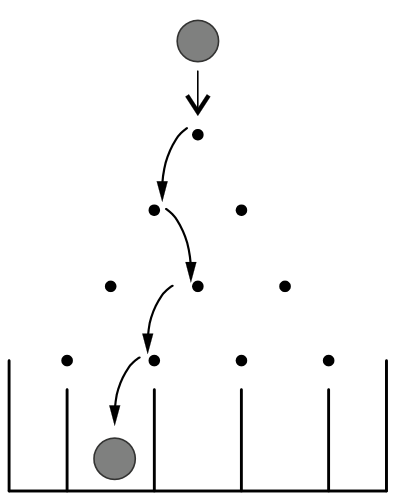
A ball drops through a board of nails. At each nail it goes left or right, and after passing the rows it lands in one of 5 compartments. How many different paths land it in the second compartment from the left? (The figure shows the board and one sample path.)
This is a lattice path in disguise: every drop is a string of left/right choices, exactly like right/up moves on a grid. So use the vertex-labeling method — write at each nail how many ways the ball can reach it, adding the ways from the two nails feeding into it above.
- The single top nail starts with 1.
- Row by row, each nail’s number is the sum of the one or two nails directly above it — pure Pascal’s triangle.
- After 4 rows of nails, the bottom compartments read
1, 4, 6, 4, 1(the 4th row of Pascal’s triangle).
The second compartment from the left reads 4 — choice (C). Four paths, found by adding, not by tracing every zigzag.
The board is a tilted grid: left/right is the same as up/right. Once you see that, the answer is a single entry of Pascal’s triangle — row 4 is 1, 4, 6, 4, 1, and you read off the second slot. The vertex-add method gets there with no formula and no path-tracing.
Right/up paths from (0,0) to (m,n): C(m+n, m). For paths through P: split at P, multiply the two leg counts. For paths avoiding a forbidden cell F: (total) − (paths through F).
2016 · #10 During a cycle race starting at D and finishing at B, every connecting road between the towns A, B, C and D shown in the diagram is...
During a cycle race starting at D and finishing at B, every connecting road between the towns A, B, C and D shown in the diagram is ridden along exactly once. How many possible routes are there for the race?
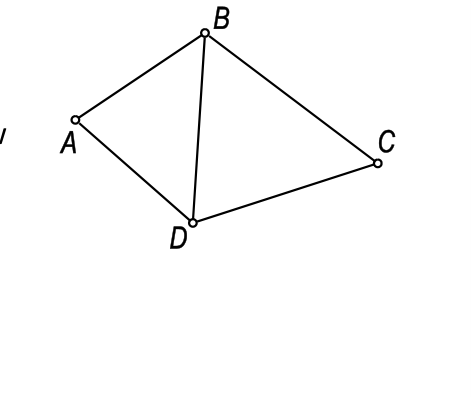
Show answer
Show hints
Still stuck? Show hint 2 →
Show solution
- The five roads are A-B, A-D, B-D, B-C and D-C; the race must use each exactly once, leaving D and arriving at B.
- Organise by the first move from D: starting D-A leads to 2 finishing routes, starting D-B leads to 2, and starting D-C leads to 2.
- That makes 2 + 2 + 2 = 6 possible routes.
1986 · #9 (figure problem)
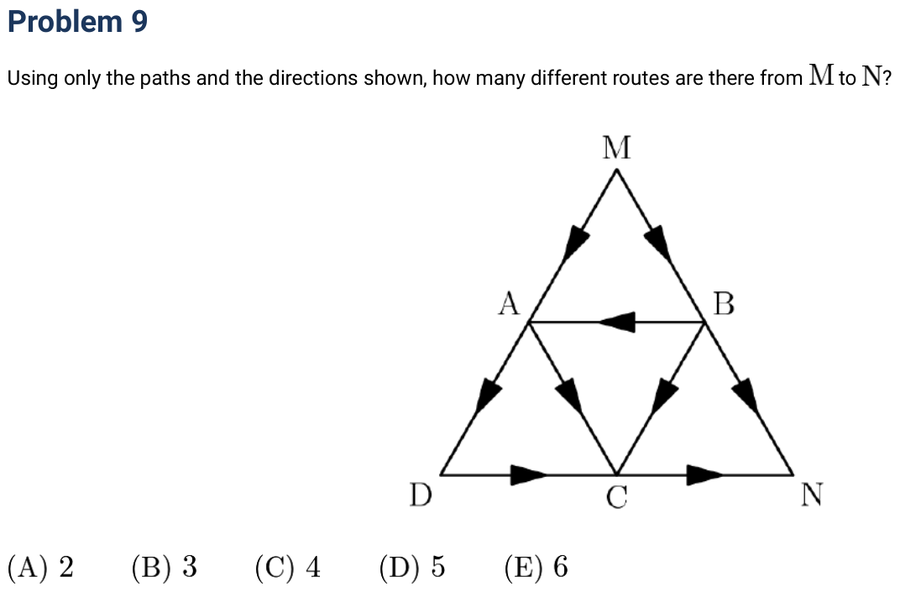
Show answer
Show hints
Still stuck? Show hint 2 →
Still stuck? Show hint 3 →
Show solution
- The key idea: the number of routes into a point equals the sum of the routes into the points that arrow toward it. So you never trace a whole path — you just accumulate. Start: M = 1 (there's one way to 'be at the start').
- Top region: B is fed only by M, so B = 1. A is fed by M and by B, so A = 1 + 1 = 2.
- Bottom: D is fed only by A, so D = 2. C is fed by A, B, and D, so C = 2 + 1 + 2 = 5.
- Finally N is fed by B and C: N = 1 + 5 = 6 routes.
- Why this transfers: this 'add up the incoming counts' trick is exactly how you count lattice paths (and how Pascal's triangle is built) — it turns an explosion of routes into a handful of additions.
Pascal's triangle — the number machine behind combinations
You have met C(n, k), lattice paths, and “exactly k heads” in different chapters. They are secretly the same numbers. There is one picture that holds all of them — a triangle of numbers you can build with nothing but addition.
Build it: each number is the sum of the two above
Start with a single 1 at the top. Every row starts and ends with 1. Every other number is the sum of the two numbers sitting above it — one to the upper-left, one to the upper-right. That is the whole rule. No formula, only adding.
The number you build is exactly C(n, k): go to row n, count k steps in from the left (starting at 0). Row 4 reads 1, 4, 6, 4, 1 — and sure enough C(4,0)=1, C(4,1)=4, C(4,2)=6, C(4,3)=4, C(4,4)=1. So “6 ways to pick 2 of 4” is the middle of row 4.
Go deeper: why each entry is the sum of the two above, and why rows double
Why each is the sum of the two above
Look at C(4, 2) — choosing 2 things from {A, B, C, D}. Stare at one item, say D. Either D is in your pick or it is not.
- D is in: you still need 1 more from {A, B, C} — that is
C(3, 1) = 3ways. - D is out: you need all 2 from {A, B, C} — that is
C(3, 2) = 3ways.
Add the two cases: 3 + 3 = 6 = C(4, 2). Those two pieces, C(3,1) and C(3,2), are exactly the two numbers in the row above. That is why you add the two above — it is the “is this one item in or out?” split, drawn as a triangle.
Each row adds up to a power of 2
Add across any row: 1, then 1+1=2, then 1+2+1=4, then 1+3+3+1=8, then 16, then 32… The totals double every row: row n sums to 2n.
This is the subset count from chapter 8 in disguise. Flip n coins and C(n,k) counts the outcomes with exactly k heads; add the whole row and you get every outcome, 2n. So “exactly 2 heads in 4 flips” is the 6 in row 4, out of the 16 total — 6/16.
Go deeper: it is the lattice-path grid, tilted
It is also the lattice-path grid, tilted
Remember labeling each corner of a grid with “how many ways to reach it” — each corner was the sum of the one left and the one below? Tilt that grid 45° and it is Pascal's triangle. The path counts and the triangle entries are the same numbers.
THE MOVE: when a count smells like “choose k of n,” build Pascal’s triangle by adding, and read off row n, position k.
Pictured-intuition adapted from Competition Math for Middle School (AoPS).
Go deeper: read a coin-flip probability off a row
One more: read a coin-flip probability off the row
Quick example. Flip a fair coin 4 times. P(exactly 2 heads)? Row 4 of Pascal is 1, 4, 6, 4, 1. The “exactly 2 heads” count is the middle entry C(4,2) = 6, and the whole row sums to 24 = 16 (every outcome). So P = 6/16 = 3/8 — numerator and denominator both come straight from one row, no formula plugged in.
You rarely need a huge factorial. For small contest numbers, building the triangle by adding is faster and safer than the C(n,k) formula — no big products, no division.
Two facts to carry: row n sums to 2n (every “total outcomes” or “total subsets”), and each entry is the sum of the two above (the “in or out?” split). The triangle is symmetric, so C(n,k) = C(n, n−k) — the row reads the same forwards and backwards.
A fair coin is tossed 3 times. What is the probability of at least two consecutive heads?
A fair coin is tossed 3 times. What is the probability of getting at least two heads in a row?
Start with the total. Three flips give 23 = 8 equally likely outcomes — and that 8 is exactly the sum of row 3 of Pascal’s triangle: 1 + 3 + 3 + 1. (One way to get 0 heads, three ways for 1 head, three for 2 heads, one for 3 heads.)
Now count the favorable ones — outcomes with two heads back to back. List the 8 and mark them:
- HHH ✓ (three in a row), HHT ✓, THH ✓
- HTH (heads are split — no), and HTT, THT, TTH, TTT all fail.
That is 3 favorable out of 8, so P = 3/8 — choice (C).
Pascal handed you the denominator instantly (row-3 sum = 8) and reminded you the 8 outcomes split 1-3-3-1 by head-count, so you knew exactly how many to scan.
“At least two consecutive” is an adjacency rule, not a clean C(n,k), so you still list the favorable outcomes. But Pascal does the heavy half: the total 2³ = 8 is the row-3 sum, and the 1-3-3-1 split tells you the shape of the 8 before you write them down.
Build Pascal’s triangle by adding the two entries above. Row n, position k (from 0) is C(n, k). Each row sums to 2n. Use it for “choose k of n,” subsets, coin-flip counts, and lattice paths — they are one picture.
2013 · #8 A fair coin is tossed 3 times. What is the probability of at least two consecutive heads?
A fair coin is tossed 3 times. What is the probability of at least two consecutive heads?
Show answer
Show hints
Still stuck? Show hint 2 →
Show solution
- All 8 outcomes: HHH, HHT, HTH, HTT, THH, THT, TTH, TTT. Each is equally likely, so we just count favorables.
- "At least two consecutive heads" needs HH side by side: HHH, HHT, THH — that's 3. (HTH fails: its heads aren't neighbors.)
- Probability = 3 ÷ 8 = 3/8.
- Watch the trap: HTH has two heads but they're not consecutive, so it doesn't count — reading "consecutive" carefully is the whole problem.
- Sometimes it's easier to count the unwanted outcomes. Strings of 3 flips with no two heads adjacent: TTT, TTH, THT, HTT, HTH — 5 of them.
- So favorable = 8 − 5 = 3, giving probability 3/8 = 3/8. (When 'at least' makes direct counting fiddly, count the opposite.)
2018 · #7 In a game of luck, a ball rolls downwards towards hammered nails and is diverted either to the right or the left by the nail immediately...
In a game of luck, a ball rolls downwards towards hammered nails and is diverted either to the right or the left by the nail immediately below it. One possible path is shown in the diagram. How many different ways are there for the ball to reach the second compartment from the left?
Show answer
Show hints
Still stuck? Show hint 2 →
Show solution
- The ball passes 4 rows of nails, choosing left or right each time, and lands in one of 5 compartments.
- The number of ways to reach the compartments from left to right is 1, 4, 6, 4, 1.
- The second compartment from the left has 4 different paths.
2006 · #20 A singles tournament had six players. Each player played every other player only once, with no ties. If Helen won 4 games, Ines won 3...
A singles tournament had six players. Each player played every other player only once, with no ties. If Helen won 4 games, Ines won 3 games, Janet won 2 games, Kendra won 2 games and Lara won 2 games, how many games did Monica (the sixth player) win?
Show answer
Show hints
Still stuck? Show hint 2 →
Show solution
- With 6 players each meeting every other once, the number of games is "choose 2 of 6" = (6 × 5)/2 = 15. Since there are no ties, that's exactly 15 wins handed out.
- The five named players account for 4 + 3 + 2 + 2 + 2 = 13 wins.
- Monica gets the rest: 15 − 13 = 2.
- You'll reuse this: in any round-robin with no ties, (total wins) = (total games) = "choose 2" of the players. The wins are conserved, so a single missing count is always "total minus the known." No game-by-game detective work needed.
Pigeonhole principle — when something is forced
Imagine 10 pigeons and 9 nesting boxes. No matter how the pigeons choose, some box must contain at least 2 pigeons. That's the pigeonhole principle.
PIGEONHOLE PRINCIPLE
If you put n objects into k boxes and n > k, then some box must contain at least 2 objects.
Generalized: if you put n objects into k boxes, some box must contain at least ⌈n/k⌉ objects. (The ceiling function rounds up.)
The principle sounds obvious, but it's a precision tool. It lets you prove that something must exist without finding it explicitly — perfect for 'least number to guarantee' problems.
The contrapositive view (what these contests actually ask). 'Least number to guarantee N of the same kind.' Imagine the worst case: an adversary who spreads things as evenly as possible. How many more do you need to force a clump of N?
If you have k colors and want to guarantee N of one color, the worst case has N − 1 of each color before you finish — that's k(N − 1) items. The next item (one more) must complete a group of N.
WORST-CASE FORMULA
To guarantee N of the same color from k colors:
k · (N − 1) + 1 items.
Walkthrough. A drawer has socks in 3 colors. How many socks must you pull (worst case, in the dark) to guarantee a matching pair?
- k = 3 colors, N = 2 (matching = pair).
- Formula: 3·(2−1) + 1 = 4 socks.
- Worst case: first 3 socks could all be different colors. The 4th must match one of them.
The same logic scales up: 9 colors, want 4 of one → 9·3 + 1 = 28 items.
THE MOVE: for “guarantee,” imagine the unluckiest spread, then add one to force the clump.
One more: a pigeonhole guarantee
Quick example. How many people must be in a room to guarantee two share a birth month? There are 12 months (the boxes). The worst case fills one of each — 12 people, all different months, no pair yet. The 13th person must repeat a month. So k(N−1)+1 = 12(2−1)+1 = 13. The big idea: imagine the unluckiest spread, then add one.
Go deeper: pair numbers to a target, and the remainder trick
A handy trick: pair numbers to a target — the pairs ARE the pigeonholes
A whole family of contest problems reads “pick some numbers and you are forced to get two that add to T.” The move is to group the available numbers into pairs that each sum to T; those pairs become the boxes. From 1, 2, …, 20 wanting a sum of 21, the pairs are (1,20), (2,19), …, (10,11) — 10 boxes. An adversary can grab one number from each box (10 numbers) with no pair completed; the 11th pick must land in a box already used, finishing a sum of 21. Watch for a number with no partner (a leftover that pairs with itself or falls outside the range) — it forms its own box and adds 1 to the safe count. Count the boxes, then add one.
Another worked example
From the integers 1, 2, 3, …, 16, what is the smallest number of them you must choose to be guaranteed that two of your chosen numbers add up to 17?
Step 1 — build the pigeonholes. Pair every number with its “partner to 17”:(1,16), (2,15), (3,14), (4,13), (5,12), (6,11), (7,10), (8,9).
Every number from 1 to 16 sits in exactly one pair, and that is 8 pairs (8 boxes), with no number left over.
Step 2 — play the worst case. To dodge a sum of 17 for as long as possible, take at most one number from each box. That lets you collect 8 numbers (one per box) with still no pair adding to 17.
Step 3 — force the result. Once 8 are taken, every box already holds a chosen number. The 9th number you pick must fall into a box you have already used, and that completes a pair summing to 17.
Answer: 9. (Eight can fail — for instance {1,2,3,4,5,6,7,8} has no two summing to 17 — so 8 is genuinely not enough, and 9 is forced.)
Leftovers are pigeonholes too — the remainder trick
Pigeonholes are not only about colours. When you divide by k, the only possible leftovers (remainders) are 0, 1, 2, …, k−1 — exactly k boxes. Sort numbers by their remainder and the pigeonhole does the rest.
Worked example. Pick numbers from 1, 2, 3, … at random. How many must you grab to be sure two of them differ by a multiple of 5?
- Divide by 5; the leftovers are
0, 1, 2, 3, 4— that is 5 boxes. - Worst case: one number in each box — 5 numbers, all different remainders, no forced pair.
- The 6th number must repeat a remainder. Two numbers with the same remainder differ by a multiple of 5 (their difference divides evenly by 5).
So 6 numbers force it — k(N−1)+1 = 5(2−1)+1 = 6, the same worst-case formula, with remainders as the boxes. (Same engine as the sum-to-T trick above: there the boxes were pairs; here they are remainders.)
Regions are pigeonholes too — five points in a square
Pigeonholes need not be colours or remainders — they can be patches of space. Drop 5 points anywhere inside a 1 × 1 square, then slice the square through its middle each way into four ½ × ½ sub-squares. That is 4 boxes for 5 points — so some sub-square must swallow at least two points, however you spread them.
Go deeper: how close are the two trapped points?
The two points caught in one sub-square are at most its diagonal apart: √((½)² + (½)²) = √(¼ + ¼) = √(½) = √2 / 2 ≈ 0.71. So among any 5 points in a unit square, some pair is guaranteed within 0.71 of each other — without ever finding which pair.
REGIONS AS PIGEONHOLES
To force two points close, cut the space into a few sub-regions (the boxes). More points than boxes → some box holds two, and those two are at most that box’s width apart.
Geometric-pigeonhole idea adapted from Terry Chew, Math Olympiad — Advanced (L20).
When a problem asks 'least number to guarantee', think worst case. An adversary spreads things as evenly as possible — what's the most they can spread before they're forced to clump?
If items aren't equally available (e.g., 'a bag with 9 red, 7 white, 8 blue gumballs'), the worst case takes ALL of the smaller groups before forcing a clump. The formula k·(N−1) + 1 still works when there are enough of each color; when not, count carefully.
A sack contains marbles in five different colours: 2 red, 3 blue, 10 white, 4 green and 3 black. You take marbles out of the bag without looking and without putting any back. What is the smallest number of marbles you must remove to be sure of having two of the same colour?
A sack holds marbles in 5 colours: 2 red, 3 blue, 10 white, 4 green, 3 black. Reaching in blind, how many must you remove to be sure of two the same colour?
“Sure” means picture the meanest possible luck and beat it. The worst the bag can do is hand you a different colour every time. There are 5 colours, so the unluckiest run is one of each — 5 marbles, all different. No pair yet.
Now the 6th marble has nowhere new to go: there is no 6th colour, so it must repeat one you already hold. So 6 marbles guarantee a matching pair — choice (E).
Check the formula: k = 5 colours, want N = 2 of one. k(N−1) + 1 = 5 · 1 + 1 = 6. ✓ (The big counts like 10 white are a distraction — only the number of colours matters.)
The whole problem is the worst case: the adversary spreads one marble into each colour to delay a match. With 5 colours that delay lasts 5 marbles; the next one is forced. The actual amounts per colour never enter — as long as each colour has at least one, only the count of colours matters.
To guarantee N of the same kind from k categories: k(N−1) + 1 items. Imagine the worst-case adversary spreading as evenly as possible. The next item is forced.
2018 · #7 How many times do you have to roll an ordinary die to be certain that at least one number is rolled twice?
How many times do you have to roll an ordinary die to be certain that at least one number is rolled twice?
Show answer
Show hints
Still stuck? Show hint 2 →
Show solution
- A die shows only 6 different numbers.
- In the unluckiest case the first 6 rolls are all different, one of each number.
- The 7th roll has to match a number already seen.
- So 7 rolls make a repeat certain.
1991 · #14 Several students are competing in a series of three races. A student earns 5 points for winning a race, 3 points for finishing second,...
Several students are competing in a series of three races. A student earns 5 points for winning a race, 3 points for finishing second, and 1 point for finishing third. There are no ties. What is the smallest number of points a student must earn in the three races to be guaranteed of earning more points than any other student?
Show answer
Show hints
Still stuck? Show hint 2 →
Still stuck? Show hint 3 →
Show solution
- "Guaranteed to win" means your total must exceed what the strongest possible rival could score, so think worst-case for you. First, a quick filter: 5, 3, 1 are all odd, and odd + odd + odd is always odd — so every three-race total is odd. Only 9, 11, 13, 15 are reachable; check from the bottom.
- Suppose you score 11. One way is 5 + 3 + 3 — but then a rival could take the two 1st places you didn't (5 + 5) plus a 1, reaching 11 and tying you. So 11 can be tied; not safe.
- Now score 13 — say 5 + 5 + 3 (win two races, 2nd in the third). The best any single rival can still collect is 2nd in your two wins and 1st in the remaining race: 3 + 3 + 5 = 11. That's strictly less than 13, every time.
- So the smallest guaranteed-winning total is 13.
- Why this transfers: "guarantee" problems are worst-case problems — you optimize against an adversary playing their best, not against an average. Pair that with a parity filter (totals here must be odd) to skip half the candidates instantly.
Stars and bars — sharing things among people
Here’s a classic question that shows up a lot: you have 7 identical cookies to share among 3 kids. How many ways are there?
The kids don’t have to get the same number. One kid could even get zero. As long as the totals add up to 7, it counts as a valid sharing.
This sounds hard. There’s a beautiful picture-based trick that makes it easy.
The picture: stars and bars
Draw the 7 cookies in a row as stars. To split them among 3 kids, you need 2 dividers (called bars) between the stars. The cookies before the first bar go to kid 1, the cookies between the two bars go to kid 2, and the cookies after the second bar go to kid 3.
Every way of arranging 7 stars and 2 bars in a row corresponds to exactly one way of sharing the cookies. So now you count arrangements of 7 stars and 2 bars.
Counting the arrangements
There are 7 + 2 = 9 positions in the row. We pick which 2 positions are bars; the rest are stars. From chapter 8, that's C(9, 2) = 9 · 8 / 2 = 36 ways.
So there are 36 ways to share 7 cookies among 3 kids (zeros allowed).
STARS & BARS
To split N identical items among k people (zeros allowed):
C(N + k − 1, k − 1)
(Imagine N stars and k−1 bars in a row; choose where the bars go.)
The “each kid gets at least one” trick
Often the problem says every kid must get at least one cookie. The trick: give every kid one cookie up front, then share what’s left freely.
Example. 7 cookies, 3 kids, each kid at least 1. Hand out 3 cookies up front (one per kid). Now share the remaining 4 cookies among the 3 kids with no minimum. That’s C(4 + 2, 2) = C(6, 2) = 15 ways.
THE MOVE: identical items, distinct people → draw stars and (people − 1) bars, then count where the bars go.
Go deeper: the same trick counts dice sums, and minimums for everyone
The same trick counts dice sums
Here is a place the dividers sneak in where you would not expect them. In how many ways can three dice show a sum of 6? (Order matters — a red 1, white 2, blue 3 is different from 3, 2, 1.)
Your instinct is to hunt for triples that add to 6 and count the orderings of each. That works, but it is fiddly. Here is the divider view. Draw the 6 as 6 dots in a row. Slot 2 dividers into the gaps to cut the dots into three piles — the first pile is die 1, the middle is die 2, the last is die 3:
Two rules make this match the dice exactly. Every die must show at least 1, so no divider can sit at either end (that would give a pile of 0). And two dividers cannot share the same gap, so no two dividers are adjacent. Six dots leave 5 inner gaps, and you drop 2 dividers into different gaps: C(5, 2) = 10 ways.
So three dice make a sum of 6 in 10 ways. (Sanity check by listing the triples: 1-1-4 has 3 orderings, 1-2-3 has 6, 2-2-2 has 1 — that is 3 + 6 + 1 = 10. The dividers got there without the case-hunt.) The gap rule “no end, no doubling up” is exactly the “each person gets at least one” trick wearing a costume — every die is a person who must get at least 1 pip.
Framing inspired by Competition Math for Middle School (AoPS) — the “Sticks and Stones” divider model, including the dice-sum variant.
One more: a minimum for every recipient
Quick example. Share 10 identical candies among 4 kids so that each kid gets at least one. Hand out 1 candy to each up front (uses 4), then share the remaining 10 − 4 = 6 freely. Stars and bars: C(6 + 4 − 1, 4 − 1) = C(9, 3) = 9 · 8 · 7 / 6 = 84 ways. Paying the minimums first turns “at least one” into the plain zeros-allowed count.
Two clues that you should reach for stars and bars:
- The items are identical (cookies, apples, marbles — not labeled).
- The recipients are distinct (Alice, Bob, Carla — or kid 1, kid 2, kid 3).
If both are true, draw stars (the items) and bars (one fewer bar than there are recipients). Count the arrangements.
If the problem says “each recipient gets at least m,” hand out m to each up front; then run stars-and-bars on what’s left.
Alice has 24 apples. In how many ways can she share them with Becky and Chris so that each of the three people has at least two apples?
Problem. Alice has 24 apples to share among herself, Becky, and Chris — each of the three gets at least 2 apples. How many ways?
Step 1 — pay the minimums first. Give 2 apples to each person up front. That uses 2 · 3 = 6 apples, leaving 24 − 6 = 18 to share freely (zeros now allowed).
Step 2 — stars and bars on the leftover. 18 identical apples among 3 distinct people = C(18 + 3 − 1, 3 − 1) = C(20, 2).
Step 3 — compute. C(20, 2) = 20 · 19 / 2 = 190 ways.
The “at least 2” restriction is a smokescreen. Hand out the minimums first and the problem becomes the standard “identical items, distinct recipients, zeros allowed” setup. Then it’s one combination away from the answer.
Identical items, distinct recipients: C(N + k − 1, k − 1). For minimums (each gets at least m): hand out the minimums first, then apply the formula to what’s left.
2026 · #20 The land of Catania uses gold coins (1 mm thick) and silver coins (3 mm thick). In how many ways can Taylor make a stack exactly 8 mm...
The land of Catania uses gold coins (1 mm thick) and silver coins (3 mm thick). In how many ways can Taylor make a stack exactly 8 mm tall using any arrangement of gold and silver coins, where order matters?
Show answer
Show hints
Still stuck? Show hint 2 →
Show solution
- Sort stacks of height n by what the top coin is. If it's gold (1 mm), the rest is any stack of height n−1; if it's silver (3 mm), the rest is any stack of height n−3. Those cases don't overlap and cover everything, so f(n) = f(n−1) + f(n−3).
- Seed the small cases: f(0) = 1 (the empty stack), f(1) = 1, f(2) = 1 (only gold fits). Then climb: f(3)=2, f(4)=3, f(5)=4, f(6)=6, f(7)=9, f(8)=13.
- So there are 13 stacks.
- Why this transfers: ‘order matters’ counting with a few fixed step sizes is almost always a recursion — condition on the last piece, and the count for n becomes a sum of counts for smaller totals (this is the same engine behind staircase / tiling problems).
2020 · #23 Five different awards are to be given to three students. Each student will receive at least one award. In how many different ways can...
Five different awards are to be given to three students. Each student will receive at least one award. In how many different ways can the awards be distributed?
Show answer
Show hints
Still stuck? Show hint 2 →
Show solution
- Awards are distinct and students are distinct, so without the ‘at least one’ rule each award has 3 independent choices: 35 = 243 total.
- Subtract the assignments where one named student gets nothing (the other two share all 5): C(3,1) × 25 = 3 × 32 = 96.
- Those subtractions double-counted the assignments where two named students get nothing (one student hogs everything), so add them back: C(3,2) × 15 = 3.
- 243 − 96 + 3 = 150.
- Why this transfers: ‘onto’ / ‘everyone gets something’ distributions are the home turf of inclusion–exclusion: count everything, subtract single exclusions, add back double exclusions. The alternating −, + pattern fixes the over-removal automatically.
- With 5 awards into 3 nonempty piles, the pile sizes are either 3-1-1 or 2-2-1 — the only ways to break 5 into three positive parts.
- Shape 3-1-1: pick who gets 3 (3 ways), choose their 3 awards C(5,3)=10, then the last 2 awards go one each to the other two students (2 ways): 3 × 10 × 2 = 60.
- Shape 2-2-1: pick who gets the single award (3 ways) and which award C(5,1)=5, then split the remaining 4 into two pairs for the two named students C(4,2)=6: 3 × 5 × 6 = 90.
- 60 + 90 = 150 — same answer, built directly with no subtracting.
Counting figures — choose what defines them
“How many rectangles are in this picture?” feels like a spot-and-count chore where you point at each one and hope you did not miss any. There is a far safer way: instead of hunting for the figures, count the choices that build them. Each figure is pinned down by picking a few key pieces — count the ways to pick, and you have counted the figures, with nothing missed and nothing doubled.
Here is the key idea for rectangles: every rectangle is fixed by two vertical lines and two horizontal lines. Pick the two lefts/rights, pick the two tops/bottoms — you have named exactly one rectangle.
So counting rectangles = counting ways to choose 2 lines from each direction:
A grid that is 3 squares wide and 2 tall has 4 vertical lines and 3 horizontal lines, so it holds C(4,2)×C(3,2) = 6×3 = 18 rectangles.
One more: count squares by size, not by eye
Quick example. How many squares (of every size) are in a 3×3 grid of unit cells? Sweep by size: 1×1 sit in a 3×3 array → 9; 2×2 in a 2×2 array → 4; 3×3 in a 1×1 array → 1. Add: 9 + 4 + 1 = 14. In an n×n grid this is always 12 + 22 + … + n2 — a size-by-size sweep that never misses one.
A handy trick: for a full grid, count lines straight from the cell counts
When the picture is a clean grid of cells you never have to count its lines by hand. A grid that is m cells wide and n cells tall has m + 1 vertical lines and n + 1 horizontal lines (one more line than cells in each direction — think of a 1-cell row: two edges). Drop those straight into the choose-two rule:
No diagram-staring required — read off m and n, add one to each, and choose two. The same “one more line than cells” bump is the only place this trick can trip you, so always add the 1 before you choose.
Another worked example
A chocolate bar is scored into a grid 4 squares wide and 3 squares tall (12 little squares in all). How many rectangles — of every size, from a single square up to the whole bar — can you trace along the score lines?
Step 1 — turn cells into lines. Width 4 cells → 4 + 1 = 5 vertical lines. Height 3 cells → 3 + 1 = 4 horizontal lines.
Step 2 — a rectangle = two verticals and two horizontals. Choose 2 of the 5 vertical lines and 2 of the 4 horizontal lines:C(5, 2) = (5 × 4) / 2 = 10 and C(4, 2) = (4 × 3) / 2 = 6.
Step 3 — multiply (each vertical pair can team with each horizontal pair, independent choices): 10 × 6 = 60.
Answer: 60 rectangles. Quick gut-check on the smallest size: the 1×1 squares should number 4 × 3 = 12 (one per cell), and indeed picking two adjacent verticals and two adjacent horizontals gives those 12. All the remaining 60 − 12 = 48 rectangles are the larger blocks — so 60 sits sensibly above the cell count, as it must.
Squares are counted a different way — by size. A 1×1 square fits in many spots, a big square in few. Add up the per-size counts:
| square size | positions in a 3×2 grid | count |
|---|---|---|
| 1×1 | 3 across × 2 down | 6 |
| 2×2 | 2 across × 1 down | 2 |
| total squares | 8 | |
In an n×n grid this becomes 1²+2²+…+n² squares.
When the figure isn't a clean grid (overlapping boxes, an L-shape), the formula won't apply — so count systematically by size: all the smallest pieces first, then the next size up, then the combined ones. A size-by-size sweep never misses what random eyeballing does.
THE MOVE: don't hunt for figures — count the choices that define each one.
Anna has connected every upper point to every lower point with straight lines. How many lines has she drawn?
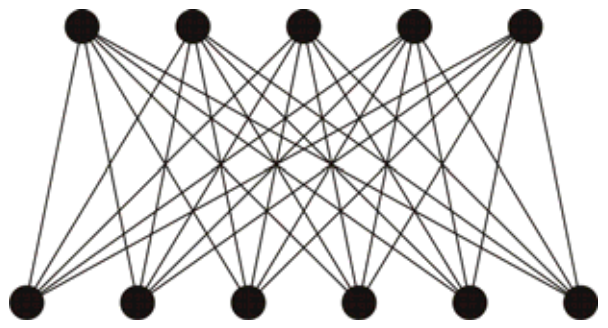
Anna draws a line from every top point to every bottom point. The figure shows 5 points on top and 6 on the bottom. How many lines does she draw?
Same idea as the rectangles: don’t trace the lines — count the choices that define one. Each line is fixed by picking one top point and one bottom point. Those two picks are independent, so multiply (chapter 2):
5 top × 6 bottom = 30 lines — choice (C).
Every line corresponds to exactly one (top, bottom) pair, and every pair gives one line — a clean one-to-one match, so the count is exact.
A line is defined by its two endpoints, one from each group, so the count is (tops) × (bottoms). This is the same engine as “rectangle = 2 verticals × 2 horizontals”: name the defining pieces, count the ways to pick them, multiply. No tracing, no eyeballing.
On a clean grid, # rectangles = C(verticals,2) × C(horizontals,2) and squares add up by size (1²+2²+…). On a messy figure, sweep size by size — never eyeball. The unifying habit: count the choices that define each figure.
2016 · #10 During a cycle race starting at D and finishing at B, every connecting road between the towns A, B, C and D shown in the diagram is...
During a cycle race starting at D and finishing at B, every connecting road between the towns A, B, C and D shown in the diagram is ridden along exactly once. How many possible routes are there for the race?
Show answer
Show hints
Still stuck? Show hint 2 →
Show solution
- The five roads are A-B, A-D, B-D, B-C and D-C; the race must use each exactly once, leaving D and arriving at B.
- Organise by the first move from D: starting D-A leads to 2 finishing routes, starting D-B leads to 2, and starting D-C leads to 2.
- That makes 2 + 2 + 2 = 6 possible routes.
2006 · #20 A singles tournament had six players. Each player played every other player only once, with no ties. If Helen won 4 games, Ines won 3...
A singles tournament had six players. Each player played every other player only once, with no ties. If Helen won 4 games, Ines won 3 games, Janet won 2 games, Kendra won 2 games and Lara won 2 games, how many games did Monica (the sixth player) win?
Show answer
Show hints
Still stuck? Show hint 2 →
Show solution
- With 6 players each meeting every other once, the number of games is "choose 2 of 6" = (6 × 5)/2 = 15. Since there are no ties, that's exactly 15 wins handed out.
- The five named players account for 4 + 3 + 2 + 2 + 2 = 13 wins.
- Monica gets the rest: 15 − 13 = 2.
- You'll reuse this: in any round-robin with no ties, (total wins) = (total games) = "choose 2" of the players. The wins are conserved, so a single missing count is always "total minus the known." No game-by-game detective work needed.
Geometric probability — favorable area over total area
So far every probability was favorable count ÷ total count — you counted things you could list. But what if a dart can land anywhere on a board, or a bus arrives at any moment in a window? There is nothing to list; the outcomes blur into a smooth region. The fix is the same fraction, measured by size instead of by count.
GEOMETRIC PROBABILITY
P = favorable measure ÷ total measure
The “measure” is a length on a line, an area in the plane, or even a volume — whatever the outcomes live in.
You have already met the 1-D version: a traffic light on a 60-second cycle, where P(not green) was favorable time ÷ total time. Area is the same idea one dimension up.
A dart on a board — favorable area over total area
A dart lands at a uniformly random point on a square board with a circle drawn inside it. The chance it lands inside the circle is just the circle’s area ÷ the square’s area — no listing, no casework.
When the circle is inscribed in a square (touching all four sides), its radius is half the side. If the side is 2r, then P = πr² ÷ (2r)² = πr² ÷ 4r² = π/4 ≈ 0.785. The radius cancels — the answer is the same for any square.
Shaded ring — subtract the inner area
A point is chosen at random inside a circle of radius 6. What is the probability it lands in the ring outside a smaller circle of radius 4 (but still inside the big one)?
Work in terms of π and it stays clean. Big circle area = π · 6² = 36π; small circle area = π · 4² = 16π. The favorable ring is the difference: 36π − 16π = 20π. So
P = 20π ÷ 36π = 20/36 = 5/9.
The π cancels every time — for area ratios of similar shapes you rarely need its value at all.
Go deeper: the unlock — graph two unknowns as a square
The unlock: graph two unknowns as a square
The hardest geometric-probability problems hide their geometry. The move that cracks them: when two quantities are each random in a range, make one the x-coordinate and the other the y-coordinate. Every possible pair becomes a point in a square, and the condition you want carves out a region. Then it is just area ÷ area again.
Two numbers x and y are each picked at random between 1 and 4. What is the probability their sum is more than 4?
The whole square of possibilities runs from 1 to 4 in each direction, so it is 3 × 3 = 9 square units. The bad corner where x + y ≤ 4 is the little triangle with corners (1,1), (1,3), (3,1) — legs of length 2, area ½ · 2 · 2 = 2. So the favorable area is 9 − 2 = 7, and
P(x + y > 4) = 7/9.
Countless pairs, no list — just a square and a triangle.
GRAPH-AS-A-SQUARE
Two random quantities → plot one across, one up. All outcomes fill a rectangle; the condition cuts out a region. Probability = that region’s area ÷ the rectangle’s area.
THE MOVE: when there is nothing to count, measure instead — favorable size ÷ total size. Two unknowns? Graph them as a square and shade the region.
Pictured-intuition adapted from Competition Math for Middle School (AoPS).
If the outcomes form a length, divide lengths; a region, divide areas. For area ratios, keep π symbolic — it almost always cancels.
When two quantities are each random, graph them as (x, y): all outcomes fill a rectangle, and the favorable condition is a sub-region. The whole problem becomes one area-over-area fraction.
No list of outcomes? Use size: P = favorable measure ÷ total measure (length, area, or volume). Inscribed circle in a square → π/4. Two random numbers → graph as a square and shade.
Expected value — the average outcome
You roll a fair die over and over and average the results. What number do you drift toward? Not any single face — you settle on the average outcome, 3.5, a number you can never actually roll. That long-run average is the expected value.
EXPECTED VALUE
The expected value is the average outcome: add up (each outcome) × (its probability). When every outcome is equally likely, that is just the plain average of the outcomes.
A die averages 3.5 — the balance point
Picture the six faces as six equal weights, one at each of 1, 2, 3, 4, 5, 6 on a beam. Where does the beam balance? Right in the middle of the evenly-spaced weights — at 3.5. That balance point is the expected value.
By the formula: each face has probability 1/6, so
EV = (1 + 2 + 3 + 4 + 5 + 6) ÷ 6 = 21 ÷ 6 = 3.5.
No one expects to roll a 3.5; it is the average a long run of rolls homes in on.
Expected value with money — the change machine
A broken change machine: feed it a penny (1¢) and it spits back one coin at random — a penny, nickel, dime, or quarter, each equally likely. Feed it 100 pennies. How much profit can you expect?
First the expected coin out. The four equally-likely values are 1, 5, 10, 25 cents, so the average is (1 + 5 + 10 + 25) ÷ 4 = 41 ÷ 4 = 10.25 cents per pull. You paid 1 cent, so your expected profit per pull is 10.25 − 1 = 9.25 cents.
Over 100 pulls: 100 × 9.25¢ = 925¢ = $9.25. Expected value scales — the per-try average times the number of tries.
THE MOVE: for “on average” or “in the long run,” weight each outcome by its probability and add — do not chase any single result.
Climb: linearity of expectation (#22–#25 territory)
The most powerful expected-value tool: the expected value of a sum is the sum of the expected values,
E[X + Y] = E[X] + E[Y],
and it holds even when X and Y are not independent. That lets you find the expected total without untangling the cases.
Example. Roll three dice; what is the expected sum? Each die alone averages 3.5, so the sum averages 3.5 + 3.5 + 3.5 = 10.5 — no need to consider how the dice interact. Break a messy total into simple pieces, average each piece, and add.
Worked examples adapted from Competition Math for Middle School (AoPS).
Expected value is the balance point of the outcomes. Equally-likely outcomes → plain average. Otherwise weight each by its probability and add.
For many repeats, find the EV of one trial and multiply by the number of trials. For a sum of several things, add their separate EVs (linearity).
EV = average outcome = Σ(outcome × probability). A fair die averages 3.5. Per-trial EV × trials gives the long-run total; E[X+Y] = E[X]+E[Y] even when dependent.
Stretch test
Five harder counting and probability problems. Each combines multiple techniques.
2019 · #25 Alice has 24 apples. In how many ways can she share them with Becky and Chris so that each of the three people has at least two apples?
Alice has 24 apples. In how many ways can she share them with Becky and Chris so that each of the three people has at least two apples?
Show answer
Show hints
Still stuck? Show hint 2 →
Show solution
- Pre-give 2 apples to each person (6 used), so the floor is automatically met. That leaves 18 apples to hand out among the three with no lower limit — the hard constraint is gone.
- Picture the 18 apples in a row; placing 2 dividers among them splits them into the three shares (a person can get 0). Choosing 2 divider slots out of 18 + 2 = 20 positions gives C(20, 2) = 190.
- Why this transfers: a "each gets at least k" condition is removed by pre-allotting k to everyone, converting it to the standard zero-allowed stars-and-bars count C(n + r − 1, r − 1).
2023 · #21 Alina writes the numbers 1, 2, …, 9 on separate cards, one number per card. She wishes to divide the cards into 3 groups of 3 cards so...
Alina writes the numbers 1, 2, …, 9 on separate cards, one number per card. She wishes to divide the cards into 3 groups of 3 cards so that the sum of the numbers in each group will be the same. In how many ways can this be done?
Show answer
Show hints
Still stuck? Show hint 2 →
Show solution
- The total 1+2+…+9 = 45 splits into three equal groups, so each must sum to 15. That target instantly pins the big and small cards.
- 7, 8, 9 must each land in a different group (any two of them already total 15 or more, leaving no room for a positive third). By the same squeeze, 1, 2, 3 spread out one per group too.
- So the only real choice is 5's partner-pair, which must sum to 10: {3,5,7}, {2,5,8}, or {1,5,9}. Test each by finishing the other two groups.
- {2,5,8} dies: it would leave 1, 3, 7, 9 to form two groups of 15, but 9 needs a 6 (gone) and 7 needs an 8 (gone) — impossible. The other two succeed: {1,5,9}/{3,4,8}/{2,6,7} and {3,5,7}/{1,6,8}/{2,4,9}.
- So there are 2 ways. This transfers: in equal-sum partition problems, first compute the target, then corner the extreme values — the largest elements have the fewest legal homes, so placing them first kills most of the casework.
2016 · #21 A top hat contains 3 red chips and 2 green chips. Chips are drawn randomly, one at a time without replacement, until all 3 of the reds...
A top hat contains 3 red chips and 2 green chips. Chips are drawn randomly, one at a time without replacement, until all 3 of the reds are drawn or until both green chips are drawn. What is the probability that the 3 reds are drawn?
Show answer
Show hints
Still stuck? Show hint 2 →
Still stuck? Show hint 3 →
Show solution
- Imagine shuffling all 5 chips and revealing them one by one (ignore the early stop — it doesn't change the order). The reds are all out before the greens are all out exactly when the LAST chip revealed is green.
- Why: if the last chip is green, then both greens were NOT out before that point, so the reds must have completed first; if the last chip is red, the greens finished first.
- Every chip is equally likely to occupy the last position, so P(last is green) = 2 greens / 5 chips = 2/5.
- Why this transfers: "which group finishes drawing first" usually hinges only on the single LAST element of a full random order — a powerful shortcut that dodges casework entirely.
- List which chip sits in the final (5th) position of a random arrangement: it's R, R, R, G, or G — 5 equally likely outcomes, 2 of them green.
- The reds-first event is exactly those 2 green-last outcomes, giving 2/5 = 2/5. (You can also enumerate all arrangements and count, landing on the same 2/5.)
1992 · #23 If two dice are tossed, the probability that the product of the numbers showing on the tops of the dice is greater than 10 is
If two dice are tossed, the probability that the product of the numbers showing on the tops of the dice is greater than 10 is
Show answer
Show hints
Still stuck? Show hint 2 →
Still stuck? Show hint 3 →
Show solution
- There are 36 equally likely ordered outcomes. Go die-by-die and count partners giving product > 10: first die 1 → none; 2 → only 6 (gives 12), 1 way; 3 → 4, 5, 6, that's 3; 4 → 3, 4, 5, 6, that's 4; 5 → 3, 4, 5, 6, that's 4; 6 → 2, 3, 4, 5, 6, that's 5.
- Total winners: 1 + 3 + 4 + 4 + 5 = 17. So the probability is 17/36.
- Why count this way: sweeping through one die's values in order is a checklist that guarantees no outcome is double-counted or skipped — the safest method for ‘how many of the 36’ dice questions.
- Watch the boundary: ‘greater than 10’ excludes a product of exactly 10 (like 2×5 or 5×2), so those don't count — a classic trap.
2000 · #21 Keiko tosses one penny and Ephraim tosses two pennies. The probability that Ephraim gets the same number of heads that Keiko gets is
Keiko tosses one penny and Ephraim tosses two pennies. The probability that Ephraim gets the same number of heads that Keiko gets is
Show answer
Show hints
Still stuck? Show hint 2 →
Show solution
- Keiko's single coin: 1 head or 0 heads, each probability ½. Ephraim's two coins: 0 heads (TT) with probability ¼, 1 head (HT or TH) with probability ½, 2 heads (HH) with probability ¼. His '2 heads' can never match Keiko, so ignore it.
- Match at 1 head: ½ · ½ = ¼. Match at 0 heads: ½ · ¼ = ⅛.
- These cases are exclusive, so add: ¼ + ⅛ = ⅜.
- The principle: 'same outcome for two players' = sum over each shared value of P(A gets it)·P(B gets it). Limiting to the value the *smaller* experiment can produce keeps the casework tiny.
- Keiko has 2 equally likely results (H, T); Ephraim has 4 (HH, HT, TH, TT). Together that's 2 × 4 = 8 equally likely combined outcomes.
- Matching ones: Keiko H pairs with Ephraim's 1-head results HT, TH (2 ways); Keiko T pairs with Ephraim's TT (1 way). That's 3 favorable out of 8.
- Probability = 3/8 = ⅜.
Stretch practice — beyond AMC 8
81 bonus problems on Counting & Probability. These are typed-answer (no multiple choice) and tilt harder — closer to early AMC 10. Try the ones that look fun.
Stretch · #1 A rabbit climbs a staircase of 10 steps, hopping either 1 step or 2 steps at a time. In how many different orders can it reach the top?
Show answer
Show hints
Still stuck? Show hint 2 →
Still stuck? Show hint 3 →
Show solution
- The last hop onto step n comes from step n−1 (a 1-hop) or step n−2 (a 2-hop), so ways(n) = ways(n−1) + ways(n−2).
- Tiny cases by listing: a 1-step staircase has 1 way; a 2-step staircase has 2 ways (1+1 or 2).
- Now add the two previous each time: 3→3, 4→5, 5→8, 6→13, 7→21, 8→34, 9→55, 10→89.
- So the rabbit can climb the 10 steps in 89 different orders. (These are the Fibonacci numbers.)
Stretch · #1 You flip a fair coin and get 5 heads in a row. (1) What is the probability that the very next flip is also heads? (2) Separately, before...
Show answer
Show hints
Still stuck? Show hint 2 →
Still stuck? Show hint 3 →
Show solution
- The single next flip: coin flips are independent, so nothing that already happened can change a future flip. The coin has no memory of those 5 heads. So the chance the next flip is heads is just \(\frac{1}{2}\), the same as always.
- A streak from the start: warm up with 2 flips. The four equally likely outcomes are \(HH, HT, TH, TT\). Only 1 of these 4 is two-heads, so the probability is \(\frac{1}{4}=\frac{1}{2}\times\frac{1}{2}\).
- Each extra flip multiplies by another \(\frac{1}{2}\). For 6 heads in a row, \(\left(\frac{1}{2}\right)^6=\frac{1}{64}\).
- So both are true at once: a long streak really is unlikely as a whole, but that does NOT make the single next flip anything other than \(\frac{1}{2}\).
Stretch · #1 Laura is training her pet white rabbit, Ghost, to climb a flight of 10 steps. Ghost can hop up 1 step or 2 steps at a time. He never...
Show answer
Show hints
Still stuck? Show hint 2 →
Still stuck? Show hint 3 →
Show solution
- Ghost's final hop onto step \(n\) came from step \(n-1\) (a 1-hop) or step \(n-2\) (a 2-hop), so ways(\(n\)) = ways(\(n-1\)) + ways(\(n-2\)).
- Tiny cases by listing: a 1-step staircase has 1 way; a 2-step staircase has 2 ways ('1-1' or '2').
- Now add the two previous each time to build the table:
Steps Ways 1 1 2 2 3 3 4 5 5 8 6 13 7 21 8 34 9 55 10 89 - These are the Fibonacci numbers. Reading the table at 10 steps gives the answer: Ghost can climb the flight in \(89\) different ways.
Stretch · #1 You pick 5 cards from a big pile of cards that are each either red or blue. Show that no matter which 5 you grab, you are guaranteed to...
Show answer
Show hints
Still stuck? Show hint 2 →
Still stuck? Show hint 3 →
Show solution
- Make two boxes (the 'holes'): one for red cards, one for blue cards. Each of your 5 cards goes into the box matching its color.
- Could you avoid having 3 of one color? That would mean each box holds at most 2 cards. But \(2+2 = 4\), and you have 5 cards.
- So at least one box must hold 3 or more cards — giving 3 cards of the same color. You are guaranteed at least \(3\) of one color.
Stretch · #1 A man has 3 shirts and 4 ties. In how many ways can he choose a shirt and a tie?
Show answer
Show hints
Still stuck? Show hint 2 →
Still stuck? Show hint 3 →
Show solution
- Picking an outfit happens in two steps: choose a shirt AND then choose a tie. When you do one thing and then another, multiply.
- There are 3 shirts and 4 ties, so the number of outfits is \(3 \times 4 = 12\).
- You can see it with a tree: draw one branch for each shirt, and let each shirt branch split into 4 ties. Counting the 12 branch-ends gives the 12 outfits.
Stretch · #2 A drawer has 7 blue socks and 7 red socks, all jumbled together. You reach in (in the dark) and pull out socks. (1) How many socks must...
Show answer
Show hints
Still stuck? Show hint 2 →
Still stuck? Show hint 3 →
Show solution
- Part 1, a matching pair of any color: with only two colors, after you grab 2 socks the unluckiest result is one blue and one red — no pair yet. But the 3rd sock has to be blue or red, so it MUST match one of the two you already hold. So 3 socks guarantee a matching pair. (You can also list the patterns of 3 socks: BBB, BBR, BRR, RRR — every one contains a pair.)
- Part 2, two BLUE socks specifically: this is a pickier demand. Imagine pulling out reds again and again with terrible luck. There are 7 red socks, so you could pull all 7 reds before any blue appears. After those 7 reds you still need 2 blue socks, so in the worst case you need \(7+2=9\) socks.
- The lesson: read the question carefully! 'A matching pair of any color' (3 socks) and 'two of a specific color' (9 socks) have completely different answers.
Stretch · #2 At the end of the 7th inning of last night's baseball game, the score was tied 8–8. How many different scores were possible at the end...
Show answer
Show hints
Still stuck? Show hint 2 →
Still stuck? Show hint 3 →
Show solution
- Reduce the tie to tiny cases. Tie 0–0: only 0–0 came before → 1 possibility.
- Tie 1–1: each team had 0 or 1, a 2-by-2 grid → 4 possibilities. Tie 2–2: a 3-by-3 grid → 9. Tie 3–3: a 4-by-4 grid → 16.
- The counts 1, 4, 9, 16 are the perfect squares. For a tie \(n\)–\(n\), Team A has \(n+1\) choices (0 to \(n\)) and so does Team B, and they are independent, so the count is \((n+1)^2\).
- For the 8–8 tie, \(n = 8\), so the count is \((8+1)^2 = 9^2 = 81\) possible scores.
Stretch · #2 At a party there are 6 people, and everyone knows at least one other person there. Show that at least 2 people know the exact same...
Show answer
Show hints
Still stuck? Show hint 2 →
Still stuck? Show hint 3 →
Show solution
- Each of the 6 people knows at least 1 other and at most 5 others, so each person's number of acquaintances is one of \(1, 2, 3, 4, 5\).
- That's only 5 possible values. Make those 5 values into 5 boxes ('knows 1', 'knows 2', ..., 'knows 5').
- Put each of the 6 people into the box for how many people they know. With 6 people and only 5 boxes, some box holds at least 2 people.
- Those 2 people know the same number of others, so at least \(2\) people must match.
Stretch · #2 Look at a six-pointed star (a Star of David) built from a triangular grid. Hidden inside are triangles of three different sizes — some...
Show answer
Show hints
Still stuck? Show hint 2 →
Still stuck? Show hint 3 →
Show solution
- Two skills are needed: seeing that there are three sizes, and counting carefully so none get missed.
- Because the star looks the same flipped upside down, for each size the 'up' count equals the 'down' count.
- Tally the three sizes:
Size Up Down Total Small 6 6 12 Medium 3 3 6 Large 1 1 2 - Add the totals: 12 + 6 + 2 = 20.
- So there are 20 triangles in all (12 small, 6 medium, 2 large). The big idea: when a puzzle says 'count them all,' get organized instead of randomly pointing and hoping.
Stretch · #2 A pizza shop lets you start with plain cheese and then add any of these 6 toppings: peppers, onions, sausage, mushrooms, broccoli,...
Show answer
Show hints
Still stuck? Show hint 2 →
Still stuck? Show hint 3 →
Show solution
- Walk through the toppings one at a time and ask: do I add this one? Each answer is Yes or No — that is 2 choices — and you do it for all 6 toppings.
- Since you decide topping 1 AND topping 2 AND ... AND topping 6, you multiply: \(2 \times 2 \times 2 \times 2 \times 2 \times 2 = 2^6 = 64\).
- The 'No to all six' outcome is just the plain cheese slice, so it is correctly included. There are 64 different pizzas, so it takes 64 days.
Stretch · #3 There are 26 teams in the annual football draft. Each team's office has a direct phone line to every other team's office. How many phone...
Show answer
Show hints
Still stuck? Show hint 2 →
Still stuck? Show hint 3 →
Show solution
- Reduce the number of offices and count the connecting lines:
Offices Lines 1 0 2 1 3 3 4 6 5 10 - The jumps between line-counts are 1, 2, 3, 4, ... — every new office joins to every office already present, so the \(n\)-th office adds \(n-1\) lines, giving a total of \(0+1+2+\dots+(n-1) = \dfrac{n(n-1)}{2}\).
- Another view: each of the \(n\) offices needs a line to the other \(n-1\) offices, which is \(n(n-1)\) line-ends, but each line is counted twice, so divide by 2.
- For \(n = 26\): \(\dfrac{26 \times 25}{2} = \dfrac{650}{2} = 325\) telephone lines.
Stretch · #3 Picture a flower with 6 triangular petals around a center. Each petal can be either OPEN or CLOSED, all on its own. How many different...
Show answer
Show hints
Still stuck? Show hint 2 →
Still stuck? Show hint 3 →
Show solution
- Go petal by petal. Petal 1 can be open or closed: 2 choices. For each of those, petal 2 has 2 choices, so 2 petals give \(2 \times 2 = 4\) patterns.
- Three petals give \(2 \times 2 \times 2 = 8\), and so on — each new petal doubles the count.
- For all 6 petals: \(2 \times 2 \times 2 \times 2 \times 2 \times 2 = 2^6 = 64\).
- So there are 64 different open/closed patterns. (Fun aside: many of these look the SAME if you rotate or flip the flower; counting only the truly different shapes gives 13, but that uses symmetry ideas beyond this problem.)
Stretch · #3 Ms. Smith wants to tip her doorman. Her purse holds exactly four different things: a quarter, a half dollar, a silver dollar, and a...
Show answer
Show hints
Still stuck? Show hint 2 →
Still stuck? Show hint 3 →
Show solution
- Each of the 4 different items gets a give-it-or-not decision. That is a 4-step AND process: \(2 \times 2 \times 2 \times 2 = 2^4 = 16\).
- Those 16 groups include the 'give nothing' group. Since she definitely gives a tip, throw that one out: \(16 - 1 = 15\).
- Because all four items are different values, no two different groups are worth the same, so we are not over-counting. There are 15 possible tips.
Stretch · #4 How many squares of all sizes are there on an \(8 \times 8\) checkerboard?
Show answer
Show hints
Still stuck? Show hint 2 →
Still stuck? Show hint 3 →
Show solution
- There are squares of every size from 1×1 up to 8×8, not just the 64 unit squares.
- How many \(k\)-by-\(k\) squares fit? Its left edge can start in any of \((9-k)\) columns and its top edge in any of \((9-k)\) rows, so there are \((9-k)^2\) of size \(k\):
Size \(k\) Count \((9-k)^2\) 1 64 2 49 3 36 4 25 5 16 6 9 7 4 8 1 - Add them all up: \(64 + 49 + 36 + 25 + 16 + 9 + 4 + 1 = 204\). This is \(1^2 + 2^2 + \dots + 8^2\); the formula \(\dfrac{n(n+1)(2n+1)}{6}\) for \(n = 8\) gives \(\dfrac{8 \times 9 \times 17}{6} = 204\) too.
- So the board holds \(204\) squares of all sizes.
Stretch · #4 A flower has 6 petals. Each petal opens with probability \(\tfrac12\) (like a fair coin: heads = open, tails = closed), and the petals...
Show answer
Show hints
Still stuck? Show hint 2 →
Still stuck? Show hint 3 →
Show solution
- Because each petal is like a fair coin, all \(2^6 = 64\) open/closed patterns are equally likely, so \(P(\text{exactly 2 open}) = \dfrac{\text{patterns with exactly 2 open}}{64}\).
- Patterns with exactly 2 open means choosing which 2 of the 6 petals are open. The number of ways to pick 2 of 6 is \(\tfrac{6 \times 5}{2} = 15\) (6 choices for the first, 5 for the second, divide by 2 since order doesn't matter).
- So there are 15 good patterns out of 64: \(P(\text{exactly 2 open}) = \dfrac{15}{64} \approx 0.23\).
- The probability is \(\dfrac{15}{64}\).
Stretch · #4 A traveler wants to tip a porter using coins from her pocket: 4 pennies, 1 nickel, 1 dime, and 6 quarters. She gives at least one coin....
Show answer
Show hints
Still stuck? Show hint 2 →
Still stuck? Show hint 3 →
Show solution
- Because the pennies are identical and the quarters are identical, count by HOW MANY of each kind we give, not which exact coin. That makes it an AND process over the four kinds.
- Pennies: 0, 1, 2, 3, or 4 gives 5 choices. Nickel: give it or not gives 2 choices. Dime: 2 choices. Quarters: 0 through 6 gives 7 choices.
- Multiply: \(5 \times 2 \times 2 \times 7 = 140\).
- This count includes giving nothing. Since she gives at least one coin, subtract that one case: \(140 - 1 = 139\).
Stretch · #5 A license plate starts with three digits, like \(N_1 N_2 N_3\), where each digit is chosen at random from 0 through 9 (so 007 and 000...
Show answer
Show hints
Still stuck? Show hint 2 →
Still stuck? Show hint 3 →
Show solution
- Total strings: each of the 3 positions has 10 choices, so by the multiplication principle there are \(10\times 10\times 10=1000\) possible strings (000 through 999).
- All three different: the first digit can be any of 10, the second must differ from the first (9 left), the third must differ from both (8 left): \(10\times 9\times 8=720\). So \(P(\text{all different})=\frac{720}{1000}=0.72\).
- Not all different is the opposite event, so \(P(\text{not all different})=1-0.72=0.28\).
- Check: exactly-two-equal gives \(3\times(10\times 9)=270\) and all-three-equal gives \(10\), total \(280\), which is \(0.28\). It matches!
Stretch · #5 Ms. Streett will tip a coat-check helper using coins in her purse: 2 dimes, 2 quarters, and 1 nickel. She will definitely give at least...
Show answer
Show hints
Still stuck? Show hint 2 →
Still stuck? Show hint 3 →
Show solution
- Count by how many of each kind she gives (an AND process).
- Dimes: 0, 1, or 2 gives 3 ways. Quarters: 0, 1, or 2 gives 3 ways. Nickel: 0 or 1 gives 2 ways.
- Multiply: \(3 \times 3 \times 2 = 18\).
- She definitely tips, so drop the 'give nothing' case: \(18 - 1 = 17\) ways.
Stretch · #6 A plate has the form \(N_1 N_2 N_3 - L_1 L_2 L_3\): three digits (0-9) then three letters (A-Z). The total number of possible plates is...
Show answer
Show hints
Still stuck? Show hint 2 →
Still stuck? Show hint 3 →
Show solution
- The digits and letters are picked independently, so count each part and multiply.
- Three different digits: \(10\times 9\times 8=720\). Three different letters: \(26\times 25\times 24=15{,}600\).
- Favorable plates: \(720\times 15{,}600=11{,}232{,}000\).
- Probability: \(\frac{11{,}232{,}000}{17{,}576{,}000}\approx 0.0639\), about 1 in 16.
Stretch · #6 A tennis tournament has 61 players. In any round with an odd number of players, one player gets a 'bye' (they skip that round and...
Show answer
Show hints
Still stuck? Show hint 2 →
Still stuck? Show hint 3 →
Show solution
- Bracket way (the long way): Round 1 has 61 players (one bye), 30 matches, 31 left; Round 2: 15 matches, 16 left; Round 3: 8 matches, 8 left; Round 4: 4 matches; Round 5: 2 matches; Round 6: 1 match. Total \(30+15+8+4+2+1=60\).
- The clever way: the champion is the only player who never loses, and everyone loses exactly once, by being knocked out in one match.
- A bye is not a match and knocks no one out. Each match knocks out exactly one player, and we must knock out everyone except the champion.
- So the number of matches is \(61-1=60\). Counting losers skips all the messy bye bookkeeping.
Stretch · #6 A 9-inch piece of wire is bent at two of the inch marks so its two ends meet, forming a triangle. The two bends must land exactly on...
Show answer
Show hints
Still stuck? Show hint 2 →
Still stuck? Show hint 3 →
Show solution
- Whole-number sides adding to 9 that obey the triangle rule are only three shapes: 3-3-3 (equilateral), 1-4-4 (isosceles), and 2-3-4 (scalene). Many people stop and answer '3' — but the question asks for bending-point choices.
- Lay the wire out as marks 1 through 8; picking two bends fixes where each side falls. List by the smaller bend: bend at 1 and 5 (1 way); bend at 2 and {5 or 6} (2 ways); bend at 3 and {5,6,7} (3 ways); bend at 4 and {5,6,7,8} (4 ways).
- Total: \(1 + 2 + 3 + 4 = 10\) choices.
- So there are 10 choices of bending points. (Notice 10 is the 4th triangular number.)
Stretch · #7 Using the same plate form \(N_1 N_2 N_3 - L_1 L_2 L_3\) (total \(17{,}576{,}000\) plates), how many plates have three EQUAL digits and...
Show answer
Show hints
Still stuck? Show hint 2 →
Still stuck? Show hint 3 →
Show solution
- If all three digits are equal, the first digit can be any of 10, and the other two are forced to match it: \(10\times 1\times 1=10\) ways. Same idea for letters: \(26\times 1\times 1=26\) ways.
- Digits and letters are independent, so \(10\times 26=260\) plates have three equal digits and three equal letters.
- Probability: \(\frac{260}{17{,}576{,}000}\approx 0.0000148\), about 1 in 67,600.
Stretch · #7 Now use a 10-inch wire instead of 9, again bent at two inch marks to make a triangle. Will there be MORE choices, FEWER, or the SAME...
Show answer
Show hints
Still stuck? Show hint 2 →
Still stuck? Show hint 3 →
Show solution
- For sides adding to 10 with the triangle rule, every side must be less than 5 (a side of 5 or more couldn't be beaten by the rest). The only whole-number triangles are 2-4-4 and 3-3-4, both isosceles — no scalene triangle fits.
- Count the bending-point pairs: 2-4-4 comes from {2,6}, {4,6}, {4,8}; and 3-3-4 comes from {3,6}, {3,7}, {4,7}.
- That's \(3 + 3 = 6\) choices, all isosceles — fewer than the 10 choices for the 9-inch wire.
- So the answer is 6: a longer wire does not always mean more triangles. Always check, don't assume!
Stretch · #8 A 'symmetrical' plate has the form \(N_1 N_2 N_1 - L_1 L_2 L_1\): the first and third digits match, the first and third letters match,...
Show answer
Show hints
Still stuck? Show hint 2 →
Still stuck? Show hint 3 →
Show solution
- Build the symmetrical digit part \(N_1 N_2 N_1\): choose \(N_1\) in 10 ways, choose \(N_2\) different from it in 9 ways, and \(N_3\) is forced to equal \(N_1\) (1 way): \(10\times 9\times 1=90\).
- Same for the letters \(L_1 L_2 L_1\): \(26\times 25\times 1=650\).
- So the number of symmetrical plates is \(90\times 650=58{,}500\), and the probability is \(\frac{58{,}500}{17{,}576{,}000}\approx 0.00333\), about 1 in 300.
Stretch · #8 How many subsets does a set of 5 elements have? (A subset is any group you can form, including the empty group and the whole set.)
Show answer
Show hints
Still stuck? Show hint 2 →
Still stuck? Show hint 3 →
Show solution
- Forming a subset is a 5-step AND process: for each element, decide 'in' or 'out' (2 choices).
- The empty set (all 'out') and the full set (all 'in') both count.
- Multiply: \(2^5 = 32\). A set of 5 elements has 32 subsets.
Stretch · #9 A fruit bowl has 3 apples, 2 oranges, and 4 bananas. Judy will take at least one piece of fruit. How many different fruit combinations...
Show answer
Show hints
Still stuck? Show hint 2 →
Still stuck? Show hint 3 →
Show solution
- Identical pieces mean we count by quantity per fruit (AND process).
- Apples: 0-3 gives 4 ways. Oranges: 0-2 gives 3 ways. Bananas: 0-4 gives 5 ways.
- Multiply: \(4 \times 3 \times 5 = 60\).
- This includes taking nothing. Since she takes at least one piece, subtract that case: \(60 - 1 = 59\).
Stretch · #10 Peggy will buy one or more new fish for her tank from 6 identical coral fish, 7 identical angel fish, and 3 identical blue fish. In how...
Show answer
Show hints
Still stuck? Show hint 2 →
Still stuck? Show hint 3 →
Show solution
- Count by quantity of each identical kind (AND process).
- Coral: 0-6 gives 7 ways. Angel: 0-7 gives 8 ways. Blue: 0-3 gives 4 ways. So \(7 \times 8 \times 4 = 224\).
- 'One or more' rules out taking no fish, so subtract that one case: \(224 - 1 = 223\).
Stretch · #11 A drawer has \(7\) pairs of blue socks and \(7\) pairs of red socks, all jumbled together. Reaching in the dark, how many socks must you...
Show answer
Show hints
Still stuck? Show hint 2 →
Still stuck? Show hint 3 →
Show solution
- Ask the key question: with the worst luck, how many socks can you draw and still have no match?
- There are only two colors. The unluckiest grab gives you one blue and one red — \(2\) socks, no match yet.
- But the third sock you pull MUST be blue or red, and either way it matches one you already hold. So \(3\) socks are always enough (and \(2\) is not). The numbers \(7\) and \(7\) never matter — only that there are \(2\) colors.
Stretch · #11 Write any 6 whole numbers into the 6 cells of a 2-row, 3-column grid. Show that you can pick a rectangle (2 of the 3 columns) whose 4...
Show answer
Show hints
Still stuck? Show hint 2 →
Still stuck? Show hint 3 →
Show solution
- Only even/odd matters for whether a sum is even, so replace each number by E or O.
- Look at each of the 3 columns as a top/bottom pair and ask whether its two numbers add to an even or odd total. Label each column 'even-sum' or 'odd-sum' — just 2 labels (boxes) for 3 columns.
- Since \(3 > 2\), two columns share a label. If both are 'even-sum', the four corners total even + even = even; if both are 'odd-sum', they total odd + odd = even.
- Either way, that pair of columns forms a rectangle whose 4 corner numbers add up to an even number.
Stretch · #11 A carrier has 3 letters and 5 mailboxes. In how many ways can the letters be placed if (a) each letter must go in a different mailbox;...
Show answer
Show hints
Still stuck? Show hint 2 →
Still stuck? Show hint 3 →
Show solution
- Place the 3 letters one after another — a 3-step AND process.
- (a) Different mailboxes: the first letter has 5 choices, the second has 4 (one box is taken), the third has 3, so \(5 \times 4 \times 3 = 60\).
- (b) No restriction: each letter independently may go in any of the 5 boxes, so \(5 \times 5 \times 5 = 125\).
Stretch · #12 An apartment building has \(20\) mailboxes. How many letters must the mailman deliver to be CERTAIN that at least one box ends up with...
Show answer
Show hints
Still stuck? Show hint 2 →
Still stuck? Show hint 3 →
Show solution
- Ask the key question: how many letters can be delivered without any box reaching \(3\)?
- In the worst case, every one of the \(20\) boxes gets exactly \(2\) letters: \(20 \times 2 = 40\) letters, and still no box has \(3\).
- But the very next letter, the \(41\)st, has to go into a box that already holds \(2\), making it \(3\). So \(41\) letters guarantee that some box has at least \(3\).
Stretch · #12 Now there are 6 letters and 4 mailboxes. In how many ways can the letters be placed if (a) each letter must go in a different mailbox;...
Show answer
Show hints
Still stuck? Show hint 2 →
Still stuck? Show hint 3 →
Show solution
- (a) Different mailboxes: you would need at least 6 boxes to put 6 letters in different boxes, but there are only 4. By the pigeonhole idea (more letters than boxes forces a box to hold two), it is impossible — 0 ways.
- (b) No restriction: place the 6 letters one at a time, each with 4 choices, so \(4^6 = 4096\).
Stretch · #13 A drawer holds \(6\) red, \(7\) green, \(4\) blue, and \(9\) yellow ribbons, all the same shape so you can't tell them apart by feel. In...
Show answer
Show hints
Still stuck? Show hint 2 →
Still stuck? Show hint 3 →
Show solution
- Ask the key question: what is the most ribbons you can hold while still missing a color?
- The unluckiest run grabs every ribbon of the three most common colors and skips the rarest (blue): \(6\) (red) \(+\ 7\) (green) \(+\ 9\) (yellow) \(= 22\) ribbons, and you still have zero blue.
- The \(23\)rd ribbon has no choice but to be blue, completing all four colors. So you must take \(23\) ribbons to be certain. (You might get lucky much sooner, but 'certain' means even in the worst case.)
Stretch · #13 A bin holds a mix of 3 kinds of apples. A customer wants 3 apples of the same kind. What is the smallest number of apples they must grab...
Show answer
Show hints
Still stuck? Show hint 2 →
Still stuck? Show hint 3 →
Show solution
- Use the 3 kinds as 3 boxes. To dodge getting 3 of a kind, each box can hold at most 2 apples.
- The most apples grabbed that way is \(2 \times 3 = 6\) (exactly 2 of each kind) — so 6 apples might not give 3 of a kind.
- Grab a 7th apple: now 7 apples in 3 boxes, and \(7 = 2\times 3 + 1\), so some box must hold at least 3.
- That's 3 of the same kind, guaranteed, so \(7\) is the smallest number that always works.
Stretch · #14 A class has 50 students. The oldest is 18 and the youngest is 15. Show that at least 2 students were born in the same month of the same year.
Show answer
Show hints
Still stuck? Show hint 2 →
Still stuck? Show hint 3 →
Show solution
- Students aged 15 to 18 were born in one of 4 different years.
- Each year has 12 months, so the number of possible (birth year, birth month) combinations is \(4 \times 12 = 48\). Make these 48 combinations the boxes.
- Put each of the 50 students into the box for their birth month and year. Since \(50 > 48\), some box holds at least 2 students.
- Those 2 students were born in the same month of the same year.
Stretch · #15 Mrs. Stux has 3 dimes, 2 quarters, and 4 nickels in her purse. She will give a tip of one or more coins. How many different tips can she...
Show answer
Show hints
Still stuck? Show hint 2 →
Still stuck? Show hint 3 →
Show solution
- Count by how many of each kind she gives (AND process).
- Dimes: 0-3 gives 4 ways. Quarters: 0-2 gives 3 ways. Nickels: 0-4 gives 5 ways. So \(4 \times 3 \times 5 = 60\).
- She gives one or more coins, so subtract the empty tip: \(60 - 1 = 59\).
Stretch · #16 A tournament has \(36\) players. One loss knocks you out. How many games must be played to crown a single champion? Then: how would the...
Show answer
Show hints
Still stuck? Show hint 2 →
Still stuck? Show hint 3 →
Show solution
- Ask the complement question: count losses, not wins. Every game makes exactly one loser, so the number of games equals the number of losses.
- One loss to eliminate: out of \(36\) players, exactly \(1\) becomes champion and the other \(35\) are each eliminated by \(1\) loss. That is \(35\) losses, so \(35\) games.
- Two losses to eliminate: each of the \(35\) eliminated players must collect \(2\) losses, giving \(35 \times 2 = 70\) losses. The champion might also pick up a loss along the way (one is allowed), so the total is \(70\) games if the champion never lost, or \(71\) if the champion lost exactly once before winning.
Stretch · #17 In a town of 10 people, everyone has at least 1 friend (friendship is mutual). Show that at least 2 people have the same number of friends.
Show answer
Show hints
Still stuck? Show hint 2 →
Still stuck? Show hint 3 →
Show solution
- Each of the 10 people has at least 1 friend and at most 9 friends (everyone else in town), so each person's friend-count is one of \(1, 2, 3, \dots, 9\) — 9 possible values.
- Make these 9 values the boxes and put each person into the box equal to their number of friends.
- With 10 people but only 9 boxes, some box holds at least 2 people.
- Those two people have the same number of friends.
Stretch · #17 How many whole numbers less than 1000 can be made if every digit must come from the set {3, 5, 6, 7, 9}? (Digits may repeat.)
Show answer
Show hints
Still stuck? Show hint 2 →
Still stuck? Show hint 3 →
Show solution
- A number under 1000 has 1, 2, or 3 digits — three separate cases (OR, so add). In each case every digit slot is freely chosen from the 5 allowed digits (AND, so multiply), and repeats are allowed.
- One digit: 5. Two digits: \(5 \times 5 = 25\). Three digits: \(5 \times 5 \times 5 = 125\).
- Add the cases: \(5 + 25 + 125 = 155\).
Stretch · #18 A state makes regular plates two ways. Old plates: 2 letters then a 2-digit number from 10 to 99. New plates: 2 letters then a 3-digit...
Show answer
Show hints
Still stuck? Show hint 2 →
Still stuck? Show hint 3 →
Show solution
- Two separate formats means an OR process (add), and each format is an AND process (multiply).
- Old plates: 2 letters then a number 10-99 (that's 90 values): \(26 \times 26 \times 90 = 676 \times 90 = 60840\).
- New plates: 2 letters then a number 100-999 (that's 900 values): \(26 \times 26 \times 900 = 676 \times 900 = 608400\).
- Add the two formats: \(60840 + 608400 = 669240\).
Stretch · #19 How many whole numbers less than 1000 can be made if every digit must come from a set of 8 different nonzero digits? (Digits may repeat.)
Show answer
Show hints
Still stuck? Show hint 2 →
Still stuck? Show hint 3 →
Show solution
- Numbers under 1000 have 1, 2, or 3 digits (separate cases, OR), and each digit slot is freely chosen from the 8 nonzero digits (AND, repeats allowed; no leading-zero worry since 0 isn't allowed).
- Add: \(8 + 8^2 + 8^3 = 8 + 64 + 512 = 584\).
Stretch · #20 Color every square of a \(3 \times 9\) grid red or blue. Show that no matter how you color it, two of the columns end up colored exactly...
Show answer
Show hints
Still stuck? Show hint 2 →
Still stuck? Show hint 3 →
Show solution
- Each column is a stack of 3 squares, each red or blue. The number of ways to color a stack of 3 with 2 colors is \(2 \times 2 \times 2 = 2^3 = 8\). Make these 8 patterns the boxes.
- The grid has 9 columns. Sort each column into the box for its pattern.
- Since \(9 > 8\), two columns share a pattern.
- That means two columns are colored exactly the same.
Stretch · #20 Find the number of plates for each rule: (a) 2 letters followed by a 2-digit number (10-99); (b) 2 letters then a 2-digit number, OR a...
Show answer
Show hints
Still stuck? Show hint 2 →
Still stuck? Show hint 3 →
Show solution
- A '2-digit number' means 10-99, which is 90 values. A letter slot has 26 choices, a digit slot 10, and a 'letter or digit' slot \(26 + 10 = 36\).
- (a) 2 letters then a 2-digit number (AND): \(26 \times 26 \times 90 = 60840\).
- (b) That format OR the reverse (two non-overlapping formats; each equals part (a)): \(60840 + 60840 = 121680\).
- (c) 3 characters, each a letter or digit (AND): \(36 \times 36 \times 36 = 46656\).
Stretch · #21 A state allows plates that are 2 letters followed by 2 digits, OR 2 digits followed by 2 letters. Each digit slot may be 0-9. How many...
Show answer
Show hints
Still stuck? Show hint 2 →
Still stuck? Show hint 3 →
Show solution
- Two non-overlapping formats (OR, add), each an AND process. A digit slot ranges 0-9 (10 choices).
- Letters then digits: \(26 \times 26 \times 10 \times 10 = 67600\). Digits then letters: \(10 \times 10 \times 26 \times 26 = 67600\).
- Add: \(67600 + 67600 = 135200\).
Stretch · #24 A committee of at least 2 people is to be formed from 5 people. How many different committees are possible?
Show answer
Show hints
Still stuck? Show hint 2 →
Still stuck? Show hint 3 →
Show solution
- A committee is a subset of the 5 people, so there are \(2^5 = 32\) subsets in all (each person in or out).
- 'At least 2' forbids the empty committee and the 1-person committees. Empty committee: 1. One-person committees: 5.
- Subtract: \(32 - 1 - 5 = 26\).
Stretch · #25 A radio station's call sign has 3 letters. The first letter must be W or K, and the other two letters can be anything (A-Z). How many...
Show answer
Show hints
Still stuck? Show hint 2 →
Still stuck? Show hint 3 →
Show solution
- The first letter is W or K (2 choices). The remaining two letters are unrestricted (26 each).
- It's all one AND process: \(2 \times 26 \times 26 = 2 \times 676 = 1352\).
Stretch · #27 An urn has 3 red marbles and 1 blue marble. Two marbles are drawn at random. Find the probability that both are red if (a) the first...
Show answer
Show hints
Still stuck? Show hint 2 →
Still stuck? Show hint 3 →
Show solution
- (a) With replacement (independent draws): each draw is red with probability \(\frac{3}{4}\), so \(\frac{3}{4} \times \frac{3}{4} = \frac{9}{16}\).
- (b) Without replacement: the first is red with probability \(\frac{3}{4}\); after removing one red, 2 reds remain among 3 marbles, so the second is red with probability \(\frac{2}{3}\).
- Multiply: \(\frac{3}{4} \times \frac{2}{3} = \frac{6}{12} = \frac{1}{2}\).
Stretch · #29 A die is rolled 3 times. Find the probability that a 2 shows up all 3 times.
Show answer
Show hints
Still stuck? Show hint 2 →
Still stuck? Show hint 3 →
Show solution
- Each roll is independent, so multiply (AND process). The chance of a 2 each time is \(\frac{1}{6}\).
- So \(\left(\frac{1}{6}\right)^3 = \frac{1}{216}\).
Stretch · #30 A nickel and a dime are tossed at the same time. Find the probability that (a) both show heads; (b) both show tails; (c) one shows heads...
Show answer
Show hints
Still stuck? Show hint 2 →
Still stuck? Show hint 3 →
Show solution
- Each coin is heads or tails with probability \(\frac{1}{2}\), and the coins are independent, so multiply for 'and'.
- (a) Both heads: \(\frac{1}{2} \times \frac{1}{2} = \frac{1}{4}\). (b) Both tails: \(\frac{1}{2} \times \frac{1}{2} = \frac{1}{4}\).
- (c) One head, one tail — two separate ways (OR, add): (nickel H, dime T) or (nickel T, dime H), so \(\frac{1}{4} + \frac{1}{4} = \frac{1}{2}\).
Stretch · #31 Helen tosses a coin 6 times. Find the probability that she gets heads on the first 3 tosses and tails on the last 3 tosses (in that...
Show answer
Show hints
Still stuck? Show hint 2 →
Still stuck? Show hint 3 →
Show solution
- An exact order H H H T T T is required. Each toss is independent with probability \(\frac{1}{2}\), so multiply (AND process).
- So \(\left(\frac{1}{2}\right)^6 = \frac{1}{64}\). Because we want one specific order, there is no 'choosing' step — just the single product.
Stretch · #32 The numbers 7, 8, 11, 12, and 15 are written on 5 slips of paper and mixed in a hat. Two slips are picked (without replacement). Find...
Show answer
Show hints
Still stuck? Show hint 2 →
Still stuck? Show hint 3 →
Show solution
- A sum is odd only when one number is odd and the other is even. Among {7, 8, 11, 12, 15}, the odds are 7, 11, 15 (three) and the evens are 8, 12 (two).
- Favorable pairs (one odd, one even): \(3 \times 2 = 6\). Total ways to pick 2 of 5 slips: 10.
- So \(P(\text{odd sum}) = \frac{6}{10} = \frac{3}{5}\).
Stretch · #33 A box has 7 marbles: 3 red and 4 blue. Two are drawn one after another. Find the probability both are red if (a) the first is put back...
Show answer
Show hints
Still stuck? Show hint 2 →
Still stuck? Show hint 3 →
Show solution
- (a) With replacement (independent): each draw is red with probability \(\frac{3}{7}\), so \(\frac{3}{7} \times \frac{3}{7} = \frac{9}{49}\).
- (b) Without replacement (dependent): after one red is removed, 2 reds remain among 6 marbles, so \(\frac{3}{7} \times \frac{2}{6} = \frac{3}{7} \times \frac{1}{3} = \frac{1}{7}\).
Stretch · #34 Roz bought 12 cups of yogurt, but 4 of them are spoiled. She grabs 3 cups at random, one after another. Find the probability that all 3...
Show answer
Show hints
Still stuck? Show hint 2 →
Still stuck? Show hint 3 →
Show solution
- Grab three cups in a row (none put back); the spoiled count and the total both drop each time.
- Multiply: \(\frac{4}{12} \times \frac{3}{11} \times \frac{2}{10} = \frac{24}{1320} = \frac{1}{55}\).
Stretch · #35 Blake thinks his chance of getting into college A is 0.75 and into college B is 0.5. He multiplies to claim the chance of getting into...
Show answer
Show hints
Still stuck? Show hint 2 →
Still stuck? Show hint 3 →
Show solution
- Multiplying two probabilities to get 'both happen' only works when the two events are INDEPENDENT — one happening has no effect on the chance of the other.
- Blake's arithmetic (\(0.75 \times 0.5 = 0.375\)) is fine, but the multiplication itself is only allowed if the two acceptances are independent.
- In real life they probably are NOT: the same grades, test scores, and essays affect both colleges. A strong applicant tends to get into both, a weaker one tends to be rejected by both.
- So the events are linked, and the true chance of 'both' is likely higher than 0.375. His reasoning isn't justified unless the events are independent, which is doubtful here.
Stretch · #43 A family has 4 children, each equally likely to be a girl or a boy. Find the probability that (a) exactly 3 are girls; (b) none are...
Show answer
Show hints
Still stuck? Show hint 2 →
Still stuck? Show hint 3 →
Show solution
- There are \(2^4 = 16\) equally likely sequences for the 4 children.
- (a) Exactly 3 girls: 4 ways to pick which 3 are girls, so \(\frac{4}{16} = \frac{1}{4}\).
- (b) No girls (all boys): just 1 sequence, so \(\frac{1}{16}\).
- (c) At least 2 girls means 2, 3, or 4 girls: counts \(6 + 4 + 1 = 11\), so \(\frac{11}{16}\).
Stretch · #3 Imagine a tiny 'year' with only 5 days, and a group of 3 people who each have a birthday on a random one of those 5 days. What is the...
Show answer
Show hints
Still stuck? Show hint 2 →
Still stuck? Show hint 3 →
Show solution
- Computing 'at least two share' head-on is messy, so ask the easier opposite question: what is the chance all 3 birthdays are different? Then subtract from 1.
- Line the people up. Person 1: any of the 5 days works, \(\frac{5}{5}\). Person 2: must avoid person 1's day, so 4 of 5 are safe, \(\frac{4}{5}\). Person 3: must avoid both used days, so 3 of 5 are safe, \(\frac{3}{5}\).
- Multiply: \(P(\text{all different})=\frac{5}{5}\times\frac{4}{5}\times\frac{3}{5}=\frac{60}{125}=\frac{12}{25}=0.48\).
- Since 'all different' and 'at least one shared' are opposite events that together are certain, \(P(\text{at least two share})=1-0.48=0.52\). Even with only 3 people a shared birthday is slightly more likely than not — the same reason the real 30-people, 365-day problem comes out to about 70%.
Stretch · #3 On graph paper, mark any 5 points that sit exactly on grid corners (their \(x\) and \(y\) coordinates are whole numbers). Show that 2 of...
Show answer
Show hints
Still stuck? Show hint 2 →
Still stuck? Show hint 3 →
Show solution
- The midpoint is a grid corner exactly when \(x_1+x_2\) and \(y_1+y_2\) are both even, which happens only when each pair of coordinates has the same parity. So all that matters is the even/odd status of each point's two coordinates.
- Each point falls into one of 4 parity types (our boxes): (even,even), (even,odd), (odd,even), (odd,odd).
- Drop your 5 points into these 4 boxes. Since \(5 > 4\), some box holds 2 points.
- Those two points match in both coordinates' parity, so \(x_1+x_2\) and \(y_1+y_2\) are both even — the midpoint lands right on a grid corner.
Stretch · #4 You have 3 cards. Card A is red on both sides. Card B is blue on both sides. Card C is red on one side, blue on the other. You shuffle...
Show answer
Show hints
Still stuck? Show hint 2 →
Still stuck? Show hint 3 →
Show solution
- The trap answer is \(\frac{1}{2}\): 'the card is either A (red-red) or C (red-blue), so 50-50.' That's wrong because it counts cards, but the right thing to count is faces.
- There are three red faces in the whole set: Card A side 1 (other side red), Card A side 2 (other side red), and Card C red side (other side blue).
- Seeing red means one of these three equally likely red faces is up. In 2 of those 3 cases (both faces of card A), the hidden side is also red; in only 1 case (card C) is it blue.
- So \(P(\text{other side is red})=\frac{2}{3}\). The key move: condition on what you actually saw (a red face) and count faces, not cards.
Stretch · #4 Now do the same idea in 3-D space. Mark any 9 points whose coordinates \((x,y,z)\) are all whole numbers. Show that 2 of them have a...
Show answer
Show hints
Still stuck? Show hint 2 →
Still stuck? Show hint 3 →
Show solution
- As in the flat version, the only thing that matters about a point is whether each coordinate is even or odd. With three coordinates each even or odd, the number of patterns is \(2\times2\times2 = 8\).
- Make these 8 patterns your boxes and drop the 9 points in. Since \(9 > 8\), two points land in the same box.
- They match in even/odd for \(x\), for \(y\), and for \(z\), so \(x_1+x_2\), \(y_1+y_2\), and \(z_1+z_2\) are all even.
- Dividing each by 2 gives whole numbers, so the midpoint has all whole-number coordinates.
Stretch · #6 A club has 4 married couples (8 people total). A 3-person committee is chosen, but a husband and wife may NOT both be on it. How many...
Show answer
Show hints
Still stuck? Show hint 2 →
Still stuck? Show hint 3 →
Show solution
- No two members can be spouses, so the 3 members come from 3 different couples. Build the committee in steps.
- Step 1: pick the 3 couples to be represented. With 4 couples, choosing 3 is the same as choosing the 1 couple to leave out, so there are 4 ways.
- Step 2: from each of the 3 chosen couples, pick which spouse serves — 2 ways each.
- Multiply: \(4 \times (2 \times 2 \times 2) = 4 \times 8 = 32\). There are 32 possible committees.
Stretch · #7 A key blank has 4 positions where metal can be left alone or cut. At each position you may leave it alone OR cut it at one of 3...
Show answer
Show hints
Still stuck? Show hint 2 →
Still stuck? Show hint 3 →
Show solution
- Each of the 4 positions is a step. At a position you can leave the metal alone or cut at one of 3 depths, so \(1 + 3 = 4\) outcomes per position.
- Multiply over the 4 positions: \(4 \times 4 \times 4 \times 4 = 4^4 = 256\).
- This counts the key with no cuts at all. Since at least one position must be cut, remove that single key: \(256 - 1 = 255\).
Stretch · #9 A small lottery puts 10 balls numbered 1 to 10 in a bag, then draws 3 of them one at a time. To win, the 3 numbers drawn must match the...
Show answer
Show hints
Still stuck? Show hint 2 →
Still stuck? Show hint 3 →
Show solution
- Draw the 3 balls one at a time, and each one must be one of your numbers that hasn't been matched yet.
- 1st ball is one of your 3 numbers, out of 10 balls: \(\frac{3}{10}\). 2nd ball is one of your remaining 2 numbers, out of the 9 left: \(\frac{2}{9}\). 3rd ball is your last number, out of the 8 left: \(\frac{1}{8}\).
- Multiply: \(\frac{3}{10}\times\frac{2}{9}\times\frac{1}{8}=\frac{6}{720}=\frac{1}{120}\). So even in this tiny lottery your chance is only 1 in 120.
- A real 'pick 6 of 50' lottery uses the same idea: \(\frac{6}{50}\times\frac{5}{49}\times\frac{4}{48}\times\frac{3}{47}\times\frac{2}{46}\times\frac{1}{45}\approx\frac{1}{15{,}900{,}000}\), about 1 in 16 million. The lesson: the lottery is a very poor investment.
Stretch · #9 A round table has 5 chairs, and a name card is taped to the table in front of each chair. Five friends sit down without looking, and it...
Show answer
Show hints
Still stuck? Show hint 2 →
Still stuck? Show hint 3 →
Show solution
- Spin the table one click at a time. There are 4 'new' positions (1, 2, 3, or 4 clicks); the no-spin start has nobody correct, by assumption.
- Focus on one friend. As the cards parade past that friend's seat over the 4 clicks, the friend's own card lines up with the seat exactly once (not at the start, so during one of the 4 clicks). So each friend has exactly one correct spin position.
- Make the 4 spin positions our boxes and put each of the 5 friends into the box for their one correct spin. Since \(5 > 4\), two friends land in the same box.
- At that single spin position, both of those friends sit in front of their own cards — so some spin makes at least \(2\) friends correct.
Stretch · #10 Two evenly matched teams play a best-of-seven series (first to win \(4\) games wins). Each game is a coin flip. The chance the series...
Show answer
Show hints
Still stuck? Show hint 2 →
Still stuck? Show hint 3 →
Show solution
- Imagine the teams play all \(7\) games no matter what; there are \(2^7 = 128\) equally likely win/loss patterns, and each probability is (count)\(/128\).
- The series reaches \(7\) games only if it is tied \(3\)-\(3\) after \(6\) games. The number of ways for team A to win exactly \(3\) of the first \(6\) is \(\binom{6}{3} = 20\), and game \(7\) can go either way, giving \(20 \times 2 = 40\) patterns.
- So \(P(7) = \frac{40}{128} = \frac{5}{16}\). (For the others: \(P(4) = \frac{2}{16}\), \(P(5) = \frac{4}{16}\), \(P(6) = \frac{5}{16}\), summing to \(1\).)
- A \(6\)-game and a \(7\)-game series are equally likely (\(\frac{5}{16}\) each): once the score is \(3\)-\(2\) after \(5\) games, game \(6\) either ends it or forces a game \(7\), each with probability \(\frac{1}{2}\).
Stretch · #10 Color every square of a \(3 \times 9\) grid either black or white, any way you like. Show that you can always find a rectangle (using 2...
Show answer
Show hints
Still stuck? Show hint 2 →
Still stuck? Show hint 3 →
Show solution
- Look at any single column: 3 squares in 2 colors, so by pigeonhole at least 2 of its squares share a color. For each column record a 'feature': which two rows match, and what color they share.
- How many features are possible? 3 ways to pick the matched row-pair (1&2, 1&3, or 2&3) times 2 color choices, so \(3 \times 2 = 6\) features. Make these 6 features the boxes.
- The grid has 9 columns, each giving one feature, but only 6 boxes. Since \(9 > 6\), two columns share a feature.
- That means the same two rows have the same color in both columns — those 4 squares are the corners of a rectangle, all one color.
Stretch · #12 Flip a fair coin \(4\) times. The chances of getting exactly \(0, 1, 2, 3, 4\) heads come from the counts \(1, 4, 6, 4, 1\) out of...
Show answer
Show hints
Still stuck? Show hint 2 →
Still stuck? Show hint 3 →
Show solution
- Each set of \(4\) flips is one of \(2^4 = 16\) equally likely sequences, so \(P(k \text{ heads}) = \frac{\text{sequences with } k \text{ heads}}{16}\).
- The counts come from Pascal's triangle (row 4): \(1, 4, 6, 4, 1\), giving probabilities \(\frac{1}{16}, \frac{4}{16}, \frac{6}{16}, \frac{4}{16}, \frac{1}{16}\).
- Check the total: \(1 + 4 + 6 + 4 + 1 = 16\), so the probabilities add to \(\frac{16}{16} = 1\).
- The largest count is \(6\), at \(k = 2\). So the most likely outcome is exactly \(2\) heads, with probability \(\frac{6}{16} = \frac{3}{8}\).
Stretch · #13 There are 3 different math books and 2 different art books, all different. Roslyn will choose some of them. How many selections can she...
Show answer
Show hints
Still stuck? Show hint 2 →
Still stuck? Show hint 3 →
Show solution
- All 5 books are different, so a selection is a subset; each book is in or out, giving \(2^5 = 32\) subsets in all.
- (a) At least one book: remove the empty selection, so \(2^5 - 1 = 31\).
- (b) At least one math book: split into the 3 math books and the 2 art books. Math must include at least one, so \(2^3 - 1 = 7\). Art is free, so \(2^2 = 4\).
- Multiply (AND process): \(7 \times 4 = 28\).
Stretch · #14 In how many ways can a triangle be named using 3 different letters of the 26-letter alphabet? (The same triangle can be read starting at...
Show answer
Show hints
Still stuck? Show hint 2 →
Still stuck? Show hint 3 →
Show solution
- A triangle's name lists its 3 corners, but the SAME triangle can start at any of the 3 corners and go either of 2 directions. So first count ordered lists, then divide out these repeats.
- Ordered lists of 3 different letters: \(26 \times 25 \times 24 = 15600\).
- Each triangle is named \(3 \times 2 = 6\) different ways, so divide: \(\dfrac{15600}{6} = 2600\).
- (This is the same as 'just choose which 3 letters', since once you pick 3 corners there is only one triangle.)
Stretch · #16 Brenda will borrow either 2 or 3 books from a stack of 5 books. In how many ways can she make her selection?
Show answer
Show hints
Still stuck? Show hint 2 →
Still stuck? Show hint 3 →
Show solution
- This is an OR process: she takes exactly 2 OR exactly 3 books, and these can't happen together.
- Ways to choose 2 of 5 books: there are 10 (you can list the pairs).
- Ways to choose 3 of 5 books: choosing 3 to take is the same as choosing the 2 to leave behind, so this is also 10.
- The two cases don't overlap, so add: \(10 + 10 = 20\).
Stretch · #22 A state uses plates of 3 letters followed by 3 digits, and every possible plate is already used. To make more plates cheaply, it will...
Show answer
Show hints
Still stuck? Show hint 2 →
Still stuck? Show hint 3 →
Show solution
- Adding one extra slot multiplies the number of plates by the number of symbols that slot allows. So to make the MOST new plates, choose the slot with the most options.
- A letter offers 26 choices; a digit offers only 10. Since 26 is bigger than 10, adding a LETTER slot makes far more plates.
- The old pool was \(26^3 \times 10^3 = 17{,}576{,}000\) plates. A letter multiplies by 26, giving \(456{,}976{,}000\); a digit would only multiply by 10, giving \(175{,}760{,}000\). So add a letter.
Stretch · #23 How many different selections of at least one book can Erica make from 4 different books? (a) Solve it with an AND process. (b) Solve it...
Show answer
Show hints
Still stuck? Show hint 2 →
Still stuck? Show hint 3 →
Show solution
- (a) AND process: each of the 4 different books is in or out — a 4-step AND process giving \(2^4 = 16\) subsets. 'At least one' removes the empty set: \(2^4 - 1 = 15\).
- (b) OR process: split by how many books she takes and add: \(4 + 6 + 4 + 1 = 15\) (pick 1, pick 2, pick 3, pick 4).
- Both give 15. The AND process is much easier — one quick power of 2 minus 1, instead of adding four separate counts.
Stretch · #26 A tattoo shop offers 6 different designs. No one gets the same design twice. (a) Bob may get any number of them, even none. How many...
Show answer
Show hints
Still stuck? Show hint 2 →
Still stuck? Show hint 3 →
Show solution
- Since no design is repeated, a set of tattoos is a subset of the 6 designs.
- (a) Any number, even none: each design is in or out (AND process), so \(2^6 = 64\).
- (b) The eagle is definitely in, so that design is fixed and only the other 5 are still free choices: \(2^5 = 32\).
Stretch · #28 Maile pulls one card at random from a standard 52-card deck. (a) What is the probability it is a seven or an ace? (b) What is the...
Show answer
Show hints
Still stuck? Show hint 2 →
Still stuck? Show hint 3 →
Show solution
- (a) Seven or ace: no card is both, so the chances simply add. There are 4 sevens and 4 aces: \(\frac{4}{52} + \frac{4}{52} = \frac{8}{52} = \frac{2}{13}\).
- (b) Seven or red: there are 4 sevens and 26 red cards, but the seven of hearts and seven of diamonds got counted in BOTH groups. Subtract those 2 once: \(\frac{4}{52} + \frac{26}{52} - \frac{2}{52} = \frac{28}{52} = \frac{7}{13}\).
- When two events can't overlap, just add; when they can overlap, subtract the part counted twice.
Stretch · #36 A die is rolled 5 times. Rolling a number less than 3 (a 1 or a 2) counts as a 'success'. What is the probability of getting exactly 3 successes?
Show answer
Show hints
Still stuck? Show hint 2 →
Still stuck? Show hint 3 →
Show solution
- A success ('less than 3', a 1 or 2) has probability \(p = \frac{2}{6} = \frac{1}{3}\), and a failure has \(q = \frac{2}{3}\). Any single pattern with 3 successes and 2 failures has probability \(p^3 q^2\) (independent rolls, multiply).
- How many such patterns? That's the number of ways to pick which 3 of the 5 rolls are successes, which is 10. These patterns don't overlap, so add (OR) — i.e. multiply the count by the per-pattern chance.
- So \(10 \times \left(\frac{1}{3}\right)^3 \left(\frac{2}{3}\right)^2 = 10 \times \frac{1}{27} \times \frac{4}{9} = \frac{40}{243}\).
Stretch · #37 A die is rolled 5 times; rolling less than 3 (a 1 or 2) is a 'success'. What is the probability of getting exactly 3 OR exactly 4 successes?
Show answer
Show hints
Still stuck? Show hint 2 →
Still stuck? Show hint 3 →
Show solution
- 'Exactly 3' and 'exactly 4' successes can't both happen, so add (OR process), with \(p = \frac{1}{3}\) and \(q = \frac{2}{3}\).
- From the previous problem, \(P(\text{exactly }3) = \frac{40}{243}\).
- For exactly 4 successes there are 5 patterns (choose which single roll is the one failure), each worth \(p^4 q\): \(5 \times \left(\frac{1}{3}\right)^4 \times \frac{2}{3} = 5 \times \frac{1}{81} \times \frac{2}{3} = \frac{10}{243}\).
- Add the two cases: \(\frac{40}{243} + \frac{10}{243} = \frac{50}{243}\).
Stretch · #38 Deanna guesses on a 4-question multiple-choice quiz. Each question has 4 choices, so each guess is correct with probability...
Show answer
Show hints
Still stuck? Show hint 2 →
Still stuck? Show hint 3 →
Show solution
- Each guess is correct with probability \(p = \frac{1}{4}\) and wrong with \(q = \frac{3}{4}\). Passing needs at least 3 of 4 correct, so add 'exactly 3' and 'exactly 4' (OR). Use the common denominator \(4^4 = 256\).
- Exactly 4 correct (1 pattern): \(\left(\frac{1}{4}\right)^4 = \frac{1}{256}\).
- Exactly 3 correct (4 patterns — which question is wrong): \(4 \times \left(\frac{1}{4}\right)^3 \times \frac{3}{4} = 4 \times \frac{1}{64} \times \frac{3}{4} = \frac{12}{256}\).
- Add: \(\frac{12}{256} + \frac{1}{256} = \frac{13}{256} \approx 0.05\). Only about a 5% chance — studying is a much better plan!
Stretch · #39 Two equally good teams play a best-of-three series (first to win 2 games wins the series). Each game is a coin-flip (each team wins with...
Show answer
Show hints
Still stuck? Show hint 2 →
Still stuck? Show hint 3 →
Show solution
- Each game is independent, Team A winning with probability \(\frac{1}{2}\).
- Method 1 (list the ways A wins, A must win the last game): A wins in 2 games (A A) is \(\frac{1}{2} \times \frac{1}{2} = \frac{1}{4}\). A wins in 3 games: 2 patterns (A B A and B A A), each \(\left(\frac{1}{2}\right)^3 = \frac{1}{8}\), totaling \(\frac{1}{4}\).
- Add: \(\frac{1}{4} + \frac{1}{4} = \frac{1}{2}\).
- Method 2 (symmetry): the two teams are equally good, so A and B are equally likely to win the series, giving A's chance as exactly \(\frac{1}{2}\) — matching Method 1.
Stretch · #40 Find the probability of getting exactly 4 heads in 6 tosses of a fair coin.
Show answer
Show hints
Still stuck? Show hint 2 →
Still stuck? Show hint 3 →
Show solution
- All 6 tosses give \(2^6 = 64\) equally likely sequences.
- The number with exactly 4 heads is the number of ways to choose which 4 of the 6 tosses are heads, which is 15.
- So the probability is \(\frac{15}{64}\).
Stretch · #41 Find the probability of getting (a) a three or a five in exactly 2 out of 4 rolls of a fair die; (b) exactly 2 even numbers in 4 rolls...
Show answer
Show hints
Still stuck? Show hint 2 →
Still stuck? Show hint 3 →
Show solution
- There are 6 ways to choose which 2 of the 4 rolls are the successes.
- (a) Success = three or five, \(p = \frac{2}{6} = \frac{1}{3}\), failure \(q = \frac{2}{3}\): \(6 \times \left(\frac{1}{3}\right)^2 \left(\frac{2}{3}\right)^2 = 6 \times \frac{1}{9} \times \frac{4}{9} = \frac{24}{81} = \frac{8}{27}\).
- (b) Success = even, \(p = \frac{1}{2}\): \(6 \times \left(\frac{1}{2}\right)^2 \left(\frac{1}{2}\right)^2 = 6 \times \frac{1}{16} = \frac{6}{16} = \frac{3}{8}\).
Stretch · #42 A card is drawn from a full deck and put back; this is done 3 times. Find the probability of getting at least one ace in the 3 draws....
Show answer
Show hints
Still stuck? Show hint 2 →
Still stuck? Show hint 3 →
Show solution
- Putting the card back makes the draws independent. Each draw is NOT an ace with probability \(\frac{12}{13}\).
- Directly counting 'at least one ace' means handling 1, 2, or 3 aces — messy. The slick move is to find the chance of NO aces and subtract from 1.
- \(P(\text{no aces}) = \left(\frac{12}{13}\right)^3 = \frac{1728}{2197}\).
- \(P(\text{at least one ace}) = 1 - \frac{1728}{2197} = \frac{469}{2197} \approx 0.21\).
Stretch · #44 A family has 5 children, each equally likely to be a boy or a girl. Find the probability that (a) at least 4 are boys; (b) at least 4 are girls.
Show answer
Show hints
Still stuck? Show hint 2 →
Still stuck? Show hint 3 →
Show solution
- There are \(2^5 = 32\) equally likely sequences.
- (a) At least 4 boys = exactly 4 OR exactly 5 boys. Exactly 5 boys: 1 sequence. Exactly 4 boys: 5 sequences (which single child is the girl). Total favorable: \(5 + 1 = 6\), so \(\frac{6}{32} = \frac{3}{16}\).
- (b) At least 4 girls: since boys and girls are equally likely, swapping the labels shows this has the SAME probability as part (a), so \(\frac{6}{32} = \frac{3}{16}\).
Counting & Probability quick-reference
FORMULAS TO KNOW COLD
- Count from a to b (both ends): b − a + 1. (Keep both fenceposts — that is the +1.)
- Multiplication principle: independent steps multiply. Multiply WITHIN a case (AND), add ACROSS cases (OR).
- Factorial: n! = n·(n−1)·…·2·1. 5! = 120. 6! = 720. 7! = 5040. (0! = 1 by convention.)
- Permutations (order matters): P(n, k) = n! / (n−k)!.
- Combinations (order doesn't matter): C(n, k) = n! / (k! · (n−k)!).
- Symmetry: C(n, k) = C(n, n−k).
- Pairs / handshakes: C(n, 2) = n(n−1) / 2. (5 → 10, 10 → 45, 20 → 190.)
- Polygon diagonals: n(n−3) / 2.
- Gauss sum: 1 + 2 + … + n = n(n+1) / 2. (1 + … + 100 = 5050.)
- Subsets of an n-element set: 2n.
- Circular arrangements: (n−1)! (rotations of the same arrangement count once).
- Letters with repeats: n! / (d₁! · d₂! · …).
- Stars and bars: identical N items among k distinct recipients (zeros allowed) = C(N+k−1, k−1).
- Probability: favorable / total (only when outcomes are equally likely).
- Independent events: P(A and B) = P(A) · P(B).
- Mutually exclusive: P(A or B) = P(A) + P(B).
- Complement: P(not A) = 1 − P(A).
- Inclusion-exclusion: |A ∪ B| = |A| + |B| − |A ∩ B|.
- Lattice paths (right/up): C(m+n, m).
- Geometric probability: favorable measure ÷ total measure (length, area, or volume). Inscribed circle in a square → π/4.
- Expected value: Σ(outcome × probability) = the average outcome. Fair die → 3.5. Linearity: E[X+Y] = E[X]+E[Y].
- Pigeonhole (guarantee N from k): k(N−1) + 1 items.
- Degree-sum parity: sum of everyone's handshake counts = 2 × (handshakes), so it is always even — the number of people who shook an odd number of hands is even.
- Fencepost / off-by-one. Counting a to b is b − a + 1, not b − a; “span ÷ step” misses the endpoints. List a tiny case to check both ends.
- Order matters or not? Permutation vs. combination — read the problem carefully.
- With or without replacement? Without = the pool shrinks for the second draw.
- Forgetting to subtract overlap in “A or B” with both possible. If a total exceeds the whole group, you forgot to subtract the overlap.
- “At least one” trap. Use complementary counting; count the “none” case and subtract.
- Outcomes not equally likely. Favorable / total only works when every counted outcome is equally likely — the 11 dice-sums (2…12) are NOT equal; count the 36 ordered pairs instead.
- Dividing by 2 when you didn't double-count. Halve a handshake/pair count only if EVERY item was counted twice; mixed cases (e.g. some shakes one-way) must be split first.
- Over-counting symmetric arrangements. If items can be rotated/reflected to the same arrangement, divide by the symmetry count.
Drill these:
- 5! = 120. 6! = 720. 7! = 5040.
- C(5,2) = 10. C(10,2) = 45. C(10,3) = 120.
- 10 handshakes among 5 people. 45 among 10. 190 among 20.
- Rolling 2 dice: 36 outcomes. P(sum = 7) = 6/36 = 1/6. P(sum = 12) = 1/36.
- Flipping 3 coins: 8 outcomes. P(exactly 2 heads) = C(3, 2)/8 = 3/8.
- Paths from (0,0) to (4,3): C(7, 3) = 35.
Want to climb higher? — advanced counting tools (#22–#25 territory)
- PIE for 3 sets: |A ∪ B ∪ C| = |A| + |B| + |C| − |A∩B| − |A∩C| − |B∩C| + |A∩B∩C|.
- Pascal’s identity: C(n, k) + C(n, k+1) = C(n+1, k+1). (Useful for building Pascal’s triangle row-by-row.)
- Binomial sum: C(n,0) + C(n,1) + … + C(n,n) = 2n. (Same fact as “number of subsets” — two views.)
- Linearity of expectation: E[X + Y] = E[X] + E[Y], even when X and Y are NOT independent. Lets you compute the expected total without disentangling cases.
- Recursion-as-counting: when a problem builds on smaller cases, count f(1), f(2), f(3) and look for a relation like f(n) = f(n−1) + f(n−2) (Fibonacci). Then chase the recurrence.
- Geometric pigeonhole: regions can be boxes too — e.g. 5 points in a 1×1 square, cut into four ½×½ sub-squares, force two points within
√2/2 ≈ 0.71of each other. See the interactive in the Pigeonhole chapter (“regions are pigeonholes too”). - Count two ways / invariants: find one total that two different counts must both equal and let them pin each other down — e.g. sum of handshake counts = 2×(handshakes), so the number of odd-degree people is even (degree-sum parity); or “count the losers” in a knockout (n−1 games).