About this topic
Try this in your head: 1 + 2 + 3 + … + 100. A teacher once handed that to a roomful of bored kids to keep them quiet. One boy — Carl Friedrich Gauss, about nine years old — put his slate down in under a minute. The answer is 5050. He did not add 100 numbers. He saw something.
That is the whole game on these contests. At school, arithmetic means working carefully left to right and not making a slip. On a contest, almost every arithmetic problem is built so there is a faster road than left to right. A pair adds to a round number. The same factor hides in three terms. A ‘closest to’ question never needed the exact answer at all.
The setters do this on purpose. They are not testing whether you can compute. They are testing whether you can read a calculation — see its shape, then take the short road.
This lesson is ten habits. Each one starts from something you already know — what an average is, what ‘closest to’ means, the distributive property — and turns it into a fast move you can trust under pressure. By the end you will stop punching numbers and start looking first.
Order of operations: read in tiers
Read 2 + 3 × 4 straight across and you get 20. The real answer is 14: arithmetic is not read left-to-right like English — some operations jump the queue. The fix is to read every calculation in tiers, settling the top tier first.
Now: read in tiers
Read this out loud the way you would read a sentence: 2 + 3 × 4. Most people say ‘two plus three is five, times four is twenty.’ That answer is wrong. The real answer is 14. Arithmetic is not read straight across like English.
Watch what these have in common:
2 + 3 × 4 = 2 + 12 = 14(not 20)10 − 2 × 3 = 10 − 6 = 4(not 24)1 + 2 × 5 = 1 + 10 = 11(not 15)
In every line the multiplication happened first, even though the plus or minus came earlier on the page. That is the pattern. Multiplication is repeated addition, so it has to settle before any plain addition does. We read a calculation in tiers, top tier first.
PEMDAS — the four tiers
- Parentheses (any grouping: brackets, a fraction bar, the bar of a square root)
- Exponents (powers and roots)
- Multiplication and Division — same tier, left to right
- Addition and Subtraction — same tier, left to right
Mnemonic: Please Excuse My Dear Aunt Sally. In many countries it is BODMAS — same rule, different letters.
THE MOVE: read it in tiers, top down. Find the grouping and exponents, settle them, then sweep the multiplications and divisions left to right, then the pluses and minuses left to right.
Watch the order in action
One tier per row. The highlighted piece gets computed; its value drops to the next row.
The exponent trap: a power grabs only what it touches
Exponents are tighter than × and ÷. The power lands on its own number, not on whatever is multiplied with it:
2 × 3² = 2 × 9 = 18, not(2 × 3)² = 36.24 ÷ 2² = 24 ÷ 4 = 6, not(24 ÷ 2)² = 144.−3² = −9, but(−3)² = 9. A minus sign joins the base only inside parentheses.
(20 + 18) ÷ (20 − 18)? Settle each parenthesis first, then divide.Why tiers? — the idea under the rule
Multiplication is shorthand for repeated addition: 3 × 4 means ‘three fours.’ So in 2 + 3 × 4, the 3 × 4 is one chunk — three fours bundled together — and you add the 2 to that bundle. Exponents bundle repeated multiplication the same way, so they settle even sooner. Parentheses are us shouting ‘treat this as one number.’ PEMDAS is not a random rule to memorize; it is the order that keeps the shorthand honest.
Go deeper: place value, carrying & fast mental addition (the groundwork)
First, see what a number is made of
Before you crunch anything, look at how a number is built. 34 is not a single thing — it is 3 tens and 4 ones. Picture a ten as a tall rod of ten cubes and a one as a single cube:
Three ten-rods and four single cubes. That is what ‘34’ means.
Each spot to the left is worth ten times the spot on its right: ones, tens, hundreds, thousands. So 506 is 5 hundreds, 0 tens, 6 ones — the 0 is holding the tens column open so the 5 stays in the hundreds. This is place value, and it is why ‘carrying’ works.
‘Carry’ is bundling ten ones into one ten
Add 27 + 5. The ones are 7 + 5 = 12 ones. But you are not allowed to keep 12 ones — the ones column only holds 0 through 9. So you bundle ten of them into one ten-rod and slide it left, leaving 2 ones behind. That slid rod is the little ‘1’ you write above the tens column.
Ten loose cubes snap into one rod and move to the tens column. That snap IS the carry.
Subtraction with ‘borrowing’ is the same trick in reverse: you break one ten-rod back into ten ones when the ones column runs short. Carry bundles up; borrow breaks down. Same ten, different direction.
Make a ten — the fastest way to add in your head
Adding 8 + 5, your brain does not count ‘9, 10, 11, 12, 13.’ The quick way: steal 2 from the 5 to finish the 8 into a clean 10, then add the 3 that is left. 8 + 5 = (8 + 2) + 3 = 10 + 3 = 13. Tens are easy to add; you are routing every sum through the nearest ten.
Jump to 10 first, then jump the leftover. Two easy hops beat counting one at a time.
Subtraction works as number-line hops too. 23 − 8? Hop back 3 to land on the clean 20, then back 5 more: 20 − 5 = 15. Always aim for the nearest ten — it is the rest stop your brain handles instantly.
9 + 6 in your head, then check 9 + 6. What is the value? (Hint: finish the 9 into 10 first.)Trick: subtract by ‘adding up’ to the next round number
Hard subtractions like 1000 − 376 get easy if you count up from the small number to round stops instead of borrowing across all those zeros. From 376: up 4 to 380, up 20 to 400, up 600 to 1000 — that is 4 + 20 + 600 = 624. No borrowing, no crossed-out zeros.
Compute 20 − (3 + 4). Work left to right like reading a sentence: 20 − 3 = 17, then 17 + 4 = 21. So the answer is 21.
Why it breaks: The minus sign sits in front of the whole parenthesis, so it flips every term inside — the +4 should have become −4, but reading left to right kept it positive.
The fix: Settle the parenthesis first: 20 − (3 + 4) = 20 − 7 = 13. Or distribute the minus onto both terms: 20 − 3 − 4 = 13. The two wrong-and-right answers differ by 2 × 4 = 8 — exactly twice the term whose sign got dropped. A minus in front of parentheses flips every term inside.
Harry and Terry are each told to calculate 8 − (2 + 5). Harry gets the correct answer. Terry ignores the parentheses and calculates 8 − 2 + 5. If Harry's answer is H and Terry's answer is T, what is the difference H − T?
Harry and Terry each compute 8 − (2 + 5). Harry obeys the parentheses; Terry ignores them. Find H − T.
Harry: H = 8 − (2 + 5) = 8 − 7 = 1. Terry drops the parentheses: T = 8 − 2 + 5 = 11.
The question wants H − T = 1 − 11 = −10 — choice A.
You did not even need the numbers. Dropping the parentheses flips the sign of the 5, so Terry's answer runs ahead of Harry's by exactly 2 × 5 = 10. Harry minus Terry is therefore −10.
This is a tier-reading lesson dressed as a story. The shape is ‘X with parentheses versus X without.’ The gap is always twice whatever term got its sign flipped, and the sign of H − T depends only on who ended up bigger. Terry did, because he turned a −5 into a +5.
Read in tiers, top down: grouping and exponents first, then × and ÷ left to right, then + and − left to right. A minus sign in front of parentheses flips every term inside.
2023 · #1 What is the value of (8 × 4 + 2) − (8 + 4 × 2)?
What is the value of (8 × 4 + 2) − (8 + 4 × 2)?
Show answer
Show hints
Still stuck? Show hint 2 →
Show solution
- The two parentheses look almost identical — same numbers 8, 4, 2 — but the × sits in a different spot. That's the whole trick: the answer comes from where the multiplication lands, not from the numbers themselves.
- First parentheses: multiply first, so 8 × 4 + 2 = 32 + 2 = 34.
- Second parentheses: 8 + 4 × 2 = 8 + 8 = 16.
- Subtract: 34 − 16 = 18. Sanity check: the first group is much bigger because the big multiply (8 × 4) happens there, so a positive answer feels right.
2017 · #1 Which of the following values is the largest?
Which of the following values is the largest?
Show answer
Show hints
Still stuck? Show hint 2 →
Show solution
- The insight: all-addition (A) keeps every digit working for you; any × either zeroes out a term (anything × 0) or wastes one (anything × 1). So (A) should win — no arithmetic needed to see it leads.
- Confirm: (A) 2 + 0 + 1 + 7 = 10; (B) 0 + 1 + 7 = 8; (C) 2 + 0 + 7 = 9; (D) 2 + 0 + 7 = 9; (E) 0.
- Largest is (A) = 10. You'll see this again: when options differ only by an operation, ask which operation grows the value rather than computing all five.
2024 · #2 What is the value of \(\dfrac{20 \times 24}{2\times 0 + 2\times 4}\)?
What is the value of \(\dfrac{20 \times 24}{2\times 0 + 2\times 4}\)?
Show answer
Show hints
Still stuck? Show hint 2 →
Show solution
- Top: 20 × 24 = 480.
- Bottom: 2×0 + 2×4 = 0 + 8 = 8.
- 480 ÷ 8 = 60.
1991 · #2 16 + 84 − 2 =
16 + 84 − 2 =
Show answer
Show hints
Still stuck? Show hint 2 →
Show solution
- The bar acts like parentheses around the whole top and the whole bottom: top = 16 + 8 = 24, bottom = 4 − 2 = 2.
- Now divide the two totals: 24 ÷ 2 = 12.
- Trap to dodge: don't divide term-by-term (16÷4 + 8÷2 = 8) — the bar isn't shorthand for that. It groups everything above against everything below.
2022 · #1 What is \((20+22) \div (20-22)\)?
What is \((20+22) \div (20-22)\)?
Show answer
Show hints
Still stuck? Show hint 2 →
Show solution
- The numerator is 20+22 = 42.
- The denominator is 20-22 = -2.
- 42 divided by -2 is -21, so the answer is B.
Pair from the ends — why arithmetic series collapse
Add these the slow way and you will burn a minute: 4 + 7 + 10 + 13 + 16. Now try Gauss's trick. Fold the list in half and add the outer pair: 4 + 16 = 20. The next pair in: 7 + 13 = 20. The lonely middle, 10, is half of 20. Every pair balances to the same total.
(4, 16) sums to 20. (7, 13) sums to 20. The middle 10 is half of 20. Average = 10.
So the total is 5 × 10 = 50 — count times average, no slogging. This works for any list that climbs by the same step each time. Such a list is an arithmetic series, and it has a gorgeous property:
ARITHMETIC SERIES SUM
For an evenly-spaced list with first term a, last term L, and n terms:
sum = (a + L) ÷ 2 × n
In words: average the first and last, then multiply by how many.
The balance is the reason. For every number above the middle there is one the same distance below, so they cancel and the whole list averages to its center. This is what Gauss saw with 1 + 2 + … + 100: fifty pairs of 101 give 5050.
That (first + last) ÷ 2 you just used is the average of the list — and for an evenly-spaced list it also equals the middle value (the median). Mean = median for a steady-step list; you will meet both words again in the stats chapters.
THE MOVE: never add an evenly-spaced list term by term. Pair from the ends, or use (first + last) ÷ 2 × count.
12 + 23 + 34 + 45 + 56 + 67 + 78 + 89? Pair from the ends.Go deeper: named sums, ‘how many more’, fence-post counting & the middle-term trick
Two series worth memorizing cold
Two evenly-spaced sums show up so often they are worth knowing on sight, not re-deriving:
NAMED SUMS
- First n counting numbers:
1 + 2 + … + n = n(n + 1) ÷ 2(the triangular numbers). So 1+2+…+100 =100 × 101 ÷ 2 = 5050. - First n odd numbers:
1 + 3 + 5 + … = n²— the running total is always a perfect square.
The odd-number fact is the prettier one. Lay 1, then 3, then 5 dots as L-shaped collars wrapping a growing square: each new odd number is exactly the next collar, so after n collars you have an n × n square. Quick check: 1 + 3 + 5 + 7 + 9 = 25 = 5² (pair the ends — 1+9 = 10, 3+7 = 10, middle 5 — total 25, ✓).
Notice what we just did: tried a few small cases, watched the pattern, and trusted it. That move — reduce to small cases, then find the pattern — is one you will reuse on far harder problems.
‘How many more?’ is a gap, not a pile
When a question asks how many more Ana has than Ben, or how much taller one bar is, you are not adding their piles — you are measuring the gap between them on a number line. Ana has 32 stickers, Ben has 19. Mark both and read the jump from one to the other:
‘How many more’ is the distance between the two marks — one subtraction, never an addition.
So ‘how many more / fewer’ is always the difference of the two amounts: bigger minus smaller. The trap is reading the bigger number alone, or adding the two by reflex. Find the two marks, measure the jump between them.
Fence-post counting — count the gaps, not the posts
Here is a trap that catches almost everyone. How many whole numbers run from 7 to 23? Your instinct is 23 − 7 = 16. Resist it. Count on your fingers: 7, 8, 9 — that is three numbers, yet 9 − 7 = 2. Subtraction gives the number of steps, not the number of terms. The true count is 23 − 7 + 1 = 17.
THE +1 RULE (inclusive count)
To count whole numbers from a to b with both ends included: b − a + 1. The ‘+1’ puts the starting post back, the one subtraction quietly dropped.
Why ‘fence-post.’ Build a straight fence 4 sections long. How many posts? Not 4 — 5. There is a post on each end plus the ones between. Posts = gaps + 1. When a problem talks about posts, trees, stripes, or chimes, decide first whether it wants the things (posts) or the spaces between them (gaps).
5 posts, but only 4 gaps between them. Posts = gaps + 1.
A handy trick: the middle term IS the average
For any evenly-spaced list with an odd count, the average equals the middle term — the pairs from the ends all balance around it. So the sum is just middle × count. Run it backwards too: if you are given the sum, divide by the count to find the middle, then step outward by the gap to name any term you want. No long addition.
Another worked example
The sum of five consecutive odd numbers is 175. What is the largest of them?
Five odd numbers in a row are evenly spaced (gap of 2), and there is an odd count, so the middle one is the average: 175 ÷ 5 = 35. The list centers on 35, stepping by 2 on each side: 31, 33, 35, 37, 39. The largest is 39. Check the ends: 31 + 39 = 70 and 33 + 37 = 70 — two pairs of 70 plus the lonely 35 give 140 + 35 = 175. ✓
The setter wants you to find the pairing. Whenever a list looks symmetric, or climbs by the same step, this move applies — even when the list is split into two columns, you can usually pair across them.
(1 + 11 + 21 + 31 + 41) + (9 + 19 + 29 + 39 + 49) =
The expression is (1 + 11 + 21 + 31 + 41) + (9 + 19 + 29 + 39 + 49). Two columns, each climbing by 10, stacked so they line up.
Pair across the columns, term by term: 1+9 = 10, 11+19 = 30, 21+29 = 50, 31+39 = 70, 41+49 = 90.
Now those five sums are themselves evenly spaced (10, 30, 50, 70, 90, step 20). Average the first and last: (10 + 90) ÷ 2 = 50. Times five terms: 50 × 5 = 250 — choice E.
Faster still: treat all ten numbers as one list. Its average is (1 + 49) ÷ 2 = 25, and 25 × 10 = 250.
The setters built two parallel runs and stacked them so the pairing leaps out. Whenever you see two columns of numbers marching alongside each other at a fixed offset, pair across — do not add the columns separately.
For any evenly-spaced list, sum = (first + last) ÷ 2 × count. To count terms from a to b inclusive, it is b − a + 1 — remember the +1.
2018 · #5 What is the value of1 + 3 + 5 + … + 2017 + 2019 − 2 − 4 − 6 − … − 2016 − 2018 ?
What is the value of
Show answer
Show hints
Still stuck? Show hint 2 →
Show solution
- Regroup as 1 + (3 − 2) + (5 − 4) + … + (2019 − 2018). The 1 at the front has no even partner; every other odd pairs with the even just below it, and each pair equals 1.
- The evens run 2, 4, …, 2018, which is 1009 numbers, so there are 1009 pairs — each contributing 1.
- Total: 1 + 1009 = 1010. Sanity check: there are 1010 odds and 1009 evens, so one extra positive term survives — a positive answer near 1000, ruling out the negative choices instantly.
- You'll see it again: when two long sequences are subtracted term-by-term, pairing turns the whole thing into "(how many pairs) × (the per-pair value)."
2026 · #1 What is the value of the following expression?1 + 2 − 3 + 4 + 5 − 6 + 7 + 8 − 9 + 10 + 11 − 12
What is the value of the following expression?
Show answer
Show hints
Still stuck? Show hint 2 →
Show solution
- The signs march +, +, − over and over — that's a clue to chop the 12 terms into groups of three, not to slog left to right.
- Each group is (small + next − bigger). The first few: 1+2−3 = 0, 4+5−6 = 3, 7+8−9 = 6, 10+11−12 = 9. The group totals just climb by 3.
- Add the four group totals: 0 + 3 + 6 + 9 = 18.
- Why this transfers: when a long expression has a repeating sign or operation pattern, group by the length of that pattern — the messy string usually collapses into a short, regular list you can add in your head.
- Add every term as if all were positive: 1+2+…+12 = 12×132 = 78.
- The subtracted terms are 3, 6, 9, 12; we had counted them as +, so we must remove them twice: 2 × (3+6+9+12) = 2 × 30 = 60.
- 78 − 60 = 18.
2013 · #3 What is the value of 4 · (−1 + 2 − 3 + 4 − 5 + 6 − 7 + … + 1000)?
What is the value of 4 · (−1 + 2 − 3 + 4 − 5 + 6 − 7 + … + 1000)?
Show answer
Show hints
Still stuck? Show hint 2 →
Show solution
- Group as (−1 + 2) + (−3 + 4) + … + (−999 + 1000). Each pair (−k + (k+1)) collapses to exactly +1 — the alternating signs were doing all the work.
- The numbers 1 through 1000 form 1000 ÷ 2 = 500 pairs, so the parenthesis is just 500.
- Multiply by the outside 4: 4 × 500 = 2000.
- Sanity check: 500 small +1's, then quadrupled — landing near 2000 (not 0 or 500) makes sense; choices −10 and 0 ignore the ×4 and the leftover positive.
1985 · #2 90 + 91 + 92 + 93 + 94 + 95 + 96 + 97 + 98 + 99 =
90 + 91 + 92 + 93 + 94 + 95 + 96 + 97 + 98 + 99 =
Show answer
Show hints
Still stuck? Show hint 2 →
Show solution
- These ten numbers climb by 1, so their average is the middle value: (90 + 99)⁄2 = 94.5. There are 10 of them.
- Sum = 94.5 × 10 = 945 — the average times the count.
- Sanity check: all ten numbers are in the 90s, so the total must be between 10×90 = 900 and 10×99 = 990. 945 lands right in the middle, as it should.
- Pair 90+99, 91+98, 92+97, 93+96, 94+95 — five pairs, each summing to 189.
- 5 × 189 = 945.
1987 · #3 2(81 + 83 + 85 + 87 + 89 + 91 + 93 + 95 + 97 + 99) =
2(81 + 83 + 85 + 87 + 89 + 91 + 93 + 95 + 97 + 99) =
Show answer
Show hints
Still stuck? Show hint 2 →
Show solution
- The ten numbers climb by 2 each time, so pairing ends inward gives a constant total: 81 + 99 = 180, 83 + 97 = 180, and so on. Ten numbers make five pairs, each 180, so the bracket is 5 × 180 = 900.
- Then double: 2 × 900 = 1800.
- Why this transfers: this is the Gauss trick — any evenly-spaced sum equals (count) × (average of first and last). Here that's 10 × (81+99)/2 = 10 × 90 = 900, the same 900 without listing pairs.
2011 · #3 A zebra crossing has alternating white and black stripes each 50 cm wide. The first stripe is white and the last one is white. The zebra...
A zebra crossing has alternating white and black stripes each 50 cm wide. The first stripe is white and the last one is white. The zebra crossing in front of our school has 8 white stripes. How wide is the road?
Show answer
Show hints
Still stuck? Show hint 2 →
Show solution
- The pattern is white, black, white, ... starting and ending white, with 8 white stripes.
- Between/around 8 white stripes there are 7 black stripes, so 8+7=15 stripes total.
- Each stripe is 50 cm = 0.5 m, so the road is 15×0.5 = 7.5 m wide.
Factor the common piece — the distributive property
Look at 17 × 6 + 17 × 4. The slow road computes 102 + 68 = 170 — two multiplications and an addition. But both terms carry the same 17. Pull it out front: 17 × (6 + 4) = 17 × 10 = 170. One multiplication, and the 6 + 4 collapses to a round 10.
Try a few more and feel the pattern:
8 × 12 + 8 × 8 = 8 × 20 = 16025 × 7 + 25 × 3 = 25 × 10 = 2506 × 99 + 6 × 1 = 6 × 100 = 600
Every time, the shared number stepped outside and the leftovers added to something friendly. That is the distributive property, read in reverse.
DISTRIBUTIVE PROPERTY
a × b + a × c = a × (b + c)
Forward, a × (b + c) means ‘a copies of (b + c)’ — a copies of b plus a copies of c. Contest problems hide the right-hand side and reward you for reading it back into the left.
Two blocks of height 17 glue into one strip 10 wide. Same area, one multiplication.
THE MOVE: see the same number more than once in a sum? Factor it out, add the leftovers, multiply once at the end.
25 × 6 + 25 × 4 by factoring — do not multiply each piece.Go deeper: the rectangle (area) model, hidden factors, the minus-sign link & more examples
The area model — why ‘multiply’ is really ‘find the rectangle’
Here is the same idea, run the other way, and it is the secret behind multiplying two-digit numbers in your head. Picture 12 × 14 as the area of a rectangle 12 tall and 14 wide. Break the 12 into 10 + 2 and the 14 into 10 + 4. Two cuts split the rectangle into four tidy pieces, and the whole product is the four areas added up.
One big square, two skinny strips, one little corner. Add the four areas: 168.
No carrying, no column tricks — you chopped a hard rectangle into four easy ones. The big 10 × 10 does most of the work; the two strips and the tiny corner finish it. This is exactly what the distributive property does on paper: (10 + 2)(10 + 4) = 100 + 40 + 20 + 8. Every term is one of the four pieces.
THE FOUR-PIECE PRODUCT
(a + b)(c + d) = ac + ad + bc + bd
Each piece pairs one chunk of the height with one chunk of the width. Nothing is double-counted, nothing is missed — that is the whole rectangle.
17 × 19. Split 17 into 10 + 7 and 19 into 10 + 9, find the four areas, and add.Trick: the leftover term may be hiding the factor itself
Sometimes one of the terms is the bare factor — written without a visible ‘× 1.’ Spotting that turns it into a clean factoring.
Quick example — spot the hidden factor
Compute 13 × 87 + 13.
That lonely + 13 is really 13 × 1. Now both terms share 13: 13 × 87 + 13 × 1 = 13 × (87 + 1) = 13 × 88.
And 13 × 88 = 13 × 8 × 11 = 104 × 11 = 1144 — far easier than multiplying 13 × 87 first. (Check the leftovers hunt for a round number too: 13 × 87 + 13 × 13 = 13 × 100 = 1300.)
One law, two directions — and the minus sign obeys it too
Pulling the common factor out and handing the factor in are not two rules — they are the same law read in opposite directions. Reading a × (b + c) as ab + ac is called expanding; reading ab + ac back as a × (b + c) is called factoring. Same equation, you just choose which side helps. Contests hide the factored side and reward you for reading it; algebra later will lean on the expanding side constantly.
Here is the part most kids never connect. The ‘minus in front of parentheses’ trap from the first chapter is also the distributive property — because a leading minus is secretly ‘times −1.’
−(b + c) = (−1)(b + c) = (−1)b + (−1)c = −b − c
That is why a minus sign flips every term inside: the −1 distributes to each one. So 20 − (3 + 4) = 20 − 3 − 4 = 13, never 20 − 3 + 4. Distribution and the sign-flip are one idea wearing two hats.
Framing inspired by AoPS Prealgebra.
30 − (9 + 8).A handy trick: factor toward a round 100
When two products share a number and the other two pieces look like they might add to 100 (or 10, or 1000), pull the shared number out on purpose — the leftovers may snap to something you can multiply in your head. Watch for partners like 13 + 87, 64 + 36, 28 + 72: each is secretly a round 100 in disguise.
Another worked example
Compute 37 × 13 + 37 × 87 without doing either multiplication the long way.
Both terms carry a 37. Factor it out: 37 × (13 + 87). The leftovers add to a round hundred: 13 + 87 = 100. So the whole thing is 37 × 100 = 3700 — one easy step. (The slow road would have you find 37 × 13 = 481 and 37 × 87 = 3219, then add to 3700 anyway. Same answer, far more work.)
See also: when a problem hides a² − b², the same factoring becomes a one-step subtraction shortcut — that is the next chapter. The full algebra identity lives in Algebra · Difference of squares.
Whenever the same number appears more than once in a sum, factor it out. Then glance at the leftover terms — they often add to a round number, or can be written using the factor too.
Six rectangles each with a common base width of 2 have lengths of 1, 4, 9, 16, 25, and 36. What is the sum of the areas of the six rectangles?
Six rectangles all share a base width of 2; their lengths are 1, 4, 9, 16, 25, 36. Find the total area.
The slow road finds six areas and adds them. But every rectangle is 2 wide, so 2 is a common factor:
area = 2×1 + 2×4 + … + 2×36 = 2 × (1 + 4 + 9 + 16 + 25 + 36).
Those lengths are the first six perfect squares, and they add to 91. So the total area is 2 × 91 = 182 — choice D.
The shared width 2 is the signal. Pulling it out turns six multiplications into one. Whenever a problem repeats the same dimension, rate, or price across many terms, that repeated value is begging to be factored out.
Spot the common factor, pull it out front, add the leftovers, multiply once. One multiplication beats three.
2017 · #5 What is the value of the expression1 · 2 · 3 · 4 · 5 · 6 · 7 · 81 + 2 + 3 + 4 + 5 + 6 + 7 + 8 ?
What is the value of the expression
Show answer
Show hints
Still stuck? Show hint 2 →
Show solution
- First the easy part — the denominator is a sum, not a product: 1 + 2 + … + 8 = 36. (Pair 1+8, 2+7, 3+6, 4+5 = four 9's, or use 8·9/2.) And 36 = 6 · 6.
- Now cancel instead of multiply: the top already has a 6, and 2 · 3 builds a second 6 — both 6's wipe out the denominator.
- What survives on top: 1 · 4 · 5 · 7 · 8 = 4·5·7·8 = 1120.
- Why this transfers: a fraction of products is an invitation to cancel, never to brute-force; reduce before you ever multiply.
- Write 36 = 4 · 9. The top contains a 4 (cancel it) and a 9 living inside 3 · 6 = 18 = 9 · 2 (cancel the 9, leaving a 2 behind).
- After canceling the 4, the 3, and replacing the 6 with 2: top = 1 · 2 · 2 · 5 · 7 · 8 = 1120 — same answer, different factors canceled.
1991 · #3 Two hundred thousand times two hundred thousand equals
Two hundred thousand times two hundred thousand equals
Show answer
Show hints
Still stuck? Show hint 2 →
Still stuck? Show hint 3 →
Show solution
- Write each number as a front digit times its zeros: 200,000 = 2 with five 0's = 2 × 10⁵. Multiplying, the fronts give 2 × 2 = 4 and the zeros simply add up: 5 + 5 = 10 zeros.
- So the product is 4 followed by ten zeros = 40,000,000,000 = forty billion.
- Why this transfers: when multiplying round numbers, never line them up to multiply digit-by-digit — peel off the trailing zeros, multiply the small leftovers, and re-attach the combined zero count. (300 × 4000 = 12 with 5 zeros = 1,200,000.)
- Sanity check on the name: a billion has 9 zeros; 40 billion is 4 followed by 10 zeros, which is exactly what we got. ✓
2013 · #6 The number in each box below is the product of the numbers in the two boxes that touch it in the row above. For example, 30 = 6 × 5....
The number in each box below is the product of the numbers in the two boxes that touch it in the row above. For example, 30 = 6 × 5. What is the missing number in the top row?
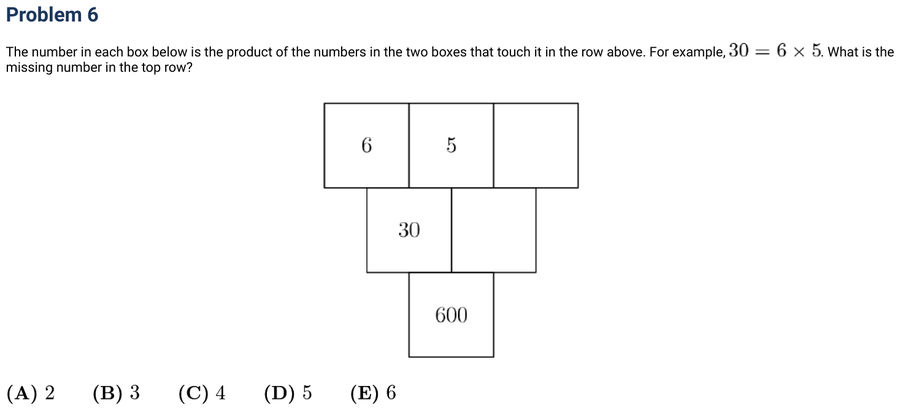
Show answer
Show hints
Still stuck? Show hint 2 →
Show solution
- Bottom box 600 = (left-middle 30) × (right-middle). Reverse the multiplication: right-middle = 600 ÷ 30 = 20.
- That right-middle box came from the top: it = 5 × (top-right). Reverse again: top-right = 20 ÷ 5 = 4.
- Why this works: any "product" pyramid is just multiply-down / divide-up — always start from the box you can compute and divide back toward the gap.
- Check downward: top 6 × 5 = 30 (matches), then 30 × 20 = 600 (matches).
Order, pairing, factoring
Three problems on the three most basic arithmetic moves.
2023 · #1 What is the value of (8 × 4 + 2) − (8 + 4 × 2)?
What is the value of (8 × 4 + 2) − (8 + 4 × 2)?
Show answer
Show hints
Still stuck? Show hint 2 →
Show solution
- The two parentheses look almost identical — same numbers 8, 4, 2 — but the × sits in a different spot. That's the whole trick: the answer comes from where the multiplication lands, not from the numbers themselves.
- First parentheses: multiply first, so 8 × 4 + 2 = 32 + 2 = 34.
- Second parentheses: 8 + 4 × 2 = 8 + 8 = 16.
- Subtract: 34 − 16 = 18. Sanity check: the first group is much bigger because the big multiply (8 × 4) happens there, so a positive answer feels right.
1989 · #1 (1 + 11 + 21 + 31 + 41) + (9 + 19 + 29 + 39 + 49) =
(1 + 11 + 21 + 31 + 41) + (9 + 19 + 29 + 39 + 49) =
Show answer
Show hints
Still stuck? Show hint 2 →
Still stuck? Show hint 3 →
Show solution
- Notice the two groups are built from the same ten-step pattern, just shifted: 1 pairs with 9, 11 with 19, 21 with 29, and so on. Each pair adds to a number ending in 0 — that's the whole point of pairing instead of adding straight down.
- The five pairs give 10 + 30 + 50 + 70 + 90 = 250.
- Why this transfers: whenever a sum can be reshuffled so terms combine into round numbers, do the reshuffling first — addition is allowed in any order, and round numbers carry almost no chance of a slip.
- Sanity check: ten numbers averaging about 25 should total roughly 250, which matches.
- First group: 1+11+21+31+41 = 105 (five terms averaging 21). Second group: 9+19+29+39+49 = 145 (five terms averaging 29).
- 105 + 145 = 250. The pairing trick just avoids these two intermediate totals.
2014 · #6 Six rectangles each with a common base width of 2 have lengths of 1, 4, 9, 16, 25, and 36. What is the sum of the areas of the six rectangles?
Six rectangles each with a common base width of 2 have lengths of 1, 4, 9, 16, 25, and 36. What is the sum of the areas of the six rectangles?
Show answer
Show hints
Still stuck? Show hint 2 →
Show solution
- All widths equal 2, so total area = 2×1 + 2×4 + … + 2×36 = 2 × (1 + 4 + 9 + 16 + 25 + 36).
- The lengths are the first six squares; their sum is 91.
- Total area: 2 × 91 = 182.
- Why this transfers: a common factor in every term can always be pulled outside the sum — that's the distributive property doing the heavy lifting, turning six multiplications into one.
‘Closest to’ — round before you multiply
When a problem says closest to or approximately, stop and look at the answer choices before you touch a number. They are usually far apart — 10s, 100s, even 1000s. That spread is a gift: it tells you exactly how sloppy you are allowed to be.
If the choices sit 100 apart, you can be off by nearly 50 and still land in the right box. So round each number to something easy and multiply the clean versions.
2.46 × 8.16≈2.5 × 8 = 20— no ugly decimals.$1.98 + $5.04 + $9.89≈$2 + $5 + $10 = $17.0.0003 × 8{,}000{,}000 = 2400— messy made tidy.
TWO RULES THAT RARELY FAIL
- Round before you multiply, not after. Multiplying tidy numbers is fast and accurate enough.
- Round in opposite directions when you can. Bump one factor up and the other down so the errors push against each other and cancel.
This is safe because multiplication is gentle: a 2% nudge in one factor moves the product by about 2%. Round each factor by 5% and you are still within 10–15% of the truth — almost always well inside the answer-choice gap.
Trick: bracket the answer between a low and a high estimate
When you are unsure which way to round, do it both ways. Round everything down for a guaranteed-too-small answer, then everything up for a guaranteed-too-big one. The true value is trapped between them — and that trap usually contains exactly one answer choice.
Quick example — trap the product
18.7 × 4.2 is closest to 60, 79, or 110?
Low: 18 × 4 = 72. High: 19 × 5 = 95. The true product sits between 72 and 95, so 60 and 110 are both impossible — only 79 survives.
(Exact value is 78.54, comfortably inside the bracket.)
THE MOVE: read the spread of the choices first. The wider the gap, the harder you are allowed to round.
Look at how far apart the answer choices are first. Wide gaps mean aggressive rounding is safe; choices within 10% of each other mean you must compute exactly.
The product (1.8)(40.3 + .07) is closest to
The product (1.8)(40.3 + .07) is closest to which of 7, 42, 74, 84, 737?
The choices are spread wide, so round hard. The .07 is far too small to matter, so 40.3 + .07 ≈ 40. Then 1.8 × 40 = 72, and the nearest choice is 74 — choice C.
A second look confirms it without any multiplication: 1.8 is between 1 and 2, so the product must land between 40 and 80. That alone kills 7, 42, 84, and 737, leaving only 74.
The temptation is to add 40.3 + 0.07 carefully and then multiply two decimals. You never needed that. The choices are 30-plus apart, so rounding the second factor straight to 40 is more than precise enough.
Check the spread of the choices, then round each factor before multiplying — not after. Round opposite directions so errors cancel.
2006 · #1 Mindy made three purchases for $1.98, $5.04, and $9.89. What was her total, to the nearest dollar?
Mindy made three purchases for $1.98, $5.04, and $9.89. What was her total, to the nearest dollar?
Show answer
Show hints
Still stuck? Show hint 2 →
Show solution
- The question only wants the nearest dollar, so round before doing any arithmetic: $1.98 → 2, $5.04 → 5, $9.89 → 10.
- 2 + 5 + 10 = 17.
- Why this is safe: each price is within about 10 cents of a whole dollar, so the rounding errors are tiny and can't push the sum across a dollar boundary. When numbers sit close to round values, round first — you'll see this trick on every "estimate the total" question.
2017 · #4 When 0.000315 is multiplied by 7,928,564 the product is closest to which of the following?
When 0.000315 is multiplied by 7,928,564 the product is closest to which of the following?
Show answer
Show hints
Still stuck? Show hint 2 →
Show solution
- Round to one significant figure: 0.000315 ≈ 3 × 10⁻⁴, and 7,928,564 ≈ 8 × 10⁶. The choices are spread by factors of 10, so this rounding is safe.
- Multiply the fronts and add the exponents: (3 × 8) × 10−4 + 6 = 24 × 102 = 2400.
- Why this transfers: whenever answer choices differ by orders of magnitude, estimate — nail the leading digit and the exponent, and ignore the rest.
1991 · #3 Two hundred thousand times two hundred thousand equals
Two hundred thousand times two hundred thousand equals
Show answer
Show hints
Still stuck? Show hint 2 →
Still stuck? Show hint 3 →
Show solution
- Write each number as a front digit times its zeros: 200,000 = 2 with five 0's = 2 × 10⁵. Multiplying, the fronts give 2 × 2 = 4 and the zeros simply add up: 5 + 5 = 10 zeros.
- So the product is 4 followed by ten zeros = 40,000,000,000 = forty billion.
- Why this transfers: when multiplying round numbers, never line them up to multiply digit-by-digit — peel off the trailing zeros, multiply the small leftovers, and re-attach the combined zero count. (300 × 4000 = 12 with 5 zeros = 1,200,000.)
- Sanity check on the name: a billion has 9 zeros; 40 billion is 4 followed by 10 zeros, which is exactly what we got. ✓
Negatives and fractions — test, don't trust
Your instincts about numbers were trained on numbers bigger than 1. Squaring makes things bigger. A reciprocal makes things smaller. Negatives feel ‘small.’ All three of those instincts break the moment a number is negative or sits between 0 and 1 — and contests live in exactly those gaps.
Watch the instincts fail:
- Square a fraction and it gets smaller:
(1/2)² = 1/4. - Take the reciprocal of a fraction and it gets bigger:
1 ÷ (1/2) = 2. - Flip the sign of a negative and it becomes a big positive:
−(−3) = +3. - The reciprocal of
−2is−1/2, which is actually bigger than−2.
−1/2 sits to the right of −2 on the line — so −2 is less than its own reciprocal.
Trying to argue your way through this in your head is how you lose points. There is a faster, safer path.
THE MOVE: stop reasoning — test the cases
When a problem hands you a value, or asks ‘which of these is largest / smallest,’ do not philosophize. Plug the numbers in, write the five results in a column, and read off the winner. Five concrete numbers are faster to compare than five clever arguments.
−17 to leave −33? (Test it: −17 − ? = −33.)Why ‘divide’ is really ‘multiply by the reciprocal’
The reciprocal of a number is what you multiply it by to get 1: the reciprocal of 4 is 1/4, since 4 × 1/4 = 1. Here is the quiet fact under all of division: dividing by a number is the same as multiplying by its reciprocal.
Why? ‘12 ÷ 4’ asks ‘how many fours fit in 12?’ — the answer 3. Now 12 × 1/4 takes a quarter of 12, also 3. Same answer, because cutting into 4 equal parts and taking one part is the same as asking how many 4s fit. So ÷ 4 and × 1/4 are two names for one move.
This is the trick that makes the ‘flip and multiply’ rule for fractions make sense: 6 ÷ (1/2) is 6 × 2 = 12 — there are twelve halves in 6. And it is why a reciprocal of a number between 0 and 1 comes out bigger than 1: small pieces fit many times. Dividing never needs a separate rule; it is multiplication in disguise.
Negative inputs flip your sign rules. Inputs between 0 and 1 flip your size rules. Do not try to reason about them — substitute, list the results, compare.
Which of these numbers is less than its reciprocal?
Which of −2, −1, 0, 1, 2 is less than its reciprocal?
The reciprocal of x is 1/x. Test each candidate instead of arguing:
−2vs1/(−2) = −0.5. Is −2 < −0.5? Yes — −2 is farther left.−1vs1/(−1) = −1. Equal, not less.0has no reciprocal — skip.1vs1/1 = 1. Equal.2vs1/2 = 0.5. Is 2 < 0.5? No.
Only −2 works — choice A.
The trap is to picture ‘a number bigger than its reciprocal’ using friendly numbers like 2 and 1/2, then assume the same direction holds everywhere. It does not. Once you test the negative, −2 turns out to be smaller than its reciprocal, because flipping a big negative gives a small negative.
Negative inputs flip sign rules; inputs between 0 and 1 flip size rules. When in doubt, plug in real numbers and compare — do not reason in your head.
2017 · #1 Which of the following values is the largest?
Which of the following values is the largest?
Show answer
Show hints
Still stuck? Show hint 2 →
Show solution
- The insight: all-addition (A) keeps every digit working for you; any × either zeroes out a term (anything × 0) or wastes one (anything × 1). So (A) should win — no arithmetic needed to see it leads.
- Confirm: (A) 2 + 0 + 1 + 7 = 10; (B) 0 + 1 + 7 = 8; (C) 2 + 0 + 7 = 9; (D) 2 + 0 + 7 = 9; (E) 0.
- Largest is (A) = 10. You'll see this again: when options differ only by an operation, ask which operation grows the value rather than computing all five.
2011 · #1 Which of the following calculations gives the biggest result?
Which of the following calculations gives the biggest result?
Show answer
Show hints
Still stuck? Show hint 2 →
Show solution
- Read each option as a number: 201×1=201, 20×1×1=20, 1×2011=2011, 1+2011=2012, and 1÷2011 is just under 1.
- The two big ones are 2011 and 2012; adding gives the larger.
- So 1+2011=2012 is the biggest.
2022 · #1 What is \((20+22) \div (20-22)\)?
What is \((20+22) \div (20-22)\)?
Show answer
Show hints
Still stuck? Show hint 2 →
Show solution
- The numerator is 20+22 = 42.
- The denominator is 20-22 = -2.
- 42 divided by -2 is -21, so the answer is B.
Work backward — undo the story
Some problems hand you the end of a story and ask for the start. ‘I doubled a number, added 4, and got 20 — what was the number?’ You could guess and check. The fast way is to walk the story backward, undoing each step with its opposite.
Run it in reverse: end at 20, undo the ‘add 4’ by subtracting (20 − 4 = 16), undo the ‘double’ by halving (16 ÷ 2 = 8). Start was 8. Forward to check: 8 × 2 + 4 = 20. ✓
Top arrows are the story; bottom arrows undo it from the right end, each flipped to its opposite.
UNDO IN REVERSE ORDER
Going backward, flip every operation and reverse the order:
- added → subtract · subtracted → add
- multiplied → divide · divided → multiply
Last step done becomes first step undone.
THE MOVE: when a problem gives the result and hides the start, do not guess — reverse the steps and undo each one.
Going further: chained percentages — multiply the keep-fractions
When the same kind of step repeats — ‘lose 25%, then 25% of what is left’ — do it as one multiplication, not several. ‘Lose 25%’ means you keep 75% = 3/4. Doing it twice keeps (3/4)(3/4) = 9/16. So 128 apples become 128 × 9/16 = 72 in one stroke.
| What happened | Kept | Total lost |
|---|---|---|
| Lose 25%, then 25% | 9/16 | 7/16 ≈ 43.75% (NOT 50%) |
| Lose 50%, then 50% | 1/4 | 75% (NOT 100%) |
| Lose 10%, then 10% | 81/100 | 19% (NOT 20%) |
The second cut comes off the already-shrunk amount, so the losses never add up the way they look. Multiply the keep-fractions instead.
When a problem gives you the end and asks for the start, reverse the operations: last step done is first step undone, and each operation flips to its opposite.
Connie multiplies a number by 2 and gets 60 as her answer. However, she should have divided the number by 2 to get the correct answer. What is the correct answer?
Connie multiplied a number by 2 and got 60. She was supposed to divide it by 2. What is the correct answer?
First undo her mistake to find the original number. She multiplied by 2 to get 60, so the number was 60 ÷ 2 = 30.
Now do what she should have done to that number: 30 ÷ 2 = 15 — choice B.
The traps are right there in the choices. 120 is ‘multiply 60 by 2 again’; 30 is the original number; 240 is doubling twice. Each one comes from skipping the ‘undo first’ step.
In any ‘someone did the wrong operation’ problem, run the wrong operation backward to recover the true input first. Never apply the correct operation to the wrong answer — that is exactly the trap the wrong choices are built from.
Reverse the steps: undo the last operation first, flipping each to its opposite. To recover a hidden start, work backward, not by guessing.
2024 · #5 Pieter has a parcel that weighs 445 g and the eight weights shown. He places the parcel on the right pan of the scale (see picture)....
Pieter has a parcel that weighs 445 g and the eight weights shown. He places the parcel on the right pan of the scale (see picture). Pieter may put weights on either side of the scale. What is the smallest number of weights he needs to balance the scale?
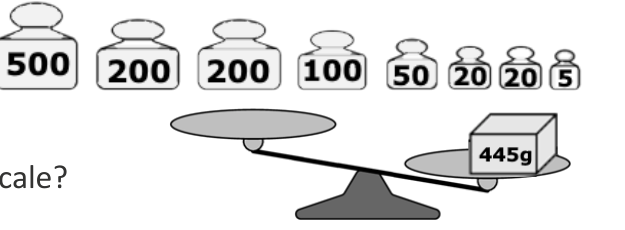
Show answer
Show hints
Still stuck? Show hint 2 →
Show solution
- Putting a weight opposite the parcel adds its value; putting it with the parcel subtracts it, so balancing needs a signed combination equal to 445 g.
- Use 500 on the empty side and 50 + 5 on the parcel's side: 500 − 50 − 5 = 445.
- That is just three weights, and no two-weight combination reaches 445.
- So the minimum number of weights is 3.
2025 · #3 A bookshelf with three rows has 17 books in the top row, 15 books in the middle row and 7 books in the bottom row. Monika would like to...
A bookshelf with three rows has 17 books in the top row, 15 books in the middle row and 7 books in the bottom row. Monika would like to have the same number of books in each row, but she wants to rearrange as few books as possible. How many books does she have to move from the middle row to the bottom row?
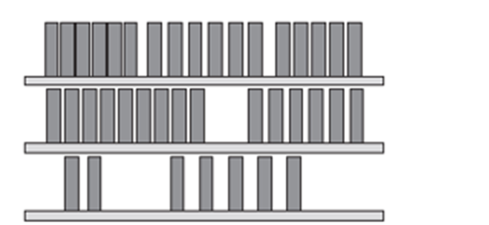
Show answer
Show hints
Still stuck? Show hint 2 →
Show solution
- Total books: 17 + 15 + 7 = 39, so each row should have 39 ÷ 3 = 13.
- The bottom row is short by 13 − 7 = 6 books; the top row has 4 spare and the middle has 2 spare.
- To move as few as possible, send the top’s 4 spare and the middle’s 2 spare straight to the bottom.
- So only 2 books go from the middle row to the bottom row.
1999 · #1 (6 ? 3) + 4 − (2 − 1) = 5. To make this statement true, the question mark between the 6 and the 3 should be replaced by
(6 ? 3) + 4 − (2 − 1) = 5. To make this statement true, the question mark between the 6 and the 3 should be replaced by
Show answer
Show hints
Still stuck? Show hint 2 →
Show solution
- Start with the certain part. 4 − (2 − 1) = 4 − 1 = 3 — no operation choice touches it, so settle it first.
- Now the equation reads (6 ? 3) + 3 = 5, so 6 ? 3 must be 2. Only division does that: 6 ÷ 3 = 2, the sign is ÷.
- Why this transfers: in any "fill the blank" equation, evaluate every known piece first so the unknown is left alone — then you solve one tiny question instead of testing every option.
2023 · #4 John throws 150 coins onto a table. 60 of them show “heads”, the others show “tails”. He wants the same number of coins to show heads as...
John throws 150 coins onto a table. 60 of them show “heads”, the others show “tails”. He wants the same number of coins to show heads as tails. How many coins that show heads does he have to turn over?
Show answer
Show hints
Still stuck? Show hint 2 →
Show solution
- There are 150 coins: 60 heads and 150 − 60 = 90 tails.
- For an even split he needs 75 heads and 75 tails.
- He must move 15 coins from the larger pile to the smaller, i.e. flip 15 coins.
- So the answer is 15 (B).
Averages — go back to totals
A team's three games averaged 20 points. How many did they score in all? You did not need the individual games — 20 × 3 = 60. That tiny step is the secret to every average problem: an average is a disguise for a total. Strip the disguise and you can do plain arithmetic.
AVERAGE ↔ TOTAL
average × count = total
total ÷ count = average
See it: an average is a leveling-off
Picture four stacks of blocks of heights 3, 7, 5, 1. The average is the height they would all be if you knocked the tall ones down and used the blocks to fill the short ones — pour the towers into one flat row. The blocks never leave; they spread out evenly.
Total blocks = 3+7+5+1 = 16, shared among 4 stacks → height 4 each. That flat height is the average.
That is why average × count = total: the leveled height times how many stacks gives back every block you started with. The average is the total, spread flat.
THE MOVE: turn every average into a total before you do anything. Add, subtract, or combine totals, and divide back to an average only at the very end.
This single move kills the most popular average trap on the planet: never average two averages. A class of 20 kids averages 80; a class of 10 averages 70. The combined average is not 75. Go to totals:
20 × 80 + 10 × 70 = 1600 + 700 = 2300, over 20 + 10 = 30 kids, gives 2300 ÷ 30 ≈ 76.7.
Why 76.7 and not the tidy 75 halfway between? Picture a seesaw with one average sitting at 70 and the other at 80. The 70-end carries only 10 kids; the 80-end carries 20. The heavier crowd drags the balance point toward itself. The combined average always lands nearer the bigger group — here, closer to 80.
The fulcrum sits closer to the heavier side. More kids = more pull.
That is weighted averaging, and every weighted-average problem on these contests is the same: go to totals, do plain arithmetic, divide once at the end.
Pictured-intuition adapted from Competition Math for Middle School (AoPS).
Go deeper: more average moves: deviations cancel, shift/scale a list, swap a value, rounding leftovers & the raise-the-average shortcut
The seesaw trick — ups and downs must cancel
Here is a beautiful fact: the amounts numbers sit ABOVE the mean exactly cancel the amounts they sit BELOW it. Picture a seesaw balanced at the mean. Every number is a kid at some distance from the center. The board is level, so the two sides must match.
Below: −10 + (−5) = −15. Above: +5 + 10 = +15. They cancel.
So if four of five scores around a mean of 80 are 70, 75, 88, 92 (deviations −10, −5, +8, +12, totaling +5), the fifth must contribute −5 to rebalance — it is 75. Often faster than ‘total = mean × count, missing = total − sum so far.’
Shift the whole list — the mean rides along
Add the same amount to every value, and you do not need to re-add anything. If five candy bags average 11 pieces and you drop 23 more into each bag, the new average is just 11 + 23 = 34. The total grew by 5 × 23, but it is split among the same 5 bags, so the per-bag share climbs by exactly 23.
SHIFT AND SCALE A LIST
- Add the same
nto every value → the mean goes up byn(and the median and mode do too). - Multiply every value by
k→ the mean is multiplied byk.
This also runs backward: to average ugly numbers like 5{,}647{,}205 and 5{,}647{,}212, subtract 5{,}647{,}200 from each, average the small leftovers, then add it back.
This is the engine behind ‘everyone gets older’ and ‘everyone gets a raise’ problems. You never need the individual values — only how much each one moved.
Swap a value — track only the change to the total
Adding or removing one value changes the total by exactly that value; replacing one value with another changes the total by the difference. Ten teammates average 13.5, so their ages total 10 × 13.5 = 135. A 15-year-old joins and an 11-year-old leaves: the total shifts by +15 − 11 = +4, to 139, over the same 10 people — new average 13.9. You touched two numbers, not eleven.
Framing inspired by AoPS Prealgebra.
Division leftovers — round up or round down?
Division is the same total-and-count machine run backward: total ÷ count. A clean problem wants the quotient and nothing more. The hard ones leave a leftover, and the trap is deciding what to do with it. The leftover never changes — the question does.
ROUND UP or DOWN?
- ‘As many as you can’ / ‘how many fit’ → round DOWN. A partial one does not count.
- ‘How many do you need’ / ‘to cover everyone’ → round UP. The leftover still needs its own group.
The bus picture. 95 kids, each bus holds 30. 95 ÷ 30 = 3 leftover 5. Full buses? 3 (round down). Buses to carry everyone? 4 — the last 5 kids still need a ride (round up). Same division, opposite answers.
Raise-the-average problems — a one-line shortcut
‘What must the next score be to lift the average?’ is the same total game, but the deviation idea above gives a faster path. Think about how much each slot has to climb. A new score equal to the old average leaves the average unchanged. To push it higher, the newcomer must cover the lift for every slot at once.
LIFT-THE-AVERAGE SHORTCUT
To raise an n-value average by r, the new value must be r × n above the current average. (Each of the n slots rises by r; the one new score supplies all of it.)
Seven quizzes average 88; you take an eighth. To make the eight-quiz average 90 (a lift of 2 over n = 8 slots), the eighth score must be 2 × 8 = 16 above 88 — that is 88 + 16 = 104. Check it the long way: target total 90 × 8 = 720, old total 88 × 7 = 616, eighth = 720 − 616 = 104. Same answer, no big totals to subtract.
Shortcut adapted from Competition Math for Middle School (AoPS).
r = 2 over n = 6 slots, so the score is 2 × 6 = 12 above 80: 80 + 12 = 92. (Long way: 82 × 6 = 492, 80 × 5 = 400, 492 − 400 = 92.)A handy trick: combine groups through their totals, never their averages
You cannot average two averages directly unless the groups are the same size — a small group and a big group do not get an equal vote. The safe move is always the same: turn each average back into a total with average × count, add the totals, add the counts, then divide once at the very end.
Another worked example
The two boys A and B average 123 cm in height. The four girls C, D, E, F average 132 cm. What is the average height of all six children?
Resist the temptation to write (123 + 132) ÷ 2 — the groups are different sizes. Go back to totals instead. The boys total 123 × 2 = 246 cm; the girls total 132 × 4 = 528 cm. All six together: 246 + 528 = 774 cm across 2 + 4 = 6 children, so the average is 774 ÷ 6 = 129 cm. Notice it lands closer to 132 than to 123, because the 132-group is bigger — exactly why averaging the averages (which would give 127.5) is wrong.
See also: ‘average speed’ is a weighted average in disguise — you cannot just average the two speeds. Its full treatment lives in Rates & Ratios.
Going further: the average of every number you can spell with the same digits
Here is a surprise that needs no addition at all. Write every 3-digit number you can make from the digits 1, 2, 3 (using each once):
123 132 213 231 312 321
What is their average? You could add all six and divide by six — or you could spot the symmetry. There are six numbers and three digits, so each digit lands in each place (hundreds, tens, ones) exactly twice. Every column is perfectly balanced, so the average has the same digit in every place: the average of {1, 2, 3} is 2, giving the average number 222.
DIGIT-PERMUTATION AVERAGE
When you list all the numbers you can form by rearranging a fixed set of digits, each digit shows up equally often in every place. So the average is just the digit-average written in every position:
average = (digit-average) × 111…1
For three digits that is (digit-sum ÷ 3) × 111. No long addition.
Check it the slow way: 123 + 132 + 213 + 231 + 312 + 321 = 1332, and 1332 ÷ 6 = 222. ✓ Same answer, far more work.
(2 + 3 + 7) ÷ 3 = 4, so the average number is 4 × 111 = 444. (Check: the six numbers total 2664, and 2664 ÷ 6 = 444.)Symmetry shortcut adapted from Terry Chew, Maths Olympiad — Average.
Convert every average into a total before doing anything else. Combine, compare, or subtract totals; divide back to an average only at the very end. Never average two averages.
One class of 30 students averaged 90 on a test; another class of 10 averaged 60. The combined average is halfway between: (90 + 60) ÷ 2 = 75.
Why it breaks: Averaging the two averages pretends the classes are the same size. They are not — 30 students pull on the 90 end far harder than 10 students pull on the 60 end.
The fix: Go to totals. 30 × 90 + 10 × 60 = 2700 + 600 = 3300 points among 30 + 10 = 40 students, so the real average is 3300 ÷ 40 = 82.5 — nearer the bigger class, as it must be. Never average two averages; combine totals, divide once.
Theresa's parents have agreed to buy her tickets to see her favorite band if she spends an average of 10 hours per week helping around the house for 6 weeks. For the first 5 weeks she helps around the house for 8, 11, 7, 12 and 10 hours. How many hours must she work for the final week to earn the tickets?
Theresa must average 10 hours of help per week over 6 weeks. For the first five weeks she helped 8, 11, 7, 12, and 10 hours. How many hours does week 6 need?
Turn the target average into a target total: 6 × 10 = 60 hours across the whole stretch.
Add what she has done: 8 + 11 + 7 + 12 + 10 = 48.
So week 6 must be 60 − 48 = 12 hours — choice D.
Notice you never averaged anything. You treated the goal average as a target total and subtracted what was already banked. That is the move for every ‘one more value makes the average X’ problem.
average × count = total. Work with totals, divide back to an average at the end. For division leftovers, read whether a partial group counts before you round.
2014 · #3 Isabella had a week to read a book for a school assignment. She read an average of 36 pages per day for the first three days and an...
Isabella had a week to read a book for a school assignment. She read an average of 36 pages per day for the first three days and an average of 44 pages per day for the next three days. She then finished the book by reading 10 pages on the last day. How many pages were in the book?
Show answer
Show hints
Still stuck? Show hint 2 →
Show solution
- First three days: 36 × 3 = 108 pages (the average undoes back into a total).
- Next three days: 44 × 3 = 132 pages.
- Total: 108 + 132 + 10 = 250.
- Key idea you'll reuse: total = average × count. Knowing any two of {total, average, count} gives the third — the same lever solves "find the missing test score" problems.
2020 · #2 Four friends do yardwork for their neighbors over the weekend, earning $15, $20, $25, and $40, respectively. They decide to split their...
Four friends do yardwork for their neighbors over the weekend, earning $15, $20, $25, and $40, respectively. They decide to split their earnings equally among themselves. In total how much will the friend who earned $40 give to the others?
Show answer
Show hints
Still stuck? Show hint 2 →
Show solution
- Equal split means each friend ends with the average: (15 + 20 + 25 + 40) ÷ 4 = 100 ÷ 4 = $25.
- The $40 friend keeps $25 and gives away the surplus above average: $40 − $25 = $15.
- Why this transfers: in any “pool and share equally” problem, only the gaps from the average move — people above the average pay exactly their surplus, people below receive their shortfall. (Sanity check: those below average, $15 and $20, are short by $10 and $5 — together $15, matching what the $40 friend gives.)
2025 · #3 Buffalo Shuffle-o is a card game in which all the cards are distributed evenly among all players at the start of the game. When Annika...
Buffalo Shuffle-o is a card game in which all the cards are distributed evenly among all players at the start of the game. When Annika and 3 of her friends play Buffalo Shuffle-o, each player is dealt 15 cards. Suppose 2 more friends join the next game. How many cards will be dealt to each player?
Show answer
Show hints
Still stuck? Show hint 2 →
Show solution
- The deck doesn't grow when friends arrive — the total number of cards is the thing that stays fixed. Find it: 4 players × 15 cards = 60 cards.
- Now redeal that same 60 among 4 + 2 = 6 players: 60 ÷ 6 = 10 cards each.
- Why this transfers: in any "shared evenly" problem, hunt for the quantity that doesn't change (here, the total). Pin it down once, then it answers every version of the question.
2014 · #2 A cake weighs 900 g. Paul cuts it into 4 pieces. The biggest piece weighs exactly as much as the other three pieces together. How much...
A cake weighs 900 g. Paul cuts it into 4 pieces. The biggest piece weighs exactly as much as the other three pieces together. How much does the biggest piece weigh?
Show answer
Show hints
Still stuck? Show hint 2 →
Show solution
- If the biggest piece weighs as much as the other three together, then those two parts are equal halves of the cake.
- So the biggest piece is half of 900 g.
- Half of 900 g is 450 g.
2002 · #3 What is the smallest possible average of four distinct positive even integers?
What is the smallest possible average of four distinct positive even integers?
Show answer
Show hints
Still stuck? Show hint 2 →
Show solution
- To shrink an average, feed it the smallest allowed values. "Distinct positive even" means the four smallest are 2, 4, 6, 8.
- These are evenly spaced, so their average sits dead center — halfway between 4 and 6, which is 5. (Check: (2 + 4 + 6 + 8) ÷ 4 = 20 ÷ 4 = 5.)
- *Worth keeping:* the mean of any evenly-spaced list equals its middle value (the average of the first and last) — no summing required.
2019 · #1 Ike and Mike go into a sandwich shop with a total of $30.00 to spend. Sandwiches cost $4.50 each and soft drinks cost $1.00 each. Ike...
Ike and Mike go into a sandwich shop with a total of $30.00 to spend. Sandwiches cost $4.50 each and soft drinks cost $1.00 each. Ike and Mike plan to buy as many sandwiches as they can and use the remaining money to buy soft drinks. Counting both soft drinks and sandwiches, how many items will they buy?
Show answer
Show hints
Still stuck? Show hint 2 →
Show solution
- Sandwiches are the only limiting purchase, so ask how many fit: $30 ÷ $4.50 = 6 with $3 left (a 7th would need $31.50 — too much).
- Each soda is exactly $1, so the $3 leftover turns straight into 3 sodas — no arithmetic, just read it off.
- Total items: 6 + 3 = 9.
- Why this transfers: any "buy as many of A as possible, then fill with B" problem is a division-with-remainder — the quotient is the A count, the remainder funds the B's.
Rounding and averages
Three problems on closest-to estimation and total-then-average thinking.
2006 · #1 Mindy made three purchases for $1.98, $5.04, and $9.89. What was her total, to the nearest dollar?
Mindy made three purchases for $1.98, $5.04, and $9.89. What was her total, to the nearest dollar?
Show answer
Show hints
Still stuck? Show hint 2 →
Show solution
- The question only wants the nearest dollar, so round before doing any arithmetic: $1.98 → 2, $5.04 → 5, $9.89 → 10.
- 2 + 5 + 10 = 17.
- Why this is safe: each price is within about 10 cents of a whole dollar, so the rounding errors are tiny and can't push the sum across a dollar boundary. When numbers sit close to round values, round first — you'll see this trick on every "estimate the total" question.
2014 · #3 Isabella had a week to read a book for a school assignment. She read an average of 36 pages per day for the first three days and an...
Isabella had a week to read a book for a school assignment. She read an average of 36 pages per day for the first three days and an average of 44 pages per day for the next three days. She then finished the book by reading 10 pages on the last day. How many pages were in the book?
Show answer
Show hints
Still stuck? Show hint 2 →
Show solution
- First three days: 36 × 3 = 108 pages (the average undoes back into a total).
- Next three days: 44 × 3 = 132 pages.
- Total: 108 + 132 + 10 = 250.
- Key idea you'll reuse: total = average × count. Knowing any two of {total, average, count} gives the third — the same lever solves "find the missing test score" problems.
2016 · #3 Four students take an exam. Three of their scores are 70, 80, and 90. If the average of their four scores is 70, then what is the...
Four students take an exam. Three of their scores are 70, 80, and 90. If the average of their four scores is 70, then what is the remaining score?
Show answer
Show hints
Still stuck? Show hint 2 →
Show solution
- The average is the total split 4 ways, so the total = average × count = 70 × 4 = 280.
- Three scores are 70 + 80 + 90 = 240, so the missing score is 280 − 240 = 40.
- Sanity check: two of the known scores (80, 90) sit ABOVE the average of 70, so something must sit well below to pull it back — a low score like 40 fits, an answer of 70 wouldn't.
- You'll see this again as: "find the missing value given the mean" — always convert the average into a total first, then the unknown is just total minus the rest.
- Measure each score as a deviation from the target average 70: 70 is 0, 80 is +10, 90 is +20. The known scores are +30 total above 70.
- For the average to land exactly on 70, the deviations must cancel, so the last score must be 30 BELOW 70: 70 − 30 = 40.
Mean, median, mode — three different middles
Five people are in a room: four earn $30,000 and one earns $5,000,000. What is the ‘typical’ income? The mean says about $1,024,000 — a number nobody in the room is close to. The median says $30,000 — which actually describes the room. Same five people, two very different ‘middles.’ Contests love this gap.
THREE MIDDLES — AND ONE SPREAD
- Mean (average): sum ÷ count. The balance point.
- Median: the middle value after sorting. For an even count, average the two middle values.
- Mode: the most frequent value. A list may have one mode, several, or none.
- Range: largest − smallest. Not a middle at all — it measures how spread out the list is. These four are the statistics contests ask for most.
The first three answer ‘what is typical?’; the range answers a different question — ‘how far apart are the extremes?’ One outlier barely moves the median but can blow the range wide open. For {5, 5, 6, 8, 106} the range is 106 − 5 = 101, even though four of the five values sit within 3 of each other.
16 − 2 = 14.The mean gets yanked around by extreme values; the median shrugs them off. Picture {1, 2, 3, 4, 100} on a line:
The lone 100 drags the mean far from the pack. The median stays planted in the middle of the sorted list.
Go deeper: all three middles on one dot-picture (mode, median, mean together)
All three on one picture
Take a friendly set with a repeat in it: {2, 4, 5, 5, 9}. Already sorted. Plot the five dots, stacking the repeat, and all three middles show up in one glance.
Mode = the tallest stack of dots. Median = the dot in the middle of the row. Mean = where the row would balance on a fulcrum.
Here all three happen to land on 5, but they answer different questions: mode is most common, median is middle of the line-up, mean is balance point of the whole row. Slide that lonely 9 out to 99 and only the mean lurches right — the median and mode do not budge. That is exactly the gap contests poke at.
THE MOVE: sort the list once, then read all three middles off the same sorted line. The mean wants the raw sum, but a sorted list hands you the median and mode at a glance.
To find the median of n values: sort, then take position (n+1)÷2 if n is odd, or average positions n÷2 and n÷2 + 1 if even. Do not compute anything you do not need — sort.
Going further: make one number as big as possible
The mean locks the total. So to make one value as big as it can be, make every other value as small as the rules allow. Take five different positive integers with mean 15 (they add to 75) and median 18:
| slot | 1st | 2nd | 3rd (median) | 4th | 5th (largest) |
|---|---|---|---|---|---|
| smallest legal | 1 | 2 | 18 | 19 | 75 − (1+2+18+19) = 35 |
Push the four other slots to their smallest distinct legal values; whatever the total has left over is the most the last one can be — here, 35. (Same engine as the push-to-extremes move in Algebra.)
For ‘make the mean equal the median’ problems, do casework on where the new value lands in the sorted order — each case pins the value differently. Always check your value is consistent with the case you assumed.
Here is a list of the numbers of fish that Tyler caught in nine outings last summer: 2, 0, 1, 3, 0, 3, 3, 1, 2. Which statement about the mean, median, and mode is true?
Tyler's nine catches: 2, 0, 1, 3, 0, 3, 3, 1, 2. Which statement about mean, median, and mode is true?
Sort once: 0, 0, 1, 1, 2, 2, 3, 3, 3. Now everything is in view.
So mean (1.67) < median (2) < mode (3) — choice C.
One sort gives you all three answers. The mean needs the raw sum, but reading the median and mode off the sorted list in a single glance is what keeps you from miscounting under time pressure.
Mean = sum ÷ count. Median = middle after sorting. Mode = most frequent. Sort once, then read all three.
2010 · #4 What is the sum of the mean, median, and mode of the numbers 2, 3, 0, 3, 1, 4, 0, 3?
What is the sum of the mean, median, and mode of the numbers 2, 3, 0, 3, 1, 4, 0, 3?
Show answer
Show hints
Still stuck? Show hint 2 →
Show solution
- Sort: 0, 0, 1, 2, 3, 3, 3, 4. Now everything is easy to see.
- Mode (most repeated) = 3, sitting in an obvious cluster. Median (middle): with 8 numbers, average the 4th and 5th: (2 + 3)/2 = 2.5.
- Mean (fair share): sum = 16, so 16/8 = 2.
- Total: 3 + 2.5 + 2 = 7.5.
- Why this transfers: the three M's are easy to mix up. Naming what each one does — popular, middle, fair-share — keeps you from grabbing the wrong one under time pressure.
2013 · #5 Hammie is in the 6th grade and weighs 106 pounds. His quadruplet sisters are tiny babies and weigh 5, 5, 6, and 8 pounds. Which is...
Hammie is in the 6th grade and weighs 106 pounds. His quadruplet sisters are tiny babies and weigh 5, 5, 6, and 8 pounds. Which is greater, the average (mean) weight of these five children or the median weight, and by how many pounds?
Show answer
Show hints
Still stuck? Show hint 2 →
Show solution
- Sort the weights: 5, 5, 6, 8, 106. The median is the middle one = 6 — notice the 106's size never mattered, only that it sits at the end.
- Mean = (5 + 5 + 6 + 8 + 106) ÷ 5 = 130 ÷ 5 = 26 — the lone 106 hauls the average up to 26.
- The average is larger, by 26 − 6 = 20 pounds.
- You'll see this again: whenever one value is wildly bigger than the rest, the mean exceeds the median — that's exactly why incomes are reported by median, not average.
When the mean misleads — and the median holds steady
You just met the three middles. This chapter zooms in on the fight between two of them — mean versus median — because that fight is where the setters hide their traps. Watch it play out: five friends compare how many books they read last summer: four read 3 each, and one bookworm read 83. What is the ‘typical’ number? The mean says (3+3+3+3+83)÷5 = 95÷5 = 19 — yet not one friend read anywhere near 19. The median says 3, which describes four of the five exactly. Same five friends, two wildly different ‘typical’ numbers. Contests live in this gap.
Go deeper: the ‘drop the highest and lowest’ trimmed-mean trick
First, a fair fix: drop the highest and the lowest
Judges, gymnastics, diving — scoring panels meet this problem head-on. Their rule: throw out the single highest and single lowest score, then average what is left. Tossing the two extremes removes the values most likely to be unfair, so the leftover average describes the performance, not the loudest judge. It is the total-and-count machine from the last chapter, run on a trimmed list.
Quick example — six judges, drop two
Six judges score a dive: 6.8, 7.2, 7.5, 8.1, 8.4, 9.0. Drop the lowest (6.8) and the highest (9.0). The four that remain — 7.2, 7.5, 8.1, 8.4 — total 31.2, so the score is 31.2 ÷ 4 = 7.8.
Notice you only ever go to a total and divide. Dropping the extremes first is exactly a defence against an outlier — which is what the rest of this chapter is about.
Framing adapted from Terry Chew, Maths Olympiad — Average.
The reason shows up the moment you picture the mean as a balance point on a seesaw. One value far out at the end yanks the balance toward itself, no matter how many ordinary values sit on the other side.
One value far from the pack hauls the mean toward it. The median — the middle of the sorted line — does not move.
OUTLIERS: WHO MOVES, WHO STAYS
- An outlier is a value far from the rest of the data.
- The mean is pulled hard toward an outlier — one giant value can wreck it.
- The median barely notices. It only cares which value sits in the middle, not how big the extremes are.
- The range (largest − smallest, from the last chapter) does the opposite of the median — it is all about the extremes, so a single outlier can blow it wide open.
This is why a teacher who drops your lowest test before averaging is removing an outlier so it stops dragging your mean down.
The median ignores what happens at the edges
Take the sorted list 2, 4, 5, 7, 9. The median is the middle value, 5. Now push the top value way out — change 9 to 9000. Sorted, it is 2, 4, 5, 7, 9000. The middle value is still 5. The median did not flinch, even though the mean exploded.
WHY THE MEDIAN IS ROBUST
Raising the values above the median, or lowering the ones below it, leaves the middle value untouched. The median reports the position of the middle, not the size of the extremes.
So the two statistics answer different questions. The mean asks ‘if we shared everything equally, how much each?’ — it depends on the total, so every value counts, including monsters. The median asks ‘what is the middle of the line-up?’ — it ignores how extreme the edges are.
Framing inspired by AoPS Prealgebra.
THE MOVE: when a list has one value far from the rest, expect the mean and median to disagree — and the mean to sit closer to the outlier.
Going further: what a single statistic can't tell you
The mean and median each hide a lot. Two warnings worth carrying:
- Neither tells you the group size. A town with a mean wealth of 150 thousand could be one millionaire among paupers, or everyone comfortably alike. The average alone cannot say which.
- Knowing the mean tells you nothing about the median, and vice versa. A class with mean 70 might have a median of 50 (one student aced it, most struggled) or a median of 90 (one student bombed, most did well).
Whenever a problem gives you only an average, ask what it is not telling you — that gap is usually where the answer hides.
A basketball team plays 11 games and scores a steady 42 to 73 points each time. In game 12 they score 40, their lowest yet. Since 40 is below everything else, the median must drop — so the median shows a decrease.
Why it breaks: Adding a new low value below the pack does not lower the middle — it can only nudge the middle one slot toward the lower scores, and with so many tightly-packed values the middle barely moves. The thing a new minimum always changes is the spread, not the center.
The fix: A score below every previous score pushes the smallest value down, so the range (largest minus smallest) grows. The median is robust; the range is not. A lone extreme value attacks the spread first, the mean second, and the median least of all.
Hammie is in the 6th grade and weighs 106 pounds. His quadruplet sisters are tiny babies and weigh 5, 5, 6, and 8 pounds. Which is greater, the average (mean) weight of these five children or the median weight, and by how many pounds?
Hammie weighs 106 pounds; his four baby sisters weigh 5, 5, 6, and 8. Which is greater, the mean or the median of these five weights, and by how much?
Spot the outlier first: 106 sits miles from the babies. That tells you the mean will be hauled up high while the median stays among the babies.
Median: sort — 5, 5, 6, 8, 106 — the middle (3rd) value is 6.
Mean: total 5 + 5 + 6 + 8 + 106 = 130, over 5 children, is 130 ÷ 5 = 26.
So the mean (26) beats the median (6) by 26 − 6 = 20 — choice E, ‘average, by 20.’
You could see the shape of the answer before computing: the single 106-pound child is a classic outlier, so the mean had to be the bigger one. The only real work was finding by how much. That is the whole point of this chapter — recognize the outlier, and you know which way the mean leans.
One value far from the rest is an outlier. It drags the mean toward it but leaves the median (the middle of the sorted list) almost untouched. A new extreme value grows the range first of all.
2015 · #5 Billy's basketball team scored the following points over the course of the first 11 games of the season: 42, 47, 53, 53, 58, 58, 58, 61,...
Billy's basketball team scored the following points over the course of the first 11 games of the season: 42, 47, 53, 53, 58, 58, 58, 61, 64, 65, 73. If his team scores 40 in the 12th game, which of the following statistics will show an increase?
Show answer
Show hints
Still stuck? Show hint 2 →
Show solution
- 40 is below the old low of 42, so it's the new minimum; the maximum (73) is unchanged.
- Range = max − min: was 73 − 42 = 31, now 73 − 40 = 33 → increases. A wider gap is exactly what a new low creates.
- Quick rule-out for the rest: mean drops (a below-average score lowers the average), median can only stay or fall (adding a small value never lifts the middle), mode stays 58, and mid-range = (max+min)/2 falls because min fell while max held.
- Only the range increases. Why this transfers: before crunching numbers, sort statistics by what each one 'feels' — spread (range, mid-range) vs. center (mean, median, mode) — and a single new value usually moves only the ones it touches.
2010 · #4 What is the sum of the mean, median, and mode of the numbers 2, 3, 0, 3, 1, 4, 0, 3?
What is the sum of the mean, median, and mode of the numbers 2, 3, 0, 3, 1, 4, 0, 3?
Show answer
Show hints
Still stuck? Show hint 2 →
Show solution
- Sort: 0, 0, 1, 2, 3, 3, 3, 4. Now everything is easy to see.
- Mode (most repeated) = 3, sitting in an obvious cluster. Median (middle): with 8 numbers, average the 4th and 5th: (2 + 3)/2 = 2.5.
- Mean (fair share): sum = 16, so 16/8 = 2.
- Total: 3 + 2.5 + 2 = 7.5.
- Why this transfers: the three M's are easy to mix up. Naming what each one does — popular, middle, fair-share — keeps you from grabbing the wrong one under time pressure.
2011 · #4 Here is a list of the numbers of fish that Tyler caught in nine outings last summer: 2, 0, 1, 3, 0, 3, 3, 1, 2. Which statement about...
Here is a list of the numbers of fish that Tyler caught in nine outings last summer: 2, 0, 1, 3, 0, 3, 3, 1, 2. Which statement about the mean, median, and mode is true?
Show answer
Show hints
Still stuck? Show hint 2 →
Show solution
- Sorted: 0, 0, 1, 1, 2, 2, 3, 3, 3.
- Mode = 3 (it shows up three times). Median = the 5th value = 2. Mean = 15/9 = 5/3 ≈ 1.67.
- So 5/3 < 2 < 3 ⇒ mean < median < mode.
- Intuition: the two zero-fish days drag the mean down below the middle value, which is why the mean ends up smallest here.
Tables and graphs — read only what you need
This is the problem that breaks strong students: the arithmetic is trivial, but they misread one bar, one axis label, one row — and lose the whole point. The math is not the hard part. The reading is.
THE MOVE: name what you need, read only those numbers, then ignore the rest. A graph problem is mostly scenery built to distract you. Find the two or three values the question actually asks about, pull them out, and do the small arithmetic.
READING CHECKLIST
- Axis units first. One tick might be 1, or 5, or 50, or a million. A ‘50’ gridline can mean 50 dollars or 50 thousand — check before reading any height.
- Underline the named quantities in the question. Read only those bars or rows.
- ‘How many more X than Y’ is the difference of two bars, not either height alone.
- ‘Percent of total’ needs the total first; then it is part ÷ total.
- Cumulative graphs stack as they go — answers are differences of heights, not direct reads.
Pie charts: a slice's angle ÷ 360° is its fraction of the whole; multiply that fraction by the given total to get the slice's value.
If a question asks the spaghetti-to-manicotti ratio, read only those two bars: 250 and 100. The rest is scenery.
For ‘percent of total’ on a table, compute the row total first, then subcategory ÷ total. For ‘how many more X than Y’ on a bar graph, it is the difference of the two bars — not their individual heights.
650 students were surveyed about their pasta preferences. The choices were lasagna, manicotti, ravioli and spaghetti. The results of the survey are displayed in the bar graph. What is the ratio of the number of students who preferred spaghetti to the number of students who preferred manicotti?
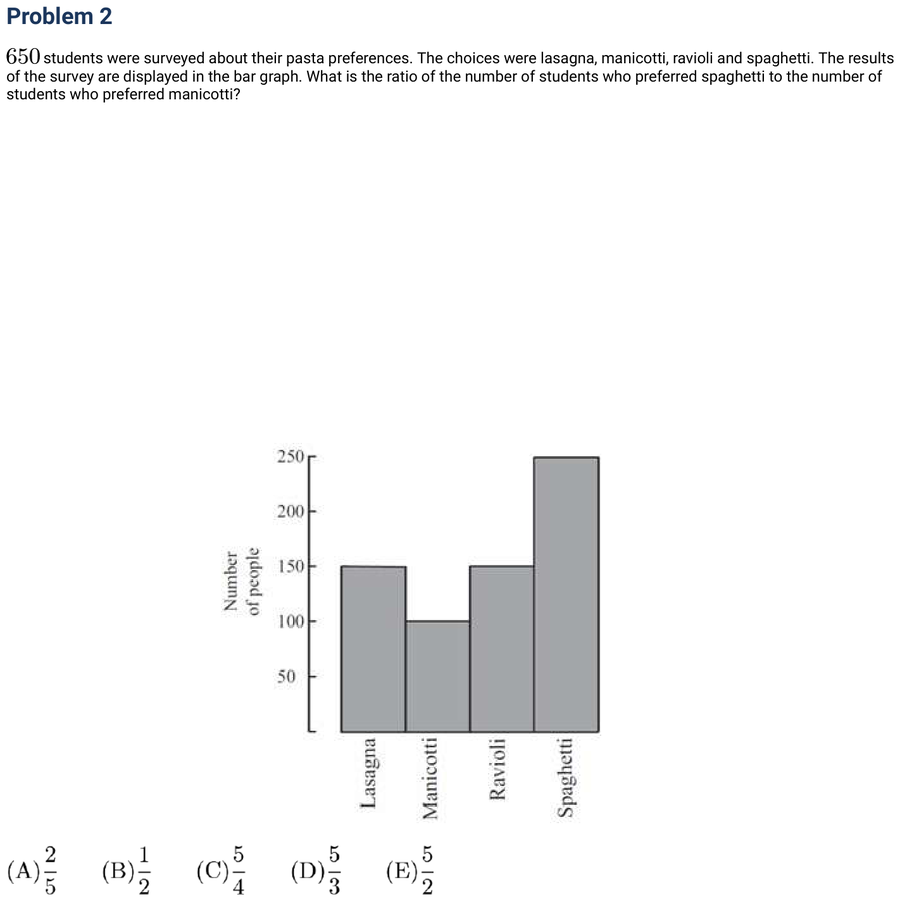
650 students rated four pastas; the results sit in a bar graph. Find the ratio of students who preferred spaghetti to those who preferred manicotti.
Resist totaling all 650 or reading every bar. The question names exactly two: read spaghetti = 250 and manicotti = 100. Everything else is scenery.
Ratio = 250 : 100. Cancel the shared 50: 5 : 2, which is 5/2 — choice E.
Sanity check: spaghetti is more than double manicotti, and 5/2 = 2.5, so the answer points the right way.
The 650 total and the other two foods are there to slow you down. Five seconds to confirm the y-axis scale, then read only the two named bars. The arithmetic after that is a single cancellation.
Read axes and units first. Underline the named quantities, read only those, then do the small arithmetic. Never rush the reading — that is where the points are lost.
2020 · #2 Amira is travelling from Atown to Betown and passes two road signs (see picture). One number on a sign is hidden. What is this hidden number?
Amira is travelling from Atown to Betown and passes two road signs (see picture). One number on a sign is hidden. What is this hidden number?
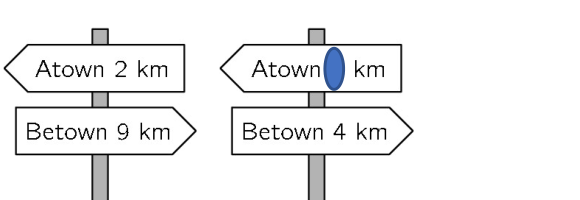
Show answer
Show hints
Still stuck? Show hint 2 →
Show solution
- On the full sign, Atown is 2 km and Betown is 9 km, so the towns are 2+9 = 11 km apart.
- On the other sign Betown reads 4 km and the Atown number is hidden.
- Since the total must still be 11, the hidden number is 11 - 4 = 7.
2018 · #3 If you hit the target board you score points. The number of points depends on which of the three areas you hit. Diana throws two darts,...
If you hit the target board you score points. The number of points depends on which of the three areas you hit. Diana throws two darts, three times, at the target board. On the first attempt she scores 14 points and on the second 16 points. How many points does she score on the third attempt?

Show answer
Show hints
Still stuck? Show hint 2 →
Show solution
- Each throw is two darts, so a score is the sum of two ring values.
- The first total 14 and the second total 16 force the ring values (the rings are worth more as you go inward).
- The two darts in the third picture both land in the highest-value ring.
- Their sum is 18 points.
2026 · #2 In the array shown below, three 3s are surrounded by 2s, which are in turn surrounded by a border of 1s. What is the sum of the numbers...
In the array shown below, three 3s are surrounded by 2s, which are in turn surrounded by a border of 1s. What is the sum of the numbers in the array?
| 1 | 1 | 1 | 1 | 1 | 1 | 1 |
| 1 | 2 | 2 | 2 | 2 | 2 | 1 |
| 1 | 2 | 3 | 3 | 3 | 2 | 1 |
| 1 | 2 | 2 | 2 | 2 | 2 | 1 |
| 1 | 1 | 1 | 1 | 1 | 1 | 1 |
Show answer
Show hints
Still stuck? Show hint 2 →
Show solution
- The grid is a mirror image top-to-bottom: row 1 = row 5, and row 2 = row 4. So you only have to add up three rows, then double two of them.
- Row 1 (all 1s): 7. Row 2: 1 + five 2s + 1 = 12. Middle row: 1+2+3+3+3+2+1 = 15.
- Total = 2×7 (top & bottom) + 2×12 (2nd & 4th) + 15 (middle) = 14 + 24 + 15 = 53.
- Why this transfers: whenever a figure repeats or mirrors, add one copy of each distinct piece and multiply — the symmetry does most of the counting for you.
- The three 3s sit in the center: 3 × 3 = 9.
- The 2s form a ring — five in row 2, five in row 4, two in the middle row = 12 twos: 12 × 2 = 24.
- Everything else is a 1. The grid is 5×7 = 35 cells, so the 1s number 35 − 3 − 12 = 20, worth 20.
- Total: 9 + 24 + 20 = 53.
Number sense — estimate the size first
Some problems hand you a horror like 0.000315 × 7{,}928{,}564 and then offer choices that are miles apart: 210, 240, 2100, 2400, 24000. They are not asking for the exact product. They are asking one thing: how big is the answer? Computing it exactly is a waste — smart estimation wins.
ORDER OF MAGNITUDE
The ‘order of magnitude’ of a number is roughly how many digits it has. 47 is about 10¹; 4,700 is about 10³; 470,000 is about 10⁵. When the choices look like 24, 240, 2400, 24000, the only real question is which power of 10 you land on.
THE MOVE: rewrite each ugly number as (a small number) × (a power of 10). Multiply the small parts, ADD the exponents, count the zeros.
0.000315 ≈ 0.0003 = 3 × 10⁻⁴7,928,564 ≈ 8,000,000 = 8 × 10⁶- Product
≈ 3 × 8 × 10⁻⁴⁺⁶ = 24 × 10² = 2400.
POWERS OF 10 — KNOW COLD
- 10² = 100 · 10³ = 1,000
- 10⁶ = 1,000,000 (a million, 6 zeros)
- 10⁹ = 1,000,000,000 (a billion, 9 zeros)
- 10⁻³ = 0.001 · 10⁻⁶ = 0.000001
To multiply: \((a \times 10^m)(b \times 10^n) = (a \cdot b) \times 10^{m+n}\). Multiply the small parts, add the exponents.
One caution. All of this works because the choices are far apart. When the answer choices are close together — within 10% of each other — aggressive rounding can land you in the wrong box. Then you compute exactly and round only at the very end.
A handy trick: bracket the answer between an easy under- and over-guess
When you only need to pick the closest choice, trap the true value between two round numbers you can compute instantly: round both factors down for a guaranteed low bound, and both up for a high bound. The right answer must sit inside that fence — usually only one choice does.
Another worked example
Which is closest to 6.13 × 48.7 — 250, 300, 350, or 600?
Round down for a floor: 6 × 48 = 288. Round up for a ceiling: 7 × 50 = 350. The true product is fenced between 288 and 350, which already kills 250 and 600. To break the tie, nudge to the nearest whole factors: 6 × 49 ≈ 294 — just under 300 and far from 350. So the answer is 300. (The exact value is about 298.5, confirming the fence worked.)
When choices span orders of magnitude, estimate — do not compute. Rewrite each number as a single digit times a power of 10, multiply the digits, add the exponents, count the zeros. When choices are close, compute exactly and round at the end.
When 0.000315 is multiplied by 7,928,564 the product is closest to which of the following?
When 0.000315 is multiplied by 7,928,564, the product is closest to 210, 240, 2100, 2400, or 24000?
The choices jump by powers of 10, so the question is really ‘which magnitude?’ Round each factor to one digit:
So 24 × 100 = 2400 — choice D. No exact calculation needed; the choices are far enough apart that the estimate pins the right one.
The whole trick is noticing the choices differ by powers of 10. That means the leading digits barely matter — the magnitude does. Round each factor to a single significant digit, multiply, add exponents, count zeros.
Choices spanning orders of magnitude? Estimate: \(a \times 10^m\) form, multiply digits, add exponents, count zeros. Choices close together? Compute exactly, round last.
1991 · #3 Two hundred thousand times two hundred thousand equals
Two hundred thousand times two hundred thousand equals
Show answer
Show hints
Still stuck? Show hint 2 →
Still stuck? Show hint 3 →
Show solution
- Write each number as a front digit times its zeros: 200,000 = 2 with five 0's = 2 × 10⁵. Multiplying, the fronts give 2 × 2 = 4 and the zeros simply add up: 5 + 5 = 10 zeros.
- So the product is 4 followed by ten zeros = 40,000,000,000 = forty billion.
- Why this transfers: when multiplying round numbers, never line them up to multiply digit-by-digit — peel off the trailing zeros, multiply the small leftovers, and re-attach the combined zero count. (300 × 4000 = 12 with 5 zeros = 1,200,000.)
- Sanity check on the name: a billion has 9 zeros; 40 billion is 4 followed by 10 zeros, which is exactly what we got. ✓
2006 · #1 Mindy made three purchases for $1.98, $5.04, and $9.89. What was her total, to the nearest dollar?
Mindy made three purchases for $1.98, $5.04, and $9.89. What was her total, to the nearest dollar?
Show answer
Show hints
Still stuck? Show hint 2 →
Show solution
- The question only wants the nearest dollar, so round before doing any arithmetic: $1.98 → 2, $5.04 → 5, $9.89 → 10.
- 2 + 5 + 10 = 17.
- Why this is safe: each price is within about 10 cents of a whole dollar, so the rounding errors are tiny and can't push the sum across a dollar boundary. When numbers sit close to round values, round first — you'll see this trick on every "estimate the total" question.
1986 · #4 The product (1.8)(40.3 + .07) is closest to
The product (1.8)(40.3 + .07) is closest to
Show answer
Show hints
Still stuck? Show hint 2 →
Show solution
- Because we only need the closest choice, round: 40.3 + .07 ≈ 40, and 1.8 stays. The 0.07 is far too small to move the answer, so don't waste effort on it.
- 1.8 × 40 = 72, and the nearest choice is 74.
- Sanity check using the spread-out choices: 1.8 is between 1 and 2, so the product must be between 40 and 80 — that instantly rules out 7, 42, 84, and 737, leaving only 74.
Exponent laws — count the copies
A power is shorthand for the same number multiplied over and over. 2⁵ means five 2s multiplied: 2 × 2 × 2 × 2 × 2 = 32. The big number is the base (what you multiply); the little raised number is the exponent (how many copies). Read it as ‘two to the fifth.’
Once you see a power as ‘a stack of copies,’ every exponent rule becomes obvious — you are only counting copies.
Multiplying same-base powers: add the exponents
What is 2³ × 2⁴? Do not reach for 8 and 16. Count copies instead: 2³ is three 2s, 2⁴ is four 2s, so together you have seven 2s — that is 2⁷.
Three 2s next to four 2s makes seven 2s. The exponents add because the copies pile up.
PRODUCT RULE (same base)
\(a^m \times a^n = a^{m+n}\)
Same base? Adding the powers counts all the copies. (Different bases do not combine — 2³ × 5² stays as it is.)
Dividing same-base powers: subtract; a power of a power: multiply
Division cancels copies. 9⁷ ÷ 9³ is seven 9s over three 9s; three cancel top and bottom, leaving 9⁴. So you subtract exponents. And a power of a power, like (7⁵)³, is three copies of (five 7s) — fifteen 7s in all, so you multiply: 7¹⁵.
TWO MORE RULES
- Quotient (same base): \(a^m \div a^n = a^{m-n}\) — cancel copies, subtract.
- Power of a power: \((a^m)^n = a^{mn}\) — copies of copies, multiply.
THE MOVE: same base, one operation up. Multiply → add exponents. Divide → subtract. Power of a power → multiply. Walk the staircase down for zero and negatives.
2⁵ × 2² as a single power of 2, then give its value.7⁰ + 3⁰ + 5⁰? (Each base is nonzero. Remember what any nonzero number to the zero power equals.)Go deeper: the staircase — why \(a^0=1\) and negative exponents flip
The staircase: why \(a^0 = 1\) and negatives flip
Here is the prettiest pattern in arithmetic. Walk the powers of 2 downward. Each step down divides by 2:
Each step down halves. Past 2¹ = 2 comes 2⁰ = 1, then 1/2, then 1/4. The pattern never breaks.
The staircase forces two definitions on us. Step below 2¹ = 2 and you land on 2⁰ = 1. Keep going and the exponents go negative, giving fractions: 2⁻¹ = 1/2, 2⁻² = 1/4. A negative exponent is not a negative number — it means one over the positive power.
ZERO AND NEGATIVE EXPONENTS
- Zero power: any nonzero
agives \(a^0 = 1\). - Negative power: \(a^{-n} = 1 \div a^n\) — the reciprocal of the positive power. So
3⁻² = 1/3² = 1/9.
These are not random rules to memorize. The product rule already demands them: 2³ × 2⁰ should be 2³, which only works if 2⁰ = 1. And 2² × 2⁻² should be 2⁰ = 1, which only works if 2⁻² = 1/4. The staircase keeps the copy-counting honest in both directions.
Framing inspired by AoPS Prealgebra.
Go deeper: the big trap — \((a+b)^2\) is not \(a^2+b^2\) (and the next-square shortcut)
The big one: (a + b)² is NOT a² + b²
This is the single most common slip in all of arithmetic, and even adults make it. Test it once and never forget it: (3 + 4)² = 7² = 49, but 3² + 4² = 9 + 16 = 25. Not equal — off by 24. You cannot hand an exponent out across a plus sign the way you hand out a multiplication.
So what does (a + b)² equal? Square is area, so draw the square. A square with side a + b splits cleanly into four pieces: the big a² corner, the little b² corner, and two identical a×b strips. That second ab strip is exactly the piece the wrong answer forgets.
Two big corners (a², b²) AND two equal strips (ab each). The forgotten 2ab is why the shortcut fails.
SQUARE OF A SUM
(a + b)² = a² + 2ab + b²
The middle 2ab is the whole story — drop it and you get the classic wrong answer. (Setting b = 1 gives the ‘next square’ shortcut below.)
The next-square shortcut — square big numbers in your head
Put b = 1 and the formula becomes a mental-math gem: (a + 1)² = a² + 2a + 1. To square a number that sits one above a round one, start from the round square and add (twice the round number) + 1. Squaring 21? Start at 20² = 400, add 2×20 + 1 = 41: 21² = 441. No long multiplication.
23² with the square-of-a-sum picture: split 23 into 20 + 3, then add the four pieces.Framing inspired by AoPS Prealgebra.
Going further: it is never a sum rule, for any power
The same warning holds for cubes and beyond: \((a+b)^n\) is almost never \(a^n + b^n\). Try \((1+1)^3 = 2^3 = 8\) against 1³ + 1³ = 2 — nowhere close. Exponents only split across products and quotients of the same base (the rules above), never across a plus or minus. When a sum sits inside a power, it is in parentheses: finish the sum first, then apply the exponent.
Simplify 2⁵ × 2³. The bases are both 2 and the exponents are 5 and 3, so multiply the exponents: 2⁵ × 2³ = 2¹⁵.
Why it breaks: Multiplying the powers counts copies of copies, but here you are only laying copies side by side — five 2s next to three 2s is eight 2s, not fifteen.
The fix: For a product of same-base powers you add exponents: 2⁵ × 2³ = 2⁵⁺³ = 2⁸ = 256. You multiply exponents only for a power of a power, like (2⁵)³ = 2¹⁵. Multiply means add; only a power-tower multiplies.
Two hundred thousand times two hundred thousand equals
Two hundred thousand times two hundred thousand — which of: four hundred thousand, four million, forty thousand, four hundred million, forty billion?
Write each number as a single digit times a power of ten: 200{,}000 = 2 × 10⁵. So the product is (2 × 10⁵)(2 × 10⁵).
Regroup and use the product rule on the powers of ten: (2 × 2) × (10⁵ × 10⁵) = 4 × 10⁵⁺⁵ = 4 × 10¹⁰.
4 × 10¹⁰ is 4 followed by 10 zeros — forty billion — choice E.
The exponent law does the heavy lifting: once both numbers are powers of ten, you add the exponents (5 + 5 = 10) and multiply the leading digits. No long multiplication, no counting zeros by hand. This is the product rule hiding inside a number-sense problem.
Same base: multiply → add exponents, divide → subtract exponents, power of a power → multiply exponents. \(a^0 = 1\); \(a^{-n} = 1/a^n\). A power of a sum is NOT a sum of powers.
1991 · #3 Two hundred thousand times two hundred thousand equals
Two hundred thousand times two hundred thousand equals
Show answer
Show hints
Still stuck? Show hint 2 →
Still stuck? Show hint 3 →
Show solution
- Write each number as a front digit times its zeros: 200,000 = 2 with five 0's = 2 × 10⁵. Multiplying, the fronts give 2 × 2 = 4 and the zeros simply add up: 5 + 5 = 10 zeros.
- So the product is 4 followed by ten zeros = 40,000,000,000 = forty billion.
- Why this transfers: when multiplying round numbers, never line them up to multiply digit-by-digit — peel off the trailing zeros, multiply the small leftovers, and re-attach the combined zero count. (300 × 4000 = 12 with 5 zeros = 1,200,000.)
- Sanity check on the name: a billion has 9 zeros; 40 billion is 4 followed by 10 zeros, which is exactly what we got. ✓
2017 · #3 What is the value of the expression √(16 · √(8 · √4)) ?
What is the value of the expression √(16 · √(8 · √4)) ?
Show answer
Show hints
Still stuck? Show hint 2 →
Show solution
- Start at the deepest layer: √4 = 2. This is the whole game — it makes the next product land on a perfect square.
- Middle layer: √(8 · 2) = √16 = 4. Again a perfect square pops out.
- Outer layer: √(16 · 4) = √64 = 8.
- Why it works: contest nested radicals are built so every layer collapses to an integer. If yours doesn't, recheck the layer below.
- Write each √ as a power of 1/2: the expression is (16 · (8 · 4^(1/2))^(1/2))^(1/2).
- Innermost 4^(1/2) = 2, then 8·2 = 16 and 16^(1/2) = 4, then 16·4 = 64 and 64^(1/2) = 8 — same collapse, viewed as halving exponents.
2014 · #6 Six rectangles each with a common base width of 2 have lengths of 1, 4, 9, 16, 25, and 36. What is the sum of the areas of the six rectangles?
Six rectangles each with a common base width of 2 have lengths of 1, 4, 9, 16, 25, and 36. What is the sum of the areas of the six rectangles?
Show answer
Show hints
Still stuck? Show hint 2 →
Show solution
- All widths equal 2, so total area = 2×1 + 2×4 + … + 2×36 = 2 × (1 + 4 + 9 + 16 + 25 + 36).
- The lengths are the first six squares; their sum is 91.
- Total area: 2 × 91 = 182.
- Why this transfers: a common factor in every term can always be pulled outside the sum — that's the distributive property doing the heavy lifting, turning six multiplications into one.
Powers and the misleading mean
Three problems on the two newest habits: exponent/magnitude thinking and reading past a skewed average.
1991 · #3 Two hundred thousand times two hundred thousand equals
Two hundred thousand times two hundred thousand equals
Show answer
Show hints
Still stuck? Show hint 2 →
Still stuck? Show hint 3 →
Show solution
- Write each number as a front digit times its zeros: 200,000 = 2 with five 0's = 2 × 10⁵. Multiplying, the fronts give 2 × 2 = 4 and the zeros simply add up: 5 + 5 = 10 zeros.
- So the product is 4 followed by ten zeros = 40,000,000,000 = forty billion.
- Why this transfers: when multiplying round numbers, never line them up to multiply digit-by-digit — peel off the trailing zeros, multiply the small leftovers, and re-attach the combined zero count. (300 × 4000 = 12 with 5 zeros = 1,200,000.)
- Sanity check on the name: a billion has 9 zeros; 40 billion is 4 followed by 10 zeros, which is exactly what we got. ✓
2013 · #5 Hammie is in the 6th grade and weighs 106 pounds. His quadruplet sisters are tiny babies and weigh 5, 5, 6, and 8 pounds. Which is...
Hammie is in the 6th grade and weighs 106 pounds. His quadruplet sisters are tiny babies and weigh 5, 5, 6, and 8 pounds. Which is greater, the average (mean) weight of these five children or the median weight, and by how many pounds?
Show answer
Show hints
Still stuck? Show hint 2 →
Show solution
- Sort the weights: 5, 5, 6, 8, 106. The median is the middle one = 6 — notice the 106's size never mattered, only that it sits at the end.
- Mean = (5 + 5 + 6 + 8 + 106) ÷ 5 = 130 ÷ 5 = 26 — the lone 106 hauls the average up to 26.
- The average is larger, by 26 − 6 = 20 pounds.
- You'll see this again: whenever one value is wildly bigger than the rest, the mean exceeds the median — that's exactly why incomes are reported by median, not average.
2015 · #5 Billy's basketball team scored the following points over the course of the first 11 games of the season: 42, 47, 53, 53, 58, 58, 58, 61,...
Billy's basketball team scored the following points over the course of the first 11 games of the season: 42, 47, 53, 53, 58, 58, 58, 61, 64, 65, 73. If his team scores 40 in the 12th game, which of the following statistics will show an increase?
Show answer
Show hints
Still stuck? Show hint 2 →
Show solution
- 40 is below the old low of 42, so it's the new minimum; the maximum (73) is unchanged.
- Range = max − min: was 73 − 42 = 31, now 73 − 40 = 33 → increases. A wider gap is exactly what a new low creates.
- Quick rule-out for the rest: mean drops (a below-average score lowers the average), median can only stay or fall (adding a small value never lifts the middle), mode stays 58, and mid-range = (max+min)/2 falls because min fell while max held.
- Only the range increases. Why this transfers: before crunching numbers, sort statistics by what each one 'feels' — spread (range, mid-range) vs. center (mean, median, mode) — and a single new value usually moves only the ones it touches.
Difference of squares — a one-step subtraction shortcut
One shape shows up on contest after contest and melts a scary subtraction into a five-second answer: a difference of two squares, a² − b². The moment you see one square minus another, do not reach for the squares. Instead use:
DIFFERENCE OF SQUARES
a² − b² = (a − b)(a + b)
A subtraction of two big squares becomes a single multiplication of a small gap by a friendly sum.
It is the area model from the distributive chapter, run on a square with a corner bitten out. Take an a × a square and cut a b × b corner from it. The leftover L-shape has area a² − b². Slide the thin leftover piece around and it forms one clean strip: (a − b) tall and (a + b) wide. Same area, one easy multiplication.
Why it is a speed trick
The power shows when a and b are close, because then a − b is tiny:
49² − 48² = (49 − 48)(49 + 48) = 1 × 97 = 97100² − 99² = 1 × 199 = 1992024² − 2023² = 1 × (2024 + 2023) = 404755² − 45² = (55 − 45)(55 + 45) = 10 × 100 = 1000
When the two squares are consecutive (a − b = 1), the answer is just their sum: n² − (n − 1)² = n + (n − 1). So 50² − 49² = 99 with no squaring at all — the gap is 1, the sum is 99, done.
THE MOVE: see one square minus another? Rewrite it as (gap) × (sum) before you touch a single square.
50² − 49² using the shortcut — do not square anything.50 − 49 = 1 and the sum is 50 + 49 = 99: the answer is 1 × 99 = 99.62² − 38² by reading it as (gap) × (sum).62 − 38 = 24, sum 62 + 38 = 100, so the answer is 24 × 100 = 2400. (Squaring both first — 3844 − 1444 — gives the same 2400, far slower.)Going further: the near-square trick (a square next to a product)
A close cousin shows up too: a square sitting next to the product of its neighbours. Multiply the two numbers around n and you always fall short of n² by exactly 1:
(n + 1)(n − 1) = n² − 1, so n² − (n + 1)(n − 1) = 1 — always.
That is just the difference of squares with b = 1. It means a frightening line like 134579² − 134580 × 134578 is simply 1 — no calculator, just recognition (134580 and 134578 are the neighbours of 134579). Whenever a square is paired with the product of the numbers just above and below it, the difference is 1.
Recognition staging adapted from Terry Chew, Formulae for Multiplication.
This is the arithmetic face of an identity you will meet again in algebra: (a + b)(a − b) = a² − b². The full algebraic treatment — using it to factor and simplify expressions — lives in Algebra · Difference of squares.
See one square minus another? Do not square anything. Rewrite a² − b² as (a − b)(a + b) — a small gap times a friendly sum.
a² − b² = (a − b)(a + b). When the squares are close, the gap is tiny and the answer is one quick multiply; when they are consecutive, it is just their sum.
Stretch test
Five of the meatiest arithmetic problems in the set. Each is a habit from above pushed a little further. No calculator.
2018 · #5 What is the value of1 + 3 + 5 + … + 2017 + 2019 − 2 − 4 − 6 − … − 2016 − 2018 ?
What is the value of
Show answer
Show hints
Still stuck? Show hint 2 →
Show solution
- Regroup as 1 + (3 − 2) + (5 − 4) + … + (2019 − 2018). The 1 at the front has no even partner; every other odd pairs with the even just below it, and each pair equals 1.
- The evens run 2, 4, …, 2018, which is 1009 numbers, so there are 1009 pairs — each contributing 1.
- Total: 1 + 1009 = 1010. Sanity check: there are 1010 odds and 1009 evens, so one extra positive term survives — a positive answer near 1000, ruling out the negative choices instantly.
- You'll see it again: when two long sequences are subtracted term-by-term, pairing turns the whole thing into "(how many pairs) × (the per-pair value)."
2013 · #3 What is the value of 4 · (−1 + 2 − 3 + 4 − 5 + 6 − 7 + … + 1000)?
What is the value of 4 · (−1 + 2 − 3 + 4 − 5 + 6 − 7 + … + 1000)?
Show answer
Show hints
Still stuck? Show hint 2 →
Show solution
- Group as (−1 + 2) + (−3 + 4) + … + (−999 + 1000). Each pair (−k + (k+1)) collapses to exactly +1 — the alternating signs were doing all the work.
- The numbers 1 through 1000 form 1000 ÷ 2 = 500 pairs, so the parenthesis is just 500.
- Multiply by the outside 4: 4 × 500 = 2000.
- Sanity check: 500 small +1's, then quadrupled — landing near 2000 (not 0 or 500) makes sense; choices −10 and 0 ignore the ×4 and the leftover positive.
2017 · #5 What is the value of the expression1 · 2 · 3 · 4 · 5 · 6 · 7 · 81 + 2 + 3 + 4 + 5 + 6 + 7 + 8 ?
What is the value of the expression
Show answer
Show hints
Still stuck? Show hint 2 →
Show solution
- First the easy part — the denominator is a sum, not a product: 1 + 2 + … + 8 = 36. (Pair 1+8, 2+7, 3+6, 4+5 = four 9's, or use 8·9/2.) And 36 = 6 · 6.
- Now cancel instead of multiply: the top already has a 6, and 2 · 3 builds a second 6 — both 6's wipe out the denominator.
- What survives on top: 1 · 4 · 5 · 7 · 8 = 4·5·7·8 = 1120.
- Why this transfers: a fraction of products is an invitation to cancel, never to brute-force; reduce before you ever multiply.
- Write 36 = 4 · 9. The top contains a 4 (cancel it) and a 9 living inside 3 · 6 = 18 = 9 · 2 (cancel the 9, leaving a 2 behind).
- After canceling the 4, the 3, and replacing the 6 with 2: top = 1 · 2 · 2 · 5 · 7 · 8 = 1120 — same answer, different factors canceled.
2026 · #1 What is the value of the following expression?1 + 2 − 3 + 4 + 5 − 6 + 7 + 8 − 9 + 10 + 11 − 12
What is the value of the following expression?
Show answer
Show hints
Still stuck? Show hint 2 →
Show solution
- The signs march +, +, − over and over — that's a clue to chop the 12 terms into groups of three, not to slog left to right.
- Each group is (small + next − bigger). The first few: 1+2−3 = 0, 4+5−6 = 3, 7+8−9 = 6, 10+11−12 = 9. The group totals just climb by 3.
- Add the four group totals: 0 + 3 + 6 + 9 = 18.
- Why this transfers: when a long expression has a repeating sign or operation pattern, group by the length of that pattern — the messy string usually collapses into a short, regular list you can add in your head.
- Add every term as if all were positive: 1+2+…+12 = 12×132 = 78.
- The subtracted terms are 3, 6, 9, 12; we had counted them as +, so we must remove them twice: 2 × (3+6+9+12) = 2 × 30 = 60.
- 78 − 60 = 18.
2002 · #3 What is the smallest possible average of four distinct positive even integers?
What is the smallest possible average of four distinct positive even integers?
Show answer
Show hints
Still stuck? Show hint 2 →
Show solution
- To shrink an average, feed it the smallest allowed values. "Distinct positive even" means the four smallest are 2, 4, 6, 8.
- These are evenly spaced, so their average sits dead center — halfway between 4 and 6, which is 5. (Check: (2 + 4 + 6 + 8) ÷ 4 = 20 ÷ 4 = 5.)
- *Worth keeping:* the mean of any evenly-spaced list equals its middle value (the average of the first and last) — no summing required.
Stretch practice — beyond AMC 8
10 bonus problems on Arithmetic & Operations. These are typed-answer (no multiple choice) and tilt harder — closer to early AMC 10. Try the ones that look fun.
Stretch · #1 A common mistake is to 'break a square root apart' over a plus sign: \(\sqrt{a+b}=\sqrt{a}+\sqrt{b}\). Test it with \(a = 9, b = 16\):...
Show answer
Show hints
Still stuck? Show hint 2 →
Still stuck? Show hint 3 →
Show solution
- Compute the right side of the supposed rule: \(\sqrt{9}+\sqrt{16}=3+4=7\).
- Compute the true left side: \(\sqrt{9+16}=\sqrt{25}=5\).
- Since \(7 \neq 5\), the rule \(\sqrt{a+b}=\sqrt{a}+\sqrt{b}\) is FALSE — one counterexample is enough to kill it.
- Same idea checks a claim like \(\sqrt{36}=\sqrt{30}+\sqrt{6}\): \(\sqrt{30} > 5\) and \(\sqrt{6} > 2\), so the right side exceeds \(7\), far more than \(\sqrt{36}=6\). A square root never splits over a plus sign.
Stretch · #1 A class from a town of 4,300 people takes a trip to a mountain 120 km away. The class has 500 dollars in its treasury. The whole trip...
Show answer
Show hints
Still stuck? Show hint 2 →
Still stuck? Show hint 3 →
Show solution
- The 360 dollars is the bus fee plus all the rope-walk fees. Take out the bus fee first: \(360 - 110 = 250\) dollars.
- That 250 dollars is shared equally by 25 students, so each student's rope-walk costs \(250 \div 25 = 10\) dollars.
- (a) The rope-walk costs 10 dollars per student.
- (b) The town's population (4,300), the distance (120 km), and the 500-dollar treasury are never used — they are background story, not needed for part (a).
Stretch · #2 A worker bikes to work. The trip is 3 km and he usually rides at 15 km/h. One day, after going 1 km, he gets a flat tire, so he pushes...
Show answer
Show hints
Still stuck? Show hint 2 →
Still stuck? Show hint 3 →
Show solution
- Picture the round trip: home —(ride 1 km)— flat —(walk 2 km)— work, then work —(ride 3 km)— home.
- He rode 1 km going + 3 km coming = 4 km. He walked 2 km. So he rode \(4 - 2 = 2\) km more than he walked.
- A neat way to see it: the 2 km from the flat to work was walked once and ridden once, so it cancels. Only the first 1 km was ridden both directions and never walked, counting twice (\(2 \times 1 = 2\) km).
- So he rode 2 km more than he walked. (Notice everything except that 1 km — even the speed and lateness — is unnecessary for this question.)
Stretch · #3 Find the value of \(3+2\times 5\). (A common wrong answer is \(25\), from adding first.)
Show answer
Show hints
Still stuck? Show hint 2 →
Still stuck? Show hint 3 →
Show solution
- Multiplication is done before addition. Adding first (the trap) gives \(3+2=5\) then \(5\times 5=25\) — wrong.
- The \(\times\) is like stronger glue than \(+\), so \(2\times 5\) clumps into one block worth \(10\) first.
- Then add: \(3 + 10 = 13\).
- So \(3+2\times 5=13\).
Stretch · #3 Mr. Mayer takes the 7:25 bus to his office in the morning, then walks home in the afternoon. The whole day's travel (bus there + walk...
Show answer
Show hints
Still stuck? Show hint 2 →
Still stuck? Show hint 3 →
Show solution
- Let \(W\) be the one-way walking time and \(B\) the one-way bus time, in minutes.
- Walking both ways takes 1 h 50 min = 110 min, and that is \(W + W\): \(2W = 110\), so \(W = 55\) min.
- Bus-then-walk takes 1 h 10 min = 70 min, and that is \(B + W\): \(B + 55 = 70\), so \(B = 15\) min.
- Both ways by bus takes \(2B = 2 \times 15 = 30\) minutes. (The 7:25 start time is not needed for this; with it, he would arrive at 7:40.)
Stretch · #4 Using the idea that subtracting is the same as 'flip the sign and add,' find the value of \((-3)-(-5)\).
Show answer
Show hints
Still stuck? Show hint 2 →
Still stuck? Show hint 3 →
Show solution
- Read the middle \(-\) as 'flip the sign and add': \((-3)-(-5)=(-3)+(\text{flip of } -5)=(-3)+(+5)\).
- This is the familiar 'a minus times a minus makes a plus' — subtracting \(-5\) becomes adding \(+5\).
- Now add: starting at \(-3\) and going up \(5\) on a number line lands at \(2\).
- So \((-3)-(-5)=2\).
Stretch · #5 Find the sum \(7+77+777+7777+77777\) (five terms). Then describe the pattern for the sum of any number of such terms.
Show answer
Show hints
Still stuck? Show hint 2 →
Still stuck? Show hint 3 →
Show solution
- Start with the easier version using 9's, because a block of \(k\) nines equals \(10^k-1\): \(9+99+999+9999+99999=(10+100+1000+10000+100000)-5\).
- The round numbers add to \(111110\), so the nines-sum is \(111110-5=111105\).
- Now scale by \(\tfrac79\), since every 7 is \(\tfrac79\) of a 9: \(7+77+777+7777+77777=\tfrac{7}{9}\times111105=7\times12345=86415\).
- Direct check by adding: \(7+77=84\), \(+777=861\), \(+7777=8638\), \(+77777=86415\).
- Pattern: the sum of the first \(n\) such terms is \(\dfrac{7\,(10^{n+1}-9n-10)}{81}\); a neat fact is that for \(n\le 9\) the answer is \(7\) times \(123\ldots n\) (here \(7\times12345=86415\)).
Stretch · #5 A truck carries 4,000 crates. At its first stop it drops off half the crates. At the second stop it drops off half of what is left. At...
Show answer
Show hints
Still stuck? Show hint 2 →
Still stuck? Show hint 3 →
Show solution
- Follow the crates left on the truck. Dropping off half means half stay: \(4000\to2000\to1000\to500\to250\to125\to\dots\)
- After each stop, half of whatever is on the truck stays on the truck, so no matter how many stops happen, something is always still aboard.
- (Once the number gets odd, like 125, you can't literally split it evenly — the problem ignores that on purpose, and arguing about it is part of the fun.)
- So there is no last stop: the amount on the truck gets closer and closer to 0 but never reaches it. The 'success' here is realizing there is no answer — a neat doorway to thinking about infinity.
Stretch · #8 Fuel flows steadily into a tank at \(2{,}000\) liters per hour. The day is split into six \(4\)-hour periods. During those periods the...
Show answer
Show hints
Still stuck? Show hint 2 →
Still stuck? Show hint 3 →
Show solution
- Each 4-hour period brings in \(4\times2000=8000\) liters. Let \(x\) be the amount at the start of the day; the net change in a period is \(8000\) minus the usage.
- Track the running total:
Period Usage Net (8000−usage) Tank after 1 6000 +2000 x+2000 2 13500 −5500 x−3500 3 7300 +700 x−2800 4 10000 −2000 x−4800 5 8000 0 x−4800 6 3200 +4800 x - The lowest the tank ever gets is \(x-4800\). To keep at least 200 liters: \(x-4800\ge200\Rightarrow x\ge5000\).
- Using the smallest allowed start \(x=5000\), the highest the tank ever gets is \(x+2000=7000\). The tank must hold that peak, so the smallest workable capacity is \(7000\) liters.
Stretch · #15 A \(16\)-ounce bottle is full of juice. On day \(1\) you drink \(1\) oz, then refill the bottle to the top with water. On day \(2\) you...
Show answer
Show hints
Still stuck? Show hint 2 →
Still stuck? Show hint 3 →
Show solution
- Don't track the mixture — ask the complement question: how much water enters the bottle? Each day you replace exactly what you drank, so on day \(k\) you add \(k\) oz of water.
- The drinking amounts climb \(1, 2, 3, \ldots\) and reach \(16\) on day \(16\). On that last day you drink the final \(16\) oz and the bottle is empty, so you do NOT refill — no water is added on day \(16\). Water is added only on days \(1\) through \(15\).
- Because the bottle ends empty, all the water that went in gets drunk: water drunk \(= 1+2+3+\cdots+15 = \frac{15 \times 16}{2} = 120\) oz.
- Check another way: total liquid drunk over all \(16\) days is \(1+2+\cdots+16 = 136\) oz. Of that, only the original \(16\) oz was juice, so the water is \(136 - 16 = 120\) oz. Same answer.
Arithmetic quick-reference
FORMULAS TO KNOW COLD
- PEMDAS: Parentheses, Exponents, Mul/Div, Add/Sub — in tiers.
- Arithmetic series: sum = (first + last) ÷ 2 × count.
- Sum 1+2+…+n = n(n+1)÷2. (1+2+…+100 = 5050.)
- Sum of first n odds 1+3+5+… = n².
- Inclusive count: from a to b is b − a + 1 (the +1!).
- Distributive: a×b + a×c = a×(b + c).
- Minus over parens: a − (b + c) = a − b − c.
- Average ↔ total: total = average × count.
- Deviations from the mean sum to zero.
- Shift / scale a list: add n to every value → mean (median, mode) +n; multiply every value by k → mean ×k.
- Swap one value: the total changes by the difference; new mean = (old total + change) ÷ count.
- Powers of 10: 10³ = 1,000; 10⁶ = million; 10⁹ = billion.
- Exponent laws (same base): \(a^m \cdot a^n = a^{m+n}\); \(a^m \div a^n = a^{m-n}\); \((a^m)^n = a^{mn}\).
- Zero / negative power: \(a^0 = 1\); \(a^{-n} = 1/a^n\).
- Scientific notation: \((a \times 10^m)(b \times 10^n) = (a b) \times 10^{m+n}\) — multiply the fronts, add the exponents.
- Square of a sum:
(a + b)² = a² + 2ab + b²— never just a² + b². - Outliers: drag the mean, leave the median alone.
- Reading left to right instead of in PEMDAS tiers.
- Dropping parentheses after a minus sign. a − (b + c) ≠ a − b + c.
- Forgetting the +1 when counting inclusively (fence-post error).
- Averaging two averages. Combine totals first, divide once.
- Trusting size instincts with negatives or fractions. Test the cases.
- Rounding the leftover the wrong way — check whether a partial group counts.
- Misreading a graph axis. A ‘50’ tick means different things in different graphs.
- Multiplying exponents when you should add. \(a^m \cdot a^n = a^{m+n}\) (add); only a power of a power multiplies.
- Splitting a power across a plus sign. (a + b)² = a² + 2ab + b², never a² + b² — the 2ab strip is the forgotten piece.
- Trusting the mean when one value is an outlier. Check the median — it is robust.
- Trusting your gut when an answer feels obvious. That feeling is exactly when a quick test of a small concrete case earns its keep — the same ‘test, don’t trust’ move that saved you on negatives and fractions.
Drill these:
- Sum 1 to 100 = 5050. Sum 1 to n = n(n+1)÷2.
- 5 + 10 + 15 + … + 100 = 5 × (1 + 2 + … + 20) = 5 × 210 = 1050.
- 25 × 4 = 100. So ×25 is the same as ×100 then ÷4.
- How many whole numbers from 7 to 23? 23 − 7 + 1 = 17.
- Median of {3, 6, 9, 12, 15, 18}: average of 9 and 12 = 10.5.
- 2³ + 3² = 8 + 9 = 17.
Exponent fluency for the hard end of the test
The 20+ problems lean on exponent moves done in your head, not on a single rule. Carry these:
- Read every exponent as a copy-count so the laws are obvious: same base → multiply adds powers \(a^m \cdot a^n = a^{m+n}\), divide subtracts \(a^m \div a^n = a^{m-n}\), power-of-a-power multiplies \((a^m)^n = a^{mn}\).
- The staircase fixes the edge cases without memorizing: \(a^0 = 1\) and \(a^{-n} = 1/a^n\) are just steps below \(a^1\), each dividing by the base.
- Square big numbers fast with \((a + b)^2 = a^2 + 2ab + b^2\): e.g. \(21^2 = 20^2 + 2\cdot 20 + 1 = 441\). The middle \(2ab\) is the piece most kids drop.
- Scientific notation turns ugly products into magnitude bookkeeping: \((a \times 10^m)(b \times 10^n) = ab \times 10^{m+n}\) — multiply the fronts, add the exponents, count zeros.
A quick way to catch arithmetic slips — casting out nines
A 19th-century shortcut for checking arithmetic without redoing it. It catches most slips in seconds.
The fact: a number and its digit sum leave the same leftover when divided by 9. (Why? 10, 100, 1000, … all leave leftover 1 when divided by 9, so each digit contributes only itself.)
How to use it. Compute your answer, then check:
- Take the digit sum of each input; keep adding digits until one digit is left.
- Combine those single digits the same way the problem combines the inputs (+ if you added, × if you multiplied).
- Take the digit sum of your computed answer.
- The two single digits should match. If they do not, you slipped.
Try it. Is 472 + 351 = 823? Digit sums: 4+7+2 = 13 → 4; 3+5+1 = 9 → 0 (since 9 acts like 0 here). Combine: 4 + 0 = 4. Digit sum of 823: 8+2+3 = 13 → 4. ✓ They match, so the answer is consistent.
It does not catch every error — swapping two digits leaves the digit sum unchanged — but it catches most, fast.