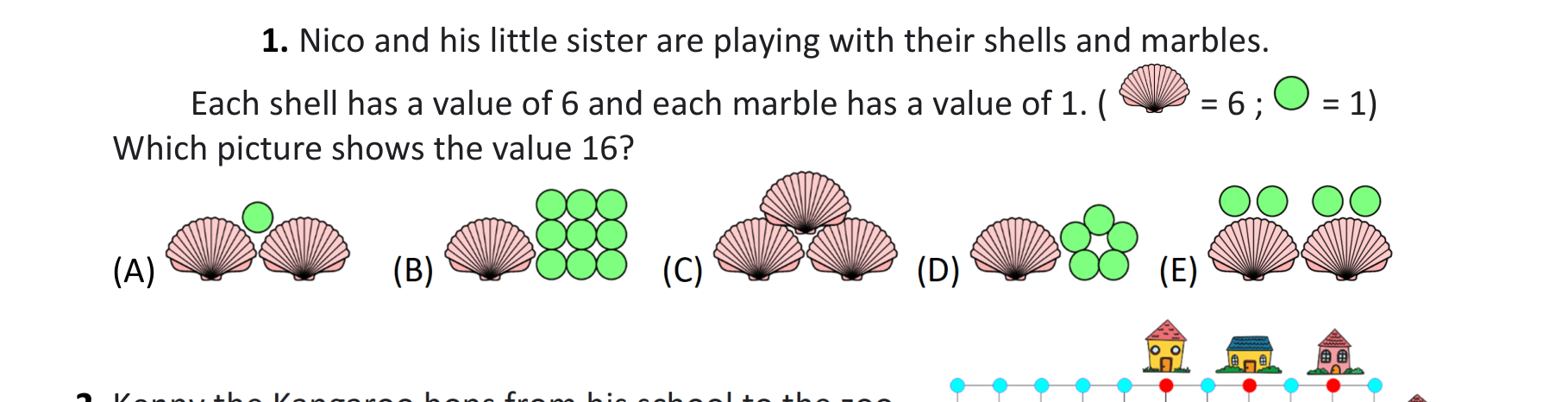
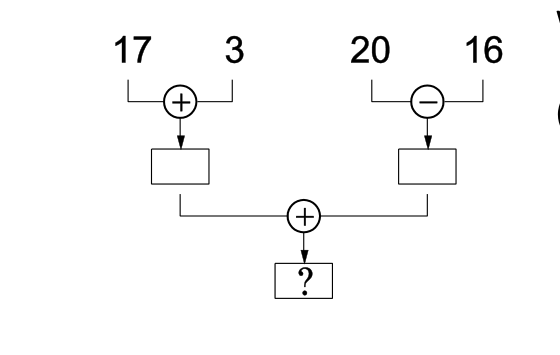
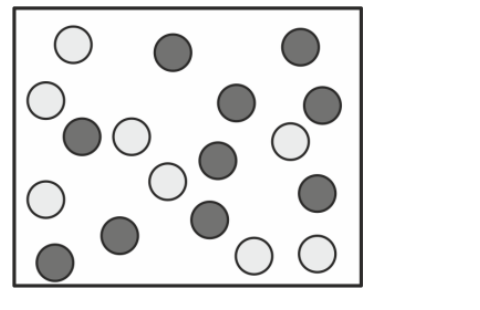
Nico and his little sister play with shells and marbles. Each shell is worth 6 and each marble is worth 1 (shell = 6, marble = 1). Which picture shows the value 16?
Show answer
Answer: E
Show hints
Hint 1 of 2
Each shell counts as 6 and each marble counts as 1 - add up each picture's total.
Still stuck? Show hint 2 →
Hint 2 of 2
You need a total of exactly 16, so look for two shells plus four marbles.
Show solution
Approach: add the shell and marble values in each option
A shell is worth 6 and a marble is worth 1.
Two shells give 12, and you need 4 more to reach 16, so 4 marbles.
The picture with two shells and four marbles totals 12 + 4 = 16.
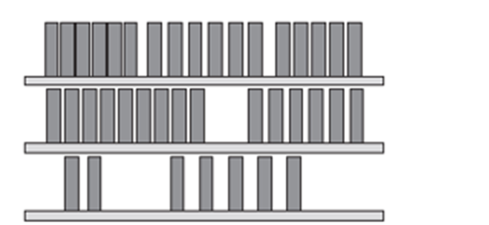
A bookshelf with three rows has 17 books in the top row, 15 books in the middle row and 7 books in the bottom row. Monika would like to have the same number of books in each row, but she wants to rearrange as few books as possible. How many books does she have to move from the middle row to the bottom row?
Show answer
Answer: B — 2
Show hints
Hint 1 of 2
First find how many books each row should hold.
Still stuck? Show hint 2 →
Hint 2 of 2
Books should only be moved into rows that are short; figure out the bottom row’s shortfall.
Show solution
Approach: even out the rows with fewest moves
Total books: 17 + 15 + 7 = 39, so each row should have 39 ÷ 3 = 13.
The bottom row is short by 13 − 7 = 6 books; the top row has 4 spare and the middle has 2 spare.
To move as few as possible, send the top’s 4 spare and the middle’s 2 spare straight to the bottom.
So only 2 books go from the middle row to the bottom row.
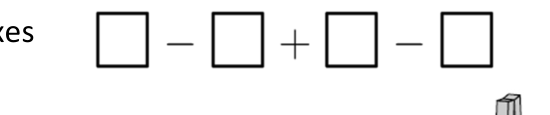
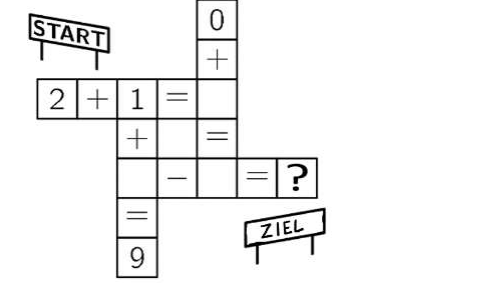
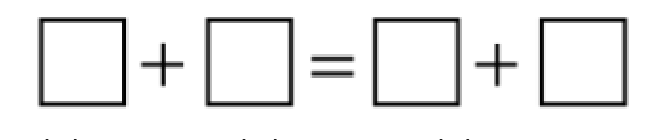
Simona writes the numbers 2, 0, 2 and 5 in the boxes, one number per box (see picture). In what order can she write them so that the calculation gives the biggest result?
Show answer
Answer: E — 5, 2, 0, 2
Show hints
Hint 1 of 2
The third box is the one that gets subtracted, so put the smallest number there.
Still stuck? Show hint 2 →
Hint 2 of 2
Put the 0 in the subtracted (third) box and add everything else.
Show solution
Approach: minimise what is subtracted, maximise what is added
The calculation is first + second minus third + fourth.
To make it biggest, subtract the smallest number, which is 0.
Then the other three (5, 2, 2) are all added: 5 + 2 - 0 + 2 = 9.
The order 5, 2, 0, 2 does this, which is option E.
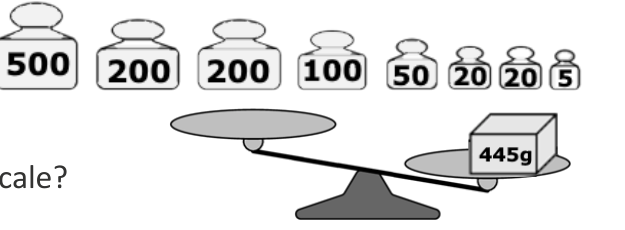
Pieter has a parcel that weighs 445 g and the eight weights shown. He places the parcel on the right pan of the scale (see picture). Pieter may put weights on either side of the scale. What is the smallest number of weights he needs to balance the scale?
Show answer
Answer: B — 3
Show hints
Hint 1 of 2
Weights on the parcel's side help it; weights on the other side fight it, so a weight you put with the parcel counts as minus and a weight opposite counts as plus.
Still stuck? Show hint 2 →
Hint 2 of 2
You need the opposite-side weights minus the parcel-side weights to equal 445 g using as few weights as possible.
Show solution
Approach: make 445 as a difference of a few weights
Putting a weight opposite the parcel adds its value; putting it with the parcel subtracts it, so balancing needs a signed combination equal to 445 g.
Use 500 on the empty side and 50 + 5 on the parcel's side: 500 − 50 − 5 = 445.
That is just three weights, and no two-weight combination reaches 445.
The two markers with a question mark have the same value: \(20 + 10 + 10 + ? + ? + 1 = 51\). Which value do you have to use instead of the question mark so that the calculation is correct?
Show answer
Answer: C — 5
Show hints
Hint 1 of 2
Add up the numbers you can already read.
Still stuck? Show hint 2 →
Hint 2 of 2
Subtract that running total from 51, then split the leftover between the two equal markers.
Show solution
Approach: fill the known values, then split the remainder
The known markers add to 20 + 10 + 10 + 1 = 41.
The two equal question marks must make up 51 − 41 = 10.
John throws 150 coins onto a table. 60 of them show “heads”, the others show “tails”. He wants the same number of coins to show heads as tails. How many coins that show heads does he have to turn over?
Show answer
Answer: B — 15
Show hints
Hint 1 of 2
First work out how many coins currently show tails.
Still stuck? Show hint 2 →
Hint 2 of 2
Each coin you flip changes the head-count by one; aim for an equal split of 75 and 75.
Show solution
Approach: balance the two counts with single flips
There are 150 coins: 60 heads and 150 − 60 = 90 tails.
For an even split he needs 75 heads and 75 tails.
He must move 15 coins from the larger pile to the smaller, i.e. flip 15 coins.
Logic & Word ProblemsArithmetic & Operationssum-constraintcasework
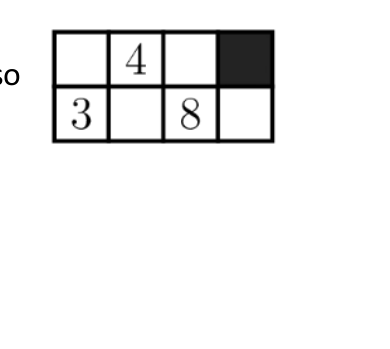
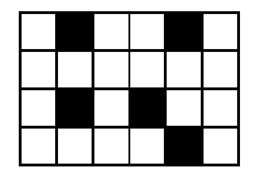
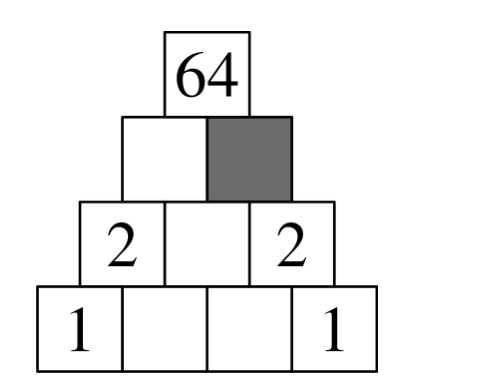
Evita wants to write the numbers from 1 to 8, with one number in each field. The sum of the numbers in each row should be equal. The sum of the numbers in each of the four columns should also be the same. She has already written in the numbers 3, 4 and 8 (see diagram). Which number does she have to write in the dark field?
Show answer
Answer: E — 7
Show hints
Hint 1 of 2
The numbers 1..8 add to 36; use that to find each row sum and each column sum.
Still stuck? Show hint 2 →
Hint 2 of 2
Fit the remaining numbers around the given 3, 4 and 8 so every row and every column hits its target.
Show solution
Approach: use the fixed total to pin row/column sums, then place numbers
1 + 2 + ... + 8 = 36; with two equal rows each row sums to 18, and with four equal columns each column sums to 9.
Place the remaining numbers so each column totals 9 and each row totals 18, respecting the given 3, 4 and 8.
On every birthday Maria gets as many teddies as the age she turns: 1 teddy on her first birthday, 2 teddies on her second birthday, and so on. How many teddies does Maria have in total the day after her sixth birthday?
Show answer
Answer: C — 21
Show hints
Hint 1 of 2
On each birthday she gets a number of teddies equal to her age that day.
Still stuck? Show hint 2 →
Hint 2 of 2
Add up the teddies from birthday 1 through birthday 6.
Show solution
Approach: add the gifts from each birthday
Birthdays 1 to 6 give 1, 2, 3, 4, 5 and 6 teddies.
Add them up: 1 + 2 + 3 + 4 + 5 + 6 = 21.
So the day after her sixth birthday she has 21 teddies (choice C).
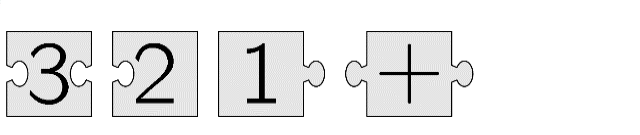
When the 5 puzzle pieces shown are fitted together correctly, the result is a rectangle with a calculation written on it. What is the answer to this calculation?
Show answer
Answer: B — 32
Show hints
Hint 1 of 2
The five puzzle pieces carry the symbols 2, 0, 2, 1 and +; fit them into one calculation.
Still stuck? Show hint 2 →
Hint 2 of 2
Arrange them as a two-digit plus a two-digit sum and read off the total.
Show solution
Approach: reassemble the pieces into one addition
The pieces 2, 0, 2, 1 and + fit together to spell the calculation 20 + 12.
When the 5 pieces shown are fitted together correctly, the result is a rectangle with a calculation written on it. What is the answer to this calculation?
Show answer
Answer: A — −100
Show hints
Hint 1 of 2
Fit the jigsaw pieces into a rectangle so the symbols line up into a single calculation.
Still stuck? Show hint 2 →
Hint 2 of 2
Once assembled it reads a short arithmetic expression — just evaluate it.
Show solution
Approach: assemble the pieces into the expression and compute
The five pieces fit together to spell out a calculation using the digits 2, 0, 2, 1 and a minus sign.
Denise fired a silver and a gold rocket at the same time. The rockets exploded into 20 stars in total. The gold rocket exploded into 6 more stars than the silver one. How many stars did the gold rocket explode into?
Show answer
Answer: D — 13
Show hints
Hint 1 of 2
The two rockets together make 20 stars, and the gold makes 6 more than the silver.
Still stuck? Show hint 2 →
Hint 2 of 2
Take the 6 extra off the 20 first, split what is left evenly, then give the gold its extra back.
Show solution
Approach: split the total after removing the difference
Remove the 6 extra gold stars: 20 - 6 = 14 shared equally.
Each rocket's base share is 14 / 2 = 7, so the silver has 7.
Logic & Word ProblemsArithmetic & Operationsmagic-squaresum-constraintwork-backward
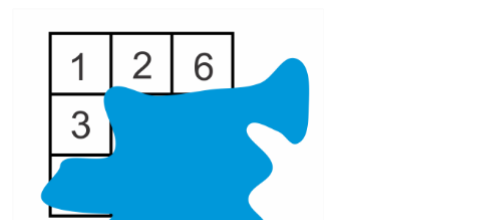
Juca wrote a whole number greater than zero in each box of the 3×3 board shown, so that the sums of the numbers in each row and in each column are equal. The only thing Juca remembers is that no number is used three times. What number is written in the center box?
Show answer
Answer: C — 4
Show hints
Hint 1 of 2
All three rows and columns share the same total; the top row 1 + 2 + 6 gives that total.
Still stuck? Show hint 2 →
Hint 2 of 2
Fill the grid from the common sum of 9, using that no value may appear three times.
Show solution
Approach: use the common row/column sum
Each row and column sums to 1 + 2 + 6 = 9.
The left column 1 + 3 + ? = 9 forces the bottom-left to be 5.
Filling in keeps the sums at 9; the center value can be 4 (center 5 would repeat a number three times, which is forbidden).
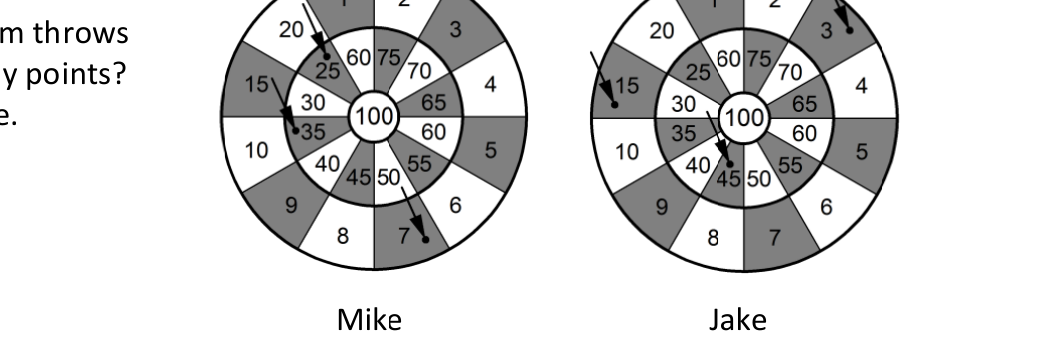
If you hit the target board you score points. The number of points depends on which of the three areas you hit. Diana throws two darts, three times, at the target board. On the first attempt she scores 14 points and on the second 16 points. How many points does she score on the third attempt?
Show answer
Answer: B — 18
Show hints
Hint 1 of 2
Two darts land in the ringed areas, so each total is a sum of two of the ring values.
Still stuck? Show hint 2 →
Hint 2 of 2
Use the 14 and 16 totals to pin down the ring values, then find the largest two-ring total for the third throw.
Show solution
Approach: find the ring point-values from the given totals, then read off the third
Each throw is two darts, so a score is the sum of two ring values.
The first total 14 and the second total 16 force the ring values (the rings are worth more as you go inward).
The two darts in the third picture both land in the highest-value ring.
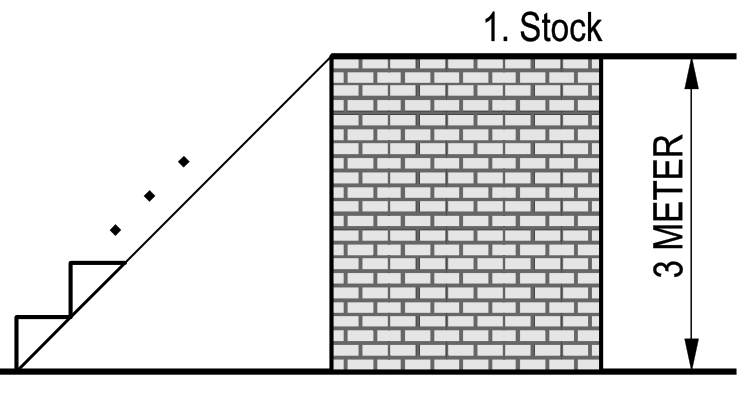
Bernd produces steps for a staircase which are 15 cm high and 15 cm deep (see diagram). The staircase should reach from the ground floor to the first floor, which is 3 m higher. How many steps does Bernd have to produce?
Show answer
Answer: D — 20
Show hints
Hint 1 of 2
Every step adds the same height. How much total height must the steps cover?
Still stuck? Show hint 2 →
Hint 2 of 2
Turn 3 m into centimetres, then see how many 15 cm steps fit.
Show solution
Approach: divide the total rise by the height of one step
The staircase must rise 3 m = 300 cm.
Each step is 15 cm high, so the number of steps is 300 : 15 = 20.
Yvonne has 20 €, and each of her four sisters has 10 €. How much does Yvonne have to give to each of her sisters so that all of them have the same amount of money?
Show answer
Answer: A — 2
Show hints
Hint 1 of 2
First find how much each person should have once the money is shared equally.
Still stuck? Show hint 2 →
Hint 2 of 2
Then see how much Yvonne must hand to each sister to reach that level.
Show solution
Approach: equalise the total
Total money = 20 + 4×10 = 60 €, shared among 5 people = 12 € each.
Yvonne must drop from 20 to 12, giving away 8 € over 4 sisters.
Mike cuts a pizza into four equally big pieces. Then he cuts each piece into three equally big pieces. Into how many equally big pieces did Mike cut the pizza?
Show answer
Answer: E — 12
Show hints
Hint 1 of 2
Picture the four pieces side by side, then split each one.
Still stuck? Show hint 2 →
Hint 2 of 2
Each of the four pieces turns into three pieces.
Show solution
Approach: count the pieces in equal groups
After the first cuts there are 4 pieces.
Each of those 4 pieces is split into 3, so you get 4 groups of 3.
In a cave there live a starfish, two seahorses and three turtles. They are visited by three starfish, four turtles and five seahorses. How many animals are there now in the cave altogether?
Show answer
Answer: E — 18
Show hints
Hint 1 of 2
Add up everyone who is now inside the cave: the original animals plus the visitors.
Still stuck? Show hint 2 →
Hint 2 of 2
Total the residents (1 + 2 + 3) and the visitors (3 + 4 + 5) separately, then combine.
Renate combines 555 little piles of 9 stones each into one big pile. Then she splits the big pile into little groups of 5 stones each. How many such groups does she get?
Show answer
Answer: A — 999
Show hints
Hint 1 of 2
Find the total number of stones first.
Still stuck? Show hint 2 →
Hint 2 of 2
Then split that total into groups of 5.
Show solution
Approach: total then divide
The big pile has 555 × 9 = 4995 stones.
Splitting into groups of 5 gives 4995 ÷ 5 = 999 groups.
Mr Bauer has 10 ducks. 5 of these ducks lay an egg every day. The other 5 lay an egg every second day. How many eggs will the 10 ducks have laid after 10 days?
Show answer
Answer: A — 75
Show hints
Hint 1 of 2
Work out the two groups of ducks separately, then add their egg counts.
Still stuck? Show hint 2 →
Hint 2 of 2
An every-second-day duck lays once every two days, so in 10 days it lays only 5 eggs.
Show solution
Approach: count each group's eggs over 10 days and add
The 5 everyday ducks each lay 10 eggs in 10 days: 5 × 10 = 50 eggs.
The other 5 ducks lay every second day, so 5 eggs each in 10 days: 5 × 5 = 25 eggs.
A cake weighs 900 g. Paul cuts it into 4 pieces. The biggest piece weighs exactly as much as the other three pieces together. How much does the biggest piece weigh?
Show answer
Answer: D — 450 g
Show hints
Hint 1 of 2
The biggest piece equals all the other pieces put together, so it is one of two equal halves of the cake.
Still stuck? Show hint 2 →
Hint 2 of 2
Half of the whole cake is the biggest piece.
Show solution
Approach: the biggest piece is half the cake
If the biggest piece weighs as much as the other three together, then those two parts are equal halves of the cake.
The container ship MSC Fabiola carries 12500 identically long containers. When put next to each other in a row they make a 75 km long line. Roughly, how long is one container?
Show answer
Answer: A — 6 m
Show hints
Hint 1 of 2
Put the whole line and the number of containers into the same units first.
Still stuck? Show hint 2 →
Hint 2 of 2
Divide the total length by how many containers make it up.
Show solution
Approach: convert to one unit, then divide
The line is 75 km = 75000 m long and is made of 12500 containers.
Today is Carmen, Gerda and Sabine's birthday. The sum of their ages is now 44. How big will the sum of their ages be the next time it is a two-digit number with two equal digits?
Show answer
Answer: C — 77
Show hints
Hint 1 of 2
Every year that passes, the total of three ages goes up by 3.
Still stuck? Show hint 2 →
Hint 2 of 2
Which numbers with two equal digits can you actually reach by adding multiples of 3 to 44?
Show solution
Approach: step the total up by 3 each year and land on a repdigit
Each birthday all three get one year older, so the sum rises by 3 each year.
Starting from 44, the reachable totals are 44, 47, 50, 53, … (everything 44 + 3k).
Check the two-equal-digit numbers: 55 and 66 are not of the form 44 + 3k, but 77 = 44 + 33 is.
So the next time the sum is a two-digit repdigit it equals 77.
Katrin has 38 matches. She uses all of them to make a triangle and a square that share no matches. Each side of the triangle is made of 6 matches. How many matches are in one side of the square?
Show answer
Answer: B — 5
Show hints
Hint 1 of 2
Work out how many matches the triangle uses, then see what is left for the square.
Still stuck? Show hint 2 →
Hint 2 of 2
Whatever the square gets, split it evenly across its four equal sides.
Show solution
Approach: subtract the triangle's matches, then divide the rest by 4
The triangle has three sides of 6 matches, so it uses 3 × 6 = 18 matches.
That leaves 38 − 18 = 20 matches for the square.
The square's four equal sides share these, so each side has 20 ÷ 4 = 5 matches.
A market has a special corn-on-the-cob offer: each cob costs 20 cent, and every 6th cob is free. Mrs. Maisl buys four pieces of corn-on-the-cob for each of the four members of her family and gets the discount offered. How much does she end up paying?
Show answer
Answer: C — 2.80 €
Show hints
Hint 1 of 2
First find the total number of cobs bought.
Still stuck? Show hint 2 →
Hint 2 of 2
Use the every-6th-cob-free rule to subtract the free cobs before multiplying by the price.
Show solution
Approach: count cobs, apply the free-cob discount
She buys 4 cobs for each of 4 people: 4 × 4 = 16 cobs.
Every 6th cob is free, so cobs number 6 and 12 are free — 2 free cobs.
She pays for 16 − 2 = 14 cobs at 20 cent each: 14 × 20 = 280 cent.
The number 3 should be added to the number 6. This amount is then doubled, and the result is increased by 1. Which of the following sums fits this description?
Show answer
Answer: D — \((6 + 3) \times 2 + 1\)
Show hints
Hint 1 of 2
Translate the words step by step into an expression.
Still stuck? Show hint 2 →
Hint 2 of 2
'This amount is then doubled' means multiply the whole sum (6+3) by 2 first.
Show solution
Approach: translate words to an expression
'Add 3 to 6' gives (6 + 3).
'This amount is doubled' gives (6 + 3) x 2.
'the result increased by 1' gives (6 + 3) x 2 + 1, which is choice D.
On the 24th of February 2012 Grandfather's chicks hatched. There are 29 days in February in 2012. How old are the chicks today, on the 15th of March 2012?
Show answer
Answer: D — 20 days
Show hints
Hint 1 of 2
Count the days from 24 February up to 15 March, using that February has 29 days.
Still stuck? Show hint 2 →
Hint 2 of 2
Find how many days from the 24th to the end of February, then add the March days.
A zebra crossing has alternating white and black stripes each 50 cm wide. The first stripe is white and the last one is white. The zebra crossing in front of our school has 8 white stripes. How wide is the road?
Show answer
Answer: B — 7.5 m
Show hints
Hint 1 of 2
If the crossing starts and ends with a white stripe, how many black stripes sit between the white ones?
Still stuck? Show hint 2 →
Hint 2 of 2
Count the total number of stripes first, then multiply by the 50 cm width.
Show solution
Approach: count all stripes, then multiply by width
The pattern is white, black, white, ... starting and ending white, with 8 white stripes.
Between/around 8 white stripes there are 7 black stripes, so 8+7=15 stripes total.
Each stripe is 50 cm = 0.5 m, so the road is 15×0.5 = 7.5 m wide.
The bell of a clocktower rings every full hour (8:00, 9:00, 10:00 etc.) and rings as many times as the number of hours. It also rings once on every half hour (8:30, 9:30, 10:30 etc.). How often will it ring between 7:55 and 10:45?
Show answer
Answer: D — 30 times
Show hints
Hint 1 of 2
List every full hour and every half hour strictly between 7:55 and 10:45.
Still stuck? Show hint 2 →
Hint 2 of 2
A full hour rings as many times as the hour number; each half hour rings once.
Show solution
Approach: count rings by occasion
Full hours in the window: 8:00 rings 8, 9:00 rings 9, 10:00 rings 10, total 27 rings.
Half hours 8:30, 9:30, 10:30 each ring once, adding 3.
In a cafe the soup costs €4, the main course €9 and the dessert €5. The three courses ordered together cost €15. How many euros cheaper is this than ordering the same three courses separately?
Show answer
Answer: A — €3
Show hints
Hint 1 of 2
First add up the three separate prices.
Still stuck? Show hint 2 →
Hint 2 of 2
Then compare that total with the combined price of 15.
Show solution
Approach: compare separate total with bundle price
Eva is a centipede with exactly 100 feet. Yesterday she bought 16 pairs of shoes and put them on right away. Even so, she still had 14 feet with no shoes. On how many feet was she already wearing shoes before she went shopping yesterday?
Show answer
Answer: C — 54
Show hints
Hint 1 of 2
Each pair of shoes covers 2 feet; first find how many feet have shoes now.
Still stuck? Show hint 2 →
Hint 2 of 2
Subtract the feet she put new shoes on today from the total now wearing shoes.
Show solution
Approach: count shod feet, then remove today's new shoes
She has 100 feet and 14 are bare, so 100 − 14 = 86 feet wear shoes now.
Today she put on 16 pairs = 32 shoes, covering 32 feet.
So before shopping she already wore shoes on 86 − 32 = 54 feet.
Rudi feeds six sheep in the petting zoo. The six sheep get a total of 210 g of food. Each of the five large sheep gets the same amount, and the small sheep gets twice as much as a large sheep. How much food does the small sheep get?
Show answer
Answer: C — 60 g
Show hints
Hint 1 of 2
The small sheep eats as much as two large sheep, so count it as two large sheep.
Still stuck? Show hint 2 →
Hint 2 of 2
Then the 210 g is shared into 7 equal large-sheep portions.
Show solution
Approach: count everything in equal large-sheep portions
The small sheep eats as much as two large sheep, so pretend it is two large sheep.
Now there are 5 + 2 = 7 equal large-sheep portions sharing 210 g.
Each portion is 210 ÷ 7 = 30 g.
The small sheep gets two portions: 30 + 30 = 60 g, option C.
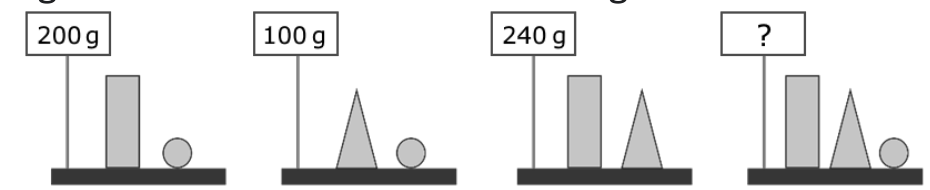
Lucy weighs building blocks two at a time and reads these scale values: 200 g, 100 g and 240 g (see picture). How much do the three different building blocks weigh all together?
Show answer
Answer: A — 270 g
Show hints
Hint 1 of 2
Each reading is the weight of two of the three blocks together.
Still stuck? Show hint 2 →
Hint 2 of 2
Add the three known readings — that counts every block twice.
Show solution
Approach: add the pair-weights and halve
The three readings 200, 100, 240 each weigh two blocks, so together they count all three blocks twice.
Sum: 200 + 100 + 240 = 540 grams.
Half of that is the weight of the three blocks once: 540 ÷ 2 = 270.
In a queue in front of a ferry there are 8 cars with 19 people in total. There are either 2 or 3 people in each car. How many cars are there with exactly 2 people?
Show answer
Answer: D — 5
Show hints
Hint 1 of 2
If every car held 2 people there would be only 16; you need 3 more.
Still stuck? Show hint 2 →
Hint 2 of 2
Each car upgraded from 2 to 3 people adds exactly one person.
Show solution
Approach: start from all-twos and account for the extra people
Eight cars with 2 people each would carry 16 people, but there are 19.
The 3 extra people come from 3 cars holding 3 instead of 2.
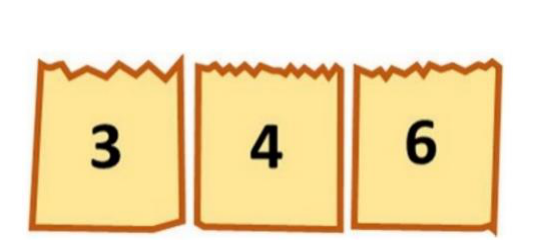
Maria has a total of 19 apples in 3 bags. She takes the same amount of apples from each bag. Then there are 3, 4 and 6 apples in the bags. How many apples did Maria take from each bag?
Show answer
Answer: B — 2
Show hints
Hint 1 of 3
First add up how many apples are still left in all three bags.
Still stuck? Show hint 2 →
Hint 2 of 3
Maria started with 19, so the apples she took are the 19 minus the ones still left.
Still stuck? Show hint 3 →
Hint 3 of 3
She took the same number from each bag, so share the taken apples equally among 3 bags.
Show solution
Approach: find how many were taken in all, then share among 3 bags
Count the apples still in the bags: 3 and 4 and 6 make 13.
Maria began with 19, so the apples she took away are 19 take away 13, which is 6.
She took the same from each of the 3 bags, so share 6 into 3 equal groups: 2 from each bag, option B.
Logic & Word ProblemsArithmetic & Operationswork-backwardsum-constraint
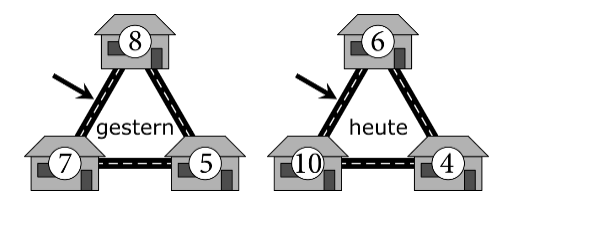
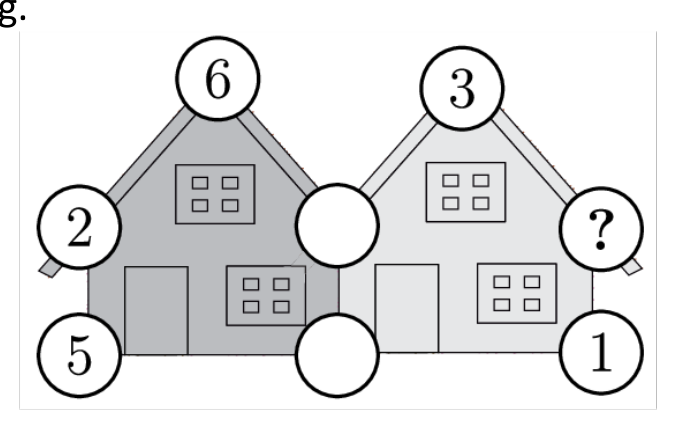
Several mice live in three houses. Last night every mouse left its house and moved directly to one of the other two houses. The diagram shows how many mice were in each house yesterday (“gestern”) and today (“heute”). How many mice used the path indicated by the arrow?
Show answer
Answer: B — 11
Show hints
Hint 1 of 2
Every mouse leaves its own house, so each house's outgoing mice split between the other two.
Still stuck? Show hint 2 →
Hint 2 of 2
Set up the flows between the three houses from yesterday's and today's counts; the arrow is one of those flows.
Show solution
Approach: balance the mouse flows between the three houses
Yesterday the houses held 8, 7, 5 and today they hold 6, 10, 4; every mouse moved to a different house.
Writing the six directed flows and using that each house empties out gives equations linking them.
Number TheoryArithmetic & Operationsdigit-sumcasework
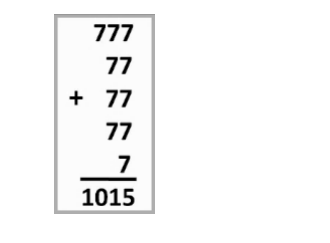
Bart wrote the number 1015 as a sum of numbers that are made up of only the digit 7. In total he used the digit 7 ten times (see diagram). Now he wants to write the number 2023 as a sum of numbers made up of only the digit 7, using the digit 7 nineteen times in total. How many times does he have to use the number 77?
Show answer
Answer: E — 6
Show hints
Hint 1 of 2
Numbers made only of 7s are 7, 77, 777, ... each contributing several 7s to the digit-count.
Still stuck? Show hint 2 →
Hint 2 of 2
Match the value 2023 and the total of 19 sevens together; that pins how many 77s appear.
Show solution
Approach: balance the value 2023 and the count of 19 sevens
Let there be a parts equal to 7, b equal to 77 and c equal to 777 (777 × 3 > 2023, so no bigger parts).
Value: 7a + 77b + 777c = 2023, i.e. a + 11b + 111c = 289 (dividing by 7). Digit count: a + 2b + 3c = 19.
Subtracting gives 9b + 108c = 270, so b + 12c = 30; the only choice keeping a ≥ 0 is c = 2, b = 6 (then a = 1).
Check: 7 + 6×77 + 2×777 = 7 + 462 + 1554 = 2023, using 1 + 12 + 6 = 19 sevens. So 77 is used 6 times, option E.
Logic & Word ProblemsArithmetic & Operationssum-constraintwork-backward
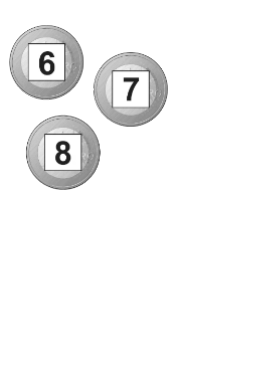
Jakob wrote six consecutive numbers on six little pieces of white paper, one number per piece. He stuck the six pieces on the front and back of three coins. Then he threw the coins three times. After the first throw the numbers 6, 7, 8 were on top (see diagram), which Jakob then coloured red. After the second throw the sum of the numbers on top was 23, and after the third throw the sum was 17. How big is the sum of the numbers on the three white pieces of paper?
Show answer
Answer: A — 18
Show hints
Hint 1 of 2
The six consecutive numbers are paired front/back on three coins, so the two faces of one coin are a fixed-difference pair.
Still stuck? Show hint 2 →
Hint 2 of 2
Use the three throw-sums (the first is 6+7+8) to deduce the hidden faces and then the unseen white totals.
Show solution
Approach: pair the faces by the coins and use the three sums
The first throw shows 6, 7, 8, so those three reds sum to 21; each later throw replaces some reds by their white partners, changing the sum by white − red on the flipped coins.
From 21 the sums become 23 (a change of +2) and 17 (a change of −4); the total change if all three were flipped is (white total) − 21.
The six numbers are consecutive and include 6, 7, 8; the only set making the throws consistent is 4,5,6,7,8,9, so the whites are 4, 5, 9.
A rugby team scored 24, 17 and 25 points in their 7th, 8th and 9th game of the previous season. The average number of points per game was higher after 9 games than after their first 6 games. Their average after 10 games was more than 22 points. What is the minimum number of points they could have scored in their 10th game?
Show answer
Answer: C — 24
Show hints
Hint 1 of 2
Turn each 'average' statement into a statement about total points using the number of games.
Still stuck? Show hint 2 →
Hint 2 of 2
Combine the inequality after 9 games with the 'more than 22 after 10 games' condition to bound the 10th score from below.
Show solution
Approach: convert averages to total-point inequalities and minimise
Let the first-6-game total be T; games 7–9 add 24+17+25 = 66, so the 9-game total is T + 66.
'Higher average after 9 than after 6' gives \(\frac{T+66}{9} > \frac{T}{6}\); clearing denominators, \(6(T+66) > 9T\), so \(396 > 3T\) and \(T < 132\).
'More than 22 after 10 games' gives \(T + 66 + g > 220\), so \(g > 154 - T\); to make the 10th score \(g\) as small as possible, take \(T\) as large as allowed, \(T = 131\).
Then \(g > 154 - 131 = 23\), so the smallest whole-number score is 24, option C.
2022 tiles are placed in one long row. Adam removes every sixth tile. Then Beate removes every fifth of the remaining tiles. Subsequently Cora removes every fourth of the remaining tiles. How many tiles are left?
Show answer
Answer: D — 1011
Show hints
Hint 1 of 2
After removing every k-th tile, the fraction (k-1)/k of the tiles survive.
Still stuck? Show hint 2 →
Hint 2 of 2
Multiply 2022 by 5/6, then 4/5, then 3/4 in turn.
Show solution
Approach: multiply by the surviving fractions in order
Removing every 6th leaves 2022 * 5/6 = 1685.
Removing every 5th of those leaves 1685 * 4/5 = 1348.
Removing every 4th of those leaves 1348 * 3/4 = 1011.
The three zebras Runa, Zara and Biba take part in a competition. The winner is the zebra with the most stripes. Runa has 15 stripes. Zara has 3 stripes more than Runa. Runa has 5 stripes less than Biba. How many stripes does the winner have?
Show answer
Answer: C — 20
Show hints
Hint 1 of 2
Work out each zebra's stripe count from Runa's 15.
Still stuck? Show hint 2 →
Hint 2 of 2
The winner has the most stripes - compare all three.
Show solution
Approach: compute each total and take the largest
Runa has 15. Zara has 15 + 3 = 18. Biba has 15 + 5 = 20.
The kangaroo had two branches for lunch. Each branch had 10 leaves. The kangaroo ate some leaves from one branch. Then, from the second branch, it ate as many leaves as were left on the first branch. How many leaves in total were left on the two branches?
Show answer
Answer: D — 10
Show hints
Hint 1 of 3
Whatever is LEFT on the first branch is exactly what gets EATEN from the second branch.
Still stuck? Show hint 2 →
Hint 2 of 3
Try a number: if 4 leaves are left on branch one, the kangaroo eats 4 from branch two.
Still stuck? Show hint 3 →
Hint 3 of 3
Count the leaves still left on both branches and look for a pattern.
Show solution
Approach: the leftover from one branch is eaten from the other
Whatever is left on the first branch, the kangaroo eats that same number from the second branch.
So the leaves eaten from branch two exactly match the leaves still on branch one.
That leaves one full branch worth in total: 10 leaves.
Each of the 5 boxes contains either apples or bananas, but not both. The total weight of all the bananas is 3 times the weight of all the apples. Which boxes contain apples?
Show answer
Answer: E — 1 and 4
Show hints
Hint 1 of 2
If the bananas weigh 3 times the apples, then for every 1 kg of apples there are 3 kg of bananas — so apples are 1 part out of 4 equal parts of the whole.
Still stuck? Show hint 2 →
Hint 2 of 2
Add all five box weights, take a quarter of that for the apples, then find which boxes add up to it.
Show solution
Approach: apples are one quarter of the total weight
The five boxes weigh 7, 5, 6, 2, 16, totalling 36 kg.
Bananas are 3 times the apples, so apples make up 36 / 4 = 9 kg.
Boxes summing to 9 kg are the 7 kg and 2 kg ones, i.e. boxes 1 and 4.
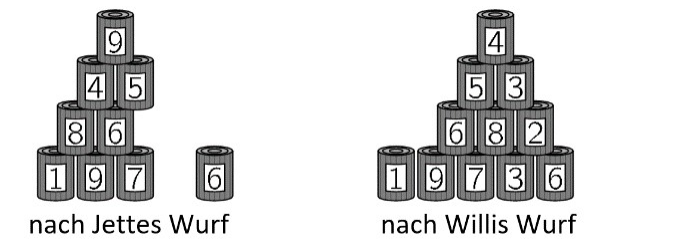
Jette and Willi throw balls at two identically built pyramids, each made up of 15 tins (each tin is worth the number written on it). The pictures show each pyramid after Jette's throw and after Willi's throw. Jette hits 6 tins and gets 25 points. Willi hits 4 tins. How many points does Willi get?
Show answer
Answer: D — 26
Show hints
Hint 1 of 3
Both pyramids are built the same, so each one holds the same total number of points.
Still stuck? Show hint 2 →
Hint 2 of 3
Use Jette's picture: the tins left standing plus the 25 she knocked down give the whole pyramid's total.
Still stuck? Show hint 3 →
Hint 3 of 3
For Willi, that same total minus the tins still standing in his picture is his score.
Show solution
Approach: find the grand total, then subtract what's left
After Jette's throw the standing tins add up to 55, and the 6 she knocked down scored 25, so the whole pyramid totals 55 + 25 = 80.
After Willi's throw the standing tins add up to 54.
The road from Anna's house to Mary's house is 16 km long. The road from Mary's house to John's house is 20 km long. The road from the crossing to Mary's house is 9 km long. How long is the road from Anna's house to John's house?
Show answer
Answer: E — 18 km
Show hints
Hint 1 of 3
Notice the two roads cross in the middle — that crossing is on the way from Anna to John.
Still stuck? Show hint 2 →
Hint 2 of 3
Both long roads (Anna-to-Mary and John-to-Mary) include the same 9 km piece up to Mary.
Still stuck? Show hint 3 →
Hint 3 of 3
Take that 9 km off each road to find Anna-to-crossing and John-to-crossing, then add them.
Show solution
Approach: break each road at the crossing, then add the two near pieces
Anna's road to Mary is 16 km, but the last 9 km is from the crossing to Mary, so Anna to the crossing is 16 − 9 = 7 km.
John's road to Mary is 20 km, and again 9 km of it is from the crossing to Mary, so John to the crossing is 20 − 9 = 11 km.
Anna to John goes through the crossing: 7 + 11 = 18 km.
Viola practices long-jumping. On average she has jumped 3.80 m so far. On her next jump she reaches 3.99 m and thus her mean increases to 3.81 m. How far does she have to jump on her next attempt in order to increase her mean to 3.82 m?
Show answer
Answer: C — 4.01 m
Show hints
Hint 1 of 2
First use the jump from 3.80 to 3.81 average to find how many jumps she had.
Still stuck? Show hint 2 →
Hint 2 of 2
Then work out the new total she needs for a 3.82 average and subtract.
Show solution
Approach: find the count of jumps, then the required total
If the mean rises from 3.80 to 3.81 after a 3.99 m jump, then 3.80n + 3.99 = 3.81(n+1), giving n = 18 (now 19 jumps, total 72.39 m).
For a mean of 3.82 over 20 jumps the total must be 76.40 m.
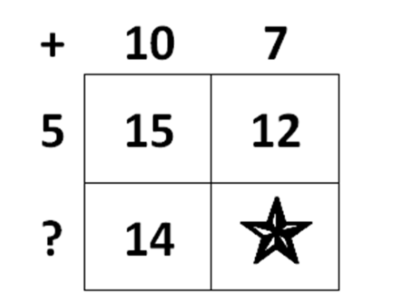
Every box shows the result of the addition of the numbers on the very left and on the very top (for example: \(5 + 7 = 12\)). Which number is written behind the star?
Show answer
Answer: B — 11
Show hints
Hint 1 of 2
Each cell equals its row number plus its column number; use the filled cells to find the hidden row number.
Still stuck? Show hint 2 →
Hint 2 of 2
Once you know the missing row label, add it to the star's column heading.
Show solution
Approach: recover the hidden labels, then add
Each box is row-label + column-label. The cell '14' sits in the star's row under column 10, so the hidden row label is 14 - 10 = 4.
The star is in that same row (label 4) under column 7.
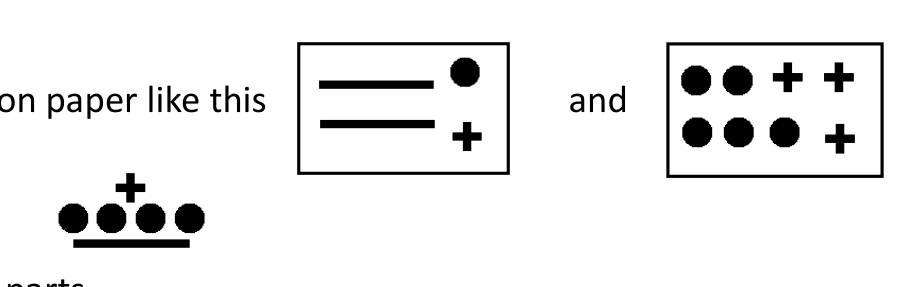
Lisa has several sheets of construction paper, of two kinds (shown). She wants to make 7 identical crowns, and for that she cuts out the necessary parts. What is the minimum number of sheets of construction paper that she has to cut up?
Show answer
Answer: B — 9
Show hints
Hint 1 of 2
First count exactly what one crown is made of: how many dots, crosses, and bars.
Still stuck? Show hint 2 →
Hint 2 of 2
Only the first kind of sheet has bars, and you need one bar per crown; start by getting enough bars, then top up the dots.
Show solution
Approach: cover the scarce part first (bars), then make up the dots
Each crown needs 4 dots, 1 cross, and 1 bar, so 7 crowns need 28 dots, 7 crosses, and 7 bars.
Only the first kind of sheet has bars (2 bars, plus 1 dot and 1 cross each); to get 7 bars she needs 4 of these sheets, giving 8 bars, 4 dots, and 4 crosses.
She still needs 28 - 4 = 24 more dots; the second kind of sheet has 5 dots (and 3 crosses) each, so 5 of them give 25 dots — enough, and plenty of crosses.
A number is written into every square of a 4 × 4 table. Mary is looking for the 2 × 2 table where the sum of the four numbers is greatest. How big is this sum?
1
2
1
3
4
1
1
2
1
7
3
2
2
1
3
1
Show answer
Answer: D — 14
Show hints
Hint 1 of 2
Slide a 2 x 2 window over the table and add its four numbers each time.
Still stuck? Show hint 2 →
Hint 2 of 2
The biggest entry, 7, should sit inside the best window.
Show solution
Approach: check the 2 x 2 block containing the largest numbers
Try 2 x 2 blocks, focusing on the area around the 7.
The block with 7, 3 (its right neighbour) and the 1, 3 below them gives 7+3+1+3.
That total is 14, larger than any other 2 x 2 block.
Five boys share 10 bags of marbles between themselves. Everyone gets exactly two bags (see picture). Alex gets 5 marbles, Bob 7, Charles 9 and Dennis 15. Eric gets the two bags that are left over. How many marbles does he get?
Show answer
Answer: E — 19
Show hints
Hint 1 of 2
The ten bags hold 1, 2, 3, ... up to 10 marbles; add them all first.
Still stuck? Show hint 2 →
Hint 2 of 2
Subtract the four known boys' totals from the grand total to get Eric's two bags.
Show solution
Approach: total all bags, then subtract the known amounts
The ten bags hold 1 through 10 marbles, a total of 55.
Alex, Bob, Charlie and Dennis took 5 + 7 + 9 + 15 = 36 marbles.
Kate has four flowers, which have 6, 7, 8 and 11 petals respectively. She now tears off one petal from each of three different flowers. She repeats this until it is no longer possible to tear off one petal from each of three different flowers. What is the minimum number of petals left over?
Show answer
Answer: B — 2
Show hints
Hint 1 of 2
Every single round takes away exactly 3 petals (one from each of three flowers).
Still stuck? Show hint 2 →
Hint 2 of 2
Since 3 petals leave each round, the petals removed always count up by threes; think about what is left from 32.
Show solution
Approach: petals leave 3 at a time, so the leftover is what 32 has past a count-by-three
There are 6 + 7 + 8 + 11 = 32 petals to start.
Each round takes one petal from three different flowers, so exactly 3 petals leave every round.
Counting by threes (3, 6, 9, ..., 30), the most she can remove is 30, which still keeps three flowers alive long enough to do every round.
Tick, Trick and Track are triplets. Their brother Franz is exactly 3 years older. All four children are having their birthdays today. How old can the four brothers be altogether?
Show answer
Answer: B — 27
Show hints
Hint 1 of 2
The three triplets are all the same age, and Franz is just 3 more than that.
Still stuck? Show hint 2 →
Hint 2 of 2
If you take Franz's extra 3 years off the total, what is left should split into four equal ages.
Show solution
Approach: take off Franz's extra 3, then split the rest into four equal ages
All four boys would be the same age except Franz, who has 3 extra years, so take those 3 away from the total first.
What is left must split evenly into four equal ages (one for each boy).
Take 3 off each choice and see which splits into 4 equal whole numbers: 27 − 3 = 24, and 24 shared by 4 is 6 each, so the ages are 6, 6, 6 and 9.
So the four brothers can be 27 years old altogether, choice B.
In a magic garden there are magic trees. On each tree there are either 6 pears and 3 apples, or 8 pears and 4 apples. In total there are 25 apples on the magic trees. How many pears in total are hanging on the magic trees altogether?
Show answer
Answer: D — 50
Show hints
Hint 1 of 2
Use the apple counts (3 per first kind of tree, 4 per second) to total 25 apples.
Still stuck? Show hint 2 →
Hint 2 of 2
Notice each apple comes with a fixed bundle of pears, so the pear total may not depend on the exact mix.
Show solution
Approach: find the tree counts from apples, then total the pears
A '6-pears/3-apples' tree carries 2 pears per apple, and an '8-pears/4-apples' tree also carries 2 pears per apple.
Since every apple is matched by exactly 2 pears on either kind of tree, the 25 apples come with 2 × 25 = 50 pears.
Eva writes seven numbers on a piece of paper, one of which is 201. She adds up these seven numbers and gets 2016. Now she replaces the 201 with the number 102 and again adds up the seven numbers. Which result does she get now?
Show answer
Answer: C — 1917
Show hints
Hint 1 of 2
Only one number changes, so only the change in that number changes the total.
Still stuck? Show hint 2 →
Hint 2 of 2
Find how much smaller 102 is than 201, and subtract that from 2016.
Show solution
Approach: adjust the sum by the change in the single number
Replacing 201 with 102 lowers that number by 201 − 102 = 99.
The rabbit family Hoppel eat cabbages and carrots. Each day they eat either 10 carrots or 2 cabbages. In the whole of last week they ate 6 cabbages. How many carrots did the rabbit family eat last week?
Show answer
Answer: D — 40
Show hints
Hint 1 of 3
A week has 7 days, and each day is either a carrot day or a cabbage day.
Still stuck? Show hint 2 →
Hint 2 of 3
On a cabbage day they eat 2 cabbages, so group the 6 cabbages into 2s to count the cabbage days.
Still stuck? Show hint 3 →
Hint 3 of 3
The days left over in the week are carrot days, with 10 carrots on each.
Show solution
Approach: split the 7 days into cabbage days and carrot days, then count the carrots
There are 7 days in the week, and each day is a cabbage day or a carrot day.
Cabbage days have 2 cabbages each, and 6 cabbages make 3 groups of 2, so 3 days were cabbage days.
That leaves 7 − 3 = 4 carrot days.
Each carrot day has 10 carrots, so 4 days give 4 × 10 = 40 carrots.
Each of the digits 2, 3, 4 and 5 will be placed in a square. Then there will be two numbers, which will be added together. What is the biggest number that they could make?
Show answer
Answer: D — 95
Show hints
Hint 1 of 3
Each number has a tens box and a ones box, and the tens box is worth a lot more.
Still stuck? Show hint 2 →
Hint 2 of 3
To make the total big, the biggest digits should sit in the front (tens) boxes.
Still stuck? Show hint 3 →
Hint 3 of 3
Put the two largest digits in the two front boxes and the two smallest in the back boxes.
Show solution
Approach: put the largest digits in the front (tens) places where they are worth the most
Two two-digit numbers are built from 2, 3, 4, 5, and the front digit of each counts for tens.
To make the sum largest, give the front boxes the two biggest digits, 5 and 4.
The other digits, 2 and 3, go in the back boxes.
That gives 52 + 43 = 95 (53 + 42 also makes 95), the biggest possible total.
An MP3 player has 5 songs: song A lasts 3 min, song B 2 min 30 s, song C 2 min, song D 1 min 30 s, and song E 4 min. The 5 songs play non-stop, one after another. Song C is playing when Andy leaves the house. Exactly one hour later he returns. Which song is playing when Andy comes back?
Show answer
Answer: A — A
Show hints
Hint 1 of 2
Add the five song lengths to get the length of one full loop, then see how many whole loops fit in an hour.
Still stuck? Show hint 2 →
Hint 2 of 2
After the whole loops, only a few minutes remain; track those extra minutes forward from where song C was playing.
Show solution
Approach: use the loop length, then carry the leftover minutes forward
In 60 minutes there are 4 full loops (52 minutes) plus 8 extra minutes, so the playlist ends up 8 minutes further along the loop than when he left during song C.
Starting from the beginning of C, 8 minutes later covers C, D, E (2 + 1.5 + 4 = 7.5 min) and reaches into song A.
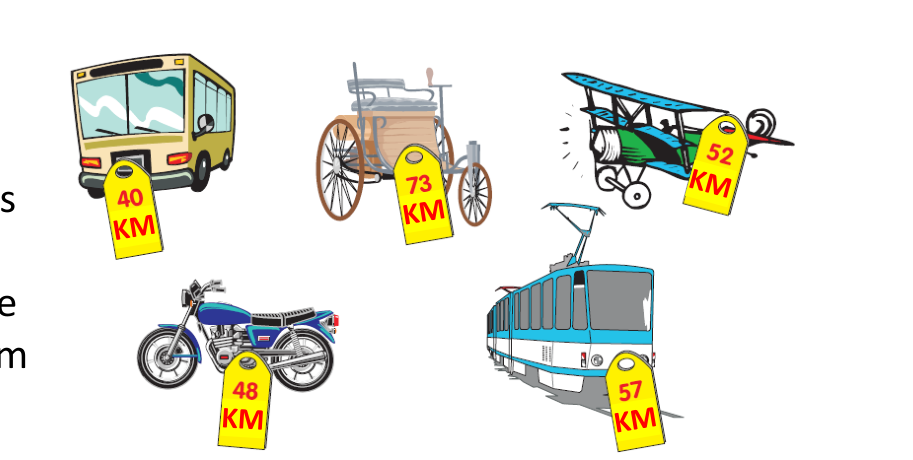
Heinzi the kangaroo has bought some toys. For them he gave 150 kangoo-coins (KC) and received 20 kangoo-coins back. Just before leaving the shop he changed his mind and exchanged one of the toys he had bought for another one. Because of this he received a further 5 kangoo-coins back from the shopkeeper. Which of the toys in the picture has Heinzi taken home with him? (The price of each toy is shown on its tag.)
Show answer
Answer: A — Carriage and Aeroplane
Show hints
Hint 1 of 3
Work out how many coins Heinzi really spent in the end, after all the change he got back.
Still stuck? Show hint 2 →
Hint 2 of 3
He handed over 150, then got 20 back, then 5 more back, so take both amounts away.
Still stuck? Show hint 3 →
Hint 3 of 3
Now look at the price tags and find the toys that add up to exactly that many coins.
Show solution
Approach: net spending, then match a price pair
He paid 150 and got 20 back, then 5 more back after the exchange: net 150 − 20 − 5 = 125.
The toys he kept must cost 125 together.
Carriage (73) + Aeroplane (52) = 125; no other pair fits.
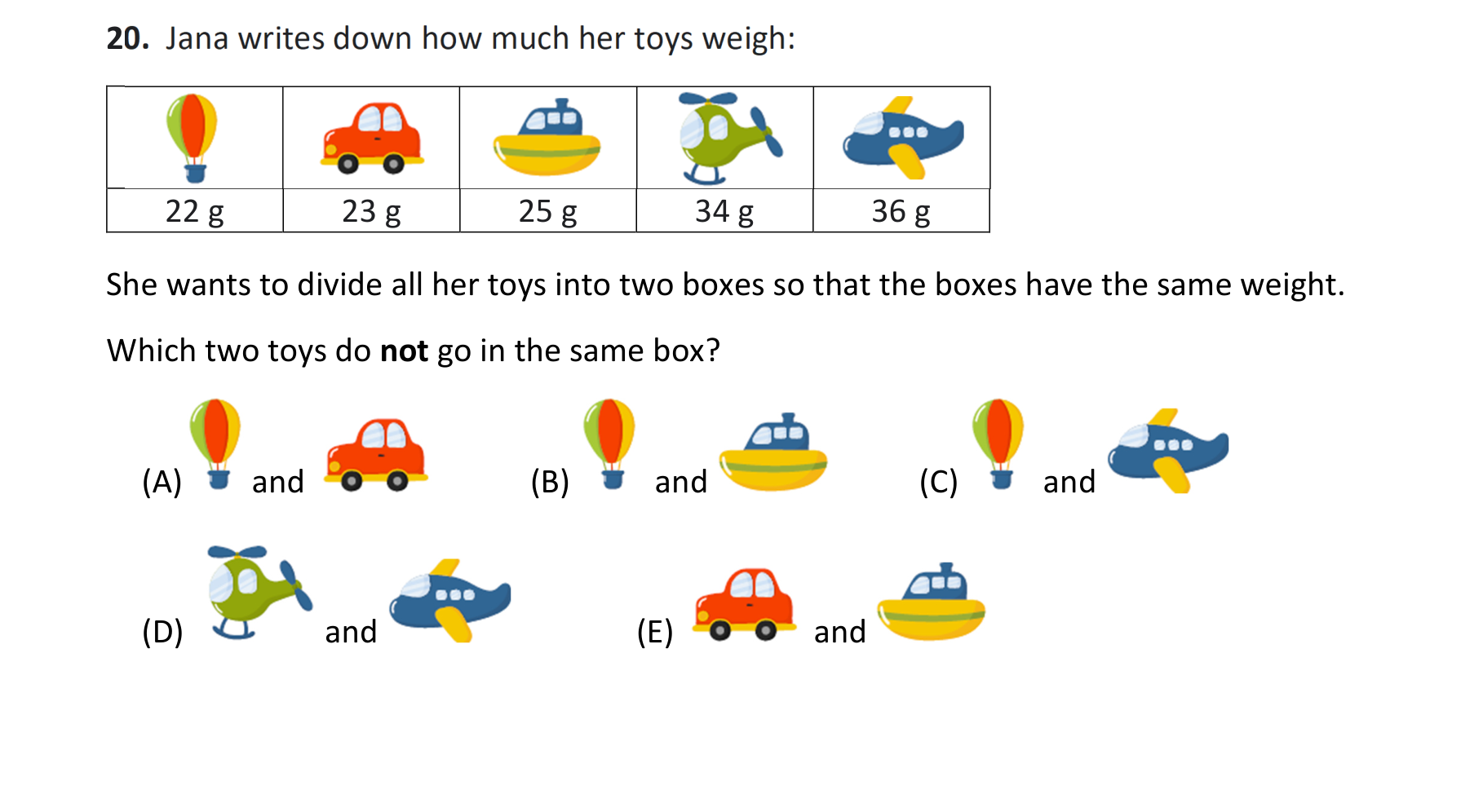
Chrissi wants to sell 10 glass marbles that each have a different weight. Their weights are 1, 2, 3, 4, 5, 6, 7, 8, 9 and 10 dag. They are to be packed into bags, two marbles at a time, so that each bag has the same weight. Which two marbles will be put into the same bag?
Show answer
Answer: C — 3 and 8
Show hints
Hint 1 of 3
Ten marbles two at a time make 5 bags, and all five bags weigh the same.
Still stuck? Show hint 2 →
Hint 2 of 3
Add all the weights 1 + 2 + ... + 10 = 55, then share that equally among 5 bags.
Still stuck? Show hint 3 →
Hint 3 of 3
Each bag must weigh 11, so find the marble that pairs with 3 to make 11.
Show solution
Approach: equal-sum pairing
The total weight is 1+2+···+10 = 55, and 5 bags means each weighs 11 dag.
Pairs making 11: (1,10), (2,9), (3,8), (4,7), (5,6).
The list 17, 13, 5, 10, 14, 9, 12, 16 gives the points scored in a test. Which two scores can be removed without changing the average value of the list?
Show answer
Answer: E — 14 and 10
Show hints
Hint 1 of 2
First find the current average of the list.
Still stuck? Show hint 2 →
Hint 2 of 2
Two numbers can be dropped without changing the mean exactly when their sum is twice the mean.
Show solution
Approach: removing two numbers keeps the mean only if their sum equals 2×mean
The eight scores total 96, so the average is 96/8 = 12.
To keep the average 12 after removing two of them, the removed pair must sum to 2×12 = 24.
Paul wanted to multiply a whole number by 301, but forgot to include the zero and multiplied by 31 instead. His answer was 372. What should his answer have been?
Show answer
Answer: B — 3612
Show hints
Hint 1 of 2
Use the wrong answer to recover the original whole number.
Still stuck? Show hint 2 →
Hint 2 of 2
Then multiply that number by 301 as he intended.
Show solution
Approach: undo the wrong multiplication, then redo it right
He multiplied by 31 and got 372, so the number is 372 ÷ 31 = 12.
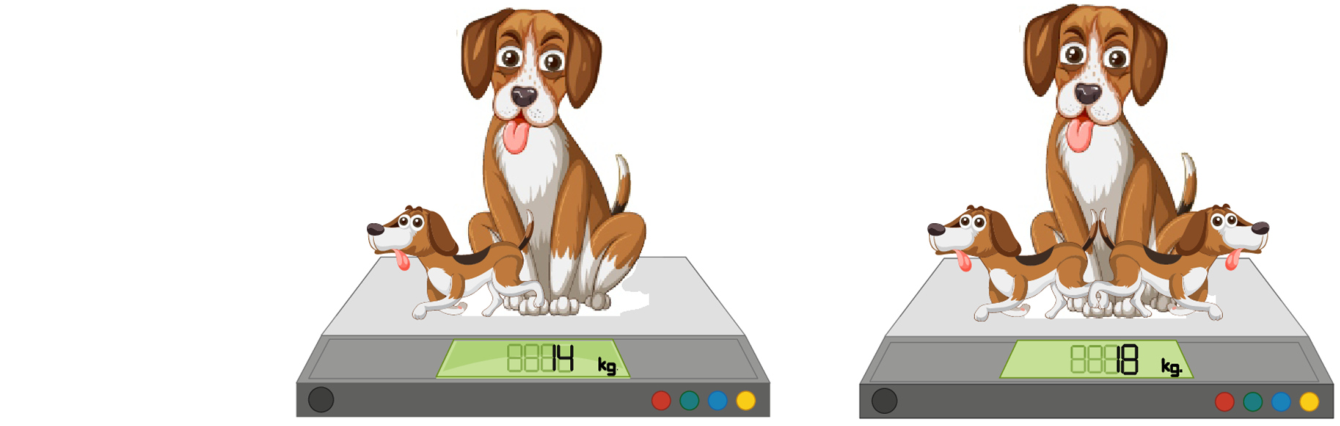
A dog has 2 puppies that both weigh the same. Picture 1 shows that the dog and one puppy together weigh 14 kilograms. Picture 2 shows that the dog and both puppies together weigh 18 kilograms. How many kilograms does the big dog weigh?
Show answer
Answer: B — 10
Show hints
Hint 1 of 3
The two pictures are the same except one has one more puppy.
Still stuck? Show hint 2 →
Hint 2 of 3
The extra weight from picture 1 to picture 2 is just one puppy.
Still stuck? Show hint 3 →
Hint 3 of 3
Once you know how heavy one puppy is, take it away from the 14 kg picture to find the dog.
Show solution
Approach: the extra puppy tells you one puppy's weight, then find the dog
Picture 1 is the dog and one puppy (14 kg). Picture 2 is the dog and both puppies (18 kg).
Going from 14 kg to 18 kg adds one more puppy, so one puppy weighs 4 kg.
Take that puppy away from picture 1: 14 take away 4 leaves 10 kg for the dog. The answer is B.
Jan puts 12 pieces of fruit on a table. Vera takes away 2 pears, 4 apples and half of the oranges. Now there are only oranges on the table. How many oranges are left?
Show answer
Answer: C — 3
Show hints
Hint 1 of 3
The 12 pieces are pears, apples and oranges all together.
Still stuck? Show hint 2 →
Hint 2 of 3
Take the pears and apples out of the 12 to see how many oranges there were.
Still stuck? Show hint 3 →
Hint 3 of 3
Vera kept only half the oranges, so split that number of oranges into two equal piles.
Show solution
Approach: find how many oranges there were, then keep half
The 2 pears and 4 apples make 6 pieces that are not oranges.
Take those 6 away from 12 and you are left with 6 oranges to start.
Vera took half the oranges away, so half of 6 stays: 3 oranges are left. The answer is C.
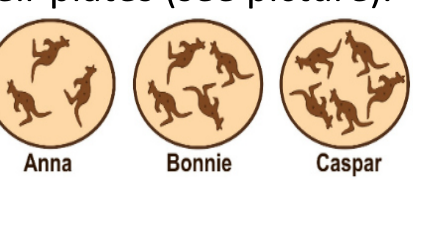
Anna, Bonnie and Caspar have some kangaroo cookies on their plates (see picture). There are 15 more cookies left over. They share these out so that each child ends up with the same number of cookies on their plate. How many cookies are added to Anna's plate?
Show answer
Answer: D — 6
Show hints
Hint 1 of 2
First find how many cookies there are altogether, then share them equally among the three children.
Still stuck? Show hint 2 →
Hint 2 of 2
Subtract the cookies Anna already has from her fair share.
Show solution
Approach: find the equal share, then see how many Anna still needs
The plates already hold 3 (Anna) + 4 (Bonnie) + 5 (Caspar) = 12 cookies.
With the 15 extra there are 12 + 15 = 27 cookies in all.
Shared equally, each child should have 27 ÷ 3 = 9 cookies.
In a 60 m hurdles race there are 5 hurdles. The first hurdle is 12 m after the start, and the distance between any two consecutive hurdles is 8 m. How far is the last hurdle from the finish line?
Show answer
Answer: E — 16 m
Show hints
Hint 1 of 2
Find the position of the last (5th) hurdle measured from the start.
Still stuck? Show hint 2 →
Hint 2 of 2
Then subtract that from the 60 m finish line.
Show solution
Approach: locate the last hurdle, then measure to the finish
Hurdle 1 is at 12 m and each later hurdle is 8 m further: 12, 20, 28, 36, 44.
The 5th hurdle is at 12 + 4×8 = 44 m.
Distance to the finish = \(60 - 44 = 16\) m, which is (E).
Sanja has two bowls of numbered balls. The left bowl holds seven balls numbered 1, 2, 6, 7, 10, 11 and 12, with arithmetic mean 7.0. The right bowl holds five balls numbered 3, 4, 5, 8 and 9, with arithmetic mean 5.8. Sanja wants to increase the arithmetic mean of both bowls. Which ball must she move from the left bowl to the right bowl to do this?
Show answer
Answer: A — 6
Show hints
Hint 1 of 2
Moving a ball must push BOTH averages up — think about what value keeps each average rising.
Still stuck? Show hint 2 →
Hint 2 of 2
The moved ball must be below the left average (so the left mean rises) yet above the right average (so the right mean rises).
Show solution
Approach: bound the ball value from both averages
Left sum is 7×7 = 49, right sum is 5.8×5 = 29.
To raise the left mean the removed ball must be below 7; to raise the right mean it must be above 5.8.
The only left-bowl ball between 5.8 and 7 is 6, which is (A).
Theo is on a treadmill and sees two stopwatches. The left one shows the time elapsed since he started his workout; the right one shows the time remaining until the end. At the moment shown the left reads 14:58 and the right reads 21:32. At some point both stopwatches will display the same time. What will they display then?
Show answer
Answer: D — 18:15
Show hints
Hint 1 of 2
One clock counts up and the other counts down at the same speed, so their sum stays constant.
Still stuck? Show hint 2 →
Hint 2 of 2
They show the same time exactly halfway through that constant total.
Show solution
Approach: the two readings always sum to the full workout time
Elapsed + remaining is constant: 14:58 + 21:32 = 36:30 (the whole workout).
They are equal at half of that total: \(36{:}30 \div 2 = 18{:}15\), which is (D).
Penguin Peter goes fishing every day and brings home 9 fish for his two children. Each day he gives 5 fish to the first child he sees, and the other child gets the remaining 4 fish. Over the last few days, one child has received 26 fish in total. How many fish did the other child get?
Show answer
Answer: D — 28
Show hints
Hint 1 of 3
Every single day the two children together get 5 + 4 = 9 fish.
Still stuck? Show hint 2 →
Hint 2 of 3
Each day a child gets either 5 or 4, so try how many days it takes one child to reach 26.
Still stuck? Show hint 3 →
Hint 3 of 3
Once you know the number of days, the other child's total is 9 per day minus 26.
Show solution
Approach: find the number of days, then take the rest of the daily 9s
Each day one child gets 5 fish and the other gets 4, so together they get 9 fish a day.
For one child to reach 26 (made of 5s and 4s), it takes 6 days: 5 + 5 + 4 + 4 + 4 + 4 = 26.
In all, the children got 9 × 6 = 54 fish over those 6 days.
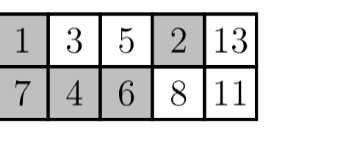
The sum of the numbers in the white fields should equal the sum of the numbers in the grey fields. Which two numbers have to be swapped so that the two sums become equal?
Show answer
Answer: A — 1 and 11
Show hints
Hint 1 of 2
Add up the grey numbers and the white numbers separately to see the gap between them.
Still stuck? Show hint 2 →
Hint 2 of 2
A swap moves one number out of each group; close exactly half the gap by picking the right pair.
Show solution
Approach: balance the two totals by closing half the gap
The grey fields total 1 + 2 + 7 + 4 + 6 = 20 and the white fields total 3 + 5 + 13 + 8 + 11 = 40, so the whole grid sums to 60 and each side should reach 30.
Swapping a grey number g for a white number w changes the grey total by (w − g); to go from 20 to 30 we need w − g = 10.
Swapping grey 1 with white 11 gives w − g = 10, making both sides 30.
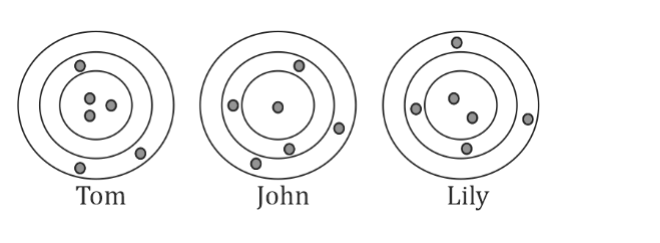
Tom, John and Lily have each shot 6 arrows at a disc with three sections (see diagram). The number of points for a hit depends on the section that has been hit. Tom has 46 points and John has 34 points. How many points did Lily get?
Show answer
Answer: D — 40
Show hints
Hint 1 of 2
Let the three ring values be the unknowns and read off how many arrows landed in each ring for Tom and John.
Still stuck? Show hint 2 →
Hint 2 of 2
Two equations fix enough about the ring values to total Lily's hits.
Show solution
Approach: set up the ring point-values from Tom and John, then total Lily
Let the outer, middle and inner rings be worth fixed point values; each player threw 6 arrows.
Tom's hits give 46 points and John's give 34 points, which pin down the ring values (each is consistent with 6 arrows).
Applying those values to Lily's six hits totals 40.
There are five gaps in the calculation shown. Adriana wants to write a “+” in four of the gaps and a “−” in one of them so that the equation is correct. Where must the “−” go?
Show answer
Answer: D — between 15 and 18
Show hints
Hint 1 of 2
If all gaps were plus signs, what would the total be, and how does one minus change it?
Still stuck? Show hint 2 →
Hint 2 of 2
Changing a + to a - in front of a value drops the sum by twice that value; find which drop hits 45.
Show solution
Approach: compare the all-plus total to 45
With all plus signs, 6+9+12+15+18+21 = 81.
Turning the sign before a number n into minus lowers the total by 2n; we need to lose 81-45 = 36, so 2n = 36 and n = 18.
The minus goes before 18, i.e. between 15 and 18, so the answer is D.
Julie and Angela played “kangball”, a ball game. Each goal in their game scores 2 points. Julie scored 5 goals and Angela scored 9 goals. How many more points than Julie did Angela score?
Show answer
Answer: C — 8
Show hints
Hint 1 of 3
First find how many MORE goals Angela scored than Julie.
Still stuck? Show hint 2 →
Hint 2 of 3
Each goal is worth 2 points, not 1.
Still stuck? Show hint 3 →
Hint 3 of 3
Turn just the extra goals into points.
Show solution
Approach: find the extra goals, then turn them into points
Angela scored 9 − 5 = 4 more goals than Julie.
Each goal is 2 points, so 4 goals is 4 × 2 = 8 points.
A rectangular chocolate bar is made of equal squares. Neil breaks off two complete strips of squares and eats the 12 squares he obtains. Later, Jack breaks off one complete strip of squares from the same bar and eats the 9 squares he obtains. How many squares of chocolate are left in the bar?
Show answer
Answer: D — 45
Show hints
Hint 1 of 2
Neil's two equal strips total 12, so a strip in that direction holds 6 — that fixes one side of the bar.
Still stuck? Show hint 2 →
Hint 2 of 2
Jack's strip runs the other way; remember Neil already removed two rows before Jack broke his strip.
Show solution
Approach: recover the bar's dimensions from the strip sizes
Neil's two equal strips give 12 squares, so each strip holds 6: one side of the bar is 6.
Jack's strip runs the other way and holds 9, but Neil had already removed 2 squares from that direction, so the full bar was 6 by (9+2) = 11, i.e. 66 squares.
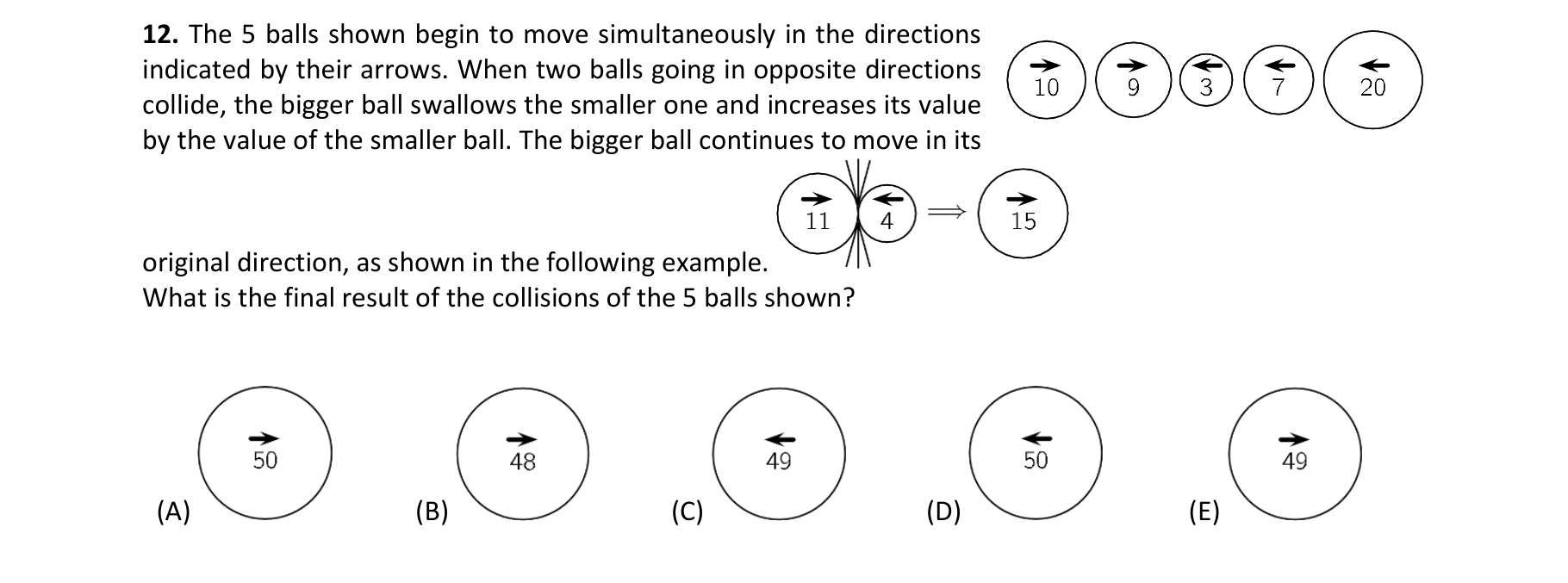
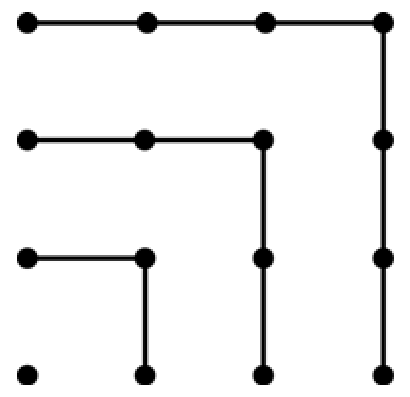
The 5 balls shown begin to move at the same time in the directions of their arrows. When two balls going in opposite directions collide, the bigger ball swallows the smaller one and grows by the smaller ball's value, then keeps moving in its own direction (see the worked example). What is the final result of the collisions of the 5 balls?
Show answer
Answer: C
Show hints
Hint 1 of 2
When two balls bump head-on, the bigger one eats the smaller one and grows by its number, still going the same way.
Still stuck? Show hint 2 →
Hint 2 of 2
No ball ever disappears, so the final ball's number is just every ball's number added together — you only need its direction too.
Show solution
Approach: all the balls merge into one, so add the values and find the direction
Nothing is ever lost in a collision, so the one ball left at the end is worth 10 + 9 + 3 + 7 + 20 = 49.
Following the bumps shows the big left-going 20 keeps winning the head-on hits, so the surviving ball moves left.
Matching '49 moving left' to the pictures gives option C.
In an ice cream shop there is some money in a drawer. After 6 ice creams were sold, there were 70 euros left in the drawer. After a total of 16 ice creams were sold, there were 120 euros left in the drawer. How many euros were there in the drawer at the start?
Show answer
Answer: C — 40
Show hints
Hint 1 of 2
Between the two moments, 10 more ice creams were sold and the drawer grew by 50 euros.
Still stuck? Show hint 2 →
Hint 2 of 2
Find the price of one ice cream, then step back to before any were sold.
Show solution
Approach: find the price per ice cream, then work back to the start
From 6 to 16 sold is 10 more ice creams, and the money rose from 70 to 120, i.e. +50 euros.
So each ice cream costs 50 / 10 = 5 euros.
The first 6 brought in 6 x 5 = 30 euros, so the start amount was 70 - 30 = 40 euros.
Costa is building a new fence in his garden. He uses 25 planks of wood, each of which are 30 cm long. He arranges these planks so that there is the same slight overlap between any two adjacent planks. The total length of Costa's new fence is 6.9 metres. What is the length, in centimetres, of the overlap between any pair of adjacent planks?
Show answer
Answer: B — 2.5
Show hints
Hint 1 of 2
With 25 planks there are 24 overlaps, all equal.
Still stuck? Show hint 2 →
Hint 2 of 2
Compare the total plank length to the actual fence length to find the overlap total.
Show solution
Approach: account for total length lost to overlaps
Laid end to end the 25 planks would span 25·30 = 750 cm.
The fence is only 690 cm, so 750 − 690 = 60 cm is lost to overlapping.
There are 24 equal overlaps, so each is 60 ÷ 24 = 2.5 cm.
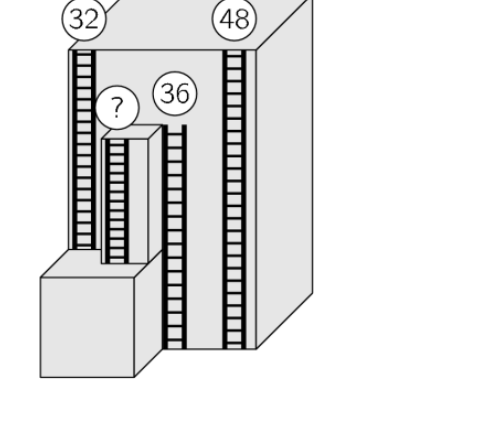
On a tall building there are 4 fire escape ladders, as shown. The heights of 3 of the ladders are marked at their tops (32, 48 and 36). What is the height of the shortest ladder?
Show answer
Answer: D — 20
Show hints
Hint 1 of 2
Each ladder stands on a ledge, and a taller ledge means a taller ladder top — the ledges step up by equal amounts.
Still stuck? Show hint 2 →
Hint 2 of 2
Find the step between two ladders whose tops you know, then step the same amount down to the shortest ladder.
Show solution
Approach: find the equal step between ladder tops and step down to the shortest
The ladders sit on ledges that rise by the same step each time, so their tops rise by that same step too.
Two of the marked tops are 48 and 36, a step of 48 - 36 = 12.
Stepping down 12 from the 32 ladder gives the shortest ladder: 32 - 12 = 20.
There are 20 questions in a quiz. Each correct answer scores 7 points, each wrong answer scores −4 points, and each question left blank scores 0 points. Eric took the quiz and scored 100 points. How many questions did he leave blank?
Show answer
Answer: B — 1
Show hints
Hint 1 of 2
Let the numbers of correct, wrong and blank answers add to 20, with score 7c − 4w = 100.
Still stuck? Show hint 2 →
Hint 2 of 2
Search for whole-number solutions and read off the blanks.
Show solution
Approach: solve the score equation in whole numbers
With c correct and w wrong: 7c − 4w = 100 and c + w ≤ 20.
c = 16, w = 3 gives 112 − 12 = 100, and that is the only fit.
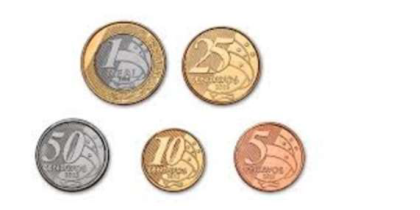
Bia has the five coins shown. She goes to the grocery store to buy one fruit, paying with exactly three of the coins and receiving no change. Among the fruit prices below, which one can she NOT pay for?
Show answer
Answer: C — 1.40
Show hints
Hint 1 of 2
The coins are 1.00, 0.50, 0.25, 0.10 and 0.05; she uses exactly three of them with no change.
Still stuck? Show hint 2 →
Hint 2 of 2
Check each price: one of the listed totals simply has no three-coin combination.
Show solution
Approach: test each price against all three-coin sums
The five coins are R$1.00, 0.50, 0.25, 0.10 and 0.05.
Arithmetic & OperationsLogic & Word Problemswork-backward
As soon as he left his city heading toward Caecá, Charles saw the sign on the left. When he came back from Caecá, he saw the sign on the right. At that point, how far was it to reach his city?
Show answer
Answer: D — 41 km
Show hints
Hint 1 of 2
The left sign (just outside his city) reads Arati 12 km, Baibá 33 km; the right sign reads Baibá 8 km, Arati 29 km.
Still stuck? Show hint 2 →
Hint 2 of 2
First use either sign to find the fixed gap between Arati and Baibá, then notice his city sits 12 km past Arati.
Show solution
Approach: use the fixed town distances on the two signs
He saw the left sign just as he left his city, so his city is 12 km before Arati (and Baibá is 33 km out).
On the way back the right sign reads Arati 29 km ahead; his city is another 12 km beyond Arati.
So the distance left to his city is 29 + 12 = 41 km.
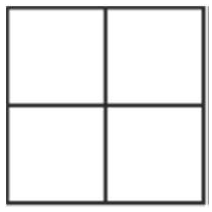
The numbers 1, 2, 3 and 4 are placed in different cells of the 2×2 table shown. Then the sum of the numbers in each row and in each column is found. Two of these sums are 4 and 5. What are the two remaining sums?
Show answer
Answer: E — 5 and 6
Show hints
Hint 1 of 2
The four entries 1,2,3,4 add to 10, so the two row sums add to 10 and the two column sums add to 10.
Still stuck? Show hint 2 →
Hint 2 of 2
If one given sum is a row and the other a column, find each partner from the total 10.
Show solution
Approach: use that all four numbers total 10
The numbers 1+2+3+4 = 10.
The two row sums add to 10; the two column sums also add to 10.
Given sums 4 and 5: the partner of a 4-sum is 6, and the partner of a 5-sum is 5.
So the two remaining sums are 5 and 6 — answer (E).
Sara has 16 blue marbles. She can swap her marbles in the following way: for 3 blue marbles she gets 1 red marble, and for 2 red marbles she gets 5 green marbles. What is the maximum number of green marbles she can get?
Show answer
Answer: B — 10
Show hints
Hint 1 of 2
First turn as many blue marbles as possible into red ones, then trade reds for greens.
Still stuck? Show hint 2 →
Hint 2 of 2
Watch the leftovers: trades only happen in fixed bundles (3 blue, 2 red).
Show solution
Approach: trade in bundles and track leftovers
16 blue ÷ 3 gives 5 red marbles (1 blue left over).
5 red ÷ 2 gives 2 trades = 10 green marbles (1 red left over).
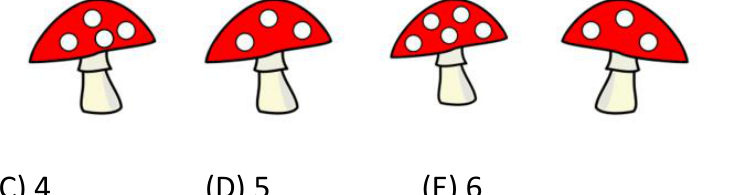
The number of spots on each fly agaric (toadstool) shows how many dwarfs fit under it. We can see one side of each toadstool; the other side has the same number of spots. When it rains, 36 dwarfs try to hide under the toadstools. How many dwarfs get wet?
Show answer
Answer: E — 6
Show hints
Hint 1 of 3
The back of each mushroom has the same spots as the front, so each mushroom really has double what you see.
Still stuck? Show hint 2 →
Hint 2 of 3
Work out how many dwarfs fit under all the mushrooms together.
Still stuck? Show hint 3 →
Hint 3 of 3
If there are more dwarfs than spaces, the leftover dwarfs are the ones who get wet.
Show solution
Approach: double the spots you can see, total them, then find the leftover dwarfs
The spots you can see are 4, 3, 5 and 3, which is 15 spots on the fronts. Each mushroom's back matches its front, so double it: there are really 30 spots in all.
So 30 dwarfs can hide under the mushrooms.
But 36 dwarfs come to hide, and 36 − 30 = 6 dwarfs have no space, so 6 get wet.
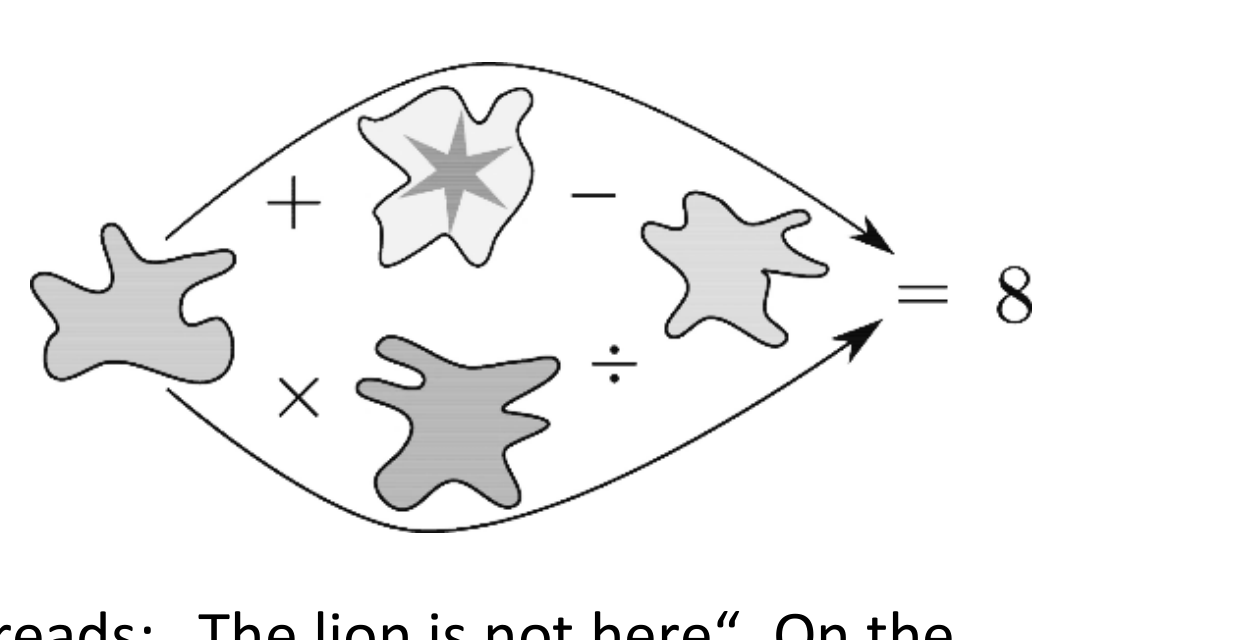
The four smudges hide four of the numbers 1, 2, 3, 4, 5. The calculations along the two arrows are both correct. Which number is hidden behind the smudge with the star?
Show answer
Answer: E — 5
Show hints
Hint 1 of 2
Each smudge hides one of 1, 2, 3, 4, 5; test which assignment makes both arrow-chains land on 8.
Still stuck? Show hint 2 →
Hint 2 of 2
Work the multiply/divide arrow first, since those choices are tight, then check the add/subtract arrow.
Show solution
Approach: try the few possibilities so both chains give 8
The four smudges hide four of the numbers 1, 2, 3, 4, 5, and each arrow's calculation must equal 8.
Only one way to place the numbers makes both the + / - path and the x / div path come out to 8.
A rectangle is split into 40 equally big squares. The rectangle has more than one row of squares. Andreas colours in all the squares of the middle row. How many squares did he not colour in?
Show answer
Answer: C — 32
Show hints
Hint 1 of 2
There must be a single middle row, so the number of rows is odd.
Still stuck? Show hint 2 →
Hint 2 of 2
Find odd factors of 40 to get the rows, then the columns give the size of the middle row.
Show solution
Approach: factor 40 into odd rows times columns
A single middle row needs an odd number of rows; the only odd factor of 40 (with more than one row) is 5, so the grid is 5 rows by 8 columns.
The middle row has 8 squares, so the uncoloured squares number 40 − 8 = 32.
Philipp wants to know how much his book weighs, correct to half a gram. However, his scale only shows weights correct to 10 g, so he weighs several identical books all together. What is the minimum number of identical books he has to put on the scale to reach his aim?
Show answer
Answer: D — 20
Show hints
Hint 1 of 3
Reading to the nearest 10 g means the true total is off by at most 5 g.
Still stuck? Show hint 2 →
Hint 2 of 3
To know one book to the nearest half-gram, the per-book error must be small enough to round correctly — under a quarter of a gram.
Still stuck? Show hint 3 →
Hint 3 of 3
Share that 5 g total error among n books and make 5/n small enough.
Show solution
Approach: bound the per-book error so it rounds to the nearest half-gram
A reading correct to 10 g can be off by up to 5 g from the true total.
Dividing by n books, one book's value is off by up to 5/n g; to pin it to the nearest half-gram the error must stay below 0.25 g, so 5/n ≤ 0.25.
Jakob writes one of the natural numbers 1 to 9 into each cell of a 3×3 table. Then he works out the sum of the numbers in each row and in each column. Five of his results are 12, 13, 15, 16 and 17. What is the sixth sum?
Show answer
Answer: A — 17
Show hints
Hint 1 of 2
Add up all nine numbers 1 to 9.
Still stuck? Show hint 2 →
Hint 2 of 2
The three row sums total that, and so do the three column sums; use the grand total of all six sums.
Show solution
Approach: use that rows and columns each total 45
The numbers 1 to 9 add to 45, so the three row sums total 45 and the three column sums total 45 — all six sums total 90.
Angelika crafts a piece of jewellery out of two grey and two white stars. The stars have areas of 1 cm², 4 cm², 9 cm² and 16 cm² respectively. She places the stars on top of each other as shown in the diagram and glues them together. How big is the total area of the visible grey parts?
Show answer
Answer: B — 10 cm²
Show hints
Hint 1 of 2
The stars are stacked biggest at the back, smallest in front.
Still stuck? Show hint 2 →
Hint 2 of 2
A grey star only shows the ring left after the next (smaller) star covers its middle.
Show solution
Approach: subtract each covering star from the grey star beneath it
Stacked back to front the areas are 16, 9, 4, 1; colours alternate grey, white, grey, white.
The grey 16-star shows everything except where the white 9-star sits: 16 − 9 = 7.
The grey 4-star shows everything except the white 1-star on top: 4 − 1 = 3.
Maria has 24 Euros. Each of her 3 sisters has 12 Euros. How much does she have to give to each sister so that all four of them have the same amount of Euros?
Show answer
Answer: C — 3
Show hints
Hint 1 of 2
First find what amount everyone should end up with.
Still stuck? Show hint 2 →
Hint 2 of 2
Maria's gift is split equally among the three sisters.
Show solution
Approach: equalise the total, then see how much each sister needs
Total money = 24 + 3 × 12 = 60 Euros, so each of the four should have 60 ÷ 4 = 15.
Maria must drop from 24 to 15, giving away 9 Euros in all.
Shared equally among 3 sisters, that is 9 ÷ 3 = 3 each, choice C.
Logic & Word ProblemsArithmetic & Operationsoff-by-one
Some girls are standing in a circle. The teacher makes them do a headcount. Bianca says one, her neighbour says two and so on. If they count in a clockwise direction, Antonia says six. If they count in an anticlockwise direction, Antonia says nine. How many girls are forming the circle?
Show answer
Answer: C — 13
Show hints
Hint 1 of 2
Count the gap from Bianca to Antonia each way around the circle.
Still stuck? Show hint 2 →
Hint 2 of 2
Going clockwise and anticlockwise covers the whole circle once.
Show solution
Approach: add the two arc-gaps to get the total around the circle
Clockwise, Antonia is number 6, so she is 5 girls along from Bianca.
Anticlockwise she is number 9, so she is 8 girls along the other way.
The two arcs together go right round the circle: 5 + 8 = 13 girls, choice C.
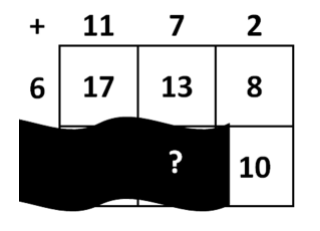
Every box shows the result of the addition of the numbers on the very left and on the very top (for example: 6 + 2 = 8). Which number is written behind the question mark?
Show answer
Answer: E — 15
Show hints
Hint 1 of 2
Every box is its left number added to its top number; find a box where you already know both to fill in a missing edge number.
Still stuck? Show hint 2 →
Hint 2 of 2
The box showing 10 sits under the top number 2, so its left number must make 10.
Show solution
Approach: use a known box to find the missing left number, then add
Each box is the number at the left of its row plus the number at the top of its column.
The box showing 10 is under the top number 2, so its left number is 8 (because 8 + 2 = 10).
The question-mark box is in that same row, under the top number 7.
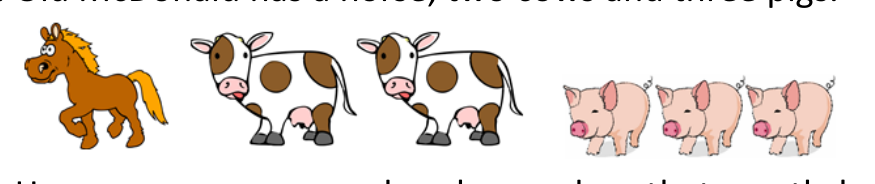
Grandma stands in the courtyard calling her cat and all her chickens. After a little while, 20 legs come running towards her. How many chickens does Grandma have?
Show answer
Answer: C — 8
Show hints
Hint 1 of 2
The cat has 4 legs; every chicken has 2.
Still stuck? Show hint 2 →
Hint 2 of 2
Take away the cat's legs first, then split the rest into pairs.
Show solution
Approach: remove the cat's legs, then divide by two
The cat accounts for 4 of the 20 legs, leaving 20 − 4 = 16 chicken legs.
Each chicken has 2 legs, so there are 16 ÷ 2 = 8 chickens.
A house has 12 rooms. Each room has two windows and one light. Only when the light is on in a room are both of its windows lit. Yesterday evening, 18 windows were lit. In how many of the rooms was the light off?
Show answer
Answer: B — 3
Show hints
Hint 1 of 2
A room shows light in both its windows only when its light is on.
Still stuck? Show hint 2 →
Hint 2 of 2
Find how many rooms were lit, then compare with the 12 rooms total.
Show solution
Approach: windows come in pairs per lit room
Each lit room shows 2 illuminated windows, so 18 windows means 18 ÷ 2 = 9 rooms were lit.
There are 12 rooms in all, so 12 − 9 = 3 rooms had the light off.
11 flags are placed alongside a straight race course. The first flag is at the start, the last one at the finish. The distance between two flags is always 8 meters. How long is the race course?
Show answer
Answer: D — 80 meters
Show hints
Hint 1 of 2
The flags are like fence posts: 11 flags do not make 11 gaps.
Still stuck? Show hint 2 →
Hint 2 of 2
Count the gaps between the flags, then multiply by 8 meters.
Show solution
Approach: count the gaps (one fewer than the flags)
With 11 flags in a row there are 11 - 1 = 10 gaps between them.
Each gap is 8 meters, so the course is 10 x 8 = 80 meters.
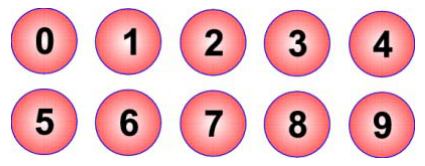
There are 10 balls, numbered 0 to 9 in a basket. John and George play a game. Each person is allowed to take three balls from the basket and calculate the total of the numbers on the balls. What is the biggest possible difference between the John and George's totals?
Show answer
Answer: E — 21
Show hints
Hint 1 of 2
To make the gap as large as possible, one player grabs the biggest numbers and the other the smallest.
Still stuck? Show hint 2 →
Hint 2 of 2
They draw from the same basket, so the two sets of three balls cannot overlap.
Show solution
Approach: maximise one total and minimise the other
One player can take the three largest balls: 9 + 8 + 7 = 24.
The other is then left to take the three smallest: 0 + 1 + 2 = 3.
The little witch takes part in a broomstick flying competition of 5 rounds. The times at which she crossed the starting line are shown in the table. Which round was her fastest?
Time
Start
09:55
after round 1
10:26
after round 2
10:54
after round 3
11:28
after round 4
12:03
after round 5
12:32
Show answer
Answer: B — the second
Show hints
Hint 1 of 2
A round's time is the gap between two crossing times, not the clock time itself.
Still stuck? Show hint 2 →
Hint 2 of 2
Subtract each crossing time from the previous one and look for the smallest gap.
Show solution
Approach: find each round's length as a time gap and pick the smallest
Round 1 lasted 09:55 to 10:26 = 31 min; Round 2: 10:26 to 10:54 = 28 min; Round 3: 10:54 to 11:28 = 34 min; Round 4: 11:28 to 12:03 = 35 min; Round 5: 12:03 to 12:32 = 29 min.
The shortest gap is 28 minutes.
That is Round 2, so the fastest round was the second.
Leo writes numbers in the multiplication pyramid. In a multiplication pyramid, you multiply two numbers that are next to each other to get the number directly above them (in the middle). Which number must Leo write in the grey field?
Show answer
Answer: E — 8
Show hints
Hint 1 of 3
Each block is found by multiplying the two blocks right under it.
Still stuck? Show hint 2 →
Hint 2 of 3
Start at the bottom row, which you know, and build one row up at a time.
Still stuck? Show hint 3 →
Hint 3 of 3
Keep multiplying neighbouring blocks until you reach the grey one.
Show solution
Approach: build the pyramid upward, multiplying each pair of neighbours
Start with the bottom row 1, 2, 2, 1.
Multiply each neighbouring pair to get the next row up: 1×2 = 2, 2×2 = 4, 2×1 = 2, so that row is 2, 4, 2.
Multiply neighbours again: 2×4 = 8 and 4×2 = 8, so the grey block is 8.
Hubert the rabbit loves cabbages and carrots. In one day he eats either 9 carrots, or 2 cabbages, or one cabbage and 4 carrots. In one week Hubert ate 30 carrots. How many cabbages did he eat during this week?
Show answer
Answer: B — 7
Show hints
Hint 1 of 3
There are 7 days in a week, so Hubert eats one of his three menus on each of the 7 days.
Still stuck? Show hint 2 →
Hint 2 of 3
Only two of the menus give carrots: the 9-carrot day and the 1-cabbage-and-4-carrots day.
Still stuck? Show hint 3 →
Hint 3 of 3
Try a few of each carrot-day until the carrots add up to 30, then count cabbages on every day.
Show solution
Approach: find which days give the 30 carrots, then count cabbages
Only two kinds of day give carrots: a 9-carrot day, or a day of 1 cabbage and 4 carrots.
Two 9-carrot days give 18 carrots, and three of the ‘1 cabbage + 4 carrots’ days give 12 more — that is 18 + 12 = 30 carrots, using 5 days.
Those three mixed days give 3 cabbages, and the 2 days left over are 2-cabbage days, giving 2 × 2 = 4 more.
Vera’s mum has made sandwiches, each using two slices of bread. There are 24 slices in a pack. How many sandwiches can she make with two whole packs and one half pack of bread?
Show answer
Answer: D — 30
Show hints
Hint 1 of 3
First work out the total number of bread slices Vera's mum has.
Still stuck? Show hint 2 →
Hint 2 of 3
A half pack has half of 24 slices, which is 12 slices.
Still stuck? Show hint 3 →
Hint 3 of 3
Each sandwich eats 2 slices, so split the total into pairs to count the sandwiches.
Show solution
Approach: count slices, then divide by 2
Two whole packs and one half pack give 24 + 24 + 12 = 60 slices.
Each sandwich uses 2 slices, so 60 ÷ 2 = 30 sandwiches.
Pinocchio’s nose is 9 cm long. Each time he lies, his nose grows by 6 cm. Each time he tells the truth, it shrinks by 2 cm. He tells three lies and twice tells the truth. How long is Pinocchio’s nose now?
Show answer
Answer: D — 23 cm
Show hints
Hint 1 of 3
Each lie adds 6 cm to the nose; each truth takes 2 cm away.
Still stuck? Show hint 2 →
Hint 2 of 3
There are three lies and two truths, so work out the total growing and the total shrinking.
Still stuck? Show hint 3 →
Hint 3 of 3
Start at 9 cm, add all the growing, then take away all the shrinking.
Show solution
Approach: add the lies, subtract the truths
Three lies add 3 × 6 = 18 cm; two truths take off 2 × 2 = 4 cm.
At the London 2012 Olympic Games the USA won the most medals: 46 gold, 29 silver and 29 bronze. China was second with 38 gold, 27 silver and 23 bronze. How many more medals did the USA win than China?
Show answer
Answer: C — 16
Show hints
Hint 1 of 3
Add up all of the USA's medals, then add up all of China's medals.
Still stuck? Show hint 2 →
Hint 2 of 3
The lighter way is to compare gold to gold, silver to silver, and bronze to bronze.
Still stuck? Show hint 3 →
Hint 3 of 3
Find each of those three differences and add the three differences together.
Show solution
Approach: compare each colour separately so the numbers stay small
Gold: the USA had 46 and China had 38, that is 8 more gold.
Silver: 29 against 27 is 2 more, and bronze: 29 against 23 is 6 more.
Adding the three extras, 8 + 2 + 6 = 16 more medals, which is answer C.
The last row in an aeroplane is row 25. There is no row 13, and row 15 has only 4 seats. Every other row has 6 seats. How many passenger seats are there on this aeroplane?
Show answer
Answer: C — 142
Show hints
Hint 1 of 2
First count how many rows actually exist (watch out for the missing row 13).
Still stuck? Show hint 2 →
Hint 2 of 2
Most rows have 6 seats; only row 15 is different, so adjust for it.
Show solution
Approach: count rows, then adjust the odd one out
Rows are numbered 1 to 25 but row 13 is missing, so there are 24 rows.
If every row had 6 seats that would be 24 x 6 = 144.
Row 15 has only 4 instead of 6, which is 2 fewer, so 144 - 2 = 142 seats.
In four of the following calculations you can swap the number 8 with another positive number without changing the answer to the sum. For which calculation does it not work?
Show answer
Answer: D — \(8 - (8 \div 8) + 8\)
Show hints
Hint 1 of 2
Try replacing every 8 by the same other number and see if the value changes.
Still stuck? Show hint 2 →
Hint 2 of 2
Four expressions simplify so the number cancels out; one does not.
Show solution
Approach: replace 8 by a variable and see which value depends on it
Replace each 8 by the same number x and simplify each expression.
(8+8−8)÷8 becomes x÷x = 1; 8+(8÷8)−8 becomes 1; 8÷(8+8+8) becomes 1/3; 8×(8÷8)÷8 becomes 1 — all independent of x.
But 8−(8÷8)+8 becomes 2x−1, which changes when x changes.
15 tables were set for a party. 5 plates were laid on 6 of the tables. 3 plates were laid on the rest of the tables. How many plates were needed in total?
Show answer
Answer: C — 57
Show hints
Hint 1 of 2
Find how many tables get 3 plates after 6 tables get 5 plates.
Still stuck? Show hint 2 →
Hint 2 of 2
Work out each group's plates and add them.
Show solution
Approach: split into two groups of tables
6 tables get 5 plates each: 6 x 5 = 30 plates.
The other 15 - 6 = 9 tables get 3 plates each: 9 x 3 = 27 plates.
A zebra crossing has alternating white and black stripes, each 50 cm wide. The first stripe is white and the last one is white. The zebra crossing in front of our school has 8 white stripes. How wide is the road?
Show answer
Answer: B — 7.5 m
Show hints
Hint 1 of 2
With the first and last stripe both white, the black stripes sit in the gaps between whites.
Still stuck? Show hint 2 →
Hint 2 of 2
Count how many stripes there are in total, then multiply by 50 cm.
Show solution
Approach: count stripes from the white count
With 8 white stripes and a black stripe in each gap between them, there are 7 black stripes.
Given are the expressions \(S_1 = 2\times3 + 3\times4 + 4\times5\), \(S_2 = 2^2 + 3^2 + 4^2\), and \(S_3 = 1\times2 + 2\times3 + 3\times4\). Which one of the following statements is true?
When Liza the cat is very lazy and sits around the whole day, she drinks 60 ml of milk. When she chases mice she drinks a third more milk. In the past two weeks, she has chased mice on every second day. How much milk has she drunk in the past two weeks?
Show answer
Answer: B — 980 ml
Show hints
Hint 1 of 2
First find how much she drinks on a chasing day (a third more than 60 ml).
Still stuck? Show hint 2 →
Hint 2 of 2
Over 14 days she chases on 7 days and is lazy on the other 7.
Show solution
Approach: combine the two kinds of days
A lazy day is 60 ml; a chasing day is a third more: 60 + 20 = 80 ml.
In two weeks (14 days) she chases on 7 days and is lazy on 7 days.
During a party, two identical cakes were each cut into four identical pieces. Each of these pieces was then cut into three identical pieces. Each person at the party got a piece of cake, and there were three pieces left over. How many people were at the party?
Show answer
Answer: B — 21
Show hints
Hint 1 of 2
Work out how many small pieces the two cakes are cut into altogether.
Still stuck? Show hint 2 →
Hint 2 of 2
Each person ate one piece, and three pieces were left.
Show solution
Approach: count pieces, then subtract leftovers
Two cakes × 4 = 8 quarters, and each quarter × 3 = 24 small pieces in all.
Three pieces were left over, so the number of people = 24 − 3 = 21, answer B.
Matthias and Klara live in a tower block. Klara lives 12 floors above Matthias. One day Matthias climbs the stairs to visit Klara. When he is halfway there he is on the 8th floor. On which floor does Klara live?
Show answer
Answer: B — 14th
Show hints
Hint 1 of 2
Halfway up the climb, Matthias has gone up half of the 12 floors.
Still stuck? Show hint 2 →
Hint 2 of 2
Find Matthias's floor first, then add 12 for Klara.
Show solution
Approach: use the halfway floor to find the start
Half of the 12-floor climb is 6 floors, and that point is the 8th floor.
A ferry boat can carry, in one trip, either 10 cars or 6 lorries. Yesterday the boat crossed the river 5 times. It was always full and carried 42 vehicles in all. How many of these were cars?
Show answer
Answer: E — 30
Show hints
Hint 1 of 2
Each of the 5 full trips carries either 10 cars or 6 lorries.
Still stuck? Show hint 2 →
Hint 2 of 2
Start by pretending every trip was lorries, then see how far short of 42 you are.
Show solution
Approach: start from all-lorry trips and swap until the total is right
If all 5 trips were lorry trips, that would be 6 + 6 + 6 + 6 + 6 = 30 vehicles, which is 12 short of 42.
Changing one lorry trip (6) into a car trip (10) adds 4 vehicles, and 12 needs three such changes.
So 3 trips were car trips: 10 + 10 + 10 = 30 cars, choice E.
Hans started a chain e-mail. He sent an e-mail to his friend Peter, who sent it on to 2 more people. Each person who gets the e-mail sends it on to 2 more people. After 3 rounds, 1 + 2 + 4 = 7 people have received the e-mail. How many people have received the e-mail after 5 rounds?
Show answer
Answer: C — 31
Show hints
Hint 1 of 2
Each round doubles the number of new people: 1, 2, 4, then 8, 16.
Still stuck? Show hint 2 →
Hint 2 of 2
Add up the new people from all five rounds.
Show solution
Approach: sum the doubling rounds
Each round the number of new people doubles: 1, 2, 4, then 8, then 16.
Today is Sunday. Francis starts reading a 290-page book today. On Sundays he reads 25 pages, and on every other day he reads 4 pages, with no exception. How many days does it take him to read the whole book?
Show answer
Answer: E — 41
Show hints
Hint 1 of 2
Group the week: one Sunday plus six ordinary days makes a fixed weekly total.
Still stuck? Show hint 2 →
Hint 2 of 2
Each full week reads 25 + 6×4 = 49 pages; see how many weeks fit into 290.
Show solution
Approach: weekly chunks then finish
A week reads 25 (Sunday) + 6 × 4 = 49 pages.
After 5 weeks (35 days) he has read 5 × 49 = 245 pages, leaving 45.
Day 36 is a Sunday (25 pages), reaching 270 with 20 left; then 5 days of 4 pages finish it.
Jana writes down how much her toys weigh: 22 g, 23 g, 25 g, 34 g and 36 g. She wants to share all her toys into two boxes so that both boxes weigh the same. Which two toys do not go in the same box?
Show answer
Answer: C
Show hints
Hint 1 of 2
Add all five weights and split into two equal boxes.
Still stuck? Show hint 2 →
Hint 2 of 2
Find which toys sum to half the total; the two that land in different boxes are your answer.
Show solution
Approach: split the weights into two equal halves
The weights 22, 23, 25, 34, 36 add to 140 g, so each box holds 70 g.
One box is 22 + 23 + 25 = 70 (balloon, car, boat); the other is 34 + 36 = 70 (helicopter, plane).
So the balloon and the plane end up in different boxes.
Adam has 9 marbles and Brenda also has 9 marbles. Together they have 8 white and 10 black marbles. Brenda has twice as many black marbles as white marbles. How many black marbles does Adam have?
Show answer
Answer: B — 4
Show hints
Hint 1 of 2
Brenda has 9 marbles, and her black pile is twice as big as her white pile.
Still stuck? Show hint 2 →
Hint 2 of 2
Once you know how many black marbles Brenda has, the rest of the 10 black ones must be Adam's.
Show solution
Approach: split Brenda's 9 into equal groups, then give the rest of the black marbles to Adam
Brenda's black pile is twice her white pile, so think of 1 white group and 2 matching black groups: that is 3 equal groups making 9, so each group is 3.
Brenda then has 3 white and 6 black marbles.
There are 10 black marbles altogether, so Adam has the leftover 10 − 6 = 4 black marbles.
Kangie eats only apples on Monday, Wednesday and Friday. On Tuesdays and Thursdays he eats only mangoes. He eats either 2 apples or 3 mangoes a day. On Saturdays and Sundays he eats nothing. How many pieces of fruit does Kangie eat in two weeks?
Show answer
Answer: E — 24
Show hints
Hint 1 of 3
Work out just ONE week first, then you can double it for two weeks.
Still stuck? Show hint 2 →
Hint 2 of 3
There are three apple-days and two mango-days each week, and nothing on weekends.
Still stuck? Show hint 3 →
Hint 3 of 3
On an apple-day he eats 2 apples; on a mango-day he eats 3 mangoes.
Show solution
Approach: count one week then double
Apple days (Mon, Wed, Fri): 3 days × 2 apples = 6 apples.
Mango days (Tue, Thu): 2 days × 3 mangoes = 6 mangoes.
That is 12 pieces a week, so two weeks give 12 × 2 = 24, option E.
The teacher wrote the numbers 1 to 8 on the board. Then he covered the numbers with triangles, squares and one circle (see picture). The sum of the numbers covered by the triangles equals the sum of the numbers covered by the squares, and the number covered by the circle is a quarter of that sum. What is the sum of the numbers covered by the triangles and the circle?
Show answer
Answer: C — 20
Show hints
Hint 1 of 3
First add up all the hidden numbers: 1 + 2 + 3 + ... + 8.
Still stuck? Show hint 2 →
Hint 2 of 3
The triangle pile and the square pile weigh the same, and the circle is just a small extra equal to a quarter of one of those piles.
Still stuck? Show hint 3 →
Hint 3 of 3
Try to split the total into two equal big piles plus a small piece that is a quarter of one big pile.
Show solution
Approach: split the total 36 into two equal piles plus a quarter-size circle
The hidden numbers are 1 through 8, and 1 + 2 + 3 + 4 + 5 + 6 + 7 + 8 = 36.
The triangles and the squares make two equal piles, and the circle adds a quarter of one of those piles, so 36 splits as one pile + one equal pile + a quarter-pile.
That is the same as four-and-a-quarter quarter-piles making 36, so each quarter-pile is 4; one full pile (the triangles) is four of them, which is 16, and the circle is one quarter-pile, which is 4.
The triangles cover 16 and the circle covers 4, so together they cover 16 + 4 = 20, choice C.
Janaina bought three toys and spent all her money. For the first toy she paid half of her money plus 1 Real; for the second she paid half of what was left plus 2 Reais; for the third she paid half of what was left plus 3 Reais. How much money did she have to begin with?
Show answer
Answer: A — 34 Reais
Show hints
Hint 1 of 2
She ends with nothing, so undo the purchases from the last toy backward.
Still stuck? Show hint 2 →
Hint 2 of 2
Reverse each step: before a 'half plus k Reais' payment, the amount was (what was left + k) x 2.
Show solution
Approach: unwind the spending from the end
After the third toy she has 0. That toy cost half of what she had plus 3, so before it she had (0+3)x2 = 6.
Before the second toy (half plus 2): (6+2)x2 = 16.
Before the first toy (half plus 1): (16+1)x2 = 34 Reais.
To find the value of \(\dfrac{a+b}{c}\) (where \(a\), \(b\) and \(c\) are positive integers), Sara types \(a + b \div c =\) into a calculator and gets 11. Then she types \(b + a \div c =\) and is surprised to get 14. She realises the calculator follows the order of operations, doing division before addition. What is the actual value of \(\dfrac{a+b}{c}\)?
Show answer
Answer: E — 5
Show hints
Hint 1 of 2
The calculator computes \(a + \dfrac{b}{c} = 11\) and \(b + \dfrac{a}{c} = 14\).
Still stuck? Show hint 2 →
Hint 2 of 2
Subtracting and adding the two equations lets you pin down \(c\) and then \(a + b\).
Show solution
Approach: set up the two order-of-operations equations
The two calculator results give \(a + \dfrac{b}{c} = 11\) and \(b + \dfrac{a}{c} = 14\).
Subtracting: \((a - b)\left(1 - \dfrac{1}{c}\right) = -3\), so \((a-b)(c-1) = -3c\); the only positive-integer fit is \(c = 4\) with \(a - b = -4\).
With \(c = 4\), the first equation gives \(a + \dfrac{b}{4} = 11\), and together with \(a - b = -4\) we get \(a = 8\), \(b = 12\), so \(a + b = 20\).
The actual value is \(\dfrac{a+b}{c} = \dfrac{20}{4} = 5\) — answer (E).
The natural numbers from 1 to 120 were written as shown into a table with 15 columns. In which column (counting from left) is the sum of the numbers the largest?
Show answer
Answer: B — 5
Show hints
Hint 1 of 3
The picture is a triangle: row 1 has one number, row 2 has two, … row 15 has fifteen (since 1 + 2 + … + 15 = 120).
Still stuck? Show hint 2 →
Hint 2 of 3
Column j is only filled from row j downward, so far-left columns have many small numbers and far-right columns have few large ones — the winner is somewhere in between.
Still stuck? Show hint 3 →
Hint 3 of 3
Compare a column's total to its right neighbour: moving right drops one small top entry but adds 1 to every entry below it.
Show solution
Approach: see the triangular fill, then balance 'fewer entries' against 'bigger entries'
Row n holds n numbers, ending at 1 + 2 + … + n; row 15 ends at 120, so it is a 15-row triangle and column j is filled only in rows j through 15.
Column 1 has fifteen entries but they are the smallest in each row; the far-right columns have only a few entries even though they are large — so the biggest total sits in the middle.
Adding up each column gives totals 575, 588, 598, 604, 605, 600, 588, … which peak at column 5.