About this topic
Most “algebra” problems on these contests are not really about solving. They are about naming. You spot what you don't know, give it a letter, write down what the story tells you, and the equation almost finishes itself. The hard part isn't the algebra — it's having the nerve to write let x = the number of dimes before you know how it ends.
Patterns are the other half. Contests love sequences like 1, 4, 7, 10, …, brand-new symbols like \(\star\) and \(\spadesuit\), and “find the 100th term” questions that look impossible until you notice they repeat. None of this is memorizing. It's a small toolkit you can carry into any problem.
This lesson climbs through ten ideas: translating words into equations, custom operations, arithmetic and geometric sequences, substitution and systems, sum constraints, finding the cycle, working backward, difference of squares, consecutive integers, and recursive sequences. Each one ends with a move you can repeat to yourself in the test.
Translate the story — name the unknown
Here's a sentence: Tom has $40 more than Jerry, and together they have $120. Most kids stare at it, then start guessing pairs of numbers. You don't have to. The story is hiding one equation, and the second you give the unknown a name, the equation falls out.
Watch what each phrase becomes. Algebra word problems are word problems with one extra step — name the unknown. Once you write “let \(x\) = the number of apples,” every phrase becomes a fact about \(x\):
- “twice as many as” → \(2x\)
- “5 more than” → \(x + 5\)
- “5 less than” → \(x - 5\) (NOT \(5 - x\) — ‘less than’ flips the order)
- “5 less than twice \(n\)” → \(2n - 5\) (build ‘twice \(n\)’ first, then take 5 off)
- “one less than half of” → \(\tfrac{x}{2} - 1\)
- “three times the sum of \(x\) and 7” → \(3(x + 7)\)
- “the difference between A and B” → \(A - B\) (order matters)
- “product” → multiply; “quotient” → divide
The trick is having the courage to write the equation before you know how to solve it.
THE MOVE
Name the unknown, then turn each sentence into one equation about that name. The story does the rest.
Draw the bar — let the picture write the equation
The bar model works whenever one amount is described in terms of another. Draw a bar for the unknown, then build every other quantity out of that same bar.
Tom has $40 more than Jerry; together $120.
Cover the gold $40 piece with your finger. What's left is two equal bars summing to \(120 - 40 = 80\). So each bar = $40 (Jerry), and Tom = \(40 + 40 = 80\). The picture showed the equation: \(2(\text{Jerry}) + 40 = 120\).
Go deeper: more bar-model shapes (a multiple, and a chain of three)
One is a multiple of the other. A has three times as much as B; together $200.
B is one bar, A is three. That's four equal bars adding to $200, so one bar = \(200 \div 4 = 50\). B has $50; A has \(3 \times 50 = 150\).
A chain of three. Anna has twice as many stickers as Ben; Ben has 5 more than Carla; together 55.
Carla is one bar. Ben is that bar plus 5. Anna is two bars plus 10. Stack them: 4 bars plus 15 makes 55, so 4 bars = 40 and one bar = 10. Carla 10, Ben 15, Anna 30.
Build every quantity out of the same bar, then the total hands you the bar.
Now SOLVE it — an equation is a balance scale
You named the unknown and wrote the equation. To finish, you have to get the letter alone. Here's the one idea behind every step you'll ever take: an equals sign is the bar of a balance scale. The two sides weigh exactly the same. So long as you do the same thing to both pans, it stays level.
Want \(x\) by itself? On the left it's sitting next to a weight of 3. Lift that 3 off — but the scale only stays level if you lift 3 off the right pan too. Left becomes \(x\); right becomes \(8 - 3 = 5\). That's the whole reason “subtract 3 from both sides” is legal: you're keeping the scale balanced.
THE FOUR LEGAL MOVES (do to BOTH pans)
| To undo… | Do to both sides | Example |
|---|---|---|
| + something | subtract it | \(x+3=8 \Rightarrow x=5\) |
| − something | add it | \(x-4=6 \Rightarrow x=10\) |
| × something | divide | \(3x=12 \Rightarrow x=4\) |
| ÷ something | multiply | \(x/2=5 \Rightarrow x=10\) |
Go deeper: more balance moves (halving, match-and-cancel, a contest example)
Two weights on a pan, solved by halving. For \(3x = 12\), the left pan holds three equal \(x\)-blocks balancing 12. Split both pans into 3 equal shares: one \(x\)-block balances \(12 \div 3 = 4\). Dividing both sides by 3 is the same as sharing each pan into 3 fair piles.
THE MOVE
Whatever you do to one side, do to the other. Peel weights off both pans (or split both pans evenly) until the letter stands alone.
Match-and-cancel: weights on BOTH pans. Sometimes the same thing sits on both pans already. If \(x + 5 = 2x + 1\), there's an \(x\) on each side — lift one \(x\) off both. Left becomes 5, right becomes \(x + 1\); then lift 1 off both to get \(x = 4\). Cancel what's common to both pans first; it shrinks the problem before you even start.
Watch it on a real contest one (Kangaroo 2010, problem 1). The puzzle balances \(\triangle + \triangle + 6\) against \(\triangle + \triangle + \triangle + \triangle\). Two triangles sit on both pans — lift them off both. What's left is \(6\) balancing \(\triangle + \triangle\). Split both pans in two: one triangle weighs \(6 \div 2 = \textbf{3}\). Cancelling the common weight did all the work.
Pictured-intuition adapted from Competition Math for Middle School (AoPS).
Go deeper: more ways to peel an equation (layers, tidy-first, skip the letter)
Two things stacked on the letter — peel from the OUTSIDE in
Most contest equations aren't one step. Look at \(8t + 9 = 65\): the letter \(t\) is wearing two layers — it got multiplied by 8, and then a 9 was added on top. To free it, take the layers off in the reverse order you'd put them on: the +9 went on last, so it comes off first. Same “socks then shoes” logic you'll meet again in Chapter 7.
THE MOVE
When the letter has an add/subtract and a multiply/divide on it, peel the add or subtract off first, then the multiply or divide. It's the order of operations run backward.
Tidy each side BEFORE you peel
Sometimes a side is messy before you even start: \(2x + 3 - x + 5 = 14\). Don't touch the balance yet — first collect like terms on that side, the way you'd gather all the apples into one pile. The \(2x\) and \(-x\) are the same object (\(x\)), so they merge to \(x\); the 3 and 5 merge to 8. The whole left side is just \(x + 8\). Now the equation reads \(x + 8 = 14\), and one peel finishes it: \(x = 6\).
You can only combine terms that are the same kind: \(2x\) and \(5x\) merge to \(7x\), but \(2x\) and \(5\) never do — one counts \(x\)'s, the other is a plain number. Simplify first, and a scary-looking equation usually shrinks to one you've already beaten.
Combine-like-terms and peel-order framing inspired by AoPS Prealgebra.
You may not need the letter at all
Here's a move that feels like cheating. Suppose \(3x - 2 = 11\) and the question wants \(6x + 5\). Your reflex is to solve for \(x\) first. You don't have to. Peel one layer: \(3x = 13\). The thing you want is built from \(6x\), which is just double \(3x\) — so \(6x = 26\), and \(6x + 5 = \textbf{31}\). You never found \(x\) (it isn't even a whole number), and you didn't need to.
THE MOVE
Read what the question actually asks. If it wants an expression in the letter, see whether you can build it directly from what you already have — scaling or adding — without isolating the letter first.
Find-the-expression-not-the-variable framing inspired by AoPS Prealgebra.
Go deeper: the chicken-and-rabbit shortcut (assume one kind, fix the gap)
A handy trick: assume they're all one kind, then fix the gap
Some counting stories hide two unknowns — how many of each of two things — yet you only seem to have one fact about totals. The classic is chickens and rabbits: you know how many heads and how many legs, and you want how many of each. The slick move skips algebra entirely: pretend every animal is the cheaper kind, then patch the difference.
Suppose there are 12 animals with 38 legs. Imagine for a moment they were all chickens. Then there'd be \(12 \times 2 = 24\) legs — but the story says 38, so we are \(38 - 24 = 14\) legs short. Every chicken you swap out for a rabbit adds exactly \(4 - 2 = 2\) legs. To make up 14 legs you need \(14 \div 2 = 7\) swaps, so there are 7 rabbits and \(12 - 7 = 5\) chickens. Check: \(5\times 2 + 7\times 4 = 10 + 28 = 38\). ✓
THE MOVE
Assume all of the smaller-count kind, compute the legs (or wheels, or points), find how far short you are, and divide by the gap-per-swap. That quotient is the count of the other kind.
Another worked example
A car park holds cars and motorbikes — 30 vehicles with 90 wheels in all (cars have 4 wheels, motorbikes have 2). How many cars are there?
- Pretend all 30 are motorbikes: \(30 \times 2 = 60\) wheels.
- We're short \(90 - 60 = 30\) wheels. Each car instead of a motorbike adds \(4 - 2 = 2\) wheels.
- Number of cars \(= 30 \div 2 = \textbf{15}\) (so 15 motorbikes too).
- Check: \(15\times 4 + 15\times 2 = 60 + 30 = 90\). ✓
Assume-all-one-kind framing inspired by Terry Chew's Math Olympiad Algebraic Expressions.
For two-unknown problems, name them both, then look for the second piece of information in the problem. That's your second equation.
Read what the question actually asks at the end. A bar model often hands you the small piece first, but the problem may want the large piece, the total, or the difference. Solve for the named bar, then take the extra step to the real ask.
Three years ago I was two-thirds as old as I will be in eight years. Let \(n\) be my age now. “Three years ago” is \(n-3\); “in eight years” is \(n+8\). Reading left to right, I write \(\tfrac{2}{3}(n-3) = n+8\) and solve.
Why it breaks: That equation says my age-three-years-ago, scaled by \(\tfrac23\), equals my age-in-eight-years — the multiplier landed on the wrong age. The sentence says the past age IS two-thirds of the future age, so the \(\tfrac23\) belongs on \(n+8\). (Solve the bogus one and you get \(n=-30\) — a negative age, the tell that the setup was wrong.)
The fix: Translate the phrase that owns the “two-thirds”: “past age = \(\tfrac23\) of future age” is \(n-3 = \tfrac{2}{3}(n+8)\). Then \(3(n-3)=2(n+8)\), so \(3n-9 = 2n+16\), giving \(n=25\). Check: three years ago I was 22, in eight years I'll be 33, and \(\tfrac23\cdot 33 = 22\). ✓
Bogus-solution device and this age-mistranslation inspired by AoPS Prealgebra.
The Fort Worth Zoo has a number of two-legged birds and a number of four-legged mammals. On one visit to the zoo, Margie counted 200 heads and 522 legs. How many of the animals that Margie counted were two-legged birds?
Problem. 200 heads, 522 legs, all birds (2 legs) and mammals (4 legs). How many birds?
Naming both feels heavy — so don't. Pretend every animal is a 4-legged mammal. That would be \(200 \times 4 = 800\) legs.
But there are only 522 legs — a shortage of \(800 - 522 = 278\). Every animal that's really a bird was over-counted by 2 legs.
So the number of birds is \(278 \div 2 = \textbf{139}\) (choice C). Check: 139 birds + 61 mammals = 200 heads, and \(139\times 2 + 61\times 4 = 522\) legs. ✓
You could name birds \(b\) and mammals \(m\) and solve the system — and that works. But the “assume the extreme, then fix the gap” move is one multiplication and one division. Naming is the safety net; spotting the shortcut is the speed.
Name the unknown before trying to solve. Translate each sentence into an equation in that name. Then re-read the question to be sure which quantity it wants.
2003 · #4 A group of children riding on bicycles and tricycles rode past Billy Bob's house. Billy Bob counted 7 children and 19 wheels. How many...
A group of children riding on bicycles and tricycles rode past Billy Bob's house. Billy Bob counted 7 children and 19 wheels. How many tricycles were there?
Show answer
Show hints
Still stuck? Show hint 2 →
Show solution
- Suppose all 7 children rode bicycles. That would be 7 × 2 = 14 wheels — but only counts as a starting guess.
- We actually see 19 wheels, so 19 − 14 = 5 wheels are unaccounted for. A tricycle is just a bicycle with one extra wheel, so each leftover wheel marks one tricycle: 5 tricycles.
- You'll see this again: the "assume the cheapest option, then spend the surplus" trick cracks chickens-and-rabbits, coins, and stamp problems without any algebra.
- With b bicycles and t tricycles: b + t = 7 and 2b + 3t = 19.
- Subtract twice the first from the second: t = 19 − 14 = 5.
2014 · #7 There are four more girls than boys in Ms. Raub's class of 28 students. What is the ratio of number of girls to the number of boys in her class?
There are four more girls than boys in Ms. Raub's class of 28 students. What is the ratio of number of girls to the number of boys in her class?
Show answer
Show hints
Still stuck? Show hint 2 →
Show solution
- Set aside the 4 "extra" girls. The other 24 students are half boys, half girls: 12 each. So boys = 12, girls = 12 + 4 = 16.
- Ratio girls : boys = 16 : 12 = 4 : 3.
- Reusable formula: with a known sum S and difference D, the two amounts are (S+D)/2 and (S−D)/2 — no equation-solving needed.
- Let boys = b; girls = b + 4. Then b + (b + 4) = 28, so 2b = 24 and b = 12.
- Girls = 16, ratio = 16 : 12 = 4 : 3.
2024 · #21 A group of frogs (called an army) is living in a tree. A frog turns green when in the shade and turns yellow when in the sun. Initially,...
A group of frogs (called an army) is living in a tree. A frog turns green when in the shade and turns yellow when in the sun. Initially, the ratio of green to yellow frogs was 3 : 1. Then 3 green frogs moved to the sunny side and 5 yellow frogs moved to the shady side. Now the ratio is 4 : 1. What is the difference between the number of green frogs and yellow frogs now?
Show answer
Show hints
Still stuck? Show hint 2 →
Show solution
- The 3 : 1 ratio pins green to yellow, so use one variable: let y = initial yellow, then initial green = 3y.
- Net the movements per color. Green: 5 yellow-turned-green arrive, 3 leave for the sun → 3y + 5 − 3 = 3y + 2. Yellow: 3 sun-turned-yellow arrive, 5 leave for shade → y + 3 − 5 = y − 2.
- New ratio 4 : 1 means green is 4 times yellow: 3y + 2 = 4(y − 2) = 4y − 8 → y = 10. So now green = 32, yellow = 8.
- The question asks the DIFFERENCE now: 32 − 8 = 24. Watch the ask: it wants the current gap, not the original counts — easy to stop a step early.
- Every move just recolors a frog (sun↔shade), so the total is fixed. Initially green:yellow = 3:1, so the total is a multiple of 3+1 = 4; finally it's 4:1, a multiple of 4+1 = 5. The total is a multiple of both, so a multiple of 20.
- Now the difference. Finally green:yellow = 4:1, so the gap is 4−1 = 3 parts out of 5, i.e. 35 of the total. With the total = 40 (the value consistent with the 3 net-out yellow and 4:1 split), the difference is 35×40 = 24.
Custom operations — define and apply
You open a problem and there's a symbol you've never seen — \(\star\), \(\diamond\), \(\spadesuit\), \(\triangle\) — with a definition next to it. Your stomach drops. Don't let it. That symbol is a machine: it eats two numbers and spits out one, using the recipe the problem handed you.
Put the LEFT number on the left of the recipe, the RIGHT number on the right, then compute. That's the whole game.
THE MOVE
Replace the symbol with its recipe, parentheses first. For nested expressions, work inside out — same as ordinary parentheses.
Order can matter
Try three recipes on the same two inputs and watch what happens when you swap them:
| Rule | 3 ★ 4 | 4 ★ 3 | Same? |
|---|---|---|---|
a ★ b = a + b | 7 | 7 | YES |
a ★ b = a + 2b | 11 | 10 | NO — order matters |
a ★ b = a · b | 12 | 12 | YES |
See the pattern? When the recipe treats the two inputs the same way, swapping does nothing. When one input gets squared or doubled and the other doesn't, swapping changes the answer. So read which number is on the left.
Nested operations — work inside out
Go deeper: the named trick, reverse machine, and a worked example
Named trick: substitute, then it's just arithmetic
Every custom-operation problem is the same two moves: (1) copy the recipe with the numbers dropped in, (2) compute by the normal order of operations. The strange glyph never does anything but tell you which recipe to copy.
Worked example. Define \(a \diamond b = 2a - b\). Find \((5 \diamond 2) \diamond 3\).
- Inside first: \(5 \diamond 2 = 2\cdot 5 - 2 = 8\).
- Outside: \(8 \diamond 3 = 2\cdot 8 - 3 = \textbf{13}\).
Notice \(\diamond\) is not symmetric (the left input gets doubled), so the inside parentheses really have to go first — do it the other way and you get a different number.
a ★ b = a + 2b. What is \(3 \star (4 \star 5)\)?A handy trick: run the machine backward to find a missing input
So far the machine has eaten two numbers and handed you the output. Contest problems love to flip it: they give you the output and one input, and hide the other — find the input that makes it work. Don't panic and don't guess. Substitute the recipe as usual, leave the unknown as a letter, and you'll be staring at an ordinary equation you already know how to peel (Chapter 1's balance-scale moves).
Define \(a \star b = 3a - b\), and suppose \(x \star 4 = 11\). Copy the recipe with the unknown in place: \(3x - 4 = 11\). Peel the \(-4\) (add 4 to both sides): \(3x = 15\); divide by 3: \(x = 5\). Check: \(3\cdot 5 - 4 = 15 - 4 = 11\). ✓ The strange glyph was never the hard part — once you copy the recipe, it's just a one-line equation.
THE MOVE
For a missing input, write the recipe with a letter where the unknown goes, set it equal to the given output, and solve that equation the normal way. A custom operator never changes how you solve — only what you write down.
Another worked example
The operator \(\diamond\) is defined by \(a \diamond b = 2a + b\). It is given that \((x \diamond 3) \diamond 1 = 19\). Find \(x\).
- Name the inner result: let \(m = x \diamond 3 = 2x + 3\).
- Then \(m \diamond 1 = 2m + 1 = 19\), so \(2m = 18\) and \(m = 9\).
- But \(m = 2x + 3 = 9\), so \(2x = 6\) and \(x = \textbf{3}\).
- Check: \(x \diamond 3 = 2\cdot 3 + 3 = 9\), then \(9 \diamond 1 = 2\cdot 9 + 1 = 19\). ✓
a ♦ b = 2a + b. If \(x \diamond 3 = 17\), what is \(x\)?Solve-for-the-input framing inspired by Terry Chew's Math Olympiad Defining New Operators.
Go deeper: recipes that build a whole staircase of terms
A few contest operators don't just combine two numbers — the right input tells you how many terms to write. A classic: \(a \diamond b\) means “write \(a\), then \(aa\), then \(aaa\), … up to \(b\) copies of the digit \(a\), and add them all.” So \(4 \diamond 3 = 4 + 44 + 444 = \textbf{492}\). The glyph is still just a recipe — read it slowly and write exactly what it says.
The right input is a counter. The first number is the digit you keep repeating; the second number counts how many rungs of the staircase to build. \(2 \diamond 4 = 2 + 22 + 222 + 2222 = \textbf{2468}\) — four terms because \(b = 4\).
Concatenation-recipe operator adapted from Terry Chew's Math Olympiad Defining New Operators.
If the operation is a symmetric formula (such as X ★ Y = X/Y + Y/X), then X ★ Y = Y ★ X and order doesn't matter. If it isn't symmetric, order matters — track which input is on the left.
The trap is memory. The symbol \(\star\) means whatever THIS problem says — nothing carries over from a problem you saw last week. Re-read the definition every single time.
Consider these two operations:
What is the value of (5 ◆ 3) ★ 6?
Problem. Two recipes: \(a \diamond b = a^2 - b^2\) and \(a \star b = (a-b)^2\). Find \((5 \diamond 3) \star 6\). Parentheses first.
Inside: \(5 \diamond 3 = 5^2 - 3^2 = 25 - 9 = 16\). (Or spot the difference of squares: \((5+3)(5-3) = 8\times 2 = 16\) — no squaring needed.)
Now feed 16 into the star recipe: \(16 \star 6 = (16-6)^2 = 10^2 = \textbf{100}\) (choice D).
Two strange symbols, but each is a one-line instruction. Swap in the rule, do the inside parentheses, then the outside. The only way to slip is to forget which recipe goes with which symbol — so write the values down, don't juggle them in your head.
Treat the symbol as a function. Look up its definition each time. Apply inside-out for nested expressions.
2010 · #2 If a@b = a × ba + b for a, b positive integers, then what is 5@10?
If a@b = a × ba + b for a, b positive integers, then what is 5@10?
Show answer
Show hints
Still stuck? Show hint 2 →
Show solution
- Plug a = 5, b = 10 into product-over-sum: 5@10 = (5 · 10)/(5 + 10) = 50/15.
- Simplify by dividing top and bottom by 5: 50/15 = 10/3.
- Why this transfers: a strange symbol like @, ★, or ◇ is never magic — it's a one-line instruction. Substitute carefully and the ‘hard’ problem becomes ordinary arithmetic.
1998 · #2 If acbd = a·d − b·c, what is the value of 3142 ?
If acbd = a·d − b·c, what is the value of 3142 ?
Show answer
Show hints
Still stuck? Show hint 2 →
Show solution
- Match the positions to the rule: a = 3 (top-left), b = 4 (top-right), c = 1 (bottom-left), d = 2 (bottom-right). The rule wants a·d − b·c.
- So 3·2 − 4·1 = 6 − 4 = 2.
- Why this transfers: contests love inventing a brand-new symbol just to see if you'll calmly substitute into the definition. There's nothing to memorize — locate the inputs, run the recipe. (This particular criss-cross is the 2×2 determinant you'll meet again later.)
2011 · #4 My calculator has gone mad. If I want to multiply, it divides, and if I want to add, it subtracts. I type in...
My calculator has gone mad. If I want to multiply, it divides, and if I want to add, it subtracts. I type in \((12\times3)+(4\times2)=\). Which result will it give me?
Show answer
Show hints
Still stuck? Show hint 2 →
Show solution
- The calculator turns × into ÷ and + into −.
- So (12×3)+(4×2) is actually carried out as (12÷3)−(4÷2).
- That gives 4−2 = 2.
Arithmetic and geometric sequences
Look at 1, 4, 7, 10, 13. What's the 100th number? You could write out all 100 — or you could notice the only thing that's happening: +3, every step. Once you see the step, you can jump straight to any term.
From the 1st term to the 5th, the step is taken 4 times, not 5.
ARITHMETIC SEQUENCE — add the same each step
Fixed step \(d\). Example: 1, 4, 7, 10, 13 (\(d = 3\)).
nth term: \(a_n = a_1 + (n-1)\,d\)
Sum of first n: \(S_n = n \cdot \dfrac{a_1 + a_n}{2}\) (average × count).
GEOMETRIC SEQUENCE — multiply the same each step
Fixed ratio \(r\). Example: 2, 6, 18, 54 (\(r = 3\)).
nth term: \(a_n = a_1 \cdot r^{\,n-1}\)
THE MOVE
nth term = start \(+ (n-1) \times\) step. The first term takes zero steps; the 100th takes 99.
The off-by-one trap. The first term hasn't moved from itself yet, so it's \(a_1 + 0\cdot d\). The 100th is 99 steps out. Always test your formula on \(n = 1\): it should spit back the real first term.
Walkthrough. Find the 50th term of 7, 11, 15, 19, …
- Start \(a_1 = 7\), step \(d = 4\).
- \(a_{50} = 7 + (50-1)\times 4 = 7 + 196 = \textbf{203}\).
- Test: \(a_1 = 7 + 0\cdot 4 = 7\). ✓
Named trick: to ADD an arithmetic run, use count × average
Don't add the terms one by one. The sum of an evenly-spaced list is \(\textbf{count} \times \textbf{average}\), and the average of an arithmetic run is just \(\dfrac{\text{first} + \text{last}}{2}\) (the ends balance around the middle).
Worked example. Add \(2 + 5 + 8 + \cdots + 29\). Count the terms: from 2 to 29 in steps of 3 is \((29-2)\div 3 + 1 = 10\) terms. Average \(= \dfrac{2+29}{2} = 15.5\). Sum \(= 10 \times 15.5 = \textbf{155}\).
Go deeper: growing figures — count only the new border
See the step as dots — growing figures
The same “same step every time” idea shows up as a picture that grows. Look at a row of dot-triangles, each one adding a new bottom row:
Each figure is the one before it plus a fresh bottom row. The new row is what you count.
You don't redraw the whole picture. You ask: what does the new ring or row add? Here the rows added are 2, 3, 4, … (these are the triangular numbers 1, 3, 6, 10). For shapes that grow by a border, the border is a small arithmetic sequence of its own — count only the new piece, then add it to the last total.
THE MOVE
For a growing figure, count the new border the next stage adds, not the whole thing. Squares grow by +8 each ring, hexagons by +6, triangles by +3 — the side-count is the step.
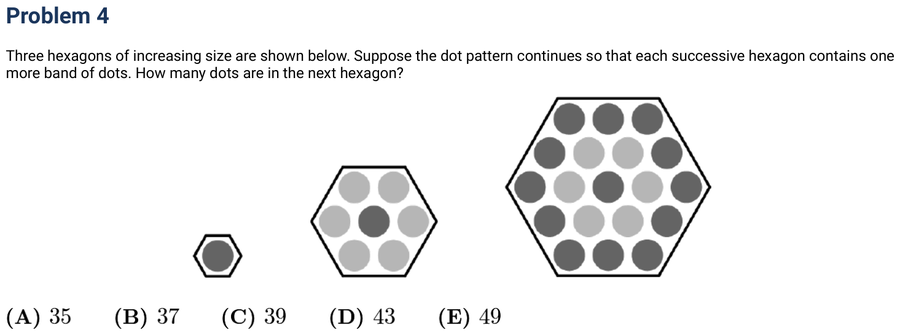
Watch it on a real one (AMC 8 2020, problem 4). Hexagons grow by one band of dots each time. A hexagon has 6 sides, so each new band holds 6 more dots than the last: the bands run 1, 6, 12, 18, … The third hexagon already shows \(1 + 6 + 12 = 19\) dots. The next one only tacks on the band of 18: \(19 + 18 = \textbf{37}\). You never drew the fourth hexagon — you only counted its outer ring.
Go deeper: no fixed step? reduce-and-expand via differences
When there's no fixed step — shrink it, table it, read the jumps
Not every pattern marches by the same step. Some sequences speed up. The move that cracks all of them has a name: Reduce and Expand. When a problem throws a scary number at you — “the 100th figure,” “a 26-team league” — you don't fight the big number. You shrink it to the first few cases you can actually count, line them up in a table, and watch what happens. The pattern hides in the jumps between terms, not the terms themselves.
Take the triangular numbers — dots stacked in a growing triangle: 1, 3, 6, 10, 15. They don't grow by a fixed amount. So look one level down, at the differences:
The terms 1, 3, 6, 10, 15 look hard to predict, but the jumps are dead simple: 2, 3, 4, 5, … — the counting numbers. To get the 6th term you don't need a formula; the next jump is \(+6\), so the 6th triangular number is \(15 + 6 = 21\). That's the whole Reduce-and-Expand idea: when the terms won't talk, ask the differences.
THE MOVE (Reduce and Expand)
Scary number? Shrink it to the first 4–5 cases you can count. Tabulate. If the terms have no obvious rule, look at the differences between them — that's usually where the pattern lives. Then grow it back to the case you were asked.
Strategy framing inspired by Posamentier, The Art of Problem Solving (teacher resource).
Beyond AMC 8 (optional): a one-shot formula for triangular numbers
Building up term by term is fine for the 6th. For the 100th, there's a shortcut. The \(n\)th triangular number is \(1 + 2 + 3 + \cdots + n\), and pairing ends (first with last) gives \(T_n = \dfrac{n(n+1)}{2}\). Check: \(T_5 = \dfrac{5\cdot 6}{2} = 15\). ✓ So \(T_{100} = \dfrac{100\cdot 101}{2} = 5050\) — no table needed.
Go deeper: two terms far apart, and the middle = average shortcut
Two terms far apart? Get the step in one division
Sometimes you're handed two terms that aren't next to each other — say the 3rd term is 10 and the 8th term is 25 — and asked for some other term. You don't need the first term to find the step. Going from the 3rd to the 8th is \(8 - 3 = 5\) hops, and the value climbed by \(25 - 10 = 15\). So each hop is \(15 \div 5 = 3\). The step is just the total climb divided by the number of hops.
THE MOVE
From the \(x\)th term to the \(y\)th term there are \(y - x\) hops, so \(d = \dfrac{a_y - a_x}{\,y - x\,}\). Subtract the values, divide by the gap in positions.
Worked example. The 3rd term is 10, the 8th is 25. Then \(d = \dfrac{25 - 10}{8 - 3} = \dfrac{15}{5} = 3\). To reach the 15th term, step out from the 8th: \(a_{15} = 25 + (15 - 8)\times 3 = 25 + 21 = \textbf{46}\). (No need to back up to \(a_1\) at all.)
The middle term is the average of any two terms that straddle it
In an evenly-spaced list the terms balance around the center, so a term in the middle equals the average of two terms the same distance on either side. The 12th term is the average of the 9th and 15th (each 3 away), the 12th and the 14th average to the 13th, and so on.
Why: the 9th is \(3d\) below the 12th and the 15th is \(3d\) above it; the two \(3d\)'s cancel when you average, leaving the 12th exactly. This is the same “ends balance around the middle” idea behind count×average for sums.
Find-d-from-two-terms and median=mean shortcuts adapted from Competition Math for Middle School (AoPS).
Go deeper: adding a geometric run — and one that never ends
Adding a geometric run
An arithmetic run added up with count×average. A geometric run — where each term is the last one times a fixed ratio \(r\) — has its own tidy shortcut. Take \(2 + 6 + 18 + 54\). Call the sum \(S\). Here's the trick: multiply the whole sum by the ratio 3 and line the two rows up.
\(S = 2 + 6 + 18 + 54\)
\(3S = \;\;\;\;6 + 18 + 54 + 162\)
Subtract the top from the bottom and almost everything cancels — the middle terms match up and vanish: \(3S - S = 162 - 2\), so \(2S = 160\) and \(S = 80\). (Check by hand: \(2+6+18+54 = 80\). ✓)
THE MOVE
To add a geometric run, multiply the sum by the ratio, subtract the original, and all the inside terms cancel. You're left with \((r-1)S = (\text{last}\times r) - \text{first}\). Equivalently, \(S = \dfrac{a_1\,(r^{\,n} - 1)}{r - 1}\).
A sum that never ends — yet stops at a number
Now keep multiplying by a ratio smaller than 1, forever: \(\tfrac{1}{3} + \tfrac{1}{9} + \tfrac{1}{27} + \cdots\). Each piece is a third of the one before, so the leftover gap keeps shrinking. Picture a number line: start at 0, hop \(\tfrac13\), then a third of what remains, then a third of that — you creep up on a wall and never pass it. That wall is the sum.
The same multiply-and-subtract finds it. Let \(S = \tfrac13 + \tfrac19 + \tfrac1{27} + \cdots\). Then \(3S = 1 + \tfrac13 + \tfrac19 + \cdots = 1 + S\) (the whole tail is just \(S\) again). So \(3S - S = 1\), giving \(2S = 1\) and \(S = \tfrac12\). An infinite pile of fractions adds to a plain \(\tfrac12\).
THE FORMULA (only when \(|r| < 1\))
\(a_1 + a_1 r + a_1 r^2 + \cdots = \dfrac{a_1}{1 - r}\)
Here \(a_1 = \tfrac13\), \(r = \tfrac13\): \(\dfrac{1/3}{1 - 1/3} = \dfrac{1/3}{2/3} = \tfrac12\). ✓ If \(r\) is 1 or bigger the terms don't shrink, the pile grows without bound, and there is no finite sum.
Finite and infinite geometric-series sums adapted from Competition Math for Middle School (AoPS).
Always sanity-check your formula on small n. a₁ from your formula should equal the actual first term. If it doesn't, you have an off-by-one.
“The 10th number” means 9 steps from the first, not 10. The classic miss is multiplying the step by \(n\) instead of \(n-1\). Picture fenceposts: 10 posts have 9 gaps between them.
Lucius is counting backward by 7s. His first three numbers are 100, 93, and 86. What is his 10th number?
Problem. Lucius counts backward by 7s: 100, 93, 86, … What's his 10th number?
This is arithmetic with start 100 and step \(-7\). Getting from the 1st to the 10th is 9 steps, not 10.
So you subtract \(9 \times 7 = 63\): \(100 - 63 = \textbf{37}\) (choice B). Check: \(37 + 63 = 100\). ✓
The whole problem is the fencepost count. Multiply by 10 and you get 30 — a wrong answer that's sitting right there in the choices, waiting for you. Count gaps, not posts.
Arithmetic: \(a_n = a_1 + (n-1)d\). Sum \(= n(a_1+a_n)/2\). Geometric: \(a_n = a_1 r^{\,n-1}\). Verify on small cases.
2005 · #12 Big Al the ape ate 100 delicious yellow bananas from May 1 through May 5. Each day he ate six more bananas than on the previous day. How...
Big Al the ape ate 100 delicious yellow bananas from May 1 through May 5. Each day he ate six more bananas than on the previous day. How many delicious bananas did Big Al eat on May 5?
Show answer
Show hints
Still stuck? Show hint 2 →
Show solution
- Total is 100 over 5 days, so the average per day is 100 ÷ 5 = 20. Because the increase is steady, that average lands exactly on the middle day, May 3.
- May 5 is two days past the middle, each day +6: 20 + 2·6 = 32.
- Why this transfers: for any arithmetic sequence with an odd count of terms, sum ÷ count gives the center term instantly — far faster than solving for the first term. (Note 30, choice C, is the trap for stopping one step short.)
- Let May 3 = x. The five days are x−12, x−6, x, x+6, x+12; the ±12 and ±6 cancel, so the sum is just 5x.
- 5x = 100 ⇒ x = 20, and May 5 = x+12 = 32. Centering the variable makes the symmetric terms cancel cleanly.
2015 · #9 On her first day of work, Janabel sold one widget. On day two, she sold three widgets. On day three, she sold five widgets, and on each...
On her first day of work, Janabel sold one widget. On day two, she sold three widgets. On day three, she sold five widgets, and on each succeeding day, she sold two more widgets than she had sold on the previous day. How many widgets in total had Janabel sold after working 20 days?
Show answer
Show hints
Still stuck? Show hint 2 →
Show solution
- Day k sales = 2k − 1, so over 20 days the total is 1 + 3 + 5 + … + 39 — the first 20 odd numbers.
- Key fact: 1 + 3 + 5 + … + (2n−1) = n2. (Picture building an n×n square one L-shaped layer at a time: each new layer adds the next odd number of unit squares.)
- Total = 202 = 400.
- Pair first-with-last: (1 + 39), (3 + 37), (5 + 35), … Each pair sums to 40.
- The 20 terms make 10 such pairs, so the total is 10 × 40 = 400.
- This is the all-purpose arithmetic-series trick: sum = (number of terms) × (first + last)/2 = 20 · (1 + 39)/2 = 400.
2020 · #4 Three hexagons of increasing size are shown below. Suppose the dot pattern continues so that each successive hexagon contains one more...
Three hexagons of increasing size are shown below. Suppose the dot pattern continues so that each successive hexagon contains one more band of dots. How many dots are in the next hexagon?
Show answer
Show hints
Still stuck? Show hint 2 →
Show solution
- A hexagon has 6 sides, so each new outer ring adds 6 more dots than the ring before it: the bands are 1, 6, 12, 18, … (a center dot, then rings stepping up by 6).
- Hexagon 3 already has 1 + 6 + 12 = 19 dots (matches the picture).
- The 4th hexagon just tacks on the next ring of 18: 19 + 18 = 37.
- You'll see this again as: “centered hexagonal” growth — when a shape grows by adding a border, count only the border. Its size usually climbs by a fixed step tied to the number of sides (hexagon → +6, square → +8, triangle → +3).
- Summing 1 + 6 + 12 + … + 6(n−1) gives 1 + 6·(1+2+…+(n−1)) = 1 + 3n(n−1).
- For the 4th hexagon, n = 4: 1 + 3·4·3 = 1 + 36 = 37 — a one-line check on the band-by-band count.
Translation, operations, sequences
Three problems on name-the-unknown, custom operations, and arithmetic sequences.
2022 · #6 Three positive integers are equally spaced on a number line. The middle number is 15 and the largest number is 4 times the smallest...
Three positive integers are equally spaced on a number line. The middle number is 15 and the largest number is 4 times the smallest number. What is the smallest of these three numbers?
Show answer
Show hints
Still stuck? Show hint 2 →
Show solution
- Insight: “equally spaced” means the middle is the average of the outer two, so the two outer numbers add to 2 × 15 = 30 — no spacing variable needed.
- The two outer numbers are the smallest and 4 times the smallest, which together make 5 of the smallest. So 5 × smallest = 30 ⇒ smallest = 6.
- Sanity check: the three numbers are 6, 15, 24 — gaps 9 and 9, equally spaced, and 24 = 4 × 6. ✓
2023 · #3 Wind chill estimates how cold it feels in wind, using(wind chill) = (air temperature) − 0.7 × (wind speed),with temperature in °F and...
Wind chill estimates how cold it feels in wind, using
with temperature in °F and wind speed in mph. If the air temperature is 36°F and the wind speed is 18 mph, which is closest to the wind chill?
Show answer
Show hints
Still stuck? Show hint 2 →
Show solution
- The word ‘closest’ is a hint that you can estimate. 0.7 × 18 is close to 0.7 × 18 = 12.6, and even rounding to ‘about 13 colder’ already points at choice (B).
- Exactly: 0.7 × 18 = 12.6.
- Subtract from the temperature: 36 − 12.6 = 23.4.
- Closest choice is 23. Sanity check: wind should make it feel colder, so the answer must be below 36 — it is.
2025 · #4 Lucius is counting backward by 7s. His first three numbers are 100, 93, and 86. What is his 10th number?
Lucius is counting backward by 7s. His first three numbers are 100, 93, and 86. What is his 10th number?
Show answer
Show hints
Still stuck? Show hint 2 →
Show solution
- The trap is multiplying by 10. But the 1st number cost no subtraction — going from the 1st to the 10th is only 9 steps, not 10. (Think fenceposts: 10 posts have 9 gaps between them.)
- Each step subtracts 7, so you subtract 9 × 7 = 63 total: 100 − 63 = 37.
- Why this transfers: the nth term of a sequence starting at the 1st uses n − 1 steps, not n. This off-by-one (fencepost) idea shows up in any "count from term 1 to term n" question. Sanity check: 37 + 63 = 100. ✓
Substitution and systems — collapse to one unknown
Two equations, two unknowns. It looks like twice the work — but the whole game is to get rid of one unknown so you're back to a single equation you already know how to crush. There are two ways to do it, and one read of the problem usually tells you which.
WHICH METHOD TO PICK
| Use SUBSTITUTION when… | Use ELIMINATION when… |
|---|---|
| One equation is already solved for a variable (or easily can be), e.g. \(y = x + 2\). | Coefficients line up so a variable cancels by adding or subtracting, e.g. both have \(+y\). |
THE MOVE
Before solving for both, read what the question asks. If it wants a sum or a difference, add or subtract the equations — you may be one line from the answer.
Named trick: line up a column, then subtract it away
When one variable already has the same coefficient in both equations, you don't need substitution at all — subtract the equations and that whole column vanishes.
Worked example. Solve \(2x + 3y = 12\) and \(2x + y = 8\).
- Both have \(2x\). Subtract the second from the first: \((3y - y) = 12 - 8\), so \(2y = 4\) and \(y = 2\).
- Back-substitute: \(2x + 2 = 8\), so \(x = 3\). Check both: \(2\cdot3 + 3\cdot2 = 12\) ✓ and \(2\cdot3 + 2 = 8\) ✓
Go deeper: sum-and-difference, skip-solving shortcuts, and the +1 factoring trick
The sum-and-difference shortcut
When the system is \(x + y = S\) and \(x - y = D\):
- Add: \(2x = S + D\), so \(x = \dfrac{S+D}{2}\) — the average.
- Subtract: \(2y = S - D\), so \(y = \dfrac{S-D}{2}\) — the half-difference.
Contests use sum-and-difference constantly. Memorize it.
Don't always solve for everything
Your instinct is to find \(x\), then \(y\). Often you don't have to.
1. Coefficients swapped — add them. Find \(x + y\): given \(2x + 3y = 13\) and \(3x + 2y = 12\). Add them: \(5x + 5y = 25\), so \(x + y = 5\). You never found \(x\) or \(y\) alone — and you didn't need to.
2. Subtract them. Find \(x - y\), given \(3x + 2y = 20\) and \(x + 4y = 18\). Subtract: \(2x - 2y = 2\), so \(x - y = 1\).
3. Sometimes you nudge first. Given \(4x + y = 17\) and \(2x + 3y = 11\), adding cancels nothing. Double the second to \(4x + 6y = 22\), subtract the first → \(5y = 5\), so \(y = 1\), \(x = 4\), and \(x + y = 5\). Choosing the multiplier that kills a variable was the shortcut.
The factoring trick: when a product sneaks in
Some systems hide a factorisation. With whole numbers and \(x + y + xy = 14\): your instinct is to guess pairs. Resist it. Add 1 to both sides — \(x + y + xy + 1 = 15\) — and the left factors: \((x+1)(y+1) = 15\). The only factor pair above 1 is \(3\times 5\), so \(x\) and \(y\) are 2 and 4, giving \(x + y = 6\). The ‘+1’ on each variable is the whole trick.
When you see \(x + y + xy\), add 1 and factor.
(Factoring trick adapted from Problem Solving via the AMC, Australian Maths Trust.)
For 'sum and difference' problems (x + y = 10, x − y = 2), add to get 2x = 12 (x = 6), subtract to get 2y = 8 (y = 4). Two lines.
After you find one variable, check whether the question wanted it. Many systems hand you \(x\) easily, but the problem asks for \(y\), or \(x+y\), or the larger of the two. Also: always verify your pair in BOTH equations — with \((4,2)\): \(2\cdot 4 + 2 = 10\) and \(4 + 2 = 6\). Both pass.
A toy cost the same whether I paid in quarters or in dimes, but paying in dimes needed 9 more coins. Let \(c\) be the number of quarters. Paying in dimes takes \(c+9\) coins, and since both pay for the same toy, the coin counts must match: \(c = c+9\).
Why it breaks: \(c = c+9\) has no solution — you equated the number of coins, but quarters and dimes aren't worth the same, so equal counts is the wrong thing to set equal. What's equal is the value, not the count.
The fix: Equate the money. \(c\) quarters are worth \(25c\) cents; \(c+9\) dimes are worth \(10(c+9)\) cents. Same price: \(25c = 10(c+9)\), so \(25c = 10c+90\), \(15c = 90\), \(c = 6\). The toy cost \(25\times 6 = 150\) cents = $1.50. (Check: \(6+9 = 15\) dimes \(=\) $1.50. ✓) When two descriptions count different-valued things, set the values equal, never the raw counts.
Coin value-vs-count framing inspired by AoPS Prealgebra.
The top of one tree is 16 feet higher than the top of another tree. The heights of the two trees are in the ratio 3 : 4. In feet, how tall is the taller tree?
Problem. One tree's top is 16 feet higher than the other's; their heights are in ratio \(3 : 4\). How tall is the taller tree?
Think in equal parts: one tree is 3 parts, the other 4 parts. The gap is \(4 - 3 = 1\) part, and that gap is the given 16 ft. So 1 part = 16 ft.
The taller tree is 4 parts: \(4 \times 16 = \textbf{64}\) ft (choice B).
You could set heights \(3k\) and \(4k\), write \(4k - 3k = 16\), and solve \(k = 16\). That's the same idea — “ratio plus a difference” always cracks open by pricing one part. Match the given number to how many parts it is, then scale.
Substitute or eliminate to collapse to one variable. For sum/difference systems, add and subtract to get both in two lines. Read the ask before solving for everything.
2003 · #4 A group of children riding on bicycles and tricycles rode past Billy Bob's house. Billy Bob counted 7 children and 19 wheels. How many...
A group of children riding on bicycles and tricycles rode past Billy Bob's house. Billy Bob counted 7 children and 19 wheels. How many tricycles were there?
Show answer
Show hints
Still stuck? Show hint 2 →
Show solution
- Suppose all 7 children rode bicycles. That would be 7 × 2 = 14 wheels — but only counts as a starting guess.
- We actually see 19 wheels, so 19 − 14 = 5 wheels are unaccounted for. A tricycle is just a bicycle with one extra wheel, so each leftover wheel marks one tricycle: 5 tricycles.
- You'll see this again: the "assume the cheapest option, then spend the surplus" trick cracks chickens-and-rabbits, coins, and stamp problems without any algebra.
- With b bicycles and t tricycles: b + t = 7 and 2b + 3t = 19.
- Subtract twice the first from the second: t = 19 − 14 = 5.
2022 · #5 Anna, Beatrice and Clara are 15 years old altogether. Anna and Beatrice together are 11 years old, and Beatrice and Clara together are...
Anna, Beatrice and Clara are 15 years old altogether. Anna and Beatrice together are 11 years old, and Beatrice and Clara together are 12 years old. How old is the oldest of the three?
Show answer
Show hints
Still stuck? Show hint 2 →
Show solution
- All three add to 15. Anna+Beatrice = 11, so Clara = 15-11 = 4.
- Beatrice+Clara = 12, so Anna = 15-12 = 3, and Beatrice = 15-3-4 = 8.
- The oldest is Beatrice at 8, so the answer is E.
2012 · #9 The Fort Worth Zoo has a number of two-legged birds and a number of four-legged mammals. On one visit to the zoo, Margie counted 200...
The Fort Worth Zoo has a number of two-legged birds and a number of four-legged mammals. On one visit to the zoo, Margie counted 200 heads and 522 legs. How many of the animals that Margie counted were two-legged birds?
Show answer
Show hints
Still stuck? Show hint 2 →
Show solution
- Imagine all 200 animals are 4-legged: that would be 200 × 4 = 800 legs — one easy multiplication instead of solving a system.
- Reality shows only 522 legs, a shortage of 800 − 522 = 278.
- Every bird counted as a mammal hides 2 legs (it has 2, not 4), so each bird explains exactly 2 of the missing legs: birds = 278 / 2 = 139.
- Sanity check: 139 birds + 61 mammals = 200 heads ✓, and 139×2 + 61×4 = 278 + 244 = 522 legs ✓.
- Let t = birds, f = mammals. Heads: t + f = 200. Legs: 2t + 4f = 522.
- Double the head equation: 2t + 2f = 400, and subtract it from the leg equation to clear t... or subtract from the legs to clear f: 2f = 122, so f = 61.
- Then t = 200 − 61 = 139 birds. The shortcut above is just this subtraction done in your head.
1989 · #7 If the value of 20 quarters and 10 dimes equals the value of 10 quarters and n dimes, then n =
If the value of 20 quarters and 10 dimes equals the value of 10 quarters and n dimes, then n =
Show answer
Show hints
Still stuck? Show hint 2 →
Still stuck? Show hint 3 →
Show solution
- Both sides carry 10 quarters and 10 dimes — cross those out, since identical amounts on each side don't affect the balance. The left keeps 10 extra quarters; the right keeps (n − 10) extra dimes.
- So 10 quarters must equal (n − 10) dimes in value: 10 × 25¢ = 250¢, and 250 ÷ 10 = 25 extra dimes. Then n = 10 + 25 = 35.
- Why this transfers: in any 'this equals that' setup, deleting whatever is common to both sides shrinks the problem to its real difference — here, 'trade 10 quarters for dimes' instead of juggling 600¢ totals.
- Left side: 20×25 + 10×10 = 500 + 100 = 600¢.
- Right side: 10×25 + n×10 = 250 + 10n. Set 250 + 10n = 600, so 10n = 350 and n = 35.
Sum constraints — push to extremes
“Five positive numbers add to 50.” That single sentence is a sum constraint, and it's secretly a tug-of-war: the total is fixed, so the numbers can't all grow. If one goes up, another must come down.
Picture the total as one fixed pizza cut into 5 slices. Make one slice bigger and every other slice has to shrink — the pizza never gets larger.
THE MOVE
To make one number as big as possible, shrink all the others to their smallest allowed value. To make one small, blow the others up to their largest. Whatever's left in the budget goes to your target.
The “distinct” trap
If the problem says distinct positive integers, you can't use four 1's. The smallest four distinct positive integers are 1, 2, 3, 4 — sum 10. So the largest would be \(20 - 10 = 10\). Big drop. Always re-read for the word “distinct.”
| Constraint on the others | Smallest possible “other” sum | Largest target |
|---|---|---|
| Just positive | 1 + 1 + 1 + 1 = 4 | 16 |
| Distinct positive | 1 + 2 + 3 + 4 = 10 | 10 |
| Distinct AND each ≥ 5 | 5 + 6 + 7 + 8 = 26 | impossible (over budget) |
For ‘integer’ versions, watch the per-value constraint (often ‘at least 1’ or ‘between 0 and 100’). Push to the extreme allowed; if your answer exceeds the per-value upper bound, cap and adjust.
If a per-value cap exists (e.g. “each number is at most 10”), you can't dump everything into one slot. Push the others to their minimum, then if your target overflows its cap, stop at the cap and spill the surplus into the next variable.
Ricardo has 2020 coins, some of which are pennies (1-cent coins) and the rest of which are nickels (5-cent coins). He has at least one penny and at least one nickel. What is the difference in cents between the greatest possible and least possible amounts of money that Ricardo can have?
Problem. 2020 coins, each a penny (1¢) or a nickel (5¢), with at least one of each. What's the difference between the most and the least total value?
Don't compute max and min separately. Write the total as \(p + 5n = (p+n) + 4n = 2020 + 4n\). The 2020 is fixed; only \(4n\) moves.
With at least one of each and \(p + n = 2020\), the count of nickels \(n\) runs from 1 to 2019.
The fixed 2020 cancels in the difference, leaving \(4(2019 - 1) = 4 \times 2018 = \textbf{8072}\) (choice C).
For “max minus min” questions, peel off the constant part — the spread depends only on what varies. Each penny-to-nickel swap adds a fixed 4 cents, so the answer is (gain per swap) × (allowed swaps). The push-to-extremes idea, in disguise.
Fixed total + extreme of one ↔ push the others to the opposite extreme, subject to per-value caps.
2019 · #10 The six smallest odd natural numbers are written on the sides of a die. Toni rolls the die three times and adds the numbers. Which sum...
The six smallest odd natural numbers are written on the sides of a die. Toni rolls the die three times and adds the numbers. Which sum will Toni not be able to make?
Show answer
Show hints
Still stuck? Show hint 2 →
Still stuck? Show hint 3 →
Show solution
- The faces are the odd numbers 1, 3, 5, 7, 9, 11, and the biggest total you can roll is 11 + 11 + 11 = 33.
- Three odd numbers always add to an odd number, and every odd value from 3 up to 33 can be reached.
- 35 is larger than the biggest possible total of 33, so it can never be made: 35 (E).
2019 · #30 A train has 18 carriages. There are 700 passengers on the train. In every five successive carriages there are exactly 199 passengers in...
A train has 18 carriages. There are 700 passengers on the train. In every five successive carriages there are exactly 199 passengers in total. How many passengers are in the two middle carriages of the train altogether?
Show answer
Show hints
Still stuck? Show hint 2 →
Show solution
- Since each window of 5 carriages sums to 199, sliding by one shows carriage i and carriage i+5 carry the same number.
- So the 18 carriages repeat with period 5; carriages 1-15 give 3 × 199 = 597, leaving carriages 16,17,18 to total 700 − 597 = 103.
- Those equal carriages 1,2,3, so carriages 4+5 = 199 − 103 = 96; the two middle carriages 9,10 equal carriages 4,5, giving 96.
2022 · #30 Altogether 2022 kangaroos and some koalas live in seven parks. In each park there live as many kangaroos as there are koalas in all the...
Altogether 2022 kangaroos and some koalas live in seven parks. In each park there live as many kangaroos as there are koalas in all the other parks together. How many koalas live in the seven parks in total?
Show answer
Show hints
Still stuck? Show hint 2 →
Show solution
- Let the total number of koalas be K. In each park the kangaroos equal K minus that park's own koalas.
- Summing over all seven parks: total kangaroos = 7K - K = 6K = 2022.
- So K = 337 koalas in total, the answer is B.
Find the cycle — far-out terms repeat, so use the remainder
“What's the 2017th digit of this sequence?” The problem is daring you to write out 2017 terms. Don't take the bait. Sequences built by a fixed rule almost always loop — they fall into a short repeating block. Find the block, and 2017 becomes a tiny remainder problem.
THE MOVE
List 4–6 terms until you spot a number coming back. The gap between two repeats is the cycle length \(L\). Then position \(n\) is determined by the leftover of \(n\) shared into groups of \(L\).
Bend the line into a circle
Here's the picture that makes the remainder click. The terms don't run off forever in a straight line — once they loop, you can bend them into a wheel. Walk one step per term around the wheel; after a full lap you're back where you started, so step number \(n\) lands on the same spoke as its leftover after dividing by the cycle length.
The big number 98 never makes you take 98 steps. You take 94 steps from the first looped term, and 94 laps-worth of stepping is the same as its leftover, 4. Land on the spoke; read the term.
Warm up on something you already know: days of the week. Today is Monday — what day is it in 100 days? The week is a cycle of length 7. \(100 \div 7\) leaves a remainder of 2 (since \(98\) is a whole number of weeks), so you step 2 days past Monday: Wednesday. You did not count 100 days; you counted the leftover. That is the entire idea, dressed up.
How to find the cycle:
- Compute the first several terms (4 to 6 is usually enough).
- Watch for the moment the sequence (or a key feature) starts repeating.
- The cycle length is the number of terms between two consecutive repeats.
Then reduce the position-number by the cycle length (its leftover) to land in the right spot.
Cycles you'll meet on contests:
- Units digits of powers (covered in the Number Theory lesson).
- Days of the week (cycle 7).
- Repeating decimals (e.g. \(1/7 = 0.\overline{142857}\), cycle 6).
- Folds or rotations that return to start.
- “Apply a rule over and over” — what does it return to?
The cycle isn't always obvious from the first 2 terms. List 4–6 terms before looking for the repeat. If you don't see it, look at differences or ratios — sometimes those cycle instead.
Off-by-one again. If the cycle starts at term 1, a leftover of 0 means the LAST position in the block, not the first. Always confirm your indexing by checking a small term you can see directly.
Terri builds a sequence of positive integers by these rules: if the integer is less than 10, multiply it by 9; if it is even and greater than 9, divide it by 2; if it is odd and greater than 9, subtract 5. Find the 98th term of the sequence that begins 98, 49, … .
Rule: if the number is under 10, multiply by 9; if it's even and over 9, halve it; if it's odd and over 9, subtract 5. The sequence starts 98, 49, … Find the 98th term.
Run it: \(98 \to 49 \to 44 \to 22 \to 11 \to 6 \to 54 \to 27 \to 22\,\ldots\) The 22 has come back, so from the 4th term on it loops: 22, 11, 6, 54, 27 — a cycle of length 5.
Terms 4, 5, 6, 7, 8 are positions 0, 1, 2, 3, 4 of the cycle. For term 98, step in from term 4: that's \(98 - 4 = 94\) steps, and 94 shared into groups of 5 leaves 4. Position 4 of the cycle is \(\textbf{27}\) (choice D).
Any “find the very-far term” of a rule-based sequence is really “find the cycle, then take the step-count's leftover as your position.” The big index 98 never needs all 98 terms — just eight, plus a remainder.
List enough terms to see the cycle. Reduce the position-number by the cycle length. Off-by-one errors are common — verify on small cases.
2017 · #26 The number sequence 2, 3, 6, 8, 8, … is created by the following rule: the first two digits are 2 and 3. After that, every subsequent...
The number sequence 2, 3, 6, 8, 8, … is created by the following rule: the first two digits are 2 and 3. After that, every subsequent digit is the units digit of the product of the two previous digits. Which digit is the 2017th digit of the sequence?
Show answer
Show hints
Still stuck? Show hint 2 →
Show solution
- The sequence is 2, 3, 6, 8, 8, 4, 2, 8, 6, 8, 8, 4, ... ; from the 6th term it cycles with period 6: (4, 2, 8, 6, 8, 8).
- Position 2017 is 2011 steps past the 6th term, and 2011 mod 6 = 1, picking the 2nd entry of the cycle.
- That entry is 2.
2003 · #23 (figure problem)
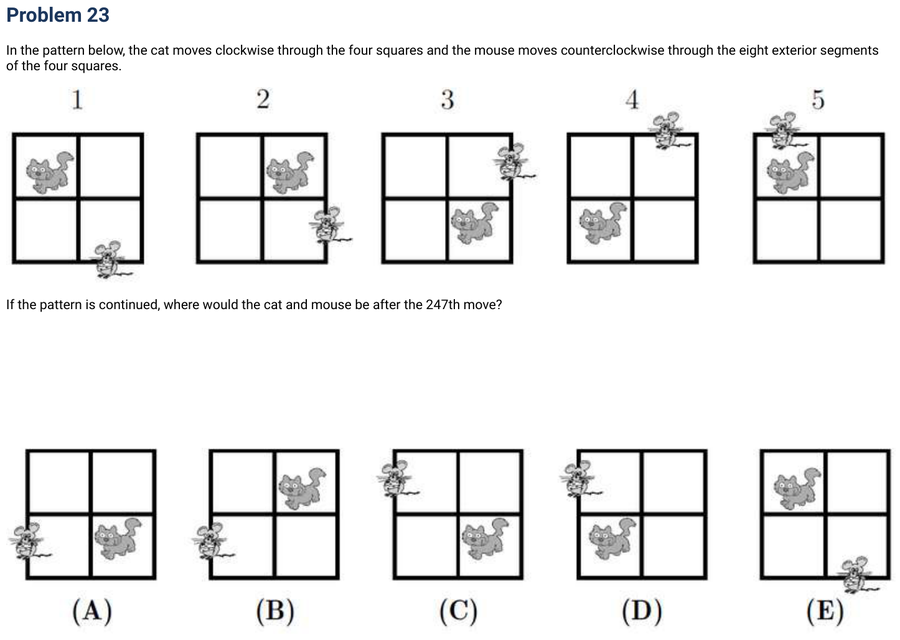
Show answer
Show hints
Still stuck? Show hint 2 →
Show solution
- Both animals repeat, so after a full loop they're back to start — only the remainder of 247 matters, and the two can be handled independently.
- Cat: 4 squares per loop. 247 = 4·61 + 3, remainder 3, so the cat sits where it is after move 3 — the bottom-right square.
- Mouse: 8 segments per loop. 247 = 8·30 + 7, remainder 7, so the mouse sits where it is after move 7 — the bottom-left segment.
- The only picture with the cat bottom-right and mouse bottom-left is A.
- You'll see this again: for two things cycling at different rates, reduce the big move count mod each cycle separately — remainder by 4 for the cat, by 8 for the mouse — rather than tracking them together.
Substitution, sum constraints, cycles
Three problems mixing systems, sum constraints, and pattern-cycle finding.
1990 · #24 (figure problem)
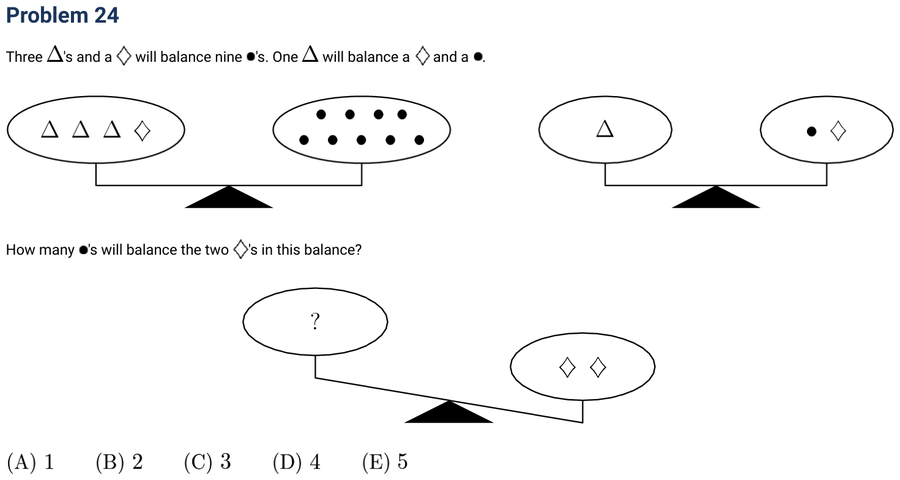
Show answer
Show hints
Still stuck? Show hint 2 →
Show solution
- Read the scales as equations: 3T + D = 9C, and T = D + C. You want how many circles equal two diamonds (2D).
- The second balance lets you replace each triangle by 'one diamond + one circle.' Swap all three triangles in the first balance: 3(D + C) + D = 9C, i.e. 4D + 3C = 9C.
- Take the 3C off both sides (remove 3 circles from each pan): 4D = 6C. Cut everything in half: 2D = 3C. So two diamonds balance 3 circles.
- *Why this transfers:* when one unknown is given in terms of others, substitute it in to wipe that unknown out — and on a balance you can always add or remove the same thing from both pans without tipping it.
- From the right scale, 1 triangle = 1 diamond + 1 circle, so 3 triangles = 3 diamonds + 3 circles.
- The left scale says 3 triangles + 1 diamond = 9 circles. Replace the 3 triangles: (3 diamonds + 3 circles) + 1 diamond = 9 circles, so 4 diamonds + 3 circles = 9 circles.
- Remove 3 circles from each side: 4 diamonds = 6 circles. Halve it: 2 diamonds = 3 circles — exactly the two diamonds in the question.
2002 · #25 Loki, Moe, Nick, and Ott are good friends. Ott had no money, but the others did. Moe gave Ott one-fifth of his money, Loki gave Ott...
Loki, Moe, Nick, and Ott are good friends. Ott had no money, but the others did. Moe gave Ott one-fifth of his money, Loki gave Ott one-fourth of his money, and Nick gave Ott one-third of his money. Each gave Ott the same amount of money. What fractional part of the group's money does Ott now have?
Show answer
Show hints
Still stuck? Show hint 2 →
Show solution
- Anchor on the equal gift: let each be $1. Then $1 = ⅕ of Moe → $5, = ¼ of Loki → $4, = ⅓ of Nick → $3.
- Giving money away doesn't create or destroy any: the group total stays $5 + $4 + $3 = $12. Ott now holds the three $1 gifts = $3.
- Ott's share = 3/12 = 1/4.
- *Two ideas worth keeping:* (1) when several quantities share a common value, set *that* value to a friendly number and back out the rest; (2) money passed within a group conserves the total — so a "fraction of the whole" question only needs the unchanged grand total as its denominator.
2017 · #21 Suppose a, b, and c are nonzero real numbers, and a + b + c = 0. What are the possible value(s) fora|a| + b|b| + c|c| + abc|abc| ?
Suppose a, b, and c are nonzero real numbers, and a + b + c = 0. What are the possible value(s) for
Show answer
Show hints
Still stuck? Show hint 2 →
Show solution
- Each x/|x| equals +1 (if x>0) or −1 (if x<0). So we're adding four signs — three for a, b, c, and one for their product abc.
- Since the three sum to 0 and none is zero, they aren't all the same sign: exactly one or exactly two of a, b, c are negative.
- Two positive, one negative: the three signs are +1, +1, −1 (sum +1); one negative factor makes abc negative, sign −1. Total: +1 − 1 = 0.
- Two negative, one positive: signs −1, −1, +1 (sum −1); two negatives make abc positive, sign +1. Total: −1 + 1 = 0.
- Both cases give 0. The deeper reason: the abc sign always cancels the sum of the first three, because the product's sign tracks the parity of how many are negative.
- The value can't depend on which specific numbers you pick, so test one: a=1, b=1, c=−2 (sum 0). Then signs give 1 + 1 + (−1) + (−1) = 0.
- A single value of 0 already eliminates every choice except (A); the casework above confirms 0 is the only value, so the answer is 0.
- Test-taking tip: when a problem asks 'what are the possible values' and the answer must be constant, computing one clean example often pins it instantly.
Work backward through equations
“Think of a number. Double it. Add 5. Divide by 3. You got 7. What was the number?” Trying to guess-and-check is slow. There's a cleaner way: run the whole thing in reverse, undoing one step at a time.
Think of getting dressed. Socks, then shoes. To get back to bare feet, you take off shoes first, then socks. Last on, first off.
THE MOVE
Start from the final result and undo each step in reverse order, swapping every operation for its opposite. Last on, first off.
INVERSE OPERATIONS (do these to UNDO)
| The forward step was … | To undo, do … |
|---|---|
| + k (add) | − k (subtract) |
| − k (subtract) | + k (add) |
| × k (multiply) | ÷ k (divide) |
| ÷ k (divide) | × k (multiply) |
| square | square root (watch signs) |
| + p% (× by 1 + p/100) | divide by 1 + p/100 |
Same moves, one twist — solving INEQUALITIES
An inequality like \(2x + 7 < -3\) is solved with the exact same balance moves as an equation: add or subtract from both sides, multiply or divide both sides — almost the same. There's one rule that has no equation-cousin, and it's the most-missed line in beginning algebra.
THE FLIP RULE
When you multiply or divide BOTH sides of an inequality by a negative number, you must reverse the sign: \(<\) becomes \(>\), \(\ge\) becomes \(\le\). Adding, subtracting, or multiplying by a positive — no flip.
See why on the number line. Start with a true statement, \(3 < 5\). Multiply both sides by \(-2\): the left becomes \(-6\), the right becomes \(-10\). But \(-6\) is to the right of \(-10\), so \(-6 > -10\). The order swapped — negating reflects every number across zero, which reverses left-and-right. That reflection is the flip.
Solve \(3(5 - 2y) \ge 2y - 9\). Expand: \(15 - 6y \ge 2y - 9\). Subtract \(2y\): \(15 - 8y \ge -9\). Subtract 15: \(-8y \ge -24\). Divide both sides by \(-8\): \(y \ge 3\).
Why it breaks: The last step divided by \(-8\), a negative — so the \(\ge\) had to flip to \(\le\), and it didn't. Test it: \(y = 5\) gives \(y \ge 3\) (the bogus claim) but the original becomes \(3(5-10) = -15\) and \(2\cdot5 - 9 = 1\), and \(-15 \ge 1\) is false. So \(y=5\) is not a solution, yet the bogus answer allowed it.
The fix: At \(-8y \ge -24\), dividing by \(-8\) flips the sign: \(y \le 3\). Check \(y = 0\): \(3(5) = 15 \ge -9\). ✓ And \(y = 5\) is correctly excluded. Any time a negative coefficient gets divided away, the inequality turns around.
Inequality sign-flip WARNING inspired by AoPS Prealgebra.
Go deeper: undo a percent by dividing (and a number-trick to practice)
Named trick: undo a percent by dividing, not subtracting
A discount or markup is a multiply, so its undo is a divide — never “add the percent back.” Taking 20% off multiplies by \(0.8\); to recover the original you divide by \(0.8\).
Worked example. After a 20%-off sale a jacket costs $48. What was the original price?
- Forward: original \(\times\, 0.8 = 48\).
- Undo with the inverse: \(48 \div 0.8 = \textbf{60}\) dollars. Check: \(60 \times 0.8 = 48\). ✓ (Adding 20% of 48 back gives 57.60 — the classic wrong answer.)
When working backward through multi-step problems, write each undo on a fresh line — don't combine in your head. Accumulated mental error is the biggest source of wrong answers.
Two opposite mistakes: undoing in the WRONG order (you must reverse the sequence), and undoing with the SAME operation instead of its inverse. If the last forward step was ÷3, the first undo is ×3 — not another divide.
Jim should have added 26 to a certain number. Instead he subtracted 26 and obtained −14. What result would he have obtained if he had added 26?
Problem. Jim should have added 26 to a number. Instead he subtracted 26 and got \(-14\). What would adding 26 have given?
First recover the original. He subtracted 26 to land on \(-14\), so undo that: \(-14 + 26 = 12\). The number was 12.
Now do what he meant to: \(12 + 26 = \textbf{38}\) (choice D).
The wrong move (subtract 26) is a forward step you can undo. Reverse it to get the true number, then run the correct step. Two clean lines beat guessing.
To undo a forward chain, apply inverse operations in reverse order. Write each step rather than combining mentally.
1990 · #21 A list of 8 numbers is formed by beginning with two given numbers. Each new number in the list is the product of the two previous...
A list of 8 numbers is formed by beginning with two given numbers. Each new number in the list is the product of the two previous numbers. Find the first number if the last three numbers are 16, 64, 1024.
Show answer
Show hints
Still stuck? Show hint 2 →
Show solution
- Label the list t₁…t₈; the rule is tₙ = tₙ₋₁ × tₙ₋₂. We know t₆=16, t₇=64, t₈=1024 (and indeed 16×64 = 1024 ✓, a good consistency check).
- To go back, rearrange the rule: tₙ₋₂ = tₙ ÷ tₙ₋₁. Step down: t₅ = t₇÷t₆ = 64÷16 = 4; t₄ = t₆÷t₅ = 16÷4 = 4; t₃ = t₅÷t₄ = 4÷4 = 1; t₂ = t₄÷t₃ = 4÷1 = 4; t₁ = t₃÷t₂ = 1÷4.
- So the first number is 1/4. (Verify forward: 1/4, 4 → 1, 4, 4, 16, 64, 1024 ✓.)
- *Why this transfers:* when a problem hands you the end of a chain, reverse the operation (multiply→divide, add→subtract) and walk back — always sanity-check by running it forward.
1998 · #25 Three generous friends redistribute their money as follows: Amy gives Jan and Toy enough to double each of their amounts; then Jan gives...
Three generous friends redistribute their money as follows: Amy gives Jan and Toy enough to double each of their amounts; then Jan gives Amy and Toy enough to double theirs; finally Toy gives Amy and Jan enough to double theirs. Toy had $36 at the beginning and $36 at the end. What is the total amount the three friends have?
Show answer
Show hints
Still stuck? Show hint 2 →
Show solution
- Key idea: the total never changes, since every step just moves dollars between people. So if we can pin the total at any single moment, we're done.
- Toy receives (and doubles) in rounds 1 and 2: $36 → $72 → $144 just before his own turn.
- On his turn Toy gives away enough to double Amy and Jan, and he ends at $36 — so he handed out 144 − 36 = $108. That $108 was exactly what it took to double Amy and Jan together, meaning they held $108 between them just before.
- At that instant the total is Toy's 144 + the others' 108 = $252 — and since the total is constant, that's the answer.
- Why this transfers: in any 'pass things around' puzzle, first ask what stays fixed (here, the total). An invariant lets you ignore the messy middle and read the answer off one clean snapshot.
- Suppose the total is T. At the very end all three have whole amounts and Toy has $36. The last move (Toy doubling Amy and Jan) means just before it, Amy and Jan each had half their final amount, and Toy had everything else.
- Peeling back each doubling step in reverse keeps the total T fixed at every stage. Using Toy's $36 start, the backward chain pins T = $252, matching the invariant method — a good check that working forward, backward, or by invariant must all agree.
2010 · #26 The numbers from 1 to 10 are written on a board. The children now play the following game: one child erases two of the numbers and...
The numbers from 1 to 10 are written on a board. The children now play the following game: one child erases two of the numbers and writes in their place the sum of the two numbers minus 1. Then a second child does the same, and so on, until only one number is left on the board. The last number is …
Show answer
Show hints
Still stuck? Show hint 2 →
Show solution
- Replacing two numbers by (their sum − 1) lowers the board's total by 1 and the count by 1.
- Starting from the numbers 1–10 (total 55, ten numbers), reaching one number takes 9 moves, dropping the total by 9.
- The final number is 55 − 9 = 46, independent of the order.
Difference of squares and the basic identities
Quick: what's \(99^2 - 98^2\)? Squaring both feels brutal. But there's a back door. \(99^2 - 98^2 = (99+98)(99-98) = 197 \times 1 = 197\). The nasty subtraction collapsed into one multiplication. That back door has a name — and the cleanest way to see why all these tricks work is to draw them as areas.
First, why distributing works — it's an area
How do you multiply \(7 \times 103\) in your head? You split it: \(7\times 100 + 7\times 3 = 721\). That split is the distributive rule \(a(b+c) = ab + ac\), and a rectangle shows exactly why. Make a rectangle 7 tall and \(100 + 3\) wide. Slice it at the 100 mark: two rectangles, areas \(7\times 100\) and \(7\times 3\). Same total — you counted it in two pieces.
Whenever you “distribute,” you are slicing one rectangle into pieces and adding the pieces back. The rule never lies because area never changes when you cut it up.
Two binomials — the 2×2 box (this is FOIL)
Now multiply \((a+b)(c+d)\). Build a rectangle that's \(a+b\) tall and \(c+d\) wide. The two cuts — one across, one down — chop it into four pieces. Add the four areas and you have the product. No “FOIL” mnemonic to memorize; the grid shows all four products.
Try it with numbers: \((10+2)(10+3) = 12\times 13\). The four boxes are \(100, 30, 20, 6\), which add to \(156\). Check: \(12\times 13 = 156\). ✓ The box model and the multiplication agree because they're the same area, sorted two ways.
IDENTITIES TO MEMORIZE
- Difference of squares: \(a^2 - b^2 = (a + b)(a - b)\)
- Square of a sum: \((a + b)^2 = a^2 + 2ab + b^2\)
- Square of a difference: \((a - b)^2 = a^2 - 2ab + b^2\)
THE MOVE
The instant you see \(a^2 - b^2\), rewrite it as \((a+b)(a-b)\). Hard subtraction becomes easy multiplication.
Go deeper: why \(a^2-b^2=(a+b)(a-b)\) — cut and rearrange
Why \(a^2 - b^2 = (a+b)(a-b)\) — cut and rearrange
Here's the picture that makes it obvious. Start with a big square, \(a\) on a side, so its area is \(a^2\). Bite a small \(b\times b\) square out of one corner. What's left — the gray L-shape — has area \(a^2 - b^2\).
Now cut the L into its two strips and lay them end to end. They form a single rectangle whose height is \(a - b\) and whose width is \(a + b\) — area \((a+b)(a-b)\). Nothing was added or thrown away, so \(a^2 - b^2 = (a+b)(a-b)\). The identity is the same gray region, re-laid as a rectangle.
Pictured-intuition adapted from Competition Math for Middle School (AoPS).
Watch it work:
- \(99^2 - 98^2 = (99+98)(99-98) = 197 \times 1 = \textbf{197}\).
- \(51^2 - 49^2 = (51+49)(51-49) = 100 \times 2 = \textbf{200}\).
- \(1000^2 - 999^2 = 1999\).
The reverse is just as useful: when you see a product like \((\text{big})(\text{small difference})\), it may be a hidden difference of squares.
Sum of consecutive odd numbers has the same flavor: \(1 + 3 + 5 + \cdots + (2n-1) = n^2\). Each new odd number wraps an L-shaped border around an \((n-1)^2\) square to grow it to \(n^2\).
Go deeper: know the sum and product? get everything without the numbers
Know the sum and product? You're done — without finding the numbers
Two secret numbers. You're told their sum and their product. The question asks for something else entirely — their squares added, their reciprocals added, their difference. Your instinct is to dig out the two numbers first. Resist it. The same square-of-a-sum identity, read backward, hands you the answer without ever knowing the numbers.
Start from the identity above: \((a+b)^2 = a^2 + 2ab + b^2\). Slide the \(2ab\) across and look what's left:
THE BRIDGE FROM (sum, product) TO EVERYTHING
\(a^2 + b^2 = (a+b)^2 - 2ab\)
So the sum-of-squares is the sum, squared, minus twice the product. Two more fall out of the same two facts:
- Reciprocals: \(\dfrac{1}{a} + \dfrac{1}{b} = \dfrac{a+b}{ab}\) — sum over product, straight off.
- Difference: \((a-b)^2 = (a+b)^2 - 4ab\), so \(a - b = \sqrt{(a+b)^2 - 4ab}\).
Watch it work. Two positive numbers have sum 5 and product 6. Find \(a^2 + b^2\). Plug in: \(5^2 - 2\cdot 6 = 25 - 12 = 13\). (Check: the numbers are 2 and 3, and \(4 + 9 = 13\). The identity beat you to it.) Want \(\tfrac{1}{a}+\tfrac{1}{b}\)? It's \(\tfrac{5}{6}\), no digging required.
THE MOVE
When a problem gives you \(a+b\) and \(ab\) and asks for something symmetric, build it from those two. The two numbers are a trap you don't need to fall into.
Framing inspired by Competition Math for Middle School (AoPS).
Go deeper: square a near-round number, and the difference-of-squares examples
Named trick: square a near-round number with \((a+b)^2\)
The same area-box that gives FOIL also squares awkward numbers fast. To square something just off a round number, split it: \((a\pm b)^2 = a^2 \pm 2ab + b^2\), with \(a\) the round part.
Worked examples.
- \(21^2 = (20+1)^2 = 400 + 2\cdot20\cdot1 + 1 = \textbf{441}\).
- \(99^2 = (100-1)^2 = 10000 - 200 + 1 = \textbf{9801}\).
Don't drop the middle \(2ab\) term — that's the one everyone forgets, and it's where most of the value lives.
Go deeper: the most common slip: distributing a negative
The most common slip: distributing a negative
The minus sign in front of a bracket has to reach every term inside — not just the first one. Forgetting the second term is the single most common algebra error there is.
Simplify \(4x - 3(x - 2)\). The \(-3\) times \(x\) is \(-3x\), and then we have the \(-2\) inside, so… \(4x - 3x - 6 = x - 6\).
Why it breaks: \(-3 \times (-2) = +6\), not \(-6\). Two negatives multiply to a plus. The correct expansion is \(-3(x - 2) = -3x + 6\), so \(4x - 3(x - 2) = 4x - 3x + 6 = \textbf{x + 6}\). Check at \(x = 5\): the original is \(20 - 3(3) = 20 - 9 = 11\), and \(x + 6 = 11\). ✓ The bogus answer \(x - 6 = -1\) is wrong.
THE MOVE
When a \(-\) sits in front of a bracket, flip the sign of every term inside, then add. A handy check: subtracting \((x - 2)\) should make the expression bigger by 2 for each unit, because you're taking away a smaller thing.
“Most common mistake” framing adapted from Competition Math for Middle School (AoPS).
Go deeper: telescoping tricks — chains and products of squares
A handy trick: telescope a whole chain of squared differences
The difference-of-squares back door is even better when squares come in a long alternating chain: \(10^2 - 9^2 + 8^2 - 7^2 + 6^2 - 5^2\). Squaring all six numbers is a slog. Instead group them in consecutive pairs and crack each pair open with \(a^2 - b^2 = (a+b)(a-b)\). Because the two numbers in each pair differ by 1, every \((a-b)\) factor is just 1 — so each pair collapses to plain \(a + b\):
\((10^2 - 9^2) + (8^2 - 7^2) + (6^2 - 5^2) = (10+9) + (8+7) + (6+5) = 19 + 15 + 11 = \textbf{45}\).
A page of squaring turned into adding three little sums. The same move works for \(1^2 - 2^2 + 3^2 - 4^2 + \cdots\): pair from the start and each pair becomes a sum (with a sign), and a hard-looking sum melts away.
THE MOVE
In an alternating chain of squares, bracket consecutive terms into pairs. Each pair \(a^2 - b^2\) with \(a - b = 1\) is simply \(a + b\). Add those instead of squaring anything.
Another worked example
Evaluate \(20^2 - 19^2 + 18^2 - 17^2 + 16^2 - 15^2\).
- Pair consecutive terms: \((20^2-19^2) + (18^2-17^2) + (16^2-15^2)\).
- Each pair has difference 1, so it equals the sum of the two numbers: \((20+19) + (18+17) + (16+15)\).
- That's \(39 + 35 + 31 = \textbf{105}\).
- Spot-check the first pair directly: \(400 - 361 = 39\). ✓
Telescoping-pairs framing inspired by Terry Chew's Math Olympiad Difference of Squares.
Telescope a long product of squares
Difference of squares also rescues a scary-looking product. Take \(\left(1 - \tfrac{1}{2^2}\right)\left(1 - \tfrac{1}{3^2}\right)\left(1 - \tfrac{1}{4^2}\right)\cdots\) Multiplying these fractions out term by term would be a nightmare. Instead, crack open one factor: \(1 - \dfrac{1}{k^2} = \dfrac{k^2 - 1}{k^2} = \dfrac{(k-1)(k+1)}{k^2}\). Difference of squares on the top.
Now line up the first few factors and watch the pieces cancel:
\(\dfrac{1\cdot 3}{2\cdot 2}\cdot\dfrac{2\cdot 4}{3\cdot 3}\cdot\dfrac{3\cdot 5}{4\cdot 4}\cdot\dfrac{4\cdot 6}{5\cdot 5}\cdots\)
Each \((k+1)\) on one numerator meets the matching number on the next denominator and both vanish — the chain telescopes. Almost everything cancels; only the very first numerator factor (a 1) and the very last numerator factor survive on top, over the leftover \(2\) and last \(k\) on the bottom. Stopping at \(k = n\) leaves
THE COLLAPSE
\(\left(1 - \tfrac{1}{2^2}\right)\left(1 - \tfrac{1}{3^2}\right)\cdots\left(1 - \tfrac{1}{n^2}\right) = \dfrac{n+1}{2n}\)
Watch it work. Up to \(k = 4\): \(\tfrac{3}{4}\cdot\tfrac{8}{9}\cdot\tfrac{15}{16}\). Multiply straight: \(\tfrac{3}{4}\cdot\tfrac{8}{9} = \tfrac{24}{36} = \tfrac{2}{3}\), then \(\tfrac{2}{3}\cdot\tfrac{15}{16} = \tfrac{30}{48} = \tfrac{5}{8}\). The formula agrees: \(\dfrac{n+1}{2n} = \dfrac{5}{8}\) at \(n = 4\). ✓
Telescoping-product example adapted from Terry Chew's Math Olympiad Difference of Squares.
Whenever you see \(x^2 - y^2\), it is \((x+y)(x-y)\). Whenever you see \((x+1)(x-1)\), it is \(x^2 - 1\).
Sign and shape errors: \(a^2 - b^2 = (a+b)(a-b)\), NOT \((a-b)^2\). And \((a+b)^2 \ne a^2 + b^2\) — the middle \(2ab\) term is the one everyone drops.
Pick two consecutive positive integers whose sum is less than 100. Square both of those integers and then find the difference of the squares. Which of the following could be the difference?
Problem. Pick two consecutive positive integers (sum under 100), square both, take the difference of the squares. Which choice could it be: 2, 64, 79, 96, 131?
Let the integers be \(n\) and \(n+1\). Then \((n+1)^2 - n^2 = (n+1+n)(n+1-n) = (2n+1)(1) = 2n+1\) — which is exactly \(n + (n+1)\), the sum of the two integers.
So the difference is always odd, and since the sum is under 100, it's under 100. Of the choices, only \(\textbf{79}\) is odd and below 100 (choice C).
The factorization \((n+1)^2 - n^2 = 2n+1\) is the entire problem. It turns “which is possible?” into “which choice is odd and small?” — and three options die on the spot.
Memorize \(a^2-b^2=(a+b)(a-b)\), \((a+b)^2=a^2+2ab+b^2\), \((a-b)^2=a^2-2ab+b^2\). Recognize them in disguise. Given a sum and a product, build \(a^2+b^2\), \(\tfrac1a+\tfrac1b\), and \(a-b\) without ever finding \(a\) and \(b\).
1991 · #4 If 991 + 993 + 995 + 997 + 999 = 5000 − N, then N =
If 991 + 993 + 995 + 997 + 999 = 5000 − N, then N =
Show answer
Show hints
Still stuck? Show hint 2 →
Still stuck? Show hint 3 →
Show solution
- The five terms are each near 1000, so pretend they're all 1000: that's 5000. But each is a little less — by 9, 7, 5, 3, 1. The total shortfall is exactly what gets subtracted from 5000.
- Add the gaps: 9 + 7 + 5 + 3 + 1 = 25. So the sum is 5000 − 25, matching 5000 − N, which gives N = 25.
- Speed note: 9 + 7 + 5 + 3 + 1 is the first five odd numbers, and the sum of the first k odd numbers is always k² — here 5² = 25, no adding needed.
- Why this transfers: when numbers cluster near a round value, measure each from that value and add the small differences — far lighter than adding the bulky numbers and far safer than miscounting digits.
2001 · #2 I'm thinking of two whole numbers. Their product is 24 and their sum is 11. What is the larger number?
I'm thinking of two whole numbers. Their product is 24 and their sum is 11. What is the larger number?
Show answer
Show hints
Still stuck? Show hint 2 →
Show solution
- Start from the product, because 24 has only four factor pairs: 1·24, 2·12, 3·8, 4·6.
- Now apply the sum filter — which pair adds to 11? Only 3 + 8 = 11.
- The larger of the two is 8. Whenever you know two numbers' product AND sum, list the factor pairs first; you'll meet the same idea later as factoring x² − 11x + 24.
- Split 11 and test: 5 + 6 → 30, 4 + 7 → 28, 3 + 8 → 24. ✓
- The pair 3 and 8 hits the product, so the larger is 8.
Consecutive integers — and the page-number tricks
Add up \(8 + 9 + 10 + 11 + 12\). You could grind it left to right — or notice the 10 sits dead center, and the rest pair up around it: \(8+12 = 20\) and \(9+11 = 20\), both twice the middle. The sum is then \(5 \times 10 = 50\). That one fact collapses most consecutive-integer problems.
THE MOVE
sum of \(n\) consecutive integers \(= n \times (\text{middle})\)
For odd \(n\), the middle is an integer (the 3rd of 5, the 5th of 9). For even \(n\), the “middle” sits between two integers (a half-integer like 7.5).
One more, with an odd count
Worked example. Seven consecutive integers add to 84. What is the largest?
- Sum \(=\) count \(\times\) middle, so middle \(= 84 \div 7 = 12\) (an integer, because 7 is odd).
- The seven are \(9, 10, 11, 12, 13, 14, 15\) — three on each side of 12. Largest \(= \textbf{15}\).
Go deeper: why it works (pair from the ends) and the even-count case
Why it works — pair from the ends
Pair smallest with largest, 2nd-smallest with 2nd-largest, and so on. Each pair sums to the same thing — twice the middle. The middle pairs with itself; it's the fulcrum.
What if \(n\) is even? The middle is a half-integer.
For 4 consecutive integers 7, 8, 9, 10: the middle sits at 8.5, so sum \(= 4 \times 8.5 = 34\). Check: \(7+8+9+10 = 34\). ✓
For 6 consecutive integers summing to 2013: middle \(= 2013/6 = 335.5\). So the 3rd term is 335, the 4th is 336, and the integers are 333, 334, 335, 336, 337, 338. Largest \(= 338\).
Go deeper: more consecutive-integer facts, page-number digits, and \(n(n{+}1)=X\)
Other consecutive-integer facts
| Fact | Why it matters |
|---|---|
| \(n\) consecutive integers always include a multiple of \(n\). | 4 in a row always contain a multiple of 4. |
| \(n(n+1)\) is always even. | One of any two consecutives is even. |
| \(n(n+1)(n+2)\) is divisible by 6. | Three in a row have an even one and a multiple of 3. |
| Sum of first \(n\) odds \(= n^2\). | \(1+3+5+\cdots+(2n-1) = n^2\). (L-shapes building a square.) |
| \((n+1)^2 - n^2 = 2n+1\). | Always the next odd number. \(5^2 - 4^2 = 9\). ✓ |
Page-number problems — a special flavor
“How many digits to number pages 1 through 200?” Break into digit-length blocks:
| Pages | How many numbers | Digits each | Total |
|---|---|---|---|
| 1 – 9 | 9 | 1 | 9 |
| 10 – 99 | 90 | 2 | 180 |
| 100 – 999 | 900 | 3 | 2700 |
For pages 1–200: \(9 + 180 + 3\times(200-99) = 9 + 180 + 303 = \textbf{492}\) digits.
Two consecutive numbers multiplied \(= X\)
If \(n(n+1) = 1056\), take \(\sqrt{1056} \approx 32.5\). Try \(32 \times 33 = 1056\). ✓ The integer just under \(\sqrt{X}\) is your \(n\).
Sum = count × middle. Whenever the sum of consecutive numbers is given, divide by the count to find the middle, then build outward. n(n+1) = X? Take \(\sqrt{X}\) and try the integer just under it. Digits in pages 1 to N? Break into 1-digit (1–9 → 9), 2-digit (10–99 → 180), 3-digit (100–N → 3(N−99)) blocks and add.
For an EVEN count, the middle is a half-integer — don't round it to a term. \(2013/6 = 335.5\) is not a term; it tells you the two center terms are 335 and 336. Step outward from there.
The sum of six consecutive positive integers is 2013. What is the largest of these six integers?
Problem. Six consecutive positive integers sum to 2013. Find the largest.
Sum \(=\) count \(\times\) middle, so middle \(= 2013 \div 6 = 335.5\). Six terms means the middle falls between the 3rd and 4th, so the 3rd is 335 and the 4th is 336.
Counting outward: 333, 334, 335, 336, 337, 338. The largest is \(\textbf{338}\) (choice B).
Faster than “let \(x\) = smallest, then \(6x + 15 = 2013\).” The sum-equals-count-times-middle move gives the center in one division, and the rest is counting.
Sum of \(n\) consecutives \(= n \times\) middle. For pages, break by digit-length blocks. For consecutive products, take the square root.
2010 · #7 I write down seven consecutive whole numbers. The sum of the smallest three is 33. What is the sum of the biggest three numbers?
I write down seven consecutive whole numbers. The sum of the smallest three is 33. What is the sum of the biggest three numbers?
Show answer
Show hints
Still stuck? Show hint 2 →
Show solution
- The smallest three are n, n+1, n+2 with sum 3n+3 = 33, so n = 10.
- The seven numbers are 10,11,12,13,14,15,16.
- The biggest three sum to 14+15+16 = 45.
2022 · #29 Some points are marked on a straight line. Renate marks a new point between every pair of adjacent points, then repeats this three more...
Some points are marked on a straight line. Renate marks a new point between every pair of adjacent points, then repeats this three more times. Now there are 225 points on the line. How many points were there at the start?
Show answer
Show hints
Still stuck? Show hint 2 →
Show solution
- Marking a point between each adjacent pair turns n points into n + (n-1) = 2n - 1.
- Doing this four times: n to 2n-1 to 4n-3 to 8n-7 to 16n-15.
- Set 16n - 15 = 225, so 16n = 240 and n = 15; the answer is C.
Recursive sequences and function-iteration
The sequences so far had clean rules — add \(d\), multiply by \(r\), repeat a block. But contests also love sequences where each term is built from several earlier ones. The famous one: 1, 1, 2, 3, 5, 8, 13, … where each number is the sum of the two before it. You don't need a formula for these. You need a table.
RECURSIVE SEQUENCE
Each new term is defined from the ones before it:
- Fibonacci: \(a_n = a_{n-1} + a_{n-2}\) (add the previous two).
- Tribonacci: \(a_n = a_{n-1} + a_{n-2} + a_{n-3}\) (add the previous three).
- Multiplicative: \(a_n = a_{n-1} \cdot a_{n-2}\).
- Self-referential: \(a_n = 2a_{n-1} + 1\).
THE MOVE
Build a table. Write the terms in a row and compute forward, one at a time. Five or six terms is almost always all you need — never reach for a closed formula.
Walkthrough. A sequence starts 1, 2 and each later term is the product of the previous two. Find the 6th term.
- \(a_1 = 1,\ a_2 = 2\).
- \(a_3 = 1 \cdot 2 = 2\).
- \(a_4 = 2 \cdot 2 = 4\).
- \(a_5 = 2 \cdot 4 = 8\).
- \(a_6 = 4 \cdot 8 = \textbf{32}\).
The Fibonacci-stairs story
You're climbing a staircase, taking 1 stair or 2 at a time. How many ways to climb \(n\) stairs?
Why does \(f(n) = f(n-1) + f(n-2)\)? Look at the last step of any path to stair \(n\). It was either a 1-step (so you came from stair \(n-1\)) or a 2-step (from stair \(n-2\)). Every path falls into exactly one camp, so total ways \(= f(n-1) + f(n-2)\). This shows up in any “take 1 or 2 steps” counting problem — spot it once, recognize it forever.
Go deeper: function-iteration — apply the same rule over and over
Function-iteration: apply the same rule over and over
A close cousin is function-iteration: start with a number, apply a rule, then apply it again to the result. The rule “double, then add 1,” starting at 3:
- \(2\cdot 3 + 1 = 7\)
- \(2\cdot 7 + 1 = 15\)
- \(2\cdot 15 + 1 = 31\)
- \(2\cdot 31 + 1 = 63\)
That's the recursive rule \(a_n = 2a_{n-1} + 1\) in disguise. When a problem asks for the rule applied many times, compute the first few and look for a cycle (Chapter 6).
Go deeper (stretch): set the thing equal to itself
A nested radical that goes on forever
Here's one that looks impossible: find the value of \(\sqrt{6 + \sqrt{6 + \sqrt{6 + \cdots}}}\), the square roots nesting forever. There's nothing to compute — it never ends. But the endless part is the whole trick. Give the whole tower a name, \(x\). Now look inside the very first square root: under it sits \(6\) plus … the exact same endless tower again. So the thing under the root is \(6 + x\), which means
\(x = \sqrt{6 + x}\).
The infinity collapsed into one short equation. Square both sides: \(x^2 = 6 + x\), so \(x^2 - x - 6 = 0\). That factors as \((x - 3)(x + 2) = 0\) (Chapter 8's sum-and-product factoring), giving \(x = 3\) or \(x = -2\). A nest of square roots can't be negative, so \(x = \textbf{3}\). Check: \(\sqrt{6 + 3} = \sqrt{9} = 3\) — feeding 3 back in reproduces 3, exactly the self-consistency we needed. ✓
THE MOVE
When an expression contains a copy of itself (a never-ending radical, a never-ending fraction), name the whole thing \(x\), spot the inner copy, and replace it with \(x\) too. The infinity turns into one ordinary equation. Then throw away any answer that can't actually happen (a negative length, a root of a negative).
A fraction that goes on forever
The same idea cracks an endless fraction \(x = 1 + \dfrac{1}{1 + \dfrac{1}{1 + \cdots}}\). The piece below the first \(1 +\) is the whole fraction over again, so \(x = 1 + \dfrac{1}{x}\). Multiply through by \(x\): \(x^2 = x + 1\), i.e. \(x^2 - x - 1 = 0\). The positive answer is \(x = \dfrac{1 + \sqrt{5}}{2} \approx 1.618\) — the famous golden ratio, hiding inside a stack of \(1\)'s.
Self-referential-substitution framing adapted from Competition Math for Middle School (AoPS).
Build a table; never reach for a formula. Write \(a_1, a_2, \ldots\) in a row and compute forward. Five or six terms is almost always enough.
Watch your indexing. \(a_1\) is the first term; the 6th term is \(a_6\). Misindexing by one is the number-one mistake.
Look for cycles. When the rule has finitely many states (e.g. “last digit doubles plus 1”), iterating eventually repeats; then the \(n\)th term follows from \(n\) reduced by the cycle length.
Two slips: (1) miscounting which term is asked — the “6th term” is \(a_6\), not \(a_5\); and (2) one arithmetic error early poisons every term after it. Double-check each line as you build.
A sequence of numbers starts with 1, 2, and 3. The fourth number of the sequence is the sum of the previous three numbers in the sequence: 1 + 2 + 3 = 6. In the same way, every number after the fourth is the sum of the previous three numbers. What is the eighth number in the sequence?
Problem. The sequence starts 1, 2, 3, and every term after the 3rd is the sum of the previous three. Find the 8th term.
Build the table, one line at a time: \(a_1 = 1,\ a_2 = 2,\ a_3 = 3\), then \(a_4 = 1+2+3 = 6\).
\(a_5 = 2+3+6 = 11\); \(a_6 = 3+6+11 = 20\); \(a_7 = 6+11+20 = 37\).
\(a_8 = 11+20+37 = \textbf{68}\) (choice D). No formula — just careful forward arithmetic.
The temptation is to hunt for a closed form. Don't. The index here is small, so direct iteration beats any clever algebra. The only real risk is a slip in \(a_5\) or \(a_6\) that snowballs — so verify as you go.
Build a table. Compute forward, one term at a time. Watch the indexing. Look for cycles when the rule has finitely many states.
1990 · #21 A list of 8 numbers is formed by beginning with two given numbers. Each new number in the list is the product of the two previous...
A list of 8 numbers is formed by beginning with two given numbers. Each new number in the list is the product of the two previous numbers. Find the first number if the last three numbers are 16, 64, 1024.
Show answer
Show hints
Still stuck? Show hint 2 →
Show solution
- Label the list t₁…t₈; the rule is tₙ = tₙ₋₁ × tₙ₋₂. We know t₆=16, t₇=64, t₈=1024 (and indeed 16×64 = 1024 ✓, a good consistency check).
- To go back, rearrange the rule: tₙ₋₂ = tₙ ÷ tₙ₋₁. Step down: t₅ = t₇÷t₆ = 64÷16 = 4; t₄ = t₆÷t₅ = 16÷4 = 4; t₃ = t₅÷t₄ = 4÷4 = 1; t₂ = t₄÷t₃ = 4÷1 = 4; t₁ = t₃÷t₂ = 1÷4.
- So the first number is 1/4. (Verify forward: 1/4, 4 → 1, 4, 4, 16, 64, 1024 ✓.)
- *Why this transfers:* when a problem hands you the end of a chain, reverse the operation (multiply→divide, add→subtract) and walk back — always sanity-check by running it forward.
1998 · #22 Terri builds a sequence of positive integers by these rules: if the integer is less than 10, multiply it by 9; if it is even and greater...
Terri builds a sequence of positive integers by these rules: if the integer is less than 10, multiply it by 9; if it is even and greater than 9, divide it by 2; if it is odd and greater than 9, subtract 5. Find the 98th term of the sequence that begins 98, 49, … .
Show answer
Show hints
Still stuck? Show hint 2 →
Show solution
- Run the rules: 98 →(÷2) 49 →(−5) 44 →(÷2) 22 →(÷2) 11 →(−5) 6 →(×9) 54 →(÷2) 27 →(−5) 22 … The 22 has returned, so from term 4 on it cycles 22, 11, 6, 54, 27 — a loop of length 5.
- Terms 4, 5, 6, 7, 8 are positions 0, 1, 2, 3, 4 of the cycle. For term 98, step in from term 4: that's 98 − 4 = 94 steps, and 94 leaves a leftover of 4 when shared into groups of 5. Position 4 of the cycle is 27.
- Why this transfers: any 'find the very-far term' of a rule-based sequence is really 'find the cycle, then take the step-count's leftover (its remainder) as your position.' The big index 98 never needs all 98 terms.
2017 · #26 The number sequence 2, 3, 6, 8, 8, … is created by the following rule: the first two digits are 2 and 3. After that, every subsequent...
The number sequence 2, 3, 6, 8, 8, … is created by the following rule: the first two digits are 2 and 3. After that, every subsequent digit is the units digit of the product of the two previous digits. Which digit is the 2017th digit of the sequence?
Show answer
Show hints
Still stuck? Show hint 2 →
Show solution
- The sequence is 2, 3, 6, 8, 8, 4, 2, 8, 6, 8, 8, 4, ... ; from the 6th term it cycles with period 6: (4, 2, 8, 6, 8, 8).
- Position 2017 is 2011 steps past the 6th term, and 2011 mod 6 = 1, picking the 2nd entry of the cycle.
- That entry is 2.
Add it all up: when several equations are symmetric
Three friends — Ava, Ben, Cara — each bring a bag of coins. You never get told what's in any one bag. You're only told the pair totals:
- Ava + Ben \(= 20\)
- Ben + Cara \(= 30\)
- Cara + Ava \(= 40\)
Three equations, three unknowns. You could grind through substitution — but there's a one-line shortcut, and it comes from adding all three equations at once.
Why adding them works
Add the three left sides and the three right sides:
\((A + B) + (B + C) + (C + A) = 20 + 30 + 40 = 90\).
On the left, every letter appears exactly twice — one \(A\) from the first pair and one \(A\) from the third, and the same for \(B\) and \(C\). So the left side is just \(2(A + B + C)\), giving
\(2(A + B + C) = 90 \;\Rightarrow\; A + B + C = 45\).
Now peel one bag at a time. To get Ava alone, take the whole sum and remove the pair she isn't in — Ben + Cara:
- \(A = (A+B+C) - (B+C) = 45 - 30 = \textbf{15}\)
- \(B = 45 - (C+A) = 45 - 40 = \textbf{5}\)
- \(C = 45 - (A+B) = 45 - 20 = \textbf{25}\)
Check: \(15 + 5 = 20\) ✓, \(5 + 25 = 30\) ✓, \(25 + 15 = 40\) ✓ — all three pair totals land. One addition unlocked everything.
THE MOVE
When several equations are symmetric — every variable plays the same role — add them all. The left side collapses to a clean multiple of the symmetric sum \(A + B + C\). Find that sum first; then subtract one equation at a time to peel each variable.
The same trick, more variables
It scales straight up. If
\(2x + y + z = 14,\quad x + 2y + z = 18,\quad x + y + 2z = 22,\)
adding all three gives \(4x + 4y + 4z = 54\) on the left (each variable appears \(2 + 1 + 1 = 4\) times), so \(x + y + z = 54 \div 4 = 13.5\). Then each equation is just \((x+y+z)\) plus one extra copy of its lead variable, so \(x = 14 - 13.5 = 0.5\), \(y = 18 - 13.5 = 4.5\), \(z = 22 - 13.5 = 8.5\). Check the first: \(2(0.5) + 4.5 + 8.5 = 1 + 13 = 14\). ✓
When the equations aren't symmetric
“Add it all up” is magic only because each variable carries the same total weight across the equations. If one variable is heavier in one equation (say \(3x\) here but \(x\) there), adding won't give a clean multiple of \(x + y + z\) — fall back to ordinary elimination from Chapter 4. The test: does every variable appear the same number of times overall? If yes, add them all.
Pairwise-totals motivation adapted from Posamentier, The Art of Problem Solving (teacher resource); multi-variable form from Terry Chew's Math Olympiad Defining New Operators.
Symmetric equations → add them all → you get a clean multiple of the symmetric sum. Get the sum first, then subtract one equation to peel each variable.
Big-number patterns: shrink it, table it, grow it back
“At a party of 30 people, everyone shakes hands with everyone else once. How many handshakes?” Thirty is too big to draw. So don't — shrink the problem to a few tiny cases you can count, line them up in a table, and let the pattern show itself. This is the most general big-number move on the whole contest, and it has a name: Reduce and Expand.
Reduce: count the small cases
| people | handshakes | jump from before |
|---|---|---|
| 2 | 1 | — |
| 3 | 3 | +2 |
| 4 | 6 | +3 |
| 5 | 10 | +4 |
| 6 | 15 | +5 |
The handshake counts \(1, 3, 6, 10, 15\) have no fixed step — but the jumps are dead simple: \(2, 3, 4, 5, \ldots\). And there's a clean reason. When the \(n\)th person walks in, everyone already there is a new hand to shake — that's \(n - 1\) fresh handshakes. So each new person adds one more than the last did. The jumps are the counting numbers.
Expand: grow the rule back
With \(n\) people, the total is \(1 + 2 + 3 + \cdots + (n-1)\) — the sum of all the jumps. Pair the ends (first with last) the way Chapter 3 did and that sum is
THE FORMULA (grown from the table)
handshakes for \(n\) people \(= \dfrac{n(n-1)}{2}\)
Check it against the table: \(n = 5\) gives \(\dfrac{5\cdot 4}{2} = 10\). ✓
Now the scary number is easy: \(30\) people give \(\dfrac{30 \cdot 29}{2} = \dfrac{870}{2} = \textbf{435}\) handshakes. You never drew 30 dots — you grew a rule from five tiny pictures.
THE MOVE (Reduce and Expand)
Scary number? Shrink it to the first 4–5 cases you can count. Tabulate. If the terms have no fixed step, read the jumps between them — that's usually where the rule hides. Then grow it back to the case you were asked.
The very same handshake count answers a pile of disguised questions, because they're all “count the pairs”:
- Lines between dots. \(n\) dots, no three in a line — how many segments join pairs? \(\dfrac{n(n-1)}{2}\), the same count.
- Round-robin games. \(n\) teams each play every other once: \(\dfrac{n(n-1)}{2}\) games.
- Diagonals + sides of a polygon. Every pair of corners is joined, so \(\dfrac{n(n-1)}{2}\) segments in all (subtract the \(n\) sides to get just the diagonals).
When the jumps aren't simple — look one level deeper
Sometimes the first jumps don't form an obvious pattern. Take the squares \(1, 4, 9, 16, 25\): the jumps are \(3, 5, 7, 9\) (the odd numbers), and the jumps of the jumps are a constant \(2\). When the first differences don't settle, take second differences. A constant second difference means the rule is a tidy “\(n^2\)-flavored” one — reduce-and-expand still wins, you just dug one row lower.
Handshake / reduce-and-expand framing adapted from Posamentier, The Art of Problem Solving (teacher resource).
Big number? Reduce to the first few cases, tabulate, read the jumps, expand the rule back. Counting pairs (handshakes, games, segments) is always \(\tfrac{n(n-1)}{2}\).
Age problems: the gap never changes
Age problems sound tricky because everyone is getting older at once. The secret that makes them easy: the gap between two ages never changes. If you're 6 years older than your sister today, you'll be 6 years older forever — in 10 years, in 100 years. The multiple between two ages keeps shrinking as people grow, but the difference is frozen.
THE TWO FACTS
- Difference is constant. Older − younger stays the same in every year.
- Everyone ages together. “In \(t\) years” adds \(t\) to every age at once; “\(t\) years ago” subtracts \(t\) from each.
Worked example: the shrinking multiple
A father is 4 times as old as his son now. In 20 years he will be only twice as old. How old is each now?
Name the son's age now \(s\). Then the father is \(4s\). In 20 years the son is \(s + 20\) and the father is \(4s + 20\), and we're told the father is then twice the son:
\(4s + 20 = 2(s + 20)\).
Expand the right side — carefully, the 2 hits both terms: \(4s + 20 = 2s + 40\). Peel: \(2s = 20\), so \(s = 10\). The son is \(\textbf{10}\) and the father is \(4 \times 10 = \textbf{40}\).
Check: in 20 years the son is 30 and the father is 60 — exactly twice. ✓ And notice the gap: \(40 - 10 = 30\) now, \(60 - 30 = 30\) later. Frozen, as promised.
Draw it as a bar — the gap is one block
You can skip the algebra entirely. Picture the son's age as one bar; the father is four such bars. The fixed difference is \(4 - 1 = 3\) bars.
The gap is frozen at \(3s\). Twenty years on, the father is twice the son, which means the gap equals the son's later age — one extra son-age sits on top. So \(3s = s + 20\), giving \(2s = 20\) and \(s = 10\). Same answer, no brackets to expand.
THE MOVE
Write everyone's age now from one unknown. For “in \(t\) years” add \(t\) to each; for “\(t\) years ago” subtract \(t\) from each. Then turn the “times as old” sentence into one equation — and use the frozen difference as a free check.
The classic trap: don't scale the gap
The number-one age mistake is treating the multiple as if it stayed fixed — “he's 4 times older now, so he's 4 times older later.” He isn't: as both grow, the older person's lead becomes a smaller and smaller fraction of the total, so the multiple shrinks toward 1. The thing that truly stays put is the plain difference. When in doubt, anchor on the difference, not the ratio.
Constant-difference and shrinking-multiple framing adapted from Terry Chew's Math Olympiad Age Problems.
The age difference is frozen forever; only the multiple shrinks as people grow. Write every age from one unknown, add/subtract \(t\) to all of them together, then solve — and check with the fixed gap.
Stretch test
Five harder algebra problems combining translation, substitution, systems, sum-constraints, and pattern tricks.
2024 · #21 A kangaroo jumps up a mountain and back down again on the same path. Going up, it covers 1 metre per jump. Going down, it covers 3...
A kangaroo jumps up a mountain and back down again on the same path. Going up, it covers 1 metre per jump. Going down, it covers 3 metres per jump. In total it jumped 2024 times. How many metres did it cover in total?
Show answer
Show hints
Still stuck? Show hint 2 →
Show solution
- Up: H metres at 1 m/jump needs H jumps. Down: H metres at 3 m/jump needs H/3 jumps.
- Total jumps: H + H/3 = 4H/3 = 2024, so H = 1518 m.
- Distance covered is up + down = 2H = 3036 metres.
2019 · #23 After Euclid High School's last basketball game, it was determined that 14 of the team's points were scored by Alexa and 27 were scored...
After Euclid High School's last basketball game, it was determined that 14 of the team's points were scored by Alexa and 27 were scored by Brittany. Chelsea scored 15 points. None of the other 7 team members scored more than 2 points. What was the total number of points scored by the other 7 team members?
Show answer
Show hints
Still stuck? Show hint 2 →
Show solution
- Let T be the team total. Alexa's T/4 and Brittany's 2T/7 must both be whole numbers, so T is a multiple of lcm(4, 7) = 28.
- Others' points = T − T4 − 2T7 − 15 = 13T28 − 15, and this must sit in [0, 14] since 7 players score ≤ 2 each.
- Test multiples of 28: T = 28 gives 13 − 15 = −2 (impossible); T = 56 gives 26 − 15 = 11 ✓ (in range); T = 84 gives 39 − 15 = 24 (too big). Only T = 56 works.
- Why this transfers: when unknowns are split by fractions, the denominators force the total to be a multiple of their lcm — combine that with a realistic bound (here, ≤14) and the candidate list is tiny.
2023 · #25 Fifteen integers a1, a2, a3, …, a15 are arranged in order on a number line. The integers are equally spaced and have the property that1...
Fifteen integers a1, a2, a3, …, a15 are arranged in order on a number line. The integers are equally spaced and have the property that
What is the sum of the digits of a14?
Show answer
Show hints
Still stuck? Show hint 2 →
Show solution
- Equally spaced = arithmetic, so a fixed integer d is added each step. The clever part: although a1 and a15 are each only known within a window, their difference 14d is squeezed into a narrow range — and that range may contain just one multiple of 14.
- Widest and narrowest gaps: 241 − 10 ≤ 14d ≤ 250 − 1, i.e. 231 ≤ 14d ≤ 249. The only multiple of 14 in there is 238 = 14 × 17, so d = 17.
- Now back-substitute: a2 = a1 + 17 ≤ 20 forces a1 ≤ 3, while a15 = a1 + 238 ≥ 241 forces a1 ≥ 3. The two pincers meet at a1 = 3.
- a14 = a15 − d = (3 + 238) − 17 = 224, so the digit sum is 2 + 2 + 4 = 8. This transfers: when loose bounds multiply into a tight one, a divisibility condition (here ‘multiple of 14’) often leaves a single survivor — squeeze, then sieve.
2024 · #21 A group of frogs (called an army) is living in a tree. A frog turns green when in the shade and turns yellow when in the sun. Initially,...
A group of frogs (called an army) is living in a tree. A frog turns green when in the shade and turns yellow when in the sun. Initially, the ratio of green to yellow frogs was 3 : 1. Then 3 green frogs moved to the sunny side and 5 yellow frogs moved to the shady side. Now the ratio is 4 : 1. What is the difference between the number of green frogs and yellow frogs now?
Show answer
Show hints
Still stuck? Show hint 2 →
Show solution
- The 3 : 1 ratio pins green to yellow, so use one variable: let y = initial yellow, then initial green = 3y.
- Net the movements per color. Green: 5 yellow-turned-green arrive, 3 leave for the sun → 3y + 5 − 3 = 3y + 2. Yellow: 3 sun-turned-yellow arrive, 5 leave for shade → y + 3 − 5 = y − 2.
- New ratio 4 : 1 means green is 4 times yellow: 3y + 2 = 4(y − 2) = 4y − 8 → y = 10. So now green = 32, yellow = 8.
- The question asks the DIFFERENCE now: 32 − 8 = 24. Watch the ask: it wants the current gap, not the original counts — easy to stop a step early.
- Every move just recolors a frog (sun↔shade), so the total is fixed. Initially green:yellow = 3:1, so the total is a multiple of 3+1 = 4; finally it's 4:1, a multiple of 4+1 = 5. The total is a multiple of both, so a multiple of 20.
- Now the difference. Finally green:yellow = 4:1, so the gap is 4−1 = 3 parts out of 5, i.e. 35 of the total. With the total = 40 (the value consistent with the 3 net-out yellow and 4:1 split), the difference is 35×40 = 24.
2025 · #20 Sarika, Dev, and Rajiv are sharing a large block of cheese. They take turns cutting off half of what remains and eating it: first Sarika...
Sarika, Dev, and Rajiv are sharing a large block of cheese. They take turns cutting off half of what remains and eating it: first Sarika eats half of the cheese, then Dev eats half of the remaining half, then Rajiv eats half of what remains, then back to Sarika, and so on. They stop when the cheese is too small to see. About what fraction of the original block of cheese does Sarika eat in total?
Show answer
Show hints
Still stuck? Show hint 2 →
Show solution
- Each turn eats half of what remains, so after turn n there's 1/2n left, and turn n ate 1/2n of the original. Sarika takes turns 1, 4, 7, …, so her bites are 12, 116, 1128, … — each 18 of the previous.
- So it's a geometric series, first term a = 12, ratio r = 18.
- Sum = a1 − r = 1/27/8 = 4/7.
- Why this transfers: a never-ending halving (or any |ratio| < 1) sums to a finite total a1 − r — pull out one person's terms, find the constant ratio between consecutive ones, and apply the formula.
- In every round of three turns, Sarika, Dev, and Rajiv eat in the fixed ratio 12 : 14 : 18 = 4 : 2 : 1 of whatever was there at the round's start.
- Since that 4 : 2 : 1 split repeats on every leftover chunk, it holds for the whole block too. Sarika's share is 44 + 2 + 1 = 4/7 — and the cheese is essentially all eaten.
Stretch practice — beyond AMC 8
16 bonus problems on Algebra & Patterns. These are typed-answer (no multiple choice) and tilt harder — closer to early AMC 10. Try the ones that look fun.
Stretch · #3 Two friends want to buy a horse, but neither has enough alone. The first says, 'If you gave me half of your money, I'd have exactly...
Show answer
Show hints
Still stuck? Show hint 2 →
Still stuck? Show hint 3 →
Show solution
- Let \(A\) = first friend's money, \(B\) = second's, \(H\) = horse price. Then \(A + \tfrac{1}{2}B = H\) and \(B + \tfrac{1}{3}A = H\).
- Clear fractions: \(2A + B = 2H\) and \(A + 3B = 3H\). From the first, \(B = 2H - 2A\).
- Substitute: \(A + 3(2H - 2A) = 3H \Rightarrow A + 6H - 6A = 3H \Rightarrow -5A = -3H \Rightarrow A = \tfrac{3}{5}H\), and \(B = 2H - \tfrac{6}{5}H = \tfrac{4}{5}H\). So \(A : B : H = 3 : 4 : 5\).
- Smallest whole numbers: \(A = 3, B = 4, H = 5\). Check: \(3 + \tfrac12(4) = 5\) and \(4 + \tfrac13(3) = 5\). The horse costs 5.
Stretch · #4 Forty-two birds sit on three trees. Then 3 birds fly from tree 1 to tree 2, and 7 birds fly from tree 2 to tree 3. Now there are twice...
Show answer
Show hints
Still stuck? Show hint 2 →
Still stuck? Show hint 3 →
Show solution
- After the move the three trees are in the ratio 1 : 2 : 4. Think of tree 1's count as one part, so the trees hold \(1 + 2 + 4 = 7\) parts totaling 42 birds: 1 part \(= 42 \div 7 = 6\). So after the move the trees hold 6, 12, and 24 birds.
- Rewind: tree 1 lost 3 birds, so it started with \(6 + 3 = 9\). Tree 3 gained 7, so it started with \(24 - 7 = 17\). Tree 2 is the rest: \(42 - 9 - 17 = 16\).
- Check: tree 2 received 3 and lost 7, a change of \(-4\), and \(16 - 4 = 12\). Correct!
- Originally there were 9, 16, and 17 birds on trees 1, 2, and 3.
Stretch · #5 Three children pool their pocket money. You are told only the pair totals: Anya and Ben together have 20 dollars; Ben and Carla together...
Show answer
Show hints
Still stuck? Show hint 2 →
Still stuck? Show hint 3 →
Show solution
- Let \(A, B, C\) be Anya, Ben, Carla's money: \(A + B = 20\), \(B + C = 30\), \(C + A = 40\).
- Add all three: \((A+B) + (B+C) + (C+A) = 90\). Each child appears in two pairs, so the left side is \(2(A+B+C)\), giving \(A + B + C = 45\).
- Peel off each child: \(C = 45 - (A+B) = 45 - 20 = 25\); \(A = 45 - (B+C) = 45 - 30 = 15\); \(B = 45 - (C+A) = 45 - 40 = 5\).
- Check: \(15 + 5 = 20\), \(5 + 25 = 30\), \(25 + 15 = 40\). So Carla has 25 dollars (Anya 15, Ben 5).
Stretch · #6 Find the pair of numbers \((x,y)\) that makes both equations true: \(123x+321y=345\) and \(321x+123y=543\).
Show answer
Show hints
Still stuck? Show hint 2 →
Still stuck? Show hint 3 →
Show solution
- The coefficients are mirror images, so add and subtract.
- Add the equations: \((123+321)x+(321+123)y=345+543\Rightarrow 444x+444y=888\Rightarrow x+y=2\).
- Subtract the first from the second: \((321-123)x+(123-321)y=543-345\Rightarrow 198x-198y=198\Rightarrow x-y=1\).
- Solve \(x+y=2\) and \(x-y=1\): adding gives \(2x=3\), so \(x=\tfrac32\), and then \(y=\tfrac12\). So \((x,y)=\left(\tfrac32,\tfrac12\right)\).
Stretch · #6 Many students freeze on \(5x=3x\) because there seems to be 'nothing' on the right. Solve \(5x=3x\) using the same first step you would...
Show answer
Show hints
Still stuck? Show hint 2 →
Still stuck? Show hint 3 →
Show solution
- Use the same move as for \(5x=3x+6\): subtract \(3x\) from both sides.
- \(5x-3x=3x-3x\) gives \(2x=0\). The right side is the NUMBER zero, not 'nothing.'
- Divide both sides by \(2\): \(x=0\).
- So \(x=0\). The equation was never harder than the first one — it only felt that way because \(0\) can look like 'nothing.'
Stretch · #13 Solve \(4(7x + 5) = 9x + 1\). Then plug your answer back in to make sure it really works.
Show answer
Show hints
Still stuck? Show hint 2 →
Still stuck? Show hint 3 →
Show solution
- Open the parentheses: \(4(7x + 5) = 28x + 20\), so the equation is \(28x + 20 = 9x + 1\).
- Gather the \(x\)'s on one side and the numbers on the other: \(28x - 9x = 1 - 20\), so \(19x = -19\) and \(x = -1\).
- Check by substituting \(x = -1\): left side \(4(7(-1) + 5) = 4(-2) = -8\); right side \(9(-1) + 1 = -8\).
- Both sides equal \(-8\), so \(x = -1\) is correct.
Stretch · #14 Solve part (b): \(\sqrt{x - 2} = \sqrt{-1 - x}\). Square both sides to find a candidate, then check whether anything under a square root...
Show answer
Show hints
Still stuck? Show hint 2 →
Still stuck? Show hint 3 →
Show solution
- Square both sides: \(x - 2 = -1 - x\). Then \(2x = 1\), so the candidate is \(x = \frac{1}{2}\).
- Check the insides at \(x = \frac{1}{2}\): \(x - 2 = -\frac{3}{2}\) (negative) and \(-1 - x = -\frac{3}{2}\) (negative).
- Both square roots would be of negative numbers, which are not real. So \(x = \frac{1}{2}\) is a fake answer created by squaring.
- Therefore there is no real solution. (The companion equation (a) \(\sqrt{1-x} = \sqrt{x-1}\) does have a solution, \(x = 1\); the lesson is that squaring only gives a candidate — the check confirms it.)
Stretch · #2 Two numbers add up to \(12\), and when you multiply them you get \(4\). Without finding the two numbers, find the sum of their...
Show answer
Show hints
Still stuck? Show hint 2 →
Still stuck? Show hint 3 →
Show solution
- Call the numbers \(x\) and \(y\). We are told the sum \(x+y=12\) and the product \(xy=4\).
- We want \(\frac{1}{x}+\frac{1}{y}\). Adding fractions means a common denominator, which is \(xy\): \(\frac{1}{x}+\frac{1}{y} = \frac{y}{xy}+\frac{x}{xy} = \frac{x+y}{xy}\).
- The top is the SUM and the bottom is the PRODUCT, both of which we already know, so \(\frac{1}{x}+\frac{1}{y} = \frac{12}{4} = 3\). We never had to find the two messy numbers themselves.
Stretch · #2 In the equation \(Ax^2+Bx+C=0\), the two solutions (roots) turn out to be exactly \(A\) and \(B\). Here \(A\), \(B\), \(C\) are nonzero...
Show answer
Show hints
Still stuck? Show hint 2 →
Still stuck? Show hint 3 →
Show solution
- For \(Ax^2+Bx+C=0\) the roots add to \(-\tfrac{B}{A}\). Since the roots are \(A\) and \(B\), \(A+B=-\tfrac{B}{A}\).
- Multiply both sides by \(A\): \(A^2+AB=-B\), so \(B(A+1)=-A^2\) and \(B=\dfrac{-A^2}{A+1}\).
- Rewrite \(\dfrac{A^2}{A+1}=A-1+\dfrac{1}{A+1}\); the leftover \(\dfrac{1}{A+1}\) is a whole number only when \(A+1=\pm1\). Since \(A\ne0\), we can't use \(A+1=1\), so \(A+1=-1\), giving \(A=-2\).
- Then \(B=\dfrac{-(-2)^2}{-2+1}=\dfrac{-4}{-1}=4\).
- Use that \(B=4\) is a root of \(-2x^2+4x+C=0\): plug \(x=4\) to get \(-2(16)+4(4)+C=0\Rightarrow-32+16+C=0\Rightarrow C=16\).
- Check: \(-2x^2+4x+16=-2(x-4)(x+2)\), whose roots are \(4\) and \(-2\) — exactly \(B\) and \(A\). So \(A=-2,\ B=4,\ C=16\).
Stretch · #4 Three friends sit in a circle, each holding some money. Going around, each says, 'If I doubled my money by taking what the next person...
Show answer
Show hints
Still stuck? Show hint 2 →
Still stuck? Show hint 3 →
Show solution
- The three equations are identical in form around the circle, a strong hint the three amounts are equal.
- Subtract the first from the second: \((x_2 + x_3) - (x_1 + x_2) = 0 \Rightarrow x_3 = x_1\). Subtract the second from the third: \((x_3 + x_1) - (x_2 + x_3) = 0 \Rightarrow x_1 = x_2\).
- So \(x_1 = x_2 = x_3\). Call the common amount \(x\); any equation reads \(x + x = h\), so \(2x = h\) and \(x = \tfrac{h}{2}\).
- Each friend holds exactly half the prize price, \(\tfrac{h}{2}\).
Stretch · #5 Insisting the rule \(x^m\cdot x^n=x^{m+n}\) keeps working tells you what new exponents must mean. Multiplying \(x^{1/2}\) by itself...
Show answer
Show hints
Still stuck? Show hint 2 →
Still stuck? Show hint 3 →
Show solution
- Throw away the 'bag of x's' picture for new exponents and REQUIRE \(x^m\cdot x^n=x^{m+n}\) to keep holding; the rule then forces the definitions.
- Multiply \(x^{1/2}\) by itself: \(x^{1/2}\cdot x^{1/2}=x^{\frac12+\frac12}=x^{1}=x\).
- So \(x^{1/2}\) is a number that times itself gives \(x\) — that is exactly the square root: \(x^{1/2}=\sqrt{x}\).
- The same trick handles negatives: \(x^{-3}\cdot x^{3}=x^{0}=1\), so \(x^{-3}=\frac{1}{x^3}\). We keep the useful rule and let it define the new cases.
Stretch · #7 Three numbers add up to \(13\), multiply to \(-165\), and the sum of their squares is \(155\). What are the three numbers?
Show answer
Show hints
Still stuck? Show hint 2 →
Still stuck? Show hint 3 →
Show solution
- Because the product \(-165=3\times5\times11\) is small and negative, the three numbers are probably small whole numbers with one negative.
- Use the identity \((a+b+c)^2=a^2+b^2+c^2+2(ab+ac+bc)\). With \(a+b+c=13\) and \(a^2+b^2+c^2=155\): \(169=155+2(ab+ac+bc)\Rightarrow ab+ac+bc=7\).
- We need three numbers with sum \(13\), pairwise-product sum \(7\), and product \(-165\). The factors of \(165\) are \(3,5,11\). Try \(-3,\,5,\,11\).
- Check: sum \(-3+5+11=13\); product \((-3)(5)(11)=-165\); sum of squares \(9+25+121=155\). All three conditions match, so the numbers are \(-3,\ 5,\ 11\).
Stretch · #9 When you multiply out \((x+y)^4\), you get \(x^4 + 4x^3y + 6x^2y^2 + 4xy^3 + y^4\). The numbers out front are \(1, 4, 6, 4, 1\), and...
Show answer
Show hints
Still stuck? Show hint 2 →
Still stuck? Show hint 3 →
Show solution
- To add up the front numbers (coefficients), set \(x=1\) and \(y=1\). Then every term becomes just its front number, so the whole expression equals the sum of those numbers.
- Check on the warm-up: \((1+1)^4 = 2^4 = 16\), and indeed \(1+4+6+4+1 = 16\).
- Do the same for the eighth power: \((1+1)^8 = 2^8 = 256\). So the front numbers of \((x+y)^8\) add up to \(256\) — no multiplying out required.
Stretch · #9 A number raised to a power equals \(1\) in more ways than people expect. Suppose \(\left(x^2-5x+5\right)^{\,x^2-9x+20}=1\). Find every...
Show answer
Show hints
Still stuck? Show hint 2 →
Still stuck? Show hint 3 →
Show solution
- Way 1: base \(=1\). \(x^2-5x+5=1\) becomes \(x^2-5x+4=(x-1)(x-4)=0\), so \(x=1\) or \(x=4\).
- Way 2: exponent \(=0\) (base not \(0\)). \(x^2-9x+20=(x-4)(x-5)=0\), so \(x=4\) or \(x=5\). At \(x=5\) base \(=5\), at \(x=4\) base \(=1\); both fine.
- Way 3: base \(=-1\) with even exponent. \(x^2-5x+5=-1\) becomes \(x^2-5x+6=(x-2)(x-3)=0\), so \(x=2\) or \(x=3\). Exponent is \(6\) at \(x=2\) and \(2\) at \(x=3\) — both even, so both fine.
- Collecting everything: \(x=1,2,3,4,5\).
Stretch · #9 You have a tower of \(n\) discs stacked biggest-on-bottom on one of three rods. Move the whole tower to another rod, moving only one...
Show answer
Show hints
Still stuck? Show hint 2 →
Still stuck? Show hint 3 →
Show solution
- Small cases: \(H(1) = 1\), \(H(2) = 3\), \(H(3) = 7\).
- To move an \(n\)-disc tower: move the top \(n-1\) to the spare rod (\(H(n-1)\) moves), move the biggest disc (1 move), move the \(n-1\) back on top (\(H(n-1)\) moves). So \(H(n) = 2H(n-1) + 1\), which is best possible since the bottom disc can't move until everything above it is parked elsewhere.
- The values \(1, 3, 7, 15, 31, \dots\) are each one less than a power of 2, so \(H(n) = 2^n - 1\).
- Check: \(2H(n) + 1 = 2(2^n - 1) + 1 = 2^{n+1} - 1 = H(n+1)\), so the formula \(H(n) = 2^n - 1\) holds forever.
Stretch · #20 How many numbers \(x\) make \(|x - 2| + |x - 6| < 3\) true? (If none, answer \(0\).)
Show answer
Show hints
Still stuck? Show hint 2 →
Still stuck? Show hint 3 →
Show solution
- Read the left side as distances: \(|x - 2|\) is how far \(x\) is from \(2\), and \(|x - 6|\) is how far \(x\) is from \(6\). The left side is the total distance to both points.
- The points \(2\) and \(6\) are \(4\) apart. If \(x\) is between them, the two distances split the gap and add to exactly \(4\); if \(x\) is outside, the total is even more than \(4\).
- So no matter what \(x\) is, the left side is always at least \(4\), and can never be less than \(3\).
- Therefore there is no solution: \(0\) values of \(x\) work.
Algebra quick-reference
SOLVING MOVES
- Balance rule: do the SAME thing to both sides — peel weights off both pans (subtract), or split both pans evenly (divide) — until the letter stands alone.
- Peel order: when the letter has an add/subtract AND a multiply/divide on it, undo the add/subtract FIRST, then the multiply/divide (order of operations, run backward).
- Tidy first: combine like terms on each side (2x + 5x = 7x; but 2x and 5 never merge) before you peel.
- Inequality flip: multiply or divide BOTH sides by a NEGATIVE → reverse the sign (\(<\) becomes \(>\)). Positive or +/− → no flip.
- Word-to-symbol: '5 less than n' → n − 5 (not 5 − n); '5 less than twice n' → 2n − 5; 'three times the sum of n and 7' → 3(n + 7).
FORMULAS TO KNOW COLD
- Linear: y = mx + b. Slope m = rise/run.
- Arithmetic sequence: a_n = a_1 + (n−1)d. Sum = n(a_1 + a_n)/2.
- Geometric sequence: a_n = a_1 · r^(n−1).
- Difference of squares: a² − b² = (a+b)(a−b). (Mental math: 51·49 = 50²−1 = 2499.)
- Square of binomial: (a±b)² = a² ± 2ab + b².
- Sum & product bridge: a² + b² = (a+b)² − 2ab; and 1/a + 1/b = (a+b)/(ab). (Answer symmetric questions without finding a and b.)
- Sum 1+2+…+n = n(n+1)/2 (the triangular numbers 1, 3, 6, 10, 15, …).
- Sum 1+3+5+…+(2n−1) = n².
- Sum of squares 1²+2²+…+n² = n(n+1)(2n+1)/6.
- Sum of cubes 1³+2³+…+n³ = [n(n+1)/2]².
- Sum of n consecutive integers = n × middle.
- Average of an arithmetic sequence = (first + last) / 2.
- Exponent rules: xa·xb = xa+b; xa/xb = xa−b; (xa)b = xab; x−a = 1/xa; x0 = 1.
- Fibonacci: 1, 1, 2, 3, 5, 8, 13, 21, 34, 55, … (each = sum of previous two).
- Digit-counts for pages: 1–9 → 9, 10–99 → 180, 100–999 → 2700.
- Off-by-one in nth term. The 100th term is 99 steps past the first, not 100.
- Forgetting the inequality flip. Dividing both sides by a negative reverses the sign: −8y ≥ −24 gives y ≤ 3, not y ≥ 3.
- Peeling in the wrong order. In 8t + 9 = 65, undo the +9 first, then the ×8 — not the other way.
- Solving for the wrong variable. Re-read what the question asks before reporting.
- Custom operations. Re-read the definition each time — symbols mean different things in different problems.
- Forgetting to verify all conditions. Check your solution against EVERY constraint, not just the ones you used.
- Sign errors in difference of squares. a² − b² = (a+b)(a−b), not (a−b)².
- Dropping the middle term. (a+b)² = a² + 2ab + b², NOT a² + b² — the 2ab is the one everyone forgets.
Drill these:
- 100th term of 5, 8, 11, 14, … → 5 + 99·3 = 302.
- Sum of 1 to 100 = 5050. Sum of 1 to 200 = 20100.
- (a+b)² when a+b=5, ab=6: 25 = a² + 2(6) + b² → a²+b² = 13.
- x² − 9 = (x+3)(x−3). x² − 25 = (x+5)(x−5).
- Three consecutive integers sum to 99 → middle = 33, integers 32, 33, 34.
- Two consecutive integers multiply to 132 → n ≈ √132 ≈ 11.5 → try 11·12 = 132 ✓.
- How many digits in writing 1 through 100? 9 + 90·2 + 3 = 192.
Want to climb higher? — advanced algebra tricks (#22–#25 territory)
- Symmetric-sum trick. When several equations share a symmetric structure (e.g.,
2x + y + z = a,x + 2y + z = b,x + y + 2z = c), ADD them all. The left side simplifies to a clean multiple of (x + y + z). Solve for the symmetric sum first; then individual variables. - Sum & product of two numbers. If x + y = S and xy = P, then x and y are the roots of
t² − St + P = 0. So x² + y² = S² − 2P. Useful when the problem gives you S and P without giving x and y individually. - Simon’s Favorite Factoring Trick (SFFT). An equation like
xy + 3x + 2y = 17can be tamed by adding a constant to both sides to factor:xy + 3x + 2y + 6 = 23 ⇒ (x+2)(y+3) = 23. Now hunt integer factor pairs of 23. - Sum/difference of cubes: a³ + b³ = (a + b)(a² − ab + b²); a³ − b³ = (a − b)(a² + ab + b²).
- Reduce and Expand (for scary numbers). Faced with 'the 100th figure' or 'a 26-team league', don't fight the big number — shrink it to the first 4–5 cases, tabulate, and read the first differences between terms. If the terms have no fixed step, the jumps usually do (triangular numbers 1, 3, 6, 10 jump by 2, 3, 4, 5). Find the rule small, then grow it back.
- Trinomial factoring (\(x^2 + bx + c\)). Find two numbers that add to \(b\) and multiply to \(c\) — those are the roots’ opposites. E.g. \(x^2 + 7x + 12\): two numbers summing to 7, product 12 are 3 and 4, so \((x+3)(x+4)\). With a negative product the signs differ: \(x^2 + 7x - 18\) wants sum 7, product \(-18\) → 9 and \(-2\) → \((x+9)(x-2)\).
- Harder trinomials (\(ax^2 + bx + c\)) by the AC-split. Multiply \(a\times c\), find two numbers with that product that add to \(b\), split the middle term, then factor by grouping. For \(6x^2 - 23x - 18\): \(a c = -108\); the pair \(-27, +4\) sums to \(-23\), so \(6x^2 - 27x + 4x - 18 = 3x(2x-9) + 2(2x-9) = (3x+2)(2x-9)\).
- Zero-product solving. To solve a quadratic equation, get one side to 0, factor, then set each factor to 0 — a product is zero only if a factor is. \(x^2 - 5x + 6 = 0 \Rightarrow (x-2)(x-3) = 0 \Rightarrow x = 2\) or \(x = 3\). (Stretch only; most AMC 8 algebra never needs the quadratic formula.)