There are 200 fish in an aquarium, of which 1% are blue and the rest are yellow. How many yellow fish have to be removed to make the number of blue fish equal 2% of all the fish?
Show answer
Answer: E — 100
Show hints
Hint 1 of 2
1% of 200 is just 2 blue fish, and that count never changes—only the total does.
Still stuck? Show hint 2 →
Hint 2 of 2
You want 2 fish to be 2% of the new total, so the new total must be 100.
Show solution
Approach: hold the blue count fixed and shrink the total
1% of 200 is 2 blue fish; removing yellow fish does not change that.
For 2 fish to be 2% of the total, the total must be 100.
At a party there were 4 boys and 4 girls. Boys only danced with girls and girls only danced with boys. At the end of the evening each person was asked how many people they had danced with. The boys gave the answers 3, 1, 2, 2 and three of the girls answered 2. Which answer did the fourth girl give?
Show answer
Answer: C — 2
Show hints
Hint 1 of 2
Each dance pairs one boy with one girl, so the boys' counts and the girls' counts add up to the same total.
Still stuck? Show hint 2 →
Hint 2 of 2
Add the boys' answers, then subtract the three known girls' answers.
Show solution
Approach: count each dance from both sides
Every dance links a boy and a girl, so the sum of the boys' partner-counts equals the sum of the girls'.
Boys reported 3+1+2+2 = 8 dances in total.
Three girls reported 2 each = 6, so the fourth girl danced 8-6 = 2 times.
2009 people are taking part in a public fun run. The number of people Hans beat is three times as big as the number of people who finished before him. In which place did Hans finish the race?
Show answer
Answer: A — 503rd
Show hints
Hint 1 of 2
Let b be the number who finished before Hans; then the number he beat is 3b.
Still stuck? Show hint 2 →
Hint 2 of 2
Everyone except Hans is either ahead of him or behind him — set up one equation.
Show solution
Approach: split the field into ahead, Hans, and behind
Besides Hans there are 2008 runners: those ahead (b) and those he beat (3b).
So b + 3b = 2008, giving 4b = 2008 and b = 502.
Hans is one place behind those 502 runners, so he finishes in place 503.
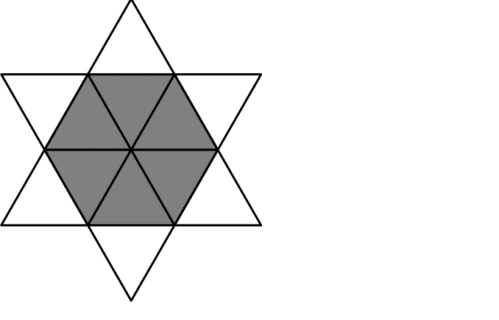
The star shown is made by fitting together 12 congruent equilateral triangles. The perimeter of the star is 36 cm. What is the perimeter of the grey hexagon?
Show answer
Answer: C — 18 cm
Show hints
Hint 1 of 2
The star's outline and the hexagon's outline are both built from those equal triangle edges.
Still stuck? Show hint 2 →
Hint 2 of 2
Count how many equal edges form each outline.
Show solution
Approach: compare edge counts of equal-length segments
The star's outline is made of 12 equal triangle edges, so each edge is 36/12 = 3 cm.
The grey hexagon's perimeter is 6 of those same edges.
What is the smallest number of digits that must be removed from the number 12323314 so that the number left over reads the same forwards and backwards?
Show answer
Answer: C — 3
Show hints
Hint 1 of 2
A palindrome reads the same forwards and backwards; keep the longest such block you can.
Still stuck? Show hint 2 →
Hint 2 of 2
Removing digits is fastest when you keep the longest in-order palindrome and delete the rest.
Show solution
Approach: keep longest palindrome, delete the rest
The number is 1 2 3 2 3 3 1 4.
The longest run of digits that stays in order and reads the same both ways has length 5 (for example 1 2 3 2 1).
Harry does his paper round in Long Street. He has to deliver one newspaper to each house with an odd number. The first house with an odd number is 15 and the last house is number 53. How many houses does Harry have to visit?
Show answer
Answer: B — 20
Show hints
Hint 1 of 2
List the odd house numbers: 15, 17, 19, …, 53.
Still stuck? Show hint 2 →
Hint 2 of 2
Count terms in an arithmetic list with: (last − first)/step + 1.
Show solution
Approach: count terms of an arithmetic progression
The houses are 15, 17, 19, …, 53, stepping by 2.
Number of terms = (53 − 15)/2 + 1 = 38/2 + 1 = 19 + 1 = 20.
Harry delivers newspapers in Long Street. He must deliver a paper to every house with an odd house number. If the first house is number 15 and the last is number 53, to how many houses does Harry deliver?
Show answer
Answer: B — 20
Show hints
Hint 1 of 2
List only the odd numbers from 15 to 53; they rise in steps of 2.
Still stuck? Show hint 2 →
Hint 2 of 2
Use (last - first)/step + 1, and don't forget the +1.
Show solution
Approach: count terms of an arithmetic list
The odd house numbers are 15, 17, 19, ..., 53, increasing by 2.
Mari, Ville and Ossi are going to a coffee shop. Each of them has 3 glasses of juice, 2 cups of ice cream and 5 biscuits. What value could the total bill come up to in the end?
Show answer
Answer: C — €37.20
Show hints
Hint 1 of 2
Each of the three orders the same things, so the bill is three identical orders added up.
Still stuck? Show hint 2 →
Hint 2 of 2
That makes the total a multiple of 3—check which price is divisible by 3.
Show solution
Approach: the total is three equal orders, hence a multiple of 3
Three people each buy 3 + 2 + 5 items, so the bill is 3 × (one person's order).
Therefore the total must be divisible by 3.
Of the choices only €37.20 (3720 cents) is divisible by 3, so the bill is €37.20.
There are three boxes in front of me: one white, one red and one green. One box holds a chocolate bar, another holds an apple, and one box is empty. The chocolate bar is in either the white box or the red box. The apple is in neither the white box nor the green box. In which box is the chocolate bar?
Show answer
Answer: A — White
Show hints
Hint 1 of 2
Start with the apple: it is in neither the white nor the green box.
Still stuck? Show hint 2 →
Hint 2 of 2
Once you place the apple, the chocolate's two options shrink to one.
Show solution
Approach: elimination
The apple is in neither white nor green, so the apple is in the red box.
The chocolate is in the white or the red box, but red now holds the apple.
Therefore the chocolate is in the white box — answer A.
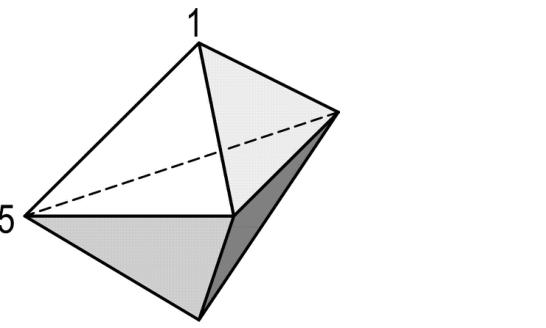
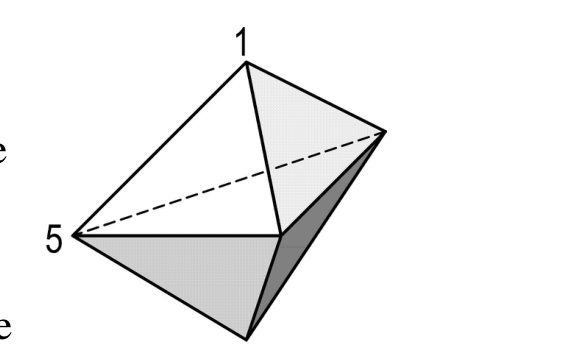
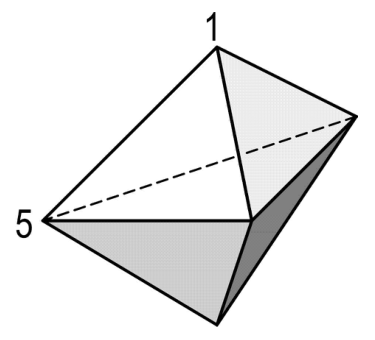
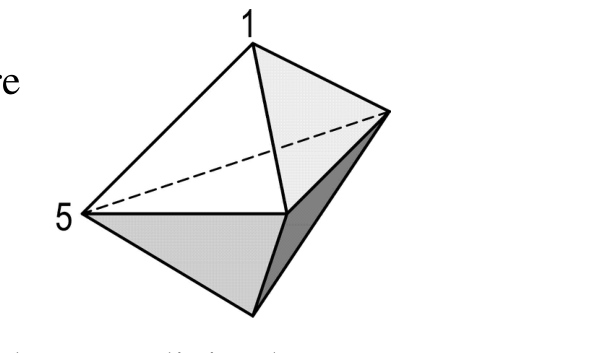
The diagram shows a solid made up of 6 triangles. Each vertex is assigned a number, two of which are indicated. The total of the three numbers on each triangular face is the same. What is the total of all five numbers?
Show answer
Answer: C — 17
Show hints
Hint 1 of 2
Adding the sums of all six faces counts every vertex the same number of times.
Still stuck? Show hint 2 →
Hint 2 of 2
Equal face sums force the three ‘waist’ vertices to be equal and the two tips to be equal.
Show solution
Approach: use equal face sums to collapse the unknowns
Each triangular face joins a tip vertex to two neighbouring waist vertices.
Equal sums make all three waist vertices equal and both tip vertices equal.
The figure marks a tip as 1 and a waist vertex as 5, so the five numbers are 1, 1, 5, 5, 5, totalling 17.
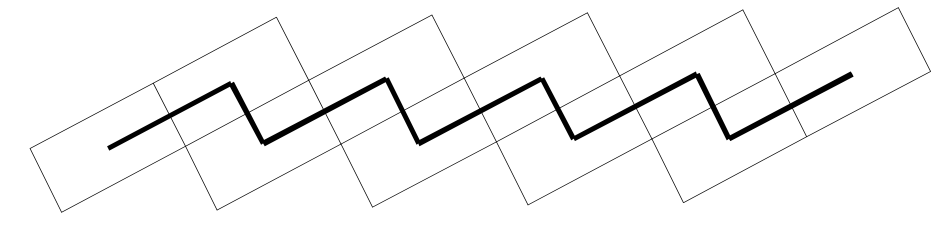
In his garden Tony made a pathway using 10 paving stones. Each paver was 4 dm wide and 6 dm long. He then drew a black line connecting the middle points of each paving stone. How long is the black line?
Show answer
Answer: C — 46 dm
Show hints
Hint 1 of 3
The black line is a chain of straight pieces, each joining the middle of one stone to the middle of the next stone.
Still stuck? Show hint 2 →
Hint 2 of 3
Look at one zig and one zag in the picture: as you cross from a stone to the next, you slide 4 dm sideways and 3 dm up or down (half of the 6 dm length).
Still stuck? Show hint 3 →
Hint 3 of 3
Count how many of those slanted pieces there are between 10 stones.
Show solution
Approach: see one slanted piece, then count the pieces along the zig-zag
The line goes from the middle of each stone to the middle of the next one, so with 10 stones there are 9 slanted pieces.
Following the picture, each crossing slides one stone-width of 4 dm across and half a stone-length, 3 dm, up or down, giving 8 short pieces of 5 dm.
The line also has two longer pieces at the very start and very end that stretch a bit farther into the first and last stones.
Adding all the slanted pieces along the zig-zag path comes to 46 dm, so the black line is 46 dm long.
The circles \(k_1\) (with centre \(M_1\) and radius 13) and \(k_2\) (with centre \(M_2\) and radius 15) intersect each other in the points P and Q. The length of \(PQ\) is 24. What possible value could the distance \(M_1M_2\) be?
Show answer
Answer: D — 14
Show hints
Hint 1 of 2
Drop a perpendicular from each centre to the common chord PQ; it bisects PQ.
Still stuck? Show hint 2 →
Hint 2 of 2
Each centre’s distance to the chord is a leg of a right triangle with the radius.
Show solution
Approach: right triangles from each centre to the chord
Half the chord is 12, so the distance from M₁ to PQ is √(13² − 12²) = 5, and from M₂ it is √(15² − 12²) = 9.
If the centres lie on opposite sides of PQ, M₁M₂ = 5 + 9 = 14.
A long number is built by writing the number 2009 in a row 2009 times. What is the sum of all the odd digits in this number that are immediately to the left of an even digit?
Show answer
Answer: D — 18072
Show hints
Hint 1 of 2
Inside the repeated block 2009, which digit sits just before an even digit?
Still stuck? Show hint 2 →
Hint 2 of 2
Each copy of 2009 contributes the same fixed amount; count how many junctions there are.
Show solution
Approach: find the repeating pattern, then multiply
The string is 2009 2009 2009 … (2009 copies).
Within one block 2-0-0-9, the only odd digit followed by an even one is the 9 before the next block's 2.
That happens at each junction between consecutive blocks: 2008 junctions, each adding 9.
In a drawer there are 2 white, 3 red and 4 blue socks. Lisa knows that one third of the socks have holes, but she does not know the colour of the faulty socks. She randomly picks socks from the drawer until she has a usable pair, i.e. a pair without holes and of equal colour. What is the minimum number of socks she has to draw to be certain of getting a usable pair?
Show answer
Answer: D — 7
Show hints
Hint 1 of 2
Picture an adversary who hands you the worst possible socks before you can win.
Still stuck? Show hint 2 →
Hint 2 of 2
The worst run is all faulty socks plus one good sock of every colour—count those, then add one.
Show solution
Approach: worst-case (pigeonhole) counting
Three socks have holes; even if you draw all three, they cannot help.
You could then draw one good sock of each colour (white, red, blue) without a matching pair: 3 more.
After 3 + 3 = 6 socks you might still have no usable pair, so the 7th guarantees one. Answer 7.
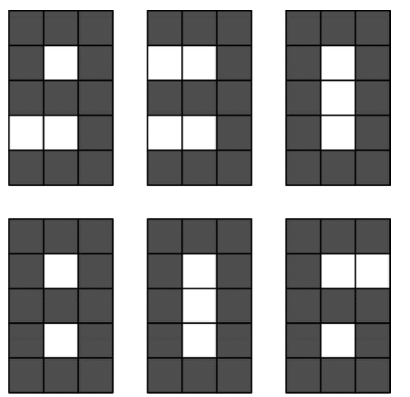
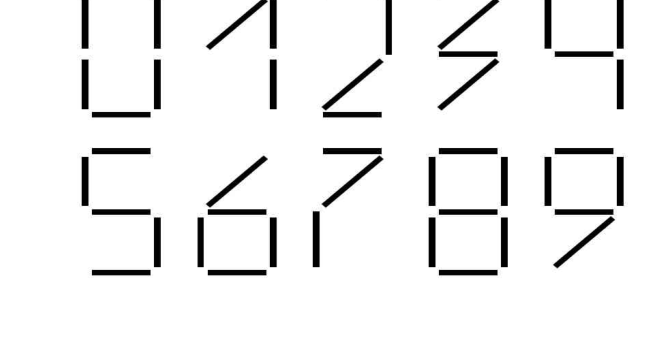
Each digit is built from sticks as shown. The “weight” of a number is the number of sticks used to build it. What is the weight of the heaviest two-digit number?
Show answer
Answer: E — 14
Show hints
Hint 1 of 2
Count the sticks each digit needs, like a calculator display.
Still stuck? Show hint 2 →
Hint 2 of 2
Use the two digits that need the most sticks to make the heaviest number.
Show solution
Approach: seven-segment stick count
By the stick pictures, the digit 8 needs 7 sticks, the most of any digit.
To make the heaviest two-digit number, put 8 in both places: 88.
A certain film lasts 90 minutes. It begins at 17:10. During the film there are two advert breaks, one lasting eight minutes and the other five minutes. At what time will the film end?
Show answer
Answer: D — 18:53
Show hints
Hint 1 of 2
Add the film length and both break lengths to the start time.
Still stuck? Show hint 2 →
Hint 2 of 2
Work in minutes from 17:10.
Show solution
Approach: add all the durations to the start time
The film runs 90 minutes and the breaks add 8 + 5 = 13 minutes.
Total time on screen and breaks: 90 + 13 = 103 minutes.
Starting at 17:10, add 103 minutes: 17:10 + 1 h 43 min = 18:53.
The diagram on the right shows a solid made up of 6 triangles. Each vertex is assigned a number, two of which are shown. The total of the three numbers on each triangular face is the same. What is the total of all five numbers?
Show answer
Answer: C — 17
Show hints
Hint 1 of 2
The solid is a triangular bipyramid: two apexes and a middle triangle of three vertices.
Still stuck? Show hint 2 →
Hint 2 of 2
Equal face sums force the three middle vertices to be equal and the two apexes to be equal.
Show solution
Approach: use equal triangle sums to pin down the vertex values
Label the two tips t and the three middle vertices m₁,m₂,m₃.
Each face uses one tip and two middle vertices; equal sums force m₁=m₂=m₃=m and both tips equal to t.
The two given numbers 1 and 5 must be t and m; taking t=1, m=5 gives matching face sums.
A bridge is being built across a river that is 120 m wide. One quarter of the bridge continues onto the land on the left bank, and another quarter continues onto the land on the right bank. How long is the bridge?
Show answer
Answer: D — 240 m
Show hints
Hint 1 of 2
A quarter on each bank means half the bridge is over the water.
Still stuck? Show hint 2 →
Hint 2 of 2
If the river part is half the bridge and equals 120 m, scale up.
Show solution
Approach: part-to-whole
One quarter is on the left land and one quarter on the right land, so half the bridge is over the river.
That river half is 120 m.
So the whole bridge is 2 × 120 = 240 m — answer D.
In a dance group there are 25 boys and 19 girls. Every week 2 more boys and 3 more girls join the group. After how many weeks will there be the same number of boys as girls in the dance group?
Show answer
Answer: A — 6
Show hints
Hint 1 of 2
The girls start behind but gain on the boys each week.
Still stuck? Show hint 2 →
Hint 2 of 2
How many more girls than boys arrive each week, and how big is the gap to close?
Show solution
Approach: close the gap one week at a time
At the start there are 25 boys and 19 girls: 6 more boys.
Each week 3 girls and 2 boys join, so the girls gain 1 on the boys per week.
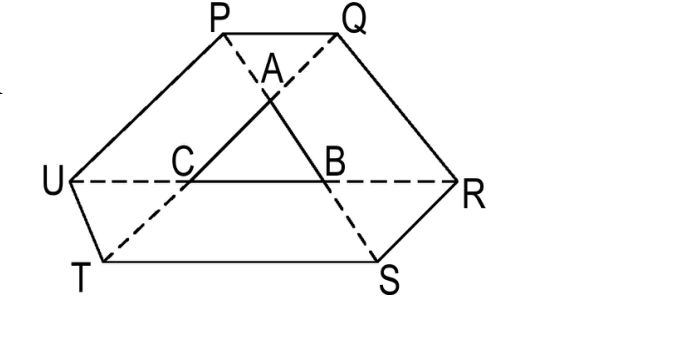
Each side of a triangle ABC is extended to the points P, Q, R, S, T and U, so that \(PA=AB=BS\), \(TC=CA=AQ\) and \(UC=CB=BR\). The area of ABC is 1. How big is the area of the hexagon PQRSTU?
Show answer
Answer: D — 13
Show hints
Hint 1 of 2
Each extension creates triangles that share a base and height with ABC, so compare areas piece by piece.
Still stuck? Show hint 2 →
Hint 2 of 2
Count how many copies of [ABC] (= 1) tile the whole hexagon.
Show solution
Approach: split the hexagon into triangles equal in area to ABC
Extending each side to double-length builds outer triangles each with area related to [ABC] = 1.
Summing the central triangle and the six outer pieces tiles the hexagon with 13 unit-area triangles.
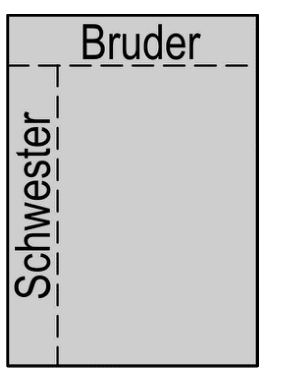
Peter shared a bar of chocolate. First he broke off a row with five pieces for his brother. Then he broke off a column with 7 pieces for his sister. How many pieces were there in the entire bar of chocolate?
Show answer
Answer: D — 40
Show hints
Hint 1 of 2
A 'row of five' tells you how many columns the bar has; a 'column of seven' tells you how many rows.
Still stuck? Show hint 2 →
Hint 2 of 2
Be careful: the column he breaks off is from what is LEFT after the first row is gone.
Show solution
Approach: recover the grid dimensions, then multiply
A row holds 5 pieces, so the bar is 5 columns wide.
After removing that row, a full column still has 7 pieces, so the bar has 7 + 1 = 8 rows.
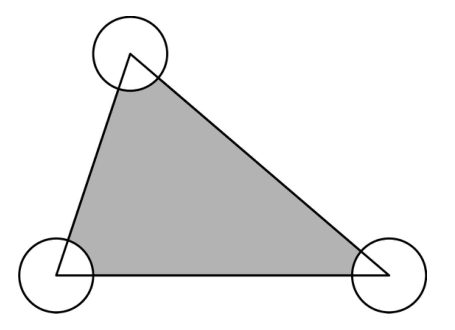
The area of the triangle shown equals 80 m². Each circle has a radius of 2 m and its centre is at one of the vertices of the triangle. What is the area of the grey shaded region (in m²)?
Show answer
Answer: B — 80 − 2π
Show hints
Hint 1 of 2
The grey region is the triangle with three circular wedges removed at the corners.
Still stuck? Show hint 2 →
Hint 2 of 2
The three corner angles of any triangle add to 180° — a half turn.
Show solution
Approach: subtract the three corner sectors from the triangle
At each vertex a circular sector of radius 2 is cut out of the triangle.
The three sector angles are the triangle's interior angles, which total 180° = half a full circle.
Together they form half a circle of radius 2: area = ½·π·2² = 2π.
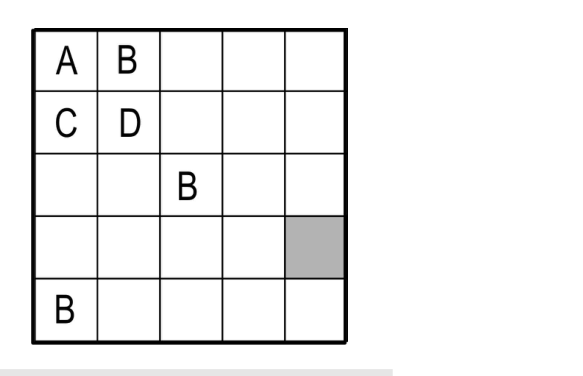
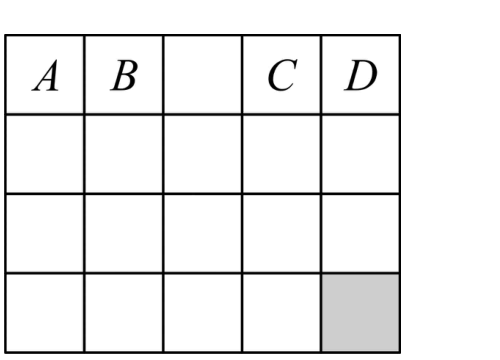
In the diagram we want to colour the fields with the colours A, B, C and D so that adjacent fields always have different colours. (Even fields that share only one corner count as adjacent.) Some fields have already been coloured in. In which colour can the grey field be coloured?
Show answer
Answer: D — either C or D
Show hints
Hint 1 of 2
Start from the filled 2×2 block and propagate the ‘different even diagonally’ rule outward.
Still stuck? Show hint 2 →
Hint 2 of 2
Track exactly which colours are forbidden for the grey field by its coloured neighbours and their forced neighbours.
Show solution
Approach: propagate the king-adjacency constraints
Filling cells one at a time, each new cell must differ from all eight neighbours (corners included).
Carrying the forced colours across the grid leaves the grey field free to be coloured C or D, but not A or B.
A farmer has 30 cows, some chickens and no other animals. The total number of chicken legs is equal to the total number of cow legs. How many animals does the farmer have?
Show answer
Answer: B — 90
Show hints
Hint 1 of 2
Count the cow legs first.
Still stuck? Show hint 2 →
Hint 2 of 2
Chicken legs match cow legs, so work out how many chickens that is.
Show solution
Approach: match leg counts, then total the animals
30 cows have 30 × 4 = 120 legs.
The chickens have the same number of legs: 120.
Each chicken has 2 legs, so there are 120 ÷ 2 = 60 chickens.
Leonhard made up a sequence in which, starting with the third term, each term is the sum of the previous two terms. The fourth term is 6 and the sixth term is 15. What is the seventh term of the sequence?
Show answer
Answer: E — 24
Show hints
Hint 1 of 2
Each term is the sum of the two before it; write the 4th and 6th in terms of the first two.
Still stuck? Show hint 2 →
Hint 2 of 2
Two equations in the first two terms pin everything down.
Show solution
Approach: set up the recurrence from the two known terms
Let the first two terms be a and b. Then t₄ = a + 2b = 6 and t₆ = 3a + 5b = 15.
Solving gives b = 3 and a = 0, so the sequence is 0, 3, 3, 6, 9, 15, …
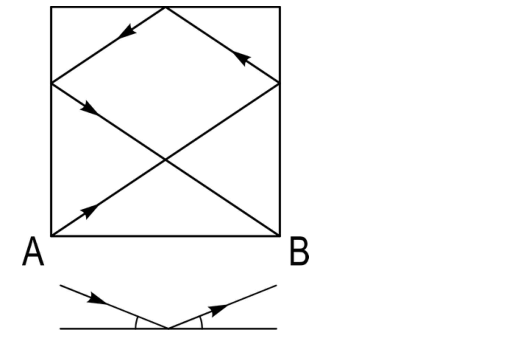
A (very small) ball is kicked off from point A on a square billiard table with side length 2 m. After moving along the shown path and touching the sides three times as indicated, the path ends at point B. How long is the path that the ball travels from A to B? (As indicated: angle of incidence = angle of reflection.)
Show answer
Answer: B — \(2\sqrt{13}\)
Show hints
Hint 1 of 2
Unfold each bounce by reflecting the table, turning the zig-zag into one straight segment.
Still stuck? Show hint 2 →
Hint 2 of 2
The straight unfolded distance is the hypotenuse of a right triangle whose legs come from the reflections.
Show solution
Approach: reflect (unfold) the bounces into a straight line
Reflecting the square at each bounce straightens the path into a single line from A to the final image of B.
That line is the hypotenuse of a right triangle with legs 4 and 6 (in units of the 2 m side).
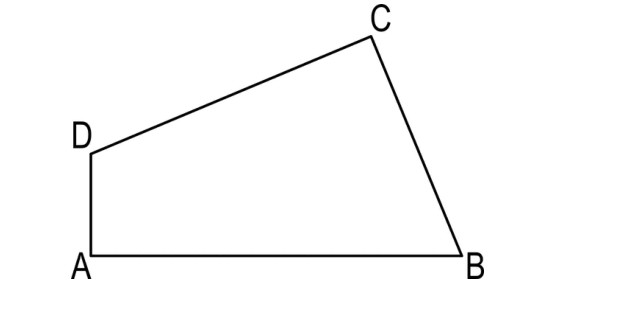
The quadrilateral on the right has side lengths AB = 11, BC = 7, CD = 9 and DA = 3. The angles at A and C are right angles. What is the area of the quadrilateral?
Show answer
Answer: C — 48
Show hints
Hint 1 of 2
The two right angles let you split the shape with diagonal BD into two right triangles.
Still stuck? Show hint 2 →
Hint 2 of 2
Add the areas of right triangle ABD (legs 11 and 3) and right triangle CBD (legs 7 and 9).
Show solution
Approach: split into two right triangles
Draw diagonal BD. Angle A is a right angle, so triangle ABD has legs AB = 11 and AD = 3.
Its area is ½ × 11 × 3 = 16.5.
Angle C is a right angle, so triangle CBD has legs BC = 7 and CD = 9, area ½ × 7 × 9 = 31.5.
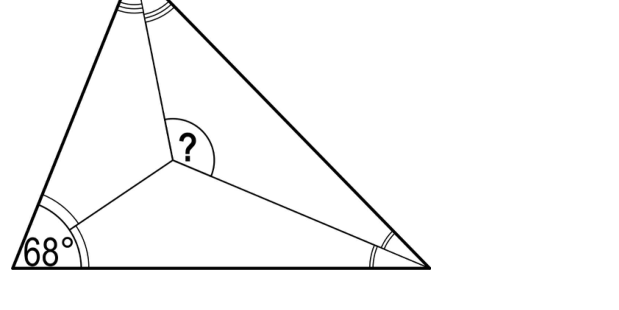
In the triangle shown, one interior angle measures 68°. The three angle bisectors of the triangle are drawn. What is the size of the angle marked with a question mark?
Show answer
Answer: B — 124°
Show hints
Hint 1 of 2
The three bisectors meet at the incenter; the marked angle is one of the angles there.
Still stuck? Show hint 2 →
Hint 2 of 2
The incenter angle facing a vertex equals 90° plus half that vertex's angle.
Show solution
Approach: use the incenter angle formula
The bisectors meet at the incenter, and the marked angle faces the 68° vertex.
The two bisectors meeting there come from the other vertices B and C; that angle is 90° + (A/2).
With A = 68°, the marked angle = 90° + 34° = 124°.
In a group of 2009 kangaroos each one is either light or dark. The smallest of the light kangaroos is bigger than exactly 8 dark kangaroos. One light one is bigger than exactly 9 dark ones, another light one is bigger than exactly 10 dark ones, and so on. Exactly one light kangaroo is bigger than all dark kangaroos. How many light kangaroos are there?
Show answer
Answer: B — 1001
Show hints
Hint 1 of 2
Line up the light kangaroos by size and read off how many darks each one beats.
Still stuck? Show hint 2 →
Hint 2 of 2
The counts 8, 9, 10, … rise by one per light kangaroo until one beats every dark.
Show solution
Approach: match each light kangaroo to its ‘beats-this-many-darks’ count
The k-th smallest light kangaroo beats exactly 7 + k dark kangaroos.
The largest light beats all D darks, so 7 + L = D, where L lights and D darks total 2009.
A dance group has 39 boys and 23 girls. Every week 6 more boys and 8 more girls join the group. After some weeks there will be the same number of boys as girls. How many boys and girls will be in the dance group then?
Show answer
Answer: D — 174
Show hints
Hint 1 of 2
At the start there are more boys than girls — how big is that gap?
Still stuck? Show hint 2 →
Hint 2 of 2
Each week girls gain 8 but boys gain only 6, so watch how much the gap shrinks every week.
Show solution
Approach: close the gap week by week
At the start there are 39 − 23 = 16 more boys than girls.
Each week the girls gain 8 and the boys gain 6, so the gap shrinks by 2 every week.
To close a gap of 16 at 2 per week takes 16 ÷ 2 = 8 weeks; then boys = 39 + 8×6 = 87 and girls = 23 + 8×8 = 87.
Together that is 87 + 87 = 174 — answer D.
Algebra version (older kids)Set 39 + 6w = 23 + 8w, so 16 = 2w and w = 8, giving 174.
Maria can score 0, 1, 2, 3, 4 or 5 points on a test. After 4 tests she has a mean of exactly 4. One of the following statements therefore cannot be true. Which one is it?
Show answer
Answer: E — Maria scored 3 exactly three times.
Show hints
Hint 1 of 2
A mean of 4 over 4 tests means the four scores total 16.
Still stuck? Show hint 2 →
Hint 2 of 2
Check which statement forces a score above the maximum of 5.
Show solution
Approach: test each statement against total = 16 and max score 5
Four scores averaging 4 must sum to 16, with each score between 0 and 5.
Three scores of 3 already total 9, leaving 7 for the last test — impossible since the max is 5.
Every other statement can be completed within the rules, so the impossible one is E.
Nick measured all 6 angles in two triangles. One of the triangles was acute-angled and the other obtuse-angled. He noted four of the angles to be 120°, 80°, 55° and 10°. What is the size of the smallest angle in the acute-angled triangle?
Show answer
Answer: A — 45°
Show hints
Hint 1 of 2
The 120 degree angle must belong to the obtuse triangle; the acute triangle's angles are all below 90.
Still stuck? Show hint 2 →
Hint 2 of 2
Split the four given angles so one triangle is obtuse and the other has three angles under 90 summing to 180.
Show solution
Approach: sort the angles into the two triangles
The obtuse triangle holds 120, leaving 60 for its other two angles, e.g. 10 and 50.
The acute triangle then uses 80 and 55, needing a third angle of 180 - 80 - 55 = 45 (all under 90 - valid).
The smallest angle in the acute triangle is 45 degrees.
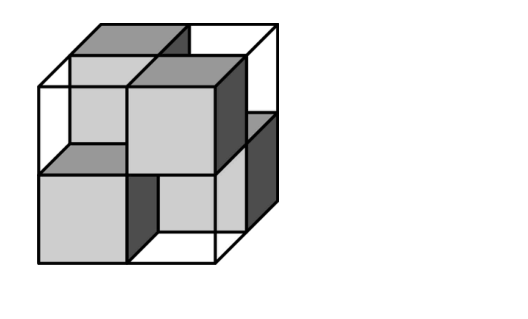
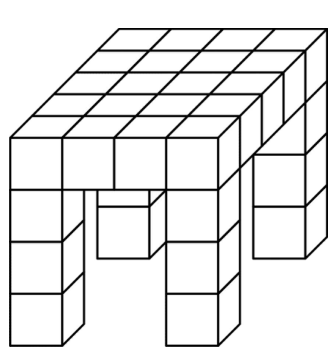
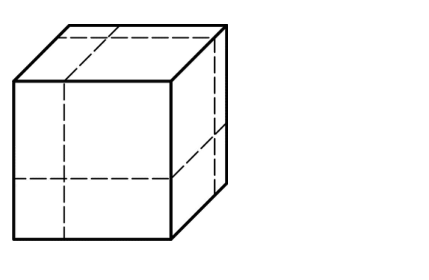
In the diagram a \(2\times 2\times 2\) cube is made up of four transparent \(1\times 1\times 1\) cubes and four non-transparent black \(1\times 1\times 1\) cubes. They are placed so that the entire big cube is non-transparent; i.e. looking at it from front to back, right to left, or top to bottom, at no point can you see through the cube. What is the minimum number of black \(1\times 1\times 1\) cubes needed to make a \(3\times 3\times 3\) cube non-transparent in the same way?
Show answer
Answer: B — 9
Show hints
Hint 1 of 2
Think of the lines of sight: every straight line through the cube along a face direction must hit a black cube.
Still stuck? Show hint 2 →
Hint 2 of 2
Count how many such lines there are and how many lines one black cube can block at once.
Show solution
Approach: cover every line of sight with as few cubes as possible
For a 3×3×3 cube there are 9 lines in each of the three directions: 27 lines that must each contain a black cube.
One black cube lies on exactly one line per direction, so it blocks 3 lines.
Thus at least 27 ÷ 3 = 9 cubes are needed, and 9 can be arranged to work. Answer 9.
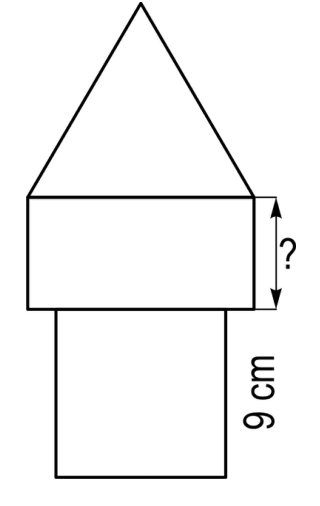
The “tower” in the diagram is made up of a square, a rectangle and an equilateral triangle. Each of these three shapes has the same perimeter. The side length of the square is 9 cm. How long is the marked side of the rectangle?
Show answer
Answer: C — 6 cm
Show hints
Hint 1 of 2
All three shapes share one perimeter — find it from the square first.
Still stuck? Show hint 2 →
Hint 2 of 2
The triangle's side fixes the rectangle's long side; use the shared perimeter to get the other side.
Show solution
Approach: equal perimeters
The square has side 9, so its perimeter is 4 × 9 = 36; every shape has perimeter 36.
The equilateral triangle has side 36 ÷ 3 = 12, which is the rectangle's longer side.
The rectangle's perimeter 2(12 + h) = 36 gives h = 6.
So the indicated side of the rectangle is 6 cm — answer C.
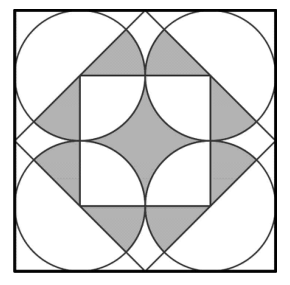
Don't measure the curves one by one - look for symmetry that pairs grey bulges with white bites.
Still stuck? Show hint 2 →
Hint 2 of 2
The circular bulges and bites cancel, leaving a clean fraction of the square.
Show solution
Approach: use symmetry to cancel curved pieces
The figure is built from circles, a tilted square and a central square with full four-fold symmetry.
By symmetry every curved piece sticking out of the grey is matched by an equal curved bite taken from it, so the grey equals a plain straight-edged region.
On the island of nobles and liars, 25 people are standing in a queue. The first person in the line claims that everybody behind him is a liar. Each of the other people claims that the person in front of him is a liar. How many liars are actually in the queue? (Nobles always tell the truth and liars always lie.)
Show answer
Answer: C — 13
Show hints
Hint 1 of 2
Each person’s claim is about the one right in front, which forces neighbours to be of opposite type.
Still stuck? Show hint 2 →
Hint 2 of 2
Decide the first person’s type by testing his claim about everyone behind him.
Show solution
Approach: force an alternating pattern, then fix the start
A claim ‘the person in front is a liar’ makes each pair of neighbours opposite types, so the line strictly alternates.
If the first were a noble, all 24 behind would be liars—impossible under alternation—so the first is a liar.
Three squirrels Anni, Asia and Elli have collected 7 nuts. They have all collected a different amount of nuts, and everybody has collected at least one nut. Anni has collected the least and Asia the most. How many nuts has Elli collected?
Show answer
Answer: B — 2
Show hints
Hint 1 of 2
All three counts are different whole numbers, each at least 1, adding to 7.
Still stuck? Show hint 2 →
Hint 2 of 2
With Anni smallest and Asia largest, try the smallest possible values for Anni.
Show solution
Approach: find the only set of three distinct positive numbers summing to 7
The three counts are different and each at least 1, with Anni least and Asia most.
The smallest Anni can be is 1; the three must still differ and sum to 7.
1 + 2 + 4 = 7 is the only way, so Anni = 1, Elli = 2, Asia = 4.
On the island of nobles and liars, 25 people are standing in a queue. The first person in the line claims that everybody behind him is a liar. Each of the other people claims that the person in front of him is a liar. How many liars are actually in the queue? (Nobles always tell the truth and liars always lie.)
Show answer
Answer: C — 13
Show hints
Hint 1 of 2
Every person from the 2nd on calls the person in front a liar, so neighbours must be opposite types.
Still stuck? Show hint 2 →
Hint 2 of 2
That forces a strict alternation — then check the first person's claim.
Show solution
Approach: force alternating types, then fix the start
Each person (from the 2nd) calls the one in front a liar, so any two neighbours have opposite types: types alternate.
If person 1 were a noble, his claim 'all behind are liars' would fail (alternation puts nobles behind him).
So person 1 is a liar; then positions 1,3,5,…,25 are liars and the even positions are nobles.
On the island of the truth-tellers and the liars, there are 25 people standing in a line. The person at the front claims that everybody standing behind him is a liar. Everybody else claims that the person standing in front of them is a liar. How many liars are standing in the line? (Truth-tellers always tell the truth and liars always lie.)
Show answer
Answer: C — 13
Show hints
Hint 1 of 2
Suppose the front person tells the truth and check whether the chain stays consistent.
Still stuck? Show hint 2 →
Hint 2 of 2
Once the front person must be a liar, the labels alternate down the line.
Show solution
Approach: test the front person, then alternate
If person 1 were truthful, everyone behind would be a liar; but then liar person 3 calling liar person 2 a liar would be true - contradiction. So person 1 lies.
Person 2 truthfully calls person 1 a liar, so person 2 tells the truth; the labels then alternate, putting liars at the odd positions.
Among 25 people the odd positions 1, 3, ..., 25 give 13 liars.
Today is Sunday. Francis starts reading a 290-page book today. On Sundays he reads 25 pages, and on every other day he reads 4 pages, with no exception. How many days does it take him to read the whole book?
Show answer
Answer: E — 41
Show hints
Hint 1 of 2
Group the week: one Sunday plus six ordinary days makes a fixed weekly total.
Still stuck? Show hint 2 →
Hint 2 of 2
Each full week reads 25 + 6×4 = 49 pages; see how many weeks fit into 290.
Show solution
Approach: weekly chunks then finish
A week reads 25 (Sunday) + 6 × 4 = 49 pages.
After 5 weeks (35 days) he has read 5 × 49 = 245 pages, leaving 45.
Day 36 is a Sunday (25 pages), reaching 270 with 20 left; then 5 days of 4 pages finish it.
The diagram shows an object with 6 triangular faces. On each corner there is a number (two are shown). The sum of the numbers on the corners of each face is the same. What is the sum of all 5 numbers?
Show answer
Answer: C — 17
Show hints
Hint 1 of 2
Equal face-sums force just two values: the two tips are equal and the three middle corners are equal.
Still stuck? Show hint 2 →
Hint 2 of 2
Use the two shown numbers to tell which value is a tip and which is a middle corner.
Show solution
Approach: exploit equal face sums to find the two values
The solid is a triangular bipyramid: two tips plus three middle corners. Equal face sums force all three middle corners equal and both tips equal.
The shown 1 is a tip and the shown 5 is a middle corner, so the numbers are 1, 1 (tips) and 5, 5, 5 (middle).
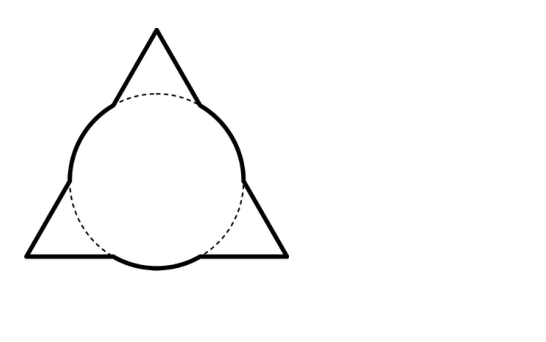
An equilateral triangle with side length 3 and a circle with radius 1 have the same centre. What is the perimeter of the figure created when the two are put together?
Show answer
Answer: A — \(6+\pi\)
Show hints
Hint 1 of 2
Decide where the circle pokes out past the triangle and where the corners poke out past the circle.
Still stuck? Show hint 2 →
Hint 2 of 2
The outline is the three straight side-pieces plus the bulging circular arcs; add their lengths.
Show solution
Approach: trace the union’s boundary, mixing straight pieces and arcs
The circle (radius 1) reaches past each side’s midpoint, replacing a chunk of each side with an outward arc, while the sharp corners stay.
Adding the leftover straight pieces and the three equal arcs, the lengths combine to 6 + π.
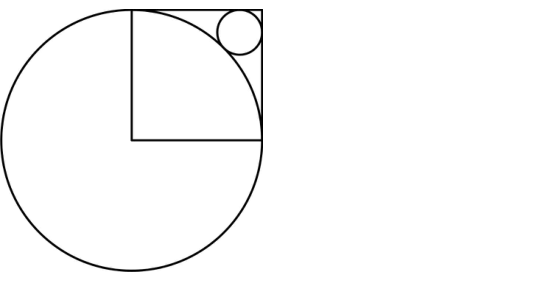
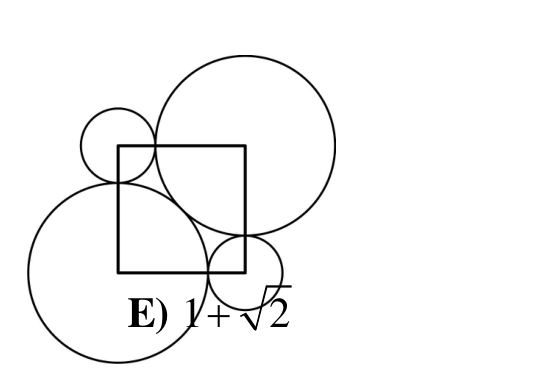
The centres of the four circles shown are at the corners of the square. The two big circles touch each other and also touch the two little circles. By what factor must you multiply the radius of the little circles to obtain the radius of the big circles?
Show answer
Answer: E — \(1+\sqrt{2}\)
Show hints
Hint 1 of 2
The two big circles touch along the square's diagonal; the big and small circles touch along a side.
Still stuck? Show hint 2 →
Hint 2 of 2
Write both touching conditions in terms of the side length, then take the ratio R/r.
Show solution
Approach: relate radii through the diagonal and the side
Let the square have side s, big radius R, small radius r.
Two big circles at opposite corners touch across the diagonal: 2R = s√2, so R = s/√2.
A big and a small circle touch along a side: R + r = s, so r = s − s/√2.
In the equation E×I×G×H×TF×O×U×R = T×W×O each letter represents a certain digit (the same letter represents the same digit each time). How many different values can the expression T·H·R·E·E have?
Show answer
Answer: A — 1
Show hints
Hint 1 of 2
Ten different letters stand for the ten different digits - so one of them must be 0.
Still stuck? Show hint 2 →
Hint 2 of 2
Ask what the product T x H x R x E x E becomes once a 0 is in play.
Show solution
Approach: spot the forced zero
The ten distinct letters use every digit 0-9, so exactly one letter is 0.
A 0 sits among T, H, R, E in any valid arrangement, making the product T x H x R x E x E equal to 0.
So the expression can take only 1 value (it is always 0).
Eight cards numbered 1 to 8 are placed in two boxes A and B so that the sum of the cards in each box is the same. If box A holds exactly 3 cards, which of the following statements is definitely true?
Show answer
Answer: D — The card numbered 2 is in B.
Show hints
Hint 1 of 2
The eight cards add to 36, so each box must total 18.
Still stuck? Show hint 2 →
Hint 2 of 2
List the 3-card sets that make 18; then see which card lands in the other box every time.
Show solution
Approach: check all valid splits
1+2+…+8 = 36, so each box sums to 18.
Box A's three cards summing to 18 can be {3,7,8}, {4,6,8} or {5,6,7}.
In every one of these, the leftover box B contains the card 2.
So 'the card numbered 2 is in B' is the statement that is always true — answer D.
Anna and Peter live in the same street. On one side of Anna’s house there are 27 houses, and on the other side 13 houses. Peter lives in the house right in the middle of the street. How many houses are there between Anna’s and Peter’s houses?
Show answer
Answer: A — 6
Show hints
Hint 1 of 2
Count all the houses: 27 on one side, Anna's own, and 13 on the other.
Still stuck? Show hint 2 →
Hint 2 of 2
Peter is the exact middle house; count the gap between his and Anna's positions.
Show solution
Approach: number the houses and locate Anna and Peter
There are 27 + 1 + 13 = 41 houses, so the middle (Peter's) house is the 21st.
Anna has 27 houses on one side, so she is the 28th house from that end.
Houses strictly between the 21st and the 28th: 28 − 21 − 1 = 6.
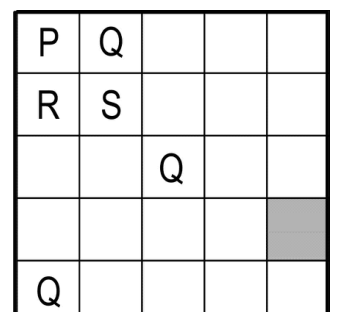
We want to paint each square in the grid with the colours P, Q, R and S, so that neighbouring squares always have different colours. (Squares which share the same corner point also count as neighbouring.) Some of the squares are already painted. In which colour(s) could the grey square be painted?
Show answer
Answer: D — either R or S
Show hints
Hint 1 of 2
'Share a corner' counts as neighbouring, so no colour repeats among any block of touching cells.
Still stuck? Show hint 2 →
Hint 2 of 2
Propagate the forced colours toward the grey cell and see which colours survive.
Show solution
Approach: forced colouring with king-move adjacency
With touching-corner cells counting as neighbours, every cell must differ from all 8 around it.
Filling the grid from the given P, Q, R, S forces the colours toward the grey square, and exactly two choices survive every constraint.
100 students take an exam with 4 questions. 90 solve the first question, 85 the second, 80 the third and 70 the fourth. Determine the smallest possible number of students that have solved all four questions.
Show answer
Answer: D — 25
Show hints
Hint 1 of 2
Count the ‘misses’ rather than the solves: how many failures are there in total?
Still stuck? Show hint 2 →
Hint 2 of 2
Spread the failures over as many different students as possible to minimise those who got everything.
Show solution
Approach: count failures and subtract from 100
The numbers who missed each question are 10, 15, 20, 30, totalling 75 failures.
At best each failure falls on a different student, so at most 75 students missed something.
Then at least 100 − 75 = 25 students solved all four.
Andrea, Branimir, Celestin and Doris (not necessarily in this order) finish a fencing tournament ranked first to fourth. Adding Andrea’s, Branimir’s and Doris’s ranks gives a total of 6. Adding Branimir’s and Celestin’s ranks gives the same total. Who won the tournament if Branimir finished ahead of Andrea?
Show answer
Answer: D — Doris
Show hints
Hint 1 of 2
Use that all four ranks add to 1+2+3+4 = 10.
Still stuck? Show hint 2 →
Hint 2 of 2
From A+B+D = 6 find Celestin's rank, and from B+C = 6 find Branimir's, then place the rest.
Show solution
Approach: sum constraint
Ranks 1–4 total 10. A + B + D = 6 means Celestin's rank C = 4.
B + C = 6 with C = 4 gives Branimir B = 2.
Remaining ranks 1 and 3 go to Andrea and Doris; Branimir(2) beat Andrea, so Andrea = 3 and Doris = 1.
A secret agent wants to crack a six-digit code. He knows that the sum of the digits in the even positions is equal to the sum of the digits in the odd positions. Which of the following numbers is the code? (Each ? stands for an unknown digit.)
Show answer
Answer: D — 12?9?8
Show hints
Hint 1 of 3
For each number, circle the digits in the 1st, 3rd and 5th spots, and box the digits in the 2nd, 4th and 6th spots.
Still stuck? Show hint 2 →
Hint 2 of 3
The known digits in one group might already be too big for the other group to ever catch up, even using a 9 in each blank.
Still stuck? Show hint 3 →
Hint 3 of 3
Look for the one number whose two groups CAN be made equal.
Show solution
Approach: compare the known digits in the two groups and see which one can balance
Add up the known digits in the odd spots (1st, 3rd, 5th) and in the even spots (2nd, 4th, 6th), and remember a blank can be at most 9.
In A, B, C and E one group's known digits are already so far ahead that even filling the other group's blanks with 9 cannot make them equal.
In D the number is 12?9?8: the even spots give 2 + 9 + 8 = 19, and the odd spots are 1 + ? + ?, which reaches 19 when both blanks are 9 (1 + 9 + 9 = 19).
Only option D can have its two groups equal, so the code is option D.
Friday writes several different positive whole numbers, all less than 11, next to each other in the sand. Robinson Crusoe looks at the sequence and notices with amusement that adjacent numbers are always divisible by each other. What is the maximum amount of numbers he could possibly have written in the sand?
Show answer
Answer: D — 9
Show hints
Hint 1 of 2
Among 1–10, each neighbour pair must have one number dividing the other.
Still stuck? Show hint 2 →
Hint 2 of 2
Treat numbers as dots and 'divides' as links, then find the longest chain of distinct numbers.
Show solution
Approach: build the longest chain of distinct numbers where each neighbour pair divides
Among 1–10, the only number that 7 divides or that divides 7 is 1 (since 14 is too big), so 7 can sit next to 1 only — meaning 7 must be an end of the row, touching 1.
If all ten numbers were used, 7 would need that single end spot, but then the rest of 1–10 still cannot all be chained, so 10 numbers is impossible.
Drop 7 and a valid row of 9 exists: 9, 3, 6, 2, 4, 8, 1, 5, 10, where every neighbour pair has one dividing the other.
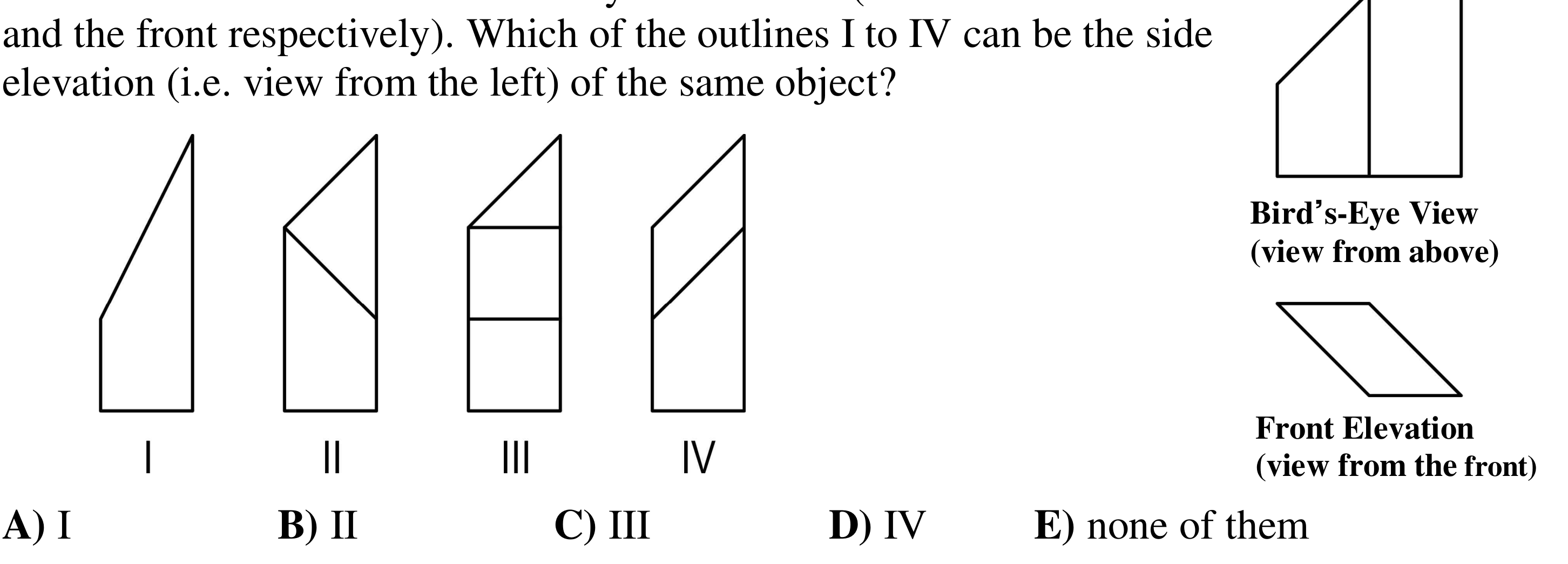
The diagram shows the bird’s-eye view and front elevation of a solid that is defined by flat surfaces (i.e. the view from above and from the front respectively). Which of the outlines I to IV can be the side elevation (i.e. the view from the left) of the same object?
Show answer
Answer: D — IV
Show hints
Hint 1 of 2
From the two given views, read off the solid’s height profile across its width and depth.
Still stuck? Show hint 2 →
Hint 2 of 2
Test each candidate side outline against that profile—only one can come from the same solid.
Show solution
Approach: reconstruct the solid’s outline from the two given views
The top view and the front view together constrain the solid’s heights along each direction.
Checking each candidate side elevation against those constraints, only outline IV is consistent with both given views.
The diagram shows an object with 6 triangular faces. There is a number at each corner (two of them are shown). The sum of the numbers at the corners of each triangular face is the same. What is the sum of all 5 numbers?
Show answer
Answer: C — 17
Show hints
Hint 1 of 2
Equal triangle sums tie the corner numbers together — use the two shown values 1 and 5.
Still stuck? Show hint 2 →
Hint 2 of 2
Pair up the corners so each triangle's sum matches, then add all five corners.
Show solution
Approach: equal face sums
Every triangular face has the same corner sum, which links the five corner numbers.
Fitting the shown 1 and 5 into that condition forces the remaining corners.
Adding all five corner numbers gives 17 — answer C.
Meta collects pictures of famous sports people. Each year she collects as many pictures as she did in the previous two years. In 2008 she had 60 photos and this year she has 96. How many photos did she have in 2006?
Show answer
Answer: B — 24
Show hints
Hint 1 of 2
Each year's count equals the previous two years added together.
Still stuck? Show hint 2 →
Hint 2 of 2
You know 2008 and 2009; work backwards to find 2007, then 2006.
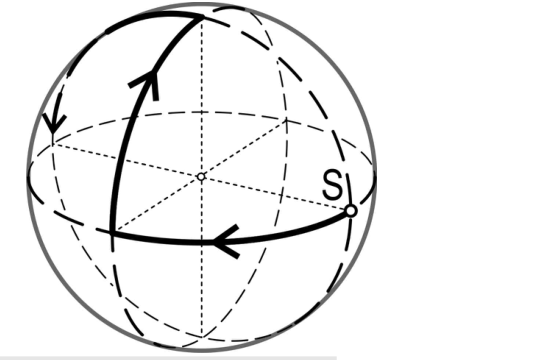
There are three great circles on a sphere that intersect each other at right angles. Starting at point S, a little bug moves along the great circles in the direction indicated. At each crossing it turns alternately to the right or to the left. How many quarter circles does it crawl along until it is back at point S?
Show answer
Answer: A — 6
Show hints
Hint 1 of 2
The three perpendicular great circles meet at six points (the axis tips); each arc between them is a quarter circle.
Still stuck? Show hint 2 →
Hint 2 of 2
Track the turns: with the right/left alternation the path closes after surprisingly few quarter-arcs.
Show solution
Approach: trace the alternating-turn path between the six crossing points
Three mutually perpendicular great circles cross at six points (like the six face-centres of a cube); each arc from one crossing to the next neighbouring crossing is a quarter circle.
From S the bug reaches a crossing after one quarter arc, turns, takes the next quarter arc, and so on, alternating right and left.
Tracing this alternating walk closes the loop after visiting six such crossings, so it covers six quarter circles before returning to S.
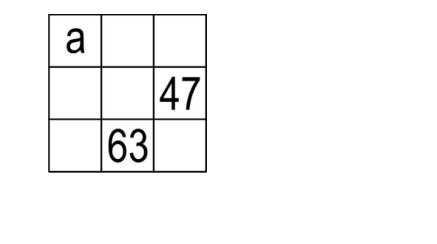
The sum of the numbers in each row, column and diagonal in the “magic square” on the right is always constant. Only two numbers are visible. Which number is missing in field a?
Show answer
Answer: D — 55
Show hints
Hint 1 of 2
Use that every line, column and both diagonals share the same total S.
Still stuck? Show hint 2 →
Hint 2 of 2
Combine a few of those equal-sum lines so the unknown cell pops out on its own.
Show solution
Approach: add and subtract equal-sum lines to isolate the corner
Writing each row, column and diagonal as equal to S gives a linear system in the cells.
Combining the equations forces the corner cell a to a single value regardless of the others.
The rooms in a hotel each have a three-digit number. The first digit gives the floor and the last two digits give the room number on that floor; for example, room 125 is on floor 1, room 25. The hotel has 5 floors (1 to 5) with 35 rooms on each floor, so floor 1 has rooms 101 to 135, and so on. How many times does the digit 2 appear in all the room numbers of the hotel?
Show answer
Answer: E — 105 times
Show hints
Hint 1 of 2
Split a room number into the floor digit and the two room digits, and count the 2s place by place.
Still stuck? Show hint 2 →
Hint 2 of 2
Count 2s in the hundreds, tens and units across floors 1–5 and rooms 01–35.
Show solution
Approach: count by digit place
Rooms run 101–135, 201–235, …, 501–535: 175 rooms in all.
Hundreds place: a 2 appears on the whole 2nd floor, 35 times.
Tens place: rooms x20–x29 give 10 twos per floor × 5 = 50 times.
Units place: rooms ending in 2 give 4 per floor × 5 = 20 times.
In a vase there is one red, one blue, one yellow and one white flower. Maja the bee visits each flower exactly once. She begins with the red flower and she never flies directly from the yellow to the white flower. In how many different ways can she visit each flower?
Show answer
Answer: D — 4
Show hints
Hint 1 of 2
She always starts at the red flower, so list the orders of the other three.
Still stuck? Show hint 2 →
Hint 2 of 2
Then cross out any order where yellow comes immediately before white.
Show solution
Approach: list the routes and remove the forbidden ones
Starting at red, the other three flowers (blue, yellow, white) can be ordered in 6 ways.
Remove every order in which yellow is immediately followed by white.
Two of the six orders are forbidden, leaving 4 allowed routes.
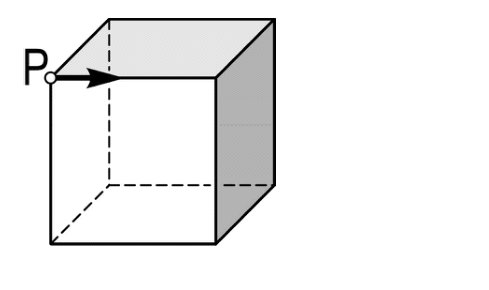
A beetle walks along the edges of a cube. Starting from point P it first moves in the direction shown. At the end of each edge it changes the direction in which it turns, turning first right, then left, then right, etc. Along how many edges will it walk before it returns to point P?
Show answer
Answer: C — 6
Show hints
Hint 1 of 2
Follow the beetle edge by edge, alternating a right turn then a left turn at each vertex.
Still stuck? Show hint 2 →
Hint 2 of 2
Track when it first lands back on P - the path closes into a loop.
Show solution
Approach: trace the alternating-turn path
Starting at P along the given edge, the beetle turns right, then left, then right, ... at successive vertices.
Following this rule the path closes into a loop returning to P.
Two runners each run at constant speed around a racetrack. Both start at the same time at the same point. A is faster than B, takes 3 minutes to cover one lap, and overtakes B for the first time after 8 minutes. How long does B take to cover one lap?
Show answer
Answer: D — 4 min 48 sec
Show hints
Hint 1 of 2
‘First overtake’ means A has run exactly one extra full lap compared with B.
Still stuck? Show hint 2 →
Hint 2 of 2
Set A’s laps minus B’s laps equal to 1 at the 8-minute mark and solve for B’s lap time.
Show solution
Approach: first overtaking = exactly one lap ahead
In 8 minutes A completes 8/3 laps; B completes 8/T laps for lap time T.
First overtaking means 8/3 − 8/T = 1, so 8/T = 5/3 and T = 24/5 minutes.
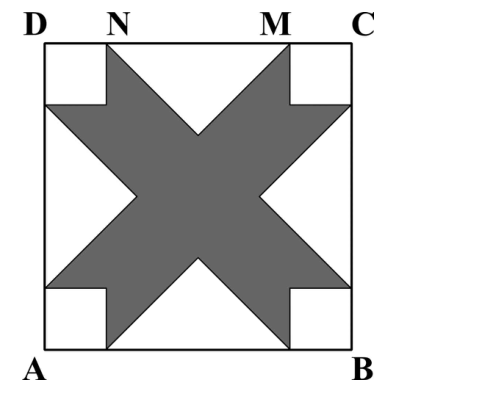
ABCD is a square with side length 10 cm. The distance from N to M is 6 cm. Every part that is not shaded grey is either a square or an isosceles triangle. What is the grey shaded area?
Show answer
Answer: C — 48 cm²
Show hints
Hint 1 of 2
The corner cut-offs and the centred segment NM = 6 fix the small white pieces.
Still stuck? Show hint 2 →
Hint 2 of 2
Find the total white area (corner squares plus isosceles triangles) and subtract from 100.
Show solution
Approach: whole minus white pieces
The square ABCD has area 10 × 10 = 100.
The unshaded parts are small squares at the corners and isosceles triangles, fixed by NM = 6 and the side 10.
In a haunted house the house ghost suddenly disappears. At that moment in time all clocks show 6:15. However, there is also one strange clock in the house that showed the correct time before that event — starting from the disappearance it begins to count backwards. At 19:30 in real time the house ghost reappears. What time does the odd clock show at that moment?
Show answer
Answer: A — 17:00
Show hints
Hint 1 of 2
The vanishing happens at 6:15 in the evening, that is 18:15.
Still stuck? Show hint 2 →
Hint 2 of 2
Find how much real time passes, then subtract it because the odd clock runs backwards.
Show solution
Approach: run the time backwards by the elapsed amount
When the ghost vanishes the clocks read 6:15 p.m. = 18:15.
The ghost returns at 19:30, so 1 hour 15 minutes of real time pass.
The odd clock counts backwards, so it shows 18:15 − 1:15 = 17:00.
How many 10-digit numbers are made up solely of the digits 1, 2 and 3 (not necessarily all of them) and have the property that adjacent digits always differ by exactly 1?
Show answer
Answer: C — 64
Show hints
Hint 1 of 2
Adjacent digits differ by 1, so from a 2 you can go to 1 or 3, but from a 1 you must go to 2.
Still stuck? Show hint 2 →
Hint 2 of 2
Build the count digit by digit, tracking how many strings end in each digit.
Show solution
Approach: count step by step with a small transition table
Because neighbours differ by 1, a 2 must sit next to a 1 or a 3, while a 1 or a 3 must sit next to a 2 — so 2s and (1-or-3)s strictly alternate.
That fixes which of the 10 positions hold a 2: either all odd positions or all even positions, giving 2 patterns.
In each pattern the five non-2 slots are independently a 1 or a 3, so \(2^5 = 32\) ways per pattern.
Total = \(2 \times 32 = 64\), so the answer is 64.
How many 10-digit numbers are there which use only the digits 1, 2 and 3 (not necessarily all) and are written in such a way that consecutive digits always have a difference of 1?
Show answer
Answer: C — 64
Show hints
Hint 1 of 2
From a 2 you may go to 1 or 3, but a 1 must be followed by 2 (and a 3 by 2).
Still stuck? Show hint 2 →
Hint 2 of 2
Count step by step how many valid strings of each length end in 1, 2 or 3.
Show solution
Approach: count by tracking the last digit
Track how many valid strings end in 1, 2, 3 as length grows: a 1 or 3 forces a following 2, while a 2 allows a 1 or 3.
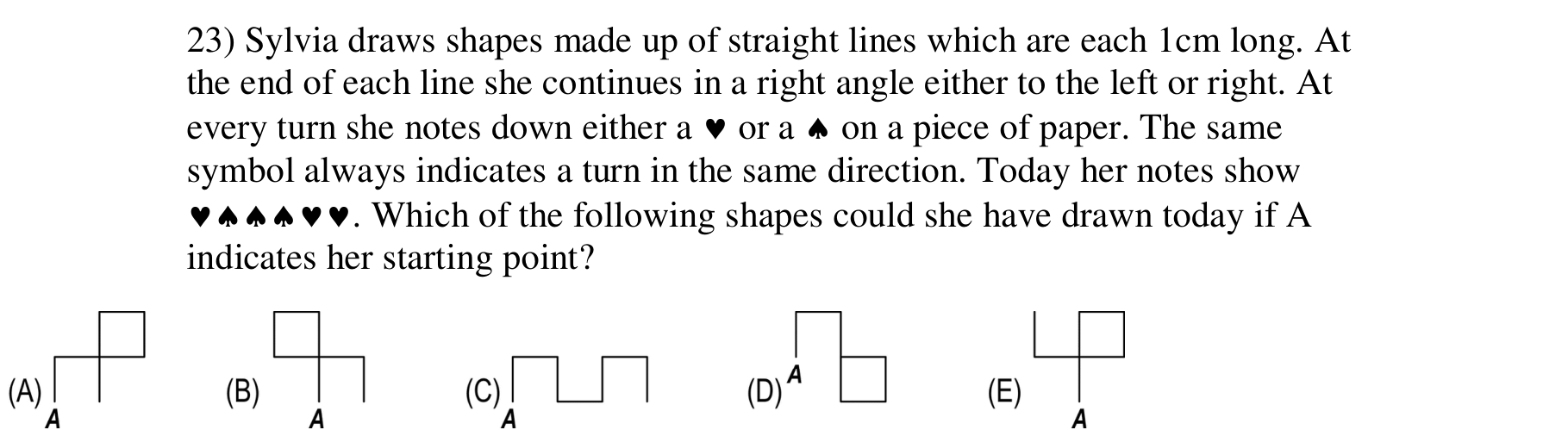
Sylvia draws shapes made of straight lines that are each 1 cm long. At the end of each line she turns a right angle, either left or right. At every turn she writes down a ♥ or a ♠, and the same symbol always means a turn in the same direction. Today her notes show ♥♠♠♠♥♥. Which of the following shapes could she have drawn today if A is her starting point?
Show answer
Answer: E
Show hints
Hint 1 of 3
Every symbol is a right-angle turn; one symbol always turns the same way and the other symbol always turns the other way.
Still stuck? Show hint 2 →
Hint 2 of 3
Notice the notes have three of the same symbol in a row (♠♠♠) in the middle, so the correct shape must make three same-direction turns in a row there.
Still stuck? Show hint 3 →
Hint 3 of 3
Start at A, walk 1 cm at a time, and turn the way each symbol tells you.
Show solution
Approach: match the ♥/♠ turn pattern by walking from the start point A
Each line is 1 cm and each symbol is a right-angle turn, with one symbol always turning left and the other always turning right.
The middle of the notes has three of the same symbol in a row (♠♠♠), which means three turns the same way in a row — that traces three sides of a little square.
Starting at A and walking the path while turning as ♥♠♠♠♥♥ tells you, the path closes up in the shape of option E.
We want to colour each square in the grid with one of the colours A, B, C and D so that neighbouring squares always have different colours. (Squares that share a corner also count as neighbouring.) Some squares are already coloured. Which colour(s) could the grey square be?
Show answer
Answer: A — A
Show hints
Hint 1 of 2
Neighbours include diagonal touches, so the grey square clashes with every square around its corner.
Still stuck? Show hint 2 →
Hint 2 of 2
List the colours already used by all squares touching the grey one; whatever is left is the answer.
Show solution
Approach: eliminate neighbour colours
The grey square touches several painted squares, including diagonally.
Those neighbours already use the colours B, C and D.
The only colour left that differs from every neighbour is A.
In Funny-Foot-Land men and women wear the same sort of shoes. Each man has a left foot that is two sizes bigger than his right foot. Each woman has a left foot that is one size bigger than her right foot. However, shoes are only sold in pairs of the same size. To save money some friends decide to buy shoes together. After putting on their new shoes, two shoes are left over — one of size 36 and one of size 45. What is the minimum number of people in that group?
Show answer
Answer: A — 5
Show hints
Hint 1 of 2
Each person uses two different shoe sizes; shoes come only in same-size pairs.
Still stuck? Show hint 2 →
Hint 2 of 2
Think of going from size 36 up to size 45 in steps of 1 (a woman) or 2 (a man) — how few steps reach 45?
Show solution
Approach: link size 36 to size 45 with the fewest people
A man uses sizes that differ by 2; a woman uses sizes that differ by 1.
Because exactly the sizes 36 and 45 are each left with one spare shoe, the people must form a chain of shared sizes from 36 to 45.
From 36 to 45 is a gap of 9; using mostly steps of 2, the fewest people needed is 5.
All factors of a number N (with the exception of 1 and N itself) are written down one after another. It turns out that the biggest of these factors is 45 times as big as the smallest. For how many numbers N is this true?
Show answer
Answer: C — 2
Show hints
Hint 1 of 2
The smallest proper factor is the least prime p; the largest proper factor is N/p.
Still stuck? Show hint 2 →
Hint 2 of 2
Set N/p = 45p, so N = 45p², and require p to really be the smallest prime factor.
Show solution
Approach: express N through its smallest and largest proper factors
The smallest proper factor is the least prime p of N and the largest is N/p.
'Largest = 45 × smallest' means N/p = 45p, so N = 45p².
Since 45 = 3²·5, p must be 2 or 3 for p to stay the smallest prime: N = 180 or N = 405.
Both work (factors of 180 run 2…90, of 405 run 3…135), so there are 2 such numbers.
A cube is cut in three directions as shown, to produce eight cuboids (each cut is parallel to one of the faces of the cube). What is the ratio of the total surface area of the eight cuboids to the surface area of the original cube?
Show answer
Answer: D — 2 : 1
Show hints
Hint 1 of 2
Each straight cut makes two new faces, each equal to the cross-section it slices.
Still stuck? Show hint 2 →
Hint 2 of 2
Add the new face area from the three cuts to the original surface and compare.
Show solution
Approach: count the new surface from each cut
Let the cube's surface be 6 (in face units). Each middle cut adds two faces of area 1, i.e. +2 per cut.
Three cuts add 6, giving total 6 + 6 = 12.
The ratio of new total to original is 12 : 6 = 2 : 1.
Kangoo has 2009 unit cubes that he puts together to make one big cuboid. He also has 2009 square stickers measuring 1 × 1 with which he tries to cover the surface area of the cuboid. He manages to do this and even has some spare stickers. How many are left over?
Show answer
Answer: B — 763
Show hints
Hint 1 of 2
The cuboid uses all 2009 unit cubes, so its dimensions multiply to 2009 = 7·7·41.
Still stuck? Show hint 2 →
Hint 2 of 2
Only one shape has surface area small enough to cover with 2009 stickers — find it.
Show solution
Approach: pick the factorization whose surface area fits 2009 stickers
2009 = 7·7·41, so the cuboid dimensions are a factorization of 2009.
The compact shape 7×7×41 has surface area 2(49 + 287 + 287) = 1246.
Every other factorization needs more than 2009 stickers, so 7×7×41 is the one he can finish.
All factors of a number N (with the exception of 1 and N itself) are written down one after the other. It turns out that the biggest factor is 45 times as big as the smallest factor. For how many numbers N is that true?
Show answer
Answer: C — 2
Show hints
Hint 1 of 2
The smallest factor above 1 is the least prime p; the largest below N is N/p.
Still stuck? Show hint 2 →
Hint 2 of 2
Set N/p = 45p, so N = 45 p^2, and check p is really the smallest prime of N.
Show solution
Approach: translate the factor condition into N = 45 p^2
The condition (largest proper factor) = 45 x (smallest proper factor) gives N/p = 45p, so N = 45 p^2.
Because 45 = 3^2 x 5, N always has factor 3, so the smallest prime p can only be 2 or 3: p=2 gives N=180, p=3 gives N=405, both valid.
55 pupils are taking part in a competition. A jury marks each question with a “+” if it is solved correctly, with a “−” if it is solved incorrectly, and a “0” if it was not attempted. It turns out that no two students had the same number of “+” as well as the same number of “−”. What is the minimum number of questions that had to be asked in the competition?
Show answer
Answer: B — 9
Show hints
Hint 1 of 2
Each pupil is described by the pair (number of +, number of −), and these pairs must all be different.
Still stuck? Show hint 2 →
Hint 2 of 2
Count how many such pairs are possible with Q questions, and make it reach 55.
Show solution
Approach: count the distinct (plus, minus) pairs
With Q questions a pupil’s pluses and minuses satisfy (#+) + (#−) ≤ Q, giving (Q+1)(Q+2)/2 possible pairs.
All 55 pupils need different pairs, so (Q+1)(Q+2)/2 ≥ 55.
The smallest Q is 9, since 10·11/2 = 55. Answer 9.
Robert wants to place stones on a 4 × 4 game board so that the number of stones in each row and in each column is different; that is, there are 8 different amounts. To do this he can place one or several stones in any one field, or even leave single fields empty. What is the minimum number of stones needed?
Show answer
Answer: A — 14
Show hints
Hint 1 of 2
The four row totals and four column totals are eight different whole numbers.
Still stuck? Show hint 2 →
Hint 2 of 2
The smallest eight distinct totals are 0–7; the stones are the sum of either the rows or the columns.
Show solution
Approach: minimise the shared row/column total
The eight totals must be eight distinct non-negative integers; the smallest set is 0,1,2,3,4,5,6,7.
Total stones equals the sum of the four row totals, which must equal the sum of the four column totals.
Split 0–7 into two equal-sum fours, e.g. rows {0,1,6,7} and columns {2,3,4,5}, each summing to 14.
Such a board is realisable, so the minimum number of stones is 14.
A square is cut into 2009 smaller squares. The side length of each smaller square is a whole number. What is the minimum possible side length of the original square?
Show answer
Answer: B — 45
Show hints
Hint 1 of 2
A side-n square split into unit squares gives n^2 pieces; merging blocks lowers the count.
Still stuck? Show hint 2 →
Hint 2 of 2
You need n^2 at least 2009 and must hit exactly 2009 by merging.
Show solution
Approach: bound n then adjust the piece count
Side 44 allows at most 44^2 = 1936 < 2009 pieces, so 44 is too small.
Side 45 starts at 2025 unit squares; replacing a 3x3 block by one square removes 8 pieces, and doing it twice removes 16 to reach exactly 2009.
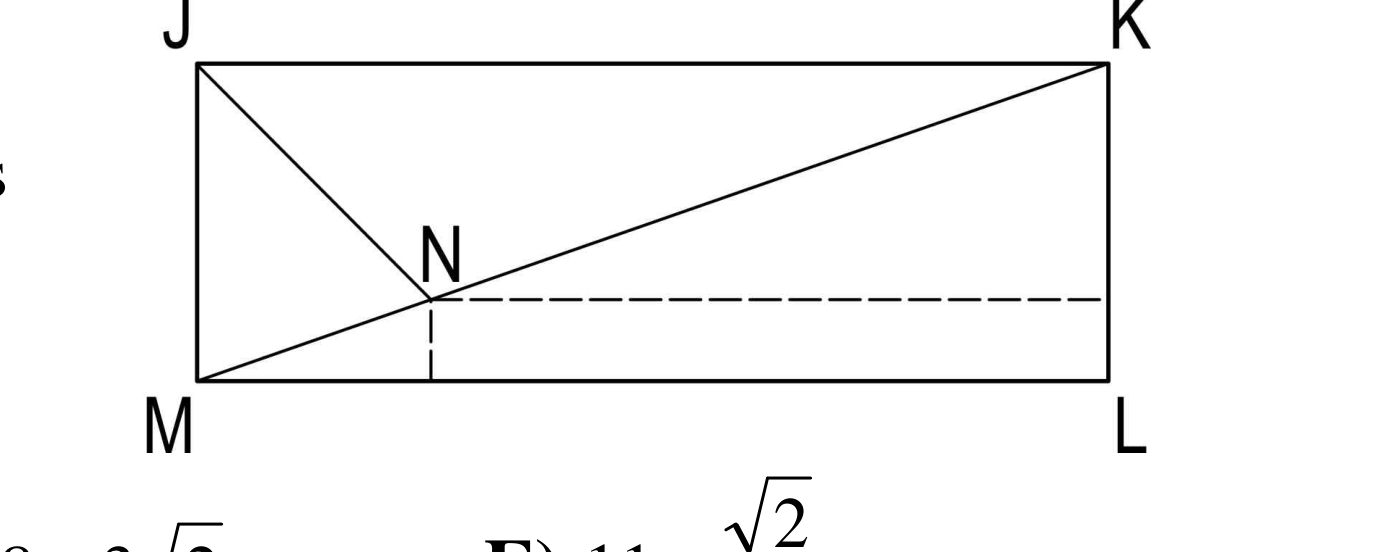
In a rectangle JKLM the angle bisector at J intersects the diagonal KM at N. The distance of N to LM is 1 and the distance of N to KL is 8. How long is LM?
Show answer
Answer: A — \(8+2\sqrt{2}\)
Show hints
Hint 1 of 2
The bisector from J makes equal angles, so drop the two given distances as the legs of similar right triangles.
Still stuck? Show hint 2 →
Hint 2 of 2
Combine the distance-to-LM = 1 and distance-to-KL = 8 conditions with where N sits on diagonal KM.
Show solution
Approach: place coordinates and use the bisector’s 45° line
Put M at the origin; the bisector from J runs at 45°, so N’s drop to the base and its horizontal match along that line.
The conditions (height of N = 1, distance to side KL = 8) give (h − 1)² = 8 for the rectangle’s height.
A number of oranges, peaches, apples and bananas are placed in a row. What is the minimum number of fruits needed so that each kind of fruit lies next to each other kind at least once somewhere in the row?
Show answer
Answer: C — 8
Show hints
Hint 1 of 2
There are four fruit types, so 6 unordered pairs must each appear side by side somewhere.
Still stuck? Show hint 2 →
Hint 2 of 2
Think of fruits as dots and 'were neighbours' as edges of K₄; you want a near-Eulerian walk.
Show solution
Approach: cover all six pairs with the fewest neighbour-links
With 4 types there are 6 pairs to realise as adjacencies; a row of n fruits has only n−1 adjacencies.
Each type would need to touch the other three, but all four 'dots' have odd degree 3 in the pair-graph K₄.
Repeating one link fixes the parity, giving 7 needed adjacencies, hence 8 fruits.
A row such as orange-peach-apple-orange-banana-peach-apple-banana shows 8 works, so the answer is 8.
In the quadrilateral PQRS, PQ = 2006, QR = 2008, RS = 2007 and SP = 2009. At which corners must the interior angle definitely be smaller than 180°?
Show answer
Answer: D — P, R, S
Show hints
Hint 1 of 2
A simple quadrilateral has at most one reflex (>180) angle - find which vertex could be it.
Still stuck? Show hint 2 →
Hint 2 of 2
A vertex folds inward only if its two sides together are shorter than the other two together.
Show solution
Approach: find the only vertex that could be reflex
A vertex can be reflex only if the two sides meeting there sum to less than the other two sides.
At Q: 2006+2008 = 4014 < 2009+2007 = 4016, so only Q might be reflex; at P, R, S the two sides are not shorter than the rest, so those angles are under 180.
The corners definitely below 180 degrees are P, R and S.
I have a 6 cm × 6 cm square and a certain triangle. If I lay the square on top of the triangle I can cover up to 60% of the area of the triangle. If I lay the triangle on top of the square I can cover up to 23 of the area of the square. What is the area of the triangle?
Show answer
Answer: D — 40 cm²
Show hints
Hint 1 of 2
The largest possible overlap of square and triangle is one quantity seen two ways.
Still stuck? Show hint 2 →
Hint 2 of 2
Set 60% of the triangle equal to 2/3 of the square and solve.
Show solution
Approach: equate the maximum overlap from both views
The square has area 36, so 2/3 of it is 24 - the most the shapes can share.
From the triangle's side that same maximum is 60% of its area: 0.6 x T = 24, so T = 40.
The numbers 1, 2, 3, …, 99 are divided up into n groups. The following rules apply:
• Each number is in exactly one group. • There are at least two numbers in each group. • If two numbers are in the same group, then their sum is not divisible by 3.
Determine the smallest n which fulfils these rules.
Show answer
Answer: C — 33
Show hints
Hint 1 of 2
Sort the numbers 1–99 by their remainder when divided by 3—there are 33 of each remainder.
Still stuck? Show hint 2 →
Hint 2 of 2
Two numbers add to a multiple of 3 only in certain remainder pairs; that limits what can share a group.
Show solution
Approach: work with remainders mod 3
There are 33 numbers each of remainder 0, 1 and 2. Two remainder-0 numbers, or a remainder-1 with a remainder-2, sum to a multiple of 3.
So a group holds at most one remainder-0 number and never mixes remainder-1 with remainder-2.
Each of the 33 remainder-0 numbers needs its own group (paired with allowed others), forcing at least 33 groups, which is achievable.
A kangaroo is sitting at the origin of a Cartesian coordinate system. With each bounce it can jump one unit in the horizontal or the vertical direction. How many points are there where the kangaroo could be after 10 jumps?
Show answer
Answer: A — 121
Show hints
Hint 1 of 2
After 10 unit jumps, a reachable point has |x| + |y| ≤ 10, and its parity matches 10 (even).
Still stuck? Show hint 2 →
Hint 2 of 2
Count all lattice points inside that diamond with even taxicab distance.
Show solution
Approach: count even-parity points within taxicab distance 10
Each jump changes \(x\) or \(y\) by 1, so after 10 jumps \(|x| + |y|\) is at most 10 and has the same parity as 10, i.e. even.
Every such point is actually reachable, so count the lattice points with \(|x|+|y|\) even and \(\le 10\).
By distance: 1 point at distance 0, then \(4d\) points at each even distance \(d = 2,4,6,8,10\), giving \(1 + 4(2+4+6+8+10) = 1 + 120 = 121\).
Friday writes different positive whole numbers that are all less than 11 next to each other in the sand. Robinson Crusoe looks at the sequence and notices with amusement that adjacent numbers are always divisible by each other. What is the maximum amount of numbers he could possibly have written in the sand?
Show answer
Answer: D — 9
Show hints
Hint 1 of 2
Join two numbers when one divides the other; you want the longest chain of distinct numbers 1-10.
Still stuck? Show hint 2 →
Hint 2 of 2
Small numbers like 1 and 2 connect to many others - use them as bridges.
Show solution
Approach: find the longest divisibility chain in 1-10
Make a chain where each neighbouring pair has one dividing the other, e.g. 4, 8, 1, 5, 10, 2, 6, 3, 9.
That uses 9 distinct numbers below 11; all 10 is impossible because 7 cannot neighbour any of them.
Samantha and her three sisters go to the theatre. They have reserved a loge with four seats. Samantha and two of her sisters arrive early and sit down without paying attention to their seat numbers. Marie arrives later and insists on sitting in the seat indicated on her ticket. What is the probability that Samantha has to change her seat, if every sister who has to swap seats then insists on sitting in the seat indicated on her ticket?
Show answer
Answer: B — 12
Show hints
Hint 1 of 2
The first three sit at random; then Marie’s arrival may start a chain of forced swaps.
Still stuck? Show hint 2 →
Hint 2 of 2
Work out, over the random seatings, how often that chain ends up moving Samantha.
Show solution
Approach: trace the swap chain over all random seatings
The three early sisters occupy three of the four seats at random; Marie then claims her own seat, displacing whoever is there into a chain.
Checking every equally-likely seating, Samantha ends up having to move in exactly half of them.
A single-digit prime number is called “strange.” A prime number with more than one digit is called “strange” if the numbers obtained by deleting its first digit and by deleting its last digit are both strange prime numbers again. How many strange prime numbers are there?
Show answer
Answer: D — 9
Show hints
Hint 1 of 2
Start from the single-digit 'strange' primes 2, 3, 5, 7 and build longer ones digit by digit.
Still stuck? Show hint 2 →
Hint 2 of 2
A longer prime is strange only if dropping its first digit AND dropping its last digit each give a strange prime.
Show solution
Approach: build strange primes upward by length
The single-digit strange primes are 2, 3, 5, 7.
A two-digit prime is strange if removing either end digit leaves a strange prime: 23, 37, 53, 73 qualify.
A three-digit prime needs both trimmed numbers strange: only 373 works (37 and 73 are strange).
No four-digit prime qualifies, so the count is 4 + 4 + 1 = 9.
In triangle ABC the interior angle B equals 20° and C equals 40°. The length of the angle bisector through A is 2. What is the difference of the side lengths BC and AB?
Show answer
Answer: C — 2
Show hints
Hint 1 of 2
With B=20 and C=40, angle A is 120, so its bisector makes two 60 degree halves.
Still stuck? Show hint 2 →
Hint 2 of 2
Set the sides by the sine rule with bisector length 2; the difference BC - AB is strikingly clean.
Show solution
Approach: use the angle-bisector length
Angle A = 180 - 20 - 40 = 120, bisected into two 60 degree parts; by the sine rule the sides are proportional to sin20, sin40, sin120.
Scaling so the bisector from A has length 2 and computing the sides, BC - AB works out to exactly 2.
A sequence of whole numbers is defined by \(a_0=1\), \(a_1=2\) and \(a_{n+2}=a_n+(a_{n+1})^2\) for \(n\ge 0\). When \(a_{2009}\) is divided by 7, the remainder is
Show answer
Answer: B — 1
Show hints
Hint 1 of 2
Remainders on division by 7 repeat, so compute the sequence mod 7 until it cycles.
Still stuck? Show hint 2 →
Hint 2 of 2
Find the cycle length, then locate 2009 within the cycle.
Show solution
Approach: find the period of the sequence modulo 7