Problem 13 · 2026 AMC 8
Hard
Geometry & Measurement
tilted-squarepythagorean
Show answer
Answer: A — 10.
Show hints
Hint 1 of 2
Don't try to measure the slanted side directly. The area of any square is just (side length)² — so you only need side², never the side itself.
Still stuck? Show hint 2 →
Hint 2 of 2
Treat one tilted side as a journey across the grid: so many units right and so many up. By the Pythagorean theorem, side² = (across)² + (up)², and that is the area — no square roots needed.
Show solution
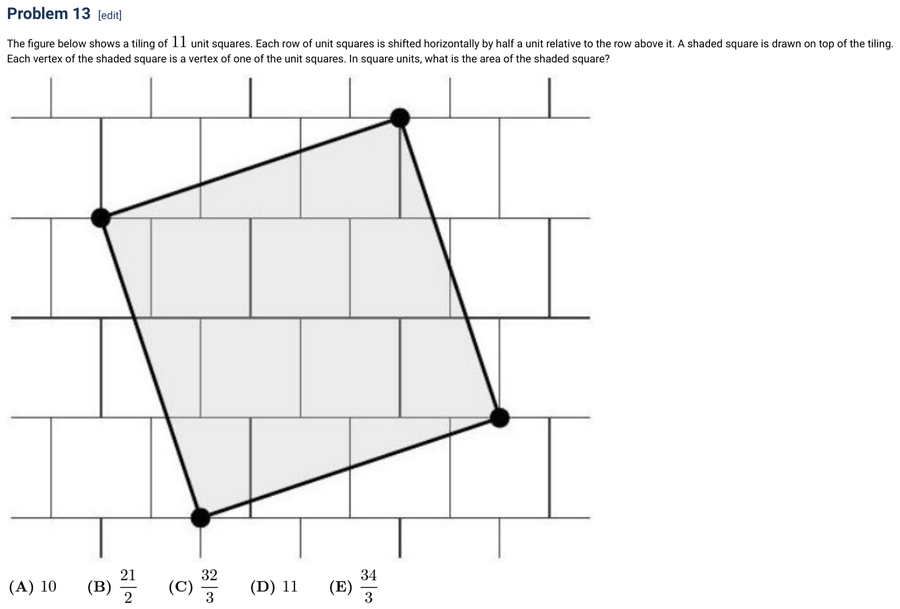
Approach: area = side², and side² = (horizontal step)² + (vertical step)²
- Pick one side of the shaded square and trace it from corner to corner across the tiling: it moves 1 unit across and 3 units up (the half-unit row shifts let the vertices land on lattice points).
- That side is the hypotenuse of a right triangle with legs 1 and 3, so side² = 1² + 3² = 10. But the area of the square is side², so the area is 10 — you never even compute the side.
- Why this transfers: for any tilted square on a grid, the area is just (horizontal step)² + (vertical step)² of one side. This is the ‘tilted-square shortcut’ — it skips both the square root and the messier ‘big square minus 4 corner triangles’ method.
Another way — bounding box minus four corner triangles:
- Enclose the tilted square in the smallest upright square. With side-steps of 1 and 3, that box is 4 × 4 = 16.
- The four right-triangle corners each have legs 1 and 3, area ½·1·3 = 1.5, so four of them remove 4 × 1.5 = 6.
- Tilted-square area = 16 − 6 = 10, matching the shortcut.
Mark:
· log in to save