Problem 21 · 2020 AMC 8
Hard
Counting & Probability
careful-countingcasework
Show answer
Answer: A — 28 paths.
Show hints
Hint 1 of 2
Don't trace individual zig-zag paths. Instead label each reachable square with how many paths reach it. Since you arrive at a square only from the two squares diagonally below, that count is the sum of those two — the marker can't be in two places, so paths just add.
Still stuck? Show hint 2 →
Hint 2 of 2
This is Pascal's triangle. Write 1 on P, then fill each square above as the sum of its two lower neighbors — but whenever a square is missing (the board edge cuts it off), treat it as 0. Read the number that lands on Q.
Show solution
Approach: label squares with path-counts (Pascal's triangle), respecting the edge
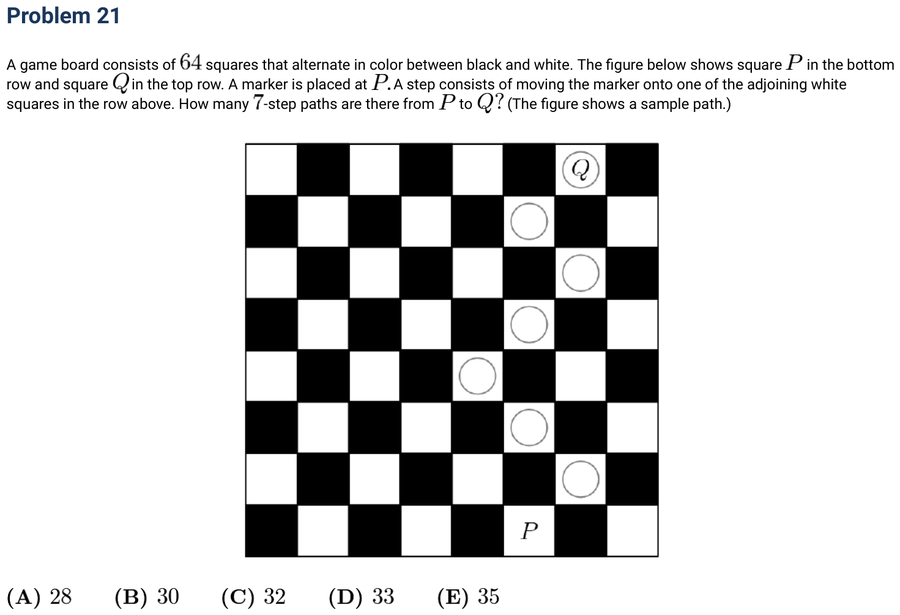
- Each step moves up one row to a diagonally-adjacent square, so the number of paths to a square is the sum of the paths to the two squares just below it. Start by writing 1 on P.
- Build upward row by row. Near the right edge of the board one of the two lower neighbors is missing, so it contributes 0 — this is what bends the answer away from a clean power of 2.
- The counts grow 1; 1, 1; 1, 2, 1; 1, 3, 3; 4, 6, 4; … and feeding them up through the 7 rows, the value landing on Q is 28.
- Why this transfers: any ‘count the lattice paths’ problem yields to this add-the-two-below labeling — it's Pascal's triangle in disguise. The edge of the board simply zeroes out the off-board neighbor, which is why the count is 28 instead of the unrestricted 27.
Mark:
· log in to save