Problem 20 · 2020 AMC 8
Hard
Algebra & Patterns
caseworksubstitution
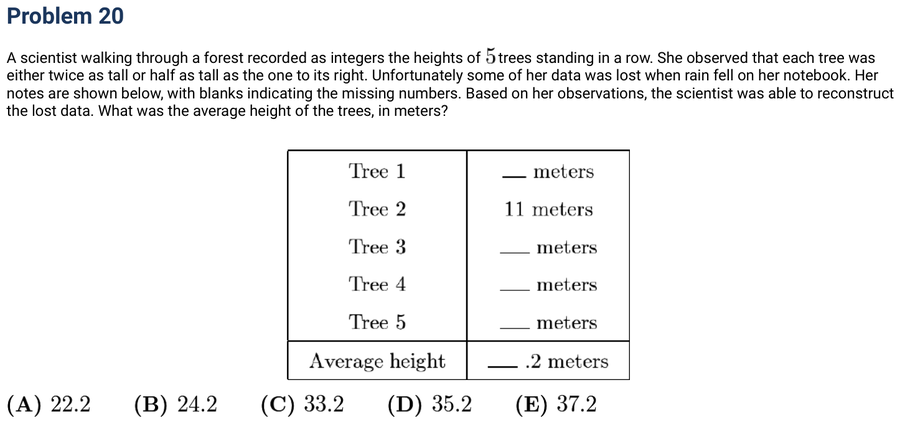
Show answer
Answer: B — 24.2 meters.
Show hints
Hint 1 of 2
The only number you're handed is 11 — an odd one. Since every height is a whole number, no neighbor can be ‘half of 11’ (that's 5.5). So the trees touching Tree 2 are forced upward, not down.
Still stuck? Show hint 2 →
Hint 2 of 2
Once the integer rule fixes Tree 1 and Tree 3, only a couple of branches remain for Trees 4 and 5. Don't compute all the averages — the answer must end in ‘.2’, so use that to pick the right branch.
Show solution
Approach: let the odd value 11 force integers, then filter by the ‘.2’ ending
- The doubling/halving rule says each neighbor is twice or half of 11. Half of 11 is 5.5 — not a whole number — so Tree 1 and Tree 3 are both forced to 22.
- Tree 4 is twice or half of Tree 3 (22), so 44 or 11; Tree 5 then doubles or halves Tree 4.
- Rather than grinding every average, lean on the clue that it ends in ‘.2’: (44, 88) → 37.4; (44, 22) → 121/5 = 24.2; (11, 22) → 17.6; (11, 5.5) is rejected (not an integer).
- Only (44, 22) ends in .2, giving average = 24.2 meters.
- Why this transfers: an integer constraint is a powerful filter — start from the value that can't be halved (here the odd 11) and it forces its neighbors, collapsing a tree of possibilities to a handful. Then use a second clue (the ‘.2’) to finish without exhausting every case.
Mark:
· log in to save