Problem 16 · 2017 AMC 8
Medium
Geometry & Measurement
area-fractionpythagorean-triple
Show answer
Answer: D — 12/5.
Show hints
Hint 1 of 2
Both perimeters secretly contain the shared side AD, so it cancels. "Equal perimeters" really just says AC + CD = AB + BD — a balance on the two pieces of BC.
Still stuck? Show hint 2 →
Hint 2 of 2
Once you find where D sits, don't redo an area from scratch: ▵ABD and ▵ABC share the same height from A, so their areas are in the simple ratio of their bases on line BC.
Show solution
Approach: cancel the shared side, then use base ratio
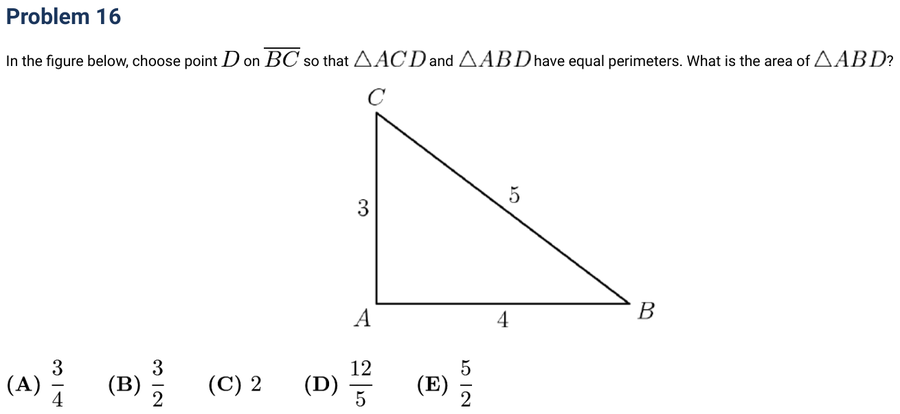
- ▵ABC is a 3-4-5 right triangle (right angle at A, AC = 3, AB = 4, BC = 5). Let BD = x, so CD = 5 − x.
- Equal perimeters share side AD, which cancels: AC + CD = AB + BD ⇒ 3 + (5 − x) = 4 + x ⇒ x = 2. So BD = 2. Spotting that AD cancels is what makes this one line instead of two messy perimeter sums.
- ▵ABD and ▵ABC share the altitude from A down to line BC, so their areas scale as their bases: area(▵ABD)/area(▵ABC) = BD/BC = 2/5.
- area(▵ABC) = (1/2)(3)(4) = 6, so area(▵ABD) = (2/5)(6) = 12/5.
- You'll reuse the base-ratio idea constantly: two triangles with a common apex and bases on the same line have areas in the ratio of those bases — no need to find the height.
Mark:
· log in to save