Problem 24 · 2013 AMC 8
Hard
Geometry & Measurement
coordinate-bashshoelace
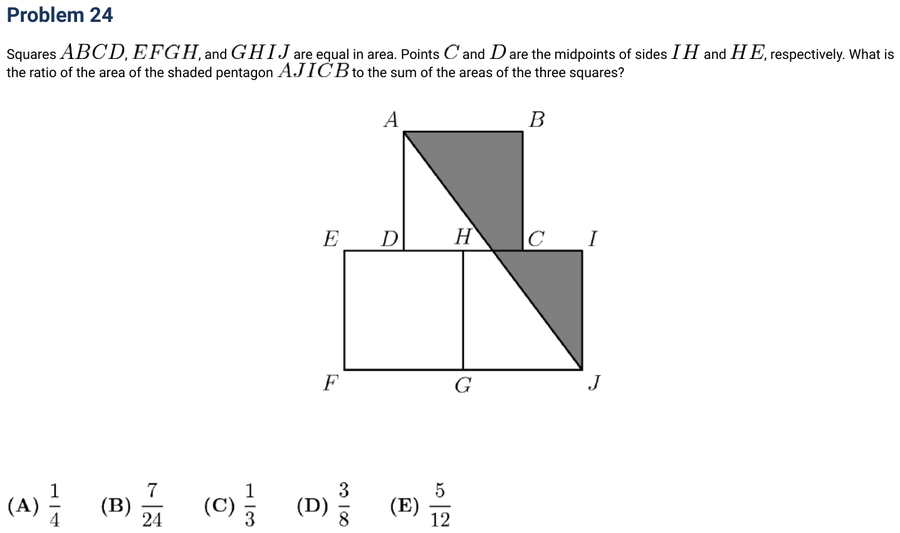
Squares ABCD, EFGH, and GHIJ are equal in area. Points C and D are the midpoints of sides IH and HE, respectively. What is the ratio of the area of the shaded pentagon AJICB to the sum of the areas of the three squares?
Show answer
Answer: C — 1/3.
Show hints
Hint 1 of 2
No actual size is given, so the answer can't depend on it — set each square's side to 1. Then the denominator is fixed at 3, and only the pentagon's area is left to find.
Still stuck? Show hint 2 →
Hint 2 of 2
The jagged pentagon is awkward, but its complement (the unshaded region ADEFJ, cut off by the straight diagonal from A to J) is a clean rectangle-plus-triangle. Subtracting the easy piece beats chasing the hard one. Coordinates with F = (0,0) make every corner exact.
Show solution
Approach: subtract the easy unshaded complement
- Set each side to 1 (the ratio doesn't care about size), so the three squares total area 3 — that's the denominator handled. Now we only need the shaded area.
- Rather than fight the jagged pentagon, find the unshaded leftover ADEFJ — the diagonal A–J splits it off cleanly. Put F = (0,0); its corners are A = (0.5, 2), D = (0.5, 1), E = (0, 1), F = (0, 0), J = (2, 0).
- That region is a 0.5×1 rectangle (EDKF-style strip, area ½) plus right triangle AKJ with legs 1.5 and 2 (area ½·1.5·2 = 1.5), totaling 2.
- Shaded = 3 − 2 = 1, so the ratio is 1 ÷ 3 = 1/3.
- Why this transfers: when a shaded shape is jagged but its complement is made of rectangles and triangles, subtract the complement — the "hard region = whole − easy region" move.
Another way — coordinates + shoelace on the pentagon directly:
- With F = (0, 0): A = (0.5, 2), J = (2, 0), I = (2, 1), C = (1.5, 1), B = (1.5, 2).
- Shoelace on AJICB: ½ |(0.5·0 + 2·1 + 2·1 + 1.5·2 + 1.5·2) − (2·2 + 0·2 + 1·1.5 + 1·1.5 + 2·0.5)| = ½ |10 − 8| = 1.
- Ratio = 1 ÷ 3 = 1/3. (Shoelace works on any polygon once you have the vertices in order.)
Mark:
· log in to save