Danica wants to arrange her model cars in rows with exactly 6 cars in each row. She now has 23 model cars. What is the smallest number of additional cars she must buy in order to be able to arrange all her cars this way?
Show answer
Answer: A — 1 more car.
Show hints
Hint 1 of 2
"Exactly 6 per row" is a disguised way of saying "the total must be a multiple of 6." So really: what's the next multiple of 6 once you pass 23?
Still stuck? Show hint 2 →
Hint 2 of 2
When a word problem demands a whole number of equal groups, translate it to "the total is a multiple of (group size)" and round up to the nearest one.
Show solution
Approach: round up to the next multiple of 6
Rows of exactly 6 means the total must be a multiple of 6 — that's the hidden condition. So 23 itself won't work.
Count up from 23 to the next multiple of 6: 24 = 6 × 4. She needs 24 − 23 = 1 more car.
You'll see this again: any "arrange in equal rows / groups" problem is secretly asking for a multiple, so the answer is always (next multiple) − (what you have).
A sign at the fish market says, "50% off, today only: half-pound packages for just $3 per package." What is the regular price for a full pound of fish, in dollars? (Assume that there are no deals for bulk.)
Show answer
Answer: D — $12.
Show hints
Hint 1 of 2
Two separate doublings are hiding here: a half-pound is half of a pound (one doubling), and a 50%-off price is half of the regular price (another doubling). What happens if you double twice?
Still stuck? Show hint 2 →
Hint 2 of 2
"50% off" means the sale price is half the original, so to undo it you double. Always ask "what fraction of the original is this?" before reaching for the discount.
Show solution
Approach: double once for the full pound, double again to undo 50% off
$3 buys half a pound, so a full pound at the sale price is 2 × $3 = $6.
"50% off" means $6 is only half of the regular price, so regular = 2 × $6 = $12.
Watch the trap: the two halvings (half-pound and half-price) tempt you to answer $6. Doubling twice — ×4 from the $3 — lands you at $12.
What is the value of 4 · (−1 + 2 − 3 + 4 − 5 + 6 − 7 + … + 1000)?
Show answer
Answer: E — 2000.
Show hints
Hint 1 of 2
Don't add left to right — the signs alternate, so reach for a partner instead. Pair each odd with the even right after it: (−1 + 2), (−3 + 4)…. What does every pair equal?
Still stuck? Show hint 2 →
Hint 2 of 2
Pairing turns a long alternating sum into "(value of one pair) × (number of pairs)." The only real work is counting how many pairs there are.
Show solution
Approach: pair each −odd with the next +even
Group as (−1 + 2) + (−3 + 4) + … + (−999 + 1000). Each pair (−k + (k+1)) collapses to exactly +1 — the alternating signs were doing all the work.
The numbers 1 through 1000 form 1000 ÷ 2 = 500 pairs, so the parenthesis is just 500.
Multiply by the outside 4: 4 × 500 = 2000.
Sanity check: 500 small +1's, then quadrupled — landing near 2000 (not 0 or 500) makes sense; choices −10 and 0 ignore the ×4 and the leftover positive.
Eight friends ate at a restaurant and agreed to share the bill equally. Because Judi forgot her money, each of her seven friends paid an extra $2.50 to cover her portion of the total bill. What was the total bill?
Show answer
Answer: C — $140.
Show hints
Hint 1 of 2
The seven $2.50 extras didn't vanish — together they exactly paid off Judi's one share. So 7 × $2.50 is one person's share of the bill.
Still stuck? Show hint 2 →
Hint 2 of 2
Find the size of one equal part first, then scale up to the whole. One share × (number of shares) = total.
Show solution
Approach: find one share, then multiply by 8
The 7 extra payments covered exactly Judi's portion, so one person's share = 7 × $2.50 = $17.50. (That's the key reframe: the extras add up to one full share.)
Everyone owed the same share, and there are 8 people, so the total bill = 8 × $17.50 = $140.
Sanity check: $17.50 per person feels right for a restaurant, and 8 of them lands at $140 — matching a choice.
Hammie is in the 6th grade and weighs 106 pounds. His quadruplet sisters are tiny babies and weigh 5, 5, 6, and 8 pounds. Which is greater, the average (mean) weight of these five children or the median weight, and by how many pounds?
Show answer
Answer: E — Average, by 20.
Show hints
Hint 1 of 2
One giant value (106) sits among four tiny ones. The median ignores how big that outlier is — it only cares about position — but the mean gets dragged toward it. So expect the average to win.
Still stuck? Show hint 2 →
Hint 2 of 2
Median = middle of the sorted list (resistant to outliers); mean = total ÷ count (sensitive to outliers). One lonely large number is what separates them.
Show solution
Approach: find the resistant median, then the outlier-pulled mean
Sort the weights: 5, 5, 6, 8, 106. The median is the middle one = 6 — notice the 106's size never mattered, only that it sits at the end.
Mean = (5 + 5 + 6 + 8 + 106) ÷ 5 = 130 ÷ 5 = 26 — the lone 106 hauls the average up to 26.
The average is larger, by 26 − 6 = 20 pounds.
You'll see this again: whenever one value is wildly bigger than the rest, the mean exceeds the median — that's exactly why incomes are reported by median, not average.
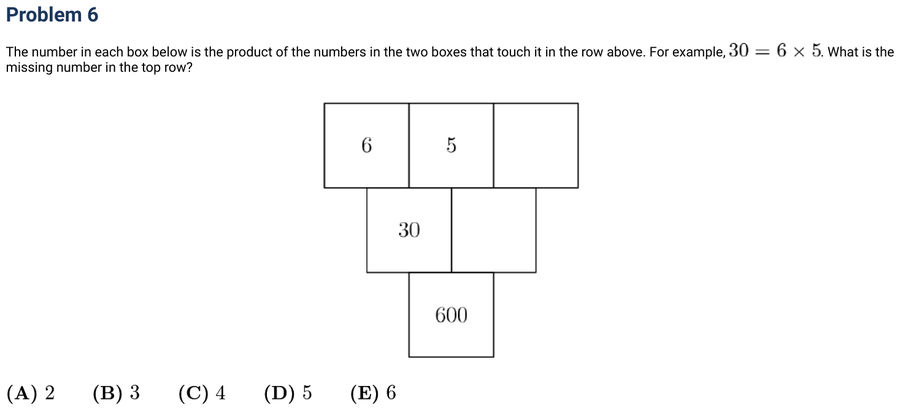
The number in each box below is the product of the numbers in the two boxes that touch it in the row above. For example, 30 = 6 × 5. What is the missing number in the top row?
Show answer
Answer: C — 4.
Show hints
Hint 1 of 2
You can't fill the top box directly — but you can work backwards. The bottom 600 came from multiplying, so a missing factor is found by dividing. Which box can you unlock with 600 ÷ 30?
Still stuck? Show hint 2 →
Hint 2 of 2
In a product pyramid, multiply to go down and divide to go back up. Solve the box you have the most info about first, then chain to the unknown.
Trey and his mom stopped at a railroad crossing to let a train pass. As the train began to pass, Trey counted 6 cars in the first 10 seconds. It took the train 2 minutes and 45 seconds to clear the crossing at a constant speed. Which of the following was the most likely number of cars in the train?
Show answer
Answer: C — About 100 cars.
Show hints
Hint 1 of 2
Constant speed means the cars-per-second rate never changes. So the whole train is just the early sample (6 cars in 10 s) scaled up to the full time. Find that one rate first.
Still stuck? Show hint 2 →
Hint 2 of 2
Turn the count into a rate (cars per second), then multiply by the total seconds. "Constant speed" is the green light to use a single proportion.
Show solution
Approach: scale the cars-per-second rate to the total time
Get everything in one unit: total time = 2 × 60 + 45 = 165 seconds.
The rate is 6 cars every 10 seconds = 0.6 cars/second, and it holds the whole time. So cars = 0.6 × 165 = 99.
The answer choices are round numbers, so 99 → 100 — "most likely" signals you to round to the nearest choice.
Sanity check: 165 s is about 16 ten-second chunks of 6 cars ≈ 16 × 6 ≈ 96, comfortably near 100.
A fair coin is tossed 3 times. What is the probability of at least two consecutive heads?
Show answer
Answer: C — 3/8.
Show hints
Hint 1 of 2
Only 8 outcomes exist for 3 flips — small enough to just list them all and circle the winners. "Consecutive" means the two heads must be neighbors (positions 1-2 or 2-3), not scattered.
Still stuck? Show hint 2 →
Hint 2 of 2
When the sample space is tiny (23 = 8), full enumeration beats any clever formula. Probability = (favorable outcomes) ÷ (total outcomes).
Show solution
Approach: enumerate all 8 equally-likely outcomes
All 8 outcomes: HHH, HHT, HTH, HTT, THH, THT, TTH, TTT. Each is equally likely, so we just count favorables.
"At least two consecutive heads" needs HH side by side: HHH, HHT, THH — that's 3. (HTH fails: its heads aren't neighbors.)
Probability = 3 ÷ 8 = 3/8.
Watch the trap: HTH has two heads but they're not consecutive, so it doesn't count — reading "consecutive" carefully is the whole problem.
Another way — complement — subtract the 'no HH' outcomes:
Sometimes it's easier to count the unwanted outcomes. Strings of 3 flips with no two heads adjacent: TTT, TTH, THT, HTT, HTH — 5 of them.
So favorable = 8 − 5 = 3, giving probability 3/8 = 3/8. (When 'at least' makes direct counting fiddly, count the opposite.)
The Incredible Hulk can double the distance it jumps with each succeeding jump. If its first jump is 1 meter, the second jump is 2 meters, the third jump is 4 meters, and so on, then on which jump will it first be able to jump more than 1 kilometer (1,000 meters)?
Show answer
Answer: C — 11th jump.
Show hints
Hint 1 of 2
Doubling each time means you're climbing powers of 2: 1, 2, 4, 8, …. The only catch is the off-by-one — jump 1 is 20, not 21. Watch which jump number lines up with which power.
Still stuck? Show hint 2 →
Hint 2 of 2
"Repeated doubling" is always powers of 2. The danger is the exponent offset; anchor it by checking a small case (jump 3 = 4 = 22) before extrapolating.
Show solution
Approach: powers of 2, watching the off-by-one
Jump 1 = 1 = 20, jump 2 = 2 = 21, … so jump n = 2n−1 meters. (The exponent is one behind the jump number — that's the spot people slip.)
Memorized landmark: 210 = 1024 is the first power of 2 over 1000 (since 29 = 512 falls short).
Set n − 1 = 10, so the first jump past 1000 m is the 11th.
Worth keeping: 210 ≈ 1000 is a handy anchor — every 10 doublings multiplies by roughly a thousand.
What is the ratio of the least common multiple of 180 and 594 to the greatest common factor of 180 and 594?
Show answer
Answer: C — 330.
Show hints
Hint 1 of 2
Don't compute the huge LCM and tiny GCD separately and then divide. Once both numbers are in prime-factored form, the ratio reads off prime by prime: for each prime, LCM takes the bigger exponent and GCD the smaller, so the ratio just keeps the difference.
Still stuck? Show hint 2 →
Hint 2 of 2
Prime factorization is the master key for LCM and GCD: GCD = product of min exponents, LCM = product of max exponents. Compare the two prime towers side by side.
Show solution
Approach: prime factor each number, then compare exponents
Factor: 180 = 22 · 32 · 5 and 594 = 2 · 33 · 11.
GCD takes the smaller power of each shared prime: 21 · 32 = 18.
LCM takes the larger power of every prime that appears: 22 · 33 · 5 · 11 = 4 · 27 · 55 = 5940.
Ratio: 5940 ÷ 18 = 330.
Another way — ratio straight from exponent gaps (no big numbers):
LCM/GCD keeps, for each prime, the gap between the two exponents: 2 has exponents 2 and 1 (gap 1), 3 has 2 and 3 (gap 1), and 5, 11 appear in only one number (full power).
So the ratio = 21 · 31 · 5 · 11 = 2 · 3 · 5 · 11 = 330 — no 5940 or 106,920 ever needed.
Another way — product identity LCM · GCD = a · b:
Use LCM(a,b) · GCD(a,b) = a · b, so LCM/GCD = ab/GCD2.
Ted's grandfather used his treadmill on 3 days this week. He went 2 miles each day. On Monday he jogged at a speed of 5 miles per hour. He walked at the rate of 3 miles per hour on Wednesday and at 4 miles per hour on Friday. If Grandfather had always walked at 4 miles per hour, he would have spent less time on the treadmill. How many minutes less?
Show answer
Answer: D — 4 minutes.
Show hints
Hint 1 of 2
Same 2 miles every day, so time is decided entirely by speed: time = distance ÷ rate. Slower = longer, faster = shorter. The "always 4 mph" plan is your benchmark.
Still stuck? Show hint 2 →
Hint 2 of 2
You don't even need all three days. Friday was already 4 mph (no change). Monday at 5 mph was faster than 4, so it would actually take more time at 4 — the real saving lives only where he went slower than 4.
Show solution
Approach: compare each real day to the 4-mph benchmark
Distance is fixed at 2 miles, so time = 2 ÷ rate. At 4 mph the benchmark is 2/4 hr = 30 min per day.
Friday was 4 mph — already on benchmark, 0 difference. Monday at 5 mph took 2/5 hr = 24 min, which is 6 min less than 30 (so "always 4" would cost +6 there).
Wednesday at 3 mph took 2/3 hr = 40 min, which is 10 min more than 30.
Net time saved by going all-4-mph = +6 (Mon) − 10 (Wed) + 0 (Fri)… flip sign for "less time": 10 − 6 = 4 minutes less.
Check the totals: actual 24 + 40 + 30 = 94 min; all-4 plan 3 × 30 = 90 min; 94 − 90 = 4. Same answer.
At the 2013 Winnebago County Fair a vendor is offering a "fair special" on sandals. If you buy one pair of sandals at the regular price of $50, you get a second pair at a 40% discount, and a third pair at half the regular price. Javier took advantage of the "fair special" to buy three pairs of sandals. What percentage of the $150 regular price did he save?
Show answer
Answer: B — 30%.
Show hints
Hint 1 of 2
"Percent saved" always means dollars-saved compared to the full regular price ($150 for three pairs), not to what he ended up paying. So you only need the total dollars knocked off.
Still stuck? Show hint 2 →
Hint 2 of 2
Percent saved = (dollars saved) ÷ (original price). Find the savings in dollars first; the percentages 40% and 50% are just shortcuts to those dollar amounts.
Show solution
Approach: total dollars saved ÷ regular price
Only the 2nd and 3rd pairs are discounted (the 1st is full price). Convert each discount to dollars: 40% of $50 = $20 saved, and half of $50 = $25 saved.
Total saved = $20 + $25 = $45, against the regular three-pair price of $150.
Percent saved = 45 ÷ 150 = 30%.
Watch the trap: the discounts 40% and 50% average to 45%, but each applies to only one of three pairs — spreading the savings over the full $150 is what drops the answer to 30%.
Number Theoryplace-value-differencedivisibility-by-9
When Clara totaled her scores, she inadvertently reversed the units digit and the tens digit of one score. By which of the following might her incorrect sum have differed from the correct one?
Show answer
Answer: A — 45.
Show hints
Hint 1 of 2
Swapping the tens and units digit only moves value between the "tens place" and "ones place." A digit worth 10 in one spot is worth 1 in the other — so each unit you shuffle changes the number by 9. The difference can only be a multiple of 9.
Still stuck? Show hint 2 →
Hint 2 of 2
Reversing two adjacent digits always changes a number by a multiple of 9 (it's a place-value gap of 10 − 1). So scan the choices for the one divisible by 9 — no equation needed.
Show solution
Approach: digit swap forces a multiple-of-9 difference
Write the swapped two digits as 10a + b before and 10b + a after. The difference is (10a + b) − (10b + a) = 9(a − b) — a multiple of 9, no matter what the digits are.
So Clara's error in the sum must be divisible by 9.
Check the choices for divisibility by 9 (digit-sum trick): only 45 has digit sum 9. So the answer is 45 = 9 × 5.
You'll see this again: any "reversed digits" puzzle hinges on this multiple-of-9 fact — it's the same reason the digit-sum test for 9 works.
Abe holds 1 green and 1 red jelly bean in his hand. Bob holds 1 green, 1 yellow, and 2 red jelly beans in his hand. Each randomly picks a jelly bean to show the other. What is the probability that the colors match?
Show answer
Answer: C — 3/8.
Show hints
Hint 1 of 2
A "match" can only happen on a color both people own. Yellow is Bob-only, so it can never match — the only matchable colors are green and red. Handle those two cases separately.
Still stuck? Show hint 2 →
Hint 2 of 2
Two independent picks: within a case multiply (AND), across the separate cases add (OR). First filter to colors both hands share.
Show solution
Approach: split into the only two matchable colors
Only green and red exist in both hands (Bob's yellow can never match), so a match is "both green" OR "both red."
Both green = P(Abe green) × P(Bob green) = (1/2)(1/4) = 1/8 — multiply because both must happen.
Both red = P(Abe red) × P(Bob red) = (1/2)(2/4) = 1/4.
If 3p + 34 = 90, 2r + 44 = 76, and 53 + 6s = 1421, what is the product of p, r, and s?
Show answer
Answer: B — 40.
Show hints
Hint 1 of 2
Each equation has one known power and one unknown power. Move the known number to the right side first, and you're left with "(base)? = (a number)" — just ask which power of that base it is.
Still stuck? Show hint 2 →
Hint 2 of 2
To solve bx = N by hand, rewrite N as a power of b and read off the exponent. Recognizing small powers (32=9, 25=32, 64=1296) is the whole skill here.
Show solution
Approach: isolate each power, then recognize it
Equation 1: 3p = 90 − 34 = 90 − 81 = 9 = 32, so p = 2.
Equation 2: 2r = 76 − 44 = 32 = 25, so r = 5.
Equation 3: 6s = 1421 − 53 = 1421 − 125 = 1296 = 64, so s = 4.
Product = 2 · 5 · 4 = 40.
Tip: when an exponential equation has a clean integer answer, the leftover number is almost always a recognizable power of the base — match by eye instead of guessing.
A number of students from Fibonacci Middle School are taking part in a community service project. The ratio of 8th-graders to 6th-graders is 5 : 3, and the ratio of 8th-graders to 7th-graders is 8 : 5. What is the smallest number of students that could be participating in the project?
Show answer
Answer: E — 89 students.
Show hints
Hint 1 of 2
The 8th-graders appear in both ratios — they're the shared hinge. In ratio 5:3 their count is a multiple of 5; in ratio 8:5 it's a multiple of 8. Make those two pictures agree first.
Still stuck? Show hint 2 →
Hint 2 of 2
To merge two ratios that share a quantity, force the shared term to a common value — the smallest is the LCM. Then every group count comes out whole.
Show solution
Approach: make the shared 8th-grader count an LCM
8th-graders link both ratios, so their count must be a multiple of 5 (from 5:3) and of 8 (from 8:5). Smallest such count = lcm(5, 8) = 40 — pick that to keep everyone whole.
6th-graders: 40 × 3/5 = 24 (from 5:3).
7th-graders: 40 × 5/8 = 25 (from 8:5).
Total = 40 + 24 + 25 = 89.
Why this transfers: any "chain" of ratios sharing a common term is stitched together by setting that term to the LCM — the same trick scales recipe ratios, gear ratios, and unit conversions.
The sum of six consecutive positive integers is 2013. What is the largest of these six integers?
Show answer
Answer: B — 338.
Show hints
Hint 1 of 2
Consecutive numbers are balanced around their middle, so their sum is just (average) × (count). Divide 2013 by 6 to land right in the center of the six numbers — then the largest is a short hop away.
Still stuck? Show hint 2 →
Hint 2 of 2
For evenly spaced numbers, sum = average × count, and the average sits dead center. Find the center first; the endpoints follow.
Show solution
Approach: divide to find the center, then step to the largest
Six consecutive integers average to sum ÷ 6 = 2013 ÷ 6 = 335.5. With 6 numbers the center falls between the 3rd and 4th, so those two are 335 and 336.
Counting outward, the six are 333, 334, 335, 336, 337, 338, so the largest is 338.
You'll see this again: "sum = average × count" cracks every consecutive-integer problem — find the middle, then walk to whichever term you need.
Another way — algebra with a variable:
Let the smallest be x. The sum is x + (x+1) + … + (x+5) = 6x + 15.
Set 6x + 15 = 2013, so 6x = 1998 and x = 333. Largest = 333 + 5 = 338.
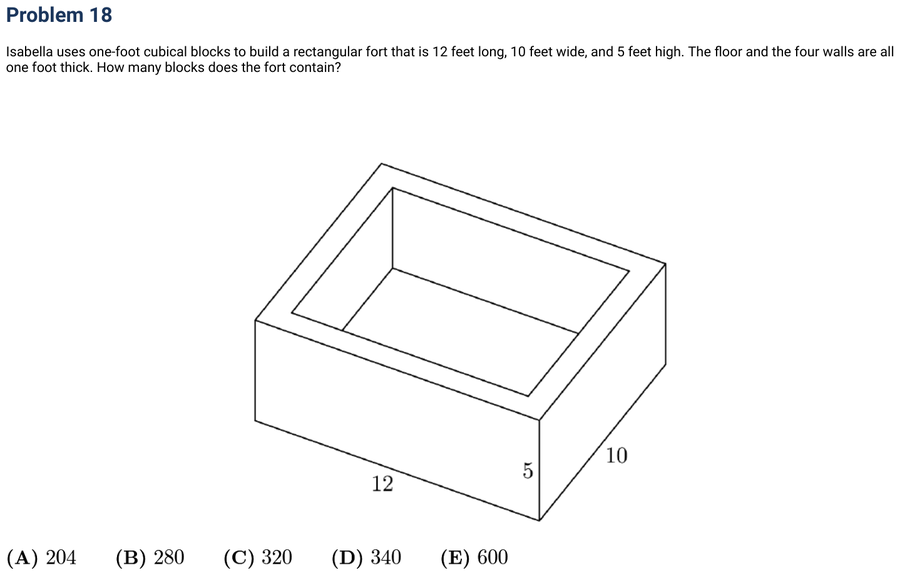
Isabella uses one-foot cubical blocks to build a rectangular fort that is 12 feet long, 10 feet wide, and 5 feet high. The floor and the four walls are all one foot thick. How many blocks does the fort contain?
Show answer
Answer: B — 280 blocks.
Show hints
Hint 1 of 2
Counting the floor and four walls block-by-block is a nightmare of overlaps. Instead, imagine the fort as a solid box, then carve out the empty room inside — subtraction beats addition here.
Still stuck? Show hint 2 →
Hint 2 of 2
"Solid total minus the hollow" is the go-to for any shell or frame. The only care needed is how much the hollow shrinks: a 1-ft wall on each side removes 2 from a dimension; a floor with no ceiling removes only 1 from the height.
Show solution
Approach: solid outer box minus the hollow interior
Pretend the fort is solid: 12 × 10 × 5 = 600 cubes.
Now find the empty room. Walls on both sides shave 2 off length (12 → 10) and 2 off width (10 → 8); the floor shaves 1 off height but there's no ceiling (5 → 4). Hollow = 10 × 8 × 4 = 320.
Blocks actually used = 600 − 320 = 280.
Watch the trap: the open top is the whole subtlety — height loses only 1 (floor), not 2. Treating it like a closed box would give the wrong hollow.
Bridget, Cassie, and Hannah are discussing the results of their last math test. Hannah shows Bridget and Cassie her test, but Bridget and Cassie don't show theirs to anyone. Cassie says, 'I didn't get the lowest score in our class,' and Bridget adds, 'I didn't get the highest score.' What is the ranking of the three girls from highest to lowest score?
Show answer
Answer: D — Cassie, Hannah, Bridget.
Show hints
Hint 1 of 2
The hidden fact is that Cassie and Bridget have seen exactly one score besides their own: Hannah's. For either to be certain of her claim, the comparison with Hannah must settle it — so each statement secretly compares that girl to Hannah.
Still stuck? Show hint 2 →
Hint 2 of 2
In these "what can they deduce" puzzles, ask what information each speaker actually has. A confident claim is only justified if their limited view forces it — that turns each sentence into one inequality.
Show solution
Approach: convert each confident statement into a comparison with Hannah
Both girls saw only Hannah's score. Cassie says "I'm not lowest" with certainty — she can only be sure if she beat the one score she saw, so Cassie > Hannah.
Bridget says "I'm not highest" with certainty — she can only be sure if she scored below Hannah, so Hannah > Bridget.
Why this transfers: the trick is always "a certain statement reveals what the speaker can see" — the knowledge each person has is the real data, not just the words.
A 1 × 2 rectangle is inscribed in a semicircle with the longer side on the diameter. What is the area of the semicircle?
Show answer
Answer: C — π.
Show hints
Hint 1 of 2
By symmetry, the center of the semicircle sits at the middle of the diameter — right below the rectangle's center. A radius drawn to an upper corner is the hypotenuse of a little right triangle. What are its two legs?
Still stuck? Show hint 2 →
Hint 2 of 2
Don't chase the radius directly — build a right triangle from the center to a point on the circle and use the Pythagorean theorem. Also note area only needs r2, so you never have to simplify √2.
Show solution
Approach: right triangle from the center to a top corner
Put the center at the midpoint of the diameter. The rectangle (long side 2 on the diameter, height 1) reaches a top corner that is 1 across and 1 up from the center.
That corner lies on the circle, so the radius is its distance: r2 = 12 + 12 = 2. (No need to take the square root.)
Semicircle area = ½πr2 = ½π(2) = π.
Worth keeping: area formulas use r2, so stop the moment you know r2 — squaring back a messy radius is wasted work.
Samantha lives 2 blocks west and 1 block south of the southwest corner of City Park. Her school is 2 blocks east and 2 blocks north of the northeast corner of City Park. On school days she bikes on streets to the southwest corner of City Park, then takes a diagonal path through the park to the northeast corner, and then bikes on streets to school. If her route is as short as possible, how many different routes can she take?
Show answer
Answer: E — 18 routes.
Show hints
Hint 1 of 2
The forced diagonal through the park splits the trip into three separate legs that don't interfere with each other. Count each leg's shortest routes on its own, then combine — how do independent choices multiply?
Still stuck? Show hint 2 →
Hint 2 of 2
A shortest grid route is just an arrangement of fixed moves (so many easts, so many norths). Number of routes = C(total steps, steps in one direction). And independent stages multiply.
Show solution
Approach: count each leg, then multiply (independent stages)
Leg 1, home → SW corner: 2 easts and 1 north in some order. Choosing where the single north goes among 3 steps gives C(3, 1) = 3 routes.
Leg 2, the diagonal through the park: a single forced path = 1 way (this is what cleanly separates the two grids).
Leg 3, NE corner → school: 2 easts and 2 norths, C(4, 2) = 6 routes.
The legs are independent, so multiply: 3 × 1 × 6 = 18.
You'll see this again: shortest-path counts on a grid are always "choose which steps are north," and independent stages of a journey multiply — the multiplication principle.
Toothpicks are used to make a grid that is 60 toothpicks long and 32 toothpicks wide. How many toothpicks are used altogether?
Show answer
Answer: E — 3932 toothpicks.
Show hints
Hint 1 of 2
Each toothpick lies either horizontally or vertically, so sort them into those two piles and count each pile separately — never try to count the whole grid at once.
Still stuck? Show hint 2 →
Hint 2 of 2
The classic fence-post catch: a row of cells 60 long needs 61 vertical lines (one extra at the far end), and the lines stack 33 high (one more than 32). Always "cells + 1" for the dividing lines.
Show solution
Approach: split into horizontal and vertical toothpicks
Horizontal toothpicks form rows of length 60. The grid is 32 cells tall, so there are 32 + 1 = 33 such rows: 33 × 60 = 1980.
Vertical toothpicks form columns of length 32. The grid is 60 cells wide, so there are 60 + 1 = 61 such columns: 61 × 32 = 1952.
Add the two piles: 1980 + 1952 = 3932.
Watch the trap: using 60 and 32 (instead of 61 and 33) drops the boundary lines and gives 1920 or 1952 — both are decoy choices. The "+1 fence-post" is the whole problem.
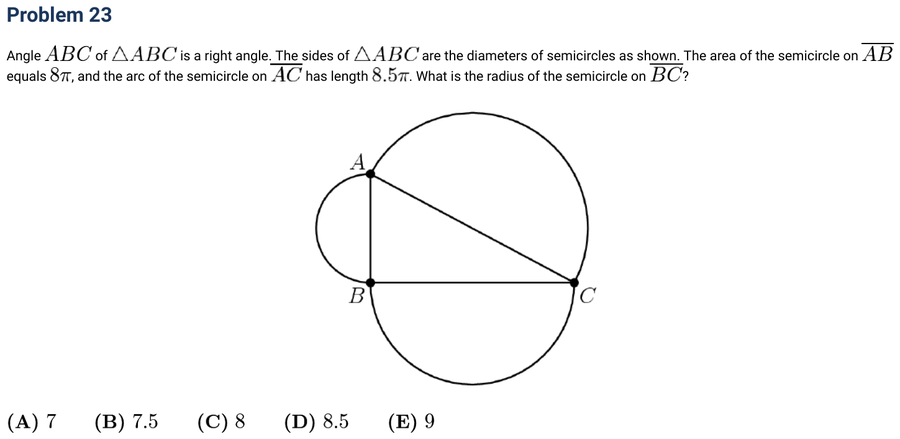
Angle ABC of ▵ABC is a right angle. The sides of ▵ABC are the diameters of semicircles as shown. The area of the semicircle on AB equals 8π, and the arc of the semicircle on AC has length 8.5π. What is the radius of the semicircle on BC?
Show answer
Answer: B — Radius 7.5.
Show hints
Hint 1 of 2
The semicircles are just disguises for the triangle's three sides. Each clue (an area, an arc length) is really telling you a side length — translate them back to AB and AC first, and a familiar right triangle appears.
Still stuck? Show hint 2 →
Hint 2 of 2
Pin down which radius-formula each clue uses: semicircle area = ½πr2, semicircle arc = πr. Recover the radii, double them for the diameters (= sides), then it's just the Pythagorean theorem.
Show solution
Approach: decode each semicircle into a side, then use Pythagoras
Side AB: its semicircle has area ½πr2 = 8π, so r2 = 16, r = 4, and AB = 2·4 = 8.
Side AC: its semicircle arc is πr = 8.5π, so r = 8.5 and AC = 2·8.5 = 17.
Right angle at B makes AC the hypotenuse: BC = √(172 − 82) = √225 = 15. (Spotting the 8-15-17 triple skips the square root entirely.)
The question wants the semicircle's radius on BC, so halve: 15 ÷ 2 = 7.5.
Watch the trap: after all that work it's tempting to answer 15 (the side) — but the figure's circles ride on the sides, and the question asks for a radius, so the final halving matters.
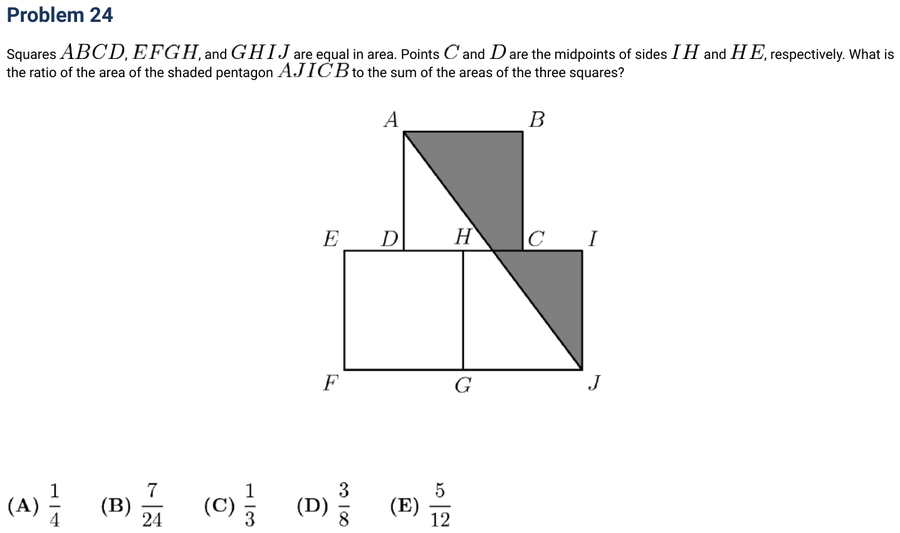
Squares ABCD, EFGH, and GHIJ are equal in area. Points C and D are the midpoints of sides IH and HE, respectively. What is the ratio of the area of the shaded pentagon AJICB to the sum of the areas of the three squares?
Show answer
Answer: C — 1/3.
Show hints
Hint 1 of 2
No actual size is given, so the answer can't depend on it — set each square's side to 1. Then the denominator is fixed at 3, and only the pentagon's area is left to find.
Still stuck? Show hint 2 →
Hint 2 of 2
The jagged pentagon is awkward, but its complement (the unshaded region ADEFJ, cut off by the straight diagonal from A to J) is a clean rectangle-plus-triangle. Subtracting the easy piece beats chasing the hard one. Coordinates with F = (0,0) make every corner exact.
Show solution
Approach: subtract the easy unshaded complement
Set each side to 1 (the ratio doesn't care about size), so the three squares total area 3 — that's the denominator handled. Now we only need the shaded area.
Rather than fight the jagged pentagon, find the unshaded leftover ADEFJ — the diagonal A–J splits it off cleanly. Put F = (0,0); its corners are A = (0.5, 2), D = (0.5, 1), E = (0, 1), F = (0, 0), J = (2, 0).
That region is a 0.5×1 rectangle (EDKF-style strip, area ½) plus right triangle AKJ with legs 1.5 and 2 (area ½·1.5·2 = 1.5), totaling 2.
Shaded = 3 − 2 = 1, so the ratio is 1 ÷ 3 = 1/3.
Why this transfers: when a shaded shape is jagged but its complement is made of rectangles and triangles, subtract the complement — the "hard region = whole − easy region" move.
Another way — coordinates + shoelace on the pentagon directly:
With F = (0, 0): A = (0.5, 2), J = (2, 0), I = (2, 1), C = (1.5, 1), B = (1.5, 2).
Shoelace on AJICB: ½ |(0.5·0 + 2·1 + 2·1 + 1.5·2 + 1.5·2) − (2·2 + 0·2 + 1·1.5 + 1·1.5 + 2·0.5)| = ½ |10 − 8| = 1.
Ratio = 1 ÷ 3 = 1/3. (Shoelace works on any polygon once you have the vertices in order.)
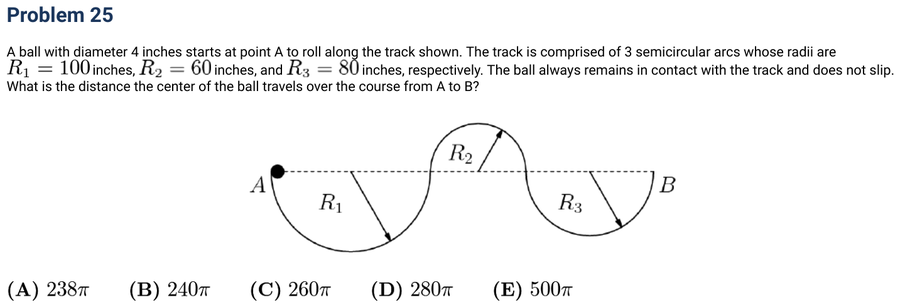
A ball with diameter 4 inches starts at point A to roll along the track shown. The track is comprised of 3 semicircular arcs whose radii are R1 = 100 inches, R2 = 60 inches, and R3 = 80 inches, respectively. The ball always remains in contact with the track and does not slip. What is the distance the center of the ball travels over the course from A to B?
Show answer
Answer: A — 238π.
Show hints
Hint 1 of 2
The ball touches the track but its center always sits one ball-radius (2 in) away. So the center traces its own set of semicircles, each concentric with the track's — the only question is whether the center is on the near or far side of each arc.
Still stuck? Show hint 2 →
Hint 2 of 2
On an arc that curves away from the center of the ball's path (ball rolls along the outside), the center's radius is R − 2; where the track curves the other way (ball rides the inside of the bend), it's R + 2. Match each arc to the picture, then a semicircle's length is just πR.
Show solution
Approach: shift each arc's radius by the ball's radius, then add the half-circumferences
The ball's diameter is 4, so its radius is 2 — the center always floats 2 inches off the track.
Read each bend from the figure: arc 1 and arc 3 are humps the ball rolls over the outside of, so the center's radius shrinks by 2 (100 → 98, 80 → 78); arc 2 is the dip where the ball hugs the inside, so it grows by 2 (60 → 62).
Each leg is a semicircle of length π·(center radius), so total = π(98 + 62 + 78) = 238π.
Why the ±2 matters: ignoring the offset gives π(100+60+80) = 240π (choice B, the trap). The shifts nearly cancel but not quite — two shrinks and one grow leave a net −2π.
You'll see this again: a rolling object's center traces a curve parallel to the track, offset by its radius — the same idea behind a coin rolling around a coin.