Problem 18 · 2009 AMC 8
Medium
Counting & Probability
pattern-scaling
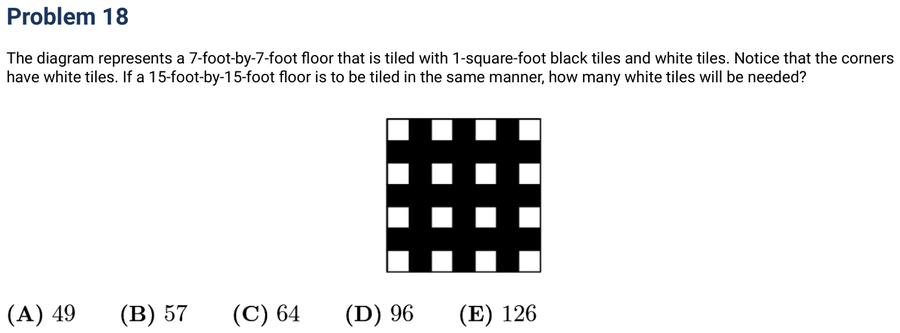
The diagram represents a 7-foot-by-7-foot floor that is tiled with 1-square-foot light tiles and dark tiles. Notice that the corners have dark tiles. If a 15-foot-by-15-foot floor is to be tiled in the same manner, how many dark tiles will be needed?
Show answer
Answer: C — 64 dark tiles.
Show hints
Hint 1 of 2
With corners dark, the dark tiles land exactly on the ODD rows and ODD columns — they form their own little grid sitting inside the big one. So the count is (odd rows) × (odd columns), not anything you have to draw out.
Still stuck? Show hint 2 →
Hint 2 of 2
Don't count dark tiles on the figure one by one and guess — find the RULE on the small 7×7, then apply the same rule to 15×15.
Show solution
Approach: dark tiles form an odd×odd subgrid — count and rescale
- Dark tiles occupy odd row + odd column positions. In a 7-wide floor the odd numbers are 1, 3, 5, 7 — that's 4 of them, so 4 × 4 = 16 dark tiles (matches the diagram).
- In a 15-wide floor the odd numbers are 1, 3, 5, 7, 9, 11, 13, 15 — 8 of them each way.
- Dark tiles = 8 × 8 = 64.
- Why this transfers: a repeating tile pattern is really a smaller grid — nail down its spacing on the example, then scale by counting how many lattice points fit. (Quick rule: an n-wide row, n odd, has (n+1)/2 odd positions.)
Mark:
· log in to save