Bridget bought a bag of apples at the grocery store. She gave half of the apples to Ann. Then she gave Cassie 3 apples, keeping 4 apples for herself. How many apples did Bridget buy?
Show answer
Answer: E — 14 apples.
Show hints
Hint 1 of 2
The story runs forward (give away, give away, keep), but you know the END, not the start. So play the movie in reverse.
Still stuck? Show hint 2 →
Hint 2 of 2
To undo a story, reverse the order AND flip each action: gave away → add back, took half → double.
Show solution
Approach: work backward, inverting each step
Start from what's known: 4 apples kept. The last thing before that was giving Cassie 3, so undo it — add them back: 4 + 3 = 7. That 7 is what she had right after giving Ann half.
Giving away half means 7 is the OTHER half, so the original was double: 2 × 7 = 14.
Why this transfers: whenever a problem hands you the finish and asks for the start, work-backward turns it into pure arithmetic — just remember to invert each operation (subtract becomes add, halve becomes double).
Another way — algebra (one equation):
Let she bought n. After giving Ann half she has n/2; after Cassie's 3 she has n/2 − 3 = 4.
On average, for every 4 sports cars sold at the local dealership, 7 sedans are sold. The dealership predicts that it will sell 28 sports cars next month. How many sedans does it expect to sell?
Show answer
Answer: D — 49 sedans.
Show hints
Hint 1 of 2
Think of the cars in repeating BATCHES: every batch is 4 sports cars + 7 sedans. The whole question is just 'how many batches?'
Still stuck? Show hint 2 →
Hint 2 of 2
Find the scale factor (what turns 4 into 28), then apply that SAME factor to 7. This is what 'keeping a ratio' means.
Show solution
Approach: scale the ratio by a single factor
How many batches of 4 sports cars make 28? 28 ÷ 4 = 7 batches.
Each batch also has 7 sedans, so 7 batches give 7 × 7 = 49 sedans.
You'll see it again as: any 'A is to B' ratio scaled to a new amount — find the multiplier on one quantity, reuse it on the other. No cross-multiplying needed when the numbers divide nicely.
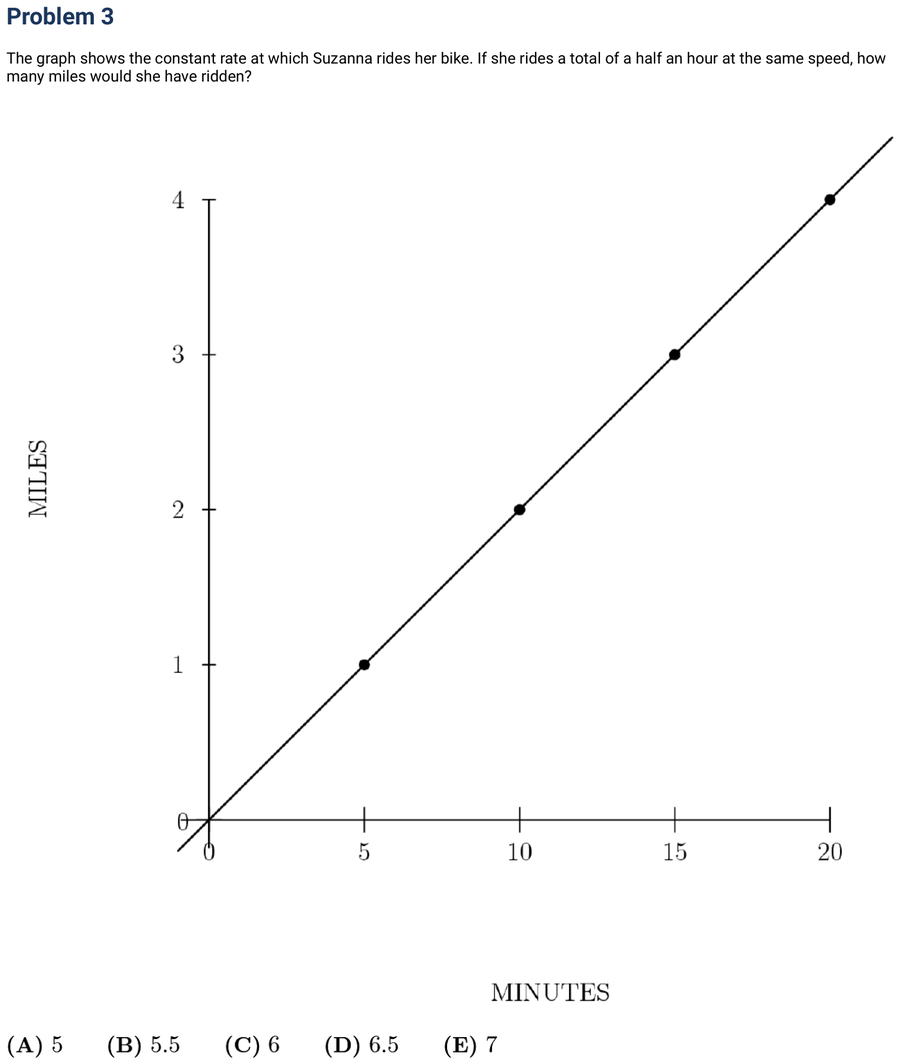
The graph shows the constant rate at which Suzanna rides her bike. If she rides a total of a half an hour at the same speed, how many miles would she have ridden?
Show answer
Answer: C — 6 miles.
Show hints
Hint 1 of 2
"Constant rate" is the key phrase: one dot on the graph fixes the speed forever, so you don't need the line to reach 30 minutes — you can just scale up.
Still stuck? Show hint 2 →
Hint 2 of 2
Read one easy point off the graph, turn it into a simple per-minute rate, then count how many of those time-chunks fit in 30 minutes.
Show solution
Approach: read one point, scale to the new time
Pick the cleanest point on the line: she goes 1 mile every 5 minutes.
Half an hour = 30 minutes, which is 30 ÷ 5 = 6 of those 5-minute chunks. So 6 × 1 = 6 miles.
Why this works: a straight line through the origin means distance and time grow in lockstep — one ratio (1 mile / 5 min) describes every point, so rescaling is all you ever need.
Another way — unit rate then multiply:
Speed = 1 mile / 5 min = 0.2 mi/min, which is 12 mph.
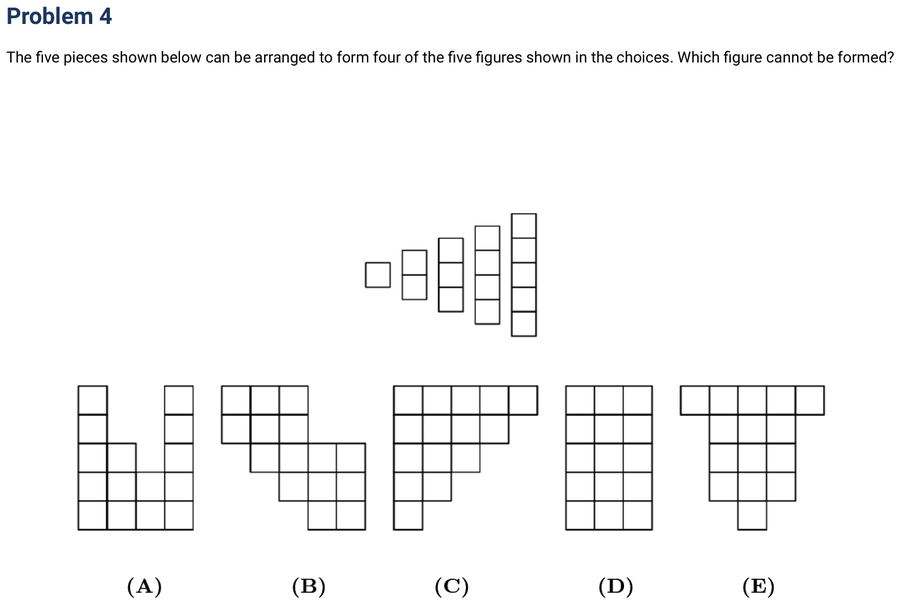
The five pieces shown below can be arranged to form four of the five figures shown in the choices. Which figure cannot be formed?
Show answer
Answer: B — B.
Show hints
Hint 1 of 2
Don't try to actually build all five figures — that's a maze. Instead hunt for the ONE piece that's hardest to place: the long 1×5 strip. It can't bend.
Still stuck? Show hint 2 →
Hint 2 of 2
Find a feature of the stubborn piece, then test the target shapes against it. A shape that can't host that feature is the impossible one.
Show solution
Approach: rule out by the most constrained piece
The 1×5 strip is rigid: in any arrangement it occupies 5 squares in a perfectly straight line, horizontal or vertical.
So the answer shape MUST contain a straight 5-in-a-row somewhere. Scan the choices for that run — figure B has no straight 5-block run in either direction, so the strip has nowhere to go.
Why this transfers: with fitting/packing puzzles, attack the most restrictive piece first. One necessary feature it forces (here, "a straight length-5 slot must exist") often eliminates the answer instantly — far faster than constructing everything.
A sequence of numbers starts with 1, 2, and 3. The fourth number of the sequence is the sum of the previous three numbers in the sequence: 1 + 2 + 3 = 6. In the same way, every number after the fourth is the sum of the previous three numbers. What is the eighth number in the sequence?
Show answer
Answer: D — 68.
Show hints
Hint 1 of 2
There's no clever shortcut to hunt for — the rule itself IS the tool. Each new term only needs the three just before it, so you can roll forward step by step.
Still stuck? Show hint 2 →
Hint 2 of 2
Keep a sliding window of the last three numbers; add them for the next term, then slide the window forward one.
Show solution
Approach: iterate the recurrence (sliding window of 3)
Each term = sum of the previous three. Roll forward: 1, 2, 3, then 1+2+3 = 6, then 2+3+6 = 11, then 3+6+11 = 20, then 6+11+20 = 37, then 11+20+37 = 68.
That 68 is the 8th term. Sanity check: terms should grow but not explode — each roughly doubles, and 37 → 68 fits, so we didn't skip or double-count a term.
You'll meet this again: a rule like "each term = sum of the last few" is a recurrence (this one is the Tribonacci pattern, cousin of Fibonacci). For a small target index, just iterate — only reach for formulas when the index is huge.
Steve's empty swimming pool will hold 24,000 gallons of water when full. It will be filled by 4 hoses, each of which supplies 2.5 gallons of water per minute. How many hours will it take to fill Steve's pool?
Show answer
Answer: A — 40 hours.
Show hints
Hint 1 of 2
Four hoses running at once act like one big hose — their rates simply ADD. The answer wants hours, so save yourself a conversion by building the combined rate in gallons-per-HOUR from the start.
Still stuck? Show hint 2 →
Hint 2 of 2
Once you have a single combined rate, time = total amount ÷ rate.
Show solution
Approach: combine rates, then divide total by rate
One hose: 2.5 gal/min. Working together, rates add: 4 × 2.5 = 10 gal/min. Since the answer is in hours, scale up now: 10 gal/min × 60 = 600 gal/hour.
Time = total ÷ rate = 24,000 ÷ 600 = 40 hours.
Why this transfers: whenever several workers/pipes/machines run simultaneously, add their individual rates into one combined rate — then it's a single division. Converting units BEFORE dividing (here min→hr) avoids a clumsy 2,400-minute intermediate.
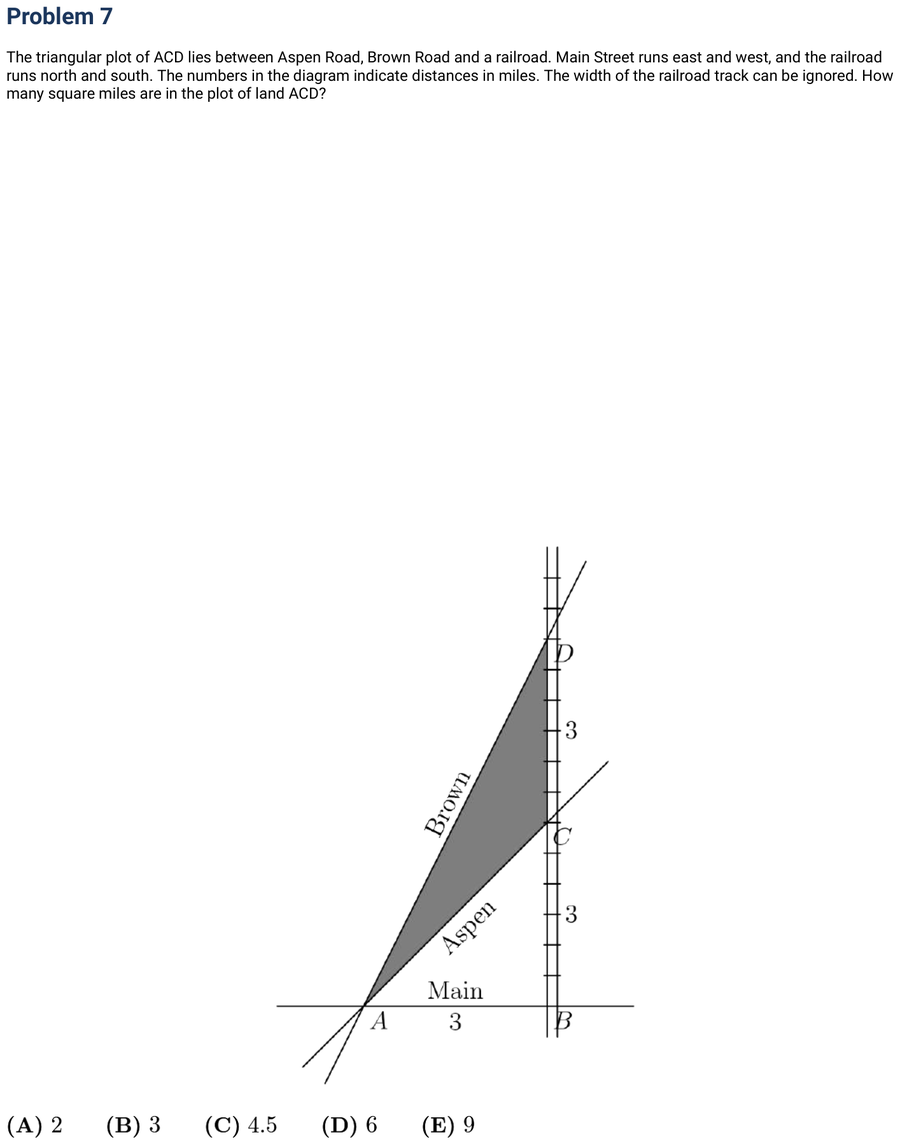
The triangular plot of ACD lies between Aspen Road, Brown Road and a railroad. Main Street runs east and west, and the railroad runs north and south. The numbers in the diagram indicate distances in miles. The width of the railroad track can be ignored. How many square miles are in the plot of land ACD?
Show answer
Answer: C — 4.5 square miles.
Show hints
Hint 1 of 2
The triangle looks slanted, but you get to CHOOSE which side is the base. Pick the side CD sitting on the (vertical) railroad — then the height is just the straight horizontal distance over to A.
Still stuck? Show hint 2 →
Hint 2 of 2
Base and height must be perpendicular. The railroad runs north–south and Main Street runs east–west, so they're already at right angles — that's why those two segments are the easy base/height pair.
Show solution
Approach: choose a convenient base, read its perpendicular height
Use CD as the base: C and D both lie on the railroad, with CD = 3.
The height is the perpendicular distance from A across to that railroad line. Since Main Street (east–west) meets the railroad (north–south) at a right angle, that distance is just AB = 3.
Area = ½ × base × height = ½ × 3 × 3 = 4.5.
Why this transfers: on a tilted triangle, find a side that lies along a grid line or axis — its perpendicular height is then a simple horizontal or vertical gap, sparing you any slope or distance-formula work.
The length of a rectangle is increased by 10% and the width is decreased by 10%. What percent of the old area is the new area?
Show answer
Answer: B — 99%.
Show hints
Hint 1 of 2
Tempting trap: "+10% then −10% cancels to 0." It doesn't — the 10% you take off is computed from the BIGGER length, so the drop slightly outweighs the gain.
Still stuck? Show hint 2 →
Hint 2 of 2
Turn each percent change into a multiplier (up 10% → ×1.1, down 10% → ×0.9) and just multiply them. Area = length × width, so the area's multiplier is the product.
Show solution
Approach: multiply the multipliers
New area ÷ old area = 1.1 × 0.9 = 0.99 = 99%.
Intuition for the 1% loss: 1.1 × 0.9 = (1 + 0.1)(1 − 0.1) = 1 − 0.1² = 1 − 0.01. The leftover is the square of the percent — tiny, and always a LOSS.
You'll see it again: stacked percent changes always multiply, never add. "Raise then drop by the same %" always ends below where you started, by exactly (that %)².
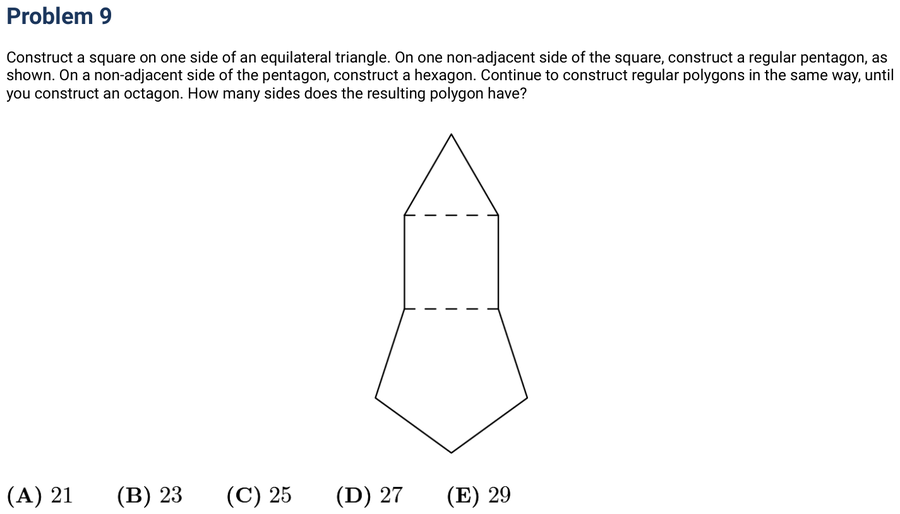
Construct a square on one side of an equilateral triangle. On one non-adjacent side of the square, construct a regular pentagon, as shown. On a non-adjacent side of the pentagon, construct a hexagon. Continue to construct regular polygons in the same way, until you construct an octagon. How many sides does the resulting polygon have?
Show answer
Answer: B — 23 sides.
Show hints
Hint 1 of 2
The shared edges between two glued polygons sit INSIDE the chain — they vanish from the outline. So don't add up all the sides; subtract the buried ones.
Still stuck? Show hint 2 →
Hint 2 of 2
Count the glue-joints. Each interior polygon is glued on two sides (to its neighbor before and after), so it hides 2 sides; the two end polygons are glued on only one side, hiding just 1.
Show solution
Approach: total sides minus the buried (shared) edges
The shapes are 3, 4, 5, 6, 7, 8 (triangle through octagon). All sides together: 3+4+5+6+7+8 = 33.
Now subtract every edge that gets glued shut. There are 5 glue-joints between consecutive shapes, and each joint hides one edge from BOTH shapes it joins — so 2 sides vanish per joint: 5 × 2 = 10 buried sides.
Outline = 33 − 10 = 23.
Why this transfers: when figures share borders, the outline counts only edges touched by the outside. "Add everything, then subtract each shared edge once per shape it belongs to" is the same trick behind perimeter-of-glued-shapes problems.
Another way — per-polygon contribution:
End shapes give all-but-1 side: (3−1) + (8−1) = 2 + 7 = 9.
On a checkerboard composed of 64 unit squares, what is the probability that a randomly chosen unit square does not touch the outer edge of the board?
Show answer
Answer: D — 9/16.
Show hints
Hint 1 of 2
"Doesn't touch the outer edge" means: peel off the whole one-square-thick border ring. What's left in the middle is the safe region.
Still stuck? Show hint 2 →
Hint 2 of 2
Peeling one ring removes a row/column from EACH of the four sides — so an 8-wide board becomes 8 − 2 = 6 wide inside.
Show solution
Approach: subtract the border ring, then take the ratio
Drop the outer ring: the inside is a 6×6 block (8 minus 1 row off the top and 1 off the bottom, same for the sides). That's 6 × 6 = 36 interior squares.
Probability = interior ÷ total = 36 / 64 = 9/16.
Why this transfers: "not on the edge" problems shrink an n×n grid to (n−2)×(n−2) — the −2 is one layer off opposite sides. Same idea for borders on rugs, frames, or seating around a table.
Another way — count the edge squares instead:
Border of an 8×8: 4×8 − 4 corners counted twice = 32 − 4 = 28 edge squares.
Interior = 64 − 28 = 36, so 36/64 = 9/16. (Subtracting the ring directly is faster.)
The Amaco Middle School bookstore sells pencils costing a whole number of cents. Some seventh graders each bought a pencil, paying a total of $1.43. Some of the 30 sixth graders each bought a pencil, and they paid a total of $1.95. How many more sixth graders than seventh graders bought a pencil?
Show answer
Answer: D — 4 more.
Show hints
Hint 1 of 2
The number of buyers in each grade must be a WHOLE number = (total paid) ÷ (one price). So the single pencil price has to divide BOTH totals evenly. Work in cents: 143 and 195.
Still stuck? Show hint 2 →
Hint 2 of 2
A number dividing both 143 and 195 is a common divisor — factor each and look for what they share.
Show solution
Approach: the price is a common divisor of both totals
Switch to cents so everything's whole: $1.43 = 143¢, $1.95 = 195¢. The price p must divide both (buyers = total ÷ p has to come out whole).
Factor: 143 = 11 × 13 and 195 = 3 × 5 × 13. Their only shared factors are 1 and 13.
Rule out p = 1¢: at 1¢ each, 195 sixth graders would have bought — but there are only 30. So p = 13¢.
Why this transfers: "equal items, total cost, unknown unit price" means the price divides every total — reach for common divisors (gcd), then use side conditions (like "at most 30 kids") to pick the right one.
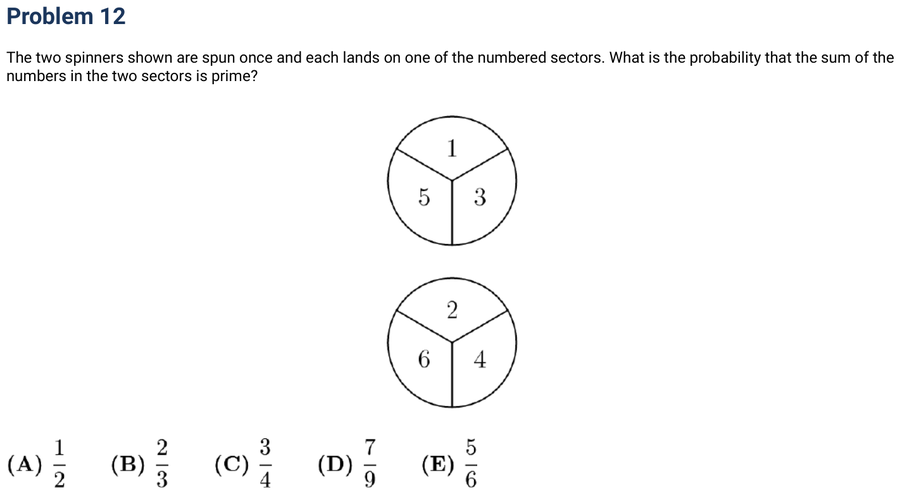
The two spinners shown are spun once and each lands on one of the numbered sectors. What is the probability that the sum of the numbers in the two sectors is prime?
Show answer
Answer: D — 7/9.
Show hints
Hint 1 of 2
First spinner is all ODD (1, 3, 5); second is all EVEN (2, 4, 6). Odd + even is always odd — so every one of the 9 sums is odd, and you never have to worry about "even, so not prime."
Still stuck? Show hint 2 →
Hint 2 of 2
Among odd sums the only non-primes are 9, 15, 21, … (odd multiples of 3). The sums here run 3 to 11, so the only danger is a 9. Count BAD outcomes — it's quicker than counting good ones.
Show solution
Approach: use parity, then count the few non-primes (complement)
There are 3 × 3 = 9 equally likely outcomes. Since odd + even = odd, every sum is odd, so the only way to miss "prime" is to land on an odd non-prime in range (3–11) — that's just 9.
Which pairs sum to 9? Only 3+6 and 5+4 — 2 outcomes.
So 2 fail and 7 succeed: probability = 7/9 = 7/9.
Why this transfers: spotting that all sums share a parity slashes the work, and counting the FEW bad cases (complement) beats listing all the good ones.
Another way — list all nine sums:
Sums: 3, 5, 7, 5, 7, 9, 7, 9, 11. The two 9s are the only composites.
A three-digit integer contains one of each of the digits 1, 3, and 5. What is the probability that the integer is divisible by 5?
Show answer
Answer: B — 1/3.
Show hints
Hint 1 of 2
Divisibility by 5 depends ONLY on the last digit — here that means the units digit must be the 5. The other two digits don't matter, so ignore them.
Still stuck? Show hint 2 →
Hint 2 of 2
By symmetry, each of 1, 3, 5 is equally likely to be the units digit. So you don't even need to count all the arrangements.
Show solution
Approach: only the units digit matters — use symmetry
A number is a multiple of 5 exactly when its last digit is 0 or 5. Our digits are 1, 3, 5, so we need the 5 sitting in the units place.
The three digits are placed at random, and there's nothing special about any one slot — so the 5 lands in the units place with probability 1/3 (just as 1 or 3 each would).
Why this transfers: a divisibility rule that reads only the last digit lets you collapse a whole-number question to one position — then symmetry handles the probability without listing every arrangement.
Another way — count arrangements directly:
All orderings: 3! = 6. Those ending in 5: fix 5 last, arrange the rest: 2! = 2.
Austin and Temple are 50 miles apart along Interstate 35. Bonnie drove from Austin to her daughter's house in Temple, averaging 60 miles per hour. Leaving the car with her daughter, Bonnie rode a bus back to Austin along the same route and averaged 40 miles per hour on the return trip. What was the average speed for the round trip, in miles per hour?
Show answer
Answer: B — 48 mph.
Show hints
Hint 1 of 2
The trap answer is 50 (just averaging 60 and 40). But she spends MORE time at the slow 40 mph, so the average leans below 50. Average speed is always total distance ÷ total time — never the average of the speeds.
Still stuck? Show hint 2 →
Hint 2 of 2
Since the distance each way is the same, the actual 50 miles cancels out — the answer depends only on the two speeds 60 and 40.
Show solution
Approach: total distance ÷ total time
Time there: 50/60 = 5/6 hr. Time back: 50/40 = 5/4 hr. Total time = 5/6 + 5/4 = 10/12 + 15/12 = 25/12 hr.
Sanity check: 48 is below the plain average of 50 — correct, because the slow leg eats more time.
You'll see it again: equal-distance round trips give the harmonic mean of the speeds, 2×60×40/(60+40) = 4800/100 = 48 — always below the ordinary average, and the actual distance never matters.
Another way — pick a convenient distance:
The distance cancels, so use the LCM of 60 and 40: pretend each leg is 120 miles.
Out: 120/60 = 2 hr. Back: 120/40 = 3 hr. Total 240 miles in 5 hr = 48 mph.
A recipe that makes 5 servings of hot chocolate requires 2 squares of chocolate, 1/4 cup sugar, 1 cup water and 4 cups milk. Jordan has 5 squares of chocolate, 2 cups of sugar, lots of water, and 7 cups of milk. If she maintains the same ratio of ingredients, what is the greatest number of servings of hot chocolate she can make?
Show answer
Answer: D — 8¾ servings.
Show hints
Hint 1 of 2
You can only make as much as your SCARCEST ingredient allows — like a chain breaking at its weakest link. Having extra of everything else doesn't help once one runs out.
Still stuck? Show hint 2 →
Hint 2 of 2
For each ingredient ask: how many full recipes does my supply cover? (supply ÷ amount-per-recipe). The smallest of those numbers is the limit; then turn recipes into servings.
The smallest is milk at 1.75 recipes — milk runs out first, so it caps everything.
Each recipe makes 5 servings: 1.75 × 5 = 35/4 = 8¾ servings.
Why this transfers: any "how much can I make / how many can I build" problem is a weakest-link question — compute the limit from each resource and take the minimum. Don't average them or use the most plentiful one.
How many 3-digit positive integers have digits whose product equals 24?
Show answer
Answer: D — 21.
Show hints
Hint 1 of 2
Split the job in two: FIRST find which sets of three digits multiply to 24 (order ignored), THEN count how many numbers each set makes by reordering. Don't try to do both at once.
Still stuck? Show hint 2 →
Hint 2 of 2
Each digit must be 1–9 (no 0, or the product is 0). To list the sets cleanly, factor 24 = 2³ × 3 and hand the factors out three ways. Watch for repeats — a set with a doubled digit has fewer arrangements.
Show solution
Approach: list digit-sets, then count orderings (correct for repeats)
Digit-sets (each 1–9) with product 24: {1,3,8}, {1,4,6}, {2,3,4}, {2,2,6}. That's it — any other split needs a digit above 9.
Count orderings of each. Three different digits give 3! = 6 numbers each: that's 6 + 6 + 6 = 18 from the first three sets.
{2,2,6} has a repeated 2, so swapping the two 2's gives nothing new: only 3!/2! = 3 numbers.
Total: 18 + 3 = 21.
Why this transfers: "count the numbers with property X" usually splits into "find the unordered ingredient sets, then count arrangements." And always divide out duplicate items — forgetting the repeat is the #1 overcount error.
The positive integers x and y are the two smallest positive integers for which the product of 360 and x is a square and the product of 360 and y is a cube. What is the sum of x and y?
Show answer
Answer: B — 85.
Show hints
Hint 1 of 2
A perfect square is a number whose prime exponents are ALL even; a perfect cube has all exponents divisible by 3. So prime-factor 360 first and just look at the exponents.
Still stuck? Show hint 2 →
Hint 2 of 2
To minimize the multiplier, top up each exponent to the NEXT even number (for a square) or next multiple of 3 (for a cube) — add only the missing primes, nothing extra.
Show solution
Approach: round each prime's exponent up to the target
360 = 2³ · 3² · 5¹. Read the exponents: 3, 2, 1.
Square (all exponents even): 3 → 4 needs one more 2; 2 is already even; 1 → 2 needs one more 5. So multiply by 2 × 5 = 10. Thus x = 10.
Cube (all exponents multiples of 3): 3 is fine; 2 → 3 needs one more 3; 1 → 3 needs two more 5's. So multiply by 3 × 5² = 75. Thus y = 75.
x + y = 10 + 75 = 85.
Why this transfers: "multiply to make a perfect square/cube" is purely about exponents — round each up to the next even / next multiple of 3, and you're done. The minimum multiplier supplies exactly the missing primes.
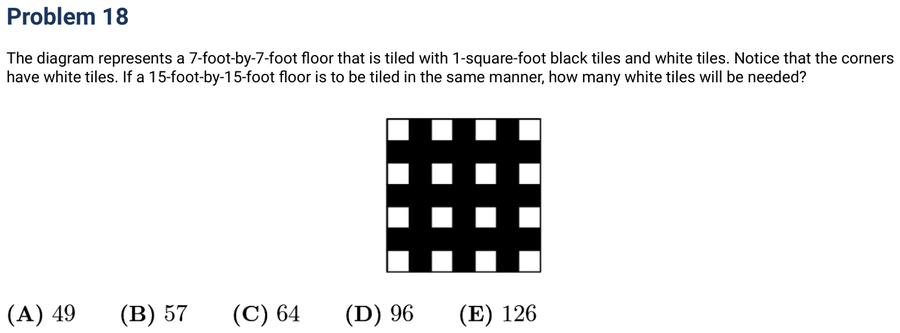
The diagram represents a 7-foot-by-7-foot floor that is tiled with 1-square-foot light tiles and dark tiles. Notice that the corners have dark tiles. If a 15-foot-by-15-foot floor is to be tiled in the same manner, how many dark tiles will be needed?
Show answer
Answer: C — 64 dark tiles.
Show hints
Hint 1 of 2
With corners dark, the dark tiles land exactly on the ODD rows and ODD columns — they form their own little grid sitting inside the big one. So the count is (odd rows) × (odd columns), not anything you have to draw out.
Still stuck? Show hint 2 →
Hint 2 of 2
Don't count dark tiles on the figure one by one and guess — find the RULE on the small 7×7, then apply the same rule to 15×15.
Show solution
Approach: dark tiles form an odd×odd subgrid — count and rescale
Dark tiles occupy odd row + odd column positions. In a 7-wide floor the odd numbers are 1, 3, 5, 7 — that's 4 of them, so 4 × 4 = 16 dark tiles (matches the diagram).
In a 15-wide floor the odd numbers are 1, 3, 5, 7, 9, 11, 13, 15 — 8 of them each way.
Dark tiles = 8 × 8 = 64.
Why this transfers: a repeating tile pattern is really a smaller grid — nail down its spacing on the example, then scale by counting how many lattice points fit. (Quick rule: an n-wide row, n odd, has (n+1)/2 odd positions.)
Two angles of an isosceles triangle measure 70° and x°. What is the sum of the three possible values of x?
Show answer
Answer: D — 165.
Show hints
Hint 1 of 2
"Isosceles" only promises SOME two angles are equal — it doesn't say which. That ambiguity is exactly why there are three answers, so don't lock in one picture.
Still stuck? Show hint 2 →
Hint 2 of 2
Make the equal pair the variable: either 70° matches x°, or the 70° is the repeated angle, or x° is the repeated angle. Use angle-sum 180° in each case.
Show solution
Approach: case-split on which angles are the equal pair
Case 1 — 70° and x° are the equal pair: then x = 70. (Third angle 40°, valid.)
Case 2 — two 70° angles: the third angle is x = 180 − 70 − 70 = 40.
Case 3 — two x° angles, with 70° the odd one: 2x + 70 = 180 ⇒ x = 55.
All three are valid triangles, so sum them: 70 + 40 + 55 = 165.
Why this transfers: when a shape is "isosceles" but the equal sides/angles aren't specified, systematically try each candidate for the matched pair — and check each case gives a real triangle (positive angles summing to 180°) before counting it.
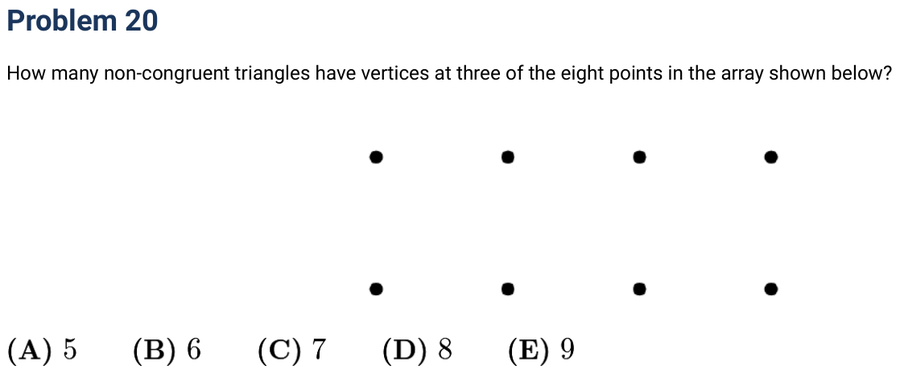
How many non-congruent triangles have vertices at three of the eight points in the array shown below?
Show answer
Answer: D — 8.
Show hints
Hint 1 of 2
The 8 points form 2 rows of 4. Any triangle must use BOTH rows — three points on one line make no triangle — so it's always two points on one row and one point on the other.
Still stuck? Show hint 2 →
Hint 2 of 2
"Non-congruent" means count SHAPES, not positions: a triangle and its mirror image are the same shape. So organize by the horizontal gap between the two same-row points (1, 2, or 3) and how far the lone point sits from them, then drop mirror duplicates.
Show solution
Approach: classify by the pair's width and the lone point's offset, count shapes up to mirror
Every triangle = two points on one row + one on the other (the rows are 1 unit apart). What fixes the SHAPE is two numbers: the gap g between the same-row pair, and the lone point's horizontal offset from them. Slide-and-flip copies are congruent, so count each distinct (g, offset) once.
Gap g = 1 (adjacent pair, like columns 1–2): the lone point can sit directly under one end (offset 0), or 1, or 2 columns out to the side. The two sides are mirror images, so the distinct shapes come from offsets 0, 2, 3 measured from the pair — 3 shapes.
Gap g = 2 (pair like columns 1–3): lone point under an end, under the middle, or one column beyond — 3 shapes.
Gap g = 3 (pair at the far ends, columns 1–4): the lone point is at one of the two inner columns; those two choices are mirror images of each other, and being under an endpoint repeats a thinner shape — 2 shapes.
Total distinct shapes: 3 + 3 + 2 = 8.
Why this transfers: for "how many non-congruent figures," never list raw positions — pick the few measurements that pin down a shape (here a base length and an offset) and count those, folding mirror images together.
Andy and Bethany have a rectangular array of numbers with 40 rows and 75 columns. Andy adds the numbers in each row. The average of his 40 sums is A. Bethany adds the numbers in each column. The average of her 75 sums is B. What is the value of AB?
Show answer
Answer: D — 15/8.
Show hints
Hint 1 of 2
The actual numbers never matter. Andy's row-sums and Bethany's column-sums both add up EVERY entry of the array exactly once — so the two grand totals are identical.
Still stuck? Show hint 2 →
Hint 2 of 2
Average = total ÷ (how many you averaged). Andy divided the grand total by 40, Bethany by 75. Write both totals as one shared value S.
Show solution
Approach: both grand totals are the same number
Let S = sum of all entries. Adding by rows or by columns both reach S, so 40A = S and 75B = S. Hence 40A = 75B.
Rearrange: A/B = 75/40 = 15/8.
Sanity check: fewer rows (40) than columns (75) means each row-sum is bigger on average, so A > B — and 15/8 > 1. Good. This transfers as a counting invariant: when one total can be tallied two ways, set the two tallies equal.
How many whole numbers between 1 and 1000 do not contain the digit 1?
Show answer
Answer: D — 728.
Show hints
Hint 1 of 2
Counting by independent digit-choices is the move: each digit slot can be filled freely, and 'no digit 1' just means each slot avoids one value. Multiply the choices per slot.
Still stuck? Show hint 2 →
Hint 2 of 2
Be careful at the boundaries: the FIRST digit of a number can't be 0 (or it's shorter), and remember 1000 itself contains a 1. Splitting by number of digits keeps the leading-zero rule straight.
Show solution
Approach: multiply allowed choices per digit, split by length
Forbidden digit is 1. A non-leading slot may be any of {0,2,3,4,5,6,7,8,9} = 9 choices; a leading slot also bans 0, leaving {2,…,9} = 8 choices.
1-digit: 8. 2-digit: 8 × 9 = 72. 3-digit: 8 × 9 × 9 = 648. (1000 has a 1, so it's out.)
Total: 8 + 72 + 648 = 728.
Why this transfers: 'how many numbers avoid digit d' is a per-slot multiplication — just mind the leading-zero rule and the top endpoint.
Another way — pad to 3 digits and subtract:
Write every number 1–999 as a 3-digit string 001…999, allowing leading zeros. With no '1' anywhere, each of the 3 slots has 9 allowed digits: 9³ = 729 strings (this counts 000).
Drop 000 (it's not in our range) and note 1000 has a 1: 729 − 1 = 728. Padding turns three cases into one clean power.
On the last day of school, Mrs. Awesome gave jelly beans to her class. She gave each boy as many jelly beans as there were boys in the class. She gave each girl as many jelly beans as there were girls in the class. She brought 400 jelly beans, and when she finished, she had six jelly beans left. There were two more boys than girls in her class. How many students were in her class?
Show answer
Answer: B — 28 students.
Show hints
Hint 1 of 2
"Each boy gets one bean per boy" means the boys together get b × b = b2 beans — a square! Likewise girls get g2. Beans handed out = 400 − 6 = 394, so b2 + g2 = 394.
Still stuck? Show hint 2 →
Hint 2 of 2
You now want two squares (with b just 2 more than g) that add to 394. Since 394 ≈ 14² + 14², the numbers sit right near 14 — so a quick guess-and-check beats heavy algebra.
Show solution
Approach: two squares summing to 394, with b = g + 2
Each boy receives b beans and there are b boys ⇒ b2 beans to boys; similarly g2 to girls. Given out: 400 − 6 = 394. So b2 + g2 = 394 with b = g + 2.
The two squares average about 197, and √197 ≈ 14 — so test the consecutive-even-apart pair around 14: g = 13, b = 15 gives 169 + 225 = 394. It works.
Students = 13 + 15 = 28.
Why this transfers: "sum of two squares near a known total" almost always yields to estimating the size (√half-the-total) and checking a couple of nearby values — lighter than expanding a quadratic.
The letters A, B, C, and D represent digits. If AB + CA = DA and AB − CA = A, what digit does D represent?
Show answer
Answer: E — 9.
Show hints
Hint 1 of 2
Attack the UNITS column first — it's almost never tangled by carries. In the addition, the units give B + A ending in A, which forces B = 0.
Still stuck? Show hint 2 →
Hint 2 of 2
Once B = 0 you know AB = 10A (a round number). Feed that into the subtraction AB − CA = A to pin down A and C, then read off D.
Show solution
Approach: crack the units column, then use the subtraction
Units of the addition: B + A ends in A. Adding B leaves the last digit unchanged only if B = 0 (and there's no carry). So B = 0, making AB = 10A.
Subtraction: 10A − (10C + A) = A ⇒ 9A − 10C = A ⇒ 8A = 10C ⇒ 4A = 5C.
4A = 5C needs A divisible by 5 and C by 4 (single digits): A = 5, C = 4.
Then DA = AB + CA = 50 + 45 = 95, so D = 9 (and the units '5' matches A — consistent).
Why this transfers: in any cryptarithm, start where carries are simplest (units of a sum) to lock one letter, then substitute forward. A relation like 4A = 5C is solved by divisibility, not by trying all 100 pairs.
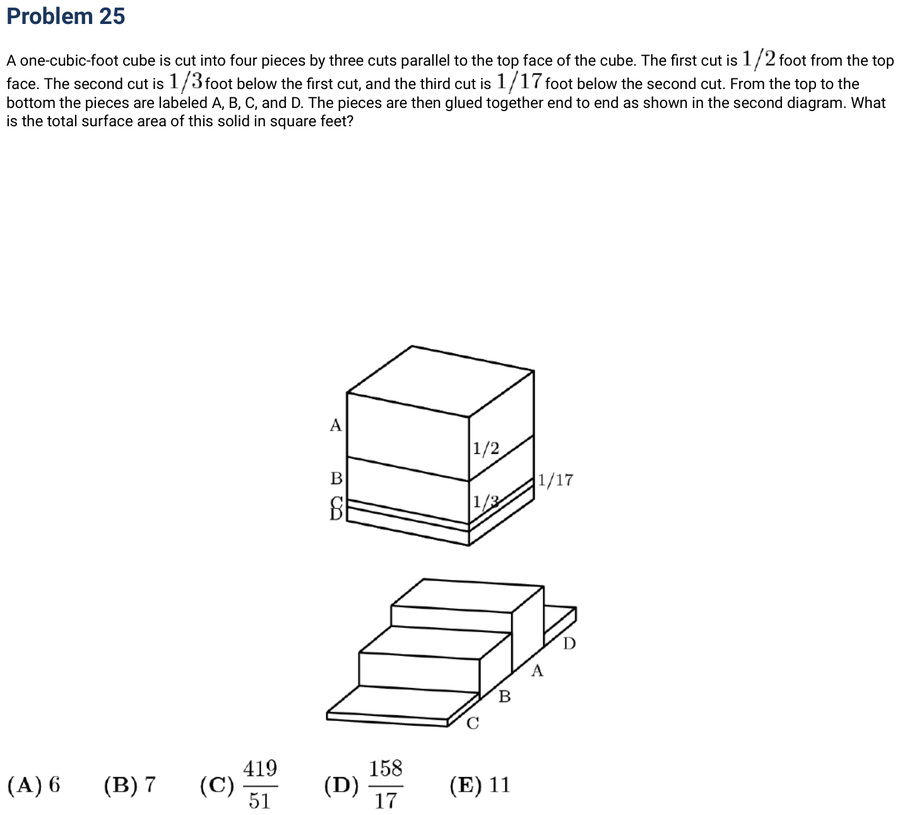
A one-cubic-foot cube is cut into four pieces by three cuts parallel to the top face of the cube. The first cut is 12 foot from the top face. The second cut is 13 foot below the first cut, and the third cut is 117 foot below the second cut. From the top to the bottom the pieces are labeled A, B, C, and D. The pieces are then glued together end to end as shown in the second diagram. What is the total surface area of this solid in square feet?
Show answer
Answer: E — 11 square feet.
Show hints
Hint 1 of 2
Those ugly cut fractions (1/2, 1/3, 1/17) are bait — the slabs together still came from one cube, so their heights always add to 1. Look from all 6 directions instead of tracking each slab's thickness.
Still stuck? Show hint 2 →
Hint 2 of 2
Add up the SILHOUETTE area seen from each face. Top and bottom each show four 1×1 squares; front and back each show a staircase whose four heights total 1 (a full unit); the two ends each show only the tallest step.
Show solution
Approach: project onto all 6 faces — heights conspire to 1
Each piece keeps its 1×1 footprint. Top & bottom views: you see all four 1×1 squares — 4 sq ft from the top, 4 from the bottom.
Front & back views: the staircase silhouette is four width-1 strips whose heights are the four slab thicknesses — and those came from slicing one unit cube, so they sum to exactly 1. Area = 1 each ⇒ 2 sq ft.
Two end views: the slabs descend like a staircase, so from an end you see only the tallest piece A's cross-section, 1 × ½ = ½ — 1 sq ft for both ends.
Total surface area = 4 + 4 + 2 + 1 = 11.
Why this transfers: for a blocky solid, total surface area = sum of the six flat-on silhouette areas (no part of an axis-aligned surface ever hides behind another). And when pieces come from one whole, their dimensions secretly add back to that whole — so deliberately messy fractions often cancel.