Problem 9 · 2009 AMC 8
Medium
Geometry & Measurement
shared-sides-polygon-chain
Construct a square on one side of an equilateral triangle. On one non-adjacent side of the square, construct a regular pentagon, as shown. On a non-adjacent side of the pentagon, construct a hexagon. Continue to construct regular polygons in the same way, until you construct an octagon. How many sides does the resulting polygon have?
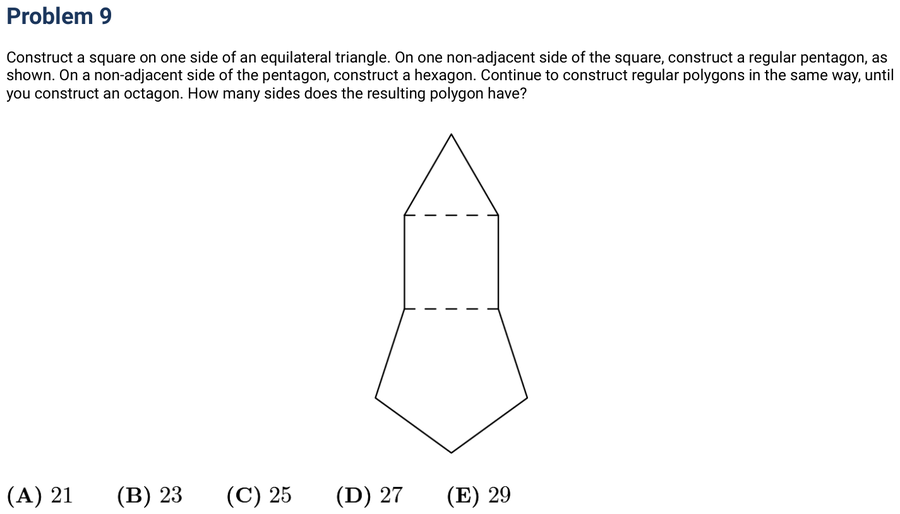
Show answer
Answer: B — 23 sides.
Show hints
Hint 1 of 2
The shared edges between two glued polygons sit INSIDE the chain — they vanish from the outline. So don't add up all the sides; subtract the buried ones.
Still stuck? Show hint 2 →
Hint 2 of 2
Count the glue-joints. Each interior polygon is glued on two sides (to its neighbor before and after), so it hides 2 sides; the two end polygons are glued on only one side, hiding just 1.
Show solution
Approach: total sides minus the buried (shared) edges
- The shapes are 3, 4, 5, 6, 7, 8 (triangle through octagon). All sides together: 3+4+5+6+7+8 = 33.
- Now subtract every edge that gets glued shut. There are 5 glue-joints between consecutive shapes, and each joint hides one edge from BOTH shapes it joins — so 2 sides vanish per joint: 5 × 2 = 10 buried sides.
- Outline = 33 − 10 = 23.
- Why this transfers: when figures share borders, the outline counts only edges touched by the outside. "Add everything, then subtract each shared edge once per shape it belongs to" is the same trick behind perimeter-of-glued-shapes problems.
Another way — per-polygon contribution:
- End shapes give all-but-1 side: (3−1) + (8−1) = 2 + 7 = 9.
- Each middle shape gives all-but-2: (4−2) + (5−2) + (6−2) + (7−2) = 2+3+4+5 = 14.
- Total: 9 + 14 = 23.
Mark:
· log in to save