Problem 22 · 2006 AMC 8
Medium
Algebra & Patterns
pyramid-formula
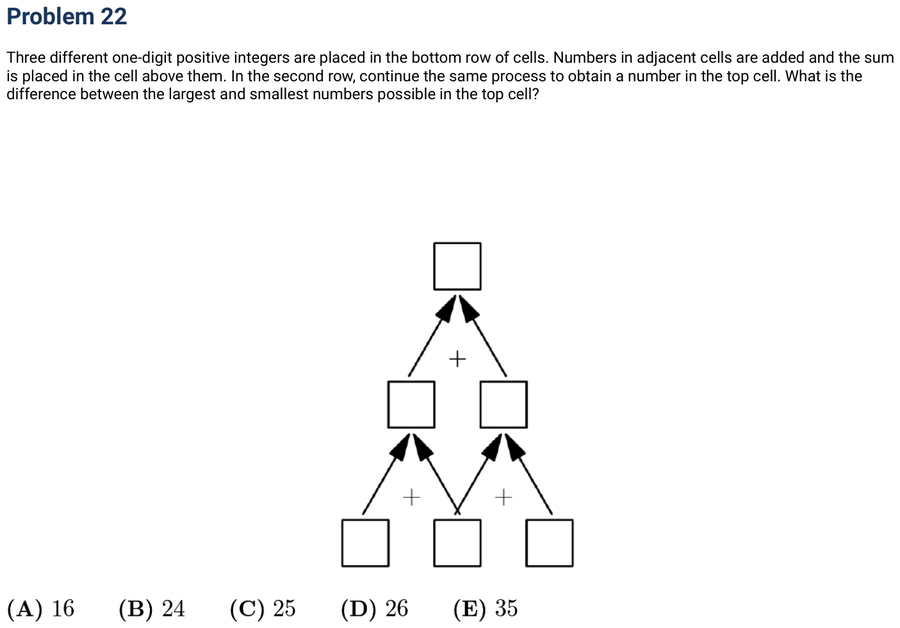
Three different one-digit positive integers are placed in the bottom row of cells. Numbers in adjacent cells are added and the sum is placed in the cell above them. In the second row, continue the same process to obtain a number in the top cell. What is the difference between the largest and smallest numbers possible in the top cell?
Show answer
Answer: D — 26.
Show hints
Hint 1 of 2
Don't guess-and-check piles of triples. First trace one general bottom row up the pyramid with letters a, b, c — the top cell becomes a single formula.
Still stuck? Show hint 2 →
Hint 2 of 2
When you build it, the MIDDLE number flows up through both second-row cells, so it gets counted twice: top = a + 2b + c. To make the top big, put your biggest digit in the middle; to make it small, put your smallest there.
Show solution
Approach: derive top = a + 2b + c, then place digits by weight
- Bottom a, b, c gives second row a+b and b+c; adding those gives top = a + 2b + c. The middle cell b carries double weight.
- Smallest top: use digits 1, 2, 3 with the smallest (1) in the doubled middle — b=1, ends a,c=2,3, giving 2 + 2·1 + 3 = 7.
- Largest top: use 7, 8, 9 with the largest (9) in the middle — b=9, ends 8,7, giving 8 + 2·9 + 7 = 33.
- Difference: 33 − 7 = 26.
- The reusable idea: in any add-upward pyramid the cells don't count equally — positions deeper in the middle get multiplied more (here the row reads weights 1, 2, 1). Once you know the weights, optimizing is just "biggest digit on the heaviest spot."
Mark:
· log in to save