Mindy made three purchases for $1.98, $5.04, and $9.89. What was her total, to the nearest dollar?
Show answer
Answer: D — $17.
Show hints
Hint 1 of 2
"To the nearest dollar" is permission to throw away the pennies — you don't need an exact total. Each price is already hugging a whole dollar.
Still stuck? Show hint 2 →
Hint 2 of 2
Rounding first, then adding, is far lighter than adding first, then rounding — and here it gives the same answer because each price is so close to a whole number.
Show solution
Approach: round each first, then add
The question only wants the nearest dollar, so round before doing any arithmetic: $1.98 → 2, $5.04 → 5, $9.89 → 10.
2 + 5 + 10 = 17.
Why this is safe: each price is within about 10 cents of a whole dollar, so the rounding errors are tiny and can't push the sum across a dollar boundary. When numbers sit close to round values, round first — you'll see this trick on every "estimate the total" question.
On the AMC 8 contest Billy answers 13 questions correctly, answers 7 questions incorrectly and doesn't answer the last 5. What is his score? (right = +1, wrong or N/A = +0)
Show answer
Answer: C — 13.
Show hints
Hint 1 of 2
Read the scoring rule carefully: wrong and blank both earn the same as each other — zero. So all the "7 wrong" and "5 blank" numbers are decoys.
Still stuck? Show hint 2 →
Hint 2 of 2
When points come only from one category, ignore every other number in the problem. The 7 and the 5 are there to tempt you into subtracting.
Show solution
Approach: ignore the zero-point categories
Wrong = 0 points and blank = 0 points, so only the 13 correct matter.
13 × 1 = 13.
Watch out: the answer choices 6 (13−7) and 1 (13−7−5) are traps for kids who think wrong answers cost points — many contests do penalize, but this one doesn't. Always score by the rule you're actually given.
Elisa swims laps in the pool. When she first started, she completed 10 laps in 25 minutes. Now she can finish 12 laps in 24 minutes. By how many minutes has she improved her lap time?
Show answer
Answer: A — 1/2 minute.
Show hints
Hint 1 of 2
The question asks about her lap time — how long ONE lap takes. So convert each situation to minutes-per-lap before comparing; don't compare 25 vs 24 directly.
Still stuck? Show hint 2 →
Hint 2 of 2
"Per one lap" means divide minutes by laps. The unit you want (min/lap) tells you which number goes on top.
Show solution
Approach: convert each to minutes per lap, then subtract
Lap time = total minutes ÷ number of laps. Before: 25 ÷ 10 = 2.5 min/lap. Now: 24 ÷ 12 = 2 min/lap.
She shaved off 2.5 − 2 = 1/2 minute per lap.
Why convert first: the two situations use different lap counts, so the totals (25 and 24) aren't comparable. Reducing both to the same per-unit measure makes them line up — this "put everything in the same units" move powers almost every rate problem.
Initially, a spinner points west. Chenille moves it clockwise 214 revolutions and then counterclockwise 334 revolutions. In what direction does the spinner point after the two moves?
Show answer
Answer: B — East.
Show hints
Hint 1 of 2
Opposite spins partly undo each other — so first combine them into ONE net turn instead of tracking two separate moves.
Still stuck? Show hint 2 →
Hint 2 of 2
A whole revolution always lands you back where you started, so only the leftover fraction of a turn matters. Throw away whole revolutions.
Show solution
Approach: combine into one net turn, then drop whole revolutions
A full revolution returns the spinner to where it was, so ignore the whole 1 and keep only the ½: a half-turn from west.
Half a turn is straight across ⇒ west becomes east.
Why discard whole turns: direction is periodic — it repeats every full revolution. Keeping only the fractional part (the "remainder" after whole turns) is the same idea you use for clock problems and any repeating cycle.
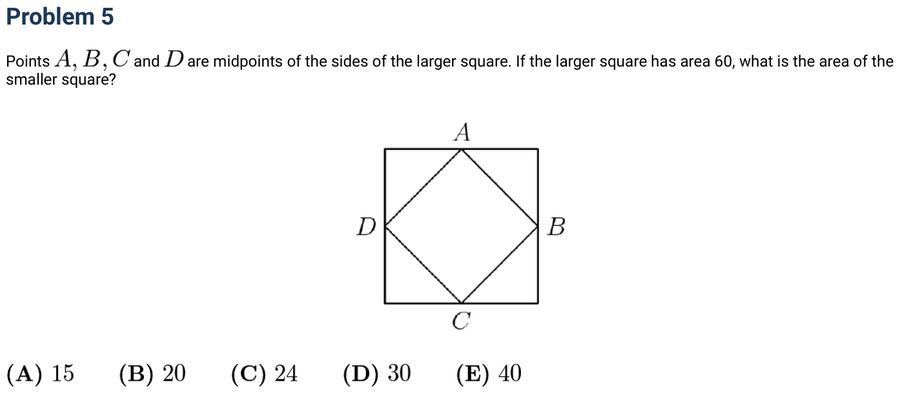
Points A, B, C and D are midpoints of the sides of the larger square. If the larger square has area 60, what is the area of the smaller square?
Show answer
Answer: D — 30.
Show hints
Hint 1 of 2
The midpoint lines cut off four corner triangles. Picture folding each triangle inward along the slanted line — where do the four corners land?
Still stuck? Show hint 2 →
Hint 2 of 2
Connecting the midpoints of any square always makes a tilted square with exactly HALF the area. Knowing this fact lets you skip all the computation.
Show solution
Approach: the four corner triangles fold in to fill the inner square
The four slanted lines slice off four right triangles at the corners. Fold each one inward along its slanted edge.
The four triangles exactly tile the inner diamond — so the inner square is made of half the big square's area, the other half being the (folded-out) triangles.
Inner area = 60 ÷ 2 = 30.
You'll see it again: the midpoint square of ANY square (or even any quadrilateral — the "Varignon" idea) has half the area. Remember the fact and these become instant.
Another way — side length from the half-diagonal:
Let the big square have side s, so s2 = 60. Each midpoint sits halfway along a side.
The inner square's side is the hypotenuse of a right triangle with legs s/2 and s/2, so (inner side)2 = (s/2)2 + (s/2)2 = s2/2.
Inner area = (inner side)2 = s2/2 = 60/2 = 30 — the algebra confirms the half-area fact.
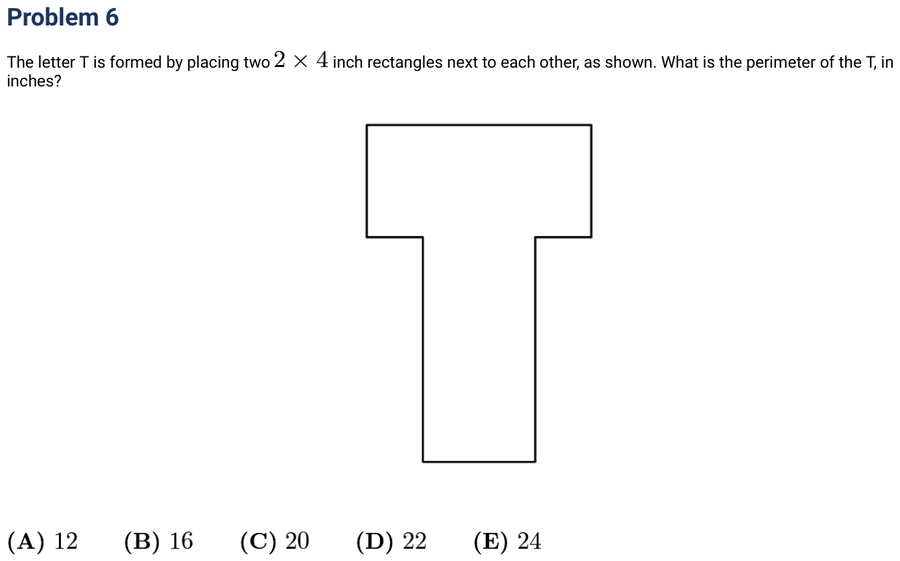
The letter T is formed by placing two 2 × 4 inch rectangles next to each other, as shown. What is the perimeter of the T, in inches?
Show answer
Answer: C — 20.
Show hints
Hint 1 of 2
When two shapes touch, the edges along the touch line end up INSIDE — they're no longer part of the outline. So find where the two rectangles press together.
Still stuck? Show hint 2 →
Hint 2 of 2
Total outline = (sum of both perimeters) − (every edge that became internal). The shared seam disappears from BOTH rectangles, so subtract it twice.
Show solution
Approach: add the two perimeters, remove the hidden seam
Each 2 × 4 rectangle has perimeter 2(2 + 4) = 12, so separately they total 24.
Where the stem meets the bar, a 2-inch segment of each rectangle is pressed against the other. That seam is now interior, so it leaves the outline of both — subtract 2 twice.
24 − 2 − 2 = 20.
Worth keeping: whenever pieces are glued together, perimeter of the whole = sum of the parts' perimeters − 2 × (length of each shared seam). The seam vanishes from both sides, which is why it's counted twice.
Another way — walk the outline directly:
Trace the T's edge and add the segments: the bar's top is 4; coming down the right side and around the stem and back up the left mixes 2-inch and other pieces.
Summing all the boundary segments of the T gives 20 — a good way to double-check the subtraction method, since you never touch the interior seam at all.
Circle X has a radius of π. Circle Y has a circumference of 8π. Circle Z has an area of 9π. List the circles in order from smallest to largest radius.
Show answer
Answer: B — Z, X, Y.
Show hints
Hint 1 of 2
The circles are described in three different languages — radius, circumference, area. Translate all three into the SAME thing (radius) before you can compare them.
Still stuck? Show hint 2 →
Hint 2 of 2
Peel the radius out of each formula: C = 2πr and A = πr2. The lone π factors cancel, leaving clean whole-number radii.
Show solution
Approach: convert all three descriptions to radius
Y: C = 2πr = 8π, so r = 4. Z: πr2 = 9π, so r2 = 9 and r = 3. X: r = π ≈ 3.14 (given directly).
Now they're comparable: 3 < 3.14 < 4, so smallest to largest is Z, X, Y.
The key fact for the close call: π lands between 3 and 4 (it's about 3.14), so circle X squeezes in between Z and Y. Anytime quantities are given in different forms, reduce them to one common measure first.
The table shows some of the results of a survey by radio station KACL. What percentage of the males surveyed listen to the station? (Total surveyed: 200. Females: 96. Females who listen: 58. Males who don't listen: 26. Total listeners: 136. Total non-listeners: 64.)
Show answer
Answer: E — 75%.
Show hints
Hint 1 of 2
A two-way table is built on the rule that rows and columns must add to their totals. Find a cell you CAN fill (males total), then chase the rest.
Still stuck? Show hint 2 →
Hint 2 of 2
You only need the male row: total males, then split into listen/don't-listen. Ignore the female numbers once you have the male total.
Show solution
Approach: complete the male row, then take the percentage
Total males = total surveyed − total females = 200 − 96 = 104.
Males who listen = males total − males who don't = 104 − 26 = 78.
Percentage of males who listen = 78 ÷ 104 = 75%.
Shortcut worth seeing: instead of finding 78, note 26 out of 104 is exactly ¼ (since 26 × 4 = 104), so the non-listeners are 25% and the listeners are 100% − 25% = 75%. Spotting the clean fraction beats the division.
What is the product of 32 × 43 × 54 × … × 20062005?
Show answer
Answer: C — 1003.
Show hints
Hint 1 of 2
Don't multiply anything yet! Write out just the first few fractions and look for numbers that appear on both a top and a bottom — those cancel.
Still stuck? Show hint 2 →
Hint 2 of 2
This is a telescoping product: every numerator (3, 4, 5, …) reappears as the next denominator and cancels. Only the very first bottom and very last top survive.
Show solution
Approach: telescoping — let the chain cancel itself
Line them up: (3/2)(4/3)(5/4)…(2006/2005). The 3 on top of the first fraction cancels the 3 on the bottom of the second; the 4 cancels the 4, and so on all the way down.
Everything in the middle wipes out. What's left is just the first denominator (2) and the last numerator (2006): 2006 ÷ 2 = 1003.
You'll see it again: any product where each term's top equals the next term's bottom telescopes — the answer is simply (last top) ÷ (first bottom). Spotting the cancellation pattern saves you from a 2004-step multiplication.
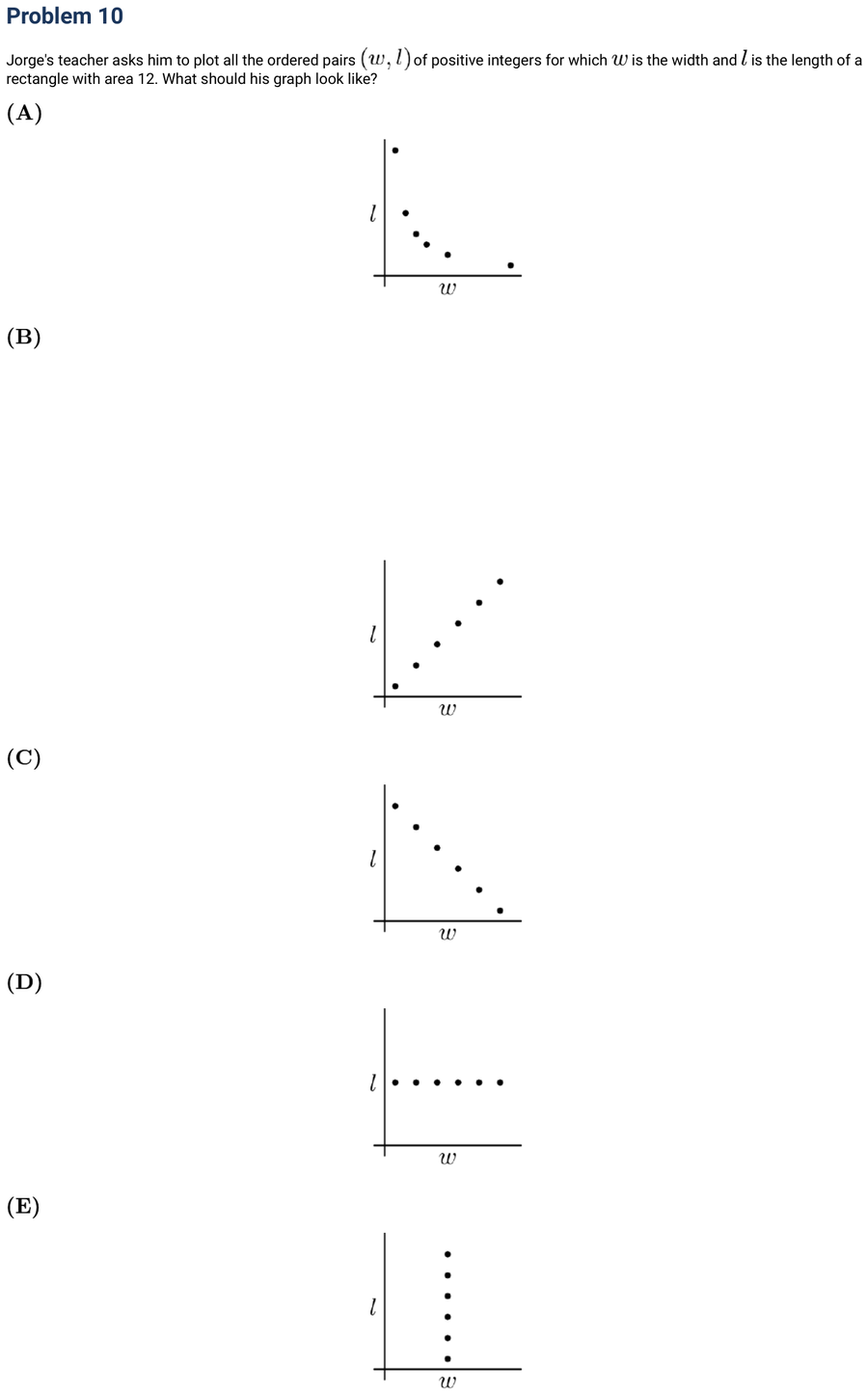
Jorge's teacher asks him to plot all the ordered pairs (w, l) of positive integers for which w is the width and l is the length of a rectangle with area 12. What should his graph look like?
Show answer
Answer: A — Graph A.
Show hints
Hint 1 of 2
Don't reason about the graph abstractly — just LIST the actual rectangles. Which whole-number widths and lengths multiply to 12?
Still stuck? Show hint 2 →
Hint 2 of 2
Two clues separate the choices: (1) only whole numbers work, so you get a few separate dots, not a solid line; (2) wl = 12 means as w grows, l shrinks — an inverse relationship, which curves rather than going straight.
Show solution
Approach: list the integer points and read their shape
Find every pair of positive integers multiplying to 12: (1,12), (2,6), (3,4), (4,3), (6,2), (12,1). That's six separate dots — not a continuous line.
As w goes 1, 2, 3, 4, 6, 12 the length l drops 12, 6, 4, 3, 2, 1: a falling pattern, but the drops get smaller and smaller (a curve that bends, not a straight slant).
Six dots, falling and curving — that's graph A.
How to rule out look-alikes: a straight falling line (C) would need equal-sized drops, but inverse proportion (l = 12/w) bends. Constant l (D) or rising dots (B) ignore the rule entirely. Listing the points makes the right shape obvious.
How many two-digit numbers have digits whose sum is a perfect square?
Show answer
Answer: C — 17.
Show hints
Hint 1 of 2
Flip the question: instead of testing all 90 two-digit numbers, first ask which digit SUMS are even allowed. The smallest sum is 1 (from 10) and the largest is 18 (from 99), so only the perfect squares 1, 4, 9, 16 can occur.
Still stuck? Show hint 2 →
Hint 2 of 2
Now handle each target sum separately. The tens digit must be 1–9 (no leading zero), but the units digit may be 0–9 — that asymmetry is what makes the counts uneven, so watch the edges.
Show solution
Approach: first pin down the possible digit sums, then count each case
A two-digit number's digit sum runs from 1 (for 10) up to 18 (for 99). The perfect squares in that window are 1, 4, 9, and 16 — only four cases to check.
Sum = 16: 79, 88, 97 ⇒ 3 numbers (only these fit, since each digit caps at 9 — big sums leave very few splits).
Total: 1 + 4 + 9 + 3 = 17.
Why the counts shrink at the top: for sum 16 the digits are nearly maxed out (each at most 9), so few splits fit; for middling sums like 9 there's lots of freedom. Narrowing to the four legal sums first is what keeps this from being a 90-number slog.
Antonette gets 70% on a 10-problem test, 80% on a 20-problem test and 90% on a 30-problem test. If the three tests are combined into one 60-problem test, which percent is closest to her overall score?
Show answer
Answer: D — 83%.
Show hints
Hint 1 of 2
You can NOT just average 70, 80, 90 — the tests have different sizes, so the bigger tests should count for more. Go back to actual problems right and wrong.
Still stuck? Show hint 2 →
Hint 2 of 2
A percentage is a fraction in disguise. Turn each percent into a count of correct problems, pool them, then form one big fraction: total right ÷ total problems. This is a weighted average.
Show solution
Approach: count actual correct problems, then one overall fraction
Convert each percent to a count: 70% of 10 = 7, 80% of 20 = 16, 90% of 30 = 27.
Pool them: 7 + 16 + 27 = 50 correct out of 60 total.
50 ÷ 60 ≈ 0.833 ⇒ closest to 83%.
Why not 80%? The naive average of 70, 80, 90 is 80 — that's answer choice C, the trap. It would only be right if the tests were the same size. Because the 90% test is the biggest (30 problems), it pulls the real score above 80. Always weight by size.
Cassie leaves Escanaba at 8:30 AM heading for Marquette on her bike. She bikes at a uniform rate of 12 miles per hour. Brian leaves Marquette at 9:00 AM heading for Escanaba on his bike. He bikes at a uniform rate of 16 miles per hour. They both bike on the same 62-mile route between Escanaba and Marquette. At what time in the morning do they meet?
Show answer
Answer: D — 11:00 AM.
Show hints
Hint 1 of 2
Two riders heading toward each other close the gap between them at the SUM of their speeds — think of the empty road shrinking, not the riders moving. But first deal with the half-hour head start so you start both clocks together.
Still stuck? Show hint 2 →
Hint 2 of 2
Closing speed: when two things approach each other, add their speeds; the gap divided by that combined speed is the time to meet.
Show solution
Approach: settle the head start, then close the gap at combined speed
Cassie rides alone from 8:30 to 9:00, half an hour, covering ½ × 12 = 6 miles. So at 9:00 the gap between them is 62 − 6 = 56 miles.
From 9:00 they ride toward each other, closing the gap at 12 + 16 = 28 mph.
Time to close 56 miles: 56 ÷ 28 = 2 hours. They meet at 9:00 + 2:00 = 11:00 AM.
Why add the speeds: in one hour Cassie eats 12 miles of road and Brian eats 16, so 28 miles of gap vanish per hour regardless of where they are. This "combined speed" trick turns every meeting problem into one simple division — just remember to handle any head start first.
Problems 14, 15 and 16 involve Mrs. Reed's English assignment. A Novel Assignment. The students in Mrs. Reed's English class are reading the same 760-page novel. Three friends, Alice, Bob and Chandra, are in the class. Alice reads a page in 20 seconds, Bob reads a page in 45 seconds and Chandra reads a page in 30 seconds. If Bob and Chandra both read the whole book, Bob will spend how many more seconds reading than Chandra?
Show answer
Answer: B — 11,400 seconds.
Show hints
Hint 1 of 2
You're asked for a DIFFERENCE, so don't compute two big times and subtract giants. Find how much longer Bob takes on a SINGLE page first.
Still stuck? Show hint 2 →
Hint 2 of 2
Factor before you multiply: 760·45 − 760·30 = 760·(45−30). Pulling out the common 760 turns two big multiplications into one small one.
Show solution
Approach: per-page gap, then scale up
On each page Bob is slower by 45 − 30 = 15 seconds.
Over all 760 pages that gap accumulates: 760 × 15 = 11,400 seconds.
Why this beats brute force: computing 760×45 = 34,200 and 760×30 = 22,800 and subtracting works, but factoring out the shared 760 first (the distributive property) skips the big numbers entirely. Difference questions love this — subtract the rates, then multiply once.
Chandra and Bob, who each have a copy of the book, decide that they can save time by "team reading" the novel. In this scheme, Chandra will read from page 1 to a certain page and Bob will read from the next page through page 760, finishing the book. When they are through they will tell each other about the part they read. What is the last page that Chandra should read so that she and Bob spend the same amount of time reading the novel?
Show answer
Answer: C — Page 456.
Show hints
Hint 1 of 2
"Same amount of time" is the hook. Write each reader's time as (pages they read) × (seconds per page) and set the two times equal.
Still stuck? Show hint 2 →
Hint 2 of 2
Equal time with different speeds means the faster reader covers MORE pages. The pages split in the same ratio as the speeds — here Chandra (30 s/page) to Bob (45 s/page).
Show solution
Approach: set the two reading times equal
Let Chandra read x pages; Bob reads the rest, 760 − x. Chandra's time is 30x seconds, Bob's is 45(760 − x).
Equal time: 30x = 45(760 − x). Expand and gather: 75x = 45 × 760, so x = 45 × 760 ÷ 75 = 456.
Chandra reads through page 456.
The shape to remember: since Chandra is faster (30 vs 45), she should read more pages — the page split is 45 : 30 = 3 : 2 in her favor, and 3/5 of 760 = 456. Equal-time splits always favor the faster worker, in proportion to the other's slowness.
Another way — split the pages by ratio, no equation:
Equal time means pages are shared in inverse proportion to the per-page times: Chandra : Bob = 45 : 30 = 3 : 2.
Chandra gets 3 parts out of 3 + 2 = 5: (3/5)(760) = 456 pages — same answer with pure ratio reasoning.
Before Chandra and Bob start reading, Alice says she would like to team read with them. If they divide the book into three sections so that each reads for the same length of time, how many seconds will each have to read?
Show answer
Answer: E — 7200 seconds.
Show hints
Hint 1 of 2
"Read for the same length of time" means in that one shared block of time, each person reads pages at their own speed. The fast reader simply gets through more pages.
Still stuck? Show hint 2 →
Hint 2 of 2
Pages read in equal time are in proportion to reading SPEED (pages per second), which is the inverse of seconds-per-page. Build the speed ratio first, split the 760 pages by it, then find one person's time.
Show solution
Approach: split pages by speed ratio, then read off the shared time
Speeds (pages/sec): Alice 1/20, Chandra 1/30, Bob 1/45. To clear fractions, scale by 180: 9 : 6 : 4. So in equal time Alice reads 9 parts, Chandra 6, Bob 4.
The parts total 9 + 6 + 4 = 19, and they cover all 760 pages, so each part is 760 ÷ 19 = 40 pages. Alice 360, Chandra 240, Bob 160.
Now find the shared time from any one reader — Bob: 160 pages × 45 sec/page = 7200 seconds. (Check: Alice 360 × 20 = 7200, Chandra 240 × 30 = 7200 — all match.)
The big idea: equal time ⇒ pages divide in proportion to speed. The fact that 760 ÷ 19 came out to a whole number (40) is the contest hinting you're on the intended path.
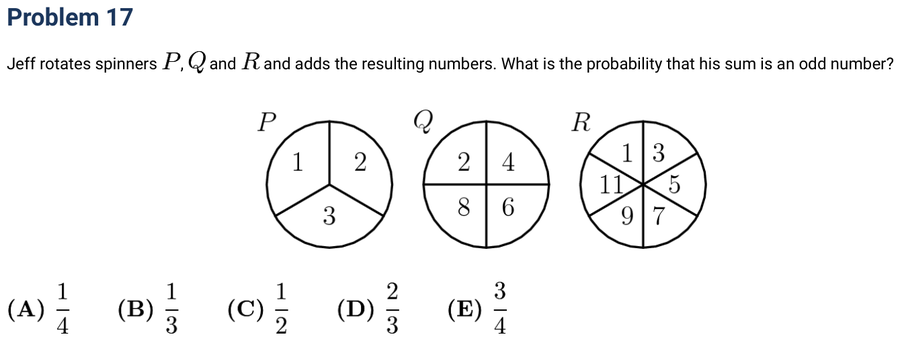
Jeff rotates spinners P, Q and R and adds the resulting numbers. What is the probability that his sum is an odd number?
Show answer
Answer: B — 1/3.
Show hints
Hint 1 of 2
Odd-or-even doesn't depend on the actual values, only on each number's parity. So glance at each spinner: are its numbers all even, all odd, or mixed?
Still stuck? Show hint 2 →
Hint 2 of 2
Adding an even number never changes parity; adding an odd number flips it. Track only the flips — a spinner that's entirely even or entirely odd has a fixed, predictable effect, so the whole answer collapses onto the one mixed spinner.
Show solution
Approach: track parity, not values — collapse to the one mixed spinner
Read the spinners' parities: Q is all even (2, 4, 6, 8), R is all odd (1, 3, 5, 7, 9, 11), and only P is mixed (1, 2, 3).
Q always adds an even (no effect on parity); R always adds an odd (one guaranteed flip). So before P, the running sum is odd for sure.
Then P decides everything: the total stays odd only if P is even. P is even just on the "2" slice — 1 of its 3 equal regions.
Probability = 1/3.
The transferable move: in any sum-parity question, the certain (all-even or all-odd) parts give a fixed baseline; the probability lives entirely in the parts that can be either. Find the one undecided piece and ignore the rest.
A cube with 3-inch edges is made using 27 cubes with 1-inch edges. Nineteen of the smaller cubes are white and eight are black. If the eight black cubes are placed at the corners of the larger cube, what fraction of the surface area of the larger cube is white?
Show answer
Answer: D — 5/9.
Show hints
Hint 1 of 2
Don't think about all 6 faces and 8 cubes at once. By symmetry every face looks identical, so the whole-cube fraction equals the fraction on a SINGLE face.
Still stuck? Show hint 2 →
Hint 2 of 2
On one 3×3 face, ask: which of the 9 little squares are black? A corner cube of the big cube touches each face it's on at exactly that face's corner square.
Show solution
Approach: symmetry — just analyze one face
Every face is identical, so the surface fraction for the whole cube equals the fraction on one face. Look at a single 3 × 3 face: 9 unit squares.
The black cubes sit at the big cube's 8 corners. On any one face, the four corner unit squares are exactly those corner cubes — so 4 squares are black, leaving 9 − 4 = 5 white.
White fraction = 5/9.
Why one face is enough: the cube's symmetry makes every face the same, so a count on one face IS the answer — no need to total all 54 surface squares. Spotting symmetry to shrink the work is the whole game here.
Trap to dodge: the choice 19/27 counts white CUBES out of all cubes, but the question asks about surface AREA — the buried center cube and hidden faces don't show, so don't mix the two up.
Another way — total surface area, counting black squares directly:
The big cube has 6 faces × 9 = 54 unit squares of surface. Each of the 8 corner (black) cubes shows on 3 faces, contributing 3 black squares, for 8 × 3 = 24 black squares.
White squares = 54 − 24 = 30, so white fraction = 30/54 = 5/9 — matches the one-face shortcut.
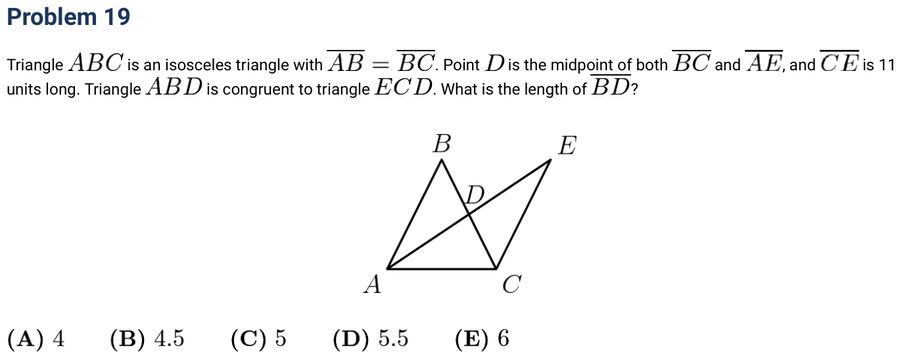
Triangle ABC is an isosceles triangle with AB = BC. Point D is the midpoint of both BC and AE, and CE is 11 units long. Triangle ABD is congruent to triangle ECD. What is the length of BD?
Show answer
Answer: D — 5.5.
Show hints
Hint 1 of 2
You want BD, but the only length given is CE = 11. Build a chain of equal lengths that connects them — that's what the congruence and the isosceles condition are for.
Still stuck? Show hint 2 →
Hint 2 of 2
Congruent triangles have equal matching sides: read ▵ABD ≅ ▵ECD in order, so AB matches EC. Match the letters position by position to find which sides are equal.
Show solution
Approach: chain equal segments from the known length to BD
Match the congruence letter-for-letter: ▵ABD ≅ ▵ECD pairs AB with EC, so AB = EC = 11.
The triangle is isosceles with AB = BC, so BC = 11 too.
D is the midpoint of BC, so BD = ½ × 11 = 5.5.
The skill to keep: never read a congruence as a blob — line the letters up in order so corresponding parts (A↔E, B↔C, D↔D) tell you exactly which sides are equal. From there it's just hopping along equal segments to the one you want.
A singles tournament had six players. Each player played every other player only once, with no ties. If Helen won 4 games, Ines won 3 games, Janet won 2 games, Kendra won 2 games and Lara won 2 games, how many games did Monica (the sixth player) win?
Show answer
Answer: C — 2 games.
Show hints
Hint 1 of 2
Don't try to reconstruct who beat whom — you can't and you don't need to. Instead notice that every single game produces exactly ONE win, so total wins is a fixed, knowable number.
Still stuck? Show hint 2 →
Hint 2 of 2
Count the total number of games (each pair plays once), which equals total wins. Monica's wins are just that total minus everyone else's.
Show solution
Approach: every game makes exactly one win
With 6 players each meeting every other once, the number of games is "choose 2 of 6" = (6 × 5)/2 = 15. Since there are no ties, that's exactly 15 wins handed out.
The five named players account for 4 + 3 + 2 + 2 + 2 = 13 wins.
Monica gets the rest: 15 − 13 = 2.
You'll reuse this: in any round-robin with no ties, (total wins) = (total games) = "choose 2" of the players. The wins are conserved, so a single missing count is always "total minus the known." No game-by-game detective work needed.
An aquarium has a rectangular base that measures 100 cm by 40 cm and has a height of 50 cm. The aquarium is filled with water to a depth of 37 cm. A rock with volume 1000 cm3 is then placed in the aquarium and completely submerged. By how many centimeters does the water level rise?
Show answer
Answer: A — 0.25 cm.
Show hints
Hint 1 of 2
The submerged rock pushes water up. That extra water forms a thin flat slab sitting on top, with the rock's volume but the tank's base. Picture that slab.
Still stuck? Show hint 2 →
Hint 2 of 2
A slab's volume = base area × height. You know the slab's volume (= rock volume) and the base, so the rise is volume ÷ base area. The starting depth and tank height are decoys.
Show solution
Approach: the rise is a thin slab with the rock's volume
Submerging the rock displaces exactly 1000 cm³ of water, which spreads across the full base as a thin layer of rise.
That layer is a box: base 100 × 40 = 4000 cm², volume 1000 cm³. Its height (the rise) = 1000 ÷ 4000 = 0.25 cm.
Why the 37 cm and 50 cm don't matter: the rise depends only on how much volume you add and how wide the tank is — not on the current depth (as long as the rock stays submerged and the water doesn't overflow). Sanity check: 0.25 cm of rise × 4000 cm² = 1000 cm³, exactly the rock. Spotting the decoy numbers is half the battle.
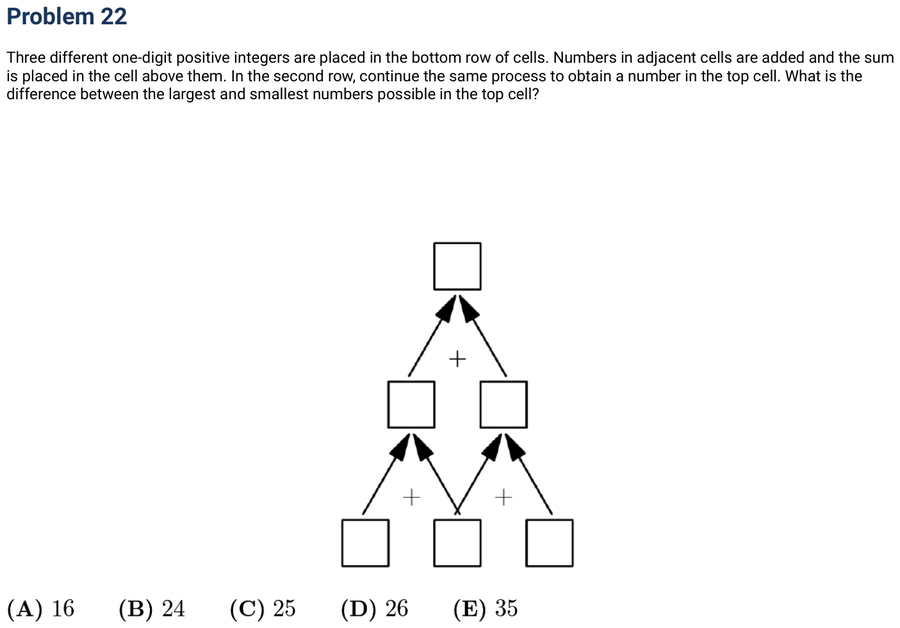
Three different one-digit positive integers are placed in the bottom row of cells. Numbers in adjacent cells are added and the sum is placed in the cell above them. In the second row, continue the same process to obtain a number in the top cell. What is the difference between the largest and smallest numbers possible in the top cell?
Show answer
Answer: D — 26.
Show hints
Hint 1 of 2
Don't guess-and-check piles of triples. First trace one general bottom row up the pyramid with letters a, b, c — the top cell becomes a single formula.
Still stuck? Show hint 2 →
Hint 2 of 2
When you build it, the MIDDLE number flows up through both second-row cells, so it gets counted twice: top = a + 2b + c. To make the top big, put your biggest digit in the middle; to make it small, put your smallest there.
Show solution
Approach: derive top = a + 2b + c, then place digits by weight
Bottom a, b, c gives second row a+b and b+c; adding those gives top = a + 2b + c. The middle cell b carries double weight.
Smallest top: use digits 1, 2, 3 with the smallest (1) in the doubled middle — b=1, ends a,c=2,3, giving 2 + 2·1 + 3 = 7.
Largest top: use 7, 8, 9 with the largest (9) in the middle — b=9, ends 8,7, giving 8 + 2·9 + 7 = 33.
Difference: 33 − 7 = 26.
The reusable idea: in any add-upward pyramid the cells don't count equally — positions deeper in the middle get multiplied more (here the row reads weights 1, 2, 1). Once you know the weights, optimizing is just "biggest digit on the heaviest spot."
A box contains gold coins. If the coins are equally divided among six people, four coins are left over. If the coins are equally divided among five people, three coins are left over. If the box holds the smallest number of coins that meets these two conditions, how many coins are left when equally divided among seven people?
Show answer
Answer: A — 0.
Show hints
Hint 1 of 2
Two leftover conditions at once is hard to handle directly. List the numbers satisfying the rarer condition (leftover 4 from groups of 6), then just scan that short list for the other condition.
Still stuck? Show hint 2 →
Hint 2 of 2
"Leftover 4 when split into 6s" is the same as starting at 4 and stepping by 6. Walk that list and stop at the first number that also leaves 3 when split into 5s — the smallest match is your answer.
Show solution
Approach: list one condition, scan for the other
Numbers leaving 4 when divided by 6: 4, 10, 16, 22, 28, … (start at 4, add 6 each time).
Check each against "leftover 3 when divided by 5": 4→4, 10→0, 16→1, 22→2, 28→3 ✓. The first that works is 28.
Now 28 ÷ 7 = 4 with remainder 0 — it splits evenly among seven people.
Shortcut to notice: "leftover 4 out of 6" means 2 short of a full group, and "leftover 3 out of 5" also means 2 short of a full group. Being exactly 2 short of both 6 and 5 means 2 short of their LCM, 30 — so the number is 30 − 2 = 28 instantly, no listing needed. Spotting a common shortfall turns two conditions into one.
Another way — common shortfall → LCM:
Leftover 4 of 6 is the same as being 2 below a multiple of 6; leftover 3 of 5 is being 2 below a multiple of 5.
So the count is 2 below a common multiple of both: 2 below lcm(6,5) = 30, giving 28. Then 28 splits evenly by 7, remainder 0.
In the multiplication problem below, A, B, C, D are different digits. ABA × CD = CDCD. What is A + B?
Show answer
Answer: A — 1.
Show hints
Hint 1 of 2
Look at the answer CDCD: it's the two-digit block CD written twice. Ask what number you multiply a two-digit block by to repeat it — like how 37 × 1001 = 37037.
Still stuck? Show hint 2 →
Hint 2 of 2
Repeating a 2-digit block means multiplying by 101 (since CD·101 = CD00 + CD = CDCD). Compare that to the given ABA × CD and the value of ABA falls right out.
Show solution
Approach: recognize the repeat as multiplying by 101
Writing the block CD twice is exactly CD × 101, because CD × 100 shifts it left two places and adding CD fills the bottom: CDCD.
But the problem says ABA × CD = CDCD = 101 × CD. Cancelling the CD on both sides forces ABA = 101.
Reading off the digits: A = 1, B = 0, so A + B = 1.
Worth keeping: repeating an n-digit block multiplies it by a "1 0…0 1" number — 11 for 1 digit, 101 for 2 digits, 1001 for 3. Recognizing these place-value patterns cracks most cryptarithms without trial and error.
Barry wrote 6 different numbers, one on each side of 3 cards, and laid the cards on a table, as shown. The sums of the two numbers on each of the three cards are equal. The three numbers on the hidden sides are prime numbers. What is the average of the hidden prime numbers? (Visible sides: 44, 59, 38.)
Show answer
Answer: B — 14.
Show hints
Hint 1 of 3
Look at the three visible numbers: 44 and 38 are even, but 59 is odd. Since all three card-sums are EQUAL, that odd one out is the lever — what kind of prime must hide behind it?
Still stuck? Show hint 2 →
Hint 2 of 3
Almost every prime is odd; the only even prime is 2. Use parity: even + (odd prime) is odd, while odd + (odd prime) is even — so the sums can only all match if one special card hides the 2.
Still stuck? Show hint 3 →
Hint 3 of 3
Once parity pins down which card hides 2, you get the common sum, then subtract each visible number to recover the other two hidden primes — and check they're actually prime.
Show solution
Approach: parity of the visible numbers forces where 2 hides
The three sums are equal, so they're all the same parity (all odd or all even). Behind 44 and 38 (even), an odd prime gives an odd sum; behind 59 (odd), an odd prime gives an even sum. Those can't match — so something must break the "odd prime" assumption.
The only escape is the one even prime, 2. To make 59's sum match the others' parity, the 2 must hide behind 59: 59 + 2 = 61 (odd). Then 44 and 38 need odd primes to reach 61 (odd), which is consistent.
Common sum = 61. Behind 44: 61 − 44 = 17 (prime ✓). Behind 38: 61 − 38 = 23 (prime ✓). All six numbers (44, 59, 38, 2, 17, 23) are different, as required.
Average of the hidden primes: (2 + 17 + 23) ÷ 3 = 42 ÷ 3 = 14.
The transferable move: "2 is the only even prime" is a parity wildcard — whenever primes must satisfy an even/odd condition, the 2 is almost always the special case that makes it work. Spot the odd-one-out, and parity tells you where it goes.