Problem 17 · 2006 AMC 8
Medium
Counting & Probability
parity-of-sum
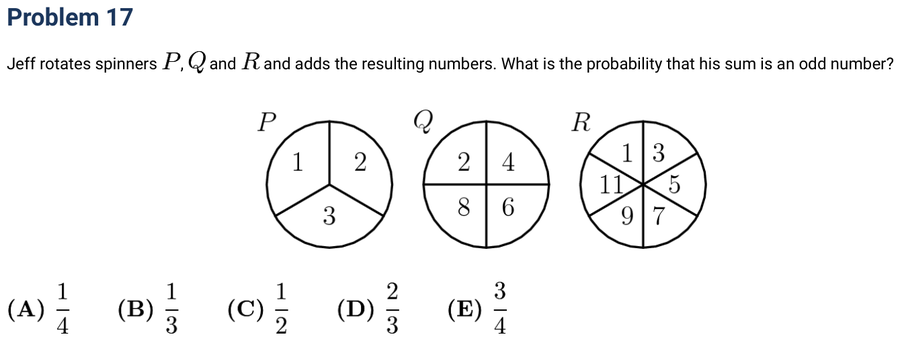
Jeff rotates spinners P, Q and R and adds the resulting numbers. What is the probability that his sum is an odd number?
Show answer
Answer: B — 1/3.
Show hints
Hint 1 of 2
Odd-or-even doesn't depend on the actual values, only on each number's parity. So glance at each spinner: are its numbers all even, all odd, or mixed?
Still stuck? Show hint 2 →
Hint 2 of 2
Adding an even number never changes parity; adding an odd number flips it. Track only the flips — a spinner that's entirely even or entirely odd has a fixed, predictable effect, so the whole answer collapses onto the one mixed spinner.
Show solution
Approach: track parity, not values — collapse to the one mixed spinner
- Read the spinners' parities: Q is all even (2, 4, 6, 8), R is all odd (1, 3, 5, 7, 9, 11), and only P is mixed (1, 2, 3).
- Q always adds an even (no effect on parity); R always adds an odd (one guaranteed flip). So before P, the running sum is odd for sure.
- Then P decides everything: the total stays odd only if P is even. P is even just on the "2" slice — 1 of its 3 equal regions.
- Probability = 1/3.
- The transferable move: in any sum-parity question, the certain (all-even or all-odd) parts give a fixed baseline; the probability lives entirely in the parts that can be either. Find the one undecided piece and ignore the rest.
Mark:
· log in to save