Problem 10 · 2006 AMC 8
Easy
Algebra & Patterns
inverse-proportion
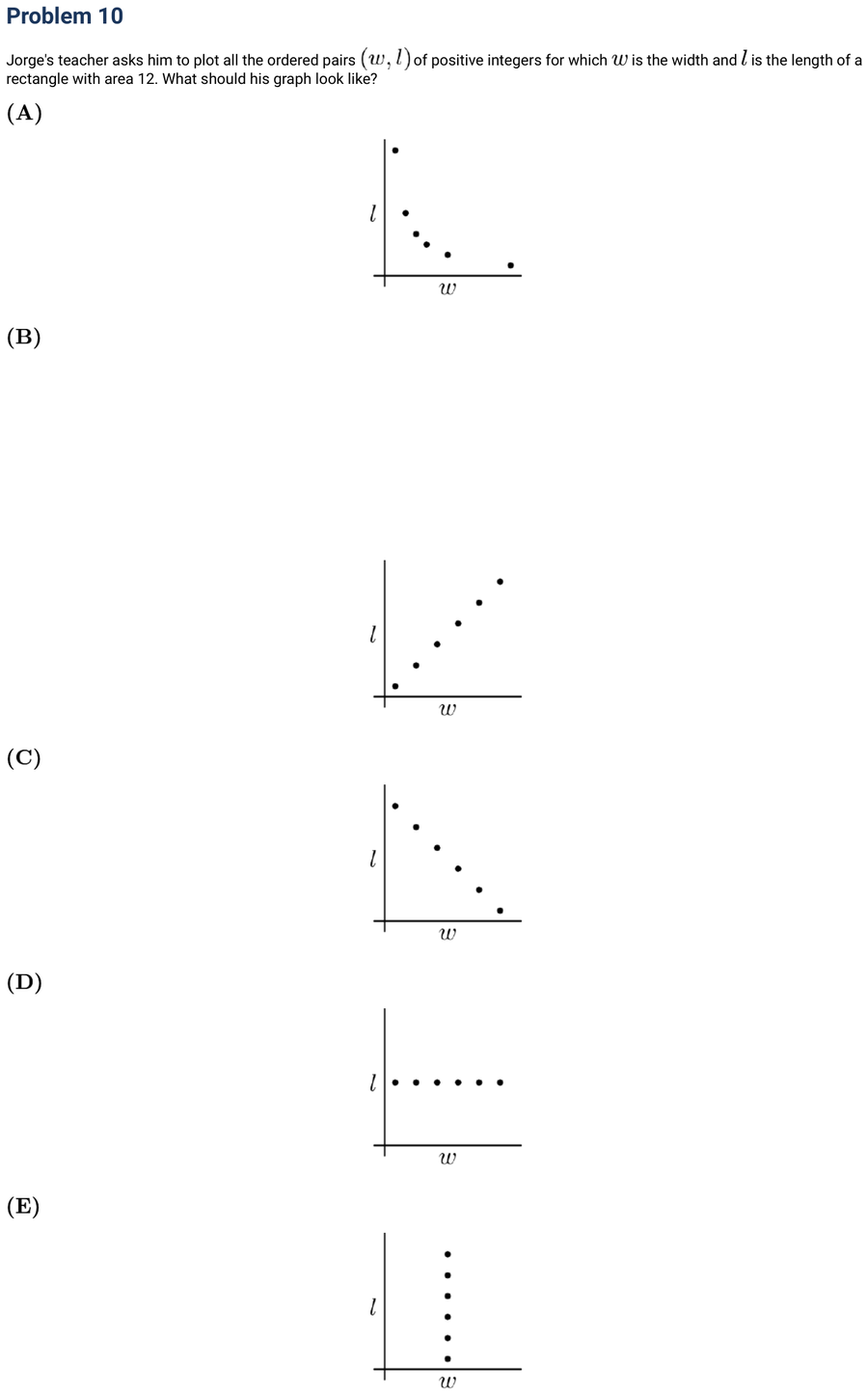
Jorge's teacher asks him to plot all the ordered pairs (w, l) of positive integers for which w is the width and l is the length of a rectangle with area 12. What should his graph look like?
Show answer
Answer: A — Graph A.
Show hints
Hint 1 of 2
Don't reason about the graph abstractly — just LIST the actual rectangles. Which whole-number widths and lengths multiply to 12?
Still stuck? Show hint 2 →
Hint 2 of 2
Two clues separate the choices: (1) only whole numbers work, so you get a few separate dots, not a solid line; (2) wl = 12 means as w grows, l shrinks — an inverse relationship, which curves rather than going straight.
Show solution
Approach: list the integer points and read their shape
- Find every pair of positive integers multiplying to 12: (1,12), (2,6), (3,4), (4,3), (6,2), (12,1). That's six separate dots — not a continuous line.
- As w goes 1, 2, 3, 4, 6, 12 the length l drops 12, 6, 4, 3, 2, 1: a falling pattern, but the drops get smaller and smaller (a curve that bends, not a straight slant).
- Six dots, falling and curving — that's graph A.
- How to rule out look-alikes: a straight falling line (C) would need equal-sized drops, but inverse proportion (l = 12/w) bends. Constant l (D) or rising dots (B) ignore the rule entirely. Listing the points makes the right shape obvious.
Mark:
· log in to save