Problem 5 · 2006 AMC 8
Easy
Geometry & Measurement
midpoint-square
Points A, B, C and D are midpoints of the sides of the larger square. If the larger square has area 60, what is the area of the smaller square?
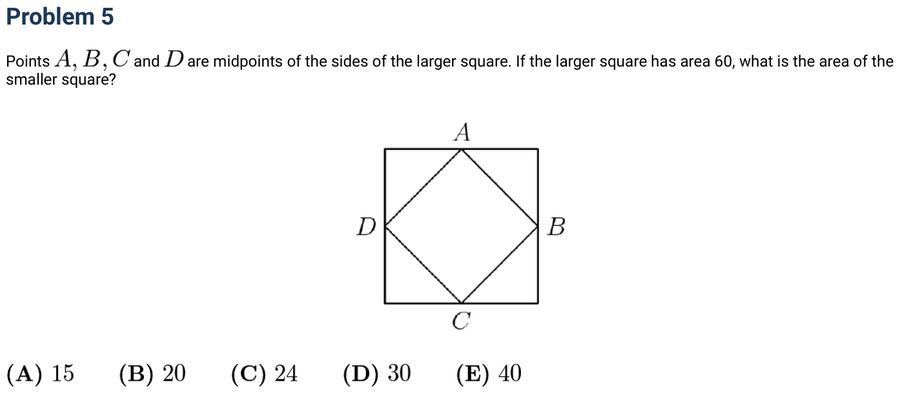
Show answer
Answer: D — 30.
Show hints
Hint 1 of 2
The midpoint lines cut off four corner triangles. Picture folding each triangle inward along the slanted line — where do the four corners land?
Still stuck? Show hint 2 →
Hint 2 of 2
Connecting the midpoints of any square always makes a tilted square with exactly HALF the area. Knowing this fact lets you skip all the computation.
Show solution
Approach: the four corner triangles fold in to fill the inner square
- The four slanted lines slice off four right triangles at the corners. Fold each one inward along its slanted edge.
- The four triangles exactly tile the inner diamond — so the inner square is made of half the big square's area, the other half being the (folded-out) triangles.
- Inner area = 60 ÷ 2 = 30.
- You'll see it again: the midpoint square of ANY square (or even any quadrilateral — the "Varignon" idea) has half the area. Remember the fact and these become instant.
Another way — side length from the half-diagonal:
- Let the big square have side s, so s2 = 60. Each midpoint sits halfway along a side.
- The inner square's side is the hypotenuse of a right triangle with legs s/2 and s/2, so (inner side)2 = (s/2)2 + (s/2)2 = s2/2.
- Inner area = (inner side)2 = s2/2 = 60/2 = 30 — the algebra confirms the half-area fact.
Mark:
· log in to save