Problem 21 · 2004 AMC 8
Easy
Counting & Probability
complementary-counting
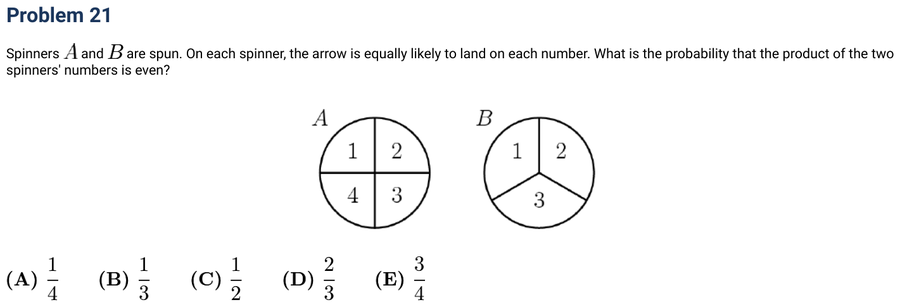
Spinners A and B are spun. On each spinner, the arrow is equally likely to land on each number. What is the probability that the product of the two spinners' numbers is even?
Show answer
Answer: D — 2/3.
Show hints
Hint 1 of 2
'Even product' can happen lots of ways (this even, that even, both even) — messy to count. But the opposite is razor-simple: a product is odd only when both spinners are odd. Count that one easy case and subtract.
Still stuck? Show hint 2 →
Hint 2 of 2
The technique is complementary counting: P(even) = 1 − P(odd), and a product is odd exactly when every factor is odd. Whenever 'at least one even' shows up, flip to 'all odd'.
Show solution
Approach: complement (1 minus all-odd)
- Spinner A shows 1, 2, 4, 3 — odds are {1, 3}, so P(A odd) = 2/4 = 1/2. Spinner B shows 1, 2, 3 — odds are {1, 3}, so P(B odd) = 2/3.
- Product is odd only if both are odd: P(odd) = (1/2)(2/3) = 1/3.
- Therefore P(even) = 1 − 1/3 = 2/3.
- Why the complement wins: the direct count needs three even-cases, but 'both odd' is a single product — one multiplication instead of several additions. Odd × odd = odd is the only way to dodge an even factor.
Another way — count favorable outcomes directly:
- There are 4 × 3 = 12 equally likely (A, B) outcomes.
- Odd products come only from A ∈ {1,3} and B ∈ {1,3}: that's 2 × 2 = 4 odd outcomes, so 12 − 4 = 8 even outcomes.
- P(even) = 8/12 = 2/3.
Mark:
· log in to save