Problem 18 · 2000 AMC 8
Hard
Geometry & Measurement
area-decompositionperimeter
Show answer
Answer: E — Same area, but quadrilateral I has the smaller perimeter.
Show hints
Hint 1 of 2
The answer choices split into 'compare area' and 'compare perimeter,' so settle area FIRST — and don't eyeball it. On a geoboard you can find area exactly (slice into triangles, or use base × height).
Still stuck? Show hint 2 →
Hint 2 of 2
Equal area does NOT force equal perimeter — a shape can enclose the same space with more boundary. Once areas tie, compare the sides one by one: the shapes share a pair of equal slants, so look only at the *other* sides.
Show solution
Approach: lock down area exactly, then compare the differing sides
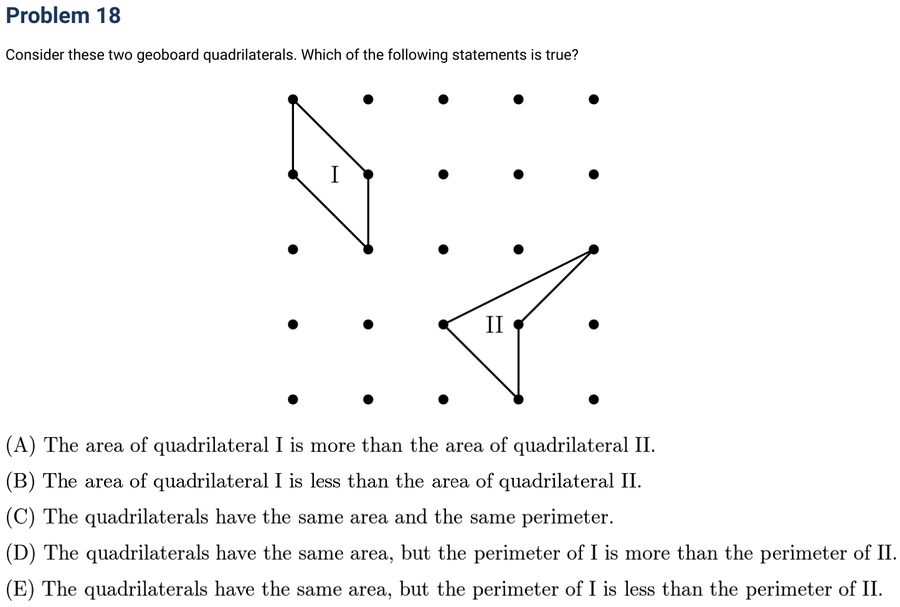
- Area first. Region I is a parallelogram of base 1 and height 1, so area = 1. Region II splits into two triangles, each base 1 and height 1, area ½ + ½ = 1. The areas are *equal* — so it's down to perimeter.
- Both shapes have a matching pair of slant sides (each spanning 1 across and 1 up, length √2). Their remaining sides differ: region I's other two sides are plain unit segments (length 1 each), while region II's remaining side is a long diagonal clearly stretching more than 1.
- So region II carries more boundary — its perimeter is larger, which means region I's perimeter is the *smaller* one: choice E.
- The big idea: area and perimeter are independent — same area can hide very different perimeters (a key reason 'compare the figures' problems list both). Pin down the one that's easy to compute exactly, then reason about the other.
Mark:
· log in to save