Problem 12 · 2000 AMC 8
Medium
Arithmetic & Operations
careful-counting
Show answer
Answer: D — 353 blocks.
Show hints
Hint 1 of 2
Fewer blocks means longer blocks, so you'd love every block to be a 2-footer (50 per row). The only thing stopping you is the rule that joints must stagger — figure out what that forces, row by row.
Still stuck? Show hint 2 →
Hint 2 of 2
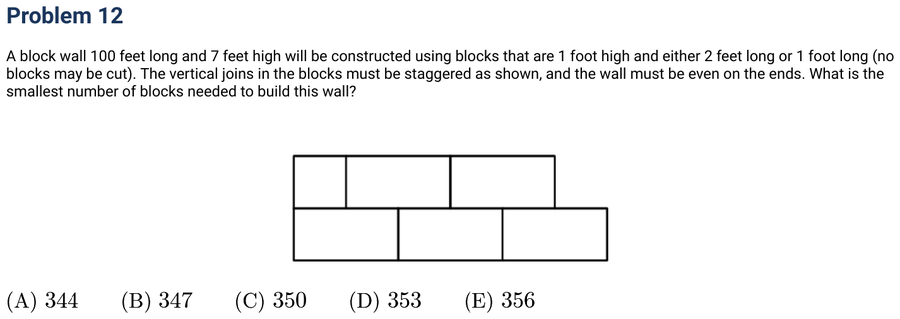
A row of fifty 2-ft blocks has its joints at every even foot. The next row must NOT line up with those, so its joints sit at odd feet — which means that row has to start and end with a 1-ft half-block. Count the two row 'types.'
Show solution
Approach: find the two repeating row patterns, then count rows of each
- Cheapest row = all 2-ft blocks: 100 ÷ 2 = 50 blocks, with joints at 2, 4, 6, … An identical row directly above would line its joints up — not allowed.
- So alternate rows must shift: a 1-ft block at each end, then 49 two-ft blocks fill the middle (1 + 98 + 1 = 100 ft) = 51 blocks. Joints now fall at odd feet, staggered from the rows below.
- The 7 rows alternate 50, 51, 50, 51, 50, 51, 50: four rows of 50 and three of 51. Total = 200 + 153 = 353.
- You'll see it again: in tiling/bricklaying puzzles, find the small set of repeating patterns the rules allow, count blocks in each, then multiply by how many rows of each — don't try to count the whole wall at once.
Mark:
· log in to save