Problem 24 · 1997 AJHSME
Stretch
Geometry & Measurement
area-decomposition
Show answer
Answer: C — 3 : 2.
Show hints
Hint 1 of 2
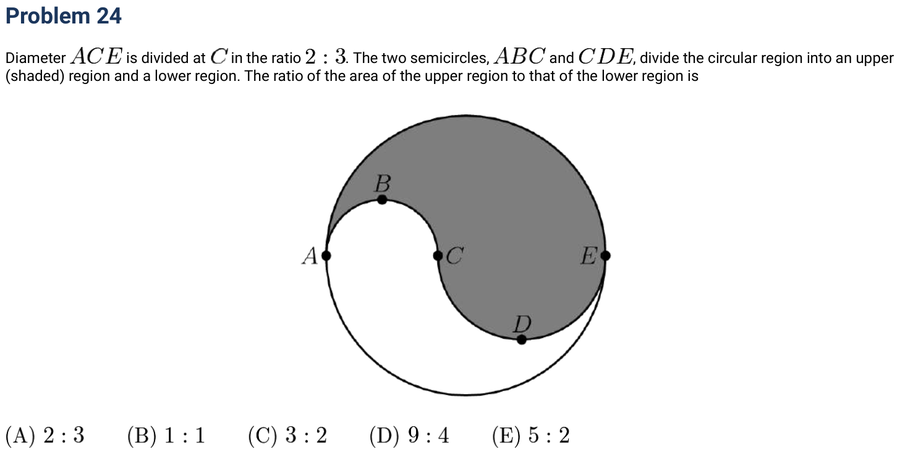
Pick a friendly diameter so the 2:3 split is whole: AE = 10 gives AC = 4, CE = 6, big radius 5. Then build the wavy upper region out of clean half-disks rather than fighting the S-curve directly.
Still stuck? Show hint 2 →
Hint 2 of 2
Decompose a curvy region into known semicircles: start with the big upper half-disk, then subtract the bump that dips below the dividing line and add the bump that rises above it.
Show solution
Approach: big half-disk, minus the dipping bump, plus the rising bump
- Let AE = 10, so AC = 4 (radius 2) and CE = 6 (radius 3); the big circle has radius 5. Half-areas: big = ½·π·5² = 12.5π, small ABC = ½·π·2² = 2π, small CDE = ½·π·3² = 4.5π.
- The S-shaped boundary carves the upper region as: big upper half-disk − semicircle ABC (it pushes down, removing area) + semicircle CDE (it bulges up, adding area) = 12.5π − 2π + 4.5π = 15π.
- The whole circle is 25π, so the lower region is 25π − 15π = 10π. Ratio = 15π : 10π = 3 : 2.
- Sanity check: the upper region is the bigger one, matching the shaded (mostly-top) figure. Notice: the π's cancel in the ratio — area-ratio problems rarely need the actual value of π.
Mark:
· log in to save