Look at the denominators: 10, 100, 1000, 10000. Each fraction lives one place deeper in the decimal — the numerators are about to become the digits themselves.
Still stuck? Show hint 2 →
Hint 2 of 2
Powers-of-ten denominators ARE the decimal places: a number over 10ⁿ just drops its numerator into the nth decimal slot.
Show solution
Approach: read the digits straight off the place values
Each denominator is a power of ten, so each numerator simply lands in its own decimal slot: 1/10 = 0.1 (tenths), 9/100 = 0.09 (hundredths), 9/1000 = 0.009 (thousandths), 7/10000 = 0.0007 (ten-thousandths).
No carrying is needed because the digits never collide — they just stack into the answer: 0.1997.
You'll see it again: any sum of numerators over 10, 100, 1000, … is really place-value in disguise. Reading the digits off beats long division.
Ahn chooses a two-digit integer, subtracts it from 200, and doubles the result. What is the largest number Ahn can get?
Show answer
Answer: D — 380.
Show hints
Hint 1 of 2
Don't try numbers at random — ask which way the dial turns. You subtract Ahn's number, so a SMALLER number subtracted means a BIGGER result.
Still stuck? Show hint 2 →
Hint 2 of 2
To maximize an answer, drive each piece to its best extreme: pick the smallest legal two-digit number.
Show solution
Approach: push the variable to its best extreme
The result is 2 × (200 − n). Subtracting n then doubling, so the only way to make it big is to make n as small as possible — the value drops as n grows.
The smallest two-digit number is 10 (not 00 or 1, which aren't two digits), giving 2 × (200 − 10) = 2 × 190 = 380.
Trap check: the choices include 398, which you'd get from n = 1 — but 1 isn't a two-digit number. Re-reading the rules catches it.
You'll see it again: for 'largest/smallest possible value' problems, find which direction helps and slam each free choice to its boundary.
Don't judge by how many digits a decimal has — 0.9709 is not bigger just because it's longer. Compare left to right, one place at a time.
Still stuck? Show hint 2 →
Hint 2 of 2
Decimals compare like a race: the first place where they differ decides the winner, and everything after that is irrelevant.
Show solution
Approach: left-to-right place comparison
Tenths first: all five start 0.9…, a tie. Move right.
Hundredths: 0.97, 0.979, 0.9709 all have a 7, but 0.907 has 0 and 0.9089 has 0 — those two are knocked out, even though 0.9089 has lots of digits.
Thousandths decides the survivors: 0.979 has a 9 while 0.97 and 0.9709 have 0, so 0.979 wins.
Why this transfers: extra trailing digits never make a decimal bigger — only an earlier place can. 0.97 = 0.9700, which already beats 0.9709? No: 0.9700 vs 0.9709 ties through hundredths, then 0 vs 0 in thousandths, then 0 vs 9 — so 0.9709 > 0.97. The first difference rules.
Julie is preparing a speech. It must last between one-half hour and three-quarters of an hour, and her ideal rate is 150 words per minute. If she speaks at that rate, which of the following word counts is an appropriate length?
Show answer
Answer: E — 5650 words.
Show hints
Hint 1 of 2
A 'between' problem becomes easy once you turn the two time limits into the language of the answer — word counts. Convert the fences, then see which choice sits inside.
Still stuck? Show hint 2 →
Hint 2 of 2
When a quantity must fall in a range, translate BOTH endpoints into the same units as the answers and look for the one trapped between them.
Show solution
Approach: convert the time fences to word counts, then trap the answer
Half an hour = 30 min, three-quarters = 45 min. At 150 words/min the speech must hold between 150 × 30 = 4500 and 150 × 45 = 6750 words.
Scan the choices for the one inside [4500, 6750]: 2250, 3000, 4200 are too low; 4350 is still under 4500; only 5650 fits.
Sanity check: 5650 ÷ 150 ≈ 37.7 minutes — comfortably between 30 and 45, confirming it.
You'll see it again: for 'which value is in the allowed range' questions, compute the two boundaries first; you rarely need to test every answer.
There are many two-digit multiples of 7, but only two of them have a digit sum of 10. The sum of these two multiples of 7 is
Show answer
Answer: A — 119.
Show hints
Hint 1 of 2
You have two conditions — 'multiple of 7' AND 'digits add to 10.' Pick whichever list is SHORTER to write out, then filter it by the other.
Still stuck? Show hint 2 →
Hint 2 of 2
When two conditions must both hold, generate the smaller set first and test it against the second condition.
Show solution
Approach: list the shorter set, filter by the other condition
There are about thirteen two-digit multiples of 7, so walk through 14, 21, 28, … and keep only those whose digits sum to 10: that gives 28 (2+8) and 91 (9+1).
Their sum is 28 + 91 = 119.
Another way — start from the digit-sum list instead:
Two-digit numbers with digit sum 10 are quick to list: 19, 28, 37, 46, 55, 64, 73, 82, 91.
Test each for divisibility by 7 — only 28 = 7×4 and 91 = 7×13 survive, so the sum is 28 + 91 = 119.
Lesson: either list works; choosing the shorter condition to enumerate first saves time.
In the number 74982.1035, the value of the place occupied by the digit 9 is how many times as great as the value of the place occupied by the digit 3?
Show answer
Answer: C — 100,000.
Show hints
Hint 1 of 2
You don't need the actual place values (hundreds, thousandths) — just COUNT the gaps between the two digits. Each step to the left is one factor of 10.
Still stuck? Show hint 2 →
Hint 2 of 2
Moving one place left multiplies value by 10; so the ratio is just 10 raised to the number of places between the digits.
Show solution
Approach: count the place jumps, not the place values
In 74982.1035, walk from the 3 leftward to the 9 and count steps: 3 → 0 → 1 → (decimal point) → 2 → 8 → 9. That's 5 places.
Every step left multiplies the value by 10, so the 9's place is 10⁵ = 100,000 times the 3's place.
Why this transfers: the digits in between (and what they are) never matter for a place-value ratio — only the number of place jumps does.
The area of the smallest square that will contain a circle of radius 4 is
Show answer
Answer: D — 64.
Show hints
Hint 1 of 2
'Smallest square' means the circle just barely fits — it kisses all four sides at once. When that happens, what part of the circle exactly spans the square?
Still stuck? Show hint 2 →
Hint 2 of 2
A circle touching opposite sides of its tightest square sets the side = the circle's diameter (not its radius).
Show solution
Approach: the snug circle's diameter sets the side
The smallest containing square has the circle tangent to all four sides, so the circle's full width — its diameter — equals the side. With radius 4, that's 2 × 4 = 8.
Area = side² = 8² = 64.
Trap: it's tempting to use the radius (4) as the side and get 16 — but the radius only reaches halfway across. Always picture the diameter spanning the gap.
You'll see it again: 'tightest box around a circle' → side = diameter; 'tightest circle around a square' → diameter = the square's diagonal.
Walter catches the school bus at 7:30 a.m., has 6 classes that last 50 minutes each, has 30 minutes for lunch, and has 2 hours of additional time at school. He takes the bus home and arrives at 4:00 p.m. How many minutes has he spent on the bus?
Show answer
Answer: B — 60 minutes.
Show hints
Hint 1 of 2
You can't time the bus rides directly — but you DO know the whole day and everything that wasn't the bus. The bus is whatever's left over.
Still stuck? Show hint 2 →
Hint 2 of 2
Indirect (complementary) counting: when one piece is hard to measure, find the whole and subtract all the easy pieces.
Show solution
Approach: whole day minus everything that isn't the bus
The full stretch from 7:30 a.m. to 4:00 p.m. is 8½ hours = 510 minutes — this includes the two bus rides plus all of school.
Add up everything that ISN'T the bus: 6 classes × 50 + 30 lunch + 2 hr extra = 300 + 30 + 120 = 450 minutes.
Whatever's left must be the bus: 510 − 450 = 60 minutes (the round trip).
You'll see it again: 'time/space spent doing X' is often easiest as total − (everything else), instead of measuring X head-on.
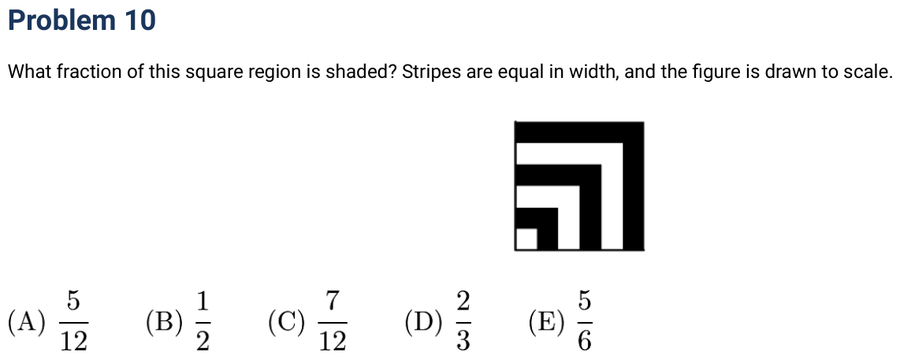
The stripes are equal width, so impose a grid where one stripe = one cell wide. The figure spans 6 widths, so overlay a 6 × 6 grid and the messy picture becomes pure counting.
Still stuck? Show hint 2 →
Hint 2 of 2
Turning a 'to scale' shaded-region picture into a unit grid converts area into countable squares — the standard move for these.
Show solution
Approach: overlay a unit grid and count cells
Equal stripe widths let you tile the square with a 6 × 6 grid (36 unit cells), so each black L-shaped stripe is a whole number of cells.
Counting the three black L's from inside out gives 3, 7, and 11 cells — total 3 + 7 + 11 = 21 shaded.
Shaded fraction = 21/36 = 7/12.
Nice pattern: the black L's grow 3, 7, 11 — jumping by 4 each time, since each larger L wraps an extra cell along two arms. Spotting the +4 rhythm guards against a miscount.
You'll see it again: 'drawn to scale, equal widths' is a hint to grid it; counting cells beats fighting with areas.
Let [N] mean the number of whole number divisors of N. For example, [3] = 2 because 3 has two divisors, 1 and 3. Find the value of
[ [11] × [20] ].
Show answer
Answer: A — 6.
Show hints
Hint 1 of 2
This is a function-inside-a-function: resolve the innermost brackets to plain numbers first, then move outward — never try to do it all at once.
Still stuck? Show hint 2 →
Hint 2 of 2
To count a number's divisors, prime-factorize it, then multiply (each exponent + 1). A divisor is built by choosing how many of each prime to include, and there are (exponent + 1) choices per prime.
Show solution
Approach: count divisors via prime factorization, inside-out
Innermost: [11] = 2 since 11 is prime (only divisors 1 and 11). And [20] = [2² · 5] = (2+1)(1+1) = 6.
Why the formula works: for 12 = 2²·3, a divisor picks 0, 1, or 2 twos (3 ways) and 0 or 1 three (2 ways), giving 3 × 2 = 6 divisors — and indeed 1, 2, 3, 4, 6, 12.
Curiosity: the answer also equals [20], since both 12 and 20 are 'p²q' shaped — same exponent pattern means same divisor count.
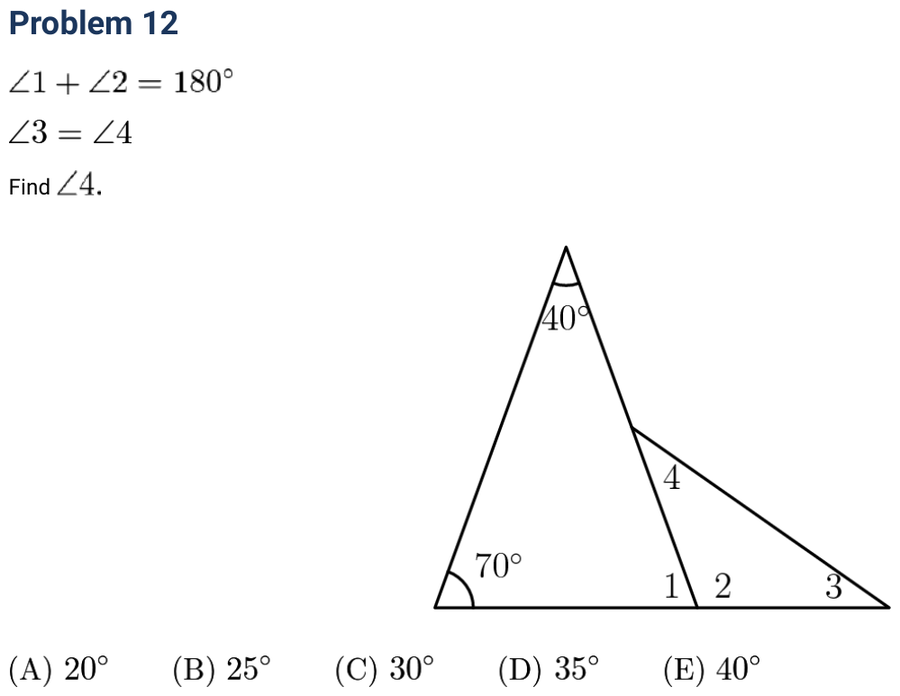
∠4 lives in the right triangle, but you can't touch it yet. Start where ALL the numbers are — the left triangle — and let each angle hand you the next one, like dominoes.
Still stuck? Show hint 2 →
Hint 2 of 2
Angle-chasing toolkit: angles in a triangle sum to 180°, and two angles on a straight line are supplementary (sum to 180°). Chain them.
Show solution
Approach: chase angles step by step into the target triangle
Left triangle has 40° (apex) and 70° (base), so the third angle ∠1 = 180° − 40° − 70° = 70°.
∠1 and ∠2 sit on the straight base line, so ∠2 = 180° − 70° = 110°.
Now the right triangle's three angles are ∠2, ∠3, ∠4: ∠3 + ∠4 = 180° − 110° = 70°. Since ∠3 = ∠4 (given), each is 70° ÷ 2 = 35°.
Why this transfers: angle problems are dominoes — you can't reach the far angle directly, so start from the fully-determined triangle and propagate one relation at a time.
Three bags of jelly beans contain 26, 28, and 30 beans. The fractions of yellow beans in the bags are 50%, 25%, and 20%, respectively. All three bags are poured into one bowl. Which of the following is closest to the percent of yellow beans in the bowl?
Show answer
Answer: A — About 31%.
Show hints
Hint 1 of 2
You can't just average 50%, 25%, 20% — the bags hold different amounts. Go back to actual beans: count the yellows, count the total, then take the overall ratio.
Still stuck? Show hint 2 →
Hint 2 of 2
A combined percentage is a weighted average: total of the parts ÷ total of the wholes, never the plain mean of the rates.
Show solution
Approach: real counts: yellow total over grand total
Convert each rate to a count, choosing the easy fraction: 50% of 26 = 13, 25% of 28 = 7, 20% of 30 = 6.
Yellow total = 13 + 7 + 6 = 26; bean total = 26 + 28 + 30 = 84. The bowl's ratio is 26/84 ≈ 30.9%, closest to 31%.
Trap: averaging the percentages, (50+25+20)/3 ≈ 31.7%, lands near the same answer here by luck — but that shortcut is wrong whenever the bag sizes differ much. Always weight by how many beans each bag has.
You'll see it again: mixing groups of different sizes always calls for a weighted average — sum the actual amounts, then divide.
A set of five positive integers has mean 5, median 5, and 8 as its only mode. What is the difference between the largest and smallest integers in the set?
Show answer
Answer: D — 7.
Show hints
Hint 1 of 2
Each statistic is a clue that PINS DOWN actual numbers. Sort the five into slots ⬚ ⬚ ⬚ ⬚ ⬚ and let mean, median, mode each fill in what they force.
Still stuck? Show hint 2 →
Hint 2 of 2
Convert mean → a fixed total (sum = mean × count); convert 'only mode 8' → at least two 8s; convert median → the middle slot. Then the rest is forced.
Show solution
Approach: translate each statistic into a fixed slot, then solve for the rest
Write the sorted set as a ≤ b ≤ 5 ≤ d ≤ e (median 5 fixes the middle). Mean 5 means the total is 5 × 5 = 25.
'Only mode is 8' forces two 8s, and they must be the two largest: d = e = 8 (16 used). So a + b = 25 − 16 − 5 = 4.
a and b are distinct positive integers summing to 4 (distinct so 8 stays the *only* mode), forcing 1 and 3 → set {1, 3, 5, 8, 8}.
Largest − smallest = 8 − 1 = 7.
You'll see it again: with mean/median/mode puzzles, lay out sorted slots and spend your strongest constraints (total and mode) first — the leftover slots then have only one legal filling.
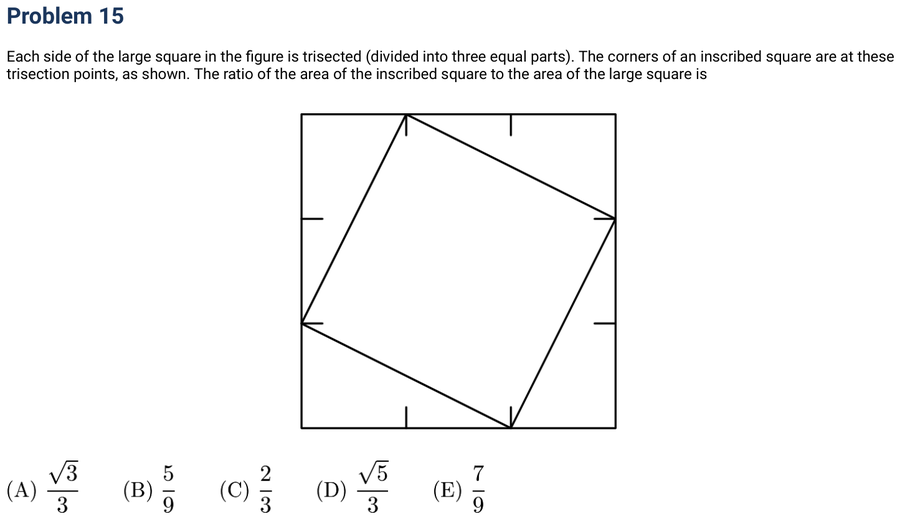
Trisection means clean thirds, so set the big side to 3 — then each tilted inner side is the slanted edge of a right triangle that goes 2 along and 1 up.
Still stuck? Show hint 2 →
Hint 2 of 2
For a tilted square, find its side via the Pythagorean theorem on the corner triangle; for an area RATIO you only ever need side², so the √ never has to be evaluated.
Show solution
Approach: Pythagoras gives side², which is the area
Let the big square's side be 3 (trisection points fall at 1 and 2). Each side of the inner square is the hypotenuse of a right triangle with legs 2 and 1.
By the Pythagorean theorem the inner side² = 2² + 1² = 5. (No need to take the square root!)
Area ratio = inner side² / big side² = 5 / 3² = 5/9.
Key shortcut: a square's area IS its side², so for area problems stop at side² = 5 — chasing √5 just invites it to be squared right back.
Another way — subtract the four corner triangles:
The inner square is the big 3×3 square with four right triangles snipped off the corners, each with legs 2 and 1.
Each corner triangle has area ½ · 2 · 1 = 1, so four of them total 4. Inner area = 9 − 4 = 5.
Ratio = 5/9 = 5/9 — same answer with no Pythagoras at all, just area bookkeeping.
Penni buys $100 of stock in each of three companies: AA, BB, and CC. After one year AA is up 20%, BB is down 25%, and CC is unchanged. In the second year AA drops 20% from its new value, BB rises 25% from its new value, and CC is unchanged. If A, B, C are the final values, which ordering is correct?
Show answer
Answer: E — B < A < C.
Show hints
Hint 1 of 2
The big trap: a 20% gain then a 20% loss does NOT bring you back to $100 — the loss is taken on a bigger amount. Picture each percent change as MULTIPLYING by a factor, and notice the factors don't undo each other.
Still stuck? Show hint 2 →
Hint 2 of 2
Turn every percent change into a multiplier (up 20% → ×1.2, down 25% → ×0.75) and multiply them. ×1.2 then ×0.8 = ×0.96, a net loss.
Show solution
Approach: convert each change to a multiplier and multiply
AA: ×1.2 then ×0.8 → overall ×0.96, so 100 → 96. The +20%/−20% pair lands BELOW the start because the 20% drop is off the higher $120.
BB: ×0.75 then ×1.25 → overall ×0.9375, so 100 → 93.75. CC: unchanged at 100.
Ordering the finals: 93.75 < 96 < 100, i.e. B < A < C.
Why this transfers: percent changes never simply cancel — a +x% then −x% always leaves you at ×(1 − x²) of the start, a small loss. Multipliers, not addition, govern stacked percents.
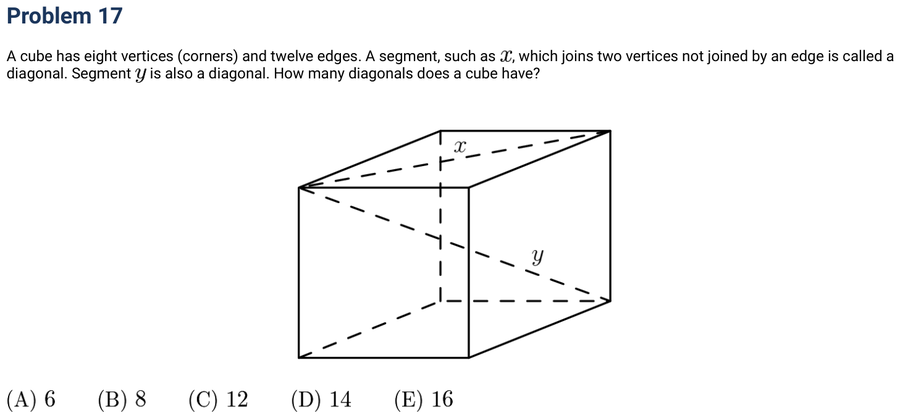
Diagonals come in two flavors: ones lying flat ON a face, and ones boring through the INSIDE of the cube. Count the two types separately so you don't miss the inside ones (like segment y).
Still stuck? Show hint 2 →
Hint 2 of 2
Sort by type to avoid double-counting or omissions: face diagonals (2 per face) plus interior space diagonals (one from each vertex to its far corner).
Show solution
Approach: split into face diagonals and space diagonals
Face diagonals: each of the 6 faces is a square with 2 diagonals, so 6 × 2 = 12 (segment x is one of these).
Space diagonals: each vertex has exactly one opposite vertex through the interior, and 8 vertices pair up into 8 ÷ 2 = 4 such diagonals (segment y is one).
Total = 12 + 4 = 16.
Another way — all vertex pairs minus the edges:
Connect every pair of the 8 vertices: that's C(8,2) = (8 × 7)/2 = 28 segments in all.
Of those, 12 are edges (not diagonals). A diagonal is any vertex-pair that isn't an edge: 28 − 12 = 16.
Lesson: 'count everything, subtract what doesn't qualify' is often faster than itemizing each kind.
Last week small boxes of facial tissue were priced at 4 boxes for $5. This week they are on sale at 5 boxes for $4. The percent decrease in the price per box during the sale was closest to
Show answer
Answer: B — About 35%.
Show hints
Hint 1 of 2
'4 for $5' versus '5 for $4' looks like a tidy swap, but the percent change isn't 20%. Boil both down to the same fair unit — the price of ONE box — before comparing.
Still stuck? Show hint 2 →
Hint 2 of 2
Percent decrease = (drop ÷ ORIGINAL) × 100%. The original price is the denominator, not the new price — that's where this trap bites.
Show solution
Approach: reduce to per-box price, divide the drop by the original
Per box, old price = $5 ÷ 4 = $1.25; sale price = $4 ÷ 5 = $0.80.
Drop = $1.25 − $0.80 = $0.45. Percent decrease = $0.45 ÷ $1.25 = 0.36 = 36%, closest to 35%.
Trap: dividing the drop by the NEW price ($0.45 ÷ $0.80 ≈ 56%) is wrong — percent change always measures against where you started.
You'll see it again: to compare two 'X for $Y' deals, always collapse each to a single unit price first.
Don't multiply anything out — line up the fractions and watch the 3, then 4, then 5… appear on top of one fraction AND on the bottom of the next. They annihilate in a chain.
Still stuck? Show hint 2 →
Hint 2 of 2
This is a telescoping product: in 3/2 · 4/3 · 5/4 · … every numerator cancels the following denominator, collapsing the whole chain to (last top) / (first bottom).
Show solution
Approach: telescoping cancellation
Each numerator equals the next fraction's denominator (the 3 on top of 3/2 cancels the 3 under 4/3, and so on), so the entire product collapses to a/2 — only the very last numerator and the very first denominator survive.
Set a/2 = 9 → a = 18. Since each fraction is (top)/(top − 1), b = a − 1 = 17.
Sum = 18 + 17 = 35.
Why this transfers: whenever consecutive terms share a factor that cancels its neighbor, the long product (or sum) telescopes to just the endpoints — recognizing the pattern saves all the multiplying.
A pair of 8-sided dice have sides numbered 1 through 8, each equally likely. What is the probability that the product of the two numbers facing up exceeds 36?
Show answer
Answer: A — 5/32.
Show hints
Hint 1 of 2
A product over 36 is rare — both dice have to be large. So don't list all 64 outcomes; only the top rolls matter. Sweep the first die from high down and ask 'how big must the other be?'
Still stuck? Show hint 2 →
Hint 2 of 2
When few outcomes qualify, count the SUCCESSES directly by organized cases instead of computing every possibility.
Show solution
Approach: case on the first die, find the threshold for the second
For each value of the first die, find the smallest second value that pushes the product past 36: a 1–4 can't reach it; a 5 needs 8 (1 way); a 6 needs 7 or 8 (2); a 7 needs 6, 7, 8 (3); an 8 needs 5, 6, 7, 8 (4).
Counts 1 + 2 + 3 + 4 = 10 ordered pairs out of 8 × 8 = 64 total.
Probability = 10/64 = 5/32.
Nice pattern: the winning counts run 1, 2, 3, 4 as the first die climbs 5→8 — a neat staircase that signals you've been systematic, not just guessing.
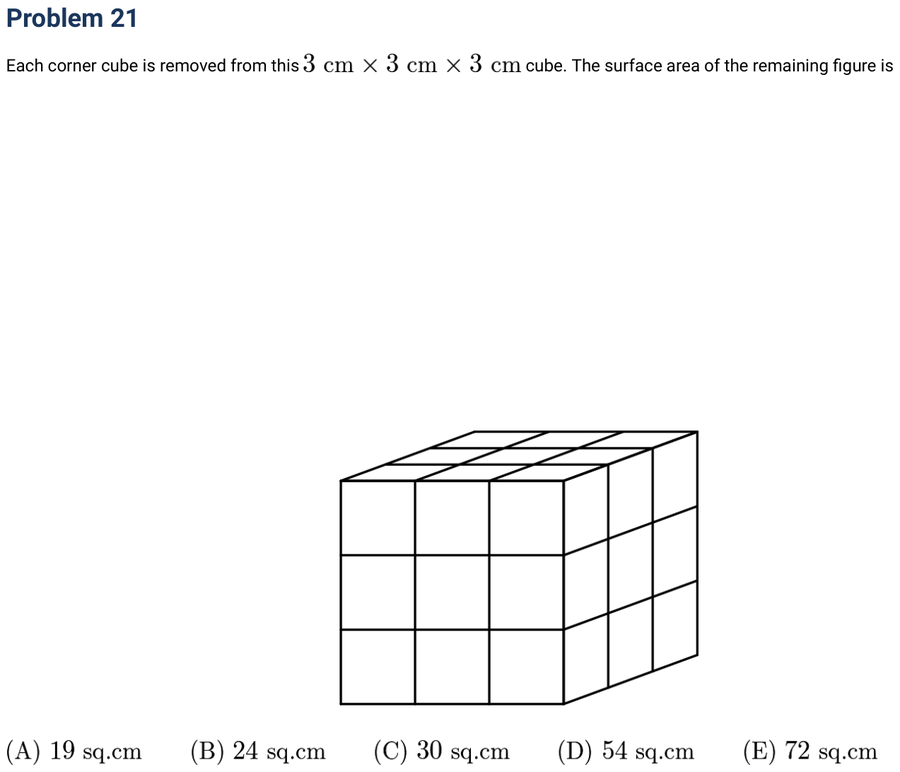
Before computing anything, ask what a single corner-cut actually DOES to the surface. A corner cube shows 3 faces to the outside; pull it out and you expose 3 fresh faces from the notch. Notice anything?
Still stuck? Show hint 2 →
Hint 2 of 2
Look for an invariant: if every move removes exactly as much surface as it adds, the total can't change — so you only need the original.
Show solution
Approach: spot the surface-area invariant
A corner cube touches 3 of the big cube's outer faces. Removing it deletes those 3 unit squares but uncovers 3 new unit squares (the inside walls of the notch) — a perfect trade, so surface area is unchanged.
All 8 corners are separated by a middle cube, so the cuts don't interfere; the area still equals the original cube's: 6 × 3² = 6 × 9 = 54 sq cm.
Why this transfers: the elegant move is recognizing 'lose 3, gain 3 = no change' before crunching numbers. Hunting for an invariant turns a scary 3-D figure into a one-line answer.
A two-inch cube (2 × 2 × 2) of silver weighs 3 pounds and is worth $200. How much is a three-inch cube of silver worth?
Show answer
Answer: E — $675.
Show hints
Hint 1 of 2
Silver is worth its weight, and weight comes from how much METAL is there — that's volume, not side length. Going from a 2-inch to a 3-inch cube isn't 1.5× the value.
Still stuck? Show hint 2 →
Hint 2 of 2
Value tracks volume. When a 3-D solid scales, volume grows with the CUBE of the side ratio, so reason in unit cubes.
Show solution
Approach: value is proportional to volume
Slice the 2-inch cube into unit cubes: 2³ = 8 of them, sharing $200, so each unit cube is worth $200 ÷ 8 = $25.
A 3-inch cube is 3³ = 27 unit cubes, worth 27 × $25 = $675.
Trap: the side only grows from 2 to 3 (×1.5), but value grows ×(3/2)³ = ×3.375, giving 200 × 3.375 = $675. The weight (3 lb) is a decoy — you never needed it.
You'll see it again: scale a length by k and area scales by k², volume (and anything proportional to it, like mass or value) by k³.
Some positive integers have both properties: (I) the sum of the squares of their digits is 50, and (II) each digit is larger than the one to its left. The product of the digits of the largest such integer is
Show answer
Answer: C — 36.
Show hints
Hint 1 of 2
'Each digit larger than the one before' secretly means the digits are all DIFFERENT — and the smallest possible distinct digits already pile up squares fast. First pin down how many digits can even fit under a square-sum of 50.
Still stuck? Show hint 2 →
Hint 2 of 2
Two moves: (1) bound the count of digits using the minimum square-sum, then (2) to make the NUMBER biggest, work from the largest possible final digit downward.
Show solution
Approach: bound the digit count, then settle the largest digit
Strictly increasing ⇒ distinct digits. Five distinct increasing digits force squares ≥ 1+4+9+16+25 = 55 > 50, so there are at most 4 digits. (A 4-digit answer beats any 3-digit one, so aim for 4.)
Test the last (largest) digit d: d = 7 gives 49, leaving only 1 for three more squares — impossible. d = 6 gives 36, leaving 14 = 1 + 4 + 9 for the smaller digits 1, 2, 3. That works: 1236, with 1 + 4 + 9 + 36 = 50.
Smaller last digits (d = 5 etc.) can't reach a 4-digit set summing to 50, so 1236 is the largest valid integer.
Digit product = 1 × 2 × 3 × 6 = 36.
Why this transfers: 'largest integer with property P' problems split into bounding the length, then greedily fixing digits from the most significant (or here, the constraint-heaviest) end down.
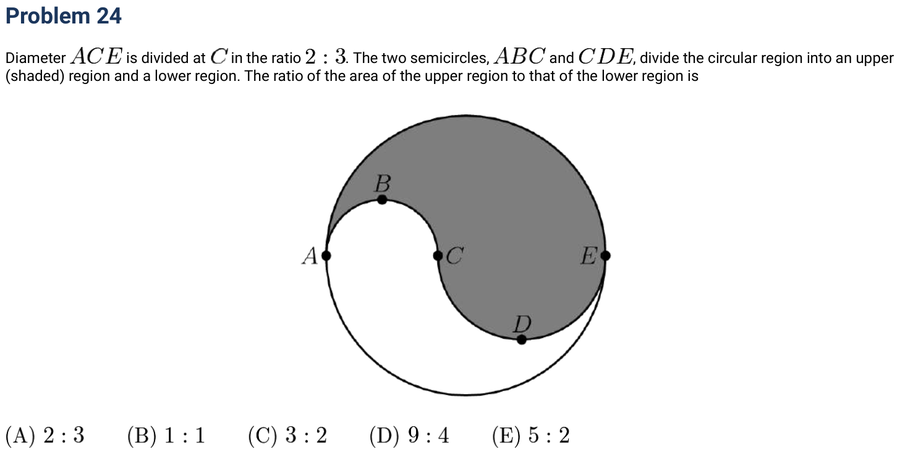
Pick a friendly diameter so the 2:3 split is whole: AE = 10 gives AC = 4, CE = 6, big radius 5. Then build the wavy upper region out of clean half-disks rather than fighting the S-curve directly.
Still stuck? Show hint 2 →
Hint 2 of 2
Decompose a curvy region into known semicircles: start with the big upper half-disk, then subtract the bump that dips below the dividing line and add the bump that rises above it.
Show solution
Approach: big half-disk, minus the dipping bump, plus the rising bump
Let AE = 10, so AC = 4 (radius 2) and CE = 6 (radius 3); the big circle has radius 5. Half-areas: big = ½·π·5² = 12.5π, small ABC = ½·π·2² = 2π, small CDE = ½·π·3² = 4.5π.
The S-shaped boundary carves the upper region as: big upper half-disk − semicircle ABC (it pushes down, removing area) + semicircle CDE (it bulges up, adding area) = 12.5π − 2π + 4.5π = 15π.
The whole circle is 25π, so the lower region is 25π − 15π = 10π. Ratio = 15π : 10π = 3 : 2.
Sanity check: the upper region is the bigger one, matching the shaded (mostly-top) figure. Notice: the π's cancel in the ratio — area-ratio problems rarely need the actual value of π.
All the even numbers from 2 to 98 inclusive, except those ending in 0, are multiplied together. What is the units digit of the product?
Show answer
Answer: D — 6.
Show hints
Hint 1 of 2
A units digit only depends on the units digits of the factors — the tens never reach the ones place. So 12, 22, 32, … all behave like '2', and the long list shrinks to a repeating pattern of 2, 4, 6, 8.
Still stuck? Show hint 2 →
Hint 2 of 2
For a units digit of a huge product, replace each factor by its units digit, group the repeats, and use the fact that units digits of powers cycle.
Show solution
Approach: reduce to units digits, group, then use power cyclicity
Excluding multiples of 10, each block of ten (2,4,6,8 then 12,14,16,18 …) contributes the units digits 2, 4, 6, 8. Their product ends like 2 × 4 × 6 × 8 = 384, i.e. units digit 4.
From 2 to 98 there are 10 such blocks, so the overall units digit is that of 4¹⁰.
Powers of 4 cycle 4, 6, 4, 6, …: 4² = 16 ends in 6, and any power of 6 ends in 6, so 4¹⁰ = (4²)⁵ ends in 6.
You'll see it again: units digits of nⁿ-style products are tamed by (1) keeping only units digits and (2) exploiting their short repeating cycle — never multiply the giant number out.