Problem 24 · 1995 AJHSME
Hard
Geometry & Measurement
area-two-wayspythagorean
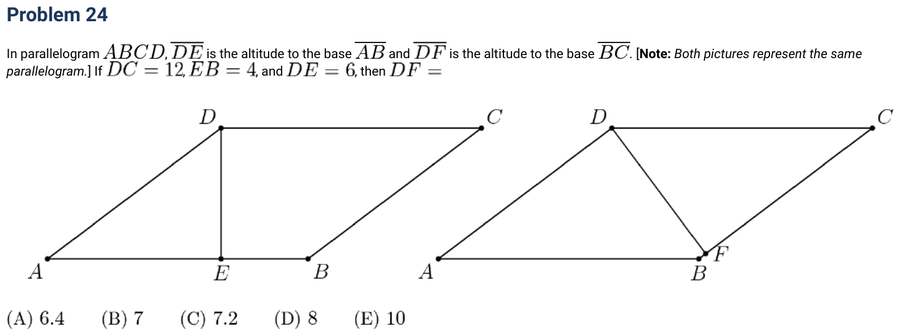
Show answer
Answer: C — 7.2.
Show hints
Hint 1 of 2
A parallelogram has ONE area, but you can compute it from EITHER base with its matching height: AB × DE or BC × DF. Set those two equal and the unknown DF pops out — no new area needed.
Still stuck? Show hint 2 →
Hint 2 of 2
To use the second base you need BC. Opposite sides are equal, so BC = AD, and AD is the hypotenuse of the right triangle formed by the altitude DE. Pythagoras gives it.
Show solution
Approach: area-two-ways: same area from two different base–height pairs
- Big idea: the parallelogram's area is a single number, so (base AB)(height DE) = (base BC)(height DF). Find the area once, find BC, then solve for DF.
- Area from AB: opposite sides are equal so AB = DC = 12, and DE = 6, giving area = 12 × 6 = 72.
- Find BC: it equals AD. The altitude DE splits off right triangle ADE with AE = AB − EB = 12 − 4 = 8 and DE = 6, so AD = √(8² + 6²) = √100 = 10. Thus BC = 10. (The 6-8-10 is just a doubled 3-4-5 triple.)
- Now the two-ways equation: 10 × DF = 72, so DF = 7.2.
- Why this transfers: 'compute one area two different ways and equate' is a workhorse for finding an awkward height or length — it turns an unknown into a simple equation. Sanity check: BC (10) is shorter than AB (12), so its matching height DF must be TALLER than DE... but 7.2 < 6 is false — recheck: a longer base pairs with a shorter height, and BC=10 < AB=12, so DF should be larger than DE=6. Indeed 7.2 > 6. Consistent.
Mark:
· log in to save