Walter has exactly one penny, one nickel, one dime, and one quarter in his pocket. What percent of one dollar is in his pocket?
Show answer
Answer: D — 41%.
Show hints
Hint 1 of 2
A dollar IS 100 cents — so cents and 'percent of a dollar' are the very same number.
Still stuck? Show hint 2 →
Hint 2 of 2
That means you don't need a percent calculation at all: just total the coins in cents.
Show solution
Approach: read cents directly as percent (a dollar = 100 cents)
The trick: 'percent' means 'out of 100,' and a dollar is exactly 100 cents. So however many cents you have IS the percent of a dollar — no division needed.
Total the coins: 1 + 5 + 10 + 25 = 41 cents, which is 41% of a dollar.
You'll see it again: any time the whole is 100 (100 cents, 100 students, a 100-point test), counts and percents are the same number.
Jose is 4 years younger than Zack. Zack is 3 years older than Inez. Inez is 15 years old. How old is Jose?
Show answer
Answer: C — 14.
Show hints
Hint 1 of 2
Only one person has a real number: Inez is 15. Start where you actually know something and build outward.
Still stuck? Show hint 2 →
Hint 2 of 2
Each clue is a 'how far apart' link — follow the chain Inez → Zack → Jose, adding or subtracting at each link.
Show solution
Approach: anchor at the known value, then walk the chain
Don't try to solve everyone at once — start from the one fixed fact: Inez is 15.
Zack is 3 years older than Inez, so Zack is 15 + 3 = 18.
Jose is 4 years younger than Zack, so Jose is 18 − 4 = 14.
The habit that transfers: in a chain of comparisons, find the one person with a number and walk outward one link at a time — never juggle all the unknowns together.
A teacher tells the class: "Think of a number, add 1 to it, and double the result. Give the answer to your partner. Partner, subtract 1 from the number you are given and double the result to get your answer." Ben thinks of 6 and gives his answer to Sue. What should Sue's answer be?
Show answer
Answer: C — 26.
Show hints
Hint 1 of 2
This is a 'machine' problem: a number goes in, gets transformed, and the OUTPUT becomes the input to the next machine. Don't skip ahead — feed Ben's result straight into Sue.
Still stuck? Show hint 2 →
Hint 2 of 2
Each person runs the same kind of step: take a number, add or subtract 1, then double. Do Ben's whole step, get his answer, then start Sue fresh with it.
Show solution
Approach: follow the output of one stage into the next
Treat each person as a little machine. Ben's machine: (number + 1) then double. With 6: (6 + 1) × 2 = 14. That 14 is what Sue receives — Ben's number 6 is gone.
The trap this catches: kids often re-use 6 in Sue's step. The rule is to pass forward only the answer, not the original number — that's how chained operations work.
Find the smallest whole number that is larger than the sum 212 + 313 + 414 + 515.
Show answer
Answer: C — 16.
Show hints
Hint 1 of 2
You're not asked for the exact sum — only the next whole number above it. That means you can ESTIMATE instead of finding common denominators.
Still stuck? Show hint 2 →
Hint 2 of 2
Split each mixed number into its whole part and its fraction part. The whole parts are easy; then just decide how big the leftover fractions add up to.
Show solution
Approach: estimate — split off the whole parts, then bound the fractions
The key realization: the question wants the smallest whole number ABOVE the sum, so we never need the exact value — a good estimate is enough.
Whole parts: 2 + 3 + 4 + 5 = 14. The four fraction parts are ½, ⅓, ¼, ⅕ — each less than ½, and together a little more than 1 (½ + ⅓ ≈ 0.83 already, plus ¼ + ⅕ ≈ 0.45, so ≈ 1.28).
So the total is about 15.28 — comfortably between 15 and 16. The smallest whole number larger than it is 16.
Sanity check: the fractions can't reach 2 (the biggest, ½, isn't even close to making them sum that high), so the answer can't be 17. And they clearly exceed 1, so it isn't 15. 16 is the only fit.
Perimeter and side of a square are locked together: side = perimeter ÷ 4. So a perimeter instantly tells you a side — work in sides, not perimeters.
Still stuck? Show hint 2 →
Hint 2 of 2
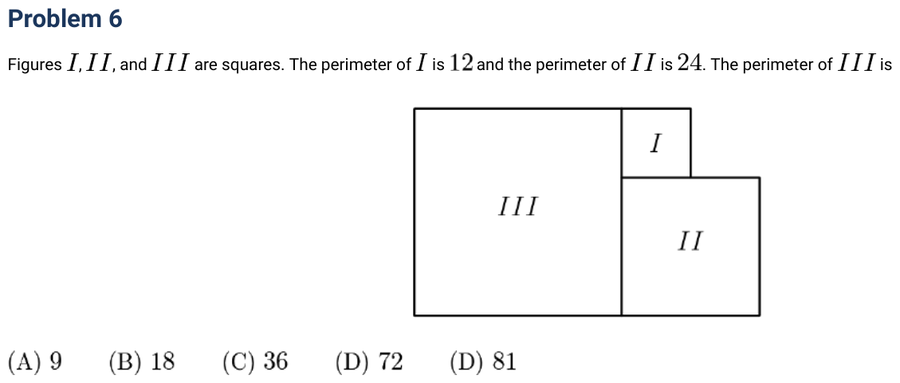
Look at how the squares stack in the picture: the big square's left edge is exactly as tall as the two smaller squares stacked. So its side is the SUM of the two small sides.
Show solution
Approach: convert perimeters to sides, read the side relationship from the picture
First turn each perimeter into a side (a square's side is perimeter ÷ 4, since all four sides match): square I has side 12 ÷ 4 = 3, square II has side 24 ÷ 4 = 6.
Now read the figure: the big square III runs alongside squares I and II stacked together, so its side equals 3 + 6 = 9.
Perimeter of III = 4 × 9 = 36.
Why this transfers: for squares, perimeter, side, and area are all instantly convertible (÷4, then square). The real work is always reading how the sides line up in the picture.
At Clover View Junior High, half of the students go home on the school bus, one fourth go home by automobile, and one tenth go home on their bicycles. The rest walk home. What fractional part of the students walk home?
Show answer
Answer: B — 3/20.
Show hints
Hint 1 of 2
Everyone goes home SOME way, so the four groups together make 1 whole. The walkers are simply 'everything that's left over' — that's a subtraction, not a fourth fraction to compute directly.
Still stuck? Show hint 2 →
Hint 2 of 2
Add the three known fractions over a common denominator, then take them away from 1. Denominators 2, 4, 10 all fit into 20.
Show solution
Approach: the walkers are the leftover — subtract the rest from the whole
The whole student body is 1. Since walkers are 'the rest,' find them by taking the three known groups away from 1 — much cleaner than trying to figure walkers out on their own.
Over the common denominator 20: bus + car + bike = 12 + 14 + 110 = 1020 + 520 + 220 = 1720.
Walkers = 1 − 1720 = 3/20.
You'll see it again: whenever the parts must fill a whole, the unknown 'remaining' part is fastest found as (whole − everything else). This is complementary counting with fractions.
An American traveling in Italy wishes to exchange American dollars for Italian lire. If 3000 lire = $1.60, how much lire will the traveler receive for $1.00?
Show answer
Answer: D — 1875 lire.
Show hints
Hint 1 of 2
You're given lire for $1.60 but asked for lire per $1.00. Find the 'per one dollar' rate — that's the unit rate, and a unit rate makes every later question easy.
Still stuck? Show hint 2 →
Hint 2 of 2
To get the rate for exactly $1, divide the lire by the number of dollars: 3000 ÷ 1.60.
Show solution
Approach: find the unit rate (lire per single dollar)
The whole game is to find how many lire one dollar buys — the unit rate. Once you have 'per $1,' any dollar amount is just a multiply.
Sanity check: $1 is less than $1.60, so you should get fewer than 3000 lire — and 1875 < 3000. Good. (Choice 4875 is the trap of multiplying instead of dividing.)
Why this transfers: exchange rates, unit prices, and speeds all become trivial once you reduce them to 'per one' first.
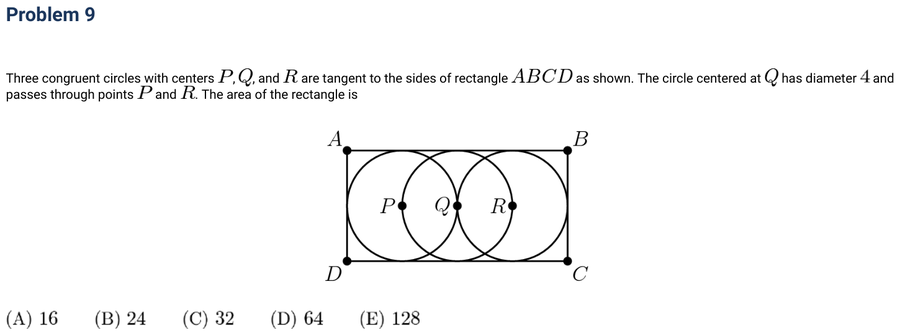
Don't reach for circle formulas — area of a rectangle only needs its width and height, and the circles are just there to MEASURE those lengths. The radius is your ruler.
Still stuck? Show hint 2 →
Hint 2 of 2
'Circle Q passes through P and R' is the secret length clue: P and R sit on circle Q, so PQ and QR each equal Q's radius. Tangency to the top and bottom edges gives the height.
Show solution
Approach: use the radius as a ruler to measure the rectangle's sides
Diameter 4 means radius 2. The circles are tangent to the top and bottom edges, so the rectangle's height is exactly one diameter: 4.
For the width, use the clue 'Q passes through P and R': that puts P and R on circle Q, so PQ = QR = 2 (a radius), giving PR = 4. The left and right circles are tangent to the side edges, adding one radius (2) beyond P and beyond R.
The reusable idea: when a figure is built from tangent circles, every key length is a whole number of radii. Count radii along each edge instead of computing anything.
A jacket and a shirt originally sold for 80 dollars and 40 dollars, respectively. During a sale Chris bought the 80-dollar jacket at a 40% discount and the 40-dollar shirt at a 55% discount. The total amount saved was what percent of the total of the original prices?
Show answer
Answer: A — 45%.
Show hints
Hint 1 of 2
The two discount percents (40% and 55%) are taken off DIFFERENT prices, so you can't just average them. Convert each to actual dollars saved first, then compare to the actual total.
Still stuck? Show hint 2 →
Hint 2 of 2
'What percent of the total' means: (dollars saved) ÷ (total original price), where the total is 80 + 40 = 120.
Show solution
Approach: convert percents to dollars, then one percent at the end
The trap here is averaging 40% and 55% to get 47½% — but those percents sit on different-sized prices, so they don't average. Switch to dollars, where amounts add cleanly.
Saved on the jacket: 40% of $80 = $32. Saved on the shirt: 55% of $40 = $22. Total saved = $54.
Original total = $80 + $40 = $120, so the saving is 54120 = 45%.
Why this transfers: percentages only add or average directly when they're on the same base. Different bases → turn into real quantities first, combine, then take one final percent.
When two people start together and walk opposite ways around a loop, at the instant they meet their distances ADD UP to the whole loop. That one fact replaces any speed/time algebra.
Still stuck? Show hint 2 →
Hint 2 of 2
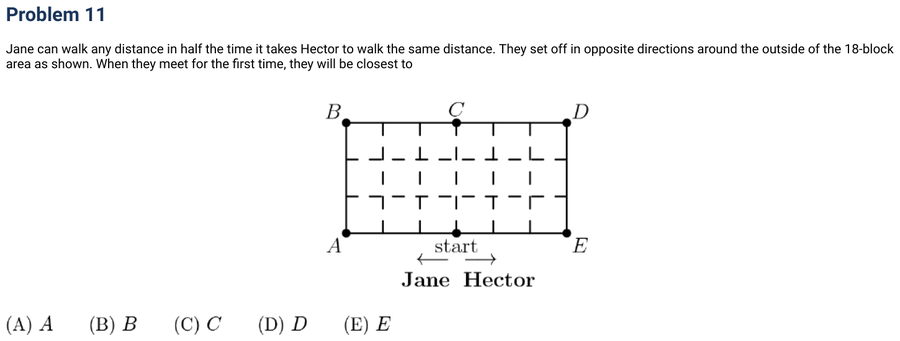
Speeds split the loop in the same ratio as the speeds. Jane is twice as fast, so of the 18 blocks she walks 2 parts and Hector 1 part — Hector walks just 13 of 18 = 6 blocks. Then trace those 6 blocks on the picture.
Show solution
Approach: their combined distance equals the loop; split it by the speed ratio
The key idea: going opposite ways around the rectangle, when they first meet their two distances together equal the full perimeter, 18 blocks. No need to find time or actual speed.
Speed ratio is 2 : 1 (Jane : Hector), so they split the 18 blocks the same way: Jane walks 12, Hector walks 6.
Trace Hector's 6 blocks from the start (bottom middle): 3 blocks right to corner E, then 3 blocks up the right side — landing exactly on corner D. (Jane's 12 blocks bring her to D too, confirming the meeting point.)
Why this transfers: for two travelers closing a loop or a gap, 'distances sum to the whole' plus 'distances split as the speed ratio' solves almost every meeting problem with no equations.
A lucky year is one in which at least one date, written as month/day/year, has the property that the month times the day equals the last two digits of the year. For example, 1956 is lucky because 7/8/56 has 7 × 8 = 56. Which of the following is NOT a lucky year?
Show answer
Answer: E — 1994.
Show hints
Hint 1 of 2
'Month × day = the two-digit year' is really asking: can you FACTOR that number into month × day, where the month is 1–12 and the day is a real calendar day? So this is a factoring hunt in disguise.
Still stuck? Show hint 2 →
Hint 2 of 2
The dangerous factor pairs are ones where the only factorizations need a month bigger than 12. Check 94 last — it's the one with almost no factors.
Show solution
Approach: treat each year as a factoring question: month (1–12) × day
Reframe 'lucky' as: can the last two digits be written as (a number 1–12) × (a valid day)? That turns the puzzle into checking factor pairs.
90 = 9 × 10 ✓, 91 = 7 × 13 ✓, 92 = 4 × 23 ✓, 93 = 3 × 31 ✓ — each has a month ≤ 12 paired with a real day.
94 is the trap: its only factorizations are 1 × 94 and 2 × 47. The month must be 1–12, so the only candidate is month 2 (February) with day 47 — impossible. No valid pair exists, so 1994 is not lucky.
Why this transfers: when a number has few factors (here 94 = 2 × 47, a product of two primes), it has very few ways to be split — which is exactly why it fails. Always factor first; the sparse-factor number is your prime suspect.
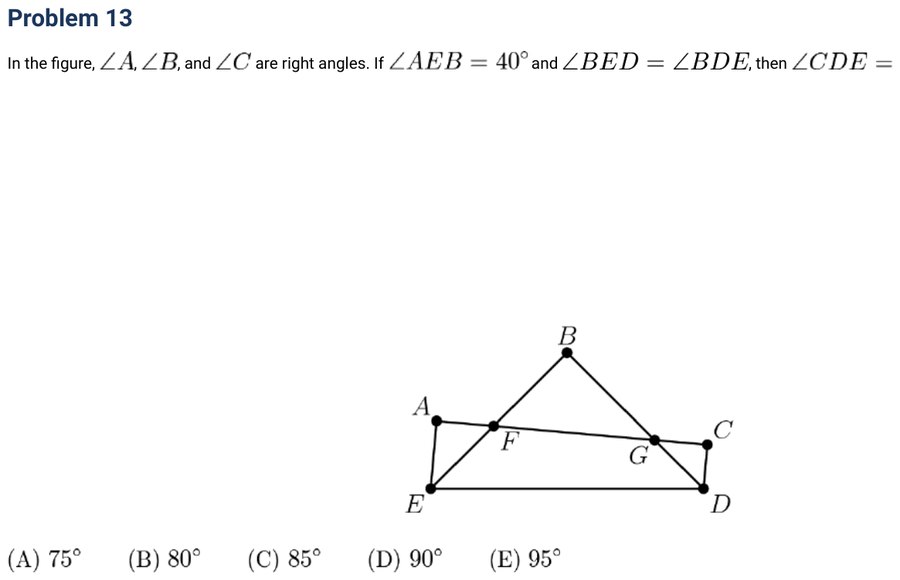
This is an angle CHASE: don't look for one formula — start from the angle you know (40°) and convert it step by step into the angle you want, using each right angle and the equal-angle clue as you pass through it.
Still stuck? Show hint 2 →
Hint 2 of 2
First conversion: side EA stands perpendicular to the base ED, so the 40° at E lives inside a 90° corner. That instantly gives you a second angle at E to carry forward. The equal-angles clue (∠BED = ∠BDE) then bounces an angle across the isosceles triangle to the far side.
Show solution
Approach: angle chase from the known 40° through the right angles
Anchor: the only number given is ∠AEB = 40°. The plan is to relay it across the figure toward ∠CDE, spending one right angle at a time.
At E, EA is perpendicular to the base ED, so ∠AED = 90°. That leaves ∠BED = 90° − 40° = 50°. The clue ∠BED = ∠BDE then hands that 50° across the isosceles triangle to ∠BDE = 50°.
Continuing the relay through the right angles at B and C (each 90° corner converts one angle into its complement), the chase delivers ∠CDE = 95°.
The habit that transfers: in any 'find the far angle' figure, name the one known angle and march it through the givens — perpendiculars give complements, equal sides give equal angles, triangles give 'the three add to 180°.' Each given is one conversion step.
A team won 40 of its first 50 games. How many of the remaining 40 games must this team win so that it will have won exactly 70% of its games for the season?
Show answer
Answer: B — 23.
Show hints
Hint 1 of 2
The 70% is of the WHOLE season, not the remaining games. So first figure out how many total wins 70% demands; that target is the anchor for everything else.
Still stuck? Show hint 2 →
Hint 2 of 2
Find the target total wins for the full 90-game season, then subtract the wins the team already banked.
Show solution
Approach: find the season's target win count, then subtract what's already won
Work backward from the goal: the team wants 70% of the entire season, and the season is 50 + 40 = 90 games. So the target is 70% of 90 = 63 wins.
It already has 40 wins, so it still needs 63 − 40 = 23 more.
The trap to avoid: 70% applies to all 90 games, not just the last 40 — anchoring on the season total keeps you out of that mistake.
Sanity check: 23 of the remaining 40 is a bit over half — reasonable, since the team is already winning 40/50 = 80% and needs to dip toward 70% overall.
What is the 100th digit to the right of the decimal point in the decimal form of 4/37?
Show answer
Answer: B — 1.
Show hints
Hint 1 of 2
A repeating decimal loops forever in a fixed block, so the digits go in cycles. You don't write out 100 digits — you find the block, then figure out where the 100th digit lands WITHIN the cycle.
Still stuck? Show hint 2 →
Hint 2 of 2
Find the repeating block of 4/37 (it's short). Then use the leftover after dividing 100 by the block length to pick the right digit in the block.
Show solution
Approach: find the repeating block, then locate position 100 inside the cycle
Do the division: 4 ÷ 37 = 0.108108108… The block '108' repeats, length 3. So the digit at any position depends only on where it sits inside that 3-long cycle.
Position 100: how many whole blocks fit, with what leftover? 100 = 3 × 33 + 1, leftover 1. After 33 complete '108' blocks you're at the 1st digit of the next block.
The 1st digit of '108' is 1.
Why this transfers: for any repeating decimal, divide the position by the block length and read the leftover — leftover 1 → 1st digit, leftover 2 → 2nd, and a leftover of 0 means you've landed on the LAST digit of the block. This 'cycle position' trick handles powers, units digits, and calendars too.
Students from three middle schools worked on a summer project. Seven students from Allen school worked for 3 days, four students from Balboa school worked for 5 days, and five students from Carver school worked for 9 days. The total amount paid for the students' work was $774. Assuming each student received the same amount for a day's work, how much did the students from Balboa school earn altogether?
Show answer
Answer: C — 180.00 dollars.
Show hints
Hint 1 of 2
Pay depends on BOTH how many students and how many days — so the real unit being paid for is one 'student-day' (one student working one day). Count those, not students.
Still stuck? Show hint 2 →
Hint 2 of 2
Add up all the student-days, find the dollars per student-day, then multiply by Balboa's share.
Show solution
Approach: invent the right unit (student-days), then find its rate
The insight: each student is paid the same per day, so money tracks 'student-days' — one student for one day. Seven students for 3 days is 21 student-days, and so on. Build everything from this unit.
The $774 paid for all 86, so each student-day is worth 774 ÷ 86 = $9. Balboa's 20 student-days earned 20 × $9 = $180.
Why this transfers: when a quantity depends on two factors multiplied together (people × time, machines × hours, workers × days), make the combined unit first — then it's a plain unit-rate problem.
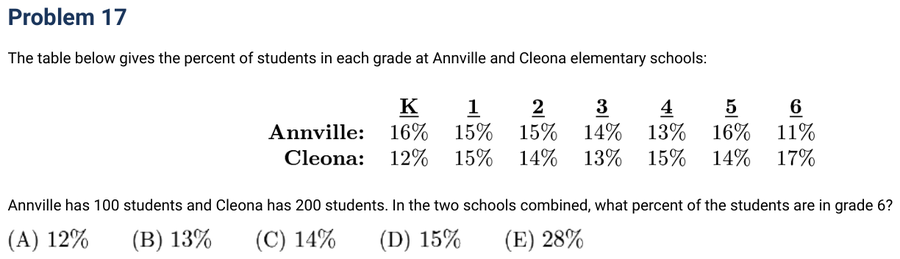
The two schools are different sizes, so you can't just average 11% and 17%. A percent of 100 students and a percent of 200 students mean different numbers of kids — convert to actual kids first.
Still stuck? Show hint 2 →
Hint 2 of 2
Turn each grade-6 percent into a head count, add the counts, then take that over the 300 total.
Show solution
Approach: convert to head counts (the schools have different sizes), then one combined percent
The trap is averaging 11% and 17% to get 14%. That's wrong because Cleona has twice as many students — its percentage should count double. So switch to real counts.
Grade 6 counts: Annville 11% of 100 = 11 kids; Cleona 17% of 200 = 34 kids. Together 45 kids.
Out of all 300 students that's 45300 = 15%.
Why this transfers: this is a weighted average — percentages can only be combined directly when the groups are the same size. Different sizes → count the actual items, then re-percent at the end. (Notice 15% leans toward Cleona's 17%, because Cleona is the bigger school.)
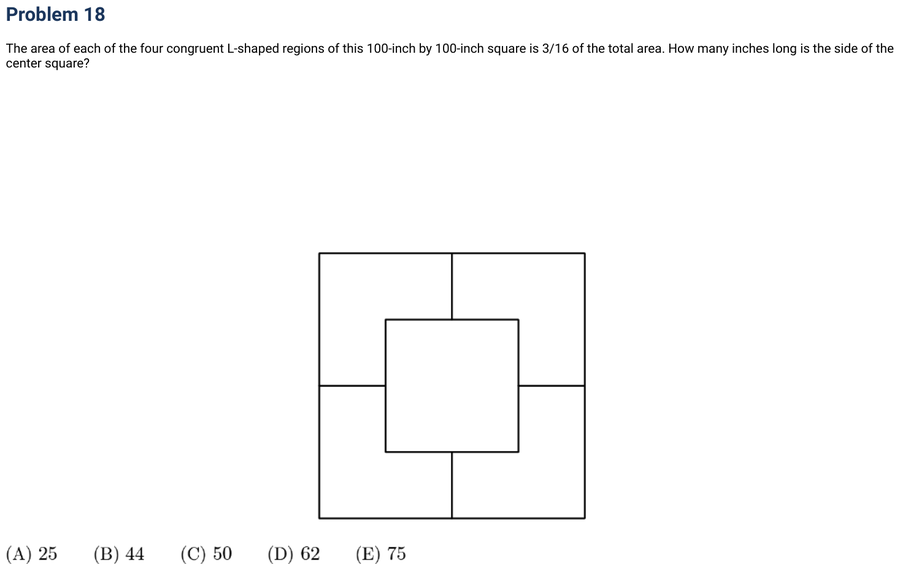
The four L-shapes plus the center square fill the whole big square. So instead of measuring the center directly, find what FRACTION of the square the four L's eat up — the center is whatever fraction is left.
Still stuck? Show hint 2 →
Hint 2 of 2
Work in area first; only turn area into side length at the very end with a square root.
Show solution
Approach: leftover area (whole − the four L's), then square-root to a side
Don't try to read the center square's side off the picture. Use the whole: the four L-regions and the center together make the full square (fraction 1). Each L is 316, so four of them cover 4 × 316 = 1216 = 34.
That leaves the center square as 1 − 34 = 14 of the area.
The big square is 100 × 100 = 10000 sq in, so the center is 14 × 10000 = 2500 sq in. Its side is √2500 = 50 inches.
Why this transfers: for 'what's left in the middle' figures, fractions of area beat measuring lengths — and a center square that's exactly 14 the area has side exactly 12 the big side (since √(1/4) = 1/2). Sure enough, 50 is half of 100.
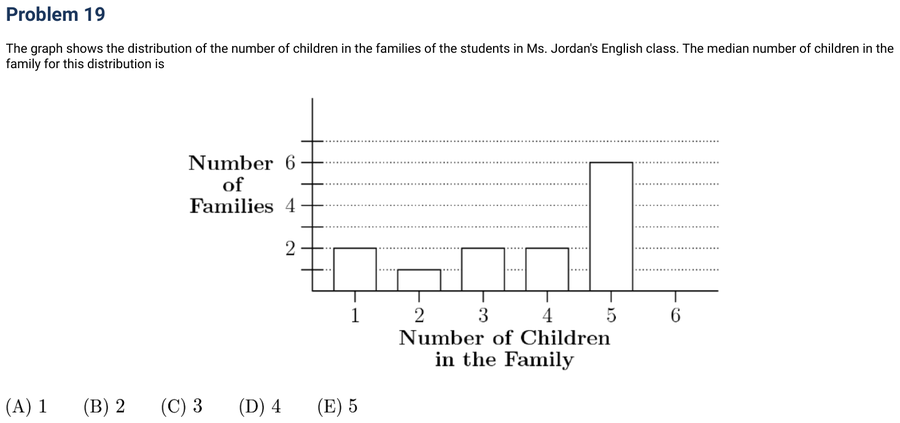
Median is the MIDDLE value, not the tallest bar. Read carefully: the bar HEIGHT is how many families, and the number you're averaging over is the children-per-family on the bottom axis. First find how many families there are in all.
Still stuck? Show hint 2 →
Hint 2 of 2
Once you know the total count, the median sits at the middle position. You don't need to write every value — just walk along the bars counting until you reach that middle spot.
Show solution
Approach: total the families, then walk the bars to the middle position
Read the bars as counts of families: 2 families have 1 child, 1 has 2, 2 have 3, 2 have 4, 6 have 5 — that's 2 + 1 + 2 + 2 + 6 = 13 families.
With 13 values in order, the median is the 7th one (six below it, six above). Walk the bars: positions 1–2 are '1 child,' position 3 is '2,' positions 4–5 are '3,' positions 6–7 are '4.' The 7th lands in the '4 children' group.
So the median is 4.
The trap this catches: the '5 children' bar is tallest, so it's tempting to answer 5 — but tallest is the MODE, not the median. Median = middle position. Sanity check: the 7th value is 4, comfortably below the popular 5's that pile up at the top end.
Diana and Apollo each roll a standard die, obtaining a number at random from 1 to 6. What is the probability that Diana's number is larger than Apollo's number?
Show answer
Answer: B — 5/12.
Show hints
Hint 1 of 2
The two players are interchangeable, so 'Diana's number is bigger' and 'Apollo's number is bigger' must be EXACTLY as likely as each other. Use that fairness instead of listing cases.
Still stuck? Show hint 2 →
Hint 2 of 2
Every outcome is one of three things: Diana bigger, Apollo bigger, or a tie. Knock out the ties first, then the symmetry splits what remains evenly in two.
Show solution
Approach: symmetry — peel off the ties, split the rest in half
Key insight: the dice are identical and the two rolls are interchangeable, so 'Diana > Apollo' and 'Apollo > Diana' are equally likely. The only outcome that breaks the symmetry is a tie — so handle ties separately.
Total outcomes: 6 × 6 = 36. Ties (1-1, 2-2, …, 6-6) are 6 of them, leaving 36 − 6 = 30 where someone is strictly bigger.
By the symmetry, half of those 30 favor Diana: 15 outcomes. Probability = 1536 = 5/12.
Why this transfers: whenever two players or choices are interchangeable, the 'one beats the other' cases are equal — so P(A wins) = (1 − P(tie)) ÷ 2. Find the ties, and the rest is free. Trap: ½ forgets the ties; 5/12 is just under ½, which makes sense.
Another way — direct count:
Count outcomes where Diana > Apollo by Apollo's roll: if Apollo rolls 1, Diana wins with 2–6 (5 ways); rolls 2 → 4 ways; … rolls 5 → 1 way; rolls 6 → 0 ways.
Total favorable = 5 + 4 + 3 + 2 + 1 + 0 = 15, out of 36, giving 5/12 — matching the symmetry answer.
A plastic snap-together cube has a protruding snap on one side and receptacle holes on the other five sides. What is the smallest number of these cubes that can be snapped together so that only receptacle holes are showing?
Show answer
Answer: B — 4.
Show hints
Hint 1 of 2
The real requirement: every snap must DISAPPEAR — it has to plug into some other cube's hole. So count the snaps that need hiding, and ask how to hide them all.
Still stuck? Show hint 2 →
Hint 2 of 2
Picture each snap as an arrow that must point into a neighbor. Try to make the arrows form a closed loop so each cube's snap feeds the next cube.
Show solution
Approach: every snap must be absorbed — chain them into a closed loop
Reframe the goal: 'only holes showing' means every snap is buried inside another cube's hole. With n cubes there are n snaps, and each needs its own neighbor's hole to vanish into.
Why not fewer? Each cube's snap must hide in some OTHER cube, so the snaps form a chain 'cube → cube → …' with no loose end — meaning the chain must close into a loop. With cubes you can only turn a 90° corner per step, so the smallest loop that actually returns to its start is a square ring of 4 (a straight line or an L always leaves an end snap exposed).
Four cubes in a square, each snap pointing into the neighbor ahead, hide all four snaps; only holes face outward. So the answer is 4.
Why this transfers: 'each thing must point into another, with none left over' is a closed-loop (cycle) idea — the minimum is the smallest loop that has no loose end. You meet it again in handshake, gift-exchange, and arrow-chasing puzzles.
The number 6545 can be written as a product of a pair of positive two-digit numbers. What is the sum of this pair of numbers?
Show answer
Answer: A — 162.
Show hints
Hint 1 of 2
You can't see the two-digit factors by staring at 6545 — but its prime factorization reveals every possible way to split it. Break it into primes first; the answer is just a regrouping of those.
Still stuck? Show hint 2 →
Hint 2 of 2
6545 ends in 5, so 5 comes out immediately. Keep pulling small primes, then sort the prime pieces into two groups that each land between 10 and 99.
Show solution
Approach: prime-factor, then regroup the primes into two two-digit numbers
Break 6545 down: it ends in 5 → divide by 5 to get 1309; 1309 = 7 × 187 = 7 × 11 × 17. So 6545 = 5 × 7 × 11 × 17.
Now bundle those four primes into two two-digit numbers. The bundle (5 × 17) × (7 × 11) = 85 × 77 works — both are two-digit. (5×7=35 with 11×17=187 fails, since 187 is three digits.)
Sum = 85 + 77 = 162.
Why this transfers: the prime factorization is the master list of a number's building blocks — every factor pair is just one way of dividing those primes into two teams. Factor first, then the regrouping is quick.
How many four-digit whole numbers are there such that the leftmost digit is odd, the second digit is even, and all four digits are different?
Show answer
Answer: B — 1400.
Show hints
Hint 1 of 2
Build the number one digit-slot at a time and count the choices for each slot; the answer is the product. Fill the MOST restricted slots first (the odd and even ones) so the 'all different' rule is easy to track.
Still stuck? Show hint 2 →
Hint 2 of 2
Odd digits and even digits never overlap, so choosing the first (odd) and second (even) can never collide. Then each later digit just avoids the ones already placed.
Show solution
Approach: multiplication principle, filling the constrained slots first
Handle the picky positions first. First digit must be odd → {1,3,5,7,9}, 5 choices. Second must be even → {0,2,4,6,8}, 5 choices. These can't clash, since no number is both odd and even — that's why we do them first.
Now the 'all different' rule kicks in for the rest. Third digit: any of 10 digits except the 2 already used → 8 choices. Fourth: except the 3 used → 7 choices.
The technique: for 'how many arrangements' problems, count choices slot by slot and multiply — and always fill the tightest-constrained slots first so the leftover counts stay clean. Sanity check: ignoring repeats it'd be 5 × 5 × 10 × 10 = 2500, and removing the clashes drops it to 1400 — smaller, as it should be.
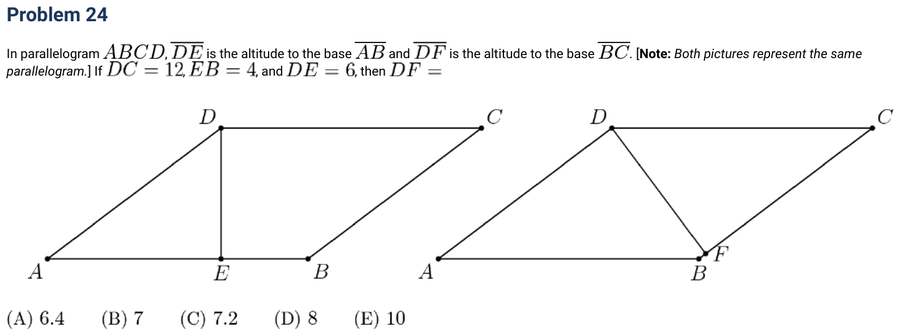
A parallelogram has ONE area, but you can compute it from EITHER base with its matching height: AB × DE or BC × DF. Set those two equal and the unknown DF pops out — no new area needed.
Still stuck? Show hint 2 →
Hint 2 of 2
To use the second base you need BC. Opposite sides are equal, so BC = AD, and AD is the hypotenuse of the right triangle formed by the altitude DE. Pythagoras gives it.
Show solution
Approach: area-two-ways: same area from two different base–height pairs
Big idea: the parallelogram's area is a single number, so (base AB)(height DE) = (base BC)(height DF). Find the area once, find BC, then solve for DF.
Area from AB: opposite sides are equal so AB = DC = 12, and DE = 6, giving area = 12 × 6 = 72.
Find BC: it equals AD. The altitude DE splits off right triangle ADE with AE = AB − EB = 12 − 4 = 8 and DE = 6, so AD = √(8² + 6²) = √100 = 10. Thus BC = 10. (The 6-8-10 is just a doubled 3-4-5 triple.)
Now the two-ways equation: 10 × DF = 72, so DF = 7.2.
Why this transfers: 'compute one area two different ways and equate' is a workhorse for finding an awkward height or length — it turns an unknown into a simple equation. Sanity check: BC (10) is shorter than AB (12), so its matching height DF must be TALLER than DE... but 7.2 < 6 is false — recheck: a longer base pairs with a shorter height, and BC=10 < AB=12, so DF should be larger than DE=6. Indeed 7.2 > 6. Consistent.
Buses from Dallas to Houston leave every hour on the hour. Buses from Houston to Dallas leave every hour on the half hour. The trip from one city to the other takes 5 hours. Assuming the buses travel on the same highway, how many Dallas-bound buses does a Houston-bound bus pass on the highway (not in the station)?
Show answer
Answer: D — 10.
Show hints
Hint 1 of 3
You don't have to track positions or speeds. The only thing that lets two buses meet on the road is that they are on the road AT THE SAME TIME — so this is really a question about overlapping time windows, not motion.
Still stuck? Show hint 2 →
Hint 2 of 3
Pin down ONE Houston-bound bus and its 5-hour window. Then an oncoming bus is passed exactly when its own 5-hour window overlaps that one — so count the oncoming departure times whose trips overlap.
Still stuck? Show hint 3 →
Hint 3 of 3
An oncoming bus already on the road when yours starts still counts (you pass it later on), and one that starts before you finish counts too. So look both BACKWARD and forward from your window — don't just count buses that leave during your trip.
The freeing insight: two buses on the same highway pass each other if and only if they share the road at the same moment. Speeds and exact meeting points never matter — only whether their time-on-road windows overlap. So pick one bus and compare windows.
Pin your Houston-bound bus: say it leaves Dallas at 12:00 and (5-hour trip) arrives Houston at 17:00, so it owns the road-window 12:00–17:00.
A Dallas-bound bus that left Houston at time t owns the window (t, t+5). It overlaps yours when it hasn't already arrived (t + 5 > 12:00, i.e. t > 7:00) AND it has already left (t < 17:00). So the meeting condition is simply 7:00 < t < 17:00.
Houston buses leave on the half hour, so the departures in that range are 7:30, 8:30, 9:30, … , 16:30 — that's 10 buses (one every hour across a 10-hour span).
The trap this catches: only counting buses that leave during your own 12:00–17:00 trip gives 5 or 6 and misses the ones already underway when you start — that's why the overlap test must reach back to 7:00. Sanity check: the early 7:30 bus reaches Dallas at 12:30 (just after you set out, so you do pass it on the road), and the late 16:30 bus is still rolling when you arrive — both genuine highway meetings, not station ones.
Why this transfers: whenever you're asked 'how many of these cross paths,' translate each traveler into a time interval and count overlapping intervals — the geometry of who-is-where dissolves into simple interval arithmetic.
Another way — draw it as a distance–time picture:
Sketch time across the bottom and distance (Dallas at the bottom, Houston at the top) up the side. Your bus is one slanted line going up; every Dallas-bound bus is a slanted line going down, starting on the half hours.
Two lines crossing = a pass. Your line spans the 5-hour width, and a down-line crosses it exactly when it starts within 5 hours before you finish and ends within 5 hours after you begin — the same 7:00-to-17:00 window. Counting the crossing lines gives 10.