Problem 20 · 1992 AJHSME
Hard
Geometry & Measurement
net-folding
Show answer
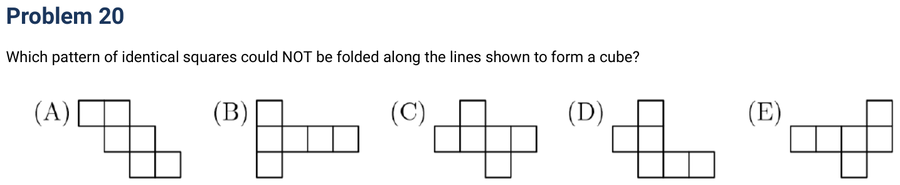
Answer: D — Pattern D.
Show hints
Hint 1 of 3
A cube has exactly 6 faces, and a folding pattern has 6 squares — so a good net must send each square to a DIFFERENT face, with none left bare. Picture folding the flaps up one at a time.
Still stuck? Show hint 2 →
Hint 2 of 3
Quick test for a cube net: pick any one square as the ‘bottom,’ fold the rest up, and check that nothing doubles up. The bad net makes two squares collide on the same face.
Still stuck? Show hint 3 →
Hint 3 of 3
A handy shortcut: a row of more than 4 squares in a straight strip can't work — a cube band is only 4 squares around, so a 5th in line wraps back and overlaps.
Show solution
Approach: fold each net in your head and look for two squares landing on the same face
- Six squares must become six different faces. Imagine choosing one square as the base and folding the others upright.
- Four of the patterns fold cleanly — every square reaches its own face and the cube closes up.
- Pattern D doesn't: as you fold, two of its squares swing onto the SAME face, which leaves a different face uncovered. With a gap and a doubled-up face, it can't seal into a cube.
- Why this transfers: the test for any cube net is ‘does every square map to a distinct face?’ Watch for a straight strip longer than 4 (it wraps around and overlaps) or two squares that fold into the same spot — either one disqualifies the net.
Mark:
· log in to save