Problem 16 · 1992 AJHSME
Hard
Geometry & Measurement
volume-cylinder
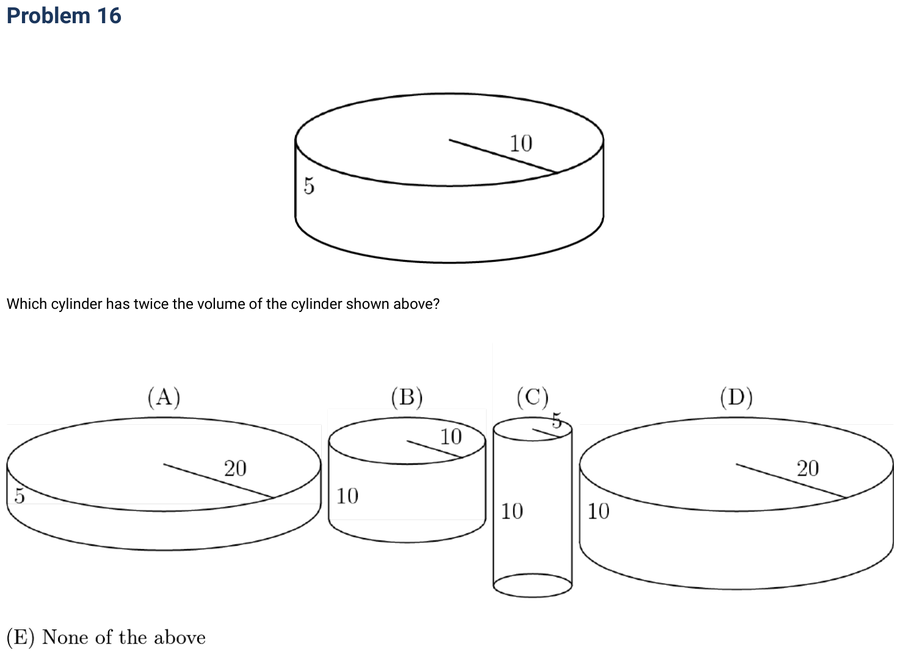
Show answer
Answer: B — Cylinder B.
Show hints
Hint 1 of 3
"Twice the volume" doesn't have to mean changing the radius. The volume formula has TWO knobs (radius and height) — which one could you turn to exactly double the volume most simply?
Still stuck? Show hint 2 →
Hint 2 of 3
Volume = π · radius2 · height. Height affects volume in a plain way (double height → double volume), but radius is SQUARED, so changing it has an outsized effect.
Still stuck? Show hint 3 →
Hint 3 of 3
Compute the target (twice the original), then test each choice — but watch the radius-squared: a doubled radius quadruples that part, not doubles it.
Show solution
Approach: since height scales volume directly, just double the height
- Original: radius 10, height 5, so volume = π · 102 · 5 = 500π. We want twice that, 1000π.
- Height multiplies volume one-for-one, so keeping radius 10 and doubling the height to 10 gives π · 102 · 10 = 1000π — exactly double. That's cylinder B.
- Why the others fail: doubling the RADIUS to 20 (choices A, D) multiplies volume by 22 = 4, far past double; choice C (radius 5, height 10) actually shrinks it. The radius-squared is the trap.
- Why this transfers: in any V = (something) · height formula, height is the ‘easy’ dimension — to double volume, just double the height. Squared dimensions like radius change the result much faster, so reach for the linear knob when you want a clean factor.
Mark:
· log in to save