Problem 22 · 1991 AJHSME
Hard
Counting & Probability
complementary-countingparity
Show answer
Answer: D — 7/9.
Show hints
Hint 1 of 3
A product is even the moment EITHER number is even — one even factor is enough. The only way to FAIL (get an odd product) is for both spins to be odd. Counting that single bad case is easier than counting all the good ones.
Still stuck? Show hint 2 →
Hint 2 of 3
Use the complement: P(even) = 1 − P(both odd). Find each spinner's chance of landing odd, then multiply (the spins are independent).
Still stuck? Show hint 3 →
Hint 3 of 3
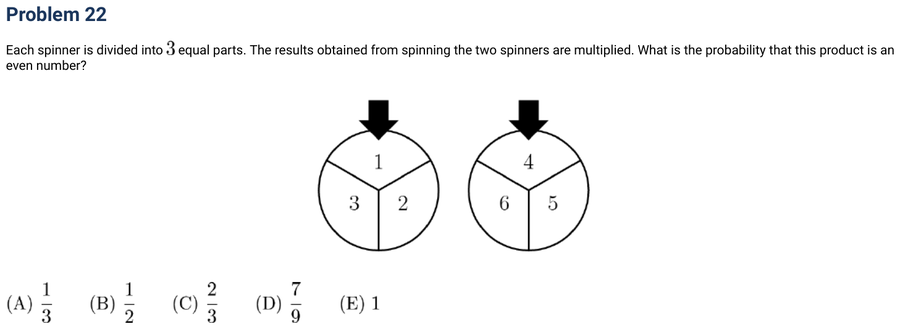
Spinner one has numbers 1, 2, 3 (two odd); spinner two has 4, 5, 6 (one odd). Multiply those odd-chances to get 'both odd,' then subtract from 1.
Show solution
Approach: complementary counting — 1 minus the chance of the only bad case
- A product is even unless both factors are odd (any single even number drags the product even). So instead of listing every even outcome, find the one way it goes wrong — both odd — and subtract from 1.
- Spinner 1 shows 1, 2, 3: odd in 2 of 3 cases, so P(odd) = 2/3. Spinner 2 shows 4, 5, 6: odd only on the 5, so P(odd) = 1/3.
- The spins are independent, so P(both odd) = 2/3 × 1/3 = 2/9.
- P(even product) = 1 − 2/9 = 7/9.
- Why this transfers: when a result needs "at least one" of something (here, at least one even factor), it's usually far faster to compute the single opposite case ("none of them") and subtract from 1 — complementary counting.
Another way — count the 9 equally likely outcomes:
- There are 3 × 3 = 9 equally likely (spin1, spin2) pairs. The product is odd only when both are odd: (1,5) and (3,5) — just 2 pairs.
- So 9 − 2 = 7 pairs give an even product, and the probability is 7/9.
Mark:
· log in to save