Problem 20 · 1991 AJHSME
Stretch
Number Theory
cryptarithmplace-value
Show answer
Answer: A — 1.
Show hints
Hint 1 of 3
The letter A appears in the hundreds place (in ABC), the tens place (in AB), and the ones place (in A). So A pulls a LOT of weight in the total of 300. Roughly how big can A be before three copies of it overshoot 300?
Still stuck? Show hint 2 →
Hint 2 of 3
Write what each letter is worth: ABC = 100A + 10B + C, AB = 10A + B, A = A. Add them: 111A + 11B + C = 300. Now the hundreds force A almost immediately.
Still stuck? Show hint 3 →
Hint 3 of 3
111A alone must be near 300 without passing it: A = 3 gives 333 (too big), A = 1 gives only 111 (can't reach 300 with the small leftovers). So A is pinned. Then solve 11B + C = whatever's left.
Show solution
Approach: expand by place value; the hundreds digit pins everything down
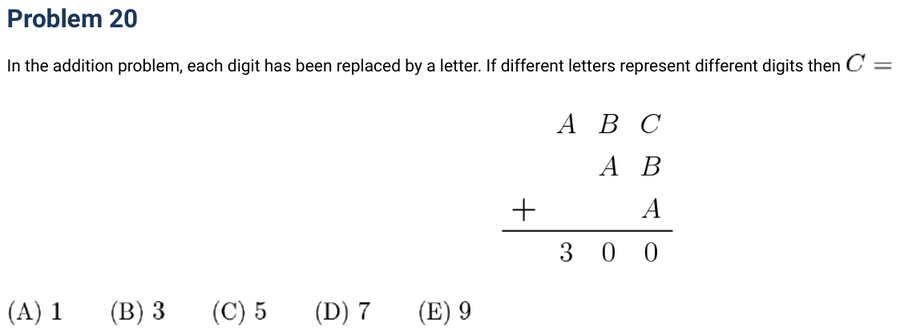
- Translate the stacked sum into place value: ABC + AB + A = (100A + 10B + C) + (10A + B) + A = 111A + 11B + C = 300.
- Look at A first: it's multiplied by 111. A = 3 gives 333 (over 300); A = 1 gives 111, and even with B = C = 9 you'd reach only 111 + 99 + 9 = 219 (short of 300). So A = 2 is forced.
- That leaves 11B + C = 300 − 222 = 78. The biggest B can be is 7 (since 11 × 8 = 88 > 78), and 11 × 7 = 77 leaves C = 1.
- Check: 271 + 27 + 2 = 300, and A, B, C = 2, 7, 1 are all different. So C = 1.
- Why this transfers: in a cryptarithm, attack the leftmost (highest place-value) digit first — it carries the most weight and usually only one digit fits, which then unlocks the rest.
Another way — add column by column with carries:
- Units column: A + B + C must end in 0 (the total's ones digit). Tens column: A + B plus any carry must also end in 0. Hundreds column: A plus the carry from the tens must equal 3.
- If the tens carry 1 into the hundreds, then A + 1 = 3, so A = 2. Filling that back through the columns gives B = 7 and C = 1, and 271 + 27 + 2 = 300 checks out — so C = 1.
Mark:
· log in to save