Problem 18 · 1991 AJHSME
Hard
Fractions, Decimals & Percents
pictographpercent
Show answer
Answer: C — 30%.
Show hints
Hint 1 of 3
"The scale was left off" sounds like missing information, but it isn't — every X stands for the SAME number of employees, whatever that number is. So a percent (a ratio) doesn't need the scale at all. What two counts of X's do you actually need?
Still stuck? Show hint 2 →
Hint 2 of 3
Percent for 5+ years = (X's in the 5,6,7,8,9,10 columns) ÷ (X's in ALL columns), times 100. The unknown "employees per X" cancels top and bottom — just count symbols.
Still stuck? Show hint 3 →
Hint 3 of 3
Tally each column's height. The total comes to a round number, which makes the fraction easy to turn into a percent.
Show solution
Approach: the missing scale cancels — count X's and take the ratio
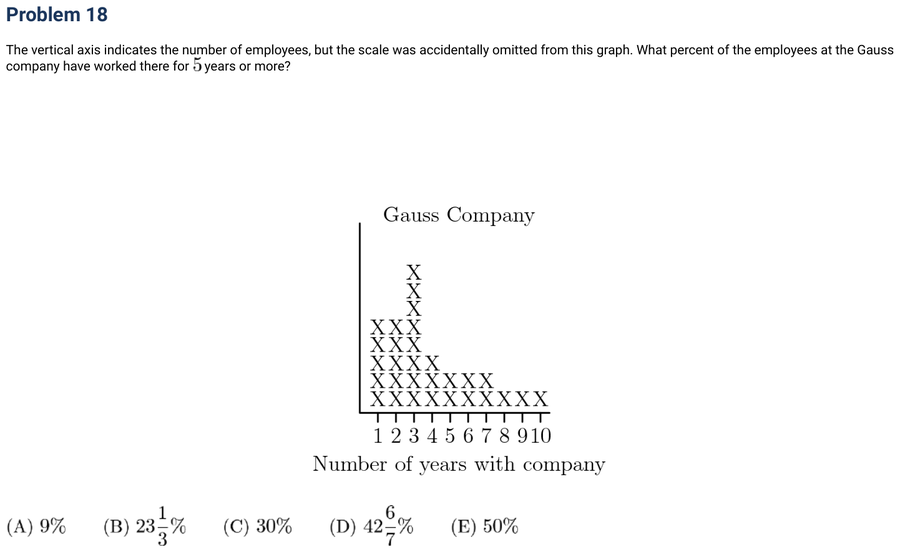
- The percent of employees with 5+ years is (employees with 5+ years) ÷ (all employees). Each X is the same number of employees, say k; that k multiplies both top and bottom and cancels, so the scale being missing doesn't matter — just count X's.
- Column heights (years 1–10): 8, 5, 5, 3, 2, 2, 2, 1, 1, 1. Total X's = 30.
- Years 5 and up are columns 5–10: 2 + 2 + 2 + 1 + 1 + 1 = 9 X's.
- Fraction = 9 ÷ 30 = 3/10 = 30%.
- Why this transfers: a ratio or percent never needs the absolute scale — any common unit cancels. Whenever a problem hides the "how many per symbol," check whether you only need a fraction; if so, counting symbols is enough.
Mark:
· log in to save