Brynn's savings decreased by 20% in July, then increased by 50% of the new amount in August. Brynn's savings are now what percent of the original amount?
Show answer
Answer: E — 120%.
Show hints
Hint 1 of 2
Careful — the answer isn't simply −20 + 50 = +30%. The 50% rise acts on the already-shrunk amount, so the two changes don't just add.
Still stuck? Show hint 2 →
Hint 2 of 2
Turn each change into a multiplier (×0.8, then ×1.5) and multiply them — that's how percent changes compound, and you never need the starting amount.
Show solution
Approach: turn each percent change into a multiplier
A percent change is really a multiplier: down 20% leaves 80%, so × 0.8; up 50% means × 1.5. And changes chain by multiplying, so you never need a starting amount.
0.8 × 1.5 = 1.2, which is 120% of the original.
Watch the trap: the answer is not −20% + 50% = +30%. Percents stack by multiplying, not adding, because the +50% applies to the shrunken amount, not the original.
Another way — plug in a friendly number:
Pretend Brynn started with $100. July: down 20% leaves $80. August: up 50% of $80 adds $40, giving $120.
$120 out of the original $100 is 120%. Picking 100 makes the percent fall right out.
What is the value of this expression in decimal form?
4411 + 11044 + 441100
Show answer
Answer: C — 6.54.
Show hints
Hint 1 of 2
Before finding a common denominator, glance at each fraction alone — do any of them just collapse to a clean number?
Still stuck? Show hint 2 →
Hint 2 of 2
Each one simplifies on its own (every part hides a factor of 11). Turn each into a decimal, then add.
Show solution
Approach: simplify each fraction, then add
Don't reach for a common denominator — each fraction simplifies to a clean decimal on its own, so just turn them one at a time. 4411 = 4.
11044 = 52 = 2.5 (cancel 22).
441100 = 4100 = 0.04 (cancel 11).
Add: 4 + 2.5 + 0.04 = 6.54. Sanity check: answers near 6.5 should sit just above 6.5 once the tiny 0.04 is added — rules out 6.4 and 6.9.
Another way — pull out the shared 11 first (MAA):
Every numerator and denominator carries a factor of 11. Spotting that turns 44, 110, 1100 into 4×11, 10×11, 100×11 — the 11's cancel before you divide.
You're left with 41 + 104 + 4100 = 4 + 2.5 + 0.04 = 6.54.
Three fourths of a pitcher is filled with pineapple juice. The pitcher is emptied by pouring an equal amount of juice into each of 5 cups. What percent of the total capacity of the pitcher did each cup receive?
Show answer
Answer: C — 15%.
Show hints
Hint 1 of 2
The question asks for a percent of the whole pitcher, not of the juice. So divide the 34 that's there among 5 cups — each share is still measured against the full pitcher.
Still stuck? Show hint 2 →
Hint 2 of 2
Each cup gets 34 ÷ 5 = 320 of the pitcher. To make a percent, rewrite it with denominator 100.
Show solution
Approach: split the fraction, then scale to /100
Each cup gets 34 ÷ 5 = 320 of the whole pitcher (the “of the pitcher” never goes away).
Percent means “out of 100,” so scale the denominator to 100: 320 = 15100 = 15%.
Sanity check: 5 cups × 15% = 75%, exactly the 34 we poured. The shares add back to the whole.
Which of the following is the correct order of the fractions 1511, 1915, and 1713, from least to greatest?
Show answer
Answer: E — 19/15 < 17/13 < 15/11.
Show hints
Hint 1 of 2
Don't cross-multiply three times — first notice each fraction sits just barely above 1. The whole question is really "which one sticks up the most past 1?"
Still stuck? Show hint 2 →
Hint 2 of 2
In every fraction the top is exactly 4 bigger than the bottom, so each equals 1 + 4denominator. Same numerator, so the comparison collapses to comparing denominators.
Show solution
Approach: split off the whole 1, compare the leftover
Every fraction has top − bottom = 4, so write each as 1 + 4denom. The "1" is shared, so only the leftover 4denom decides the order.
Same numerator 4 with a bigger denominator gives a smaller piece: 415 < 413 < 411.
Adding back the shared 1 keeps that order, so least to greatest is 1915 < 1713 < 1511 (choice E).
Why this transfers: when fractions cluster near a round number, subtract that number off and compare the tiny remainders — far easier than cross-multiplying, and the rule "same top, bigger bottom = smaller" does the rest.
Before multiplying anything, turn each "1 + a fraction" into a single fraction. Notice each one becomes a fraction whose top is exactly one more than its bottom — that's a pattern begging to chain.
Still stuck? Show hint 2 →
Hint 2 of 2
The technique is telescoping: when you line up fractions where each numerator matches the next denominator, almost everything cancels and only the very first bottom and very last top survive.
Show solution
Approach: rewrite and telescope
First combine each factor: 1 + 1/n = (n+1)/n. So the product becomes 21 · 32 · 43 · 54 · 65 · 76 — a neat staircase of consecutive numbers.
Each top cancels the next bottom (the 2 on top kills the 2 below, the 3 kills the 3…), leaving only the first denominator (1) and the last numerator (7): the answer is 7.
You'll see it again: whenever a long product or sum has terms that pass a piece to their neighbor, look for telescoping — you almost never compute the whole chain, just the two surviving ends.
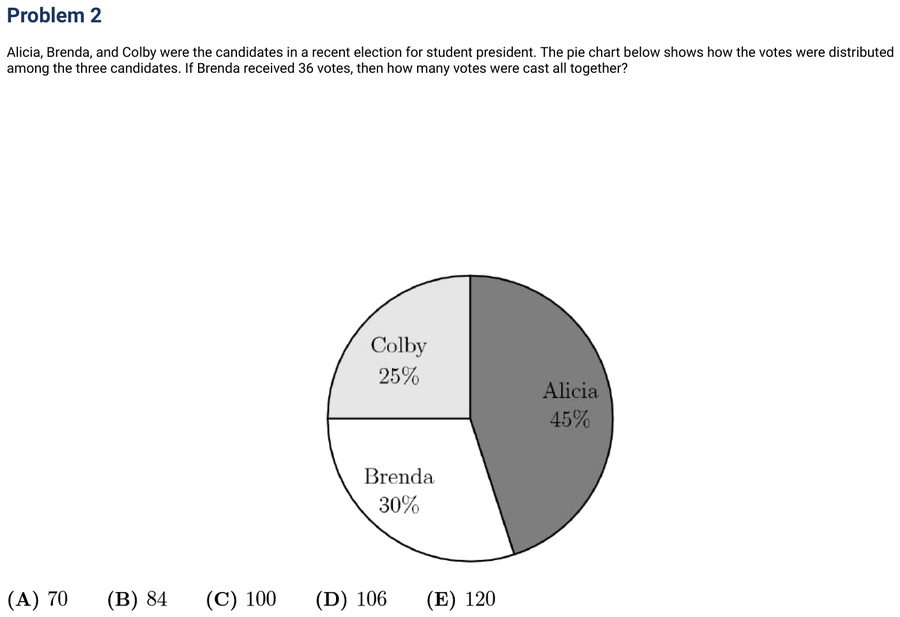
The pie chart tells you Brenda's slice is 30%. So 36 votes is 30% of everything — the question is really "36 is 30% of what?"
Still stuck? Show hint 2 →
Hint 2 of 2
Use a unit-percent anchor: find what 10% is, then the whole is just ten of those. It sidesteps division by an awkward decimal.
Show solution
Approach: anchor on 10%, then scale up
From the chart, Brenda's 36 votes = 30% of the total. The clean move: 30% = 36, so 10% = 36 ÷ 3 = 12.
The whole is 100% = ten of those tenths: 10 × 12 = 120 votes.
Why this transfers: turning a percent into its 1%- or 10%-unit first lets you scale to any target percent with simple multiplication — no decimal division.
Another way — direct division:
30% of the total is 36, so total = 36 ÷ 0.30 = 36 ÷ (3/10) = 36 × 10/3 = 120.
A sign at the fish market says, "50% off, today only: half-pound packages for just $3 per package." What is the regular price for a full pound of fish, in dollars? (Assume that there are no deals for bulk.)
Show answer
Answer: D — $12.
Show hints
Hint 1 of 2
Two separate doublings are hiding here: a half-pound is half of a pound (one doubling), and a 50%-off price is half of the regular price (another doubling). What happens if you double twice?
Still stuck? Show hint 2 →
Hint 2 of 2
"50% off" means the sale price is half the original, so to undo it you double. Always ask "what fraction of the original is this?" before reaching for the discount.
Show solution
Approach: double once for the full pound, double again to undo 50% off
$3 buys half a pound, so a full pound at the sale price is 2 × $3 = $6.
"50% off" means $6 is only half of the regular price, so regular = 2 × $6 = $12.
Watch the trap: the two halvings (half-pound and half-price) tempt you to answer $6. Doubling twice — ×4 from the $3 — lands you at $12.
At the 2013 Winnebago County Fair a vendor is offering a "fair special" on sandals. If you buy one pair of sandals at the regular price of $50, you get a second pair at a 40% discount, and a third pair at half the regular price. Javier took advantage of the "fair special" to buy three pairs of sandals. What percentage of the $150 regular price did he save?
Show answer
Answer: B — 30%.
Show hints
Hint 1 of 2
"Percent saved" always means dollars-saved compared to the full regular price ($150 for three pairs), not to what he ended up paying. So you only need the total dollars knocked off.
Still stuck? Show hint 2 →
Hint 2 of 2
Percent saved = (dollars saved) ÷ (original price). Find the savings in dollars first; the percentages 40% and 50% are just shortcuts to those dollar amounts.
Show solution
Approach: total dollars saved ÷ regular price
Only the 2nd and 3rd pairs are discounted (the 1st is full price). Convert each discount to dollars: 40% of $50 = $20 saved, and half of $50 = $25 saved.
Total saved = $20 + $25 = $45, against the regular three-pair price of $150.
Percent saved = 45 ÷ 150 = 30%.
Watch the trap: the discounts 40% and 50% average to 45%, but each applies to only one of three pairs — spreading the savings over the full $150 is what drops the answer to 30%.
Peter's family ordered a 12-slice pizza for dinner. Peter ate one slice and shared another slice equally with his brother Paul. What fraction of the pizza did Peter eat?
Show answer
Answer: C — 1/8.
Show hints
Hint 1 of 2
The whole pizza is already cut into 12 equal slices — that's your natural unit. Count Peter's share in slices first, before turning it into a fraction of the pizza.
Still stuck? Show hint 2 →
Hint 2 of 2
"Shared equally" means he got half a slice, not a whole one. So count in halves: how many half-slices did he eat?
Show solution
Approach: count the share in slices, then over 12
Peter ate 1 whole slice plus half of another — that's 1½ slices out of the 12.
A clean way to avoid the ½: count in half-slices. Peter ate 3 half-slices, and the pizza holds 24 half-slices, so his share is 3/24 = 1/8.
Sanity check: one slice alone is 1/12, and he ate a bit more than one slice, so the answer should be a little bigger than 1/12 — 1/8 is.
A shop advertises everything is "half price in today's sale." In addition, a coupon gives a 20% discount on sale prices. Using the coupon, the price today represents what percentage off the original price?
Show answer
Answer: D — 60%.
Show hints
Hint 1 of 2
Don't add 50% + 20% — the 20% comes off the already-halved price, not the original. Track what survives each step, not what's taken off.
Still stuck? Show hint 2 →
Hint 2 of 2
This is chaining percentages by multiplying: a discount of d leaves the fraction (1 − d), and successive discounts multiply. Always work with the surviving fraction.
Show solution
Approach: multiply the surviving fractions, then subtract from 1
Half price means you still pay 1/2 of the original. The 20%-off coupon then leaves 80% = 0.8 of that, so discounts chain by multiplying.
What you actually pay: 0.5 × 0.8 = 0.4 of the original price.
So the total discount is 1 − 0.4 = 60% — not the 70% you'd get by wrongly adding 50 + 20.
Why multiply, not add: each percent acts on the price left after the previous one. Multiplying the "keep" fractions is the safe path for any stacked discount or tax.
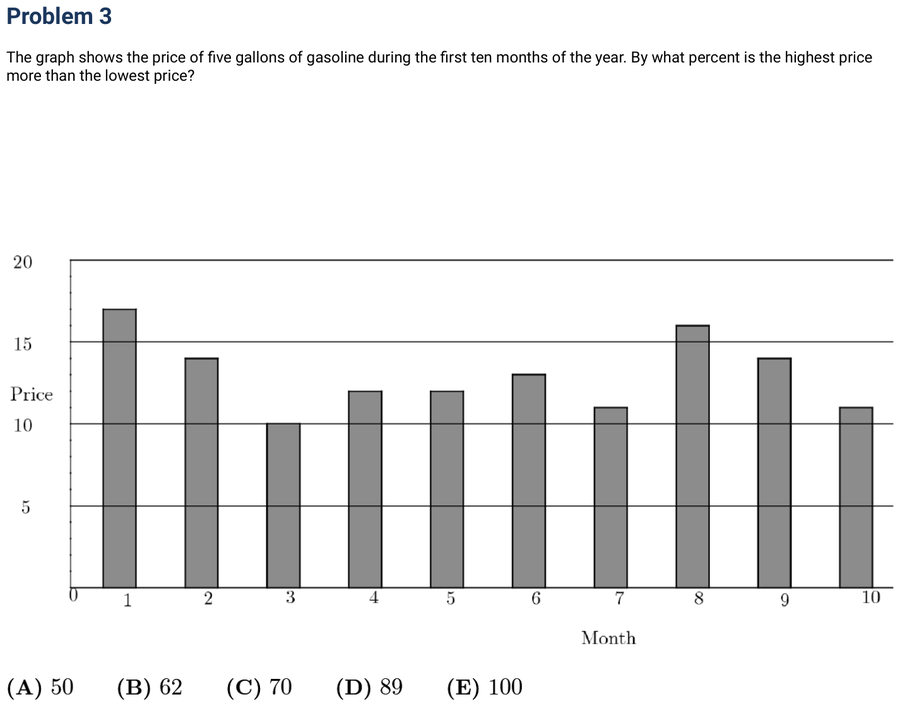
The graph shows the price of five gallons of gasoline during the first ten months of the year. By what percent is the highest price more than the lowest price?
Show answer
Answer: C — 70%.
Show hints
Hint 1 of 2
‘More than’ is the key phrase: you're comparing the gap to the starting amount, not to the bigger amount. The low price is the baseline (the 100%).
Still stuck? Show hint 2 →
Hint 2 of 2
Percent change always divides by where you started: (new − old) / old. The word after ‘than’ tells you the baseline.
Show solution
Approach: compare the gap to the baseline (the low)
Read the tallest and shortest bars: highest = 17, lowest = 10. The gap is 17 − 10 = 7.
‘How much more than the low’ means measure that gap against the low: 7 / 10 = 0.7 = 70%.
Watch out: a common trap is dividing by 17 (the high). Dividing by the wrong number is exactly why the wrong answers are on the list — always anchor to the amount named after ‘than.’
Ryan got 80% of the problems correct on a 25-problem test, 90% on a 40-problem test, and 70% on a 10-problem test. What percent of all the problems did Ryan answer correctly?
Show answer
Answer: D — 84%.
Show hints
Hint 1 of 2
You can't just average 80, 90, 70 — the tests are different sizes, and the big test should pull harder. Go back to raw counts: how many problems did he actually get right out of how many total?
Still stuck? Show hint 2 →
Hint 2 of 2
An overall percent is a weighted average: total correct over total problems. Each test's weight is its number of problems.
Show solution
Approach: weighted average via raw counts
Ignore the percents for a moment and count right answers: 0.8 · 25 + 0.9 · 40 + 0.7 · 10 = 20 + 36 + 7 = 63 correct.
Out of 25 + 40 + 10 = 75 problems: 63 / 75 = 84%.
Sanity check: 84 lands between the lowest (70) and highest (90) scores and leans toward 90 — right, because the 40-problem test is the heaviest. A plain average of 80, 90, 70 gives 80, the wrong answer (A is the trap), proof that size matters.
The length of a rectangle is increased by 10% and the width is decreased by 10%. What percent of the old area is the new area?
Show answer
Answer: B — 99%.
Show hints
Hint 1 of 2
Tempting trap: "+10% then −10% cancels to 0." It doesn't — the 10% you take off is computed from the BIGGER length, so the drop slightly outweighs the gain.
Still stuck? Show hint 2 →
Hint 2 of 2
Turn each percent change into a multiplier (up 10% → ×1.1, down 10% → ×0.9) and just multiply them. Area = length × width, so the area's multiplier is the product.
Show solution
Approach: multiply the multipliers
New area ÷ old area = 1.1 × 0.9 = 0.99 = 99%.
Intuition for the 1% loss: 1.1 × 0.9 = (1 + 0.1)(1 − 0.1) = 1 − 0.1² = 1 − 0.01. The leftover is the square of the percent — tiny, and always a LOSS.
You'll see it again: stacked percent changes always multiply, never add. "Raise then drop by the same %" always ends below where you started, by exactly (that %)².
In 2005 Tycoon Tammy invested 100 dollars for two years. During the first year her investment suffered a 15% loss, but during the second year the remaining investment showed a 20% gain. Over the two-year period, what was the change in Tammy's investment?
Show answer
Answer: D — 2% gain.
Show hints
Hint 1 of 2
The 20% gain is on the shrunken $85, not the original $100 — so −15% then +20% does NOT cancel to +5%.
Still stuck? Show hint 2 →
Hint 2 of 2
Turn each change into a multiplier (lose 15% = ×0.85, gain 20% = ×1.20) and multiply them in a row.
Show solution
Approach: chain the percentage multipliers
Each year scales the money: a 15% loss is ×0.85, a 20% gain is ×1.20. Doing them in sequence means multiplying: 0.85 × 1.20 = 1.02.
1.02 means the money ended at 102% of the start — a 2% gain. The starting $100 never even matters.
Why this transfers: percent changes compound (multiply), they never add — that's why the +20% can't undo the −15% to give +5%.
Another way — track the actual dollars:
After year 1: 100 − 15% = $85. After year 2: 85 + 20% of 85 = 85 + 17 = $102.
The average cost of a long-distance call in the USA in 1985 was 41 cents per minute, and the average cost of a long-distance call in the USA in 2005 was 7 cents per minute. Find the approximate percent decrease in the cost per minute of a long-distance call.
Show answer
Answer: E — About 80%.
Show hints
Hint 1 of 2
Percent decrease compares the drop to where you started, not where you ended — the 41 is the reference, not the 7. And the answers are far apart, so a rough estimate is enough.
Still stuck? Show hint 2 →
Hint 2 of 2
Percent change = (change) ÷ (original). The original is always the denominator.
Show solution
Approach: drop over the starting value, estimated
The drop is 41 − 7 = 34, measured against the starting price 41 (not the ending 7).
34/41 is just under 34/40, and 34 is most of 41 — clearly in the 80s percent, so 80%.
Common trap: dividing by the new value (7) instead of the original (41) inflates the answer. Decrease always references the start.
Another way — the price almost vanished:
7 cents is roughly one-sixth of 41 cents, so about 5/6 of the cost disappeared.
A mixture of 30 liters of paint is 25% red tint, 30% yellow tint and 45% water. Five liters of yellow tint are added to the original mixture. What is the percent of yellow tint in the new mixture?
Show answer
Answer: C — 40%.
Show hints
Hint 1 of 2
Percentages of a changing total are slippery — switch to actual liters. Pouring in yellow grows the yellow and the whole batch, so both the top and bottom of the fraction move.
Still stuck? Show hint 2 →
Hint 2 of 2
Convert percents to amounts before mixing: track the quantity you care about and the total separately, then re-form the percent at the end.
Show solution
Approach: switch to liters, update both parts
Yellow at the start: 30% of 30 = 9 L. (The red and water percents are scenery — ignore them.)
Add 5 L of yellow: yellow becomes 9 + 5 = 14 L, and the whole batch grows to 30 + 5 = 35 L.
New yellow percent = 14/35 = 2/5 = 40%.
Common trap: the answer isn't 30% + something simple — you must enlarge the denominator too. Yellow jumped from 9/30 to 14/35 because both numbers changed.
Initially, a spinner points west. Chenille moves it clockwise 214 revolutions and then counterclockwise 334 revolutions. In what direction does the spinner point after the two moves?
Show answer
Answer: B — East.
Show hints
Hint 1 of 2
Opposite spins partly undo each other — so first combine them into ONE net turn instead of tracking two separate moves.
Still stuck? Show hint 2 →
Hint 2 of 2
A whole revolution always lands you back where you started, so only the leftover fraction of a turn matters. Throw away whole revolutions.
Show solution
Approach: combine into one net turn, then drop whole revolutions
A full revolution returns the spinner to where it was, so ignore the whole 1 and keep only the ½: a half-turn from west.
Half a turn is straight across ⇒ west becomes east.
Why discard whole turns: direction is periodic — it repeats every full revolution. Keeping only the fractional part (the "remainder" after whole turns) is the same idea you use for clock problems and any repeating cycle.
The table shows some of the results of a survey by radio station KACL. What percentage of the males surveyed listen to the station? (Total surveyed: 200. Females: 96. Females who listen: 58. Males who don't listen: 26. Total listeners: 136. Total non-listeners: 64.)
Show answer
Answer: E — 75%.
Show hints
Hint 1 of 2
A two-way table is built on the rule that rows and columns must add to their totals. Find a cell you CAN fill (males total), then chase the rest.
Still stuck? Show hint 2 →
Hint 2 of 2
You only need the male row: total males, then split into listen/don't-listen. Ignore the female numbers once you have the male total.
Show solution
Approach: complete the male row, then take the percentage
Total males = total surveyed − total females = 200 − 96 = 104.
Males who listen = males total − males who don't = 104 − 26 = 78.
Percentage of males who listen = 78 ÷ 104 = 75%.
Shortcut worth seeing: instead of finding 78, note 26 out of 104 is exactly ¼ (since 26 × 4 = 104), so the non-listeners are 25% and the listeners are 100% − 25% = 75%. Spotting the clean fraction beats the division.
Antonette gets 70% on a 10-problem test, 80% on a 20-problem test and 90% on a 30-problem test. If the three tests are combined into one 60-problem test, which percent is closest to her overall score?
Show answer
Answer: D — 83%.
Show hints
Hint 1 of 2
You can NOT just average 70, 80, 90 — the tests have different sizes, so the bigger tests should count for more. Go back to actual problems right and wrong.
Still stuck? Show hint 2 →
Hint 2 of 2
A percentage is a fraction in disguise. Turn each percent into a count of correct problems, pool them, then form one big fraction: total right ÷ total problems. This is a weighted average.
Show solution
Approach: count actual correct problems, then one overall fraction
Convert each percent to a count: 70% of 10 = 7, 80% of 20 = 16, 90% of 30 = 27.
Pool them: 7 + 16 + 27 = 50 correct out of 60 total.
50 ÷ 60 ≈ 0.833 ⇒ closest to 83%.
Why not 80%? The naive average of 70, 80, 90 is 80 — that's answer choice C, the trap. It would only be right if the tests were the same size. Because the 90% test is the biggest (30 problems), it pulls the real score above 80. Always weight by size.
Karl bought five folders from Pay-A-Lot at a cost of $2.50 each. Pay-A-Lot had a 20%-off sale the following day. How much could Karl have saved on the purchase by waiting a day?
Show answer
Answer: C — $2.50.
Show hints
Hint 1 of 2
The savings is just the discount — 20% of what he actually spent. You only need that piece, not the new price.
Still stuck? Show hint 2 →
Hint 2 of 2
20% means 'one fifth.' Taking a fraction is often faster than multiplying by a decimal.
Show solution
Approach: savings = the discount itself
He spent 5 · $2.50 = $12.50 on the folders.
Saving 20% means saving one fifth: $12.50 ÷ 5 = $2.50.
Shortcut worth keeping: 'percent off' is a fraction in disguise — 20% = 1/5, 25% = 1/4, 50% = 1/2. Dividing by the fraction's denominator beats reaching for the calculator.
Another way — discount per folder, then scale:
Each folder's discount is 20% of $2.50 = $0.50.
Five folders: 5 · $0.50 = $2.50. Same answer, and you never need the $12.50 total at all.
Suppose d is a digit. For how many values of d is 2.00d5 > 2.005?
Show answer
Answer: C — 5 values.
Show hints
Hint 1 of 2
Both numbers start 2.00…, so everything up to there is a tie. Only the digits after that point can break it.
Still stuck? Show hint 2 →
Hint 2 of 2
When numbers share a long matching prefix, peel it off — compare just the part where they actually differ.
Show solution
Approach: strip the matching prefix, then compare
Write the right side as 2.0050 so both have the same length. They agree through 2.00, so subtract that common part away — the contest is now 0.00d5 vs 0.0050.
The first place they can differ is the thousandths: d vs 5. If d > 5, left wins. If d < 5, right wins. If d = 5, they're still tied (0.0055 vs 0.0050) — and the next place, 5 vs 0, tips it to the left. So d = 5 works too.
Conclusion: d ≥ 5, i.e. d = 5, 6, 7, 8, 9 ⇒ 5 values.
Why this transfers: to compare decimals, ignore the shared leading digits and judge at the first place they split — matching length first (pad with a 0) keeps you from misreading place values.
Another way — algebra on the gap:
Subtract 2.005 from both sides: the inequality becomes 0.00d5 − 0.0050 > 0, i.e. (d − 5)·0.001 + 0.00005 > 0.
That holds exactly when d − 5 ≥ 0, so d ≥ 5 — the 5 digits 5 through 9.
The sales tax rate in Bergville is 6%. During a sale at the Bergville Coat Closet, the price of a coat is discounted 20% from its $90.00 price. Two clerks, Jack and Jill, calculate the bill independently. Jack rings up $90.00 and adds 6% sales tax, then subtracts 20% from this total. Jill rings up $90.00, subtracts 20% of the price, then adds 6% of the discounted price for sales tax. What is Jack's total minus Jill's total?
Show answer
Answer: C — $0.
Show hints
Hint 1 of 2
Resist computing the two bills. Instead, write each as 90 times some multipliers — 'add 6%' is ×1.06, 'take 20% off' is ×0.80. Then just compare.
Still stuck? Show hint 2 →
Hint 2 of 2
Both clerks multiply by the same three numbers, only in a different order. What do you know about how order affects a product?
Show solution
Approach: see them as the same product reordered
Translate each step into a multiplier: 'add 6% tax' is ×1.06, 'discount 20%' is ×0.80.
Jack does 90 · 1.06 · 0.80; Jill does 90 · 0.80 · 1.06. Same three factors, swapped order.
Multiplication doesn't care about order, so the totals are identical — the difference is $0.
Why this transfers: stacked percentage changes are just multipliers, and multipliers commute. 'Discount then tax' always equals 'tax then discount' — recognizing this saves you from grinding out two dollar amounts (and from the ±$1.06 traps).
After Sally takes 20 shots, she has made 55% of her shots. After she takes 5 more shots, she raises her percentage to 56%. How many of the last 5 shots did she make?
Show answer
Answer: C — 3.
Show hints
Hint 1 of 2
Percentages are slippery, but made shots are whole numbers. Convert each percentage into an actual count of baskets — then the answer is just the difference between the two counts.
Still stuck? Show hint 2 →
Hint 2 of 2
The technique is turn rates into counts: a percent of a known total is a concrete number you can subtract. Don't manipulate the percents; manipulate the makes.
Show solution
Approach: convert percents to make-counts, then subtract
Before: 55% of 20 = 11 made. After: 56% of 25 = 14 made. Both must be whole numbers — baskets don't come in fractions — which is the quiet reason the percents were chosen to land cleanly.
The last 5 shots added 14 − 11 = 3 made baskets.
Sanity check: she made 3 of 5 new shots (60%), which is higher than her old 55% — consistent with her average creeping up to 56%.
Another way — solve for the unknown makes:
Let x be the new makes. Then (11 + x) / 25 = 0.56.
Two 600 mL pitchers contain orange juice. One pitcher is 1/3 full and the other pitcher is 2/5 full. Water is added to fill each pitcher completely, then both pitchers are poured into one large container. What fraction of the mixture in the large container is orange juice?
Show answer
Answer: C — 11/30.
Show hints
Hint 1 of 2
The water is a red herring — adding water tops each pitcher to 600 mL but adds zero juice. So just track two numbers: how much juice total, and how much liquid total. Fraction = juice ÷ everything.
Still stuck? Show hint 2 →
Hint 2 of 2
The principle is track the part that matters, ignore the filler: the answer is (amount of OJ) / (total volume). Don't average the fractions 1/3 and 2/5 — that's the trap, since both pitchers end up the same final size only by coincidence of being equal.
Show solution
Approach: total juice over total volume
Juice in: pitcher 1 has 600 × 1/3 = 200 mL, pitcher 2 has 600 × 2/5 = 240 mL. Total juice = 440 mL.
Total liquid: both pitchers are filled, so 600 + 600 = 1200 mL.
Fraction juice = 440 / 1200 = 11/30.
Quick check: the two juice fractions 1/3 (≈ 0.33) and 2/5 (= 0.40) should blend to something between them, and 11/30 ≈ 0.367 sits right in the middle — here a plain average works only because the pitchers are equal-sized.
Another way — average the concentrations (equal pitchers only):
Because both pitchers hold the same 600 mL, the mixture's juice fraction is the plain average of the two: (1/3 + 2/5) / 2.
1/3 + 2/5 = 5/15 + 6/15 = 11/15; halve it: 11/30.
Caution: this shortcut only works when the containers are equal in size — otherwise you must weight by volume.
A burger at Ricky C's weighs 120 grams, of which 30 grams are filler. What percent of the burger is not filler?
Show answer
Answer: D — 75%.
Show hints
Hint 1 of 2
"Percent that is NOT filler" means the non-filler part compared to the whole burger — find that part first.
Still stuck? Show hint 2 →
Hint 2 of 2
Percent of a whole = part ÷ whole, written out of 100.
Show solution
Approach: part over whole
The question asks for the non-filler part, so peel it off first: 120 − 30 = 90 grams are not filler.
Now compare that part to the whole burger: 90/120. This simplifies to 3/4 = 75%.
Shortcut check: the filler is 30/120 = 1/4 = 25%, and the rest must make 100%, so 100% − 25% = 75% — same answer, faster. Finding one part and subtracting from 100% often beats computing the other part directly.
Another way — filler percent, then subtract from 100%:
If 20% of a number is 12, what is 30% of the same number?
Show answer
Answer: B — 18.
Show hints
Hint 1 of 2
The mystery number never has to be found — 30% and 20% of the SAME number are themselves in a fixed ratio.
Still stuck? Show hint 2 →
Hint 2 of 2
30% is 1.5 times as much as 20%, so the answer is 1.5 times the 12.
Show solution
Approach: scale the known percentage up directly
Both percentages sit on the same number, so 30% relates to 20% the same way 30 relates to 20: it's 1.5 times as big.
Whatever 20% is worth (12), 30% is 1.5 of that: 1.5 × 12 = 18.
Why this is faster: a handier unit here is 10%, which is 12 ÷ 2 = 6. Then 30% = three of those tens = 6 × 3 = 18. Working in 10%-chunks skips finding the whole number entirely.
Another way — find the whole first:
20% of the number is 12, so the number is 12 ÷ 0.2 = 60.
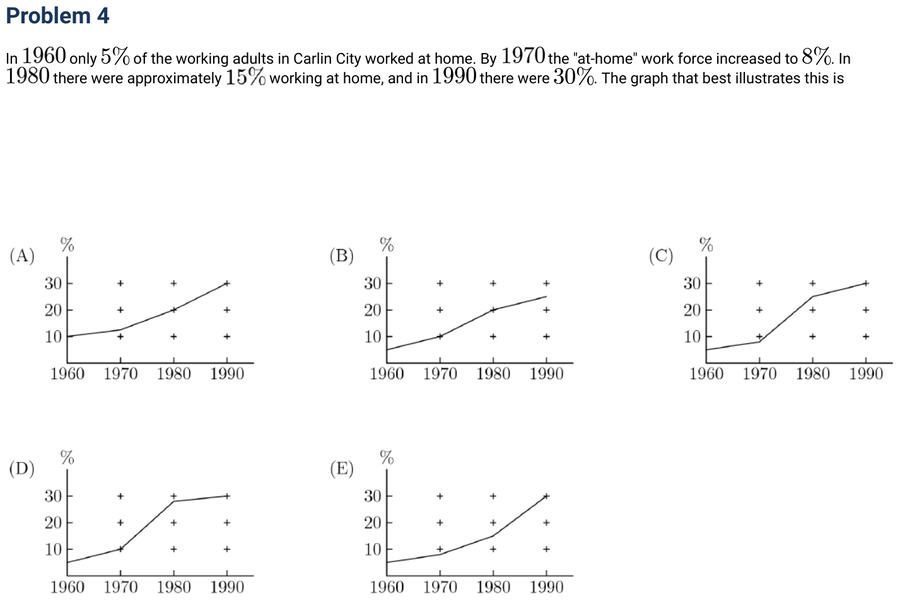
Don't just check that a graph goes up — look at HOW the jumps change: 5→8 is +3, but 8→15 is +7 and 15→30 is +15. Each step is bigger than the last.
Still stuck? Show hint 2 →
Hint 2 of 2
A rise whose jumps keep growing curves *upward* (concave up, accelerating) — not a straight line. Eliminate any graph that climbs steadily or levels off.
Show solution
Approach: read the shape of the change, not just the direction
List the decade jumps: 5→8 (+3), 8→15 (+7), 15→30 (+15). The increases roughly *double* each time, so the curve must get steeper and steeper.
Only graph E both passes through all four heights AND bends upward with that accelerating climb.
You'll see it again: in 'which graph fits' problems, the giveaway is usually the *pattern of change* (steepening, leveling, dipping) — a steady-slope line and an accelerating curve look different even when they share endpoints.
Which triplet of numbers has a sum NOT equal to 1?
Show answer
Answer: D — (1.1, −2.1, 1.0).
Show hints
Hint 1 of 2
The question wants the ODD one out, so you don't need every exact sum — scan for a triplet whose pieces pair up suspiciously. In D, the two positives 1.1 and 1.0 add to 2.1, the very number being subtracted.
Still stuck? Show hint 2 →
Hint 2 of 2
Look for cancellation before you add: matching a positive and a negative that erase each other tells you the answer faster than full arithmetic.
Show solution
Approach: hunt for the cancellation instead of adding all five
Glance for pieces that cancel. In D, 1.1 + 1.0 = 2.1, exactly the amount subtracted, so 1.1 − 2.1 + 1.0 = 0 — not 1.
A quick check confirms the rest land on 1 (½ + ⅓ + ⅙ = 1, 2 − 2 + 1 = 1, .1 + .3 + .6 = 1, −1.5 − 2.5 + 5 = 1).
The odd one out is (1.1, −2.1, 1.0). Why this transfers: on "which is different" problems, scan for the special structure (a perfect cancellation) before grinding every option — the outlier usually announces itself.
A big fraction-over-a-fraction is just a division: (top) ÷ (bottom). Notice the two pieces on top already share the same denominator, so adding them is a freebie.
Still stuck? Show hint 2 →
Hint 2 of 2
Dividing by a fraction means flipping it and multiplying. Watch for the same fraction showing up twice.
Show solution
Approach: the bar means divide; flipping turns it into a square
The top adds easily because the bottoms match: 3/8 + 7/8 = 10/8 = 5/4.
The big bar means divide by 4/5, and dividing by a fraction means flip-and-multiply: (5/4) ÷ (4/5) = (5/4) × (5/4).
That's the same fraction times itself: (5/4)² = 25/16.
Why this transfers: a fraction stacked over a fraction is always a division in disguise — rewrite it as ÷, then flip the bottom. And a sanity check: 5/4 is a bit over 1, so its square should be a bit over 1; 25/16 ≈ 1.56 fits.
Look at the denominators: 10, 100, 1000, 10000. Each fraction lives one place deeper in the decimal — the numerators are about to become the digits themselves.
Still stuck? Show hint 2 →
Hint 2 of 2
Powers-of-ten denominators ARE the decimal places: a number over 10ⁿ just drops its numerator into the nth decimal slot.
Show solution
Approach: read the digits straight off the place values
Each denominator is a power of ten, so each numerator simply lands in its own decimal slot: 1/10 = 0.1 (tenths), 9/100 = 0.09 (hundredths), 9/1000 = 0.009 (thousandths), 7/10000 = 0.0007 (ten-thousandths).
No carrying is needed because the digits never collide — they just stack into the answer: 0.1997.
You'll see it again: any sum of numerators over 10, 100, 1000, … is really place-value in disguise. Reading the digits off beats long division.
Don't judge by how many digits a decimal has — 0.9709 is not bigger just because it's longer. Compare left to right, one place at a time.
Still stuck? Show hint 2 →
Hint 2 of 2
Decimals compare like a race: the first place where they differ decides the winner, and everything after that is irrelevant.
Show solution
Approach: left-to-right place comparison
Tenths first: all five start 0.9…, a tie. Move right.
Hundredths: 0.97, 0.979, 0.9709 all have a 7, but 0.907 has 0 and 0.9089 has 0 — those two are knocked out, even though 0.9089 has lots of digits.
Thousandths decides the survivors: 0.979 has a 9 while 0.97 and 0.9709 have 0, so 0.979 wins.
Why this transfers: extra trailing digits never make a decimal bigger — only an earlier place can. 0.97 = 0.9700, which already beats 0.9709? No: 0.9700 vs 0.9709 ties through hundredths, then 0 vs 0 in thousandths, then 0 vs 9 — so 0.9709 > 0.97. The first difference rules.
Walter has exactly one penny, one nickel, one dime, and one quarter in his pocket. What percent of one dollar is in his pocket?
Show answer
Answer: D — 41%.
Show hints
Hint 1 of 2
A dollar IS 100 cents — so cents and 'percent of a dollar' are the very same number.
Still stuck? Show hint 2 →
Hint 2 of 2
That means you don't need a percent calculation at all: just total the coins in cents.
Show solution
Approach: read cents directly as percent (a dollar = 100 cents)
The trick: 'percent' means 'out of 100,' and a dollar is exactly 100 cents. So however many cents you have IS the percent of a dollar — no division needed.
Total the coins: 1 + 5 + 10 + 25 = 41 cents, which is 41% of a dollar.
You'll see it again: any time the whole is 100 (100 cents, 100 students, a 100-point test), counts and percents are the same number.
You can't compare fractions by eye when the bottoms are all different — first give them a shared yardstick.
Still stuck? Show hint 2 →
Hint 2 of 2
Rewrite every fraction over one common denominator (24 fits all of them). Once the bottoms match, the fraction with the biggest top wins.
Show solution
Approach: compare over a common denominator
All five bottoms (3, 4, 8, 12, 24) divide 24, so 24 is the natural common yardstick. Rewrite each: 1/3 = 8/24, 1/4 = 6/24, 3/8 = 9/24, 5/12 = 10/24, 7/24 = 7/24.
Now the bottoms all match, so just read off the biggest top: 10 wins, so 5/12 is largest.
Why this works: a fraction's size is 'how many pieces' (top) of 'a fixed piece-size' (bottom). Only when the piece-size is the same can you compare by counting pieces. You'll reuse this every time you add, subtract, or order fractions.
Another way — compare each to a benchmark:
Notice 1/3, 1/4, 7/24 are all below 1/3 ≈ 0.33, while 3/8 = 0.375 and 5/12 ≈ 0.417 are bigger.
Between the two big ones, 5/12 > 3/8 (10/24 vs 9/24), so 5/12 is largest — no full common denominator needed if you only care about the top contenders.
Every fraction already shares the bottom 10 — so don't fight the fractions, just collect all the tops into one big numerator.
Still stuck? Show hint 2 →
Hint 2 of 2
Pair the small numerators to add fast: 1+2+…+9 is four pairs of 10 plus the leftover 5 = 45. (This pairing trick is how you sum any run of counting numbers.)
Show solution
Approach: add numerators over the common 10
The bottoms are all 10, so the whole thing is one fraction: (1+2+3+…+9+55)/10.
Add the tops smartly: 1+2+…+9 pairs up as (1+9)+(2+8)+(3+7)+(4+6)+5 = 45. Then 45 + 55 = 100.
So the sum is 100/10 = 10. Sanity check: 55/10 alone is 5.5, and the other nine terms average about 0.5 each (≈4.5 total), landing right at 10.
When the fraction 4984 is expressed in simplest form, the sum of the numerator and the denominator will be
Show answer
Answer: C — 19.
Show hints
Hint 1 of 2
The numerator 49 is 7×7, and that's the clue — does 7 also divide 84? If so the fraction isn't in lowest terms yet.
Still stuck? Show hint 2 →
Hint 2 of 2
'Simplest form' means top and bottom share no common factor. Cancel the shared 7, THEN add — never add before reducing, or you'd get 49+84=133 (a trap answer).
Show solution
Approach: reduce first, then add
49 = 7×7, and 84 = 7×12, so they share a factor of 7. Divide both by 7: 49/84 = 7/12. Now 7 and 12 share nothing, so it's in simplest form.
7 + 12 = 19.
Trap to dodge: the question asks for the sum after simplifying. Adding the original 49+84 gives 133 (choice E) — that's the bait for anyone who skips the reduce step.
5/4 is one whole plus a quarter. Which choices are secretly just a quarter dressed up — and which one hides a different-sized piece?
Still stuck? Show hint 2 →
Hint 2 of 3
When choices look different but might be equal, convert them all to ONE common form (a decimal, or a fraction over the same bottom number) so they line up for comparison.
Still stuck? Show hint 3 →
Hint 3 of 3
A bigger denominator means a smaller slice: 1/5 is less than 1/4, so don't be fooled into reading 1 1/5 as 1.25.
Show solution
Approach: rewrite every choice in one common form so the odd one out stands out
5/4 = 1 + 1/4 = 1.25. Now test each: 10/8 = 1.25 (just doubled top and bottom); 1 1/4 = 1.25; 1 3/12 = 1 + 1/4 = 1.25 (3/12 reduces to 1/4); 1 10/40 = 1 + 1/4 = 1.25 (10/40 reduces to 1/4).
That leaves 1 1/5. Since 1/5 = 0.2, this is 1.2, NOT 1.25 — so 1 1/5 is the one not equal.
Trap to remember: a fifth feels "close" to a quarter, but cutting something into 5 pieces gives smaller pieces than cutting into 4. The trickster choice swaps the denominator from 4 to 5 hoping you won't notice the slice shrank.
Which digit of .12345, when changed to 9, gives the largest number?
Show answer
Answer: A — the 1.
Show hints
Hint 1 of 2
You only get to bump ONE digit up to 9. Where would that extra jump add the most — near the front of the decimal, or near the back?
Still stuck? Show hint 2 →
Hint 2 of 2
The leftmost decimal digit is the tenths place, worth the most. The same place-value idea as making big/small numbers: changes near the front matter most.
Show solution
Approach: spend your one change on the most valuable place
Reading left to right, the places shrink fast: tenths, hundredths, thousandths… A digit's *position* decides how much changing it helps, not the digit itself.
The leftmost digit (the 1) sits in the tenths place — the most valuable spot. Bumping it to 9 turns .12345 into .92345, a jump of 0.8.
Changing any digit further right adds far less (the 2 only buys 0.07). So change the 1.
*Sanity check:* .92345 clearly beats .19345, .12945, etc. — the leading digit dominates, exactly like why 9xxx beats x9xx in whole numbers.
Look at the denominators 10, 100, 1000 — those ARE the names of the decimal places. What do tenths, hundredths, thousandths look like written out?
Still stuck? Show hint 2 →
Hint 2 of 3
A fraction over a power of ten is already a decimal: the bottom tells you which column the top digit lives in.
Still stuck? Show hint 3 →
Hint 3 of 3
The digits 2, 4, 6 land in three different columns, so nothing collides — no adding needed.
Show solution
Approach: read each denominator as a decimal place
The denominator names the column: /10 is the tenths place, /100 the hundredths, /1000 the thousandths. So 2/10 puts a 2 in the tenths column, 4/100 a 4 in the hundredths, 6/1000 a 6 in the thousandths.
Because each digit sits in a separate column, you just write them in order: .246 — no carrying, no lining up.
Trap to avoid: the off-answer .0246 comes from shoving all three digits one column too far right. Anchor on 2/10 = 0.2 (a 2 right after the point) and the rest follows.
Every choice starts with .9, so the tenths place is a tie. Where do the numbers first disagree?
Still stuck? Show hint 2 →
Hint 2 of 3
Compare decimals column by column from the left, like comparing words in a dictionary — the first place they differ decides it. Length does NOT decide it.
Still stuck? Show hint 3 →
Hint 3 of 3
Look at the hundredths place (second digit after the point): which choice has the biggest digit there?
Show solution
Approach: compare left-to-right, first difference wins
All five share .9 in the tenths place, so that round is a tie. Move to the next column — the hundredths. There .99 shows a 9 while every other choice shows a 0.
A bigger digit in the first column that differs settles it immediately, so .99 is largest.
Trap to avoid: more digits does NOT mean bigger. .9099 looks long but .9 then 0 makes it smaller than .99 right at the hundredths column. Lining the decimal points up vertically makes this obvious.
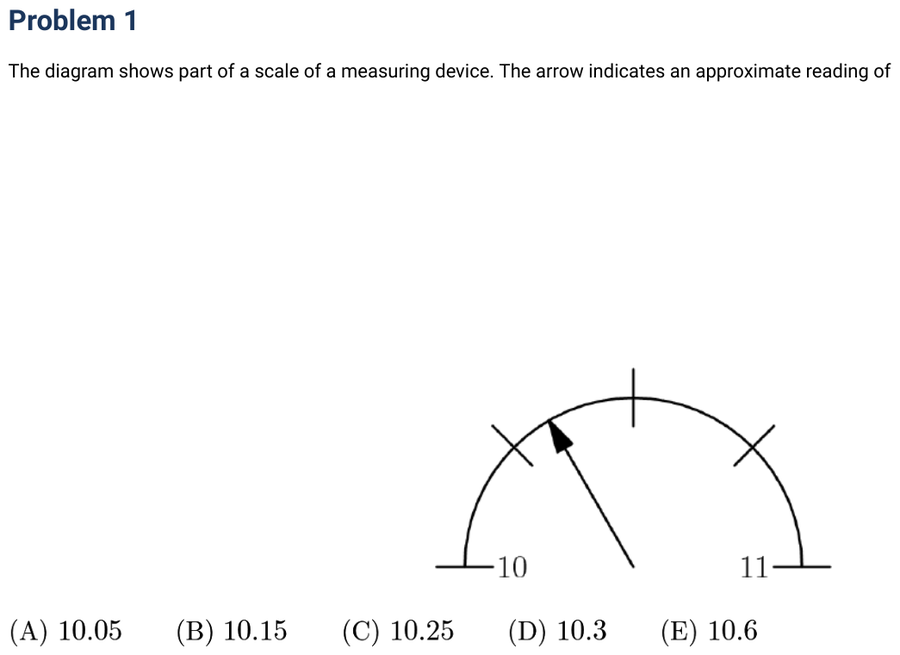
The arrow falls between the 10 and 11 marks — so the reading is 10-point-something. Where in the gap does the tip land?
Still stuck? Show hint 2 →
Hint 2 of 2
Reading a scale means judging what fraction of one gap you're into. The tip looks about a quarter of the way from 10 to 11.
Show solution
Approach: read the fraction of one gap
The arrow tip sits between 10 and 11, about one-fourth of the way along that gap. The whole answer is 10 plus that fraction.
One gap = 1 unit, so a quarter of it = 0.25, giving 10 + 0.25 = 10.25.
Why this transfers: every analog scale — rulers, thermometers, dials — is read the same way. Lock onto the two marks the pointer is between, then estimate the fraction of that single gap; never guess against the whole scale at once.
Don't multiply left to right. Those decimals are familiar fractions in disguise — 0.25 = 1⁄4 and 0.125 = 1⁄8. Which factor would 'undo' each one?
Still stuck? Show hint 2 →
Hint 2 of 2
Multiplication can be reordered freely, so hunt for pairs that make a whole number: 8 cancels the eighth, 2 fits the quarter.
Show solution
Approach: reorder to make canceling pairs
0.125 = 1⁄8 and 0.25 = 1⁄4, so pair each big number with the fraction it cancels: (8 × 0.125) × (2 × 0.25) = 1 × 0.5.
Product = 1⁄2.
Why this transfers: because order and grouping don't change a product, scan a long multiplication for factors that pair into 1, 10, or 100 first. Pairing beats grinding through ugly decimals one at a time.
Before reaching for a common denominator, look at each fraction on its own. What does 2⁄20 reduce to? And 3⁄30?
Still stuck? Show hint 2 →
Hint 2 of 2
In every fraction here the bottom is exactly ten times the top — so each one is secretly the same value.
Show solution
Approach: simplify each term first, then add
Each fraction has a bottom that's 10× its top, so each one equals 1⁄10: 2⁄20 = 1⁄10 and 3⁄30 = 1⁄10.
The sum is just 1⁄10 + 1⁄10 + 1⁄10 = 3⁄10 = 0.3.
Why this transfers: always simplify each fraction before adding. Reducing first can collapse a scary-looking sum into identical pieces, dodging the messy common-denominator step entirely.
Each number already lives in a different place: 4 in the tenths, 2 in the hundredths, 6 in the thousandths. What happens when no two of them share a column?
Still stuck? Show hint 2 →
Hint 2 of 2
When addends don't overlap in any place value, the digits just slot in next to each other — no carrying.
Show solution
Approach: drop each digit into its own place
.4 fills the tenths place, .02 the hundredths, .006 the thousandths — three different columns, so nothing overlaps and nothing carries.
Read them off in order: .426.
Sanity-check the traps: .066 comes from misaligning the decimal points, and .012 from ignoring them entirely. Lining up the points is the whole game.
Decimals are just fractions whose denominator is 10, 100, 1000… Can you nudge the 25 into one of those?
Still stuck? Show hint 2 →
Hint 2 of 2
25 × 4 = 100, and a denominator of 100 means you can read the answer straight off as hundredths.
Show solution
Approach: scale the denominator to a power of 10
A denominator of 25 isn't a power of ten, but 25 × 4 = 100 is. Multiply top and bottom by 4: 2⁄25 = 8⁄100.
8⁄100 is just 8 hundredths = 0.08.
Why this transfers: any fraction whose denominator divides a power of 10 (denominators built only from 2s and 5s) becomes an exact decimal this way — 7⁄20 → 35⁄100 = 0.35, 3⁄8 → 375⁄1000 = 0.375.
Another way — long division:
Divide 2 ÷ 25 directly: 25 goes into 20 zero times, into 200 eight times exactly.
Result 0.08 — same answer, but scaling to 100 skips the work.
Which of the following numbers has the largest reciprocal?
Show answer
Answer: A — 1⁄3.
Show hints
Hint 1 of 2
Picture cutting a pizza: dividing 1 into *more* pieces (a bigger number on the bottom) makes each piece *smaller*. So which number gives the biggest reciprocal?
Still stuck? Show hint 2 →
Hint 2 of 2
Reciprocal flips a number over 1, and flipping reverses the order: the smallest positive number has the largest reciprocal.
Show solution
Approach: flipping reverses size order
The reciprocal of a positive number is 1 over it. Taking 1-over reverses the size order — the *smallest* number turns into the *largest* reciprocal. So you never have to compute a single reciprocal; just find the smallest number.
The smallest of the choices is 1⁄3; its reciprocal is 3, larger than the reciprocals of 1, 5, and 1986 (which are all 1 or less).
Why this transfers: whenever you flip a list of positive numbers, biggest and smallest swap places — handy for spotting the answer without arithmetic.
Before multiplying anything out, scan the WHOLE expression as one big fraction: list every factor on top and every factor on the bottom. Notice anything?
Still stuck? Show hint 2 →
Hint 2 of 2
When every factor upstairs is matched by an identical factor downstairs, the product is forced to be 1 — you never need the actual numbers. This is the cancel-matching-factors habit: rearrange into one fraction first, then strike pairs.
Show solution
Approach: cancel matching factors
Write it as one fraction: the top has 3, 5, 7, 9, 11 and the bottom has 9, 11, 3, 5, 7 — the SAME five numbers. Every factor on top is matched by a copy on the bottom.
Matched pairs each make 1, so the whole product collapses to 1.
Why this transfers: whenever a product of fractions has identical numerators and denominators (just shuffled), the answer is 1 — spotting the matching set beats computing 945 ÷ 945.
Don't divide the messy numbers head-on. Split the bottom: handle the 10⁴ against the 10⁷ separately from the 5. Dividing powers of 10 just means cancelling matching zeros.
Still stuck? Show hint 2 →
Hint 2 of 2
Powers of ten divide by subtracting exponents: 10⁷ ⁄ 10⁴ = 10⁷⁻⁴ = 10³. Peel off the 10s first, deal with the small factor (the 5) last.
Show solution
Approach: subtract powers, then divide
Group the tens: 10⁷ ⁄ 10⁴ = 10³ = 1000 (seven zeros over four zeros leaves three). Now just 1000 ÷ 5.
1000 ÷ 5 = 200.
Sanity check: the answer should be a clean number with a few zeros, which immediately rules out the decimal choices (.002, .2) — peeling the powers of 10 first tells you the size before you ever divide.
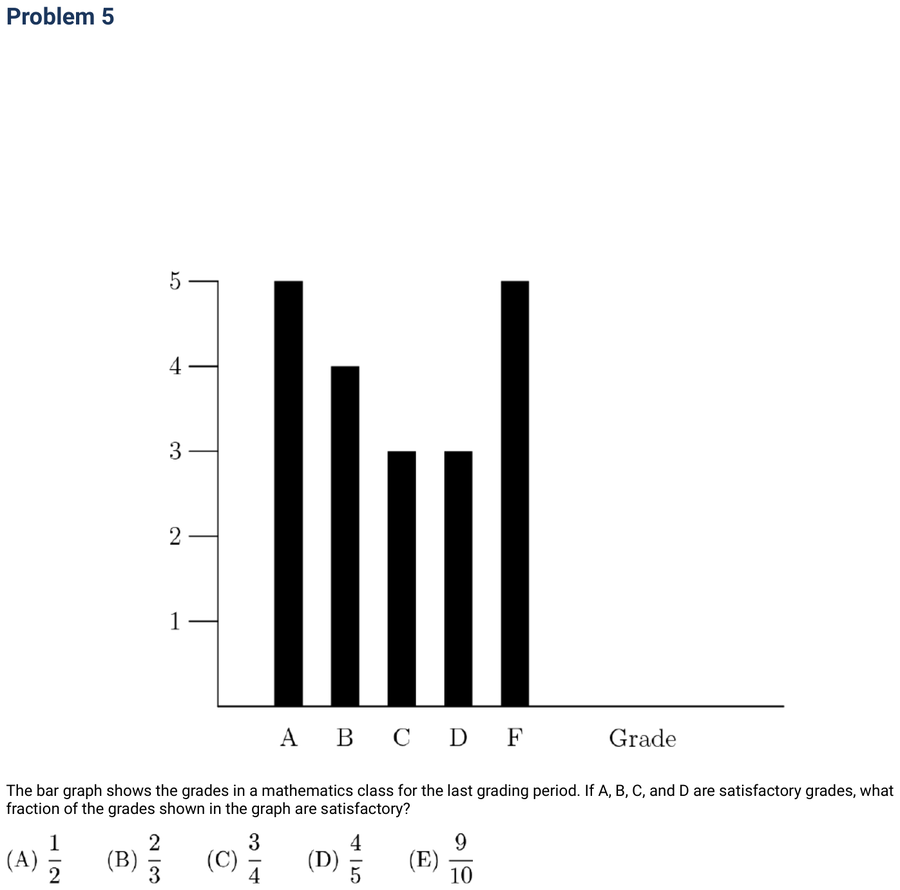
A fraction needs a top AND a bottom. The top is the satisfactory grades (A, B, C, D). The bottom is EVERY grade in the class — and the F bar still counts toward that total even though it isn't satisfactory.
Still stuck? Show hint 2 →
Hint 2 of 2
Read each bar's height off the axis, total them for the denominator, total just the satisfactory ones for the numerator, then simplify. The classic trap is leaving the F's out of the bottom.
Show solution
Approach: satisfactory ÷ total
Read the bar heights: A = 5, B = 4, C = 3, D = 3, F = 5. Satisfactory (A+B+C+D) = 5 + 4 + 3 + 3 = 15.
The whole class is the total of ALL bars including F: 15 + 5 = 20.
Fraction = 15 ⁄ 20 = 3⁄4.
Spot the trap: if you forget the 5 F's, you'd get 15⁄15 = 1, which isn't even an option — the unsatisfactory grades belong in the denominator, just not the numerator.
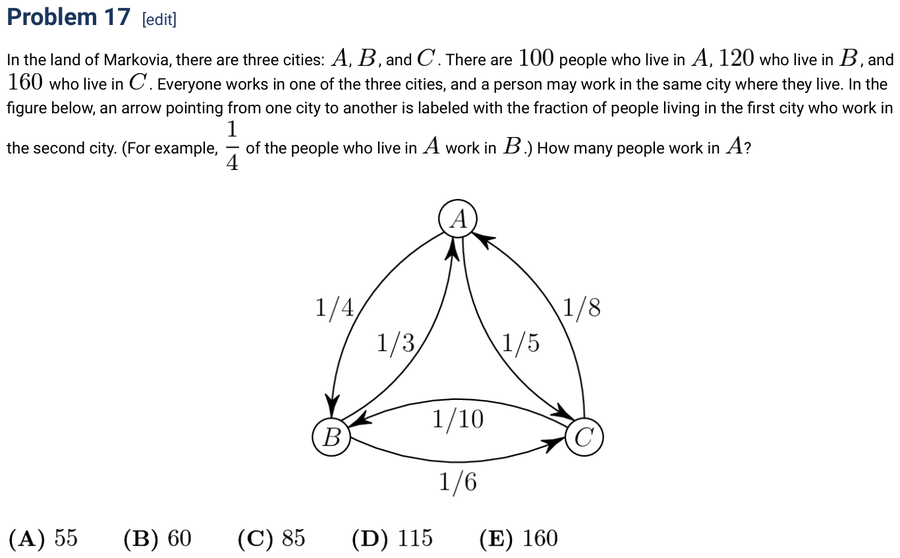
Sort people by where they work, not where they live. Workers in A arrive from three places: stayers in A, commuters from B, commuters from C. Add those three.
Still stuck? Show hint 2 →
Hint 2 of 2
The sneaky one is A→A: there's no arrow for "stays in A," so count it the easy way — everyone in A minus those who leave for B or C. The other two are just fraction × population.
Show solution
Approach: group by workplace; count the stayers by subtraction
Reorganize people by workplace. Workers in A come from three home cities, so add the three streams — and for the A→A stream, there's no "stays" arrow, so use complementary counting: everyone in A minus those who commute out.
Why this transfers: in flow problems, choose to count by the destination, and fill any missing "stay put" category by subtracting the ones who leave from the whole — the leftover-fractions always sum to 1.
Jordan owns 15 pairs of sneakers. Three fifths of the pairs are red and the rest are white. Two thirds of the pairs are high-top and the rest are low-top. The red high-top sneakers make up a fraction of the collection. What is the least possible value of this fraction?
Show answer
Answer: C — 4/15.
Show hints
Hint 1 of 2
There are a FIXED 10 high-tops. To make as few of them red as possible, give as many high-tops as you can to the white pairs instead — crowd red out.
Still stuck? Show hint 2 →
Hint 2 of 2
Technique (minimize an overlap by pushing to the extreme): 9 red, 6 white; 10 high-top, 5 low-top. Whites can absorb at most 6 high-tops, so red is forced to take whatever high-tops are left.
Show solution
Approach: push white pairs into high-top to crowd out red
First nail the four counts. Red = 35×15 = 9, white = 6; high-top = 23×15 = 10, low-top = 5. The total of 10 high-tops is fixed; we only choose WHO gets them.
To minimize red high-tops, hand high-tops to white first. There are only 6 white pairs, so at most 6 high-tops can be white — do exactly that.
That leaves 10 − 6 = 4 high-top spots with nowhere to go but red. So the smallest red-high-top fraction is 415. This transfers: to minimize the overlap of two groups, shove the limited "other" group as full as it goes — the forced leftover is your minimum (it's the same logic as the Pigeonhole/inclusion bound).
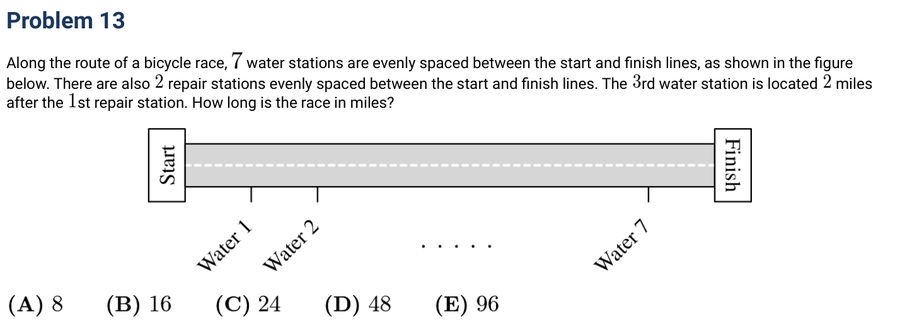
Forget miles for a moment — locate each station as a fraction of the whole route. The watch-out: stations sit between start and finish, so 2 stations make 3 equal gaps (not 2).
Still stuck? Show hint 2 →
Hint 2 of 2
2 repair stations → route split into thirds, so the 1st repair is at 1/3. 7 water stations → eighths, so the 3rd water is at 3/8. The gap between those positions is the given 2 miles.
Show solution
Approach: convert station positions to fractions of the route
Pin each station as a fraction of the route. The key (and the trap): n stations spaced between start and finish cut it into n+1 equal pieces. So 2 repair stations → thirds (1st repair at L/3) and 7 water stations → eighths (3rd water at 3L/8).
The 3rd water is 2 miles past the 1st repair, so 3L/8 − L/3 = 2.
Combine over 24: (9L − 8L)/24 = L/24 = 2, so L = 48 miles. Worth keeping: ‘k things evenly spaced between two ends’ always means k+1 gaps — the classic fencepost catch.
Another way — spacing variables (MAA):
Let w be the gap between water stations and r the gap between repair stations. The whole route is 8w = 3r.
The 3rd water (at 3w) is 2 past the 1st repair (at r): 3w = r + 2. Sub r = 3w − 2 into 8w = 3r: 8w = 9w − 6, so w = 6.
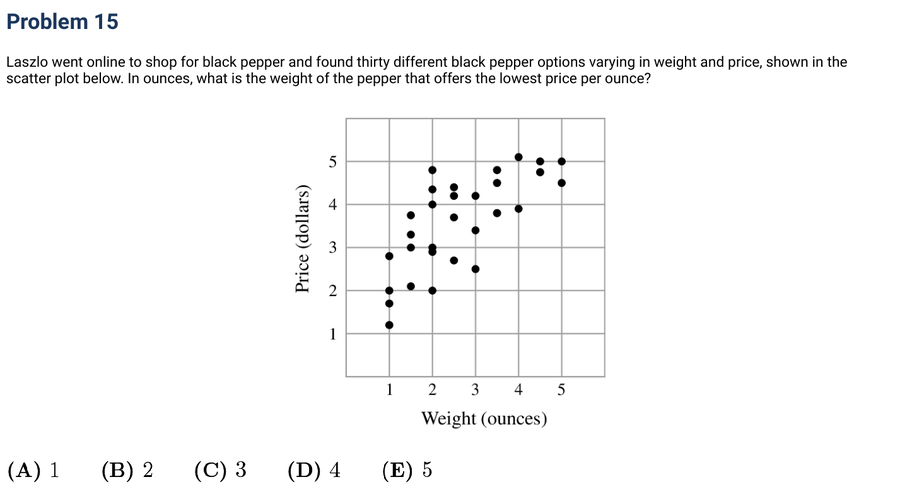
You want the cheapest per ounce, not the cheapest sticker price. So at each weight only the lowest dot can possibly win — ignore every dot above it.
Still stuck? Show hint 2 →
Hint 2 of 2
Price ÷ weight is the slope of the line from the origin to a dot — flatter line = better deal. So find the dot you could draw the most gently-sloped line to. Then check just the five lowest dots by dividing.
Show solution
Approach: only the lowest dot per weight matters; smallest price÷weight wins
Insight: a higher dot at the same weight is strictly worse, so for each weight keep only the lowest dot — that trims 30 points down to 5 candidates.
Now compare price ÷ weight for those 5. Reading the plot: 1 oz ≈ $1.25 → 1.25; 2 oz ≈ $2 → 1.00; 3 oz ≈ $2.5 → ≈0.83; 4 oz ≈ $3.9 → ≈0.97; 5 oz ≈ $4.5 → ≈0.90.
The 3-ounce option is cheapest per ounce (≈$0.83/oz). Answer: 3 ounces.
You'll see this again: price-per-ounce is the slope of the line from the origin to a dot — the best deal is the dot you can reach with the flattest such line, which you can often spot by eye before dividing.
Jamal has a drawer containing 6 green socks, 18 purple socks, and 12 orange socks. After adding more purple socks, Jamal noticed that there is now a 60% chance that a sock randomly selected from the drawer is purple. How many purple socks did Jamal add?
Show answer
Answer: B — 9 purple socks added.
Show hints
Hint 1 of 2
Adding purple socks changes the purple count and the total — two moving numbers. Look for what doesn't move: the green and orange socks. Anchor everything to them.
Still stuck? Show hint 2 →
Hint 2 of 2
The 6 + 12 = 18 non-purple socks never change. If purple is now 60%, then those 18 are exactly the other 40%. That one fact gives the new total directly.
Show solution
Approach: anchor to the part that never changes (non-purple = 40%)
Only purple socks are added, so the 6 green + 12 orange = 18 non-purple socks stay fixed. After the change, purple is 60%, so the unchanged 18 must be the remaining 40%.
New total = 18 ÷ 0.4 = 45 socks. He started with 36, so he added 45 − 36 = 9 purple socks.
Why this transfers: when one group grows and you're given the other group's percentage, pin your work to the unchanging group. “18 socks = 40%” pins the whole down in one step — far lighter than introducing a variable and cross-multiplying.
Another way — set up the new probability and solve (MAA):
If s purple are added, (18 + s) / (36 + s) = 0.6.
Cross-multiply: 18 + s = 21.6 + 0.6s, so 0.4s = 3.6 and s = 9.
Suppose 15% of x equals 20% of y. What percentage of x is y?
Show answer
Answer: C — 75%.
Show hints
Hint 1 of 2
“What percent of x is y?” is asking for y ÷ x. So your goal is to get y alone in terms of x — watch the direction so you don't flip them.
Still stuck? Show hint 2 →
Hint 2 of 2
Turn the percents into decimals: 0.15x = 0.20y. Solving for y gives y as a multiple of x, and that multiple is the answer.
Show solution
Approach: rearrange to y = (something) × x
“What percent of x is y?” means find y ÷ x — so isolate y in terms of x.
0.15x = 0.20y ⇒ y = 0.150.20x = 0.75x, so y is 75% of x.
Watch the direction: the question fixes x as the base (“percent ofx”), so the answer is y/x. Flipping it would give 133⅓%, which is the trap choice. Always reread which quantity is the ‘of’.
Another way — pick a concrete number:
Let 15% of x = 20% of y = 60 (any shared value works). Then x = 60 ÷ 0.15 = 400 and y = 60 ÷ 0.20 = 300.
y as a percent of x: 300/400 = 75%. Plugging in real numbers makes ‘percent of which one’ impossible to flip by accident.
98 factors is a signal: this is meant to collapse, not be multiplied out. Each fraction is k(k+2) over (k+1)2 — numbers one apart, top and bottom — which begs to be split so neighbors cancel.
Still stuck? Show hint 2 →
Hint 2 of 2
Each factor k(k+2)(k+1)(k+1) breaks into kk+1 × k+2k+1; collect all the first pieces in one chain and all the second pieces in another.
Show solution
Approach: split each factor into two telescoping chains
Every factor is k(k+2)(k+1)(k+1) = kk+1 × k+2k+1, for k = 1 to 98.
Chain 1 (the kk+1 pieces): 12 × 23 × … × 9899. Each top cancels the next bottom, leaving 199.
Chain 2 (the k+2k+1 pieces): 32 × 43 × … × 10099, which cancels down to 1002 = 50.
Multiply the two leftovers: 199 × 50 = 5099.
Why this transfers: a long product or sum that looks hopeless is usually telescoping — each piece cancels part of its neighbor. Factor every term into simple pieces, line them up, and almost everything collapses, leaving just the two ends.
Chloe and Zoe are both students in Ms. Demeanor's math class. Last night they each solved half of the problems in their homework assignment alone and then solved the other half together. Chloe had correct answers to only 80% of the problems she solved alone, but overall 88% of her answers were correct. Zoe had correct answers to 90% of the problems she solved alone. What was Zoe's overall percentage of correct answers?
Show answer
Answer: C — 93%.
Show hints
Hint 1 of 2
The hidden link is the 'together' half — the girls worked it side by side, so they got the same questions right there. Chloe's data secretly tells you that shared score, which is the missing piece for Zoe.
Still stuck? Show hint 2 →
Hint 2 of 2
Pick a friendly total of 100 problems (50 alone + 50 together). Percentages with no given count are free to scale, so choose the number that makes the arithmetic clean.
Show solution
Approach: pick 100 problems, then mine Chloe's data for the shared half
Let there be 100 problems: 50 alone + 50 together. (No count was given, so we're free to choose the convenient one — the percentages won't change.)
Chloe alone: 80% of 50 = 40 correct. Chloe overall: 88 of 100. So her together-score = 88 − 40 = 48 of 50. And that 48 is shared — it's also Zoe's together-score.
Zoe alone: 90% of 50 = 45 correct. Zoe total = 45 + 48 = 93 of 100 = 93%.
Why this transfers: when two people share part of a task, that shared part is one number you can solve for from either person and then reuse for the other.
Jefferson Middle School has the same number of boys and girls. 34 of the girls and 23 of the boys went on a field trip. What fraction of the students on the field trip were girls?
Show answer
Answer: B — 9/17.
Show hints
Hint 1 of 2
No actual count of students is given — so pick a convenient one. Since the fractions are fourths and thirds, imagine 12 girls and 12 boys (12 makes both fractions come out as whole people), then literally count who goes.
Still stuck? Show hint 2 →
Hint 2 of 2
Out of 12 girls, 3/4 go = 9 girls; out of 12 boys, 2/3 go = 8 boys. Now the answer is just (girls on trip) over (everyone on trip).
Show solution
Approach: pick a friendly common size and count actual heads
Equal numbers of boys and girls, so let there be 12 of each (12 is divisible by both 4 and 3, so no fractional people).
Girls on the trip: 3/4 of 12 = 9. Boys on the trip: 2/3 of 12 = 8. Trip total = 9 + 8 = 17.
Fraction that are girls = 9/17 = 9/17.
Sanity check: more than half the trip is girls (9 of 17), which fits — the girls' fraction 3/4 beats the boys' 2/3, so girls should be the majority. That alone rules out the 1/2 and below choices.
Why this transfers: when a problem gives only fractions/percents and no totals, invent a total that clears every denominator (here, 12) — counting real objects beats juggling abstract fractions.
Another way — compare via a common denominator (no chosen number):
With equal group sizes, line up the trip fractions over a common denominator: 3/4 = 9/12 and 2/3 = 8/12.
So girls : boys on the trip = 9 : 8, and the fraction of girls is 9 / (9 + 8) = 9/17.
A merchant offers a large group of items at 30% off. Later, the merchant takes 20% off these sale prices and claims that the final price of these items is 50% off the original price. The total discount is
Show answer
Answer: B — 44%.
Show hints
Hint 1 of 2
The merchant's "30 + 20 = 50% off" is the trap. The second discount comes off the *already-shrunk* price, not the original — so the cuts compound, they don't add.
Still stuck? Show hint 2 →
Hint 2 of 2
Flip from "how much off" to "how much you still pay." After 30% off you pay 0.70; the next 20% off leaves 0.80 *of that*. Chain the survivors by multiplying.
Show solution
Approach: multiply the fractions of price still paid
Track what *survives* each cut, not what's removed. 30% off leaves you paying 0.70 of the original; another 20% off leaves 0.80 of *that*.
Multiply the survivors: 0.70 × 0.80 = 0.56. You pay 56%, so the real discount is 100% − 56% = 44% — less than the claimed 50%.
*Why this transfers:* successive percent changes *multiply* their keep-factors; they never add. The second 20% is only 20% of the smaller 70%, which is why two discounts always total *less* than their sum.
Another way — add the pieces removed:
First cut removes 30%, leaving 70%. The second cut removes 20% of that 70%, i.e. 0.20 × 70% = 14%.
Of the 36 students in Richelle's class, 12 prefer chocolate pie, 8 prefer apple, and 6 prefer blueberry. Half of the remaining students prefer cherry pie and half prefer lemon. For Richelle's pie graph showing this data, how many degrees should she use for cherry pie?
Show answer
Answer: D — 50 degrees.
Show hints
Hint 1 of 2
A pie slice's angle is just that group's share of the full circle — students and degrees rise together in lockstep.
Still stuck? Show hint 2 →
Hint 2 of 2
With 36 students splitting 360°, each student is worth 360 ÷ 36 = 10° — a clean conversion factor that turns the whole problem into easy counting.
Show solution
Approach: students → fraction of 360°
First find the cherry count. The leftover after the named pies is 36 − 12 − 8 − 6 = 10 students, and half of those pick cherry, so 5 students.
Set up the "per-student" rate once: 360° ÷ 36 students = 10° each. Cherry's 5 students take 5 × 10° = 50°.
The slick part is the 10°-per-student rate: with 36 students in 360°, the numbers are tailor-made to cancel. Whenever a count divides 360 evenly, find the degrees-per-item first and the rest is multiplication.
Another way — fraction of the whole circle:
Cherry is 5 of 36 students, a fraction 5/36 of the class.
Apply that same fraction to the full circle: (5/36) × 360° = 50°.
For the game show Who Wants To Be a Millionaire?, the dollar values of each question are shown in the following table (where K = 1000). Between which two questions is the percent increase of the value the smallest?
Question values (K = 1000)
Question
1
2
3
4
5
6
7
8
Value
100
200
300
500
1K
2K
4K
8K
Question
9
10
11
12
13
14
15
Value
16K
32K
64K
125K
250K
500K
1000K
Show answer
Answer: B — From 2 to 3.
Show hints
Hint 1 of 2
Don't compute every percent — scan the pattern. A value that doubles is exactly a +100% increase, and most steps in this table double.
Still stuck? Show hint 2 →
Hint 2 of 2
So you can throw out every doubling and only compare the few steps that grow by less than double: 2→3, 3→4, and 11→12.
Show solution
Approach: ignore the doublings, compare the exceptions
Recognize the pattern: doubling = +100%. Almost every step here doubles, so it can't be the smallest. Only three steps break the pattern: 2→3, 3→4, and 11→12 (and 11→12 is nearly a double, so it's large).
Smallest is from question 2 to 3 at 50%. The transferable insight: percent change compares the rise to the STARTING value, so spotting which steps grow proportionally least beats grinding every number.
Three bags of jelly beans contain 26, 28, and 30 beans. The fractions of yellow beans in the bags are 50%, 25%, and 20%, respectively. All three bags are poured into one bowl. Which of the following is closest to the percent of yellow beans in the bowl?
Show answer
Answer: A — About 31%.
Show hints
Hint 1 of 2
You can't just average 50%, 25%, 20% — the bags hold different amounts. Go back to actual beans: count the yellows, count the total, then take the overall ratio.
Still stuck? Show hint 2 →
Hint 2 of 2
A combined percentage is a weighted average: total of the parts ÷ total of the wholes, never the plain mean of the rates.
Show solution
Approach: real counts: yellow total over grand total
Convert each rate to a count, choosing the easy fraction: 50% of 26 = 13, 25% of 28 = 7, 20% of 30 = 6.
Yellow total = 13 + 7 + 6 = 26; bean total = 26 + 28 + 30 = 84. The bowl's ratio is 26/84 ≈ 30.9%, closest to 31%.
Trap: averaging the percentages, (50+25+20)/3 ≈ 31.7%, lands near the same answer here by luck — but that shortcut is wrong whenever the bag sizes differ much. Always weight by how many beans each bag has.
You'll see it again: mixing groups of different sizes always calls for a weighted average — sum the actual amounts, then divide.
Penni buys $100 of stock in each of three companies: AA, BB, and CC. After one year AA is up 20%, BB is down 25%, and CC is unchanged. In the second year AA drops 20% from its new value, BB rises 25% from its new value, and CC is unchanged. If A, B, C are the final values, which ordering is correct?
Show answer
Answer: E — B < A < C.
Show hints
Hint 1 of 2
The big trap: a 20% gain then a 20% loss does NOT bring you back to $100 — the loss is taken on a bigger amount. Picture each percent change as MULTIPLYING by a factor, and notice the factors don't undo each other.
Still stuck? Show hint 2 →
Hint 2 of 2
Turn every percent change into a multiplier (up 20% → ×1.2, down 25% → ×0.75) and multiply them. ×1.2 then ×0.8 = ×0.96, a net loss.
Show solution
Approach: convert each change to a multiplier and multiply
AA: ×1.2 then ×0.8 → overall ×0.96, so 100 → 96. The +20%/−20% pair lands BELOW the start because the 20% drop is off the higher $120.
BB: ×0.75 then ×1.25 → overall ×0.9375, so 100 → 93.75. CC: unchanged at 100.
Ordering the finals: 93.75 < 96 < 100, i.e. B < A < C.
Why this transfers: percent changes never simply cancel — a +x% then −x% always leaves you at ×(1 − x²) of the start, a small loss. Multipliers, not addition, govern stacked percents.
Last week small boxes of facial tissue were priced at 4 boxes for $5. This week they are on sale at 5 boxes for $4. The percent decrease in the price per box during the sale was closest to
Show answer
Answer: B — About 35%.
Show hints
Hint 1 of 2
'4 for $5' versus '5 for $4' looks like a tidy swap, but the percent change isn't 20%. Boil both down to the same fair unit — the price of ONE box — before comparing.
Still stuck? Show hint 2 →
Hint 2 of 2
Percent decrease = (drop ÷ ORIGINAL) × 100%. The original price is the denominator, not the new price — that's where this trap bites.
Show solution
Approach: reduce to per-box price, divide the drop by the original
Per box, old price = $5 ÷ 4 = $1.25; sale price = $4 ÷ 5 = $0.80.
Drop = $1.25 − $0.80 = $0.45. Percent decrease = $0.45 ÷ $1.25 = 0.36 = 36%, closest to 35%.
Trap: dividing the drop by the NEW price ($0.45 ÷ $0.80 ≈ 56%) is wrong — percent change always measures against where you started.
You'll see it again: to compare two 'X for $Y' deals, always collapse each to a single unit price first.
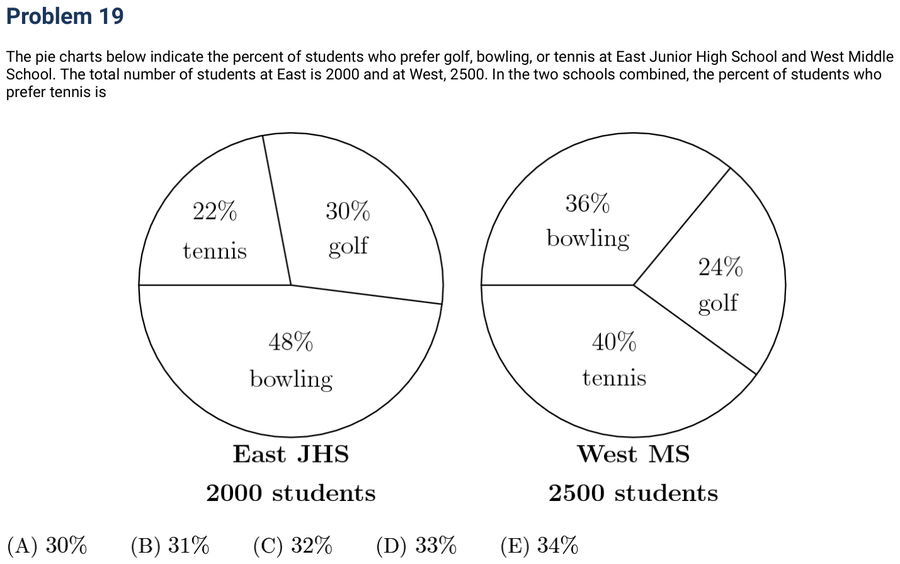
Big trap: you canNOT just average 22% and 40% to get 31% — the two schools have different sizes, so a percent at the bigger school counts for more. Turn the percents into actual HEADCOUNTS first.
Still stuck? Show hint 2 →
Hint 2 of 2
Count the real tennis fans at each school (a percent OF its own total), add them, then divide by everyone combined. This is a weighted average: the larger school pulls the result toward its percent.
Show solution
Approach: count heads, then divide by everyone
Convert to actual people: East has 22% of 2000 = 440 tennis fans, West has 40% of 2500 = 1000. Together that's 1440 tennis fans.
Divide by all students, 2000 + 2500 = 4500: 1440 ⁄ 4500 = 32%.
Notice 32% is NOT the plain average of 22% and 40% (which is 31%). It leans toward 40% because West is the bigger school — that's a weighted average at work.
Why this transfers: to combine percentages from groups of different sizes, never average the percents — turn each into a count, total the counts, and divide. Equal-size groups are the only time the shortcut average is correct.
A jacket and a shirt originally sold for 80 dollars and 40 dollars, respectively. During a sale Chris bought the 80-dollar jacket at a 40% discount and the 40-dollar shirt at a 55% discount. The total amount saved was what percent of the total of the original prices?
Show answer
Answer: A — 45%.
Show hints
Hint 1 of 2
The two discount percents (40% and 55%) are taken off DIFFERENT prices, so you can't just average them. Convert each to actual dollars saved first, then compare to the actual total.
Still stuck? Show hint 2 →
Hint 2 of 2
'What percent of the total' means: (dollars saved) ÷ (total original price), where the total is 80 + 40 = 120.
Show solution
Approach: convert percents to dollars, then one percent at the end
The trap here is averaging 40% and 55% to get 47½% — but those percents sit on different-sized prices, so they don't average. Switch to dollars, where amounts add cleanly.
Saved on the jacket: 40% of $80 = $32. Saved on the shirt: 55% of $40 = $22. Total saved = $54.
Original total = $80 + $40 = $120, so the saving is 54120 = 45%.
Why this transfers: percentages only add or average directly when they're on the same base. Different bases → turn into real quantities first, combine, then take one final percent.
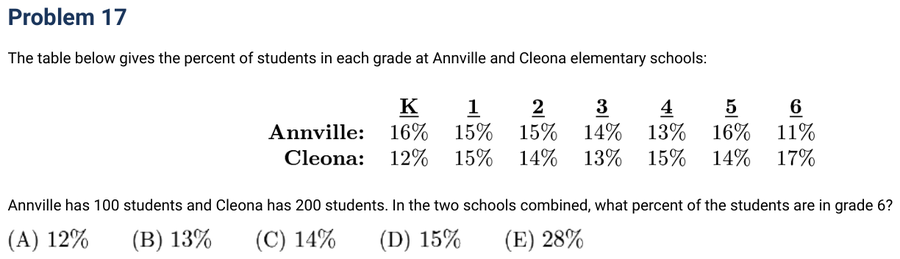
The two schools are different sizes, so you can't just average 11% and 17%. A percent of 100 students and a percent of 200 students mean different numbers of kids — convert to actual kids first.
Still stuck? Show hint 2 →
Hint 2 of 2
Turn each grade-6 percent into a head count, add the counts, then take that over the 300 total.
Show solution
Approach: convert to head counts (the schools have different sizes), then one combined percent
The trap is averaging 11% and 17% to get 14%. That's wrong because Cleona has twice as many students — its percentage should count double. So switch to real counts.
Grade 6 counts: Annville 11% of 100 = 11 kids; Cleona 17% of 200 = 34 kids. Together 45 kids.
Out of all 300 students that's 45300 = 15%.
Why this transfers: this is a weighted average — percentages can only be combined directly when the groups are the same size. Different sizes → count the actual items, then re-percent at the end. (Notice 15% leans toward Cleona's 17%, because Cleona is the bigger school.)
A shopper buys a 100-dollar coat on sale for 20% off. An additional 5 dollars are taken off the sale price by using a discount coupon. A sales tax of 8% is paid on the final selling price. The total amount the shopper pays for the coat is
Show answer
Answer: A — 81.00 dollars.
Show hints
Hint 1 of 2
Read the order the problem hands you: the price keeps changing, and tax only lands on the FINAL selling price — so finish all the price-cutting before tax touches anything.
Still stuck? Show hint 2 →
Hint 2 of 2
Handle each cut in its own form: a percent-off means 'multiply' (or take a fraction away), but the coupon is a flat dollar amount you just subtract. Don't blend them.
Show solution
Approach: discounts first, then tax
20% off $100: 20% of 100 is 20, so the sale price is $80.
Coupon: subtract a flat $5 → $75. This is the final selling price, so tax goes here.
Add 8% tax: 8% of 75 = 6, so total = 75 + 6 = $81.00. (Tip: adding 8% in one shot is ×1.08, but '8% of 75 = 6' is the lighter mental step.)
Trap to dodge: don't add the 8% tax onto the $80 before the coupon — tax is charged after every discount, and applying it early gives the wrong (bigger) total.
A stacked fraction like this can only be untangled from the innermost piece outward — you can't simplify the top until the bottom is a single number. Start at the deepest 2 + 1/3.
Still stuck? Show hint 2 →
Hint 2 of 2
Each layer is the same two-step move: add to make one fraction, then 'take 1 over it' (flip). Repeat that move as you climb out.
Show solution
Approach: peel the continued fraction from the inside out
Deepest layer: 2 + 1/3 = 7/3. The next layer is 1 ÷ (7/3) = 3/7 — 'one over a fraction' just flips it.
Climb out: 1 + 3/7 = 10/7. Then the outermost 1 ÷ (10/7) flips again to 7/10.
Why this transfers: every continued (stacked) fraction unwinds bottom-up with the same rhythm — combine into one fraction, then flip when it's '1 over' it. Reciprocals (flipping) are the engine; reading it top-down would dead-end.
If the length of a rectangle is increased by 20% and its width is increased by 50%, then the area is increased by
Show answer
Answer: D — 80%.
Show hints
Hint 1 of 2
Percents on area don't ADD — they MULTIPLY. Length and width each scale by their own factor, and area is length × width, so the two factors multiply together. (Adding 20%+50% to get 70% is the trap.)
Still stuck? Show hint 2 →
Hint 2 of 2
Turn each increase into a multiplier: +20% means ×1.2, +50% means ×1.5. Multiply those, then see how far above 1 the result lands.
Show solution
Approach: multiply the two scale factors
+20% on length is ×1.2; +50% on width is ×1.5. Since area = length × width, the new area is 1.2 × 1.5 = 1.8 times the old.
1.8 times means 0.8 more than the original — an increase of 80%.
No-algebra check: take a 10×10 = 100 rectangle. New sides 12 and 15 give 180 — up 80 out of 100, i.e. 80%. Trap to dodge: percentage changes on a product never just add; choice C (70%) is the bait for 20+50.
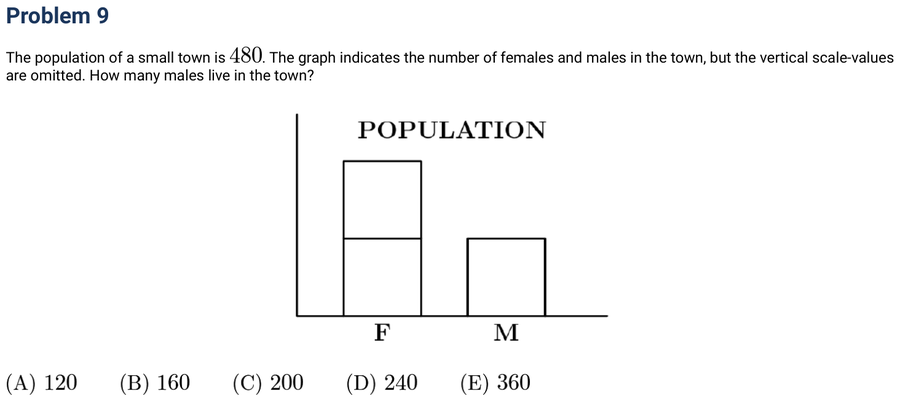
The numbers up the side are missing — but the picture still tells you something. How do the two bar HEIGHTS compare? (Look at the line drawn partway up the F bar.)
Still stuck? Show hint 2 →
Hint 2 of 3
Even with no scale, a bar graph still shows ratios: if one bar is twice as tall as another, those groups are in a 2 : 1 ratio. Turn the ratio into "equal parts" of the whole.
Still stuck? Show hint 3 →
Hint 3 of 3
Total people = female parts + male parts. Find the size of one part, then take the males' share.
Show solution
Approach: missing scale is fine — read the height ratio, then divide the total into parts
The line across the F bar marks exactly the M bar's height, showing the female bar is twice the male bar. So females : males = 2 : 1.
That's 2 parts + 1 part = 3 equal parts making up the whole town of 480. One part = 480 ÷ 3 = 160.
Males are 1 part, so there are 160 males.
Why this transfers: a bar graph without numbers is useless for amounts but perfect for ratios — comparing heights still works. Convert any ratio a : b into (a+b) equal parts of the total and you can split the whole.
Sanity check: 160 males + 320 females = 480, and 320 is indeed double 160. Fits the picture.
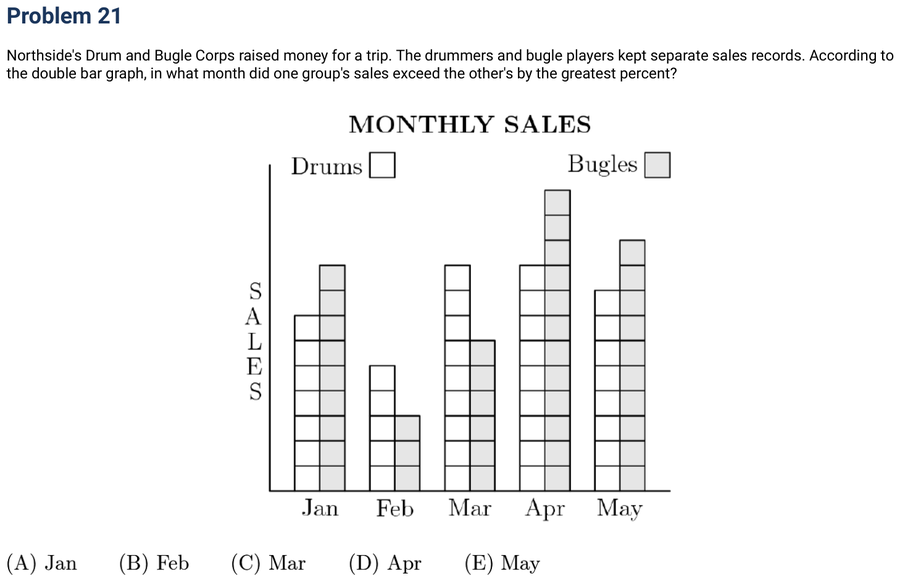
It says greatest PERCENT, not greatest amount. The same 2-unit lead is a huge deal over a tiny bar but barely noticeable over a tall one. So where should you look?
Still stuck? Show hint 2 →
Hint 2 of 3
Percent difference compares the gap to the SMALLER bar, not to the chart. The same gap looks biggest where the bars are shortest — hunt for the lowest pair.
Still stuck? Show hint 3 →
Hint 3 of 3
Find the month where one bar is a large fraction of the other, e.g. one bar is double the other.
Show solution
Approach: the same gap is a bigger PERCENT over short bars — check the smallest month
Percent difference measures how big the gap is relative to the smaller bar. So scan for the month with the shortest bars, where even a small lead is a large share.
February is by far the lowest: drums show 4 and bugles show 2. Drums exceed bugles by 2, and 2 is 100% of the bugles' 2 — the drums are double.
No other month comes close: e.g. April (drums 5, bugles 7) is only a 40% gap, March is a tie. So the greatest percent difference is in February.
Why this transfers: ‘greatest percent’ almost never means ‘tallest bars’ — it means ‘biggest ratio,’ which favors small numbers. A lead of 2 is trivial next to 50 but enormous next to 2. Always compare the gap to the smaller value.
"The scale was left off" sounds like missing information, but it isn't — every X stands for the SAME number of employees, whatever that number is. So a percent (a ratio) doesn't need the scale at all. What two counts of X's do you actually need?
Still stuck? Show hint 2 →
Hint 2 of 3
Percent for 5+ years = (X's in the 5,6,7,8,9,10 columns) ÷ (X's in ALL columns), times 100. The unknown "employees per X" cancels top and bottom — just count symbols.
Still stuck? Show hint 3 →
Hint 3 of 3
Tally each column's height. The total comes to a round number, which makes the fraction easy to turn into a percent.
Show solution
Approach: the missing scale cancels — count X's and take the ratio
The percent of employees with 5+ years is (employees with 5+ years) ÷ (all employees). Each X is the same number of employees, say k; that k multiplies both top and bottom and cancels, so the scale being missing doesn't matter — just count X's.
Years 5 and up are columns 5–10: 2 + 2 + 2 + 1 + 1 + 1 = 9 X's.
Fraction = 9 ÷ 30 = 3/10 = 30%.
Why this transfers: a ratio or percent never needs the absolute scale — any common unit cancels. Whenever a problem hides the "how many per symbol," check whether you only need a fraction; if so, counting symbols is enough.
Look up what a C means on the scale first: it's a score from 75 to 84. Now you're just hunting the 15 scores for the ones that land in that window.
Still stuck? Show hint 2 →
Hint 2 of 2
Don't compute 5/15 as an ugly decimal — simplify the fraction first. The 'percent that got a C' is just (how many C's) over 15.
Show solution
Approach: count what fits the window, then simplify the fraction
Read the scale: a C is 75–84. Sweep the 15 scores and tally only those in that band: 77, 75, 84, 78, 80 — that's 5. (Watch the edges: 74 is a D, 85 is a B; 75 and 84 *do* count.)
So the C fraction is 5/15. Simplify *before* converting: 5/15 = 1/3.
One-third as a percent is 33⅓%.
*Worth keeping:* simplify a fraction before turning it into a percent — 1/3 = 33⅓% is worth memorizing, and it dodges messy long division.
A big fraction is really just 'top ÷ bottom.' Collapse the top into one fraction and the bottom into one fraction before you do anything else.
Still stuck? Show hint 2 →
Hint 2 of 3
1 − 1⁄3 means 'a whole minus one of its thirds' — picture three thirds, take one away. Same idea for 1 − 1⁄2.
Still stuck? Show hint 3 →
Hint 3 of 3
To divide by a fraction, flip it and multiply: ÷(1⁄2) becomes ×2.
Show solution
Approach: simplify top and bottom, then flip-and-multiply
Treat the bar as a division sign and clean each half first. Top: 1 − 1⁄3 = 2⁄3 (three thirds minus one third). Bottom: 1 − 1⁄2 = 1⁄2 (two halves minus one half).
Now (2⁄3) ÷ (1⁄2). Dividing by 1⁄2 asks 'how many halves fit in 2⁄3?' — and there are twice as many, so flip and multiply: (2⁄3) × 2 = 4⁄3.
Why this transfers: never wrestle a stacked fraction all at once — reduce the top to a single fraction, the bottom to a single fraction, then it's one clean division. Sanity check: the answer is more than 1, which makes sense since the top 2⁄3 is bigger than the bottom 1⁄2.
A fraction keeps its value only when the top and the bottom are shrunk (or grown) by the SAME factor — multiplying top and bottom by the same thing changes nothing.
Still stuck? Show hint 2 →
Hint 2 of 3
Look at each choice as 'what got multiplied by 0.1?' The original is 9/(7×53); track how many ×0.1's land on top versus on the bottom.
Still stuck? Show hint 3 →
Hint 3 of 3
9 → .9 is one ×0.1 on top. To stay equal you need exactly one matching ×0.1 somewhere on the bottom — and 7 → .7 supplies it while 53 stays put.
Show solution
Approach: count the ×0.1 factors on top vs. bottom
The starting fraction is 9/(7×53). Every choice turns the 9 into .9, which is one factor of 0.1 on top. For the value to be unchanged, the bottom must pick up exactly one matching factor of 0.1 too.
Choice A is .9/(.7×53): top got ×0.1, and 7→.7 is ×0.1 on the bottom while 53 is untouched. Same ×0.1 top and bottom cancels, so .9/(.7×53) = 9/(7×53). That's the match — choice A.
Every other choice puts a different amount of shrinking on the bottom: B and E shrink two bottom numbers (too much), C turns 53→5.3 (only ×0.1 but value still off because... ) — quick test: in C the bottom is .7×5.3, which is ×0.1 on the 7 AND ×0.1 on the 53, so the bottom shrank by ×0.01 total versus ×0.1 on top, changing the value.
Why this transfers: to keep a fraction's value, the ×0.1 (or ×10) factors on top and bottom must balance exactly — count them like matching pairs. This 'scale top and bottom the same' rule is the engine behind every equivalent-fraction problem.
Suppose the estimated 20 billion dollar cost to send a person to the planet Mars is shared equally by the 250 million people in the U.S. Then each person's share is
Show answer
Answer: C — 80 dollars.
Show hints
Hint 1 of 2
Don't write out all those zeros. Measure both amounts in the same unit — 'millions' — so the giant word on each side cancels. How many millions is 20 billion?
Still stuck? Show hint 2 →
Hint 2 of 2
A billion is 1000 millions, so 20 billion = 20,000 million. Now both top and bottom are 'so-many million,' and the 'million' cancels.
Show solution
Approach: rewrite both numbers in the same unit, then cancel it
Put both amounts in millions: 20 billion = 20,000 million, and the population is 250 million. Now the shared word 'million' cancels top and bottom: 20,000 million ⁄ 250 million = 20,000 ⁄ 250.
20,000 ⁄ 250 = 80 dollars.
Why this transfers: when a quotient mixes huge words like billion and million, convert both to the same scale so that scale cancels. You're left dividing small, friendly numbers instead of juggling rows of zeros.
'Reciprocal of (a sum)' means you must finish the sum first, getting one single fraction, before you flip anything. So: what is 1⁄2 + 1⁄3 as one fraction?
Still stuck? Show hint 2 →
Hint 2 of 2
Add over a common denominator of 6, then flip the result top-for-bottom.
Show solution
Approach: add into one fraction, then flip
First combine: 1⁄2 + 1⁄3 = 3⁄6 + 2⁄6 = 5⁄6. Reciprocal flips a single fraction over, so the answer is 6⁄5.
Trap to avoid: you cannot flip each piece separately. Flipping gives 2 + 3 = 5 (choice E), which is wrong — the reciprocal of a sum is not the sum of the reciprocals.
Why this transfers: 'reciprocal of (…)' is one operation on the *whole* finished value. Always collapse what's inside the parentheses to a single number first, then take the reciprocal once.
You're told the *part* (45 cups) and the *percent* it represents (36%); you want the *whole*. Since 45 is only 36% of the maker, the full capacity must be larger than 45 — which choices does that already rule out?
Still stuck? Show hint 2 →
Hint 2 of 2
If 36% of the full amount is 45, then full × 0.36 = 45. Undo the multiply: divide 45 by 0.36.
Show solution
Approach: the part ÷ its percent gives the whole
45 cups is 36% of the full pot, so Full × 0.36 = 45, giving Full = 45 ⁄ 0.36 = 4500 ⁄ 36 = 125 cups.
Intuition check: if 36% is 45 cups, then each 1% is 45 ⁄ 36 = 1.25 cups, so the full 100% is 1.25 × 100 = 125 cups. Same answer, and it's comfortably bigger than 45 as expected.
Why this transfers: 'this part is P% of the whole' always rearranges to whole = part ÷ (P as a decimal). Finding the 'per 1%' amount first and scaling to 100 is a handy mental shortcut for the same idea.
You don't need the exact sum — just which half-unit it lands in. Add the whole numbers, then ask only how big the leftover fractions can get.
Still stuck? Show hint 2 →
Hint 2 of 2
The whole parts give 10 exactly. For the three fractions, find a floor and a ceiling: one of them is already 1⁄2, and the other two together are tiny.
Show solution
Approach: split off the whole parts, then bound the fractions
Whole parts: 2 + 3 + 5 = 10 — that's locked in. Now the fractions 1⁄7 + 1⁄2 + 1⁄19 only need bounding, not exact addition.
Floor: it's more than 1⁄2, because one term is already 1⁄2 and the others are positive. Ceiling: it's less than 1, because 1⁄7 + 1⁄19 is well under 1⁄2 (each is smaller than 1⁄4).
So the fractions land between 1⁄2 and 1, putting the total between 10 1⁄2 and 11 — answer B.
Why this transfers: when a question asks 'between which values,' estimate with bounds instead of finding a common denominator. Far less work, no arithmetic slips.
Which of the following fractions has the largest value?
Show answer
Answer: E — 151⁄301.
Show hints
Hint 1 of 2
Don't hunt for a common denominator across all five. Pick one easy yardstick they're all near and measure each against it.
Still stuck? Show hint 2 →
Hint 2 of 2
Each fraction is close to 1⁄2. To test a⁄b against 1⁄2, just compare 2a to b — double the top and see if it beats the bottom.
Show solution
Approach: compare every fraction to the landmark 1⁄2
Use the test a⁄b > 1⁄2 exactly when 2a > b (double the numerator, compare to the denominator). Double each top: 6 vs 7, 8 vs 9, 34 vs 35, 200 vs 201 — every one falls just short, so each is a hair below 1⁄2.
But 151⁄301 doubles to 302 vs 301: 302 > 301, so it's just over 1⁄2.
Four fractions sit below 1⁄2 and one sits above it, so 151⁄301 is the largest.
Why this transfers: comparing many quantities to a single landmark (here 1⁄2) replaces ten messy pairwise comparisons with five quick checks.
Joyce made 12 of her first 30 shots in the first three games of this basketball game, so her seasonal shooting average was 40%. In her next game, she took 10 shots and raised her seasonal shooting average to 50%. How many of these 10 shots did she make?
Show answer
Answer: E — 8.
Show hints
Hint 1 of 2
A season average is about totals, not single games. Work out her total makes before and after the new game, and the difference is what you want.
Still stuck? Show hint 2 →
Hint 2 of 2
After the extra game she's taken 30 + 10 = 40 shots at a 50% average. How many total baskets does that mean — and how many had she already made?
Show solution
Approach: work in season totals, then take the difference
An average is (total made) ⁄ (total shots), so work with totals. After the game she's taken 40 shots at 50%, meaning 50% × 40 = 20 total makes.
She'd already made 12, so this game she made 20 − 12 = 8.
Why this transfers: never average the averages or work game-by-game — convert each percentage back to a count of makes over a count of shots, then subtract. Totals are what actually add up.
Half the people in a room left. One third of those remaining started to dance. There were then 12 people who were not dancing. The original number of people in the room was what?
Show answer
Answer: C — 36.
Show hints
Hint 1 of 2
Follow the 12 non-dancers backward. What single fraction of the ORIGINAL crowd are they?
Still stuck? Show hint 2 →
Hint 2 of 2
Half the people stay, and of those 1⁄3 dance — so 2⁄3 of the stayers don't. Chain the fractions: 1⁄2 of the room, then 2⁄3 of that.
Show solution
Approach: compose the fractions back to the original
Half stay, so the stayers are 1⁄2 of the original. Of the stayers, 1⁄3 dance, leaving 2⁄3 not dancing. Chain them: the non-dancers are 2⁄3 × 1⁄2 = 1⁄3 of the original room.
That third equals 12, so the whole room is N = 3 × 12 = 36.
Why this transfers: 'a fraction of a fraction' multiplies — collapsing the two steps into one fraction of the start lets you solve in a single division instead of tracking three separate counts.
Another way — walk forward and check:
Start with 36: half leave → 18 remain. A third of 18 dance → 6 dancers, so 18 − 6 = 12 not dancing.
"Same grade on both tests" means Test-1 grade equals Test-2 grade. Where in a grid does the row label match the column label? Picture the path those cells trace.
Still stuck? Show hint 2 →
Hint 2 of 2
Those matching cells (A-A, B-B, C-C, D-D, F-F) run straight down the diagonal. Add just those five, then turn the count into a percent of 30.
Show solution
Approach: the matching cells form the diagonal
A student scored the same on both tests exactly when their row (Test 1) matches their column (Test 2). In the grid those equal-label cells line up on the main diagonal — so you ignore the other 20 cells entirely.
If 200 ≤ a ≤ 400 and 600 ≤ b ≤ 1200, then the largest value of the quotient b ⁄ a is
Show answer
Answer: C — 6.
Show hints
Hint 1 of 2
A fraction grows two ways: a bigger top *or* a smaller bottom. To make b⁄a as large as it can be, push each part to its own extreme — which way for b, which way for a?
Still stuck? Show hint 2 →
Hint 2 of 2
Top as big as allowed, bottom as small as allowed: use b at its maximum and a at its minimum. The two choices don't interfere, so you can pick both extremes at once.
Show solution
Approach: push top up, bottom down
A quotient is largest when its numerator is largest and its denominator is smallest — and those two pushes are independent, so you can do both. Pick b at its top (1200) and a at its bottom (200).
b ⁄ a = 1200 ⁄ 200 = 6.
Watch the trap: it's tempting to use the two biggest numbers (1200 and 400), but a big denominator *shrinks* the fraction — 1200⁄400 = 3, smaller than 6. Smallest bottom is what matters.
Why this transfers: any 'maximize a fraction in a range' problem reduces to max-numerator-over-min-denominator (assuming everything stays positive).
Sale prices at the Ajax Outlet Store are 50% below original prices. On Saturdays an additional discount of 20% off the sale price is given. What is the Saturday price of a coat whose original price is $180?
Show answer
Answer: B — $72.
Show hints
Hint 1 of 2
The two discounts don't add up to 70% off. The 20% comes off the *already-reduced* sale price, not the original — so the discounts stack one after the other. What fraction of the price *survives* each cut?
Still stuck? Show hint 2 →
Hint 2 of 2
Track what you keep, not what you lose: after "50% off" you keep 0.5 of the price; after a further "20% off" you keep 0.8 of that. Multiply the keep-factors.
Show solution
Approach: chain the 'fraction kept' factors
Each discount is taken on the current price, so they multiply rather than add. After 50% off you keep half: $180 × 0.5 = $90 (the sale price).
On Saturday, 20% off means you keep 80% of *that*: $90 × 0.8 = $72.
Watch the trap: 50% + 20% is *not* 70% off (that would give $54). Successive discounts stack multiplicatively — keeping 0.5 then 0.8 means keeping 0.5 × 0.8 = 0.4, i.e. 40% of $180.
Why this transfers: any chain of percent changes is handled by multiplying 'fraction remaining' factors — far safer than adding or subtracting the percents.
Another way — combine the factors first:
Keep-factor overall = 0.5 × 0.8 = 0.4, so Saturday price = $180 × 0.4 = $72 in one step.
The winter bar is hidden, so you can't read it — but the other three bars *are* readable, and the 25% fact secretly tells you the grand total. What is 25% as a simple fraction, and what does that say about the total?
Still stuck? Show hint 2 →
Hint 2 of 3
25% means 'one quarter,' so Fall is a quarter of the whole year — making the total four times the Fall bar. Find the total, then subtract the three visible bars to uncover winter.
Still stuck? Show hint 3 →
Hint 3 of 3
Read the bars: Spring 4.5, Summer 5, Fall 4. The total is 4 × Fall.
Show solution
Approach: use 25% to recover the total, then subtract the visible seasons
The covered bar can't be measured, so come at it from the total instead. 25% is exactly one quarter, and Fall is that quarter, so the whole year = 4 × Fall = 4 × 4 = 16 million.
Read the three uncovered bars: Spring 4.5, Summer 5, Fall 4 (total 13.5 million).
Winter is whatever's left of the total: 16 − 13.5 = 2.5 million.
Why this works: a hidden value in a 'parts add to a whole' setup is best found as total − (everything else) — and a tidy percent like 25% is your shortcut to that total.
The value of the expression (304)⁵ ⁄ ((29.7)(399)⁴) is closest to
Show answer
Answer: D — 3.
Show hints
Hint 1 of 3
Never compute a fifth power here — the word 'closest' plus those round-ish numbers (304, 399, 29.7) is begging you to round to 300, 400, 30 first.
Still stuck? Show hint 2 →
Hint 2 of 3
After rounding, you have 300⁵ on top and 400⁴ on the bottom. Don't expand them — pair up four of the 300s with the four 400s to make (300⁄400)⁴ = (3⁄4)⁴, and you're left with one spare 300 over the 30.
Still stuck? Show hint 3 →
Hint 3 of 3
(3⁄4)⁴ is a bit under ⅓, and the leftover 300⁄30 = 10, so the product is roughly 10 × (a third).
Show solution
Approach: round, then pair the powers into (3⁄4)⁴
'Closest' means estimate, so round to friendly numbers: 304 → 300, 399 → 400, 29.7 → 30. The expression becomes 300⁵ ⁄ (30 · 400⁴).
Don't expand the powers — regroup instead. Match four 300s against the four 400s: (300⁄400)⁴ = (3⁄4)⁴. The fifth 300 pairs with the 30 to give 300⁄30 = 10.
So it's (3⁄4)⁴ · 10 = (81⁄256) · 10 ≈ 0.316 · 10 ≈ 3.16, closest to 3.
Sanity check the size: 81⁄256 is just under ⅓, and ⅓ of 10 is about 3.3 — so the answer is a small single-digit number, instantly ruling out the .003, .03, .3, and 30 options. The art is grouping powers before multiplying, not crunching huge numbers.
The difference between a 6.5% sales tax and a 6% sales tax on an item priced at $20 before tax is
Show answer
Answer: B — $.10.
Show hints
Hint 1 of 2
You don't have to compute both taxes and subtract. Both are a percent of the SAME $20, so the difference in dollars is just the difference in rates, applied once. What is 6.5% − 6%?
Still stuck? Show hint 2 →
Hint 2 of 2
When two percentages act on the same amount, subtract the rates first, then take that single percent of the amount. Here the gap is only 0.5% — half of one percent.
Show solution
Approach: take the percent difference of the price
The two taxes differ by 6.5% − 6% = 0.5%, and both apply to the same $20, so the extra cost is just 0.5% of $20.
0.5% = 0.005, and 0.005 × 20 = $0.10.
Why this transfers: 'percent of the same base' problems collapse to one calculation — combine the rates before multiplying, instead of computing each piece and subtracting. (Sanity check: 1% of $20 is 20¢, so half a percent is 10¢.)
Mika wants to estimate how far a new electric bike goes on a full charge. She made two trips totaling 40 miles: the first used 12 of the battery and the second used 310 of the battery. How many miles can the bike go on a fully charged battery?
Show answer
Answer: C — 50 miles.
Show hints
Hint 1 of 2
The 40 miles didn't drain a full battery. First combine the two trips: what single fraction of the battery did the 40 miles actually use?
Still stuck? Show hint 2 →
Hint 2 of 2
Once you know 40 miles used some fraction of the charge, the rest is one proportion: scale that fraction up to a whole battery (the full charge is 5/5).
Show solution
Approach: find the fraction the 40 miles used, then scale to a whole battery
Combine the two trips: ½ + 3/10. With a common denominator, 5/10 + 3/10 = 8/10 = 4/5 of the battery powered the 40 miles.
If 4/5 of a charge gives 40 miles, each fifth gives 40 ÷ 4 = 10 miles, so a full 5/5 gives 5 × 10 = 50 miles.
Why this works: ‘a fraction of the whole equals a known amount’ is a proportion — find the value of one unit piece (here, one-fifth = 10 mi), then multiply up to the whole.
Another way — divide by the fraction:
4/5 of the battery = 40 miles, so the full battery is 40 ÷ 45 = 40 × 54 = 50 miles.
A poll asked some people whether they liked solving mathematics problems, and exactly 74% answered "yes." What is the fewest possible number of people who could have been asked?
Show answer
Answer: D — 50 people.
Show hints
Hint 1 of 2
You can't have a fraction of a person, so 74% of the group has to land on a whole number. What does that force about the group size?
Still stuck? Show hint 2 →
Hint 2 of 2
Reduce 74/100 to lowest terms. The denominator of the reduced fraction is the smallest group size that makes the count whole.
Show solution
Approach: the reduced denominator is the smallest workable group
‘74% said yes’ means (yes count) = 74100 × (group), and that has to be a whole number of people.
Reduce: 74100 = 3750. Since 37 and 50 share no factors, the group must be a multiple of 50 for 37/50 of it to be whole — so the fewest is 50 people (with 37 yeses).
Why this transfers: ‘exactly p% must be a whole count’ problems always come down to reducing p/100 — the smallest group is the reduced denominator, because that's the first size that clears the fraction.
Harold made a plum pie to take on a picnic. He was able to eat only 14 of the pie, and he left the rest for his friends. A moose came by and ate 13 of what Harold left behind. After that, a porcupine ate 13 of what the moose left behind. How much of the original pie still remained after the porcupine left?
Show answer
Answer: D — 1/3.
Show hints
Hint 1 of 2
Don't track what each animal ate — track what each one left behind. Then the leftovers chain together.
Still stuck? Show hint 2 →
Hint 2 of 2
Each ‘a fraction of what's left’ means multiply. Harold leaves 3/4, the moose leaves 2/3 of that, the porcupine leaves 2/3 of that — so multiply 3/4 × 2/3 × 2/3.
Show solution
Approach: multiply the 'leftover' fractions
The trap is to subtract each bite from the whole pie — but the moose eats a third of what's left, not a third of the whole pie. So work with what each animal leaves, and chain those leftovers by multiplying (‘of’ means ×).
Harold leaves 34; the moose leaves 23 of that; the porcupine leaves 23 of that.
34 × 23 × 23 = 1236 = 13. This transfers: repeated ‘a fraction of what remains’ (discounts on discounts, evaporation, decay) always multiplies the survival fractions.
Another way — twelve slices (MAA):
Cut the pie into 12 equal slices. Harold eats 3, leaving 9. Moose eats 13 of 9 = 3, leaving 6. Porcupine eats 13 of 6 = 2, leaving 4.
Never multiply all this out. Each fraction is (a number)/(that number + 2), so the lists of numerators and denominators are nearly the same — line them up and watch what cancels.
Still stuck? Show hint 2 →
Hint 2 of 2
Numerators: 1, 2, 3, …, 20. Denominators: 3, 4, …, 22. Everything from 3 to 20 appears in both and cancels — only the two ends survive.
Show solution
Approach: telescoping — the lists overlap, so almost everything cancels
Insight: don't compute — collect. Each factor is (k)/(k+2), so the numerators run 1, 2, 3, …, 20 and the denominators run 3, 4, 5, …, 22. Every number from 3 to 20 shows up in both lists, so it cancels.
Only the unmatched ends remain — 1 and 2 on top, 21 and 22 on the bottom: 1 · 221 · 22 = 2462 = 1231.
You'll see this again: a long product (or sum) where each term overlaps the next is a telescope — line up the lists and only the few leftover ends matter. The shift here is 2, so two terms survive on each end.
A cup of boiling water (212°F) is placed to cool in a room whose temperature remains constant at 68°F. Suppose the difference between the water temperature and the room temperature is halved every 5 minutes. What is the water temperature, in degrees Fahrenheit, after 15 minutes?
Show answer
Answer: B — 86°F.
Show hints
Hint 1 of 2
The temperature itself isn't what halves — the gap between the water and the room is. Track that gap, not the thermometer.
Still stuck? Show hint 2 →
Hint 2 of 2
Starting gap: 212 − 68 = 144. In 15 minutes it halves three times. Add the shrunken gap back onto room temperature.
Show solution
Approach: track the gap (it's what halves), then add room temp back
Insight: “halved” describes the difference from room temperature, not the reading itself. So work with the gap. Starting gap: 212 − 68 = 144°F.
15 minutes is three 5-minute steps, so halve the gap three times: 144 → 72 → 36 → 18.
The water is now 18° above the room: 68 + 18 = 86°F.
You'll see this again: whenever something decays “toward” a fixed level, shift your view to the gap from that level — the gap shrinks by a clean ratio while the raw quantity doesn't.
Gilda has a bag of marbles. She gives 20% of them to her friend Pedro. Then Gilda gives 10% of what is left to another friend, Ebony. Finally, Gilda gives 25% of what is now left in the bag to her brother Jimmy. What percentage of her original bag of marbles does Gilda have left for herself?
Show answer
Answer: E — 54%.
Show hints
Hint 1 of 2
Each "gives away X%" is the same as "keeps (100−X)%." Don't track what leaves — track the fraction that stays, because those just multiply.
Still stuck? Show hint 2 →
Hint 2 of 2
Keeps in order: 80%, then 90% of that, then 75% of that. Multiply 0.8 × 0.9 × 0.75 — no need to ever pick an actual number of marbles.
Show solution
Approach: multiply the surviving fractions
Flip each gift into what's kept: after Pedro she keeps 80%, after Ebony she keeps 90% of that, after Jimmy she keeps 75% of what's left.
Percentages of percentages just multiply: 0.8 × 0.9 × 0.75 = 0.54 = 54%.
Why this transfers: for a chain of successive percentage changes, convert each to its multiplier (a 20% loss = ×0.8) and multiply them — you never need the starting amount, and order doesn't matter.
Another way — pretend she started with 100:
Start with 100 marbles. Pedro takes 20 → 80 left. Ebony takes 10% of 80 = 8 → 72 left. Jimmy takes 25% of 72 = 18 → 54 left.
54 out of 100 = 54% — same result, and picking 100 keeps every step a whole number.
The harmonic mean of a set of non-zero numbers is the reciprocal of the average of the reciprocals of the numbers. What is the harmonic mean of 1, 2, and 4?
Show answer
Answer: C — 12/7.
Show hints
Hint 1 of 2
The scary name is just a recipe. Read the definition backwards from the answer: it's the "reciprocal of the average of the reciprocals" — so peel it off in the forward order: flip, average, flip.
Still stuck? Show hint 2 →
Hint 2 of 2
The technique for any unfamiliar definition: execute it as literal instructions, one verb at a time, and don't skip the last step — here the final "reciprocal" is exactly the step people forget.
Show solution
Approach: follow the definition
Flip each number: the reciprocals of 1, 2, 4 are 1, 1/2, 1/4, which sum to 7/4.
Average the three reciprocals: (7/4) ÷ 3 = 7/12.
Now do the final flip the name demands — the reciprocal of 7/12 is 12/7. Sanity check: the harmonic mean always lands below the ordinary average (here (1+2+4)/3 ≈ 2.33) and pulls toward the small numbers, and 12/7 ≈ 1.71 does exactly that.
What is the correct ordering of the three numbers 519, 721, and 923, in increasing order?
Show answer
Answer: B — 5/19 < 7/21 < 9/23.
Show hints
Hint 1 of 2
Look at each fraction's gap between top and bottom: 19 − 5, 21 − 7, 23 − 9 — all 14! Every fraction is exactly 14 short of being 1, so compare how far each falls below 1.
Still stuck? Show hint 2 →
Hint 2 of 2
Rewrite each as 1 − (the missing piece): the bigger the piece you subtract, the smaller the fraction. This compare-against-1 trick beats finding a common denominator of 19, 21, 23.
Show solution
Approach: every fraction is 1 minus a piece — compare the pieces
Spot the shared structure: each numerator is 14 below its denominator, so each fraction equals 1 − 14/(denominator). Concretely 5/19 = 1 − 14/19, 7/21 = 1 − 14/21, 9/23 = 1 − 14/23.
Now compare the subtracted pieces: 14/19 > 14/21 > 14/23 (same top 14, so the smallest bottom gives the biggest piece).
Subtracting a bigger piece leaves a smaller fraction, so 5/19 is smallest and 9/23 largest: 5/19 < 7/21 < 9/23.
Intuition / sanity check: all three sit just under 1; the one closest to 1 (smallest leftover gap) is biggest. Reusable when a batch of fractions share a constant top−bottom difference — rewrite as 1 − (piece) and rank the pieces.
Another way — cross-multiply pairwise:
Compare 5/19 vs 7/21 by cross-multiplying: 5×21 = 105 vs 7×19 = 133. Since 105 < 133, 5/19 < 7/21.
Compare 7/21 vs 9/23: 7×23 = 161 vs 9×21 = 189, so 7/21 < 9/23.
Chaining gives 5/19 < 7/21 < 9/23 — more arithmetic, but no clever rewrite needed.
The taxi fare in Gotham City is $2.40 for the first 12 mile and additional mileage charged at the rate $0.20 for each additional 0.1 mile. You plan to give the driver a $2 tip. How many miles can you ride for $10?
Show answer
Answer: C — 3.3 miles.
Show hints
Hint 1 of 2
Strip away the costs that don't depend on distance first: the $2 tip and the $2.40 flat charge for the first half-mile. Whatever's left is the only money that buys extra distance.
Still stuck? Show hint 2 →
Hint 2 of 2
Simplify the awkward rate before dividing: $0.20 per 0.1 mile is the same as $2 per whole mile — much friendlier numbers.
Show solution
Approach: peel off the fixed costs, then divide the leftover by the per-mile rate
Take out the fixed pieces: $10 − $2 tip − $2.40 for the first half-mile = $5.60 left for extra distance.
Turn the rate into per-mile: $0.20 per 0.1 mile = $2 per mile. So $5.60 ÷ $2 = 2.8 extra miles.
Add back the half-mile you already paid for: 0.5 + 2.8 = 3.3 miles.
Worth keeping: in any "flat fee plus a per-unit rate" problem, subtract every fixed charge first — only the remainder gets divided by the rate.
There are 270 students at Colfax Middle School, where the ratio of boys to girls is 5 : 4. There are 180 students at Winthrop Middle School, where the ratio of boys to girls is 4 : 5. The two schools hold a dance and all students from both schools attend. What fraction of the students at the dance are girls?
Show answer
Answer: C — 22/45.
Show hints
Hint 1 of 2
You can't just average the two fractions of girls — the schools have different sizes. You need actual head counts of girls, then pool everyone together.
Still stuck? Show hint 2 →
Hint 2 of 2
Both ratios split a school into 9 equal parts (5+4 and 4+5). Conveniently 270 and 180 are both multiples of 9, so each part is a whole number of students.
Show solution
Approach: convert each ratio to real counts, then pool
Colfax has 9 parts: girls are 4 of them, so girls = (4/9)(270) = 120.
Winthrop has 9 parts: girls are 5 of them, so girls = (5/9)(180) = 100.
Pool everyone: 120 + 100 = 220 girls out of 270 + 180 = 450 students ⇒ 220/450 = 22/45.
Common trap: averaging 4/9 and 5/9 gives 1/2 (choice D) — wrong, because the bigger school (Colfax, mostly boys) pulls the combined fraction below 1/2. Always weight by size.
Of the 500 balls in a large bag, 80% are red and the rest are blue. How many of the red balls must be removed from the bag so that 75% of the remaining balls are red?
Show answer
Answer: D — 100 red balls.
Show hints
Hint 1 of 2
Only red balls leave the bag, so the number of blue balls never moves. Track that fixed quantity instead of chasing the changing reds.
Still stuck? Show hint 2 →
Hint 2 of 2
When one quantity stays constant through a change, anchor on it. ‘75% red’ means ‘25% blue,’ and you already know exactly how many blue there are.
Show solution
Approach: anchor on the unchanging blue count
Start: 80% of 500 = 400 red, leaving 100 blue. Removing reds can't touch those 100 blue.
At the end red is 75%, so blue is the other 25%. Those 25% are still exactly 100 balls, so the new total = 100 / 0.25 = 400 balls.
We dropped from 500 to 400, all reds: 100 red balls removed.
Why this transfers: in any ‘remove/add until the percentage changes’ problem, find the quantity that doesn't change and let it carry the new total. Chasing the moving part directly is the slow road.
A jar contains five different colors of gumdrops: 30% are blue, 20% are brown, 15% red, 10% yellow, and the other 30 gumdrops are green. If half of the blue gumdrops are replaced with brown gumdrops, how many gumdrops will be brown?
Show answer
Answer: C — 42.
Show hints
Hint 1 of 2
The 30 green gumdrops are your only real count — everything else is a percent. So first turn green into a percent (whatever's left after the others), and it unlocks the total.
Still stuck? Show hint 2 →
Hint 2 of 2
‘A known count equals a known percent’ lets you find the whole: total = count ÷ (its percent). Once you have the total, every color becomes a real number.
Show solution
Approach: convert the one known count into the total
The listed colors use 30+20+15+10 = 75%, so green is the remaining 25%. That 25% is the 30 green gumdrops, so the total = 30 / 0.25 = 120.
Now percents become counts: blue = 30% · 120 = 36, brown = 20% · 120 = 24.
Half the blue (18) turn brown: 24 + 18 = 42.
Why this transfers: whenever a problem gives mostly percents and a single raw count, that count is your bridge — divide it by its percent to get the total, then read off the rest.
A company sells detergent in three different sized boxes: small (S), medium (M) and large (L). The medium size costs 50% more than the small size and contains 20% less detergent than the large size. The large size contains twice as much detergent as the small size and costs 30% more than the medium size. Rank the three sizes from best to worst buy.
Show answer
Answer: E — MLS (best M, then L, then S).
Show hints
Hint 1 of 2
'Best buy' only depends on price per ounce, never on the actual prices. Since everything is relative percentages, you're free to pin down two convenient anchor numbers and let the rest follow.
Still stuck? Show hint 2 →
Hint 2 of 2
Pick numbers that make the percentages clean — small price = $1, large size = 10 oz — then build the others and compare dollars per ounce. Lowest $/oz wins.
Show solution
Approach: anchor convenient values, then compare $ per oz
Only ratios matter, so set Small = $1 and Large = 10 oz. Now derive the rest from the clues.
Small size: large is twice the small, so Small = 5 oz. Medium: 50% more than small ⇒ $1.50; 20% less than large ⇒ 8 oz. Large price: 30% more than medium ⇒ 1.5·1.30 = $1.95.
Unit prices ($/oz): S = 1/5 = 0.200, M = 1.50/8 = 0.1875, L = 1.95/10 = 0.195.
Cheapest per ounce to priciest: M, L, S.
Why this transfers: when a problem gives only relative sizes and prices, the answer can't depend on your starting numbers — so anchor the ones that make the arithmetic painless. And 'best deal' always means the lowest unit price, not the lowest sticker price.
Niki usually leaves her cell phone on. If her cell phone is on but she is not actually using it, the battery will last for 24 hours. If she is using it constantly, the battery will last for only 3 hours. Since the last recharge, her phone has been on 9 hours, and during that time she has used it for 60 minutes. If she doesn't talk any more but leaves the phone on, how many more hours will the battery last?
Show answer
Answer: B — 8 more hours.
Show hints
Hint 1 of 2
Think of the battery as one whole tank, and each mode as a different drain speed. 'Lasts 24 hours idle' means idling drains 1/24 of the tank per hour; 'lasts 3 hours in use' means using drains 1/3 per hour. Split the 9 hours into how much was each mode.
Still stuck? Show hint 2 →
Hint 2 of 2
The technique is fraction-of-the-job per hour (the same as combined-work-rate problems): convert each 'lasts T hours' into a rate of 1/T per hour, add up what's been spent, and see what's left.
Show solution
Approach: track the tank as fractions
The 9 hours split as 1 hour of talking + 8 hours idle (60 min used). Battery spent = 1 × 1/3 (talking) + 8 × 1/24 (idle) = 1/3 + 1/3 = 2/3 of the tank.
So 1/3 of the battery remains, and from here on she's idle only, draining 1/24 per hour. Time left = (1/3) ÷ (1/24) = (1/3) × 24 = 8 more hours.
Intuition check: that one hour of talking ate 1/3 of the battery — as much as 8 whole hours of idling. That's why a single hour of use is so costly here, and a clean way to feel the 1/3-vs-1/24 gap.
Two-thirds of the people in a room are seated in three-fourths of the chairs. The rest of the people are standing. If there are 6 empty chairs, how many people are in the room?
Show answer
Answer: D — 27 people.
Show hints
Hint 1 of 2
The one concrete number you're given is '6 empty chairs'. Find what fraction of the chairs is empty — that fraction equals 6, which unlocks the total number of chairs. Start from the fact that ties to a real count.
Still stuck? Show hint 2 →
Hint 2 of 2
The strategy is start from the known quantity and work outward: 3/4 of chairs are filled, so 1/4 are empty → chairs → seated people → (that's 2/3 of everyone) → total people. Each fraction is a stepping stone, not a thing to combine all at once.
Show solution
Approach: anchor on the empty chairs, then chain
3/4 of the chairs are filled, so 1/4 are empty — and that 1/4 is the 6 empty chairs we're told about. So 1/4 of chairs = 6 ⇒ total chairs = 24.
Filled chairs = 3/4 × 24 = 18 people seated. But seated people are 2/3 of everyone in the room.
So 2/3 of the people = 18 ⇒ total people = 18 ÷ (2/3) = 18 × 3/2 = 27.
Sanity check: 27 people — 18 seated (2/3) and 9 standing (1/3); 9 is indeed a third, so it's consistent. The habit that transfers: grab the lone numerical fact, convert it into a count, then let each fraction pull you to the next quantity.
At a party there are only single women and married men with their wives. The probability that a randomly selected woman is single is 2/5. What fraction of the people in the room are married men?
Show answer
Answer: B — 3/8.
Show hints
Hint 1 of 2
The fraction 2/5 is begging you to pick a friendly number of women — choose 5, so 2 are single and 3 are married, with no ugly fractions. The hidden link: every married woman comes with exactly one husband, so married men = married women.
Still stuck? Show hint 2 →
Hint 2 of 2
The technique is plug in a convenient total (pick the denominator) plus spotting the pairing: married men and married women come in couples, so their counts are equal. Then it's just a head-count.
Show solution
Approach: pick 5 women, count heads
Let there be 5 women (matches the /5). Then 2/5 × 5 = 2 are single and the other 3 are married.
Key link: married couples pair up, so the 3 married women bring 3 married men — and the room has only single women and married couples, no one else.
Total people = 5 women + 3 men = 8. Married men out of everyone = 3/8.
Sanity check on the trap: 'single women = 2/5' is the fraction of women, not of people; the married-men fraction (3/8) uses the bigger people-total, so it should be smaller than a naive 3/5 — and it is. Picking a concrete total turns abstract-fraction problems into plain counting.
Another way — algebra with a variable:
Let women = w. Single women = (2/5)w, married women = (3/5)w = married men.
Total people = w + (3/5)w = (8/5)w.
Married men / people = (3/5)w ÷ (8/5)w = 3/8 — the w cancels, confirming the choice of 5 didn't matter.
Business is a little slow at Lou's Fine Shoes, so Lou decides to have a sale. On Friday, Lou increases all of Thursday's prices by 10%. Over the weekend, Lou advertises the sale: "Ten percent off the listed price. Sale starts Monday." How much does a pair of shoes cost on Monday that cost $40 on Thursday?
Show answer
Answer: B — $39.60.
Show hints
Hint 1 of 2
Tempting to say up 10% then down 10% cancels — but the 10% cut comes off the new, larger price, so it removes more than the increase added.
Still stuck? Show hint 2 →
Hint 2 of 2
Turn each percent change into a multiplier and chain them: ×1.1 (up 10%) then ×0.9 (down 10%).
Show solution
Approach: turn each change into a multiplier and chain them
Each percent change is a multiplier: a 10% raise is ×1.1, a 10% cut is ×0.9. Apply them in order: Friday 40 × 1.1 = 44, then Monday 44 × 0.9 = 39.60.
The order doesn't even matter, since multipliers just combine: 1.1 × 0.9 = 0.99, so the price ends at 40 × 0.99 = 39.60 — below the start, not back to it.
Worth keeping: +x% then −x% always lands a little low, because 0.99 < 1 (in general (1+r)(1−r) = 1 − r²). Percent changes multiply, they don't add — so they never simply cancel.
The students in Mrs. Sawyer's class each chose one of five kinds of candy in a taste test. The bar graph shows their preferences. What percent of her class chose candy E?
Show answer
Answer: E — 20%.
Show hints
Hint 1 of 2
A percent needs a *whole* — and the bars don't tell you the class size, so build it first by adding every bar.
Still stuck? Show hint 2 →
Hint 2 of 2
The total comes out to a friendly 25. Since 25 × 4 = 100, each single student is worth 4% — a tiny conversion you can do in your head.
Show solution
Approach: part over whole, then turn into a percent
Percent always means "out of 100," so you need the whole class first: 6 + 8 + 4 + 2 + 5 = 25 students.
Candy E got 5 of them. With 25 in the class, each student is 100 ÷ 25 = 4%, so 5 students = 5 × 4% = 20%. (Same as 5/25 = 1/5.)
*Handy to remember:* when the total is a divisor of 100 (25, 20, 50, …), find the worth of *one* item once, then just multiply — beats fiddling with fractions for every part.
A collector offers to buy state quarters for 2000% of their face value. At that rate, how much will Bryden get for his four state quarters?
Show answer
Answer: A — $20.
Show hints
Hint 1 of 2
The scary-looking 2000% is really just a multiplier — "percent" literally means "per hundred," so divide by 100.
Still stuck? Show hint 2 →
Hint 2 of 2
First nail the face value: four quarters = $1. Then multiply by the converted percent.
Show solution
Approach: percent as a multiplier
Turn the percent into a number: 2000% = 2000 ÷ 100 = 20. So the collector pays 20 times face value.
Four quarters have a face value of $1, so Bryden gets 20 × $1 = $20.
Sanity check: 100% would be face value ($1), 200% would double it ($2), so 2000% is twenty times — $20, not $2000. "Percent" always means ÷ 100, which deflates big-looking percentages fast.
Ara and Shea were once the same height. Since then Shea has grown 20% while Ara has grown half as many inches as Shea. Shea is now 60 inches tall. How tall, in inches, is Ara now?
Show answer
Answer: E — 55 inches.
Show hints
Hint 1 of 2
The 60 inches is Shea's height AFTER a 20% growth — so 60 is 120% of the shared start, not the start itself. Undo the growth to find where they both began.
Still stuck? Show hint 2 →
Hint 2 of 2
Watch the units switch: Ara grew 'half as many *inches*,' not half the percent. Once you know Shea's inches gained, halve THAT number.
Show solution
Approach: undo the percent to find the start, then count inches
60 is 120% of the common starting height, so start = 60 ÷ 1.2 = 50 inches. That means Shea gained 60 − 50 = 10 inches.
Ara grew half as many *inches*: 10 ÷ 2 = 5 inches. Ara is now 50 + 5 = 55 inches.
The habit to build: the two people start equal but the problem mixes a percent (Shea) with raw inches (Ara). Always convert the percent into actual inches before comparing — reasoning in percents would have you compare 20% of one height with an inch count, which aren't the same kind of thing.
The third exit on a highway is located at milepost 40 and the tenth exit is at milepost 160. There is a service center on the highway located three-fourths of the way from the third exit to the tenth exit. At what milepost would you expect to find this service center?
Show answer
Answer: E — Milepost 130.
Show hints
Hint 1 of 2
"Three-fourths of the way" is a fraction of the gap between the exits, not three-fourths of 160. First find the gap.
Still stuck? Show hint 2 →
Hint 2 of 2
A fraction-of-the-way point = start + fraction × (gap). Don't forget to add it back onto the starting milepost.
Show solution
Approach: start + fraction of the gap (not fraction of the endpoint)
The trap is multiplying ¾ × 160. The fraction applies to the gap: 160 − 40 = 120 miles, and ¾ of 120 is 90.
Now add that distance onto where you started: 40 + 90 = 130.
The reusable move: a "fraction of the way from A to B" point is A + fraction × (B − A). The exit numbers (third, tenth) are a distraction — only the mileposts matter.
The ratio of the number of games won to the number of games lost (no ties) by the Middle School Middies is 114. To the nearest whole percent, what percent of its games did the team lose?
Show answer
Answer: B — 27%.
Show hints
Hint 1 of 2
A ratio of 11 to 4 isn't 11 games and 4 games — it's 11 parts to 4 parts. The whole is the parts added: 11 + 4 = 15. Percent-lost is the lost parts over the whole.
Still stuck? Show hint 2 →
Hint 2 of 2
Percent-of-the-whole always needs the WHOLE in the denominator. The ratio's denominator (4 lost) is not the total — add the parts to get it.
Show solution
Approach: ratio → parts → fraction of the whole → percent
Read the ratio as parts: 11 won-parts and 4 lost-parts, so the whole is 11 + 4 = 15 parts. Losses are 4 of those 15.
4/15 = 0.2666… ≈ 26.7%, which rounds to 27%.
The classic trap this dodges: the answer is NOT 4/11 (lost vs won) — percent of games requires lost over total games, so you must sum the parts first. Choice A (24% ≈ 4/16.7) and E (73%, the win rate) are there to catch that slip.
Tori's mathematics test had 75 problems: 10 arithmetic, 30 algebra, and 35 geometry problems. Although she answered 70% of the arithmetic, 40% of the algebra, and 60% of the geometry problems correctly, she did not pass the test because she got less than 60% of the problems right. How many more problems would she have needed to answer correctly to earn a 60% passing grade?
Show answer
Answer: B — 5 more.
Show hints
Hint 1 of 2
The percentages are of each subject, so first turn them into actual counts of correct problems — 70% of 10 is a number, not a percent.
Still stuck? Show hint 2 →
Hint 2 of 2
The question is a gap: (problems needed for 60%) − (problems she got). Find each piece as a count, then subtract.
Show solution
Approach: convert percents to counts, then close the gap to the target
Counts correct: 70% of 10 = 7, 40% of 30 = 12, 60% of 35 = 21. Total = 7 + 12 + 21 = 40.
Passing needs 60% of 75 = 45 correct. She's short by 45 − 40 = 5.
The careful move: a percent of one group can't be added to a percent of another (different sizes), so cash every percent into a head-count first, then the totals add and subtract cleanly.
Cookies for a Crowd. The recipe makes a pan of 15 cookies, and only full recipes are made. Normally 108 students each eat 2 cookies, but a concert cuts attendance by 25%. How many recipes should Walter and Gretel make for the smaller party?
Show answer
Answer: E — 11 recipes.
Show hints
Hint 1 of 2
"Down 25%" means keep the other 75% — so multiply by ¾ instead of finding the 25% and subtracting. One step, not two.
Still stuck? Show hint 2 →
Hint 2 of 2
Get their cookies, divide by 15, then round UP to whole recipes (you can't bake a fraction of a pan).
Show solution
Approach: keep ¾ of the crowd → cookies → round up pans
A 25% drop leaves ¾ of the students: ¾ × 108 = 81 students, eating 81 × 2 = 162 cookies.
Recipes: 162 ÷ 15 = 10.8, round up to 11 full recipes.
The handy reframe: "down 25%" → ×0.75 directly (and "up 25%" → ×1.25). And as always with whole pans, round up — 10 recipes (150 cookies) would leave 12 students cookieless.
Don't read the overline bars as 'long' — read them as 'what comes next.' Every choice opens 9.1234…, so line them up and find the first place where one digit beats the others.
Still stuck? Show hint 2 →
Hint 2 of 2
To compare decimals, scan left to right and stop at the first column where they differ — the bigger digit there wins, no matter how many digits trail behind.
Show solution
Approach: line them up and find the first column that differs
Write the bars out a few places: A 9.12344, B 9.12344̄ = 9.123444…, C 9.1234343…, D 9.1234234…, E 9.1234123…. All share 9.1234, so look at the 5th decimal place: it's 4 for A and B, but only 3, 2, 1 for C, D, E. The winner is A or B.
A and B agree through 9.12344. At the next place A has nothing (it stopped) — that's a 0 — while B keeps going with another 4. So B pulls ahead: B is largest.
Trap to remember: more digits does NOT mean bigger. A short number can beat a long one (0.9 > 0.12345). Compare position by position, left to right, and the first place that differs decides it.
For a sale, a store owner reduces the price of a $10 scarf by 20%. Later the price is lowered again, this time by one-half of the reduced price. The price is now
Show answer
Answer: C — $4.00.
Show hints
Hint 1 of 2
Each markdown acts on the price standing right then, not the original. Take 20% off first, then apply the second cut to whatever's left.
Still stuck? Show hint 2 →
Hint 2 of 2
Read 'lowered by one-half of the reduced price' carefully: it removes half of the current price, so the price simply gets cut in half.
Show solution
Approach: apply each cut to the current price, in order
Start at $10. A 20% cut keeps 80%, so the price becomes $10 × 0.8 = $8.
The second cut removes one-half of that $8, leaving half: $8 ÷ 2 = $4.00.
Trap to dodge: the cuts stack on the running price, not on the original $10. Tempting wrong answers come from subtracting both 'off the start' (like 20% + 50% off $10). Always discount the price that exists at that moment.
At Annville Junior High School, 30% of the students in the Math Club are in the Science Club, and 80% of the students in the Science Club are in the Math Club. There are 15 students in the Science Club. How many students are in the Math Club?
Show answer
Answer: E — 40 students.
Show hints
Hint 1 of 2
The 'in both clubs' group is the bridge between the two clubs — and you only know a real number for the Science Club (15). Count the overlap from the side you can actually compute.
Still stuck? Show hint 2 →
Hint 2 of 2
Once you have the overlap as a head count, it equals 30% of the Math Club. Going from 'a part and its percent' back to the whole means divide.
Show solution
Approach: pin the shared overlap as a number, then divide back to the whole
The overlap (students in both clubs) is described two ways, but only the Science side gives a number: 80% of the 15 Science Club students = 0.8 × 15 = 12 students are in both.
That same 12 is 30% of the Math Club. To recover the whole from a known part and its percent, divide: 12 ÷ 0.30 = 40 students.
Why this transfers: when two groups overlap, the shared piece links them — compute it from whichever side you have a concrete number for, then use 'part ÷ percent = whole' to unlock the other side. Sanity check: 30% of 40 is 12, matching.
In the number 74982.1035, the value of the place occupied by the digit 9 is how many times as great as the value of the place occupied by the digit 3?
Show answer
Answer: C — 100,000.
Show hints
Hint 1 of 2
You don't need the actual place values (hundreds, thousandths) — just COUNT the gaps between the two digits. Each step to the left is one factor of 10.
Still stuck? Show hint 2 →
Hint 2 of 2
Moving one place left multiplies value by 10; so the ratio is just 10 raised to the number of places between the digits.
Show solution
Approach: count the place jumps, not the place values
In 74982.1035, walk from the 3 leftward to the 9 and count steps: 3 → 0 → 1 → (decimal point) → 2 → 8 → 9. That's 5 places.
Every step left multiplies the value by 10, so the 9's place is 10⁵ = 100,000 times the 3's place.
Why this transfers: the digits in between (and what they are) never matter for a place-value ratio — only the number of place jumps does.
Number TheoryFractions, Decimals & Percentsbound-a-variablefind-factor-pairs
Find every pair of different positive whole numbers \(a\) and \(b\) (with \(a>b\)) so that \(\dfrac{1}{a}+\dfrac{1}{b}=\dfrac{1}{9}\).
Show answer
Answer: (a,b)=(90,10) and (36,12)
Show hints
Hint 1 of 4
Think about sizes first. If \(b\) were \(9\) or smaller, then \(\tfrac1b\) would already be \(\tfrac19\) or bigger, leaving nothing for \(\tfrac1a\). So both \(a\) and \(b\) must be bigger than \(9\).
Still stuck? Show hint 2 →
Hint 2 of 4
Clear the fractions. Multiply everything by \(9ab\) to get \(9b+9a=ab\). Rearrange to \(ab-9a-9b=0\).
Still stuck? Show hint 3 →
Hint 3 of 4
Here is the classic trick: add \(81\) to both sides so the left side factors. You get \(ab-9a-9b+81=81\), which is \((a-9)(b-9)=81\).
Show solution
Approach: Add 81 and factor (Simon's Favorite Factoring), then search factor pairs
Both numbers must be bigger than 9: if \(b\le 9\) then \(\tfrac1b\ge\tfrac19\), which already uses up all of \(\tfrac19\), leaving nothing for \(\tfrac1a\). So \(a>b>9\).
Clear fractions by multiplying \(\tfrac1a+\tfrac1b=\tfrac19\) by \(9ab\): \(9b+9a=ab\), so \(ab-9a-9b=0\).
Add \(81\) to both sides so the left factors: \(ab-9a-9b+81=81\), i.e. \((a-9)(b-9)=81\).
List factor pairs of \(81\) with the bigger factor going to \(a\): \(a-9=81, b-9=1\Rightarrow a=90, b=10\); and \(a-9=27, b-9=3\Rightarrow a=36, b=12\). (The split \(9\times9\) gives \(a=b=18\), but we need \(a>b\), so skip it.)
Check: \(\tfrac{1}{90}+\tfrac{1}{10}=\tfrac{1}{90}+\tfrac{9}{90}=\tfrac{10}{90}=\tfrac19\), and \(\tfrac{1}{36}+\tfrac{1}{12}=\tfrac{1}{36}+\tfrac{3}{36}=\tfrac{4}{36}=\tfrac19\). So the pairs are \((a,b)=(90,10)\) and \((36,12)\).
On a real national test, more than half of junior-high students missed this question: What is 75% of 12? That is surprising, because the numbers are so friendly! Show how to see the answer with a picture instead of just punching buttons. (Then try the deliberately unfriendly version: what is 74% of 13?)
Show answer
Answer: 9 (and 74% of 13 is about 9.6)
Show hints
Hint 1 of 4
The word 'percent' just means 'out of 100.' Is there a simple fraction that equals 75%?
Still stuck? Show hint 2 →
Hint 2 of 4
Draw 12 little squares. If you split them into 4 equal groups, how many squares are in each group?
Still stuck? Show hint 3 →
Hint 3 of 4
75% is the same as 3 out of every 4, which is the fraction \(\tfrac34\). Take \(\tfrac14\) of 12 first, then take 3 of those groups.
Show solution
Approach: See the percent as a friendly fraction and picture it
The trick is to see 75% as the friendly fraction \(\tfrac34\), not to reach for a percent rule.
Draw 12 squares in a 3-by-4 array and split them into 4 equal columns. Each column has 3 squares, so each column is \(\tfrac14\) of the whole.
\(\tfrac14\) of 12 = 3 squares (one column), so \(\tfrac34\) of 12 = three columns = 3 + 3 + 3 = 9.
So 75% of 12 = \(\tfrac34 \times 12 = 9\).
The unfriendly twin 74% of 13 looks almost the same on paper, but 74% is not a clean fraction and 13 won't split into equal small groups, so there is no neat picture — you would just estimate \(0.74 \times 13 \approx 9.6\). The real lesson: grab the easy picture when the numbers are friendly.
Reading a fraction as a COUNT of equal pieces, \(\frac{2}{3}\) means '2 thirds.' Using that idea (the bottom is the unit, the top is how many), what is \(\frac{2}{3}+\frac{5}{3}\)? Give your answer as a fraction.
Show answer
Answer: 7/3
Show hints
Hint 1 of 4
Think of '2 thirds' and '5 thirds' like '2 meters' and '5 meters.' When the unit (the bottom number) is the same, you just add how many you have.
Still stuck? Show hint 2 →
Hint 2 of 4
So add the tops and keep the bottom: \(2 + 5\) thirds.
Still stuck? Show hint 3 →
Hint 3 of 4
The fake rule 'add tops, add bottoms' would give \(\frac{1}{2}+\frac{1}{2}=\frac{2}{4}=\frac{1}{2}\), but two halves make a WHOLE — so that rule is wrong.
Show solution
Approach: Read the denominator as a fixed unit; add only the counts
Why you never add the bottoms: the fake rule turns \(\frac{1}{2}+\frac{1}{2}\) into \(\frac{2}{4}=\frac{1}{2}\), but two halves make a whole \(= 1\). So 'add the bottoms' is false.
Read the bottom as the NAME of the piece (the unit) and the top as HOW MANY. So \(\frac{2}{3}\) is '2 thirds' and \(\frac{5}{3}\) is '5 thirds.'
With the same unit, adding is like \(2\text{ m} + 5\text{ m} = 7\text{ m}\): \(2\text{ thirds} + 5\text{ thirds} = 7\text{ thirds}\).
So \(\frac{2}{3}+\frac{5}{3}=\frac{7}{3}\): add the tops, keep the bottom. Adding bottoms would secretly change the slice size mid-count.
What is the value of 2 + 4 + 6 + … + 343 + 6 + 9 + … + 51 ?
Show answer
Answer: B — 2/3.
Show hints
Hint 1 of 2
Don't add anything yet. Look at the top: 2, 4, 6, … are all even — they're 2 times 1, 2, 3, …. The bottom 3, 6, 9, … are 3 times 1, 2, 3, …. The same list is hiding in both.
Still stuck? Show hint 2 →
Hint 2 of 2
Factor the common multiple out of each: top = 2 × (1 + 2 + … + 17), bottom = 3 × (same sum). When the same thing sits top and bottom, it cancels — so don't waste time computing it.
Show solution
Approach: factor out the shared sum so it cancels
Each top term is 2 × something and each bottom term is 3 × something, with the same 'somethings' (1 through 17). So top = 2(1 + 2 + … + 17) and bottom = 3(1 + 2 + … + 17).
The big bracket appears in both, so it cancels — leaving just 2/3. The actual value of 1 + … + 17 never mattered.
Why this transfers: before grinding out a sum or product in a fraction, hunt for a common factor on top and bottom. Cancelling first turns scary arithmetic into a one-line answer.
Take regular hexagons cut from paper. (a) On one hexagon, fold two OPPOSITE corners in to the center. (b) On another, fold every OTHER corner (3 of them) in to the center. (c) On a third, fold ALL six corners in to the center. For each one, what fraction of the hexagon's area is left showing on top? (For part (b), what fraction is left showing?)
Show answer
Answer: (a) 2/3 left (rectangle); (b) 1/2 left (triangle); (c) 1/3 left (hexagon)
Show hints
Hint 1 of 4
Split the hexagon into 6 equal triangles, all meeting at the center point. This is the key picture!
Still stuck? Show hint 2 →
Hint 2 of 4
Folding one corner to the center exactly covers one of those 6 triangles. So folding k corners covers k of the 6 triangles.
Still stuck? Show hint 3 →
Hint 3 of 4
(a) Fold 2 corners: 2 of 6 triangles get covered. (b) Fold 3 corners. (c) Fold 6 corners.
Show solution
Approach: Cut the hexagon into 6 equal triangles and count what folds over
Cut the regular hexagon into 6 equal triangles that all meet at the center \(O\). Each triangle is \(\tfrac16\) of the hexagon, and folding a corner to the center folds exactly one of these triangles flat.
(a) Two opposite corners: two triangles fold over, so \(\tfrac26 = \tfrac13\) is covered and \(\tfrac23\) is left showing. The outline becomes a rectangle.
(b) Three alternate corners: three triangles fold over — half — so \(\tfrac12\) is left showing, and the outline is an equilateral triangle.
(c) All six corners: every corner flap folds in; the region still showing is \(\tfrac13\) of the original, and the outline is a smaller hexagon.
Just by counting how many of the 6 triangles fold, you get the area instantly: (a) \(\tfrac23\), (b) \(\tfrac12\), (c) \(\tfrac13\).
Compute \(\dfrac{3}{17} + \dfrac{6}{13}\). First warm up with the easier sum \(\dfrac{1}{2} + \dfrac{1}{3}\), thinking of adding fractions as combining amounts measured in the same unit. Give your answer as a fraction in lowest terms.
Show answer
Answer: 141/221
Show hints
Hint 1 of 4
If the numbers feel scary, do a smaller version first: how do you add \(\frac{1}{2} + \frac{1}{3}\)?
Still stuck? Show hint 2 →
Hint 2 of 4
You can only add when both pieces are measured in the SAME size. For halves and thirds, what size works? (Sixths!) Rewrite both over \(6\).
Still stuck? Show hint 3 →
Hint 3 of 4
For seventeenths and thirteenths, a size that works for both is \(17 \times 13 = 221\). Rewrite each fraction with denominator \(221\).
Show solution
Approach: Solve a simpler analogous problem, then use a common unit (denominator)
Adding fractions just means combining 'so many of one size piece.' Warm-up: for \(\frac{1}{2} + \frac{1}{3}\) use sixths — \(\frac{1}{2} = \frac{3}{6}\) and \(\frac{1}{3} = \frac{2}{6}\), so the sum is \(\frac{5}{6}\).
Same idea, bigger numbers. A common size for seventeenths and thirteenths is \(17 \times 13 = 221\). Then \(\frac{3}{17} = \frac{39}{221}\) and \(\frac{6}{13} = \frac{102}{221}\).
Add the tops: \(\frac{39}{221} + \frac{102}{221} = \frac{141}{221}\).
Since \(221 = 13 \times 17\) and \(141 = 3 \times 47\) share no common factor, \(\frac{141}{221}\) is already in lowest terms.
When Walter drove up to the gasoline pump, his tank was 1/8 full. He bought 7.5 gallons, after which the tank was 5/8 full. How many gallons does the tank hold when it is full?
Show answer
Answer: D — 15 gallons.
Show hints
Hint 1 of 2
The 7.5 gallons didn't fill the tank — they filled the CHANGE in level, from 1/8 to 5/8. Subtract to see what fraction of the tank those gallons actually were.
Still stuck? Show hint 2 →
Hint 2 of 2
5/8 − 1/8 = 4/8 = half the tank was filled by 7.5 gallons. Once you know what fraction a known amount represents, scale up to the whole.
Show solution
Approach: the gallons fill the change in fraction
The needle moved from 1/8 to 5/8, a change of 5/8 − 1/8 = 4/8 = half the tank. So 7.5 gallons is exactly half a tank.
Double it: a full tank holds 2 × 7.5 = 15 gallons.
Why this transfers: when an amount fills part of something, match it to the FRACTION that changed (not the start or end level), then scale: whole = amount ÷ fraction. Same move for 'tank,' 'recipe,' or 'discount left over.'
In the fall of 1996, 800 students took part in an annual school clean-up day. The organizers expect that in each of 1997, 1998, and 1999, participation will increase by 50% over the previous year. The number of participants expected in the fall of 1999 is
Show answer
Answer: E — 2700.
Show hints
Hint 1 of 2
A 50% increase means you keep the whole amount AND add half again — that's multiplying by 1.5 = 3/2, not adding a fixed number. Repeated growth multiplies, so apply it once per year.
Still stuck? Show hint 2 →
Hint 2 of 2
From 1996 you need three jumps (to '97, '98, '99), so multiply by 3/2 three times. Use the fraction 3/2 instead of 1.5 — the powers of 2 will cancel nicely against 800.
Show solution
Approach: compound by multiplying, using fractions
Each year multiplies by 3/2 (the original plus half again). Three years means 800 × (3/2)³ = 800 × 27/8.
Because 800 ÷ 8 = 100, this collapses to 100 × 27 = 2700 — the fraction form dodges all the decimal arithmetic.
Why this transfers: repeated percent changes MULTIPLY (they don't add — three +50%s is not +150%). Write each as a fraction like 3/2 and watch the denominators cancel the starting number.
Ana's monthly salary was $2000 in May. In June she received a 20% raise. In July she received a 20% pay cut. After the two changes in June and July, Ana's monthly salary was
Show answer
Answer: A — 1920 dollars.
Show hints
Hint 1 of 2
Tempting trap: 'up 20% then down 20% must cancel back to $2000.' It doesn't — the cut is taken off the bigger raised amount, so 20% of more is more than 20% of less. Multiply the changes instead of adding/cancelling them.
Still stuck? Show hint 2 →
Hint 2 of 2
A raise multiplies by 1.2, a cut multiplies by 0.8. Apply them in turn: 2000 × 1.2 × 0.8. Notice 1.2 × 0.8 < 1, so she ends up below where she started.
Don't add the percents — multiply the factors. Raise: 2000 × 1.2 = 2400. Cut: 2400 × 0.8 = 1920. So her salary is $1920.
Why it's not $2000: the 20% cut comes off the larger $2400, removing $480, while the raise only added $400. The combined factor is 1.2 × 0.8 = 0.96, a net 4% loss — an up-then-down (or down-then-up) by the same percent ALWAYS leaves you a little lower.
Why this transfers: chain percent changes by multiplying their factors. Equal up/down percents never return to the start; the result is start × (1 − p²) for a p-fraction change either way.
A store takes \(10\%\) off a price, and then takes another \(8\%\) off the new (already reduced) price. What single discount percentage gives the same final price?
Show answer
Answer: 17.2 percent
Show hints
Hint 1 of 4
The starting price isn't given, so pick an easy one to work with — try \(100\) dollars. (The answer as a percent won't depend on the price.)
Still stuck? Show hint 2 →
Hint 2 of 4
Take \(10\%\) off \(100\) dollars first. What's the new price?
Still stuck? Show hint 3 →
Hint 3 of 4
Now take \(8\%\) off that new price — NOT off the original \(100\). Careful!
Show solution
Approach: Pick a convenient price (specification without loss of generality)
Pick a convenient starting price of \(100\) dollars; the final percent off is the same no matter the price.
After \(10\%\) off: \(100 - 10 = 90\). After \(8\%\) off the \(90\): \(8\%\) of \(90\) is \(7.20\), so \(90 - 7.20 = 82.80\).
The price dropped from \(100\) to \(82.80\), a drop of \(17.20\) out of \(100\), which is \(17.2\%\).
Note the two discounts of \(10\%\) and \(8\%\) do NOT add to \(18\%\): they give \(17.2\%\), because the second discount comes off a smaller amount.
Find the smallest whole number that is larger than the sum 212 + 313 + 414 + 515.
Show answer
Answer: C — 16.
Show hints
Hint 1 of 2
You're not asked for the exact sum — only the next whole number above it. That means you can ESTIMATE instead of finding common denominators.
Still stuck? Show hint 2 →
Hint 2 of 2
Split each mixed number into its whole part and its fraction part. The whole parts are easy; then just decide how big the leftover fractions add up to.
Show solution
Approach: estimate — split off the whole parts, then bound the fractions
The key realization: the question wants the smallest whole number ABOVE the sum, so we never need the exact value — a good estimate is enough.
Whole parts: 2 + 3 + 4 + 5 = 14. The four fraction parts are ½, ⅓, ¼, ⅕ — each less than ½, and together a little more than 1 (½ + ⅓ ≈ 0.83 already, plus ¼ + ⅕ ≈ 0.45, so ≈ 1.28).
So the total is about 15.28 — comfortably between 15 and 16. The smallest whole number larger than it is 16.
Sanity check: the fractions can't reach 2 (the biggest, ½, isn't even close to making them sum that high), so the answer can't be 17. And they clearly exceed 1, so it isn't 15. 16 is the only fit.
At Clover View Junior High, half of the students go home on the school bus, one fourth go home by automobile, and one tenth go home on their bicycles. The rest walk home. What fractional part of the students walk home?
Show answer
Answer: B — 3/20.
Show hints
Hint 1 of 2
Everyone goes home SOME way, so the four groups together make 1 whole. The walkers are simply 'everything that's left over' — that's a subtraction, not a fourth fraction to compute directly.
Still stuck? Show hint 2 →
Hint 2 of 2
Add the three known fractions over a common denominator, then take them away from 1. Denominators 2, 4, 10 all fit into 20.
Show solution
Approach: the walkers are the leftover — subtract the rest from the whole
The whole student body is 1. Since walkers are 'the rest,' find them by taking the three known groups away from 1 — much cleaner than trying to figure walkers out on their own.
Over the common denominator 20: bus + car + bike = 12 + 14 + 110 = 1020 + 520 + 220 = 1720.
Walkers = 1 − 1720 = 3/20.
You'll see it again: whenever the parts must fill a whole, the unknown 'remaining' part is fastest found as (whole − everything else). This is complementary counting with fractions.
A team won 40 of its first 50 games. How many of the remaining 40 games must this team win so that it will have won exactly 70% of its games for the season?
Show answer
Answer: B — 23.
Show hints
Hint 1 of 2
The 70% is of the WHOLE season, not the remaining games. So first figure out how many total wins 70% demands; that target is the anchor for everything else.
Still stuck? Show hint 2 →
Hint 2 of 2
Find the target total wins for the full 90-game season, then subtract the wins the team already banked.
Show solution
Approach: find the season's target win count, then subtract what's already won
Work backward from the goal: the team wants 70% of the entire season, and the season is 50 + 40 = 90 games. So the target is 70% of 90 = 63 wins.
It already has 40 wins, so it still needs 63 − 40 = 23 more.
The trap to avoid: 70% applies to all 90 games, not just the last 40 — anchoring on the season total keeps you out of that mistake.
Sanity check: 23 of the remaining 40 is a bit over half — reasonable, since the team is already winning 40/50 = 80% and needs to dip toward 70% overall.
'Halfway between' is just the midpoint — and the midpoint of two numbers is their average. So this is an averaging problem in disguise.
Still stuck? Show hint 2 →
Hint 2 of 2
To average, add the two fractions then halve. Adding needs a common bottom (12 works for 6 and 4).
Show solution
Approach: average the two fractions
Halfway between = average = (1/6 + 1/4) ÷ 2. Add first: over 12, that's 2/12 + 3/12 = 5/12.
Now halve 5/12. Halving a fraction is doubling its bottom, so 5/12 → 5/24.
Sanity check: 1/6 ≈ 0.167 and 1/4 = 0.25, so the midpoint should be near 0.21 — and 5/24 ≈ 0.208 ✓. The answer must land BETWEEN the two given fractions, which rules out tiny choices like 1/10.
Another way — midpoint = jump halfway up the gap:
The gap from 1/4 to 1/6 is 3/12 − 2/12 = 1/12. Halfway means add half that gap to the smaller one: 2/12 + 1/24 = 4/24 + 1/24 = 5/24.
Thinking 'start + half the distance' is the same midpoint idea you use on a number line.
A pie chart and a bar graph are two costumes for the same numbers — the matching one keeps the proportions. So first read the pie as ratios, not exact amounts.
Still stuck? Show hint 2 →
Hint 2 of 2
Eyeball the slices: white is a half, black and gray are equal quarters. The right bar graph must echo that shape — one bar twice as tall as two equal shorter ones.
Show solution
Approach: translate the pie's proportions into bar heights
Read the circle as fractions: the white slice fills half the circle; the black and gray slices are equal quarters. So the ratio is white : black : gray = 2 : 1 : 1.
The bars must carry that same 2 : 1 : 1 shape — one bar twice as tall as two equal shorter bars. Only graph C shows two short equal bars and one tall bar at double their height.
Why this transfers: matching a pie to a bar graph is pure proportion-reading. Ignore the exact numbers and ask only 'which is biggest, and by what ratio?' — the slice that's half a circle becomes the bar that's double the others.
During the softball season, Judy had 35 hits. Among her hits were 1 home run, 1 triple, and 5 doubles. The rest of her hits were singles. What percent of her hits were singles?
Show answer
Answer: E — 80%.
Show hints
Hint 1 of 3
The listed hits (home run, triple, doubles) are the FEW; singles are everything else. Is it easier to count the few and subtract, or count the many directly?
Still stuck? Show hint 2 →
Hint 2 of 3
When most of a group is one thing, count the small leftover pile and subtract from the total — the complement is the shortcut.
Still stuck? Show hint 3 →
Hint 3 of 3
Once you have the number of singles, "what percent" just means singles ÷ total.
Show solution
Approach: count the small pile (non-singles), subtract, then take the percent
Only a few hits are named, so count those: 1 home run + 1 triple + 5 doubles = 7 non-singles. Everything else is a single: 35 − 7 = 28 singles.
Percent of singles = 28 ÷ 35. Since 28/35 = 4/5, that's 80%.
Why this transfers: when one category dominates, it's faster to count its complement (the leftovers) and subtract than to tally the big group directly — the same move shows up in probability ("at least one" problems) all the time.
Sanity check: 7 non-singles is one-fifth of 35, so singles must be the other four-fifths — 80% — matching our answer.
"What percent preferred blue" is blue out of EVERYONE — not blue out of the tallest bar. What's the denominator you actually need?
Still stuck? Show hint 2 →
Hint 2 of 3
A percent always needs its whole: percent = part ÷ total. Here the total is every bar added together, so read them all before dividing.
Still stuck? Show hint 3 →
Hint 3 of 3
Line up the bar tops with the frequency scale carefully — each gridline is worth 20.
Show solution
Approach: blue's count divided by the grand total of all bars
Read each bar against the scale: Red 50, Blue 60, Brown 40, Pink 60, Green 40. The total surveyed is 50 + 60 + 40 + 60 + 40 = 250.
Blue's share is 60 out of 250: 60 ÷ 250 = 0.24 = 24%.
Why this transfers: the most common percent-from-a-graph mistake is forgetting to total ALL the bars — the part means nothing without its whole. Always build the denominator first.
Sanity check: blue is one of five bars, so a fair share would be 20%. Blue is a little above average height, so a little above 20% — 24% fits.
When four gallons are added to a tank that is one-third full, the tank is then one-half full. The capacity of the tank in gallons is
Show answer
Answer: D — 24.
Show hints
Hint 1 of 3
The 4 gallons didn't fill the tank — they just nudged the level from 1/3 up to 1/2. What single fraction of the tank does that little rise represent?
Still stuck? Show hint 2 →
Hint 2 of 3
Once you know what fraction a known amount fills, scale up: if a fraction is some gallons, the whole is that many gallons × (how many of that fraction fit in a whole).
Still stuck? Show hint 3 →
Hint 3 of 3
Subtract the two level-fractions using a common denominator to find the rise.
Show solution
Approach: find the fraction the 4 gallons fills, then scale up to the whole
The level rose from 1/3 to 1/2. The rise is 1/2 − 1/3 = 3/6 − 2/6 = 1/6 of the tank. So 1/6 of the tank = 4 gallons.
A whole tank is 6 such sixths, so capacity = 6 × 4 = 24 gallons.
Why this transfers: "x units fill a fraction — find the whole" is always the same move: figure out what fraction the known amount represents, then multiply by however many of those fractions make one whole.
Sanity check: 1/3 of 24 = 8 gallons; add 4 to get 12, which is exactly 1/2 of 24. The story holds together.
Which of the following is closest to the product (.48017)(.48017)(.48017)?
Show answer
Answer: B — 0.110.
Show hints
Hint 1 of 2
The answer choices jump by factors of 10, so you don't need the exact value — you just need the right size. What round, friendly number is .48017 almost exactly equal to?
Still stuck? Show hint 2 →
Hint 2 of 2
Estimate, don't multiply: replace the messy .48017 with 0.5 (which is 1/2) and cube that. Multiplying out five-decimal numbers would be a waste of time.
Show solution
Approach: round to a friendly number, then estimate the size
The choices (.011, .110, 1.10, 11.0, 110) are spaced a full factor of 10 apart, so the question is really 'how big is it?', not 'what is it exactly.' That means rounding is allowed.
.48017 is just under 0.5, and 0.5 = 1/2, so the product is about (1/2)×(1/2)×(1/2) = 1/8 = 0.125.
Of the choices, 0.125 is nearest to 0.110. (The true cube is a touch smaller since .48 < .5, which nudges it down toward .110 — good agreement.)
*Why this transfers:* when answer choices differ by powers of 10, estimate with the nearest easy number instead of computing — the rounding error is far too small to push you into the wrong bucket.
Every choice starts from the same 13579. So don't compute any of them — just ask which *operation* changes that number the most.
Still stuck? Show hint 2 →
Hint 2 of 2
The trap is dividing by a fraction. Dividing by 1/2468 isn't 'making it smaller' — remember dividing by a fraction less than 1 *flips it over* and multiplies.
Show solution
Approach: compare the effect of each operation, don't compute
All five choices begin with 13579, so compare what each operation *does*. Adding or subtracting 1/2468 (a tiny bit less than half) barely nudges it; multiplying by 1/2468 shrinks it; '13579.2468' is just a hair over 13579.
The standout is ÷ (1/2468). Dividing by a fraction means multiplying by its flip: 13579 ÷ (1/2468) = 13579 × 2468 ≈ 33,000,000. That dwarfs everything else.
So the largest is 13579 ÷ (1/2468).
*Worth keeping:* dividing by a number smaller than 1 makes things *bigger*. That counterintuitive flip is exactly the trap this problem tests.
A dress originally priced at 80 dollars was put on sale for 25% off. If 10% tax was added to the sale price, then the total selling price (in dollars) of the dress was
Show answer
Answer: D — 66 dollars.
Show hints
Hint 1 of 2
Don't reach for percent formulas — turn the percents into the friendly fractions you know. What simple fraction is 25%? What is 10%?
Still stuck? Show hint 2 →
Hint 2 of 2
Do the steps in the order the store does: discount the price first, then charge tax on the *reduced* price (you don't pay tax on money you saved).
Show solution
Approach: turn percents into easy fractions, in order
25% is just 1/4, so 25% off means you keep 3/4. Three-quarters of $80 is 3×$20 = $60 — no calculator needed.
Tax of 10% on $60 is one-tenth of $60 = $6, added on top. So $60 + $6 = $66.
*Heads-up trap:* take the discount *before* the tax, on the lower price. (Here it happens the order wouldn't change the answer, but on many problems it does — always tax what you actually pay.)
*Worth keeping:* swapping 25%→1/4 and 10%→1/10 turns 'percent of' into one-step mental math.
A bag contains only blue balls and green balls. There are 6 blue balls. If the probability of drawing a blue ball at random from this bag is 14, then the number of green balls in the bag is
Show answer
Answer: B — 18.
Show hints
Hint 1 of 2
'Probability of blue is 1/4' is just another way of saying 1 out of every 4 balls is blue. If the 6 blue balls *are* that one-quarter, how big is the whole bag?
Still stuck? Show hint 2 →
Hint 2 of 2
The trap: the answer is the GREEN count, not the total. Find the total first, then take blue away. (1/4 blue means 3/4 green — a nice shortcut.)
Show solution
Approach: fraction-to-count, then mind the question (green, not total)
Probability 1/4 blue means blue is exactly one-quarter of the bag. The 6 blue balls are that quarter, so the full bag is 4 quarters = 4×6 = 24 balls.
But the question asks for *green*, not the total. Green = 24 − 6 = 18.
*Shortcut:* if blue is 1/4 of the bag, green is the other 3/4 = 3×6 = 18 directly — the unit '6 = one quarter' lets you scale up any piece.
*Don't fall for* picking 24 (choice C) — that's the total, the most common slip here.
Estimate to determine which of the following numbers is closest to 401.205.
Show answer
Answer: E — 2000.
Show hints
Hint 1 of 3
The answer choices jump by factors of 10 (.2, 2, 20, 200, 2000). When choices are that far apart, you don't need an exact answer — a rough size estimate picks the winner.
Still stuck? Show hint 2 →
Hint 2 of 3
Replace the ugly numbers with nearby friendly ones before dividing: 401 → 400, .205 → .2.
Still stuck? Show hint 3 →
Hint 3 of 3
Dividing by .2 means asking 'how many fifths?' — and there are 5 fifths in every 1, so dividing by .2 is the same as multiplying by 5.
Show solution
Approach: round to friendly numbers, then divide
Because the choices differ by whole factors of 10, the problem literally says 'estimate' — so round the messy numbers first: 401 ≈ 400 and .205 ≈ .2.
Now 400 ÷ .2. Dividing by .2 (one-fifth) is the same as multiplying by 5, so 400 × 5 = 2000. Closest choice: 2000.
Why this transfers: when answer choices are spread far apart, estimating is faster and safer than an exact computation — and turning 'divide by .2' into 'times 5' kills the decimal entirely.
The front product is 2×3×4 = 24, and the fractions are halves, thirds, quarters. That's no accident — what happens when you hand 24 to each fraction?
Still stuck? Show hint 2 →
Hint 2 of 3
Multiplying first and distributing beats finding a common denominator: spread the outside factor across each term inside the parentheses.
Still stuck? Show hint 3 →
Hint 3 of 3
24 is a multiple of 2, 3, AND 4, so 24×½, 24×⅓, 24×¼ are all whole numbers — no fraction arithmetic survives.
Show solution
Approach: distribute 24 over each fraction
First simplify the front: 2×3×4 = 24. The denominators 2, 3, 4 are exactly the factors that built 24, so distributing 24 to each fraction clears every denominator: 24×½ = 12, 24×⅓ = 8, 24×¼ = 6.
Add the three whole numbers: 12 + 8 + 6 = 26.
Why this transfers: a number times a sum of fractions is easiest when that number is a common multiple of the denominators — distribute it inward and the fractions vanish before you ever add. Adding ½+⅓+¼ first (a clumsier 13/12) just makes more work.
Don't compute the tiny decimals. Notice that .2 is exactly 10 times .02 — so a .2 over a .02 is just a clean 10. How many of those can you pair up?
Still stuck? Show hint 2 →
Hint 2 of 2
Split one factor of .2 off the top so the rest pairs as (.2 ⁄ .02)² — each pair becomes 10.
Show solution
Approach: pair matching factors so .2 ⁄ .02 = 10
There are three .2's on top and two .02's on the bottom. Peel one .2 aside, then pair the other two .2's with the two .02's: (.2)³ ⁄ (.02)² = .2 × (.2 ⁄ .02) × (.2 ⁄ .02) = .2 × 10 × 10.
= .2 × 100 = 20.
Why this transfers: when a fraction is built from the same digits at different decimal scales, don't grind out the decimals — pair top and bottom into clean powers of 10. Counting the factors of 10 is far safer than tracking tiny zeros.
Betty used a calculator to find the product 0.075 × 2.56. She forgot to enter the decimal points. The calculator showed 19200. If Betty had entered the decimal points correctly, the answer would have been
Show answer
Answer: B — .192.
Show hints
Hint 1 of 2
The calculator multiplied the same whole-number digits Betty wanted — the decimal point's only job is to fix where the point lands. So the digits 192 are already correct; you just have to place the point.
Still stuck? Show hint 2 →
Hint 2 of 2
The number of decimal places in a product equals the *total* number of decimal places in the two factors. Count them up, then shift the point in 19200 that many places left.
Show solution
Approach: the product's decimal places = sum of the factors' decimal places
0.075 has 3 digits after its point and 2.56 has 2, so the answer must have 3 + 2 = 5 decimal places. Slide the decimal in 19200 five places to the left.
19200 → 0.19200 = 0.192.
Sanity check: 0.075 is a bit under one-tenth and 2.56 is about 2½, so the product should be around 0.2 — and 0.192 fits, while 1.92 or 0.0192 don't.
Why this transfers: never re-multiply to fix a decimal point. Multiply the digits once, then count the combined decimal places — that count alone tells you where the point goes.
A fraction with a fraction inside it looks scary. Untangle the inside (the bottom) into one clean number before you do anything else.
Still stuck? Show hint 2 →
Hint 2 of 2
Dividing by a fraction is the same as multiplying by its flip — so dividing by 1⁄3 means multiplying by 3.
Show solution
Approach: collapse the inner fraction, then flip-and-multiply
Work from the inside out. The bottom is 1 − 2⁄3; think of 1 as 3⁄3, so 3⁄3 − 2⁄3 = 1⁄3.
Now it's just 2 ÷ 1⁄3. Dividing by 1⁄3 asks "how many thirds fit in 2?" — and 6 thirds make 2, so the answer is 6.
Sanity check on size: the bottom 1⁄3 is much smaller than 1, and dividing by something less than 1 always makes a number *bigger*, so an answer above 2 is expected (rules out every choice but 6).
The product of the 9 factors (1 − 1⁄2)(1 − 1⁄3)(1 − 1⁄4) ⋯ (1 − 1⁄10) =
Show answer
Answer: A — 1⁄10.
Show hints
Hint 1 of 2
Don't multiply nine messy fractions. First simplify ONE factor: 1 − 1⁄2 = 1⁄2, 1 − 1⁄3 = 2⁄3, 1 − 1⁄4 = 3⁄4… do you see the staircase forming?
Still stuck? Show hint 2 →
Hint 2 of 2
Each factor is (n − 1)⁄n, so every numerator is the SAME number as the denominator just before it. That's telescoping — line them up and watch the inside cancel like a chain of dominoes, leaving only the very first numerator and the very last denominator.
Show solution
Approach: telescope
Each factor 1 − 1⁄n equals (n − 1)⁄n, so the product is (1⁄2)(2⁄3)(3⁄4) ⋯ (9⁄10).
Now cancel down the chain: the 2 on top of the second cancels the 2 on the bottom of the first, the 3 cancels the 3, and so on. Everything in the middle disappears, leaving the first top (1) over the last bottom (10).
= 1⁄10.
Why this transfers: when each piece of a product (or sum) hands its denominator to the next piece's numerator, only the two ends survive. Recognizing this 'telescope' turns a 9-step grind into reading off two numbers.
The fraction halfway between 1⁄5 and 1⁄3 (on the number line) is
Show answer
Answer: C — 4⁄15.
Show hints
Hint 1 of 2
'Halfway between' two points on the number line is exactly their midpoint — and the midpoint of two numbers is just their average. So this isn't a special fraction trick; it's add-and-halve.
Still stuck? Show hint 2 →
Hint 2 of 2
To average fractions, give them a common bottom first (fifteenths work for 5 and 3), add the tops, then halve. Halving is the same as dividing the answer by 2.
Show solution
Approach: average the two fractions
The midpoint is the average: add the two fractions, then halve. Common denominator 15: 1⁄5 = 3⁄15 and 1⁄3 = 5⁄15, so the sum is 8⁄15.
Halve it: 8⁄15 ÷ 2 = 8⁄30 = 4⁄15.
Sanity check: 1⁄5 = 3⁄15 and 1⁄3 = 5⁄15, and 4⁄15 sits exactly between 3⁄15 and 5⁄15 — right in the middle, as a midpoint should be.
Steph scored 15 baskets out of 20 attempts in the first half of a game, and 10 baskets out of 10 attempts in the second half. Candace took 12 attempts in the first half and 18 attempts in the second. In each half, Steph scored a higher percentage of baskets than Candace. Surprisingly they ended with the same overall percentage of baskets scored. How many more baskets did Candace score in the second half than in the first?
Show answer
Answer: C — 9 more baskets.
Show hints
Hint 1 of 2
Both players took the same number of total attempts (30). If two people with equal attempts finish at the same overall percentage, what must be equal about their makes? That collapses the “surprising” clue into a hard number.
Still stuck? Show hint 2 →
Hint 2 of 2
Candace also made 25 baskets. Now her per-half percentages are each strictly below Steph's, which caps her first-half and second-half makes — and only one split of 25 fits both caps.
Show solution
Approach: equal attempts + equal overall % forces equal total makes; then squeeze the split
Insight: turn the “surprising” tie into arithmetic. Both shot 30 total (Steph 20+10, Candace 12+18). Equal attempts and equal overall percentage means equal makes — Steph made 15 + 10 = 25, so Candace made 25 too.
Let Candace's makes be f (of 12) and s (of 18), with f + s = 25. Beating-by-Steph in each half caps her: f/12 < 15/20 = ¾ forces f ≤ 8, and s/18 < 1 forces s ≤ 17.
Those caps add to exactly 8 + 17 = 25, so the only split is f = 8, s = 17 — any less in one half can't be made up in the other.
s − f = 17 − 8 = 9.
Why the caps pin it down: when two upper bounds sum to exactly the required total, each variable is pinned to its max — no slack to trade. (This is also the resolution of the classic “Simpson's paradox” setup: losing both halves yet tying overall.)
A store increased the original price of a shirt by a certain percent and then decreased the new price by the same amount. Given that the resulting price was 84% of the original price, by what percent was the price increased and decreased?
Show answer
Answer: E — 40%.
Show hints
Hint 1 of 2
Up then down by the same percent does NOT return to the start — the decrease acts on a bigger price. Write it as multipliers: ×(1+p) then ×(1−p), and let difference-of-squares simplify the product.
Still stuck? Show hint 2 →
Hint 2 of 2
(1+p)(1−p) = 1 − p2. Set that equal to 0.84 and the percent pops right out.
Show solution
Approach: the two changes multiply to 1 − p²
Raising by p then lowering by p multiplies the price by (1 + p)(1 − p) = 1 − p2 — a difference of squares, neatly collapsing the two steps into one.
Set 1 − p2 = 0.84, so p2 = 0.16 and p = 0.4 = 40%.
Why this transfers: a percent up and the same percent down always leaves 1 − p2 — strictly less than the original, since the drop applies to a larger amount. Recognizing (1+p)(1−p) as a difference of squares is the shortcut.
Two numbers add up to \(12\), and when you multiply them you get \(4\). Without finding the two numbers, find the sum of their reciprocals (one over each number added together).
Show answer
Answer: 3
Show hints
Hint 1 of 3
You do NOT need to find the two numbers. Give them friendly names: call them \(x\) and \(y\). You are told \(x+y=12\) and \(x\cdot y=4\).
Still stuck? Show hint 2 →
Hint 2 of 3
You want \(\frac{1}{x}+\frac{1}{y}\). To add two fractions, put them over a common denominator. What single fraction do you get?
Still stuck? Show hint 3 →
Hint 3 of 3
Adding gives \(\frac{1}{x}+\frac{1}{y} = \frac{y}{xy}+\frac{x}{xy} = \frac{x+y}{xy}\). Now plug in the two numbers you already know.
Show solution
Approach: Asking key questions — combine the reciprocals into sum-over-product
Call the numbers \(x\) and \(y\). We are told the sum \(x+y=12\) and the product \(xy=4\).
We want \(\frac{1}{x}+\frac{1}{y}\). Adding fractions means a common denominator, which is \(xy\): \(\frac{1}{x}+\frac{1}{y} = \frac{y}{xy}+\frac{x}{xy} = \frac{x+y}{xy}\).
The top is the SUM and the bottom is the PRODUCT, both of which we already know, so \(\frac{1}{x}+\frac{1}{y} = \frac{12}{4} = 3\). We never had to find the two messy numbers themselves.
Number TheoryFractions, Decimals & Percentsflip-and-divideuse-a-prime
A fraction is 'reducible' if its top and bottom share a common factor bigger than \(1\) (so it can be simplified). What is the smallest positive whole number \(n\) that makes \(\dfrac{n-12}{5n+23}\) a reducible fraction (and not equal to \(0\))?
Show answer
Answer: n=95
Show hints
Hint 1 of 4
A fraction reduces exactly when its flip reduces (same common factor on top and bottom). The flip \(\dfrac{5n+23}{n-12}\) is easier to study.
Still stuck? Show hint 2 →
Hint 2 of 4
Do the division: how many times does \(n-12\) go into \(5n+23\)? Five times \((n-12)\) is \(5n-60\), and \(5n+23-(5n-60)=83\). So \(\dfrac{5n+23}{n-12}=5+\dfrac{83}{n-12}\).
Still stuck? Show hint 3 →
Hint 3 of 4
So the only common factor that \(n-12\) can share with the top comes from the number \(83\). Since \(83\) is a prime number, \(n-12\) must be a multiple of \(83\).
Show solution
Approach: Flip the fraction, divide out the remainder, use that 83 is prime
A fraction reduces exactly when its flip reduces, so study \(\dfrac{5n+23}{n-12}\).
Divide: \(5\) copies of \((n-12)\) make \(5n-60\), and the leftover is \((5n+23)-(5n-60)=83\). So \(\dfrac{5n+23}{n-12}=5+\dfrac{83}{n-12}\).
The fraction reduces exactly when \(n-12\) and \(83\) share a common factor bigger than \(1\). But \(83\) is prime, so its only factor bigger than \(1\) is \(83\) itself, meaning \(n-12\) must be a multiple of \(83\).
The smallest positive \(n\) comes from \(n-12=83\), so \(n=95\).
The 'mediant' of two fractions adds the tops and adds the bottoms: \(\frac{a}{b} \oplus \frac{c}{d} = \frac{a+c}{b+d}\). (This is NOT how you add fractions, but the result always lands strictly between them.) What is the mediant of \(\frac{1}{3}\) and \(\frac{1}{2}\)? Give it as a fraction in lowest terms.
Show answer
Answer: 2/5
Show hints
Hint 1 of 4
Compute the mediant of \(\frac{1}{3}\) and \(\frac{1}{2}\) by adding tops and adding bottoms.
Still stuck? Show hint 2 →
Hint 2 of 4
Turn all three fractions into decimals (or a common denominator) and put them in order. Is the mediant in the middle?
Still stuck? Show hint 3 →
Hint 3 of 4
To see why it always works, compare \(\frac{a}{b}\) with \(\frac{a+c}{b+d}\) using cross-multiplication (the bigger fraction has the bigger cross-product).
Show solution
Approach: Compute the mediant, verify it lies between via cross-multiplication
Add tops and bottoms: \(\frac{1 + 1}{3 + 2} = \frac{2}{5}\), already in lowest terms.
Check the order as decimals: \(\frac{1}{3} \approx 0.333\), \(\frac{2}{5} = 0.4\), \(\frac{1}{2} = 0.5\). The mediant sits right between them.
Why it always works: if \(\frac{a}{b} < \frac{c}{d}\) then \(ad < bc\). Comparing \(\frac{a}{b}\) with \(\frac{a+c}{b+d}\) by cross-multiplying gives \(a(b+d) < b(a+c)\), i.e. \(ab + ad < ab + bc\), i.e. \(ad < bc\) — exactly what we know.
The same check shows the mediant is below \(\frac{c}{d}\), so the mediant of \(\frac{1}{3}\) and \(\frac{1}{2}\) is \(\frac{2}{5}\) and always lands strictly between.
Let W, X, Y, and Z be four different digits selected from the set {1, 2, 3, 4, 5, 6, 7, 8, 9}.
If the sum WX + YZ is to be as small as possible, then WX + YZ must equal
Show answer
Answer: D — 25/72.
Show hints
Hint 1 of 2
A fraction shrinks when its top is small and its bottom is big. With four digits to place, send your two SMALLEST digits (1, 2) up top and your two LARGEST (8, 9) to the bottoms.
Still stuck? Show hint 2 →
Hint 2 of 2
That's not the whole answer — you still choose how to pair them. There are only two pairings of {1,2} over {8,9}, so test both. Watch out: the 'obvious' choice isn't the winner.
Show solution
Approach: smallest tops over largest bottoms, paired well
Smallest tops, largest bottoms ⇒ numerators 1 and 2, denominators 8 and 9.
Two ways to pair them, both over a common 72: (a) 1/9 + 2/8 = 8/72 + 18/72 = 26/72; (b) 1/8 + 2/9 = 9/72 + 16/72 = 25/72. Option (b) is smaller.
So the minimum sum is 25/72.
Why the better pairing puts the bigger numerator over the bigger denominator: the '2' does the most damage, so park it over the biggest bottom (9) to shrink its effect. Lesson — for these extremes, 'pick the right digits' is only half the job; how you MATCH them up is the tiebreaker, so always check the few pairings.
One half of the water is poured out of a full container. Then one third of the remainder is poured out. Continue the process: one fourth of the remainder for the third pouring, one fifth of the remainder for the fourth pouring, and so on. After how many pourings does exactly one tenth of the original water remain?
Show answer
Answer: D — 9.
Show hints
Hint 1 of 3
Don't track how much you POUR OUT — track what STAYS. Pouring out 1/2 leaves 1/2; pouring out 1/3 of what's left leaves 2/3 of it; pouring out 1/4 leaves 3/4. What do you multiply to chain these?
Still stuck? Show hint 2 →
Hint 2 of 3
The amount remaining is a product of survival fractions: 1/2 × 2/3 × 3/4 × …. Before multiplying it all out, look for a pattern in how the tops and bottoms line up.
Still stuck? Show hint 3 →
Hint 3 of 3
Notice each numerator matches the previous denominator — so almost everything cancels in a chain (this ‘telescoping’ collapse leaves just the first top and last bottom).
Show solution
Approach: track what survives; the fractions telescope to a tiny result
Each pouring removes a slice and leaves the rest: keep 1/2, then 2/3 of that, then 3/4, then 4/5, and so on. After k pourings the fraction left is 1/2 × 2/3 × 3/4 × … × k/(k+1).
Watch the cancellation: the 2 on top of 2/3 cancels the 2 on the bottom of 1/2, the 3 on top of 3/4 cancels the 3 below it, and so on down the chain. Everything cancels except the very first top (1) and the very last bottom (k+1), leaving 1/(k+1).
We want exactly 1/10 left, so 1/(k+1) = 1/10 means k+1 = 10, giving k = 9 pourings.
Why this transfers: when a product's numerators reuse the previous denominators, it ‘telescopes’ — the middle all cancels and only the outermost top and bottom remain. Spotting this saves you from multiplying nine fractions by hand.
Sanity check: after 1 pouring you have 1/2; the formula gives 1/(1+1) = 1/2. Good — and 1/10 is reached when the denominator hits 10, i.e. the 9th pouring.
Jack had a bag of 128 apples. He sold 25% of them to Jill. Next he sold 25% of those remaining to June. Of those apples still in his bag, he gave the shiniest one to his teacher. How many apples did Jack have then?
Show answer
Answer: D — 71.
Show hints
Hint 1 of 3
Instead of tracking what's sold, track what STAYS: selling 25% means 75% = 3⁄4 remains. That turns each sale into a single multiplication.
Still stuck? Show hint 2 →
Hint 2 of 3
Each '25% off the remainder' acts on whatever is left at that moment, not on the original — so multiply by 3⁄4 step after step.
Still stuck? Show hint 3 →
Hint 3 of 3
128 was chosen so the 3⁄4's come out whole: 128 → 96 → 72. Then one apple goes to the teacher.
Show solution
Approach: keep 3⁄4 each time, then subtract 1
Reframe each sale by what remains: selling 25% leaves 75% = 3⁄4. After Jill, 128 × 3⁄4 = 96 apples remain.
The second 25% is taken from the 96 now in the bag, not from the original 128: 96 × 3⁄4 = 72 remain.
Give the shiniest one to the teacher: 72 − 1 = 71.
Trap to avoid: the percents do NOT add up to '50% gone.' Each percent eats a slice of a smaller pile, so apply them one at a time, multiplying by 3⁄4 each round — successive percents multiply, they never add.
Tom's Hat Shoppe increased all original prices by 25%. Now the shoppe is having a sale where all prices are 20% off these increased prices. Which statement best describes the sale price of an item?
Show answer
Answer: E — The sale price is the same as the original price.
Show hints
Hint 1 of 2
The 20% off isn't taken off the original price — it's taken off the *already-raised* price, so the two percents can't simply cancel. Turn each change into a 'multiply by' factor instead.
Still stuck? Show hint 2 →
Hint 2 of 2
Up 25% means ×1.25; then 20% off means ×0.80. Multiply those two factors together — what do you get?
Show solution
Approach: turn each percent change into a multiplier and multiply
Raising by 25% multiplies the price by 1.25; taking 20% off multiplies by 0.80. Doing both means 1.25 × 0.80 = 1.00 — so the final price equals the original. The sale price is the same as the original price.
Concrete check: start at $100 → up 25% → $125 → 20% off $125 is $25 off → $100. Right back where we started.
Trap to avoid: +25% then −20% does NOT make +5%. The 20% is a slice of the larger $125, not of the original $100, so the bigger 'off' exactly undoes the increase. Percent changes combine by multiplying their factors, never by adding the percents.
The notation tempts you to add and subtract the bottoms (3* + 6* 'looking like' 9*). But reciprocals behave very differently under + and − than under × and ÷ — translate each line into real fractions before judging.
Still stuck? Show hint 2 →
Hint 2 of 2
Multiplying and dividing reciprocals stays clean: 1⁄a · 1⁄b = 1⁄(ab), and (1⁄a) ÷ (1⁄b) = b⁄a. Adding and subtracting them does NOT just combine the bottoms.
Show solution
Approach: rewrite each statement as ordinary fractions and check
Why this transfers: the trap is assuming a tidy multiplication rule (1⁄(ab)) carries over to addition. It doesn't — products and quotients of reciprocals stay reciprocals, but sums and differences need a common denominator.
The question is about Black population only — every other row is a distraction. The 'whole' here is the Black ROW total, not the table total.
Still stuck? Show hint 2 →
Hint 2 of 2
Add the four numbers in the Black row to get the denominator, then the South entry over that total is your fraction.
Show solution
Approach: the right 'whole' is the Black row total
'What percent of the Black population' means the base is just the Black row: 5 + 5 + 15 + 2 = 27 million. Ignore the White, Asian, and Other rows entirely.
The South's Black population is 15, so the share is 15 ⁄ 27 ≈ 0.556 → nearest percent 56%.
Why this transfers: in a two-way table, a percent question fixes the 'whole' to one row or one column. Read the phrasing carefully to pick the correct denominator — using the table grand total here would give a wrong, much smaller percent.
Mr. Green receives a 10% raise every year. His salary after four such raises has gone up by what percent?
Show answer
Answer: E — more than 45%.
Show hints
Hint 1 of 2
A raise is a MULTIPLY, not an add. Each year the salary becomes 1.10 times the year before — so four raises means ×1.10 four times over, not +10% four times. Those give different answers.
Still stuck? Show hint 2 →
Hint 2 of 2
Because every raise also raises the previous raises, the total beats the naive 4 × 10% = 40%. The question is whether the extra 'raise-on-raise' pushes past 45% — so you only need a rough size, not the exact figure.
Show solution
Approach: compound the raises step by step
Start at 1.00 and multiply by 1.10 each year: after year 1, 1.10; year 2, 1.21; year 3, 1.331; year 4, ≈ 1.4641.
That's about a 46% increase — more than 45%, so the answer is more than 45%.
Why it beats 40%: simply adding 10% four times ignores that later raises act on an already-bigger salary. After two years alone you're at 1.21 (a 21% gain, not 20%) — that extra 1% snowballs, landing you past 45% by year four. This 'interest on interest' is the heart of compounding.
Another way — eyeball without exact arithmetic:
Two 10% raises multiply to 1.10 × 1.10 = 1.21. Four raises = (1.21)² = 1.21 × 1.21.
1.21 × 1.21 is clearly above 1.21 × 1.20 = 1.452, so the gain exceeds 45% — answer is more than 45% without ever finishing the multiplication.