Problem 25 · 1990 AJHSME
Stretch
Counting & Probability
counting-up-to-symmetry
Show answer
Answer: C — 8.
Show hints
Hint 1 of 2
Counting all C(9,2)=36 pairs and crossing out flips/turns is a mess. First simplify the board: by symmetry the nine cells are really only THREE kinds — the 1 center, the 4 edge-middles, and the 4 corners. Any two cells of the same kind look the same after turning the grid.
Still stuck? Show hint 2 →
Hint 2 of 2
So a pattern is decided by which *kinds* of cell you pick AND how they sit relative to each other (touching? across? diagonal?). List the kind-combinations carefully — that's symmetry classification.
Show solution
Approach: classify by cell-type and relative position (count up to the square's symmetry)
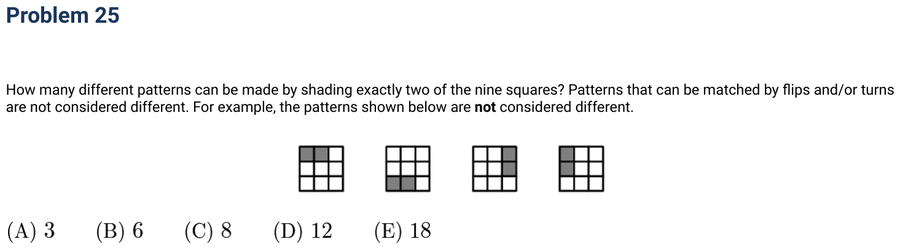
- The nine cells split into 3 symmetry types: center (1), edges (4 middle-of-side), corners (4). Turning or flipping the grid shuffles cells *within* a type, so what matters is which types you shade and how they're positioned.
- Go through the type-pairs. Center + edge: 1 way. Center + corner: 1 way. Two edges: they're either next to each other (adjacent) or across (opposite) — 2 ways. Two corners: adjacent (same side) or diagonal — 2 ways. Corner + edge: the edge either touches that corner or is on the far side — 2 ways.
- Total distinct patterns: 1 + 1 + 2 + 2 + 2 = 8. (Two center cells is impossible — there's only one center.)
- *Why this transfers:* when shapes are 'the same under flips/turns,' don't count raw placements — group the spots into symmetry types first, then count combinations of types and their relative positions. That's the heart of symmetry counting.
Mark:
· log in to save