Problem 24 · 1988 AJHSME
Stretch
Geometry & Measurement
roll-around-polygonrotation
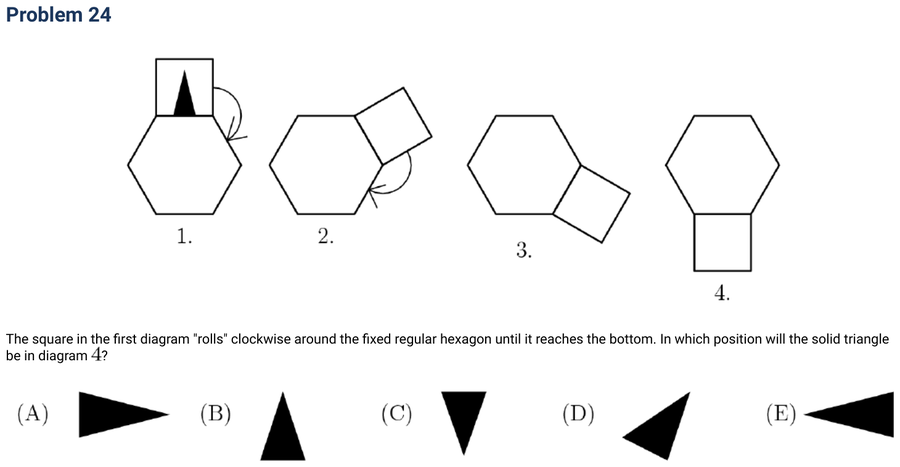
Show answer
Answer: A — A.
Show hints
Hint 1 of 2
Don't track the whole journey at once — just figure out how much the square turns at a *single* corner of the hexagon, then count how many corners it rounds from position 1 to position 4.
Still stuck? Show hint 2 →
Hint 2 of 2
At each corner the square pivots on the shared vertex. The turn there is whatever angle is left after the square's own 90° corner and the hexagon's 120° corner are taken out of the full 360° around that point.
Show solution
Approach: rotation per pivot, summed over the corners rounded
- At a corner, the square pivots about the shared vertex until its next edge lies flat on the next hexagon side. Around that vertex the full 360° is split among the square's corner (90°), the hexagon's interior corner (120°), and the turn the square sweeps. So each pivot turns the square 360° − 90° − 120° = 150° clockwise.
- Going from the top (position 1) to the bottom (position 4) rounds 3 corners, for a total of 3 × 150° = 450°. A 450° turn is the same as 450° − 360° = 90° clockwise.
- The solid triangle starts pointing straight up. Turn it 90° clockwise and it points to the right — matching choice A.
- Why this transfers: for any shape rolling around the outside of a polygon, the turn at each corner is 360° minus the rolling shape's own corner minus the polygon's corner. Add up the corners you round, then reduce by full 360° turns to read the final orientation.
Mark:
· log in to save