Problem 4 · 1988 AJHSME
Medium
Counting & Probability
count-by-rowsymmetry
Show answer
Answer: E — 11.
Show hints
Hint 1 of 2
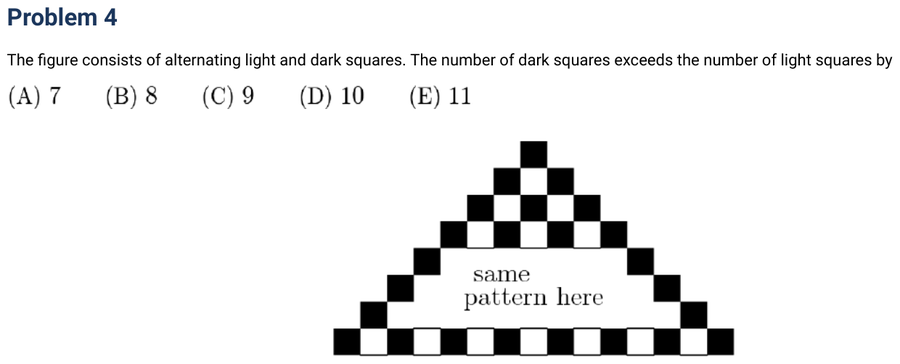
You only want the *difference* dark − light, not either total. So don't count everything — look at one row at a time and ask how far ahead dark is in that row.
Still stuck? Show hint 2 →
Hint 2 of 2
Each row alternates dark, light, dark, … and both ends are dark. An alternating strip that starts and ends the same color always has exactly one extra of that color.
Show solution
Approach: tally dark − light row by row
- Look at a single row: it goes dark, light, dark, … and begins *and* ends with dark. Whenever an alternating strip starts and ends with the same color, that color wins by exactly one — so every row has 1 more dark than light, no matter its length.
- The triangle has 11 rows, each contributing a surplus of 1, so dark beats light by 11.
- Why this transfers: when a question asks only for a difference, track the difference directly instead of computing two big totals and subtracting. The per-row +1 makes the grand total fall out instantly.
Another way — pair them off:
- In each row, pair every light square with the dark square just to its left. Every light gets a partner, but the dark square on the far right has no light partner left over.
- That's one unpaired dark per row × 11 rows = 11 extra dark squares.
Mark:
· log in to save