Problem 18 · 1986 AJHSME
Hard
Counting & Probability
posts-on-path
Show answer
Answer: B — 12.
Show hints
Hint 1 of 3
'Fewest posts' is a hint about which side to hide against the wall — the wall side needs no fence and no posts of its own, so put the *longest* side there to fence the least length.
Still stuck? Show hint 2 →
Hint 2 of 3
Now you have one straight path of fence (unrolled, it's just a line). The classic trap: a 132 m line with posts every 12 m has 132⁄12 = 11 gaps but 12 posts — one more post than gaps, because both ends get a post.
Still stuck? Show hint 3 →
Hint 3 of 3
Check the corners: at 36 m and 96 m the fence bends, but both are multiples of 12, so a post already lands there — no bonus posts needed.
Show solution
Approach: minimize fenced length, then count posts = gaps + 1
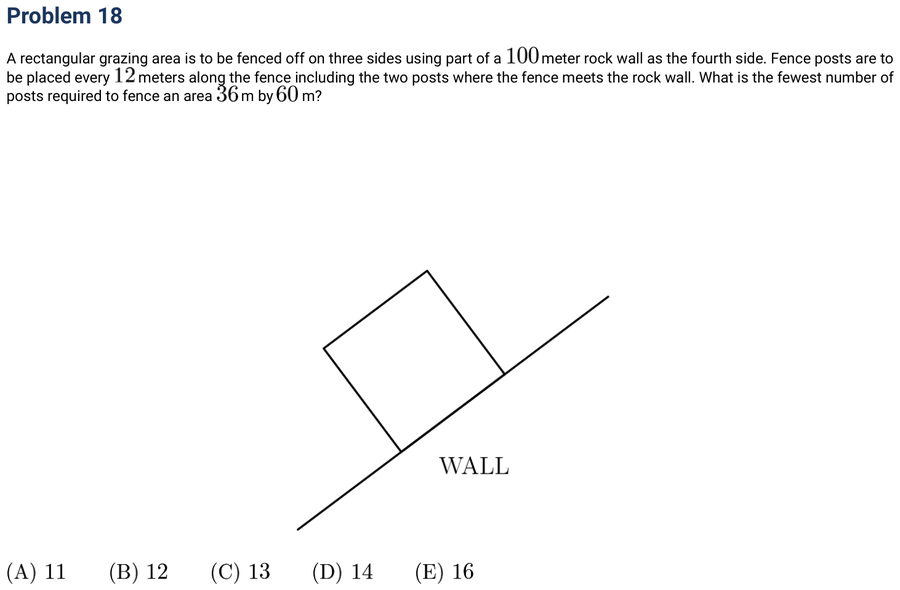
- To use the *fewest* posts, fence the *least* length, so press the longest side (60 m) against the wall — that side needs no fence. The remaining three sides total 36 + 60 + 36 = 132 m of fence.
- Think of that 132 m as one straight run (the corners don't change its length). Posts sit every 12 m, so there are 132⁄12 = 11 gaps — but the number of posts is one more than the gaps because both endpoints get a post: 11 + 1 = 12.
- Double-check the bends at 36 m and 96 m: both are multiples of 12, so posts already land exactly on the corners — nothing extra to add.
- Why 'posts = gaps + 1': this is the fencepost principle — the off-by-one that bites people who just divide and forget the two endpoints. Cutting a line into n equal pieces always needs n + 1 marks.
Mark:
· log in to save