Problem 13 · 1986 AJHSME
Hard
Geometry & Measurement
perimeter-equals-bounding-box
Show answer
Answer: C — 28.
Show hints
Hint 1 of 3
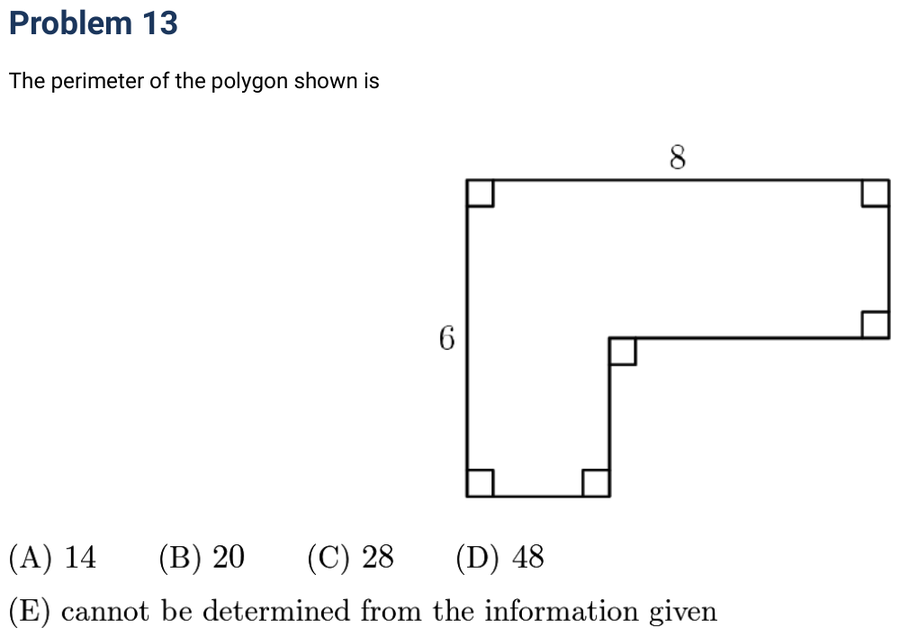
Only two lengths are labeled (8 and 6), yet the shape has six sides — so don't try to find each missing side. Instead ask: if you pushed the notched-in corner back out to make a full rectangle, would the total edge length change?
Still stuck? Show hint 2 →
Hint 2 of 3
Every horizontal piece on the staircase, added up, must still span the full width 8; every vertical piece must still span the full height 6. So the perimeter equals that of the surrounding 8-by-6 rectangle.
Still stuck? Show hint 3 →
Hint 3 of 3
Bounding rectangle: 8 wide, 6 tall — that alone fixes the perimeter even though individual side lengths are unknown.
Show solution
Approach: slide the step out — perimeter unchanged
- Look at all the horizontal edges: going across, they must total the full width, 8. Same for the vertical edges: top to bottom they total the full height, 6. Sliding the inward 'step' out to the corner just rearranges those pieces without adding or removing any length.
- So the perimeter is exactly that of the 8-by-6 bounding rectangle: 2(8 + 6) = 28.
- This is why the answer isn't 'cannot be determined' even though the step's individual sizes are hidden — for any such rectilinear staircase shape, the perimeter depends only on the overall width and height.
- Sanity check: the area would change if you moved the step, but the perimeter doesn't — a nice reminder that area and perimeter are independent.
Mark:
· log in to save