Problem 11 · 1985 AJHSME
Hard
Geometry & Measurement
cube-netopposite-faces
Show answer
Answer: E — Y.
Show hints
Hint 1 of 3
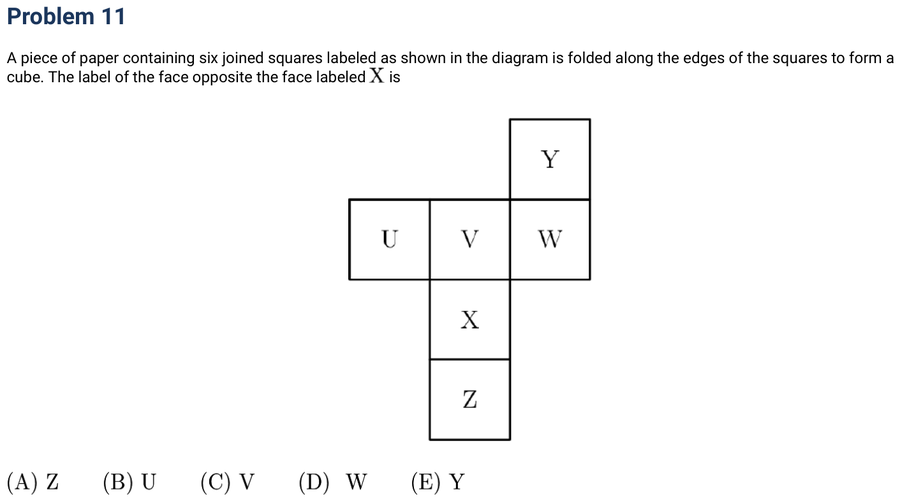
On a cube, opposite faces never share an edge. X touches V (above it) and Z (below it), so neither V nor Z can be the answer — knock those out first.
Still stuck? Show hint 2 →
Hint 2 of 3
Handy shortcut for nets: in any straight strip of THREE squares in a line, the two end squares fold to opposite faces. The vertical strip V–X–Z makes V and Z opposite — so X must pair with one of the remaining squares (U, W, or Y).
Still stuck? Show hint 3 →
Hint 3 of 3
Pick a front face and fold the rest into place. The only face left over after seating X's neighbors is the one directly across from X.
Show solution
Approach: fold around a chosen front face
- Make V the front face. Its neighbors fold in: U → left, W → right, X → bottom, and Z (below X) wraps around to the back. The square Y sits above W, and since W became the right face, Y folds up to the top.
- So X is the bottom and Y is the top — top is opposite bottom, so the face opposite X is Y.
- Why this transfers: two quick rules crack most net problems — squares that share an edge are adjacent (never opposite), and the two ends of a straight line of three squares are always opposite. Apply those before folding anything in your head.
Mark:
· log in to save