About this topic
Geometry on the AMC 8 is mostly about area, perimeter, angles, and 3D shapes. None of the formulas are hard. What's hard is reading the picture, deciding where to cut or where to apply symmetry, and not getting lost in extra information.
The single biggest mistake on geometry problems is not drawing your own picture. Even when the problem prints a diagram, redraw it on your scratch paper. Add labels for what you know. Write any lengths or angles you've computed onto the diagram. That picture becomes your record of progress.
The second biggest mistake is forgetting to use symmetry. If a figure has a center, a fold axis, or rotational symmetry, you can find one piece and multiply or mirror — saving a lot of work.
This lesson teaches the 10 most useful geometry ideas. The first three are about flat shapes (areas, decomposition, frames). The next three are about triangles and circles. The last four are 3D, angles, coordinates, and folding.
Area and perimeter — the basics that never stop being useful
Two fundamental quantities of a 2D shape:
- Perimeter = the total length of the boundary. Walk around the shape; add up the steps.
- Area = how much surface is enclosed. Counted in square units.
FORMULAS TO MEMORIZE COLD
- Rectangle: A = L · W. P = 2(L + W). Example: a 5×3 rectangle has area 15 and perimeter 16.
- Square: A = s². P = 4s. Example: side 7 → area 49, perimeter 28.
- Triangle: A = ½ · base · height. The height is perpendicular to the base, not slanted.
- Circle: A = π r². Circumference = 2π r = π d.
- Parallelogram: A = base · height (height ⊥ base).
- Trapezoid: A = ½ · (sum of the two parallel sides) · height.
One huge trap. The height in the triangle, parallelogram, and trapezoid formulas is always the perpendicular distance from the base to the opposite vertex (or opposite side). Using a slanted side instead of the perpendicular is one of the most common AMC mistakes.
For composite figures made of right angles (L-shapes, T-shapes, step shapes), the perimeter equals the perimeter of the bounding rectangle. Each inward step trades a piece of horizontal for an equal piece of inward horizontal, and similarly for vertical — net change zero.
Every quadrilateral has a one-line area formula
The rhombus is the trap. Its sides won't give you the area — its two diagonals (which cross at right angles) will: area = ½·d₁·d₂.
Tyler is tiling the floor of his 12 foot by 16 foot living room. He plans to place one-foot by one-foot square tiles to form a border along the edges of the room and to fill in the rest of the floor with two-foot by two-foot square tiles. How many tiles will he use?
Tyler's 12 ft × 16 ft living room gets a one-foot border of 1×1 tiles, and the interior is filled with 2×2 tiles. How many tiles total? Count the two regions separately:
Border (1×1 tiles). Walk around the rectangle. Total = 2(12 + 16) − 4 = 56 − 4 = 52 tiles. (The −4 is because the four corners would otherwise be counted twice.)
Interior (2×2 tiles). Stripping one foot off each side leaves a 10 ft × 14 ft inner rectangle, of area 140 sq ft. Each 2×2 tile covers 4 sq ft, so we need 140 / 4 = 35 tiles.
Total = 52 + 35 = 87 tiles (choice B).
The trap is stopping after counting the border (52) — that's only one of the two tile sizes. The problem mentions two tile sizes for a reason. Always re-read the question after step 1 to make sure you finished it.
For axis-aligned step shapes (L, T, etc.), perimeter = bounding rectangle perimeter. Area is the bounding rectangle minus the notch. Always check: are you computing area or perimeter?
2015 · #8 What is the smallest whole number larger than the perimeter of any triangle with a side of length 5 and a side of length 19?
What is the smallest whole number larger than the perimeter of any triangle with a side of length 5 and a side of length 19?
Show answer
Show hint
Show solution
- Triangle inequality: third side s < 5 + 19 = 24 (and s > 19 − 5 = 14).
- Perimeter P = 5 + 19 + s < 48 (strict). So 48 is the smallest whole number larger than every such perimeter.
2024 · #6 (figure problem)
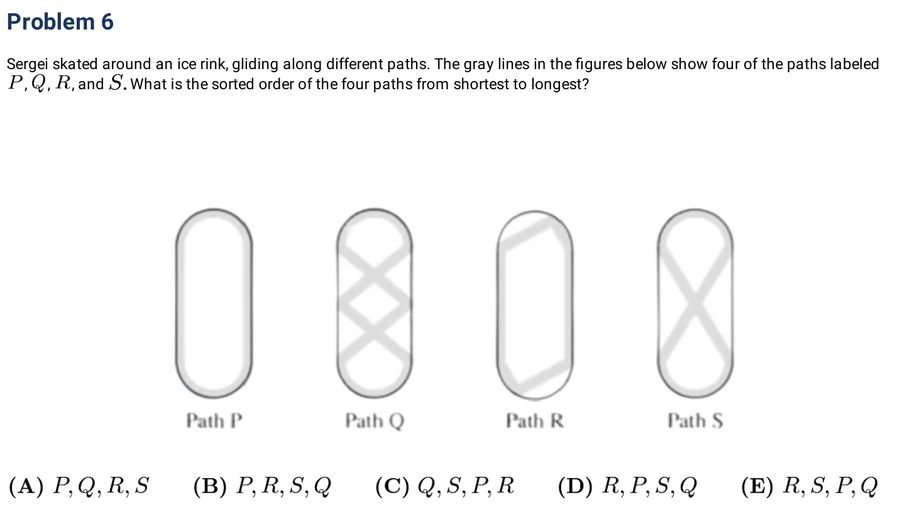
Show answer
Show hints
Still stuck? Show hint 2 →
Show solution
- R cuts the rounded ends with straight chords, so R is strictly shorter than P. Shortest.
- S adds one diagonal X inside the oval — the diagonal is a hypotenuse, longer than the legs P would take. So S > P.
- Q adds two diagonals, longer still: Q > S.
- Order: R, P, S, Q — choice D.
2026 · #3 Haruki has a piece of wire that is 24 centimeters long. He wants to bend it to form each of the following shapes, one at a time.A...
Haruki has a piece of wire that is 24 centimeters long. He wants to bend it to form each of the following shapes, one at a time.
- A regular hexagon with side length 5 cm.
- A square of area 36 cm2.
- A right triangle whose legs are 6 and 8 cm long.
Which of the shapes can Haruki make?
Show answer
Show hints
Still stuck? Show hint 2 →
Show solution
- Hexagon: perimeter = 6 × 5 = 30 cm. Longer than 24 — not possible.
- Square of area 36: side = √36 = 6, so perimeter = 4 × 6 = 24 cm. Possible. ✓
- Right triangle with legs 6 and 8: hypotenuse = √(62+82) = √100 = 10, so perimeter = 6 + 8 + 10 = 24 cm. Possible. ✓
- Only the square and the triangle can be made.
2015 · #1 How many square yards of carpet are required to cover a rectangular floor that is 12 feet long and 9 feet wide? (There are 3 feet in a yard.)
How many square yards of carpet are required to cover a rectangular floor that is 12 feet long and 9 feet wide? (There are 3 feet in a yard.)
Show answer
Show hint
Show solution
- 12 ft / 3 = 4 yd. 9 ft / 3 = 3 yd.
- Area = 4 × 3 = 12 square yards.
2019 · #2 (figure problem)
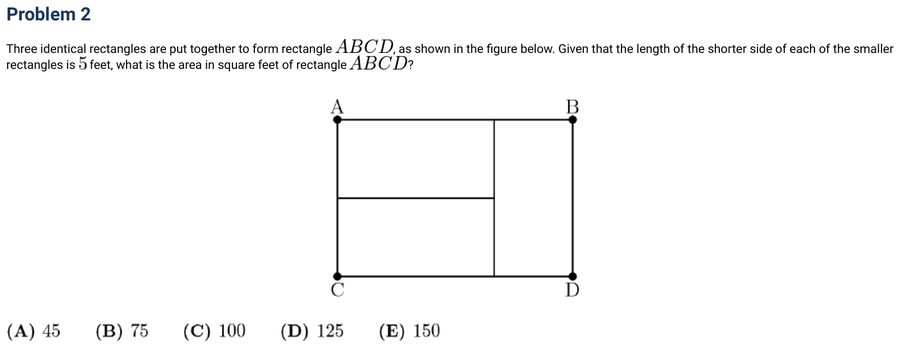
Show answer
Show hints
Still stuck? Show hint 2 →
Show solution
- Each small rectangle has short side 5. From the picture, two stacked horizontals on the left have the same height as the vertical rectangle on the right — so the long side is 2 × 5 = 10.
- ABCD has width 10 + 5 = 15 and height 10, so its area is 15 × 10 = 150 square feet.
1990 · #15 (figure problem)
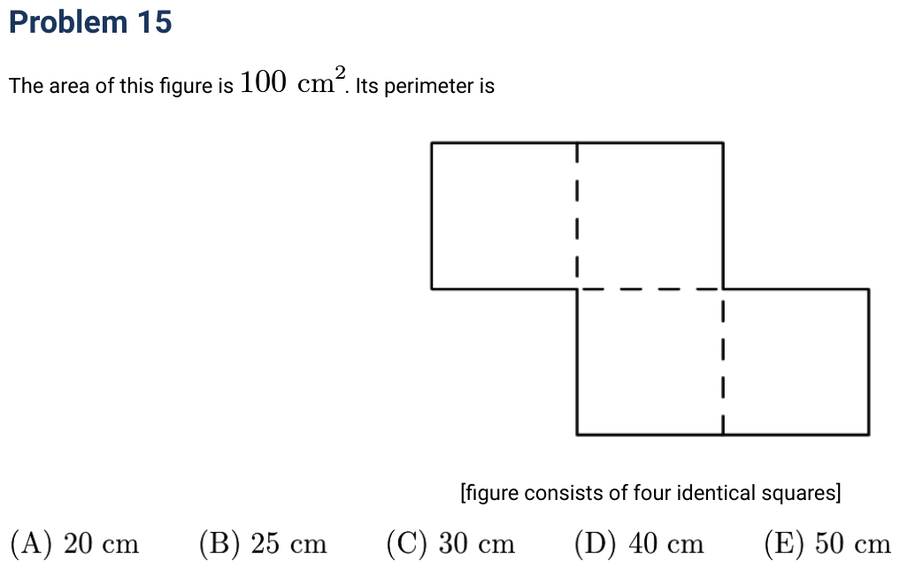
Show answer
Show hints
Still stuck? Show hint 2 →
Show solution
- Each of the four squares has area 25, so side 5. The offset (S-shaped) figure has 10 unit-side edges on its boundary.
- Perimeter = 10 × 5 = 50 cm.
Area decomposition — cut into pieces you can measure
When a region is too irregular for a single formula, cut it into pieces you DO know formulas for — rectangles, triangles, half-circles. Compute each piece, then ADD.
Often there’s more than ONE good cut. Both methods give the same answer:
HOW TO CHOOSE WHERE TO CUT
- Grid lines if the figure is on a grid — cuts make whole rectangles.
- Perpendiculars from a vertex to a side — cuts make right triangles.
- Diagonals — cuts a parallelogram or trapezoid in two equal triangles.
- Big-minus-notch when the leftover is small and obvious.
A triangle inside a rectangle — cut differently
A pentagon with vertices (0,0), (4,0), (5,3), (2,5), (0,3). Cut into a rectangle and two triangles:
- Bottom rectangle: width 4, height 3 → area 12.
- Bottom-right triangle: base 1, height 3 → ½ · 1 · 3 = 1.5.
- Top triangle: base 5, height 2 → ½ · 5 · 2 = 5.
Total: 12 + 1.5 + 5 = 18.5 square units.
For polygons with mostly right angles, slice along the right angles to make rectangles. For polygons with one or two slanted sides, drop perpendiculars to make right triangles.
If the figure is on a grid and the cutting feels messy, switch to Shoelace (chapter 9).
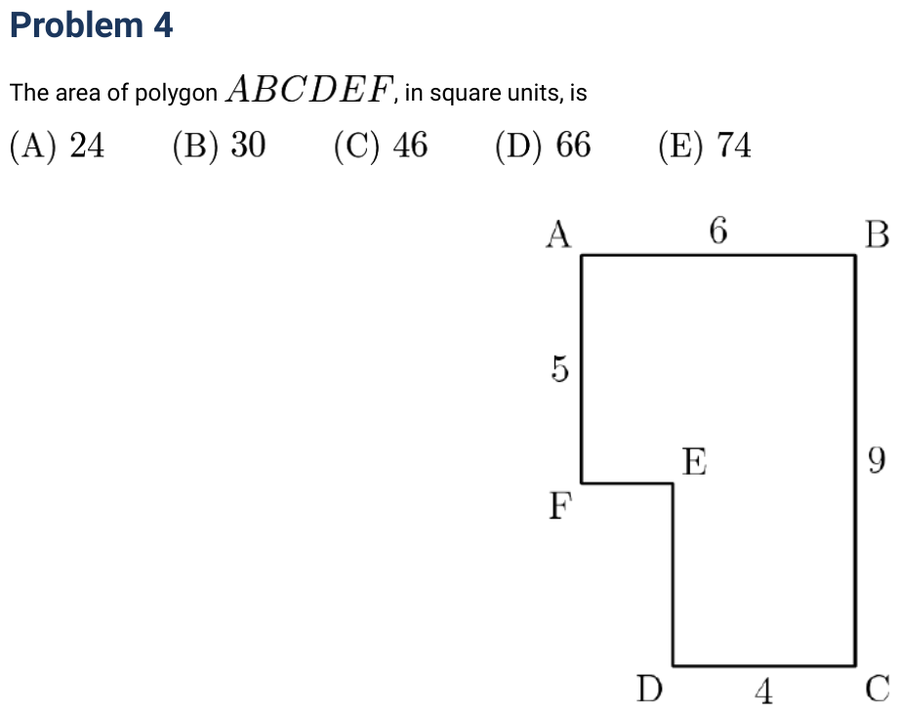
Polygon ABCDEF. Looking at the picture, the figure is an L-shape: the bounding rectangle is 6 wide × 9 tall = 54 square units. A small rectangular notch is cut out of the bottom-left.
The notch's dimensions are inferred from the labels: the bottom of the polygon goes 4 right after going down. So the notch is (6 − 4) wide = 2, and (9 − 5) tall = 4.
Notch area: 2 × 4 = 8. So polygon area = 54 − 8 = 46.
The labeled sides give you the bounding rectangle (5+4 = 9 on the right side, 6 on top) and the inward step (4 across the bottom). Read the figure carefully to identify what's the bounding box and what's the notch.
Cut, compute, add. For 'irregular' polygons inscribed in a rectangle, sometimes 'big minus notch' is faster than adding up pieces.
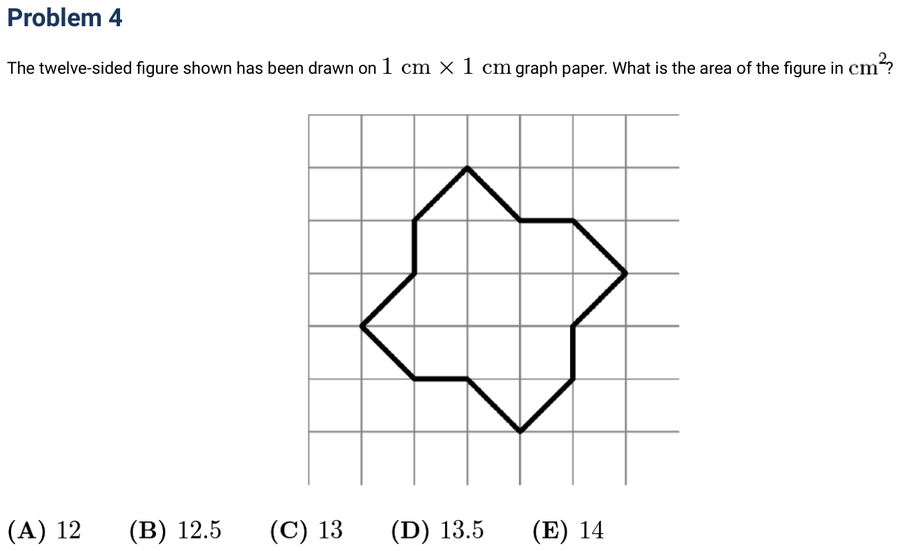
2018 · #4 (figure problem)
Show answer
Show hints
Still stuck? Show hint 2 →
Show solution
- The figure breaks into a 3 × 3 central square plus 4 identical right triangles on the outside.
- Square area: 9. Each triangle: (1/2)(2)(1) = 1; four of them: 4.
- Total: 9 + 4 = 13 cm2.
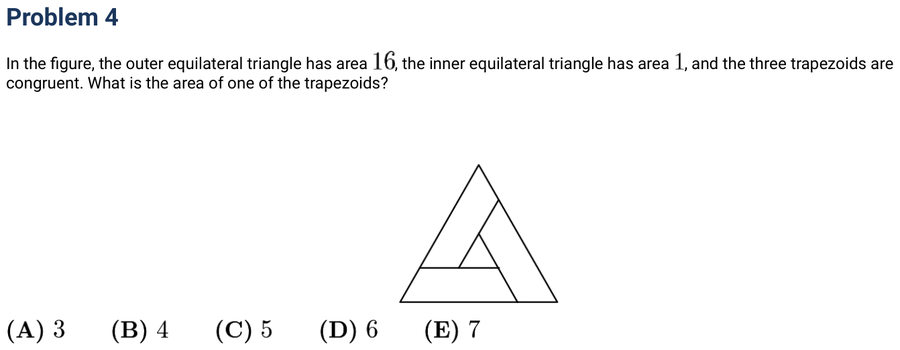
2008 · #4 In the figure, the outer equilateral triangle has area 16, the inner equilateral triangle has area 1, and the three trapezoids are...
Show answer
Show hint
Show solution
- Trapezoid combined area: 16 − 1 = 15.
- Each: 15 / 3 = 5.
2024 · #3 Four squares of side lengths 4, 7, 9, and 10 units are arranged in increasing size order so that their left edges and bottom edges...
Four squares of side lengths 4, 7, 9, and 10 units are arranged in increasing size order so that their left edges and bottom edges align. The squares alternate in the color pattern white-gray-white-gray, respectively, as shown in the figure. What is the area of the visible gray region, in square units?
Show answer
Show hints
Still stuck? Show hint 2 →
Show solution
- Smaller squares sit on top, so each gray square shows a frame = (its area) − (the square on top of it).
- Gray 10 under white 9: 102 − 92 = (10+9)(10−9) = 19.
- Gray 7 under white 4: 72 − 42 = (7+4)(7−4) = 33.
- Add the two frames: 19 + 33 = 52.
- The visible gray is the 10-square minus the 9-square plus the 7-square minus the 4-square: 100 − 81 + 49 − 16.
- = 52.
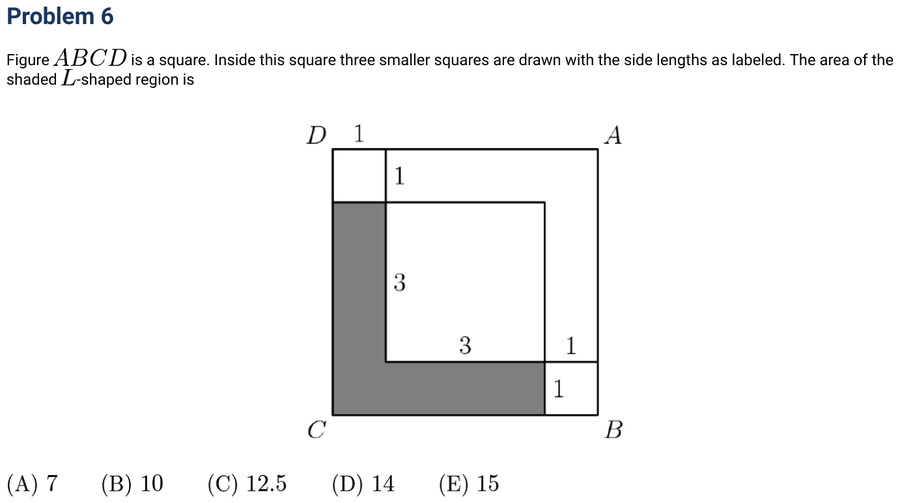
2000 · #6 (figure problem)
Show answer
Show hints
Still stuck? Show hint 2 →
Show solution
- The outer square has side 5 (area 25); the white regions are two 1×1 squares and one 4×4 square.
- Shaded L = 25 − 1 − 1 − 16 = 7.
2019 · #2 (figure problem)
Show answer
Show hints
Still stuck? Show hint 2 →
Show solution
- Each small rectangle has short side 5. From the picture, two stacked horizontals on the left have the same height as the vertical rectangle on the right — so the long side is 2 × 5 = 10.
- ABCD has width 10 + 5 = 15 and height 10, so its area is 15 × 10 = 150 square feet.
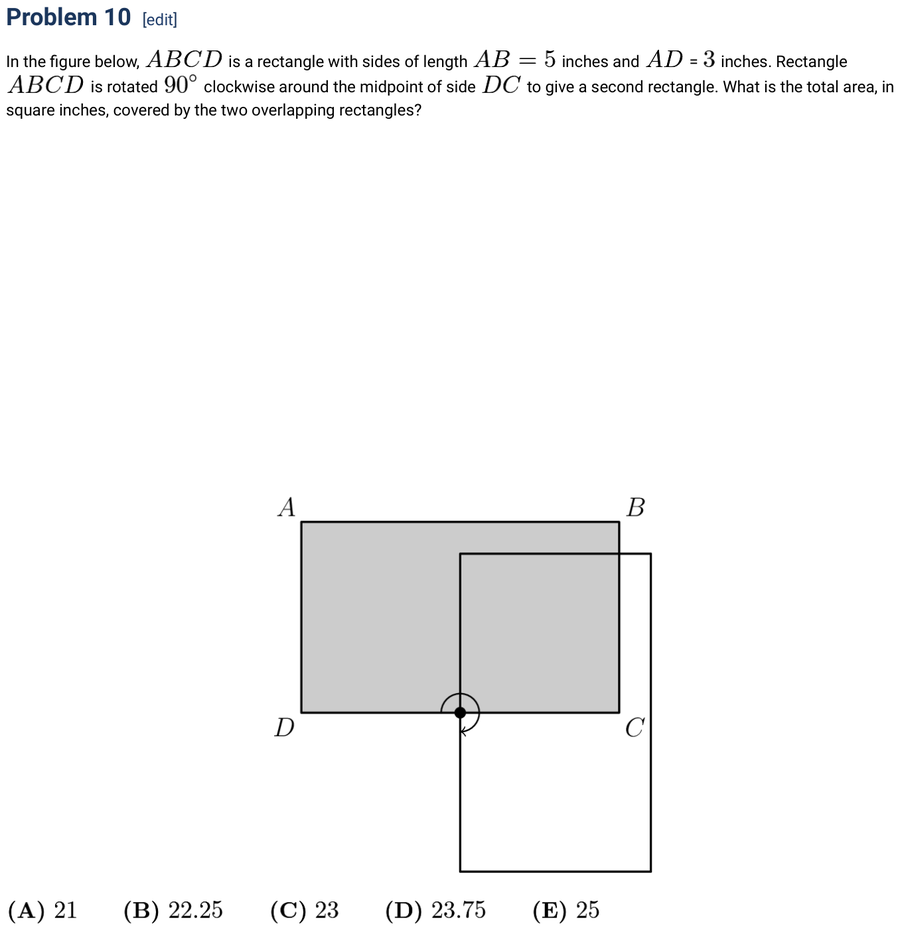
2025 · #10 (figure problem)
Show answer
Show hints
Still stuck? Show hint 2 →
Show solution
- Each rectangle has area 5 × 3 = 15.
- Rotated 90° about the midpoint of DC, the second rectangle's lower-left quarter overlaps the first rectangle's lower-right quarter — a 2.5 by 2.5 square (half of DC = 2.5), area 2.52 = 6.25.
- Total area covered = 15 + 15 − 6.25 = 23.75.
The frame trick — big region minus the hole
This is the single most common decomposition pattern on the AMC.
FRAME TRICK
Shaded area = (large region containing it) − (unshaded pieces inside).
This works when the shaded region is defined by what's removed, not by what's added. Examples:
- A square with a circle removed: area = square − circle.
- A picture inside a frame: frame area = big rectangle − inner picture rectangle.
- The leftover after cutting: original area − cut piece.
- Two overlapping shapes: union area = A + B − intersection (inclusion-exclusion).
You never measure the shaded boundary directly. You measure the big rectangle and the hole, then subtract.
The reason this works: when a shape has an irregular boundary but is clearly 'big minus small', you don't need to compute the irregular boundary at all. You just compute the two enclosing shapes.
For overlapping regions, area = A + B − overlap. For 'inside the frame' regions, area = big − small. Always identify which kind you're looking at.
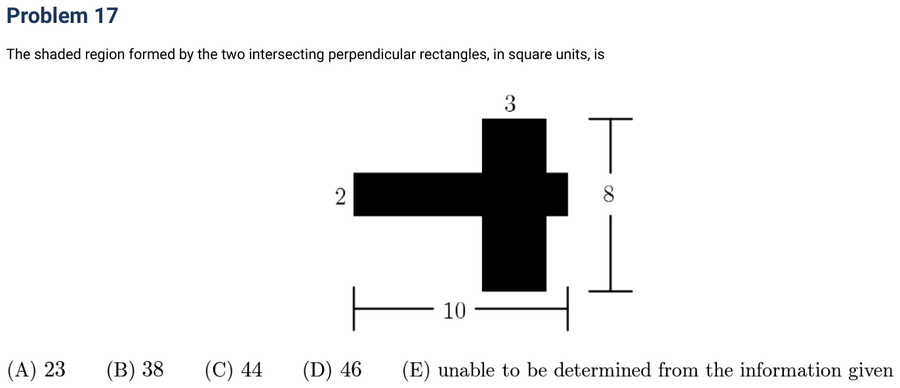
The shaded region is two perpendicular rectangles overlapping in a plus-sign shape.
- Horizontal rectangle: 10 wide × 2 tall = 20.
- Vertical rectangle: 3 wide × 8 tall = 24.
- Overlap (where both rectangles cover the same area): 3 wide × 2 tall = 6.
Shaded = 20 + 24 − 6 = 38.
Without the −6 correction, you'd get 44 — you'd be double-counting the central overlap. The fix: subtract the overlap exactly once.
For 'inside the frame' regions: area = big − small. For overlapping regions: area = A + B − overlap.
2018 · #4 (figure problem)
Show answer
Show hints
Still stuck? Show hint 2 →
Show solution
- The figure breaks into a 3 × 3 central square plus 4 identical right triangles on the outside.
- Square area: 9. Each triangle: (1/2)(2)(1) = 1; four of them: 4.
- Total: 9 + 4 = 13 cm2.
1992 · #5 (figure problem)
Show answer
Show hints
Still stuck? Show hint 2 →
Show solution
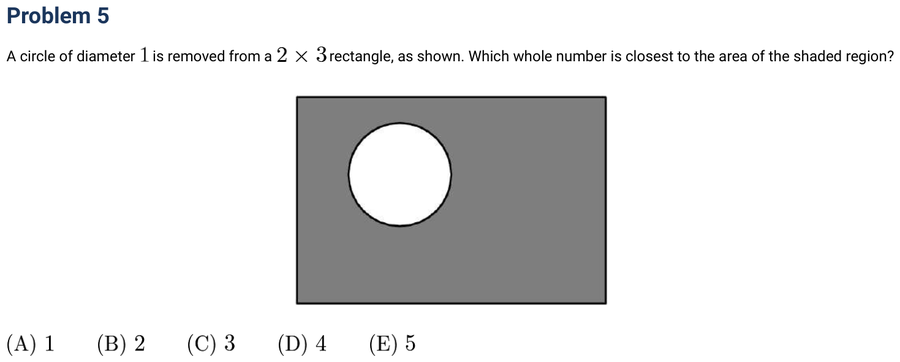
- The rectangle is 2 × 3 = 6, and the circle has area π(1/2)² ≈ 0.79.
- 6 − 0.79 ≈ 5.2, closest to 5.
1993 · #13 (figure problem)
Show answer
Show hints
Still stuck? Show hint 2 →
Show solution
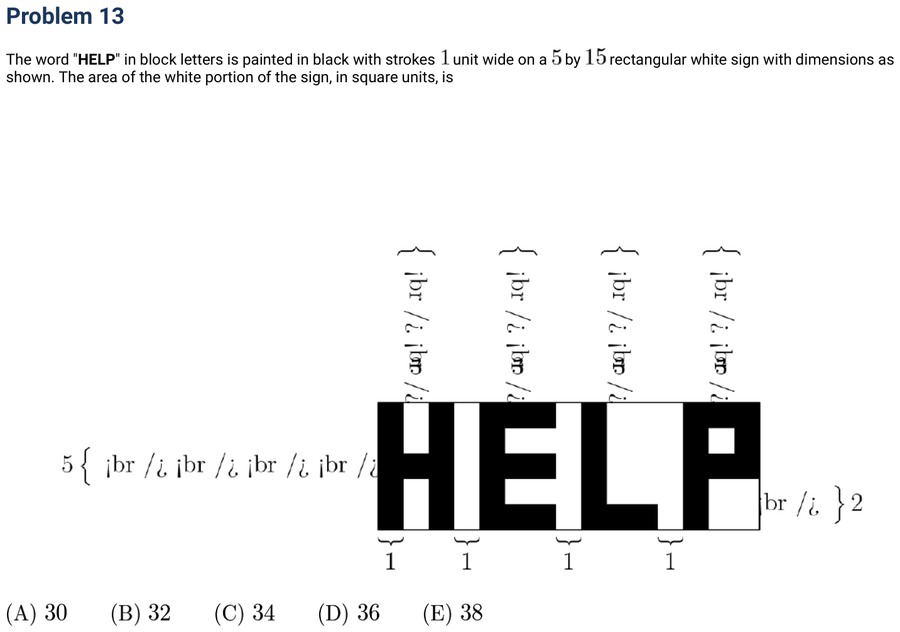
- The sign is 5 × 15 = 75 square units, and the four block letters (1-unit strokes) cover 39 squares in total.
- So the white area is 75 − 39 = 36.
2000 · #6 (figure problem)
Show answer
Show hints
Still stuck? Show hint 2 →
Show solution
- The outer square has side 5 (area 25); the white regions are two 1×1 squares and one 4×4 square.
- Shaded L = 25 − 1 − 1 − 16 = 7.
2019 · #2 (figure problem)
Show answer
Show hints
Still stuck? Show hint 2 →
Show solution
- Each small rectangle has short side 5. From the picture, two stacked horizontals on the left have the same height as the vertical rectangle on the right — so the long side is 2 × 5 = 10.
- ABCD has width 10 + 5 = 15 and height 10, so its area is 15 × 10 = 150 square feet.
Area basics — formulas, decomposition, frame
Three problems on areas, perimeters, and the frame trick.
2018 · #9 Tyler is tiling the floor of his 12 foot by 16 foot living room. He plans to place one-foot by one-foot square tiles to form a border...
Tyler is tiling the floor of his 12 foot by 16 foot living room. He plans to place one-foot by one-foot square tiles to form a border along the edges of the room and to fill in the rest of the floor with two-foot by two-foot square tiles. How many tiles will he use?
Show answer
Show hints
Still stuck? Show hint 2 →
Show solution
- Border: 2(12) + 2(16) − 4 = 52 unit tiles (subtract 4 because each corner is shared by two sides).
- Interior: 10 ft × 14 ft = 140 sq ft, filled by 2×2 tiles → 140 / 4 = 35 tiles.
- Total: 52 + 35 = 87.
1985 · #4 (figure problem)
Show answer
Show hints
Still stuck? Show hint 2 →
Show solution
- Close it up to the full 6 × 9 rectangle: area 54.
- The notch cut out is 2 × 4 = 8. Polygon = 54 − 8 = 46.
1988 · #17 (figure problem)
Show answer
Show hints
Still stuck? Show hint 2 →
Show solution
- Horizontal rectangle: 10 × 2 = 20. Vertical rectangle: 3 × 8 = 24. Overlap: 3 × 2 = 6.
- Shaded area = 20 + 24 − 6 = 38.
Right triangles — Pythagorean theorem and the famous triples
For any right triangle with legs a, b and hypotenuse c (the longest side, opposite the right angle):
PYTHAGOREAN THEOREM
a² + b² = c²
This is the most famous equation in elementary geometry. It says: in a right triangle, the area of a square built on the hypotenuse equals the sum of the areas of squares built on the two legs.
Pythagorean triples are right triangles whose three sides are all whole numbers. Memorize these:
The three most common Pythagorean triples: 3-4-5, 5-12-13, 8-15-17.
Other triples worth knowing:
- 7-24-25
- 9-40-41
- 20-21-29 (rare but does show up)
- Any multiple of a triple is also a triple: 6-8-10, 9-12-15, 30-40-50, 10-24-26, etc.
If you see a right triangle with TWO of these numbers showing, you know the third without computing.
Special non-integer right triangles. These are also crucial:
- 45-45-90 (isosceles right triangle): legs equal, hypotenuse = leg · √2. Sides in ratio
1 : 1 : √2. - 30-60-90: shorter leg = x, longer leg = x · √3, hypotenuse = 2x. Sides in ratio
1 : √3 : 2.
The 13-14-15 triangle — the one non-right triangle worth memorizing
It's not a right triangle, but its sides are all integers and so is its area:
Drop the altitude to the side of length 14. It splits into a 5-12-13 right triangle and a 9-12-15 right triangle (a 3-4-5 tripled). Both right triangles share the altitude 12, and the bases add to 5 + 9 = 14 ✓.
If you see a triangle on the AMC with sides 13, 14, 15 (or scalings of them), you can read off the area immediately.
Whenever you see a right triangle with two of these triple numbers in it, the third side is forced. For 9 and 12 as legs, hypotenuse = 15 (it's 3 × {3, 4, 5}). For 13 (hypotenuse) and 5 (a leg), the other leg = 12.
Triples often hide inside other figures. A square inscribed in a triangle might create 3-4-5 fragments. Always scan the diagram for legs that look like a known triple.
Rectangle ABCD and right triangle DCE have the same area. They are joined to form a trapezoid, as shown. What is DE?
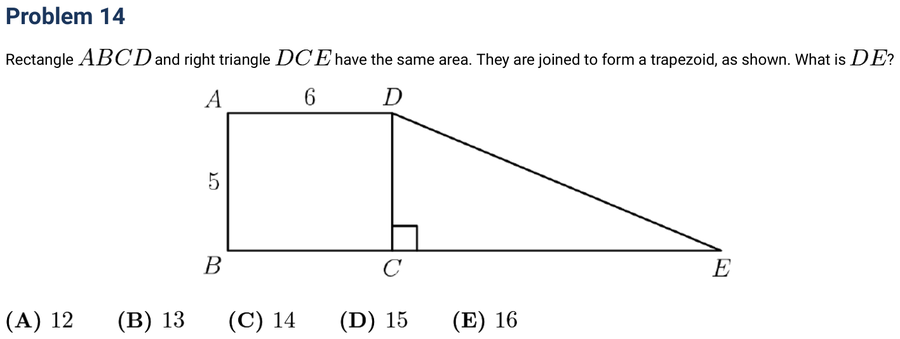
Rectangle ABCD (sides 5 and 6) and right triangle DCE have equal area, joined to form a trapezoid. Side DC = 5 is shared, and CE is the other leg of the triangle. Find DE.
Equal areas:
Rectangle area = 5 × 6 = 30.
Triangle area = ½ × 5 × CE = 30 → CE = 12.
Now DCE has legs 5 and 12 — that's the 5-12-13 triple, so the hypotenuse is forced:
DE = 13.
You never had to actually compute √(25 + 144) — the moment you see legs 5 and 12, the hypotenuse is 13 by reflex. The Pythagorean triples are pattern-matching, not arithmetic.
Memorize 3-4-5, 5-12-13, 8-15-17, 7-24-25, and their multiples. For 45-45-90 and 30-60-90 triangles, know the side ratios (1:1:√2 and 1:√3:2).
2007 · #14 The base of isosceles ▵ABC is 24 and its area is 60. What is the length of one of the congruent sides?
The base of isosceles ▵ABC is 24 and its area is 60. What is the length of one of the congruent sides?
Show answer
Show hint
Show solution
- Height = 2 · 60 / 24 = 5.
- Each congruent side = √(52 + 122) = √169 = 13.
2011 · #16 Let A be the area of the triangle with sides of length 25, 25, and 30. Let B be the area of the triangle with sides of length 25, 25,...
Let A be the area of the triangle with sides of length 25, 25, and 30. Let B be the area of the triangle with sides of length 25, 25, and 40. What is the relationship between A and B?
Show answer
Show hints
Still stuck? Show hint 2 →
Show solution
- Triangle with base 30: half-base 15, hypotenuse 25 ⇒ height = √(252 − 152) = 20. Area A = (1/2)(30)(20) = 300.
- Triangle with base 40: half-base 20, hypotenuse 25 ⇒ height = √(252 − 202) = 15. Area B = (1/2)(40)(15) = 300.
- A = B.
2013 · #20 A 1 × 2 rectangle is inscribed in a semicircle with the longer side on the diameter. What is the area of the semicircle?
A 1 × 2 rectangle is inscribed in a semicircle with the longer side on the diameter. What is the area of the semicircle?
Show answer
Show hints
Still stuck? Show hint 2 →
Show solution
- Place the semicircle's center at the midpoint of the diameter. Upper corners of the rectangle are at (1, 1) and (−1, 1).
- Radius2 = 12 + 12 = 2 ⇒ r = √2.
- Semicircle area = (1/2)πr2 = (1/2)π(2) = π.
2005 · #7 Bill walks 12 mile south, then 34 mile east, and finally 12 mile south. How many miles is he, in a direct line, from his starting point?
Bill walks 12 mile south, then 34 mile east, and finally 12 mile south. How many miles is he, in a direct line, from his starting point?
Show answer
Show hint
Show solution
- Net south: 1, east: 3/4.
- Distance: √(12 + (3/4)2) = √(1 + 9/16) = √(25/16) = 5/4 = 1¼.
2019 · #4 (figure problem)
Show answer
Show hints
Still stuck? Show hint 2 →
Show solution
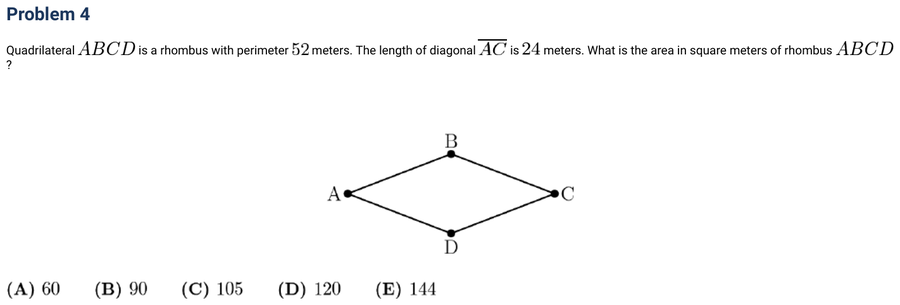
- Side length: 52 ÷ 4 = 13. Half of AC: 24 ÷ 2 = 12.
- The diagonals are perpendicular bisectors, so each quarter of the rhombus is a right triangle with leg 12 and hypotenuse 13 — a 5-12-13 triple. The other half-diagonal is 5, so BD = 10.
- Area of a rhombus = d1 × d22 = 24 × 102 = 120 sq m.
2003 · #6 (figure problem)
Show answer
Show hints
Still stuck? Show hint 2 →
Show solution
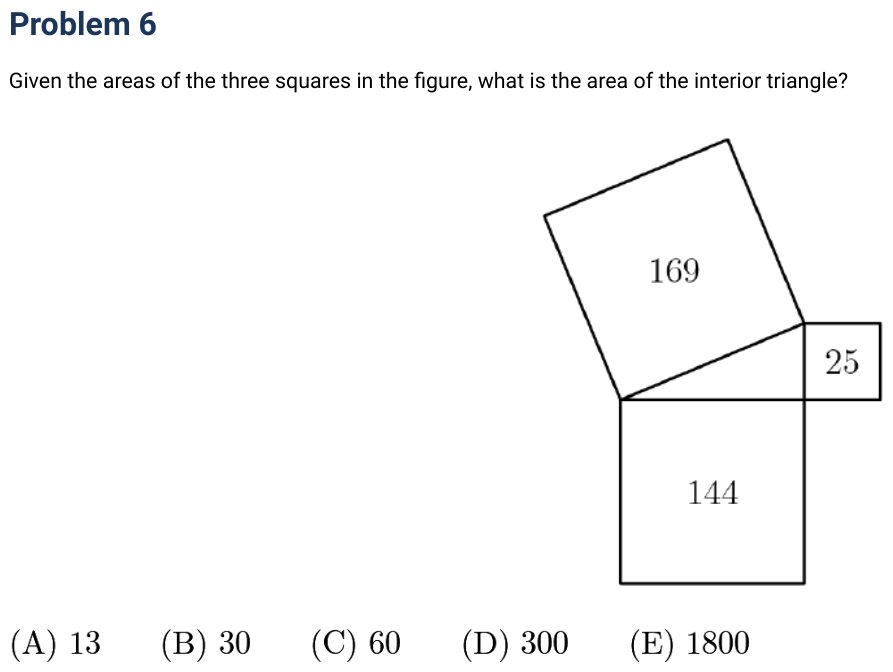
- The squares have areas 169, 144, and 25, so the triangle's sides are 13, 12, and 5.
- Since 5² + 12² = 13², the triangle is right-angled with legs 5 and 12.
- Area = ½ × 5 × 12 = 30.
Symmetry — measure one piece, then multiply
If a figure has a line of symmetry or rotational symmetry, you can find one piece and use the symmetry to handle the others without re-computing.
Lines of symmetry (axes you can fold along):
- A square has 4 axes (two through midpoints, two diagonals).
- An equilateral triangle has 3 axes.
- A rectangle has 2 axes (through midpoints, not the diagonals).
- A regular hexagon has 6 axes.
- A circle has infinitely many — any line through the center.
Rotational symmetry: a figure looks the same after rotating by some angle. A square has order 4 (looks the same after 90°, 180°, 270°, 360°). A regular hexagon has order 6.
When a figure is shaded in a symmetric pattern, the shaded area is some clean fraction of the whole — often 1/2, 1/4, 3/8. Don't compute the irregular boundary if you can guess the fraction.
For 'what fraction of the figure is shaded' problems, look for the smallest symmetric piece (a wedge, a quadrant, an eighth) and check what fraction of that piece is shaded. By symmetry, the same fraction applies to the whole figure.
The area of rectangle ABCD is 72. If point A and the midpoints of sides BC and CD are joined to form a triangle, the area of that triangle is
A rectangle with the midpoints of two opposite sides joined to opposite corners. The result is a shaded inner region.
The lines divide the rectangle into 8 smaller triangles, all symmetric in pairs. The shaded region uses 3 of these 8 triangles. So the fraction shaded is 3/8.
If the rectangle has area 72, the shaded area = 72 × 3/8 = 27.
Counting the 8 symmetric sub-pieces first is the cleanest path. Then count how many are shaded. The shaded area is (count of shaded / total count) × (total area).
Always check for symmetry before computing. The shaded fraction is often clean even when the boundary looks ugly.
2015 · #2 (figure problem)
Show answer
Show hints
Still stuck? Show hint 2 →
Show solution
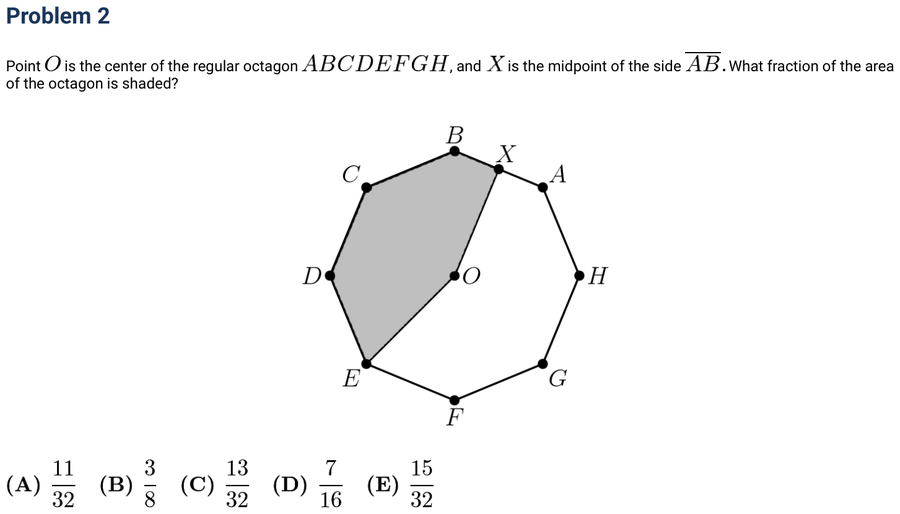
- Connect O to each vertex. The octagon splits into 8 congruent triangles, each 1/8 of the total area.
- Shaded covers triangles OBC, OCD, ODE (three full) plus ▵OXB which is half of ▵OAB.
- Total: (3 + 1/2)/8 = 3.5/8 = 7/16.
2025 · #1 (figure problem)
Show answer
Show hints
Still stuck? Show hint 2 →
Show solution
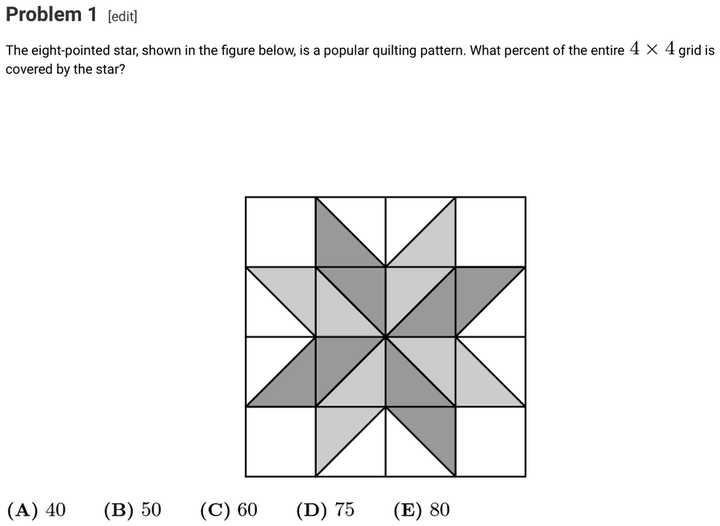
- The whole pattern sits on a 4 × 4 grid, so its total area is 16 unit squares.
- The star is built from triangles, and each shaded triangle has a congruent white triangle as its partner — the shaded and white regions match up exactly.
- So the star covers exactly half of the grid: 8 of the 16 squares, which is 50%.
2023 · #2 (figure problem)
Show answer
Show hints
Still stuck? Show hint 2 →
Show solution
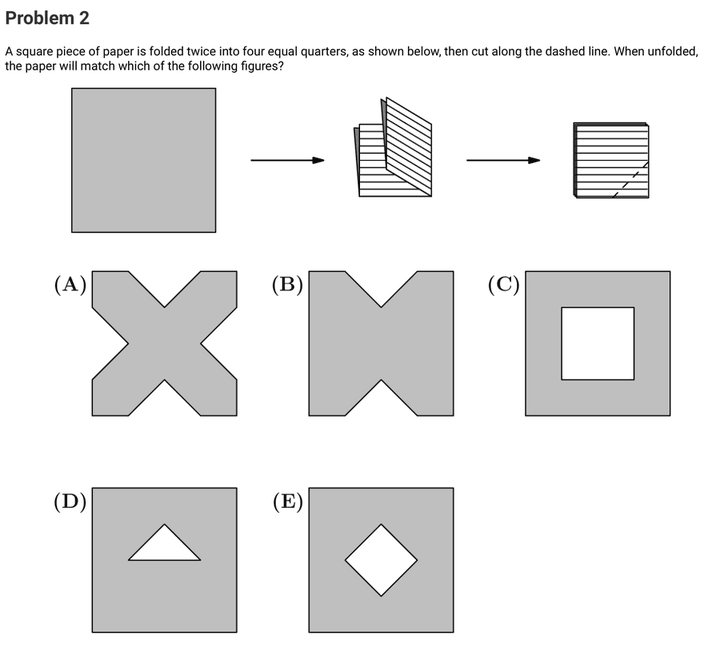
- Folding the square twice into quarters brings all four corners together; the folded corner is the center of the full sheet.
- The diagonal cut slices across that folded stack, snipping a small triangle from all four layers at once.
- Unfolding, those four snips open up into a single diamond-shaped hole in the middle of the paper — figure (E).
2017 · #16 (figure problem)
Show answer
Show hints
Still stuck? Show hint 2 →
Show solution
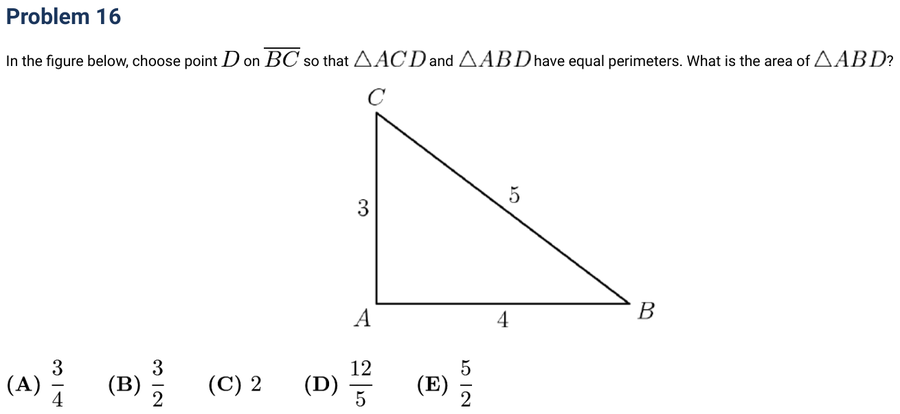
- ▵ABC is a 3-4-5 right triangle (right angle at A). Let BD = x, so CD = 5 − x.
- AD is shared, so equal perimeters ⇒ AC + CD = AB + BD ⇒ 3 + (5 − x) = 4 + x ⇒ x = 2.
- ▵ABD and ▵ABC share the altitude from A to line BC, so areas are in ratio BD : BC = 2 : 5.
- Area of ▵ABC = (1/2)(3)(4) = 6. Area of ▵ABD = (2/5)(6) = 12/5.
2019 · #6 (figure problem)
Show answer
Show hints
Still stuck? Show hint 2 →
Show solution
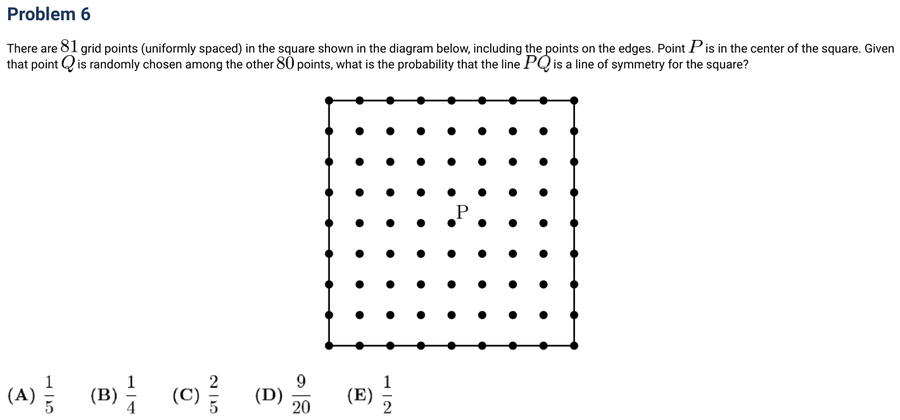
- A square has exactly 4 axes of symmetry through its center P: the two diagonals and the two perpendicular bisectors.
- Each axis contains 9 of the 81 grid points (including P). Counting Q across all 4: 4 × 9 = 36 spots, but P appears 4 times and Q can't equal P, so subtract 4 → 32 valid choices.
- Probability = 32 / 80 = 2/5.
1999 · #14 (figure problem)
Show answer
Show hints
Still stuck? Show hint 2 →
Show solution
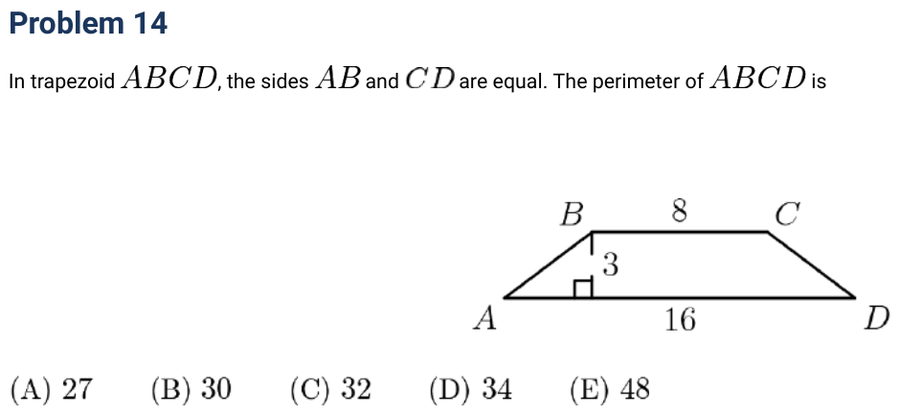
- The two equal ends of the bottom are each (16 − 8) ÷ 2 = 4, and the height is 3, so each slant side is √(4² + 3²) = 5.
- The perimeter is 16 + 8 + 5 + 5 = 34.
Surface area, volume, and nets
For 3D shapes:
3D FORMULAS
- Cube of side s: Surface area = 6s². Volume = s³.
- Rectangular box (a × b × c): SA = 2(ab + bc + ca). Volume = abc.
- Cylinder (radius r, height h): SA = 2πr² + 2πrh. Volume = πr² h.
- Sphere (radius r): SA = 4πr². Volume = (4/3)πr³.
- Cone (radius r, height h, slant ℓ): Volume = (1/3)πr²h. SA = πr² + πrℓ.
A net is a 2D unfolding of a 3D shape — the pattern of faces you'd cut out of paper and fold up. A cube has 11 distinct nets (counting rotations/reflections as the same). The most common net looks like a plus-sign cross with 6 squares.
The key skill: given a net, identify which faces become opposite when folded.
Fold F up as the front of the cube. T folds up to the top, B folds down to the bottom (so T ↔ B). L folds to the left, R folds to the right (so L ↔ R). K wraps around to become the back (so F ↔ K).
For "sculpture" problems where many cubes are stacked: count exposed unit faces by direction. Top exposed + front + back + left + right = surface area. (The bottom usually doesn't count since it sits on the ground.) This is faster than the formula "total faces minus hidden pairs" for irregular shapes.
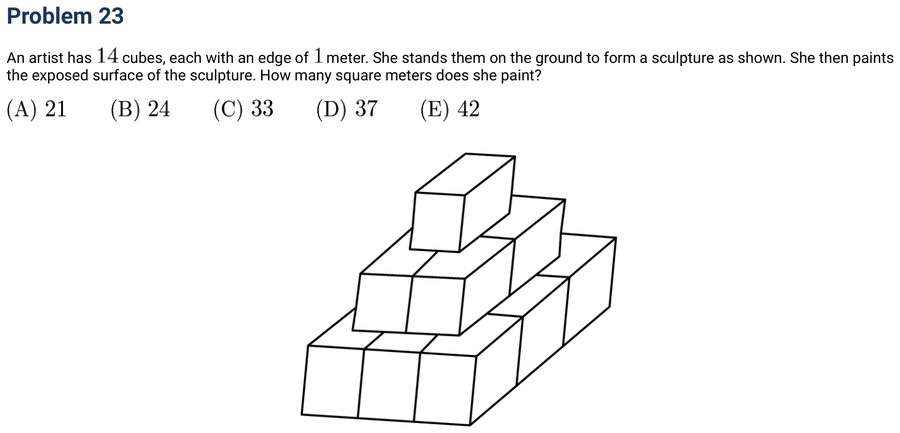
An artist arranges 14 unit cubes into a stepped sculpture and paints the exposed surfaces (not the bottoms touching the ground).
Tally by viewing direction:
- Tops (one square per cube whose top isn't covered): 10.
- Front (squares visible head-on): 6.
- Back (squares visible from behind): 6.
- Left + right sides together: 11.
Total: 10 + 6 + 6 + 11 = 33 square meters.
The directional count is faster than 'total faces minus hidden pairs' for irregular sculptures. Just count by direction, sum them.
Surface area = sum of face areas. For composite solids, count exposed faces by direction (top/front/back/left/right).
1989 · #20 (figure problem)
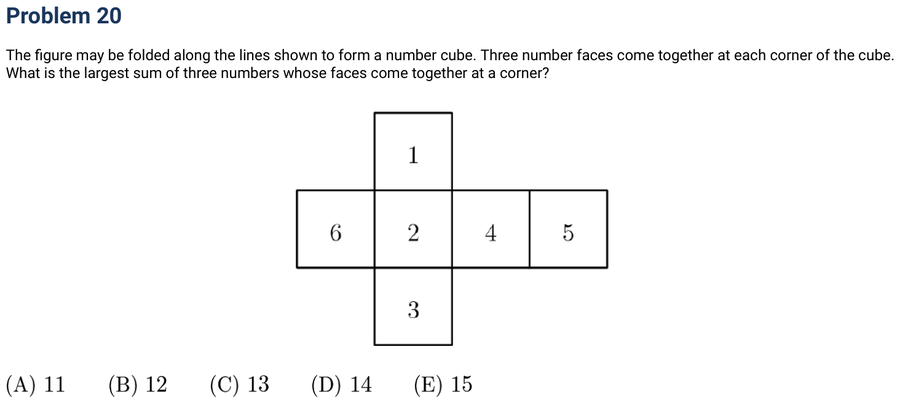
Show answer
Show hints
Still stuck? Show hint 2 →
Show solution
- Fold the net with 2 as the front: 1 goes on top and 3 on the bottom (1↔3), 6 to the left and 4 to the right (6↔4), and 5 wraps around to the back opposite 2 (2↔5).
- Each corner has one face from each pair, so the biggest corner sum is 5 + 3 + 6 = 14.
1985 · #11 (figure problem)
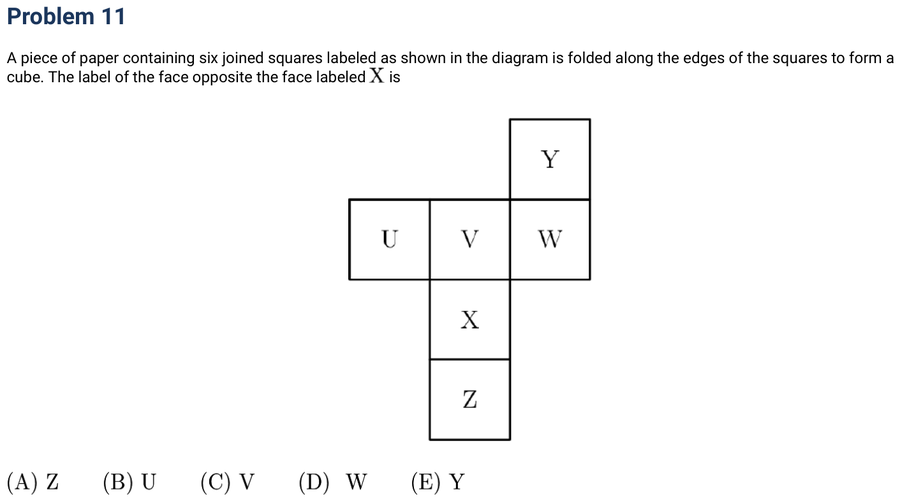
Show answer
Show hints
Still stuck? Show hint 2 →
Show solution
- Make V the front. U folds left, W folds right, X folds down to become the bottom, Z (below X) wraps around to become the back. That puts Y (the square attached to W's top) onto the top.
- Top ↔ bottom means Y is opposite X.
1991 · #15 (figure problem)
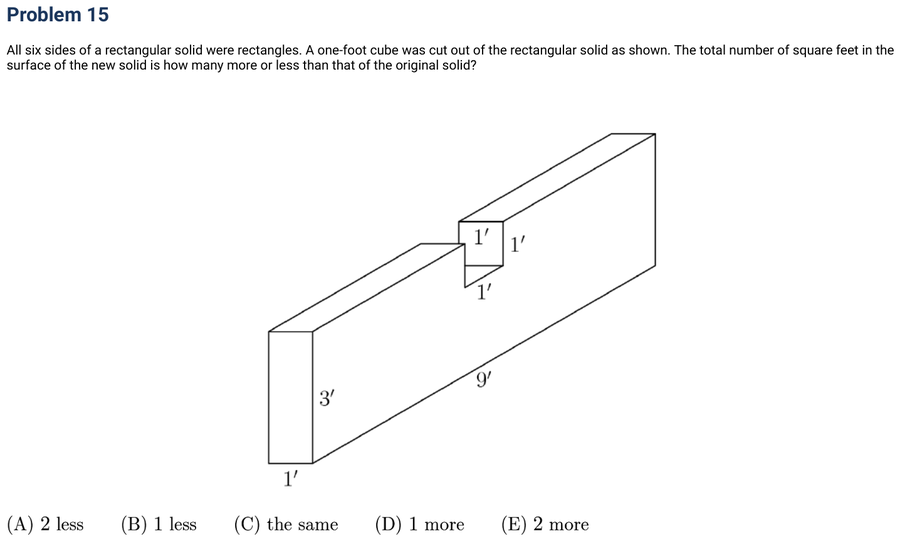
Show answer
Show hints
Still stuck? Show hint 2 →
Show solution
- Cutting the unit cube out of the corner removes three exposed unit squares but uncovers three new ones inside the notch.
- The two amounts cancel, so the surface area stays the same.
1993 · #17 (figure problem)
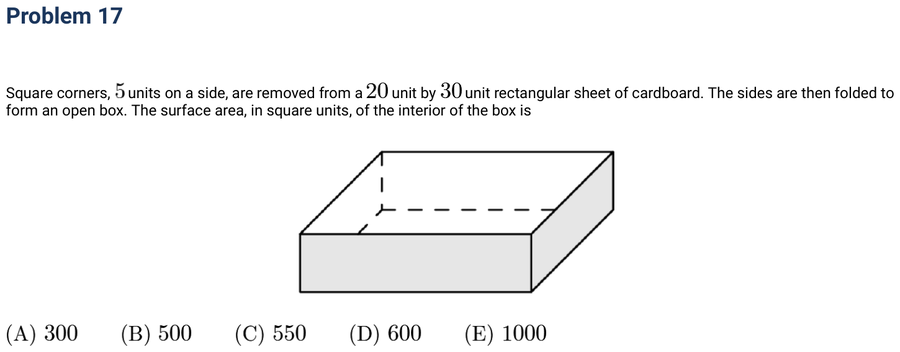
Show answer
Show hints
Still stuck? Show hint 2 →
Show solution
- The base is 10 × 20 = 200 and the height is 5, so the four walls add 2(10·5) + 2(20·5) = 300.
- The interior surface (no top) is 200 + 300 = 500.
2000 · #22 (figure problem)
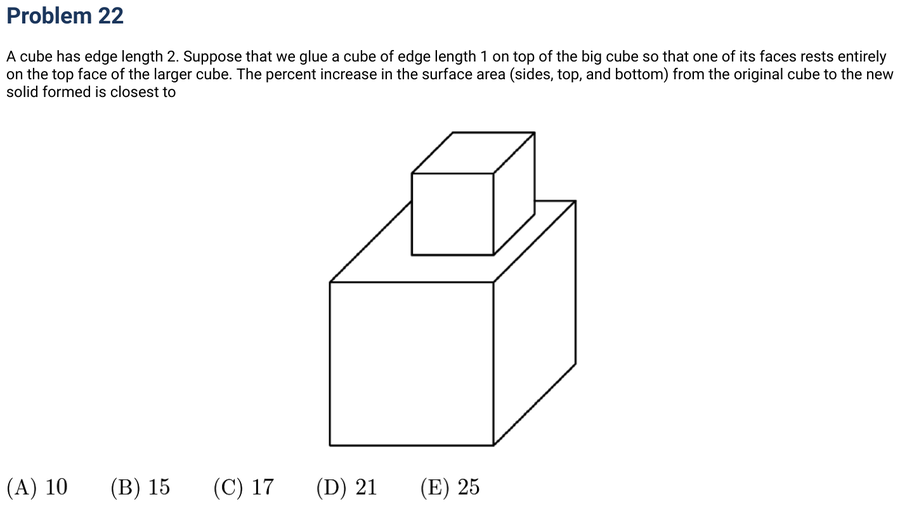
Show answer
Show hints
Still stuck? Show hint 2 →
Show solution
- The original cube's surface area is 6 · 2² = 24.
- The small cube hides a 1 × 1 patch of the big top, but its own top sits directly above that patch, so the upward-facing area is unchanged. Only its 4 side walls are new, adding 4.
- The increase is 4 / 24 = ⅙ ≈ 16.7%, closest to 17%.
Triangles and 3D
Three problems on Pythagorean triples, symmetry, and surface area.
2014 · #14 Rectangle ABCD and right triangle DCE have the same area. They are joined to form a trapezoid, as shown. What is DE?
Show answer
Show hints
Still stuck? Show hint 2 →
Show solution
- Rectangle area = 5 × 6 = 30.
- Triangle area = (1/2)(5)(CE) = 30 ⇒ CE = 12.
- DE = √(52 + 122) = √169 = 13.
2000 · #25 The area of rectangle ABCD is 72. If point A and the midpoints of sides BC and CD are joined to form a triangle, the area of that triangle is
The area of rectangle ABCD is 72. If point A and the midpoints of sides BC and CD are joined to form a triangle, the area of that triangle is
Show answer
Show hints
Still stuck? Show hint 2 →
Show solution
- The triangle is what remains after cutting off the three corner right triangles. Measured against the whole rectangle, the ones at corners B and D are ¼ each (a full side and a half-side as legs), and the one at corner C is ⅛ (two half-sides).
- Together the corners take ¼ + ¼ + ⅛ = ⅝ of the rectangle, leaving ⅜.
- So the triangle is ⅜ · 72 = 27.
1989 · #23 (figure problem)
Show answer
Show hints
Still stuck? Show hint 2 →
Show solution
- Top faces (one per cube whose top isn't covered) total 10. Front-facing exposed faces total 6, back 6, and the two side walls together account for the remaining 11.
- Adding gives 10 + 6 + 6 + 11 = 33 square meters of paint.
Angle chasing
Angle chasing is the geometry game where you keep applying angle rules to propagate known angles around a figure until you find the angle you need.
ANGLE RULES TO KNOW COLD
- Straight line: angles along a straight line sum to 180°.
- Point: angles around a single point sum to 360°.
- Triangle: interior angles sum to 180°.
- Polygon (n sides): interior angles sum to (n−2) · 180°. A square has 4·90 = 360°, a pentagon has 540°, a hexagon has 720°.
- Regular polygon (n sides): each interior angle = (n−2)·180° / n. Equilateral triangle 60°, square 90°, regular pentagon 108°, regular hexagon 120°.
- Exterior angle of a triangle: equals the sum of the two non-adjacent interior angles.
- Parallel lines + transversal: alternate interior angles are equal; corresponding angles are equal.
- Isosceles triangle: the two angles opposite the equal sides are equal.
- Vertically opposite angles (the X formed by two crossing lines) are equal.
- Inscribed angle in a circle = half the central angle that subtends the same arc.
The exterior-angle theorem is one of the most-used rules. Picture a triangle ABC, and extend one side past vertex B to make an exterior angle. That exterior angle equals the sum of the two non-adjacent interior angles (A and C):
Start from what's labeled. Apply one rule. Label the new angle. Repeat. Most angle problems collapse in 3–4 steps.
For regular polygons, the interior-angle formula is the most useful single fact. Memorize this little table — AMC reuses the same shapes constantly:
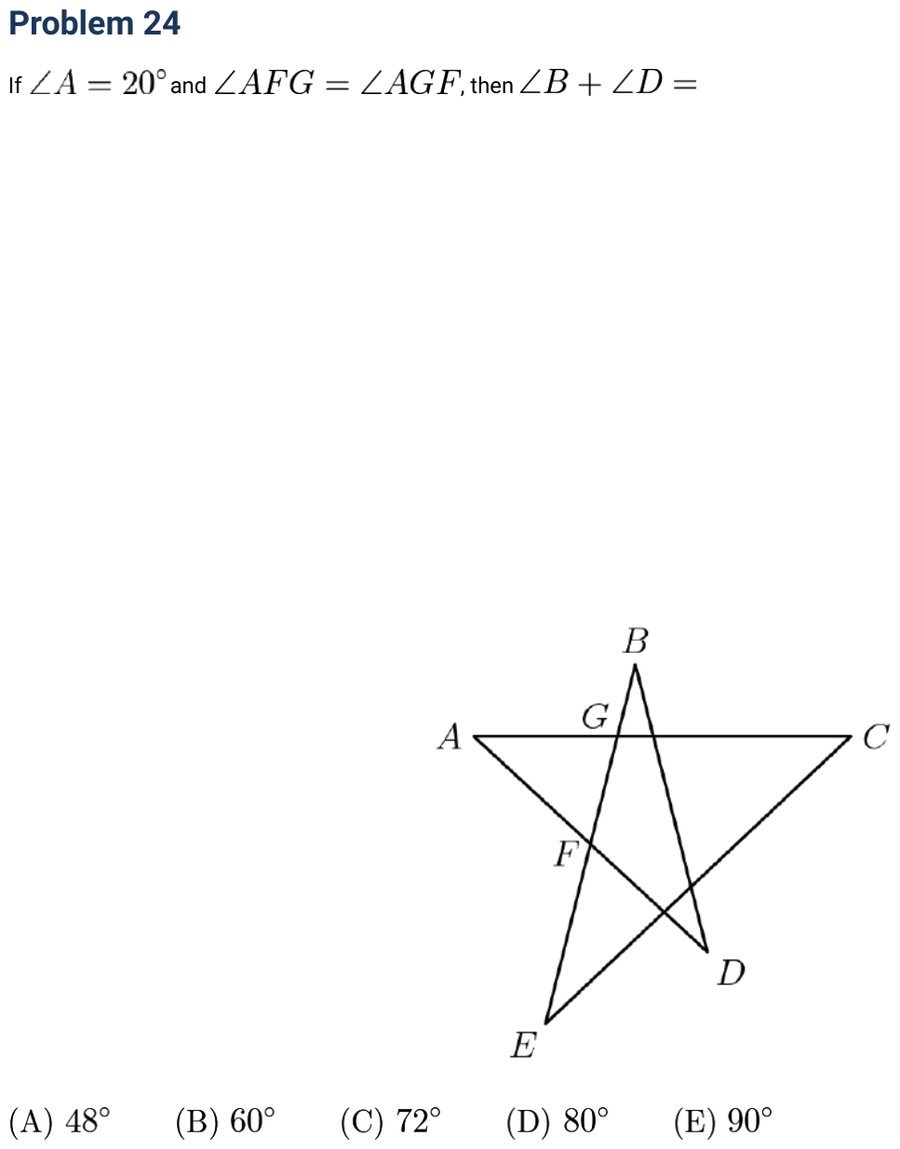
For a regular pentagram (5-pointed star) inscribed in a regular pentagon: each tip of the star is an isosceles triangle.
The interior angle of a regular pentagon is (5−2)·180°/5 = 108°, so its exterior angle is 180° − 108° = 72°. Each tip triangle's two base angles sit in those 72° exterior gaps, so apex = 180° − 2·72° = 36°.
Sum of all 5 tip angles = 5 × 36° = 180°.
Some symmetric figures have elegant angle relationships that don't require computing every angle. The five-tip sum = 180° is a classic.
Start with labeled angles. Apply one rule (triangle sum, exterior angle, parallel lines). Propagate. Most angle problems collapse in 3–4 steps.
1997 · #12 (figure problem)
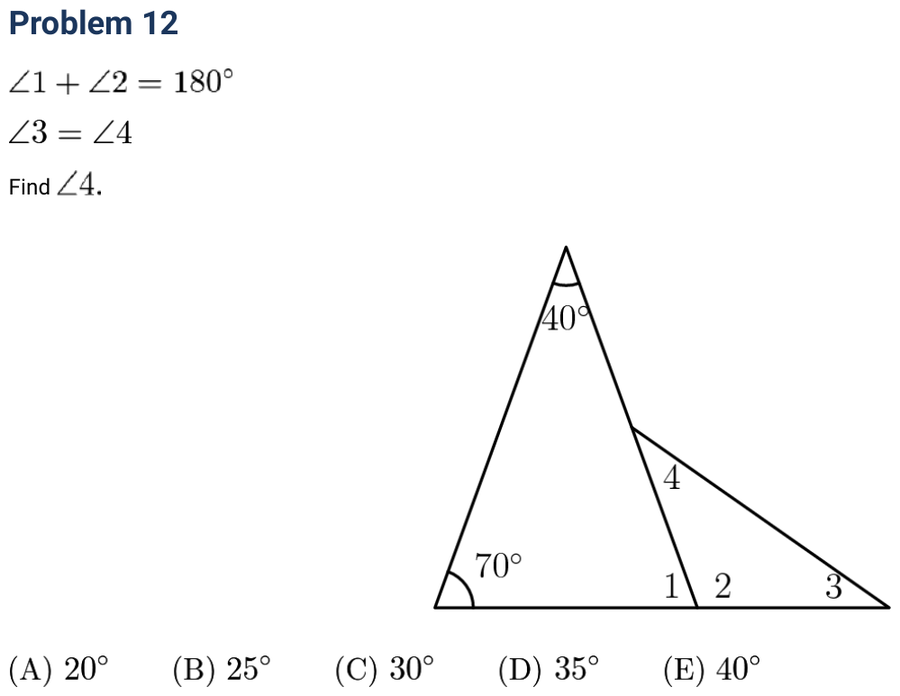
Show answer
Show hints
Still stuck? Show hint 2 →
Show solution
- In the left triangle, ∠1 = 180° − 70° − 40° = 70°, so ∠2 = 180° − 70° = 110°.
- In the right triangle ∠3 + ∠4 = 180° − 110° = 70°, and since ∠3 = ∠4, each is 35°.
1994 · #7 (figure problem)
Show answer
Show hints
Still stuck? Show hint 2 →
Show solution
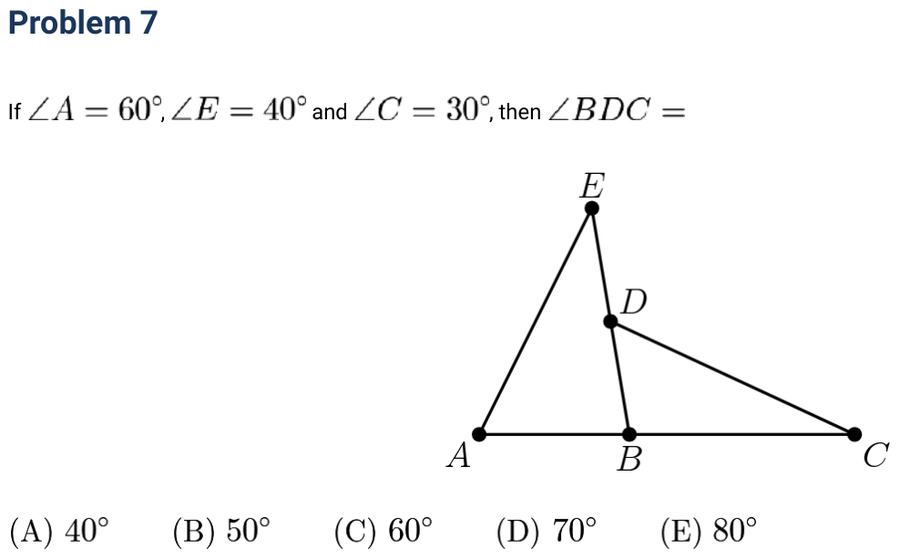
- In triangle ABE, ∠ABE = 180° − 60° − 40° = 80°.
- A, B, C are collinear, so ∠DBC = 180° − 80° = 100°. In triangle BDC, ∠BDC = 180° − 100° − 30° = 50°.
1999 · #21 (figure problem)
Show answer
Show hints
Still stuck? Show hint 2 →
Show solution
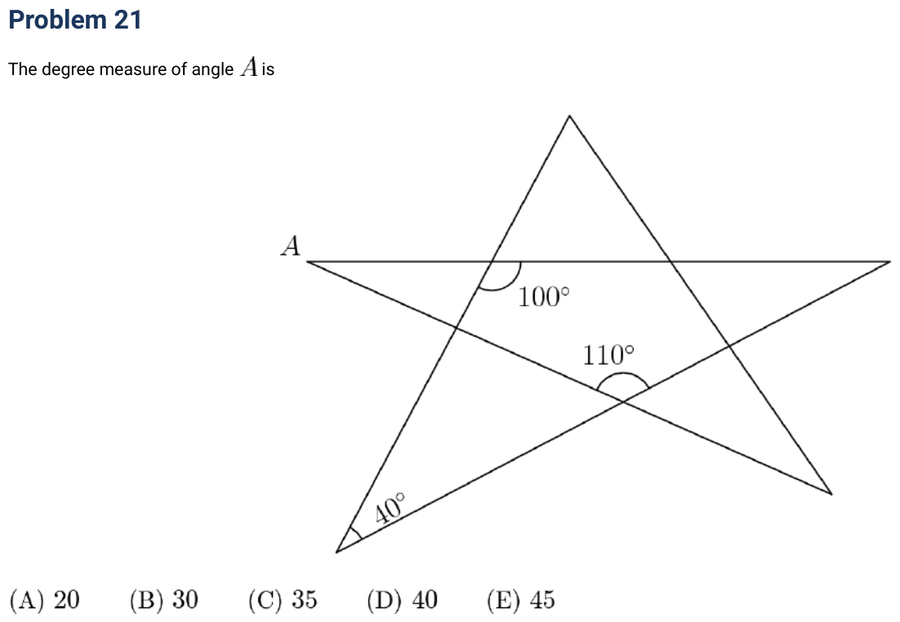
- The 100° and 110° marks have supplements 80° and 70° along their lines.
- In the triangle holding the 40° tip and that 70°, the third angle is 180° − 70° − 40° = 70°, and its vertical angle at the crossing near A is also 70°.
- A's triangle then gives ∠A = 180° − 80° − 70° = 30°.
1995 · #13 (figure problem)
Show answer
Show hints
Still stuck? Show hint 2 →
Show solution
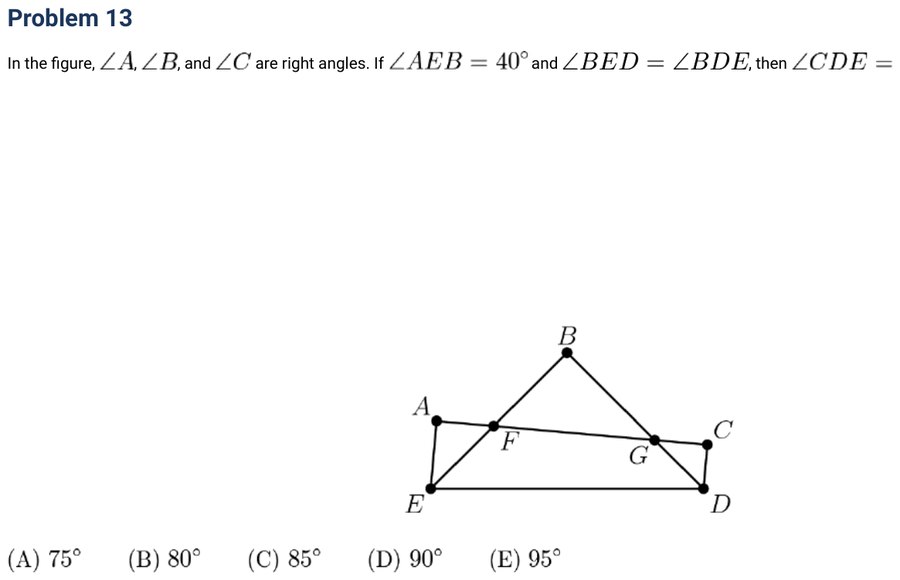
- Since EA ⊥ ED, ∠BED = 90° − 40° = 50°, and the isosceles triangle BED gives ∠BDE = 50°.
- Carrying the chase through the right angle at C gives ∠CDE = 95°.
Circles — circumference, area, arcs, and sectors
Circles are common on AMC 8. The formulas:
CIRCLE FORMULAS
- Circumference:
C = 2π r = π d(d = diameter). - Area:
A = π r². - Arc length (central angle θ in degrees):
arc = 2π r · (θ/360). - Sector area (a pie slice):
= π r² · (θ/360). - Diameter = 2r, radius = d/2.
The constant π ≈ 3.14159… For AMC, you can usually leave π in the answer; the multiple-choice options will too. Sometimes you'll need to approximate; π ≈ 22/7 or π ≈ 3.14 both work.
Common AMC moves with circles:
- Quarter circle (90° sector) area:
π r²/4. Half circle area:π r²/2. - Square inscribed in a circle of radius r: the diagonal of the square equals 2r, so the side equals
r√2. - Circle inscribed in a square of side s: the diameter equals s, so the radius equals
s/2. - For two circles tangent externally, distance between centers = R + r (sum of radii). For tangent internally (one inside the other), distance between centers = |R − r|.
Two circle facts that unlock a LOT of AMC problems
FACT 1 — INSCRIBED RIGHT TRIANGLE ↔ DIAMETER
If a triangle is inscribed in a circle and one of its sides is a diameter, then the angle opposite that diameter is always 90°.
And the reverse: if a triangle is inscribed in a circle and has a right angle, the side opposite the right angle MUST be a diameter.
This means: every triangle drawn on a semicircle (with the diameter as one side) is a right triangle. The right angle sits on the curve.
FACT 2 — TANGENT IS PERPENDICULAR TO THE RADIUS
If a line touches a circle at exactly one point (a tangent), then the radius drawn to that touch-point is perpendicular to the line.
Wherever a problem says “tangent to the circle at point P,” drop the radius to P and mark a right angle. The right angle usually unlocks a Pythagorean triangle nearby.
Whenever a shaded region involves a circle and a polygon, compute each separately and subtract (frame trick). The most common move is 'quarter-disk minus a triangle' or 'half-disk minus a rectangle.'
Two circles that share the same center have radii 10 meters and 20 meters. An aardvark runs along the path shown, starting at A and ending at K. How many meters does the aardvark run?
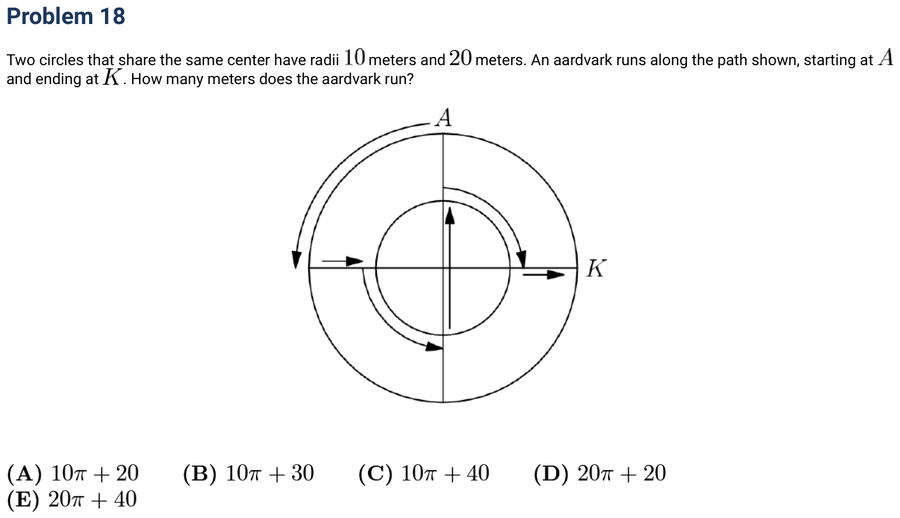
Two concentric circles have radii 10 and 20. An aardvark runs the path shown from A to K. Break the path into arcs and straight segments:
- Arc piece: the path traces half of the big circle (radius 20). Half-circumference =
½ × 2π × 20 = 20π. - Straight pieces: two radial segments of length 10 (crossing the ring between the two circles) plus a diameter of the small circle of length 20. Total straight:
10 + 10 + 20 = 40.
Add: 20π + 40.
The figure looks busy, but every piece is either part of a circle (use 2πr × fraction) or a straight segment (just a length). Split into those two types and add — that's it.
Memorize C = 2πr, A = πr². For arcs and sectors: multiply by θ/360 to get the fraction of the full circle.
2026 · #11 (figure problem)
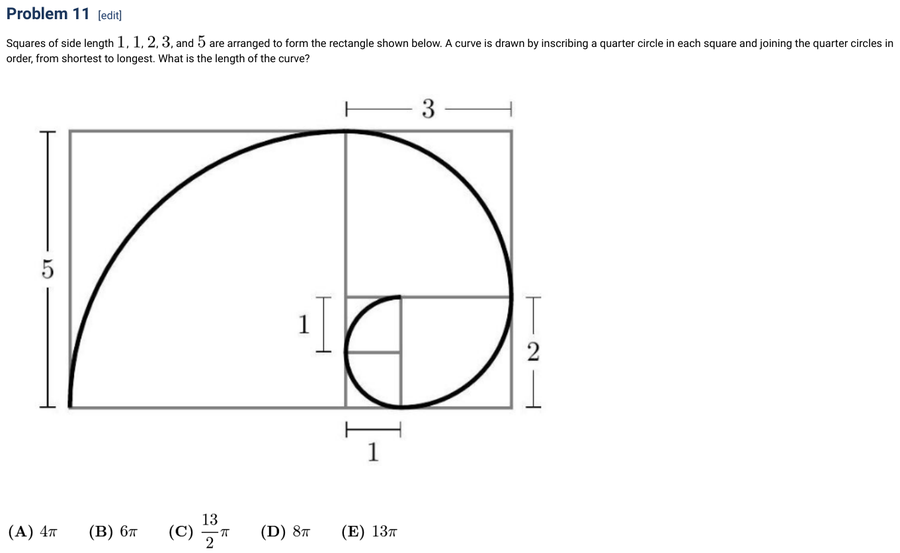
Show answer
Show hints
Still stuck? Show hint 2 →
Show solution
- Each square of side s contributes a quarter-circle of length ¼ · 2πs = πs/2.
- Total = (π/2)(1 + 1 + 2 + 3 + 5) = (π/2)(12) = 6π.
2013 · #25 A ball with diameter 4 inches starts at point A to roll along the track shown. The track is comprised of 3 semicircular arcs whose radii...
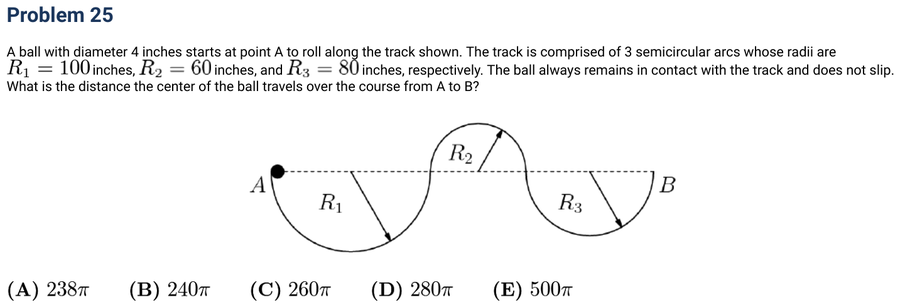
Show answer
Show hints
Still stuck? Show hint 2 →
Show solution
- Ball radius = 2 inches.
- Center radii along the three arcs: 100 − 2 = 98, 60 + 2 = 62, 80 − 2 = 78.
- Half-circumferences sum: π(98 + 62 + 78) = 238π.
1999 · #21 (figure problem)
Show answer
Show hints
Still stuck? Show hint 2 →
Show solution
- The 100° and 110° marks have supplements 80° and 70° along their lines.
- In the triangle holding the 40° tip and that 70°, the third angle is 180° − 70° − 40° = 70°, and its vertical angle at the crossing near A is also 70°.
- A's triangle then gives ∠A = 180° − 80° − 70° = 30°.
Coordinates and the Shoelace formula
When a polygon's vertices are given as coordinates, the cleanest area formula is Shoelace.
SHOELACE FORMULA
For vertices (x₁,y₁), (x₂,y₂), …, (xₙ,yₙ) listed in order around the polygon:
Area = ½ · |Σ (xᵢ · yᵢ₊₁ − xᵢ₊₁ · yᵢ)|
(Indices cycle: after the last vertex, wrap back to the first.)
How to apply it (for a triangle with vertices A=(0,0), B=(4,0), C=(0,3)):
- Write coordinates in a column, repeating the first at the bottom.
- Multiply down-right (x₁·y₂, x₂·y₃, x₃·y₁) and sum: 0·0 + 4·3 + 0·0 = 12.
- Multiply down-left (y₁·x₂, y₂·x₃, y₃·x₁) and sum: 0·4 + 0·0 + 3·0 = 0.
- Subtract, take absolute value, divide by 2: |12 − 0| / 2 = 6.
(Matches the formula ½ · base · height = ½ · 4 · 3 = 6 ✓.)
Shoelace works for ANY polygon (even concave ones). It's mostly used on triangles and quadrilaterals on AMC.
Pick’s Theorem — the magical dot-counting formula
Here’s a totally different way to find the area of a polygon when all its corners sit on grid dots (called lattice points). Instead of coordinates and arithmetic, you just count two kinds of dots.
PICK’S THEOREM
Area = I + B/2 − 1
- I = number of lattice dots strictly inside the polygon.
- B = number of lattice dots on the boundary (corners and along the edges).
Let’s try it. Below is a polygon drawn on a grid. Count dots, then plug in.
● boundary dots (B = 8) · ● interior dots (I = 5)
Plug in: Area = 5 + 8/2 − 1 = 5 + 4 − 1 = 8. Done — no coordinates, no shoelace, just dot-counting.
When to use Shoelace vs Pick’s:
- If the polygon’s corners are easy coordinates (and especially if not on grid dots) → Shoelace.
- If the polygon sits on a clean grid where you can SEE and COUNT the dots → Pick’s.
- Both will always give the same answer. Use whichever is faster for that specific picture.
For older kids: counting boundary dots on slanted edges
Some edges of a lattice polygon go diagonally and pass through extra lattice dots between the corners. To count those, use this rule: the number of lattice dots on a segment from (x₁,y₁) to (x₂,y₂) — not counting the starting endpoint — equals gcd(|x₂−x₁|, |y₂−y₁|).
Example: from (0,0) to (6,4), gcd(6,4) = 2, so the segment passes through 2 lattice dots (including the endpoint, not the start). Tally each edge this way to get the total boundary count B.
For grid-based polygons where coordinates are easy to read, Shoelace beats decomposition. For 'find a triangle's area from coordinates' problems, Shoelace is one formula away from the answer.
A triangle with vertices as A = (1, 3), B = (5, 1), and C = (4, 4) is plotted on a 6 × 5 grid. What fraction of the grid is covered by the triangle?
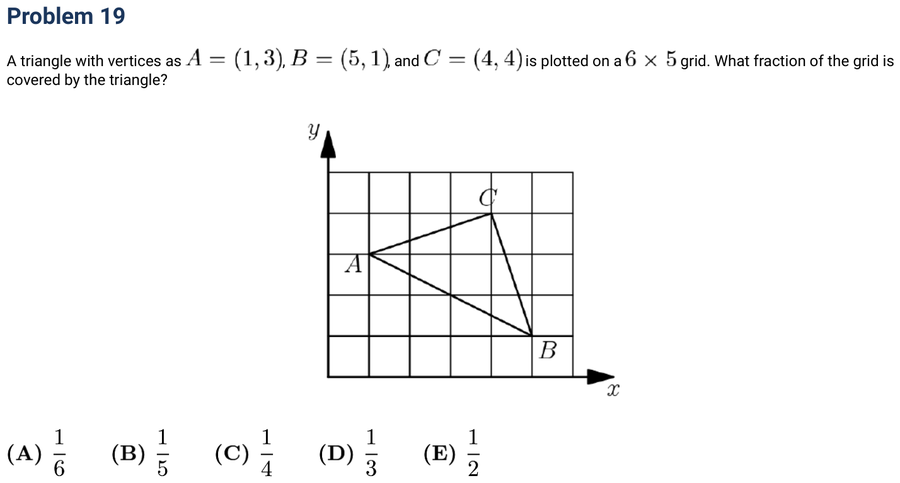
Triangle ABC has vertices A=(1,3), B=(5,1), C=(4,4) on a 6×5 grid. Apply Shoelace.
Step 1. Walk around in order: (1,3) → (5,1) → (4,4), then back to (1,3).
Step 2. Down-right sum (xi·yi+1): 1·1 + 5·4 + 4·3 = 1 + 20 + 12 = 33.
Step 3. Down-left sum (yi·xi+1): 3·5 + 1·4 + 4·1 = 15 + 4 + 4 = 23.
Step 4. Area = ½ |33 − 23| = 5. Grid area is 6·5 = 30, so the fraction is 5/30 = 1/6.
Shoelace is mechanical. Set up the coordinates carefully (going in one direction around the polygon), do the cross-multiplications, take absolute value, halve.
For coordinate-given polygons, Shoelace beats decomposition. List vertices in order, sum x·y_next − y·x_next, divide by 2.
2001 · #11 Points A, B, C, and D have these coordinates: A(3, 2), B(3, −2), C(−3, −2), and D(−3, 0). What is the area of quadrilateral ABCD?
Points A, B, C, and D have these coordinates: A(3, 2), B(3, −2), C(−3, −2), and D(−3, 0). What is the area of quadrilateral ABCD?
Show answer
Show hints
Still stuck? Show hint 2 →
Show solution
- AB and DC are both vertical, so ABCD is a trapezoid. AB runs from y = 2 to y = −2 (length 4); DC from y = 0 to y = −2 (length 2).
- The horizontal gap between them is 6, so area = ½(4 + 2)·6 = 18.
1993 · #18 (figure problem)
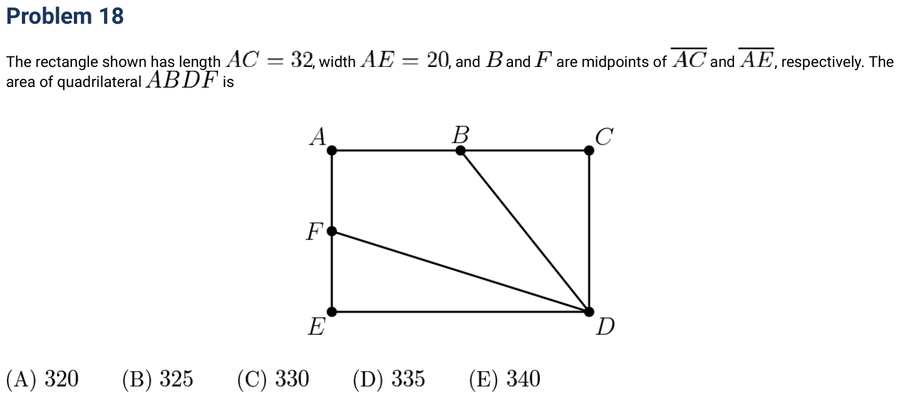
Show answer
Show hints
Still stuck? Show hint 2 →
Show solution
- Rectangle ACDE has area 32 × 20 = 640. The two right triangles cut off to leave ABDF are △BCD (legs BC = 16, CD = 20, area 160) and △FED (legs FE = 10, ED = 32, area 160).
- ABDF = 640 − 160 − 160 = 320.
- Place A(0,20), B(16,20), D(32,0), F(0,10). Shoelace gives ½|0·(20−10) + 16·(0−20) + 32·(10−20) + 0·(20−0)| = ½(320 + 320) = 320.
1996 · #22 (figure problem)
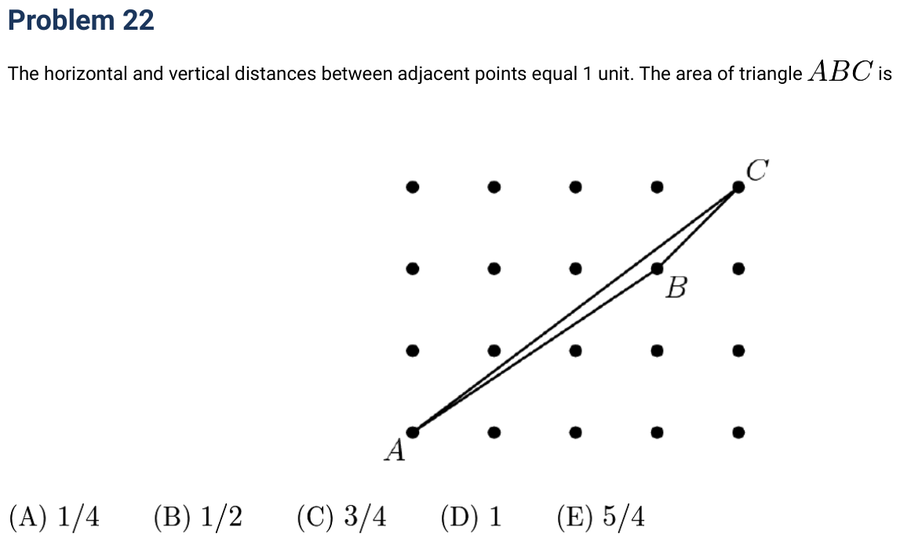
Show answer
Show hints
Still stuck? Show hint 2 →
Show solution
- Reading the grid, A = (0,0), B = (3,2), C = (4,3).
- The area is ½|0(2−3) + 3(3−0) + 4(0−2)| = ½|9 − 8| = 1/2.
2013 · #24 Squares ABCD, EFGH, and GHIJ are equal in area. Points C and D are the midpoints of sides IH and HE, respectively. What is the ratio of...
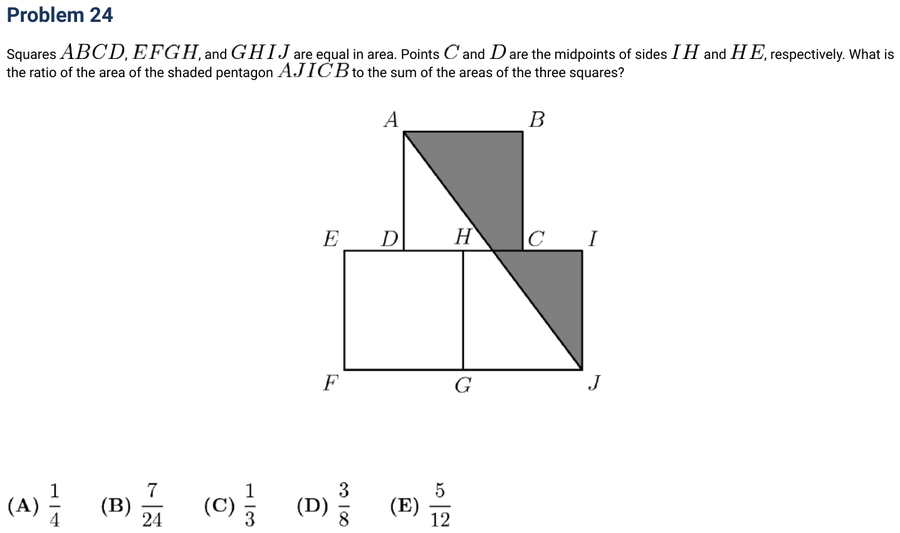
Show answer
Show hints
Still stuck? Show hint 2 →
Show solution
- Side length 1. Vertices: A = (0.5, 2), J = (2, 0), I = (2, 1), C = (1.5, 1), B = (1.5, 2).
- Shoelace: ½ |(0.5·0 + 2·1 + 2·1 + 1.5·2 + 1.5·2) − (2·2 + 0·2 + 1·1.5 + 1·1.5 + 2·0.5)| = ½ |10 − 8| = 1.
- Total square area = 3 · 1 = 3. Ratio = 1 / 3 = 1/3.
Folding, cutting, and transformations
Folding problems: a paper or shape is folded along a line. After the fold, some parts overlap; some cuts go through multiple layers.
Key insights for folds:
- The fold line is an axis of symmetry. Each side mirrors the other across it.
- A point at distance
dfrom the fold line maps to a point at distancedon the other side. - A single cut through folded paper creates symmetric cuts when the paper is unfolded.
Rolling problems: a shape rolls around the outside of another shape. The total rotation has two parts:
- Rolling component = (perimeter traveled along) ÷ (perimeter of the rolling shape) × 360°.
- Corner-pivot component = at each corner of the fixed shape, the rolling shape pivots through the exterior angle of that corner. For a hexagon (interior 120°), each exterior angle is 60°, so 6 corners contribute 6·60° = 360°.
Add the two components for the total rotation.
Reflection: reflecting a point across a vertical line flips its x-coordinate. Across a horizontal line, flips y-coordinate. The shape's orientation reverses (left ↔ right mirror image).
For folded-paper problems: pick a specific size (often the simplest works), draw the fold, see what gets cut. Then unfold mentally — each cut in the folded paper becomes a symmetric cut in the unfolded paper.
A square is folded in half, then in half again (so it's quartered), then a triangular notch is cut from the folded corner. When unfolded, what does the paper look like?
The key insight: when you fold a square twice into quarters, the folded corner is the center of the original sheet. All four corners of the original now stack on top of each other at that center.
So the cut goes through four layers at once, removing four identical triangular pieces — one from each quadrant, all meeting at the center.
When you unfold, those four notches join into a single diamond-shaped hole in the middle of the paper. That matches figure (E).
The whole problem is one question: where does the folded corner sit in the original? Answer: at the center. Everything else — the cut, the unfolded shape, the 4-fold symmetry — follows from that.
For folding / cutting: pick a concrete size. For rolling: total rotation = rolling component (perimeter traveled ÷ rolling-shape perimeter × 360°) + corner pivots (sum of exterior angles at corners touched).
1998 · #20 Let PQRS be a square piece of paper. P is folded onto R, and then Q is folded onto S. The area of the resulting figure is 9 square...
Let PQRS be a square piece of paper. P is folded onto R, and then Q is folded onto S. The area of the resulting figure is 9 square inches. Find the perimeter of square PQRS.
Show answer
Show hints
Still stuck? Show hint 2 →
Show solution
- Folding P onto R halves the square, and folding Q onto S halves it again, leaving one-fourth of the area: s²/4 = 9, so s² = 36 and s = 6.
- The perimeter is 4 × 6 = 24 inches.
2001 · #16 A square piece of paper, 4 inches on a side, is folded in half vertically. Both layers are then cut in half parallel to the fold. Three...
A square piece of paper, 4 inches on a side, is folded in half vertically. Both layers are then cut in half parallel to the fold. Three new rectangles are formed, a large one and two small ones. What is the ratio of the perimeter of one of the small rectangles to the perimeter of the large rectangle?
Show answer
Show hints
Still stuck? Show hint 2 →
Show solution
- Folding the 4×4 square in half gives a 4×2 shape; cutting parallel to the fold yields one large 4×2 rectangle and two small 4×1 rectangles.
- Perimeter ratio = 2(4 + 1) : 2(4 + 2) = 10 : 12 = 5/6.
2023 · #17 (figure problem)
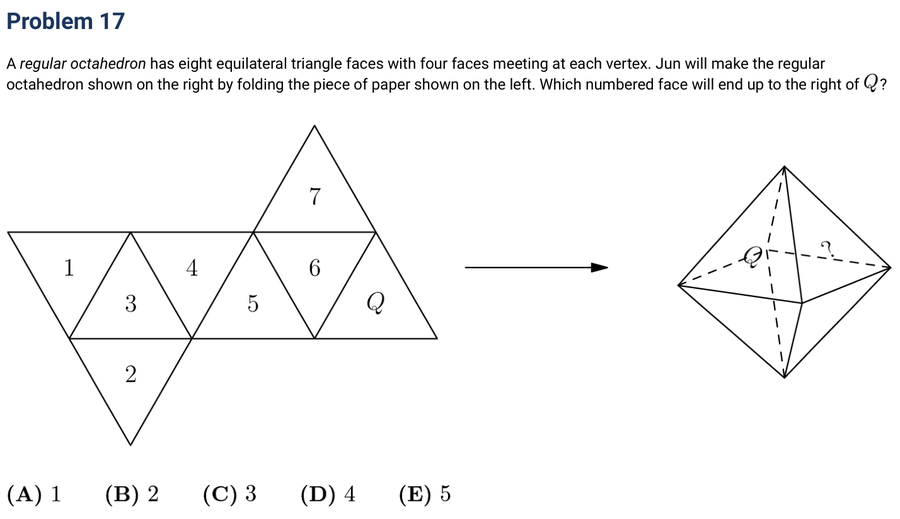
Show answer
Show hints
Still stuck? Show hint 2 →
Show solution
- An octahedron has 4 faces meeting at each vertex. In the net, faces 2, 3, 4, 5 all share a vertex, so they form one hemisphere (the bottom).
- The other hemisphere holds the remaining 4 faces: Q, 6, 7, and 1.
- Tracing the fold from Q, edges align so that face 1 ends up to its right.
2003 · #25 (figure problem)
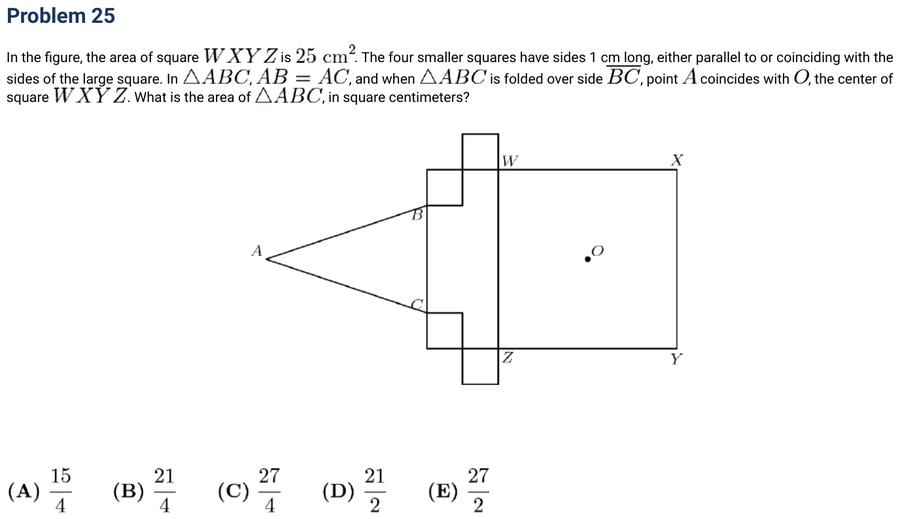
Show answer
Show hints
Still stuck? Show hint 2 →
Still stuck? Show hint 3 →
Show solution
- Square WXYZ has area 25, so its side is 5 and its center O is 5/2 from side WZ.
- The base BC sits 2 cm outside WZ (two unit squares), so BC is 5 − 2 = 3 cm long, and O is 2 + 5/2 = 9/2 cm from BC.
- Folding A onto O across BC makes A the mirror image of O, so A is also 9/2 cm from BC — that's the triangle's height.
- Area = ½ × 3 × 9/2 = 27/4 cm².
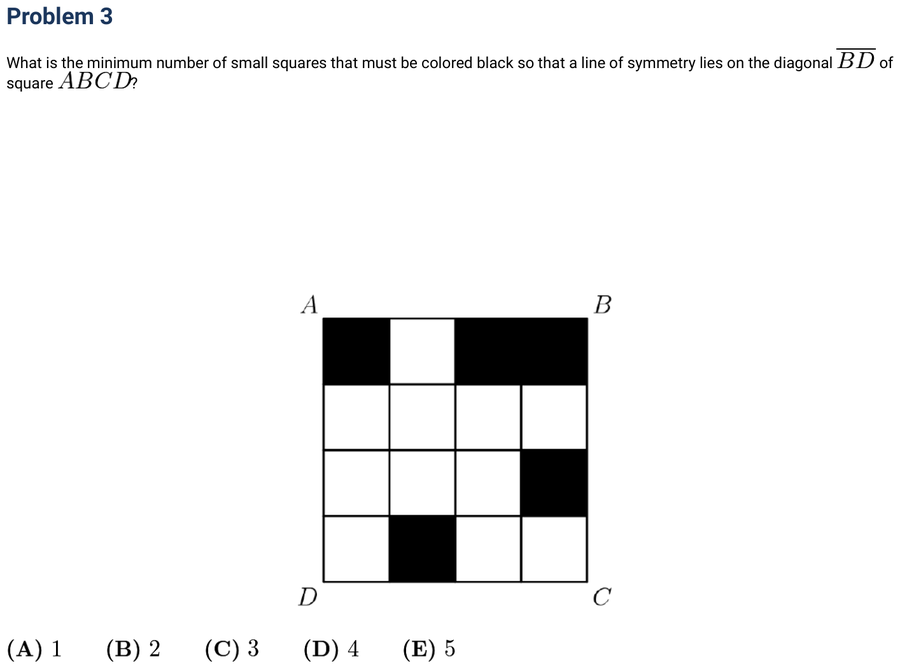
2005 · #3 What is the minimum number of small squares that must be colored black so that a line of symmetry lies on the diagonal BD of square ABCD?
Show answer
Show hint
Show solution
- Each of the 4 already-black off-diagonal cells has its mirror image (across BD) still white.
- We must blacken those 4 mirror cells ⇒ 4 additional squares.
Similar figures — when shapes scale
Two shapes are similar if they have the same shape but possibly different sizes. Every corresponding angle is equal, and every pair of corresponding sides is in the same ratio. Think of them as enlarge-or-shrink copies of each other.
SCALE FACTOR k
If a smaller figure scales up to a larger by factor k (every side multiplied by k):
- All lengths scale by k (sides, perimeter, diagonals).
- All areas scale by k².
- All volumes scale by k³.
Walkthrough. Two squares are similar (all squares are, by definition). One has side 3, the other side 6. So the scale factor is k = 2.
- Perimeters: 12 and 24 — ratio 2.
- Areas: 9 and 36 — ratio 4 = 2².
This squaring of the area ratio is the most-used fact. A scale model that's half the size has quarter the surface area; a model that's one-tenth the size has one-hundredth the surface area.
Sides double → area quadruples. Always 2² = 4, never 2.
When are two triangles similar?
You don't need to check all six conditions (3 angles + 3 side ratios). Any one of these three is enough:
SIMILARITY CRITERIA
- AA (Angle-Angle): two pairs of equal corresponding angles. The third pair is automatic (triangle angles sum to 180°).
- SAS (Side-Angle-Side): two pairs of sides in the same ratio, with the angle between them equal.
- SSS (Side-Side-Side): all three pairs of sides in the same ratio.
The AA trick is the workhorse. Whenever you spot two triangles sharing an angle (or formed by parallel lines crossed by a transversal — equal alternate-interior angles), they're similar by AA. From there, set up the side-ratio equation and solve.
Classic configuration: parallel cuts on a triangle. If a line parallel to one side of a triangle cuts the other two sides, it creates a smaller triangle similar to the original.
When areas of similar figures appear in a problem, the ratio of areas equals the square of the side ratio. If the question gives you areas and asks for sides, take the square root.
Example. Two similar triangles have areas 25 and 100. Their side ratio is √(25/100) = 1/2.
For 3D: volumes scale by k³. Two similar cones with volumes 8 and 27 cubic cm have side ratio ∛(8/27) = 2/3.
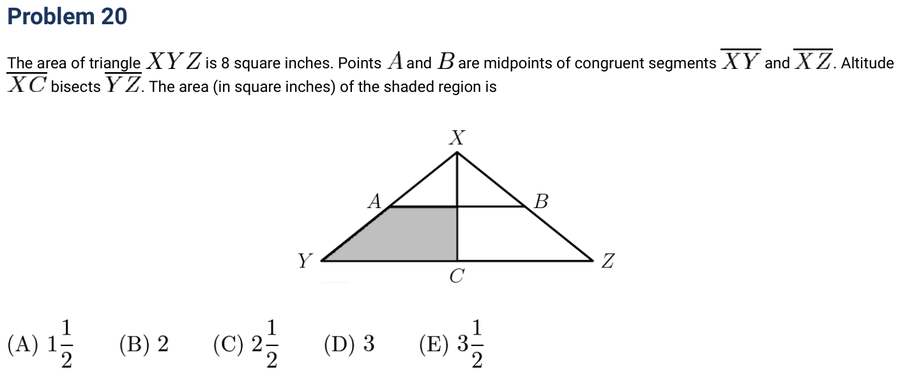
Triangle XYZ has area 8 sq in. The shaded region is △XYC (with C the midpoint of YZ) minus a small top triangle formed by midpoints. Find the shaded area.
Step 1. Altitude XC cuts △XYZ into two equal halves, so △XYC has area 8 ÷ 2 = 4.
Step 2. The small top triangle's sides are half the corresponding sides of △XYC (midpoint segments), so it's similar with k = 1/2. Its area = (1/2)² = 1/4 of △XYC = 4 · 1/4 = 1.
Step 3. Shaded = 4 − 1 = 3 square inches.
Two similar-figures moves in one problem: a midpoint segment halves linear dimensions (k = ½), and area scales by k² = ¼. Both are pattern-matches, not arithmetic.
Lengths scale by k. Areas scale by k². Volumes scale by k³. For triangle similarity, AA is usually enough — look for shared angles or parallel-line angle pairs.
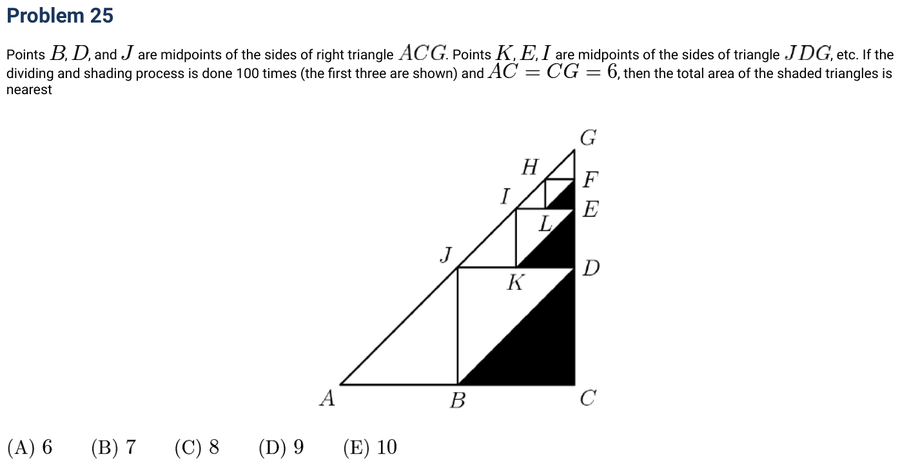
1999 · #25 (figure problem)
Show answer
Show hints
Still stuck? Show hint 2 →
Show solution
- The shaded triangles have areas 9/2, 9/8, 9/32, …, each one-fourth of the one before.
- The infinite sum is (9/2) ÷ (1 − ¼) = (9/2) ÷ (3/4) = 6, and 100 triangles is indistinguishable from that.
- So the total shaded area is nearest 6.
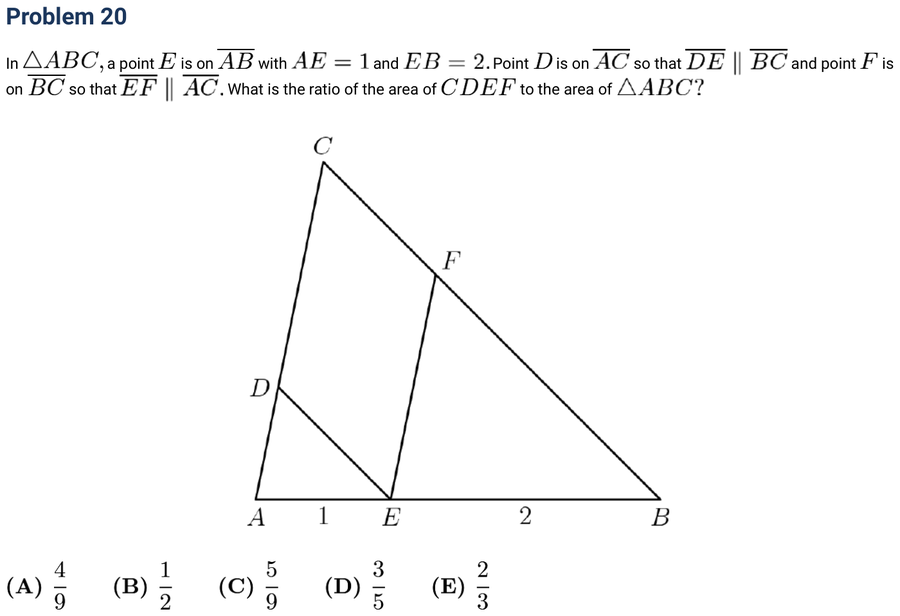
2018 · #20 (figure problem)
Show answer
Show hints
Still stuck? Show hint 2 →
Show solution
- AE/AB = 1/3 ⇒ ▵ADE has area (1/3)2 = 1/9 of ▵ABC.
- EB/AB = 2/3 ⇒ ▵EFB has area (2/3)2 = 4/9 of ▵ABC.
- Quadrilateral CDEF = ABC − ADE − EFB = 1 − 1/9 − 4/9 = 4/9.
2017 · #22 (figure problem)
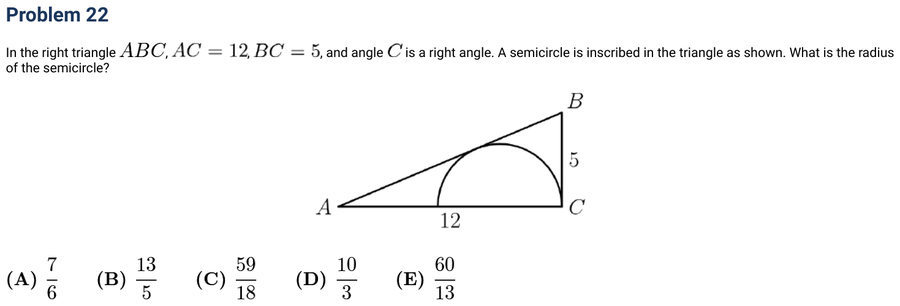
Show answer
Show hints
Still stuck? Show hint 2 →
Show solution
- Hypotenuse AB = √(122 + 52) = 13. Let O be the semicircle's center on AC and D its tangent point on AB.
- Tangents from B to the circle: BC = BD = 5. So AD = 13 − 5 = 8.
- ▵ADO ~ ▵ACB (right at D and C respectively, share angle A) ⇒ r8 = 512.
- r = 40/12 = 10/3.
Stretch test
Five harder geometry problems combining multiple techniques.
2017 · #16 (figure problem)
Show answer
Show hints
Still stuck? Show hint 2 →
Show solution
- ▵ABC is a 3-4-5 right triangle (right angle at A). Let BD = x, so CD = 5 − x.
- AD is shared, so equal perimeters ⇒ AC + CD = AB + BD ⇒ 3 + (5 − x) = 4 + x ⇒ x = 2.
- ▵ABD and ▵ABC share the altitude from A to line BC, so areas are in ratio BD : BC = 2 : 5.
- Area of ▵ABC = (1/2)(3)(4) = 6. Area of ▵ABD = (2/5)(6) = 12/5.
2002 · #16 (figure problem)
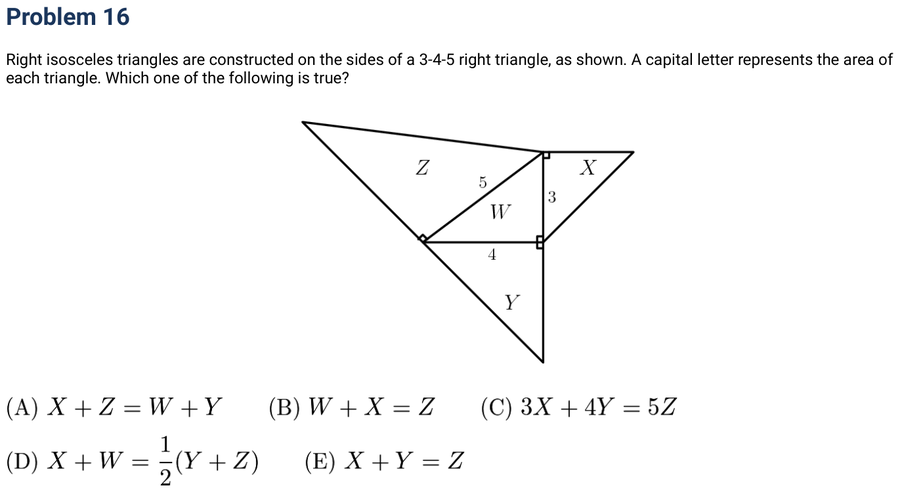
Show answer
Show hints
Still stuck? Show hint 2 →
Show solution
- A right isosceles triangle on a side of length s has both legs s, so its area is ½s². Thus X = ½·3² = 4.5, Y = ½·4² = 8, Z = ½·5² = 12.5.
- Because 3² + 4² = 5², halving every term gives X + Y = Z (4.5 + 8 = 12.5), so the answer is E.
2008 · #23 In square ABCE, AF = 2FE and CD = 2DE. What is the ratio of the area of ▵BFD to the area of square ABCE?
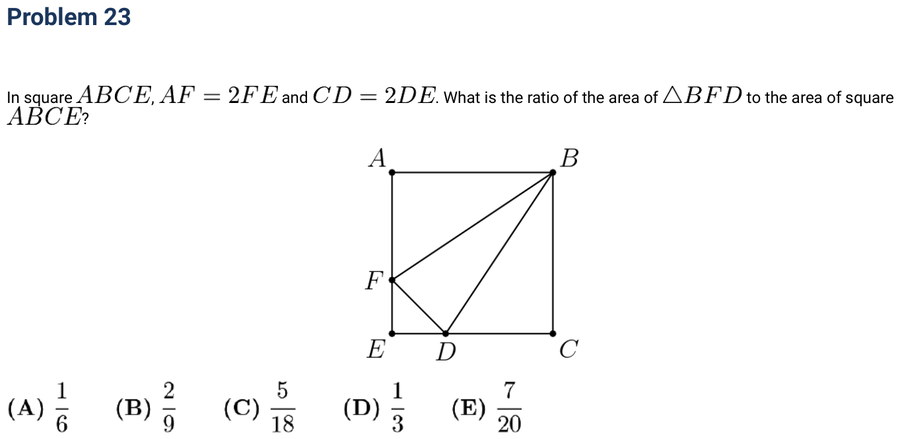
Show answer
Show hints
Still stuck? Show hint 2 →
Show solution
- Take side 1, so AF = 2/3, FE = 1/3, CD = 2/3, DE = 1/3. The three corner triangles cut off around △BFD are △ABF (legs 1, 2/3, area 1/3), △BCD (legs 1, 2/3, area 1/3), and △FED (legs 1/3, 1/3, area 1/18).
- △BFD = 1 − 1/3 − 1/3 − 1/18 = (18 − 6 − 6 − 1)/18 = 5/18.
- Place E at the origin, side s. B = (s, s), F = (0, s/3), D = (s/3, 0).
- Area △BFD = ½ |s(s/3 − 0) + 0(0 − s) + (s/3)(s − s/3)| = ½(s²/3 + 2s²/9) = 5s²/18, so the ratio is 5/18.
1995 · #24 (figure problem)
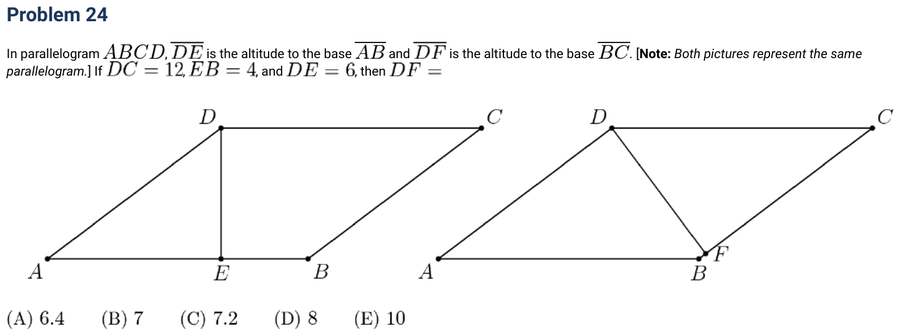
Show answer
Show hints
Still stuck? Show hint 2 →
Show solution
- AB = DC = 12 and DE = 6, so the area is 12 × 6 = 72. From right triangle ADE, AE = 12 − 4 = 8, so AD = √(8² + 6²) = 10 = BC.
- Then area = BC × DF gives 10 · DF = 72, so DF = 7.2.
2003 · #25 (figure problem)
Show answer
Show hints
Still stuck? Show hint 2 →
Still stuck? Show hint 3 →
Show solution
- Square WXYZ has area 25, so its side is 5 and its center O is 5/2 from side WZ.
- The base BC sits 2 cm outside WZ (two unit squares), so BC is 5 − 2 = 3 cm long, and O is 2 + 5/2 = 9/2 cm from BC.
- Folding A onto O across BC makes A the mirror image of O, so A is also 9/2 cm from BC — that's the triangle's height.
- Area = ½ × 3 × 9/2 = 27/4 cm².
Geometry quick-reference
FORMULAS TO KNOW COLD
- Rectangle: A = lw, P = 2(l + w).
- Square: A = s², P = 4s, diagonal = s√2.
- Triangle: A = ½ b h. Pythagorean: a² + b² = c².
- Equilateral triangle (side s): A = (√3/4) s². Height = (√3/2) s.
- Parallelogram: A = b h (h ⊥ base).
- Trapezoid: A = ½ (b₁ + b₂) h.
- Regular hexagon (side s): A = (3√3/2) s² (= 6 equilateral triangles of side s).
- Circle: A = π r², C = 2π r. Sector: π r² · θ/360. Arc: 2π r · θ/360.
- Cube: SA = 6 s², V = s³. Space diagonal = s√3.
- Box (a × b × c): SA = 2(ab + bc + ca), V = abc. Space diagonal = √(a² + b² + c²).
- Cylinder: V = π r² h, SA = 2π r² + 2π r h.
- Cone (radius r, height h): V = ⅓ π r² h.
- Sphere: V = (4/3) π r³, SA = 4π r².
- Distance between two points: √((x₂−x₁)² + (y₂−y₁)²).
- Equation of a circle: (x−a)² + (y−b)² = r² (center (a,b), radius r).
- Pick's Theorem (lattice polygons): A = I + B/2 − 1.
- 13-14-15 triangle: area = 84 (splits into 5-12-13 + 9-12-15).
- Pythagorean triples: 3-4-5, 5-12-13, 8-15-17, 7-24-25, 9-40-41, 20-21-29.
- Special right triangles: 45-45-90 sides 1:1:√2. 30-60-90 sides 1:√3:2.
- Polygon interior angle sum: (n−2) · 180°.
- Regular polygon angles: interior = (n−2)·180/n; exterior = 360/n. Pentagon 108, hexagon 120, octagon 135, n-gon 9 → 140, 10-gon → 144.
- Inscribed right triangle: if a triangle inscribed in a circle has a side equal to the diameter, the opposite angle is 90°.
- Tangent ⊥ radius: a tangent line meets the radius at the touch-point at 90°.
QUADRILATERAL AREAS
- square
s²· rectangle / parallelogramb·h - rhombus
½·d₁·d₂(the diagonals — not the sides!) - trapezoid
½(b₁+b₂)·h(average the parallel sides, times height)
- Confusing slanted side with height in parallelogram / triangle area formulas. Height is always perpendicular.
- Forgetting symmetry. Look for fold axes or rotational symmetry before computing.
- Misreading the figure. Always redraw the figure on your own paper.
- Area vs perimeter mix-up. Pay attention to units: square units for area.
- Off-by-one on grid counts. A 5×5 grid of squares has 6 horizontal lines and 6 vertical lines.
- Forgetting overlap in two-region area sums. Use A + B − (A ∩ B).
Drill these:
- Right triangle with legs 5 and 12: hypotenuse = 13.
- Square inscribed in a circle of radius r: side = r√2, area = 2 r².
- Hexagon with side 1: 6 equilateral triangles of side 1; area = 6 · (√3/4) = (3√3)/2 ≈ 2.6.
- Cube of side 4: SA = 96, V = 64.
- Cylinder r = 3, h = 5: V = π · 9 · 5 = 45π.
- Interior angle of a regular octagon: (8−2)·180/8 = 135°.
Want to climb higher? — three advanced geometry facts (#22–#25 territory)
- British Flag Theorem. For any point P inside a rectangle ABCD: PA² + PC² = PB² + PD². The sum of squared distances to opposite corners is equal — doesn't matter where P sits inside.
- Euler’s polyhedron formula. For any solid with flat faces: V − E + F = 2 (vertices − edges + faces). Cube: 8 − 12 + 6 = 2 ✓. Tetrahedron: 4 − 6 + 4 = 2 ✓.
- Inradius of a right triangle (legs a, b, hypotenuse c): r = (a + b − c) / 2. The circle inscribed in a 3-4-5 right triangle has radius (3 + 4 − 5)/2 = 1.
- Heron’s formula for area from sides only: with semi-perimeter
s = (a+b+c)/2, area = √(s(s−a)(s−b)(s−c)). Avoid unless you must — usually decomposing or finding a height is cleaner.