Tick one or more bands and topics — problems are pulled from every authored year.
Showing 20 of 485 matching
Problem 6 · 2025 Math Kangaroo
Medium
Logic & Word Problemscaseworksum-constraint
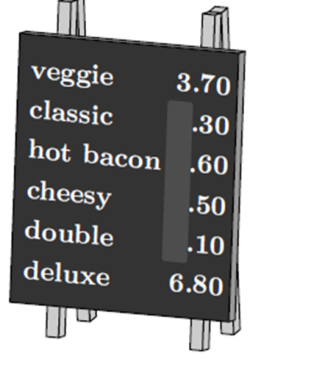
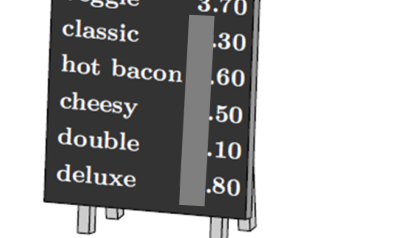
The picture on the right shows the menu of a burger restaurant. The rain has washed away some of the numbers. The burgers are ordered by price. Which of the following prices was on the board?
Show answer
Answer: B — 5.50
Show hints
Hint 1 of 2
The prices go up from top (3.70) to bottom (6.80); use the visible last two digits.
Still stuck? Show hint 2 →
Hint 2 of 2
Find whole-euro values that keep the list strictly increasing and fit the shown cents.
Show solution
Approach: fit increasing prices to the visible digits
Prices rise from 3.70 to 6.80, and the visible cents are .30, .60, .50, .10 going down.
Because .50 is less than .60, ‘cheesy’ must jump to a higher whole euro, and similarly for ‘double’.
The only increasing fit is 4.30, 4.60, 5.50, 6.10.
Among the choices, 5.50 (the cheesy price) is the one that appears.
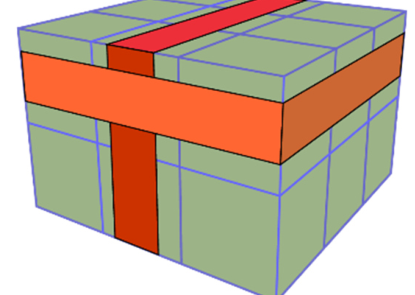
Laura glues together 18 cubes. Then she stretches two rubber bands around them — see picture. How many cubes are not touched by any of the rubber bands?
Show answer
Answer: D — 10
Show hints
Hint 1 of 3
Find the cubes each rubber band touches first, then the leftover cubes are the answer.
Still stuck? Show hint 2 →
Hint 2 of 3
The 18 cubes make a box that is 3 cubes wide, 3 cubes deep and 2 cubes tall.
Still stuck? Show hint 3 →
Hint 3 of 3
Count the cubes a band runs across, then count how many cubes nothing touches at all.
Show solution
Approach: find the touched cubes, then count the ones left over
The 18 cubes are stacked into a box 3 wide, 3 deep and 2 tall.
Follow each rubber band and mark every cube it presses against — the two bands touch 8 cubes in all.
The cubes nothing touches are the 18 minus those 8, which is 10. The answer is D.
Six children were running a race. Ariadne finished third. Bill finished sixth, just behind Ernest. Fatima finished between Ariadne and Ernest. Diana overtook Charles just before the finish line. Who won the race?
Show answer
Answer: C — Diana
Show hints
Hint 1 of 2
Pin down the fixed finishing places first (Ariadne is 3rd).
Still stuck? Show hint 2 →
Hint 2 of 2
Use ‘just behind’ and ‘between’ to place Ernest and Fatima, then the last two spots go to Diana and Charles.
Show solution
Approach: fill in the finishing order from the clues
Ariadne is 3rd. Bill is 6th just behind Ernest, so Ernest is 5th.
Fatima finishes between Ariadne (3rd) and Ernest (5th), so Fatima is 4th.
Only places 1 and 2 are left for Diana and Charles, and Diana overtook Charles at the end.
Sarah has a bag of 18 balls numbered from 1 to 18. What is the smallest number of balls Sarah must remove from the bag to be sure that she has removed at least three prime numbers?
Show answer
Answer: D — 14
Show hints
Hint 1 of 2
Ask how many balls are NOT prime — those could all come out before any prime.
Still stuck? Show hint 2 →
Hint 2 of 2
After removing every non-prime, the next few must be primes; worst case removes all non-primes first.
Show solution
Approach: worst-case (pigeonhole) counting
Primes from 1–18: 2,3,5,7,11,13,17 — seven of them; the other 11 numbers are non-prime.
Worst case she draws all 11 non-primes first, then needs 3 more to guarantee three primes.
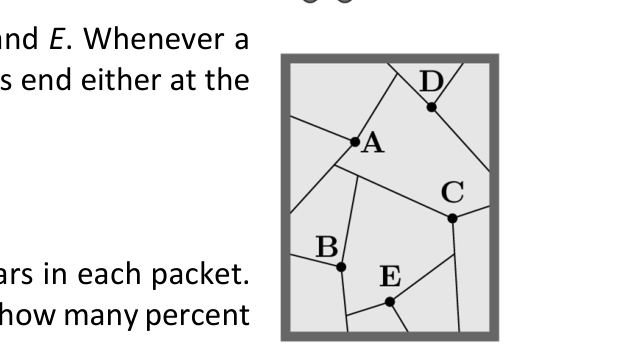
A student throws five stones in turn, hitting a window at points A, B, C, D and E. Whenever a stone hits the window, it creates cracks starting from that point. These cracks end either at the edge of the window or at an existing crack. In which order did he throw the stones?
Show answer
Answer: A — DACBE
Show hints
Hint 1 of 3
A crack can only stop on a crack that already exists, so "X's crack ends on Y's crack" means Y was thrown before X.
Still stuck? Show hint 2 →
Hint 2 of 3
Find the stone whose cracks all run to the window edge—that one must be first.
Still stuck? Show hint 3 →
Hint 3 of 3
Then repeatedly pick the next stone whose cracks only touch the edge or already-placed points.
Show solution
Approach: order the throws by which cracks land on earlier cracks
\(D\)'s cracks reach only the window edge, so \(D\) was thrown first.
Next, \(A\)'s crack ends on \(D\)'s, then \(C\)'s ends on \(A\)'s, then \(B\)'s ends on \(C\)'s, and finally \(E\)'s ends on \(B\)'s.
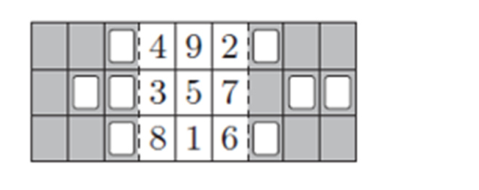
There are numbers on the middle part of a 3-part unfolded card. The left and right parts of the card have holes. Mike folds the right part along the dotted line onto the middle part. He can now see the numbers 2, 3, 5 and 6 through the holes. Then he folds the left part along the dotted line onto the other two parts. What is the sum of the numbers that he can still see through the holes?
Show answer
Answer: A — 8
Show hints
Hint 1 of 2
After folding the right flap, you already see 2, 3, 5 and 6 through its holes.
Still stuck? Show hint 2 →
Hint 2 of 2
Folding the left flap on top covers some of those holes; only the numbers under a left-flap hole stay visible.
Show solution
Approach: trace which holes still line up after both folds
After the right flap is folded over, its holes already let Mike see 2, 3, 5 and 6 on the middle panel.
When the left flap folds on top, its holes only line up over some of those numbers: two of them stay showing through a hole and the other two get covered by solid paper.
The two numbers still visible through a hole are 3 and 5, so the sum is 3 + 5 = 8, giving the answer (A) 8.
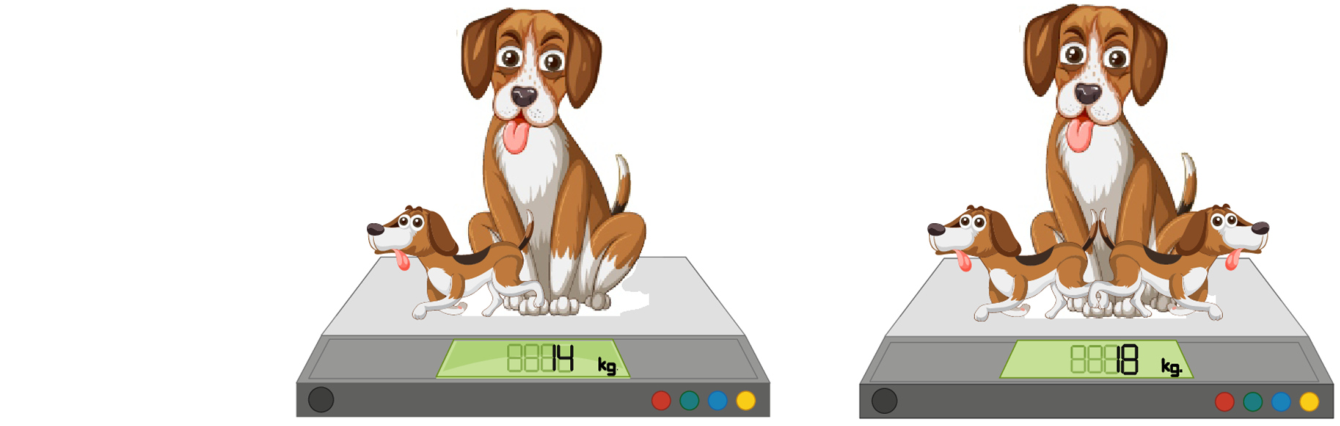
A dog has 2 puppies that both weigh the same. Picture 1 shows that the dog and one puppy together weigh 14 kilograms. Picture 2 shows that the dog and both puppies together weigh 18 kilograms. How many kilograms does the big dog weigh?
Show answer
Answer: B — 10
Show hints
Hint 1 of 3
The two pictures are the same except one has one more puppy.
Still stuck? Show hint 2 →
Hint 2 of 3
The extra weight from picture 1 to picture 2 is just one puppy.
Still stuck? Show hint 3 →
Hint 3 of 3
Once you know how heavy one puppy is, take it away from the 14 kg picture to find the dog.
Show solution
Approach: the extra puppy tells you one puppy's weight, then find the dog
Picture 1 is the dog and one puppy (14 kg). Picture 2 is the dog and both puppies (18 kg).
Going from 14 kg to 18 kg adds one more puppy, so one puppy weighs 4 kg.
Take that puppy away from picture 1: 14 take away 4 leaves 10 kg for the dog. The answer is B.
Luka has dogs, rabbits and cats as pets. Eight of these pets are not dogs, five of these pets are not rabbits and seven of these pets are not cats. How many pets does Luka have?
Show answer
Answer: A — 10
Show hints
Hint 1 of 2
Let the counts of dogs, rabbits, cats be d, r, c and turn each 'not' statement into an equation.
Still stuck? Show hint 2 →
Hint 2 of 2
Add the three equations; each total counts every pet twice.
Show solution
Approach: set up and add the three equations
Not dogs: r+c=8; not rabbits: d+c=5; not cats: d+r=7.
The picture shows the menu of a burger restaurant. The rain has washed away some of the numbers. The burgers are listed by price in increasing order, the cheapest being the “veggie” burger. What is the smallest possible price of the “deluxe” burger?
Show answer
Answer: B — 6.80
Show hints
Hint 1 of 2
Only the cents are readable; the whole-euro parts are hidden, but the prices increase down the list.
Still stuck? Show hint 2 →
Hint 2 of 2
Step down the menu choosing the smallest whole-euro part that keeps each price above the one before it.
Show solution
Approach: build the cheapest increasing price chain
Silvia's favourite chocolate bars are sold in packets. There used to be five bars in each packet. Now there are only four in each packet, but the packets still cost the same. By how many percent has each bar become more expensive?
Show answer
Answer: C — by 25%
Show hints
Hint 1 of 2
Find the cost of one bar before and after the change.
Still stuck? Show hint 2 →
Hint 2 of 2
Old price per bar is P/5, new is P/4; compare them as a ratio.
Three turtles are competing in a 10 km race. Each of them moves at a constant speed. When the first turtle finishes the competition, the second has completed 14 of the distance and the third has completed 15 of the distance. How far is the third turtle from the finish line when the second turtle finishes the race?
Show answer
Answer: B — 2 km
Show hints
Hint 1 of 2
The turtles move at steady speeds, so the distance each has covered tells you their speed ratio.
Still stuck? Show hint 2 →
Hint 2 of 2
When the 2nd turtle finishes, its distance has grown by the same factor as the 3rd turtle’s.
Show solution
Approach: scale the third turtle’s distance by the same factor
When the 1st finishes 10 km, the 2nd has done 1/4 of 10 = 2.5 km and the 3rd has done 1/5 of 10 = 2 km.
For the 2nd turtle to reach 10 km, time must be multiplied by 10 ÷ 2.5 = 4.
In that same time the 3rd turtle goes 2 × 4 = 8 km.
So the 3rd turtle is 10 − 8 = 2 km from the finish.