Tick one or more bands and topics — problems are pulled from every authored year.
Showing 20 of 401 matching
Problem 21 · 2025 Math Kangaroo
Stretch
Logic & Word Problemscasework
Fabio never tells the truth on Tuesdays, Thursdays and Saturdays, while he always tells the truth on the other days of the week. One day Mateo had the following conversation with Fabio:
Mateo: “What day is today?” Fabio: “Saturday” Mateo: “What day will tomorrow be?” Fabio: “Wednesday”
On which day of the week did the conversation take place?
Show answer
Answer: D — Thursday
Show hints
Hint 1 of 2
On a truth day both of Fabio’s answers are true; on a lying day both are false.
Still stuck? Show hint 2 →
Hint 2 of 2
Test each weekday against his two statements until one fits.
Show solution
Approach: check each day for consistency
Fabio lies on Tue/Thu/Sat and tells the truth otherwise; both his answers share that day’s truth status.
He says ‘today is Saturday’ and ‘tomorrow is Wednesday’.
Only Thursday works: it is a lying day, and both statements are indeed false (it isn’t Saturday, and tomorrow is Friday not Wednesday).
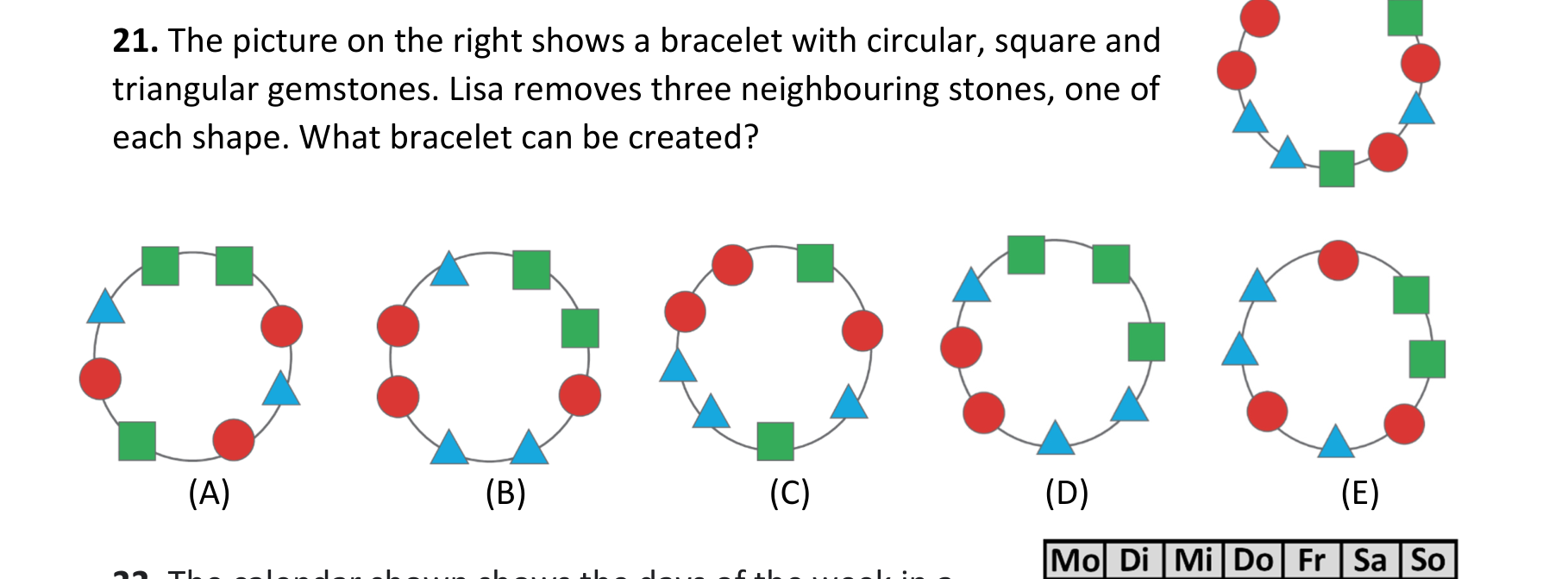
The picture on the right shows a bracelet with round, square and triangular gemstones. Lisa removes three neighbouring stones, one of each shape. Which bracelet can be created?
Show answer
Answer: B
Show hints
Hint 1 of 2
Removing three neighbours (one circle, one square, one triangle) leaves a gap of three in the ring.
Still stuck? Show hint 2 →
Hint 2 of 2
Find a stretch of three adjacent stones with one of each shape, then see what remains.
Show solution
Approach: remove a valid run of three neighbouring stones
Lisa removes three stones in a row, one of each shape.
Locate a circle, square, and triangle sitting next to each other on the bracelet.
Taking them out leaves the arrangement shown in option B.
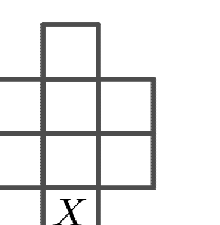
We want to place the numbers 1 through 8 in the eight squares of the figure shown in such a way that consecutive numbers are never in adjacent squares (not even diagonally adjacent). Which numbers can we write in the square marked with an X?
Show answer
Answer: B — 2 or 7
Show hints
Hint 1 of 3
Consecutive numbers may not touch even diagonally, so a number with many forbidden partners needs a roomy cell with few neighbours.
Still stuck? Show hint 2 →
Hint 2 of 3
Count how many cells each number must avoid: the ends 1 and 8 avoid just one each, while the most-crowded cell (touching the most others) needs a number that has very few neighbours to dodge.
Still stuck? Show hint 3 →
Hint 3 of 3
By the figure's symmetry, X and its mirror cell are the two most-connected cells, so list which values can sit in such a tight spot.
Show solution
Approach: match crowded cells to numbers with few forbidden neighbours
A value \(n\) (with \(1
Cell X is one of the two most-connected cells in the shape, so the number placed there must have few neighbours to conflict with; testing placements, only by putting a near-end value there can every other number be seated legally.
Working the arrangement out, the value in X must be 2 or 7 (the two cases are mirror images), answer B.
In the six-digit number PAPAYA, different letters stand for different digits and equal letters stand for equal digits. It is also given that Y = P + P = A + A + A. What is the value of P × A × P × A × Y × A?
Show answer
Answer: A — 432
Show hints
Hint 1 of 2
The clues say Y = 2P and Y = 3A — so 2P = 3A with single digits.
Still stuck? Show hint 2 →
Hint 2 of 2
Find digits where twice P equals three times A, then read off Y.
Show solution
Approach: solve the digit equations, then multiply
Y = P + P = 2P and Y = A + A + A = 3A, so 2P = 3A.
The simplest distinct digits are A = 2, P = 3, giving Y = 6.
Then \(P\times A\times P\times A\times Y\times A = 3\cdot2\cdot3\cdot2\cdot6\cdot2 = 432\), which is (A).
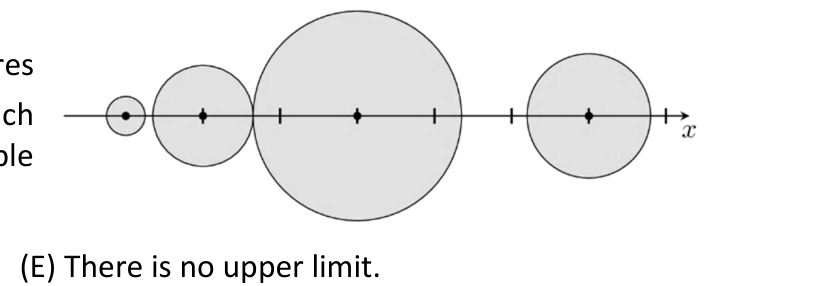
Four circular discs with radii \(r_1\), \(r_2\), \(r_3\) and \(r_4\) have their centres at the points \((0\,|\,0)\), \((1\,|\,0)\), \((3\,|\,0)\) and \((6\,|\,0)\). The discs may touch each other but may not overlap. What is the largest possible value of \(r_1 + r_2 + r_3 + r_4\)?
Show answer
Answer: B — 4
Show hints
Hint 1 of 2
Touching discs give one equation each: the sum of two radii equals the gap between their centres.
Still stuck? Show hint 2 →
Hint 2 of 2
Neighbouring constraints r₁+r₂ ≤ 1 and r₃+r₄ ≤ 3 already cap the total at 4.
Show solution
Approach: bound the sum using nearest-neighbour gaps
Discs at 0 and 1 give r₁ + r₂ ≤ 1; discs at 3 and 6 give r₃ + r₄ ≤ 3.
Adding: r₁+r₂+r₃+r₄ ≤ 4, and r₁ = 1, r₄ = 3 (others 0) achieves it.
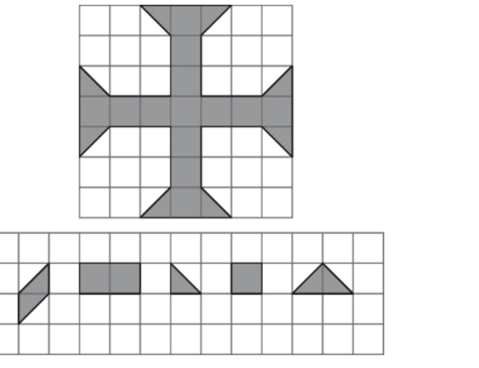
Julio wants to make the shape shown in the top picture on the right. He has several of each of the five tiles shown in the bottom picture on the right. The tiles must be placed next to each other without overlapping. What is the smallest number of tiles he must use?
Show answer
Answer: C — 13
Show hints
Hint 1 of 2
To use as few tiles as possible, you want each tile to cover as much of the cross as it can, so reach for the biggest tiles first.
Still stuck? Show hint 2 →
Hint 2 of 2
The straight parts of the cross are easy to cover with the large rectangle and big triangle; the pointy arm-tips are what force you to use the small triangles.
Show solution
Approach: cover the big areas with big tiles, the tips with small ones
Fewer tiles means each tile should cover as much as possible, so fill the wide straight parts of the cross with the largest tiles (the long rectangle and the big triangle).
The four slanted arm-tips are too thin for the big tiles, so each tip has to be finished with the small triangle pieces — these are unavoidable and set the limit on how low the count can go.
Packing the big tiles in the body and the small triangles at the tips, with no overlaps, covers the whole cross in 13 tiles, and no arrangement does it in fewer, so the answer is (C) 13.
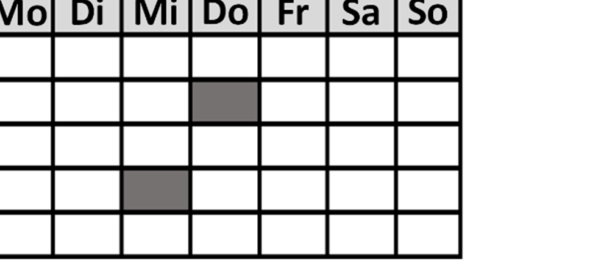
The calendar shows the days of a month, with the columns running Monday, Tuesday, …, Sunday, but the dates are missing. The two dark grey boxes are a Thursday and a Wednesday. If you add the two dates in the dark grey boxes, you get 29. What day of the week is the 1st of the month?
Show answer
Answer: D — Thursday
Show hints
Hint 1 of 3
Count the days from the grey Thursday box down to the grey Wednesday box - it is exactly 13 days later.
Still stuck? Show hint 2 →
Hint 2 of 3
So the two grey dates are 13 apart and add up to 29; find two such numbers.
Still stuck? Show hint 3 →
Hint 3 of 3
Once you know the grey Thursday's date, count back by 7s to reach the 1st.
Show solution
Approach: use the 13-day gap and the sum of 29, then walk back to the 1st
Going down two rows and one box to the left, the grey Wednesday lands 13 days after the grey Thursday.
Take away those extra 13 days from the sum 29, and 16 is left for two equal Thursday dates, so each is 16 ÷ 2 = 8 - the grey Thursday is the 8th.
Counting back a week, the 1st of the month is also a Thursday (8, then 1).
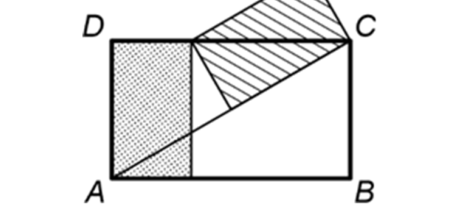
The two small rectangles in the diagram are congruent and each has an area of 4 cm². What is the area of rectangle ABCD in cm²?
Show answer
Answer: D — 12
Show hints
Hint 1 of 3
The diagonal \(AC\) of the big rectangle passes through the meeting corner of the two small rectangles.
Still stuck? Show hint 2 →
Hint 2 of 3
The diagonal cuts ABCD into two equal halves; compare how many small-rectangle areas fit against that diagonal.
Still stuck? Show hint 3 →
Hint 3 of 3
Each small rectangle has its diagonal corner on \(AC\), so each is split into two equal triangles by the diagonal — use that to count areas.
Show solution
Approach: use the main diagonal to balance the areas
Draw diagonal \(AC\); it runs through the common corner of the two congruent rectangles and splits ABCD into two equal triangles of area \(\tfrac12[ABCD]\) each.
Below the diagonal the dotted rectangle and the leftover triangle make up one half; matching the congruent rectangles against the diagonal shows the big rectangle is built from three small-rectangle areas.
Manuela takes a total of 17 shots at goal over two soccer training sessions. In the first session she scores with 60% of her shots, and in the second she scores with 75% of her shots. How many goals does she score in the second session?
Show answer
Answer: D — 9
Show hints
Hint 1 of 2
Both hit-counts must be whole numbers: 60% of the first session and 75% of the second.
Still stuck? Show hint 2 →
Hint 2 of 2
Split 17 shots so that 60% of the first part and 75% of the second part are both integers.
Show solution
Approach: force whole-number hits to fix the split
60% needs the first count to be a multiple of 5; 75% needs the second to be a multiple of 4.
With shots adding to 17, the split is 5 and 12 (5 is a multiple of 5, 12 of 4).
Second-session hits = 75% of 12 = 9, which is (D).
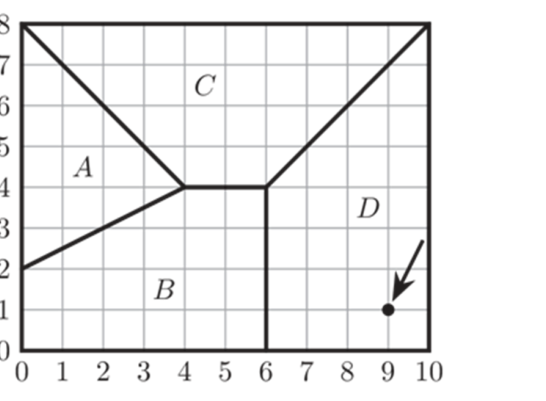
On the map shown on the right, we see a city in which there are four schools. Regions A, B, C and D each consist of the points for which the relevant school is closest. The coordinates of the school in region D are \((9\,|\,1)\). What are the coordinates of the school in region A?
Show answer
Answer: C — \((1\,|\,5)\)
Show hints
Hint 1 of 3
Each border line is the perpendicular bisector of the segment joining two schools, so a school is the mirror image of its neighbour across their shared border.
Still stuck? Show hint 2 →
Hint 2 of 3
Start from the known D-school at \((9\,|\,1)\) and reflect across the C–D and then A–C borders.
Still stuck? Show hint 3 →
Hint 3 of 3
Check your candidate: it must be equidistant from the borders of region A and farther from every other school.
Show solution
Approach: reflect a known school across the perpendicular-bisector borders
The three regions meet at the point \((4\,|\,4)\); the A–C border runs along the line through \((4\,|\,4)\) up to \((0\,|\,8)\) and the A–B border down to \((0\,|\,2)\).
School A must be the reflection of the neighbouring schools across those bisectors, placing it left of and below the corner, at integer coordinates inside region A.
Testing the options, only \((1\,|\,5)\) is equidistant from both A-borders and closest among all four schools to every point of region A, so A is at \((1\,|\,5)\), choice (C).
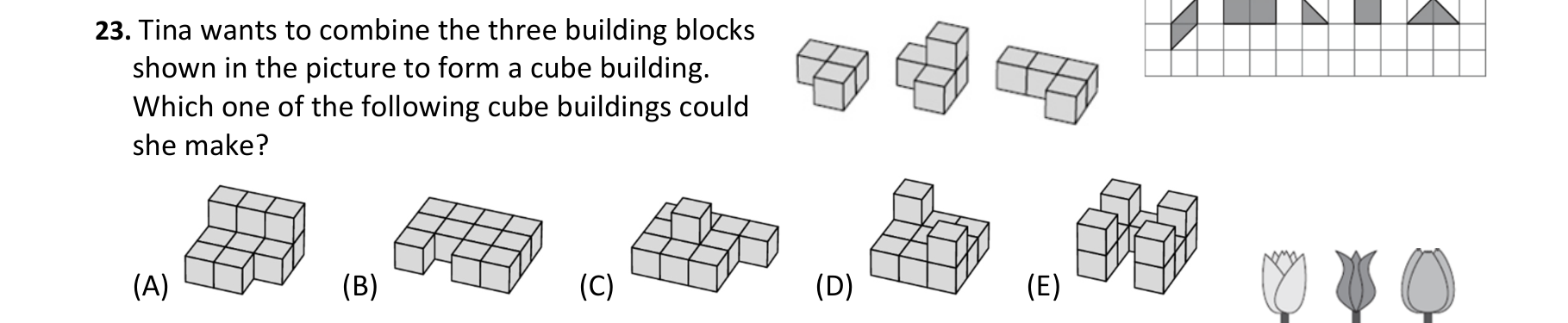
Tina wants to combine the three building blocks shown in the picture to form a cube building. Which one of the following cube buildings could she make? (The three blocks and the five choices A–E are pictured with the question.)
Show answer
Answer: D
Show hints
Hint 1 of 2
First just count: how many little cubes are in the three blocks all together? The answer building must use exactly that many cubes.
Still stuck? Show hint 2 →
Hint 2 of 2
Throw out any choice with the wrong cube count, then check the survivors by mentally snapping the three blocks together.
Show solution
Approach: count cubes first, then fit the blocks
Each of the three building blocks is made of small cubes; counting them gives a fixed total number of cubes that the finished building must contain.
Count the cubes in each answer building and cross out the ones with the wrong total — the right building must have exactly as many cubes as the three blocks combined.
Among the buildings with the correct cube count, only (D) can actually be assembled from those three particular blocks fitting together with no gaps, so the answer is (D).
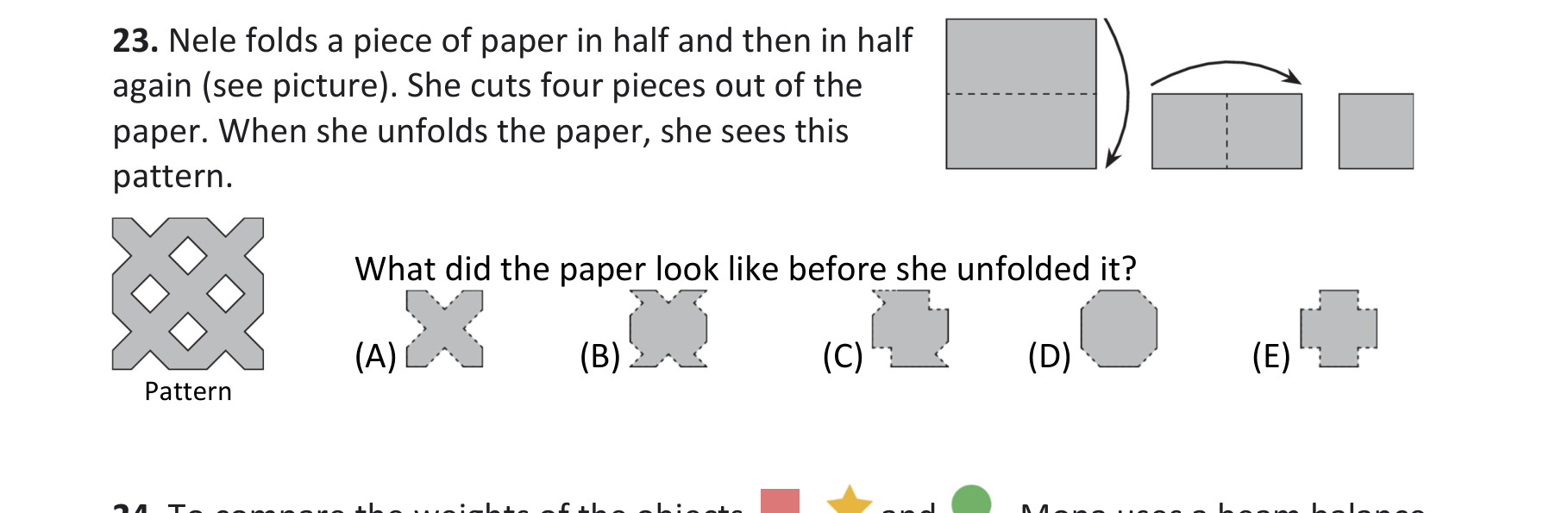
Nele folds a piece of paper in half and then in half again (see picture). She cuts four pieces out of the folded paper. When she unfolds it, she sees the pattern shown. What did the paper look like before she unfolded it?
Show answer
Answer: A
Show hints
Hint 1 of 2
Fold the unfolded pattern back in half twice and see what single quarter-piece you get.
Still stuck? Show hint 2 →
Hint 2 of 2
The folded paper shows just one quarter of the pattern, with cuts on the folded edges.
Show solution
Approach: fold the pattern back to a quarter
Folding in half twice stacks the paper into four layers, so the cuts repeat four times.
Reverse it: take one quarter of the shown pattern.
That single folded quarter is the X-shape in option A.
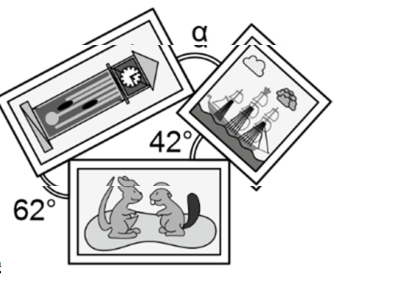
Louise places three rectangular pictures as shown in the figure. What is the size of the angle α?
Show answer
Answer: B — 70°
Show hints
Hint 1 of 2
Each picture is a rectangle, so every corner of it is a right angle (90°) — that is the key fact to lean on.
Still stuck? Show hint 2 →
Hint 2 of 2
Use a right-angle corner together with the marked 62° to find a small leftover angle, then combine it with the 42°.
Show solution
Approach: angle-chase using the rectangles' right angles
Because each picture is a rectangle, the corner sitting at the 62° mark is a right angle, so beyond the 62° there is \(90^\circ-62^\circ=28^\circ\) left over.
That 28° lines up next to the 42° gap, so \(\alpha=42^\circ+28^\circ\).
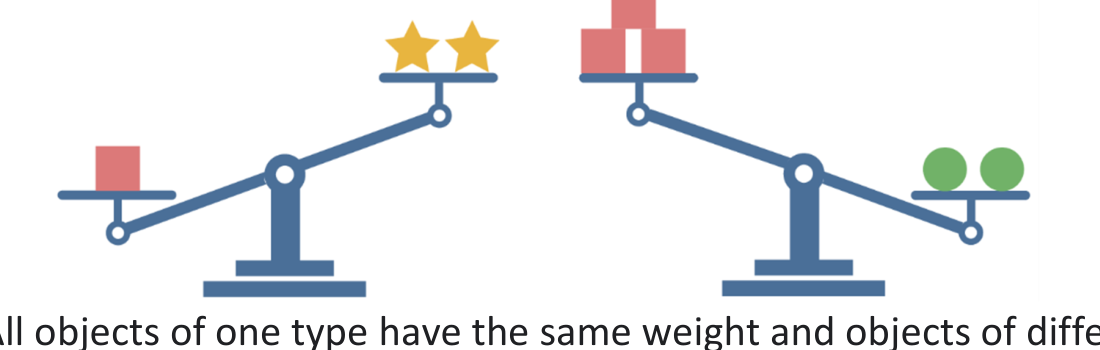
To compare the weights of a red square, a star and a green circle, Mona uses a beam balance (see picture). The lower pan holds the heavier side. Each shape always has the same weight, different shapes have different weights, and every weight is 1, 2, 3, 4 or 5 kg. How many kilograms does the red square weigh?
Show answer
Answer: C — 3 kg
Show hints
Hint 1 of 2
The lower pan is heavier: one square outweighs two stars, and two circles outweigh three squares.
Still stuck? Show hint 2 →
Hint 2 of 2
Try weights 1 to 5 for the square: it must be more than two stars yet light enough that two circles beat three of it.
Show solution
Approach: read both balances, then test the square's weight
Left balance: the square pan is lower, so one square is heavier than two stars.
Right balance: the two-circle pan is lower, so two circles are heavier than three squares.
One square beating two stars means the square is at least 3 (two different weights of 1 and 2 already make 3).
If the square is 4, three squares weigh 12, but two circles can be at most 2×5 = 10 - too light. So the square is 3, with stars 1 and circles 5: 3 > 2 and 10 > 9 both hold, giving 3 kg, option C.
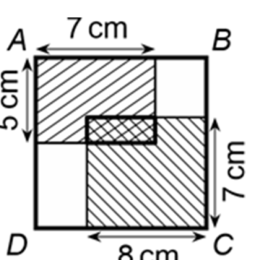
The square ABCD contains two shaded rectangles (see diagram). The dimensions are as shown and the area of the overlapping region is 18 cm². What is the perimeter of the square ABCD?
Show answer
Answer: C — 36 cm
Show hints
Hint 1 of 2
Let the square's side be \(s\); the top-left rectangle is \(7\times5\) and the bottom rectangle is \(8\times7\).
Still stuck? Show hint 2 →
Hint 2 of 2
Find the overlap's width and height in terms of \(s\) by seeing how far the two rectangles reach into each other, then set that product equal to 18.
Show solution
Approach: overlap area gives an equation for the side
The top-left rectangle reaches 7 cm in from the left and 5 cm down from the top; the bottom rectangle reaches 8 cm in from the right and 7 cm up from the bottom.
Their overlap is therefore \((7+8-s)\) wide by \((5+7-s)\) tall, i.e. \((15-s)(12-s)\), and this equals 18.
Solving \((15-s)(12-s)=18\) gives \(s=9\) (the other root is too big to fit), so the perimeter is \(4\times 9=\) 36 cm, answer C.
Anurag lives 1 km from his school and sets off at the same time every day. Walking, he travels at 4 km/h; cycling, he travels at 15 km/h. When he walks, he arrives 5 minutes before school starts. How many minutes before school starts does he arrive if he cycles?
Show answer
Answer: E — 16
Show hints
Hint 1 of 2
Find how long the 1 km walk takes and how long the 1 km ride takes.
Still stuck? Show hint 2 →
Hint 2 of 2
Cycling saves the time difference, so add that saving to the 5 minutes he already had to spare.
Show solution
Approach: compare travel times and the fixed start moment
Walking 1 km at 4 km/h takes 15 minutes; cycling 1 km at 15 km/h takes 4 minutes.
He leaves at the same moment, so cycling gets him there 15 − 4 = 11 minutes earlier than walking.
Walking he is 5 minutes early, so cycling he is \(5 + 11 = 16\) minutes early, which is (E).
Fritz fills out a table with two columns and 51 rows. In the first row, he writes 5 on the left and 3 on the right. In each subsequent row he writes the sum of the two numbers from the row above on the left and the positive difference of these two numbers on the right. Which two numbers does he write in the bottom row?
Show answer
Answer: D — \(5\cdot 2^{25}\) and \(3\cdot 2^{25}\)
Show hints
Hint 1 of 2
Compute a few rows and watch the left and right entries separately.
Still stuck? Show hint 2 →
Hint 2 of 2
Each pair (L, R) becomes (L+R, L−R); the left entry doubles every two rows starting from 5.
Show solution
Approach: track the recurrence two rows at a time
Rows give left entries 5, 8, 10, 16, 20, 32, 40… and right entries 3, 2, 6, 4, 12, 8, 24…