Tick one or more bands and topics — problems are pulled from every authored year.
Showing 20 of 435 matching
Problem 16 · 2025 Math Kangaroo
Hard
Geometry & Measurementareasymmetry
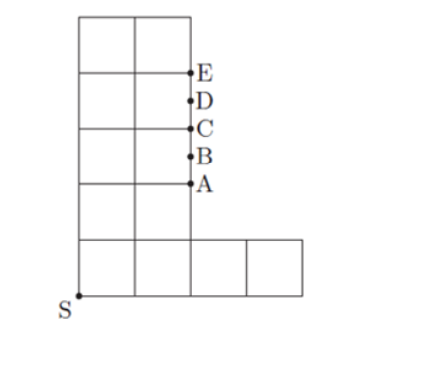
The diagram shown on the right consists of squares of equal size. Point B is in the middle of A and C, and point D is in the middle of C and E. Maria wants to divide the figure into two parts with equal areas using a straight line. Which of the points A, B, C, D or E must she connect to S to obtain this result?
Show answer
Answer: E — E
Show hints
Hint 1 of 2
First count the squares: the cut from S has to leave exactly half of them on each side.
Still stuck? Show hint 2 →
Hint 2 of 2
As you slide the far end of the cut from A up to E, more area moves to one side — stop at the point that makes the two halves equal.
Show solution
Approach: make each side hold half the squares
Count the unit squares in the whole figure and take half: the straight cut from S must leave that same area on each side.
Connecting S to a low point like A leaves too little on one side, and as the endpoint climbs from A toward E more area swings across the line.
The endpoint that finally balances the two sides into equal areas is E, so Maria connects S to E, giving the answer (E).
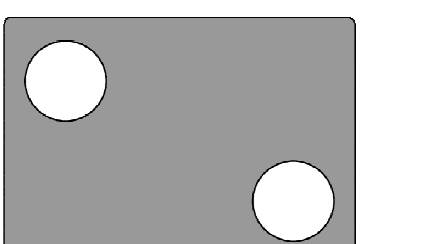
Paul shoots a ball at two targets (see diagram) a total of 27 times. When he aims for the upper-left target, he hits 50% of the time, and when he aims for the bottom-right target, he hits 80% of the time. In total, 9 of his shots miss their target. How many times does Paul hit the top-left target?
Show answer
Answer: C — 6
Show hints
Hint 1 of 2
27 shots, 9 missed, so 18 hit; let a shots aim upper-left and b aim lower-right.
Still stuck? Show hint 2 →
Hint 2 of 2
Misses are 50% of a plus 20% of b; set that equal to 9.
Show solution
Approach: set up the miss equation
a + b = 27 shots. Misses: 0.5a + 0.2b = 9.
Substitute b = 27−a: 0.5a + 0.2(27−a) = 9 → 0.3a = 3.6 → a = 12.
In a room there are 10 more people who always tell the truth than there are people who always lie. Everyone in the room was asked, “Are you telling the truth?” and all 20 people answered yes. How many liars are in the room?
Show answer
Answer: B — 5
Show hints
Hint 1 of 2
Both truth-tellers and liars answer 'yes' to 'Are you telling the truth?' — so the answers tell you nothing new.
Still stuck? Show hint 2 →
Hint 2 of 2
Just use that truth-tellers outnumber liars by 10 and there are 20 people.
Show solution
Approach: solve the count from the two given totals
A truth-teller says 'yes' truthfully; a liar also says 'yes' (lying), so all 20 say yes regardless.
If liars = L, truth-tellers = L + 10, and (L+10) + L = 20.
So \(2L = 10\), giving \(L = 5\) liars, which is (B).
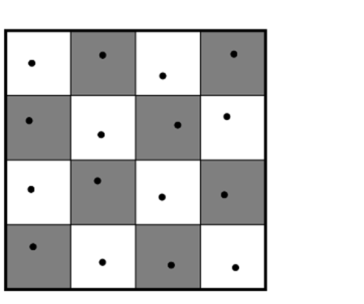
We consider a giant \(4 \times 4\) chessboard. A kangaroo is standing on each of the 16 squares. On each move, each kangaroo jumps to an adjacent square (up, down, left or right, but not diagonally). All kangaroos stay on the chessboard. Several kangaroos can be on one square at the same time. What is the maximum number of unoccupied squares that we can have after 100 moves?
Show answer
Answer: B — 14
Show hints
Hint 1 of 2
Colour the board like a checkerboard; what happens to a kangaroo's colour each jump?
Still stuck? Show hint 2 →
Hint 2 of 2
Every jump flips colour, so after an even number of moves the 8 dark-start and 8 light-start kangaroos stay split—each group can pile onto one square.
Show solution
Approach: checkerboard parity invariant
Each jump changes a kangaroo's square colour, so after 100 (even) moves 8 kangaroos sit on dark squares and 8 on light squares.
Each group can be gathered onto a single square, occupying just 2 squares total.
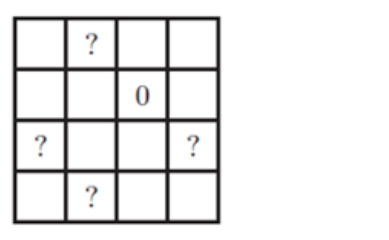
Hassan writes either the number 0 or the number 1 in each field of the table. The sum in each row, each column and each diagonal should be exactly 3. Hassan has entered 0 in one field and then fills out the table completely. What is the sum of the numbers in the fields with question marks?
Show answer
Answer: B — 2
Show hints
Hint 1 of 2
Each row and each column has 4 cells but must total 3 using only 0s and 1s — so what does that force about how many 0s are in each row and column?
Still stuck? Show hint 2 →
Hint 2 of 2
There is exactly one 0 in every row and exactly one 0 in every column; place the rest of the 0s so the two diagonals also each have a single 0.
Show solution
Approach: each row and column hides exactly one 0
A row of four 0s-and-1s that adds to 3 must be three 1s and a single 0, so every row has exactly one 0 — and by the same reasoning every column has exactly one 0, and each diagonal must also hold just one 0.
Starting from the given 0, the ‘one 0 per row, one per column, one per diagonal’ rule pins down where all four 0s go, so the whole grid is forced.
Looking at the four question-mark cells, two of them turn out to be 1 and two turn out to be 0, so their sum is 1 + 1 + 0 + 0 = 2, giving the answer (B) 2.
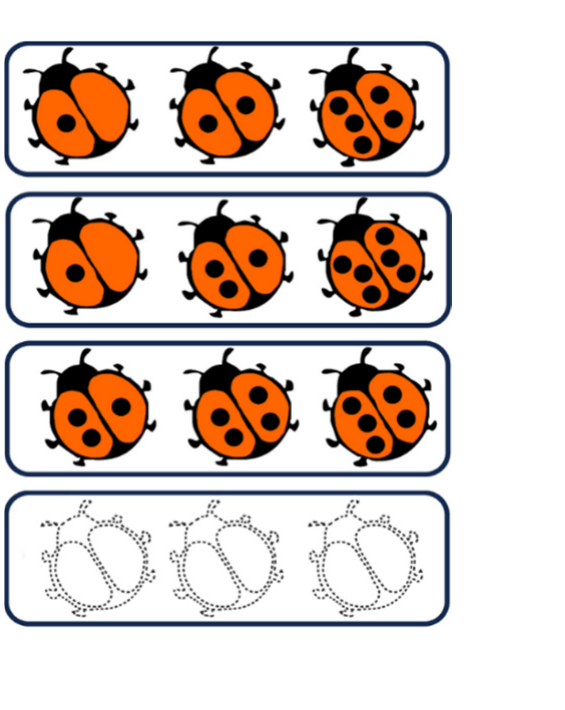
Six ladybirds have 1, 2, 3, 4, 5 and 6 spots. Marta takes four photos, each showing three different ladybirds, and each ladybird appears in the same number of photos. The first three photos are shown. How many spots do the three ladybirds in the fourth photo have in total?
Show answer
Answer: C — 12
Show hints
Hint 1 of 2
There are 4 photos with 3 ladybirds each, that is 12 ladybird-appearances shared equally among 6 ladybirds.
Still stuck? Show hint 2 →
Hint 2 of 2
So every ladybird appears in exactly 2 photos, which tells you the grand total of spots over all four photos.
Show solution
Approach: find the grand total of all four photos, then subtract the three shown
Four photos with three ladybirds each give 12 appearances; split equally among 6 ladybirds, so each appears in exactly 2 photos.
Then all four photos together show every spot-count twice: 2 × (1 + 2 + 3 + 4 + 5 + 6) = 2 × 21 = 42 spots.
The three shown photos hold 30 spots in total.
So the fourth photo has 42 − 30 = 12 spots, option C.
There are some cards on a table with various different positive integers written on them. All of these are smaller than 20 and their product is 2025. What is the maximum number of cards on the table?
Show answer
Answer: D — 5
Show hints
Hint 1 of 2
Factor 2025 and split it into as many factors below 20 as possible.
Still stuck? Show hint 2 →
Hint 2 of 2
2025 = 3^4 × 5^2; including the card '1' adds one more card for free.
Show solution
Approach: maximize the number of small factors
2025 = 3⁴ × 5²; each card value is below 20.
Break it up as 1 × 3 × 5 × 9 × 15 = 2025, all distinct and under 20.
A bee, a mouse, a beetle and a cat want to take a group photo, so they line up next to each other. The cat is not allowed to stand next to the mouse. In how many different ways can the animals line up?
Show answer
Answer: B — 12
Show hints
Hint 1 of 2
Count all line-ups, then remove the bad ones where the cat and mouse are side by side.
Still stuck? Show hint 2 →
Hint 2 of 2
Treat the cat-and-mouse pair as a single block to count the forbidden arrangements.
Show solution
Approach: total minus the cat-next-to-mouse cases
Four animals can line up in 4! = 24 ways.
Glue cat+mouse together: 3 items in 3! = 6 orders, times 2 for the internal order = 12 forbidden line-ups.
Allowed line-ups = \(24 - 12 = 12\), which is (B).
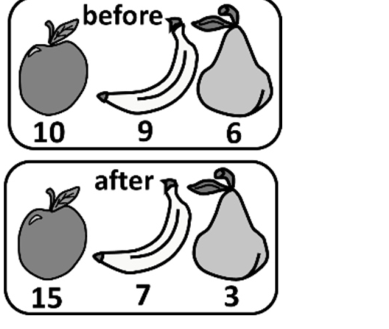
A witch has 10 apples, 9 bananas and 6 pears. One day she enchants all of her fruits into different types of fruit. For example, she turns each apple into either a banana or a pear. After that she has 15 apples, 7 bananas and 3 pears. How many apples did she turn into bananas?
Show answer
Answer: E — 7
Show hints
Hint 1 of 2
Every original fruit changes type, so all 10 apples leave and new apples arrive from other fruits.
Still stuck? Show hint 2 →
Hint 2 of 2
Set up the in/out counts for each fruit type and solve.
Show solution
Approach: track each fruit type in and out
All 9 bananas and all 6 pears must become apples or each other; the 15 final apples come only from old bananas and pears.
Since 9 + 6 = 15, every banana and every pear turned into an apple.
Then the 10 apples must supply all 7 final bananas and 3 final pears: 7 + 3 = 10.
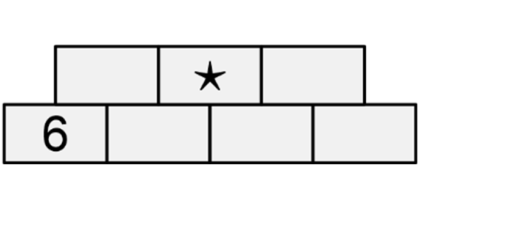
Maria writes the numbers 1, 2, 3, 4, 5, 6 and 7, each exactly once, into the number wall. Each upper box equals the sum of the two boxes just below it. The bottom-left box already holds 6. Which number must she write in the box with the star?
Show answer
Answer: D — 4
Show hints
Hint 1 of 2
The box sitting on top of the 6 is 6 plus its neighbour, and it can be at most 7.
Still stuck? Show hint 2 →
Hint 2 of 2
That forces the neighbour, then keep building upward with 1 to 7 each used once.
Show solution
Approach: use that no box can exceed 7 to fix the numbers, then build upward
Every box is the sum of the two below it, and no number is bigger than 7.
The box above the 6 is 6 + (its right neighbour), so that neighbour must be 1, giving 6 + 1 = 7.
The leftover numbers 2, 3, 5 must fill the rest; placing the bottom row as 6, 1, 3, 2 gives the next row 7, 4, 5 - and that uses 1 to 7 exactly once.
The starred middle-top box is 1 + 3 = 4, option D.
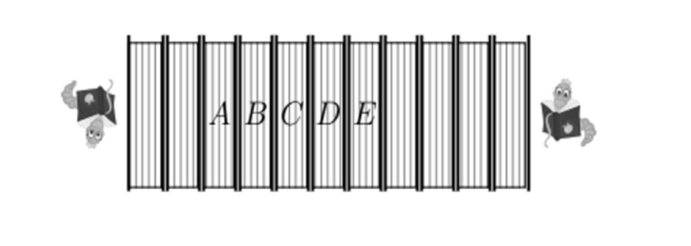
The two bookworms Linki and Rechti eat their way through a row of books. Linki starts from the left and Rechti from the right, both at the same time. Linki eats through a book cover in 3 days and through all the pages of a book in 2 days. Rechti eats through a book cover in 1 day and through all the pages of a book in 2 days. In which book (see illustration) do the two meet?
Show answer
Answer: B — B
Show hints
Hint 1 of 2
Give each worm a 'days to chew through' cost for a cover and for a set of pages, then send them toward each other.
Still stuck? Show hint 2 →
Hint 2 of 2
Add up the days each worm spends, layer by layer, until their totals show them reaching the same book.
Show solution
Approach: accumulate the days each worm needs until they meet
Linki (from the left) needs 3 days per cover and 2 days per book of pages; Rechti (from the right) needs 1 day per cover and 2 days per book of pages.
After 13 days Linki has chewed through book A entirely and reached the pages of book B \((3+2+3+3+2)\); in those same 13 days Rechti has chewed through E, D and C and into book B \((1+2+1+1+2+1+1+2+1+1)\).
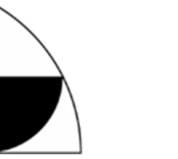
The area of the black semicircle shown is 12 cm². What is the area of the large quarter circle?
Show answer
Answer: D — 30 cm²
Show hints
Hint 1 of 3
Let the quarter circle have radius \(R\) and the small semicircle radius \(r\); read their relationship off the figure.
Still stuck? Show hint 2 →
Hint 2 of 3
The semicircle's diameter spans from the corner to the centre of the quarter circle's straight side, which forces \(R^2 = 5r^2\).
Still stuck? Show hint 3 →
Hint 3 of 3
Then just take the ratio of the two area formulas—the \(\pi\) cancels.
Show solution
Approach: write both areas with their radii and take the ratio
Quarter circle: \(\tfrac14\pi R^2\); black semicircle: \(\tfrac12\pi r^2\).
The figure fixes the semicircle so that \(R^2 = 5r^2\), hence the quarter circle is \(\dfrac{\tfrac14 R^2}{\tfrac12 r^2} = \dfrac{R^2}{2r^2} = \dfrac{5}{2}\) times the semicircle.
So the quarter circle \(= \tfrac52 \times 12 = \textbf{30 cm}^2\), choice (D).
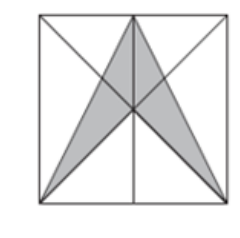
The square shown on the right has sides of 10 cm. The square is divided into two equal-sized rectangles by the vertical centre line. What is the area of the grey section?
Show answer
Answer: B — 25 cm²
Show hints
Hint 1 of 2
The whole square is 10 × 10 = 100 cm², so try to see the grey as a simple fraction of that whole.
Still stuck? Show hint 2 →
Hint 2 of 2
The centre lines split the grey ‘bow-tie’ into a left half and a right half; find the area of one half and double it.
Show solution
Approach: the grey is two equal triangles meeting at the centre
The grey shape is a bow-tie: two triangles that meet at the centre of the square, one on the left and one on the right.
The left triangle has corners at the top-middle of the square, the centre of the square, and the bottom-left corner; counting on a 10×10 grid its area is 12.5 cm², and the right triangle is its mirror image, also 12.5 cm².
Adding the two halves gives 12.5 + 12.5 = 25 cm², which is exactly one quarter of the 100 cm² square, so the answer is (B) 25 cm².
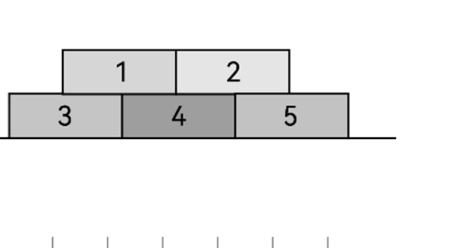
Five bricks form a wall (see figure). Peter can only remove a brick if there is no other brick directly above it. On each turn, he randomly selects one of the removable bricks with equal probability and removes it. What is the probability that the brick numbered 4 is the third to be removed?
Show answer
Answer: D — \(\frac{1}{6}\)
Show hints
Hint 1 of 2
Only the two top bricks start out removable; brick 4 sits beneath both of them, so it is freed only after both 1 and 2 are gone.
Still stuck? Show hint 2 →
Hint 2 of 2
For 4 to be third, the first two removals must be exactly bricks 1 and 2 (in some order), then 4 must be chosen on turn three.
Show solution
Approach: follow the only path that frees brick 4 by turn three
At the start only the two top bricks 1 and 2 are free (each bottom brick is still pinned by a top brick), so turn 1 removes 1 or 2.
Suppose 1 goes first; now free are {2, 3}, and brick 4 still needs 2 removed, so turn 2 must pick 2 (chance \(\tfrac{1}{2}\)), after which {3, 4, 5} are free.
Turn 3 then picks 4 with chance \(\tfrac{1}{3}\); the path probability is \(\tfrac{1}{2}\cdot\tfrac{1}{2}\cdot\tfrac{1}{3}=\tfrac{1}{12}\), and the symmetric order (2 then 1) doubles it to \(\tfrac{1}{6}\), answer D.
Emus, snakes and kangaroos live together on an Australian farm. Emus have two legs and no tail. Kangaroos have four legs and a tail. Snakes have no legs but a tail. Every animal has two eyes. Altogether they have 18 eyes, 7 tails and 24 legs. How many kangaroos live on the farm?
Show answer
Answer: E — 5
Show hints
Hint 1 of 2
Every animal has 2 eyes, so the eye count gives the total number of animals.
Still stuck? Show hint 2 →
Hint 2 of 2
Use tails to split snakes+kangaroos from emus, then legs to isolate the kangaroos.
Show solution
Approach: set up and solve from eyes, tails and legs
18 eyes mean 9 animals; 7 tails are carried by kangaroos and snakes, so 2 emus.
Legs: emus give 2×2 = 4, so kangaroos give 24 − 4 = 20 legs.
Each kangaroo has 4 legs, so there are \(20 \div 4 = 5\) kangaroos, which is (E).
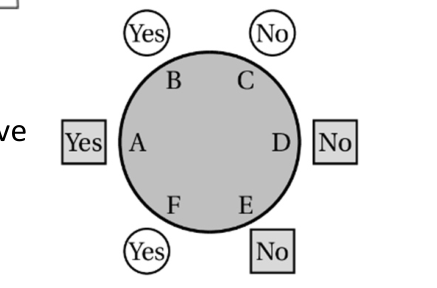
Three square Martians and three round Jupiterians are sitting at a table as shown. One of the six has the key to the spaceship. Everyone from one planet always tells the truth, and everyone from the other planet always lies. When asked “Does any of your neighbours have the key?” all six answer as shown. Who has the key?
Show answer
Answer: B — B
Show hints
Hint 1 of 3
The key-holder's two neighbours truly have a neighbour with the key, while everyone non-adjacent to the key truly does not.
Still stuck? Show hint 2 →
Hint 2 of 3
Whoever holds the key answers about their own neighbours, who do NOT have it—so the holder's truthful answer would be "No."
Still stuck? Show hint 3 →
Hint 3 of 3
Test each candidate and keep the one that yields exactly three truth-tellers and three liars.
Show solution
Approach: assume each candidate holds the key and count consistent types
Around the table the neighbours are \(A\!-\!B\!-\!C\!-\!D\!-\!E\!-\!F\!-\!A\); the answers are A:Yes, B:Yes, C:No, D:No, E:No, F:Yes.
Suppose \(B\) has the key: then \(A\) (neighbour) truly says Yes; \(B\) sees no key neighbour yet says Yes (lie); \(C\) says No but a neighbour has it (lie); \(D,E\) truly say No; \(F\) says Yes but neither neighbour has it (lie).
That is truth-tellers \(A,D,E\) and liars \(B,C,F\)—exactly three each, the only candidate that works—so the key is with B, choice (B).