Tick one or more bands and topics — problems are pulled from every authored year.
Showing 20 of 485 matching
Problem 11 · 2025 Math Kangaroo
Medium
Counting & Probabilitycareful-counting
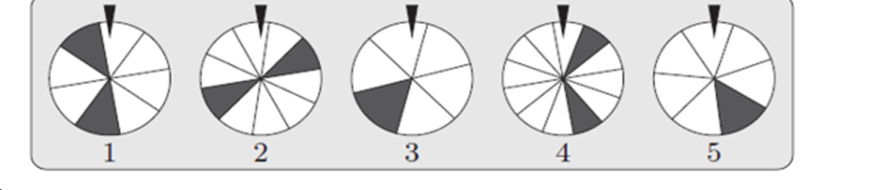
In the picture you can see five different wheels of fortune. Each wheel of fortune is divided into equal-sized parts, but the number of parts is different. Anna spins all of the wheels of fortune. If a wheel of fortune stops at the arrow with a dark sector, she wins. Which of the wheels of fortune gives Anna the best chance of winning?
Show answer
Answer: A — 1
Show hints
Hint 1 of 2
On a fair wheel, the chance of winning is just the share of the wheel that is dark: dark sectors out of total sectors.
Still stuck? Show hint 2 →
Hint 2 of 2
Write each wheel’s chance as a fraction and see which fraction is biggest — a bigger dark share on a wheel with fewer pieces wins.
Show solution
Approach: compare the fraction of dark sectors
Each wheel is split into equal parts, so the chance of stopping on dark is simply the fraction of the wheel that is dark.
Wheel 1 has 2 dark sectors out of 8, which is 14 of the wheel; the others all turn out to be smaller dark shares (each less than a quarter, since they spread their dark sectors over more pieces).
14 is the largest dark share, so wheel 1 gives Anna the best chance, and the answer is (A) 1.
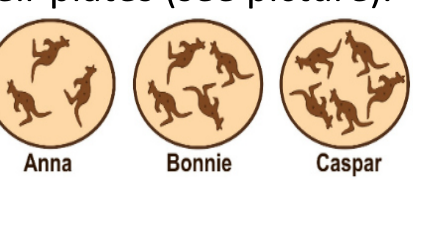
Anna, Bonnie and Caspar have some kangaroo cookies on their plates (see picture). There are 15 more cookies left over. They share these out so that each child ends up with the same number of cookies on their plate. How many cookies are added to Anna's plate?
Show answer
Answer: D — 6
Show hints
Hint 1 of 2
First find how many cookies there are altogether, then share them equally among the three children.
Still stuck? Show hint 2 →
Hint 2 of 2
Subtract the cookies Anna already has from her fair share.
Show solution
Approach: find the equal share, then see how many Anna still needs
The plates already hold 3 (Anna) + 4 (Bonnie) + 5 (Caspar) = 12 cookies.
With the 15 extra there are 12 + 15 = 27 cookies in all.
Shared equally, each child should have 27 ÷ 3 = 9 cookies.
Alex threads white and black beads alternately onto a piece of string. Twice, 5 beads are hidden — see picture. How many white beads are hidden in total?
Show answer
Answer: C — 6
Show hints
Hint 1 of 3
The beads always go white, black, white, black — never two of the same colour together.
Still stuck? Show hint 2 →
Hint 2 of 3
Look at the visible bead right before each hidden part to know what colour comes next.
Still stuck? Show hint 3 →
Hint 3 of 3
Fill in each hidden run of 5 by carrying on the colours, then count just the white ones.
Show solution
Approach: carry on the alternating colour pattern through each hidden run
The beads keep switching: white, black, white, black, and so on.
Each hidden group of 5 carries on that pattern, and in each one 3 of the 5 beads come out white.
There are two hidden groups, so 3 and 3 make 6 white beads in total. The answer is C.
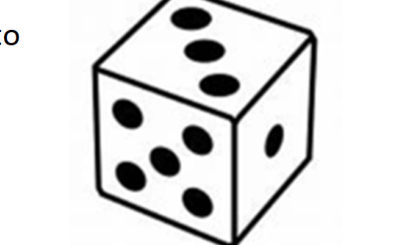
On a standard die, the sum of the number of points on opposite sides is always 7. We want to tilt the die shown several times along its edges so that all six sides are on top once. Which of the given sequences of top numbers is not possible?
Show answer
Answer: B — 3-2-5-1-6-4
Show hints
Hint 1 of 2
Each tilt moves to a face sharing an edge with the current top; opposite faces (summing to 7) can never be consecutive in the list.
Still stuck? Show hint 2 →
Hint 2 of 2
Check each sequence: two faces that are opposite must not appear next to each other.
Show solution
Approach: adjacent tops cannot be opposite faces
Tilting over an edge sends the top to a face that shares that edge, i.e. an adjacent face — never to the opposite face (its 7-partner).
So in a valid sequence no two consecutive top numbers may sum to 7; scan each option for such a forbidden step.
In sequence B, the step 2 then 5 has \(2+5=7\), an impossible move, so B is the one that cannot occur.
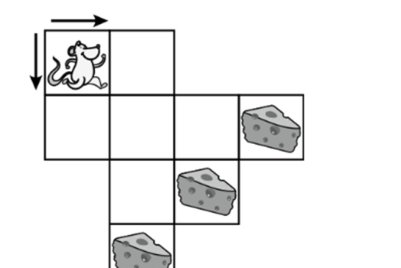
A mouse wants to reach a piece of cheese. From each square it can only move to the square to its right or to the square directly below it. How many different paths lead the mouse to a piece of cheese?
Show answer
Answer: C — 8
Show hints
Hint 1 of 2
Instead of drawing every route, write a number in each square: how many ways the mouse can reach that square.
Still stuck? Show hint 2 →
Hint 2 of 2
A square's number is the sum of the numbers in the square just left of it and the square just above it, since those are the only ways in.
Show solution
Approach: fill in path counts square by square
Write 1 in the start square; every other square gets the total of the square to its left and the square above it (the only squares that can flow into it).
Filling the staircase this way, the counts grow 1, then 2 and 3, and so on down toward the cheese.
The cheese squares collect a total of 8 paths, which is (C).
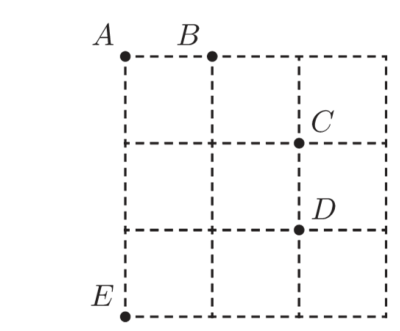
Robert wants to choose four points in such a way that the distances between any two of them are different. Which one of the points A, B, C, D or E must he remove?
Show answer
Answer: D — D
Show hints
Hint 1 of 3
Read each point's grid coordinates, then look for repeated distances rather than computing all ten exactly.
Still stuck? Show hint 2 →
Hint 2 of 3
Several pairs share the length \(\sqrt5\); find the one point common to the offending pairs.
Still stuck? Show hint 3 →
Hint 3 of 3
Remove that point and check the remaining six distances are all different.
Show solution
Approach: find the repeated length and the point it shares
With \(A(0,3), B(1,3), C(2,2), D(2,1), E(0,0)\), the pairs \(AC, BD, DE\) all have length \(\sqrt5\), so a duplicate length is the obstacle.
Point \(D\) appears in two of those equal pairs (\(BD\) and \(DE\)); the four remaining points \(A,B,C,E\) give distances \(1,\sqrt2,\sqrt5,2\sqrt2,3,\sqrt{10}\), all distinct.
Which of the five shapes cannot be placed on the large square so that it only lies on white squares? (The five shapes A–E and the patterned large square are pictured with the question.)
Show answer
Answer: D
Show hints
Hint 1 of 2
Look at where the white squares actually sit on the big board, then try to slide each shape around so all of its squares land on white.
Still stuck? Show hint 2 →
Hint 2 of 2
Four of the shapes can be tucked onto a run of white squares; hunt for the one shape whose squares are forced to grab a black square no matter where you put it.
Show solution
Approach: try to fit each shape onto only white squares
A shape works only if you can lay it down so every one of its squares sits on a white square of the board.
Slide each shape A–E around the board: four of them can be placed on a stretch of white squares with no black square underneath.
Shape D is the only one that always lands on at least one black square wherever it goes, so it cannot sit only on white squares — the answer is (D).
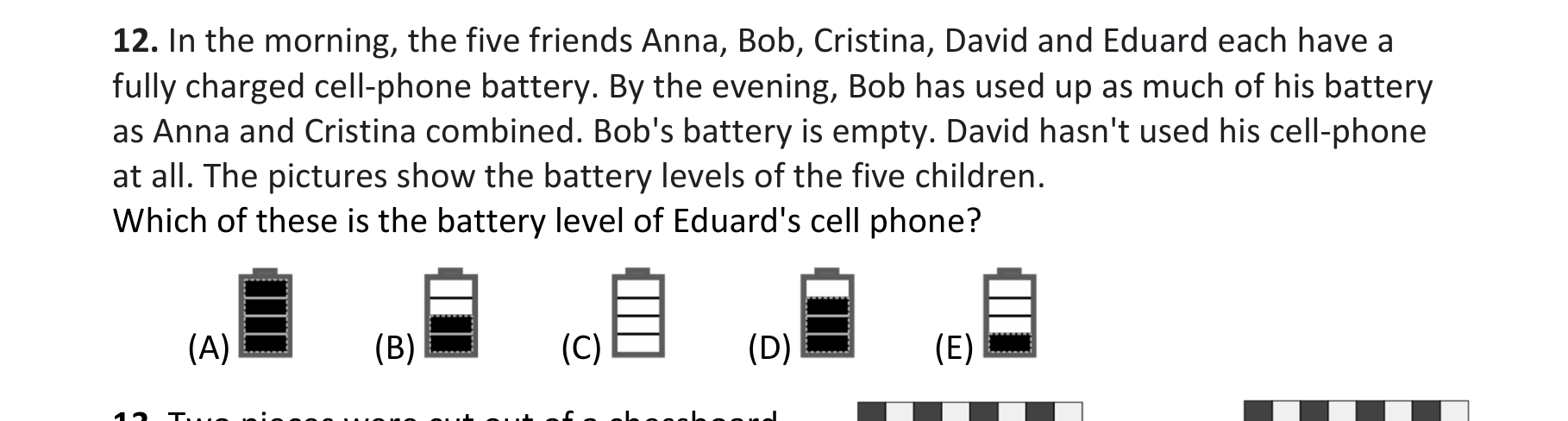
In the morning, the five friends Anna, Bob, Cristina, David and Eduard each have a fully charged phone battery. By evening, Bob has used up as much of his battery as Anna and Cristina together, and Bob's battery is now empty. David has not used his phone at all. The pictures show the battery levels of the five children. Which one is Eduard's battery level?
Show answer
Answer: B
Show hints
Hint 1 of 2
David did not use his phone, so his battery is still full - that pins down 'full'.
Still stuck? Show hint 2 →
Hint 2 of 2
Bob's used-up amount equals Anna's plus Cristina's; match the five pictures to the five children to find the leftover one for Eduard.
Show solution
Approach: assign the five battery pictures by the given clues
David's phone is full (unused) and Bob's is empty (fully used).
Bob's drained amount equals Anna's drain plus Cristina's drain combined.
Match those clues to four of the five pictures; the one left over is Eduard's.
17 squirrels are sitting on 4 trees. There are at least 2 squirrels on each tree. The number of squirrels is different on each tree. What is the largest possible number of squirrels on one tree?
Show answer
Answer: B — 8
Show hints
Hint 1 of 3
To put as many squirrels as possible on one tree, leave as few as possible on the others.
Still stuck? Show hint 2 →
Hint 2 of 3
The other three trees still need at least 2 each, and all four numbers must be different.
Still stuck? Show hint 3 →
Hint 3 of 3
The three smallest different numbers, each at least 2, are 2, 3 and 4.
Show solution
Approach: minimise the other three to maximise one
Each tree needs at least 2 squirrels and all four counts are different.
Make three trees as small as possible: 2, 3 and 4 squirrels.
Those three trees hold 2 + 3 + 4 = 9 squirrels, leaving 17 − 9 = 8 on the last tree. The answer is B.
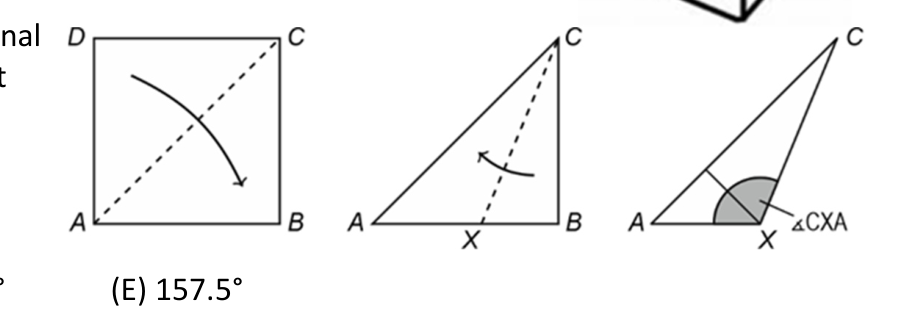
Alexander folds a square sheet of paper along its diagonal to form a triangle. He then folds the paper again so that one of the two shorter sides of the triangle lies on the longer side of the triangle to form the smaller triangle AXC (see diagrams). What is the size of the angle ∠CXA?
Show answer
Answer: B — 112.5°
Show hints
Hint 1 of 2
After the first fold you have a right isosceles triangle, with angles 90°, 45°, 45°.
Still stuck? Show hint 2 →
Hint 2 of 2
The second fold lays a 45° leg onto the hypotenuse, so the crease bisects the angle it folds — work out the resulting angle at X.
Show solution
Approach: track angles through the two folds
Folding the square along its diagonal gives a right isosceles triangle: a 90° corner and two 45° corners.
The second fold lays a short side (leg) onto the long side (hypotenuse), so the crease through X bisects the 45° corner at A into two 22.5° pieces.
At X the crease meets the right angle, giving \(\angle CXA = 90^\circ + 22.5^\circ = 112.5^\circ\), answer B.
In a 60 m hurdles race there are 5 hurdles. The first hurdle is 12 m after the start, and the distance between any two consecutive hurdles is 8 m. How far is the last hurdle from the finish line?
Show answer
Answer: E — 16 m
Show hints
Hint 1 of 2
Find the position of the last (5th) hurdle measured from the start.
Still stuck? Show hint 2 →
Hint 2 of 2
Then subtract that from the 60 m finish line.
Show solution
Approach: locate the last hurdle, then measure to the finish
Hurdle 1 is at 12 m and each later hurdle is 8 m further: 12, 20, 28, 36, 44.
The 5th hurdle is at 12 + 4×8 = 44 m.
Distance to the finish = \(60 - 44 = 16\) m, which is (E).
Among 10 different given positive integers, exactly five are divisible by 5 and exactly seven are divisible by 7. Let M be the largest of these numbers. What is the smallest possible value of M?
Show answer
Answer: E — a different value
Show hints
Hint 1 of 2
At least how many numbers must be divisible by both 5 and 7?
Still stuck? Show hint 2 →
Hint 2 of 2
Inclusion–exclusion forces ≥2 multiples of 35; the second-smallest is 70, so M is at least 70.
Show solution
Approach: inclusion–exclusion, then minimise the maximum
5 + 7 − (multiples of 35) ≤ 10, so at least 2 numbers are multiples of 35.
The two smallest multiples of 35 are 35 and 70, so 70 must appear and is the largest.
M = 70, which is not among A–D, so the answer is a different value.
Five swimmers from a school are training for a relay race. The five participants swim the same distance, one after the other, without stopping. The coach stops the intermediate time after each swimmer. The first swimmer takes 2 minutes and 8 seconds. The stopwatches show the total time after the first, second, third, fourth and fifth swimmer (see picture). Which swimmer swam the distance the fastest?
Show answer
Answer: D — the fourth
Show hints
Hint 1 of 2
Each stopwatch shows the total time after that many swimmers, so subtract to get each leg.
Still stuck? Show hint 2 →
Hint 2 of 2
All swam the same distance, so the fastest is the one with the shortest individual leg.
Show solution
Approach: difference of consecutive total times
The watches show running totals: 2:08, 4:07, 6:10, 8:05, 10:03.
Subtract each total from the one before to get each swimmer’s own time: 128 s, 119 s, 123 s, 115 s, 118 s.
Same distance means fastest = shortest time, and 115 s is the smallest.
The four-digit number 80?? is missing its last two digits. We know that this number is divisible by 8 and 9. What is the product of the last two digits?
Show answer
Answer: D — 24
Show hints
Hint 1 of 2
Divisible by both 8 and 9 means divisible by 72.
Still stuck? Show hint 2 →
Hint 2 of 2
Find the multiple of 72 between 8000 and 8099, then multiply its last two digits.
Show solution
Approach: use divisibility by 72
A number divisible by 8 and 9 is divisible by 72.
The multiple of 72 of the form 80__ is 8064 (= 72×112).
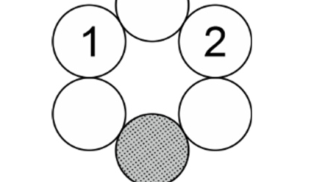
Emma wants to write a number in each circle (see diagram) so that each number equals the sum of the numbers in the two adjacent circles. She has already written two numbers. Which number will she write in the grey circle?
Show answer
Answer: D — −3
Show hints
Hint 1 of 2
Every circle equals the sum of the two circles touching it, and the 1 and 2 are not next to each other.
Still stuck? Show hint 2 →
Hint 2 of 2
Start with the empty circle between the 1 and the 2 — it must equal \(1+2\) — then keep applying the rule around the ring.
Show solution
Approach: propagate the neighbour-sum rule around the ring
The top circle sits between the 1 and the 2, so it equals \(1+2=3\).
Now use 'each circle = sum of its two neighbours' going around: the right circle is \(2-3=-1\), the left circle is \(1-3=-2\), and the grey bottom circle (between them) is \(-1+(-2)=-3\).
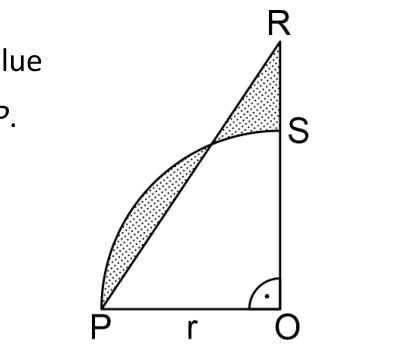
In the diagram we see a quarter circle SP with centre O and radius r, as well as a triangle ORP. The two grey regions have the same area. How long is the segment OR?
Show answer
Answer: A — \(\dfrac{\pi r}{2}\)
Show hints
Hint 1 of 2
Equal grey areas means a shared region can be added to both without changing the equality.
Still stuck? Show hint 2 →
Hint 2 of 2
Adding the common piece turns "two greys equal" into "triangle ORP = quarter circle".
Show solution
Approach: add the shared region to both grey pieces
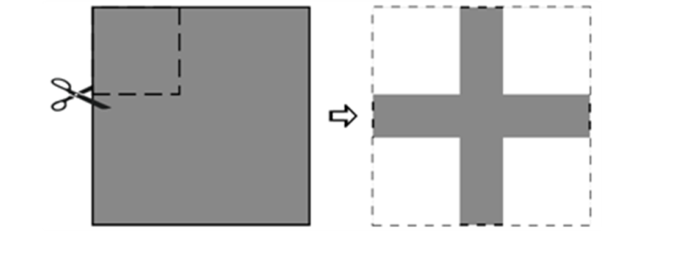
Jana cuts four small squares of the same size from the corners of a square piece of paper (see picture). The total cut-away area is 16 cm², and the area of the remaining figure (the cross) is 9 cm². What is the perimeter of the cross?
Show answer
Answer: C — 20 cm
Show hints
Hint 1 of 2
The whole square’s area is the cut-away plus the cross.
Still stuck? Show hint 2 →
Hint 2 of 2
Cutting a square out of a corner doesn’t change the perimeter — the removed edges are replaced by equal new edges.
Show solution
Approach: reassemble area, then track perimeter
Original square area = 16 (cut away) + 9 (cross) = 25, so its side is 5.
Each of the four corner squares has area 16 ÷ 4 = 4, so side 2.
Removing a 2×2 square from a corner replaces two outer edges with two equal inner edges, so the perimeter stays the same.
The cross perimeter equals the square’s perimeter: 4 × 5 = 20 cm.
Rudi feeds six sheep in the petting zoo. The six sheep get a total of 210 g of food. Each of the five large sheep gets the same amount, and the small sheep gets twice as much as a large sheep. How much food does the small sheep get?
Show answer
Answer: C — 60 g
Show hints
Hint 1 of 2
The small sheep eats as much as two large sheep, so count it as two large sheep.
Still stuck? Show hint 2 →
Hint 2 of 2
Then the 210 g is shared into 7 equal large-sheep portions.
Show solution
Approach: count everything in equal large-sheep portions
The small sheep eats as much as two large sheep, so pretend it is two large sheep.
Now there are 5 + 2 = 7 equal large-sheep portions sharing 210 g.
Each portion is 210 ÷ 7 = 30 g.
The small sheep gets two portions: 30 + 30 = 60 g, option C.