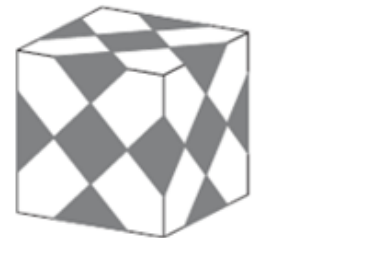
Which of the pieces shown completes the pattern? (The five choices A–E are pictured below the question.)
Show answer
Answer: C
Show hints
Hint 1 of 2
The big design is one repeating pattern; the white window is just a square-shaped hole punched out of it.
Still stuck? Show hint 2 →
Hint 2 of 2
Look at the lines touching all four edges of the hole and ask which piece lets every one of them continue without a break.
Show solution
Approach: match the missing tile to the lines around the hole
The hole sits inside a repeating pattern of overlapping squares and diamonds, so the right piece is the one that keeps every line going straight across the gap.
Trace the lines that arrive at the top, bottom, left and right edges of the white square; the correct piece must connect to all of them at once.
Only choice C lines up on all four sides so the pattern stays seamless with no broken lines, so the answer is (C).
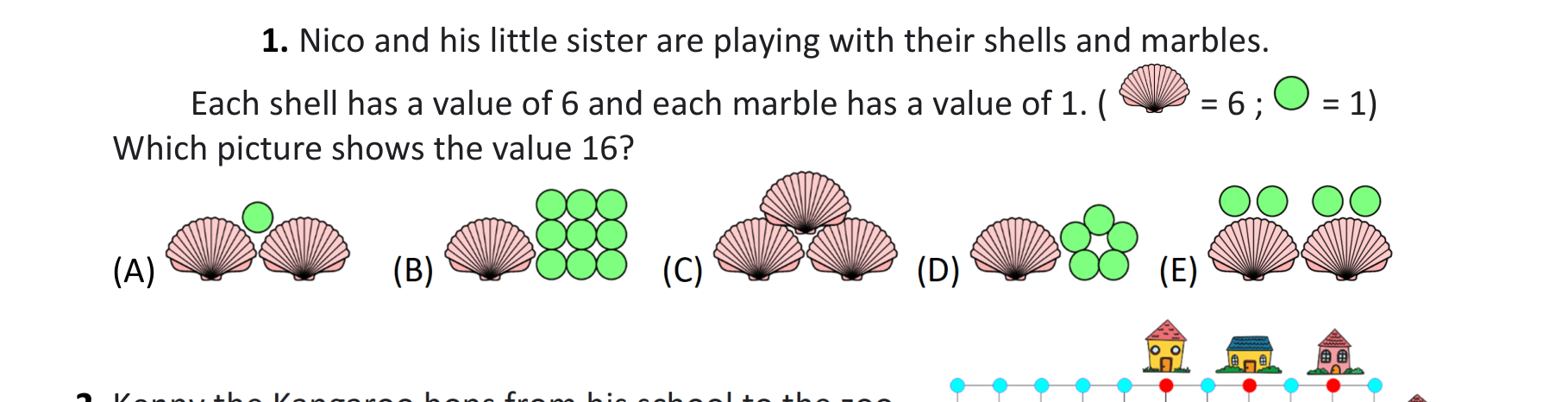
Nico and his little sister play with shells and marbles. Each shell is worth 6 and each marble is worth 1 (shell = 6, marble = 1). Which picture shows the value 16?
Show answer
Answer: E
Show hints
Hint 1 of 2
Each shell counts as 6 and each marble counts as 1 - add up each picture's total.
Still stuck? Show hint 2 →
Hint 2 of 2
You need a total of exactly 16, so look for two shells plus four marbles.
Show solution
Approach: add the shell and marble values in each option
A shell is worth 6 and a marble is worth 1.
Two shells give 12, and you need 4 more to reach 16, so 4 marbles.
The picture with two shells and four marbles totals 12 + 4 = 16.
Anna builds a wall out of black and grey bricks that shows 2025. What can Bella read on the back of the wall? (The five choices A–E are pictured below the question.)
Show answer
Answer: E
Show hints
Hint 1 of 2
Looking at the back of a wall is like seeing it in a mirror.
Still stuck? Show hint 2 →
Hint 2 of 2
Reflect the whole ‘2025’ left-to-right; each digit flips and the order of digits reverses.
Show solution
Approach: horizontal mirror reflection
Seeing the back of the wall is exactly like holding the front up to a mirror, so the whole picture flips left–right.
Two things happen at once: the order of the digits reverses (so 2025 reads 5202), and each digit itself is mirrored.
The choice that shows this left–right flip of the bricks is the back view, which is (E).
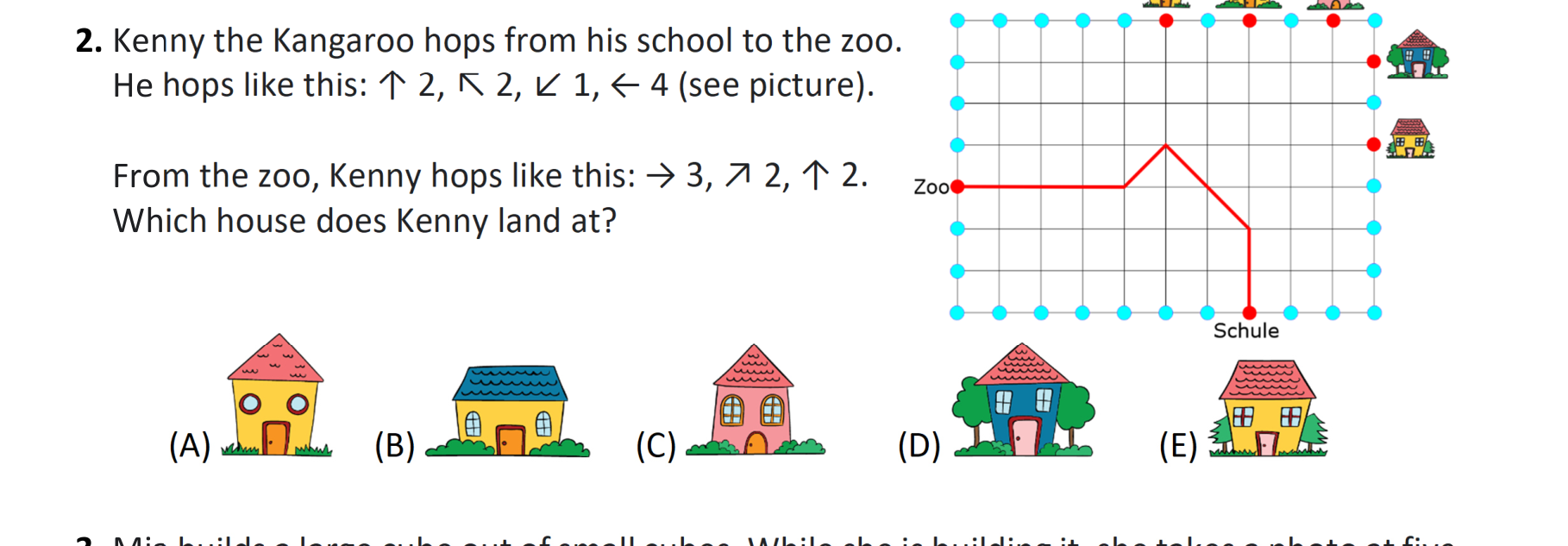
Kenny the Kangaroo hops from his school to the zoo. He hops like this: up 2, up-left 2, down-left 1, left 4 (see picture). From the zoo, Kenny hops like this: right 3, up-right 2, up 2. Which house does Kenny land at?
Show answer
Answer: A
Show hints
Hint 1 of 2
Start at the Zoo dot and follow the new hops one by one on the grid.
Still stuck? Show hint 2 →
Hint 2 of 2
Track the arrows right 3, up-right 2, up 2 step by step until you land on a house.
Show solution
Approach: trace the hops on the grid from the zoo
Begin at the Zoo marker and move right 3 squares.
Then move diagonally up-right 2 squares, then straight up 2 squares.
The base of a triangle is extended by 50% and its height is reduced by one third. What is the ratio of the area of the new triangle to the area of the original triangle?
Show answer
Answer: B — 1:1
Show hints
Hint 1 of 2
A triangle's area is proportional to base times height.
Still stuck? Show hint 2 →
Hint 2 of 2
Multiply the two change factors together and see what happens to the product.
Show solution
Approach: multiply the two scale factors
Extending the base by 50% makes it \(\tfrac{3}{2}\) of the old base; reducing the height by one third makes it \(\tfrac{2}{3}\) of the old height.
Area scales by \(\tfrac{3}{2}\times\tfrac{2}{3}=1\), so the area is unchanged.
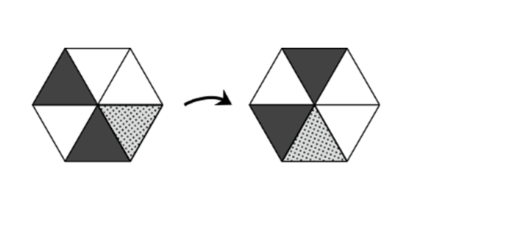
Isabelle plays with a hexagonal sheet of paper. With each move she rotates the hexagon by the same angle in the same direction. The illustration shows the sheet at the start and after the first move. After how many moves does the sheet look the same as it did at the beginning?
Show answer
Answer: A — 6
Show hints
Hint 1 of 2
The single dotted wedge acts as a marker — track where it lands after one move.
Still stuck? Show hint 2 →
Hint 2 of 2
Find the rotation angle of one move, then see how many moves complete a full turn back to the start.
Show solution
Approach: track the marker wedge under repeated equal rotations
The colouring has no rotational symmetry, so the sheet only looks identical after a whole turn brings every wedge home.
Comparing the start and the first move, the unique dotted wedge has shifted by one position — a 60° rotation.
A 60° step needs \(360^\circ \div 60^\circ = 6\) moves to return to the original picture, which is (A).
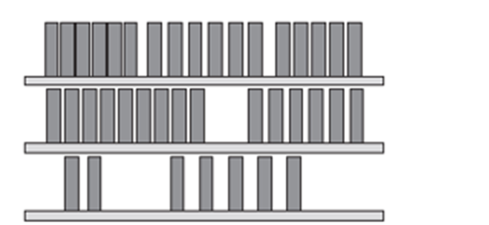
A bookshelf with three rows has 17 books in the top row, 15 books in the middle row and 7 books in the bottom row. Monika would like to have the same number of books in each row, but she wants to rearrange as few books as possible. How many books does she have to move from the middle row to the bottom row?
Show answer
Answer: B — 2
Show hints
Hint 1 of 2
First find how many books each row should hold.
Still stuck? Show hint 2 →
Hint 2 of 2
Books should only be moved into rows that are short; figure out the bottom row’s shortfall.
Show solution
Approach: even out the rows with fewest moves
Total books: 17 + 15 + 7 = 39, so each row should have 39 ÷ 3 = 13.
The bottom row is short by 13 − 7 = 6 books; the top row has 4 spare and the middle has 2 spare.
To move as few as possible, send the top’s 4 spare and the middle’s 2 spare straight to the bottom.
So only 2 books go from the middle row to the bottom row.
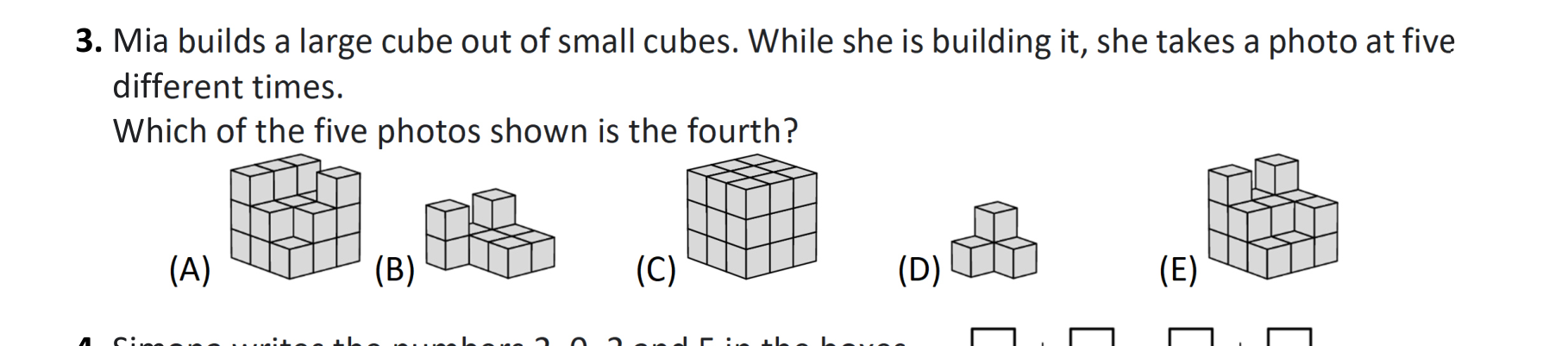
Mia builds a large cube out of small cubes. While she is building it, she takes a photo at five different times. Which of the five photos shown is the fourth?
Show answer
Answer: A
Show hints
Hint 1 of 2
The photos show the cube growing, so put them in order from fewest cubes to a full cube.
Still stuck? Show hint 2 →
Hint 2 of 2
Order the five pictures by how complete the cube is, then count to the fourth one.
Show solution
Approach: order the photos by how built-up the cube is
The cube is assembled over time, so the photos go from least built to fully built.
Arrange the five images by increasing number of small cubes placed.
The fourth picture in that order is the nearly-complete cube shown in option A.
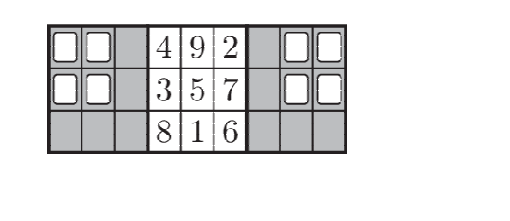
The left and right parts of a three-part brochure each contain four transparent windows. If these two parts are folded onto the middle part, some of the numbers written on the middle part are visible through the windows. What is the sum of the visible numbers when the brochure is folded?
Show answer
Answer: D — 14
Show hints
Hint 1 of 3
Both side panels fold over the middle, stacking on top of each other, so each panel reflects left-right as it closes.
Still stuck? Show hint 2 →
Hint 2 of 3
A middle number shows only if BOTH the left panel and the right panel have a window over that same cell.
Still stuck? Show hint 3 →
Hint 3 of 3
Find the windows each panel lands on after folding, then keep only the cells where the two sets of windows overlap.
Show solution
Approach: intersect the two panels' window positions
Both flaps fold inward and cover the whole 3×3 middle, so a number is visible only where the left flap AND the right flap both have a window (you must see through both layers).
Folding the left flap (it reflects) puts its windows over the middle's two right columns; folding the right flap puts its windows over the middle's two left columns — they overlap only in the centre column.
There the visible numbers are 9 (top) and 5 (middle), so the sum is \(9+5=14\), answer D.
Logic & Word Problemscomplementary-countingsum-constraint
Vasily has 20 balls. Each ball is either yellow, green, blue or black. Of the balls, exactly 17 are not green, exactly 15 are not black, and exactly 12 are not yellow. How many of his balls are blue?
Show answer
Answer: D — 4
Show hints
Hint 1 of 2
Turn each "not" statement into a count of that colour.
Still stuck? Show hint 2 →
Hint 2 of 2
Green = 20 − 17, black = 20 − 15, yellow = 20 − 12; the rest are blue.
Show solution
Approach: complementary counting
Not green = 17 means green = 3; not black = 15 means black = 5; not yellow = 12 means yellow = 8.
Simona writes the numbers 2, 0, 2 and 5 in the boxes, one number per box (see picture). In what order can she write them so that the calculation gives the biggest result?
Show answer
Answer: E — 5, 2, 0, 2
Show hints
Hint 1 of 2
The third box is the one that gets subtracted, so put the smallest number there.
Still stuck? Show hint 2 →
Hint 2 of 2
Put the 0 in the subtracted (third) box and add everything else.
Show solution
Approach: minimise what is subtracted, maximise what is added
The calculation is first + second minus third + fourth.
To make it biggest, subtract the smallest number, which is 0.
Then the other three (5, 2, 2) are all added: 5 + 2 - 0 + 2 = 9.
The order 5, 2, 0, 2 does this, which is option E.