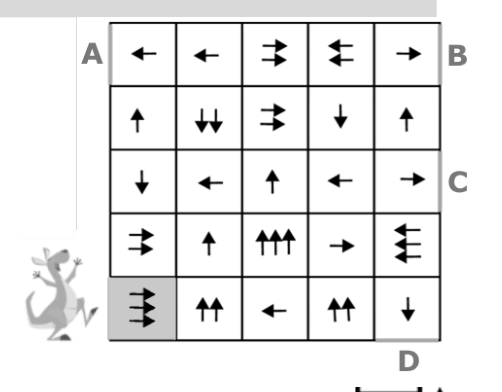
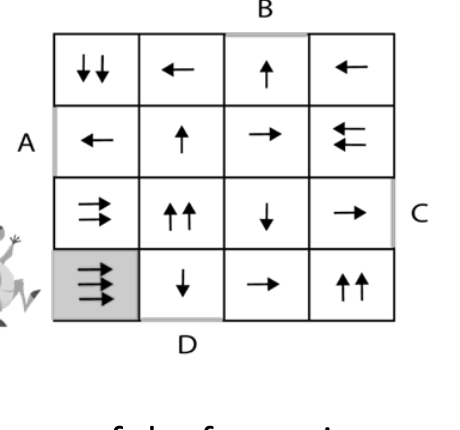
Kangaroo Joey wants to jump through the maze. Joey starts in the square at the bottom left (see picture). The number of arrows in a square tells how long the jump must be: a square with three arrows means Joey jumps over two squares in the direction of the arrows and lands in the third square.
Where will Joey leave the maze?
Show answer
Answer: B — B
Show hints
Hint 1 of 2
Start in the bottom-left square and follow the arrows one jump at a time, counting squares carefully.
Still stuck? Show hint 2 →
Hint 2 of 2
Treat each square as an instruction: the arrow gives the direction and the number of arrows gives how many squares to advance; see which edge you eventually step off.
Show solution
Approach: trace the path square by square
Begin on the bottom-left square and read its arrows: move in the arrow's direction by as many squares as there are arrows (three arrows = land in the third square).
Repeat from each square you land on, always obeying the new square's arrows.
Following the chain of jumps, Joey is carried to the edge of the grid and exits through the side marked B.
Each square below is cut into two pieces by a line. Which square was divided into two pieces that are different in shape? (The answer choices are the five pictured squares.)
Show answer
Answer: E
Show hints
Hint 1 of 3
For each square, look at the two pieces and ask: are they the same shape and size?
Still stuck? Show hint 2 →
Hint 2 of 3
Imagine cutting along the line and laying one piece on top of the other — in four squares they match exactly.
Still stuck? Show hint 3 →
Hint 3 of 3
Find the one square where the two pieces would NOT stack on top of each other.
Show solution
Approach: for each square, check whether the two pieces are the same
In each square, picture cutting along the line and laying one piece on top of the other.
In four of the squares the two pieces stack perfectly — they are the same shape and size.
In one square the pieces are clearly different: one is bigger or a different shape, so they cannot stack.
The diagram on the right is made up of five-sided tiles of equal size. Which tile can be inserted in the missing spot so that two closed lines are formed?
Show answer
Answer: C
Show hints
Hint 1 of 2
The grid in the corner already has lines running into the empty slot; the inserted tile must continue them.
Still stuck? Show hint 2 →
Hint 2 of 2
You need the two arcs in the hole to join up into exactly two separate closed loops, so match where each line meets the tile's edges.
Show solution
Approach: match the line endpoints so the curves close into two loops
Look at where the existing curves hit the boundary of the missing pentagon-shaped slot.
The added tile must have its two arcs touch those same edge points so the strokes connect.
Only the tile whose arcs link the open ends into two complete closed lines works.
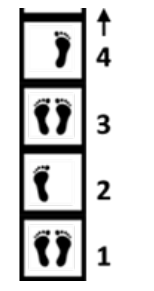
The picture shows the footprints of the first few jumps of a kind of hopscotch. The prints show whether you may land on a square with the left foot, the right foot, or both feet. Mia starts with both feet on square number 1 and repeats the jumping pattern in the direction of the arrow.
On which of the following squares is Mia allowed to land with her right foot only?
Show answer
Answer: C — square no. 20
Show hints
Hint 1 of 2
Read off the four-square footprint pattern (both / right / both / left, say) and notice it repeats every four squares.
Still stuck? Show hint 2 →
Hint 2 of 2
Find which position in the repeating cycle is the 'right foot only' square, then check which listed number lands on that position.
Show solution
Approach: find the repeating cycle of footprints
The footprints in squares 1-4 set a pattern that then repeats every four squares in the arrow's direction.
Locate the position within that 4-square cycle that calls for the right foot only.
Each candidate number lands on a fixed spot in the cycle; only square no. 20 lines up with the right-foot-only position.
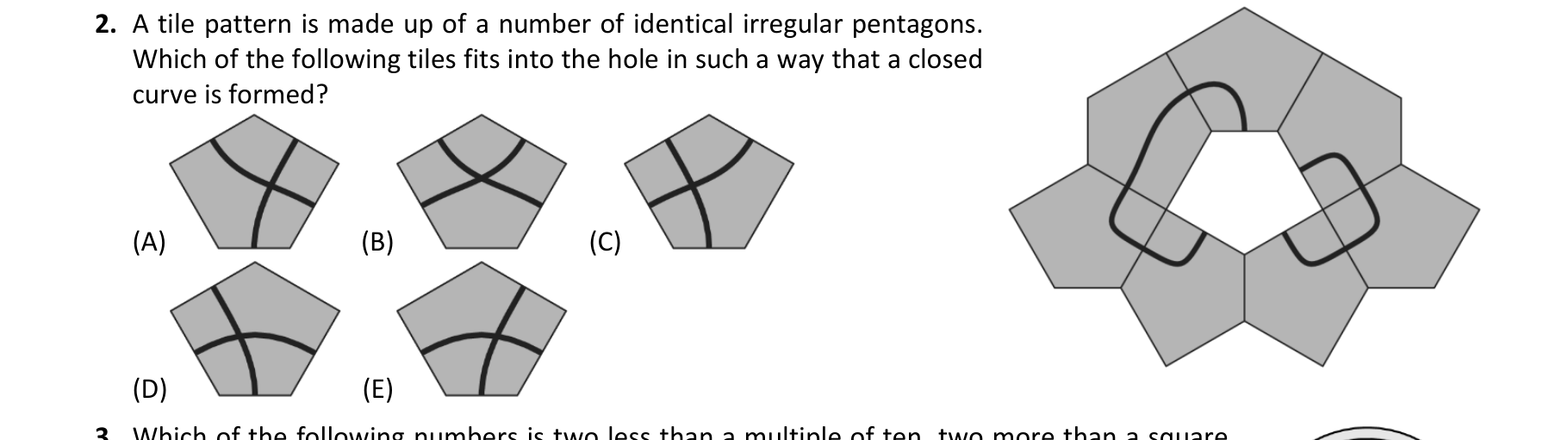
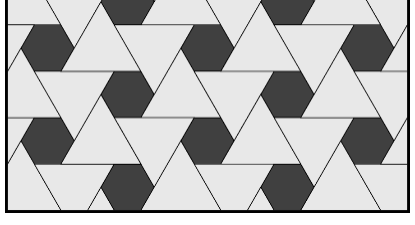
A tile pattern is made up of a number of identical irregular pentagons. Which of the following tiles fits into the hole in such a way that a closed curve is formed?
Show answer
Answer: C
Show hints
Hint 1 of 3
Find where the curves on the surrounding tiles meet the edges of the empty pentagonal hole — those are loose ends.
Still stuck? Show hint 2 →
Hint 2 of 3
The inserted tile's arcs must connect to every loose end so the curve never just stops.
Still stuck? Show hint 3 →
Hint 3 of 3
Check each option by tracing: only one tile turns all the loose ends into a single unbroken closed loop.
Show solution
Approach: match the curve ends along the hole's edges
On the edges of the empty pentagon, the surrounding tiles leave several curve ends sticking out.
The tile dropped in must join to every one of those ends, or the curve would have a loose end.
Tracing the five options, only one routes its arcs so that all ends connect.
That tile seals everything into one closed curve, so the answer is C.
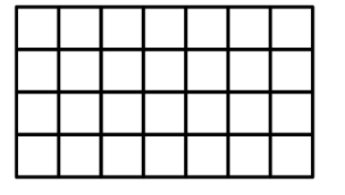
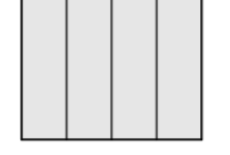
The rectangle on the right has 4 rows and 7 columns, so it is made of 28 white squares. Ira paints 2 whole rows and 1 whole column. How many squares are still white?
Show answer
Answer: C — 12
Show hints
Hint 1 of 3
Instead of counting the painted squares, count the ones that stay white.
Still stuck? Show hint 2 →
Hint 2 of 3
A square stays white only if its row was not painted AND its column was not painted.
Still stuck? Show hint 3 →
Hint 3 of 3
How many rows are left unpainted, and how many columns?
Show solution
Approach: count the white squares directly using the leftover rows and columns
A square stays white only when both its row and its column are unpainted.
Ira paints 2 of the 4 rows, so 2 rows stay white; she paints 1 of the 7 columns, so 6 columns stay white.
The white squares fill those 2 leftover rows across those 6 leftover columns: 2 × 6 = 12.
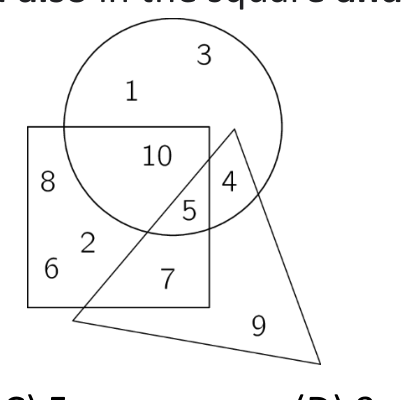
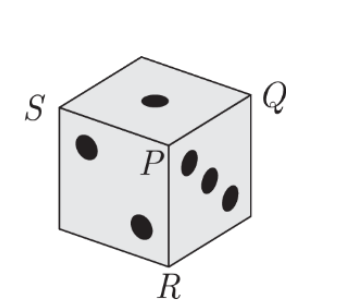
On a standard die opposite faces always show points adding to 7. The vertex sum at a corner is the sum of the points on the three faces meeting there. (For example, the faces showing 1, 2 and 3 meet at P, so the vertex sum at P is 1 + 2 + 3 = 6.) Which of the following is the biggest vertex sum among the vertices Q, R and S?
Show answer
Answer: D — 11
Show hints
Hint 1 of 2
Opposite faces add to 7, so the three faces meeting at a vertex are never an opposite pair; the bigger faces (5, 6) want to be together.
Still stuck? Show hint 2 →
Hint 2 of 2
A vertex sum is biggest when it uses the three largest faces that can actually meet, so look for the corner near the high-numbered hidden faces.
Show solution
Approach: find the three faces at each vertex and add them
From the picture the three visible faces show 1 (top), 2 (front-left) and 3 (front-right), and they meet at P, giving 1 + 2 + 3 = 6.
The hidden faces are the opposites: 6 (bottom), 5 (opposite the 2) and 4 (opposite the 3); each corner mixes visible and hidden faces.
Corner R (bottom-front) uses the two largest faces 2, 3 plus the hidden bottom 6, giving 2 + 3 + 6 = 11, larger than Q = 1 + 3 + 5 = 9 and S = 1 + 2 + 4 = 7.
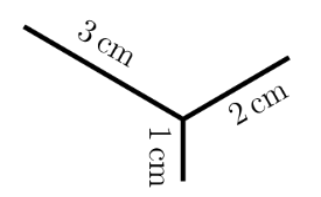
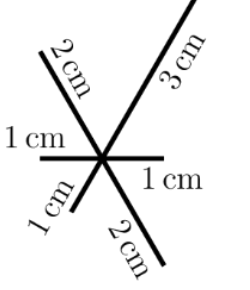
Mona wants to draw the figure shown without lifting her pen. The lengths of the segments are given. Mona can start anywhere and may go over segments more than once. What is the minimum distance, in centimetres, that Mona has to move her pen across the paper?
Show answer
Answer: B — 7 cm
Show hints
Hint 1 of 2
If you could draw the whole figure in one stroke without repeating, the pen distance would just be the total length of all the segments.
Still stuck? Show hint 2 →
Hint 2 of 2
Because some corners have an odd number of segments meeting, you must go over one short segment a second time; add that retraced length to the total.
Show solution
Approach: total segment length plus the unavoidable retraced piece
Add the lengths of all the segments in the figure: 3 + 2 + 1 = 6 cm if nothing is repeated.
A non-stop drawing can avoid repeats only when at most two corners have an odd number of segments; here too many corners are odd, so one segment must be traced twice.
The cheapest segment to repeat is the 1 cm piece, adding 1 cm: 6 + 1 = 7 cm.
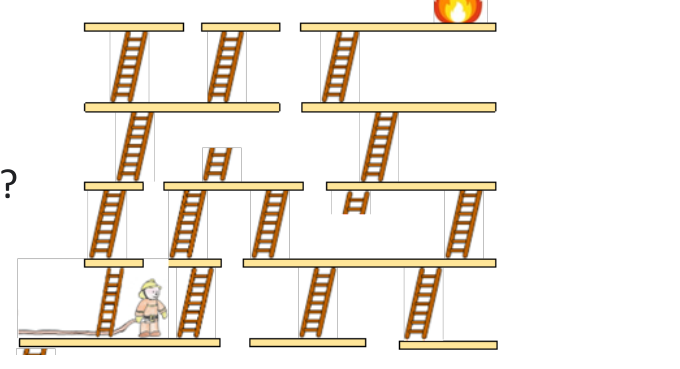
Firefighter Fred wants to put out the fire. In the picture on the right, what is the smallest number of ladders he has to climb to reach the fire without jumping?
Show answer
Answer: C — 6
Show hints
Hint 1 of 2
Start at the firefighter and find every platform you can reach by climbing whole ladders, never jumping.
Still stuck? Show hint 2 →
Hint 2 of 2
Trace the route to the fire that uses the fewest ladders — each ladder climbed counts as one.
Show solution
Approach: trace the shortest ladder path from the firefighter up to the fire
Begin at the firefighter on the ground and only move along complete ladders between platforms.
Follow the chain of ladders upward that reaches the fire's platform.
Counting each ladder used, the shortest such route uses 6 ladders.
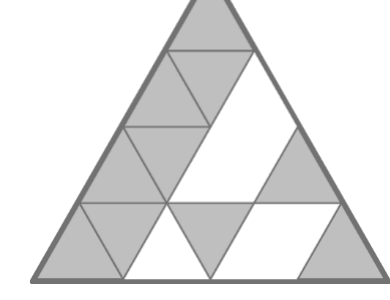
Bruno builds a big triangle out of small triangles that are all the same size. Some are already placed (shown grey). How many more small triangles does he need so that the big triangle is completely filled?
Show answer
Answer: B — 6
Show hints
Hint 1 of 3
The grey little triangles are already glued in; the white spaces are the holes still to fill.
Still stuck? Show hint 2 →
Hint 2 of 3
We only need to count the white triangles, because each hole needs exactly one more small triangle.
Still stuck? Show hint 3 →
Hint 3 of 3
Carefully point to and count every white triangle, one by one.
Show solution
Approach: count the white holes
The grey triangles are already placed, so we just need to fill the white holes.
Touch and count each white triangle one at a time.
There are 6 white triangles, so Bruno needs 6 more.
A type of hopscotch is played like this: a player jumps from one square to the next, alternating left foot, both feet, right foot, both feet, and so on, as shown. Maya plays and jumps into exactly 48 squares, starting with her left foot. How many times is her left foot on the floor during the game?
Show answer
Answer: C — 36
Show hints
Hint 1 of 2
The only jumps where the left foot is NOT on the floor are the right-foot-only jumps, so it may be easier to count those.
Still stuck? Show hint 2 →
Hint 2 of 2
Group the jumps into the repeating block left, both, right, both and see how the left foot behaves in each block.
Show solution
Approach: count the jumps where the left foot is down
The pattern repeats every four squares: left, both, right, both.
In each block of four, the left foot is down on the 'left' square and on the two 'both-feet' squares, so 3 of every 4 squares use the left foot.
Over 48 squares that is \(\frac{3}{4}\times 48 = 36\) times, answer C.
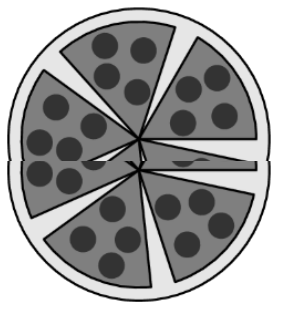
A kangaroo cuts a pizza into 6 pieces of equal size. After it has eaten one piece, it rearranges the remaining pieces so that the gaps between the pieces are all equally big. What is the angle in each gap?
Show answer
Answer: E — 12°
Show hints
Hint 1 of 2
The five remaining pieces still cover the same total angle they did before one was removed.
Still stuck? Show hint 2 →
Hint 2 of 2
Find the total angle of the 5 pieces, subtract from 360°, then split the leftover into 5 equal gaps.
Show solution
Approach: share the missing angle among the gaps
Six equal pieces means each spans 360° ÷ 6 = 60°.
Five pieces remain, covering 5 × 60° = 300°.
The empty angle is 360° − 300° = 60°, split into 5 equal gaps.
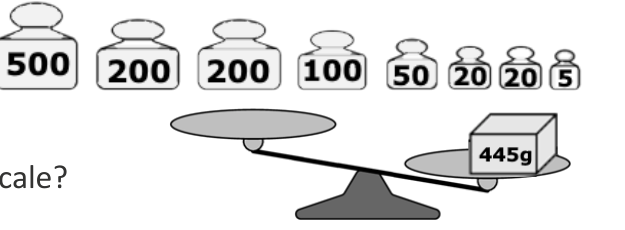
Pieter has a parcel that weighs 445 g and the eight weights shown. He places the parcel on the right pan of the scale (see picture). Pieter may put weights on either side of the scale. What is the smallest number of weights he needs to balance the scale?
Show answer
Answer: B — 3
Show hints
Hint 1 of 2
Weights on the parcel's side help it; weights on the other side fight it, so a weight you put with the parcel counts as minus and a weight opposite counts as plus.
Still stuck? Show hint 2 →
Hint 2 of 2
You need the opposite-side weights minus the parcel-side weights to equal 445 g using as few weights as possible.
Show solution
Approach: make 445 as a difference of a few weights
Putting a weight opposite the parcel adds its value; putting it with the parcel subtracts it, so balancing needs a signed combination equal to 445 g.
Use 500 on the empty side and 50 + 5 on the parcel's side: 500 − 50 − 5 = 445.
That is just three weights, and no two-weight combination reaches 445.
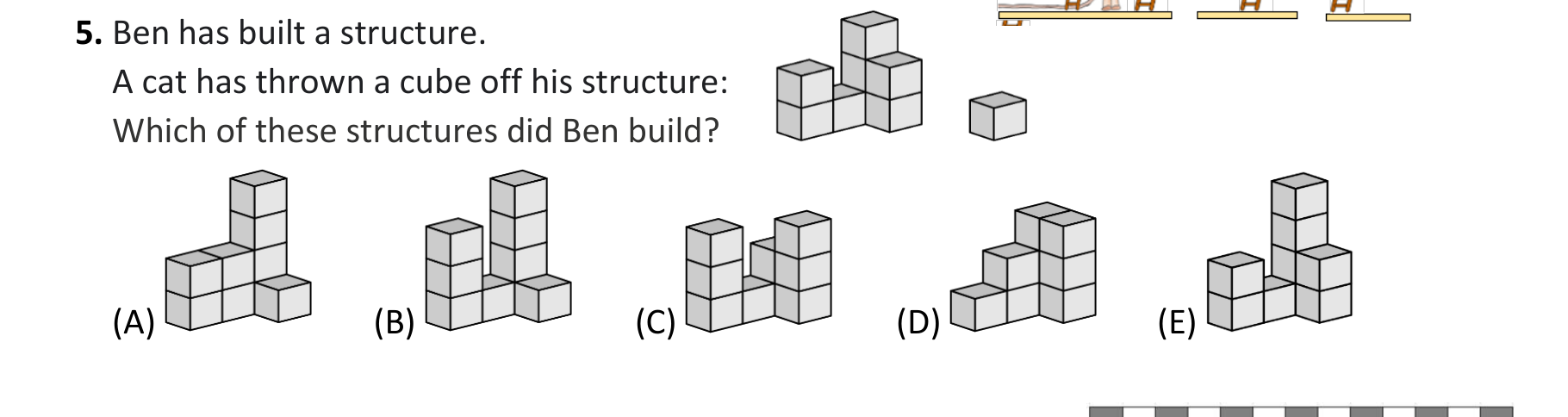
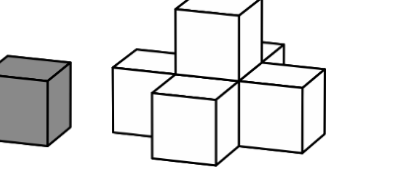
Ben built a structure out of cubes. A cat then knocked one cube off it. The picture on the right shows the knocked-down structure together with the loose cube that fell. Which of the five pictured structures (A)–(E) did Ben originally build?
Show answer
Answer: E
Show hints
Hint 1 of 3
The picture shows the knocked-down structure plus one loose cube that fell off, so Ben's tower had one more cube than the picture.
Still stuck? Show hint 2 →
Hint 2 of 3
Take each answer choice and cover up one cube — you want the one that is then left looking exactly like the pictured structure.
Still stuck? Show hint 3 →
Hint 3 of 3
Match the cubes spot by spot, remembering the loose cube goes back on top of the tall part.
Show solution
Approach: put the fallen cube back and match the cube positions to an option
The cat knocked one cube off, so Ben's real structure is the pictured shape with that one loose cube added back on.
Put the loose cube back where it fits (on the tall stack) and look at the whole shape.
Now compare that finished shape, cube by cube, with each answer choice.
Only one choice has its cubes in exactly the same spots: E.
Tim wants to draw the figure shown without lifting his pencil off the paper, so he has to go over some parts more than once. The segment lengths are marked on the figure. If he may choose his starting point freely, what is the shortest total length of line he draws?
Show answer
Answer: B — 15 cm
Show hints
Hint 1 of 2
A figure can be drawn in one stroke only if it has zero or two odd-degree vertices.
Still stuck? Show hint 2 →
Hint 2 of 2
Each odd vertex beyond the allowed two forces you to retrace one extra edge; retrace the shortest ones.
Show solution
Approach: Euler path: keep only two odd vertices, retrace the shortest edges
A figure can be drawn in one stroke only if it has at most two vertices where an odd number of segments meet; you may start and end at those two.
This figure has more than two odd vertices, so the extra odd vertices must be paired up by re-drawing (retracing) a path between them, and you pick the shortest segments to repeat.
Adding the length of the whole figure to those shortest retraced pieces gives the minimum stroke length of 15 cm, answer B.
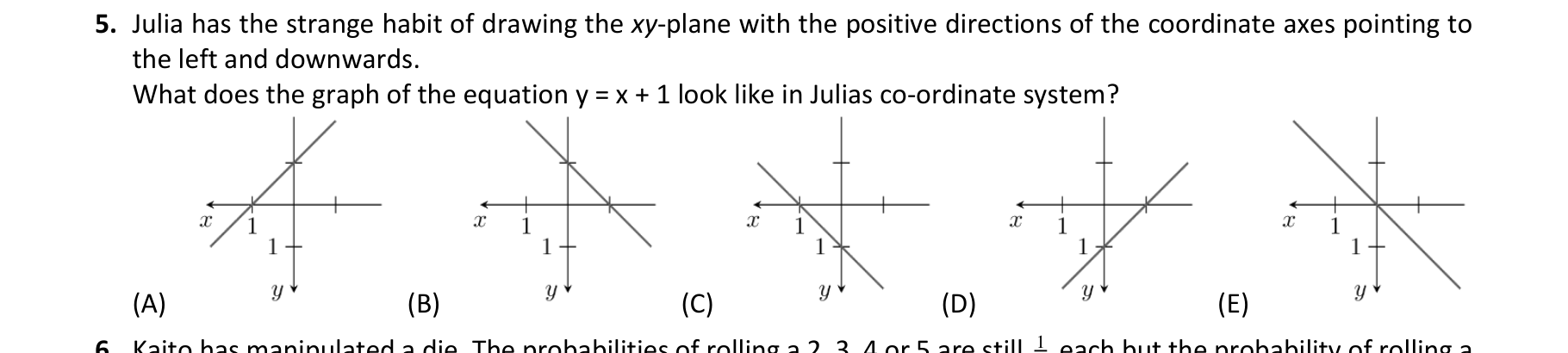
Julia has the strange habit of drawing the xy-plane with the positive directions of the coordinate axes pointing to the left and downwards. What does the graph of the equation \(y=x+1\) look like in Julia's coordinate system?
Show answer
Answer: D
Show hints
Hint 1 of 3
Reversing the direction of both axes is exactly a 180° rotation of the ordinary picture.
Still stuck? Show hint 2 →
Hint 2 of 3
A 180° turn keeps a line's slope, so the drawn line still rises to the right — only the labelled intercepts move.
Still stuck? Show hint 3 →
Hint 3 of 3
Rotate the standard graph of \(y=x+1\) half a turn and see which option's intercepts match.
Show solution
Approach: Julia's plane is the standard plane turned 180°
Making both positive axes point the opposite way is the same as rotating the usual coordinate picture by \(180^\circ\).
Under a \(180^\circ\) rotation the line \(y=x+1\) keeps its positive slope, so in Julia's drawing it still rises to the right.
Its intercepts rotate to match exactly one of the pictures.
Alex hangs a poster on his kitchen wall. The wall has white and grey tiles of the same size (see picture). How many grey tiles are completely covered by the poster?
Show answer
Answer: B — 21
Show hints
Hint 1 of 3
A tile counts only if the poster hides ALL of it; skip any tile the poster just clips at the edge.
Still stuck? Show hint 2 →
Hint 2 of 3
Mark the block of whole tiles that sit completely under the poster.
Still stuck? Show hint 3 →
Hint 3 of 3
Among only those fully-hidden tiles, count the grey ones (the white ones don't matter).
Show solution
Approach: find the tiles completely under the poster, then tally just the grey ones
First outline the tiles that the poster covers completely, ignoring tiles it only partly overlaps.
These fully-hidden tiles form a grey-and-white checkerboard block.
Now count just the grey tiles inside that block, one by one.
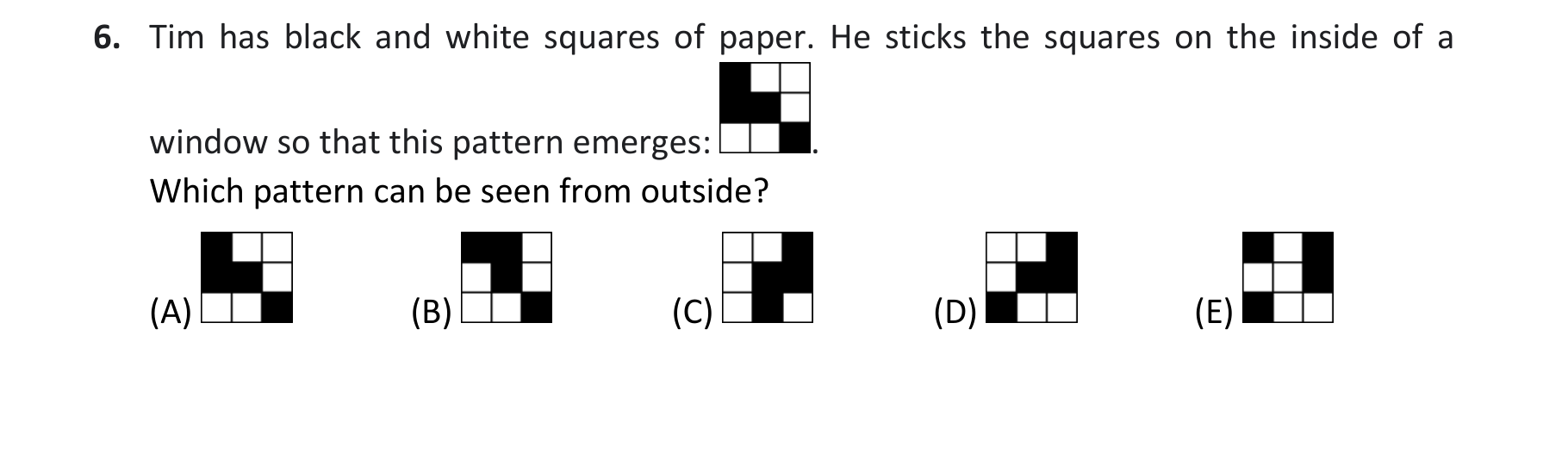
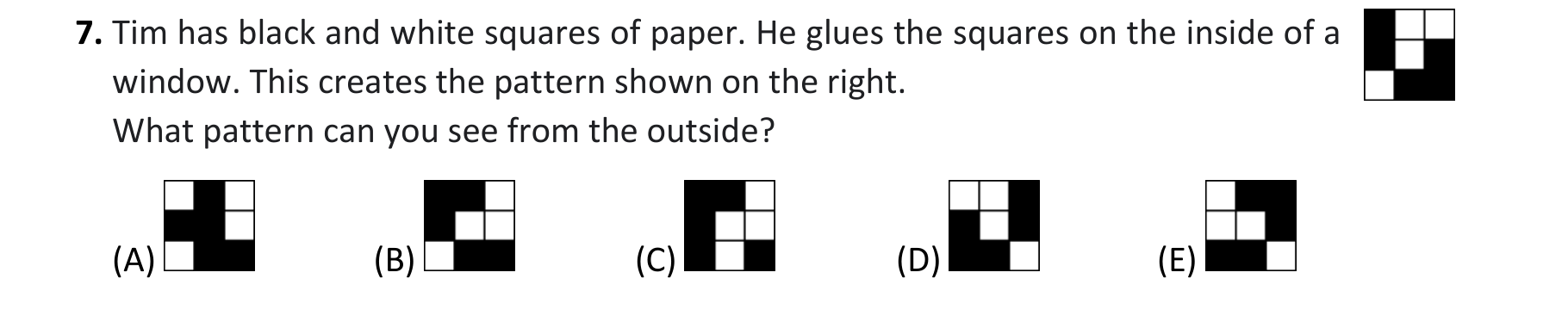
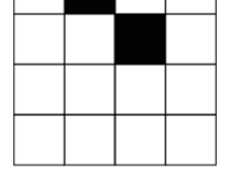
Tim has black and white squares of paper. He sticks the squares on the inside of a window so that the shown pattern appears. Which pattern can be seen from outside the window?
Show answer
Answer: D
Show hints
Hint 1 of 3
Think about looking at writing through glass from the other side — it comes out backwards.
Still stuck? Show hint 2 →
Hint 2 of 3
Seen from outside, the whole pattern is flipped like a mirror: left and right swap.
Still stuck? Show hint 3 →
Hint 3 of 3
Flip each row so the left square becomes the right square, then find the matching picture.
Show solution
Approach: flip the pattern left-to-right like a mirror
Looking from outside is like seeing the window through a mirror, so the picture flips left-to-right.
Take each row and swap its left and right squares: the black square on the left jumps to the right, and so on.
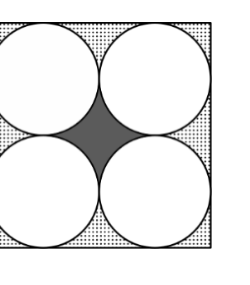
The diagram shows a square containing four touching circles of equal size. What is the ratio of the area of the black part to the area of the grey part?
Show answer
Answer: B — 1 : 3
Show hints
Hint 1 of 2
Pick an easy size: let each circle have radius 1, so the square has side 4.
Still stuck? Show hint 2 →
Hint 2 of 2
Cut the square into nine equal small squares; the black centre and the grey corners are made of those small squares minus the circle pieces inside them.
Show solution
Approach: split the leftover area into a centre square and the corners
Let each circle have radius 1; then the square has side 4 and area 16, and the four circles cover \(4\pi\).
Look at the central \(2\times 2\) square (area 4): it contains exactly four quarter-circles, so the black centre is \(4-\pi\).
The grey region is everything else outside the circles, which equals \(16-4\pi-(4-\pi)=12-3\pi=3(4-\pi)\), exactly three times the black centre.
Ria has three cards with the numbers 1, 5 and 11. She wants to place the cards next to each other to form a 4-digit number. How many different 4-digit numbers can she form?
Show answer
Answer: B — 4
Show hints
Hint 1 of 2
List the orders of the three cards and write out the number each makes.
Still stuck? Show hint 2 →
Hint 2 of 2
Two different orders can spell the same number, so count distinct numbers, not orders.
Show solution
Approach: list the distinct numbers the three cards can spell
Placing cards 1, 5, 11 in a row always gives a 4-digit number.
Writing out the orders gives 1511, 1115, 5111, and 1151 (some orders repeat).
Kaito has manipulated a die. The probabilities of rolling a 2, 3, 4 or 5 are still 16 each, but the probability of rolling a 6 is now twice the probability of rolling a 1. What is the probability of rolling a 6?
Show answer
Answer: D — 29
Show hints
Hint 1 of 2
The four fair faces use up a fixed total probability, leaving the rest for faces 1 and 6.
Still stuck? Show hint 2 →
Hint 2 of 2
Let P(1) be unknown, write P(6) = 2·P(1), and use that all six probabilities add to 1.
Show solution
Approach: use that all probabilities sum to 1
Faces 2,3,4,5 each have probability 1/6, totalling 4/6 = 2/3.
So P(1) + P(6) = 1 − 2/3 = 1/3.
With P(6) = 2·P(1): 3·P(1) = 1/3, so P(1) = 1/9 and P(6) = 2/9.
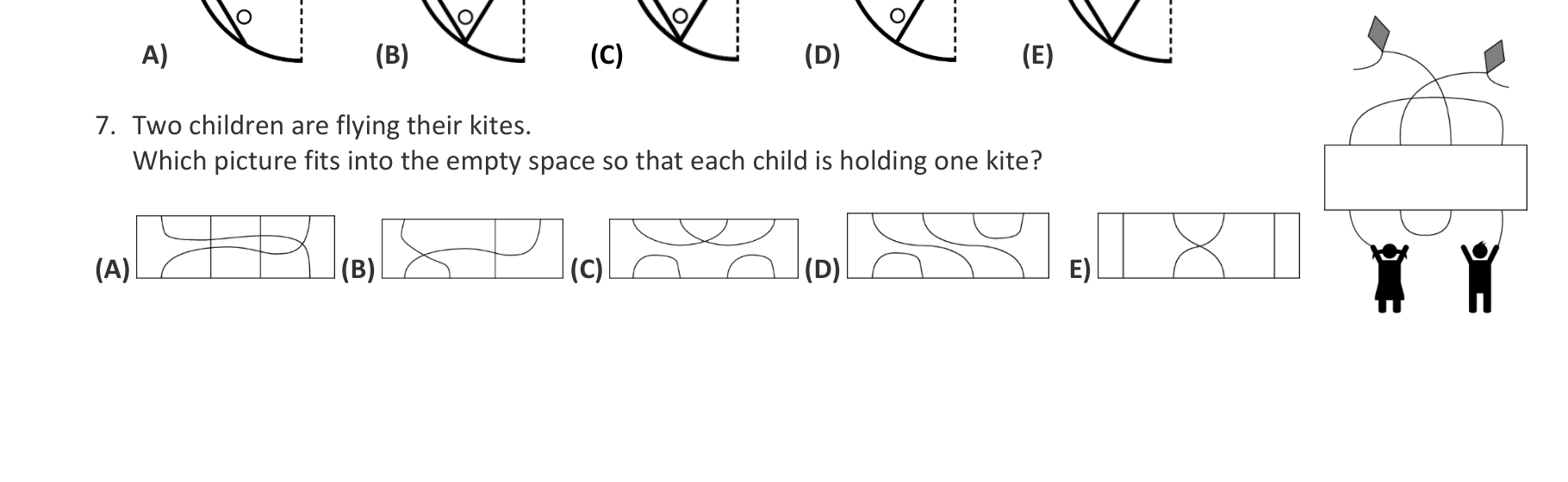
Each child's hand starts one string and each kite ends one string; the missing rectangle must connect them correctly.
Still stuck? Show hint 2 →
Hint 2 of 2
Follow where the strings enter the empty rectangle on the left and right edges, and pick the piece whose curves join the same entry points to the same kites.
Show solution
Approach: match the string entry points across the gap
On the edges of the empty space, note where each kite string enters and which child's hand the strings must reach.
The inserted piece has to carry each entering string across to the correct exit so that every child holds exactly one kite.
Only choice D routes the curves so the connections line up without crossing wrongly.
Tim has black and white paper squares. He glues them onto the inside of a window, making the pattern shown on the right. What pattern do you see when you look at the window from the outside? (The answer choices are the five pictured grids.)
Show answer
Answer: D
Show hints
Hint 1 of 3
Think about looking at a sticker stuck on the inside of a window when you walk around to the outside.
Still stuck? Show hint 2 →
Hint 2 of 3
Seen from the other side, the picture is flipped left-to-right (like in a mirror), but the top stays on top.
Still stuck? Show hint 3 →
Hint 3 of 3
Flip the shown pattern so its left column becomes the right column, then find the matching choice.
Show solution
Approach: flip the inside pattern left-to-right to see it from outside
The squares are glued on the inside, so from the outside you see the same picture flipped left-to-right (top still on top).
Flipping swaps each row's leftmost cell with its rightmost cell.
Logic & Word Problemscareful-countingcomplementary-counting
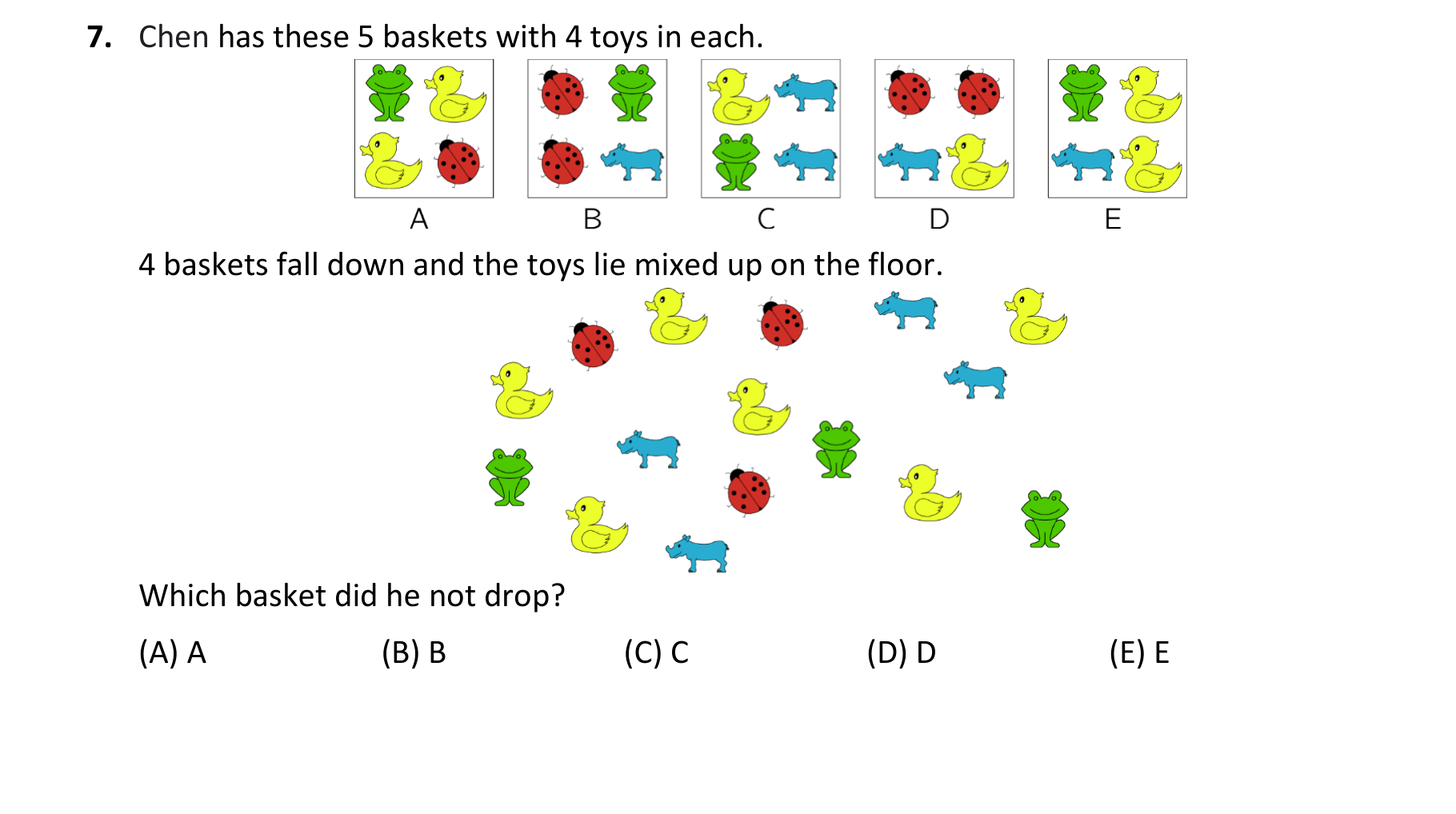
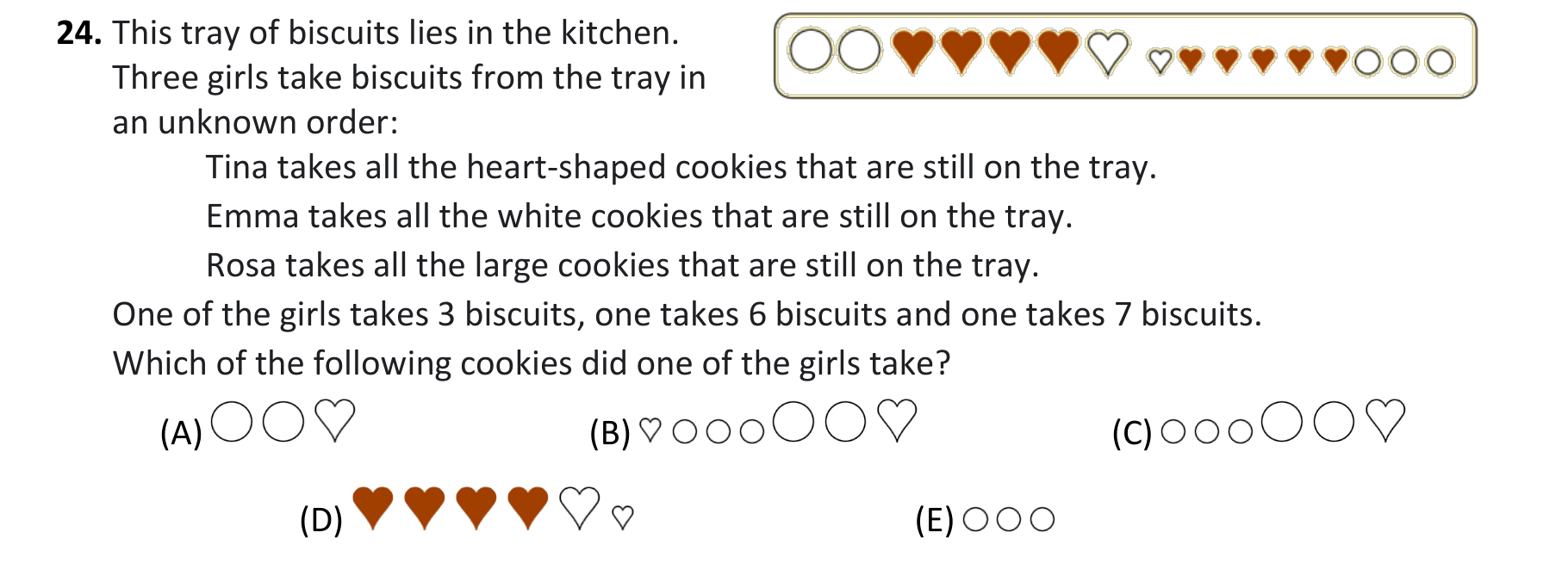
Chen has these 5 baskets, with 4 toys in each (shown as A, B, C, D, E in the picture). Four of the baskets fall down and the toys lie mixed up on the floor. Which basket did he not drop?
Show answer
Answer: B — B
Show hints
Hint 1 of 3
Look at the floor pile and notice which kind of toy is the most common there.
Still stuck? Show hint 2 →
Hint 2 of 3
The basket Chen kept is the only one with none of a toy that the others all had.
Still stuck? Show hint 3 →
Hint 3 of 3
Count the ducks: every duck is on the floor, so the kept basket has no duck.
Show solution
Approach: find the toy that is missing from the basket that stayed up
On the floor we can find ducks, frogs, ladybugs, and hippos all mixed together.
Count the yellow ducks on the floor: there are 6, which is every duck from the five baskets.
So the basket that did NOT fall has no duck in it — and the only basket with no duck is basket B.
Let a and b be numbers from the set {1, 2, 3, 4, 5, 6}. For each pair (a, b) we draw the line \(y = ax + b\) and look at the triangle it makes with the coordinate axes. For how many pairs (a, b) is that triangle isosceles?
Show answer
Answer: D — 6
Show hints
Hint 1 of 2
The line y = ax + b cuts the axes at (0, b) and (-b/a, 0); these legs make a right triangle.
Still stuck? Show hint 2 →
Hint 2 of 2
A right triangle is isosceles exactly when its two legs are equal.
Show solution
Approach: set the two axis intercept lengths equal
The right triangle has legs of length |b| (on the y-axis) and |b/a| (on the x-axis).
It is isosceles when these are equal: |b| = |b/a|, i.e. |a| = 1.
Among a in {1,...,6} only a = 1 works, and b can be any of the 6 values, giving 6 pairs.
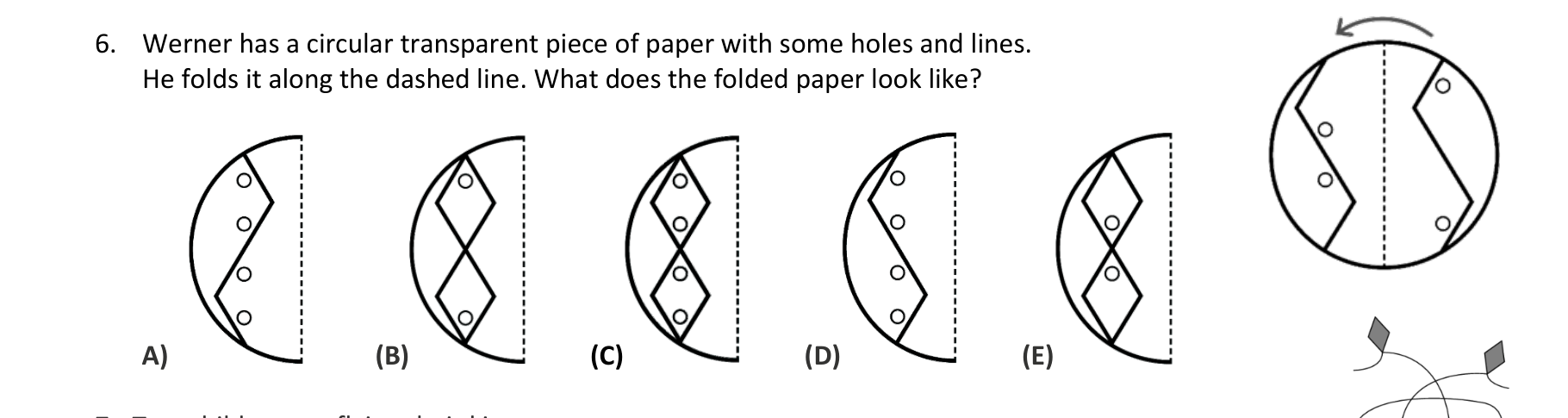
Manuel has a round transparent piece of paper with some circles on it (see diagram on the right). He folds it along the dashed line. What does it look like once it has been folded?
Show answer
Answer: C
Show hints
Hint 1 of 2
Folding along the dashed line flips the left half onto the right half like a mirror.
Still stuck? Show hint 2 →
Hint 2 of 2
The folded picture shows the right-hand circles plus the mirror images of the left-hand circles laid on top.
Show solution
Approach: reflect the left half over the fold line and overlay
The fold is a reflection across the dashed line.
Each circle on the folded-over half lands at its mirror position on the other half.
Combine the fixed circles with these reflected circles to see the result.
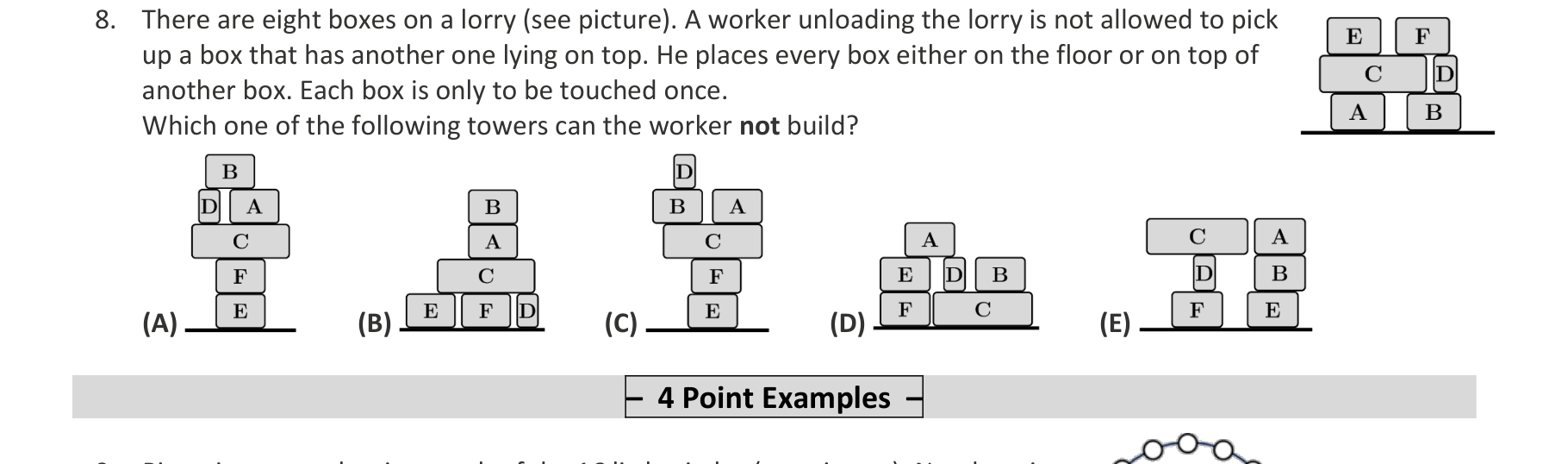
A box can be moved only when nothing sits on it, so the order boxes become free is fixed by the starting picture.
Still stuck? Show hint 2 →
Hint 2 of 2
For each tower, check whether a box ends up under another box that was still trapped when it had to be placed; that ordering conflict makes a tower impossible.
Show solution
Approach: check the forced unloading order against each tower
From the start, only the top boxes are free; a box can be placed under another only if that other box was already moved.
Read each target tower from the bottom up and see whether every box placed below another could have been freed and set down before the box on top of it.
Tower C requires putting a box beneath one that was still pinned at that moment, which the rules forbid.
213, 214 and 215 are three numbers in a row, each one more than the one before. Mohammad writes three numbers like that, but with four digits each. His sister erases some digits from each number, leaving:
???7, ?898, 48??
Which digits (from left to right) are missing?
Show answer
Answer: D — 4 8 9, 4, 9 9
Show hints
Hint 1 of 2
The three numbers are consecutive, and the middle one looks like _898.
Still stuck? Show hint 2 →
Hint 2 of 2
Pick the four-digit number ending 898, then write the one before and the one after it.
Show solution
Approach: identify three consecutive numbers from the visible digits
The middle number is 4898 (form _898, and it sits between numbers ending 7 and starting 48).
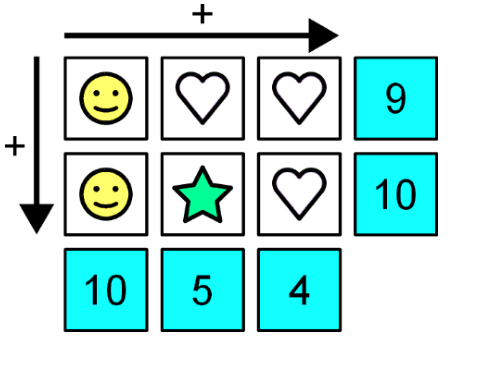
In the table, each shape stands for a different number. The number at the end of each row is the sum of that row, and the number under each column is the sum of that column. What number does the star stand for?
Show answer
Answer: C — 3
Show hints
Hint 1 of 3
Each shape always means the same number, and a line of shapes adds up to the number at its end.
Still stuck? Show hint 2 →
Hint 2 of 3
Start with a line that has two of the SAME shape — that makes the shape easy to figure out.
Still stuck? Show hint 3 →
Hint 3 of 3
Once you know the heart, look at the middle column to find the star.
Show solution
Approach: figure out the easy shapes first, then the star
The left column is two smileys adding to 10, so each smiley is 5 (because 5 and 5 make 10).
The right column is two hearts adding to 4, so each heart is 2 (because 2 and 2 make 4).
The middle column is a heart and a star adding to 5; the heart is 2, and 2 plus 3 makes 5, so the star is 3.
John has many equally sized light and dark cubes. He puts one dark cube on the table, leaving five faces visible. Next he covers all five visible faces with five light cubes, as shown. Now he wants to add dark cubes so that no light face is visible at all. What is the smallest number of dark cubes he needs?
Show answer
Answer: D — 13
Show hints
Hint 1 of 2
After the five light cubes are added you have a 3-D plus (cross); the dark cube underneath is already hidden, so only the light faces are the problem.
Still stuck? Show hint 2 →
Hint 2 of 2
One dark cube can hide more than one light face at a time when it sits in a notch where two light cubes meet, so look for those shared notches.
Show solution
Approach: wrap the light cross with dark cubes, reusing the notches
The light cubes form a plus shape (one on top, four on the sides) around the dark centre, leaving many light faces showing.
A dark cube placed in a notch between two neighbouring light arms covers a light face on each of them, so each notch is worth two faces.
Filling all the notches and the remaining flat light faces with the fewest cubes, the smallest number of dark cubes needed is 13, answer D.
There are five different kinds of fruit in a bowl: apples, grapes, cherries, strawberries and bananas. Anna likes apples, cherries, strawberries and bananas. Berta likes apples. Conny likes grapes, cherries, strawberries and bananas. Doris likes apples, grapes and cherries. Eva likes apples and cherries. The fruits are shared out so that each person gets a different kind of fruit, but everybody gets a kind of fruit that they like. Who gets the cherries?
Show answer
Answer: E — Eva
Show hints
Hint 1 of 2
Find the person with the fewest choices first; they are forced.
Still stuck? Show hint 2 →
Hint 2 of 2
Once a forced person takes their only option, that fruit is gone, which may force the next person.
Show solution
Approach: assign the forced choices in order
Berta likes only apples, so Berta must get the apples.
Eva likes only apples and cherries; with apples taken, Eva must get the cherries.
There are 6 coins on a table, each with heads facing upwards. On each move we turn over exactly 4 of the coins. What is the minimum number of moves we must make so that all coins are left with heads facing downwards?
Show answer
Answer: B — 3
Show hints
Hint 1 of 2
Every coin must end face-down, so each must be flipped an odd number of times in total.
Still stuck? Show hint 2 →
Hint 2 of 2
Six odd flip-counts add to an even number equal to 4 × (moves); find the smallest move count that finishes the job.
Show solution
Approach: track flip parities and test small move counts
To go from heads to tails, each of the 6 coins must be flipped an odd number of times.
One move changes only 4 coins; two moves cannot make all six counts odd.
Three moves can: choose the four-coin sets so every coin is flipped an odd number of times.
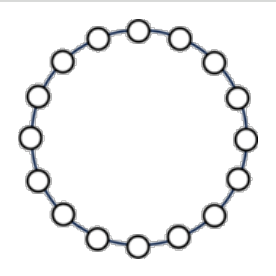
Pia writes a number in each of the 16 little circles (see picture). Numbers in neighbouring circles differ by 1. She writes the number 5 in one circle and the number 13 in another. How many different numbers does Pia write in the 16 circles?
Show answer
Answer: A — 9
Show hints
Hint 1 of 2
Stepping from circle to circle changes the number by exactly 1, so going all the way around the ring you must take as many +1 steps as -1 steps.
Still stuck? Show hint 2 →
Hint 2 of 2
To get from 5 up to 13 and back, the numbers have to pass through every value between 5 and 13.
Show solution
Approach: count the values forced by going up to 13 and back to 5
Neighbouring circles differ by 1, so as you walk around the ring the value rises or falls by 1 at each step.
Somewhere a 5 and a 13 appear, and to climb from 5 to 13 the numbers must hit every whole number 5, 6, 7, …, 13.
That is 9 different values, and with only 16 circles you can arrange them without needing any number outside 5–13.
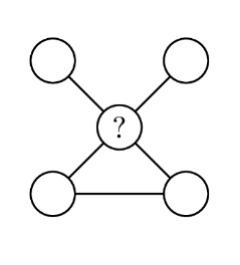
Lisa writes the numbers 1, 2, 4, 5 and 6 in the circles of the pattern, using each number exactly once. Along each of the three straight lines the numbers add up to 11. Which number does she write in the circle with the question mark?
Show answer
Answer: C — 4
Show hints
Hint 1 of 2
The two bottom circles sit on a line by themselves, so they must add to 11.
Still stuck? Show hint 2 →
Hint 2 of 2
Find which pair from the numbers adds to 11, then use the other two lines through the centre to pin down the question mark.
Show solution
Approach: use the line totals of 11 to solve for the centre
The bottom two circles form one line, so they add to 11: that's 5 and 6.
The remaining numbers 1, 2, 4 fill the two top circles and the centre, totalling 7.
Each slanted line is (top) + (centre) + (bottom) = 11; adding both gives 7 + centre = 11.
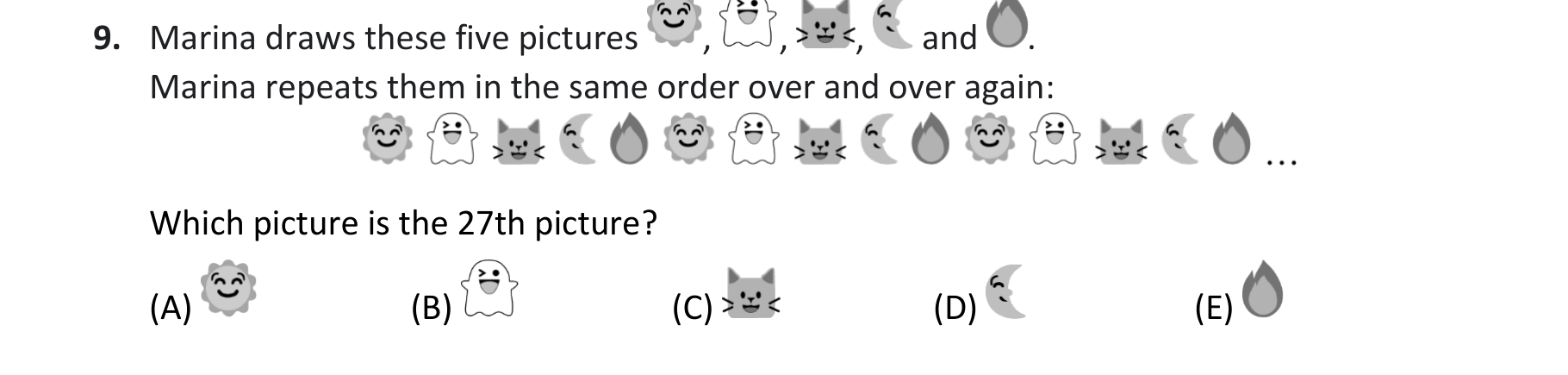
Marina draws five pictures in a fixed order (a cloud, a ghost, a cat, a moon, and a flame), then repeats the same five over and over again. Which picture is the 27th picture?
Show answer
Answer: B
Show hints
Hint 1 of 3
The pictures come in repeating groups of five, always in the same order.
Still stuck? Show hint 2 →
Hint 2 of 3
Count by fives to get close to 27 without drawing them all out.
Still stuck? Show hint 3 →
Hint 3 of 3
After five whole groups you have drawn 25 pictures, so just keep going from there.
Show solution
Approach: count in groups of five
The five pictures repeat as a group, so skip-count: 5, 10, 15, 20, 25 finishes five whole groups.
Picture 25 is the last one of a group (the flame), so picture 26 starts a new group with the 1st picture (the cloud).
Picture 27 is then the 2nd picture of the group — the ghost, option B.
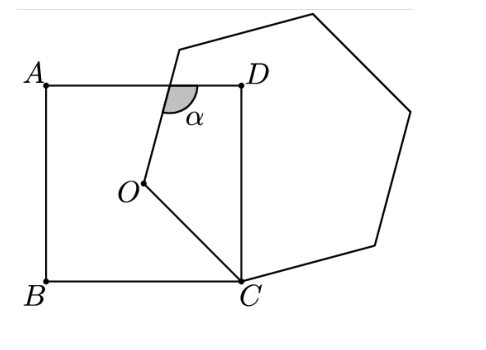
A square has vertices A, B, C, D as shown, and a regular hexagon is drawn on the side OC, where O is the centre of the square. How big is the angle α?
Show answer
Answer: A — 105°
Show hints
Hint 1 of 2
O is the centre, so OC is half a diagonal of the square; that makes triangle OCD a nice special triangle.
Still stuck? Show hint 2 →
Hint 2 of 2
A regular hexagon has interior angles of 120 degrees, so the hexagon edge leaving O is tilted a fixed amount from OC.
Show solution
Approach: find the tilt of the hexagon edge, then subtract from the straight side
Since O is the square's centre, OC and OD are both half-diagonals and CD is a side, so triangle OCD is right-angled and isosceles with the angle at C equal to 45 degrees and OC making 45 degrees with the horizontal top side AD.
At O the hexagon's interior angle is 120 degrees, so the hexagon edge leaving O is turned 120 degrees from OC, which lands it pointing 75 degrees above the horizontal.
The angle \(\alpha\) between that rising hexagon edge and the horizontal side AD is \(180^\circ-75^\circ=105^\circ\), answer A.
50 children are sitting in a circle. They throw a ball. Each child that gets the ball throws it to the child sitting six places to their left. Frida gets the ball 100 times during the game. How many children never get the ball during this time?
Show answer
Answer: D — 25
Show hints
Hint 1 of 2
The ball lands on positions that are multiples of 6 around a circle of 50.
Still stuck? Show hint 2 →
Hint 2 of 2
How many distinct seats it visits depends on the greatest common divisor of 6 and 50.
Show solution
Approach: count the orbit length using gcd
Starting from one child, the ball moves 6 seats each throw around 50 seats.
The seats it reaches are spaced by gcd(6, 50) = 2, so it visits 50 ÷ 2 = 25 children.
The other 50 − 25 = 25 children never get the ball.
Noah starts with the number 1 and multiplies it with either 6 or 10. He then multiplies the result again by either 6 or 10. He repeats this process several times. Which of the following numbers can he not obtain in this way?
Show answer
Answer: B — \(2^{90}\cdot 3^{30}\cdot 5^{80}\)
Show hints
Hint 1 of 2
Each multiplication by 6 or 10 always adds one factor of 2, plus either a 3 or a 5.
Still stuck? Show hint 2 →
Hint 2 of 2
So in the final number the power of 2 must equal the powers of 3 and 5 added together — check which option breaks this.
Show solution
Approach: count factors of 2 against 3 and 5
6 = 2·3 and 10 = 2·5, so each step adds exactly one 2 and either one 3 or one 5.
After several steps the power of 2 equals (power of 3) + (power of 5).
The picture is 45 cm wide and 30 cm high and is made up of identical rectangles. What is the area of one such rectangle?
Show answer
Answer: E — 36 cm²
Show hints
Hint 1 of 3
Every rectangle is the same, so its long side and short side appear over and over; line them up along the 45 cm width and the 30 cm height.
Still stuck? Show hint 2 →
Hint 2 of 3
Read off how many long sides and short sides fit across the width, and how many fit down the height, to get the two side lengths.
Still stuck? Show hint 3 →
Hint 3 of 3
Once you know the long side and the short side, multiply them for the area.
Show solution
Approach: read the repeated long and short sides off the picture, then multiply
Because all the rectangles are identical, only two lengths exist in the whole picture: a long side and a short side.
Matching how those sides line up along the 45 cm width and the 30 cm height shows the long side is 9 cm and the short side is 4 cm.
One rectangle is therefore 9 cm by 4 cm, with area 9 × 4 = 36.
So one rectangle has area 36 cm².
Check itFive long sides of 9 cm reach across the 45 cm width \((5 \times 9 = 45)\), and a long side plus a short side stack to make sense of the heights, leaving the short side as 4 cm; the area is \(9 \times 4 = 36\).
A basket holds five fruits: apple, grapes, cherry, strawberry and banana. Ann likes only the cherry. Ben likes all five. Cam likes the cherry, strawberry and banana. Dan likes the cherry and banana. Eli likes the grapes and strawberry. Each child takes one fruit that they like (and no two take the same fruit). Which fruit does Ben take?
Show answer
Answer: A
Show hints
Hint 1 of 2
Start with the child who likes only one fruit — that fruit is fixed.
Still stuck? Show hint 2 →
Hint 2 of 2
Remove each taken fruit and see what choices the other children have left.
Show solution
Approach: assign forced choices first, then eliminate
Ann likes only the cherry, so Ann takes the cherry.
Dan likes cherry or banana; the cherry is gone, so Dan takes the banana.
Cam likes cherry, strawberry, banana — only the strawberry is left for Cam; then Eli (grapes or strawberry) takes the grapes.
Ben likes them all, and only the apple remains, so Ben takes the apple (A).
Ardal fences a rectangular plot of land using 40 m of fence. Every side length of the rectangle is a prime number. What is the largest possible area of the plot?
Show answer
Answer: B — 91 m²
Show hints
Hint 1 of 2
The two side lengths add to half the perimeter; both must be prime.
Still stuck? Show hint 2 →
Hint 2 of 2
For a fixed sum, the product (area) is largest when the two numbers are closest together.
Show solution
Approach: find the prime pair summing to 20 with largest product
Perimeter 40 means the two sides add to 20, and both are prime.
Prime pairs adding to 20: (3,17), (7,13); their products are 51 and 91.
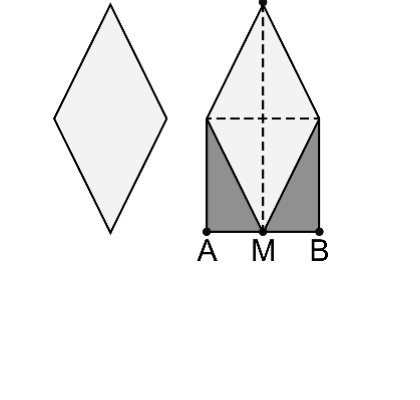
The diagram shows a rhombus. Its area is increased by adding two right-angled triangles (see diagram), where \(\angle NMA = \angle BMN = 90^\circ\). By what percentage does this increase the area?
Show answer
Answer: E — 50%
Show hints
Hint 1 of 2
Split the rhombus by a diagonal into two equal triangles and compare an added triangle to one of them.
Still stuck? Show hint 2 →
Hint 2 of 2
With the given right angles, each added triangle has the same base and height as half the rhombus.
Show solution
Approach: compare each added triangle's area to half the rhombus
The horizontal diagonal splits the rhombus into two congruent triangles, so each half is half the rhombus.
The right angles at N make the two added triangles together fit exactly onto the lower half-triangle of the rhombus, so they add up to half the rhombus.
Adding half the rhombus increases the area by 50%.
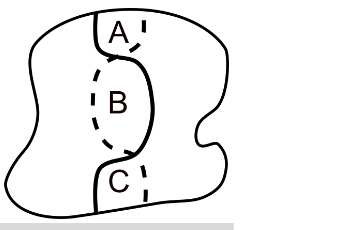
There are black and dashed paths in a park. Both paths divide the area of the park exactly in half. Which of the following statements about the areas of the sections A, B and C (shown in the diagram) is definitely correct?
Show answer
Answer: B — B = A + C
Show hints
Hint 1 of 2
Both paths cut the park into two equal halves, so the area on one side of a path equals the area on the other side.
Still stuck? Show hint 2 →
Hint 2 of 2
Compare the two halves: the regions where the paths disagree are exactly A, B and C, and that balance forces a relation between them.
Show solution
Approach: balance the two equal halves where the paths disagree
The solid path puts area \(\tfrac{1}{2}\) of the park on each side; the dashed path does the same.
Since both 'upper' halves have the same area, the places where one path lies inside and the other outside must cancel out.
The two paths cross, carving those in-between slivers into A (top), B (middle) and C (bottom), with A and C on one side of the balance and B on the other.
Cancelling gives \(A + C = B\), so the correct statement is B = A + C (answer B).
The rooms in a hotel are numbered in ascending order (No. 1, 2, 3, …), with no number left out. Beaver Benji counts the digits of all the room numbers and finds the digit ‘2’ fourteen times and the digit ‘5’ three times. What is the biggest possible room number in this hotel?
Show answer
Answer: C — 34
Show hints
Hint 1 of 2
Count how often each digit shows up as you list the room numbers 1, 2, 3, … and watch the running totals for the digit 2 and the digit 5.
Still stuck? Show hint 2 →
Hint 2 of 2
Three 5s are used up exactly at room 25 (from 5, 15, 25), so the hotel can't reach 35; check that fourteen 2s also work out by then.
Show solution
Approach: track the running count of the digits 2 and 5
List room numbers in order and tally the digit 5: it appears in 5, 15, 25, … so the third 5 occurs at room 25 and a fourth would appear at 35.
Since only three 5s are used, the hotel cannot include 35, so the largest possible number is below 35.
Now tally the digit 2 up to 34: units-place 2s in 2, 12, 22, 32 give 4, and tens-place 2s in 20–29 give 10, totalling exactly 14.
Both counts match at room 34, so that is the biggest possible room number.
Logic & Word Problemswork-backwardcareful-counting
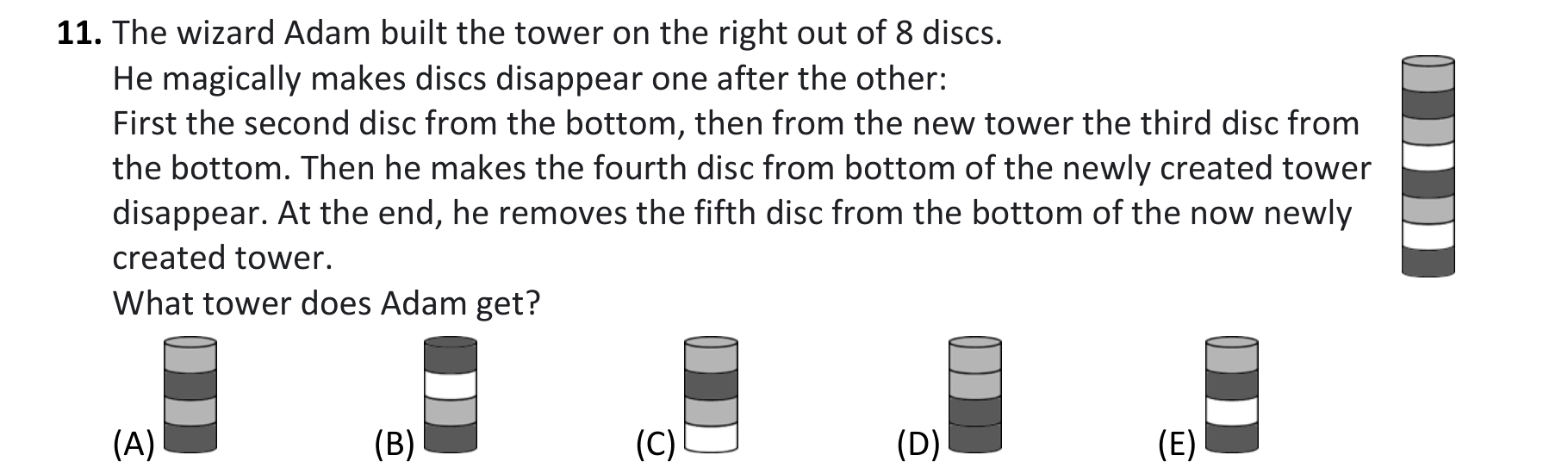
The wizard Adam built the tower on the right out of 8 discs. He magically makes discs vanish one at a time. First the 2nd disc from the bottom. Then, counting from the bottom of the new (shorter) tower, the 3rd disc. Then the 4th disc from the bottom of that newer tower. Finally the 5th disc from the bottom of the tower he now has. Which tower is left at the end? (The answer choices are the five pictured towers.)
Show answer
Answer: B
Show hints
Hint 1 of 2
Number the discs from the bottom and remove them one at a time, re-counting from the bottom after each removal.
Still stuck? Show hint 2 →
Hint 2 of 2
After each disc vanishes the tower is shorter, so 'third from the bottom' refers to the new, shorter tower.
Show solution
Approach: simulate the removals from the bottom step by step
Bottom-to-top the discs are dark, white, light, dark, white, light, dark, light.
Remove the 2nd from the bottom (white): dark, light, dark, white, light, dark, light.
Remove the new 3rd (dark), then 4th (light), then 5th (light) in turn.
What is left, bottom-to-top, is dark, light, white, dark — tower B.
A palindrome is a number that reads the same forwards and backwards, for example 121 or 444. What is the sum of the digits of the largest three-digit palindrome that is also a multiple of 6?
Show answer
Answer: E — 24
Show hints
Hint 1 of 2
A palindrome aba is a multiple of 6 when it is even and its digit sum is divisible by 3.
Still stuck? Show hint 2 →
Hint 2 of 2
Even means the outer digit a is even; push a as high as possible, then the middle digit.
Show solution
Approach: build the largest even palindrome with digit sum divisible by 3
For aba to be even, a must be even, so the largest choice is a = 8.
Then 8b8 needs digit sum 16 + b divisible by 3; the largest such b is 8, giving 888.
888 is even and divisible by 3, so it is a multiple of 6, with digit sum 24.
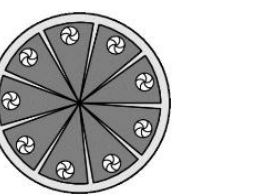
Carina has baked a cake and cut it into 10 equal pieces. She ate one piece and spread the remaining pieces out evenly (see diagram). How big is the angle between two neighbouring pieces?
Show answer
Answer: B — 4°
Show hints
Hint 1 of 2
Each of the 10 original pieces still has its own pointed tip angle.
Still stuck? Show hint 2 →
Hint 2 of 2
Nine pieces spread evenly leave gaps; the gaps share what one missing piece's worth of angle would have been.
Show solution
Approach: share the missing piece's angle among the 9 gaps
Ten equal pieces had tip angles of 360° ÷ 10 = 36° each.
After eating one, the 9 remaining pieces use 9 × 36° = 324° of tips.
The leftover 360° − 324° = 36° is split evenly into 9 gaps between neighbours.
John has black and white unit cubes and wants to use 27 of them to build a 3×3×3 cube. He wants to make sure that the surface is exactly half white and half black. What is the minimum number of black cubes that he needs?
Show answer
Answer: E — another number
Show hints
Hint 1 of 2
Corner cubes show 3 faces, edge cubes 2, face-centre cubes 1 — use the ones showing the most faces first.
Still stuck? Show hint 2 →
Hint 2 of 2
The surface has 54 little faces; half is 27 black faces, so cover 27 of them with as few cubes as possible.
Show solution
Approach: maximise black faces per cube
The 3×3×3 surface has 6×9 = 54 little faces; half of them, 27, must be black.
A corner cube shows 3 faces, an edge cube 2, a face-centre cube 1.
All 8 corners give 24 black faces; one edge (2) plus one face-centre (1) adds the last 3.
That is 8 + 1 + 1 = 10 cubes — not 11/12/13/14, so the answer is another number.
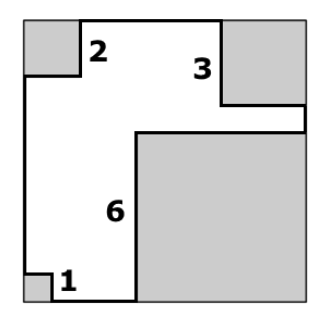
Christian cuts four small grey squares out of one big square. The white shape remains (see picture). This shape has half the area of the big square. The side lengths of the small grey squares are given in the drawing. What is the perimeter of the white shape?
Show answer
Answer: B — 40
Show hints
Hint 1 of 2
First use the 'half the area' fact: the four grey squares together equal half the big square, which pins down the big square's side.
Still stuck? Show hint 2 →
Hint 2 of 2
Cutting a square notch out of a corner does not change the perimeter, because the two removed edges are replaced by two equal new edges.
Show solution
Approach: find the side from areas, then note corner notches keep the perimeter
The grey squares have areas 1, 4, 9 and 36, summing to 50, and this is half the big square, so the big square has area 100 and side 10.
Removing a square from a corner trades two outer edges for two new inner edges of equal length, so the perimeter is unchanged.
Hence the white shape has the same perimeter as the big square: 4 × 10 = 40.
Penguin Peter goes fishing every day and brings home 9 fish for his two children. Each day he gives 5 fish to the first child he sees, and the other child gets the remaining 4 fish. Over the last few days, one child has received 26 fish in total. How many fish did the other child get?
Show answer
Answer: D — 28
Show hints
Hint 1 of 3
Every single day the two children together get 5 + 4 = 9 fish.
Still stuck? Show hint 2 →
Hint 2 of 3
Each day a child gets either 5 or 4, so try how many days it takes one child to reach 26.
Still stuck? Show hint 3 →
Hint 3 of 3
Once you know the number of days, the other child's total is 9 per day minus 26.
Show solution
Approach: find the number of days, then take the rest of the daily 9s
Each day one child gets 5 fish and the other gets 4, so together they get 9 fish a day.
For one child to reach 26 (made of 5s and 4s), it takes 6 days: 5 + 5 + 4 + 4 + 4 + 4 = 26.
In all, the children got 9 × 6 = 54 fish over those 6 days.
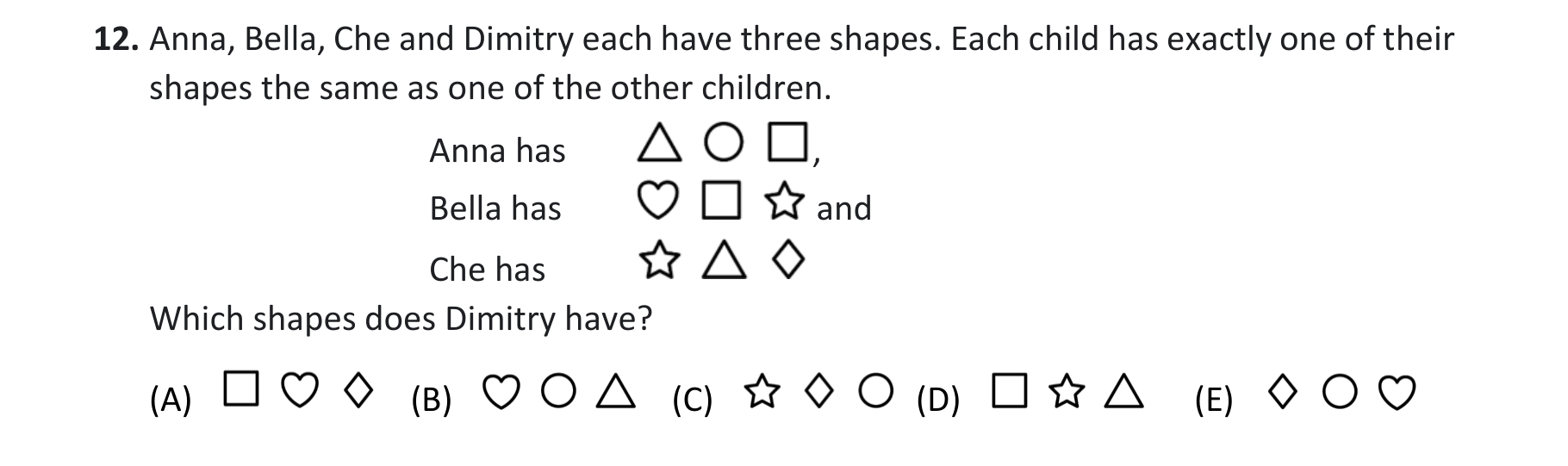
Anna, Bella, Che and Dimitry each have three shapes. Each child shares exactly one of their shapes with one other child. Anna has a triangle, a circle and a square; Bella has a heart, a square and a star; Che has a star, a triangle and a diamond. Which three shapes does Dimitry have?
Show answer
Answer: E
Show hints
Hint 1 of 3
Write out the shapes the other three children have and see which ones already come in matching pairs.
Still stuck? Show hint 2 →
Hint 2 of 3
Some shapes already appear for two children (a pair), but a few shapes appear for only one child so far.
Still stuck? Show hint 3 →
Hint 3 of 3
Dimitry must hold exactly the shapes that still need a partner, so that every shape ends up shared by two children.
Show solution
Approach: give Dimitry the shapes that still need a matching partner
Among Anna, Bella and Che, the square (Anna & Bella), the star (Bella & Che) and the triangle (Anna & Che) already come in pairs.
That leaves the circle (only Anna), the heart (only Bella) and the diamond (only Che) without a partner.
So Dimitry must have the circle, the heart and the diamond — this pairs every shape with exactly one other child, which is option E.
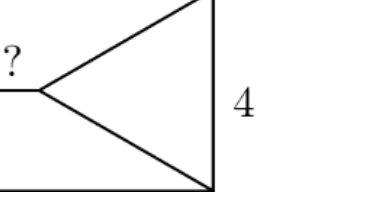
A rectangle is split into three pieces of equal area, as shown. One piece is an equilateral triangle with sides of length 4 cm; the other two are trapezoids. How long is the shorter of the two parallel sides of a trapezoid?
Show answer
Answer: B — \(\sqrt{3}\)
Show hints
Hint 1 of 2
In the picture a full side of the triangle (length 4) lies along the short side of the rectangle, so that side fixes the rectangle's height.
Still stuck? Show hint 2 →
Hint 2 of 2
Each of the three pieces has the same area, and a trapezoid's area is its average width times its height.
Show solution
Approach: use equal areas; the trapezoid's two parallel sides average to a known value
The triangle's vertical side is 4, so the rectangle is 4 tall, and the triangle's area is \(\frac{\sqrt3}{4}\cdot4^2=4\sqrt3\).
All three pieces are equal, so the rectangle's area is \(12\sqrt3\) and its width is \(\frac{12\sqrt3}{4}=3\sqrt3\).
A trapezoid has height 2 (half the rectangle) and longer parallel side \(3\sqrt3\); its area \(4\sqrt3=\tfrac12(3\sqrt3+x)\cdot 2\) gives the shorter side \(x=\sqrt3\).
So the shorter parallel side is \(\sqrt3\), answer B.
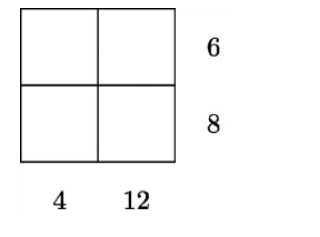
Four different positive whole numbers are written into the grid and then covered up. The product of the two numbers in each row, and in each column, is written next to or below the grid (see diagram). What is the sum of the four covered numbers?
Show answer
Answer: C — 13
Show hints
Hint 1 of 2
Label the four cells and write the four product equations for the rows and columns.
Still stuck? Show hint 2 →
Hint 2 of 2
All four numbers are different; use the column products 4 and 12 with the row products 6 and 8 to pin them down.
Show solution
Approach: solve the product equations for four distinct integers
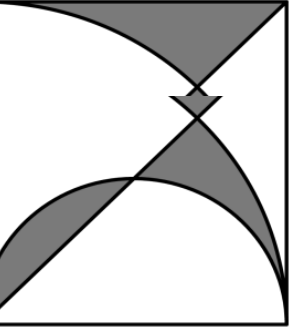
In a square with side length 6, a diagonal, a semicircle and a quarter circle are drawn as shown. What is the area of the grey region?
Show answer
Answer: A — 9
Show hints
Hint 1 of 3
Don't compute each curved piece separately — look for curved areas that exactly cancel.
Still stuck? Show hint 2 →
Hint 2 of 3
The diagonal pairs the semicircle and quarter-circle so their \(\pi\) contributions cancel, leaving a whole-number area.
Still stuck? Show hint 3 →
Hint 3 of 3
Express the grey region as a triangle plus/minus curved pieces and watch the \(\pi\)-terms vanish.
Show solution
Approach: pair the curved pieces so the \(\pi\)-terms cancel
The square has area \(6^2=36\) and the diagonal splits it into two right triangles of area \(18\).
The grey region is a triangular part with one curved bite added and an equal curved bite removed: the semicircle and quarter-circle pieces contribute opposite \(\pi\)-areas.
Those circular contributions cancel exactly, so the grey area is a clean whole number.
Evaluating, the grey region has area 9 (answer A).
The number 2024 is made up of the four digits 2, 0, 2 and 4. How many different four-digit numbers bigger than 2024 can be formed using exactly those digits?
Show answer
Answer: E — 8
Show hints
Hint 1 of 2
Only the leading digit can be 2 or 4 (a leading 0 is not a four-digit number); split into numbers starting with 2 and numbers starting with 4.
Still stuck? Show hint 2 →
Hint 2 of 2
List the rearrangements in each case and keep just those larger than 2024.
Show solution
Approach: split by leading digit and count those above 2024
Using the digits 2, 0, 2, 4, the first digit must be 2 or 4.
Starting with 2, the last three digits arrange the set {0, 2, 4}: 2024, 2042, 2204, 2240, 2402, 2420, of which five exceed 2024.
Starting with 4, every arrangement beats 2024: 4022, 4202, 4220, giving three more.
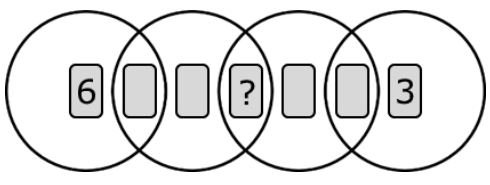
The 7 cards numbered 1 to 7 are placed in these four overlapping rings. In every ring the numbers on the cards add up to 10. What number is on the card with the question mark?
Show answer
Answer: A — 1
Show hints
Hint 1 of 3
The two end rings hold only two cards each, so start there: each of those pairs must add to 10.
Still stuck? Show hint 2 →
Hint 2 of 3
Once the 6 and the 3 give away their ring-partners, only three cards are left for the three middle spots.
Still stuck? Show hint 3 →
Hint 3 of 3
Use a middle ring (three cards adding to 10) to pin down the question mark.
Show solution
Approach: fill the two-card end rings first, then a three-card middle ring
The left ring has just 6 and its neighbour, and must total 10, so that neighbour is 4; the right ring has 3 and its neighbour, so that one is 7.
The cards 6, 4, 7, 3 are now placed, leaving 1, 2 and 5 for the three middle spots.
A middle ring holds 4, then a card, then the question mark, and must total 10, so (card) + (?) = 6; the other middle ring holds the question mark, a card, and 7, so (?) + (card) = 3.
Only ? = 1 makes both work (with 5 and 2 in the other spots), so the question-mark card is 1 (A).
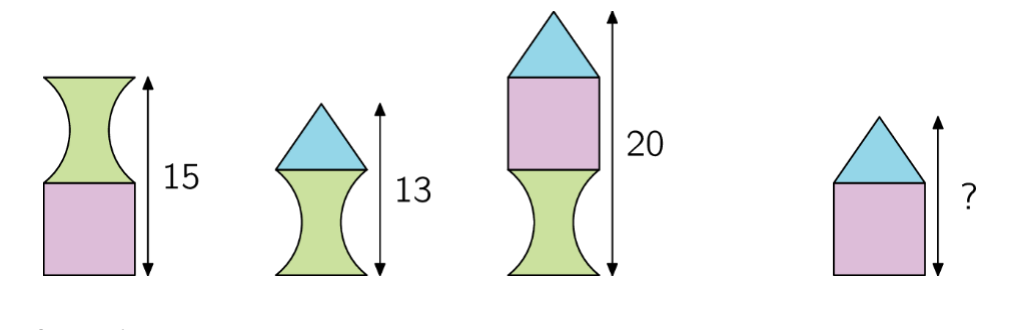
Zoran builds towers from three different building blocks (a triangle top, a rectangle, and an hourglass). The picture shows the heights of three towers. How high is the fourth tower?
Show answer
Answer: A — 12
Show hints
Hint 1 of 3
Each kind of block is always the same height, so the same block is worth the same number every time.
Still stuck? Show hint 2 →
Hint 2 of 3
Compare two towers that are almost the same — the difference in their heights tells you how tall the extra block is.
Still stuck? Show hint 3 →
Hint 3 of 3
Find the rectangle and the triangle heights, since the fourth tower is just those two stacked.
Show solution
Approach: compare towers to find each block's height
The tall tower (triangle + rectangle + hourglass) is 20, and the short one with just (triangle + hourglass) is 13; the only extra block is the rectangle, so the rectangle is 20 − 13 = 7.
The tower with (rectangle + hourglass) is 15, and the rectangle is 7, so the hourglass is 8; then in the tower of 13 the triangle is 13 − 8 = 5.
The fourth tower is just triangle + rectangle = 5 + 7 = 12.
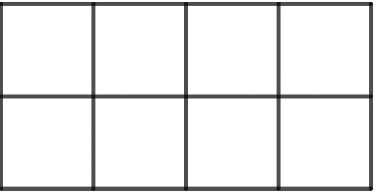
Jelena fills the 2×4 table shown with the letters A, B, C and D. She wants each letter to appear exactly once in each row and exactly once in each of the three 2×2 squares. In how many ways can she do this?
Show answer
Answer: B — 24
Show hints
Hint 1 of 2
Fill the left-hand 2x2 square first, then ask how much freedom is left.
Still stuck? Show hint 2 →
Hint 2 of 2
Because the 2x2 squares overlap by one column, knowing two columns almost forces the next.
Show solution
Approach: fill the first 2x2 block, then propagate the overlaps
The left 2x2 block can be filled with the four letters in \(4!=24\) ways.
Once columns 1 and 2 are set, the middle 2x2 block (columns 2-3) must contain the same four letters, so column 3 is forced to be column 1 with its two entries swapped between the rows; the same logic then forces column 4.
So every choice of the first block extends to exactly one full table, giving \(24\) ways, answer B.
Uli can buy exactly 12 packages of jelly babies or exactly 20 chocolate bars with her pocket money. Uli buys 9 packages of jelly babies. How many chocolate bars can she buy with the remaining money?
Show answer
Answer: C — 5
Show hints
Hint 1 of 2
Think of her whole pocket money as one amount split into 12 jelly-baby shares or 20 chocolate shares.
Still stuck? Show hint 2 →
Hint 2 of 2
Buying 9 of the 12 jelly packages uses 9/12 = 3/4 of the money, so a quarter is left.
Show solution
Approach: convert the leftover fraction of money into chocolate bars
Her money buys 12 jelly packages, so 9 packages cost 9/12 = 3/4 of it.
That leaves 1/4 of her money.
Her money buys 20 chocolate bars, so 1/4 buys 20 × 1/4 = 5 bars.
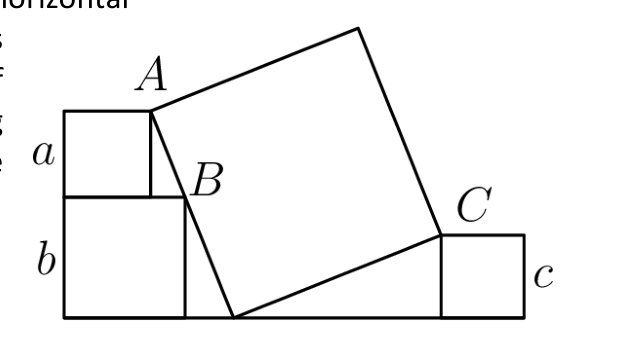
The diagram shows four squares with the entire configuration resting on a horizontal straight line. The smaller squares have side lengths a, b and c. The vertices A and C of two small squares coincide with diagonally opposite vertices of the big square. The vertex B of the third small square lies on a side of the big square. Which of the following expressions is equal to the side length of the big square?
Show answer
Answer: C — \(\sqrt{(a+b)^2+c^2}\)
Show hints
Hint 1 of 3
The tilted square's side is the hypotenuse of a right triangle whose legs you can read off from the small squares.
Still stuck? Show hint 2 →
Hint 2 of 3
Drop a horizontal and a vertical from one corner of the big square to the next; the legs are built from a, b and c.
Still stuck? Show hint 3 →
Hint 3 of 3
Find the horizontal run and the vertical rise of one side of the big square, then apply the Pythagorean theorem.
Show solution
Approach: the tilted side is a right-triangle hypotenuse
A and C of two small squares sit at diagonally opposite corners of the big square, with B on a side, so the big square is tilted.
Take one side of the big square and form the right triangle with horizontal and vertical legs: the horizontal leg adds the two small-square widths to give \(a+b\), and the vertical leg is \(c\).
By the Pythagorean theorem the side length is \(\sqrt{(a+b)^2+c^2}\).
So the answer is \(\sqrt{(a+b)^2+c^2}\) (answer C).
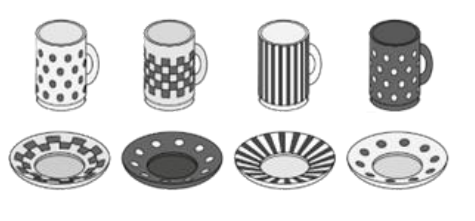
Simon has four cups with matching saucers (see picture). He places a randomly chosen cup on each saucer. Which statement is definitely true?
Show answer
Answer: D — It is impossible that exactly 3 cups are on the matching saucers.
Show hints
Hint 1 of 2
Test each statement: can you picture an arrangement where it fails? If yes, that statement is not certain.
Still stuck? Show hint 2 →
Hint 2 of 2
Think about what happens to the last cup if exactly three are already on their matching saucers.
Show solution
Approach: rule out the impossible count of correct matches
If three cups sit on their matching saucers, then three cups and three saucers are correctly paired, leaving one cup and one saucer that must also match.
So having exactly three matches forces a fourth match — you cannot have exactly three.
The other options can each happen with some arrangement, so they are not certain.
The statement that is definitely true is D: it is impossible that exactly 3 cups are on the matching saucers.
Lucas has these five puzzle pieces (shown on the right): a smiling head, a banana-tail, and three middle pieces. They snap together only where a bump fits into a notch. He wants to make a caterpillar with a head, a tail, and 1, 2 or 3 pieces in between. How many different caterpillars can Lucas build?
Show answer
Answer: B — 4
Show hints
Hint 1 of 3
The head only joins on one side and the tail only joins on one side; the pieces fit only where a bump (tab) meets a notch (socket).
Still stuck? Show hint 2 →
Hint 2 of 3
A caterpillar is head, then 1, 2, or 3 middle pieces, then tail — build the chains by matching bumps to notches.
Still stuck? Show hint 3 →
Hint 3 of 3
Go case by case: count the legal chains with exactly 1 middle piece, then 2, then 3, and add them up.
Show solution
Approach: match the connectors (bump-to-notch) and count the legal chains of 1, 2, or 3 middle pieces
A piece can join another only where a bump fits into a notch, and the head and tail each connect on just one side.
Try 1 middle piece between head and tail: only the pieces whose bumps and notches line up both ways work.
Now try 2 middle pieces, then 3 middle pieces, keeping every join a bump-into-notch fit.
Adding up all the chains that connect properly gives 4 (B) different caterpillars.
Andrew throws arrows at a target. He starts with 10 arrows. Each time he hits the target, he gets 2 more arrows. In total Andrew throws 20 arrows, and then he has run out of arrows. How many times did Andrew hit the target?
Show answer
Answer: B — 5
Show hints
Hint 1 of 3
He only started with 10 arrows, but he threw 20, so where did the extra arrows come from?
Still stuck? Show hint 2 →
Hint 2 of 3
Every hit is like a little gift of 2 more arrows.
Still stuck? Show hint 3 →
Hint 3 of 3
Figure out how many extra arrows he earned, then see how many hits that took.
Show solution
Approach: count the extra arrows the hits gave him
He started with 10 arrows but threw 20 in total, so 10 extra arrows must have come from hitting the target.
Each hit gives 2 extra arrows, so we count by twos: 2, 4, 6, 8, 10 — that takes 5 hits to reach 10 extra arrows.
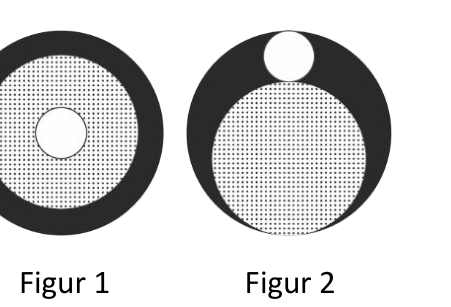
Sanjay has three differently coloured circles. First he stacks them on top of one another, as in Figure 1. Then he moves them so that they touch one another pairwise, as in Figure 2. In Figure 1 the visible black area is seven times the area of the white circle. What is the ratio of the visible black area in Figure 1 to that in Figure 2?
Show answer
Answer: D — 7 : 6
Show hints
Hint 1 of 2
Give the white circle area 1; then the Figure 1 black region is 7, so you immediately know the black circle's area.
Still stuck? Show hint 2 →
Hint 2 of 2
In Figure 2 the circles only touch (no overlap), so figure out how much of the black is newly hidden compared with Figure 1.
Show solution
Approach: scale every area to the white circle, then compare the two pictures
Let the white circle have area 1; since the visible black in Figure 1 is 7 times that, the visible black in Figure 1 is 7 units.
The total black circle has area 8 units (the 7 that show plus the 1 unit the smaller circle covers when stacked).
Re-measuring the black that stays visible once the circles are slid apart to touch pairwise in Figure 2 gives 6 units, so the ratio of visible black in Figure 1 to Figure 2 is \(7:6\), answer D.
Kangaroo Joey hops through a maze. The arrows in a square tell him which way to jump and how far: one arrow means jump to the next square, and three arrows mean jump in that direction skipping two squares and landing in the 3rd square. Joey starts in the bottom-left square (the one with three arrows). Through which exit does he leave the maze?
Show answer
Answer: E — through none of the four exits
Show hints
Hint 1 of 2
From each square, move the number of steps shown (one, two, or three) in the arrows' direction.
Still stuck? Show hint 2 →
Hint 2 of 2
Keep following the rule and watch whether Joey ever steps off an edge or just keeps looping.
Show solution
Approach: follow the arrow moves and look for a loop
Start in the bottom-left square and jump in the arrows' direction, the shown number of steps each time.
Tracing the moves, Joey keeps landing back on squares he has visited.
He enters a repeating cycle and never lands outside the grid.
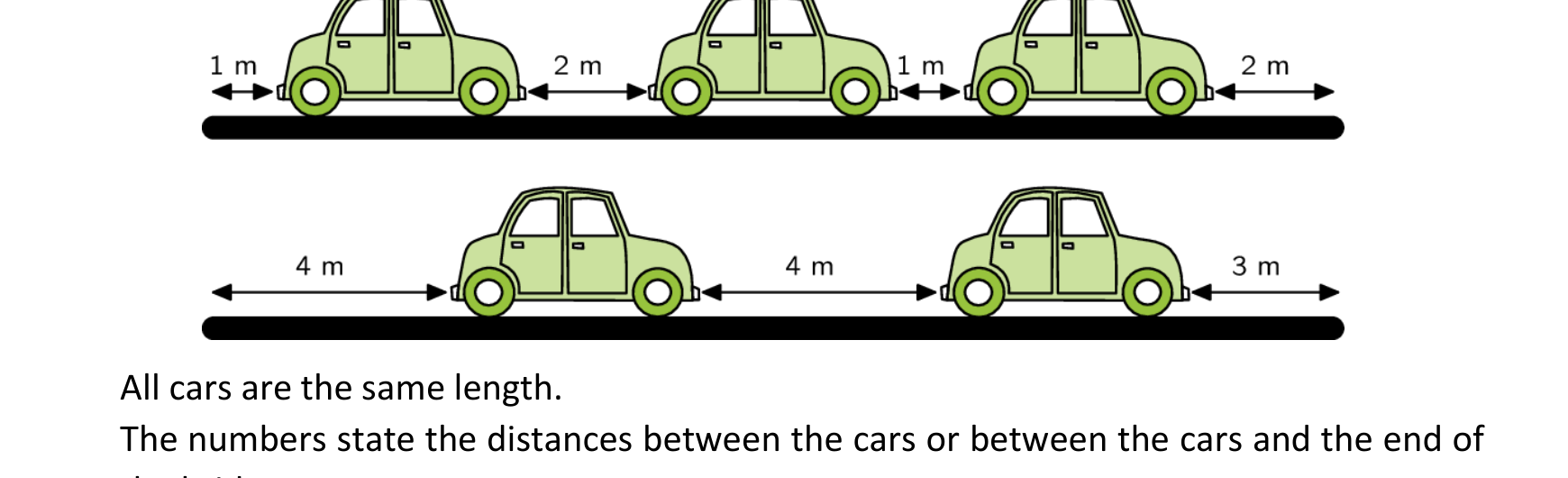
The two pictures show the same bridge at different times. All the cars are the same length. The numbers give the distances between the cars, and between a car and the end of the bridge. How long is each car?
Show answer
Answer: C — 5 metres
Show hints
Hint 1 of 3
It is the same bridge in both pictures, so the bridge is exactly the same total length both times.
Still stuck? Show hint 2 →
Hint 2 of 3
In each picture add up all the gap numbers, and count how many cars there are.
Still stuck? Show hint 3 →
Hint 3 of 3
The bottom picture has one fewer car but more gap — that extra gap must be exactly one car long.
Show solution
Approach: the same bridge length both times
Top picture: the gaps add to 1 + 2 + 1 + 2 = 6 metres, and there are 3 cars.
Bottom picture: the gaps add to 4 + 4 + 3 = 11 metres, and there are 2 cars; the bridge is the same length, so the bottom has 11 − 6 = 5 more metres of gap but exactly one fewer car.
That missing car is filling those extra 5 metres of gap, so each car is 5 metres long.
The daughter of Mary’s daughter was born today. In two years’ time the product of Mary’s age, her daughter’s age and her granddaughter’s age will be exactly 2024, and each of the three ages will be an even number. How old is Mary today?
Show answer
Answer: B — 44
Show hints
Hint 1 of 2
The granddaughter is 0 today, so in two years she is 2; that 2 is a factor of 2024.
Still stuck? Show hint 2 →
Hint 2 of 2
Factor 2024/2 into two even numbers that are sensible ages for a mother and her daughter.
Show solution
Approach: factor 2024 with the granddaughter's age fixed
In two years the ages are M+2, D+2 and 2, with product 2024, so (M+2)(D+2) = 1012.
All three ages are even, so M+2 and D+2 are both even; 1012 = 46 x 22 fits.
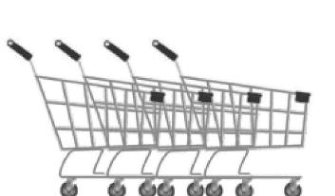
All trolleys in a shop are the same. Four trolleys slid together have a total length of 108 cm (see diagram). Ten trolleys slid together have a total length of 168 cm. How long is one trolley?
Show answer
Answer: C — 78 cm
Show hints
Hint 1 of 2
Each extra trolley adds only the part that sticks out past the one in front, a fixed overlap length.
Still stuck? Show hint 2 →
Hint 2 of 2
Compare 4 trolleys with 10 trolleys to find that fixed added length, then back out one whole trolley.
Show solution
Approach: use the difference to find the added length per trolley
Going from 4 to 10 trolleys adds 6 trolleys and 168 − 108 = 60 cm.
So each extra trolley adds 60 ÷ 6 = 10 cm.
Four trolleys = one full trolley + 3 added bits: 108 = L + 3·10, so L = 108 − 30 = 78 cm.
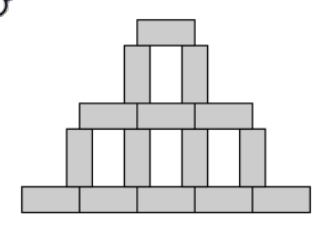
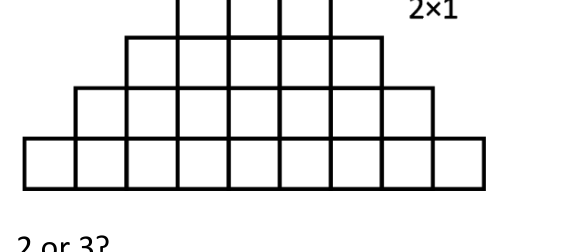
The following shape is composed of identical squares. What is the maximum number of 2×1 dominoes that can be placed on the shape if each covers exactly two squares? The dominoes can be placed horizontally or vertically and are not allowed to cover each other.
Show answer
Answer: C — 10
Show hints
Hint 1 of 3
Colour the squares like a checkerboard, since every domino must cover one square of each colour.
Still stuck? Show hint 2 →
Hint 2 of 3
The number of dominoes can never exceed the count of the rarer colour, so compare the two colour totals.
Still stuck? Show hint 3 →
Hint 3 of 3
Count black and white squares; the smaller total is the ceiling, then check it is actually reachable.
Show solution
Approach: checkerboard bound that turns out to be tight
The pyramid has rows of \(9,7,5,3\) squares, \(24\) in all, so a naive ceiling is \(12\) dominoes.
Colour it like a checkerboard: every \(2\times1\) domino covers exactly one black and one white square.
Counting gives \(14\) of one colour and \(10\) of the other, so no more than \(10\) dominoes can ever be placed.
Ten dominoes can indeed be laid without overlap, so the maximum is 10 (answer C).
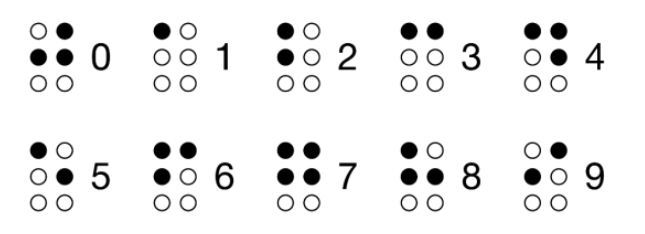
Blind people use Braille, in which numbers and letters are shown as a code with up to 6 tactile dots (black in the picture). The numbers 0 to 9 are shown on the right. How many two-digit numbers have exactly four black dots?
Show answer
Answer: E — 23
Show hints
Hint 1 of 2
First read off how many black dots each digit 0–9 uses from the chart.
Still stuck? Show hint 2 →
Hint 2 of 2
A two-digit number's dots are the tens digit's dots plus the units digit's dots; count the digit pairs whose dot-counts add to 4 (remember the tens digit can't be 0).
Show solution
Approach: tabulate dots per digit, then count pairs summing to four
From the chart, record the number of black dots for each digit 0 through 9.
For a two-digit number, add the dots of the tens digit and the units digit; we want this total to equal 4.
Counting all allowed digit pairs (tens digit 1–9, units digit 0–9) whose dot-counts sum to 4 gives 23 numbers.
So 23 two-digit numbers have exactly four black dots.
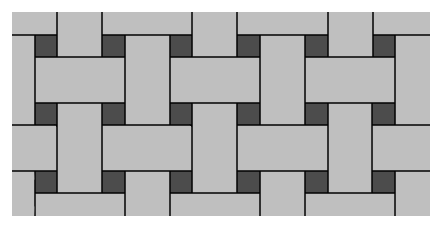
A kitchen floor uses two kinds of tiles: long rectangles and small squares. The picture shows part of the floor. Each rectangular tile is 23 cm long and 11 cm wide. How long is one side of a small square tile?
Show answer
Answer: D — 6 cm
Show hints
Hint 1 of 2
Look at one straight line in the weave where a rectangle's length lines up with its width plus some squares.
Still stuck? Show hint 2 →
Hint 2 of 2
Set up: 23 = 11 + (two square sides) and solve for one side.
Show solution
Approach: match lengths along the basket-weave edges
In the weave, a rectangle's long side (23) equals its short side (11) plus two small-square sides.
So 23 = 11 + 2 × (square side).
Then 2 × (square side) = 12, giving a square side of 6.
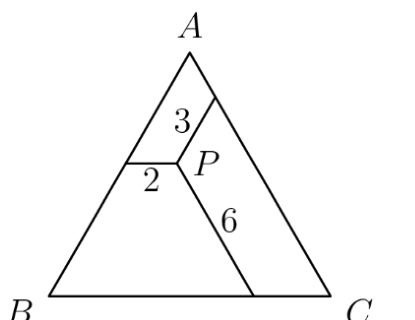
A point P is chosen inside an equilateral triangle ABC. Through P, segments of lengths 2 m, 3 m and 6 m are drawn parallel to the three sides, as shown. What is the perimeter of the triangle?
Show answer
Answer: C — 33 m
Show hints
Hint 1 of 2
The three lines through P cut the big triangle into three small equilateral triangles plus parallelograms.
Still stuck? Show hint 2 →
Hint 2 of 2
Lining up the three small equilateral triangles along one side shows their sides just add up to that whole side.
Show solution
Approach: the three side-parallel segments tile one side of the triangle
Each segment parallel to a side is the side of a small equilateral triangle that sits in a corner of the big triangle.
The three small triangles slide along one side of the big triangle and together cover it exactly, so the side length is \(2+3+6=11\) m.
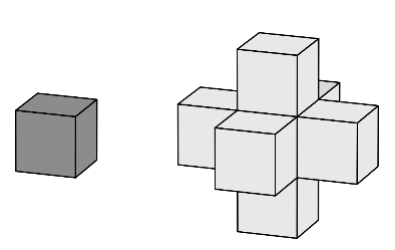
Johann has several light and dark cubes. He used them to form the solid shown on the right by gluing a light cube on each side of a dark cube. Now he wants to glue on dark cubes so that no light areas can be seen from the outside. What is the minimum number of dark cubes that he will need?
Show answer
Answer: A — 18
Show hints
Hint 1 of 3
The solid is a 3D plus sign: a central dark cube with one light cube poking out on each of its 6 faces.
Still stuck? Show hint 2 →
Hint 2 of 3
Each light arm shows 5 light faces (its outer end plus 4 sides); a dark cube tucked into a corner between two arms can hide a side face of both at once.
Still stuck? Show hint 3 →
Hint 3 of 3
Count the end-caps separately from the corner cubes, and watch for the corner cubes being shared between neighbouring arms.
Show solution
Approach: cap each arm, then fill the shared corners between arms
Each of the 6 light arms shows its outer end face, so it needs 1 dark cube as a cap: that is 6 dark cubes.
Each arm also shows 4 side faces, for 6 × 4 = 24 light side faces in all.
A dark cube sitting in a corner between two neighbouring arms covers one side face of each, so it hides 2 side faces; there are 12 such corner positions around the cross.
The 12 corner cubes hide 12 × 2 = 24 side faces, exactly all of them, so the total is 6 + 12 = 18 dark cubes.
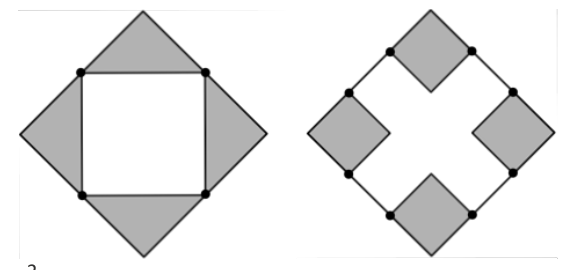
The two large squares have the same area. Parts of them are coloured grey (see picture). In the left square, the dots divide the sides into two equal pieces. In the right square, the dots divide the sides into three equal pieces. The four grey parts in the left square have a combined area of 9 cm². What is the area of the four grey parts in the right square?
Show answer
Answer: B — 8 cm²
Show hints
Hint 1 of 2
Use the left square first: the midpoint construction tells you what fraction of the square the grey corners cover, which fixes the area of the whole square.
Still stuck? Show hint 2 →
Hint 2 of 2
Then express the right square's grey pieces as a fraction of that same total area.
Show solution
Approach: find the common square area from the left figure, then take the right figure's fraction
In the left square the midpoints make the inner tilted square exactly half the big square, so the four grey corner triangles are the other half: 9 cm² is half, giving a square of 18 cm².
In the right square the dots cut each side into thirds, and the four grey pieces there make up 4/9 of the square.
So the grey area on the right is 4/9 × 18 = 8 cm².
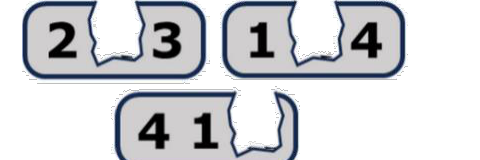
Mia has 3 cards, each showing a three-digit number. When she adds the three numbers she gets 782. Sadly a worm has eaten one digit on each card, so they now read 2 ? 3, 1 ? 4 and 4 1 ?. What do you get when you add the three digits the worm ate?
Show answer
Answer: D — 11
Show hints
Hint 1 of 3
First add up only the digits you can still see, putting a 0 in each eaten spot.
Still stuck? Show hint 2 →
Hint 2 of 3
Compare that total with 782 to see how much the eaten digits must add back.
Still stuck? Show hint 3 →
Hint 3 of 3
Remember: an eaten digit in a tens place is worth that many tens, and an eaten digit in a ones place is worth that many ones.
Show solution
Approach: add the visible digits first, then see how much the eaten digits must add back
Treat each eaten spot as 0: the cards read 203, 104 and 410, which add to 717.
But the real total is 782, so the eaten digits must add back 782 − 717 = 65.
Two of the eaten digits sit in tens places, so together they are worth 60 (meaning those two digits add to 6); the third sits in a ones place worth 5 (so that digit is 5).
The three eaten digits therefore add to 6 + 5 = 11 (D).
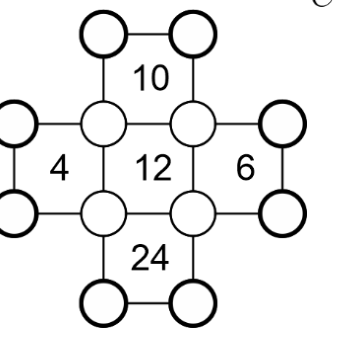
A number is written in each of the twelve circles shown. The number in each square is the product of the four numbers at the corners of that square. What is the product of the numbers in the eight bold circles?
Show answer
Answer: B — 40
Show hints
Hint 1 of 2
Multiply the four outer squares' numbers together and watch which circles get used and how many times.
Still stuck? Show hint 2 →
Hint 2 of 2
The centre square's number is the product of the four inner circles, and each inner circle sits in exactly two outer squares.
Show solution
Approach: multiply the four outer squares and divide out the inner circles
Multiplying the four outer (arm) squares \(10\times4\times6\times24=5760\) uses each of the eight bold outer circles once and each of the four inner circles twice.
The four inner circles multiply to the centre square's value 12, so their squared contribution is \(12^2=144\).
Therefore the product of the eight bold circles is \(5760\div144=40\), answer B.
The digits 0–9 can be drawn using horizontal and vertical lines, as shown. Greg chooses two digits. Together, his digits have 1 horizontal line and 5 vertical lines. What is the sum of his two digits?
Show answer
Answer: A — 5
Show hints
Hint 1 of 2
Count, for each digit drawn with segments, how many horizontal and how many vertical strokes it uses.
Still stuck? Show hint 2 →
Hint 2 of 2
Find two digits whose horizontal counts add to 1 and vertical counts add to 5.
Show solution
Approach: match segment counts to the required totals
The digit 1 uses 2 vertical and 0 horizontal segments.
The digit 4 uses 3 vertical and 1 horizontal segment.
Together: 2 + 3 = 5 vertical and 0 + 1 = 1 horizontal, exactly as required.
A teacher writes the 7 digits 1 1 2 2 2 2 3 on the board. He asks a student to insert some multiplication signs (×) in such a way that the product of the resulting numbers (possibly with multiple digits) has the value 2024. How many multiplication signs must be inserted?
Show answer
Answer: D — 4
Show hints
Hint 1 of 2
Factor 2024 first to see which building-block numbers the digits must form.
Still stuck? Show hint 2 →
Hint 2 of 2
2024 = 11 × 23 × 8, so the digits must group into 11, 23 and the factor 8 from three 2s.
Show solution
Approach: factor the target and group the digits
2024 = 2³ × 11 × 23.
Keeping the digits 1 1 2 2 2 2 3 in order, form 11, then three single 2s, then 23.
So 11 × 2 × 2 × 2 × 23 = 2024 uses five numbers, needing 4 multiplication signs.
Annie wants to write the numbers 1 to 10 in the ten circles (see picture). Each circle should have a different number. She wants the sum of the four numbers along each line to be exactly 23. Which number does she have to write in the circle with the question mark?
Show answer
Answer: D — 7
Show hints
Hint 1 of 3
Add every number once: 1 + 2 + ... + 10 = 55, then think about what you get if you instead add up all the line-totals.
Still stuck? Show hint 2 →
Hint 2 of 3
Each line is 23, but the circles where lines cross get counted more than once, so the line-totals add up to more than 55 — the extra amount is exactly the crossing circles.
Still stuck? Show hint 3 →
Hint 3 of 3
Work out how much 'extra' the crossings contribute, then see what the question-mark circle must be to make its lines reach 23.
Show solution
Approach: total all numbers, then use the leftover at the crossing circles
The ten numbers 1 through 10 add to 55.
Adding the line-totals counts every plain circle once but each crossing circle more than once, so the line-totals add up to more than 55; that surplus tells you the sum sitting at the shared crossing circles.
Filling in the circles so each line reaches 23 forces the question-mark circle to balance its line.
The required number is 7.
Quick checkWhatever line passes through the question mark must total 23; once the other three circles on that line are placed from 1–10, the question mark is what is left to reach 23, and that value is 7.
Lucy weighs building blocks two at a time and reads these scale values: 200 g, 100 g and 240 g (see picture). How much do the three different building blocks weigh all together?
Show answer
Answer: A — 270 g
Show hints
Hint 1 of 2
Each reading is the weight of two of the three blocks together.
Still stuck? Show hint 2 →
Hint 2 of 2
Add the three known readings — that counts every block twice.
Show solution
Approach: add the pair-weights and halve
The three readings 200, 100, 240 each weigh two blocks, so together they count all three blocks twice.
Sum: 200 + 100 + 240 = 540 grams.
Half of that is the weight of the three blocks once: 540 ÷ 2 = 270.
Jean-Philippe has \(n^3\) equally sized cubes. He uses them to build one big cube and paints its surface. The number of small cubes with exactly one painted face is then the same as the number of small cubes with no painted face. What is the value of n?
Show answer
Answer: D — 8
Show hints
Hint 1 of 2
For an n x n x n cube, count edge cubes (one painted face) and interior cubes (no painted face).
Still stuck? Show hint 2 →
Hint 2 of 2
Set the one-face count equal to the zero-face count and solve.
Show solution
Approach: equate the one-face and zero-face cube counts
Cubes with exactly one painted face number 6(n-2)^2; cubes with no painted face number (n-2)^3.
The diagram shows three semicircles inside a rectangle. The middle semicircle touches the other two, which each touch a short side of the rectangle. The biggest semicircle also touches the upper long side of the rectangle. The shortest distances from that side of the rectangle to the two other semicircles are 5 cm and 7 cm, respectively (see diagram). How big is the perimeter of the rectangle, in cm?
Show answer
Answer: B — 92
Show hints
Hint 1 of 3
All three semicircles have their flat sides on the bottom long side; the big one reaches the top, so the rectangle's height equals the big radius.
Still stuck? Show hint 2 →
Hint 2 of 3
The top of a small semicircle is its radius above the bottom, so the gap from the top side down to it is (height) − (its radius).
Still stuck? Show hint 3 →
Hint 3 of 3
Turn the 5 cm and 7 cm gaps into the two small radii, then read the width as the three diameters laid side by side.
Show solution
Approach: convert the top gaps into radii, then add diameters for the width
The big semicircle touches the top long side, so the height of the rectangle equals its radius R = 10 cm.
A small semicircle rises only its own radius above the bottom, so height − radius equals the listed gap: 10 − r = 5 gives r = 5 cm, and 10 − r = 7 gives r = 3 cm.
The three semicircles sit side by side along the bottom, so the width is the sum of their diameters: 2(5) + 2(10) + 2(3) = 36 cm.
A beaver wants to colour the squares and triangles in the pattern so that adjacent cells are never the same colour, even if they only touch each other in one corner. What is the minimum number of colours he needs?
Show answer
Answer: C — 5
Show hints
Hint 1 of 3
Because even a single shared corner counts as touching, look for the point where the most cells crowd together.
Still stuck? Show hint 2 →
Hint 2 of 3
A group of cells that all pairwise touch must all get different colours — that group size is a lower bound.
Still stuck? Show hint 3 →
Hint 3 of 3
Find the largest mutually-touching cluster, then show a colouring with that many colours actually works everywhere.
Show solution
Approach: largest mutually-touching cluster sets the lower bound
Two cells are adjacent if they share an edge or merely a corner, so colours clash even at a point.
Around an interior corner the four triangles of one square plus a neighbouring cell all touch one another pairwise, forcing at least 5 different colours.
A consistent colouring of the whole pattern can be carried out with exactly those 5 colours.
The map shows the seven subway lines of a city. The stations are shown by circles. Martin wants to colour in the subway lines on the plan. If two lines share a common station, they must have different colours. What is the smallest number of different colours he can use?
Show answer
Answer: A — 3
Show hints
Hint 1 of 3
Two lines need different colours only when they share a station, so first hunt for lines that all meet one another.
Still stuck? Show hint 2 →
Hint 2 of 3
If you can find three lines where every pair shares a station, those three already need three different colours — so you can never do it with just two.
Still stuck? Show hint 3 →
Hint 3 of 3
After that, try to colour the rest of the lines reusing only those three colours; if it works, three is the answer.
Show solution
Approach: find three lines that all meet (needs 3 colours), then colour everything with 3
Lines that cross at a shared station must get different colours.
On the map there are three lines that each share a station with the other two, so those three lines need three different colours — two colours can never be enough.
Going line by line, every remaining line shares stations with only lines you have already coloured, so it can always reuse one of the three colours.
Three colours are both needed and enough, so the smallest number is 3.
60 children stand in a row. Each child wears a high-visibility vest and a backpack. The vest colours always alternate: yellow, green, yellow, green, … The backpack colours follow the pattern red, brown, purple, red, brown, purple, … How many children have both a yellow vest and a purple backpack?
Show answer
Answer: E — 10
Show hints
Hint 1 of 2
Yellow vests are on odd positions; purple backpacks repeat every third child.
Still stuck? Show hint 2 →
Hint 2 of 2
Find positions that are both odd and a multiple of 3 — that's every 6th child starting at 3.
Show solution
Approach: combine the two repeating patterns
Vests go yellow, green, ..., so yellow is on positions 1, 3, 5, ... (odd).
Backpacks go red, brown, purple, ..., so purple is on positions 3, 6, 9, ...
Both happen at positions 3, 9, 15, ..., i.e. every 6th child starting at 3.
Otis builds the net of a solid from squares and triangles, as shown; every side of the squares and triangles has length 1. He folds the net to form the solid shown. What is the distance from A to B?
Show answer
Answer: A — \(1+\sqrt{2}\)
Show hints
Hint 1 of 2
Folding the band of squares makes a square tube; the triangles cap it into the solid, and every edge has length 1.
Still stuck? Show hint 2 →
Hint 2 of 2
Give the corners simple 3-D coordinates, then A and B are two of those corners; use the distance formula.
Show solution
Approach: fold to coordinates, then apply the distance formula
The four squares fold into the sides of a square prism of side 1, and the triangles fold over to close it, so all vertices sit on a unit grid.
Placing the vertices on coordinates, A and B land so that they differ by 1 in one direction and by a face diagonal \(\sqrt2\) lined up in the same straight line.
Adding those aligned pieces gives the straight-line distance \(AB = 1+\sqrt2\), answer A.
Daniel forms a 4×4-square out of the three pieces shown on the right and another piece. The sum of the four numbers in each row and in each column is the same. What does the fourth piece look like?
Show answer
Answer: A
Show hints
Hint 1 of 3
Place the three given pieces in the 4×4 grid and look at any row or column that is already complete to read off the common line sum.
Still stuck? Show hint 2 →
Hint 2 of 3
Once you know the target sum, each empty cell is forced: it must make its row and its column reach that total.
Still stuck? Show hint 3 →
Hint 3 of 3
The fourth piece must fit the leftover three cells with exactly the values those cells require.
Show solution
Approach: fit the three pieces, find the common line sum, then force the empty cells
Slot the three given strips into the 4×4 grid; a row or column that is already full reveals the common sum every line must reach.
Each remaining empty cell is then forced, since its value must complete both its row and its column to that sum.
The three forced values, in the shape of the leftover cells, read 1, 1, 3.
Cards with the same shape hide the same digit, and cards with different shapes hide different digits. Kim lays out the cards so that both calculations shown on the right are correct. What number does Kim get for triangle × circle × square?
Show answer
Answer: D — 28
Show hints
Hint 1 of 3
Each shape stands for one digit, and the two-shape answers on the right are two-digit numbers.
Still stuck? Show hint 2 →
Hint 2 of 3
When you add two single digits, the answer is at most 9 + 9 = 18, so its tens digit can only be 1.
Still stuck? Show hint 3 →
Hint 3 of 3
That tells you what the square is; then try a few values for the triangle until both pictures come out right.
Show solution
Approach: the tens digit of a sum of two single digits must be 1, then check triangle values
Triangle + triangle is a two-digit number, but adding two single digits can give at most 18, so its tens digit is 1: the square is 1.
The second picture says circle + triangle = the two-digit number 'square square' = 11.
Try triangle = 7: then 7 + 7 = 14, so the answer is 1 then 4, meaning circle = 4; and circle + triangle = 4 + 7 = 11. Both pictures work!
So triangle × circle × square = 7 × 4 × 1 = 28 (D).
Vlado took part in 31 cross-country races over the last five years. In the first year he ran the fewest races, and the number then increased every year. In the fifth year he ran three times as many races as in the first year. How many races did he run in the fourth year?
Show answer
Answer: C — 8
Show hints
Hint 1 of 2
Let the first year be a; then the fifth year is 3a, and all five years strictly increase.
Still stuck? Show hint 2 →
Hint 2 of 2
The five increasing numbers add to 31; test small values of a.
Show solution
Approach: bound the first year and pin down the fourth
With first year a and fifth year 3a, the five strictly increasing counts sum to 31.
Testing values forces a = 3 (so fifth year 9), with the middle three summing to 19.
Every valid arrangement puts 8 races in the fourth year.
Every day, penguin Paula catches 12 fish for her two children. Every day she gives one of her children 7 fish and the other 5 fish. After several days, one of her children has received 44 fish. How many fish did the other child receive?
Show answer
Answer: D — 52
Show hints
Hint 1 of 2
One child's daily share is sometimes 7 and sometimes 5; over all days the two children together get 12 each day.
Still stuck? Show hint 2 →
Hint 2 of 2
If you can find the number of days, the other child's total is just the grand total minus 44.
Show solution
Approach: find the number of days, then subtract
Over d days the children share 12d fish total.
One child's total 5d + 2·(number of 7-days) = 44 forces d = 8 (with 2 such days).
Total fish = 12 × 8 = 96, so the other child got 96 − 44 = 52.
Two candles of equal length are lit at the same time. One candle will burn down completely in 4 hours, the other in 5 hours. Both burn at a constant rate. How many hours do they have to burn until one candle is exactly 3 times as long as the other?
Show answer
Answer: A — 4011
Show hints
Hint 1 of 2
Write each candle's remaining length as a fraction of time, then set one equal to three times the other.
Still stuck? Show hint 2 →
Hint 2 of 2
Solve (1 − t/5) = 3(1 − t/4) for the time t in hours.
Show solution
Approach: equation for remaining lengths
After t hours the slow candle has fraction 1 − t/5 left, the fast one 1 − t/4.
Set the longer equal to 3 times the shorter: 1 − t/5 = 3(1 − t/4).
This gives t · (3/4 − 1/5) = 2, i.e. t · 11/20 = 2, so t = 40/11 hours.
Mary wants to write the numbers 1 to 8 in the corners of the cube. For each of the six faces, the sum of the four numbers at its corners should be the same. She has already entered the numbers 6, 7 and 8 (see picture). What number does Mary have to write in the corner with the question mark?
Show answer
Answer: C — 3
Show hints
Hint 1 of 3
Add the eight corner numbers 1 + 2 + ... + 8 first, and notice every corner is shared by exactly 3 of the 6 faces.
Still stuck? Show hint 2 →
Hint 2 of 3
Use that to find what each single face must add up to, since all six faces have the same total.
Still stuck? Show hint 3 →
Hint 3 of 3
Then pick the one face that already shows known numbers next to the question mark and make it reach that total.
Show solution
Approach: find the common face-total, then fill in one face
The corner numbers 1 through 8 add up to 36.
Each corner sits on 3 of the 6 faces, so adding all six face-totals counts every corner 3 times: 3 × 36 = 108, which split over 6 equal faces makes each face add to 18.
On the face that holds the question mark together with already-placed numbers, the four corners must reach 18, and filling in the known numbers leaves the question-mark corner as 3.
There are exactly 2 frogs in each row and in each column (see picture). At the same moment, two of the six frogs each hop to an empty neighbouring square. Afterwards there are again 2 frogs in each row and in each column. In how many ways can two frogs hop like this?
Show answer
Answer: D — 4
Show hints
Hint 1 of 3
There are only three empty squares, so each hopping frog must land on one of those empty squares.
Still stuck? Show hint 2 →
Hint 2 of 3
When a frog leaves a row (or column) and another frog must keep that row (or column) at two, the two moves have to balance each other.
Still stuck? Show hint 3 →
Hint 3 of 3
Carefully try every pair of frogs that can hop into empty neighbours, and keep only the pairs that still leave two frogs in every row and every column.
Show solution
Approach: try each pair of frogs hopping into empty neighbours and keep the ones that stay balanced
On the 3-by-3 grid the six frogs leave exactly three empty squares; a hopping frog can only move onto an empty neighbour.
If one frog hops out of a row, the row drops to one frog, so a second frog must hop back into that same row to keep it at two — and the same must hold for columns.
Go through the pairs of frogs that can both hop into empty neighbours and check which pairs keep every row and every column at two frogs.
Exactly four such pairs of hops work, so the answer is 4 (D).
A kangaroo jumps up a mountain and back down again on the same path. Going up, it covers 1 metre per jump. Going down, it covers 3 metres per jump. In total it jumped 2024 times. How many metres did it cover in total?
Show answer
Answer: D — 3036
Show hints
Hint 1 of 2
The climb up and the climb down cover the same height H, but with different jump sizes.
Still stuck? Show hint 2 →
Hint 2 of 2
Write the number of up-jumps and down-jumps in terms of H and set their sum to 2024.
Show solution
Approach: express jumps via height, solve, then double the height
Up: H metres at 1 m/jump needs H jumps. Down: H metres at 3 m/jump needs H/3 jumps.
Total jumps: H + H/3 = 4H/3 = 2024, so H = 1518 m.
A three-sided pyramid has edges with side lengths 5, 6, 7, 8, 9 and 10. The points M, N, P, Q, R and S are the midpoints of the edges, as shown in the diagram. What is the total length of the closed polyline MNPQRSM?
Show answer
Answer: C — 21
Show hints
Hint 1 of 3
Each step of the polyline joins the midpoints of two edges that meet at a vertex — that is a midsegment of a triangular face.
Still stuck? Show hint 2 →
Hint 2 of 3
A midsegment is parallel to and exactly half of the third edge of that face.
Still stuck? Show hint 3 →
Hint 3 of 3
So each of the six steps is half of one edge; add the six halves the closed path uses.
Show solution
Approach: every step is a midsegment, so half an edge
M, N, P, Q, R, S are the six edge midpoints, and each consecutive pair lies on two edges sharing a vertex.
The segment between two such midpoints is a triangle midsegment, equal to half of the third edge of that face, so each step is half of one edge.
Reading the faces the path crosses, the six steps are the halves of edges \(10, 5, 6, 7, 8, 6\), giving \(\tfrac{1}{2}(10+5+6+7+8+6)=\tfrac{1}{2}\cdot 42=\) 21 (answer C).
Daniel wants to cut a rope into 12 equal pieces and marks the places where he has to cut. Mohammed wants to cut the same rope into 16 equal pieces and marks his cuts as well. Maya finally cuts the rope at all the marked spots. How many pieces does Maya get?
Show answer
Answer: A — 24
Show hints
Hint 1 of 2
Count the marks each boy makes (11 for twelve pieces, 15 for sixteen pieces), but watch for marks that land on the same spot.
Still stuck? Show hint 2 →
Hint 2 of 2
Shared marks happen where the fractions agree; subtract those once, and remember the number of pieces is one more than the number of cuts.
Show solution
Approach: inclusion-exclusion on the cut marks, then add one
Daniel makes 11 marks (at 1/12, 2/12, …, 11/12) and Mohammed makes 15 marks (at 1/16, …, 15/16).
Marks coincide where the positions match, which happens at 1/4, 1/2 and 3/4 — that is 3 shared marks.
The picture on the right shows a honeycomb with 9 cells. Some cells contain honey. The number written in a cell tells how many of its neighbouring cells contain honey. How many cells are filled with honey?
Show answer
Answer: C — 6
Show hints
Hint 1 of 3
Each written number counts how many of that cell's touching neighbours hold honey — like a honey version of Minesweeper.
Still stuck? Show hint 2 →
Hint 2 of 3
Start at a cell with few neighbours: if a clue equals its number of neighbours, every one of them must be honey.
Still stuck? Show hint 3 →
Hint 3 of 3
Use each filled-in clue to force its neighbours, one cell at a time, until the whole comb is settled.
Show solution
Approach: use each clue to decide its neighbours, starting where a clue forces everything
Begin at an edge cell whose clue equals its number of touching neighbours — then all of those neighbours must hold honey.
Once those are fixed, neighbouring clues tell you which of their remaining cells are honey and which are empty.
Keep applying the clues, cell by cell, so that every number ends up matching the honey around it.
When the whole comb is consistent, six of the cells contain honey: 6 (C).
The number of sweets in the first bowl equals the number of bowls that hold one sweet.
The number of sweets in the second bowl equals the number of bowls that hold two sweets.
The number of sweets in the third bowl equals the number of bowls that hold three sweets.
The number of sweets in the fourth bowl equals the number of bowls that hold no sweets.
How many sweets are in the bowls altogether?
Show answer
Answer: C — 4
Show hints
Hint 1 of 2
Each bowl is counting how many bowls hold a certain number of sweets, so the four numbers must describe themselves.
Still stuck? Show hint 2 →
Hint 2 of 2
Guess that the counts are small and check whether the four sentences all come out true.
Show solution
Approach: find the one self-consistent filling and add it up
Try the bowls holding 2, 1, 0, 1 sweets and check the four statements.
Bowls with one sweet: there are 2 (bowls 2 and 4), matching bowl 1; bowls with two sweets: 1 (bowl 1), matching bowl 2; bowls with three sweets: 0, matching bowl 3; bowls with no sweets: 1 (bowl 3), matching bowl 4.
Every statement checks out, so the total is \(2+1+0+1=4\), answer C.
Tarek wants to colour two more cells of the 4×4-square black so that the pattern of white and black cells has exactly one axis of symmetry. In how many ways can he do that?
Show answer
Answer: E — 6
Show hints
Hint 1 of 3
A 4×4 grid can be symmetric about four possible lines: vertical, horizontal, and the two diagonals.
Still stuck? Show hint 2 →
Hint 2 of 3
For each candidate axis, reflect the two black cells already there and see what the two new cells would have to be.
Still stuck? Show hint 3 →
Hint 3 of 3
Be careful to keep exactly one axis — a placement that accidentally creates a second axis does not count.
Show solution
Approach: make the picture symmetric about each axis in turn and count the valid two-cell completions
Reflecting the two given black cells across the vertical axis forces one extra colouring that is symmetric only about that vertical line.
The horizontal axis similarly forces one valid colouring.
The two diagonal axes are more flexible and give the remaining colourings, for a total of four diagonal-symmetric ways.
A quadrilateral ABCD has two right angles, at the vertices B and C. It is known that AB = 4, BC = 8 and CD = 2. What is the smallest possible value of AX + DX, if X is a point on the segment BC?
Show answer
Answer: D — 10
Show hints
Hint 1 of 2
Reflect one of the right-angle vertices across line BC so the path AX + DX becomes straight.
Still stuck? Show hint 2 →
Hint 2 of 2
After reflecting A across BC, the shortest AX + DX is the straight distance to D — a right-triangle hypotenuse.
Show solution
Approach: reflect to straighten a shortest path
With right angles at B and C, AB = 4 and CD = 2 stand perpendicular to BC = 8.
Reflect A across line BC to get A'; then AX + DX = A'X + DX, smallest when A', X, D are collinear.
The picture shows a honeycomb with 16 cells. Some cells (but not all) are filled with honey. The number in a cell tells how many of its neighbouring cells are filled with honey. How many cells of the honeycomb are filled with honey?
Show answer
Answer: C — 9
Show hints
Hint 1 of 3
Start at the easiest clues: a cell saying 0 means none of its neighbours have honey, so colour all of them empty.
Still stuck? Show hint 2 →
Hint 2 of 3
A cell whose number equals how many neighbours it has must have every neighbour filled, so fill all of them.
Still stuck? Show hint 3 →
Hint 3 of 3
Keep going back and forth — each thing you mark empty or full gives new clues — until every cell is decided, then count the filled ones.
Show solution
Approach: start from the strongest clues and fill in the rest step by step
A number in a cell just counts its honey-filled neighbours, so a 0 makes all its neighbours empty, and a number as big as the cell's neighbour-count makes them all filled.
Begin with those certain cells, then each cell you settle tells you more about the cells touching it, like a chain of dominoes.
Spreading these forced choices around the comb leaves exactly one pattern that fits every number.
Counting the filled cells in that pattern gives 9.
Kanga wants to build a figure out of these three cube parts (shown at the top). He may rotate or flip the parts. Which of the five pictured figures (A)–(E) can he NOT build?
Show answer
Answer: E
Show hints
Hint 1 of 3
First count the cubes in the three given parts added together — every figure Kanga can build must have exactly that many cubes.
Still stuck? Show hint 2 →
Hint 2 of 3
For each choice, try to colour it in three groups, one matching each part, turning or flipping the parts as needed.
Still stuck? Show hint 3 →
Hint 3 of 3
The figure you simply cannot split into the three parts is the one he canNOT make.
Show solution
Approach: try to split each figure into the three given parts (rotations and flips allowed)
Each finished figure must be built from all three parts, so it always has the same total number of cubes.
For each choice, try to break it into three pieces that match the three parts, allowing turning and flipping.
Four of the figures can be split up neatly into the three parts.
One figure cannot be split that way no matter how you turn the parts, so Kanga cannot make it: E.
Cristina has 12 cards numbered 1 to 12. She places eight of them in a circle so that the sum of any two adjacent numbers is a multiple of 3. Which numbers does Cristina not use?
Show answer
Answer: E — 3, 6, 9, 12
Show hints
Hint 1 of 2
Sort 1-12 by remainder when divided by 3: three groups of four.
Still stuck? Show hint 2 →
Hint 2 of 2
Two adjacent numbers sum to a multiple of 3 only if both are multiples of 3, or one is a 'remainder 1' and the other a 'remainder 2'.
Show solution
Approach: classify by residue mod 3 and build the circle
Mod 3 the numbers split into {3,6,9,12}, {1,4,7,10}, {2,5,8,11}.
Adjacent sums divisible by 3 force the circle to alternate the remainder-1 and remainder-2 groups, using all eight of those numbers.
That leaves the multiples of 3 unused, so Christina does not use 3, 6, 9, 12.
Fresh mushrooms consist of 80% water. In dried mushrooms, however, the water is only 20% of the mass. By what percentage does the mass of a mushroom decrease during drying?
Show answer
Answer: C — 75
Show hints
Hint 1 of 2
The dry solid part of the mushroom never changes when water leaves; only water mass drops.
Still stuck? Show hint 2 →
Hint 2 of 2
Track the solid mass: it is 20% before and 80% after, so set up the new total from the fixed solid.
Show solution
Approach: hold the solid mass fixed and find the new total
Take 100 g fresh: 80% water means 20 g of solid.
Dried, water is 20% so solid is 80% of the new mass: 20 = 0.8 × new, giving new = 25 g.
We have 6 cards and there is one number written on each side of each card. The pairs of numbers on the cards are (5, 12), (3, 11), (0, 16), (7, 8), (4, 14) and (9, 10). The cards can be placed in the empty squares of the calculation \(\square+\square+\square-\square-\square-\square\) in any order with any side up. What is the smallest possible result of the calculation?
Show answer
Answer: D — −26
Show hints
Hint 1 of 3
The calculation adds three cards and subtracts three, and for any card you may show either side.
Still stuck? Show hint 2 →
Hint 2 of 3
A subtracted card should show its big number and an added card its small number, so decide which three cards to subtract.
Still stuck? Show hint 3 →
Hint 3 of 3
Moving a card from the added group to the subtracted group lowers the total by (its small side + its big side), so subtract the three cards with the largest two-number totals.
Show solution
Approach: subtract the three cards with the biggest totals, showing their large sides
Three cards are added and three are subtracted; clearly each added card should show its small number and each subtracted card its big number.
Switching a card from 'added' to 'subtracted' changes the total by \(-(\text{small}+\text{big})\), so the three subtracted cards should be the ones with the largest pair-totals: \((9,10)=19\), \((4,14)=18\), \((5,12)=17\).
Subtracting their big sides gives \(10+14+12=36\); the remaining cards add their small sides \(0+3+7=10\).
A tray of biscuits is in the kitchen (see picture). Three girls take biscuits from the tray, in some unknown order: Tina takes all the heart-shaped biscuits still on the tray, Emma takes all the white biscuits still on the tray, and Rosa takes all the large biscuits still on the tray. One girl ends up with 3 biscuits, one with 6, and one with 7. Which of the pictured groups of biscuits (A)–(E) is exactly what one of the girls took?
Show answer
Answer: E
Show hints
Hint 1 of 2
Whoever goes first takes a whole category from all 16 cookies; figure out an order giving takes of 3, 6, and 7.
Still stuck? Show hint 2 →
Hint 2 of 2
Rosa (large) going first takes 7, then Tina (hearts) takes 6, leaving Emma (white) just 3.
Show solution
Approach: find the order of takers that yields 7, 6, 3
There are 16 cookies, and the takes are 3, 6, 7, so the first taker removes 7.
If Rosa takes the 7 large cookies first, only small ones remain.
Tina then takes the 6 small hearts, leaving three small white round cookies.
Emma takes those three round white cookies — the set in option E.
Carl tells the truth one day, lies the next, tells the truth again the day after, and so on. On one day he made exactly four of the following five statements. Which statement can he not have made on that day?
Show answer
Answer: A — 2024 is divisible by 11.
Show hints
Hint 1 of 2
First decide whether the day is a truth-day or a lie-day, then every statement he made must match that.
Still stuck? Show hint 2 →
Hint 2 of 2
Two of the statements have a truth value you can settle right away no matter what day it is.
Show solution
Approach: fix whether it is a truth-day or lie-day, then test the fixed statements
Statement A is just a fact: \(2024=11\times184\), so A is always true; statement E ("truth today and truth tomorrow") is impossible because today and tomorrow always have opposite truth-status, so E is always false.
On a truth-day statements B (tomorrow Saturday) and D (yesterday Wednesday) cannot both be true, so at most three true statements are available; he cannot reach four, ruling out a truth-day.
So it is a lie-day, where every statement he made must be false; A is true, so A is the statement he could not have made, answer A.
Tiler Teri wants to cover a square floor with a regular pattern (see diagram) using six-sided and three-sided tiles. She estimates that she will need about 3000 six-sided tiles for the whole floor. About how many three-sided tiles will she need?
Show answer
Answer: D — 6000
Show hints
Hint 1 of 2
Focus on one hexagon and count how many triangles touch it, then notice each triangle is shared between hexagons.
Still stuck? Show hint 2 →
Hint 2 of 2
Pick out the small repeating block of the pattern and count hexagons versus triangles inside it to get the fixed ratio.
Show solution
Approach: use the fixed triangle-to-hexagon ratio of the repeating pattern
In this regular pattern, six triangles ring each hexagon, but every triangle is shared by three hexagons, so each hexagon effectively owns 6 ÷ 3 = 2 triangles.
That means the tiling always has 2 triangles for every hexagon.
With about 3000 hexagons, the number of triangles is about 2 × 3000 = 6000.
I have a four-digit number \(N=\overline{pqrs}\). If I place a decimal point between the digits q and r, I obtain the number \(\overline{pq}.\overline{rs}\). This is exactly the average of the two numbers \(\overline{pq}\) and \(\overline{rs}\). What is the sum of the digits of N?
Show answer
Answer: B — 18
Show hints
Hint 1 of 2
Turning pq.rs into an average gives an equation linking the two-digit blocks pq and rs.
Still stuck? Show hint 2 →
Hint 2 of 2
From pq + rs/100 = (pq + rs)/2 you get 50·pq = 49·rs, which pins down pq and rs.
Show solution
Approach: translate the average condition into an equation
The number with the decimal is pq + rs/100, and it equals (pq + rs)/2.
The sum of the digits of N is three times the sum of the digits of \(N+1\). What is the smallest possible sum of the digits of N?
Show answer
Answer: C — 12
Show hints
Hint 1 of 2
Adding 1 only changes the digit sum a lot when N ends in some nines (each trailing 9 turns into a 0).
Still stuck? Show hint 2 →
Hint 2 of 2
If N ends in exactly k nines, write the digit sum of N+1 in terms of the digit sum of N and solve.
Show solution
Approach: use trailing nines to relate the two digit sums, then minimise
If N ends in exactly \(k\) nines, then \(N+1\) turns those \(k\) nines into zeros and raises the next digit by 1, so \(S(N+1)=S(N)-9k+1\).
The condition \(S(N)=3\,S(N+1)\) becomes \(S(N)=3(S(N)-9k+1)\), which simplifies to \(2S(N)=27k-3\); the smallest valid case is \(k=1\), giving \(S(N)=12\).
This is achievable, e.g. \(N=39\) has digit sum 12 and \(N+1=40\) has digit sum 4, with \(12=3\times4\); so the smallest digit sum of N is 12, answer C.
Dagobert wants to complete the diagram so that each box in the middle and top rows equals the product of the two boxes directly underneath it. Each box must contain a positive whole number, and he wants the top box to contain 36. How many different values can the number n have?
Show answer
Answer: D — 4
Show hints
Hint 1 of 2
Write the top box as a product of the three bottom boxes, with n appearing twice.
Still stuck? Show hint 2 →
Hint 2 of 2
The top equals the bottom product with an n-squared factor, so n-squared must divide 36.
Show solution
Approach: express the top as a product and require n-squared divides 36
With bottom boxes x, n, y, the middle row is xn and ny, and the top is xn · ny = x·y·n² = 36.
So n² must divide 36: n can be 1, 2, 3 or 6.
Each choice leaves a valid positive product for x·y, so n has 4 possible values.
Jill has some black and some white unit cubes. She uses 27 of them to build a 3×3×3 cube, and she wants exactly one third of the surface to be black. If A is the smallest possible number of black cubes she can use and B the largest, what is the value of \(B - A\)?
Show answer
Answer: D — 7
Show hints
Hint 1 of 2
The 3x3x3 cube has 54 unit faces on its surface; one third is 18 black faces.
Still stuck? Show hint 2 →
Hint 2 of 2
Corner cubes show 3 faces, edges 2, face-centres 1, and the single hidden centre cube shows 0; use that for the maximum.
Show solution
Approach: count black faces by cube position to find A and B
One third of the 54 surface faces is 18 black faces.
Fewest black cubes: use 6 corner cubes (3 faces each) = 18 black faces, so A = 6.
Most black cubes: cover 18 faces with cubes showing as few faces as possible, then add the fully hidden centre cube as a free black cube; this gives B = 13, so B - A = 7.
Sylvia has several fair 12-sided dice, each with the numbers 1 to 12 written on their faces. If she rolls all the dice simultaneously, the probability of rolling exactly one 12 is equal to the probability of not rolling a 12 at all. How many dice does Sylvia have?
Show answer
Answer: D — 11
Show hints
Hint 1 of 2
Write the probability of exactly one 12 and of no 12 for n dice, then set them equal.
Still stuck? Show hint 2 →
Hint 2 of 2
n·(1/12)(11/12)^(n−1) = (11/12)^n simplifies to a single equation for n.
Show solution
Approach: set the two probabilities equal
P(no 12) = (11/12)ⁿ and P(exactly one 12) = n·(1/12)·(11/12)^(n−1).
Setting them equal and dividing by (11/12)^(n−1): n/12 = 11/12.
Ann rolled an ordinary die 24 times. Every number from 1 to 6 came up at least once, and the number 1 came up more often than any other number. Ann then added all the numbers she rolled. What is the largest total she could have obtained?
Show answer
Answer: D — 90
Show hints
Hint 1 of 2
Every face appears at least once, and 1 must appear strictly more often than each other face.
Still stuck? Show hint 2 →
Hint 2 of 2
Allow 1 to appear enough times that the other faces may each appear up to one less, then load 5's and 6's.
Show solution
Approach: minimise the count of 1 then maximise the high faces
Let 1 appear c times; every other face appears at most c-1 times, and all six faces appear at least once.
To maximise the sum we want many 5's and 6's, so allow c = 7: then faces can appear up to 6 times each, e.g. six 6's, six 5's, three 4's, one 3, one 2, and seven 1's (total 24 rolls).
That total is 7*1 + 1*2 + 1*3 + 3*4 + 6*5 + 6*6 = 90.
A farmer sells chicken eggs and duck eggs. In different baskets he has 4, 6, 12, 13, 22 and 29 eggs, with each basket holding eggs of only one kind. Christoph buys all the eggs in one basket. The farmer then realises that he now has twice as many chicken eggs as duck eggs. How many eggs did Christoph buy?
Show answer
Answer: E — 29
Show hints
Hint 1 of 2
After Christoph takes one basket, the rest must split as chicken = twice duck, so the remaining total is a multiple of 3.
Still stuck? Show hint 2 →
Hint 2 of 2
Find which single basket, when removed, leaves a multiple of 3.
Show solution
Approach: use divisibility by 3 on the remaining total
All baskets total 4+6+12+13+22+29 = 86.
Remaining = chicken + duck = 2·duck + duck = 3·duck, so it must be a multiple of 3.
86 leaves remainder 2 mod 3, so the removed basket must be ≡ 2 mod 3; only 29 qualifies.
Olga walked in the park. For half of the time she walked at 2 km/h. For half of the distance she walked at 3 km/h. For the rest of the time she walked at 4 km/h. For what fraction of the time did she walk at 4 km/h?
Show answer
Answer: A — \(\frac{1}{14}\)
Show hints
Hint 1 of 2
Name the total time T and total distance S, then write the distance covered in each phase.
Still stuck? Show hint 2 →
Hint 2 of 2
The three phases must account for all of S, which gives one equation linking S and T.
Show solution
Approach: write each phase, force the distances to add to S, then read off the time share
In the first half of the time (time \(\tfrac{T}{2}\)) at 2 km/h she covers \(2\cdot\tfrac{T}{2}=T\); the 3 km/h stretch covers half the distance \(\tfrac{S}{2}\); the leftover time \(\tfrac{T}{2}-\tfrac{S}{6}\) at 4 km/h covers \(4(\tfrac{T}{2}-\tfrac{S}{6})\).
Adding all three distances to \(S\) gives \(S=T+\tfrac{S}{2}+(2T-\tfrac{2S}{3})\), which solves to \(S=\tfrac{18T}{7}\).
Then the 4 km/h time is \(\tfrac{T}{2}-\tfrac{S}{6}=\tfrac{T}{2}-\tfrac{3T}{7}=\tfrac{T}{14}\), so its share of the total time is \(\frac{1}{14}\), answer A.
Captain Flint asks four of his pirates to note down how many gold, silver and bronze coins there were in the treasure chest. Their answers are shown in the diagram. Unfortunately, part of the paper was damaged. Only one of the four pirates told the truth; the other three lied on every single one of their answers. The total number of coins was 30. Who told the truth?
Show answer
Answer: B — Al
Show hints
Hint 1 of 3
The visible numbers are: Tom 9 silver and 11 bronze; Al 7 gold and 12 bronze; Pit 10 gold and 10 bronze; Jim 9 gold and 10 silver.
Still stuck? Show hint 2 →
Hint 2 of 3
Whoever is honest gives the real counts, so every other pirate's visible numbers must each be wrong, and the real gold, silver and bronze add to 30.
Still stuck? Show hint 3 →
Hint 3 of 3
Try each pirate as the honest one and check that the three real counts (totalling 30) make every other pirate wrong on each entry.
Show solution
Approach: assume each pirate honest in turn and force the real counts to total 30
Suppose Al is honest: then gold = 7 and bronze = 12, so silver = 30 − 7 − 12 = 11.
Check the liars against (gold, silver, bronze) = (7, 11, 12): Tom's 9 silver and 11 bronze are both wrong, Pit's 10 gold and 10 bronze are both wrong, and Jim's 9 gold and 10 silver are both wrong.
So every other pirate lied on every answer, exactly as required, and trying any other pirate as honest forces a clash, so this is the only possibility.
A function \(f:\mathbb{R}\to\mathbb{R}\) fulfils the condition \(f(20-x)=f(22+x)\) for all real numbers x. It is known that f has exactly two real zeros. What is the sum of the two zeros?
Show answer
Answer: E — another number
Show hints
Hint 1 of 2
The condition says f takes equal values at points that are mirror images of each other.
Still stuck? Show hint 2 →
Hint 2 of 2
Find the axis of symmetry by averaging 20 − x and 22 + x; the two zeros are symmetric about it.
Show solution
Approach: locate the axis of symmetry
f(20 − x) = f(22 + x) means f is symmetric about the midpoint of 20−x and 22+x.
That midpoint is (20−x + 22+x)/2 = 21, so the graph is symmetric about x = 21.
Two zeros symmetric about 21 add to 2×21 = 42, which is another number.
Twenty points are spaced equally around a circle. How many of the segments joining two of these points are longer than the radius of the circle but shorter than its diameter?
Show answer
Answer: C — 120
Show hints
Hint 1 of 2
A chord between points k steps apart has length 2R*sin(k*pi/20).
Still stuck? Show hint 2 →
Hint 2 of 2
Find which step counts k make this longer than R but shorter than the diameter 2R.
Show solution
Approach: convert the length condition to a range of step counts
The chord length 2R*sin(k*pi/20) exceeds R when k >= 4, and is below the diameter for every k except the 10-step diameter.
So k can be 4,5,6,7,8,9 (six values), each giving 20 chords by symmetry.
Anne drives from point A to point B and then immediately back to A. Benni drives from point B to point A and then immediately back to B. They drive on the same road, start at the same time, and both drive at constant speed. Anne’s speed is three times as high as Benni’s speed. They meet for the first time 15 minutes after they start. How long after the start will they meet for the second time?
Show answer
Answer: C — 30 min
Show hints
Hint 1 of 2
At the first meeting the two together have covered the whole road once, fixing the road length in their speeds.
Still stuck? Show hint 2 →
Hint 2 of 2
Track who turns around when; the second meeting comes after Anne (the faster one) catches Benni from behind.
Show solution
Approach: track positions through the turnarounds to the second meeting
With speeds 3v and v meeting head-on after 15 min, the road length is 4v·15 = 60v.
Anne reaches the far end at 20 min and turns back; Benni is still heading the same way.
Anne then closes the 20v gap at relative speed 2v, taking 10 more min, so they meet at 30 min.
Consider n different straight lines in a plane, labelled \(\ell_1, \ldots, \ell_n\). The line \(\ell_1\) intersects 5 of the other lines, the line \(\ell_2\) intersects 9 of the other lines, and the line \(\ell_3\) intersects 11 of the other lines. Which of the following is a possible value of n?
Show answer
Answer: B — 12
Show hints
Hint 1 of 2
A line misses only the lines parallel to it, so 'intersects m others' means it has \(n-1-m\) lines parallel to it.
Still stuck? Show hint 2 →
Hint 2 of 2
Since one line already intersects 11 others, n cannot be smaller than 12, so test n = 12 first.
Show solution
Approach: turn intersection counts into parallel-class sizes and check the smallest n
A line parallel to none of the others would meet all \(n-1\); since \(\ell_3\) meets 11, we need \(n-1\ge 11\), so \(n\ge 12\).
Try \(n=12\): then \(\ell_3\) is in a direction by itself (meets all 11), \(\ell_2\) has \(12-1-9=2\) lines parallel to it, and \(\ell_1\) has \(12-1-5=6\) lines parallel to it, so the directions group as \(7+3+1+1=12\) lines.
That grouping is consistent, so \(n=12\) works, answer B.
Consider the pentagon \(ABCDE\) with \(\angle BAE = \angle CBA = 90^\circ\), \(\overline{AE} = \overline{BC}\) and \(\overline{ED} = \overline{DC}\). Four points are marked along \(AB\), dividing it into five pieces of equal length, and vertical lines are drawn through these points as shown in the diagram. The dark part in the middle has an area of 13 cm² and the lightly shaded part to its left has an area of 10 cm². What is the area of the entire pentagon, in cm²?
Show answer
Answer: A — 45
Show hints
Hint 1 of 3
The pentagon is a vertical-sided base with a triangular roof peaking at D, and it is symmetric about the line through D, so the five strips pair up: 1st = 5th and 2nd = 4th.
Still stuck? Show hint 2 →
Hint 2 of 3
Each strip's area equals its (equal) width times its average height, and along a straight roof edge the average height climbs by the same fixed amount from one strip to the next.
Still stuck? Show hint 3 →
Hint 3 of 3
Use the two given strips to pin down that climb and the lowest strip, then add all five.
Show solution
Approach: use the straight roof edges to find the side strip, then sum the five symmetric strips
Along the left roof edge the strips' average heights rise by a constant step, so the 1st and 2nd strips differ by the same amount the slope adds per strip; the middle (3rd) strip straddles the peak.
Matching the given 2nd strip = 10 and middle strip = 13 fixes the geometry, which makes the 1st (and by symmetry 5th) strip equal to 6.
A game board is composed of 8 squares on which we want to stack coins. Initially, all squares are empty. On each turn we choose four adjacent squares and place one coin on each of those squares. The numbers show how high the stacks are. Unfortunately, the table wobbled and five of the stacks fell over (shown by ★). How many coins were on the field indicated with a question mark before the stack fell?
★
30
42
★
★
36
?
★
Show answer
Answer: A — 24
Show hints
Hint 1 of 3
Each move adds 1 to a block of four neighbouring squares, so differences between nearby stacks reveal hidden move counts.
Still stuck? Show hint 2 →
Hint 2 of 3
Let \(m_i\) be how many moves start at square \(i\) (covering squares \(i\) to \(i+3\)); write each known stack as a sum of the \(m_i\).
Still stuck? Show hint 3 →
Hint 3 of 3
The \(?\) stack at square 7 equals \(m_4+m_5\), which you can pull out of the known stacks 2, 3 and 6.
Show solution
Approach: express each stack as a sum of move-counts and subtract
Let \(m_i\) be how many moves start at square \(i\), so square \(p\)'s height is the sum of all windows covering it.
Square 2 gives \(m_1+m_2=30\) and square 3 gives \(m_1+m_2+m_3=42\), so \(m_3=12\).