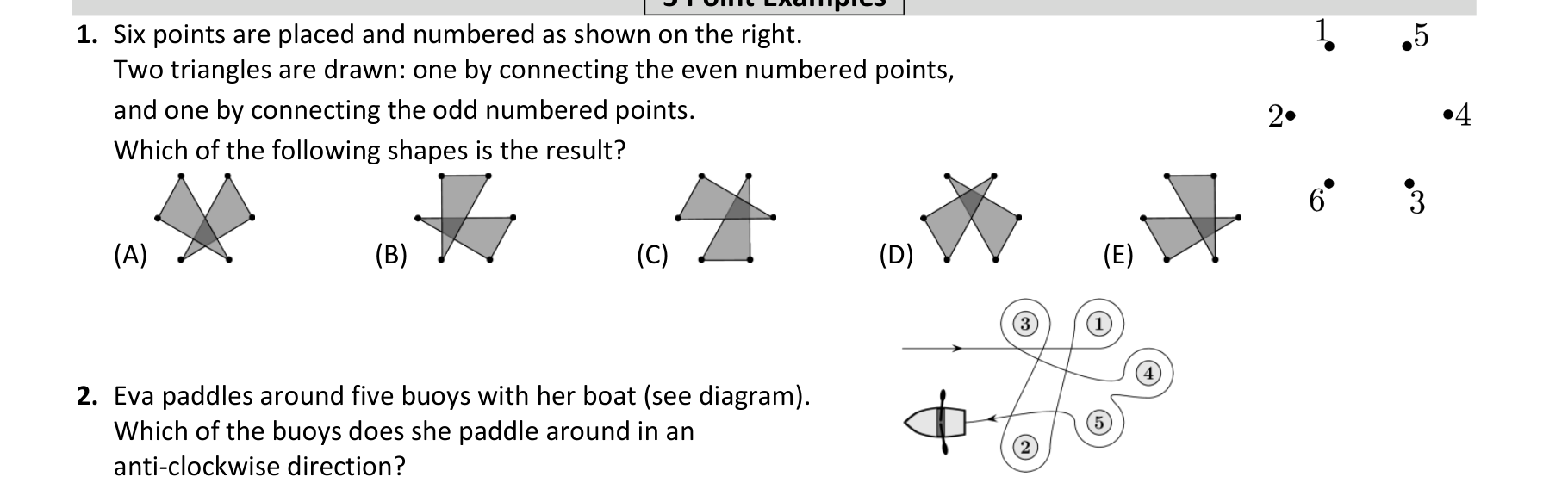
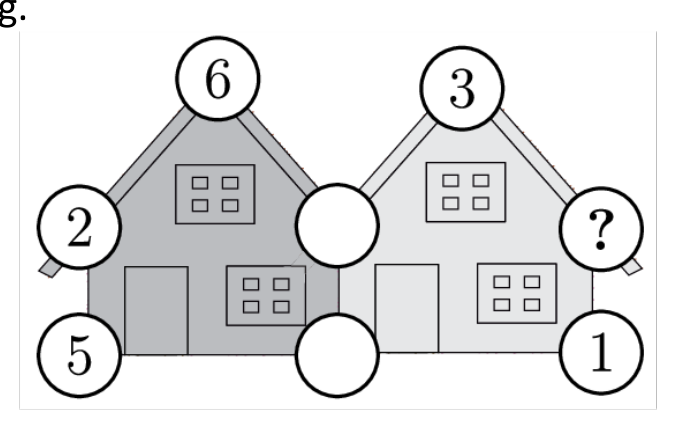
Six points are placed and numbered as shown on the right. Two triangles are drawn: one by connecting the even-numbered points, and one by connecting the odd-numbered points. Which of the following shapes is the result?
Show answer
Answer: E
Show hints
Hint 1 of 2
Mark which of the six points are odd (1,3,5) and which are even (2,4,6), then picture the two triangles they make.
Still stuck? Show hint 2 →
Hint 2 of 2
Each triangle is fixed by its three points; overlay them and compare the combined outline to each option.
Show solution
Approach: connect the odd and even points and match the overlaid figure
The odd points 1,3,5 form one triangle and the even points 2,4,6 form another.
Drawing both on the given point positions, the two triangles cross each other in a particular way.
Comparing that overlap with the choices, only E reproduces it.
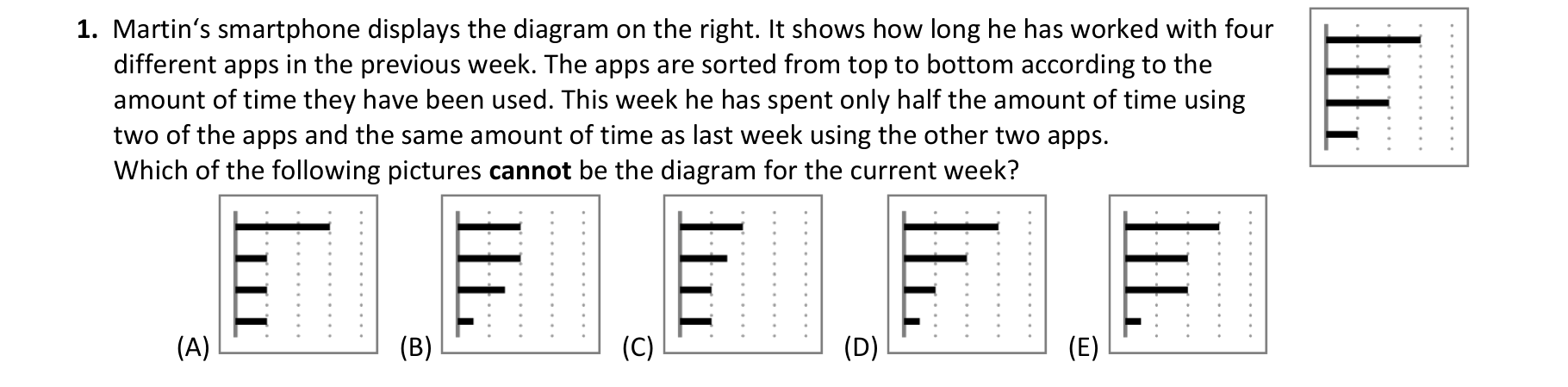
Martin's smartphone displays the diagram on the right. It shows how long he has worked with four different apps in the previous week. The apps are sorted from top to bottom according to the amount of time they have been used. This week he has spent only half the amount of time using two of the apps and the same amount of time as last week using the other two apps. Which of the following pictures cannot be the diagram for the current week?
Show answer
Answer: E
Show hints
Hint 1 of 3
Each app's new bar is either the same length as last week's or exactly half of it.
Still stuck? Show hint 2 →
Hint 2 of 3
Two bars must stay unchanged and the other two must be halved — look for the picture that can't be built that way.
Still stuck? Show hint 3 →
Hint 3 of 3
The total of all four new bars is fixed; the picture whose bars can't be split into two 'kept' and two 'halved' originals is the answer.
Show solution
Approach: rule out the bar chart that can't come from keeping two bars and halving two
Last week's four bars had fixed (decreasing) lengths; this week exactly two of them keep their length and the other two are cut to half.
So every valid new picture must show two bars equal to two of the originals and two bars equal to half of the other two originals.
Checking each option, four can be matched to such a 'keep two, halve two' pairing, but one cannot — it has a bar that is neither a full original nor half of any original.
On every birthday Maria gets as many teddies as the age she turns: 1 teddy on her first birthday, 2 teddies on her second birthday, and so on. How many teddies does Maria have in total the day after her sixth birthday?
Show answer
Answer: C — 21
Show hints
Hint 1 of 2
On each birthday she gets a number of teddies equal to her age that day.
Still stuck? Show hint 2 →
Hint 2 of 2
Add up the teddies from birthday 1 through birthday 6.
Show solution
Approach: add the gifts from each birthday
Birthdays 1 to 6 give 1, 2, 3, 4, 5 and 6 teddies.
Add them up: 1 + 2 + 3 + 4 + 5 + 6 = 21.
So the day after her sixth birthday she has 21 teddies (choice C).
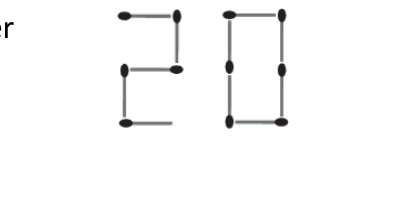
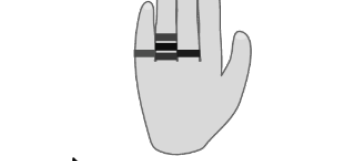
Karo has a box of matches with 30 matches. Using some of the matches she forms the number 2022. She has already formed the first two digits (see picture). How many matches will be left in the box when she has finished the number?
Show answer
Answer: B — 9
Show hints
Hint 1 of 2
Work out how many matches each digit needs, then add up what is still missing.
Still stuck? Show hint 2 →
Hint 2 of 2
She has already built '20'; only '22' remains, and each '2' costs 5 matches.
Show solution
Approach: count matches used, subtract from 30
A '2' is built from 5 matches and a '0' from 6 matches.
Forming '20' already used 5 + 6 = 11 matches.
The remaining digits '22' need 5 + 5 = 10 matches.
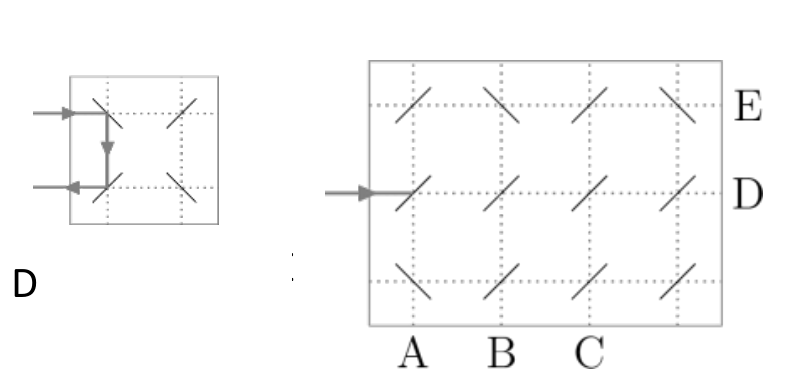
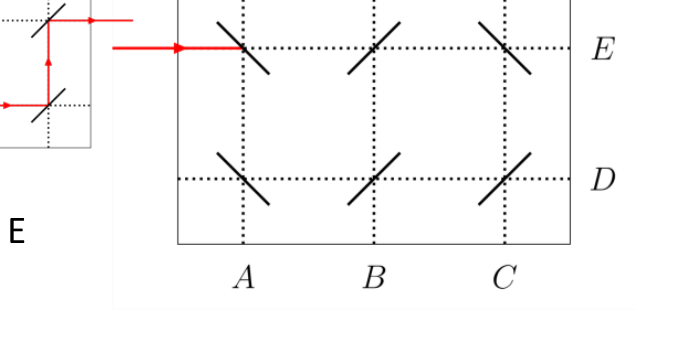
The two-sided mirrors reflect the laser beam as shown in the small picture on the left. At which letter does the laser beam leave the picture on the right?
Show answer
Answer: B — B
Show hints
Hint 1 of 2
Each diagonal mirror turns the beam by a right angle; the small example shows which way.
Still stuck? Show hint 2 →
Hint 2 of 2
Step the beam square by square, bouncing 90 degrees at every mirror, until it reaches an edge.
Show solution
Approach: trace the beam, reflecting 90 degrees at each mirror
Use the small picture to learn how each slanted mirror deflects the beam.
Starting from the entry arrow on the big grid, advance the beam and turn it a quarter-turn at every mirror it hits.
Following the bounces, the beam leaves the grid at letter B.
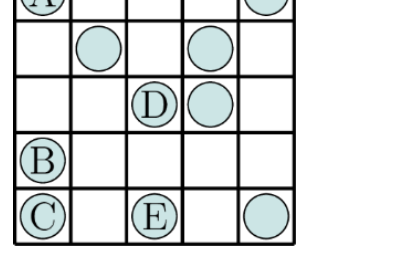
One of the five coins A, B, C, D or E should be moved to an empty square so that each row and each column ends up with exactly two coins. Which coin should be moved?
Show answer
Answer: C — C
Show hints
Hint 1 of 2
Count how many coins are in each row and in each column right now.
Still stuck? Show hint 2 →
Hint 2 of 2
Find the one row that has too many and the one column that has too many; the coin sitting where they cross is the one to move.
Show solution
Approach: balance rows and columns
Counting coins, one row has three coins (too many) and one row has only one (too few).
Likewise one column has three coins and another has only one.
The coin that sits in BOTH the overloaded row and the overloaded column is the one to move.
That coin is C; moving it to the empty cell of the short row and short column fixes every count to two.
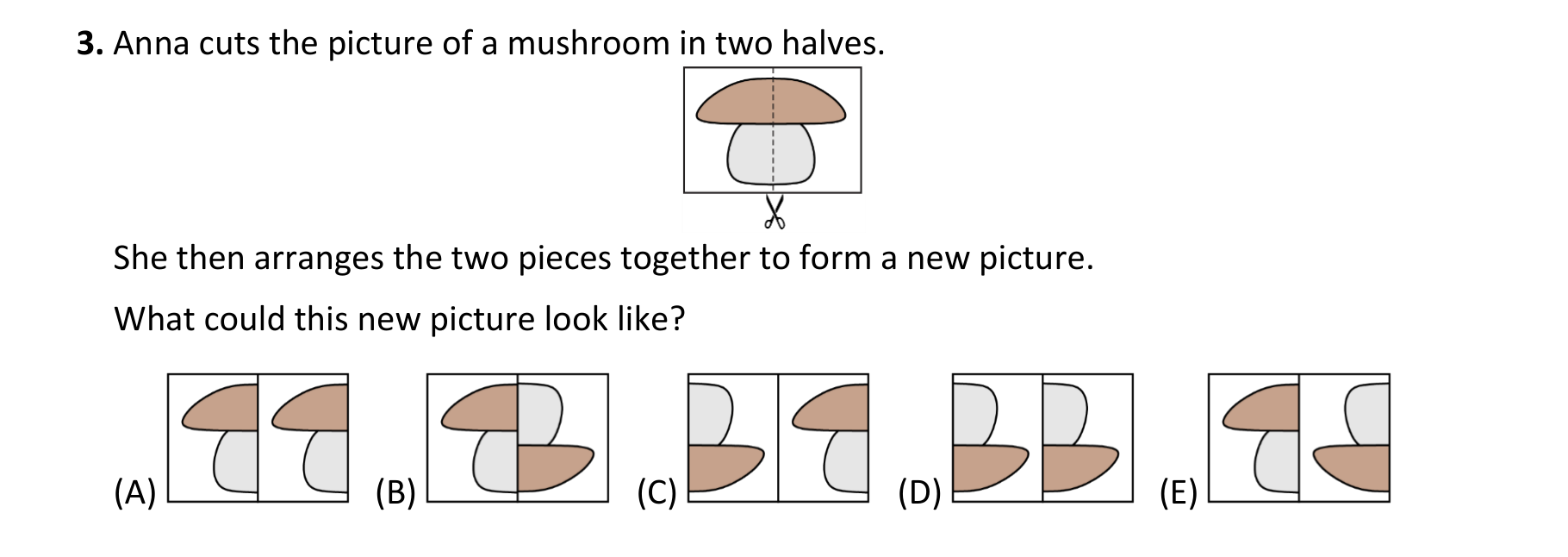
Anna cuts the picture of a mushroom in two halves (straight down the middle). She then arranges the two pieces together to form a new picture. What could this new picture look like?
Show answer
Answer: E
Show hints
Hint 1 of 2
The dashed line cuts the mushroom straight down the middle, so each piece is exactly one half.
Still stuck? Show hint 2 →
Hint 2 of 2
When you slide the two halves back together, they must add up to exactly one whole cap and one whole stem - no extra pieces, none missing.
Show solution
Approach: the two halves must add back up to one whole mushroom's worth
Cutting down the middle gives a left half and a right half, each with half a cap and half a stem.
No matter how Anna turns or slides them, the two pieces together still hold exactly one full cap's worth of brown and one full stem's worth of grey.
Only picture E is made from exactly those two matching halves, so the answer is E.
Beate arranges five cards — 4, 8, 31, 59 and 107 — side by side to make the smallest possible nine-digit number. Which card ends up furthest to the right?
Show answer
Answer: B — 8
Show hints
Hint 1 of 2
To make the joined number smallest, the cards with the smallest leading digit should sit furthest to the left.
Still stuck? Show hint 2 →
Hint 2 of 2
Order the five cards by the digit they start with, and see which card ends up last on the right.
Show solution
Approach: order the cards by their leading digit
The five cards start with the digits 1 (107), 3 (31), 4 (4), 5 (59) and 8 (8).
For the smallest number these leading digits must read in increasing order from left to right, so the cards go 107, 31, 4, 59, 8, giving 107314598.
The card furthest to the right is 8, so the answer is B.
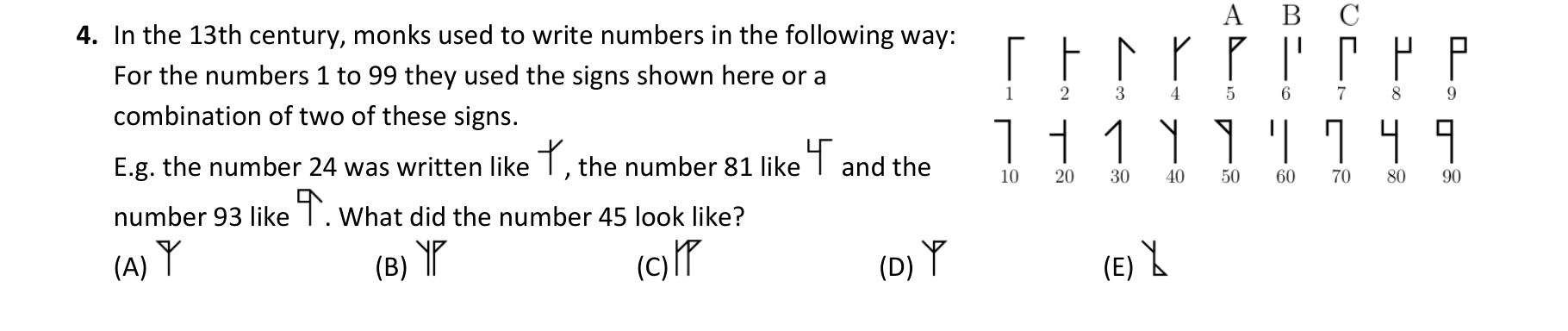
In the 13th century, monks wrote numbers in a special way: for the numbers 1 to 99 they used the signs shown here, or a combination of two of these signs. For example, the number 24 was written one way, 81 another, and 93 another. What did the number 45 look like?
Show answer
Answer: D
Show hints
Hint 1 of 2
Split 45 into a tens part and a units part: 40 and 5.
Still stuck? Show hint 2 →
Hint 2 of 2
Combine the sign for 40 with the sign for 5, just as 24 combined the signs for 20 and 4.
Show solution
Approach: combine the tens-sign and units-sign for 45
The system writes a two-digit number by combining one tens sign and one units sign.
For 45 take the sign for 40 and the sign for 5.
Putting them together gives the figure shown in D.
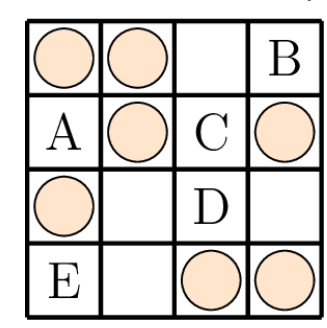
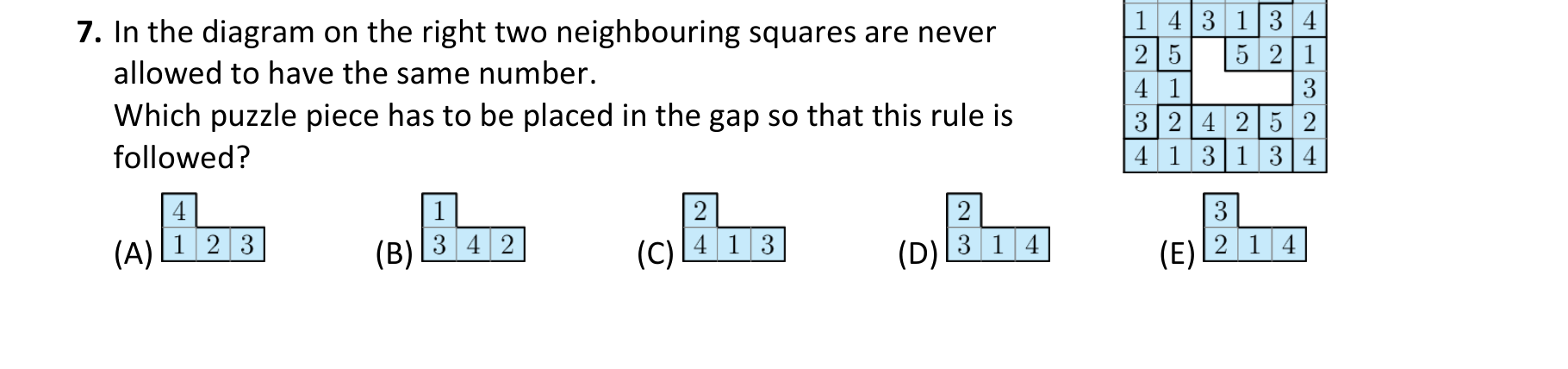
In the four squares of a row there always have to be exactly two coins. In the four squares below each other there also always have to be exactly two coins. On which square does one more coin have to be placed?
Show answer
Answer: D — square D
Show hints
Hint 1 of 2
Count the coins in each row and in each column - which one still has only one?
Still stuck? Show hint 2 →
Hint 2 of 2
One row and one column are each short a coin; they meet at a single empty square.
Show solution
Approach: find the row and column that are short a coin
The third row down has only 1 coin, and the third column across also has only 1 coin.
Both still need one more coin to reach two.
The empty square where that row and column meet is square D, so the coin goes there.
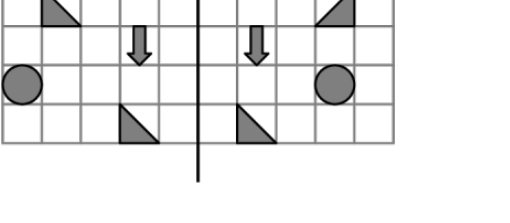
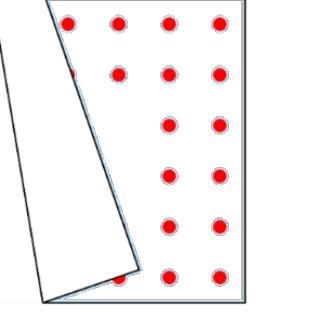
Various symbols are drawn on a piece of paper (see picture). The teacher folds the left side along the vertical line to the right. How many symbols of the left side are now congruent on top of a symbol on the right side?
Show answer
Answer: C — 3
Show hints
Hint 1 of 2
Reflect each left-side symbol across the fold line and see where it lands.
Still stuck? Show hint 2 →
Hint 2 of 2
A match needs the SAME shape AND the same orientation after the flip.
Show solution
Approach: reflect the left half onto the right and count exact matches
Folding flips every left symbol horizontally onto the matching spot on the right.
Compare each landed symbol with the symbol already on the right, requiring both shape and orientation to agree.
Exactly 3 of the left symbols land congruently on a right-side symbol.
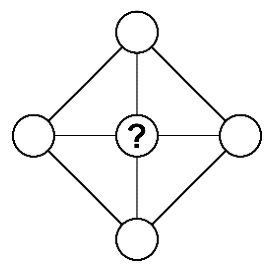
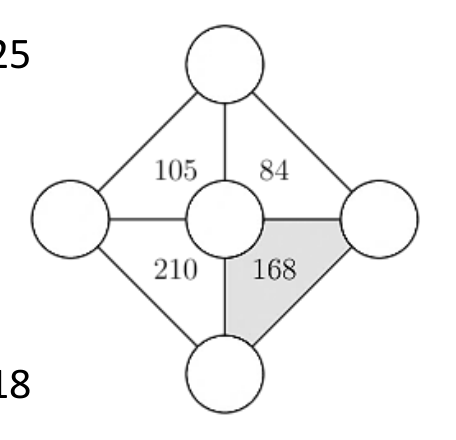
The numbers 3, 4, 5, 6 and 7 are written in the five circles of the shape shown. The product of the numbers in the four outer circles is 360. Which number is in the inner circle?
Show answer
Answer: E — 7
Show hints
Hint 1 of 2
The five numbers are fixed: 3, 4, 5, 6, 7. Find their total product first.
Still stuck? Show hint 2 →
Hint 2 of 2
Divide the product of all five by the product of the four outer ones to isolate the inner number.
Show solution
Approach: divide the full product by the outer product
The product of all five numbers 3,4,5,6,7 is 2520.
The four outer numbers multiply to 360.
The inner number is 2520 / 360 = 7, so the answer is E.
When a laser beam hits a mirror it changes direction (see the small diagram). Each mirror reflects on both of its sides. At which letter does the laser beam come out?
Show answer
Answer: B — B
Show hints
Hint 1 of 3
Put your finger where the beam starts and slide it along, but turn a corner every time you reach a slanted mirror.
Still stuck? Show hint 2 →
Hint 2 of 3
A mirror leaning like '\' turns a beam going across into a beam going down; a mirror leaning like '/' turns it the other way.
Still stuck? Show hint 3 →
Hint 3 of 3
Keep sliding and turning until your finger walks off the edge at one of the letters.
Show solution
Approach: trace the beam one mirror at a time
Start your finger on the beam and slide it straight until it touches the first slanted mirror.
At each mirror, make a quarter turn the way the mirror leans, then keep sliding.
Following every bounce, the finger leaves the grid at the letter B.
Karin places tables of size \(2\times 1\) according to the number of participants in a meeting. The diagram shows the table arrangements from above for a small, a medium and a large meeting. How many tables are used in a large meeting?
Show answer
Answer: C — 12
Show hints
Hint 1 of 2
Don't compute a formula — just see how many tables get added from one meeting to the next.
Still stuck? Show hint 2 →
Hint 2 of 2
The small, medium and large arrangements grow by the same number of tables each step.
Show solution
Approach: spot the constant jump in the number of tables
Count the \(2\times 1\) tables in the small and medium arrangements: they go 4, then 8.
Each step up adds the same number of tables (4 more), so the next arrangement has \(8+4\).
The large meeting therefore uses \(12\) tables, which is answer C.
Anna, Beatrice and Clara are 15 years old altogether. Anna and Beatrice together are 11 years old, and Beatrice and Clara together are 12 years old. How old is the oldest of the three?
Show answer
Answer: E — 8
Show hints
Hint 1 of 2
You know all three together, and two of the pairs. Subtract a pair total from the full total.
Still stuck? Show hint 2 →
Hint 2 of 2
The total minus a pair gives the third person's age; do this to find each age.
Show solution
Approach: subtract pair sums from the grand total
All three add to 15. Anna+Beatrice = 11, so Clara = 15-11 = 4.
Beatrice+Clara = 12, so Anna = 15-12 = 3, and Beatrice = 15-3-4 = 8.
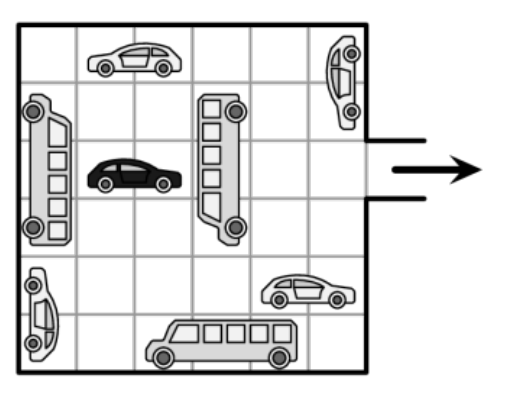
All vehicles in the garage can only drive forwards or backwards. The black car wants to leave the garage (see diagram). What is the minimum number of grey vehicles that need to move at least a little bit so that this is possible?
Show answer
Answer: C — 4
Show hints
Hint 1 of 3
Find the exit first, then the straight lane the black car must drive along to reach it.
Still stuck? Show hint 2 →
Hint 2 of 3
Only the grey vehicles actually sitting in that lane (or blocking a vehicle that does) need to move.
Still stuck? Show hint 3 →
Hint 3 of 3
Count just those blockers - vehicles parked out of the way can stay put.
Show solution
Approach: clear the black car's exit lane, moving only the blockers
The black car must drive straight to the opening on the right.
Identify every grey vehicle sitting in or across that path.
Exactly 4 of them must shift at least a little to free the route.
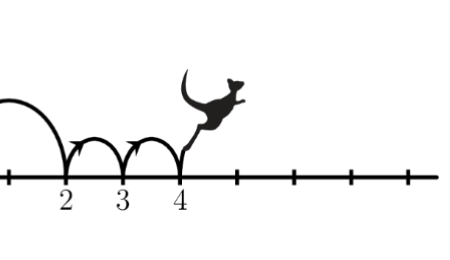
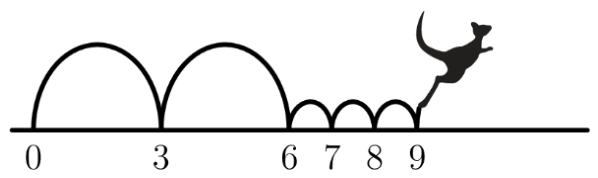
Kengu hops to the right along the number line (see diagram). He makes one big jump and then two little jumps, and repeats this pattern again and again. He starts at 0 and lands on 16. How many jumps does Kengu make in total?
Show answer
Answer: E — 12
Show hints
Hint 1 of 3
Look at the picture: how many numbers does the big jump cover, and how many does each little jump cover?
Still stuck? Show hint 2 →
Hint 2 of 3
One round is big-little-little; work out how far one whole round moves him and how many jumps that is.
Still stuck? Show hint 3 →
Hint 3 of 3
Then skip-count by that round-distance until you land on 16.
Show solution
Approach: measure one round, then skip-count to 16
From the picture, the big jump moves 2 spaces and each little jump moves 1 space.
So one round (big, little, little) moves him 2 + 1 + 1 = 4 spaces using 3 jumps.
Skip-counting by 4 reaches 16 after 4 rounds (4, 8, 12, 16).
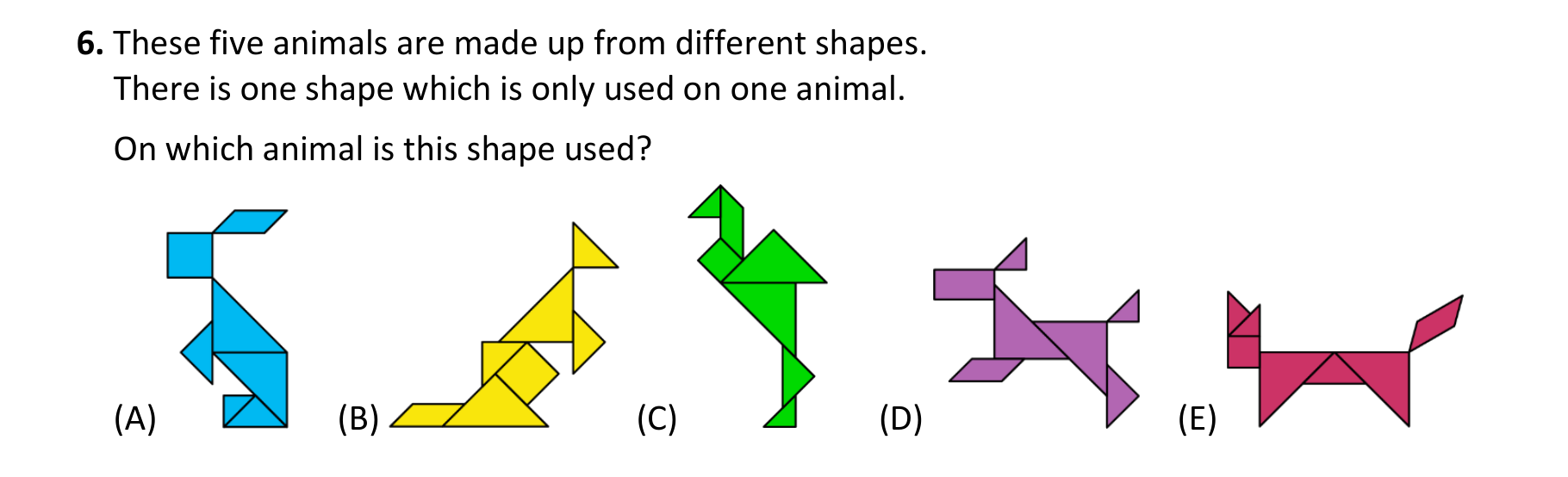
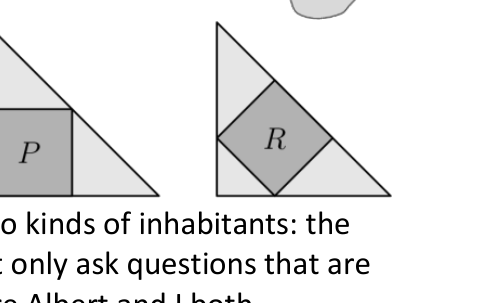
These five animals are each made up from flat shapes (triangles, a square, and a slanted parallelogram). There is one shape that is only used on one animal. On which animal is this shape used?
Show answer
Answer: D
Show hints
Hint 1 of 2
The animals are built from the same little set of shapes - triangles, a square, and one slanted shape (a parallelogram).
Still stuck? Show hint 2 →
Hint 2 of 2
Look for the one shape that you can find on just a single animal and nowhere else.
Show solution
Approach: spot the shape that appears on only one animal
Most animals are built only from triangles (and a square), which show up again and again.
The slanted parallelogram (a leaning four-sided shape) appears on just one animal.
That animal is the purple one, D, so the answer is D.
Kengu hops along the number line. He starts at 0, always makes two big jumps followed by three small jumps (see diagram), and keeps repeating this pattern. On which of these numbers will he land?
Show answer
Answer: C — 84
Show hints
Hint 1 of 2
One full cycle is two big jumps then three small jumps; find how far one cycle moves him and which spots he lands on.
Still stuck? Show hint 2 →
Hint 2 of 2
List the landing positions within one cycle, then see which cycle the answer lands in by working modulo the cycle length.
Show solution
Approach: find the repeating pattern of landing spots
From the diagram one cycle is two big jumps of 3 then three small jumps of 1, so each full cycle moves him forward 6 + 3 = 9.
Starting a cycle at a multiple of 9, he lands on +3, +6, +7, +8, +9 within it, so every landing spot is a multiple of 9 plus 3, 6, 7, 8 or 9.
Since 84 = 81 + 3 = (9 x 9) + 3, it is a landing spot, while 82, 83, 85, 86 are not, so the answer is C.
Bodil lays these seven cards — 4, 69, 113, 9, 51, 5, 67 — next to each other, so that the smallest possible 12-digit number that can be made from these cards is formed. What are the last three digits of this number?
Show answer
Answer: A — 699
Show hints
Hint 1 of 3
A number is smallest when its very first digit is as small as possible, then the next, and so on.
Still stuck? Show hint 2 →
Hint 2 of 3
When two cards could go either way, try both joins and keep the smaller one (for example 51 then 5 makes 515, which beats 551).
Still stuck? Show hint 3 →
Hint 3 of 3
Once you have the whole order, the last card you place gives the final three digits.
Show solution
Approach: build the number digit by digit, smallest first
Want the smallest start, so a card beginning with 1 leads: the card 113 goes first.
Next pick the card that keeps the number smallest at each step, comparing tricky pairs by trying both joins (51 before 5 since 515 < 551).
The order 113, 4, 51, 5, 67, 69, 9 builds 113451567699.
Its last three digits are 699, so the answer is A.
There is an animal asleep in each of the five baskets. The koala and the fox sleep in baskets with the same pattern and the same shape. The kangaroo and the rabbit sleep in baskets with the same pattern. In which basket does the mouse sleep?
Show answer
Answer: E — Basket 5
Show hints
Hint 1 of 2
Find the two baskets that look exactly the same in BOTH pattern and shape - those go to the koala and the fox.
Still stuck? Show hint 2 →
Hint 2 of 2
Then find the other two baskets that share a pattern - those go to the kangaroo and the rabbit; the basket left over is the mouse's.
Show solution
Approach: place the four named animals, then the mouse takes the leftover basket
Baskets 2 and 4 are exactly alike (green with black dots, same shape), so they hold the koala and the fox.
Baskets 1 and 3 share the orange-and-blue woven pattern, so they hold the kangaroo and the rabbit.
That leaves only Basket 5 (the tan basket with a lid) for the mouse, so the answer is Basket 5.
Otto fastens his licence plate to the car upside down, but it doesn’t matter because the plate looks exactly the same that way. Which of these plates could be Otto’s?
Show answer
Answer: B — 60 SOS 09
Show hints
Hint 1 of 2
Turning the plate upside down rotates it 180 degrees; which digits still read as valid digits after that?
Still stuck? Show hint 2 →
Hint 2 of 2
Only 0, 1, 8 (and the pair 6/9 swapping) survive a 180 turn; the whole string must read the same.
Show solution
Approach: test each plate for 180-degree symmetry
Rotating 180 degrees, 0 stays 0, 1 stays 1, 8 stays 8, while 6 and 9 swap.
The string must read identically after flipping and reversing order.
Only 60 SOS 09 reads the same upside down, so the answer is B.
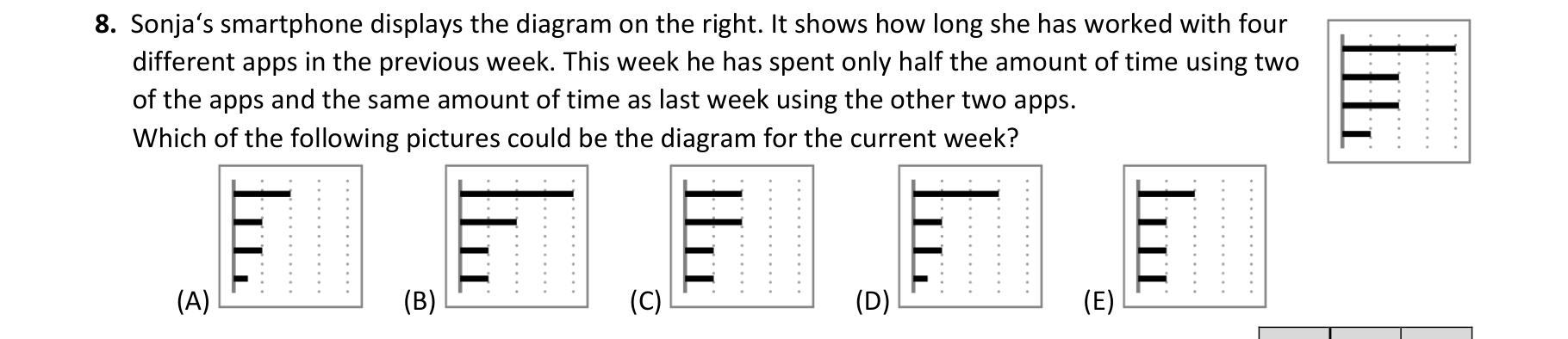
Sonja’s smartphone displays the diagram on the right. It shows how long she has worked with four different apps in the previous week. This week she has spent only half the amount of time using two of the apps and the same amount of time as last week using the other two apps. Which of the following pictures could be the diagram for the current week?
Show answer
Answer: C
Show hints
Hint 1 of 2
Two of the four bars must be exactly halved; the other two stay the same.
Still stuck? Show hint 2 →
Hint 2 of 2
Find the choice where two bars match the original lengths and two are cut in half.
Show solution
Approach: match a chart with two halved bars and two unchanged
The new week keeps two bars at their original length and halves the other two.
Check each option against the reference chart for exactly this combination.
Only option C shows two unchanged bars and two halved bars.
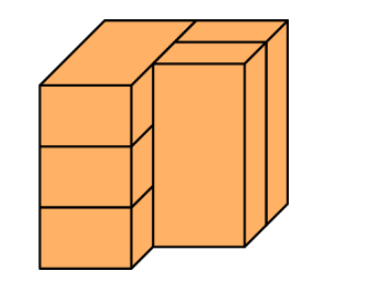
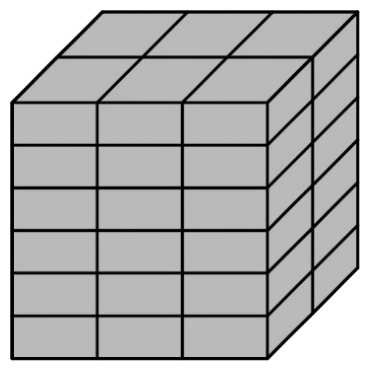
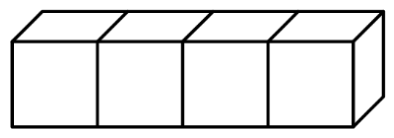
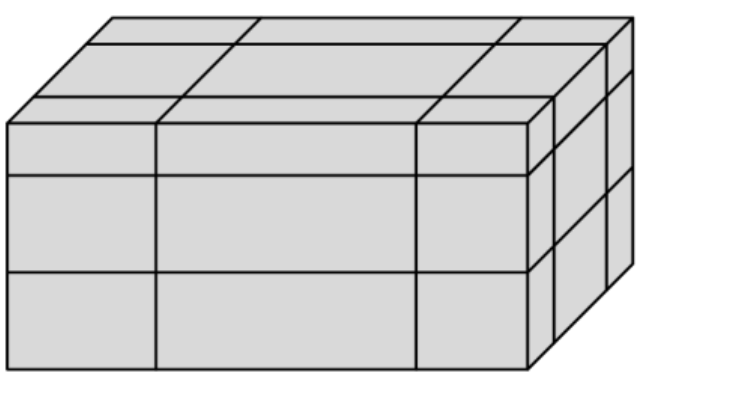
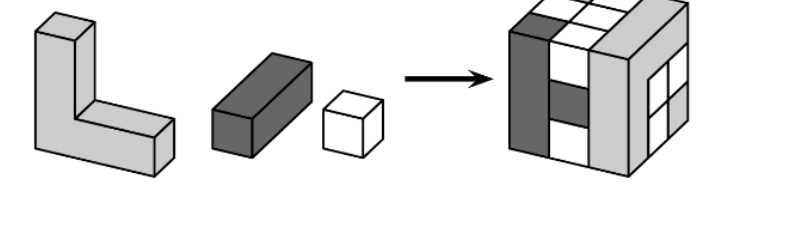
Sonja builds the cube shown out of equally sized bricks. The shortest edge of one brick is 4 cm long. What are the dimensions, in cm, of one brick?
Show answer
Answer: C — \(4 \times 8 \times 12\)
Show hints
Hint 1 of 2
The shortest brick side is 4 cm; use the cube picture to count how many bricks line up along each edge.
Still stuck? Show hint 2 →
Hint 2 of 2
Each brick edge must fit a whole number of times along the cube's edge, so all three brick lengths divide the cube's side.
Show solution
Approach: read the brick counts off the cube picture
The cube is built from equal bricks whose shortest side is 4 cm, so the cube's edge is a multiple of 4.
Counting the bricks along the three directions in the figure shows the brick is 4 cm by 8 cm by 12 cm, and 24 (the cube edge) is divisible by each of these.
So one brick measures 4 x 8 x 12 cm, the answer is C.
All integers from 2 to 2022 which can be written using only the digits 0 and 2 are written in ascending order in a list. Which number is the middle number on that list?
Show answer
Answer: B — 220
Show hints
Hint 1 of 2
List every number from 2 to 2022 using only the digits 0 and 2.
Still stuck? Show hint 2 →
Hint 2 of 2
There are 11 such numbers; the middle one is the 6th.
Show solution
Approach: list and pick the middle
The numbers are 2, 20, 22, 200, 202, 220, 222, 2000, 2002, 2020, 2022 — eleven of them.
Logic & Word Problemswork-backwardcareful-counting
Five cars are labelled 1 to 5 and drive in the direction of the arrow. First the last car overtakes the two cars in front of it. Then the car that is now second to last overtakes the two in front of it. Finally the car that is now in the middle overtakes the two in front of it. In what order do the cars drive now?
Show answer
Answer: B — 2, 1, 3, 5, 4
Show hints
Hint 1 of 3
Write the five car numbers in a row (front car first) and act out the story move by move.
Still stuck? Show hint 2 →
Hint 2 of 3
When a car overtakes the two in front of it, slide it forward so it sits just ahead of both of those two cars.
Still stuck? Show hint 3 →
Hint 3 of 3
Do the three moves one at a time and read off the new order at the end.
Show solution
Approach: act out the overtakes one move at a time
The arrow points left, so the front-to-back order starts as 1, 2, 3, 4, 5 (car 1 leads).
The last car (5) jumps past the two in front of it (4 and 3): now 1, 2, 5, 3, 4.
The new second-to-last car (3) jumps past the two in front of it (5 and 2): now 1, 3, 2, 5, 4.
The car now in the middle (2) jumps past the two in front of it (3 and 1): now 2, 1, 3, 5, 4 — answer B.
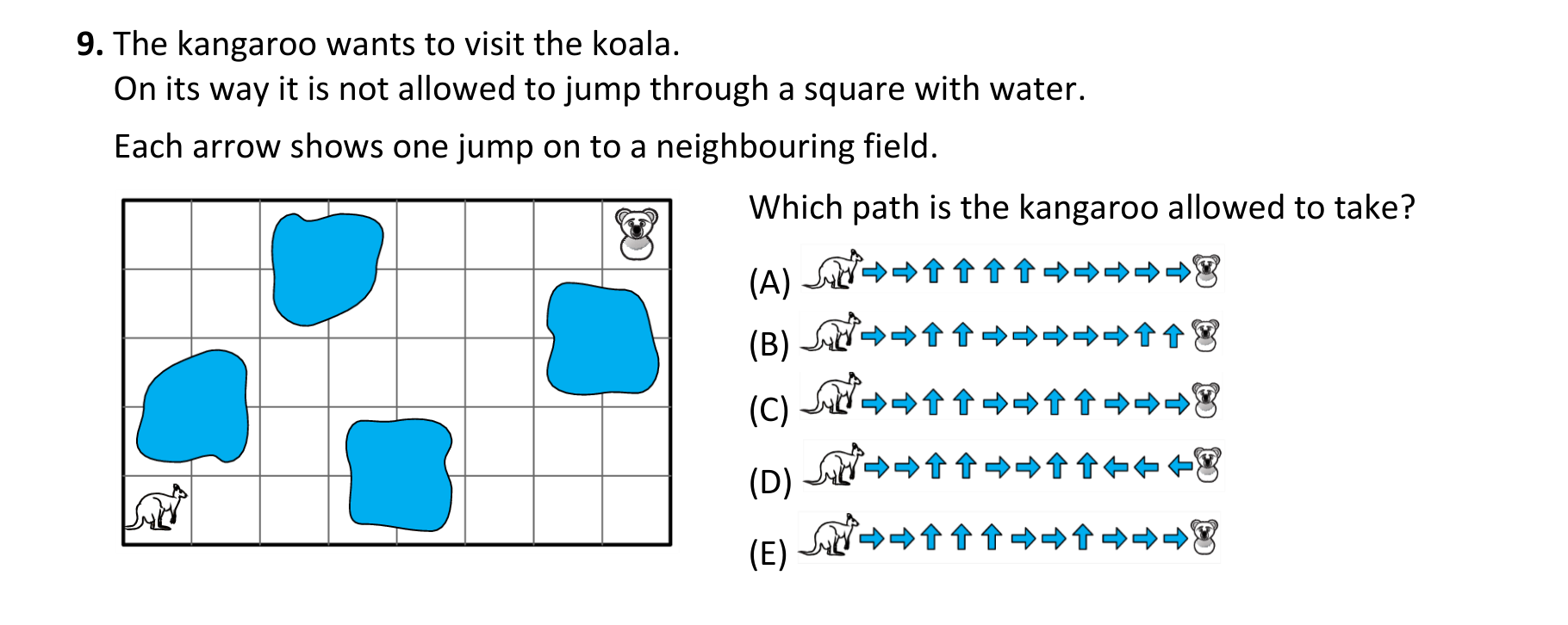
The kangaroo wants to visit the koala. On its way it is not allowed to jump onto a square with water. Each arrow shows one jump onto a neighbouring square. Which arrow path is the kangaroo allowed to take?
Show answer
Answer: C
Show hints
Hint 1 of 2
Put your finger on the kangaroo and follow one arrow at a time, one square per arrow.
Still stuck? Show hint 2 →
Hint 2 of 2
Any path that lands on a blue water square is not allowed, so cross it out; the good path stays on dry land all the way to the koala.
Show solution
Approach: trace each arrow path and reject any that hits water
Start at the kangaroo in the corner and follow each option's arrows, moving one square per arrow.
As soon as a path would land on a blue water square (or leave the grid), cross that option out.
Only path C stays on dry squares the whole way and reaches the koala, so the answer is C.
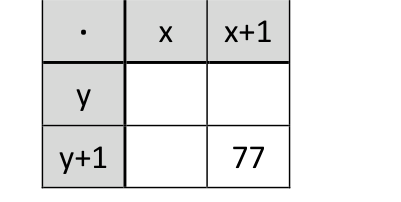
In the multiplication grid displayed, each white cell should show the product of the numbers in the grey cells that are in the same row and column respectively. One number is already entered. The integer x is bigger than the positive integer y. What is the value of y?
Show answer
Answer: A — 6
Show hints
Hint 1 of 2
The bottom-right white cell equals (y+1) times (x+1).
Still stuck? Show hint 2 →
Hint 2 of 2
Factor 77 and use that x and y are positive integers with x > y.
Show solution
Approach: factor the product in the corner cell
The 77 cell is the product of its grey row label (y+1) and column label (x+1): (y+1)(x+1) = 77.
77 = 7 * 11, and since x > y we take x+1 = 11, y+1 = 7.
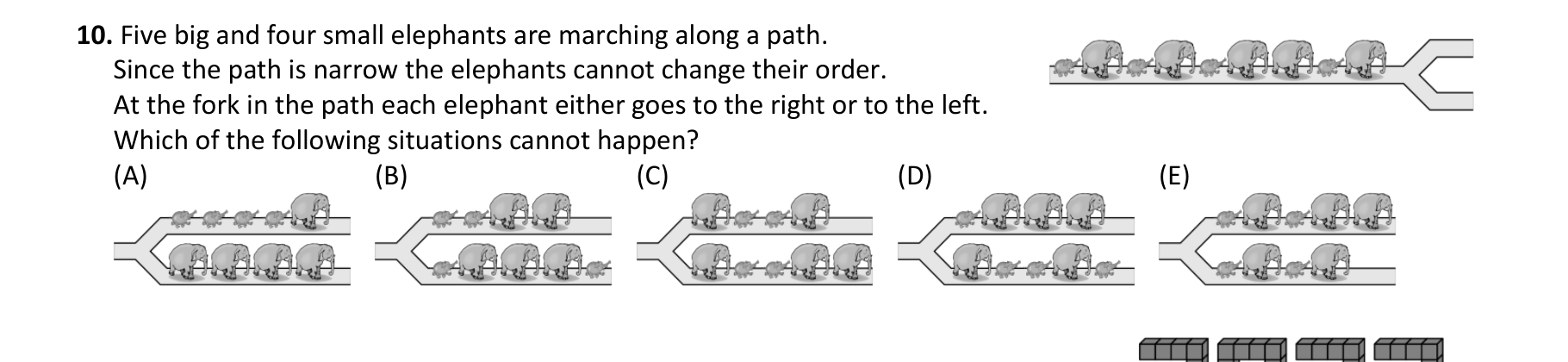
Five big and four small elephants are marching along a path in single file. Because the path is narrow, the elephants cannot change their order. At the fork in the path, each elephant goes either to the right or to the left. Which of the following situations cannot happen?
Show answer
Answer: C
Show hints
Hint 1 of 2
The elephants keep their original order; they can only split left or right at the fork, not pass each other.
Still stuck? Show hint 2 →
Hint 2 of 2
Check each picture: the order along each branch must still match the single-file order.
Show solution
Approach: check that order is preserved on both branches
Because no elephant can overtake another, both branches must show the elephants in their original order.
Test each option against that rule.
Only option C breaks the order, so that arrangement cannot happen.
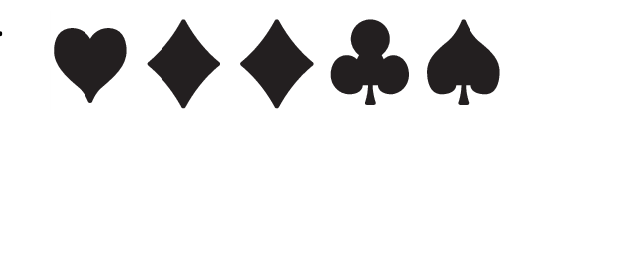
Carl writes down a five-digit number. He then places a shape on each of the five digits (see picture). He places different shapes on different digits. He places the same shape on the same digits. Which number did Carl hide?
Show answer
Answer: A — 34426
Show hints
Hint 1 of 2
Same shape means same digit; different shapes mean different digits.
Still stuck? Show hint 2 →
Hint 2 of 2
The two diamonds sit in positions 2 and 3, so those digits must be equal.
Show solution
Approach: match equal shapes to equal digits
The shapes are heart, diamond, diamond, club, spade - only positions 2 and 3 repeat.
So digits 2 and 3 are equal and all the others are different from them and each other.
Only 34426 has its 2nd and 3rd digits equal (4 and 4) with the rest distinct.
There are 5 people to choose from on a ballot paper. After counting 90 % of the votes the intermediate result looks as shown in the table. How many of the 5 people cannot win the election anymore?
Alex
Bella
Clint
Diana
Eddy
14
11
10
8
2
Show answer
Answer: B — 2
Show hints
Hint 1 of 2
The 45 counted votes are 90%, so first find the total number of votes.
Still stuck? Show hint 2 →
Hint 2 of 2
A candidate is out if even all remaining votes cannot catch the current leader.
Show solution
Approach: find remaining votes, test who can still overtake the leader
Counted votes 14+11+10+8+2 = 45 are 90%, so total = 50 and 5 votes remain.
Leader Alex has 14. A rival can win only if their votes + 5 > 14, i.e. they have at least 10 now.
Diana (8) and Eddy (2) reach at most 13 and 7, so they cannot win; the others still can.
Gerhard writes down the sum of the squares of two numbers, but some ink has run out so we cannot read every digit (see diagram). What is the last digit of the first number?
Show answer
Answer: C — 5
Show hints
Hint 1 of 2
You only need the LAST digit of the answer, so only the units digits of the two numbers matter.
Still stuck? Show hint 2 →
Hint 2 of 2
Squares can only end in 0, 1, 4, 5, 6 or 9; use the readable last digit of the total and of the second number.
Show solution
Approach: track only the units digit
Only units digits matter: the visible total ends in 9, and the second number ends in 2, so its square ends in 4.
Then the first number's square must end in 9 - 4 = 5, and a square ends in 5 only when its base ends in 5.
So the last digit of the first number is 5, the answer is C.
The points A, B, C and D are marked on a straight line in this order as shown in the diagram. We know that A is 12 cm from C and that B is 18 cm from D. How far apart from each other are the midpoints of the line segments AB and CD?
Show answer
Answer: E — 15 cm
Show hints
Hint 1 of 2
Write the midpoints of AB and CD using the positions of the four points.
Still stuck? Show hint 2 →
Hint 2 of 2
The gap equals the average of AC and BD.
Show solution
Approach: midpoint distance = average of AC and BD
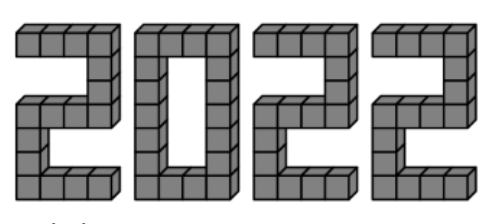
Marc builds the number 2022 from 66 cubes of the same size, all glued together (see picture). He then paints the entire outer surface. On how many of the 66 cubes has Marc painted exactly four faces?
Show answer
Answer: E — 60
Show hints
Hint 1 of 2
Every face glued to a neighbouring cube is hidden; all the rest get painted.
Still stuck? Show hint 2 →
Hint 2 of 2
Since the digits are one cube thick, a cube shows 4 painted faces exactly when it touches 2 neighbours — so look for the few cubes that touch only 1.
Show solution
Approach: count cubes that touch exactly two neighbours
The digits are one cube thick, so every cube always shows its front and back; it shows exactly 4 painted faces when it also has exactly 2 of its in-plane neighbours, i.e. it sits in a straight run or at a corner.
The 0 is a closed loop, so every one of its cubes has 2 neighbours and shows 4 faces. Each 2 is an open strip with exactly two free ends, and those end cubes have only 1 neighbour, so they show 5 painted faces.
The only exceptions are the 2 free ends on each of the three 2s, which is 6 cubes in all.
That leaves 66 − 6 = 60 cubes with exactly four painted faces, so the answer is E.
Mosif has filled a table with numbers (see diagram). When he adds the numbers in each row and in each column, the result should always be the same, but he has made a mistake. To make every total the same he has to change one single number. Which number does Mosif have to change?
9
1
5
3
7
6
4
7
4
Show answer
Answer: B — 3
Show hints
Hint 1 of 2
Work out every row total and every column total and see which one is the odd one out.
Still stuck? Show hint 2 →
Hint 2 of 2
The number to change sits where the wrong row crosses the wrong column.
Show solution
Approach: find the row and column that are off
The row sums are 15, 16, 15 and the column sums are 16, 15, 15, so the target is 15.
One row is 1 too big and one column is 1 too big.
The cell in both that row and that column is the 3; lowering it to 2 fixes both.
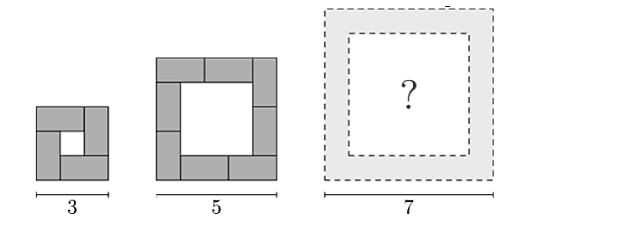
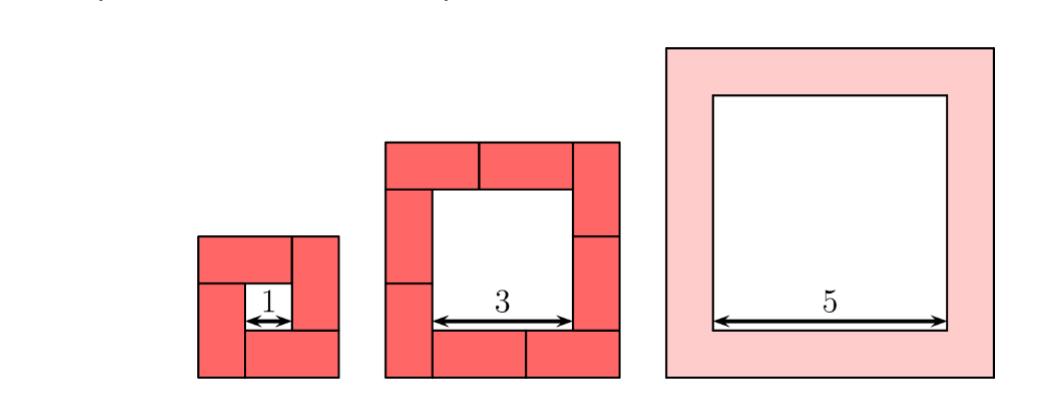
Katrin forms a path around each square. For that she uses stones that are 2 long and 1 wide (see picture). How many such stones does she need for a path around the square with side length 5?
Show answer
Answer: C — 12
Show hints
Hint 1 of 2
Count the stones in the small ring (side 1) and the next ring (side 3) shown in the picture.
Still stuck? Show hint 2 →
Hint 2 of 2
See how many stones get added each time the side gets bigger, then keep that pattern going up to side 5.
Show solution
Approach: continue the picture's stone-count pattern
In the picture, the side-1 ring uses 4 stones and the side-3 ring uses 8 stones.
So growing the side by 2 adds 4 more stones each time (4, then 8, then 12).
The side-5 ring needs 12 stones, so the answer is 12.
For older kidsA 1-stone-thick ring around a square of side \(n\) uses \(2n+2\) of the 2-by-1 stones; for \(n=5\) that is \(2\times5+2=12\).
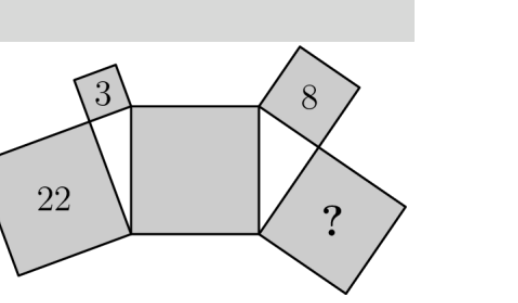
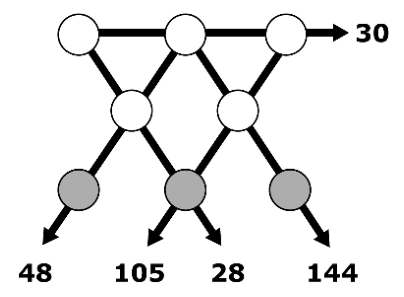
Five squares and two right-angled triangles are placed as shown in the diagram. The numbers 3, 8 and 22 in the squares state the size of the area in m². How big is the area (in m²) of the square with the question mark?
Show answer
Answer: D — 17
Show hints
Hint 1 of 2
Each right triangle ties three squares together through the Pythagorean relation on its sides.
Still stuck? Show hint 2 →
Hint 2 of 2
Chain the area relations across the two triangles to reach the '?' square.
Show solution
Approach: use that each right triangle makes leg-squares add to the hypotenuse-square
For a right triangle, the square on the hypotenuse has area equal to the sum of the squares on the two legs.
The two triangles share a side, so the chain of squares gives \(? + 8 = 22 + 3\): the unknown plus 8 equals the other two squares combined.
There are five gaps in the calculation shown. Adriana wants to write a “+” in four of the gaps and a “−” in one of them so that the equation is correct. Where must the “−” go?
Show answer
Answer: D — between 15 and 18
Show hints
Hint 1 of 2
If all gaps were plus signs, what would the total be, and how does one minus change it?
Still stuck? Show hint 2 →
Hint 2 of 2
Changing a + to a - in front of a value drops the sum by twice that value; find which drop hits 45.
Show solution
Approach: compare the all-plus total to 45
With all plus signs, 6+9+12+15+18+21 = 81.
Turning the sign before a number n into minus lowers the total by 2n; we need to lose 81-45 = 36, so 2n = 36 and n = 18.
The minus goes before 18, i.e. between 15 and 18, so the answer is D.
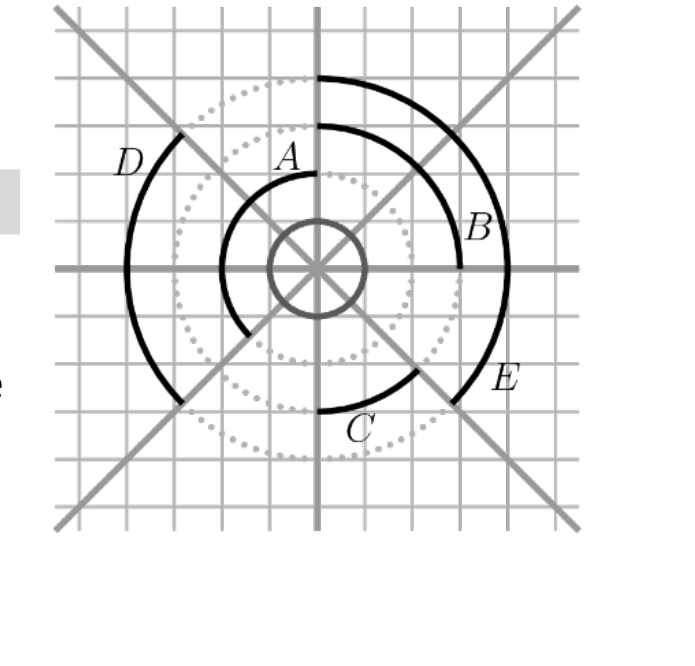
Four straight lines that intersect in one single point form eight equal angles (see diagram). Which one of the black arcs has the same length as the circumference of the little (grey) circle?
Show answer
Answer: D — D
Show hints
Hint 1 of 2
Each of the eight equal angles is 45°; an arc's length is radius times its angle.
Still stuck? Show hint 2 →
Hint 2 of 2
Match an arc whose (radius × angle) equals the small circle's circumference 2πr.
Show solution
Approach: match arc length to circumference (deferred to key)
The four lines split the plane into eight 45° sectors.
Comparing each black arc's radius and angle to the small circle's circumference picks out one arc.
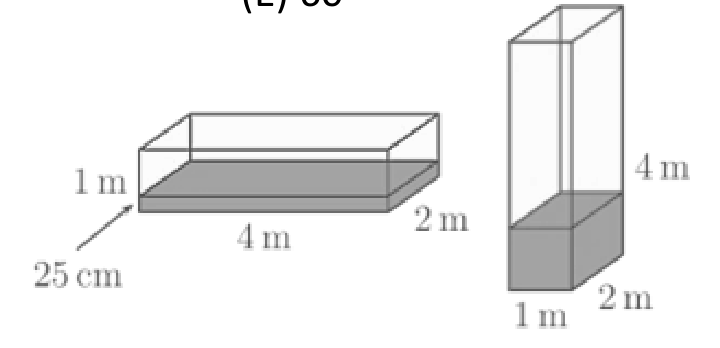
A box-shaped water tank measures 4 m × 2 m × 1 m, and the water in it is 25 cm deep. The tank is then turned onto its side (see the picture on the right). How high is the water in the tank now?
Show answer
Answer: D — 1 m
Show hints
Hint 1 of 2
The amount of water does not change — only the shape of the space it fills.
Still stuck? Show hint 2 →
Hint 2 of 2
Find the water's volume, then divide by the area of the new bottom face to get the new height.
Show solution
Approach: the volume stays the same, so divide by the new base
The water's volume is 4 × 2 × 0.25 = 2 m³ (using 25 cm = 0.25 m).
After tipping, the tank rests on a 1 m × 2 m face, so the new bottom has area 2 m².
Aladdin’s carpet is a square. Along each edge there are two rows of dots (see diagram), and each edge has the same number of dots. How many dots does the carpet have in total?
Show answer
Answer: A — 32
Show hints
Hint 1 of 3
The dots make two square loops — a big loop on the outside and a smaller loop just inside it.
Still stuck? Show hint 2 →
Hint 2 of 3
Count the dots on one side of a loop, but be careful: the corner dots belong to two sides, so don't count them twice.
Still stuck? Show hint 3 →
Hint 3 of 3
Add up the big loop and the small loop.
Show solution
Approach: count the big square loop and the small square loop of dots
The dots make two square loops, one just inside the other, with the same number on every side.
The big loop has 6 dots along each side; counting around it (corners only once) gives 4 × 6 − 4 = 20 dots.
The small loop has 4 dots along each side, giving 4 × 4 − 4 = 12 dots.
2022 tiles are placed in one long row. Adam removes every sixth tile. Then Beate removes every fifth of the remaining tiles. Subsequently Cora removes every fourth of the remaining tiles. How many tiles are left?
Show answer
Answer: D — 1011
Show hints
Hint 1 of 2
After removing every k-th tile, the fraction (k-1)/k of the tiles survive.
Still stuck? Show hint 2 →
Hint 2 of 2
Multiply 2022 by 5/6, then 4/5, then 3/4 in turn.
Show solution
Approach: multiply by the surviving fractions in order
Removing every 6th leaves 2022 * 5/6 = 1685.
Removing every 5th of those leaves 1685 * 4/5 = 1348.
Removing every 4th of those leaves 1348 * 3/4 = 1011.
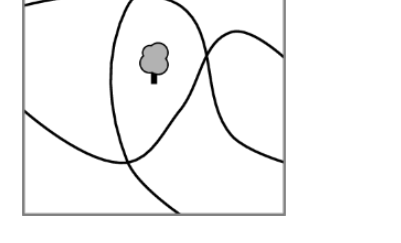
There are 5 trees and 3 paths in a park, shown on the map. One more tree is planted so that every path has an equal number of trees on each side of it. In which section of the park is the new tree planted?
Show answer
Answer: B — B
Show hints
Hint 1 of 2
Each path must split the trees so equal numbers sit on each side; count trees per side of every path now.
Still stuck? Show hint 2 →
Hint 2 of 2
The new tree must fix every path's balance at once; find the single section on the correct side of all three paths.
Show solution
Approach: balance every path at once
Right now each of the three paths has an unequal split of the five trees.
Adding one tree must even out all three paths simultaneously.
The only section that sits on the short side of every unbalanced path is B, so the answer is B.
a, b and c are real numbers not equal to zero. It is known that the numbers \(-2a^4b^3c^2\) and \(3a^3b^5c^{-4}\) have the same sign. Which of the following statements is definitely correct?
Show answer
Answer: E — \(a<0\)
Show hints
Hint 1 of 2
Track only the signs: even powers are positive, so focus on the odd-power factors and the leading constants.
Still stuck? Show hint 2 →
Hint 2 of 2
Set the two signs equal and solve for the sign of a.
Show solution
Approach: sign analysis
Sign of −2a^4 b^3 c^2 is −sign(b) (the a^4 and c^2 are positive).
Sign of 3a^3 b^5 c^(−4) is sign(a)·sign(b) (c^(−4) is positive).
Equal signs: −sign(b) = sign(a)·sign(b), so sign(a) = −1.
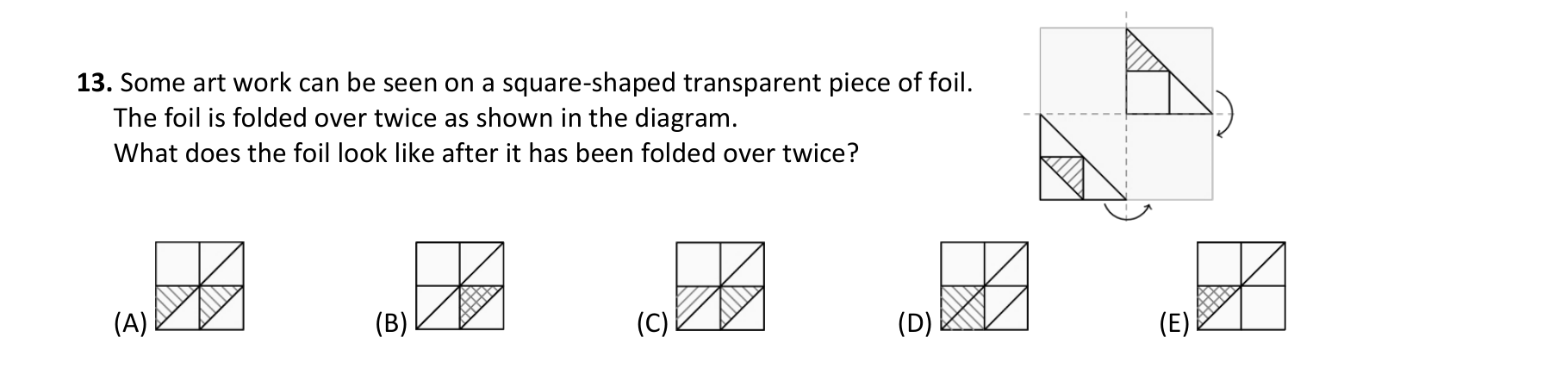
Some artwork is drawn on a square piece of transparent foil. The foil is folded over twice, as shown in the diagram. What does the foil look like after it has been folded over twice?
Show answer
Answer: A
Show hints
Hint 1 of 2
Each fold reflects the visible marks across the fold line onto the layer below.
Still stuck? Show hint 2 →
Hint 2 of 2
Fold once, draw where the marks land, then fold again and combine all layers.
Show solution
Approach: reflect the marks across each fold line
Folding flips the drawn marks across the fold crease onto the part beneath.
Apply the first fold, record the mirrored marks, then apply the second fold and overlay everything.
In a classroom the children sit in rows, with the same number of children in each row. In Robert’s row there are 2 children to his left and 3 children to his right. There are 2 rows in front of Robert and just 1 row behind him. How many children are in the class in total?
Show answer
Answer: E — 24
Show hints
Hint 1 of 2
Count the children in Robert's row including Robert himself.
Still stuck? Show hint 2 →
Hint 2 of 2
Then count the rows, again including Robert's own row.
Show solution
Approach: count one row and the number of rows, including Robert
In Robert's row there are 2 to his left, Robert, and 3 to his right: 2+1+3 = 6 children per row.
There are 2 rows in front, Robert's row, and 1 behind: 2+1+1 = 4 rows.
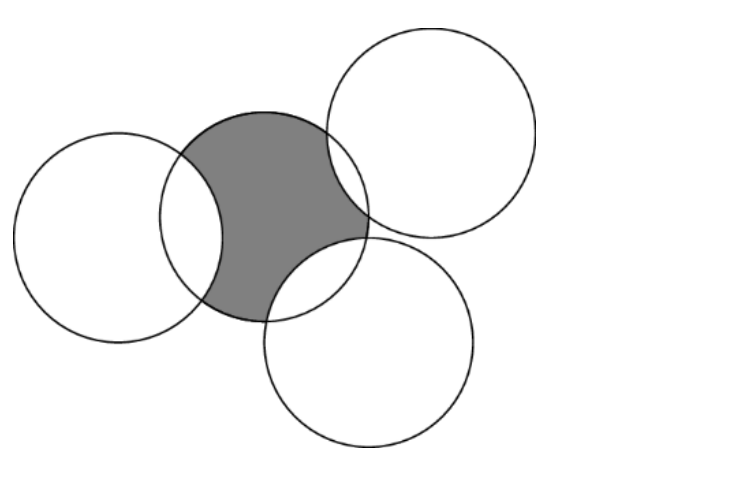
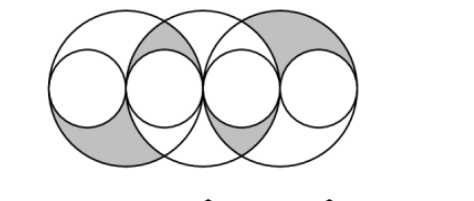
The diagram shows three big circles of equal size and four small circles. Each small circle touches two big circles and has radius 1. How big is the shaded area?
Show answer
Answer: B — \(2\pi\)
Show hints
Hint 1 of 2
The small circles have radius 1; relate the big-circle radius to the small ones.
Still stuck? Show hint 2 →
Hint 2 of 2
The shaded crescent-like pieces rearrange to a neat multiple of pi.
Show solution
Approach: express the shaded region using the small radius 1
Each small circle has radius 1 and sits where two big circles meet.
Adding and subtracting the overlapping circular regions, the shaded crescents combine to a clean area.
The gap between two shelves in Monika’s kitchen is 36 cm. A stack of 8 identical glasses is 42 cm high, and a stack of 2 such glasses is 18 cm high. What is the largest number of glasses in one stack that still fits between the shelves?
Show answer
Answer: D — 6
Show hints
Hint 1 of 2
A stack's height grows by the same amount for each extra glass; find that per-glass increase.
Still stuck? Show hint 2 →
Hint 2 of 2
Get the height of one glass, then find the largest count whose stack height stays at or below 36 cm.
Show solution
Approach: linear height model for the stack
From 2 glasses (18 cm) to 8 glasses (42 cm), 6 extra glasses add 24 cm, so each extra glass adds 4 cm.
One glass is 18 - 4 = 14 cm, and n glasses reach 14 + 4(n-1) = 10 + 4n cm.
Need 10 + 4n <= 36, so n <= 6.5; the biggest stack is 6 glasses, the answer is D.
We check the water meter and see that all digits on the display are different. What is the minimum amount of water that has to be used before this happens again?
Show answer
Answer: D — 0.137 m³
Show hints
Hint 1 of 2
The meter shows 91.876; you want the next reading whose five digits are all different.
Still stuck? Show hint 2 →
Hint 2 of 2
Step up the reading until no digit repeats, then subtract.
Show solution
Approach: find next all-distinct reading
Current reading 91.876 (digits 9,1,8,7,6 all different).
Stepping up, the next reading with five different digits is 92.013.
The year 2022 has three equal digits. This is the third time that Tortoise Eva has experienced a year where the same digit appears three times. What is the minimum age that Tortoise Eva can be this year?
Show answer
Answer: C — 23
Show hints
Hint 1 of 2
List recent years whose four digits include the same digit three times.
Still stuck? Show hint 2 →
Hint 2 of 2
She has lived through three such years; to make her as young as possible, pick the latest possible earlier two.
Show solution
Approach: find the three latest triple-digit years up to 2022
2022 has three 2s. The two latest earlier such years are 2000 (three 0s) and 1999 (three 9s).
If 2022 is her third, she was alive in 1999, so she was born by 1999.
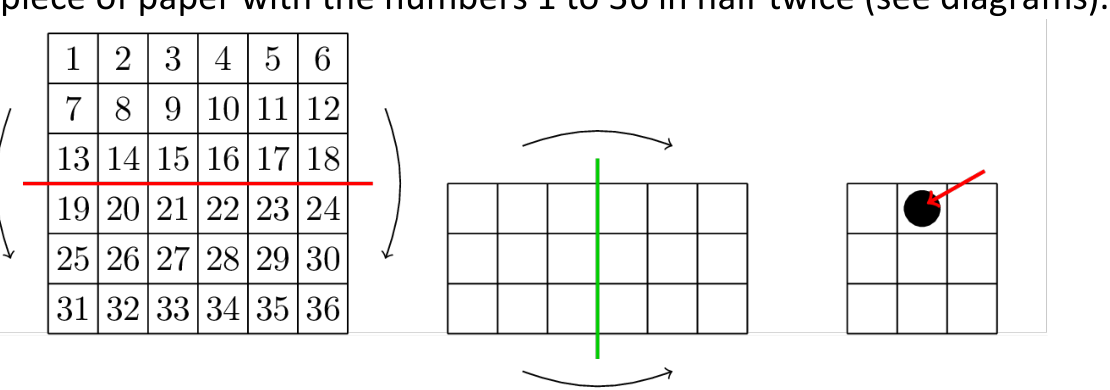
Johanna takes a paper with the numbers 1 to 36 and folds it in half twice (see diagrams). Then she pokes a hole through all four layers at once (see the diagram on the right). Which four numbers does she pierce?
Show answer
Answer: C — 14, 17, 20, 23
Show hints
Hint 1 of 2
Each fold lays one half exactly onto the other, so the hole goes through matching squares.
Still stuck? Show hint 2 →
Hint 2 of 2
Track which four numbers stack on top of each other at the hole's position.
Show solution
Approach: undo the folds to find the stacked numbers
The horizontal fold pairs each top-half square with the bottom-half square it lands on.
The vertical fold then pairs left columns with right columns.
The hole's spot stacks the squares 14, 17, 20 and 23.
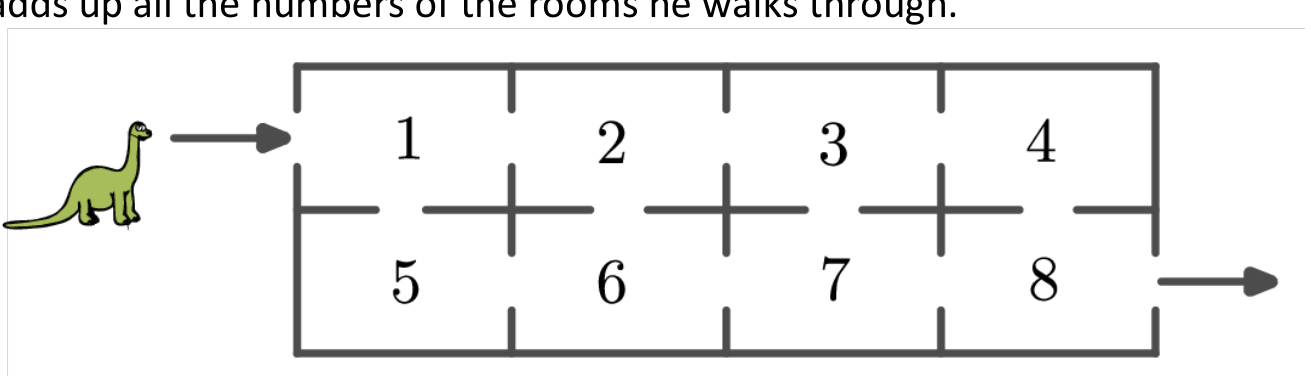
Dino walks from the entrance to the exit. He is only allowed to go through each room once. The rooms have numbers (see diagram). Dino adds up all the numbers of the rooms he walks through. What is the biggest result he can get this way?
Show answer
Answer: D — 34
Show hints
Hint 1 of 3
For the biggest total, Dino should try to walk through as many rooms as he can.
Still stuck? Show hint 2 →
Hint 2 of 3
Add up all eight room numbers first - then see whether the doorways really let him visit every single room.
Still stuck? Show hint 3 →
Hint 3 of 3
He cannot quite reach all eight; find the path that misses only the room worth the least points.
Show solution
Approach: add up all the rooms, then leave out the one room you are forced to skip
All eight room numbers add up: 1 + 2 + 3 + 4 + 5 + 6 + 7 + 8 = 36, so the most he could ever score is 36.
Trying paths through the doorways from the entrance (room 1) to the exit (room 8) without repeating a room, Dino cannot fit in every room - the best route leaves out exactly one room, and the smallest he can skip is room 2.
So his biggest total is 36 − 2 = 34, which is answer D.
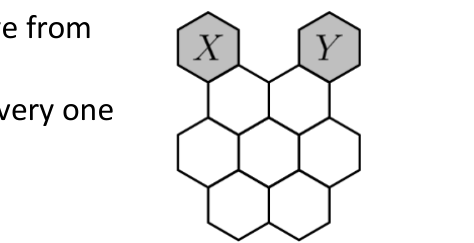
A bee called Maja wants to hike from honeycomb X to honeycomb Y. She can only move from one honeycomb to the neighbouring honeycomb if they share an edge. How many different ways are there for Maja to go from X to Y if she has to step onto every one of the seven honeycombs exactly once?
Show answer
Answer: D — 5
Show hints
Hint 1 of 2
You need a path from X to Y that visits all seven honeycombs exactly once.
Still stuck? Show hint 2 →
Hint 2 of 2
Work outward from X, pruning routes that strand a cell you can never return to.
Show solution
Approach: count the full paths through the seven-cell honeycomb graph
Model the honeycombs as nodes with edges between cells that share a side.
Trace every route from X that uses all seven cells exactly once and ends at Y, discarding ones that get stuck.
On an ordinary die the numbers on opposite faces always add up to 7. Four such dice are glued together as shown. All the numbers still visible on the outside of the solid are added up. What is the smallest possible value of that total?
Show answer
Answer: D — 58
Show hints
Hint 1 of 2
Opposite faces of a die sum to 7, so all six faces of one die total 21 and the four dice total 84.
Still stuck? Show hint 2 →
Hint 2 of 2
Visible total = 84 minus the glued (hidden) faces, so MINIMISE the visible sum by putting the biggest allowed numbers on the touching faces.
Show solution
Approach: subtract the hidden glued faces from the four-dice total
The four dice have total pip count 4 x 21 = 84, and the visible sum is 84 minus whatever is hidden at the glued joints.
To make the visible sum smallest, orient the dice so the touching faces carry as many pips as the gluing in the figure allows.
Maximising the hidden pips this way leaves a smallest visible total of 58, so the answer is D.
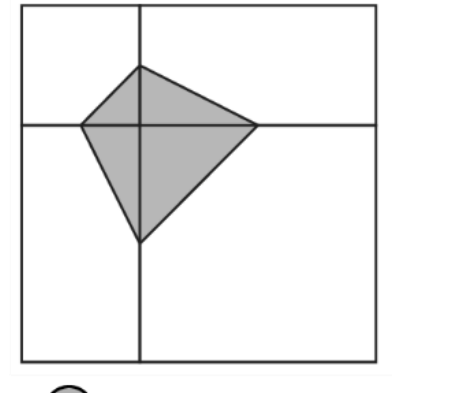
The square pictured is split into two squares and two rectangles. The vertices of the shaded quadrilateral with area 3 are the midpoints of the sides of the smaller squares. What is the area of the non-shaded part of the big square?
Show answer
Answer: D — 21
Show hints
Hint 1 of 2
The shaded kite's corners are the side-midpoints of the two small squares around the centre.
Still stuck? Show hint 2 →
Hint 2 of 2
Compute the kite's area as a fraction of the whole square — it doesn't depend on how the square is split.
Show solution
Approach: kite is one-eighth of the big square
Place the big square as side a+b with the smaller squares of sides a and b meeting at the centre cross.
The kite's four vertices are the relevant side-midpoints; its area works out to exactly 1/8 of the big square (independent of a and b).
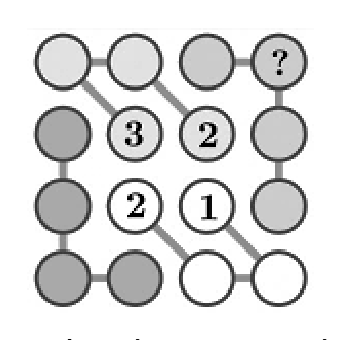
Four circles joined by a line form a chain of four. The numbers 1, 2, 3 and 4 each appear exactly once in every row, every column and every chain of four. Which number goes in the circle with the question mark?
Show answer
Answer: B — 2
Show hints
Hint 1 of 2
The rule is like a small Latin square: 1, 2, 3, 4 each appear once per row, per column and per chain.
Still stuck? Show hint 2 →
Hint 2 of 2
Use the given numbers and these no-repeat rules to pin down the ? cell.
Show solution
Approach: apply the row, column and chain constraints
Each row, each column and each chain of four must contain 1, 2, 3, 4 exactly once.
Filling in forced cells from the given 3, 2, 2, 1 narrows the options.
Three football teams play in a tournament, and each team plays every other team once. A win is worth 3 points and a loss 0 points; a draw gives each team 1 point. Which number of points is impossible for any team to finish with?
Show answer
Answer: D — 5
Show hints
Hint 1 of 2
Each team plays only two games, scoring 3, 1 or 0 in each.
Still stuck? Show hint 2 →
Hint 2 of 2
List the totals you can build from two of {0, 1, 3} and see which option is missing.
Show solution
Approach: list every possible two-game total
Per game a team gets 3 (win), 1 (draw) or 0 (loss).
The three zebras Runa, Zara and Biba take part in a competition. The winner is the zebra with the most stripes. Runa has 15 stripes. Zara has 3 stripes more than Runa. Runa has 5 stripes less than Biba. How many stripes does the winner have?
Show answer
Answer: C — 20
Show hints
Hint 1 of 2
Work out each zebra's stripe count from Runa's 15.
Still stuck? Show hint 2 →
Hint 2 of 2
The winner has the most stripes - compare all three.
Show solution
Approach: compute each total and take the largest
Runa has 15. Zara has 15 + 3 = 18. Biba has 15 + 5 = 20.
The sum of two positive integers is three times as big as their difference. The product of the two numbers is four times as big as their sum. How big is the sum of the two numbers?
Show answer
Answer: E — 18
Show hints
Hint 1 of 2
Translate both sentences into equations in the two numbers.
Still stuck? Show hint 2 →
Hint 2 of 2
The first equation forces a simple ratio between the numbers.
Show solution
Approach: solve the two equations
a + b = 3(a - b) gives 4b = 2a, so a = 2b.
a*b = 4(a + b): with a = 2b this is 2b^2 = 12b, so b = 6 and a = 12.
Lisa has four dogs of different weights. Each dog weighs a whole number of kilograms. All four dogs together weigh 60 kg, and the second heaviest dog weighs 28 kg. How heavy is the third heaviest dog?
Show answer
Answer: A — 2 kg
Show hints
Hint 1 of 2
The heaviest dog weighs more than 28 kg, so it already uses up a big chunk of the 60 kg.
Still stuck? Show hint 2 →
Hint 2 of 2
After the heaviest and the 28 kg dog, very little weight is left for the two lightest, who must still be different whole numbers.
Show solution
Approach: see how little weight is left for the two smallest dogs
The heaviest, the 28 kg dog, and the two lightest add to 60 kg, so the heaviest plus the two lightest make 60 − 28 = 32 kg.
The heaviest is more than 28, so it is at least 29 kg, leaving at most 3 kg for the two lightest together.
Two different whole numbers adding to at most 3 can only be 2 and 1, so the third heaviest is 2 kg.
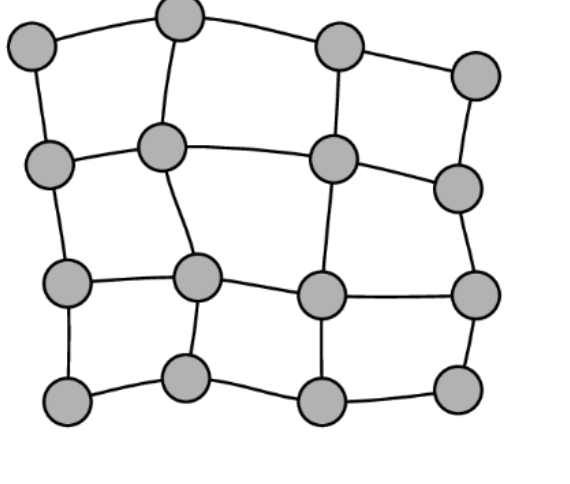
The diagram shows a map with 16 towns which are connected via roads. The government is planning to build power plants in some towns. Each power plant can generate enough electricity for the town in which it stands as well as for its immediate neighbouring towns (i.e. towns that can be reached via a direct connecting road). What is the minimum number of power plants that have to be built?
Show answer
Answer: B — 4
Show hints
Hint 1 of 2
Each plant covers its own town plus every town directly joined to it.
Still stuck? Show hint 2 →
Hint 2 of 2
Find the fewest towns whose coverage reaches all 16 (a dominating set).
Show solution
Approach: minimum dominating set (deferred to key)
You need a set of towns so that every town is chosen or adjacent to a chosen one.
Placing plants well, four towns suffice to cover all sixteen, and three cannot.
Some identical glasses are stacked on top of each other. A stack of eight glasses is 42 cm high, and a stack of two glasses is 18 cm high. How high is a stack of six glasses?
Show answer
Answer: D — 34 cm
Show hints
Hint 1 of 2
Each glass you add on top sticks up by the same fixed amount.
Still stuck? Show hint 2 →
Hint 2 of 2
Compare the two-glass and eight-glass stacks to find how much one extra glass adds.
Show solution
Approach: find how much one extra glass adds, then build up
Going from 2 glasses to 8 glasses adds 6 glasses and raises the height by 42 − 18 = 24 cm.
So each extra glass adds 24 ÷ 6 = 4 cm.
Six glasses is four more than two glasses, so the height is 18 + 4 × 4 = 34 cm.
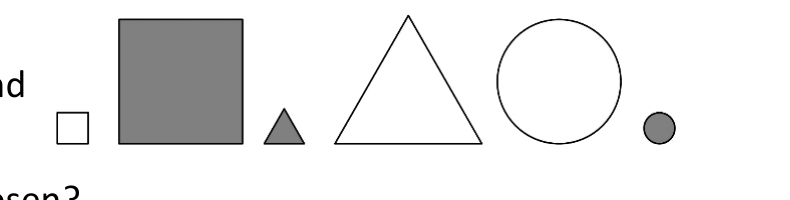
Wanda chooses some of the shapes shown. She says: “I have chosen exactly 2 grey, 2 big and 2 round shapes.” What is the smallest number of shapes Wanda could have chosen?
Show answer
Answer: B — 3
Show hints
Hint 1 of 2
You want a shape to count toward more than one of the requirements at once.
Still stuck? Show hint 2 →
Hint 2 of 2
Pick shapes that are grey-and-big, big-and-round, or grey-and-round to overlap the three needs.
Show solution
Approach: make each shape cover two requirements
She needs exactly 2 grey, 2 big and 2 round.
Choose a big grey shape (grey+big), a big round shape (big+round) and a small grey round shape (grey+round).
These three give exactly 2 grey, 2 big and 2 round.
A rabbit and a hedgehog enter a race against each other. The circular racecourse is 550 m long. The starting line and the finish line are the same. The speed of the rabbit is a constant 10 m/s, the speed of the hedgehog is a constant 1 m/s. They start at the same time, but the hedgehog tries to cheat by going in the opposite direction. When the two meet, the hedgehog turns around immediately and follows the rabbit. How many seconds after the rabbit does the hedgehog reach the finish line?
Show answer
Answer: A — 45
Show hints
Hint 1 of 2
Find when the two meet (closing speed) and where the hedgehog is then.
Still stuck? Show hint 2 →
Hint 2 of 2
After turning, the hedgehog still has to cover the rest of the loop to the finish.
Show solution
Approach: relative speed for the meeting, then finish the loop
The rabbit finishes the 550 m loop in 550/10 = 55 s.
Moving toward each other they close 550 m at 10+1 = 11 m/s, meeting at 50 s; the hedgehog has gone 50 m the wrong way.
It turns and must still cover 50 m forward to the start/finish, taking 50 s more, so it finishes at 100 s.
There are two clocks in my office. One gains one minute every hour; the other loses two minutes every hour. Yesterday I set them both to the correct time. When I checked today, one read 11:00 and the other read 12:00. At what time did I set them yesterday?
Show answer
Answer: C — 15:40
Show hints
Hint 1 of 2
Each hour the two clocks drift apart by a fixed amount; how fast does the gap between them grow?
Still stuck? Show hint 2 →
Hint 2 of 2
The clocks now read 60 minutes apart; divide by the hourly drift to find the elapsed time, then step back.
Show solution
Approach: use the growing gap between the clocks
One clock gains 1 min/hour and the other loses 2 min/hour, so they separate by 3 minutes each hour.
They are now 60 minutes apart (11:00 vs 12:00), which takes 60 / 3 = 20 hours.
The true time lies between them, and stepping back gives a setting of 15:40, so the answer is C.
In a tournament with 8 participants the players are randomly paired up in four teams for the first round and the winner of each encounter then proceeds to the second round. There are two games in the second round and the two winners then play the final. Anita and Martina are the two best players and will win against all others; in case they have to play against each other, Anita will win. How big is the chance that Martina will get to the final?
Show answer
Answer: E — \(\tfrac{4}{7}\)
Show hints
Hint 1 of 2
Martina reaches the final unless she is drawn against Anita in round 1 or in the semifinal.
Still stuck? Show hint 2 →
Hint 2 of 2
Multiply the chance of dodging Anita each round.
Show solution
Approach: avoid the stronger player each round
Round 1: Martina's opponent is one of 7; chance it is not Anita is 6/7.
Semifinal: among the four winners she meets one of 3; chance it is not Anita is 2/3.
The bus stops in the villages A, B, C and D lie along a road in this order, and neighbouring villages are 10 km apart. There are 10 children in village A, 20 in B, 30 in C and 40 in D. Every child takes the bus to school. A new school will be built where the total number of kilometres travelled by all the children is as small as possible. Where will the new school be built?
Show answer
Answer: D — in C
Show hints
Hint 1 of 3
The best spot has about as many children on one side of the school as on the other side.
Still stuck? Show hint 2 →
Hint 2 of 3
Start at one end and add up children until you reach more than half of all of them.
Still stuck? Show hint 3 →
Hint 3 of 3
The village where you pass the halfway count is the best place for the school.
Show solution
Approach: walk from one end and stop where you pass half the children
There are 10 + 20 + 30 + 40 = 100 children in all, so half of them is 50.
Counting from A: A has 10, then A and B have 30, then A, B and C have 60 - we pass 50 right at C.
Since just as many children sit on each side once we reach C, building the school in C makes the total travel smallest.
So the answer is D.
Check by trying neighboursMoving the school 10 km from C toward D saves 40 children 10 km each (400 km) but costs the other 60 children 10 km each (600 km), a net loss; moving it toward B is worse too, so C truly is best.
The grandchildren ask their grandma how old she is. The grandma invites them to guess the age. The first child says 75, the second says 78 and the third says 81. It turns out that one child is wrong by 1 year, one by 2 years and one by 4 years. How many possibilities are there for the age of the grandma?
Show answer
Answer: C — 2
Show hints
Hint 1 of 2
The three errors are 1, 2 and 4 in some order, each above or below.
Still stuck? Show hint 2 →
Hint 2 of 2
Test which actual ages let the guesses 75, 78, 81 miss by exactly {1,2,4}.
Show solution
Approach: match the error set {1,2,4} to the three guesses
The true age must differ from 75, 78 and 81 by exactly 1, 2 and 4 in some assignment, each error either above or below.
Searching the candidate ages, only a couple of values make all three differences fit the set {1,2,4}.
Werner writes down some numbers whose sum is 22. Ria subtracts each of Werner’s numbers from 7 and writes down the results; her numbers add up to 34. How many numbers did Werner write down?
Show answer
Answer: B — 8
Show hints
Hint 1 of 2
Each of Ria's numbers is 7 minus one of Werner's; what does adding them all give in terms of how many numbers there are?
Still stuck? Show hint 2 →
Hint 2 of 2
If there are n numbers, Ria's total is 7n minus Werner's total; set that equal to 34.
Show solution
Approach: sum the transformed numbers
If Werner wrote n numbers summing to 22, Ria's numbers sum to 7n - 22.
A cuboid with surface area X is cut up along six planes parallel to the sides (see diagram). What is the total surface area of all 27 thus created solids?
Show answer
Answer: C — \(3X\)
Show hints
Hint 1 of 2
Every cut parallel to a face creates two new faces equal to that cross-section.
Still stuck? Show hint 2 →
Hint 2 of 2
Two cuts in each of the three directions; total new area relates simply to X.
Show solution
Approach: count area added by the cuts
Let the three face-pair areas be S1, S2, S3, so X = 2(S1+S2+S3).
Two cuts perpendicular to each direction add 4S1 + 4S2 + 4S3 = 2X of new surface.
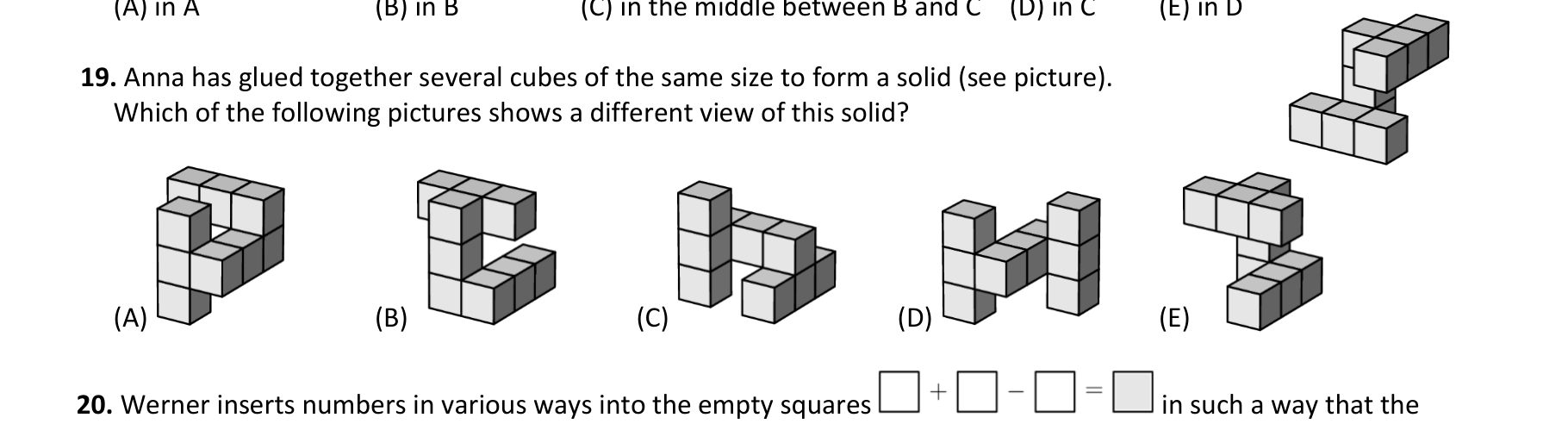
Anna has glued together several cubes of the same size to form a solid (see picture). Which of the following pictures shows a different view of this same solid?
Show answer
Answer: C
Show hints
Hint 1 of 2
Count the cubes and note the solid's overall shape, then mentally rotate it.
Still stuck? Show hint 2 →
Hint 2 of 2
A valid view must keep the same number of cubes and the same connections, just seen from another side.
Show solution
Approach: rotate the solid and match cube count and connections
The given solid has a fixed number of cubes joined in a particular way.
Each option is checked to see whether it is the same solid seen from a different direction.
Only C is a genuine rotation of the original solid.
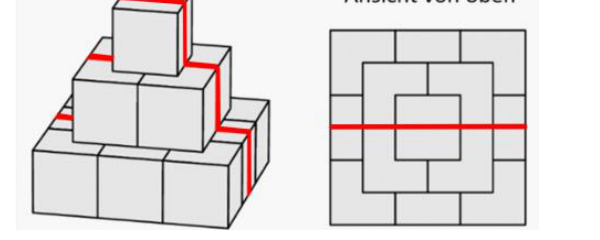
A pyramid is built from cubes (see diagram), and every cube has side length 10 cm. An ant crawls along the line drawn across the pyramid (see diagram). How long is the path the ant takes?
Show answer
Answer: E — 90 cm
Show hints
Hint 1 of 3
The drawn line is made of short straight pieces, and each piece is exactly one cube-edge long.
Still stuck? Show hint 2 →
Hint 2 of 3
One cube edge is 10 cm, so you only need to count how many cube-edges the whole line covers.
Still stuck? Show hint 3 →
Hint 3 of 3
Trace the line up the steps and back down, counting one edge at a time.
Show solution
Approach: count the cube-edges the line covers, each 10 cm
The ant's line follows the steps of the pyramid, and every little piece is one cube-edge of 10 cm.
Tracing the line up over the steps and down the other side, it covers 9 cube-edges.
There are three paths running through our park in the city (see diagram). A tree is situated in the centre of the park. What is the minimum number of trees that have to be planted additionally so that there are the same number of trees on either side of each path?
Show answer
Answer: C — 3
Show hints
Hint 1 of 2
Each path must split the trees evenly, so it needs an equal count on both sides.
Still stuck? Show hint 2 →
Hint 2 of 2
Add trees so that every one of the three paths is balanced at once.
Show solution
Approach: balance the tree count across all three dividing paths
Each path divides the park into two parts that must hold equally many trees.
Place extra trees so that all three balance conditions hold at once, including the existing central tree.
The minimum number of additional trees needed is 3.
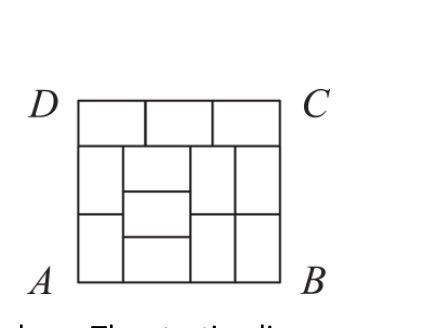
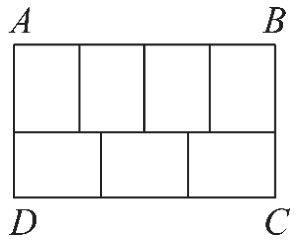
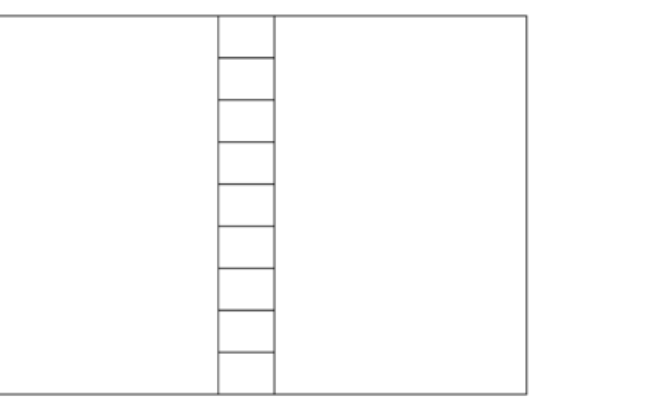
The large rectangle ABCD is made up of 7 congruent smaller rectangles (see diagram). What is the ratio AB⁄BC?
Show answer
Answer: D — 12⁄7
Show hints
Hint 1 of 2
The 7 small rectangles are all congruent; let one be \(a\) (long) by \(b\) (short) and read off how many fit across each row of the figure.
Still stuck? Show hint 2 →
Hint 2 of 2
Both rows span the same width AB, so equate the two row widths to get a relation between \(a\) and \(b\).
Show solution
Approach: equate the widths of the two rows of small rectangles
Let each small rectangle have long side \(a\) and short side \(b\). One row places 3 rectangles standing up (width \(3b\)) beside others, and the other row lays 4 rectangles flat, but both rows span the full width \(AB\).
Matching the row widths gives the relation \(4b = 3a\) (so \(a = \tfrac{4}{3}b\)), and the figure makes \(AB = 4b\) while \(BC = a + b\).
Then \(\tfrac{AB}{BC} = \tfrac{4b}{a+b} = \tfrac{4b}{\frac{4}{3}b + b} = \tfrac{4}{7/3} = \tfrac{12}{7}\), so the answer is D.
The arithmetic mean of five numbers is 24. The mean of the three smallest numbers is 19 and that of the three biggest is 28. What is the median of the five numbers?
Show answer
Answer: B — 21
Show hints
Hint 1 of 2
Write the three totals: all five, the three smallest, the three largest.
Still stuck? Show hint 2 →
Hint 2 of 2
The median is counted in both the bottom-three and top-three sums.
Show solution
Approach: overlap counts the median twice
Sum of all five = 120; smallest three sum to 57; largest three sum to 84.
57 + 84 counts every number once except the median, which is counted twice: 57 + 84 = 120 + median.
Werner fills the empty squares in the calculation \(? + ? - ? = \square\) (the grey square is the result) so that the equation is correct. He always uses four of the numbers 2, 3, 4, 5, 6, and in each calculation no number may be used more than once. How many of the five numbers can Werner put in the grey square?
Show answer
Answer: E — 5
Show hints
Hint 1 of 2
You need a + b minus c = d using four distinct numbers from {2,3,4,5,6}; ask which values d can be.
Still stuck? Show hint 2 →
Hint 2 of 2
Try to hit each candidate for the grey square with some valid choice of the other three.
Show solution
Approach: construct a valid equation for each possible result
Test each value as the grey (result) square: 3+4-5=2, 4+5-6=3, 3+6-5=4, 6+2-3=5, 5+4-3=6.
Each uses four distinct numbers from the set, so every one of the five works.
Hence all 5 numbers can appear in the grey square.
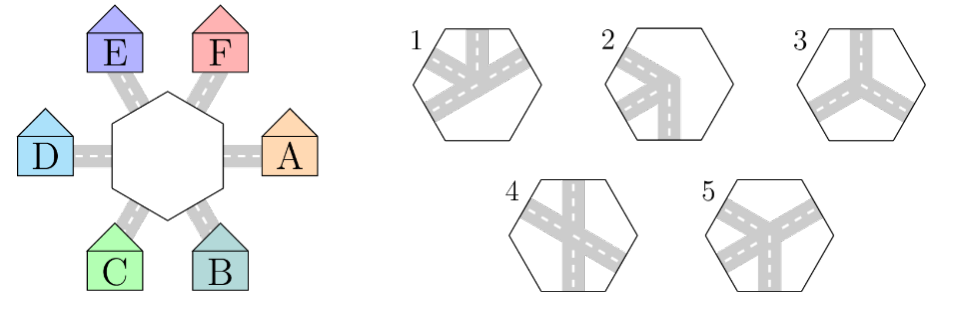
A road leads away from each of the six houses (see diagram), but the hexagon of roads for the middle is missing. Which hexagons can go in the middle so that you can travel from A to B and to E, but not to D?
Show answer
Answer: C — 1 and 5
Show hints
Hint 1 of 3
The roads inside the hexagon decide which houses get joined to which — put your finger on A and see where you can drive.
Still stuck? Show hint 2 →
Hint 2 of 3
You want A, B and E all on one set of connected roads, but D left out with no way to reach it.
Still stuck? Show hint 3 →
Hint 3 of 3
Try each hexagon in the gap and trace the roads from A every time.
Show solution
Approach: drop in each hexagon and trace the roads from A
Fit a hexagon into the gap, then put your finger on house A and follow every road you can drive along.
You need A, B and E to all join up, while D stays cut off (no road reaches it).
Only hexagons 1 and 5 connect A to B and E while leaving D alone.
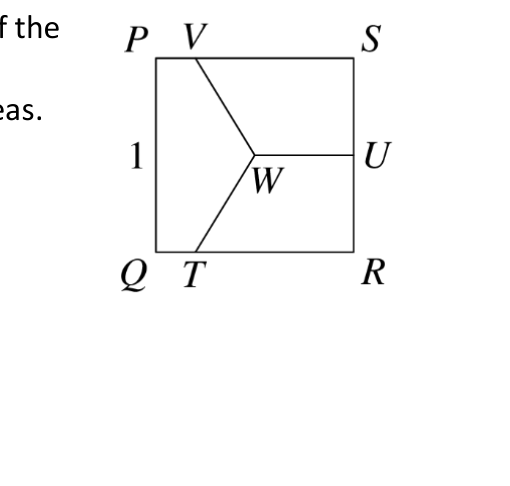
The diagram shows a square PQRS with side length 1. The point U is the midpoint of the side RS and the point W is the midpoint of the square. The three line segments TW, UW and VW split the square into three equally big areas. How long is the line segment SV?
Show answer
Answer: E — \(\tfrac{5}{6}\)
Show hints
Hint 1 of 2
Put coordinates on the unit square with W at the centre and U, V as the relevant points.
Still stuck? Show hint 2 →
Hint 2 of 2
Each of the three regions must have area 1/3; use that to locate V on the top side.
Show solution
Approach: coordinates with equal-area condition to find V, then length SV
Place P, Q, R, S as a unit square with W at the centre and U the midpoint of RS.
Requiring the three regions cut by TW, UW, VW to each have area 1/3 fixes where V sits along the top side.
From V's position the segment SV comes out to 5/6.
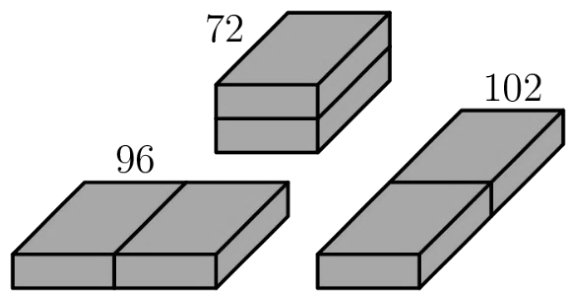
Two identical bricks can be placed side by side in three different ways, as shown. The surface areas of the three resulting cuboids are 72, 96 and 102 cm². What is the surface area, in cm², of one brick?
Show answer
Answer: D — 54
Show hints
Hint 1 of 2
Let one brick be \(a \times b \times c\); a brick's own surface area is \(2(ab+bc+ca)\).
Still stuck? Show hint 2 →
Hint 2 of 2
Add the three cuboids' surface areas and watch how each product \(ab, bc, ca\) appears the same number of times.
Show solution
Approach: add the three surface areas to isolate one brick
Let the brick be \(a \times b \times c\); doubling it along each of the three directions gives the three cuboids, with surface areas \(2(2ab+bc+2ca)\), \(2(2ab+2bc+ca)\) and \(2(ab+2bc+2ca)\).
Adding all three, every product appears the same way and the total is \(10(ab+bc+ca) = 72+96+102 = 270\), so \(ab+bc+ca = 27\).
One brick's surface is \(2(ab+bc+ca) = 2 \times 27 = 54\) cm squared, so the answer is D.
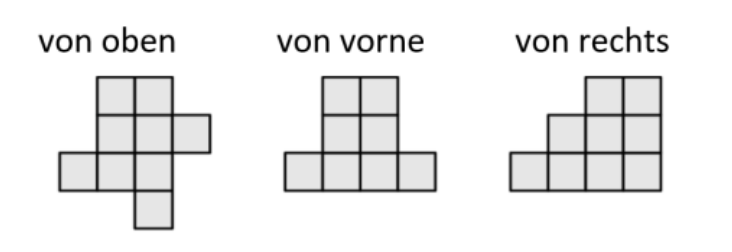
A building is made of cubes of the same size. The three pictures show it from above (von oben), from the front (von vorne) and from the right (von rechts). What is the maximum number of cubes that could be used to make this building?
Show answer
Answer: B — 19
Show hints
Hint 1 of 2
The top view fixes which columns can hold cubes; the front and side views cap each column's height.
Still stuck? Show hint 2 →
Hint 2 of 2
For the maximum, make every column as tall as its views allow.
Show solution
Approach: raise each column to the height its views permit
The top view shows which floor positions are occupied.
The front and right views give the largest height allowed for each row and column.
Stacking each column to its maximum allowed height totals 19 cubes.
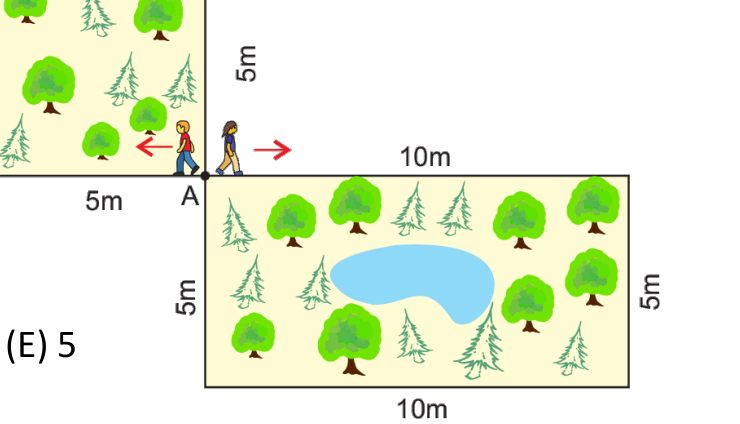
Ahmed and Sara start at point A and walk in the directions shown, at the same speed. Ahmed walks around the square garden and Sara walks around the rectangular garden. How many rounds must Ahmed walk to meet Sara at point A again for the first time?
Show answer
Answer: C — 3
Show hints
Hint 1 of 3
Work out how far one lap is for each child by adding up the sides of their garden.
Still stuck? Show hint 2 →
Hint 2 of 3
Each child is back at A after 1 lap, 2 laps, 3 laps… so skip-count the total distance for each.
Still stuck? Show hint 3 →
Hint 3 of 3
Look for the first distance that shows up in both lists — that is when they meet at A.
Show solution
Approach: skip-count each child's distances until they match
Ahmed's square garden is 5 + 5 + 5 + 5 = 20 m around; Sara's rectangle is 10 + 5 + 10 + 5 = 30 m around.
Ahmed is back at A after 20, 40, 60… metres; Sara is back at A after 30, 60, 90… metres.
The first distance in both lists is 60 m, so that is when they meet at A again.
Ahmed has gone 60 ÷ 20 = 3 laps, so he walks 3 rounds (choice C).
Once I met six sisters whose ages were six consecutive integers. I asked each one of them: How old is the oldest of your sisters? Which of the following numbers cannot be the sum of the six answers?
Show answer
Answer: D — 205
Show hints
Hint 1 of 2
Each sister names her oldest sister: five of them name the same person, but the oldest names someone different.
Still stuck? Show hint 2 →
Hint 2 of 2
Write the total of the six answers as one expression in the youngest age, then check it against each option.
Show solution
Approach: build the sum of the six answers, then test the fixed remainder
Call the ages \(n, n+1, \dots, n+5\); the oldest is \(n+5\), and her own oldest sister is \(n+4\).
Five sisters answer \(n+5\) and the oldest answers \(n+4\), so the six answers add to \(5(n+5)+(n+4)=6n+29\).
So any valid sum minus 29 must be a multiple of 6; checking the options, only \(205-29=176\) is not, so 205 cannot occur.
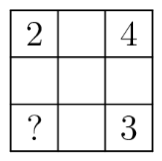
Jenny writes numbers in a \(3 \times 3\) table so that the four numbers in every \(2 \times 2\) square have the same sum. Three corner cells are already filled in (see diagram). Which number does she write in the fourth corner?
Show answer
Answer: B — 1
Show hints
Hint 1 of 2
The four overlapping 2x2 squares all share the same sum; compare two of them that overlap in a row or column.
Still stuck? Show hint 2 →
Hint 2 of 2
Comparing the four equal block-sums forces a tidy rule on the four corner cells of the grid.
Show solution
Approach: equal block-sums link the four corners
Comparing the four equal 2x2 sums cancels the shared middle cells and forces the two diagonal corner-pairs to have equal sums: one corner plus its opposite equals the other two corners added.
The given corners are 2, 4 and 3; the missing corner pairs with 4 across the diagonal, so (missing) + 4 = 2 + 3 = 5.
Therefore the fourth corner is 5 - 4 = 1, so the answer is B.
The vertices of a 20-gon are labelled using the numbers 1 to 20 so that adjacent vertices always differ by 1 or 2. The sides of the 20-gon whose vertices are labelled with numbers that only differ by 1 are drawn in red. How many red sides does the 20-gon have?
Show answer
Answer: B — 2
Show hints
Hint 1 of 2
Going around, the labels almost always jump by 2; jumps of 1 are forced only at the extremes.
Still stuck? Show hint 2 →
Hint 2 of 2
Try odds rising then evens falling and count the steps of size 1.
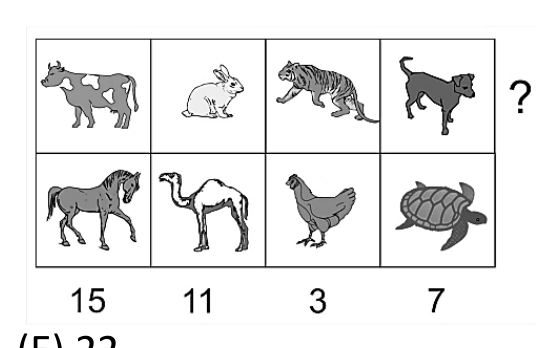
Each animal in the picture stands for a whole number greater than zero, and different animals stand for different numbers. The two animals in each column add up to the number written beneath that column. What is the largest possible value of the sum of the four numbers in the top row?
Show answer
Answer: C — 20
Show hints
Hint 1 of 3
Add the four column sums together: that total equals the top row plus the bottom row.
Still stuck? Show hint 2 →
Hint 2 of 3
The top row is biggest when the bottom row is as small as possible.
Still stuck? Show hint 3 →
Hint 3 of 3
All eight animal numbers must be different, so the bottom row cannot just be all 1s - find the smallest different numbers that still fit.
Show solution
Approach: make the bottom row as small as the all-different rule allows
The four column sums add up to 36, and that 36 splits into the top row plus the bottom row, so a smaller bottom row means a bigger top row.
Every animal stands for a different number, so the four bottom animals must be four different numbers; the smallest four different positive whole numbers are 1, 2, 3, 4 - but each top animal must beat its own bottom partner and also stay different from all the rest.
Choosing bottom values 1, 3, 5, 7 (top partners 2, 4, 6, 8) keeps all eight numbers different and gives the smallest workable bottom row of 16.
Then the top row is 36 − 16 = 20, and no allowed arrangement does better, so the answer is C.
Five girls eat plums. Laura eats 2 more plums than Sophie. Bettina eats 3 fewer plums than Laura. Clara eats one more plum than Bettina, and 3 fewer than Alice. Which two girls eat the same number of plums?
Show answer
Answer: E — Clara and Sophie
Show hints
Hint 1 of 3
Pretend Sophie eats some easy number of plums, like 10, then work out everyone else from the clues.
Still stuck? Show hint 2 →
Hint 2 of 3
Go in order: Laura is 2 more than Sophie, Bettina is 3 less than Laura, Clara is 1 more than Bettina.
Still stuck? Show hint 3 →
Hint 3 of 3
Once you have all five numbers, look for two girls with the same count.
Show solution
Approach: pretend Sophie's number, then fill in the rest
Say Sophie eats 10 plums (any number works the same way).
Laura eats 2 more, so 12; Bettina eats 3 less than Laura, so 9; Clara eats 1 more than Bettina, so 10; Alice eats 3 more than Clara, so 13.
Now compare: Sophie has 10 and Clara has 10 — they match!
So the two girls who eat the same are Clara and Sophie (choice E).
For older kids (with letters)Let Sophie = S. Then Laura = S+2, Bettina = S−1, Clara = S, Alice = S+3, so Clara = Sophie.
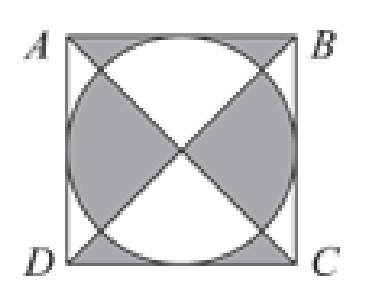
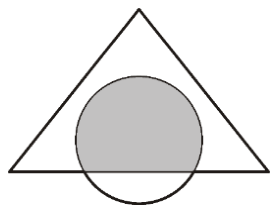
A figure is made of a triangle and a circle that partly overlap. The grey area is 45% of the whole figure, and the white part of the triangle is 40% of the whole figure. What percent of the circle’s area is the white part lying outside the triangle?
Show answer
Answer: B — 25%
Show hints
Hint 1 of 2
Split the shape into three pieces: the white triangle part, the grey overlap, and the white circle part outside.
Still stuck? Show hint 2 →
Hint 2 of 2
The whole shape is 100%; use 45% grey and 40% white-triangle to find the leftover circle piece, then compare it to the whole circle.
Show solution
Approach: track the percent pieces of the figure
The whole figure is 100%: white triangle 40% plus grey 45% leaves 15% for the white circle part outside the triangle.
The grey region is the overlap inside the circle, so the whole circle is grey (45%) plus its outside white part (15%) = 60% of the figure.
The white outside part is 15/60 = 25% of the circle, so the answer is B.
30 people are sitting around a round table. Some of them are wearing a hat. People without a hat must tell the truth; people with a hat may either tell the truth or lie. Each person claims: “At least one of my two neighbours is wearing a hat.” What is the largest number of people who can be without a hat?
Show answer
Answer: D — 20
Show hints
Hint 1 of 2
A truth-teller (no hat) says truly that a neighbour wears a hat, so a no-hat person cannot sit between two no-hat people.
Still stuck? Show hint 2 →
Hint 2 of 2
That means no three no-hat people in a row - fit as many no-hat people as that allows around 30 seats.
Show solution
Approach: forbid three hatless people in a row, then pack the most
A hatless person always tells the truth, so their claim 'a neighbour wears a hat' must be true; thus no hatless person sits between two hatless people.
So at most two hatless people can sit consecutively, in a pattern like (no-hat, no-hat, hat) repeated.
Around 30 seats that gives 2 out of every 3, i.e. 20 hatless people.
The big cube is built from three different kinds of building blocks (see diagram). How many of the little white cubes are needed to build the big cube?
Show answer
Answer: B — 11
Show hints
Hint 1 of 3
First figure out how many little cubes fill the whole big cube — it is 3 across, 3 deep and 3 tall.
Still stuck? Show hint 2 →
Hint 2 of 3
Each grey L-piece and each dark bar is made of 3 little cubes, so count how many little cubes all the coloured pieces use up.
Still stuck? Show hint 3 →
Hint 3 of 3
Whatever little cubes are left over after the coloured pieces must be the single white ones.
Show solution
Approach: count all the little cubes, then take away the coloured pieces
The big cube is 3 across, 3 deep and 3 tall, so it holds 3 × 3 × 3 = 27 little cubes.
Each grey L-piece and each dark bar is built from 3 little cubes, and together the coloured pieces fill 16 of the 27 spots.
Every spot that is left over must be a single white cube: 27 − 16 = 11.
One square is drawn inside each of the two congruent isosceles right-angled triangles. The area of square P is 45 units. How many units is the area of square R?
Show answer
Answer: B — 40
Show hints
Hint 1 of 2
The two inscribed squares sit differently: one leg-aligned, one tilted on the hypotenuse.
Still stuck? Show hint 2 →
Hint 2 of 2
There is a fixed ratio between the two square areas for the same right isosceles triangle.
Show solution
Approach: use the known ratio of the two inscribed-square areas
For an isosceles right triangle, the leg-aligned square and the hypotenuse-tilted square have a fixed area ratio of 9 : 8.
Square P (leg-aligned) has area 45, so the tilted square R has area 45 * 8/9.
The numbers 1 to 8 are written in the circles shown, one per circle. Along each of the five straight arrows the three numbers in the circles are multiplied, and the product is written at the arrow’s tip. What is the sum of the numbers in the three circles in the bottom row?
Show answer
Answer: D — 17
Show hints
Hint 1 of 2
Each product label factors into three of the numbers 1-8; the arrow-tip products constrain which numbers sit where.
Still stuck? Show hint 2 →
Hint 2 of 2
Factor 30, 48, 105, 28, 144 into the digits 1-8 and find the three bottom-row circles in the consistent assignment.
Show solution
Approach: factor the arrow products to place numbers
The numbers 1 to 8 fill the circles (total 36), and each arrow's label is the product of its three circles.
Factoring a label like \(105 = 3 \times 5 \times 7\) forces those three numbers onto that arrow, and the other labels pin down the rest by elimination.
The resulting placement puts numbers summing to 17 in the three bottom-row circles, so the answer is D.
A rectangle is split into 11 smaller rectangles as shown. All 11 small rectangles are similar to the initial rectangle. The smallest rectangles are aligned like the original rectangle (see diagram). The lower sides of the smallest rectangles have length 1. How big is the perimeter of the big rectangle?
Show answer
Answer: D — 30
Show hints
Hint 1 of 2
All 11 pieces are similar to the whole, so their side ratio is the same as the big rectangle's.
Still stuck? Show hint 2 →
Hint 2 of 2
Use the smallest rectangles' base of 1 to pin down the common ratio, then the big dimensions.
Show solution
Approach: every piece keeps the same shape, so one similarity ratio chains all the sides together
All 11 pieces (and the big rectangle) are the same shape, so they share one length-to-width ratio \(r\); call the smallest rectangle \(1\times r\) since its lower side is 1.
Reading across the diagram, the next-size rectangles and then the big one are obtained by scaling by \(r\) each time, so widths run \(1, r, r^2,\dots\) and they must add up consistently along each side.
Matching the rows and columns of the tiling forces \(r=\tfrac32\), giving big-rectangle sides \(9\) and \(6\).
Kai puts the numbers 3, 4, 5, 6 and 7 into the five circles of the diagram. For each triangle, the product of the three numbers at its vertices must equal the number written inside that triangle. What is the sum of the numbers at the vertices of the triangle marked 168?
Show answer
Answer: D — 17
Show hints
Hint 1 of 2
Factor each label as a product of three of the numbers 3,4,5,6,7 to see which three meet in that triangle.
Still stuck? Show hint 2 →
Hint 2 of 2
The number sitting in every triangle is the shared centre; the 168 triangle uses the other two plus the centre.
Show solution
Approach: factor each product to identify the three vertices
Cards of the same colour always hide the same number. When the three hidden numbers in a row are added, you get the number written to the right of that row (see diagram). Which number is hidden under the black card?
Show answer
Answer: D — 12
Show hints
Hint 1 of 3
Every card of the same colour hides the same number, so think of one secret number per colour.
Still stuck? Show hint 2 →
Hint 2 of 3
Compare two rows that are almost the same to find one colour's number first.
Still stuck? Show hint 3 →
Hint 3 of 3
Once you know grey and white, the black card is just its row total take away the other two.
Show solution
Approach: compare rows to peel off one colour at a time
The top row is grey + white + white = 34, and the bottom row is white + grey + grey = 26.
Both rows use one extra grey instead of one extra white, and they differ by 34 − 26 = 8, so a white card is 8 more than a grey card.
Trying small numbers that fit grey + 2 whites = 34: grey = 6 and white = 14 works (6 + 14 + 14 = 34).
The middle row grey + white + black = 32, so black = 32 − 6 − 14 = 12 — answer D.
For older kids (with letters)Let grey = g, white = w, black = k. From g + 2w = 34 and 2g + w = 26 you get g = 6, w = 14, then k = 32 − g − w = 12.
In a certain city the inhabitants only communicate by asking questions. There are two kinds of inhabitants: the ‘positive’ that only ask questions that are answered with ‘yes’ and the ‘negative’ that only ask questions that are answered with ‘no’. We meet the inhabitants Albert and Berta, and Berta asks us: “Are Albert and I both negative?” What kind of inhabitants are they?
Show answer
Answer: C — Albert is positive and Berta is negative
Show hints
Hint 1 of 2
A positive only asks questions whose true answer is 'yes'; a negative only 'no'.
Still stuck? Show hint 2 →
Hint 2 of 2
Test the four type-combinations against Berta's question 'Are Albert and I both negative?'
Show solution
Approach: test each type assignment for consistency with Berta asking the question
Berta can only ask her question if its true answer matches her type (yes for positive, no for negative).
Check each combination of Albert and Berta being positive or negative for consistency.
Only 'Albert positive, Berta negative' is consistent, giving answer C.
By bike it takes Marc 20 minutes to go from home to school and back; on foot the same round trip takes 60 minutes. He rides and walks at constant speeds. Yesterday Marc biked to Eva’s house (on the way to school), left the bike there, and walked the rest of the way to school. Coming home he first walked to Eva’s house, then biked the rest of the way. The whole journey took 52 minutes. What fraction of the journey did he cover by bike?
Show answer
Answer: B — 1⁄5
Show hints
Hint 1 of 2
One leg (home to school) takes 10 min by bike and 30 min on foot; the bike part is the same length each way.
Still stuck? Show hint 2 →
Hint 2 of 2
Let the bike part be a fraction \(f\) of one leg; he bikes it twice and walks the rest twice, totalling 52 min.
Show solution
Approach: mix bike and walking times over the route
A round trip is two legs; by bike one leg takes 10 min, on foot one leg takes 30 min.
Let the bike portion be a fraction \(f\) of one leg. He bikes that fraction on both legs and walks the rest on both legs, so the time is \(2(10f) + 2(30(1-f)) = 60 - 40f = 52\).
Then \(40f = 8\), so \(f = \tfrac{1}{5}\), and the bike distance is \(\tfrac{1}{5}\) of the whole journey, so the answer is B.
Two rectangles are inscribed into a triangle as shown in the diagram. The dimensions of the rectangles are \(1\times 5\) and \(2\times 3\) respectively. How big is the height of the triangle in A?
Show answer
Answer: B — \(\tfrac{7}{2}\)
Show hints
Hint 1 of 3
A corner of each rectangle sits on a slanted side, so the little triangle above each rectangle is similar to the whole triangle.
Still stuck? Show hint 2 →
Hint 2 of 3
Width-of-rectangle to base behaves like remaining-height to total height — write that proportion for both rectangles.
Still stuck? Show hint 3 →
Hint 3 of 3
Two such proportions in the unknown base and height let you eliminate the base and solve for the height.
Show solution
Approach: each inscribed rectangle cuts off a triangle similar to the whole, giving two proportions
Let the triangle have base \(b\) and height \(H\) (the height at \(A\)); a rectangle of height \(h\) and width \(w\) inscribed against the base satisfies \(\dfrac{w}{b}=\dfrac{H-h}{H}\) by similar triangles.
The two rectangles give \(\dfrac{5}{b}=\dfrac{H-1}{H}\) and \(\dfrac{3}{b}=\dfrac{H-2}{H}\) (using the 1\(\times\)5 and 2\(\times\)3 pieces).
Dividing the two equations removes \(b\): \(\dfrac{5}{3}=\dfrac{H-1}{H-2}\), so \(5(H-2)=3(H-1)\) and \(2H=7\).
Twelve weights have integer masses of 1 g, 2 g, 3 g, …, 11 g and 12 g respectively. A vendor divides those weights up into 3 groups of 4 weights each. The total mass of the first group is 41 g, the mass of the second group is 26 g (see diagram). Which of the following weights is in the same group as the weight with 9 g?
Show answer
Answer: C — 7 g
Show hints
Hint 1 of 2
The three groups sum to 1+2+...+12 = 78; you know two group totals.
Still stuck? Show hint 2 →
Hint 2 of 2
Find the third group's total, then see which 4-weight set containing 9 g fits a group total.
Show solution
Approach: use group sums to place the 9 g weight
All weights sum to 78; with groups of 41 and 26, the third group totals 78 - 41 - 26 = 11.
The 9 g weight is too heavy for the 11 g group, so it lies in the 41 g or 26 g group.
Working out which four weights total 41 and which total 26, the weight grouped with 9 g among the options is 7 g.
Four villages A, B, C and D lie (not necessarily in this order) along a straight road. A and C are 75 km apart, B and D are 45 km apart, and B and C are 20 km apart. Which of these distances cannot be the distance from A to D?
Show answer
Answer: C — 80 km
Show hints
Hint 1 of 2
Place the points on a line using the known gaps AC = 75, BD = 45, BC = 20; AD depends on the left-right order.
Still stuck? Show hint 2 →
Hint 2 of 2
Try the possible orderings of A, B, C, D consistent with the gaps and list the AD distances that can occur.
Show solution
Approach: place the points with signed positions on the line
Put C at 0. Then B is at +20 or -20 (since BC = 20), A is at +75 or -75 (since AC = 75), and D sits 45 from B.
Trying all the consistent combinations, A to D comes out as 10, 50, 100 or 140 km.
AD = 80 km never appears, so the distance that cannot occur is C.
The diagonals of the squares ABCD and EFGB are 7 cm and 10 cm long respectively (see diagram). The point P is the point of intersection of the two diagonals of the square ABCD. How big is the area of the triangle FPD (in cm²)?
Show answer
Answer: E — 17.5
Show hints
Hint 1 of 2
Place the squares on coordinates using their diagonals 7 and 10 sharing vertex B.
Still stuck? Show hint 2 →
Hint 2 of 2
P is the centre of square ABCD; find F, P, D coordinates and take the triangle area.
Show solution
Approach: coordinate geometry from the shared vertex and diagonals
Set coordinates so the squares ABCD (diagonal 7) and EFGB (diagonal 10) share the vertex B.
Locate F, P (centre of ABCD) and D from the side lengths derived from the diagonals.
A painter wants to mix 2 litres of blue paint with 3 litres of yellow to make 5 litres of green. By mistake he uses 3 litres of blue and 2 litres of yellow, making the wrong shade. What is the least amount of this green he must throw away so that, by adding only blue or yellow, the rest becomes exactly 5 litres of the correct shade?
Show answer
Answer: A — 5⁄3 litre
Show hints
Hint 1 of 2
The wrong mix is 3 blue : 2 yellow (5 L); correct green is 2 blue : 3 yellow. Compare the blue fractions.
Still stuck? Show hint 2 →
Hint 2 of 2
You may only ADD paint, so you must throw away enough wrong mix that the kept blue and yellow can still reach a 2:3 mix within 5 L.
Show solution
Approach: keep a portion that can be corrected by adding
The wrong 5 L holds 3 L blue and 2 L yellow; correct green needs blue:yellow = 2:3 in 5 L (2 L blue, 3 L yellow).
Keep a fraction k of the wrong mix: kept blue = 3k, yellow = 2k. Since you may only add, need 3k <= 2, so k <= 2/3.
The minimum thrown away is 5(1 - 2/3) = 5/3 litre, so the answer is A.
The numbers 1 to 10 were written into the ten circles in the pattern shown in the picture. The sum of the four numbers in the left and the right column is 24 each and the sum of the three numbers in the bottom row is 25. Which number is in the circle with the question mark?
Show answer
Answer: E — another number
Show hints
Hint 1 of 2
All ten numbers add to 55; the two columns already use 24 + 24 = 48.
Still stuck? Show hint 2 →
Hint 2 of 2
That leaves 7 for the two circles outside the columns; the bottom-row total of 25 then pins each one.
Show solution
Approach: use total 55 and the column/row sums
1+2+···+10 = 55. The left and right columns (four each) take 24 + 24 = 48.
The remaining two circles sum to 55 − 48 = 7; with the bottom row equal to 25 they are forced to be 6 and 1.
The question-mark circle is the one equal to 1, which is none of 2, 4, 5, 6, so the answer is another number.
What is the smallest number of cells of a \(5 \times 5\) grid that must be coloured so that every \(1 \times 4\) rectangle and every \(4 \times 1\) rectangle in the grid contains at least one coloured cell?
Show answer
Answer: B — 6
Show hints
Hint 1 of 2
Every horizontal and every vertical run of 4 cells must contain a coloured cell; first find a lower bound, then build an example reaching it.
Still stuck? Show hint 2 →
Hint 2 of 2
A single cell in the middle three columns covers both horizontal 4-strips of its row, and similarly for columns; balance these two demands.
Show solution
Approach: cover all 1x4 and 4x1 strips with a small lower bound and a matching example
Consider the four disjoint 1x4 strips in the corners (rows 1 and 5, cols 1-4 and 2-5 style); they force several coloured cells, giving a lower bound of 6.
Six cells placed in two short diagonals (for example (1,2),(2,3),(3,4) and (3,2),(4,3),(5,4)) hit every horizontal and every vertical 4-in-a-row.
Since 6 cells suffice and fewer cannot, the minimum is 6, so the answer is B.
A square is placed in a co-ordinate system as shown. Each point \((x\,|\,y)\) of the square is deleted and replaced by the point \(\left(\tfrac{1}{x}\,\middle|\,\tfrac{1}{y}\right)\). Which diagram shows the resulting shape?
Show answer
Answer: C
Show hints
Hint 1 of 3
Track where the four corners of the square land under the map \((x,y)\to(\tfrac1x,\tfrac1y)\).
Still stuck? Show hint 2 →
Hint 2 of 3
A straight edge where \(x\) is constant maps to a straight edge (\(1/x\) constant), but an edge where \(x+y\) or a slanted relation holds bends into a hyperbola.
Still stuck? Show hint 3 →
Hint 3 of 3
Decide whether the transformed sides bow inward or outward to pick the matching picture.
Show solution
Approach: image of the square's corners and edges under the reciprocal map
The corners \((1,1),(2,1),(1,2),(2,2)\) map to \((1,1),(\tfrac12,1),(1,\tfrac12),(\tfrac12,\tfrac12)\), so the image again lives in a small square region near the origin.
Edges with \(x\) or \(y\) constant stay straight, while the edges along which both coordinates vary become arcs of hyperbolas \(y=c/x\) that curve toward the origin.
Matching this curved-side small region to the options gives diagram C.
Consider the five circles with midpoints A, B, C, D and E respectively, which touch each other as displayed in the diagram. The line segments, drawn in, connect the midpoints of adjacent circles. The distances between the midpoints are AB = 16, BC = 14, CD = 17, DE = 13 and AE = 14. Which of the points is the midpoint of the circle with the biggest radius?
Show answer
Answer: A — A
Show hints
Hint 1 of 2
Each connecting segment length equals the sum of the two touching circles' radii.
Still stuck? Show hint 2 →
Hint 2 of 2
Set up r_A+r_B = 16 and the rest, then solve for the radii around the ring.
Show solution
Approach: turn each touching pair into a radius-sum equation and solve
Touching circles meet where their radii add, so \(r_A+r_B=16\), \(r_B+r_C=14\), \(r_C+r_D=17\), \(r_D+r_E=13\), \(r_E+r_A=14\).
Subtracting pairs gives \(r_A-r_C=2\) and \(r_C-r_E=4\); putting these into \(r_E+r_A=14\) yields \(r_C=8\).
Then \(r_A=10, r_B=6, r_D=9, r_E=4\), so the largest radius is at point A.
Mowgli asks a bear and a panther what day of the week it is. The bear always lies on Monday, Tuesday and Wednesday; the panther always lies on Thursday, Friday and Saturday. On every other day both tell the truth. The bear says, “Yesterday was one of my lying days.” The panther says, “Yesterday was also one of my lying days.” On which day did this conversation take place?
Show answer
Answer: A — Thursday
Show hints
Hint 1 of 2
Each animal claims 'yesterday was one of MY lying days'; an animal telling the truth today is honest, while a liar inverts its claim.
Still stuck? Show hint 2 →
Hint 2 of 2
Check each weekday: decide for the bear and panther whether today is truth or lie, then test if both statements can hold.
Show solution
Approach: test each weekday against both animals
The bear lies Mon-Tue-Wed; the panther lies Thu-Fri-Sat; both tell the truth on Sunday.
On Thursday the bear tells the truth and yesterday (Wed) really was its lying day; the panther lies today, and since yesterday (Wed) was not its lying day, its statement is false as required of a liar.
Both statements are consistent only on Thursday, so the answer is A.
Eight teams take part in a football tournament where each team plays each other team exactly once. In each game the winner gets 3 points and the loser no points. In case of a draw both teams get 1 point. In the end all teams together have 61 points. What is the maximum number of points that the team with the most points could have gained?
Show answer
Answer: D — 17
Show hints
Hint 1 of 2
A decided game adds 3 points to the total; a draw adds only 2, so the total tells you the draws.
Still stuck? Show hint 2 →
Hint 2 of 2
Maximise one team's points while keeping the overall total at 61.
Show solution
Approach: count decided games from the total, then load wins onto one team
There are \(\binom{8}{2}=28\) games; a decided game gives out 3 points and a draw gives out 2.
If \(d\) games are drawn then total points \(=3(28-d)+2d=84-d=61\), so \(d=23\) and only \(5\) games are decided.
A team can win only a decided game, so it wins at most all \(5\); giving it those 5 wins plus drawing its other 2 games gives \(5\cdot 3+2=17\) points, answer D.
Some points are marked on a straight line. Renate marks a new point between every pair of adjacent points, then repeats this three more times. Now there are 225 points on the line. How many points were there at the start?
Show answer
Answer: C — 15
Show hints
Hint 1 of 2
Inserting a point between every adjacent pair takes n points to a new count; find that rule.
Still stuck? Show hint 2 →
Hint 2 of 2
Each pass sends n points to 2n - 1; apply it four times and work backward from 225.
Show solution
Approach: iterate the doubling-minus-one rule
Marking a point between each adjacent pair turns n points into n + (n-1) = 2n - 1.
Doing this four times: n to 2n-1 to 4n-3 to 8n-7 to 16n-15.
Set 16n - 15 = 225, so 16n = 240 and n = 15; the answer is C.
A hemispheric hole is carved into each face of a wooden cube with sides of length 2. All holes are equally sized, and their midpoints are in the centre of the faces of the cube. The holes are as big as possible so that each hemisphere touches each adjacent hemisphere in exactly one point. How big is the diameter of the holes?
Show answer
Answer: C — \(\sqrt{2}\)
Show hints
Hint 1 of 2
Adjacent hemispheres touch along an edge of the cube, where their rims meet.
Still stuck? Show hint 2 →
Hint 2 of 2
Find the distance between the centres of two adjacent faces and set 2r equal to it.
Show solution
Approach: set the diameter equal to the distance between adjacent face centres
For a cube of side 2, the centres of two adjacent faces are sqrt(1^2 + 1^2) = sqrt(2) apart.
Hemispheres on those faces just touch when their radii meet along that line: r + r = sqrt(2).
Altogether 2022 kangaroos and some koalas live in seven parks. In each park there live as many kangaroos as there are koalas in all the other parks together. How many koalas live in the seven parks in total?
Show answer
Answer: B — 337
Show hints
Hint 1 of 2
Kangaroos in each park equal the koalas in all the OTHER parks; add this up over the seven parks.
Still stuck? Show hint 2 →
Hint 2 of 2
Let total koalas be K; summing kangaroos over parks gives 7K minus K. Set that equal to 2022.
Show solution
Approach: sum the cross-park condition
Let the total number of koalas be K. In each park the kangaroos equal K minus that park's own koalas.
Summing over all seven parks: total kangaroos = 7K - K = 6K = 2022.
Two circles intersect a rectangle AFMG as shown in the diagram. The line segments along the long side of the rectangle that are outside the circles have length AB = 8, CD = 26, EF = 22, GH = 12 and JK = 24. How long is the length x of the line segment LM?
Show answer
Answer: C — 16
Show hints
Hint 1 of 2
Each circle is symmetric, so the midpoint of the gap it leaves on the top side sits directly above the midpoint of the gap it leaves on the bottom side.
Still stuck? Show hint 2 →
Hint 2 of 2
Those two alignments, together with the top and bottom sides being equal in length, are enough to solve for x without ever finding a radius.
Show solution
Approach: use that each circle's top and bottom gaps share a centre line, plus equal long sides
Read the top side as AB + arc-gap + CD + middle-gap + EF = 8 + … + 26 + … + 22, and the bottom as GH + … + JK + … + x = 12 + … + 24 + … + x.
Because each circle is symmetric, the midpoint of its top chord lies exactly above the midpoint of its bottom chord; the two alignment conditions force (top chord − bottom chord) of circle 1 to be 8 and the corresponding middle-gap difference to be −12.
Setting the top side equal to the bottom side gives x = 20 + 8 − 12 = 16.