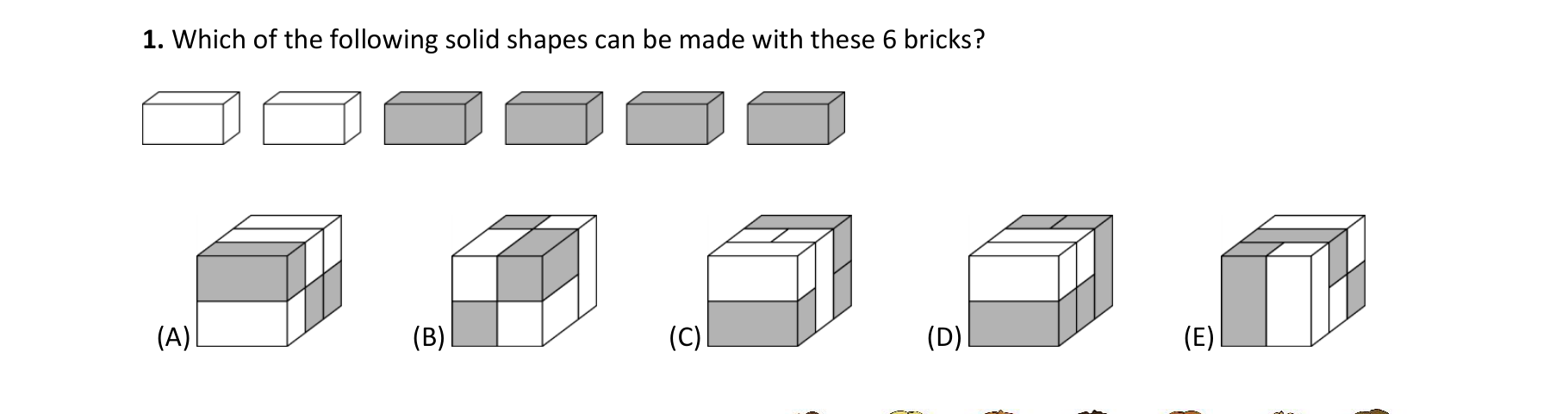
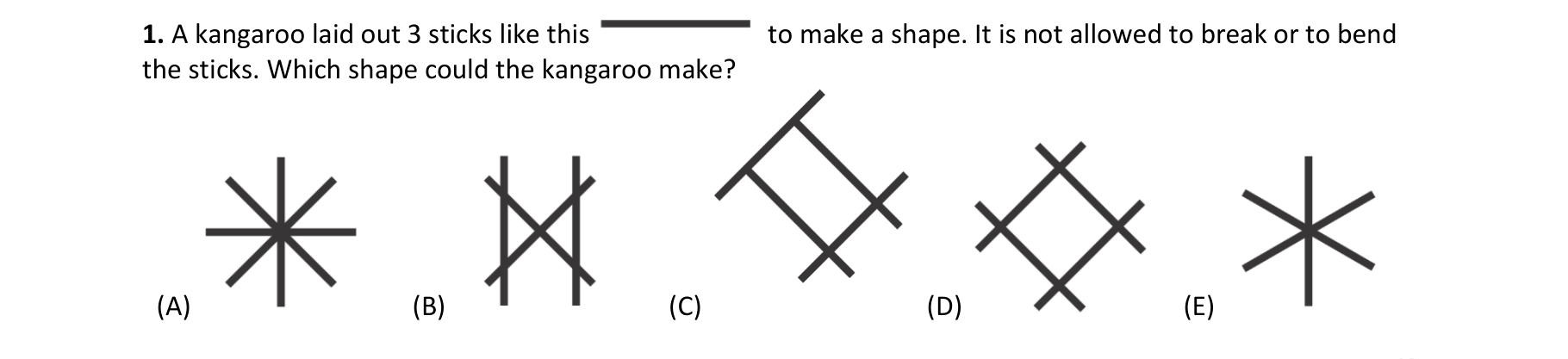
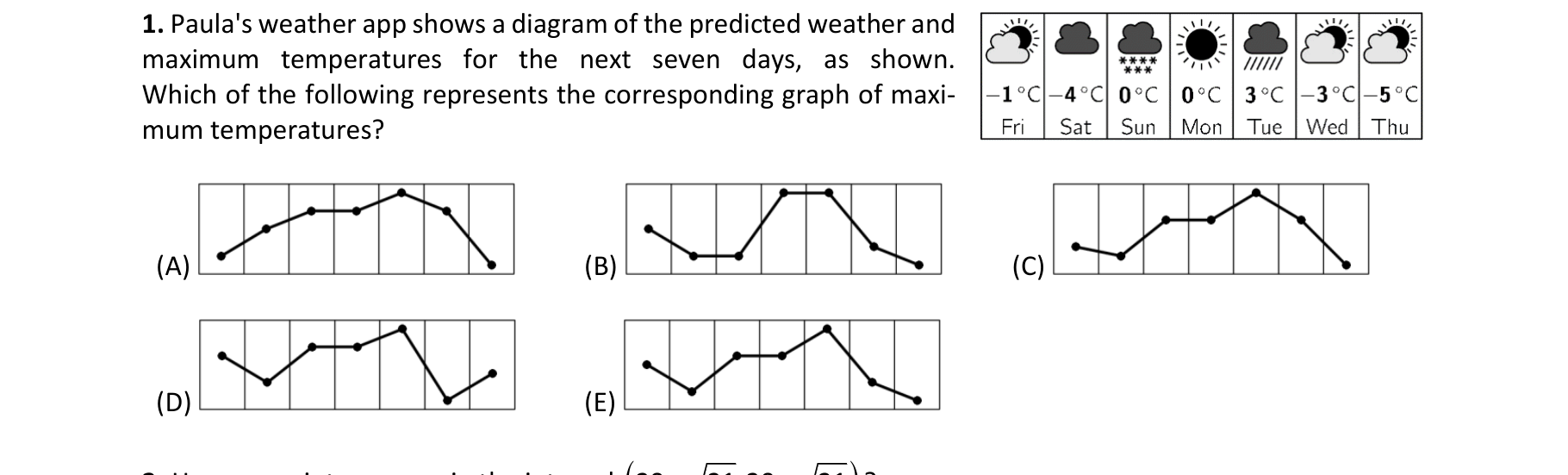
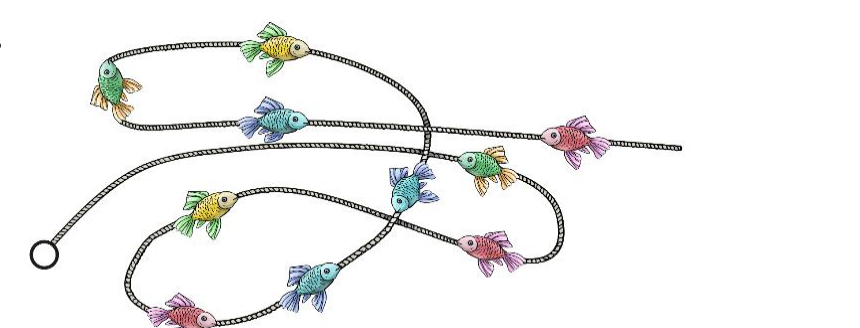
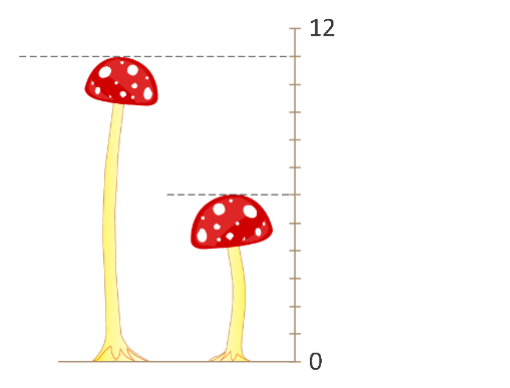
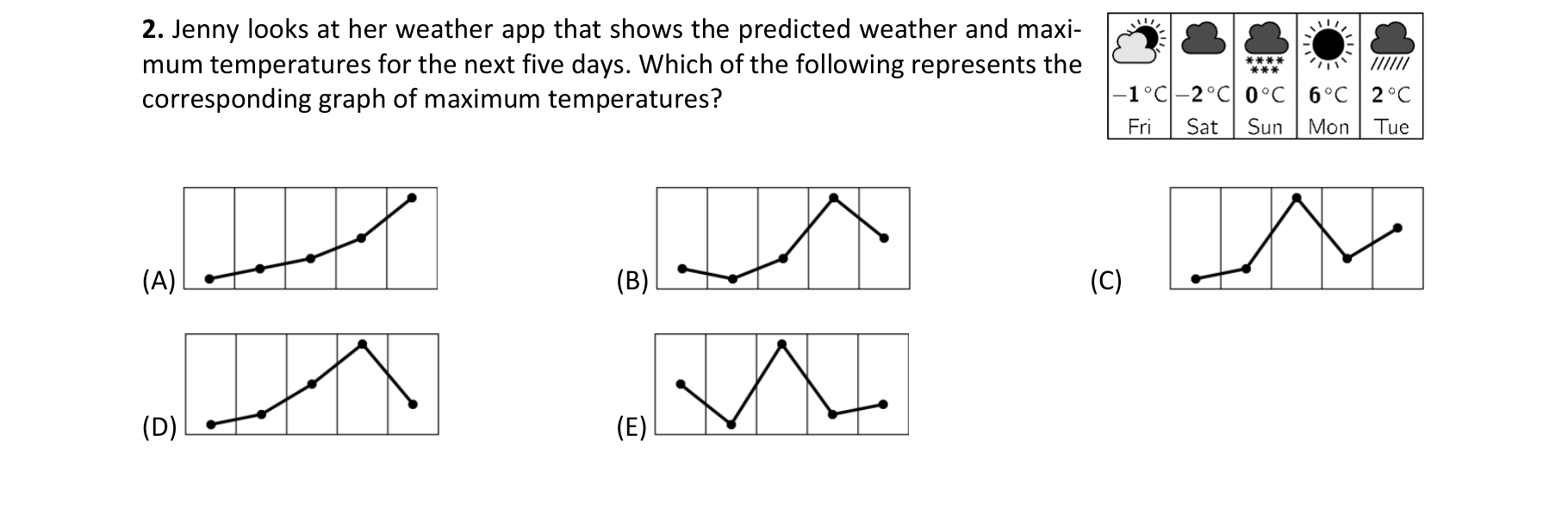
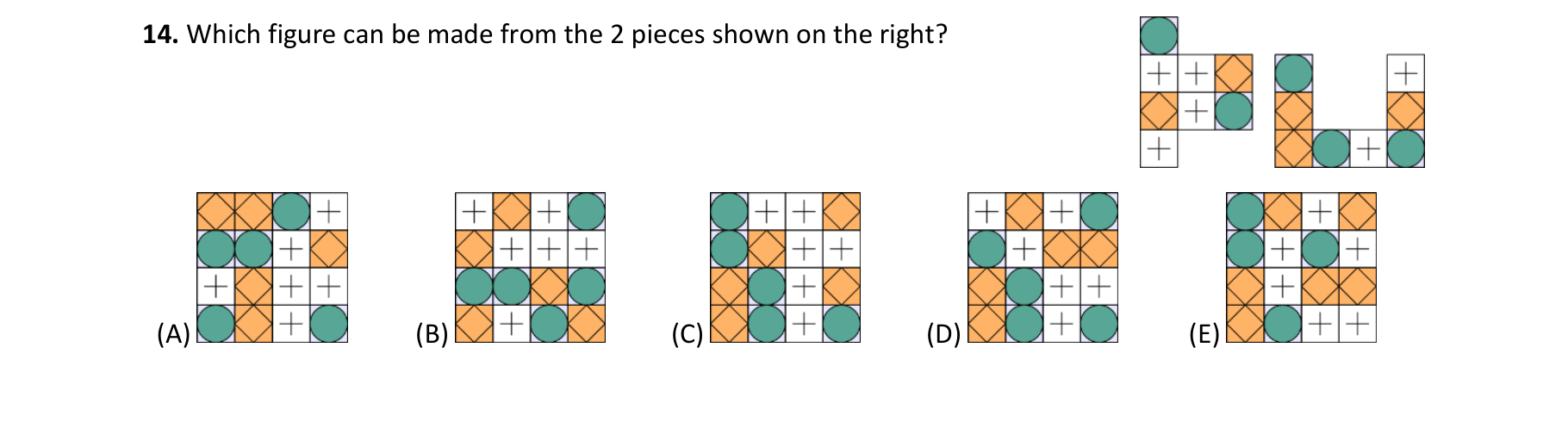
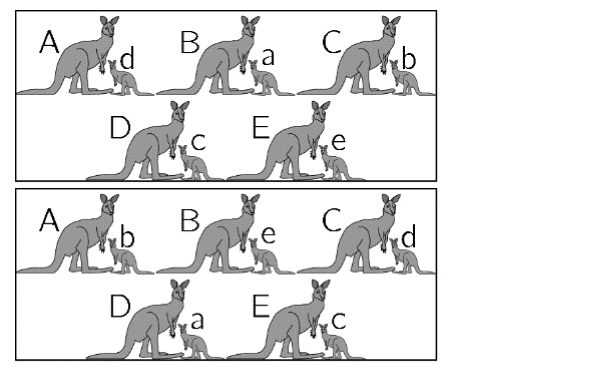
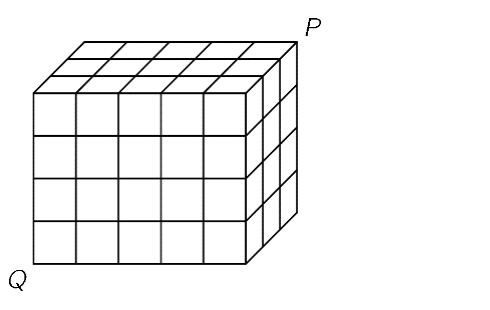
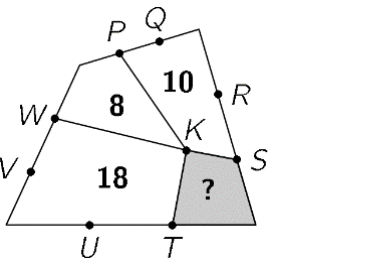
Which of the following solid shapes can be made with these 6 bricks?
Show answer
Answer: D
Show hints
Hint 1 of 2
The 6 bricks are 2 white and 4 grey, and each brick is a 1x1x2 block.
Still stuck? Show hint 2 →
Hint 2 of 2
Build the answer from twelve unit cubes (4 white, 8 grey) and check which picture shows exactly that count of each colour with the brick seams in the right places.
Show solution
Approach: match brick colours and seams to a solid
Two white bricks and four grey bricks supply 4 white unit cubes and 8 grey unit cubes.
The assembled solid must show that 2:1 grey-to-white split, with the visible faces and the seams between bricks lining up.
Only choice D shows a solid whose colouring and brick seams can come from these six bricks.
Each year, the third Thursday in March is named Kangaroo Day. The dates of Kangaroo Day for the next few years are listed below, with one error. Which date is wrong?
Show answer
Answer: C — 14/3/2024
Show hints
Hint 1 of 2
Work out the actual third Thursday of March for each listed year.
Still stuck? Show hint 2 →
Hint 2 of 2
March 1's weekday shifts each year; find which printed date isn't really a third Thursday.
Show solution
Approach: check each date against the real third Thursday
Find the weekday of March 1 for each year and locate that year's third Thursday.
Four of the five printed dates land correctly on the third Thursday of March.
Only 14/3/2024 is off — the third Thursday of March 2024 is the 21st, not the 14th.
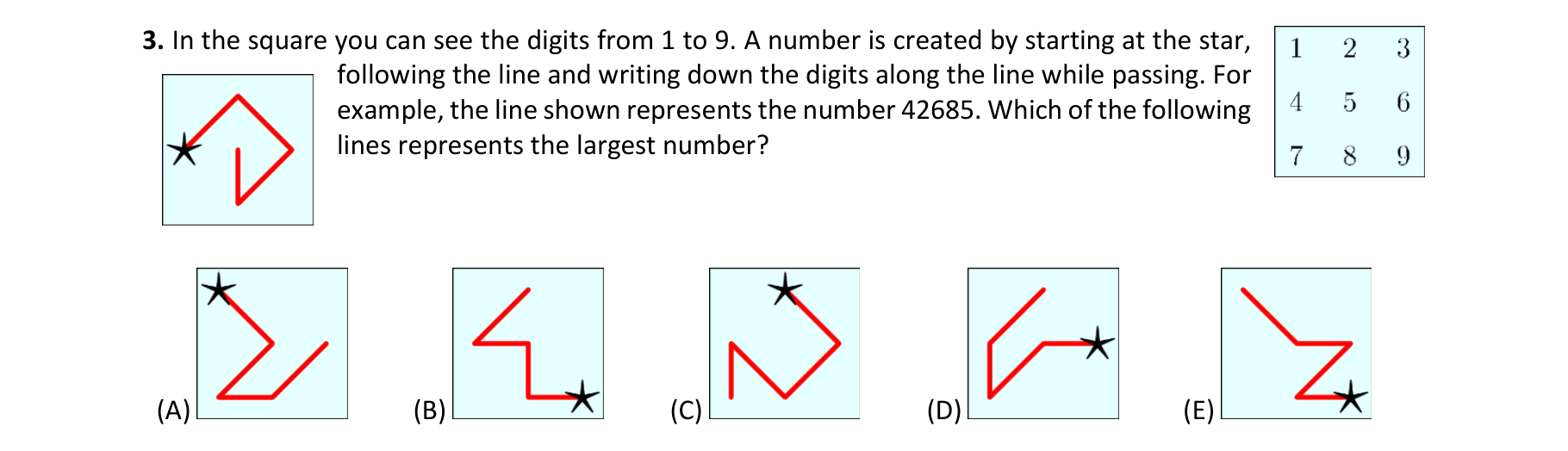
In the square you can see the digits from 1 to 9. A number is created by starting at the star, following the line and writing down the digits along the line while passing. For example, the line shown represents the number 42685. Which of the following lines represents the largest number?
Show answer
Answer: E
Show hints
Hint 1 of 2
Read off the digit string each path makes, then compare them as numbers.
Still stuck? Show hint 2 →
Hint 2 of 2
The biggest number starts with the largest leading digit; break ties by the next digit.
Show solution
Approach: trace each path into a number and compare
Each option traces a path from the star across cells of the 1-9 grid, writing the digit of every cell it passes.
Convert each path to its number and compare digit by digit from the left.
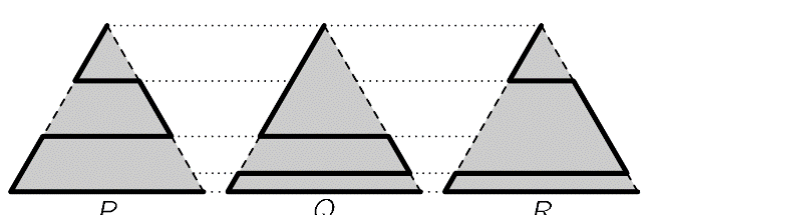
A park is shaped like an equilateral triangle. A cat wants to walk along one of the three indicated paths (thicker lines) from the upper corner to the lower-right corner. The lengths of the paths are P, Q and R, as shown. Which statement about the lengths of the paths is true?
Show answer
Answer: B — \(PShow hints
Hint 1 of 2
Every path starts at the top corner and ends at the lower-right corner, so they all cover the same overall drop and shift.
Still stuck? Show hint 2 →
Hint 2 of 2
Replacing a straight horizontal cut with travel along the slanted edge adds length, so compare how much of each path hugs the slant.
Show solution
Approach: compare the three traced paths segment by segment
All three paths join the same two corners, so they share the same net horizontal and vertical change.
Path P takes the most direct mix of horizontal cuts and short drops, so it is the shortest.
Path Q runs the most along the slanted edge, where covering the same height costs extra length, so it is the longest, with R in between.
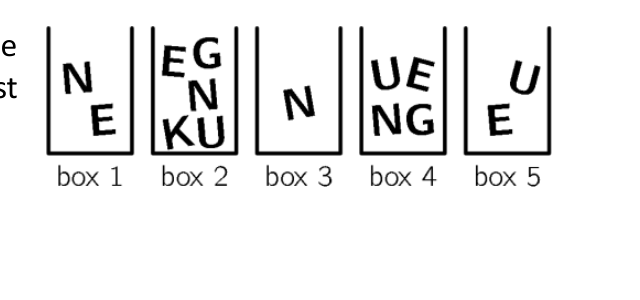
Sofie wants to write the word KENGU by using letters from the boxes. She can only take one letter from each box. What letter must Sofie take from box 4?
Show answer
Answer: D — G
Show hints
Hint 1 of 2
Find the boxes that can only supply one needed letter and lock those in first.
Still stuck? Show hint 2 →
Hint 2 of 2
Box 3 forces the N, and the only K is in box 2 — then see what is left for box 4.
Show solution
Approach: fix the forced letters, then deduce box 4
Box 3 contains only N, so KENGU's N must come from box 3.
K appears only in box 2, so K comes from box 2.
That leaves E, G, U for boxes 1, 4, 5; box 1 gives E and box 5 gives U, so box 4 must give G.
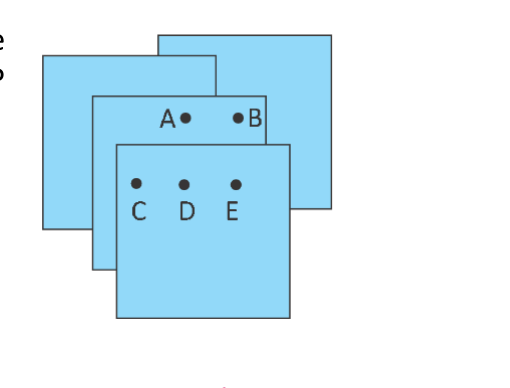
Four identical pieces of paper are placed as shown. Michael wants to punch a hole that goes through all four pieces. At which point should Michael punch the hole?
Show answer
Answer: D — D
Show hints
Hint 1 of 3
The hole has to go through all four pieces of paper at once.
Still stuck? Show hint 2 →
Hint 2 of 3
So the spot must be covered by every single sheet.
Still stuck? Show hint 3 →
Hint 3 of 3
Look for the dot that sits on top of all four sheets together.
Show solution
Approach: find the common overlap point
A hole through all four sheets must sit where all four sheets overlap.
Checking the marked points, only point D lies in the part shared by every sheet.
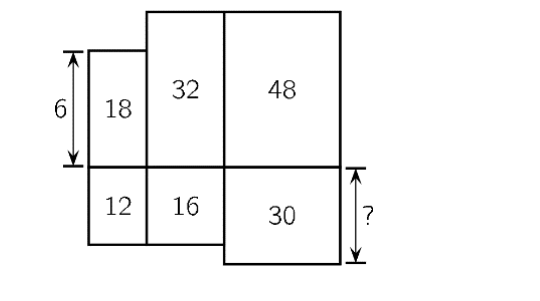
Six rectangles are arranged as shown. The top left-hand rectangle has height 6 cm. The numbers within the rectangles indicate their areas in cm². What is the height of the bottom right-hand rectangle?
Show answer
Answer: B — 5 cm
Show hints
Hint 1 of 2
The top-left rectangle has height 6 and area 18, so its width is 3 — then chain that through neighbours that share a side.
Still stuck? Show hint 2 →
Hint 2 of 2
Each shared edge passes a known length along; follow the chain until you reach the bottom-right rectangle's width, then divide its area by that width.
Show solution
Approach: propagate shared side lengths through the areas
Top-left has height 6 and area 18, so its width is 18÷6 = 3.
Bottom-left shares that width 3 and has area 12, so its height is 12÷3 = 4; the bottom-middle rectangle shares this height 4 and has area 16, so its width is 16÷4 = 4.
Top-middle shares width 4 and area 32, so its height is 32÷4 = 8; top-right shares that height 8 and area 48, so its width is 48÷8 = 6.
The bottom-right rectangle shares this width 6 and has area 30, so its height is 30÷6 = 5 cm, choice (B).
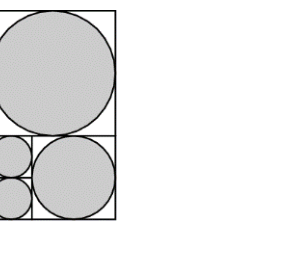
A large square is divided into smaller squares, as shown. A shaded circle is inscribed inside each of the smaller squares. What proportion of the area of the large square is shaded?
Show answer
Answer: E — \(\tfrac{\pi}{4}\)
Show hints
Hint 1 of 2
A circle inscribed in a square always fills the same fraction of that square.
Still stuck? Show hint 2 →
Hint 2 of 2
Find that fraction once; it does not depend on the square's size.
Show solution
Approach: use the fixed circle-to-square area ratio
A circle inscribed in a square of side s has area π(s/2)² = πs²/4.
That is π/4 of the square's area s², the same fraction for every square.
Since the circles fill squares that tile the big square, the shaded part is π/4 of the whole.
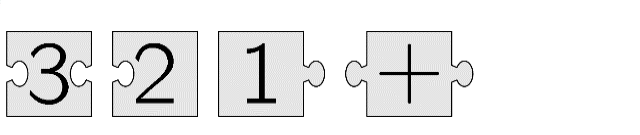
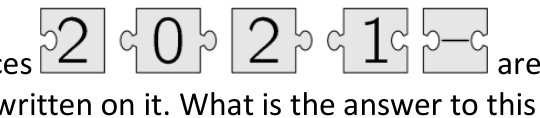
When the 5 puzzle pieces shown are fitted together correctly, the result is a rectangle with a calculation written on it. What is the answer to this calculation?
Show answer
Answer: B — 32
Show hints
Hint 1 of 2
The five puzzle pieces carry the symbols 2, 0, 2, 1 and +; fit them into one calculation.
Still stuck? Show hint 2 →
Hint 2 of 2
Arrange them as a two-digit plus a two-digit sum and read off the total.
Show solution
Approach: reassemble the pieces into one addition
The pieces 2, 0, 2, 1 and + fit together to spell the calculation 20 + 12.
The halftime score of a handball match was 9:14, so the visiting team was leading by five goals. After instructions from the coach, the home team dominated the second half and scored twice as many goals as their opponents. The home team won the match by one goal. What was the final score of the match?
Show answer
Answer: B — 21:20
Show hints
Hint 1 of 2
Let the visitors score x in the second half; then the home team scores 2x.
Still stuck? Show hint 2 →
Hint 2 of 2
Write 'home wins by one goal' as an equation in x and solve.
Show solution
Approach: set up one equation for the second half
Halftime is home 9, visitors 14. Let visitors score x more; the home team scores 2x more.
Final: home 9+2x, visitors 14+x, and home wins by one: 9+2x = (14+x)+1.
Solving gives x = 6, so home = 21 and visitors = 20.
When the 5 pieces shown are fitted together correctly, the result is a rectangle with a calculation written on it. What is the answer to this calculation?
Show answer
Answer: A — −100
Show hints
Hint 1 of 2
Fit the jigsaw pieces into a rectangle so the symbols line up into a single calculation.
Still stuck? Show hint 2 →
Hint 2 of 2
Once assembled it reads a short arithmetic expression — just evaluate it.
Show solution
Approach: assemble the pieces into the expression and compute
The five pieces fit together to spell out a calculation using the digits 2, 0, 2, 1 and a minus sign.
The pink tower is taller than the red tower but shorter than the green tower. The silver tower is taller than the green tower. Which tower is the tallest?
Show answer
Answer: D — silver tower
Show hints
Hint 1 of 3
Line the towers up from shortest to tallest using the clues.
Still stuck? Show hint 2 →
Hint 2 of 3
Green is taller than pink and red; now see how silver compares to green.
Still stuck? Show hint 3 →
Hint 3 of 3
Whoever is taller than green must be the tallest of all.
Show solution
Approach: order the towers by height
The first clues say red is shortest, then pink, then green is taller than both.
The last clue says silver is taller than green, so silver beats green and everyone below it.
In a jazz band, Giuseppe plays the saxophone, Sergio plays the trumpet and Eliana sings. They are all the same age. There are 3 more members of the band, who are 19, 20 and 21 years old. The average age of the jazz band is 21. How old is Eliana?
Show answer
Answer: C — 22
Show hints
Hint 1 of 2
Average 21 over 6 members means the total of all ages is 6×21.
Still stuck? Show hint 2 →
Hint 2 of 2
Subtract the three known ages; the rest splits equally among the three same-age members.
Show solution
Approach: use the total then divide
Six members average 21, so their ages total 6×21 = 126.
The three known members are 19+20+21 = 60, leaving 66 for the other three.
Those three are the same age, so each is 66÷3 = 22.
A rectangular sheet of paper has length x and width y where \(x > y\). The rectangle may be folded to form the curved surface of a circular cylinder in two different ways. What is the ratio of the volume of the longer cylinder to the volume of the shorter cylinder?
Show answer
Answer: B — \(y : x\)
Show hints
Hint 1 of 2
Rolling the sheet either way fixes which side becomes the circular edge and which becomes the height.
Still stuck? Show hint 2 →
Hint 2 of 2
Volume of a cylinder is (circumference)² / (4π) times height; compare the two volumes.
Show solution
Approach: compute both volumes and take the ratio
Roll so circumference = x, height = y: volume = x²y/(4π). Roll so circumference = y, height = x: volume = y²x/(4π).
Since x > y, the taller (longer) cylinder is the second one, height x, volume y²x/(4π).
Denise fired a silver and a gold rocket at the same time. The rockets exploded into 20 stars in total. The gold rocket exploded into 6 more stars than the silver one. How many stars did the gold rocket explode into?
Show answer
Answer: D — 13
Show hints
Hint 1 of 2
The two rockets together make 20 stars, and the gold makes 6 more than the silver.
Still stuck? Show hint 2 →
Hint 2 of 2
Take the 6 extra off the 20 first, split what is left evenly, then give the gold its extra back.
Show solution
Approach: split the total after removing the difference
Remove the 6 extra gold stars: 20 - 6 = 14 shared equally.
Each rocket's base share is 14 / 2 = 7, so the silver has 7.
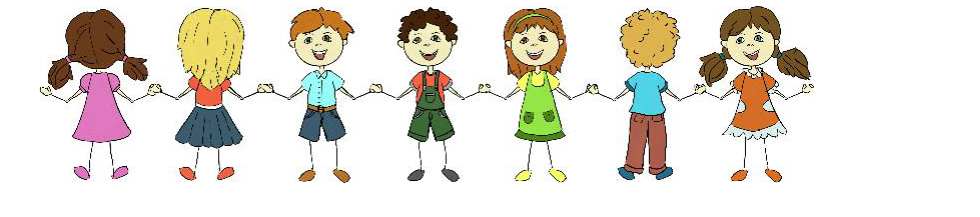
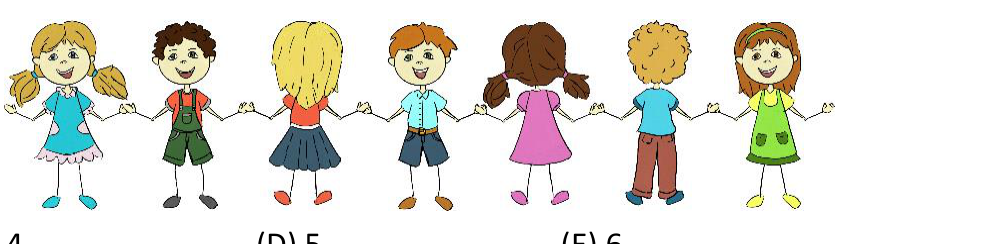
These children are standing in a line. Some are facing forwards and others are facing backwards. How many children are holding another child's hand with their right hand?
Show answer
Answer: E — 6
Show hints
Hint 1 of 3
Which hand is a child's right hand depends on which way that child is facing.
Still stuck? Show hint 2 →
Hint 2 of 3
For a child facing you, the right hand is on your left side; for one facing away, it is on your right side.
Still stuck? Show hint 3 →
Hint 3 of 3
Go child by child and only count the ones whose right hand is holding a neighbour.
Show solution
Approach: check each child's facing direction
Look at each child and decide which hand is the right hand based on whether they face front or back.
Now count only the children whose right hand is the one holding a neighbour's hand.
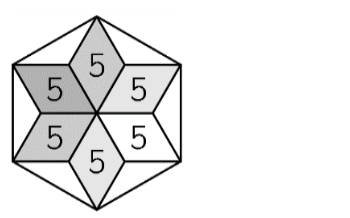
Six congruent rhombuses, each of area 5 cm², form a star. The tips of the star are joined to draw a regular hexagon, as shown. What is the area of the hexagon?
Show answer
Answer: C — 45 cm²
Show hints
Hint 1 of 2
Each rhombus splits into two small equilateral triangles, so one such triangle has area 2.5.
Still stuck? Show hint 2 →
Hint 2 of 2
The hexagon is the six-rhombus star plus six more of those same triangles in the gaps.
Show solution
Approach: count equal small triangles
The six rhombuses give the star an area of 6×5 = 30.
Each rhombus is two equal equilateral triangles, so each small triangle has area 2.5.
Filling the hexagon adds six more identical triangles: 6×2.5 = 15.
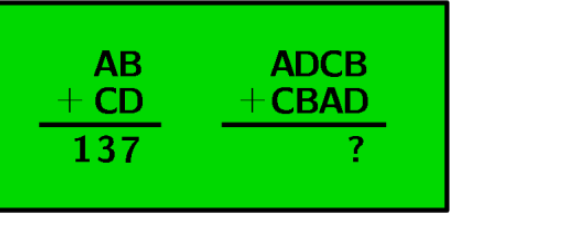
A student correctly added the two two-digit numbers on the left of the board (AB + CD) and got the answer 137. What answer will he get if he adds the two four-digit numbers on the right of the board (ADCB + CBAD)?
Show answer
Answer: B — 13 837
Show hints
Hint 1 of 2
Write the right-hand sum ADCB + CBAD in terms of the totals A+C and B+D.
Still stuck? Show hint 2 →
Hint 2 of 2
The left-hand fact AB + CD = 137 already pins down 10(A+C) + (B+D).
Show solution
Approach: express the big sum using A+C and B+D
From AB + CD = 137 we get 10(A+C) + (B+D) = 137, so A+C = 13 and B+D = 7.
Carin is going to paint the walls in her room green. The green paint is too dark, so she mixes it with white paint. She tries different mixtures. Which of the following mixtures will give the darkest green colour?
Show answer
Answer: E — They will all be equally dark
Show hints
Hint 1 of 2
The darkness comes from how much of the whole bucket is green, not from the raw number of parts.
Still stuck? Show hint 2 →
Hint 2 of 2
Look for a pattern: in every mixture, how many parts are white for each part of green?
Show solution
Approach: spot that every mixture has the same green share
In each mixture there are exactly 3 parts of white for every 1 part of green, so the green is always 1 out of every 4 parts.
As fractions: \(\frac{1}{4}\), \(\frac{2}{8}\), \(\frac{3}{12}\), \(\frac{4}{16}\) all equal \(\frac{1}{4}\).
Same green share means same darkness, so the answer is E (they are all equally dark).
Logic & Word Problemsbalance-reasoningwork-backward
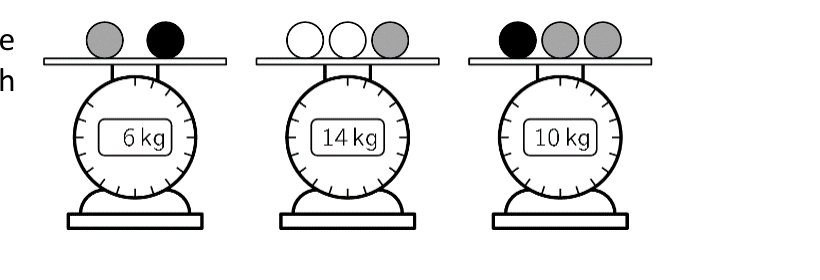
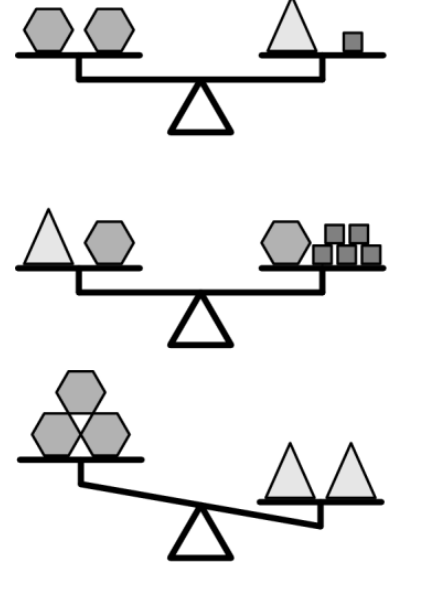
Rosana has some balls of 3 different colours. Balls of the same colour have the same weight. What is the weight of each white ball?
Show answer
Answer: C — 5
Show hints
Hint 1 of 2
Look at the two scales that both have a black ball and a grey ball on them, and compare what is different.
Still stuck? Show hint 2 →
Hint 2 of 2
Find the grey ball's weight first, then the black ball's, and only then the white ball.
Show solution
Approach: compare the scales to find one colour at a time, then the white ball
One grey and one black ball together weigh 6, while one black and two grey balls together weigh 10.
The second scale is just the first scale with one extra grey ball, and it is 10 - 6 = 4 heavier, so one grey ball weighs 4 (and the black ball weighs 6 - 4 = 2).
Two white balls plus one grey ball weigh 14, so the two white balls weigh 14 - 4 = 10, which means each white ball weighs 5.
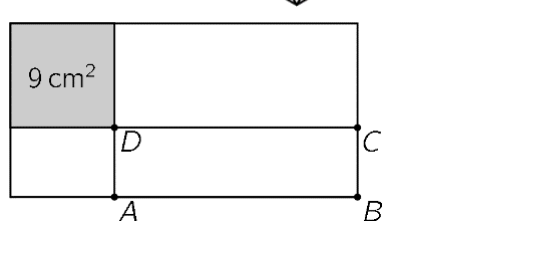
A rectangle with perimeter 30 cm is divided into four parts by a vertical line and a horizontal line. One of the parts is a square of area 9 cm², as shown in the figure. What is the perimeter of rectangle ABCD?
Show answer
Answer: C — 18 cm
Show hints
Hint 1 of 2
The square has area 9, so its side is 3; the big rectangle's half-perimeter is 15.
Still stuck? Show hint 2 →
Hint 2 of 2
Rectangle ABCD is the big rectangle with the square's width and height removed from two sides.
Show solution
Approach: relate ABCD's sides to the whole rectangle
The big rectangle has perimeter 30, so its length + width = 15.
The cut-out square has side 3 (area 9), trimming 3 from one side and 3 from the other.
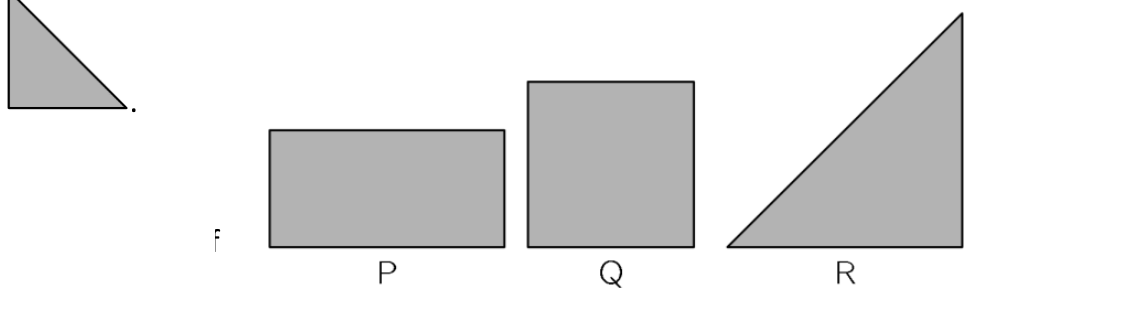
Mary had a piece of paper. She folded it exactly in half. Then she folded it exactly in half again. She got the small shape shown on the left (a right triangle). Which of the shapes P, Q or R could have been the shape of her original piece of paper?
Show answer
Answer: E — any of P, Q or R
Show hints
Hint 1 of 2
Folding once then again maps the original onto a quarter-size shape; run it backwards.
Still stuck? Show hint 2 →
Hint 2 of 2
Unfold the right triangle twice and check which of P, Q, R it could grow back into.
Show solution
Approach: unfold the result twice
Folding a sheet in half twice can turn a rectangle, a square, or a larger right triangle into this small right triangle.
Unfolding the given triangle can recreate any of shapes P, Q or R, so the answer is E (any of P, Q or R).
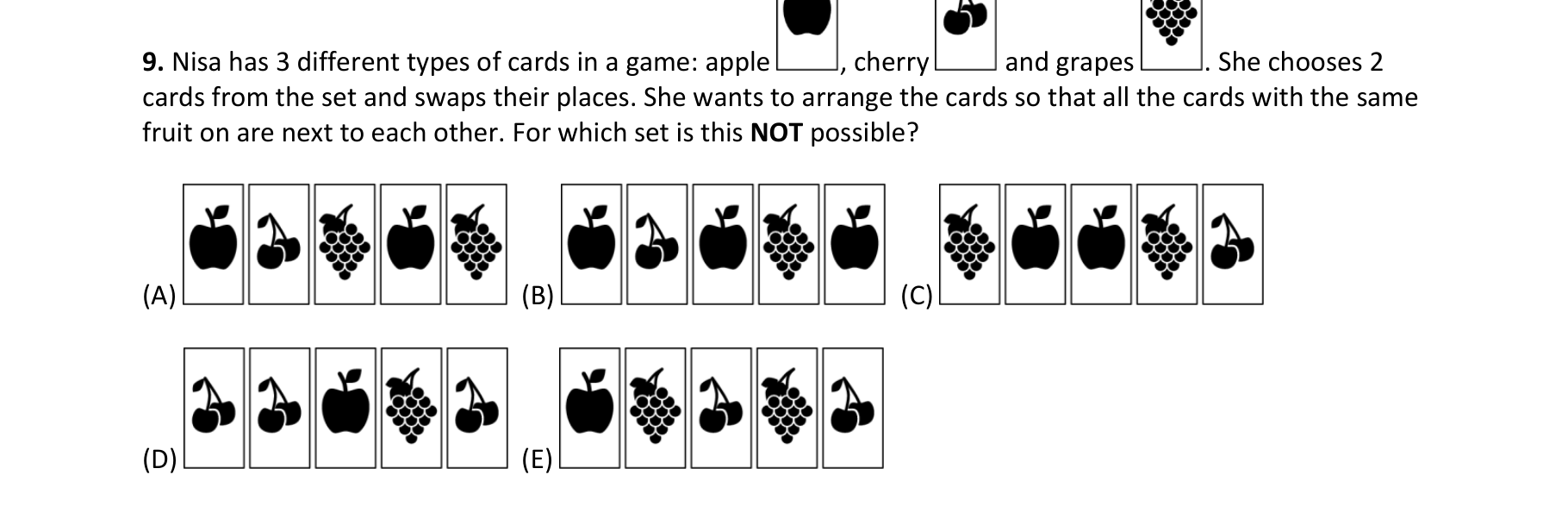
Nisa has 3 different types of cards: apple, cherry and grapes. She picks 2 cards from a row and swaps their places. She wants every card showing the same fruit to end up next to each other. For which row is this not possible with a single swap?
Show answer
Answer: A
Show hints
Hint 1 of 2
A single swap can only move 2 cards, so it can fix a row that is just 2 cards out of place.
Still stuck? Show hint 2 →
Hint 2 of 2
Check each row: try one swap and see if all the apples, all the cherries, and all the grapes end up touching.
Show solution
Approach: test whether one swap can group all like fruits in each option
One swap picks up just 2 cards and trades their spots, so it can only tidy a row that needs exactly those 2 cards moved.
Try a single swap on each row and see if it gathers every fruit into one touching group.
Four of the rows can be sorted with one swap, but in row A no single swap puts all the matching fruits together.
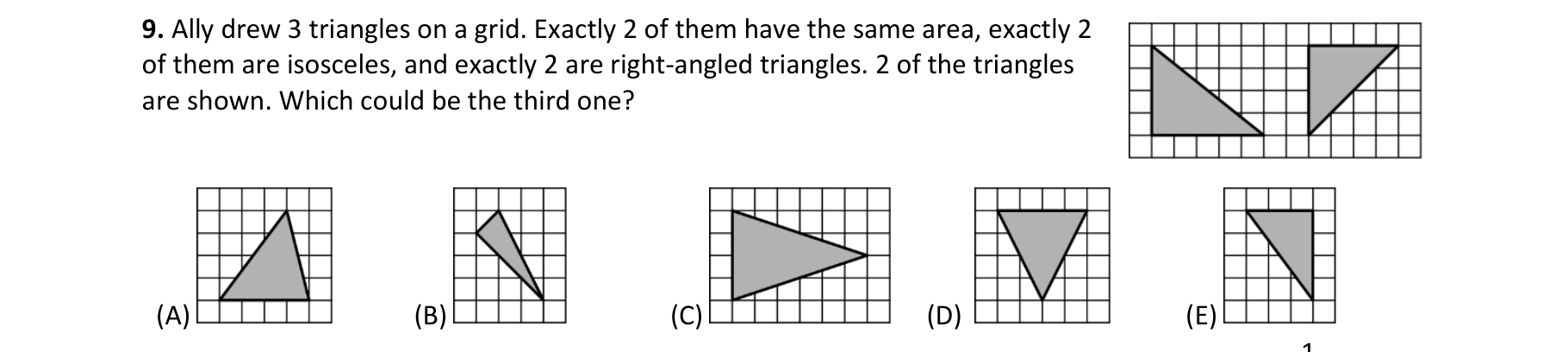
First read off the two shown triangles: count their areas, which are isosceles, and which are right-angled.
Still stuck? Show hint 2 →
Hint 2 of 2
The third triangle has to make each of the three counts land on exactly two — same area, isosceles, right-angled — so test every option against all three at once.
Show solution
Approach: make each of the three counts (equal area, isosceles, right-angled) equal exactly two
Read the two given triangles from the grid: note each one's area, whether it is isosceles, and whether it has a right angle.
The third triangle must push each count to exactly two: exactly two of equal area, exactly two isosceles, exactly two right-angled.
Check each option against all three conditions together — most options break at least one of the counts.
Only the triangle in choice (D) satisfies all three at once.
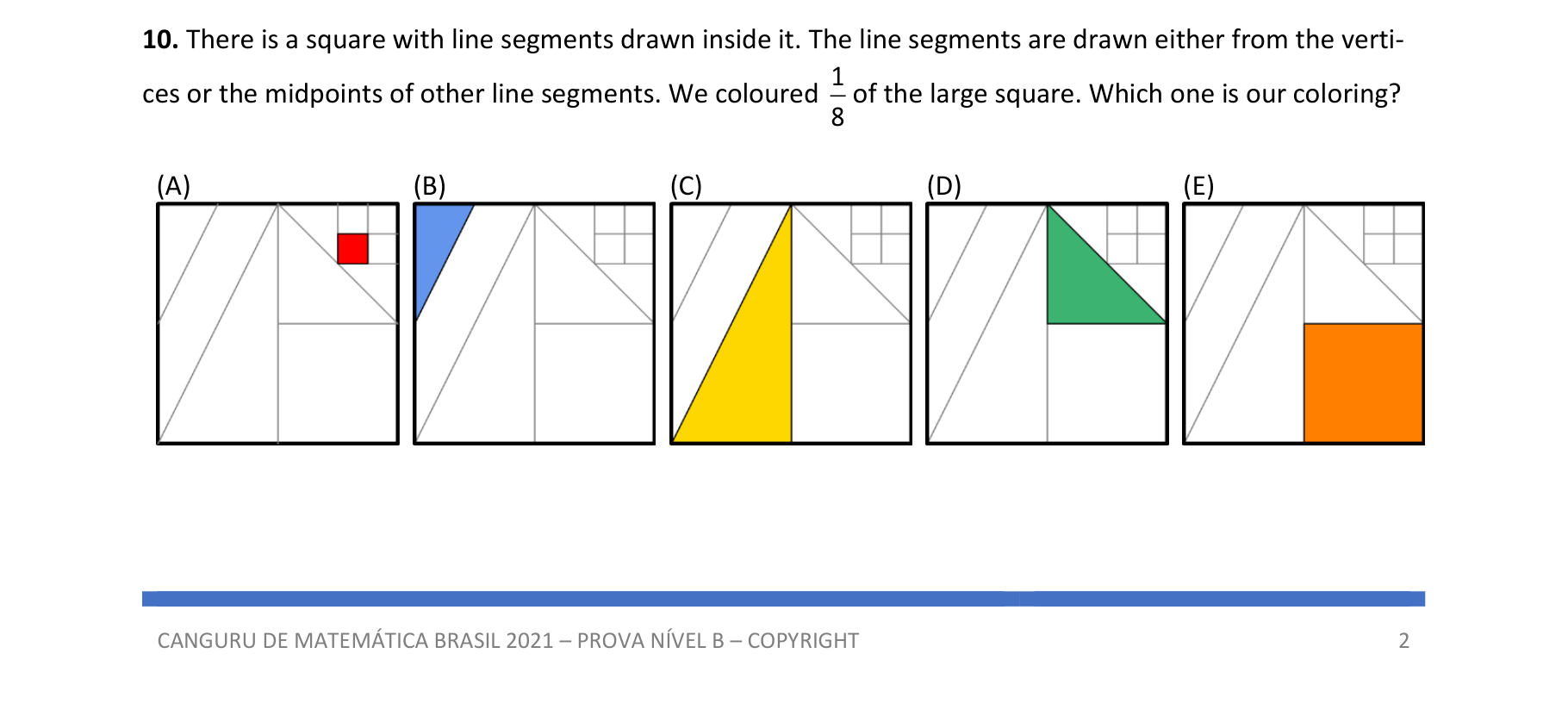
There is a square with line segments drawn inside it. The line segments are drawn either from the vertices or the midpoints of other line segments. We coloured \(\frac{1}{8}\) of the large square. Which one is our coloring?
Show answer
Answer: D
Show hints
Hint 1 of 2
Compare each shaded region's area to the whole square; you want exactly one eighth.
Still stuck? Show hint 2 →
Hint 2 of 2
Use the vertex/midpoint lines to size each shaded piece as a fraction of the big square.
Show solution
Approach: measure each shaded area as a fraction of the square
The internal lines join vertices and midpoints, so each shaded piece is a simple fraction of the large square.
Sizing them, only the region in choice D is exactly 1/8 of the square.
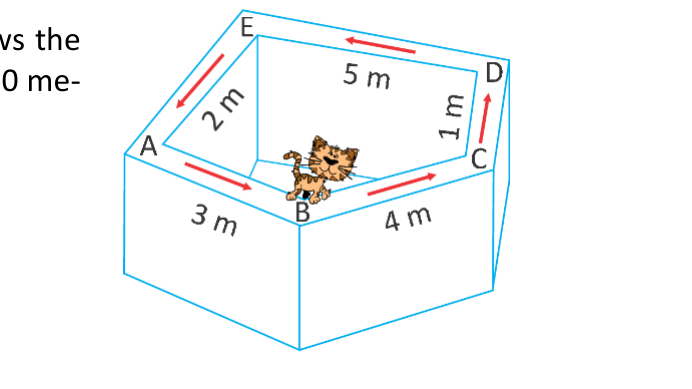
Rose the cat walks along the wall. She starts at point B and follows the direction of the arrows shown in the picture. The cat walks a total of 20 metres. Where does she end up?
Show answer
Answer: D — D
Show hints
Hint 1 of 3
Follow the arrows and add up the side lengths as the cat walks.
Still stuck? Show hint 2 →
Hint 2 of 3
Notice that one full loop brings her all the way back to where she started.
Still stuck? Show hint 3 →
Hint 3 of 3
After one full loop she still has a little walking left, so keep going from B.
Show solution
Approach: walk the path and keep a running total
Following the arrows from B, the sides are 4, 1, 5, 2 and 3 metres, which add to 15 m for one full loop back to B.
After 15 m she is at B again, with 20 − 15 = 5 m left to walk.
B to C is 4 m and C to D is 1 m, using the last 5 m exactly.
The little kangaroo has chosen a special number. She gets the same result when she subtracts 110 from her number as she does when she multiplies it by 110. What is her number?
Show answer
Answer: E — 19
Show hints
Hint 1 of 2
Call the number x and write both described results as expressions.
Still stuck? Show hint 2 →
Hint 2 of 2
Set 'x minus 1/10' equal to 'x times 1/10' and solve.
Show solution
Approach: set the two described results equal
Let the number be x. Subtracting gives x − 110; multiplying gives x10.
Byron is 5 cm taller than Aaron, but 10 cm shorter than Caron. Darren is 10 cm taller than Caron, but 5 cm shorter than Erin. Which of the following statements is true?
Show answer
Answer: E — Aaron is 30 cm shorter than Erin
Show hints
Hint 1 of 2
Anchor everyone to Aaron's height and step through the comparisons one at a time.
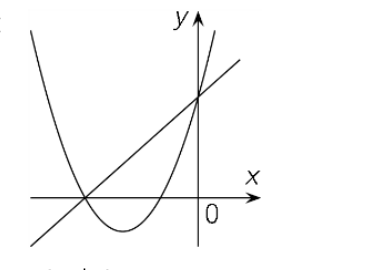
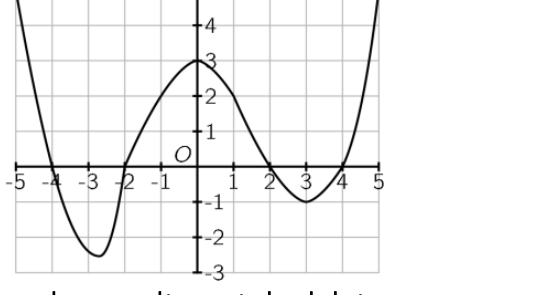
The parabola in the figure has an equation of the form \(y = ax^{2} + bx + c\) for some distinct real numbers a, b and c. Which of the following equations could be an equation of the line in the figure?
Show answer
Answer: D — \(y = ax + c\)
Show hints
Hint 1 of 2
The parabola opens upward, so what is the sign of a?
Still stuck? Show hint 2 →
Hint 2 of 2
Match the line's slope and y-intercept to combinations of a, b and c.
Show solution
Approach: read the sign of a and the intercept from the picture
The parabola opens upward, so a > 0, giving a positive slope; its y-intercept is c.
The line in the figure has positive slope and the same y-intercept c.
An equation with slope a and intercept c is y = ax + c.
The number 5021972970 is written on a sheet of paper. Julian cuts the sheet twice, so he gets 3 numbers. What is the smallest sum he can get by adding these 3 numbers?
Show answer
Answer: B — 3444
Show hints
Hint 1 of 2
Two cuts give three numbers; their sum is smallest when fewer digits sit in high place-value spots.
Still stuck? Show hint 2 →
Hint 2 of 2
Avoid leaving any single long piece with a large leading digit — spread the digits so the place values stay low.
Show solution
Approach: place the cuts to minimise total place value
The string is 5021972970; two cuts split it into three numbers.
Cutting as 502 | 1972 | 970 keeps the high place values small.
Their sum is 502 + 1972 + 970 = 3444, the smallest achievable.
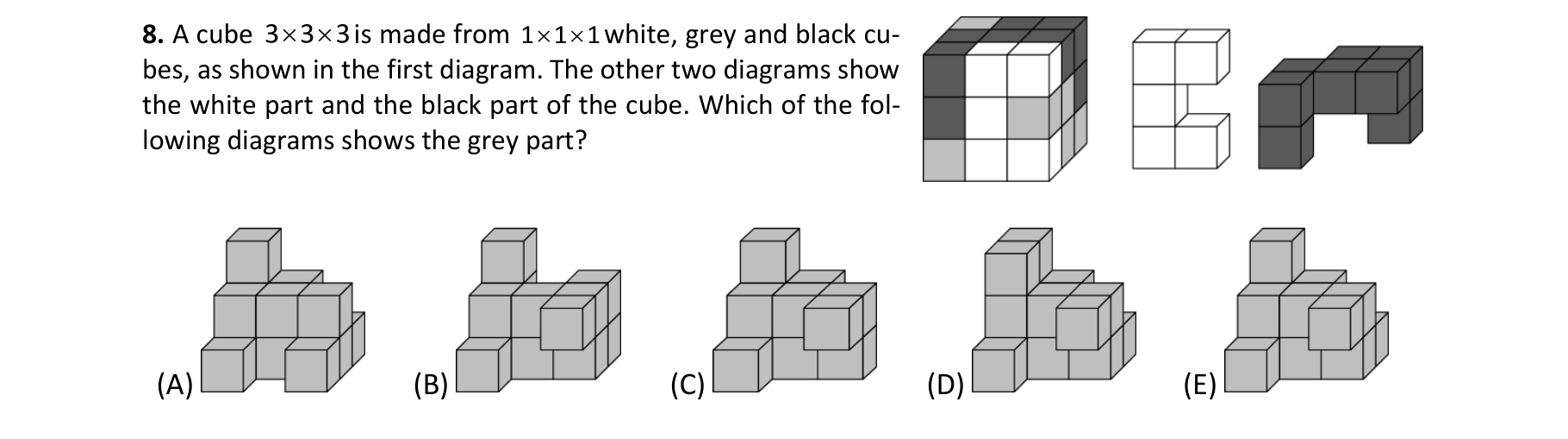
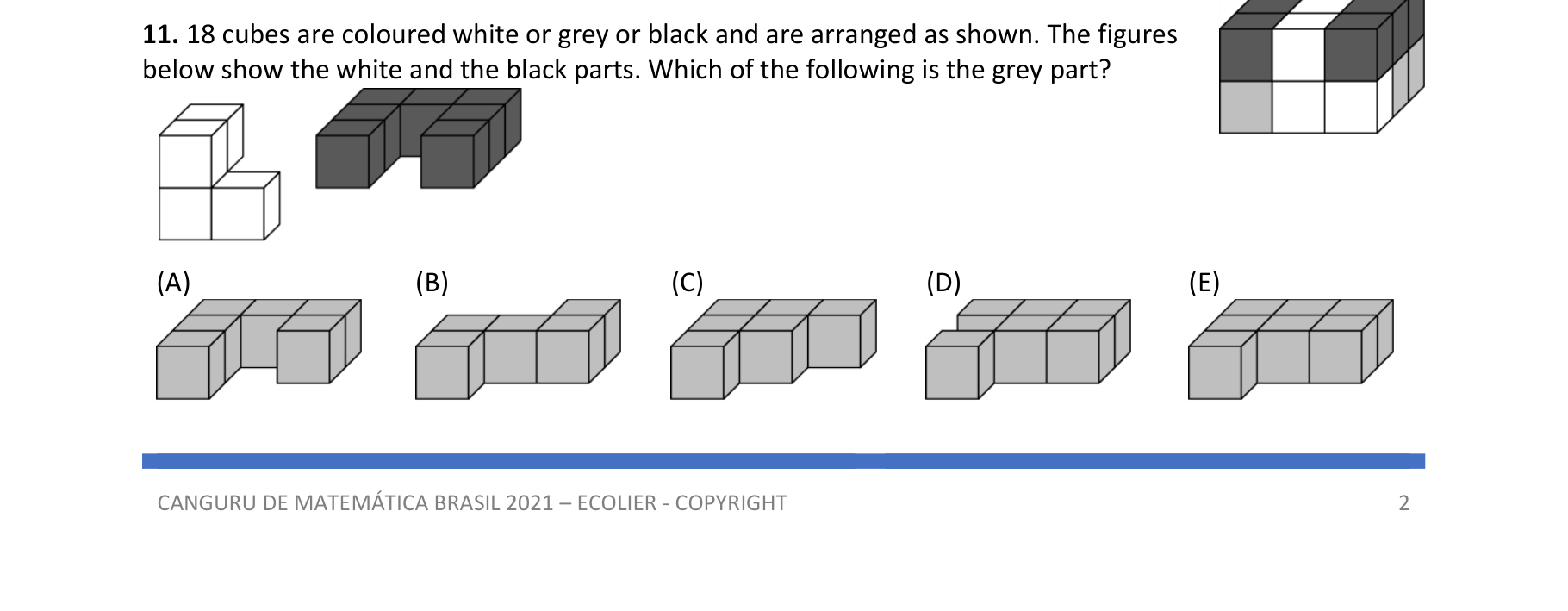
18 cubes are coloured white, grey or black and stacked into the block shown. The figures show the white part and the black part on their own. Which of the following is the grey part?
Show answer
Answer: E
Show hints
Hint 1 of 2
The whole block is white cubes plus black cubes plus grey cubes, with nothing missing.
Still stuck? Show hint 2 →
Hint 2 of 2
The grey part is just the leftover cubes — the exact shape that fills the holes the white and black pieces leave behind.
Show solution
Approach: the grey piece is the leftover after taking out the white and black
Imagine lifting the white cubes and the black cubes out of the big block.
Whatever cubes are still sitting there make up the grey part — it exactly fills the gaps the white and black left.
Matching that leftover shape to the pictures gives option E.
Julie and Angela played “kangball”, a ball game. Each goal in their game scores 2 points. Julie scored 5 goals and Angela scored 9 goals. How many more points than Julie did Angela score?
Show answer
Answer: C — 8
Show hints
Hint 1 of 3
First find how many MORE goals Angela scored than Julie.
Still stuck? Show hint 2 →
Hint 2 of 3
Each goal is worth 2 points, not 1.
Still stuck? Show hint 3 →
Hint 3 of 3
Turn just the extra goals into points.
Show solution
Approach: find the extra goals, then turn them into points
Angela scored 9 − 5 = 4 more goals than Julie.
Each goal is 2 points, so 4 goals is 4 × 2 = 8 points.
Tom had ten sparklers of the same size. He lit the first one. When only a tenth of it remained, he lit the second one. When only a tenth of that remained, he lit the third one, and so on. Sparklers burn at the same speed along their entire length, and one sparkler burns in 2 minutes. How long did it take for all 10 sparklers to burn down?
Show answer
Answer: B — 18 min 12 sec
Show hints
Hint 1 of 2
Each sparkler except the last only burns until a tenth is left before the next is lit.
Still stuck? Show hint 2 →
Hint 2 of 2
Add nine 'nine-tenths of 2 minutes' burns plus one full burn.
Show solution
Approach: sum the partial burns plus one full burn
A whole sparkler burns in 2 minutes; burning down to one tenth uses 9/10 of that, i.e. 1.8 minutes.
Sparklers 1 through 9 each contribute 1.8 minutes before the next is lit: 9×1.8 = 16.2 minutes.
The tenth sparkler burns completely: +2 minutes, total 18.2 minutes.
A rectangular chocolate bar is made of equal squares. Neil breaks off two complete strips of squares and eats the 12 squares he obtains. Later, Jack breaks off one complete strip of squares from the same bar and eats the 9 squares he obtains. How many squares of chocolate are left in the bar?
Show answer
Answer: D — 45
Show hints
Hint 1 of 2
Neil's two equal strips total 12, so a strip in that direction holds 6 — that fixes one side of the bar.
Still stuck? Show hint 2 →
Hint 2 of 2
Jack's strip runs the other way; remember Neil already removed two rows before Jack broke his strip.
Show solution
Approach: recover the bar's dimensions from the strip sizes
Neil's two equal strips give 12 squares, so each strip holds 6: one side of the bar is 6.
Jack's strip runs the other way and holds 9, but Neil had already removed 2 squares from that direction, so the full bar was 6 by (9+2) = 11, i.e. 66 squares.
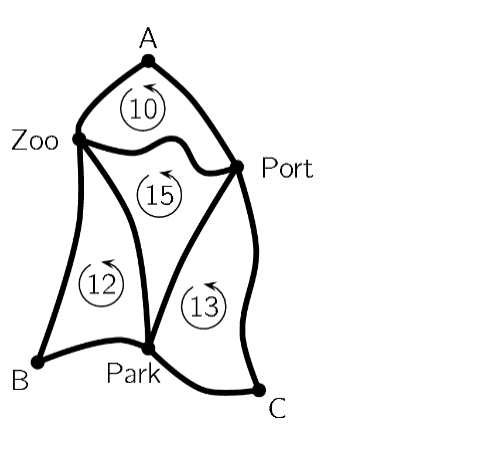
The map shows three bus stations at points A, B and C. A tour from station A to the Zoo and the Port and back to A is 10 km long. A tour from station B to the Park and the Zoo and back to B is 12 km long. A tour from station C to the Port and the Park and back to C is 13 km long. Also, a tour from the Zoo to the Park and the Port and back to the Zoo is 15 km long. How long is the shortest tour from A to B to C and back to A?
Show answer
Answer: B — 20 km
Show hints
Hint 1 of 2
Each given tour is a there-and-back loop, so it is twice some pair of legs.
Still stuck? Show hint 2 →
Hint 2 of 2
Add up the right combination of half-loops to build the A-B-C-A circuit.
Show solution
Approach: route through the inner points and use the loop totals
Send the trip A→Zoo→B→Park→C→Port→A. Then A→Zoo and Port→A are the two legs of the 10-loop minus its Zoo–Port leg, and similarly for the other two stations.
Adding up, the six legs total (10 − Zoo–Port) + (12 − Park–Zoo) + (13 − Port–Park) = 35 − (Zoo–Port + Park–Zoo + Port–Park).
But Zoo–Port + Park–Zoo + Port–Park is exactly the 15-km Zoo–Park–Port loop, so the tour is 35 − 15 = 20 km.
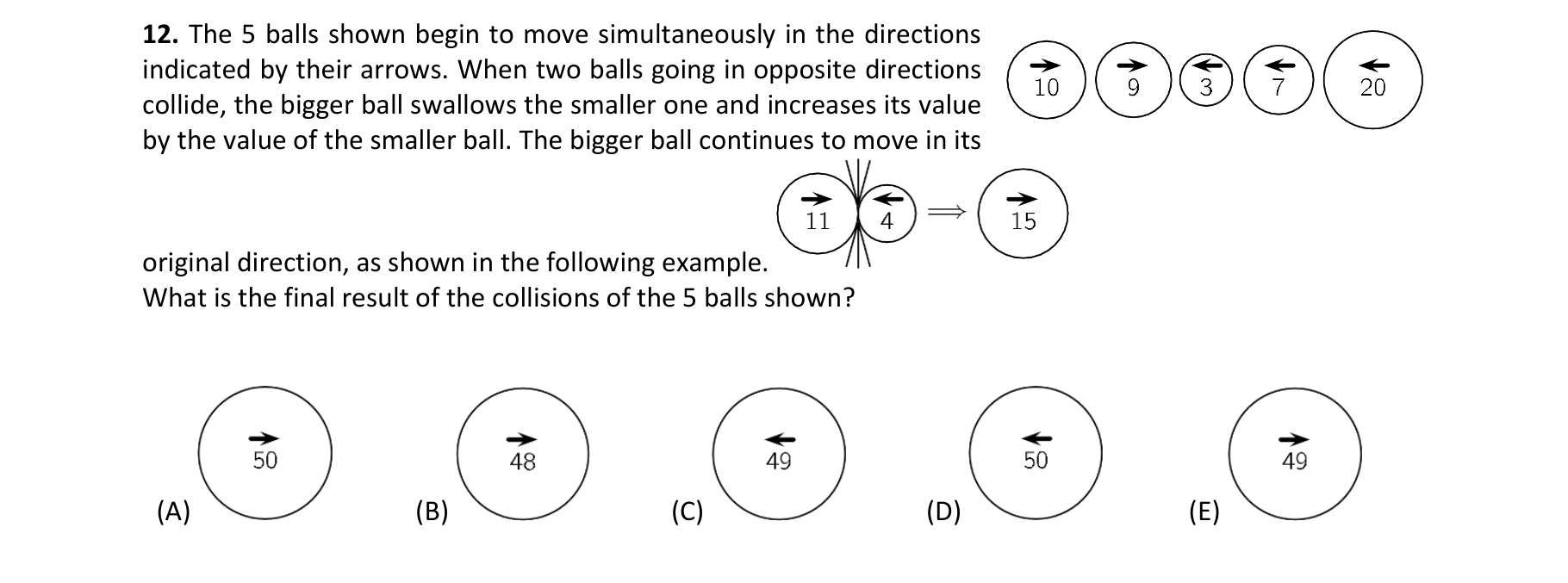
The 5 balls shown begin to move at the same time in the directions of their arrows. When two balls going in opposite directions collide, the bigger ball swallows the smaller one and grows by the smaller ball's value, then keeps moving in its own direction (see the worked example). What is the final result of the collisions of the 5 balls?
Show answer
Answer: C
Show hints
Hint 1 of 2
When two balls bump head-on, the bigger one eats the smaller one and grows by its number, still going the same way.
Still stuck? Show hint 2 →
Hint 2 of 2
No ball ever disappears, so the final ball's number is just every ball's number added together — you only need its direction too.
Show solution
Approach: all the balls merge into one, so add the values and find the direction
Nothing is ever lost in a collision, so the one ball left at the end is worth 10 + 9 + 3 + 7 + 20 = 49.
Following the bumps shows the big left-going 20 keeps winning the head-on hits, so the surviving ball moves left.
Matching '49 moving left' to the pictures gives option C.
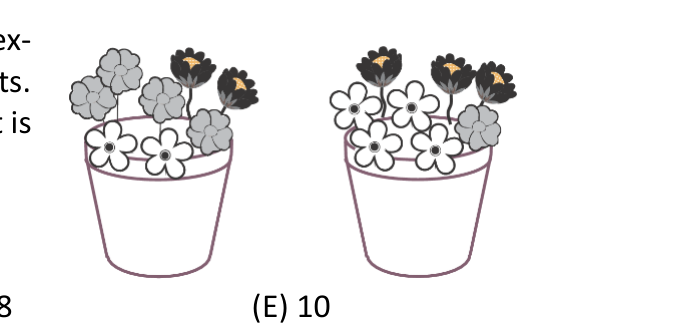
Julia has two pots with flowers, as shown. She keeps the flowers exactly where they are. She buys more flowers and puts them in the pots. After that, each pot has the same number of each type of flower. What is the smallest number of flowers she needs to buy?
Show answer
Answer: D — 8
Show hints
Hint 1 of 3
Look at one type of flower at a time and compare the two pots.
Still stuck? Show hint 2 →
Hint 2 of 3
Whichever pot has fewer of that type needs to be filled up to match the other.
Still stuck? Show hint 3 →
Hint 3 of 3
Add up all the missing flowers across both pots.
Show solution
Approach: match each flower type to the larger count
For each kind of flower, both pots must end up with the bigger of the two amounts they already have.
For every type, count how many are missing in the pot that is short, and add those up.
Adding all the missing flowers gives 8 extra flowers to buy.
Ahmad walks up 8 steps, going up either 1 or 2 steps at a time. There is a hole on the 6th step, so he cannot use this step. In how many different ways can Ahmad reach the top step?
Show answer
Answer: C — 8
Show hints
Hint 1 of 2
Count, step by step, the number of ways to reach each step using 1- or 2-step moves.
Still stuck? Show hint 2 →
Hint 2 of 2
The forbidden 6th step has 0 ways; carry that 0 forward to the top.
Show solution
Approach: build up ways-to-reach each step (Fibonacci-style)
Ways to reach steps 1..5 are 1, 2, 3, 5, 8 (each is the sum of the two below).
Step 6 is a hole, so it has 0 ways and cannot be used.
If \(A = {]0,1[} \cup {]2,3[}\) and \(B = {]1,2[} \cup {]3,4[}\), what is the set of all numbers of the form \(a+b\) with \(a \in A\) and \(b \in B\)? (Here \(]m,n[\) denotes the open interval from m to n.)
Show answer
Answer: D — \(]1,3[ \cup ]3,5[ \cup ]5,7[\)
Show hints
Hint 1 of 2
Add each piece of A to each piece of B; adding two open intervals gives another open interval.
Still stuck? Show hint 2 →
Hint 2 of 2
Take the union of all the resulting intervals.
Show solution
Approach: add the intervals pairwise and union the results
A = (0,1)∪(2,3), B = (1,2)∪(3,4). Adding endpoints: (0,1)+(1,2)=(1,3); (0,1)+(3,4)=(3,5); (2,3)+(1,2)=(3,5); (2,3)+(3,4)=(5,7).
The union is (1,3) ∪ (3,5) ∪ (5,7) — note 3 and 5 are never reached.
In an ice cream shop there is some money in a drawer. After 6 ice creams were sold, there were 70 euros left in the drawer. After a total of 16 ice creams were sold, there were 120 euros left in the drawer. How many euros were there in the drawer at the start?
Show answer
Answer: C — 40
Show hints
Hint 1 of 2
Between the two moments, 10 more ice creams were sold and the drawer grew by 50 euros.
Still stuck? Show hint 2 →
Hint 2 of 2
Find the price of one ice cream, then step back to before any were sold.
Show solution
Approach: find the price per ice cream, then work back to the start
From 6 to 16 sold is 10 more ice creams, and the money rose from 70 to 120, i.e. +50 euros.
So each ice cream costs 50 / 10 = 5 euros.
The first 6 brought in 6 x 5 = 30 euros, so the start amount was 70 - 30 = 40 euros.
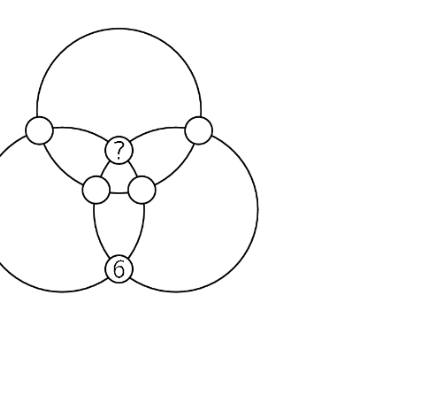
The numbers from 1 to 6 are placed in the circles at the intersections of 3 rings. The position of the number 6 is shown. The sum of the numbers on each ring is the same. What number is placed in the circle with the question mark?
Show answer
Answer: A — 1
Show hints
Hint 1 of 2
Add 1..6 to get 21; each circle lies on two rings, so the three ring-sums add to twice 21.
Still stuck? Show hint 2 →
Hint 2 of 2
That fixes every ring's sum; use the given 6 to pin down the marked circle.
Show solution
Approach: use the common ring sum
The numbers 1..6 add to 21, and every circle sits on exactly two rings.
So the three equal ring-sums total 2×21 = 42, making each ring sum to 14.
Working from the fixed 6 and the requirement that each ring totals 14 forces the marked circle.
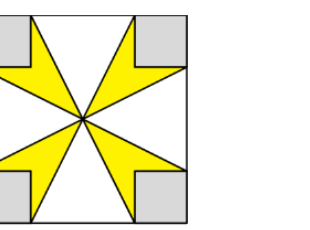
The area of the large square is 16 cm² and the area of each small (corner) square is 1 cm². What is the total area of the central flower, in cm²?
Show answer
Answer: C — 4
Show hints
Hint 1 of 2
The big square is 4×4 since its area is 16, and it is split into a 4×4 grid of unit squares.
Still stuck? Show hint 2 →
Hint 2 of 2
Find the flower's area by combining its petal pieces using the symmetry of the figure.
Show solution
Approach: decompose the unit-grid square
Area 16 means the big square is 4 by 4, so the unit corner squares have side 1 and the centre is the middle of the grid.
The flower has 8 yellow petals; the 4 'straight' petals each reach from the centre to a side, and the 4 'diagonal' petals reach toward the corner unit squares.
By symmetry the 8 petals together tile half of the inner 2×2 region around the centre plus matching slivers, and the pieces total 4 cm².
How many three-digit natural numbers have the property that when their digits are written in reverse order, the result is a three-digit number which is 99 more than the original number?
Show answer
Answer: D — 80
Show hints
Hint 1 of 2
Write the number and its reversal using place value and subtract.
Still stuck? Show hint 2 →
Hint 2 of 2
The difference depends only on the first and last digits; set it equal to 99.
Show solution
Approach: use place value to relate a number and its reversal
For a 3-digit number 100a+10b+c, the reversal is 100c+10b+a, and their difference is 99(c − a).
Setting 99(c − a) = 99 gives c = a + 1.
With a from 1 to 8 (so c stays a digit) and b any of 0–9, that is 8 × 10 = 80 numbers.
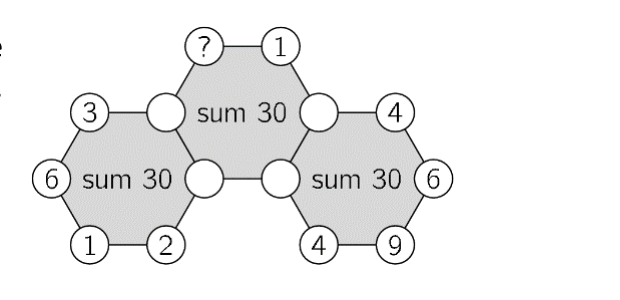
The diagram shows 3 hexagons with numbers at their vertices, but some numbers are invisible. The sum of the 6 numbers around each hexagon is 30. What is the number on the vertex marked with a question mark?
Show answer
Answer: B — 4
Show hints
Hint 1 of 2
Each hexagon's six vertex numbers add to 30; shared vertices link the hexagons.
Still stuck? Show hint 2 →
Hint 2 of 2
Set the unknown shared values from one hexagon's total, then use them in the hexagon with the '?'.
Show solution
Approach: use the constant hexagon sum and shared vertices
Every hexagon totals 30, and two neighbouring hexagons share the two vertices on their common edge.
Comparing the middle hexagon (holding the ?) with a neighbouring hexagon, the shared vertices appear in both totals and cancel, so the difference of their other vertices is forced.
Filling the blanks from the visible numbers that way pins the marked vertex to 4.
The Koala ate some leaves from 3 branches. Each branch had 20 leaves. The Koala ate a few leaves from the first branch and then ate as many leaves from the second branch as were left on the first branch. Then it ate 2 leaves from the third branch. How many leaves in total were left on the 3 branches?
Show answer
Answer: E — 38
Show hints
Hint 1 of 2
Look only at branches 1 and 2 together first — the koala eats from branch 2 exactly what is left on branch 1.
Still stuck? Show hint 2 →
Hint 2 of 2
The leaves it eats from branch 2 are the same as the leaves still on branch 1, so the two branches together always keep the same amount no matter how much it ate first.
Show solution
Approach: branches 1 and 2 together always keep 20, then add branch 3
Branches 1 and 2 start with 20 + 20 = 40 leaves between them.
From these two branches the koala eats (some off branch 1) and then the same number off branch 2, so it eats the same amount as the leaves left on branch 1 — meaning branches 1 and 2 together always keep 20 leaves, whatever it nibbled first.
Branch 3 only loses 2 leaves, so it keeps 20 - 2 = 18.
Total left = 20 + 18 = 38, so the answer is 38 (E).
Costa is building a new fence in his garden. He uses 25 planks of wood, each of which are 30 cm long. He arranges these planks so that there is the same slight overlap between any two adjacent planks. The total length of Costa's new fence is 6.9 metres. What is the length, in centimetres, of the overlap between any pair of adjacent planks?
Show answer
Answer: B — 2.5
Show hints
Hint 1 of 2
With 25 planks there are 24 overlaps, all equal.
Still stuck? Show hint 2 →
Hint 2 of 2
Compare the total plank length to the actual fence length to find the overlap total.
Show solution
Approach: account for total length lost to overlaps
Laid end to end the 25 planks would span 25·30 = 750 cm.
The fence is only 690 cm, so 750 − 690 = 60 cm is lost to overlapping.
There are 24 equal overlaps, so each is 60 ÷ 24 = 2.5 cm.
The first 1000 positive integers are written in a row in some order and all sums of any three adjacent numbers are calculated. What is the greatest number of odd sums that can be obtained?
Show answer
Answer: A — 997
Show hints
Hint 1 of 2
A sum of three numbers is odd exactly when an odd count of them is odd.
Still stuck? Show hint 2 →
Hint 2 of 2
Think about how arranging the 500 odd and 500 even numbers controls the parity of each window of three.
Show solution
Approach: track parities; a window's sum is odd when it holds an odd count of odd numbers
Only parity matters: write O for an odd number and E for an even one. There are 500 of each, and a window of three has an odd sum exactly when it contains one or three O's.
There are 998 windows of three. The repeating block OOEOOE… gives an odd sum in every window except those straddling a break, and a short check shows you cannot make all 998 odd.
Arranging the 500 O's and 500 E's carefully leaves exactly one window even, so the greatest number of odd sums is 997.
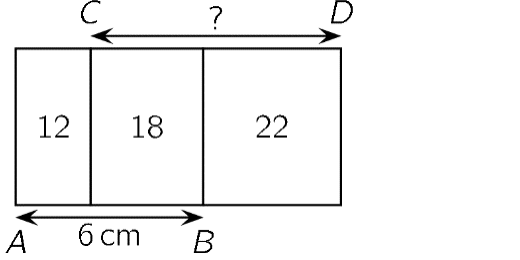
3 rectangles of the same height are positioned as shown. The numbers within the rectangles indicate their areas in cm². If AB = 6 cm, how long is the distance CD?
Show answer
Answer: C — 8 cm
Show hints
Hint 1 of 2
The rectangles share one height, so each width equals its area divided by that common height.
Still stuck? Show hint 2 →
Hint 2 of 2
AB covers the first two widths; find the height from AB, then add the last two widths for CD.
Show solution
Approach: find the shared height, then add widths
AB spans the 12 and 18 rectangles, so (12+18)/height = 6, giving height = 5 cm.
Then the widths are 12/5, 18/5, 22/5 = 2.4, 3.6, 4.4 cm.
CD spans the 18 and 22 rectangles: 3.6 + 4.4 = 8 cm.
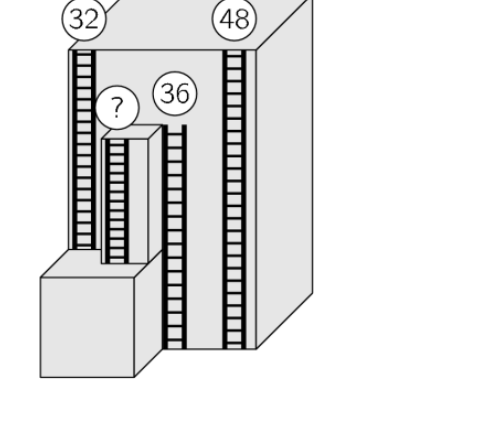
On a tall building there are 4 fire escape ladders, as shown. The heights of 3 of the ladders are marked at their tops (32, 48 and 36). What is the height of the shortest ladder?
Show answer
Answer: D — 20
Show hints
Hint 1 of 2
Each ladder stands on a ledge, and a taller ledge means a taller ladder top — the ledges step up by equal amounts.
Still stuck? Show hint 2 →
Hint 2 of 2
Find the step between two ladders whose tops you know, then step the same amount down to the shortest ladder.
Show solution
Approach: find the equal step between ladder tops and step down to the shortest
The ladders sit on ledges that rise by the same step each time, so their tops rise by that same step too.
Two of the marked tops are 48 and 36, a step of 48 - 36 = 12.
Stepping down 12 from the 32 ladder gives the shortest ladder: 32 - 12 = 20.
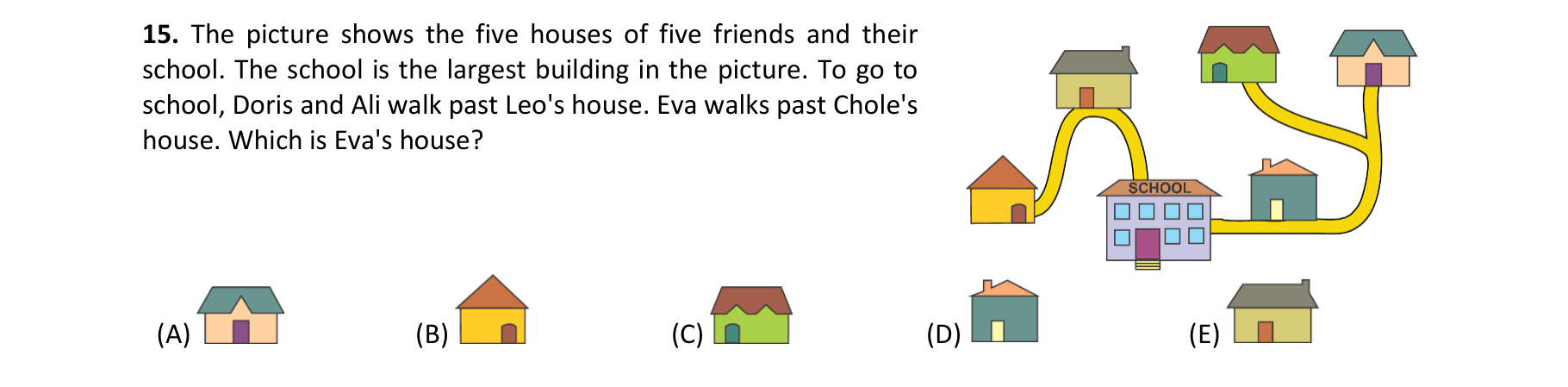
The picture shows the five houses of five friends and their school. The school is the largest building in the picture. To go to school, Doris and Ali walk past Leo's house. Eva walks past Chloe's house. Which is Eva's house?
Show answer
Answer: B
Show hints
Hint 1 of 3
Find the school first, then trace the road each child walks to get there.
Still stuck? Show hint 2 →
Hint 2 of 3
The clues about Leo's house help you figure out who lives where.
Still stuck? Show hint 3 →
Hint 3 of 3
Eva's road is the one that goes right past Chloe's house.
Show solution
Approach: trace the roads to school
Find the big school, then look at which houses you walk past on the way from each house.
The clue that Doris and Ali pass Leo's house tells you where Leo lives.
Eva's road is the one passing Chloe's house, and tracing it back, Eva's house is option B.
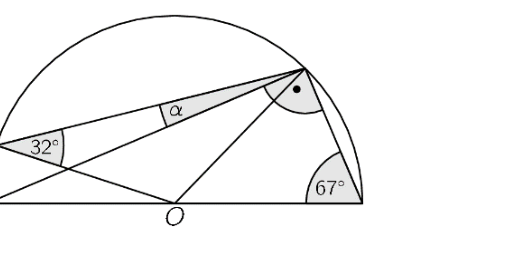
The figure shows a semicircle with center O. Two of the angles are given. What is the size, in degrees, of the angle α?
Show answer
Answer: A — 9°
Show hints
Hint 1 of 2
Every segment drawn from the centre O out to the arc is a radius, so each triangle with O at a vertex is isosceles with two equal base angles.
Still stuck? Show hint 2 →
Hint 2 of 2
Use the exterior-angle rule: in an isosceles radius-triangle the apex's exterior angle equals twice a base angle, so the angles grow by doubling as you step along the chain from \(32°\) toward the \(67°\) corner.
The chords from the diameter's left end and from O to the top point P all share endpoints with radii, so the figure is a chain of isosceles triangles built on equal radii.
Starting from the \(32°\) base angle, each successive isosceles triangle's exterior angle is twice the previous base angle, so the marked directions advance \(32°,\,64°,\,\dots\) around toward P.
The \(67°\) angle at the right-hand end fixes where the last radius points, and \(α\) is the small leftover between that direction and chord \(PR\): the doubling chain and the \(67°\) constraint leave exactly \(9°\).
Five identical right-angled triangles can be arranged so that their larger acute angles touch to form the star shown in the diagram. It is also possible to form a different star by arranging more of these triangles so that their smaller acute angles touch. How many triangles are needed to form the second star?
Show answer
Answer: D — 20
Show hints
Hint 1 of 2
Five large acute angles meeting at a point fill 360°, so each large acute angle is 72°.
Still stuck? Show hint 2 →
Hint 2 of 2
The small acute angle is 90° minus the large one; see how many fill a full turn.
Show solution
Approach: use the angles meeting at the star's centre
For the first star, 5 equal larger acute angles surround the centre: 360° ÷ 5 = 72°.
The triangle is right-angled, so the smaller acute angle is 90° − 72° = 18°.
For the second star, smaller angles meet at the centre: 360° ÷ 18° = 20 triangles.
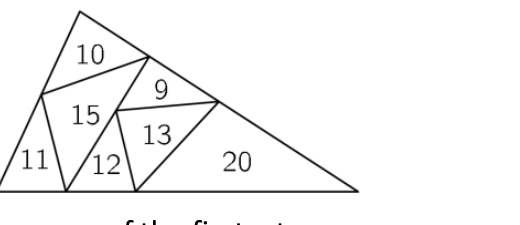
A large triangle is divided into smaller triangles as shown. The number inside each small triangle indicates its perimeter. What is the perimeter of the large triangle?
Show answer
Answer: C — 34
Show hints
Hint 1 of 2
Add up all the small perimeters; every inner edge gets counted twice.
Still stuck? Show hint 2 →
Hint 2 of 2
Subtract twice the total length of the shared interior edges to leave only the outer boundary.
Show solution
Approach: relate the sum of small perimeters to the outer boundary
Adding every small triangle's perimeter counts each interior (shared) edge twice and each outer edge once: the labels total 10+9+15+13+11+12+20 = 90.
So the large triangle's perimeter = 90 − 2×(total length of the interior edges).
The interior edges in the figure add up to 28, leaving an outer perimeter of 90 − 56 = 34.
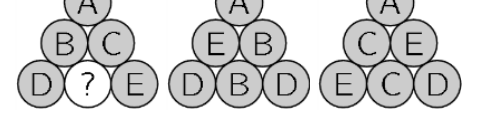
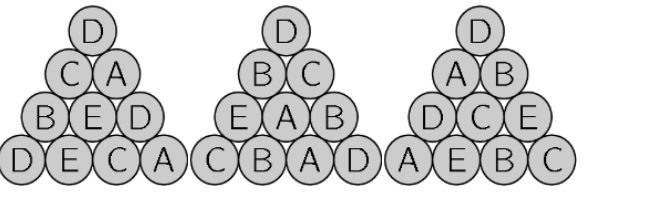
A triangular pyramid is built with 10 identical balls. Each ball has one of the letters A, B, C, D and E on it, and there are 2 balls marked with each letter. The picture shows 3 side views of the pyramid. What is the letter on the ball with the question mark?
Show answer
Answer: A — A
Show hints
Hint 1 of 2
Ten balls, two of each of A–E; the three side views show different faces of the same pyramid.
Still stuck? Show hint 2 →
Hint 2 of 2
Use the visible letters to deduce which letters are already placed, leaving the '?' ball's identity.
Show solution
Approach: reconcile the three views
Each letter appears exactly twice among the ten balls, and the three views show the pyramid from different sides.
Tracking which positions carry which letters across the views fixes every ball except the marked one.
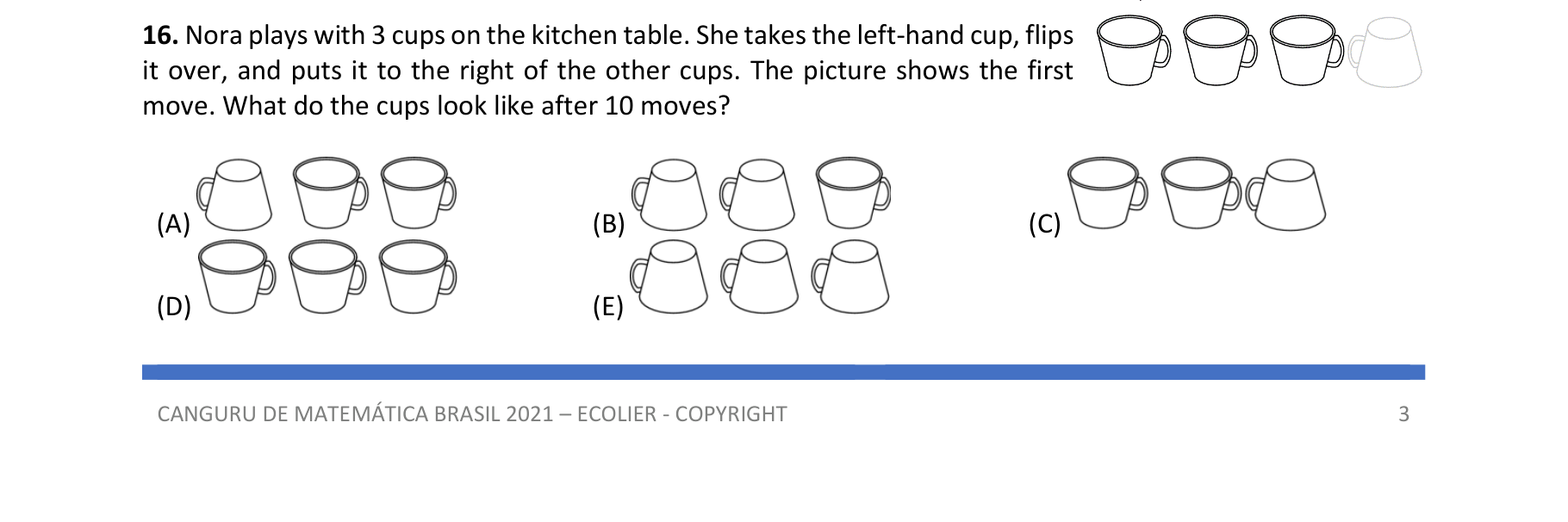
Nora plays with 3 cups on the table. In each move she takes the left-hand cup, flips it over, and puts it to the right of the other cups. The picture shows the first move. What do the cups look like after 10 moves?
Show answer
Answer: B
Show hints
Hint 1 of 2
Draw the up/down pattern after each move and watch for it to come back to the start.
Still stuck? Show hint 2 →
Hint 2 of 2
Once you know how many moves bring the cups back to the beginning, you can skip ahead to move 10.
Show solution
Approach: draw the moves until the pattern repeats, then read off move 10
Start with all 3 cups upright and flip-and-move the left cup each time: up-up-up turns into up-up-down, then up-down-down, then down-down-down.
Keep going: down-down-up, down-up-up, and at move 6 the cups are back to up-up-up — so the pattern repeats every 6 moves.
Move 10 is 4 moves past move 6, so it matches move 4: down-down-up.
The kangaroo had two branches for lunch. Each branch had 10 leaves. The kangaroo ate some leaves from one branch. Then, from the second branch, it ate as many leaves as were left on the first branch. How many leaves in total were left on the two branches?
Show answer
Answer: D — 10
Show hints
Hint 1 of 3
Whatever is LEFT on the first branch is exactly what gets EATEN from the second branch.
Still stuck? Show hint 2 →
Hint 2 of 3
Try a number: if 4 leaves are left on branch one, the kangaroo eats 4 from branch two.
Still stuck? Show hint 3 →
Hint 3 of 3
Count the leaves still left on both branches and look for a pattern.
Show solution
Approach: the leftover from one branch is eaten from the other
Whatever is left on the first branch, the kangaroo eats that same number from the second branch.
So the leaves eaten from branch two exactly match the leaves still on branch one.
That leaves one full branch worth in total: 10 leaves.
In a team competition, there are 5 teams waiting to start. Each team consists of either only boys or only girls. The numbers of team members are 9, 15, 17, 19 and 21. After all members of the first team have started, the number of girls not yet started is 3 times the number of boys not yet started. How many members are on the team that has already started?
Show answer
Answer: E — 21
Show hints
Hint 1 of 2
After one team leaves, the remaining members split as boys and 3×boys, so the leftover total must be divisible by 4.
Still stuck? Show hint 2 →
Hint 2 of 2
Total is 81; test which starting team size leaves a multiple of 4 that also splits along whole teams.
Show solution
Approach: use the divisible-by-4 leftover and check team splits
All five teams total 9+15+17+19+21 = 81.
After the first team starts, the rest split as boys + 3×boys = 4×boys, so the leftover must be a multiple of 4.
Only removing 21 leaves 60, which splits as 15 boys and 45 girls (45 = 3×15), with whole teams 15 and 9+17+19.
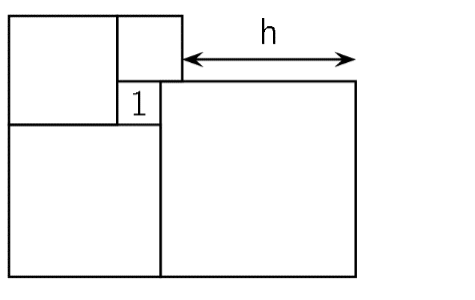
Five squares are positioned as shown. The small square indicated has area 1. What is the value of h?
Show answer
Answer: C — 4 m
Show hints
Hint 1 of 2
The marked small square has area 1, so its side is 1; use it as the unit of length.
Still stuck? Show hint 2 →
Hint 2 of 2
Work along the staircase of squares to express h in those units.
Show solution
Approach: measure with the unit square
The marked small square has area 1, so its side is 1; use that as the unit of length along the figure.
Each larger square's side is set by stacking on the one beside it, so the side lengths grow by fixed steps measured in those units.
The arrow h reaches across the top from the small square's structure to the far edge of the big right-hand square, and summing those side-steps gives h = 4 m.
An infinite list of numbers has the property that, for each positive integer n, the average of the first n terms is n. How many terms are there less than 2021?
Show answer
Answer: C — 1010
Show hints
Hint 1 of 2
If the average of the first n terms is n, what is their sum?
Still stuck? Show hint 2 →
Hint 2 of 2
Get a single term by subtracting consecutive sums.
Show solution
Approach: turn the average condition into the n-th term
Average of first n is n means the sum of the first n terms is n².
The n-th term is n² − (n−1)² = 2n − 1 (the odd numbers 1, 3, 5, …).
We need 2n − 1 < 2021, i.e. n ≤ 1010, so 1010 terms.
Ronja had four white tokens and Wanja had four grey tokens. They played a game in which they took turns to place one of their tokens to create two piles. Ronja placed her first token first. Which pair of piles could they not create?
Show answer
Answer: E
Show hints
Hint 1 of 2
Tokens are placed alternately starting with a white one, so the placing order constrains each pile.
Still stuck? Show hint 2 →
Hint 2 of 2
Reconstruct the colour pattern each option needs and find the one no legal alternating order can produce.
Show solution
Approach: test each stacking against the alternating rule
Ronja (white) places first, then they alternate colours as they build the two piles.
For each option, try to order the eight placements so colours alternate and the piles end up as shown.
Only the pair in choice E cannot arise from any valid alternating sequence.
Eva has 5 stickers: a triangle, a circle, a star, a flower and an apple. She sticks one of them on each of the 5 squares of this board so that the star is not on square 5, the apple is on square 1, and the flower is next to both the circle and the triangle. On which square did Eva stick the flower?
1
2
3
4
5
Show answer
Answer: D — 4
Show hints
Hint 1 of 2
Pin down the sure clues first: the apple goes on square 1, and the star may not go on square 5.
Still stuck? Show hint 2 →
Hint 2 of 2
The flower touches both the circle and the triangle, so those three stickers sit in a row of three squares with the flower in the middle.
Show solution
Approach: place the forced stickers, then fit the flower
The apple is on square 1, so the circle, star, flower and triangle fill squares 2, 3, 4, 5.
The flower touches both the circle and the triangle, so circle–flower–triangle sit in three squares in a row with the flower in the middle — either 2–3–4 or 3–4–5.
If they took 2–3–4, the star would be forced onto square 5, which is not allowed; so they take 3–4–5 and the star goes on square 2.
Five cars participated in a race, starting in the order I, II, III, IV, V. Whenever a car overtook another car, a point was awarded. The cars reached the finish line in the order III, V, I, IV, II. What is the smallest number of points in total that could have been awarded?
Show answer
Answer: E — 6
Show hints
Hint 1 of 2
The fewest overtakes equals the number of pairs that swap their relative order from start to finish.
Still stuck? Show hint 2 →
Hint 2 of 2
Compare every pair of cars and count how many ended in the opposite order to how they started.
Show solution
Approach: count order-reversed pairs (inversions)
Each overtake swaps one adjacent pair, so the minimum total equals the number of pairs whose order reversed.
Start I,II,III,IV,V; finish III,V,I,IV,II.
Counting all pairs that flipped relative order gives 6 such pairs.
There are 20 questions in a quiz. Each correct answer scores 7 points, each wrong answer scores −4 points, and each question left blank scores 0 points. Eric took the quiz and scored 100 points. How many questions did he leave blank?
Show answer
Answer: B — 1
Show hints
Hint 1 of 2
Let the numbers of correct, wrong and blank answers add to 20, with score 7c − 4w = 100.
Still stuck? Show hint 2 →
Hint 2 of 2
Search for whole-number solutions and read off the blanks.
Show solution
Approach: solve the score equation in whole numbers
With c correct and w wrong: 7c − 4w = 100 and c + w ≤ 20.
c = 16, w = 3 gives 112 − 12 = 100, and that is the only fit.
In the \(5 \times 5\) square shown the sum of the numbers in each row and in each column is the same. There is a number in every cell, but some of the numbers are not shown. What is the number in the cell marked with a question mark?
Show answer
Answer: B — 10
Show hints
Hint 1 of 2
The grand total of a 1–25 square fixes the common row/column sum.
Still stuck? Show hint 2 →
Hint 2 of 2
Use row and column equations through the marked cell to pin its value.
Show solution
Approach: use the magic sum, then solve the right cells
The numbers 1–25 total 325, so each row and column sums to 65.
Solving the equations for row 2 and the involved columns forces the entries 7, 15, 13, 17 around column 4.
Column 4 then gives 22 + e + 1 + j + ? = 65 with e=15, j=17, so ? = 10.
Three pirates were asked how many coins and how many diamonds their friend Graybeard had. Each of the three told the truth to one question but told a lie to the other. Their answers were: (1) He has 8 coins and 6 diamonds. (2) He has 7 coins and 4 diamonds. (3) He has 7 coins and 7 diamonds. What is the total number of coins and diamonds that Graybeard has?
Show answer
Answer: C — 13
Show hints
Hint 1 of 2
Each pirate is right about exactly one of the two counts (coins or diamonds).
Still stuck? Show hint 2 →
Hint 2 of 2
Two pirates name the same coin count, 7; that is a good place to test the truth.
Show solution
Approach: make each statement half-true
Two pirates say 7 coins, so try coins = 7: then pirates 2 and 3 are truthful about coins and must be lying about diamonds (4 and 7 are both wrong), while pirate 1's coin count 8 is the lie.
Pirate 1 must then be truthful about diamonds, giving 6 diamonds — and 6 is not 4 or 7, so pirates 2 and 3 are indeed lying there. Everything fits.
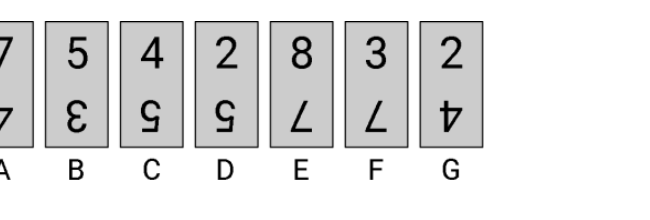
7 cards are arranged as shown. Each card has 2 numbers on it, with 1 of them written upside down. The teacher wants to rearrange the cards so that the sum of the numbers in the top row is the same as the sum of the numbers in the bottom row. She can do this by turning one of the cards upside down. Which card must she turn?
Show answer
Answer: E — G
Show hints
Hint 1 of 2
Add up the top row and add up the bottom row, then see how far apart the two totals are.
Still stuck? Show hint 2 →
Hint 2 of 2
Turning one card swaps its top and bottom numbers, so look for the card whose swap moves exactly half the gap from one row to the other.
Show solution
Approach: compare the two row totals and flip the one card that evens them out
The top numbers add to 7+5+4+2+8+3+2 = 31 and the bottom numbers add to 4+3+5+5+7+7+4 = 35, a gap of 4 (the bottom is 4 bigger).
All 14 numbers add to 66, so to make the rows equal each must be 66 / 2 = 33; the top needs to gain 2 and the bottom to lose 2.
Flipping a card moves its top number down and its bottom number up, so we need a card whose bottom is 2 more than its top — that is card G (top 2, bottom 4).
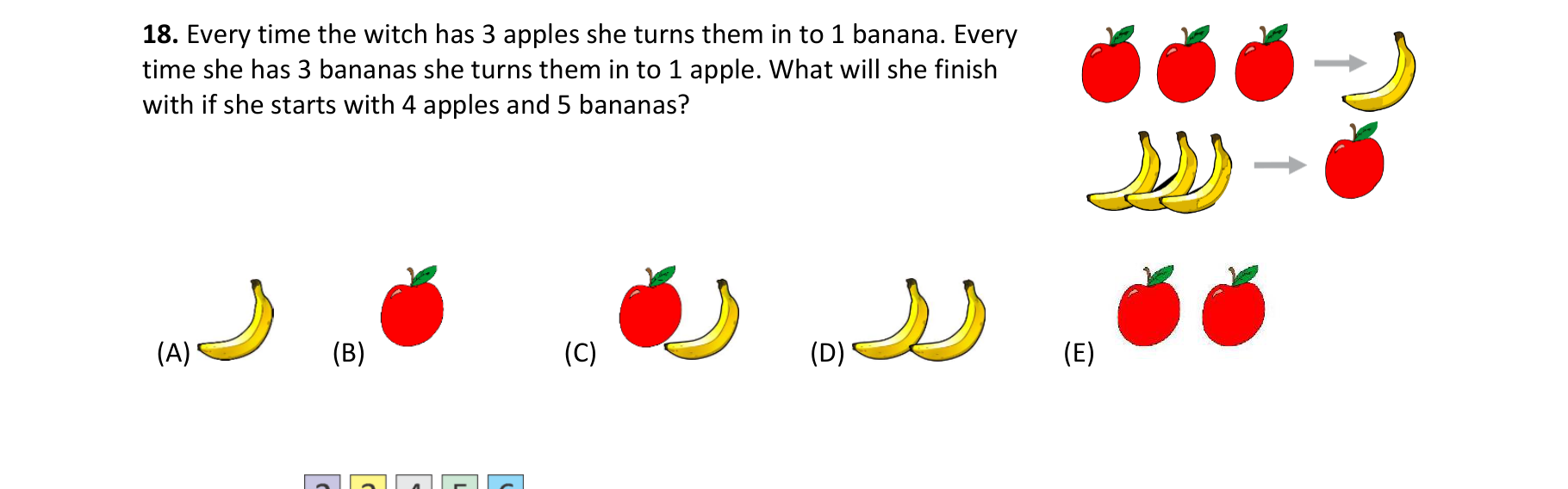
Every time the witch has 3 apples she turns them into 1 banana. Every time she has 3 bananas she turns them into 1 apple. What will she finish with if she starts with 4 apples and 5 bananas?
Show answer
Answer: A
Show hints
Hint 1 of 3
Start with her 4 apples and 5 bananas, and just keep following her two rules.
Still stuck? Show hint 2 →
Hint 2 of 3
Trade 3 apples for 1 banana, and trade 3 bananas for 1 apple, again and again.
Still stuck? Show hint 3 →
Hint 3 of 3
Keep swapping in groups of 3 until you can no longer make a group of three.
Show solution
Approach: repeatedly trade groups of three
Start with 4 apples and 5 bananas. Trade 3 apples for 1 banana: 1 apple, 6 bananas.
Trade 6 bananas (two groups of three) for 2 apples: 3 apples, 0 bananas.
Trade those 3 apples for 1 banana: 0 apples, 1 banana.
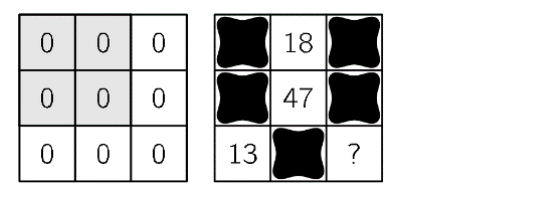
A 3×3 square initially has the number 0 in each of its cells. In one step, all four numbers in one 2×2 sub-square (such as the shaded one) are increased by 1. This operation is repeated several times to obtain the arrangement on the right. Some numbers in this arrangement are hidden. What number is in the square with the question mark?
Show answer
Answer: C — 16
Show hints
Hint 1 of 2
Each cell's value is how many of the chosen 2×2 squares cover it; the centre is covered by all four.
Still stuck? Show hint 2 →
Hint 2 of 2
Centre minus a touching edge gives the opposite-corner pair sum; use the known 13 to split it.
Show solution
Approach: express cells via the four 2x2 operation counts
Let the four 2×2 squares be used a, b, c, d times; the centre cell equals a+b+c+d.
The top-middle cell equals one pair (here 18) and the centre is 47, so the other pair sums to 47-18 = 29.
That other pair is the two bottom corners; one corner is 13, so the marked one is 29-13.
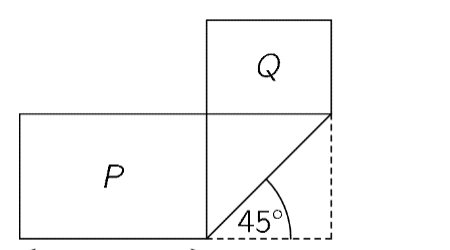
A rectangular strip of paper of dimensions 4 cm × 13 cm is folded as shown in the diagram. 2 rectangles are formed with areas P and Q where P = 2Q. What is the value of x?
Show answer
Answer: C — 6 cm
Show hints
Hint 1 of 2
The 45° fold makes the overlap a right-isosceles triangle, linking the two rectangle sizes.
Still stuck? Show hint 2 →
Hint 2 of 2
Use P = 2Q together with the strip's fixed width and length to pin down x.
Show solution
Approach: relate the two rectangle areas through the fold
The strip has width 4, so both rectangles are 4 wide: P = 4x and Q = 4y, where x and y are their lengths.
The 45° fold turns the strip square across its width, so the diagonal overlap uses a 4-by-4 square, and the three lengths fit the strip: x + 4 + y = 13.
P = 2Q gives x = 2y; with x + y = 9 this makes y = 3 and x = 6.
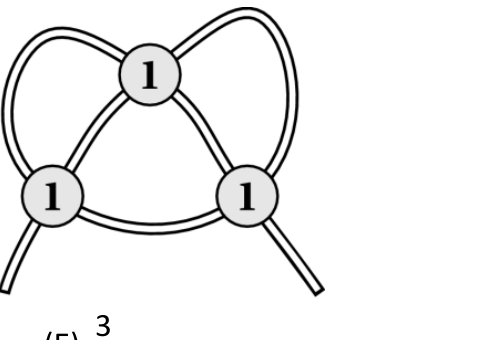
A piece of string is lying on the table. It is partially covered by three coins as seen in the figure. Under each coin the string is equally likely to pass over itself one way or the other (i.e. at each crossing either strand is equally likely to be on top). What is the probability that the string is knotted after its ends are pulled?
Show answer
Answer: B — \(\tfrac{1}{4}\)
Show hints
Hint 1 of 2
Each hidden crossing is independently 'over' or 'under', so list how many equally likely cases there are.
Still stuck? Show hint 2 →
Hint 2 of 2
Decide which of those cases actually produce a knot when the ends are pulled.
Show solution
Approach: count favourable crossing patterns out of all equally likely ones
Three crossings, each equally likely two ways, give 2³ = 8 equally likely outcomes.
Only the patterns that interlock the strand into a true knot count; exactly 2 of the 8 do.
There were 20 apples and 20 pears in a box. Carl randomly took 20 pieces of fruit from the box and Luca took the rest. Which of the following statements is always true?
Show answer
Answer: D — Carl got as many pears as Luca got apples.
Show hints
Hint 1 of 2
Carl took exactly 20 fruits, and there are exactly 20 apples in the whole box — the same number.
Still stuck? Show hint 2 →
Hint 2 of 2
Every apple Carl did NOT take is left for Luca, so think about how Carl filled up his 20 spots.
Show solution
Approach: match Carl's missing apples to his pears
Carl grabbed 20 fruits, and there are 20 apples in all, so the number of apples Carl is missing is exactly the same as the number of pears he picked up to fill his 20 spots.
All the apples Carl skipped end up with Luca, so the apples Carl missed = the apples Luca got.
Putting those together: Carl's pears = the apples Carl missed = Luca's apples, so 'Carl got as many pears as Luca got apples' is always true — choice D.
With lettersIf Carl took \(a\) apples and \(p\) pears then \(a+p=20\); Luca has \(20-a\) apples, and \(p=20-a\) too, so Carl's pears equal Luca's apples.
Logic & Word Problemswork-backwardcareful-counting
The numbers 1 to 9 are placed in the squares shown, with a number in each square. The sums of all pairs of neighbouring numbers are shown. Which number is placed in the shaded square?
Show answer
Answer: D — 7
Show hints
Hint 1 of 3
Find the smallest bracket-total first: which two different numbers from 1 to 9 can possibly add up to it?
Still stuck? Show hint 2 →
Hint 2 of 3
Once you know one square, slide along the brackets — each bracket shares a square with the next, so you can fill them in one at a time.
Still stuck? Show hint 3 →
Hint 3 of 3
Keep going along the row until you reach the shaded square.
Show solution
Approach: start at the smallest sum, then slide along the shared brackets
The smallest bracket is 3, and the only two different numbers from 1 to 9 that add to 3 are 1 and 2.
The next bracket along is 7; the square shared with the '3' pair must be the small one (1) so its partner can be 6, which also fits the 15 bracket (9 + 6) on the other side — so that run is 9, 6, 1, 2.
Now slide right through the shaded square: 2 + (shaded) = 9 (the bracket of 9), so the shaded square is 9 - 2 = 7.
The five cards shown (2, 3, 4, 5, 6) are placed into 2 boxes. The sums of the numbers in each box are the same. Which number must be in the box with the number 4?
Show answer
Answer: D — 6
Show hints
Hint 1 of 3
Add all five card numbers together first.
Still stuck? Show hint 2 →
Hint 2 of 3
Since the two boxes are equal, split that total in half to see what each box must hold.
Still stuck? Show hint 3 →
Hint 3 of 3
Now figure out which card the 4 needs next to it to reach that box total.
Show solution
Approach: find the equal totals and pair up
All five cards add to 2 + 3 + 4 + 5 + 6 = 20, so each box must hold 10.
Putting 2, 3, and 5 together makes 10, which leaves 4 and 6 for the other box.
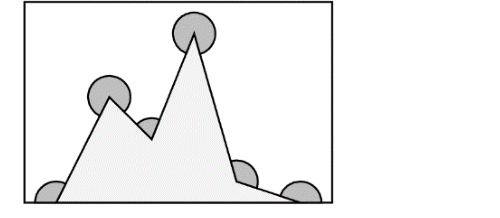
What is the sum of the six marked angles in the picture?
Show answer
Answer: C — 1080°
Show hints
Hint 1 of 2
Don't try to measure any single angle — look for whole triangles in the mountain outline, since each triangle contributes a fixed \(180°\).
Still stuck? Show hint 2 →
Hint 2 of 2
The six marked corners are exactly the corners of a few triangles in the figure; add up those triangles' angle sums.
Show solution
Approach: bundle the marked corners into whole-triangle angle sums
Each marked angle sits at a corner of the zig-zag mountain outline, and those corners are the vertices of the triangles the outline cuts the picture into.
Instead of finding any one angle, group the six marked corners so that together they form six triangle-corner triples, each triple summing to \(180°\) (the straight pieces of the outline cancel out).
Six such triangle angle sums give \(6\times 180° = 1080°\).
So the six marked angles total \(1080°\), choice (C).
Logic & Word ProblemsRatios, Rates & Proportionsratiocasework
A box of fruit contains twice as many apples as pears. Christy and Lily divided them up so that Christy had twice as many pieces of fruit as Lily. Which one of the following statements is always true?
Show answer
Answer: E — Christy took as many pears as Lily got apples.
Show hints
Hint 1 of 2
Let there be p pears and 2p apples, total 3p; Christy ends with 2p pieces and Lily with p.
Still stuck? Show hint 2 →
Hint 2 of 2
Test each statement against every possible split — only one holds in all cases.
Show solution
Approach: check each claim over all valid splits
Pears = p, apples = 2p, total 3p; Christy has 2p pieces, Lily has p.
If Christy takes a apples she takes 2p−a pears; Lily then gets the remaining 2p−a apples.
So Christy's pears always equal Lily's apples; the other options can fail.
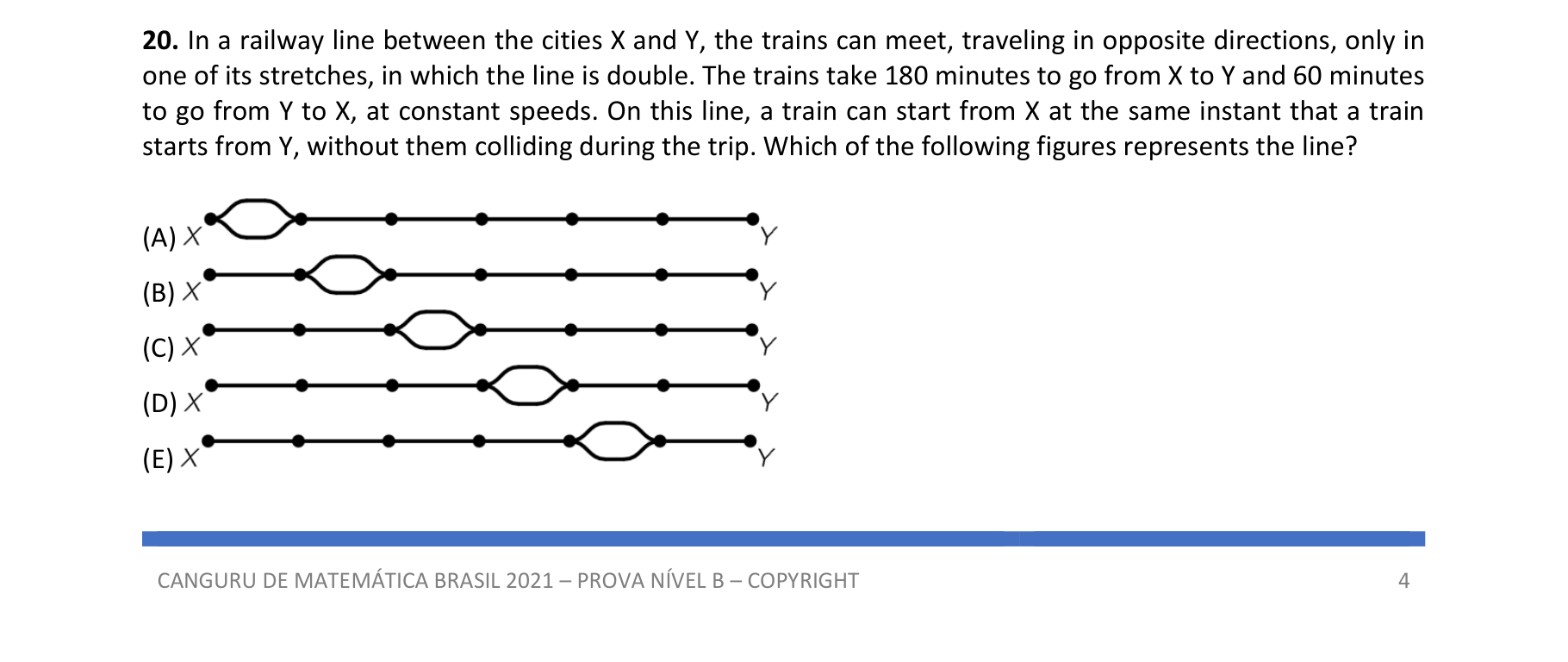
In a railway line between the cities X and Y, the trains can meet, traveling in opposite directions, only in one of its stretches, in which the line is double. The trains take 180 minutes to go from X to Y and 60 minutes to go from Y to X, at constant speeds. On this line, a train can start from X at the same instant that a train starts from Y, without them colliding during the trip. Which of the following figures represents the line?
Show answer
Answer: B
Show hints
Hint 1 of 2
The trains start together; X→Y takes 180 min and Y→X takes 60 min, so the Y-train is three times faster.
Still stuck? Show hint 2 →
Hint 2 of 2
They must cross exactly inside the doubled stretch — locate where they meet along the line.
Show solution
Approach: find the meeting point and place the double stretch there
The Y-train (60 min) is three times as fast as the X-train (180 min), so after the same time it has covered three times the distance.
They meet at the point three-quarters of the way from X to Y.
The double (passing) section must contain that meeting point, which matches figure B.
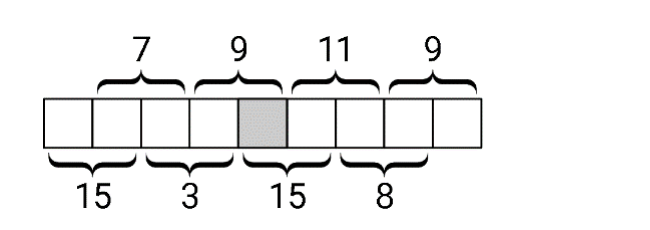
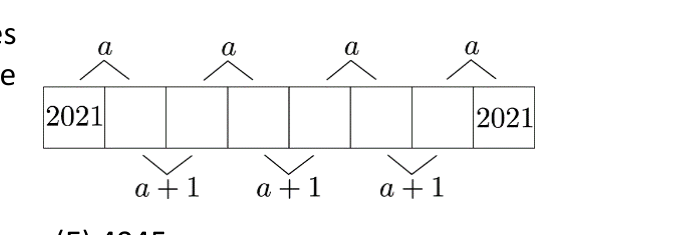
There are eight boxes in the strip shown. The numbers in adjacent boxes have sum a or a + 1, as shown. The numbers in the first box and the eighth box are both 2021. What is the value of a?
Show answer
Answer: E — 4045
Show hints
Hint 1 of 2
Step along the boxes: each next entry is the arch-sum minus the current entry.
Still stuck? Show hint 2 →
Hint 2 of 2
The arch-sums alternate a and a+1; chain from box 1 = 2021 to box 8 = 2021 and solve for a.
Show solution
Approach: walk the chain of sums and set box 8 = 2021
Starting at box 1 = 2021 and using the alternating sums a, a+1, a, a+1, ..., each box is the previous sum minus the previous box.
Logic & Word ProblemsAlgebra & Patternssubstitution
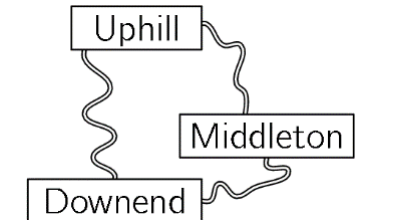
Three villages are connected by paths as shown. From Downend to Uphill, the detour via Middleton is 1 km longer than the direct path. From Downend to Middleton, the detour via Uphill is 5 km longer than the direct path. From Uphill to Middleton, the detour via Downend is 7 km longer than the direct path. How long is the shortest of the three direct paths between the villages?
Show answer
Answer: C — 3 km
Show hints
Hint 1 of 2
Name the three direct distances and turn each 'detour is k longer' fact into an equation.
Still stuck? Show hint 2 →
Hint 2 of 2
Add all three equations to get the total of the distances quickly.
Show solution
Approach: set up and add the detour equations
Let the direct paths be DU = a, DM = b, UM = c. The detours give b+c = a+1, a+c = b+5, a+b = c+7.
Adding all three: 2(a+b+c) = (a+b+c) + 13, so a+b+c = 13.
Then a = 6, b = 4, c = 3; the shortest direct path is 3 km.
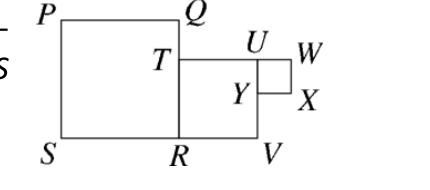
The diagram shows three squares, PQRS, TUVR and UWXY. They are placed together, edge to edge. Points P, T and X lie on the same straight line. The area of PQRS is 36 and the area of TUVR is 16. What is the area of triangle PXV?
Show answer
Answer: C — \(16\)
Show hints
Hint 1 of 2
Set coordinates with the shared baseline on the x-axis and read off the corner points.
Still stuck? Show hint 2 →
Hint 2 of 2
Use the collinearity of P, T, X to find the small square's size, then apply the shoelace area.
Show solution
Approach: coordinatise and use the shoelace formula
Place S=(0,0): then P=(0,6), R=(6,0), V=(10,0), T=(6,4), U=(10,4) from the side-6 and side-4 squares.
P, T, X collinear (line y = 6 − x/3) forces the third square's side 2, giving X=(12,2).
Shoelace on P(0,6), X(12,2), V(10,0): area = ½|0−72+40| = 16.
Ann, Bob, Carina, Dan and Ed are sitting at a round table. Ann is not next to Bob, Dan is next to Ed, and Bob is not next to Dan. Which two people are sitting next to Carina?
Show answer
Answer: A — Ann and Bob
Show hints
Hint 1 of 2
Place the people around the circle using 'Dan next to Ed' first, then apply the 'not next to' rules.
Still stuck? Show hint 2 →
Hint 2 of 2
Once the seating is forced, read off Carina's two neighbours.
Show solution
Approach: fix the circular order from the clues
Dan sits next to Ed; Bob is not next to Dan and Ann is not next to Bob.
Working these around the five-seat circle forces an order where Carina sits between Ann and Bob.
A box has fewer than 50 cookies in it. The cookies can be divided evenly between 2, 3, or 4 children. However, they cannot be divided evenly between 7 children, because 6 more cookies would be needed. How many cookies are there in the box?
Show answer
Answer: D — 36
Show hints
Hint 1 of 2
Sharing evenly between 2, 3 and 4 children means the number is in the 2, 3 and 4 times tables — so it is in the 12 times table.
Still stuck? Show hint 2 →
Hint 2 of 2
List the multiples of 12 under 50, then check which one becomes a multiple of 7 after you add the 6 missing cookies.
Show solution
Approach: list multiples of 12 under 50, then test the sharing-by-7 clue
To share evenly between 2, 3 and 4 children the number must be in all three times tables, which means the 12 times table: 12, 24, 36, 48.
Needing 6 more cookies to share between 7 means that number plus 6 lands in the 7 times table.
Check each: 12+6=18, 24+6=30, 36+6=42, 48+6=54 — only 42 is in the 7 times table (6 x 7), so the number is 36.
3 girls and 2 boys were dancing. They danced in pairs so that each girl danced with each boy for exactly 1 minute. At any time, there was only one pair on the dance floor. For how many minutes did they dance?
Show answer
Answer: B — 6
Show hints
Hint 1 of 3
Only one pair dances at a time, so the total minutes equals the number of pairs.
Still stuck? Show hint 2 →
Hint 2 of 3
Each girl needs to dance once with each boy.
Still stuck? Show hint 3 →
Hint 3 of 3
Count all the different girl-and-boy pairs you can make.
Show solution
Approach: count the pairs
There are 3 girls and 2 boys, giving 3 × 2 = 6 different pairs.
Each pair dances for 1 minute, one pair at a time.
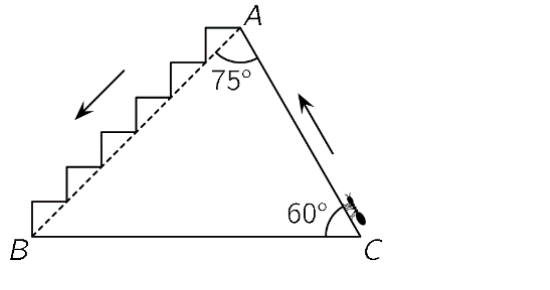
An ant climbs from C to A along the path CA and descends from A to B on the stairs, as shown in the diagram. What is the ratio of the lengths of the ascending and descending paths?
Show answer
Answer: E — √33
Show hints
Hint 1 of 2
The staircase length from A to B is just the total horizontal run plus the total vertical drop of A to B.
Still stuck? Show hint 2 →
Hint 2 of 2
With the 75° and 60° angles, angle B = 45°; compare CA to (horizontal+vertical) of AB using the law of sines.
Show solution
Approach: staircase length = horizontal + vertical; compare with CA
The descending stairs from A to B have total length equal to the horizontal distance plus the vertical distance between A and B.
Since the angles at A and C are 75° and 60°, angle B = 45°, so AB rises at 45° and its horizontal+vertical = AB·√2.
By the law of sines CA = AB·sin45°/sin60° = AB·√2/√3.
Maurice asked the canteen chef for the recipe for his pancakes. The recipe makes 100 pancakes and uses 25 eggs, 4 litres of milk, 5 kg of flour and 1 kg of butter. Maurice has 6 eggs, 400 g flour, 0.5 litres of milk and 200 g butter. What is the largest number of pancakes he can make using this recipe?
Show answer
Answer: B — 8
Show hints
Hint 1 of 2
The recipe makes 100 pancakes; for each ingredient work out how many pancakes Maurice's amount allows.
Still stuck? Show hint 2 →
Hint 2 of 2
The ingredient that runs out first sets the limit — take the smallest of the four.
Show solution
Approach: find the limiting ingredient
Per 100 pancakes: 25 eggs, 4 L milk, 5 kg (5000 g) flour, 1 kg (1000 g) butter.
Each of the 5 boxes contains either apples or bananas, but not both. The total weight of all the bananas is 3 times the weight of all the apples. Which boxes contain apples?
Show answer
Answer: E — 1 and 4
Show hints
Hint 1 of 2
If the bananas weigh 3 times the apples, then for every 1 kg of apples there are 3 kg of bananas — so apples are 1 part out of 4 equal parts of the whole.
Still stuck? Show hint 2 →
Hint 2 of 2
Add all five box weights, take a quarter of that for the apples, then find which boxes add up to it.
Show solution
Approach: apples are one quarter of the total weight
The five boxes weigh 7, 5, 6, 2, 16, totalling 36 kg.
Bananas are 3 times the apples, so apples make up 36 / 4 = 9 kg.
Boxes summing to 9 kg are the 7 kg and 2 kg ones, i.e. boxes 1 and 4.
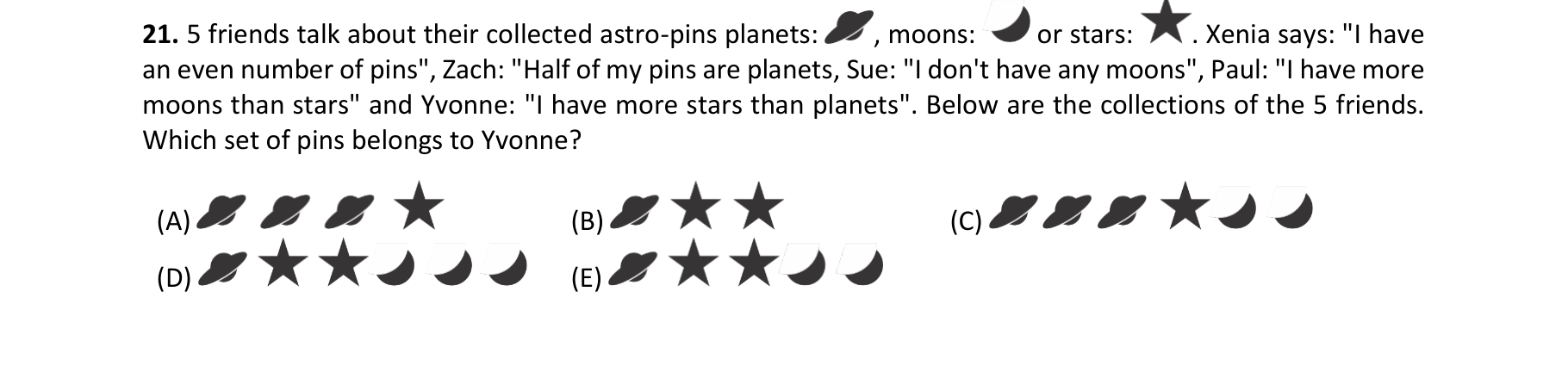
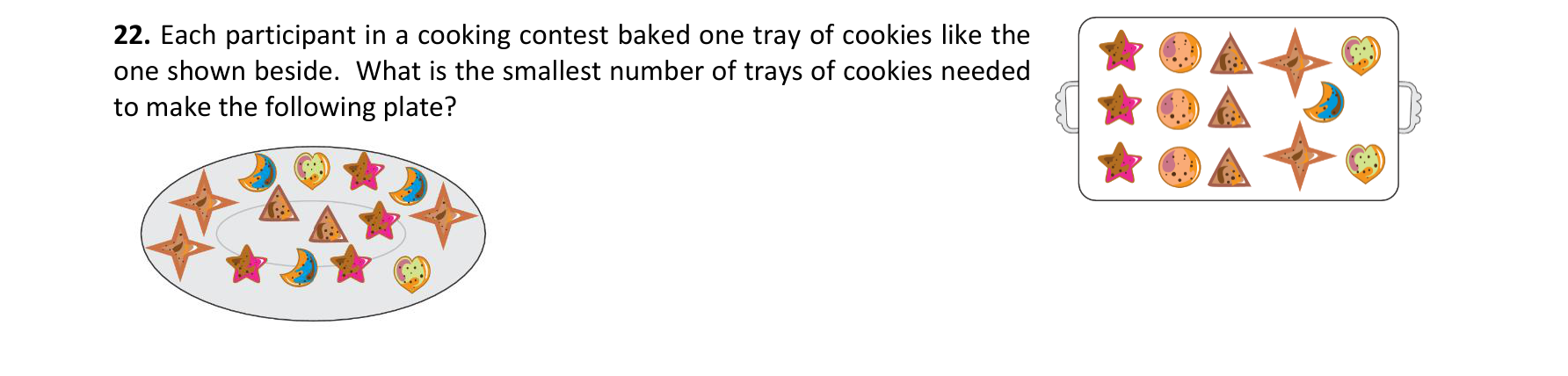
Each participant in a cooking contest baked one tray of cookies like the one shown beside. What is the smallest number of trays of cookies needed to make the following plate?
Show answer
Answer: C — 3
Show hints
Hint 1 of 3
Count how many of each kind of cookie the big plate needs.
Still stuck? Show hint 2 →
Hint 2 of 3
Now see how many of each kind you get from just one tray.
Still stuck? Show hint 3 →
Hint 3 of 3
The kind of cookie you need the most of decides how many trays you must bake.
Show solution
Approach: compare each cookie type to what one tray gives
Count each kind of cookie on the plate, and count how many of that kind one tray makes.
For each kind, see how many trays it would take, then pick the biggest of those numbers.
Three trays are enough to cover every kind, so the answer is 3.
In a particular fraction the numerator and denominator are both positive. The numerator of this fraction is increased by 40%. By what percentage should its denominator be decreased so that the new fraction is double the original fraction?
Show answer
Answer: C — 30%
Show hints
Hint 1 of 2
Increasing the top by 40% multiplies the fraction by 1.4; you want the new fraction to be twice the old.
Still stuck? Show hint 2 →
Hint 2 of 2
Find the multiplier the denominator needs, then convert it to a percent decrease.
Show solution
Approach: balance the multipliers on top and bottom
Multiplying the numerator by 1.4 while dividing the denominator by (1 − p) should double the fraction: 1.4 / (1 − p) = 2.
The numbers 1, 2, 7, 9, 10, 15 and 19 are written down on a blackboard. Two players alternately delete one number each until only one number remains on the blackboard. The sum of the numbers deleted by one of the players is twice the sum of the numbers deleted by the other player. What is the number that remains?
Show answer
Answer: B — 9
Show hints
Hint 1 of 2
The whole list sums to 63; if one player's deletions are twice the other's, what must the remaining number satisfy?
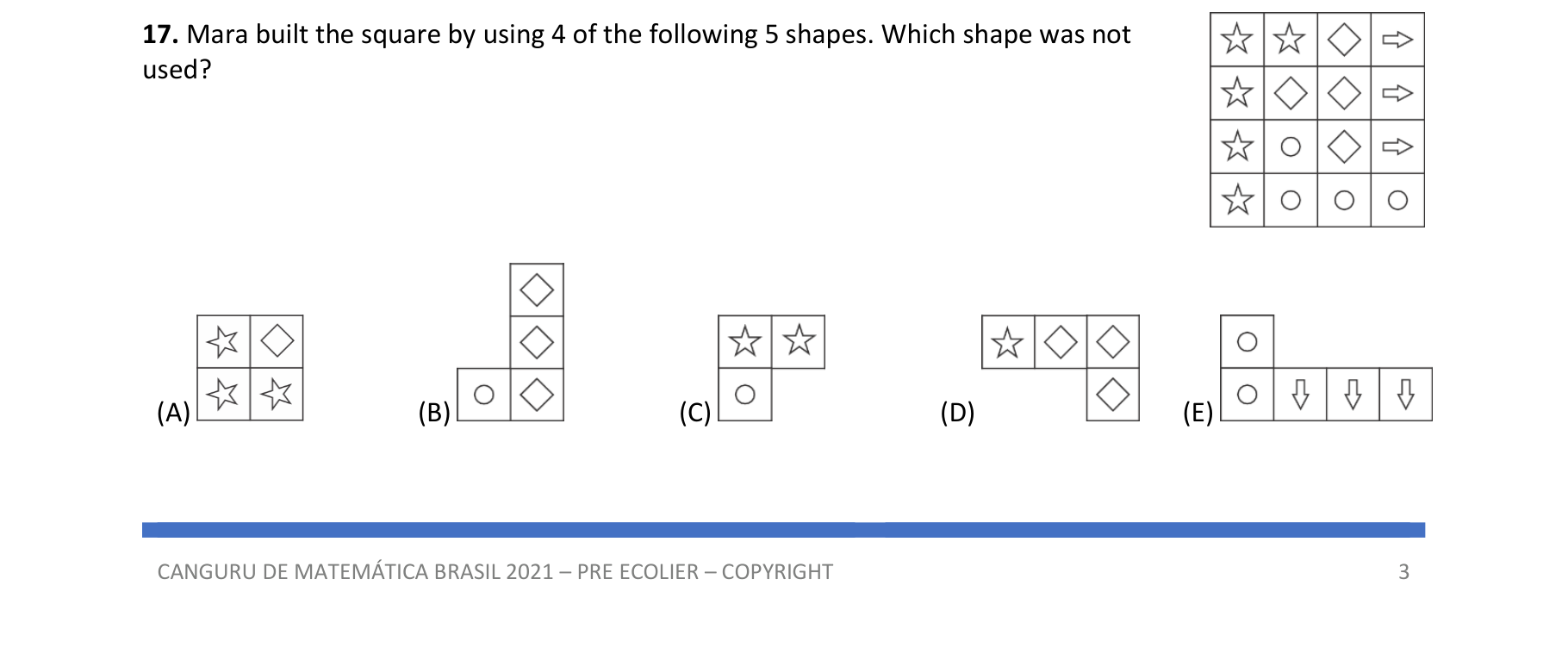
Still stuck? Show hint 2 →
Hint 2 of 2
Check which candidate value can actually be split into the required two groups of three.
Show solution
Approach: use the total and a divisibility test, then verify a split
Total is 1+2+7+9+10+15+19 = 63. If deletions are k and 2k, then 63 − r = 3k, so r is a multiple of 3.
The multiples of 3 in the list are 9 and 15; only r = 9 allows a valid split: {1,2,15}=18 and {7,10,19}=36 = 2·18.
The picture shows 3 gears with a black gear tooth on each. Which picture shows the correct position of the black teeth after the small gear has turned a full turn clockwise?
Show answer
Answer: A
Show hints
Hint 1 of 2
Meshed gears turn in opposite directions; a full turn of the small gear moves the others by matching tooth counts.
Still stuck? Show hint 2 →
Hint 2 of 2
Track the black tooth on each gear after that rotation to find the consistent picture.
Show solution
Approach: rotate each meshed gear correctly
When the small gear makes one full clockwise turn, the gears it meshes with rotate the other way by the same number of teeth.
Following each black tooth to its new position, the arrangement that results is choice A.
Elena wants to write the numbers from 1 to 9 in the squares shown. The arrows always point from a smaller number to a larger one. She has already written 5 and 7. Which number should she write instead of the question mark?
Show answer
Answer: D — 6
Show hints
Hint 1 of 3
Every arrow goes from a smaller number to a larger one, so the box where all arrows point in must hold a big number and the box where all arrows point out must hold a small one.
Still stuck? Show hint 2 →
Hint 2 of 3
Follow the arrow trails out from the boxes that already show 5 and 7, always stepping up to a bigger number.
Still stuck? Show hint 3 →
Hint 3 of 3
Work out which numbers are still allowed in the ? box after the small numbers are forced into the lower boxes.
Show solution
Approach: use 'arrows go small to large' to squeeze out which number fits the ? box
The top-left box gets an arrow in from the 7, so it must be bigger than 7, which means it is 8, and the box it points to is the biggest of all, 9.
Following the arrows down and to the left, every box on the bottom-right side has to be smaller than 5, so 1, 2, 3 and 4 are all used up down there.
That leaves only 6 free for the ? box (8 and 9 are taken by the top, and 5 and 7 are already placed).
Kangie eats only apples on Monday, Wednesday and Friday. On Tuesdays and Thursdays he eats only mangoes. He eats either 2 apples or 3 mangoes a day. On Saturdays and Sundays he eats nothing. How many pieces of fruit does Kangie eat in two weeks?
Show answer
Answer: E — 24
Show hints
Hint 1 of 3
Work out just ONE week first, then you can double it for two weeks.
Still stuck? Show hint 2 →
Hint 2 of 3
There are three apple-days and two mango-days each week, and nothing on weekends.
Still stuck? Show hint 3 →
Hint 3 of 3
On an apple-day he eats 2 apples; on a mango-day he eats 3 mangoes.
Show solution
Approach: count one week then double
Apple days (Mon, Wed, Fri): 3 days × 2 apples = 6 apples.
Mango days (Tue, Thu): 2 days × 3 mangoes = 6 mangoes.
That is 12 pieces a week, so two weeks give 12 × 2 = 24, option E.
Logic & Word ProblemsSpatial & Visual Reasoningcareful-countingcasework
A triangular pyramid is built with 20 cannon balls, as shown. Each cannon ball is labelled with one of A, B, C, D or E. There are 4 cannon balls with each type of label. The picture shows the labels on the cannon balls on 3 of the faces of the pyramid. What is the label on the hidden cannon ball in the middle of the fourth face?
Show answer
Answer: D — D
Show hints
Hint 1 of 2
Each label A–E is used exactly four times across the 20 balls.
Still stuck? Show hint 2 →
Hint 2 of 2
Tally how many of each label already appear on the three shown faces (counting shared edge balls once); the centre ball must be the label still short of four.
Show solution
Approach: count each label and find the one not yet at full quota
There are 4 balls of each label. Tally the labels visible on the three shown faces, counting shared edge/corner balls once.
One label falls one short of its quota of 4; that missing ball is the hidden centre of the fourth face.
The function f is such that \(f(x+y) = f(x) \cdot f(y)\) and \(f(1) = 2\). What is the value of \(\dfrac{f(2)}{f(1)} + \dfrac{f(3)}{f(2)} + \cdots + \dfrac{f(2021)}{f(2020)}\)?
Show answer
Answer: E — none of the previous
Show hints
Hint 1 of 2
The rule f(x+y)=f(x)f(y) with f(1)=2 forces a familiar formula for f.
Still stuck? Show hint 2 →
Hint 2 of 2
Simplify a typical term f(n+1)/f(n) before adding.
Show solution
Approach: identify the exponential and collapse each term
From f(x+y)=f(x)f(y) and f(1)=2 we get f(n)=2ⁿ.
Each term f(n+1)/f(n) = 2ⁿ⁺¹/2ⁿ = 2, and there are 2020 terms (from f(2)/f(1) to f(2021)/f(2020)).
The sum is 2020 × 2 = 4040, which is not among A–D, so none of the previous.
An apple and an orange weigh as much as a pear and a peach. An apple and a pear weigh less than an orange and a peach, and a pear and an orange weigh less than an apple and a peach. Which of the pieces of fruit is the heaviest?
Show answer
Answer: C — peach
Show hints
Hint 1 of 2
Turn each sentence into an inequality between sums of two fruits.
Still stuck? Show hint 2 →
Hint 2 of 2
Combine the inequalities to rank the fruits and spot the heaviest.
Show solution
Approach: combine the weight inequalities
The balance apple + orange = pear + peach rearranges to peach = apple + (orange − pear).
The two 'weigh less' facts force pear to be lighter than both apple and orange, so orange − pear is positive.
Then peach = apple + (a positive amount) beats apple, and likewise peach beats orange, so the heaviest is peach.
Logic & Word Problemsbalance-reasoningsubstitution
Martin placed 3 different types of objects — hexagons, squares and triangles — on sets of scales, as shown. What does he need to put on the left-hand side of the third set of scales for these scales to balance?
Show answer
Answer: A — 1 square
Show hints
Hint 1 of 2
Each balanced scale tells you that the two sides weigh the same; measure everything in squares.
Still stuck? Show hint 2 →
Hint 2 of 2
Find how many squares a triangle is worth, then a hexagon, and compare the two sides of the third scale.
Show solution
Approach: measure every object in squares, then balance the third scale
Scale 2: a triangle and a hexagon balance a hexagon and 5 squares, so the triangle weighs 5 squares.
Scale 1: 2 hexagons balance a triangle and a square, that is 5 + 1 = 6 squares, so 1 hexagon = 3 squares.
Scale 3 left side is 3 hexagons = 9 squares; the right side is 2 triangles = 10 squares, so the left is 1 square too light.
Stan has five toys: a ball, a set of blocks, a game, a puzzle and a car. He puts each toy on a different shelf of the bookcase (shelf 1 at the bottom up to shelf 5 at the top). The ball is higher than the blocks and lower than the car. The game is directly above the ball. On which shelf can the puzzle not be placed?
Show answer
Answer: C — 3
Show hints
Hint 1 of 3
The ball is the key: many clues are about where the ball sits.
Still stuck? Show hint 2 →
Hint 2 of 3
The game sits right on top of the ball, with the blocks below the ball and the car above it.
Still stuck? Show hint 3 →
Hint 3 of 3
Try each possible shelf for the ball and see where the puzzle is allowed to land.
Show solution
Approach: test the ball's shelf and rule one out
If the ball is on shelf 2: blocks on 1, game on 3, and the car and puzzle take shelves 4 and 5 in some order — puzzle is on 4 or 5.
If the ball is on shelf 3: game on 4, car on 5, and the blocks and puzzle take shelves 1 and 2 — puzzle is on 1 or 2.
(The ball can not be on 1, with nothing below it, or on 4, leaving no room for the car above the game.)
So the puzzle can land on 1, 2, 4 or 5, but never on shelf 3.
Three boys played a “Word” game in which each wrote down 10 words. A boy scored 3 points for a word if neither of the other boys had it, and 1 point if exactly one of the other boys also had it. No points were given for a word all three boys had. When they added up their scores, all three were different. Sam had 19 points, the smallest score, and James had the highest. How many points did James score?
Show answer
Answer: E — 25
Show hints
Hint 1 of 2
Each of a boy's 10 words earns him 3 (his alone), 1 (shared with exactly one other), or 0 (all three have it), so any boy's score is one of \(3u + s\) where \(u + s \le 10\).
Still stuck? Show hint 2 →
Hint 2 of 2
A word shared by two boys gives each of them 1 point, so a shared word adds points symmetrically; track the total points across all three boys and use that Sam is fixed at the minimum 19.
Show solution
Approach: bound the top score, then exhibit a triple that reaches it
Write each boy's score as \(3u + s\): \(u\) words his alone (3 each), \(s\) words shared with exactly one other boy (1 each), and \(u + s \le 10\), so every score is between 0 and 30.
Sam is the minimum at 19, and the three scores are distinct, so James (the max) is more than 19; trying James \(= 25\) means his words are eight unique \((24)\) plus one shared \((1)\), using \(8+1=9\) of his 10 words.
The shared words are also counted for whoever shares them, and a consistent set of 10-word lists can be built giving the three totals \(19,\,21,\,25\) (all different, Sam lowest, James highest), while no arrangement makes James's total exceed 25 once Sam is pinned at 19 and all three differ.
Five kangaroos named A, B, C, D and E have one child each, named a, b, c, d and e, not necessarily in that order. In the first group photo shown exactly 2 of the children are standing next to their mothers. In the second group photo exactly 3 of the children are standing next to their mothers. Whose child is a?
Show answer
Answer: D — \(D\)
Show hints
Hint 1 of 2
Each child stands by a different kangaroo in the two photos, so a child can be correctly placed in at most one photo.
Still stuck? Show hint 2 →
Hint 2 of 2
Since 2 + 3 = 5 children, every child is correct in exactly one photo; sort out which assignment makes both counts work.
Show solution
Approach: match children to mothers by an exactly-one-photo argument
In photo 1 the pairings are A-d, B-a, C-b, D-c, E-e (2 correct); in photo 2 they are A-b, B-e, C-d, D-a, E-c (3 correct).
No child keeps the same partner across photos, so each child is correct in just one photo and all five split as 2 + 3.
The only consistent bijection takes photo-1 pairs b–C, d–A and photo-2 pairs a–D, c–E, e–B, so a's mother is D.
Logic & Word ProblemsCounting & Probabilitysum-constraintcomplementary-counting
A box contains only green, red, blue and yellow counters. There is always at least one green counter amongst any 27 counters chosen from the box; always at least one red counter amongst any 25 counters chosen; always at least one blue amongst any 22 counters chosen and always at least one yellow amongst any 17 counters chosen. What is the largest number of counters that could be in the box?
Show answer
Answer: B — 29
Show hints
Hint 1 of 2
'Any 27 chosen contain a green' means you can never pick 27 with no green — so the non-green counters number at most 26.
Still stuck? Show hint 2 →
Hint 2 of 2
Write the same kind of bound for each colour and add them up.
The solid shown in the diagram has 12 regular pentagonal faces, the other faces being either equilateral triangles or squares. Each pentagonal face is surrounded by 5 square faces and each triangular face is surrounded by 3 square faces. John writes 1 on each triangular face, 5 on each pentagonal face and \(-1\) on each square. What is the total of the numbers written on the solid?
Show answer
Answer: B — 50
Show hints
Hint 1 of 2
Each pentagon is ringed by 5 squares and each triangle by 3 squares — use this to count the faces of each type.
Still stuck? Show hint 2 →
Hint 2 of 2
Multiply each face count by its written number and add.
Show solution
Approach: count each face type, then total the labels
The solid is the rhombicosidodecahedron: 12 pentagons, 20 triangles and 30 squares.
John's total is 12·5 + 20·1 + 30·(−1) = 60 + 20 − 30.
My little brother has a 4-digit bike lock with the digits 0 to 9 on each part of the lock as shown. He started on the correct combination and turned each part the same amount in the same direction and now the lock shows the combination 6348. Which of the following CANNOT be the correct combination of my brother's lock?
Show answer
Answer: C
Show hints
Hint 1 of 2
Turning every wheel by the same amount in the same direction shifts each digit by the same value (mod 10).
Still stuck? Show hint 2 →
Hint 2 of 2
Subtract 6348 digit-by-digit (mod 10); a real start must give the same shift on all four digits.
Show solution
Approach: check for a constant per-digit shift mod 10
Since each wheel turned the same amount, the true combination differs from 6348 by the same shift in every digit (mod 10).
For 8560 the shifts are 2,2,2,2 and for the others they are equal too — except 4906, whose shifts 8,6,2,8 are not all the same.
So 4906 cannot be the correct combination: choice C.
Number TheoryLogic & Word Problemsdivisibilitycasework
2021 coloured kangaroos are arranged in a row and are numbered from 1 to 2021. Each kangaroo is coloured either red, grey or blue. Amongst any three consecutive kangaroos, there are always kangaroos of all three colours. Bruce guesses the colours of five kangaroos. These are his guesses: Kangaroo 2 is grey; Kangaroo 20 is blue; Kangaroo 202 is red; Kangaroo 1002 is blue; Kangaroo 2021 is grey. Only one of his guesses is wrong. What is the number of the kangaroo whose colour he guessed incorrectly?
Show answer
Answer: B — 20
Show hints
Hint 1 of 2
'Any three in a row use all three colours' forces the colouring to repeat with period 3.
Still stuck? Show hint 2 →
Hint 2 of 2
So a kangaroo's colour depends only on its position modulo 3; compare the guesses at equal residues.
Show solution
Approach: use the period-3 structure
With every three consecutive kangaroos all different, the colour pattern repeats every 3 positions.
Positions 2, 20 and 2021 are all 2 (mod 3), so they must share one colour.
Guesses say k2 = grey, k20 = blue, k2021 = grey; the lone disagreement (k20) must be the wrong one.
On a circle 15 points are equally spaced. We can form triangles by joining any 3 of these. Congruent triangles, by rotation or reflection, are counted as only one triangle. How many different triangles can be drawn?
Show answer
Answer: A — 19
Show hints
Hint 1 of 2
A triangle on the circle is described by the three gaps between its chosen points, which add to 15.
Still stuck? Show hint 2 →
Hint 2 of 2
Counting up to rotation and reflection means counting unordered gap-triples, i.e. partitions of 15 into three parts.
Show solution
Approach: count partitions of 15 into three positive parts
An inscribed triangle is fixed (up to rotation/reflection) by the multiset of arc gaps a, b, c with a+b+c = 15 and each ≥ 1.
So we count partitions of 15 into exactly three positive parts.
There are 19 such partitions, hence 19 distinct triangles.
Each shelf holds a total of 64 deciliters of apple juice. The bottles come in three different sizes: large, medium and small (see picture). How many deciliters of apple juice does a medium bottle contain?
Show answer
Answer: D — 10
Show hints
Hint 1 of 2
Let large, medium, small bottles hold L, M, S deciliters; each shelf's bottles total 64.
Still stuck? Show hint 2 →
Hint 2 of 2
Write one equation per shelf and solve the system for M.
Show solution
Approach: set up one equation per shelf and solve
Counting bottles, the three shelves give 3L + 4S = 64, 2L + 2M + 3S = 64, and 4M + 6S = 64.
Solving the system gives S = 4, L = 16 and M = 10.
In the 4×4 table, some cells must be painted black. The numbers next to and below the table show how many cells in that row or column must be black. In how many ways can this table be painted?
Show answer
Answer: D — 5
Show hints
Hint 1 of 2
The row and column labelled 0 are entirely white, shrinking the puzzle to a 3×3 grid.
Still stuck? Show hint 2 →
Hint 2 of 2
Count black-cell placements in that 3×3 grid with row sums 2,2,1 and column sums 2,2,1.
Show solution
Approach: reduce by the zero row/column, then enumerate
Row 2 and column 2 each need 0 black cells, so they are all white.
What remains is a 3×3 grid needing row sums 2,2,1 and column sums 2,2,1.
Enumerating where the single-black row and the two double-black rows go yields exactly five valid fillings.
A 3×4×5 cuboid consists of 60 identical small cubes. A termite eats its way along the diagonal from P to Q. This diagonal does not intersect the edges of any small cube inside the cuboid. How many of the small cubes does it pass through on its journey?
Show answer
Answer: C — 10
Show hints
Hint 1 of 2
The diagonal of an a×b×c grid crosses a + b + c interior 'sheets', but crossings at shared edges count once.
Still stuck? Show hint 2 →
Hint 2 of 2
Use a + b + c minus the pairwise gcds plus the triple gcd.
Show solution
Approach: count unit cubes a space-diagonal passes through
For a 3×4×5 box the count is a+b+c − gcd(a,b) − gcd(b,c) − gcd(a,c) + gcd(a,b,c).
A triangle ABC is divided into four parts by two straight lines, as shown. The areas of the smaller triangles are 1, 3 and 3. What is the area of the original triangle?
Show answer
Answer: A — 12
Show hints
Hint 1 of 2
Triangles sharing the same height have areas in the ratio of their bases.
Still stuck? Show hint 2 →
Hint 2 of 2
Use the two equal-3 areas to find a base ratio, then chase the areas up to the whole triangle.
Show solution
Approach: use base ratios from shared-height triangles
The cevians cut ABC into triangles of areas 1, 3, 3 and one quadrilateral.
Comparing triangles on a common base/height, the segment ratios force the quadrilateral's area to be 5.
A large cube has side-length 7 cm. On each of its 6 faces, the two diagonals are drawn in red. The large cube is then cut into small cubes with side-length 1 cm. How many small cubes will have at least one red line drawn on it?
Show answer
Answer: B — 62
Show hints
Hint 1 of 2
A red face-diagonal only marks the unit cubes it passes through on that face; count by face then remove double counts.
Still stuck? Show hint 2 →
Hint 2 of 2
Edge and corner cubes can be crossed by diagonals on more than one face — don't count them twice.
Show solution
Approach: count marked cubes per face, then correct overlaps
Each face is a 7×7 grid of little squares; the two diagonals run through 7 + 7 − 1 = 13 of them (the centre square is shared).
Six faces give 6 × 13 = 78, but cubes along the edges and corners get a red line on two faces and were counted twice — there are 16 such double-counts.
So the number of unit cubes with at least one red line is 78 − 16 = 62.
Logic & Word ProblemsCounting & Probabilitycaseworkcareful-counting
In a town there are 21 knights who always tell the truth and 2000 knaves who always lie. A wizard divided 2020 of these 2021 people into 1010 pairs. Every person in a pair described the other person as either a knight or a knave. As a result, 2000 people were called knights and 20 people were called knaves. How many pairs of two knaves were there?
Show answer
Answer: D — 995
Show hints
Hint 1 of 3
Work out what each type of pair (two knights, two knaves, mixed) makes the partners say.
Still stuck? Show hint 2 →
Hint 2 of 3
Only mixed pairs produce 'knave' answers, two each — that pins down the number of mixed pairs.
Still stuck? Show hint 3 →
Hint 3 of 3
Then use the 21 knights to back out the other pair types.
Show solution
Approach: classify pairs by the labels they generate
In a same-type pair both say 'knight'; in a mixed pair both say 'knave'.
The 20 'knave' calls come 2 per mixed pair, so there are 10 mixed pairs (using 10 knights and 10 knaves).
With one knight left out, the other 10 knights form 5 knight-knight pairs; the remaining 1990 knaves form 995 knave-knave pairs.
Two plane mirrors OP and OQ are inclined at an acute angle (diagram is not to scale). A ray of light XY parallel to OQ strikes mirror OP at Y. The ray is reflected and hits mirror OQ, is reflected again and hits mirror OP and is reflected for a third time and strikes mirror OQ at right angles at R as shown. If \(OR = 5\) cm, what is the distance d of the ray XY from the mirror OQ?
Show answer
Answer: C — 5 cm
Show hints
Hint 1 of 2
Unfold the bounces by reflecting the wedge so the light path becomes a straight line.
Still stuck? Show hint 2 →
Hint 2 of 2
The incoming ray is parallel to OQ, and the final hit at R is perpendicular to OQ — relate d to OR.
Show solution
Approach: unfold the reflections into a straight path
Reflecting the mirrors turns the three-bounce path into a single straight ray; lengths are preserved.
The ray starts parallel to OQ at height d and ends meeting OQ perpendicularly at R with OR = 5.
In a group of 10 elves and trolls, each was given a token with a different number from 1 to 10 written on it. They were each asked what number was on their token, and all answered with a number from 1 to 10. The sum of the answers was 36. Each troll told a lie and each elf told the truth. What is the smallest number of trolls there could be in the group?
Show answer
Answer: B — 3
Show hints
Hint 1 of 2
If everyone told the truth the answers would total 1 + 2 + … + 10 = 55; the actual total is only 36.
Still stuck? Show hint 2 →
Hint 2 of 2
Each troll replaces its own token number with a smaller answer; how much total drop can just a few trolls create?
Show solution
Approach: cover the shortfall with the fewest liars
Honest answers would total 1 + 2 + … + 10 = 55, but the answers added to 36, so the trolls' lies pulled the total down by 19.
Each troll's biggest possible drop is from token 10 down to answer 1, a drop of 9; one troll can drop at most 9 and two trolls at most 9 + 8 = 17, both short of 19.
Three trolls can manage it — for example tokens 10, 9, 8 answering 1, 1, 1 drops the total by 9 + 8 + 7 = 24, and other choices hit exactly 19 — so the smallest number of trolls is 3.
Christina has eight coins whose weights in grams are different positive integers. Whenever she puts any two coins on one side of a balance scale and any two on the other side, the side containing the heaviest of those four coins is always the heavier side. What is the smallest possible weight of the heaviest coin?
Show answer
Answer: C — 34 g
Show hints
Hint 1 of 2
The hardest case is the heaviest coin with the lightest partner versus the next two heaviest.
Still stuck? Show hint 2 →
Hint 2 of 2
That forces each coin to exceed the sum of the previous two minus the lightest — a Fibonacci-style growth from 1, 2.
Show solution
Approach: push the worst pairing to a Fibonacci-type bound
The binding condition is: heaviest + lightest > (2nd heaviest) + (3rd heaviest), with the analogous rule for every coin acting as the maximum.
Taking the lightest as 1 forces each weight to be at least the sum of the two preceding ones.
Logic & Word ProblemsCounting & Probabilitycasework
In a tournament each of the 6 teams plays one match against every other team. In each round of matches, 3 take place simultaneously. A TV station has already decided which match it will broadcast for each round, as shown in the table. In which round will team D play against team F?
Round
1
2
3
4
5
Broadcast match
A–B
C–D
A–E
E–F
A–C
Show answer
Answer: A — 1
Show hints
Hint 1 of 2
The five rounds form a schedule where each round is three disjoint matches covering all six teams.
Still stuck? Show hint 2 →
Hint 2 of 2
Each team plays once per round, so a team's partners across the rounds are all different; reconstruct from the broadcasts.
Show solution
Approach: reconstruct the round-by-round pairing
A's broadcast matches are B (R1), E (R3) and C (R5), so A must meet D and F in rounds 2 and 4; since R2 already shows C–D, A plays F in R2 and D in R4.
Round 4 shows A–D and E–F, so its third match is B–C; round 2's leftover pair is B–E.
Now D still needs B, E, F and E still needs C, D: E–C must fall in round 1 (E is busy in the others), forcing E–D into round 5.
That leaves round 1 as A–B, C–E and the last pair D–F, so D plays F in round 1 — answer A.
Let \(M(k)\) be the maximum value of \(\left|\,4x^{2} - 4x + k\,\right|\) for x in the interval \([-1,1]\), where k can be any real number. What is the minimum possible value of \(M(k)\)?
Show answer
Answer: B — \(\tfrac{9}{2}\)
Show hints
Hint 1 of 2
Find the range of g(x) = 4x² − 4x on [−1,1]; then 4x² − 4x + k just shifts that range by k.
Still stuck? Show hint 2 →
Hint 2 of 2
The maximum of the absolute value is the larger of the two endpoint distances; choose k to balance them.
Show solution
Approach: find the range, then minimise the larger absolute endpoint
On [−1,1], g(x)=4x²−4x ranges from −1 (at x=½) to 8 (at x=−1), so 4x²−4x+k lies in [k−1, k+8].
Thus M(k) = max(|k−1|, |k+8|); this is smallest when k−1 = −(k+8), i.e. k = −7/2.
There are rectangular cards divided into 4 equal cells with different shapes drawn in each cell. Cards can be placed side by side only if the same shapes appear in adjacent cells on their common side. 9 cards are used to form a rectangle as shown in the figure. Which of the following cards was definitely NOT used to form this rectangle?
Show answer
Answer: E
Show hints
Hint 1 of 2
Cards join only when the touching cells match, so trace the shape sequence along each row and column of the assembled rectangle.
Still stuck? Show hint 2 →
Hint 2 of 2
Read the forced shapes from the given grid; one listed card has a cell pattern that can never fit.
Show solution
Approach: match each card against the forced grid pattern
The assembled rectangle fixes which shapes sit in each cell because adjacent cards must agree on their shared edge.
Reading those forced shapes, four of the candidate cards can occur somewhere in the layout.
Card E has a cell arrangement that cannot fit anywhere, so it was definitely not used.
2021 balls are arranged in a row and numbered from 1 to 2021. Each ball is coloured green, red, yellow or blue. Among any five consecutive balls there is exactly one red, one yellow and one blue ball. After any red ball, the next ball is yellow. The balls numbered 2, 20 and 202 are green. What colour is the ball numbered 2021?
Show answer
Answer: D — blue
Show hints
Hint 1 of 2
Among any 5 in a row there is one each of red, yellow, blue, so two of every five are green — the colouring repeats every 5.
Still stuck? Show hint 2 →
Hint 2 of 2
Use the green positions (2, 20, 202) to find which residues mod 5 are green, then place red-then-yellow.
Show solution
Approach: show period 5, then locate residues by colour
Any five consecutive balls contain one red, one yellow, one blue and thus two greens, which forces a period-5 colouring.
Balls 2, 20, 202 are green, so positions with remainder 2 and remainder 0 (mod 5) are green.
The red, yellow, blue sit at remainders 1, 3, 4; 'red then yellow' forces red at 3, yellow at 4, leaving blue at remainder 1.
Ball 2021 has remainder 1, so it is blue, choice (D).
The diagram shows a quadrilateral divided into 4 smaller quadrilaterals with a common vertex K. The other labelled points divide the sides of the large quadrilateral into three equal parts. The numbers indicate the areas of the corresponding small quadrilaterals. What is the area of the shaded quadrilateral?
Show answer
Answer: C — 6
Show hints
Hint 1 of 2
Because the side-points trisect the big quadrilateral's sides, triangles sharing the vertex K have areas in fixed ratios.
Still stuck? Show hint 2 →
Hint 2 of 2
Set up the proportional relations among the four corner quadrilaterals and solve for the shaded one.
Show solution
Approach: use the equal-trisection area ratios
The labelled points trisect each side of the big quadrilateral, so triangles that share the vertex K and sit on equal side-thirds have equal areas.
Splitting each of the four small quadrilaterals through K into two triangles and matching the equal-base pairs ties the three known areas 8, 10 and 18 to the shaded one.
Solving those balance relations gives the shaded quadrilateral an area of 6.
A certain game is won when one player gets 3 points ahead. Two players A and B are playing the game and at a particular point, A is 1 point ahead. Each player has an equal probability of winning each point. What is the probability that A wins the game?
Show answer
Answer: B — \(\tfrac{2}{3}\)
Show hints
Hint 1 of 2
Track A's lead as a walk that ends at +3 (A wins) or −3 (A loses), starting at +1.
Still stuck? Show hint 2 →
Hint 2 of 2
For a fair walk, the chance of reaching one boundary first is proportional to the distance from the other.
Show solution
Approach: model as a symmetric walk between absorbing boundaries
Let A's lead change by ±1 with equal chance; A wins at +3 and loses at −3, starting from +1.
For a fair random walk, P(reach +3 before −3) = (start − lower)/(upper − lower) = (1−(−3))/(3−(−3)).