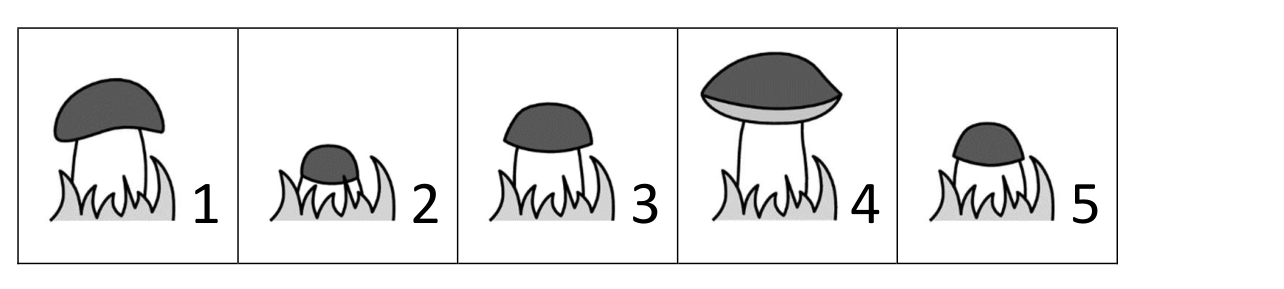
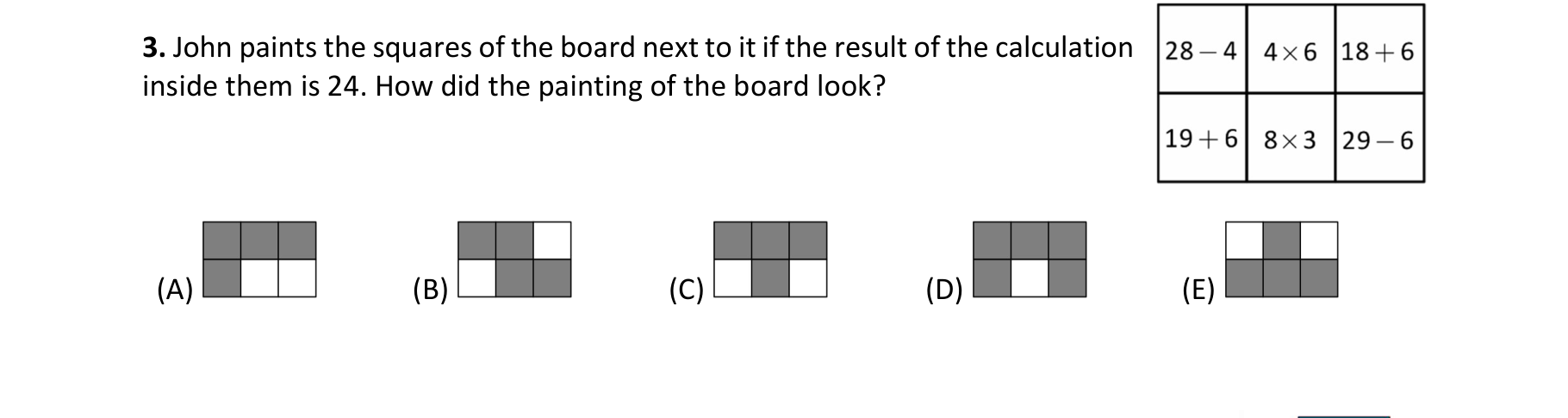
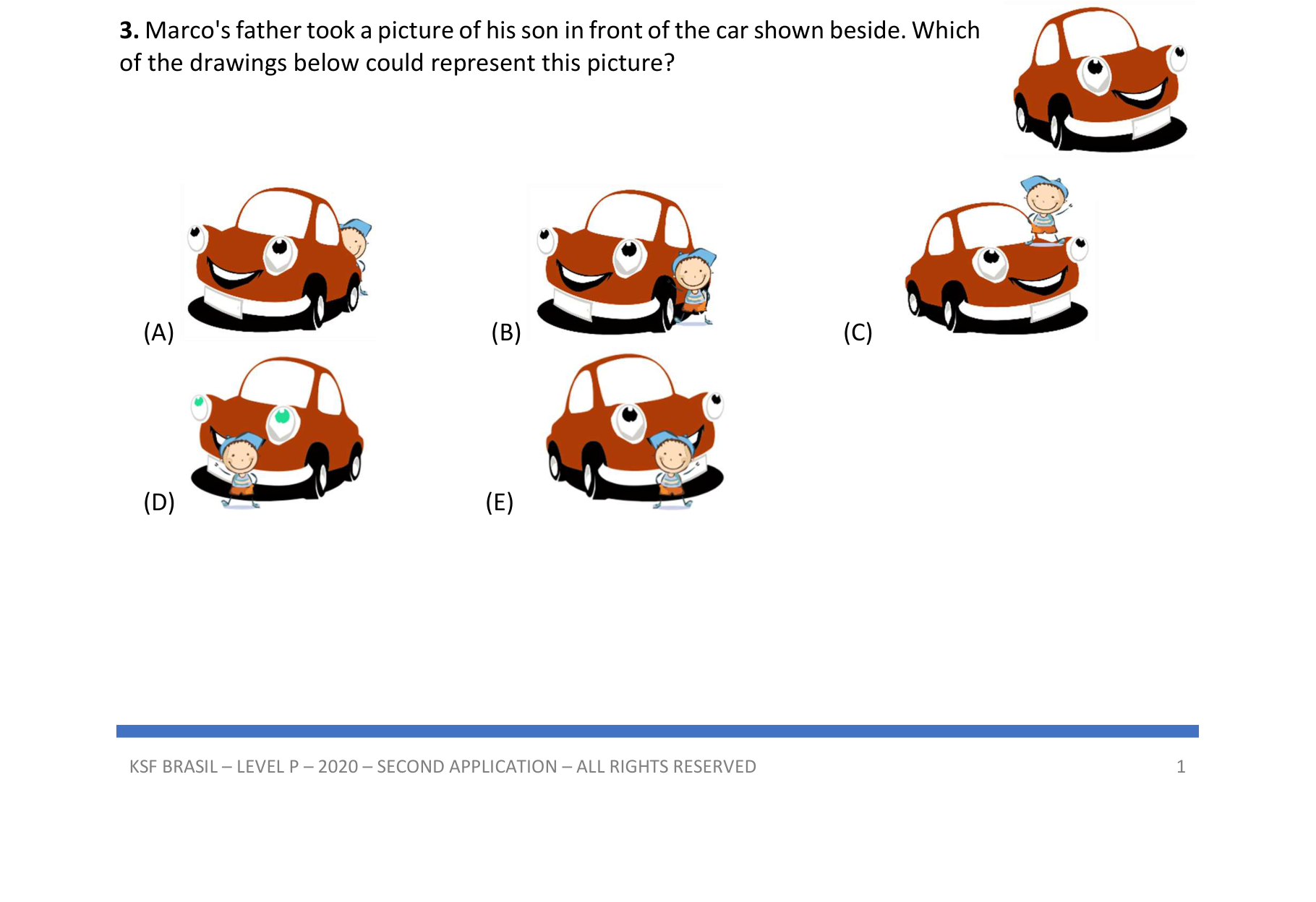
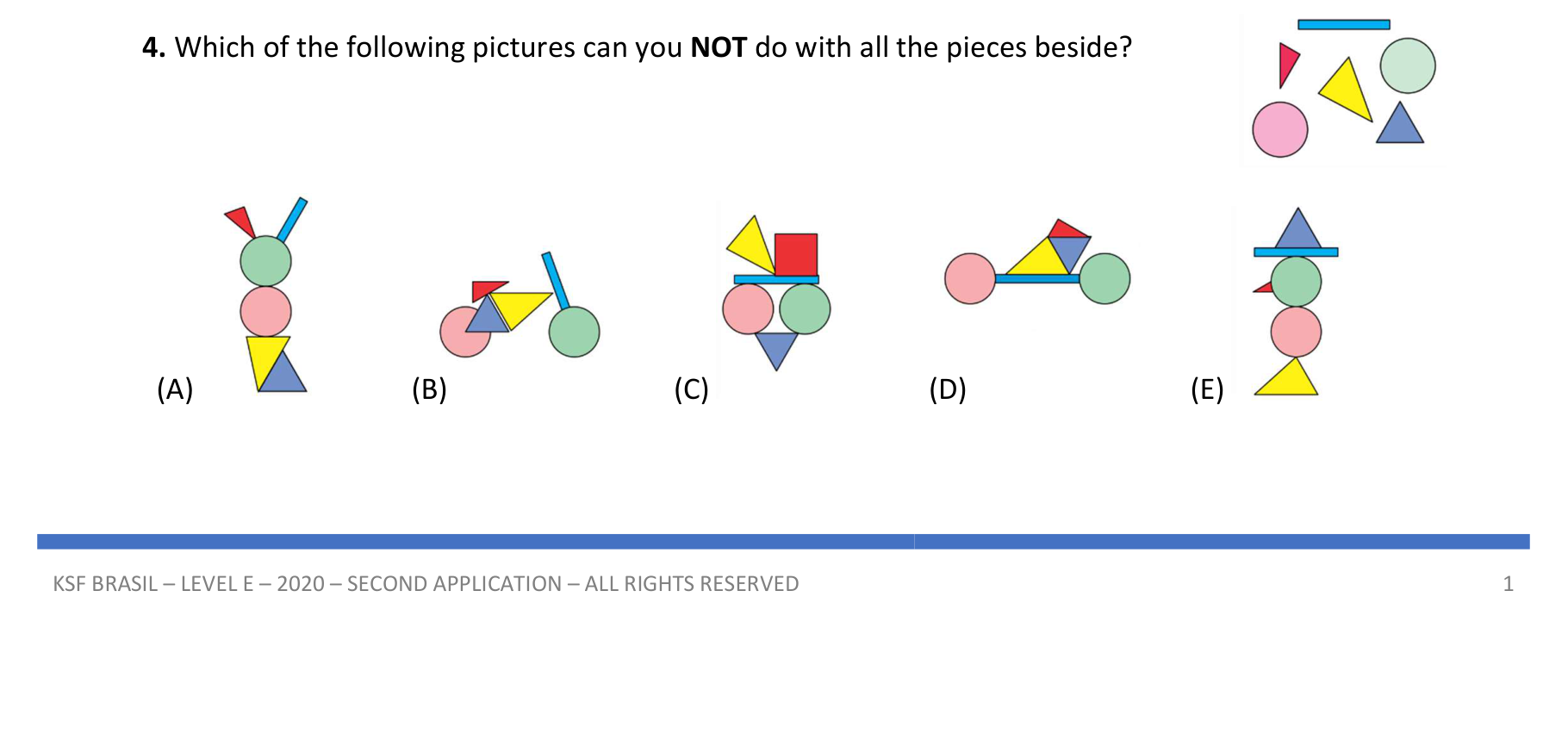
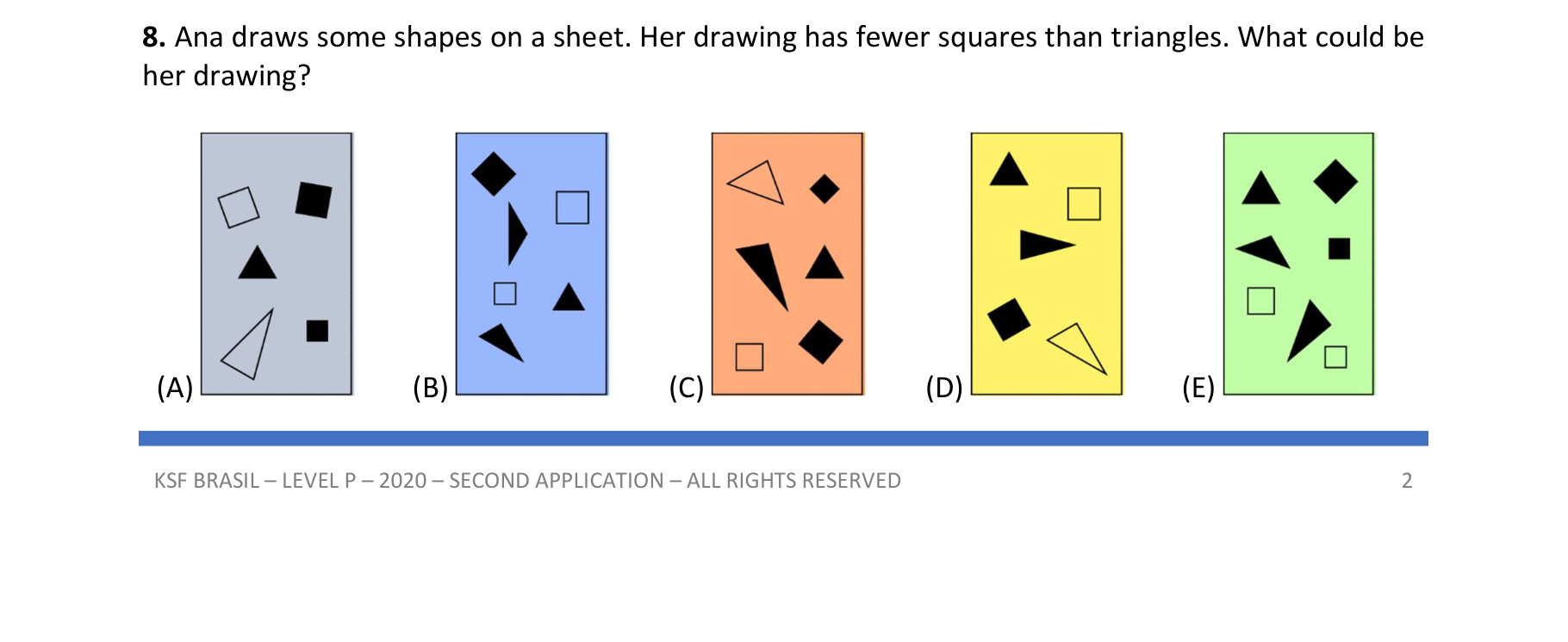
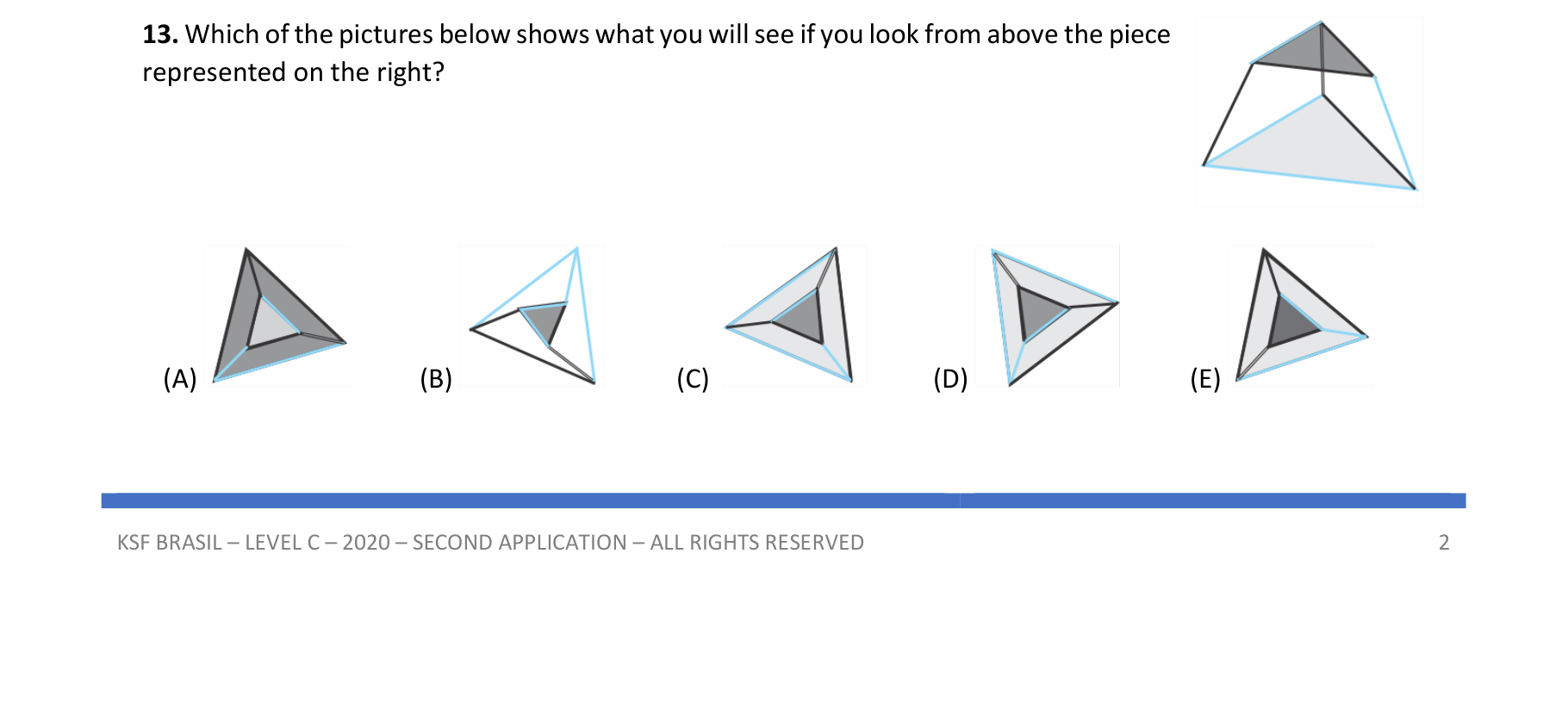
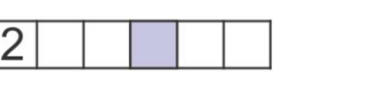
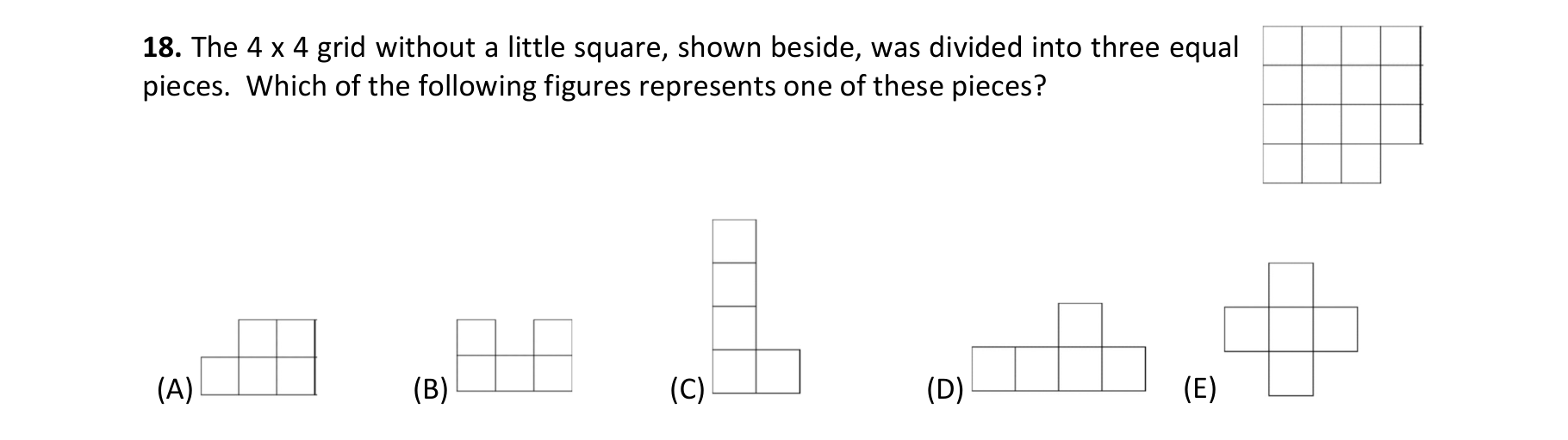
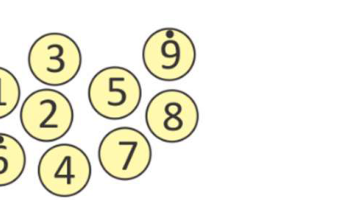
A mushroom grows a little bigger every day. Over five days Maria took a photo of this mushroom, but she put the photos in the wrong order (see picture). Which order of the photos shows the mushroom growing, from left to right?
Show answer
Answer: A — 2-5-3-1-4
Show hints
Hint 1 of 2
A mushroom only gets bigger from one day to the next, so order the photos from smallest cap to largest cap.
Still stuck? Show hint 2 →
Hint 2 of 2
Find the tiniest mushroom and read the labels in growing order.
Show solution
Approach: order the photos from smallest to largest mushroom
The mushroom grows every day, so the correct order goes from the smallest cap to the biggest, fully opened cap.
Reading the photo labels from smallest to largest gives the sequence in choice A: 2-5-3-1-4.
Using the numbers 1, 2, 3 and 4, we can write several fractions whose value is less than 1, for example, 13. How many different values, beyond the example, can be obtained?
Show answer
Answer: B — 4
Show hints
Hint 1 of 2
List every fraction (one number over another) you can build that is below 1, then drop repeats.
Still stuck? Show hint 2 →
Hint 2 of 2
Two different fractions can have the same value, like 2/4 and 1/2 — count values, not fractions.
Show solution
Approach: list the proper fractions and remove equal values
Using two of 1,2,3,4 with value < 1 gives 1/2, 1/3, 1/4, 2/3, 3/4 and 2/4.
But 2/4 equals 1/2, so the distinct values are 1/2, 1/3, 1/4, 2/3, 3/4 — five in all.
The example 1/3 is one of them, so beyond it there are 5 − 1 = 4 other values.
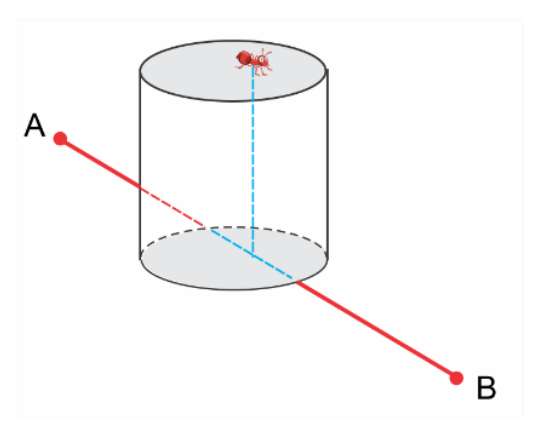
An ant used to walk 6 m in a straight line each day to go from point A to point B. One day Johnny placed an upright cylinder 1 m tall across the path. Now the ant walks along the same straight line, going up and over the cylinder and back down, as shown. How far must she walk now to get from A to B?
Show answer
Answer: A — 8 m
Show hints
Hint 1 of 2
The top of the cylinder is flat, so walking across it covers the same horizontal distance as before.
Still stuck? Show hint 2 →
Hint 2 of 2
Only the climbing up and back down is extra.
Show solution
Approach: account only for the extra vertical climb
Going over the top adds the climb up (1 m) and the climb down (1 m).
Crossing the flat top replaces the same horizontal stretch she used to walk on the ground, so that part is unchanged.
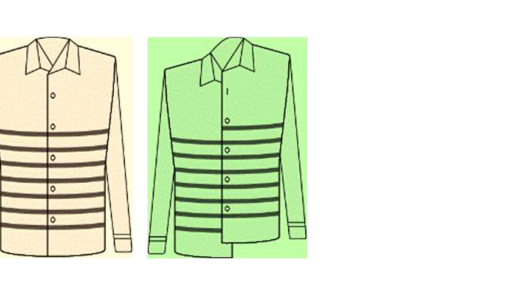
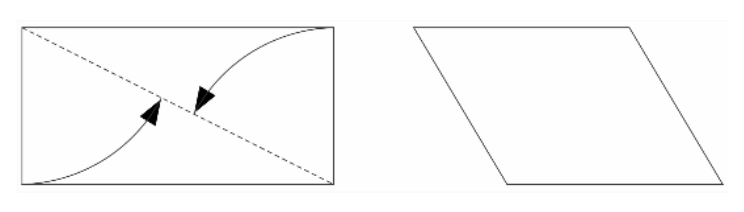
When Cosme correctly wears his new shirt, as shown in the left figure, the horizontal stripes form seven closed arches around his body. This morning he buttoned his shirt in the wrong way, as shown on the right. How many open arches were there around Cosme’s body this morning?
Show answer
Answer: B — 1
Show hints
Hint 1 of 2
A closed arch needs its stripe to line up on both sides of the button placket; an open arch is one that no longer meets.
Still stuck? Show hint 2 →
Hint 2 of 2
Misbuttoning slides one half of the shirt up by a single button, so trace which of the seven arches still join.
Show solution
Approach: track how the one-button shift breaks the stripe matches
Buttoning wrong slides the two halves of the shirt past each other by one button.
Each stripe then meets the stripe one position over, so almost every arch still closes — just one level higher.
Following the figure, only the single arch at the very bottom is left with nothing to meet, so it stays open.
Miguel decided to solve three math problems a day. Eight days later, Daniel started solving five problems a day, until the two of them tied in the total number of problems solved. How many problems had each one solved by that day?
Show answer
Answer: C — 60
Show hints
Hint 1 of 2
When Daniel starts, Miguel already has an 8-day head start of solved problems.
Still stuck? Show hint 2 →
Hint 2 of 2
Set the two running totals equal and solve for the number of days Daniel has been solving.
Show solution
Approach: equate the two running totals
By the time Daniel starts, Miguel has solved 3 × 8 = 24 problems.
After Daniel works d days, Miguel has 24 + 3d and Daniel has 5d.
Setting them equal: 24 + 3d = 5d, so 2d = 24 and d = 12.
Each has then solved 5 × 12 = 60 problems, choice C.
Every night the wizard Tilim makes the weather forecast for the king. When Tilim gets it right he gets 3 gold coins, but when he makes a mistake he pays a fine of 2 gold coins. After making the prediction for 5 days, Tilim found that he neither won nor lost coins. How many times did he get the weather forecast right in those 5 days?
Show answer
Answer: C — 2
Show hints
Hint 1 of 2
The coins he wins must exactly cancel the coins he pays in fines.
Still stuck? Show hint 2 →
Hint 2 of 2
Try a few guesses: how many right days make the coins won equal the coins lost?
Show solution
Approach: make the coins won match the coins lost
He ends with no change, so the coins he won must equal the coins he paid.
Each right day wins 3 coins and each wrong day costs 2 coins, over 5 days.
If he was right 2 days: 2 × 3 = 6 coins won, and the other 3 days cost 3 × 2 = 6 coins.
6 won and 6 paid balance out, so he was right 2 times.
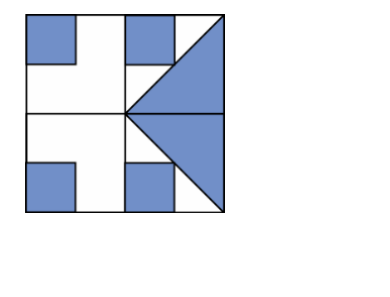
One square was divided into four equal squares, containing equal colored squares and equal colored triangles, as shown in the picture. What fraction of the original square does the colored part represent?
Show answer
Answer: B — 12
Show hints
Hint 1 of 2
The big square is four equal small squares; work out the colored part of each small square.
Still stuck? Show hint 2 →
Hint 2 of 2
Add up the colored squares and triangles and compare with the area of the whole figure.
Show solution
Approach: add the colored pieces and compare to the whole
Each small square is one quarter of the whole, and the colored squares and triangles together fill exactly half of the big square.
Counting the shaded unit squares and the shaded half-squares (triangles) gives a colored area equal to two of the four small squares.
That is 2 out of 4, i.e. 1/2 of the original square — choice B.
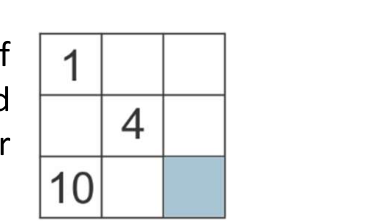
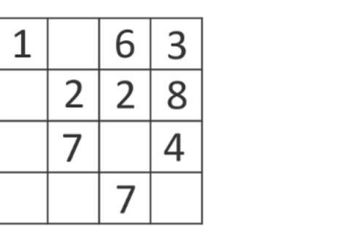
Eli drew a board on the floor with nine squares and wrote a number in each one, starting from 1 and adding 3 each time, until the board was full. Three of the numbers she wrote are shown in the picture. Which number below could be the one in the colored box?
Show answer
Answer: E — 22
Show hints
Hint 1 of 3
Skip-count out loud: start at 1 and keep adding 3 until you have written nine numbers.
Still stuck? Show hint 2 →
Hint 2 of 3
The colored box must hold one of the numbers Eli actually wrote, so check which answer choice shows up in your skip-count.
Still stuck? Show hint 3 →
Hint 3 of 3
Notice that some choices never appear in the count-by-3 list at all.
Show solution
Approach: write out Eli's count-by-3 list and see which choice fits
Eli starts at 1 and keeps adding 3, so the nine numbers she writes are 1, 4, 7, 10, 13, 16, 19, 22, 25.
Look at the choices: 14, 17 and 20 are never on this list, and 10 is already shown in another box, so they cannot sit in the colored box.
The only choice left that Eli really wrote is 22, so the colored box holds 22, which is choice E.
Maria has ten pieces of paper. Some are squares and the others are triangles. She cuts each square along one of its diagonals. She then counts the total number of vertices of the pieces she has now and gets 48. How many squares did she have before making the cuts?
Show answer
Answer: D — 6
Show hints
Hint 1 of 2
A whole square has 4 corners, but a cut square becomes two triangles — count their corners.
Still stuck? Show hint 2 →
Hint 2 of 2
Set up one equation for the 10 pieces and one for the 48 vertices.
Show solution
Approach: count vertices of cut squares vs triangles and solve
Cutting a square along a diagonal gives two triangles, 6 vertices in all.
An uncut triangle has 3 vertices.
With s squares and (10−s) triangles: 6s + 3(10−s) = 48.
Counting & ProbabilityLogic & Word Problemscasework
Three soccer teams compete in a championship. Each team plays exactly once against each of the other teams. In each match the winning team earns 4 points and the losing team loses 1 point; in case of a tie, each team earns 2 points. Once the championship is over, what is the largest possible sum of the points obtained by the three teams?
Show answer
Answer: E — 12
Show hints
Hint 1 of 2
There are only three matches; figure out the point total a single match can produce.
Still stuck? Show hint 2 →
Hint 2 of 2
Compare a decisive match (4 and −1) with a tie (2 and 2) — which gives the bigger combined total?
Show solution
Approach: maximize the total per match
Three teams each playing each other once means 3 matches in total.
A decisive match adds 4 + (−1) = 3 points; a tie adds 2 + 2 = 4 points.
Ties give more, so make all three matches ties: 3 × 4 = 12 points.
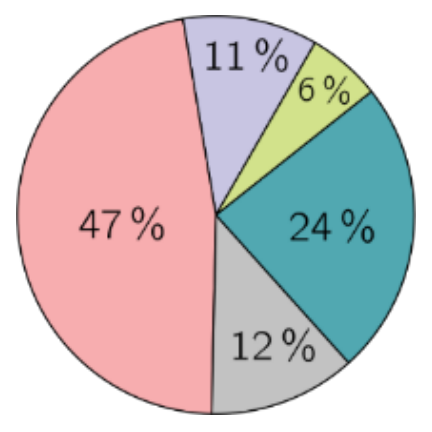
The pie chart shows the number of inhabitants in the five zones of a city. The central zone has the same population as the north, west and east zones combined, and the south zone has half as many inhabitants as the west zone. What is the difference, in percentage points, between the inhabitants of the north and east zones?
Show answer
Answer: D — 13%
Show hints
Hint 1 of 2
The central slice (47%) equals north+west+east together.
Still stuck? Show hint 2 →
Hint 2 of 2
Use 'south is half of west' to pin down which slices are which.
Show solution
Approach: match the percentage slices to the zones using the constraints
The non-central slices are 11, 6, 24, 12 (summing to 53), and central 47 = north+west+east, so south = 53 − 47 = 6.
South is half of west, so west = 12.
North + east = 47 − 12 = 35, which forces the pair to be 11 and 24.
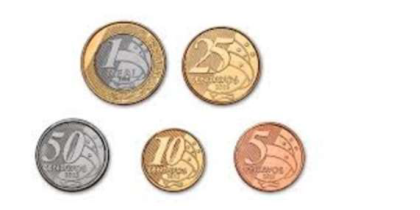
Bia has the five coins shown. She goes to the grocery store to buy one fruit, paying with exactly three of the coins and receiving no change. Among the fruit prices below, which one can she NOT pay for?
Show answer
Answer: C — 1.40
Show hints
Hint 1 of 2
The coins are 1.00, 0.50, 0.25, 0.10 and 0.05; she uses exactly three of them with no change.
Still stuck? Show hint 2 →
Hint 2 of 2
Check each price: one of the listed totals simply has no three-coin combination.
Show solution
Approach: test each price against all three-coin sums
The five coins are R$1.00, 0.50, 0.25, 0.10 and 0.05.
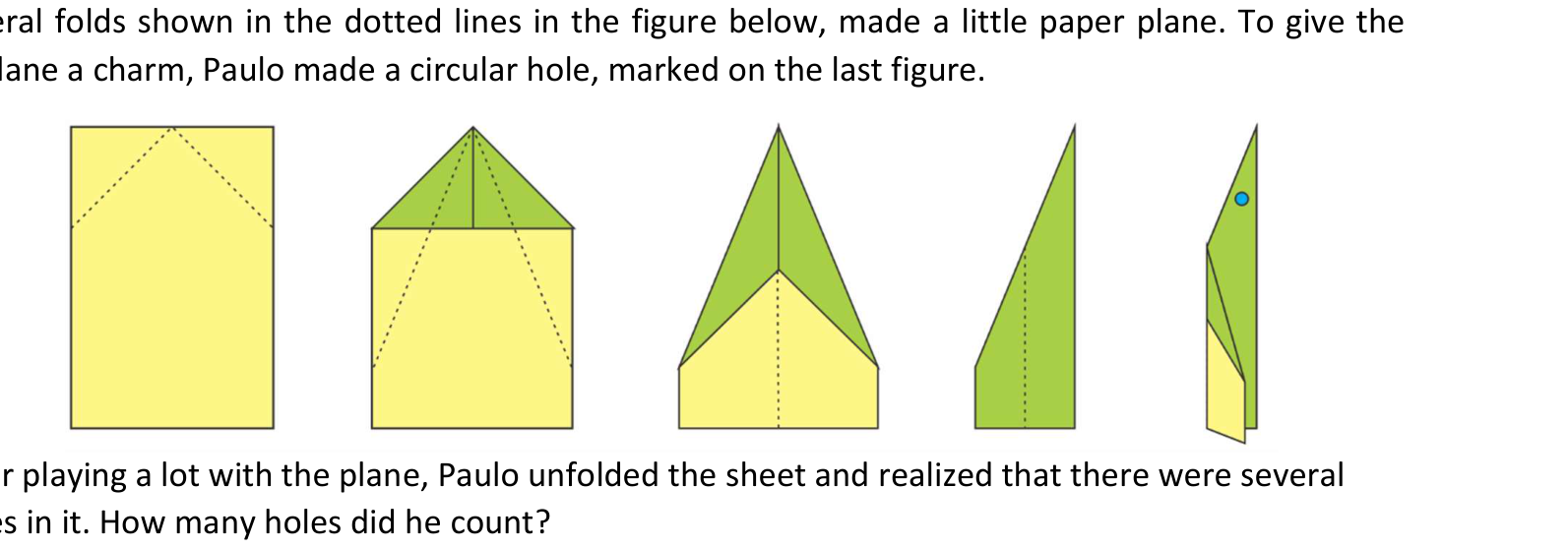
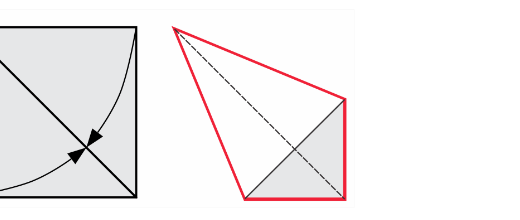
Paulo took a rectangular sheet of paper, yellow on one side and green on the other, and made the folds shown by the dotted lines to build a little paper plane. To decorate it, he punched one round hole, marked on the last picture. When he unfolded the sheet again, he found several holes in it. How many holes did he count?
Show answer
Answer: D — 8
Show hints
Hint 1 of 2
One punched hole passes through every layer the paper is folded into at that spot.
Still stuck? Show hint 2 →
Hint 2 of 2
Count how many layers stack up where the hole is punched.
Show solution
Approach: count layers pierced by the single punch
When the folded plane is punched, the hole goes through all the paper layers stacked there.
Unfolding spreads those holes out; the layers give 8 holes in total.
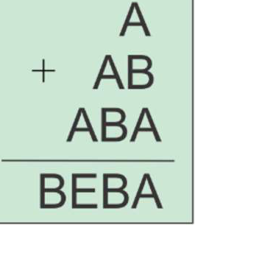
In the addition shown, different letters represent different digits and equal letters represent equal digits. The resulting sum is a four-digit number, with B different from zero. What is the sum of the digits of this number?
Show answer
Answer: B — BB
Show hints
Hint 1 of 2
Write A + AB + ABA as an expression in the digit values of A and B.
Still stuck? Show hint 2 →
Hint 2 of 2
Match it to the four-digit result BEBA and pin down each letter.
Show solution
Approach: convert the cryptarithm to place value and solve for the digits
A + AB + ABA = 112A + 11B, and BEBA = 1010B + 100E + A.
Setting them equal forces A = 9, B = 1, E = 0, so the sum is 1019.
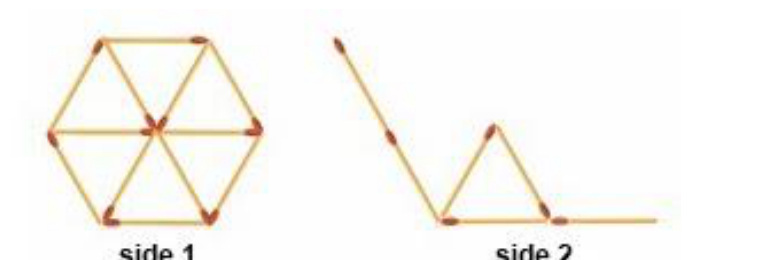
The figure of side 1 is formed by six equal triangles, made with 12 matchsticks. How many matchsticks are needed to complete the figure of side 2, shown partially started?
Show answer
Answer: D — 36
Show hints
Hint 1 of 2
Side 1 (a hexagon of six triangles) uses 12 sticks; side 2 is the next size up of the same pattern.
Still stuck? Show hint 2 →
Hint 2 of 2
Count the matchsticks in the full side-2 figure — the stick count grows faster than the side.
Show solution
Approach: scale the matchstick count to the next size
Side 1 is six small triangles forming a hexagon and needs 12 sticks.
Side 2 is the same hexagonal pattern built one size larger, and a full count of its segments comes to 36 sticks.
So 36 matchsticks are needed to complete the side-2 figure — choice D.
In a garden, a bush has branches with seven leaves, or branches with four leaves and a flower. Janaina counted the leaves and flowers and found that the bush has 9 flowers and 120 leaves. How many branches does the bush have?
Show answer
Answer: B — 21
Show hints
Hint 1 of 2
Each flower comes with a four-leaf branch, so the 9 flowers account for 9 such branches.
Still stuck? Show hint 2 →
Hint 2 of 2
Subtract those branches' leaves from 120, then divide the rest among seven-leaf branches.
Show solution
Approach: split the count into flowered and unflowered branches
A branch with a flower has 4 leaves; 9 flowers mean 9 of these branches, giving 9x4 = 36 leaves.
That leaves 120 - 36 = 84 leaves on the seven-leaf branches, i.e. 84 / 7 = 12 branches.
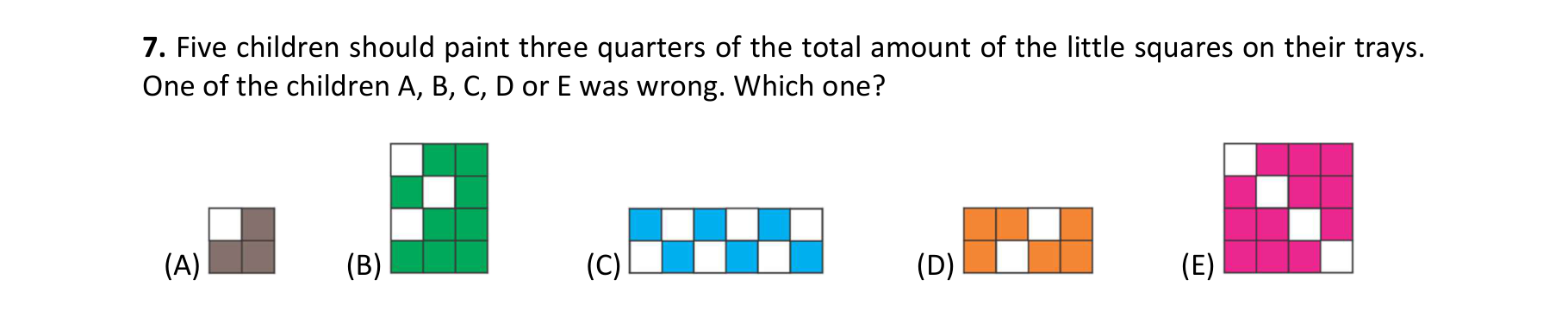
Three quarters painted means exactly 3 out of every 4 little squares are colored.
Still stuck? Show hint 2 →
Hint 2 of 2
Count colored squares versus total squares on each tray — one tray is off.
Show solution
Approach: check the painted fraction on each tray
For each tray, count the coloured squares and the total squares and compare with three quarters.
Trays A, B, D and E each have exactly 3 out of every 4 squares coloured, but tray C has only 5 of its 10 squares coloured (one half), so child C was wrong.
The digits of the year 2020 are each repeated twice and the two digits are different. How many times does this happen between the year 1000 and now (2020)?
Show answer
Answer: E — 29
Show hints
Hint 1 of 2
You want years like 2020 made of two different digits, each appearing exactly twice.
Still stuck? Show hint 2 →
Hint 2 of 2
Split by the leading digit: count such years starting with 1, then those starting with 2 up to 2020.
Show solution
Approach: count the two-distinct-digit, each-twice years by leading digit
Such a year uses two different digits, each appearing twice, e.g. 1331 or 2020.
Years from 1000–1999 (leading 1): the other digit pairs with one more 1 plus two of a different digit; enumerating the patterns gives 27 of them.
Years from 2000–2020 add just 2002 and 2020, for 2 more.
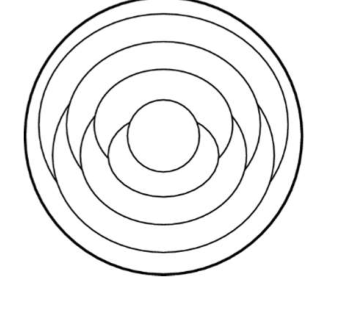
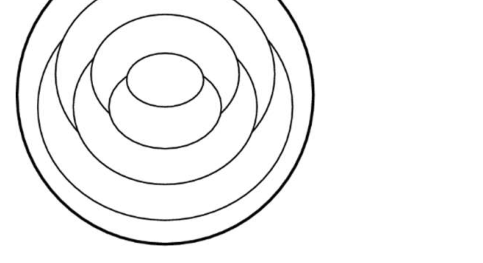
Cynthia paints each region of the figure a single colour: red, blue or yellow. Regions that touch each other must be painted different colours. In how many different ways can she colour the figure?
Show answer
Answer: E — 6
Show hints
Hint 1 of 2
The picture is a chain of nested regions; neighbours sharing a border must differ in colour.
Still stuck? Show hint 2 →
Hint 2 of 2
Work along the chain: each new region just needs to avoid the colour of the one it touches, so multiply the choices.
Show solution
Approach: count colourings region by region with the touching rule
The figure splits into regions; touching regions must get different colours from {red, blue, yellow}.
Colour the regions one at a time: the first is free, and each following region only has to differ from the single region it borders.
Multiplying the available choices at each step gives 6 valid colourings.
Gaspar has these seven different pieces, each made of equal little squares. He uses all the pieces to build rectangles with different shapes (and so different perimeters). How many different perimeters can he get?
Show answer
Answer: B — 3
Show hints
Hint 1 of 2
All the pieces together cover a fixed number of small squares — that's the area of every rectangle he makes.
Still stuck? Show hint 2 →
Hint 2 of 2
List the rectangle shapes with that area and count their different perimeters.
Show solution
Approach: fix the total area, then count distinct rectangle shapes
The pieces have 1, 2, 3, 4, 5, 6 and 7 squares, so together they always cover 1+2+3+4+5+6+7 = 28 squares.
A rectangle of 28 squares can be 1×28, 2×14 or 4×7, which give 3 different perimeters.
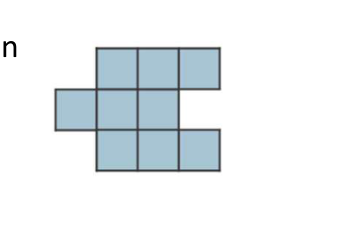
There are several figures that can be formed by nine squares of 1 cm side placed side by side (an example is shown), and one of them has the biggest perimeter. What is this perimeter?
Show answer
Answer: E — 20 cm
Show hints
Hint 1 of 2
Every time two squares share an edge, the total perimeter drops by 2.
Still stuck? Show hint 2 →
Hint 2 of 2
To make the perimeter biggest, join the nine squares with as few shared edges as possible.
Show solution
Approach: minimise shared edges to maximise perimeter
Nine separate squares have 9 × 4 = 36 unit edges.
Connecting them needs at least 8 shared edges, each removing 2.
Largest perimeter = 36 − 2×8 = 20 cm (e.g. a straight strip).
When Julia goes from home to school, she can walk half the way and take the bus for the other half. If she walks the whole way instead, she spends 45 minutes more. How much less time does it take her to go to school if she takes the bus the whole way?
Show answer
Answer: B — 45 minutes
Show hints
Hint 1 of 2
Let the full walk take W minutes and the full bus ride take B minutes; write the mixed trip as half of each.
Still stuck? Show hint 2 →
Hint 2 of 2
Compare 'walk only' with the half-and-half trip to find W − B, then compare 'bus only' with the mix.
Show solution
Approach: set up the half-and-half relation
Mixed trip = W/2 + B/2; walking only = W. Walking is 45 min more: W − (W/2 + B/2) = 45, so (W − B)/2 = 45.
The bus saves over the mixed trip by (W/2 + B/2) − B = (W − B)/2.
That is the same (W − B)/2 = 45 minutes.
So the bus-only trip takes 45 minutes less, choice B.
Five boxes contain 2, 3, 4, 7 and 15 balls. Peter wants to move balls between boxes so that every box ends up holding twice or half as many balls as one of the other boxes. At least how many balls must he move?
Show answer
Answer: A — 1
Show hints
Hint 1 of 2
Try to reach a doubling chain; notice the total 2+3+4+7+15 = 31 stays fixed.
Still stuck? Show hint 2 →
Hint 2 of 2
Compare {2,3,4,7,15} with a valid arrangement and count the fewest balls you must shift.
Show solution
Approach: find the nearest valid doubling arrangement
The boxes hold 2, 3, 4, 7, 15 - total 31 balls, which stays fixed.
A working layout (each box double or half of another) is {2, 4, 4, 7, 14}: 2=4/2, 4=2x2, 14=2x7.
Getting there from {2,3,4,7,15} just moves one ball (from the box of 15 to the box of 3).
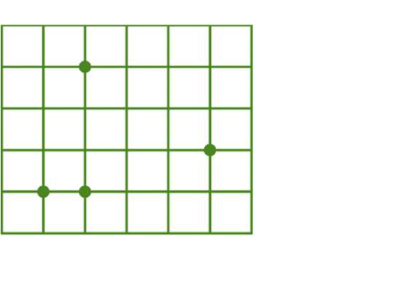
Four points were marked on a grid of 1 cm side squares. Of the possible triangular regions that can be obtained with vertices at three of these points, one has the largest area. What is this area, in cm²?
Show answer
Answer: D — 5.5
Show hints
Hint 1 of 2
List the four marked lattice points, then think which three are spread out most.
Still stuck? Show hint 2 →
Hint 2 of 2
Use the shoelace formula (or base×height) on the most spread-out triple.
Show solution
Approach: compute triangle areas on the lattice and take the largest
The points are at (2,4), (5,2), (1,1) and (2,1) on the cm grid.
The triangle (2,4), (5,2), (1,1) has area ½|2(2−1)+5(1−4)+1(4−2)| = ½·11 = 5.5.
The other triples give smaller areas (4.5, 1.5, 0.5).
Logic & Word ProblemsArithmetic & Operationsmagic-squaresum-constraintwork-backward
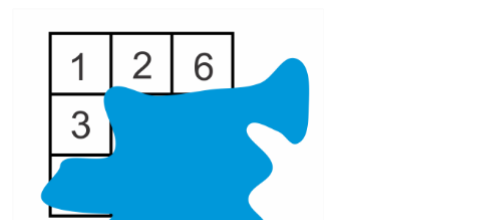
Juca wrote a whole number greater than zero in each box of the 3×3 board shown, so that the sums of the numbers in each row and in each column are equal. The only thing Juca remembers is that no number is used three times. What number is written in the center box?
Show answer
Answer: C — 4
Show hints
Hint 1 of 2
All three rows and columns share the same total; the top row 1 + 2 + 6 gives that total.
Still stuck? Show hint 2 →
Hint 2 of 2
Fill the grid from the common sum of 9, using that no value may appear three times.
Show solution
Approach: use the common row/column sum
Each row and column sums to 1 + 2 + 6 = 9.
The left column 1 + 3 + ? = 9 forces the bottom-left to be 5.
Filling in keeps the sums at 9; the center value can be 4 (center 5 would repeat a number three times, which is forbidden).
Two identical dice each have two red faces, two blue faces and two green faces. If both dice are rolled at the same time, what is the probability that the two top faces show different colours?
Show answer
Answer: E — 23
Show hints
Hint 1 of 2
Each die shows red, blue or green with equal chance 1/3.
Still stuck? Show hint 2 →
Hint 2 of 2
It is easier to find the chance the two match, then subtract.
Show solution
Approach: complementary counting on colours
Each die shows each colour with probability 2/6 = 1/3.
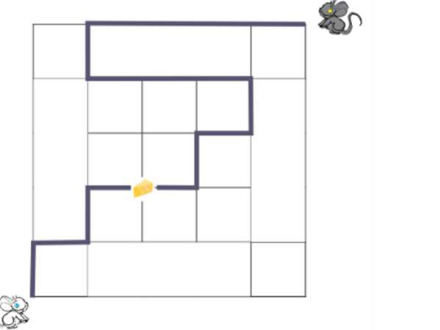
Two little mice, one white and one dark, leave at the same time toward the cheese along the different paths shown (the little squares are all equal). They reach the cheese at the same moment. If the dark mouse runs 4.5 metres per second, how many metres per second does the white mouse run?
Show answer
Answer: B — 1.5
Show hints
Hint 1 of 2
Same start, same finish, same time - so speeds are in the same ratio as the path lengths.
Still stuck? Show hint 2 →
Hint 2 of 2
Count the unit edges each mouse travels; the white mouse's speed scales 4.5 by (white length / dark length).
Show solution
Approach: speeds are proportional to path lengths over equal time
Both mice take the same time, so speed is proportional to distance.
Counting the grid edges, the white mouse's path is one third the length of the dark mouse's path.
Hence its speed is one third of 4.5 m/s, namely 4.5 x (1/3) = 1.5 m/s.
Cynthia paints each region of the figure in a single colour: red, blue or yellow. Regions that touch each other must be painted different colours. In how many different ways can Cynthia paint the figure?
Show answer
Answer: E — 6
Show hints
Hint 1 of 3
Find which regions actually share a border, since only touching regions are forced to be different colours.
Still stuck? Show hint 2 →
Hint 2 of 3
Colour one region first, then count how many free colour choices are left for each region next to it.
Still stuck? Show hint 3 →
Hint 3 of 3
Multiply the number of choices region by region as you work inward.
Show solution
Approach: colour the regions one at a time and multiply the free choices
Colour the outermost region first: there are 3 colours to pick from.
Each region just inside it touches the one outside, so it must use a different colour, which usually leaves only a small number of choices.
Multiplying the choices region by region as you move inward gives 6 different ways to paint the whole figure, choice E.
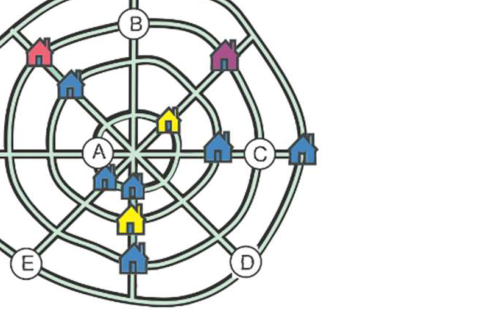
A village of 12 houses has four straight streets and four circular streets. The map shows 11 houses. Each straight street has three houses, and each circular street also has three houses. Where should the 12th house be placed on this map?
Show answer
Answer: D — On D
Show hints
Hint 1 of 2
Each straight street needs 3 houses and each circular street needs 3 houses.
Still stuck? Show hint 2 →
Hint 2 of 2
Find the position where a street is currently one house short.
Show solution
Approach: check which street is missing a house
Every street, straight or circular, must hold exactly three houses.
Count the houses already on each street and find the one with only two.
Placing the 12th house at spot D completes that street without overfilling any other.
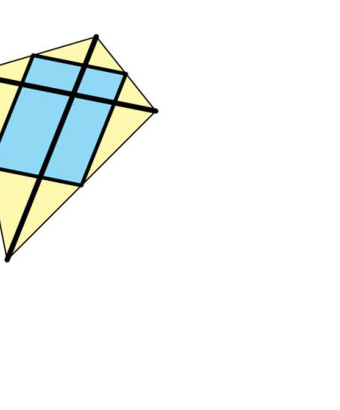
Martinho made a two-colour kite with six pieces of a thin strip of bamboo. Two pieces were used for the diagonals, which are perpendicular. The other four pieces were used to connect the midpoints of the sides of the kite, as shown in the picture. What is the ratio between the blue and yellow parts of the kite?
Show answer
Answer: E — 1
Show hints
Hint 1 of 2
Joining the midpoints of any quadrilateral’s sides makes a parallelogram inside it.
Still stuck? Show hint 2 →
Hint 2 of 2
That midpoint parallelogram always has exactly half the area of the original shape.
Show solution
Approach: use the Varignon midpoint-parallelogram half-area fact
The blue region is the parallelogram formed by the midpoints of the kite’s sides.
For any quadrilateral, this midpoint parallelogram has half the total area.
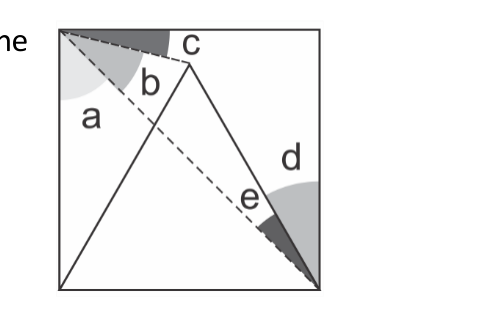
In the figure, formed by a square and an equilateral triangle, the letters indicate the measures of the angles. Which of the following equalities is true?
Show answer
Answer: E — e + d = a
Show hints
Hint 1 of 2
The triangle is equilateral (all 60°) and the square has all 90° corners; mark what each labelled angle is built from.
Still stuck? Show hint 2 →
Hint 2 of 2
Track the angles along the slanted lines and look for the relation that always balances.
Show solution
Approach: chase angles using the 60° and 90° pieces
The shape combines a square (90° corners) and an equilateral triangle (60° corners), so every labelled angle is a combination of these.
Following the diagonal that splits the figure, the angles e and d on one side add up to the angle a on the other.
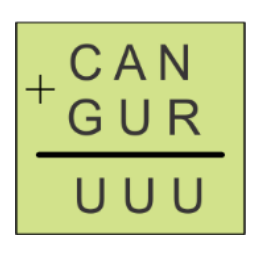
In the addition on the right, different letters stand for different digits. Assuming the sum is correct, what is the greatest possible value of \(C + A + N\)?
Show answer
Answer: D — 21
Show hints
Hint 1 of 2
Read the columns of CAN + GUR = UUU with their carries; the result is a three-digit repdigit UUU.
Still stuck? Show hint 2 →
Hint 2 of 2
To make C + A + N large, push the units and the carried digits, allowing a leading zero in the second number.
Show solution
Approach: analyse CAN + GUR = UUU column by column, then maximise C + A + N
Looking at the tens column, A plus the units carry must reach a multiple of 10, which forces A = 9 with a carry of 1.
Trying the largest digits for C and N that still close the columns gives 498 + 057 = 555 (here G = 0 is allowed).
That makes C + A + N = 4 + 9 + 8 = 21, option D, and no arrangement beats it among the choices.
Number TheoryLogic & Word Problemssum-constraintcasework
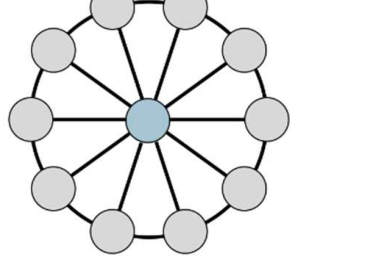
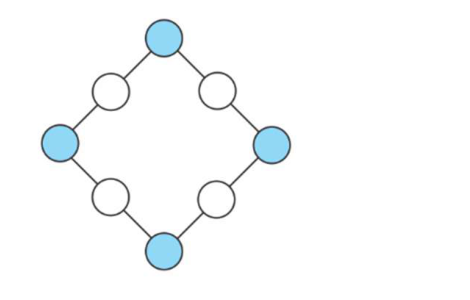
The circles in the figure are to be numbered from 0 to 10, each with a different number. The five sums of the three numbers along each diameter must all be odd. If one of these sums is as small as possible, what is the largest possible value of one of the remaining sums?
Show answer
Answer: E — 21
Show hints
Hint 1 of 2
The centre circle is shared by all five diameters; for every diameter-sum to be odd, think about the parity the centre forces.
Still stuck? Show hint 2 →
Hint 2 of 2
Make one sum smallest by surrounding it with tiny numbers, which pushes the leftover large numbers onto another diameter to maximise it.
Show solution
Approach: use parity of the shared centre, then push extremes apart
Numbers 0..10 are placed; each diameter sums two ends plus the shared centre, and all five sums are odd.
The shared centre fixes a parity pattern for the diameter ends.
Putting the smallest numbers on one diameter leaves the large numbers for another; maximising that one gives a sum of 21.
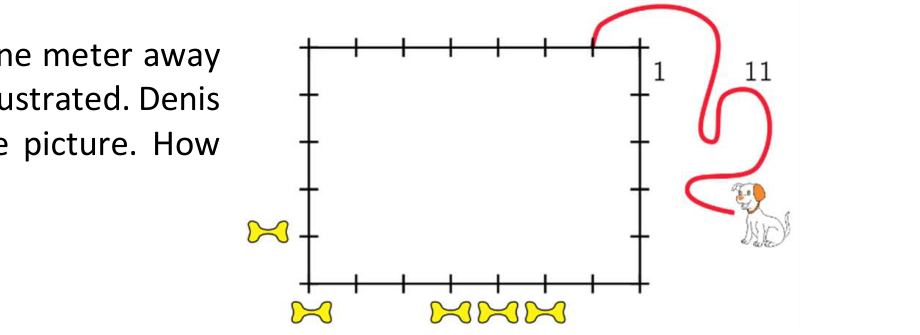
Denis ties his dog with an 11-metre rope, one metre away from a corner of a fence about 7 metres by 5 metres, as shown. Denis places 5 bones near the fence, as in the picture. How many bones can the dog reach?
Show answer
Answer: E — 5
Show hints
Hint 1 of 3
The dog is tied just outside the fence, so the rope has to hug the fence and bend around each corner to reach a bone.
Still stuck? Show hint 2 →
Hint 2 of 3
Walk the rope along the fence step by step, counting the metres (the tick marks) and bending it at every corner.
Still stuck? Show hint 3 →
Hint 3 of 3
Check how far 11 metres of rope can reach once it turns the corners.
Show solution
Approach: follow the rope along the fence, counting metres and bending at corners
The dog is tied 1 metre from the top-right corner, so the rope wraps along the top edge, down a side, and around the bottom, bending at each corner.
Counting the tick marks (each 1 metre), the farthest bone along this path is still within the 11 metres of rope once it bends around the corners.
So the rope is long enough to reach every bone, and the dog can grab all 5 of them, choice E.
Adam, Breno and Carlos live in the same apartment and bought a treadmill for exercise. Nobody uses the treadmill on Wednesdays and Sundays, and there is no day on which all three of them use the treadmill. Adam uses the treadmill 4 times a week and Breno 5 times a week. There are 4 consecutive days when Adam uses the treadmill on the first day, he does not use it on the second day, and Breno does not use it on the fourth day. Carlos uses the treadmill on one day of the week. Which day?
Show answer
Answer: A — Friday
Show hints
Hint 1 of 2
Only Mon, Tue, Thu, Fri, Sat are usable; Breno’s 5 sessions fill them all.
Still stuck? Show hint 2 →
Hint 2 of 2
Carlos’s day can’t be one where all three use it, so it’s Adam’s single off-day — find it from the four-day clue.
Show solution
Approach: pin down Adam's missing day using the consecutive-day clue
Breno uses all five active days, so Adam’s skipped day is Carlos’s day (no day has all three).
The four consecutive days with 'Breno off on day 4' must be Thu, Fri, Sat, Sun.
Then Adam uses Thu (day 1) but not Fri (day 2), so Adam’s off-day is Friday.
Arithmetic & OperationsLogic & Word Problemswork-backward
As soon as he left his city heading toward Caecá, Charles saw the sign on the left. When he came back from Caecá, he saw the sign on the right. At that point, how far was it to reach his city?
Show answer
Answer: D — 41 km
Show hints
Hint 1 of 2
The left sign (just outside his city) reads Arati 12 km, Baibá 33 km; the right sign reads Baibá 8 km, Arati 29 km.
Still stuck? Show hint 2 →
Hint 2 of 2
First use either sign to find the fixed gap between Arati and Baibá, then notice his city sits 12 km past Arati.
Show solution
Approach: use the fixed town distances on the two signs
He saw the left sign just as he left his city, so his city is 12 km before Arati (and Baibá is 33 km out).
On the way back the right sign reads Arati 29 km ahead; his city is another 12 km beyond Arati.
So the distance left to his city is 29 + 12 = 41 km.
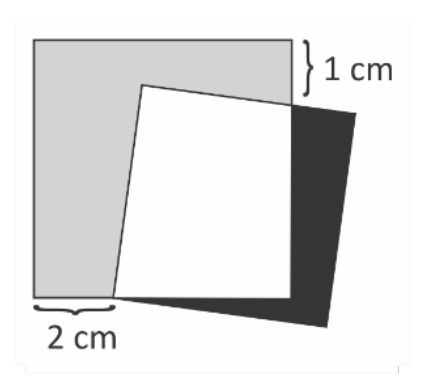
A gray square of area 36 cm² and a black square of area 25 cm² are overlaid as shown. What is the perimeter of the overlapping region — the white quadrilateral, which has one vertex on a side of the gray square?
Show answer
Answer: B — 11 cm
Show hints
Hint 1 of 2
The overlapping white region's sides come from the edges of the two squares.
Still stuck? Show hint 2 →
Hint 2 of 2
The slanted pieces pair up to recover full side lengths.
Show solution
Approach: reassemble the overlap's sides into full square sides
The white quadrilateral is bounded partly by the gray square's edge and partly by the black square's edge.
Because a vertex of one square lies on a side of the other, the slanted boundary pieces add up to one full side of each square.
So the perimeter equals side(gray) + side(black) = 6 + 5 = 11 cm.
When the bat Elisa left her cave at night, the digital clock showed the time on the left. When she came back in the morning and hung herself upside down, she read her watch and saw the time on the right. How long did she stay out of the cave?
Show answer
Answer: D
Show hints
Hint 1 of 2
The morning time is read on an upside-down watch, so first turn that reading the right way up before comparing it with the night-time clock.
Still stuck? Show hint 2 →
Hint 2 of 2
Each digit, turned a half-turn, becomes another digit (0,1,2,5,8 still read as digits) and the whole reading flips left-to-right; fix the morning time, then count the gap.
Show solution
Approach: turn the upside-down morning reading right way up, then count the gap
The night clock shows the leaving time directly.
The morning watch is held upside down, so rotate that display a half-turn: each digit changes shape and the left and right digits swap, giving the true morning time.
Counting forward from the night time to the corrected morning time gives the time she was away, 3h 41m.
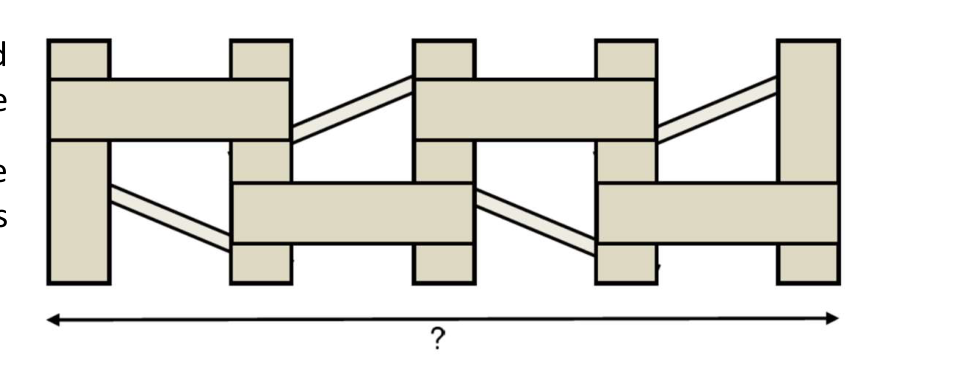
Luana builds a fence using pieces of wood 2 metres long and half a metre wide, all the same shape. The picture shows the finished fence. How long is the fence, in metres?
Show answer
Answer: B — 6.5
Show hints
Hint 1 of 2
Each board is 2 m long, but where boards overlap, length is shared, not doubled.
Still stuck? Show hint 2 →
Hint 2 of 2
Add the board lengths along the fence, subtracting the overlaps.
Show solution
Approach: add board lengths along the fence, accounting for overlaps
The fence is made of 2 m boards whose ends overlap as shown in the picture.
Adding the lengths along the run, with the shared overlaps counted once, the total length is 6.5 m.
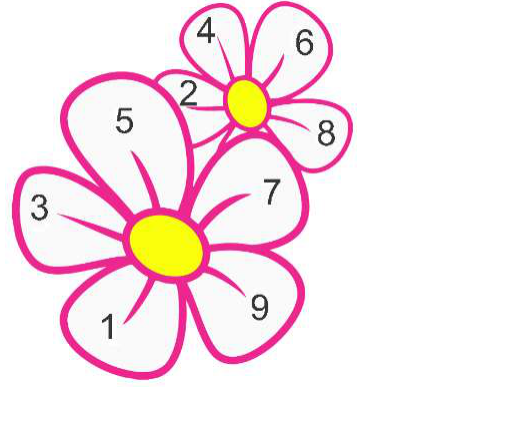
Numbers were written on the petals of two flowers, one number on each petal. One of the petals is hidden. The sum of the numbers on the back flower is twice the sum of the numbers on the front flower. What number is written on the hidden petal?
Show answer
Answer: D — 30
Show hints
Hint 1 of 2
Add up the petals you can see on each flower separately.
Still stuck? Show hint 2 →
Hint 2 of 2
The back flower's total is double the front flower's total; the hidden petal makes up the difference.
Show solution
Approach: use the doubling relationship between the two totals
The front flower shows all its numbers: 1 + 3 + 5 + 7 + 9 = 25.
The back flower must total twice that, so 2 × 25 = 50.
Its visible petals add to 2 + 4 + 6 + 8 = 20, so the hidden petal is 50 − 20 = 30.
Ana planned to walk an average of 5 km per day in March. In the first 10 days she walked an average of 4.4 km per day, and in the next 6 days she walked an average of 3.5 km per day. What average daily distance must she walk on the remaining days in order to fulfill her plan?
Show answer
Answer: C — 6 km
Show hints
Hint 1 of 2
March has 31 days; turn the planned average into a total distance she must cover.
Still stuck? Show hint 2 →
Hint 2 of 2
Subtract what she has already walked, then divide by the days that remain.
Show solution
Approach: work with totals over the month
A 5 km average over 31 days means a target total of 5 × 31 = 155 km.
First 10 days: 10 × 4.4 = 44 km; next 6 days: 6 × 3.5 = 21 km; so 65 km done in 16 days.
Remaining distance 155 − 65 = 90 km over the last 15 days is 90 ÷ 15 = 6 km/day.
Two thousand and twenty coins lie on a table, all showing heads. In each move you must turn over exactly three of the coins. What is the smallest number of moves needed so that every coin shows tails?
Show answer
Answer: C — 674
Show hints
Hint 1 of 2
Each coin must be flipped an odd number of times to end as tails.
Still stuck? Show hint 2 →
Hint 2 of 2
Three flips per move; how few moves cover 2020 odd-flip requirements?
Show solution
Approach: parity and a counting lower bound
Each of the 2020 coins needs an odd number of flips, so at least 2020 coin-flips are needed.
Each move makes 3 coin-flips, so at least 2020/3 rounded up = 674 moves.
674 moves give 2022 flips: flip 2019 coins once and one coin three times — all odd — which is achievable, so the answer is 674.
On a distant island, 2020 kangaroos hold hands in a large circle. Each kangaroo is either brown (and always tells the truth) or grey (and always lies). Every one of them says, “One of my neighbours is brown and the other is grey.” How many of the kangaroos are brown?
Show answer
Answer: A — 0
Show hints
Hint 1 of 2
Suppose a brown (truthful) kangaroo exists: its statement about its neighbours would have to hold.
Still stuck? Show hint 2 →
Hint 2 of 2
Test whether any mix of brown and grey can sit in a circle when all say the same sentence - it collapses to one case.
Show solution
Approach: check the statement's consistency around the circle
A brown kangaroo tells the truth, so its two neighbours would be one brown and one grey.
Following that around the circle leads to a contradiction, so no truthful (brown) kangaroo can exist.
Every kangaroo is therefore grey and lying - consistent, since the statement is then false for each.
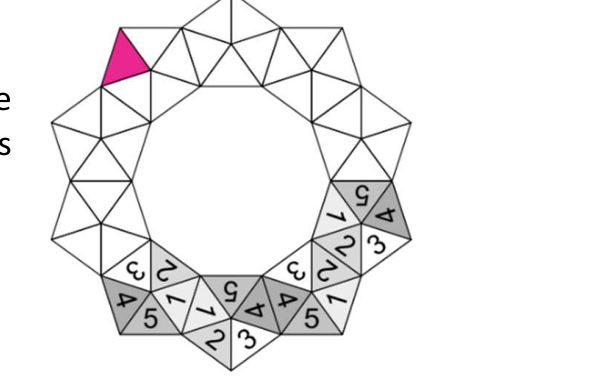
Amelia built a crown using 10 copies of the small piece shown. The pieces were joined so that touching sides always show the same number, as in the picture, where four pieces are filled in. What number appears in the coloured triangle?
Show answer
Answer: A — 1
Show hints
Hint 1 of 3
All ten pieces are exact copies, so the same little numbers repeat as you go around the ring.
Still stuck? Show hint 2 →
Hint 2 of 3
Where two pieces touch, the touching numbers match, which lines the pieces up the same way each time.
Still stuck? Show hint 3 →
Hint 3 of 3
Once you know how one piece sits, every piece sits the same, so jump that pattern around to the colored triangle.
Show solution
Approach: use the repeating pattern of identical pieces around the ring
Every piece is the same copy, and because touching sides must show equal numbers, each piece is placed in the very same way as its neighbour.
So the numbers repeat in the same order all the way around the crown, like a pattern that copies itself ten times.
Reading that repeating pattern from the filled-in pieces around to the colored triangle, the number landing there is 1, choice A.
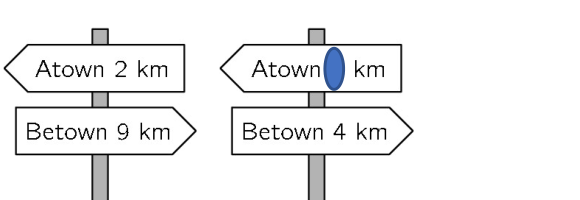
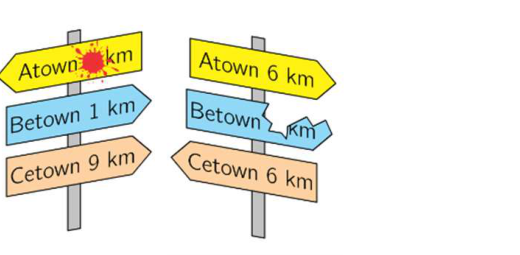
The shortest way from Atown to Cetown is through Betown. Going back along this road from Cetown to Atown, we first find the signposts on the left side of the road. Further on we find the road signs on the right side of the road. How far is it from Betown to Atown?
Show answer
Answer: D — 4 km
Show hints
Hint 1 of 2
Each signpost shows its distance to the towns; the two posts seen on the return trip pin down where each post stands on the road.
Still stuck? Show hint 2 →
Hint 2 of 2
Use the readings that name a common town to fix the gaps between the towns, then read off Betown-to-Atown.
Show solution
Approach: place the two signposts on the road from their distance readings
On the way back from Cetown the two posts give their distances to the towns, which fixes the position of each post along the straight road.
Matching up the readings that share a town determines the spacing Atown–Betown–Cetown.
Reading off that spacing, the distance from Betown to Atown is 4 km, choice D.
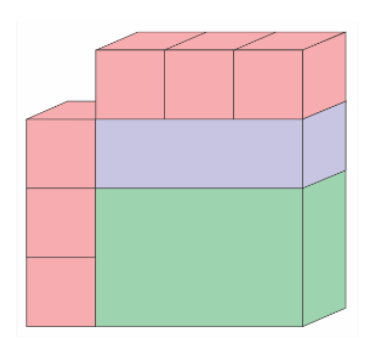
Zilda will use six identical cubes and two different rectangular blocks to build the structure shown, which has eight faces. Before gluing the pieces, she paints each one completely and works out that she needs 18 litres of paint (colour does not matter). How many litres of paint would she use if she painted the whole structure only after gluing the pieces together?
Show answer
Answer: C — 11.5
Show hints
Hint 1 of 2
Painting after gluing simply skips the faces that get hidden where two pieces touch.
Still stuck? Show hint 2 →
Hint 2 of 2
Every internal contact hides two equal faces, so pair them up and remove their paint.
Show solution
Approach: subtract the paint on the faces hidden by gluing
Painted separately, all the pieces' faces need 18 litres.
After gluing, wherever two pieces meet, two equal faces are hidden and no longer painted, so that paint is removed.
Totalling the hidden contact faces and subtracting their paint from 18 litres leaves 11.5 litres, option C.
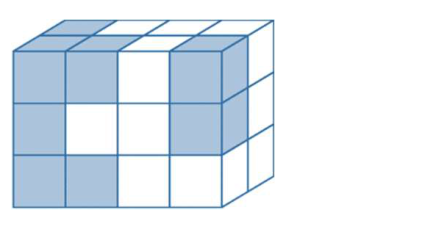
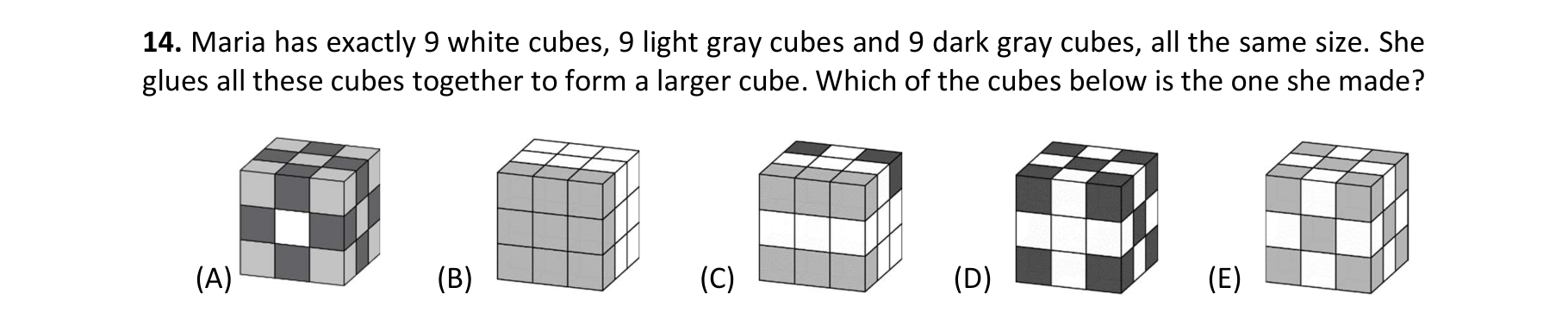
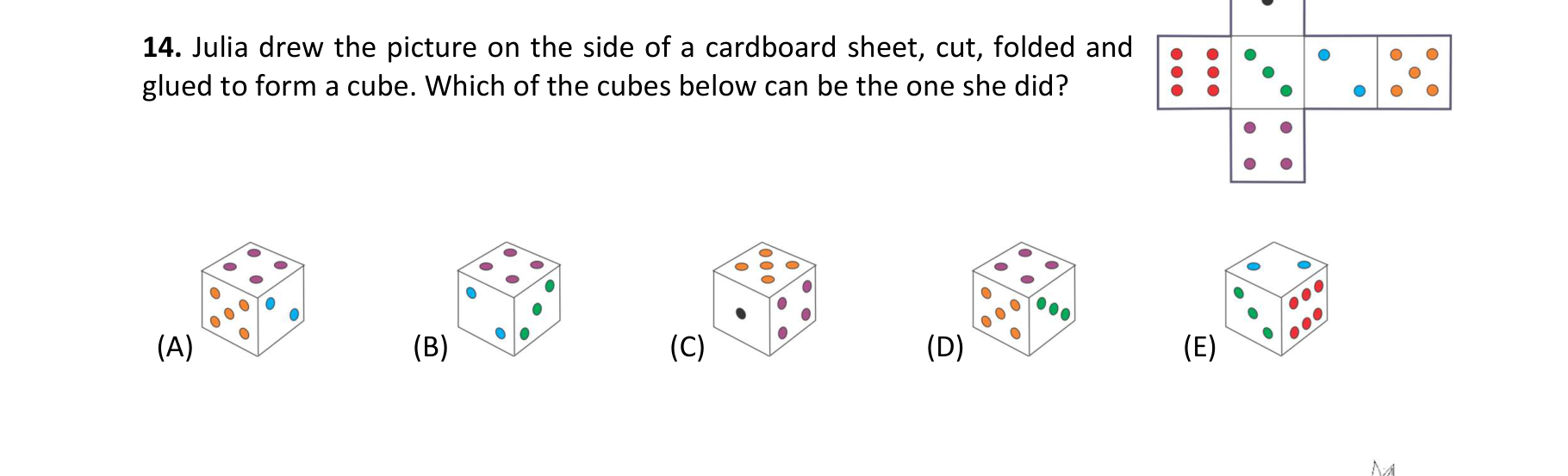
Maria has exactly 9 white cubes, 9 light-grey cubes and 9 dark-grey cubes, all the same size. She glues them all together to form one larger cube. Which of the cubes below is the one she made?
Show answer
Answer: A
Show hints
Hint 1 of 2
A 3x3x3 cube has 27 small cubes; here each colour is used exactly 9 times.
Still stuck? Show hint 2 →
Hint 2 of 2
Count the visible faces of each colour in each option - the right cube must allow exactly 9 of each colour overall.
Show solution
Approach: match the visible colour counts to 9-9-9
The big cube is 3x3x3 = 27 small cubes, painted 9 white, 9 light grey, 9 dark grey.
For each option, see whether the visible and forced hidden cubes can split into three nines.
Only cube A is consistent with using each colour exactly nine times.
Maria wants to write whole numbers in the squares of the figure, so that the sum of the numbers in three consecutive squares is always 10. She has already written one number. What number should she write in the gray square?
Show answer
Answer: B — 2
Show hints
Hint 1 of 3
Every group of three squares next to each other adds up to the same total, 10.
Still stuck? Show hint 2 →
Hint 2 of 3
Two overlapping groups of three share the middle two squares, so the ends must match.
Still stuck? Show hint 3 →
Hint 3 of 3
This means squares that are three apart always hold the same number.
Show solution
Approach: see that squares three apart must be equal
Take the first three squares and the next three squares (squares 2, 3, 4). Both groups add to 10.
Both groups share squares 2 and 3, so square 1 and square 4 must be equal, and in the same way every square equals the one three places away.
So the pattern of numbers just repeats every three squares.
The gray square sits three places from the square already holding 2, so it also holds 2.
Two isosceles triangles that are not similar have at least one side of 20 cm and have equal perimeters. If one of them has a side of 8 cm, which of the following measures can be the measure of one side of the other triangle?
Show answer
Answer: D — 14 cm
Show hints
Hint 1 of 2
Build the two isosceles triangles so their perimeters match, with a 20 in one and an 8 in the other.
Still stuck? Show hint 2 →
Hint 2 of 2
Check that a candidate side length lets you form a genuine (non-degenerate, non-similar) triangle.
Show solution
Approach: construct matching-perimeter isosceles triangles and test a side
Take (8, 20, 20): isosceles, perimeter 48, with sides 8 and 20.
The other triangle (14, 14, 20) is isosceles, perimeter 48, and not similar to the first.
In a class, every student either only swims, or only dances, or does both. Three eighths of the students in the class swim. Exactly five students do both — that is, they swim and dance. At least how many students are in the class?
Show answer
Answer: A — 16
Show hints
Hint 1 of 2
Three eighths of the class swim, so the class size must be a multiple of 8.
Still stuck? Show hint 2 →
Hint 2 of 2
The five who do both must fit inside the swimmers; find the smallest multiple of 8 that allows that.
Show solution
Approach: make the swimmer count work out
Swimmers = 3/8 of the class, so the total must be a multiple of 8.
The 5 students who do both are among the swimmers, so swimmers ≥ 5, meaning 3/8 of the total ≥ 5.
The smallest multiple of 8 giving at least 5 swimmers is 16 (3/8 of 16 = 6 swimmers, which holds the 5).
Let a, b, c be nonzero real numbers such that \((a - a^{-1})^2 + (b - b^{-1})^2 + (c - c^{-1})^2 = 0\). Which of the following can NOT be the value of \(a + b + c\)?
Show answer
Answer: C — 0
Show hints
Hint 1 of 2
A sum of three squares equals zero only if each square is zero.
Still stuck? Show hint 2 →
Hint 2 of 2
Solve x − 1/x = 0; what can x be?
Show solution
Approach: zero sum of squares forces each term zero
Since each squared term is ≥ 0 and they sum to 0, each must be 0: a = 1/a, and likewise for b and c.
So a, b, c each equal +1 or −1.
Then a+b+c is one of −3, −1, 1, 3 — never 0, so the impossible value is 0.
Toninho wants to write strictly positive, consecutive whole numbers in the nine places of the figure, so that the sum of the three numbers in each diameter is equal to 24. What is the largest possible sum of all nine numbers?
Show answer
Answer: A — 81
Show hints
Hint 1 of 2
The centre number sits on every diameter, so it gets counted in all the pair-sums.
Still stuck? Show hint 2 →
Hint 2 of 2
Write the total of all nine numbers in terms of the centre value, then make the centre as small as possible.
Show solution
Approach: express the total via the shared centre and minimise it
Each of the 4 diameters sums to 24 and shares the centre c, so the eight outer numbers total 4(24−c) = 96−4c.
Total of all nine = (96−4c) + c = 96−3c.
With nine consecutive integers the constraint forces the run 5..13 (centre 5), giving total 96−15 = 81.
The garden of Sonia's house is shaped like a 12-meter square and is divided into three lawns of equal area. The central lawn is shaped like a parallelogram whose shorter diagonal is parallel to two sides of the square, as shown in the picture. What is the length of this diagonal, in meters?
Show answer
Answer: C — 8.0
Show hints
Hint 1 of 2
The square's area is 12 × 12 = 144, split into three equal lawns of 48 each.
Still stuck? Show hint 2 →
Hint 2 of 2
The central parallelogram has its short diagonal horizontal; its area is half that diagonal times the full height 12.
Show solution
Approach: use the equal-thirds area
Total area 12 × 12 = 144, so each lawn has area 144 ÷ 3 = 48.
The central parallelogram spans the full 12 m height, and its area equals (diagonal × 12) ÷ 2.
Mary numbered the faces of three cards with the numbers 1 to 6. Using the three cards she can make three-digit numbers, for example 135 or 234, but some numbers cannot be made, such as 126. Which of the following numbers CANNOT be made?
Show answer
Answer: D — 245
Show hints
Hint 1 of 2
Each card shows two numbers (opposite faces), and you read one number from each of the three cards.
Still stuck? Show hint 2 →
Hint 2 of 2
Find the secret pairing of {1..6} into three cards; a number is impossible if two of its digits live on the same card.
Show solution
Approach: recover the card pairings, then test each number
Three cards carry digits 1..6, two per card; a three-digit number takes one digit from each card.
Examples 135 and 234 are possible while 126 is not, which pins down which digits share a card.
Checking the options, 245 needs two digits on the same card, so it cannot be made.
Ana, Bia and Cris have, together, 100 reais. They go to the movies and each one pays her own entrance fee. Before paying, Ana had twice as much as each of her friends. After paying the fee, Ana now has three times what the other two friends have together. How much did the movie entrance cost?
Show answer
Answer: E — R$ 20
Show hints
Hint 1 of 3
Split the 100 reais into equal shares first: Ana's pile is as big as both friends' piles put together.
Still stuck? Show hint 2 →
Hint 2 of 3
After they pay, picture Ana's leftover money as three equal piles next to the two friends' leftover piles together.
Still stuck? Show hint 3 →
Hint 3 of 3
Compare how much Ana lost to how much the two friends lost in total.
Show solution
Approach: share the money into equal parts, then compare the leftovers in piles
Before paying, Ana has as much as both friends together, so split 100 into four equal piles of 25: Ana holds two piles (50) and each friend holds one pile (25).
After everyone pays the same ticket, Ana's leftover is three times the two friends' leftover together; so think of Ana's leftover as 3 small piles and the two friends' leftover together as 1 small pile, four small piles in all.
The four friends-and-Ana started with 100 reais and spent 3 tickets, and those leftovers split evenly: trying the choices, a 20-real ticket leaves Ana 30 and each friend 5 (the two friends have 10 together, and 30 is three times 10).
So the ticket cost 20 reais, choice E.
For older kids (algebra)Let each friend start with x, so Ana has 2x and 2x + x + x = 100 gives x = 25. After paying f each, 50 − f = 3((25 − f) + (25 − f)) leads to 5f = 100, so f = 20.
Grandma has just baked 23 cupcakes and wants to give the same number of them to each of her six grandchildren, eating what is left over. At least how many cupcakes will she have left to eat?
Show answer
Answer: E — 5
Show hints
Hint 1 of 2
Give each of the 6 children the same number of cupcakes, as many as you can.
Still stuck? Show hint 2 →
Hint 2 of 2
Whatever does not fit into an equal share is what Grandma eats.
Show solution
Approach: share equally, then see what is left over
Give each child 3 cupcakes: that uses 6 × 3 = 18 cupcakes.
Giving each a 4th would need 24, but there are only 23, so 3 each is the most that shares evenly.
That leaves 23 − 18 = 5 cupcakes for Grandma to eat.
Marta observed that the number 2020 has the following property: the number formed by the two digits on the left is equal to the number formed by the two digits on the right. How many four-digit numbers, including 2020, have this same property?
Show answer
Answer: D — 90
Show hints
Hint 1 of 2
The property says the front two digits equal the back two digits.
Still stuck? Show hint 2 →
Hint 2 of 2
Such a number is just a two-digit block repeated; count the allowed blocks.
Show solution
Approach: count the repeated two-digit blocks
A number with this property looks like the block XY repeated, e.g. 2020 = 20|20.
The block must be a two-digit number from 10 to 99 (it can’t start with 0).
Spatial & Visual ReasoningLogic & Word Problemscube-viewsspatial-reasoning
Andrew bought 27 little cubes of the same size, each with three adjacent faces painted red and the other three painted a different color. He wants to use all of these little cubes to build one bigger cube. What is the largest number of completely red faces he can make on this big cube?
Show answer
Answer: E — 6
Show hints
Hint 1 of 2
Each small cube can show its three red faces all meeting at one corner; think about where each cube sits in the 3×3×3.
Still stuck? Show hint 2 →
Hint 2 of 2
Corner cubes show 3 faces, edge cubes 2 adjacent faces, face cubes 1 — can every position be served by a red corner?
Show solution
Approach: place each cube so red faces point outward
A small cube's three red faces meet at a vertex, so they cover any single face, any two adjacent faces, or any corner of three.
Corner positions need 3 mutually adjacent faces (matches a cube's red corner), edges need 2 adjacent, centers need 1 — all achievable.
So every outer face of the big cube can be made fully red, giving all 6 faces, choice E.
The sequence \(f_n\) is given by \(f_1 = 1\), \(f_2 = 2\) and \(f_n = f_{n-1} \cdot f_{n+1}\) for \(n \ge 2\). How many of the first 2020 terms of this sequence are even numbers?
Show answer
Answer: B — 674
Show hints
Hint 1 of 2
Rearrange the rule to f(n+1) = f(n)/f(n−1) and list a few terms.
Still stuck? Show hint 2 →
Hint 2 of 2
The sequence repeats with a short period — find it.
Show solution
Approach: detect the period and count evens within it
From the rule we get f(n+1) = f(n)/f(n−1), giving 1, 2, 2, 1, 1/2, 1/2, then repeating with period 6.
Each period of 6 has exactly two even terms (the two 2's).
2020 = 336×6 + 4; the 336 periods give 672 evens and the leading 1,2,2,1 add 2 more, totalling 674.
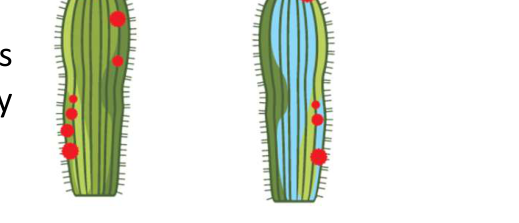
There are three flowers on the back of the left cactus. In total, the cactus on the right has six more flowers than the cactus on the left. How many flowers are on the back of the right cactus?
Show answer
Answer: D — 12
Show hints
Hint 1 of 2
Each cactus's total = the flowers you can see on its front + the flowers on its back; the left back is 3.
Still stuck? Show hint 2 →
Hint 2 of 2
Find the left cactus's total, add 6 for the right cactus, then subtract the right cactus's visible front.
Show solution
Approach: total each cactus, then subtract the visible front
The left cactus shows 5 flowers on its front plus 3 on its back, so its total is 8.
The right cactus has 6 more in total, that is 14, and it shows 2 flowers on its front, so its back has 14 − 2 = 12 flowers.
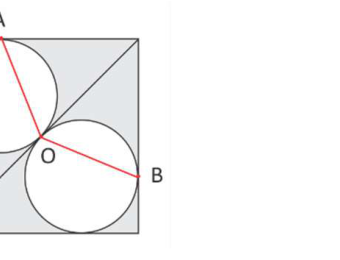
Two circles are tangent to each other and also to two sides of a square. What is the measure of the angle AÔB, determined by three of these points of tangency, as shown in the figure?
Show answer
Answer: E — 135°
Show hints
Hint 1 of 2
The two equal circles and their three tangent points sit symmetrically about a diagonal of the square.
Still stuck? Show hint 2 →
Hint 2 of 2
Drop the radii to the tangent points (each radius meets its tangent line at a right angle) and chase the angles.
Show solution
Approach: use radii-perpendicular-to-tangents plus the diagonal symmetry
The two circles are equal and lined up along the square’s diagonal, with O the point where they touch each other.
A radius meets each tangent line at 90°, so the angle from O to each outer tangency point is built from a right angle plus the 45° of the diagonal.
Adding the two symmetric halves gives the angle AÔB = 135°, choice E.
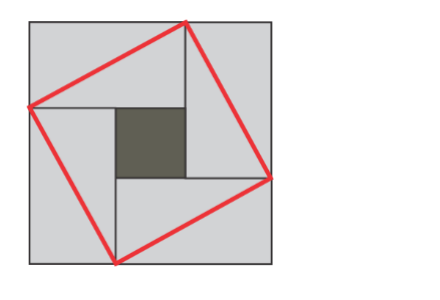
A square is formed by four identical rectangles and a central square, as in the figure. The area of the large square is 81 cm², and the square formed by the diagonals of these rectangles has area 64 cm². What is the area of the central square?
Show answer
Answer: D — 47 cm²
Show hints
Hint 1 of 2
Call the rectangle sides a and b; one big side is a + b = 9, and the diagonal is √(a²+b²) = 8.
Still stuck? Show hint 2 →
Hint 2 of 2
The central square has side a − b, so its area is a² + b² − 2ab.
Show solution
Approach: combine the sum and the diagonal
The outer square has side 9 (area 81), so a + b = 9 and (a+b)² = 81.
The diagonals' square has side 8, so a² + b² = 64.
From 81 = 64 + 2ab we get 2ab = 17, and the central square area is (a−b)² = a²+b² − 2ab = 64 − 17 = 47.
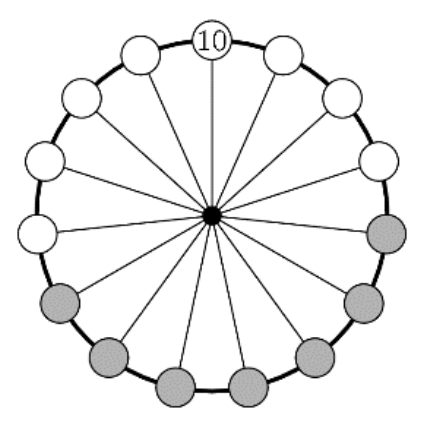
Matias wrote 15 numbers around the wheel shown. Only one of them is visible, the 10 at the top. The sum of the numbers in any seven consecutive positions (such as the gray positions in the figure) is always the same. When seven numbers in consecutive positions are added, which of the following results is possible?
Show answer
Answer: B — 70
Show hints
Hint 1 of 2
Equal 7-sums force entry n to equal entry n−7 around the 15-position wheel.
Still stuck? Show hint 2 →
Hint 2 of 2
Since gcd(7,15)=1, that links all the numbers.
Show solution
Approach: constant window sum forces all entries equal
If every 7 consecutive entries have the same sum, then sliding by one shows entry n = entry n−7 (indices mod 15).
Because gcd(7, 15) = 1, this makes all 15 numbers equal; the visible one is 10, so all are 10.
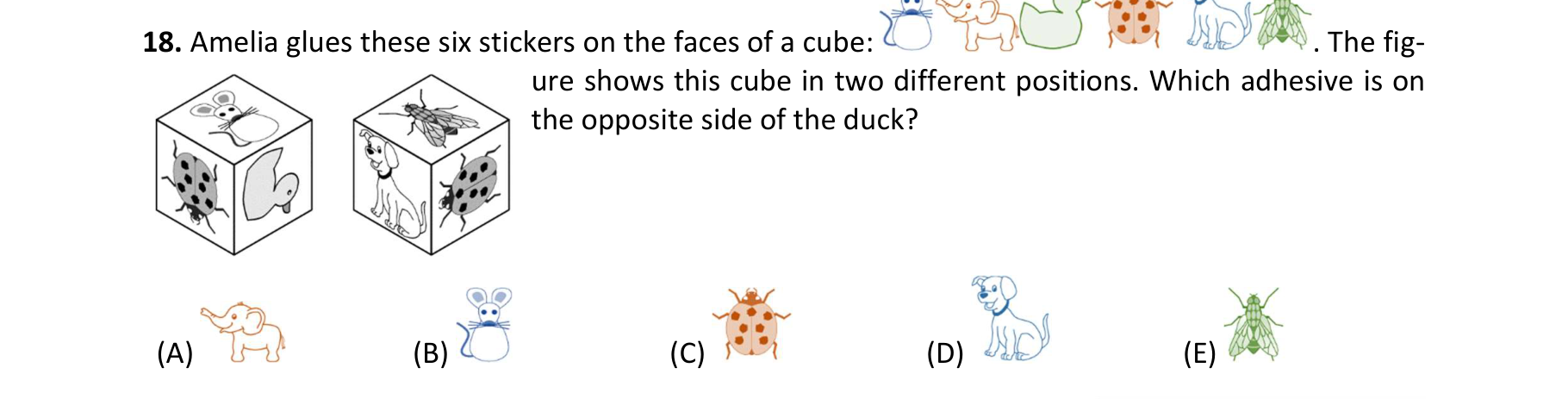
Amelia glues six stickers onto the faces of a cube. The figure shows this cube in two different positions. Which sticker is on the face opposite the duck?
Show answer
Answer: E
Show hints
Hint 1 of 2
Use the two shown views to find which stickers sit next to the duck.
Still stuck? Show hint 2 →
Hint 2 of 2
Whatever sticker never appears next to the duck in either view sits on the opposite face.
Show solution
Approach: find the duck's neighbours, the rest is opposite
Each cube view shows the duck together with some neighbouring faces.
Collect every sticker seen adjacent to the duck across the two pictures - those four are its side faces.
The remaining sticker, the fly, is opposite the duck.
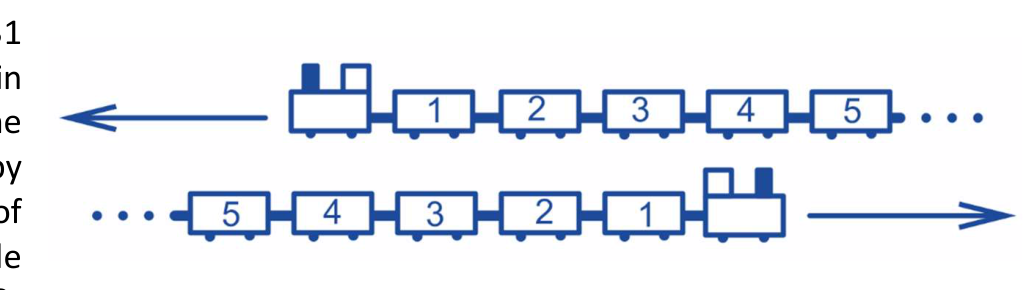
Two equal trains, each with 31 numbered wagons, travel in opposite directions. When wagon number 7 of one train is side by side with wagon number 12 of the other train, which wagon is side by side with wagon number 11?
Show answer
Answer: A — 8
Show hints
Hint 1 of 2
The two trains line up wagon-to-wagon; use the spot where 7 meets 12.
Still stuck? Show hint 2 →
Hint 2 of 2
The two facing wagon numbers always add up to the same total.
Show solution
Approach: pair wagons from the known matching point
Wagon 7 of one train lines up with wagon 12 of the other.
The wagon numbers run in opposite directions, so the two numbers across from each other always add to 19 (that is 7 plus 12).
Across from wagon 11 is the wagon numbered 19 minus 11 = 8.
Roberto and Maria leave at the same time from the same point of a long circular track, he on foot and she by bike. Maria completes a lap 24 minutes before Roberto and waits for him while having an ice cream. When he reaches this point, Maria leaves on her bike in the opposite direction and Roberto continues walking without stopping in the same direction. They then meet 5 minutes later. Assuming the speeds are kept constant, how long does it take for Roberto to do a lap of the track?
Show answer
Answer: A — 30 min
Show hints
Hint 1 of 2
Let Roberto’s lap take T minutes; Maria’s lap takes T−24.
Still stuck? Show hint 2 →
Hint 2 of 2
When they move in opposite directions and meet in 5 minutes, together they cover one full lap.
Show solution
Approach: set up a lap-time equation from the opposite-direction meeting
Roberto’s lap = T, Maria’s lap = T−24.
Meeting in 5 min going opposite ways: 5(1/T + 1/(T−24)) = 1.
This gives T² − 34T + 120 = 0, so T = 30 (rejecting T = 4).
A store announced a 30% discount for a sale. However, one day before the promotion the store raised the prices of all its products by 20%. What was the real discount the store gave on the day of the sale?
Show answer
Answer: D — 16%
Show hints
Hint 1 of 2
Start from a price of 100; apply the 20% increase first, then the 30% discount.
Still stuck? Show hint 2 →
Hint 2 of 2
Compare the final price with the original 100 to read off the real discount.
Show solution
Approach: chain the two percentage multipliers
Take the original price as 100. Raising by 20% gives 100 × 1.2 = 120.
Then the 30% sale discount gives 120 × 0.7 = 84.
The customer pays 84 instead of 100, a real discount of 16%.
Beatriz has five sisters whose ages are 2, 3, 5, 8, 10 and 17. Beatriz writes these ages in the circles of the diagram so that the sum of the ages in the four corners of the square equals the sum of the ages in the four circles in the horizontal row. What is this sum?
Show answer
Answer: D — 32
Show hints
Hint 1 of 2
The left and right circles belong to both groups, so when you set the two sums equal those two ages cancel out.
Still stuck? Show hint 2 →
Hint 2 of 2
That leaves top + bottom = centre + far-right; find the split of the six ages that makes this work, then add up the four corners.
Show solution
Approach: cancel the two shared circles, then place the rest
The corners (top, left, right, bottom) and the horizontal row (left, centre, right, far-right) share the left and right circles, so equal sums mean the unshared pairs match: top + bottom = centre + far-right.
Among 2, 3, 5, 8, 10, 17 the pairs 3 + 10 and 5 + 8 both make 13, so put 3 and 10 at top and bottom, and 5 and 8 at centre and far-right.
That leaves 2 and 17 for the shared left and right circles. Each sum is then (left + right) + (the matching 13) = (2 + 17) + 13 = 32.
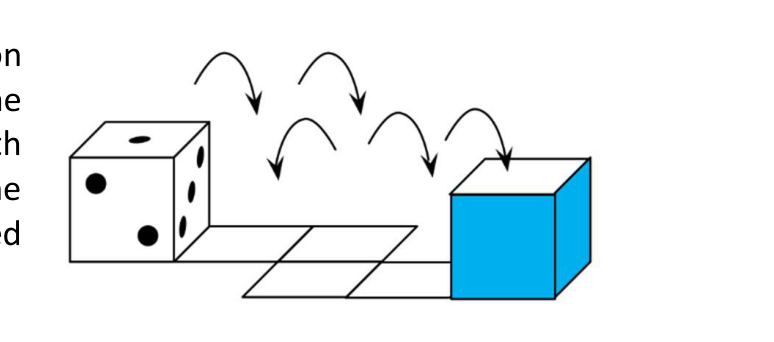
The points on opposite sides of an ordinary die add up to 7. This die is placed on the first square as shown and then rolled along, as in the picture, to the fifth square. When the die reaches the last square, what is the product of the numbers of points on its two coloured vertical faces?
Show answer
Answer: D — 18
Show hints
Hint 1 of 3
The two side faces are partners that always add to 7, so once you know one, you know the other.
Still stuck? Show hint 2 →
Hint 2 of 3
Roll a real die (or imagine one) tipping forward square by square and watch the side faces.
Still stuck? Show hint 3 →
Hint 3 of 3
Only the forward tips change the top and front faces; the two side numbers stay as a pair the whole way.
Show solution
Approach: roll the die step by step and read the two colored side faces at the end
Set a real die the same way as the picture and tip it forward, one square at a time, following the arrows to the last square.
Keep checking the two colored side faces, remembering that whatever shows on one side, its hidden partner is 7 minus that number.
On the last square the two colored side faces show 3 and 6, and 3 × 6 = 18, choice D.
Tania bought 14 chocolates, 8 of them round and the rest square. Half were white chocolates and half were dark chocolates. Among the square chocolates, only two are not white. How many dark round chocolates did Tania buy?
Show answer
Answer: D — 5
Show hints
Hint 1 of 2
Split the 14 into round/square and into white/dark and fill a little table.
Still stuck? Show hint 2 →
Hint 2 of 2
Use that only two square chocolates are dark to find the round ones.
Show solution
Approach: organise with a 2-by-2 table
There are 8 round and 6 square chocolates; 7 are white and 7 are dark.
Among the 6 square ones only 2 are dark, so 4 squares are white.
That leaves 7 minus 4 = 3 white round chocolates, so round dark = 8 minus 3 = 5.
Spatial & Visual ReasoningLogic & Word Problemscube-viewsspatial-reasoningcareful-counting
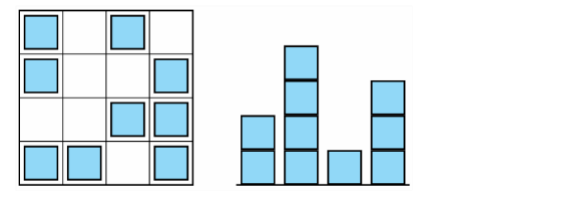
Irene made a "city" using identical wooden cubes. Beside the problem there is a view from above and a side view of this "city." We do not know which side of the "city" the side view shows. What is the smallest number of cubes Irene could have used to build it?
Show answer
Answer: E — 15
Show hints
Hint 1 of 2
The top view tells you which floor cells have at least one cube; the side view tells you the heights seen in a row.
Still stuck? Show hint 2 →
Hint 2 of 2
Add the smallest heights at each occupied cell that still match both views — the orientation is unknown.
Show solution
Approach: combine the two views for a minimum
The top view marks which ground cells are occupied; the side view limits the column heights.
Choosing the least cube count at each cell that is still consistent with both views (over the unknown orientation) gives a minimum.
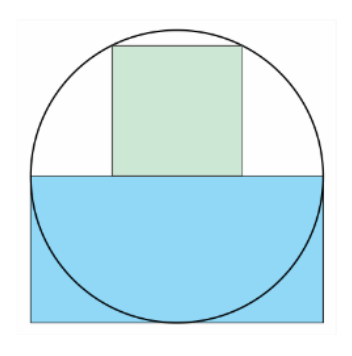
A circle is tangent to one side of a rectangle and passes through two of its vertices, as shown. A square of area 20 cm² has one side lying on a side of the rectangle and two vertices on the circle. What is the area of the rectangle?
Show answer
Answer: C — 50 cm²
Show hints
Hint 1 of 2
By symmetry put the circle's centre on the rectangle's top edge, on the vertical line of symmetry.
Still stuck? Show hint 2 →
Hint 2 of 2
The square's two upper corners sit a half-side left/right and a full side up from that centre — write that distance as the radius.
Show solution
Approach: put the circle's centre on the rectangle's top edge and use the square's corners to find the radius
By symmetry the circle's centre lies on the rectangle's top edge; since the circle is tangent to the bottom edge and passes through the top vertices, the radius equals the rectangle's height and also its half-width.
The square (side \(\sqrt{20}\)) stands on the top edge, so its upper corners are \(\tfrac{\sqrt{20}}{2}\) sideways and \(\sqrt{20}\) up from the centre: \(R^2 = \tfrac{20}{4} + 20 = 25\), so \(R = 5\).
Thus the rectangle is \(10 \times 5\), with area \(50\) cm², option C.
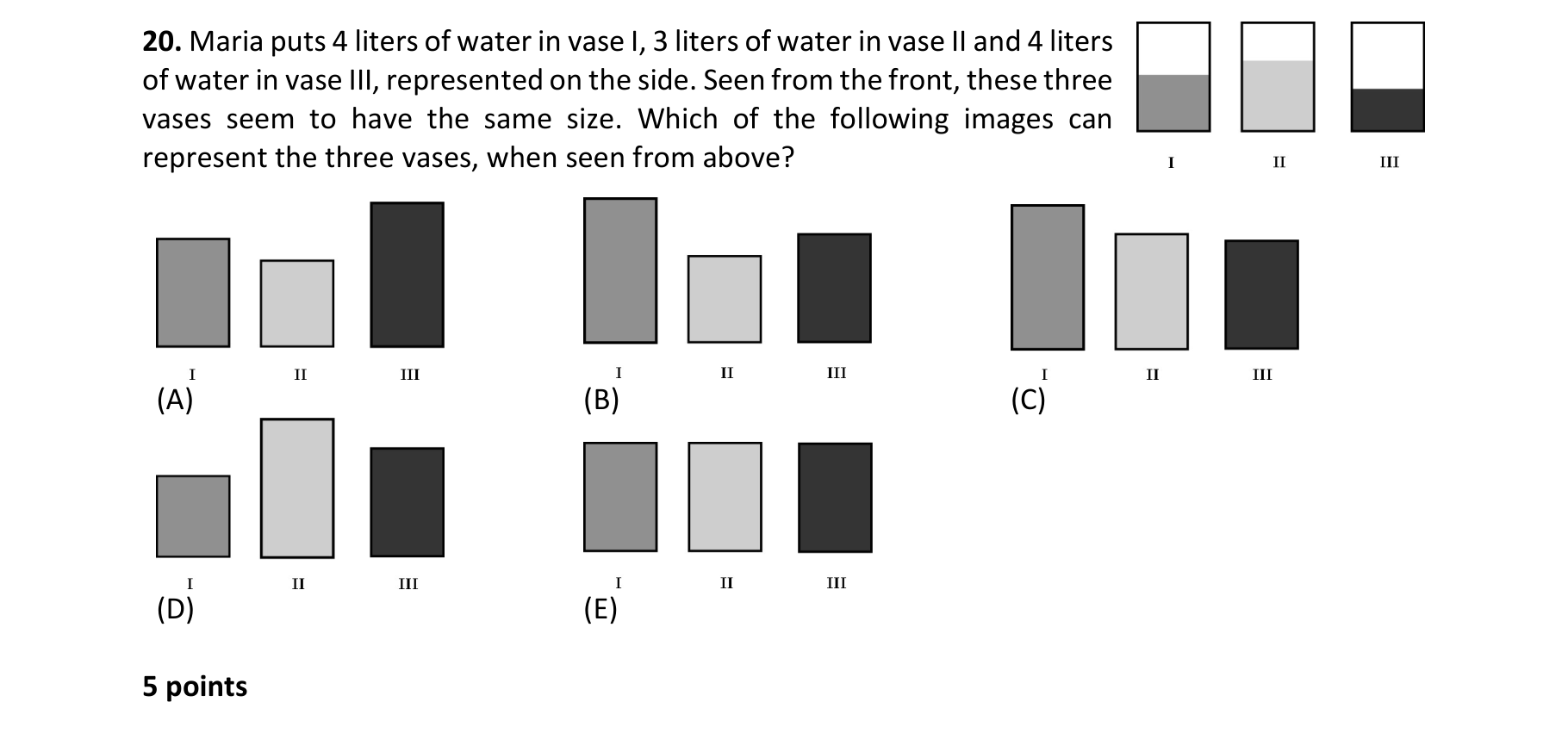
Maria pours 4 litres of water into vase I, 3 litres into vase II and 4 litres into vase III, as shown. Seen from the front, the three vases look the same size. Which of the following pictures can show the three vases seen from above?
Show answer
Answer: A
Show hints
Hint 1 of 2
Same water heights from the front but different amounts means the vases have different base areas.
Still stuck? Show hint 2 →
Hint 2 of 2
Vase II holds less (3 L vs 4 L) at the same height, so II has the smaller top - match the top-view sizes.
Show solution
Approach: use volume = base area x height to rank the tops
From the front the vases look the same size, so the shown heights reflect base area, not real width.
Vases I and III hold 4 L and II holds 3 L; with the heights shown, the top-view areas differ accordingly.
The top view giving I and III equal larger tops and II a smaller top is option A.
Five friends decided to spend their vacation together. In a conversation, Adam said, “Yesterday was Wednesday.” Beto said, “Tomorrow will be Friday.” Carlos said, “The day before yesterday was Tuesday.” David said, “The day after tomorrow is Saturday.” Finally, Eli said, “Today is Monday.” One of them was wrong. Who was wrong?
Show answer
Answer: E — Eli
Show hints
Hint 1 of 2
Translate each statement into 'today is ___' and see if they agree.
Still stuck? Show hint 2 →
Hint 2 of 2
Four friends point to the same day; the odd one out is wrong.
Show solution
Approach: convert each clue to today's weekday
Adam (yesterday Wed), Beto (tomorrow Fri), Carlos (day-before-yesterday Tue) and David (day-after-tomorrow Sat) all mean today is Thursday.
Eli says today is Monday, disagreeing with the other four, so Eli was wrong.
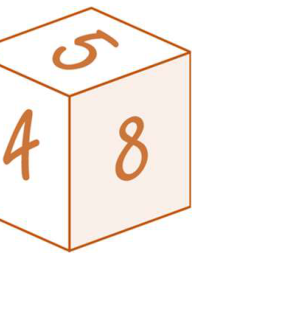
Six different numbers, chosen from the whole numbers 1 to 9, are written on the faces of a cube, one number per face. The sum of the two numbers on each pair of opposite faces is always the same. Which of these numbers could be written on the face opposite the number 8?
Show answer
Answer: A — 3
Show hints
Hint 1 of 2
Opposite faces share one common sum; three of the digits 1-9 are left off.
Still stuck? Show hint 2 →
Hint 2 of 2
Whatever sits opposite 8 must give that same pair-sum as the other two pairs.
Show solution
Approach: find a consistent equal pair-sum
The picture shows 4, 5 and 8 on three faces that touch, so none of them is opposite another; their partners are the three hidden faces.
All three pairs share one common sum. If that sum is 11, then 8 pairs with 3, 5 pairs with 6, and 4 pairs with 7 — the six numbers 3, 4, 5, 6, 7, 8 are all different and all between 1 and 9.
Any larger common sum forces a partner above 9, so the only choice that works is 8 opposite 3.
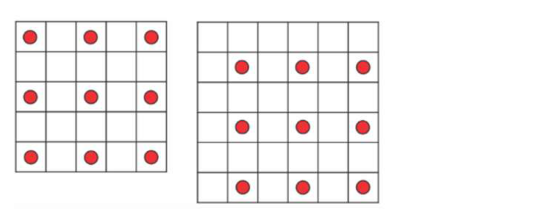
Ana plays with n × n boards by placing a token in each of the cells, with no common points with other cells containing tokens. In the picture we see how to place as many tokens as possible on 5 × 5 and 6 × 6 boards. In this way, how many tokens can Ana possibly put on a 2020 × 2020 board?
Show answer
Answer: D — 1010²
Show hints
Hint 1 of 2
'No common points' means tokens can’t even touch at a corner, so leave a gap between rows and columns.
Still stuck? Show hint 2 →
Hint 2 of 2
Place tokens on every other row and every other column; count how many fit.
Show solution
Approach: pack tokens on alternate rows and columns
Non-touching tokens go on alternate rows and alternate columns.
On an n×n board that fits ⌈n/2⌉ per direction.
For 2020, ⌈2020/2⌉ = 1010 each way, giving 1010² tokens.
Spatial & Visual ReasoningLogic & Word Problemspaper-cuttingfoldingcasework
Amelia has a paper strip with five equal cells, each containing a different drawing, as shown in the figure. She folds the strip so that the cells overlap in five layers. Which of the following sequences of layers, from top to bottom, is not possible to obtain?
Show answer
Answer: A — ★, □, ■, ○, ●
Show hints
Hint 1 of 2
Folding a strip reverses the order of the cells that flip over; track which symbol ends on top.
Still stuck? Show hint 2 →
Hint 2 of 2
Test each listed stack against an actual fold — one ordering can never arise.
Show solution
Approach: simulate the folds
Folding the five-cell strip so all cells overlap forces certain symbols to keep their relative order and others to reverse.
Checking each option against a real folding, four of them can be produced.
The ordering in A cannot be obtained by any folding, so it is the impossible one, choice A.
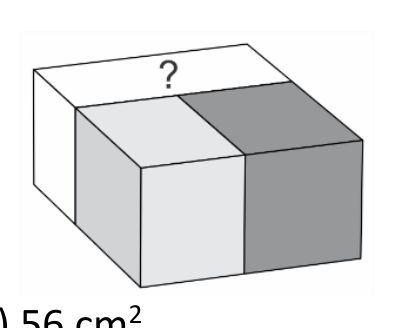
Two rectangular blocks and a cube are joined to form a larger rectangular block of volume 280 cm³. The cube, shown in dark gray, has volume 125 cm³, and the smaller rectangular block has volume 75 cm³. What is the area of the face marked with the question mark?
Show answer
Answer: A — 16 cm²
Show hints
Hint 1 of 2
The cube has side 5, so one dimension of everything is 5.
Still stuck? Show hint 2 →
Hint 2 of 2
Slice the big block into a 5-thick slab and split its face into the three pieces.
Show solution
Approach: decompose the 5x7x8 block
The total volume 280 = 5×7×8, and the cube (125) is 5×5×5.
Removing the cube's 5×5 corner from the 7×8 face leaves an L of area 31, split as 15 (the 75-block, 5×5×3) and 16 (the 80-block, 5×4×4).
Inside the gray square there are three white squares; the number in each shows its area. The white squares have sides parallel to the sides of the gray square. If the area of the gray square is 81, what is the area of the gray region not covered by the white squares?
Show answer
Answer: C — 52
Show hints
Hint 1 of 2
The gray square has area 81, so its side is 9; find the side of each white square from its area.
Still stuck? Show hint 2 →
Hint 2 of 2
The middle white square spans what is left across the side after the corner squares, so its side is 9 − 3 − 2.
Show solution
Approach: find each square's side, then subtract the white areas
The gray square has area 81, so its side is 9. The corner white squares have areas 9 and 4, so their sides are 3 and 2.
The middle white square stretches across the row between them, so its side is 9 − 3 − 2 = 4, giving area 16.
The teacher wrote the numbers 1 to 8 on the board. Then he covered the numbers with triangles, squares and one circle (see picture). The sum of the numbers covered by the triangles equals the sum of the numbers covered by the squares, and the number covered by the circle is a quarter of that sum. What is the sum of the numbers covered by the triangles and the circle?
Show answer
Answer: C — 20
Show hints
Hint 1 of 3
First add up all the hidden numbers: 1 + 2 + 3 + ... + 8.
Still stuck? Show hint 2 →
Hint 2 of 3
The triangle pile and the square pile weigh the same, and the circle is just a small extra equal to a quarter of one of those piles.
Still stuck? Show hint 3 →
Hint 3 of 3
Try to split the total into two equal big piles plus a small piece that is a quarter of one big pile.
Show solution
Approach: split the total 36 into two equal piles plus a quarter-size circle
The hidden numbers are 1 through 8, and 1 + 2 + 3 + 4 + 5 + 6 + 7 + 8 = 36.
The triangles and the squares make two equal piles, and the circle adds a quarter of one of those piles, so 36 splits as one pile + one equal pile + a quarter-pile.
That is the same as four-and-a-quarter quarter-piles making 36, so each quarter-pile is 4; one full pile (the triangles) is four of them, which is 16, and the circle is one quarter-pile, which is 4.
The triangles cover 16 and the circle covers 4, so together they cover 16 + 4 = 20, choice C.
In a classroom there are two chairs at each table. Each boy in the class sits at a table with a girl, but there are four girls who do not sit at a table with a boy. There are 14 little tables in the classroom. How many girls are in that class?
Show answer
Answer: E — 16
Show hints
Hint 1 of 2
Most tables seat one boy and one girl; a few seat two girls.
Still stuck? Show hint 2 →
Hint 2 of 2
Count the all-girl tables, then add the girls sharing with boys.
Show solution
Approach: split tables into boy-girl and girl-girl
Four girls sit without a boy, two to a table, so 2 tables are all-girl.
That leaves 14 minus 2 = 12 tables, each with one boy and one girl.
Total girls = 12 (one per mixed table) plus 4 = 16.
The window shown is a square of area 1 m² and is made up of four triangles whose areas, indicated in the figure, satisfy the ratios \(3A = 4B\) and \(2C = 3D\). A fly is placed exactly at the point where these four triangles touch each other. The fly flies straight to the nearest side of the window. How far does it fly?
Show answer
Answer: A — 40 cm
Show hints
Hint 1 of 2
Each triangle has a full side of the 1 m square as its base; its area fixes the height to that side.
Still stuck? Show hint 2 →
Hint 2 of 2
Opposite heights add to 1 m; use the ratios to find all four heights, then take the smallest.
Show solution
Approach: turn the area ratios into heights and pick the shortest
Each triangle’s area equals ½·(100 cm)·(height to its side), and opposite heights sum to 100 cm.
From 3A = 4B the left/right heights are 400/7 and 300/7 cm.
From 2C = 3D the top/bottom heights are 60 and 40 cm.
The closest side is the bottom, 40 cm away, so the fly flies 40 cm.
Geometry & MeasurementLogic & Word Problemsperimeterspatial-reasoning
In each of the four corners of a swimming pool, 10 m wide by 25 m long, there is a child. The swim instructor is sitting almost in the middle of one of the long edges of the pool. When he calls the children, they all choose the longest path along the edges to reach him. What was the sum of the distances covered by the four children?
Show answer
Answer: E — 210 m
Show hints
Hint 1 of 2
The pool's perimeter is 2×(10+25) = 70 m; the instructor sits near the middle of a long edge.
Still stuck? Show hint 2 →
Hint 2 of 2
Each child walks the longer way round, which is 70 minus the short way; add the four long routes.
Show solution
Approach: use the perimeter and take the long way each time
Perimeter = 2 × (10 + 25) = 70 m, with the instructor about 12.5 m from each end of a long edge.
The two near corners take the long route 70 − 12.5 = 57.5 m each; the two far corners take 70 − 22.5 = 47.5 m each.
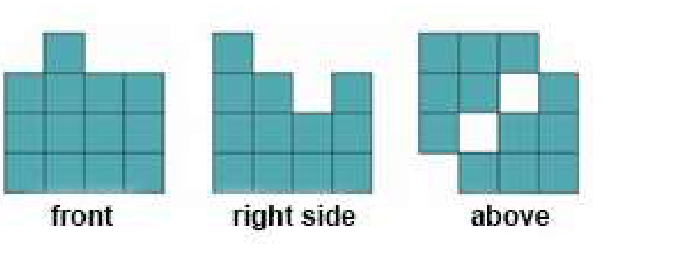
John built a structure of equal-sized wooden cubes whose front, right-side and top views are shown, using as many cubes as possible. His sister Ana wants to remove as many cubes as she can without changing any of these three views. At most, how many cubes can she remove?
Show answer
Answer: B — 12
Show hints
Hint 1 of 2
The three views (front, side, above) must all stay the same after removing cubes.
Still stuck? Show hint 2 →
Hint 2 of 2
Keep only the cubes forced by all three silhouettes; count how many of the fullest build can be taken away.
Show solution
Approach: compare the fullest build with the minimum that keeps all views
Build the most cubes giving those three views, then strip out any cube not needed by all three silhouettes.
Each removed cube must leave the front, side and top outlines unchanged.
The largest number she can remove while preserving every view is 12.
Joana has several sheets of paper, each with a drawing of a parrot. She wants to paint only the head, tail and wing of the parrot, using red, blue or green. The head and tail may be the same colour, but the wing must not be the same colour as the head or the tail. How many sheets can she paint so that no two parrots are painted the same way?
Show answer
Answer: D — 12
Show hints
Hint 1 of 2
Pick colours for head, tail and wing in turn, remembering the wing's restriction.
Still stuck? Show hint 2 →
Hint 2 of 2
Split into 'head and tail same colour' versus 'head and tail different'.
Show solution
Approach: count by cases on the head/tail colours
If head and tail share a colour (3 ways), the wing has 2 allowed colours: 3×2 = 6.
If head and tail differ (3×2 = 6 ways), the wing must avoid both, leaving 1 choice: 6.
Rita numbered the circles in the figure from 1 to 8, so that the sum of the three numbers on each of the four sides of the square equals 13. What is the sum of the four numbers written on the coloured circles?
Show answer
Answer: E — 16
Show hints
Hint 1 of 2
Adding the four side-sums counts each corner circle twice.
Still stuck? Show hint 2 →
Hint 2 of 2
Compare that double-count to the total 1+2+...+8.
Show solution
Approach: count corners twice via the side sums
The four sides each total 13, so all four sides together total 4 times 13 = 52.
This sum counts every number once, but the four corner circles twice.
Since 1+2+...+8 = 36, the extra from double-counting the corners is 52 minus 36 = 16.
The colored circles are the corners, so their sum is 16.
Julia puts the nine chips shown into a box. She then takes one chip at a time, without looking, and notes down its digit, obtaining at the end a number with nine different digits. What is the probability that the number written by Julia is divisible by 45?
Show answer
Answer: A — 19
Show hints
Hint 1 of 2
Divisible by 45 means divisible by both 9 and 5.
Still stuck? Show hint 2 →
Hint 2 of 2
The digits 1–9 always sum to 45, so 9 is automatic — only the last digit matters for 5.
Show solution
Approach: reduce to a single last-digit condition
1+2+…+9 = 45, so any arrangement is divisible by 9.
Divisibility by 5 needs the last digit to be 5 (there’s no 0).
Counting & ProbabilityLogic & Word Problemscaseworkcareful-counting
Twelve colored cubes are lined up side by side: three blue, two yellow, three red and four green, but not in that order. There is a red cube at one end and a yellow one at the other end. The red cubes are all together, and the green cubes are all together. The tenth cube from the left is blue. In how many ways can the cubes be lined up?
Show answer
Answer: D — 9
Show hints
Hint 1 of 2
The red block of 3 sits at the red end, the green block of 4 stays together, and position 10 is blue.
Still stuck? Show hint 2 →
Hint 2 of 2
Place the two big blocks and the end yellow first, then count where the loose blues and the other yellow can go.
Show solution
Approach: place the blocks, then count the rest
Red (3 together) occupies the red end and yellow occupies the far end; green stays as a block of 4.
With position 10 forced blue, the green block and the remaining blues and yellow have only a few valid placements.
Counting all consistent arrangements gives 9 ways.
A little kangaroo draws a line through the point P of the grid and then shades three triangles black, as shown. The areas of these triangles are proportional to which numbers?
Show answer
Answer: A — 1 : 4 : 9
Show hints
Hint 1 of 2
The three black triangles are similar to each other.
Still stuck? Show hint 2 →
Hint 2 of 2
Their linear sizes grow as 1, 2, 3 along the line.
Show solution
Approach: similar triangles with linear scale 1:2:3
Each black triangle is cut off by the same line in a grid cell, so they are all similar.
Their corresponding sides grow in the ratio 1 : 2 : 3 as you move along the line.
Areas scale as the square of the sides, giving 1 : 4 : 9.
A panel has 4 circles. When Lucy touches a circle, that circle and every circle touching it switch colour (white ↔ black), as shown. Starting with all circles white, at least how many circles must Lucy touch, one after another, to make all four black?
Show answer
Answer: C — 4
Show hints
Hint 1 of 2
Touching a circle flips it and its neighbours; each circle must end flipped an odd number of times.
Still stuck? Show hint 2 →
Hint 2 of 2
Find the smallest set of touches making every circle's flip-count odd.
Show solution
Approach: make every circle flip an odd number of times
Touching a circle toggles it and its neighbours; all four start white and must end black (odd flips each).
One or two touches cannot make all four flip an odd number of times.
The fewest touches achieving this is 4 (touching each circle once works).
Jonas and Elias went to the beach for their vacation, where they had ice cream every day. Each ice cream they had, had two or three balls. On the last day of vacation, Jonas and Elias had had 23 and 19 ice cream balls in total, respectively. At least how many days were they on vacation?
Show answer
Answer: C — 8
Show hints
Hint 1 of 3
To use up the fewest days, give the bigger eater (Jonas, 23 balls) the most balls each day.
Still stuck? Show hint 2 →
Hint 2 of 3
Even eating 3 balls every single day, count how many days it takes to reach 23.
Still stuck? Show hint 3 →
Hint 3 of 3
The same number of days has to work for both boys, so check that 19 also fits in that many days.
Show solution
Approach: give the most balls per day to use the fewest days, then check both totals fit
To finish in as few days as possible, eat the biggest ice cream (3 balls) every day.
Counting by 3 toward Jonas's 23: seven days give only 21 balls, which is not enough, so they need at least 8 days.
Eight days really works for both: Jonas eats 3 balls on 7 days and 2 balls on 1 day (21 + 2 = 23), and Elias eats 3 balls on 3 days and 2 balls on 5 days (9 + 10 = 19).
So they were on vacation at least 8 days, choice C.
In the figure, an arrow pointing from one person to another means that the first person is shorter than the second. For example, person B is shorter than person A. Which person is the tallest?
Show answer
Answer: C — Person C
Show hints
Hint 1 of 2
An arrow goes from the shorter person to the taller one.
Still stuck? Show hint 2 →
Hint 2 of 2
The tallest person has only arrows pointing toward them and none leaving.
Show solution
Approach: the tallest has no arrow leaving it
An arrow leaving a person means someone is taller, so the tallest person has no arrow pointing away from them.
Checking each person, only person C has every nearby arrow pointing in and none leaving.
A rectangular sheet with one side of 12 cm is folded along its 20 cm diagonal. What is the overlapping area of the folded parts, shown in gray in the picture?
Show answer
Answer: E — 75 cm²
Show hints
Hint 1 of 2
First find the rectangle’s other side from the 12 and the 20 diagonal.
Still stuck? Show hint 2 →
Hint 2 of 2
The overlap is an isosceles triangle; set its base on the crease and find its height.
Show solution
Approach: find the missing side, then the area of the symmetric overlap triangle
The other side is √(20² − 12²) = 16 cm (a 12-16-20 triangle).
Folding along the diagonal makes an isosceles overlap triangle.
Sofia has 52 isosceles right triangles, each of area 1 cm². She wants to make a square using some of these triangles. What is the area of the largest square she can make?
Show answer
Answer: D — 50 cm²
Show hints
Hint 1 of 2
Each triangle has area 1, so a square built from k of them has area k.
Still stuck? Show hint 2 →
Hint 2 of 2
Right isosceles triangles assemble into squares whose area is twice a perfect square (2, 8, 18, 32, 50, ...).
Show solution
Approach: find the largest valid square area within the supply
Each triangle has area 1, so a square of these has an integer area equal to the number used.
These isosceles right triangles tile squares of area 2×1², 2×2², 2×3², ... = 2, 8, 18, 32, 50.
The largest such area not exceeding 52 triangles is 50.
A rectangular garden was 50 m long and 40 m wide. An artificial lake was built next to it so that the whole arrangement forms a 60 m square. Then a fence was stretched in a straight line, splitting both the garden and the lake into two parts of equal area, as shown. How long is this fence?
Show answer
Answer: B — \(30\sqrt{5}\) m
Show hints
Hint 1 of 2
A line that halves both the garden and the lake must pass through both their centres.
Still stuck? Show hint 2 →
Hint 2 of 2
Find the two centres, then measure the segment across the 60×60 square.
Show solution
Approach: the bisecting line joins the two region centroids
A single straight cut that halves both regions must pass through the centroid of the garden (50×40) and the centroid of the L-shaped lake.
Placing the 60×60 square with corner at the origin, those centroids are at (25, 20) and (36.25, 42.5), so the line has slope 2.
Crossing the square, that line runs from (15, 0) to (45, 60), a length of \(\sqrt{30^2 + 60^2} = 30\sqrt{5}\) m, option B.
The Kangaroo Hotel has 30 floors, numbered 1 to 30, and each floor has 20 rooms, numbered 1 to 20. The code to enter a room is formed by writing the floor number followed by the room number, in that order. But a code can be confusing: for example, the code 111 could mean floor 11 room 1 or floor 1 room 11. Note that the code 101 is not confusing, since it can only mean floor 10 room 1 (floor 1 room 1 has the code 11, not 101). How many codes are confusing, including the one in the example?
Show answer
Answer: E — 18
Show hints
Hint 1 of 3
A code is confusing when the same digits can be cut into a floor and a room in two different correct ways.
Still stuck? Show hint 2 →
Hint 2 of 3
For three digits, you can cut after the first digit or after the second digit, so look for codes where both cuts give a real floor and a real room.
Still stuck? Show hint 3 →
Hint 3 of 3
Think about which three-digit codes start with a small floor but could also start with a teens floor.
Show solution
Approach: find three-digit codes that can be cut two ways, both giving a real floor and room
A three-digit code can be cut after the 1st digit (1-digit floor, 2-digit room) or after the 2nd digit (2-digit floor, 1-digit room); it is confusing when BOTH cuts give a real floor (1 to 30) and room (1 to 20).
For both cuts to work, the middle digit must be 1, so the codes look like floor-1-room, and they are exactly 11c and 21c where c is 1 to 9.
11c reads as floor 1 room 1c or floor 11 room c, and 21c reads as floor 2 room 1c or floor 21 room c, and c can be 1 to 9.
That is 9 codes of the form 11c and 9 codes of the form 21c, so 9 + 9 = 18 confusing codes, choice E.
Maia the bee can only walk on coloured houses. In how many ways can you colour exactly three white houses, all the same colour, so that Maia can walk from A to B?
Show answer
Answer: B — 16
Show hints
Hint 1 of 2
You need a connected colored path linking A and B using exactly three newly-colored white houses.
Still stuck? Show hint 2 →
Hint 2 of 2
Count the distinct sets of three white houses that connect A to B.
Show solution
Approach: count valid 3-house connecting paths
Maia needs a connected run of colored houses from A to B.
Colour exactly three white houses so that, together with A and B, they form a connected walk.
Carefully listing the choices of three white houses that complete a path gives 16 ways.
Carlos always tells the truth on alternate days. On the other days, he tells only lies. Today he made exactly four of the five statements that follow. Which one was not made today by him?
Show answer
Answer: C — My name is Carlos.
Show hints
Hint 1 of 2
On a truth day every statement he makes is true; on a lie day every one is false.
Still stuck? Show hint 2 →
Hint 2 of 2
Check whether all of A, B and D could be true together — if not, today must be a lie day.
Show solution
Approach: rule out a truth day, forcing a lie day
If today were a truth day, A (prime total) and B (equal counts) force exactly 1 male and 1 female friend, contradicting D (three older male friends).
So today is a lie day: every statement he makes is false.
'My name is Carlos' is true, so on a lie day he cannot make it.
Number Theorydivisibilityfactorizationperfect-square
Let N be the smallest positive number such that half of N is divisible by 2, one-third of N is divisible by 3, one-quarter of N is divisible by 4, one-fifth of N is divisible by 5, one-sixth of N is divisible by 6, one-eighth of N is divisible by 8, and one-ninth of N is divisible by 9. The square root of N is a number of how many digits?
Show answer
Answer: A — 3
Show hints
Hint 1 of 2
'Half of N divisible by 2' means N is a multiple of 4; turn each clue into a divisibility of N.
Still stuck? Show hint 2 →
Hint 2 of 2
Take the least common multiple of all those requirements, then count the digits of its square root.
Show solution
Approach: translate the clues, then take the LCM
The clues say N is a multiple of 4, 9, 16, 25, 36, 64 and 81.
A positive integer N is divisible by every integer from 2 to 11 except for two of them. Among the pairs \((6,7)\), \((7,8)\), \((8,9)\), \((9,10)\) and \((10,11)\), how many could be that pair of exceptions?
Show answer
Answer: B — 2
Show hints
Hint 1 of 2
If N misses two numbers, the LCM of the remaining nine must fail to divide each missing one.
Still stuck? Show hint 2 →
Hint 2 of 2
Test each candidate pair by building the LCM of the others.
Show solution
Approach: check each pair against the LCM of the kept numbers
For a pair to be the exception, N can be the LCM of the other nine numbers and must NOT be divisible by either removed number.
Testing each pair, only (7,8) and (8,9) work; the others leave an LCM still divisible by one of the removed numbers.
Counting & ProbabilityLogic & Word Problemscareful-countingcasework
Ten people each order an ice cream: four vanilla, three chocolate, two lemon and one mango. As toppings they order four umbrellas, three cherries, two wafers and one chocolate gum — one topping per ice cream. Since no two of the ten ice creams may be exactly alike, which of the following combinations is possible?
Show answer
Answer: E — Lemon and cherry.
Show hints
Hint 1 of 2
Each flavour gets a different topping, with limited supply (4 umbrellas, 3 cherries, 2 wafers, 1 gum).
Still stuck? Show hint 2 →
Hint 2 of 2
A pairing is impossible if it forces two identical ice creams or runs a topping short.
Show solution
Approach: test each pairing against the flavour and topping counts
Ten ice creams (4 vanilla, 3 chocolate, 2 lemon, 1 mango) each get a distinct topping (4 umbrellas, 3 cherries, 2 wafers, 1 gum), no two identical.
Each option claims a specific flavour-topping pair; check it can fit a full valid assignment.
Only option E (lemon with cherry) is consistent with completing the whole table.
Julia wrote four positive integers, one at each vertex of a triangular-based pyramid. She calculated the sum of the numbers written on the vertices of one face and the products of the numbers written on the vertices of the other two faces, obtaining 15, 20 and 30, respectively. What is the highest possible value of the product of the four numbers?
Show answer
Answer: E — 120
Show hints
Hint 1 of 2
Each face uses three of the four vertices; two faces share an edge (two vertices).
Still stuck? Show hint 2 →
Hint 2 of 2
Pick vertex values matching the two products that share a pair, then check the sum-15 face.
Show solution
Approach: match shared-edge factor triples and maximise the product
The faces with products 20 and 30 share two vertices; try the shared pair {1,5}.
Then the third vertices are 4 (for 20) and 6 (for 30), giving values 1, 5, 4, 6.
The remaining face 5+4+6 = 15 matches the required sum.
Jonas was driving his car and saw the following information on the car display: speed 90 km/h, distance travelled 116.0 km, and time 21h00min. Jonas kept driving at the same speed, and that same night he noticed that the four-digit sequence showing the distance travelled was the same four-digit sequence showing the time. At what time did this happen?
Show answer
Answer: D — 22h10min
Show hints
Hint 1 of 2
At 90 km/h he gains 90 km each hour (1.5 km per minute); update both the distance and the clock together.
Still stuck? Show hint 2 →
Hint 2 of 2
Find the moment when the four digits of the distance match the four digits of the time.
Show solution
Approach: advance distance and time together
At 90 km/h the distance climbs by 1.5 km per minute from 116.0 km at 21h00.
After 70 minutes (at 22h10) the distance is 116 + 90·(70/60) = 221.0 km.
The distance digits 2–2–1–0 match the time 22h10 exactly.
At the Sunday fair, in the morning Ana wanted to buy three kinds of fruit out of 12 options and one kind of vegetable out of the 6 available. In the afternoon some products had sold out, and Bela wanted to buy two kinds of fruit and two kinds of vegetable from those remaining. Since the number of possible choices for Bela was a quarter of the number of possible choices for Ana, how many products had sold out by the afternoon?
Show answer
Answer: C — 3
Show hints
Hint 1 of 2
Write Ana's count C(12,3)·C(6,1) and Bela's count with reduced stocks.
Still stuck? Show hint 2 →
Hint 2 of 2
Set Bela's count to a quarter of Ana's and solve.
Show solution
Approach: set the two combination counts in a 1:4 ratio
Ana has C(12,3)·C(6,1) = 1320 choices.
After f fruits and v vegetables sell out, Bela has C(12−f,2)·C(6−v,2), which must equal 1320/4 = 330.
The only solution is f = 1, v = 2, so the number sold out is 3.
Pedro assembled a cube using 64 little white equal cubes and then painted the cube red. Then he dismantled the cube and reassembled it so that all of its faces were white, and painted the cube red again. How many white faces of little cubes remained white?
Show answer
Answer: E — 192
Show hints
Hint 1 of 2
Count all the little-cube faces, then subtract the ones that get painted.
Still stuck? Show hint 2 →
Hint 2 of 2
After the first paint 96 faces are red; on reassembly another 96 (white ones turned outward) get painted.
Show solution
Approach: track which faces stay unpainted through both paintings
There are 64·6 = 384 little faces; the first painting reds 96 of them.
That leaves 288 white faces.
Reassembling white-out and repainting reds 96 more of those white faces.
Lady Josephine bought a pack of beans. The beans come mixed with impurities such as pebbles and sand, and the label says these impurities make up 8% of the contents of the package. Lady Josephine removes part of these impurities, reducing them to 4% of the contents of the package. What fraction of the total amount of impurities was removed from the package?
Show answer
Answer: B — 2548
Show hints
Hint 1 of 2
Start with a 100 g pack: 8 g impurities, 92 g good beans; removing impurities does not change the good beans.
Still stuck? Show hint 2 →
Hint 2 of 2
After removal the impurities are 4% of the new, smaller pack — solve for how much impurity was taken out.
Show solution
Approach: keep the good beans fixed
Take a 100 g pack: 8 g impurities and 92 g good beans. Removing x g of impurity leaves a pack of (100 − x) g.
Now (8 − x) is 4% of (100 − x): 8 − x = 0.04(100 − x), giving 4 = 0.96x, so x = 25/6 g.
The fraction of the original impurities removed is (25/6) ÷ 8 = 25/48.
Vilma took a sheet of paper measuring 10 cm × 20 cm and made two folds, bringing the two shorter sides onto a diagonal of the sheet. She obtains a parallelogram, as shown. What is the area of this quadrilateral, in cm²?
Show answer
Answer: D — \(50(5 - \sqrt{5})\)
Show hints
Hint 1 of 2
Each fold turns a short side onto the diagonal along an angle-bisector crease.
Still stuck? Show hint 2 →
Hint 2 of 2
Find where each crease meets a long edge, then subtract the two folded triangles.
Show solution
Approach: locate the bisector creases and subtract the folded triangles
Folding a short side onto the diagonal creases along the bisector of the corner angle.
That crease meets a long edge a distance \(5(\sqrt{5}-1)\) from the corner, so each folded triangle has area \(\tfrac12 \cdot 10 \cdot 5(\sqrt{5}-1) = 25(\sqrt{5}-1)\).
Parallelogram area \(= 200 - 2 \cdot 25(\sqrt{5}-1) = 250 - 50\sqrt{5} = 50(5-\sqrt{5})\) cm², option D.
Janaina bought three toys and spent all her money. For the first toy she paid half of her money plus 1 Real; for the second she paid half of what was left plus 2 Reais; for the third she paid half of what was left plus 3 Reais. How much money did she have to begin with?
Show answer
Answer: A — 34 Reais
Show hints
Hint 1 of 2
She ends with nothing, so undo the purchases from the last toy backward.
Still stuck? Show hint 2 →
Hint 2 of 2
Reverse each step: before a 'half plus k Reais' payment, the amount was (what was left + k) x 2.
Show solution
Approach: unwind the spending from the end
After the third toy she has 0. That toy cost half of what she had plus 3, so before it she had (0+3)x2 = 6.
Before the second toy (half plus 2): (6+2)x2 = 16.
Before the first toy (half plus 1): (16+1)x2 = 34 Reais.
Ana wants to write positive whole numbers, one in each of the squares shown, so that the sums of the four numbers in each row and the four numbers in each column are equal. She has already written some numbers, as shown. She wants to write the missing numbers so that the sum of these six numbers is as small as possible. What is this sum?
Show answer
Answer: B — 24
Show hints
Hint 1 of 2
All four row sums and all four column sums must equal one common value S.
Still stuck? Show hint 2 →
Hint 2 of 2
Each already-filled row or column caps how small its blanks can be, so push S down to the smallest value that still leaves every blank a positive whole number.
Show solution
Approach: minimise the common row/column sum, then add the forced blanks
Every row and every column must add to the same total S, so the given numbers in any line bound S from below.
Choosing the smallest S that keeps all six blanks positive whole numbers and fits every line, the blanks are forced.
Adding those six forced entries gives the minimum sum 24, choice B.
Zilda took a square sheet of paper with side 1 and made two folds, bringing two consecutive sides of the sheet onto a diagonal of it, as shown in the picture, obtaining a quadrilateral (the highlighted outline). What is the area of this quadrilateral?
Show answer
Answer: B — 2 − √2
Show hints
Hint 1 of 2
Set the square as a unit square and the diagonal from one corner; each fold brings a side onto that diagonal.
Still stuck? Show hint 2 →
Hint 2 of 2
Each crease bisects a 45° angle, hitting a side at distance tan 22.5° from a corner; find the kite's area.
Show solution
Approach: locate the creases and use the shoelace area
With a unit square and diagonal from one corner, each fold creases along the bisector of a 45° angle.
The two creases meet the far sides at distance tan 22.5° = √2 − 1 from the opposite corners.
The remaining quadrilateral is a kite whose area computes to 2 − √2.
The submerged part of an iceberg shaped like a cube makes up 96.4% of the iceberg's volume, and the part above the water has the same three edges meeting at a corner. What percentage of the total surface area of the iceberg is in contact with the air?
Show answer
Answer: A — 9%
Show hints
Hint 1 of 2
Only 3.6% of the cube pokes above water, as a small corner with three equal edges.
Still stuck? Show hint 2 →
Hint 2 of 2
A corner tetrahedron's volume is (edge)³/6 — find that edge.
Show solution
Approach: corner tetrahedron above water
The above-water part is a corner cut off by the waterline, a tetrahedron with three equal edges x along the cube's edges; its volume x³/6 = 0.036a³.
So x³ = 0.216a³, giving x = 0.6a.
Exposed area = three right triangles 3·(x²/2) = 0.54a²; over the cube's 6a² that is 9%.
Dirce built the sculpture shown by gluing together cubic boxes that are half a metre on each side. She then painted the whole sculpture except the base it rests on, using a special paint sold in cans. Each can covers 4 square metres. How many cans of paint did she have to buy?
Show answer
Answer: B — 4
Show hints
Hint 1 of 2
Each cube edge is 0.5 m, so a small face is 0.25 m^2; count painted faces of the stepped solid, skipping the base.
Still stuck? Show hint 2 →
Hint 2 of 2
Total painted area / 4 m^2 per can, then round up to whole cans.
Show solution
Approach: count exposed faces, convert to area, divide by can coverage
Each cube is 0.5 m on a side, so one face is 0.5x0.5 = 0.25 m^2.
Count every exposed face of the stepped solid except the bottom support; multiplying by 0.25 gives the painted area.
Dividing by 4 m^2 per can and rounding up, she needs 4 cans.
A large rectangular plot is divided into two lots that are separated from each other by an ABCD fence, as shown in the picture. The AB, BC and CD parts of this fence are parallel to the sides of the rectangle and have lengths of 30 m, 24 m and 10 m, respectively. The owners of these lands have agreed to knock down the fence and make a new straight AE fence, without changing the area of each of the lands. How far from point D should the end E of the fence be?
Show answer
Answer: C — 12 m
Show hints
Hint 1 of 2
The straight fence must keep each lot’s area, so the area swept on each side cancels.
Still stuck? Show hint 2 →
Hint 2 of 2
Compare the area to one side of the staircase fence with the area under the straight line.
Show solution
Approach: balance areas to locate E on the top edge
With A at the bottom, the staircase keeps a left area of 24·10 = 240 beyond the step.
A straight fence A–E to a point E on the top edge gives a left area of 20·(horizontal offset of E).
Equating, E sits 12 m horizontally from A, i.e. 12 m left of D.
Cleuza assembled the 2×2×2 block of equal balls shown beside, using one drop of glue at each contact point between two balls, for a total of 12 drops. She then glued on more balls until she completed a 4×3×2 block. How many extra drops of glue did she use?
Show answer
Answer: C — 34
Show hints
Hint 1 of 2
A glue drop sits at every place two balls touch face-to-face; count contacts in the finished 4×3×2 block.
Still stuck? Show hint 2 →
Hint 2 of 2
Subtract the 12 drops already used on the 2×2×2 block to get the extra drops.
Show solution
Approach: count touching pairs in the block
Touching pairs in an a×b×c stack number (a−1)bc + a(b−1)c + ab(c−1).
For 4×3×2 this is 3·6 + 4·2·2 + 4·3·1 = 18 + 16 + 12 = 46 drops.
She already used 12 on the 2×2×2 block, so the extra is 46 − 12 = 34.
Maria writes each positive divisor of 2020 on its own card and puts all the cards in a box. She then closes her eyes and draws the cards out one at a time. How many cards must she draw to be sure that among them are two numbers a and b with a not a divisor of b and b not a divisor of a?
Show answer
Answer: B — 6
Show hints
Hint 1 of 2
List the 12 divisors of 2020 and think of chains where each divides the next.
Still stuck? Show hint 2 →
Hint 2 of 2
A set with no 'incomparable' pair is just one such chain — how long can it be?
Show solution
Approach: longest divisibility chain plus one
2020 = 2²·5·101 has 12 divisors.
A set with no incomparable pair is a chain under divisibility; the longest chain (for example 1, 2, 4, 404, 2020) has 5 elements.
To be sure of an incomparable pair she must draw 5 + 1 = 6 cards.
Vania has a sheet of paper divided into nine equal squares. She folds it as shown — first the horizontal folds, then the vertical folds — until the coloured square is on top of the stack. She wants to write the numbers 1 to 9, one per square, so that after folding they read in order from top to bottom, starting with 1 on top. On the unfolded sheet shown, which numbers should she write in places a, b and c?
Show answer
Answer: C — a = 7, b = 5, c = 3
Show hints
Hint 1 of 2
Track where each unfolded square ends up in the stack after the horizontal then vertical folds.
Still stuck? Show hint 2 →
Hint 2 of 2
Reverse the folds to read which numbers land at positions a, b and c on the flat sheet.
Show solution
Approach: reverse the fold order to map stack layers to grid cells
Folding horizontally then vertically stacks the nine squares; the coloured square is on top (number 1), and lower layers get 2,3,...
Unfolding to the flat sheet, each layer returns to its cell, spreading the numbers in a fixed pattern.
Reading positions a, b, c gives a = 7, b = 5, c = 3 - option C.
Number TheoryAlgebra & Patternsfactorizationsubstitution
Sonia writes three consecutive whole numbers, one on each side of a triangle. Then, on each vertex of the triangle, she writes the sum of the numbers written on the two sides that meet at that vertex, and she multiplies these three vertex numbers, obtaining the product 504. What is the product of the three numbers written on the sides of the triangle?
Show answer
Answer: B — 60
Show hints
Hint 1 of 2
Call the three consecutive numbers n, n+1, n+2; each vertex product is a sum of two of them.
Still stuck? Show hint 2 →
Hint 2 of 2
The vertex sums are 2n+1, 2n+2, 2n+3; set their product to 504 and find n.
Show solution
Approach: set up the vertex products
With sides n, n+1, n+2, the three vertices hold (2n+1), (2n+2), (2n+3), and their product is 504.
Testing, 7 × 8 × 9 = 504, so 2n+1 = 7, giving n = 3 and sides 3, 4, 5.
The product of the side numbers is 3 × 4 × 5 = 60.
There are n different prime numbers \(p_1, p_2, \ldots, p_n\) written from left to right on the bottom row of the table shown. The product of two neighbouring numbers in a row is written in the box above them. The number \(K = p_1^{\alpha_1} \cdot p_2^{\alpha_2} \cdots p_n^{\alpha_n}\) is written in the single box at the top. In such a table, where \(\alpha_2 = 9\), how many of the numbers are divisible by \(p_4\)?
Show answer
Answer: D — 28
Show hints
Hint 1 of 2
The exponent of each prime at the top follows Pascal's triangle; the second exponent being 9 fixes how many primes there are.
Still stuck? Show hint 2 →
Hint 2 of 2
A cell is divisible by the fourth prime exactly when its block of bottom primes includes position 4.
Show solution
Approach: Pascal's triangle for n, then count blocks containing position 4
The exponent of the second prime at the apex is C(n−1, 1) = n−1 = 9, so there are n = 10 primes.
Each cell is the product of a contiguous block of bottom primes, and it is divisible by the fourth prime iff its block contains position 4.
The map shows some islands connected by bridges. A navigator wants to visit each island exactly once. He started at Cang Island and wants to finish at Uru Island, and he has just reached the black island in the centre. In which direction must he go now to be able to complete his route?
Show answer
Answer: C — South.
Show hints
Hint 1 of 2
He has to visit every island exactly once, so the move he makes now must not strand any island he still needs to reach.
Still stuck? Show hint 2 →
Hint 2 of 2
If he picks a direction that walks him into a dead-end corner before the rest are visited, he can never get back; only one direction keeps a path open all the way to Uru.
Show solution
Approach: choose the only move that leaves a single-visit path to Uru
He must pass through each island once and finish at Uru, so from the centre he cannot step toward any group of islands he would later be unable to leave.
Going North, East or West leads him into a part of the map he would have to enter or leave twice, leaving some island unvisited.
Heading South is the one move that still lets him reach every remaining island exactly once and end at Uru.
On the 8 × 8 board shown, in how many ways can you place two chips, one green and one red, on differently coloured cells, so that the chips are not in the same row or in the same column of the board?
Show answer
Answer: E — 1536
Show hints
Hint 1 of 2
Green and red must sit on opposite colours; count the two colour-orders separately.
Still stuck? Show hint 2 →
Hint 2 of 2
For a fixed green cell, count the opposite-colour cells that avoid its row and column.
Show solution
Approach: count valid opposite-colour pairs by removing the shared row/column cells
Put green on a white cell (32 ways); a black cell shares its row or column in 4+4 = 8 cases.
So 32 − 8 = 24 black cells work, giving 32·24 = 768 ordered pairs.
By symmetry green-black/red-white gives another 768.
Adam and Bruna try to find out which is Carla's favourite figure, among the figures shown. Carla told Bruna the shape of the figure, and told Adam the colour of the figure. Then this conversation takes place. Adam: “I don't know what Carla's favourite figure is, and I know that Bruna doesn't know either.” Bruna: “At first I didn't know what Carla's favourite figure was, but now I know.” Adam: “Now I know too.” What is Carla's favourite figure?
Show answer
Answer: E
Show hints
Hint 1 of 2
Adam knows the colour, Bruna the shape; each statement eliminates possibilities.
Still stuck? Show hint 2 →
Hint 2 of 2
Adam knowing Bruna cannot know rules out any colour containing a one-of-a-kind shape.
Show solution
Approach: step through the knowledge statements
Adam (knows colour) is sure Bruna cannot know yet, so the colour has no unique-shape figure — this rules out white (the lone hexagon), leaving green and pink.
Bruna (knows shape) now can tell: among green/pink only square, star and triangle are unique, so the figure is green square, green star, or pink triangle.
Adam now knows from the colour, which is unique only for pink, so it is the pink triangle (E).